Epithelial Tissue
"Mohmmadrjab" S. Seder
Faculty of Medicine
Histology
4
Table of Contents
 Introduction
 Function of Epithelium
 Epithelium Classification
 Basement Membrane
 Intercellular Adhesion & other Junctions
 Specialization of the Apical cell surface (Microvilli, Stereocilia, Cilia)
 Types of Epithelia
 Transport across Epithelia
 Renewal of Epithelial cells
Epithelial tissue, also known as the epithelium,
is one of the four tissues found in the human
body. It exists in various parts of the body, such
as our digestive system, outer surfaces of organs
and blood vessels throughout the body, as well as
the inner surfaces of cavities in many internal
organs.
Introduction
Tissues are: Collections of specialized cells and cell products organized to perform a limited number of
functions.
Human body consist four types of tissue:
 Epithelial tissue.
 Connective tissue.
 Muscle tissue.
 Nervous tissue (neuronal
tissue)
Main characteristics of the four basic types of tissues
Organ Components:
 Most organs can be divided into:
The parenchyma, which is composed of the cells responsible
for the organ’s specialized functions.
The stroma, the cells of which have a supporting role in the
organ. Except in the brain and spinal cord, the stroma is always
connective tissue.
Most Organs Parenchyma Stroma
------------------------------------------------------------------
 Epithelial tissues are derived from all of the embryological
germ layers: from ectoderm (e.g., the epidermis); from
endoderm (e.g., the lining of the gastrointestinal tract); from
mesoderm (e.g., the inner linings of body cavities)
germinal
layers
 Epithelial tissues are composed of closely aggregated
polyhedral cells adhering strongly to one another and to a thin
layer of ECM, forming cellular sheets that line the cavities of
organs and cover the body surface.
 Epithelia line all external and internal surfaces of the body and
all substances that enter or leave an organ must cross this type of
tissue.
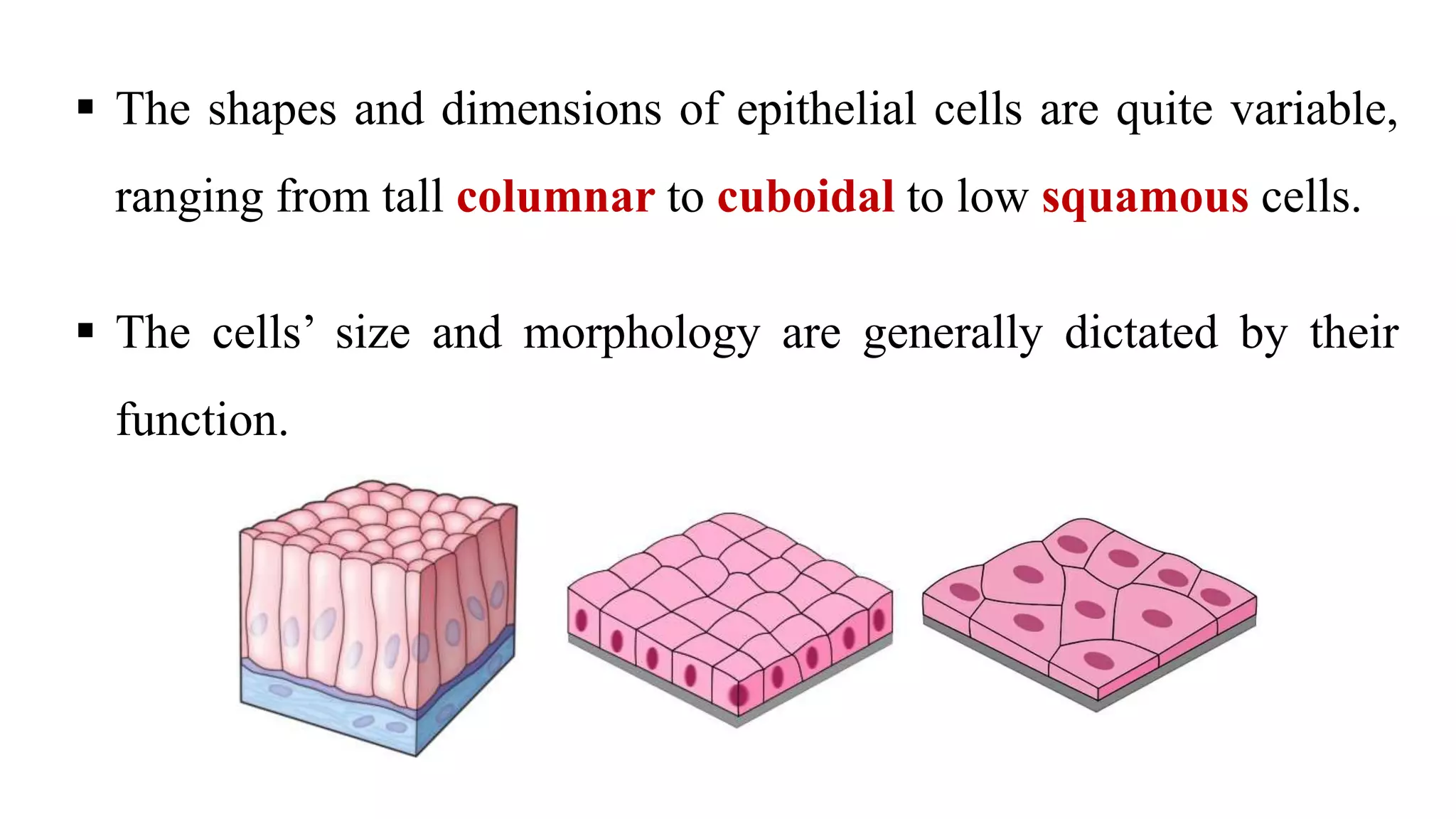
 The shapes and dimensions of epithelial cells are quite variable,
ranging from tall columnar to cuboidal to low squamous cells.
 The cells’ size and morphology are generally dictated by their
function.
 Epithelial cell nuclei vary in shape and may be elliptic (oval),
spherical, or flattened, with nuclear shape corresponding roughly
to cell shape.
 Columnar cells generally have elongated nuclei, squamous cells
have flattened nuclei, and cuboidal or pyramidal cells have more
spherical nuclei.
 The number and shape of epithelial cells' stained nuclei are
important indicators of cell shape and density. The nuclei also
allow one to determine the number of cell layers in an epithelium,
a primary morphologic criterion for classifying epithelia.
 Most epithelia are adjacent to connective tissue containing blood
vessels from which the epithelial cells receive nutrients and O2.
 Even thick epithelia do not themselves normally contain blood
vessels.
 The connective tissue that underlies
the epithelia lining the organs of the
digestive, respiratory, and urinary
systems is called the lamina
propria.
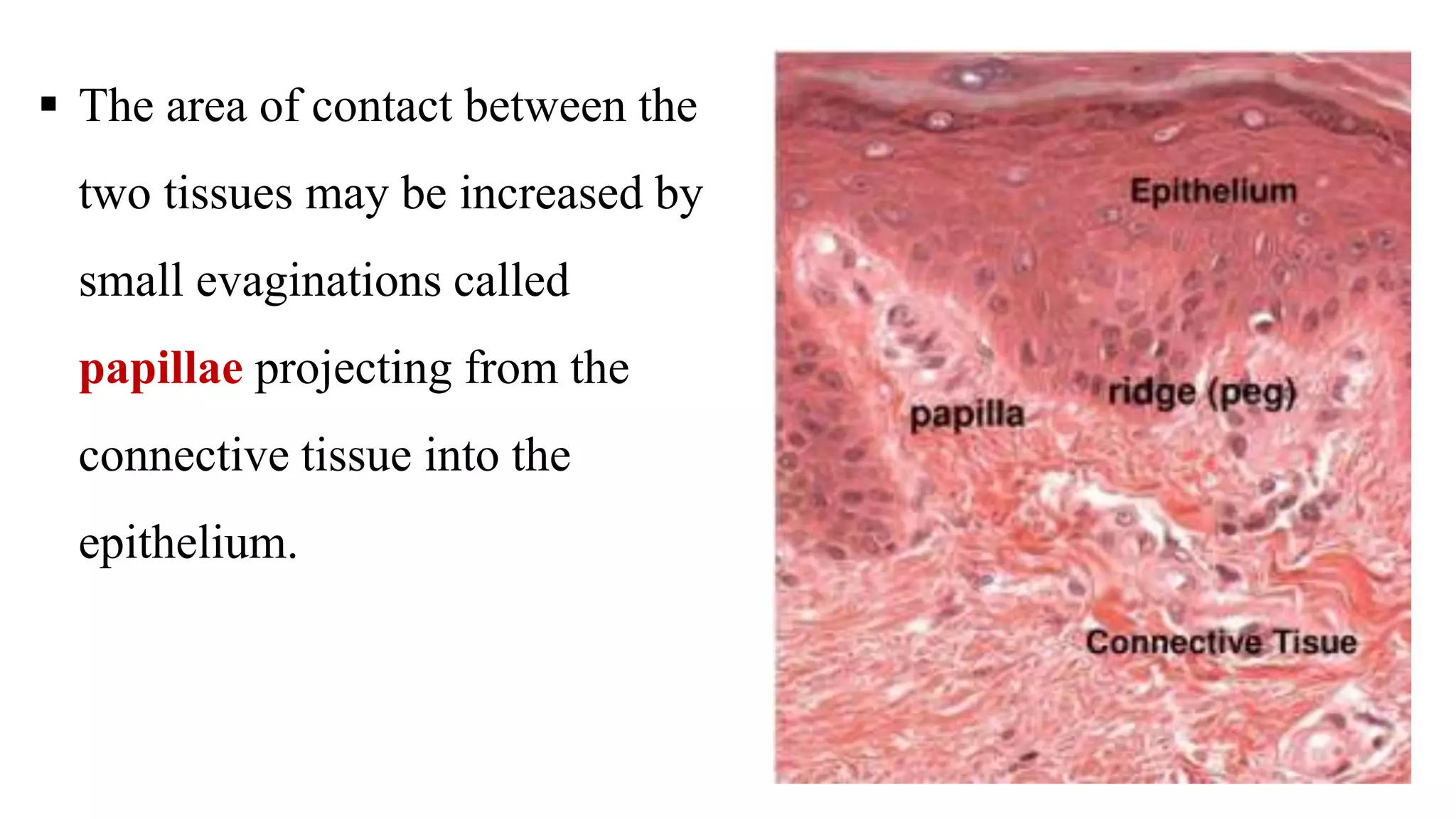
 The area of contact between the
two tissues may be increased by
small evaginations called
papillae projecting from the
connective tissue into the
epithelium.
 The region of the cell contacting the ECM and connective tissue
is called the basal pole and the opposite end, usually facing a
space, is the apical pole, with the two poles differing
significantly in both structure and function.
 Regions of cuboidal or columnar cells that adjoin neighboring
cells comprise the cells’ lateral surfaces; cell membranes here
often have numerous folds which increase the area and
functional capacity of that surface.
Function
 Protection: protect the cells underneath the layer of epithelium (skin...).
 Secretion: secrete specialized molecules into the body cavity (enzymes,
etc).
 Absorbton: absorb and exchange nutrients and waste products.
 Sensation: some specialized epithelial cells are responsable for sense
such as in the internal ear, nose, mouth, and skin...
 Filtration
 Excretion: Excretion of waste products through sweat and urine
Epithelium Classification
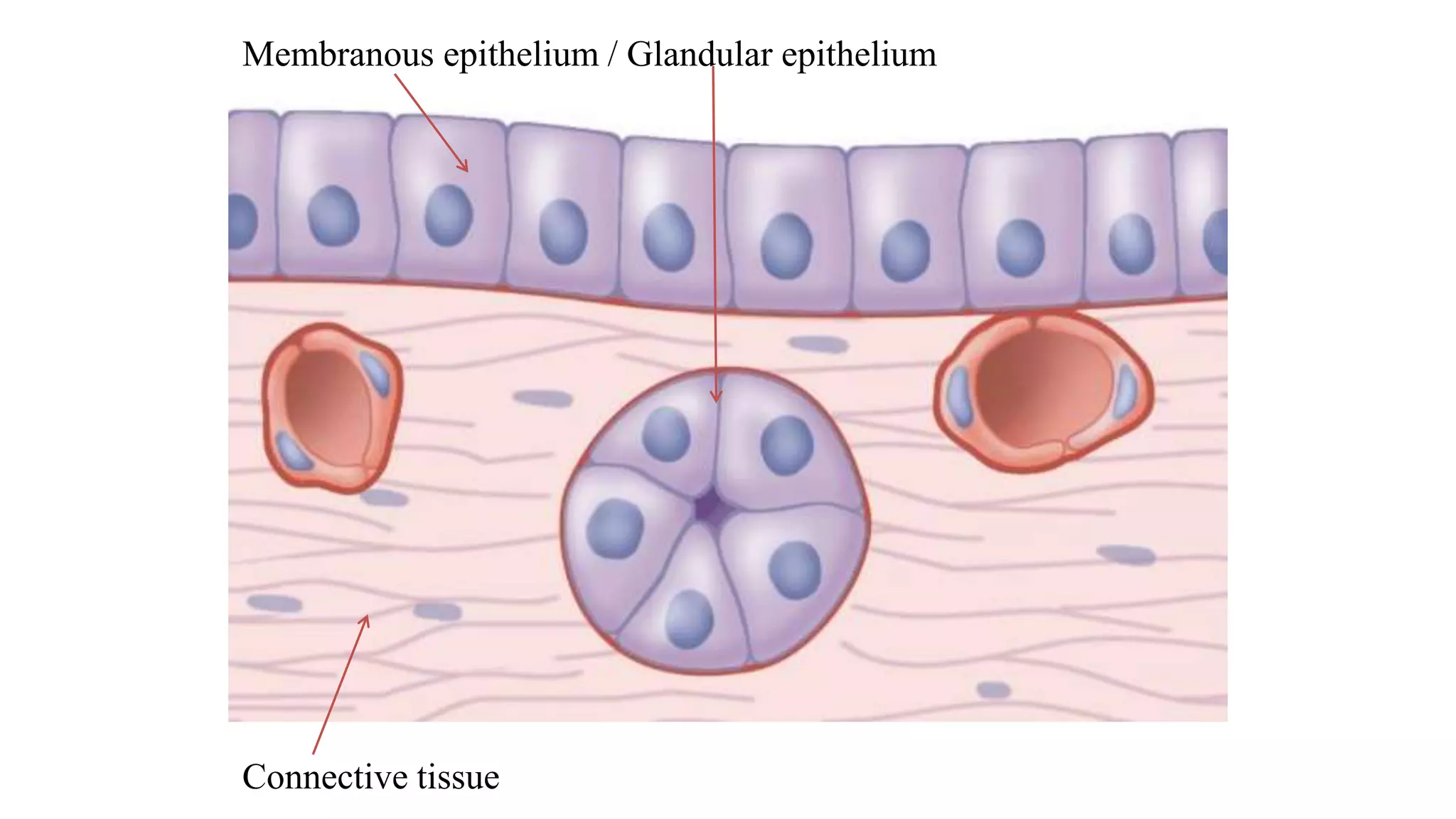
 Membranous (or lining): Membranous epithelium (lining)
covers and lines the external surface of our body as well as
lining all internal cavities, organs, tubes and passageways.
 Glandular: Glandular epithelium however is specialized
epithelial tissue that produces and secretes substances such as
sweat, stomach acid, mucus and hormones
Membranous epithelium / Glandular epithelium
Connective tissue
Simple Squamous Epithelium Glandular Epithelium
Basement Membrane
The basal surface of all epithelia rests on a thin extracellular, felt-
like sheet of macromolecules referred to as the basement
membrane
Basement membrane components:
Basement membranes have five major components:
• Type IV collagen
• Laminin
• Heparan sulfate
• Nidogen
• Perlecan
With the exception of fibronectin, these are synthesized by the
parenchymal cells. In addition, there are numerous minor and
poorly characterized protein and Glycosaminoglycan (GAG)
components.
 Glycoproteins and other
components in this structure
can often be stained and
visualized with the light
microscope.
This section of kidney shows the well-stained
basement membranes (arrows) of epithelia forming
structures within the large, round renal glomerulus
and its surrounding tubules.
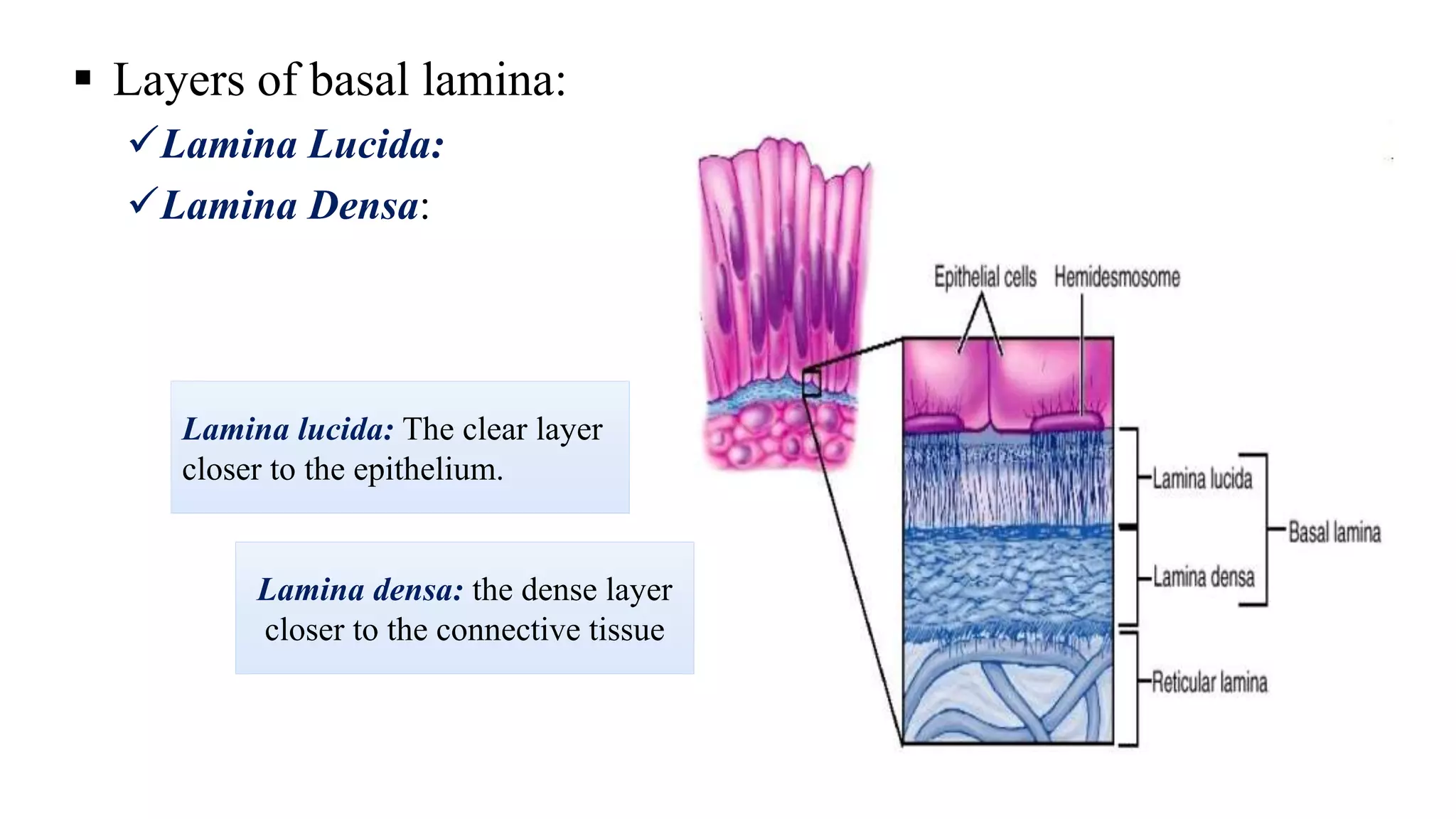
 With the transmission electron microscope (TEM) two parts of the
basement membrane may be resolved:
• Nearest the epithelial cells is the basal lamina, a thin, electron-
dense, sheet-like layer of fine fibrils.
• And beneath this layer is a more diffuse and fibrous reticular
lamina.
Basement membrane is composed of two layers:
1- Basal lamina
2- Reticular lamina
• The ultrastructural components of the basement
membrane are revealed by TEM.
• The dense basal lamina (BL), 20-100 nm thick,
may appear with thin clear zones on each side
and is anchored to a thicker
• More diffuse reticular lamina (RL) containing
collagen III fibers.
• Hemidesmosomes (H) bind the basal surface of
the epithelial cell (C) to the basal lamina.
 Layers of basal lamina:
Lamina Lucida:
Lamina Densa:
Lamina lucida: The clear layer
closer to the epithelium.
Lamina densa: the dense layer
closer to the connective tissue
 Functions of basal lamina:
1- Support
2- Selective barrier
3- Influencing cell polarity
4- Regulation of proliferation and differentiation
5- Affect cell-cell interaction
6- Pathway for cell migration
 The term“basement membrane” and “basal lamina” are
sometimes used interchangeably, but “basal lamina” usually
denotes the fine extracellular layer seen ultrastructurally and
“basement membrane” the entire structure beneath the epithelial
cells visible with the light microscope.
Intercellular Adhesion & Other Junctions
 Several membrane-associated structures provide adhesion and
communication between cells. Some are present in other
tissues but all are particularly numerous and prominent in
epithelia.
 Epithelial cells adhere strongly to neighboring cells and basal
laminae, particularly in epithelia subject to friction or other
mechanical forces.
 Lateral surfaces of epithelial cells have complexes of several
specialized intercellular junctions with different functions:
 Tight or occluding junctions form a seal between adjacent cells
 Adherent or anchoring junctions are sites of strong cell adhesion.
 Gap junctions are channels for communication between adjacent
cells.
 Tight junctions, also called zonulae occludens, are the most
apical of the junctions.
 The term “zonula” indicates that the junction forms a band
completely encircling each cell.
 The seal between the two cell membranes is due to tight
interactions between the transmembrane proteins: claudin and
occludin.
Tight Junctions
Tight Junction proteins: Occludin & Claudin
• Occludins and claudins are transmembrane proteins that
interact across the intercellular space to form TJs
• ZO (zonula occludens) proteins 1-3 link occludin and claudin
to each other, to JAMs, and to actin filaments
MEDICALAPPLICATION
Proteins of tight junctions provide the targets for certain common
bacteria of medical importance. The enterotoxin secreted by Clostridium
perfringens, which causes “food poisoning,” binds claudin molecules of
intestinal cells, prevents insertion of these proteins during maintenance of tight
junctions, and causes loss of tissue fluid into the intestinal lumen via the
paracellular pathway.
Similarly, Helicobacter pylori, which is important in the etiology of gastric
ulcers, binds the extracellular domains of tight-junction proteins in cells of the
stomach and inserts a protein into these cells, which targets ZO-1 and disrupts
signaling from the junction.
 Adherens junctions, also called zonulae adherns, which
encircles the epithelial cell, usually immediately below the
tight junction.
 Two anchoring junction:
 Cadherins
 Desmosome or Macula adherens
Adherent Junctions
Cadherins
 Cadherins are a class of type-1 transmembrane proteins. They are
dependent on calcium (Ca2+) ions to function.
 At their cytoplasmic ends, cadherins bind catenins that link to actin
filaments with actin-binding proteins. The actin filaments linked to the
adherens junctions form part of the “terminalweb,” a cytoskeletal
feature at the apical pole in many epithelial cells. Together, the tight
and adherent junctions encircling the apical ends of epithelial cells
function like the plastic bands that hold a six-pack of canned drinks
together.
Catenins join cadherins to actin filaments in adherence junctions
This junction keeps epithelial cells from slipping/sliding out of
position.
Desmosomes
 Also called “Macula adherens”
 Desmosomes: a structure by which two adjacent cells are attached,
formed from protein plaques in the cell membranes linked by filaments
 This junction resembles single “spot-weld” and does not form a belt
around the cell
Spot-weld
 Desmosomes are disc-shaped structures at the surface of one
cell that are matched with identical structures at an adjacent cell
surface
 The cytoplasmic ends of these clustered transmembrane
proteins bind plakoglobins, catenin-like proteins which link to
larger proteins called desmoplakins in an electron-dense plaque
Desmosomes
• Anchoring junctions
• Provides firm adhesion between cells
• Function as "spot welds" to join cells
• Located along lateral plasma membranes
of columnar epithelial cells or on
processes of squamous cells
• Intermediate filaments associate with
plaque proteins in cytoplasm
Desmosomes
• Desmoglein and desmocollin are non-classical cadherins
• Adaptor proteins such as γ-catenin (plakoglobin) and desmoplakin link cadherins to
intermediate filaments
MV: microvilli
TJ: tight junction
AJ: adherent junction
IF: intermediate
filaments
D: desmosomes
›››MEDICALAPPLICATION
Various blistering (bullous) diseases, such as pemphigus
vulgaris, involving the epidermis or stratified squamous epithelia
of the oral mucosa, are due to abnormal desmosome function
caused by autoimmune reactions against specific desmogleins that
reduce cell-to-cell adhesion. Similar disorders arise with genetic
mutations for various junctional proteins.
Gap junctions
 Gap junction: Mediate intercellular communication rather than
adhesion or occlusion between cells
 Gap junctions are functionally important in nearly all mammalian
tissues because they directly connect the cytoplasm of two cells,
which allows various molecules, ions and electrical impulses to
directly pass through a regulated gate between cells.
 Cryofracture preparations show that gap junctions consist of
aggregated transmembrane protein complexes that form circular
patches in the plasma membrane
Gap Junction
 The transmembrane gap junction proteins, connexins, form
hexameric complexes called connexons, each of which has a
central hydrophilic pore about 1.5 nm in diameter.
 When two cells attach, connexins in the adjacent cell
membranes move laterally and align to produce connexons
between the two cells,
 With each junction having dozens or hundreds of aligned
connexon pairs.
 Gap junctions permit intercellular exchange of molecules with
small (<1.5 nm) diameters.
The gap junction is seen as an area of close
plasma membrane apposition
(b) A cryofracture preparation of a
gap junction, showing the patch of
aggregated transmembrane
proteincomplexes, the connexons.
(X150,000)
(c) A section perpendicular to a gap
junction between two cells shows that
their cell membranes are very closely
apposed, separated only by a 2-nm-
wide electron dense space.
Hemidesmosomes
 On the basal epithelial surface, cells attach to the basal lamina by
anchoring junctions called hemidesmosomes (HDs), which can
be seen by TEM
 These adhesive structures resemble a half-desmosome
ultrastructurally, but unlike desmosomes the clustered
transmembrane proteins that indirectly link to cytokeratin
intermediate filaments are integrins rather than cadherins
 The integrins of hemidesmosomes bind primarily to laminin
molecules in the basal lamina
 HDs are highly specialized integrin-mediated epithelial attachment
structures that make cells firmly adhere to the extracellular matrix by
establishing a link between the underlying basement membrane (lamina
lucida) and the internal mechanical stress-resilient keratin intermediate
filament networ
*Integrins - membrane protein that "integrates" cell into matrix
Hemidesmosomes
 Major proteins that form HD junctions:
It has been found that there are at least five proteins that makeup
hemidesmosomes but the most common ones are:
• BP180
• BP230
• integrin α6β4
• plectin
Both plectin and BP230 are cytoplasmic plaque proteins whereas
integrin α6β4 and BP180 are transmembrane proteins.
 Functions of HDs:
• They serve mainly as sites of attachment for the actin-based contractile
system of the cytoplasm.
• In addition to playing an important structural function in tissue
integrity, Many hemidesmosomal constituents are phosphoproteins and
in certain cases the function of specific phosphorylation sites in
regulating protein-protein interactions is being uncovered.
• In addition, a more active role in transmitting signals that control
morphogenesis during development and possibly even regulate cell
growth and differentiation are being defined for cytoplasmic and
membrane components.
›››MEDICALAPPLICATION
1-
Inherited mutations of hemidesmosome proteins or acquired autoantibodies against
hemidesmosome molecules result in blistering diseases such as epidermolysis bullosa and
bullos pemphigoid, respectively. To date, several molecules including keratin 5 and 14,
plectin, collagen XVII, laminin 332 and integrin α6ß4 have been identified as being
mutated in epidermolysis bullosa. In addition to epithelial integrity, hemidesmosomes also
play a critical role in cell migration, cell-stromal coherence, polarization, spatial
organization, tissue architecture, wound healing and tissue morphogenesis.
›››MEDICALAPPLICATION
2-
Keeping the basal epidermal keratinocytes attached to the basal lamina is vital for
skin homeostasis. Genetic or acquired diseases that cause disruption of hemidesmosome
components can lead to skin blistering disorders between different layers of the skin.
These are collectively coined epidermolysis bullosa, or EB. Typical symptoms include
fragile skin, blister development, and erosion from minor physical stress. However, the
disease also can manifest as erosions on the cornea, trachea, gastrointestinal tract,
esophagus, muscular dystrophy and muscular deformity.
Junctions types & their functions
Epithelial cell junctions, their major structural features and functions, and medical significance.
Apical Surface/ Cell Junctions
Focal adhesion
 Another basal anchoring junction found in cells that are moving
during epithelial repair or reorganization is the focal adhesion,
or focal contact.
 Focal adhesion is a type of adhesive contact between the cell
and extracellular matrix through the interaction of the
transmembrane proteins integrins with their extracellular
ligands, and intracellular multiprotein assemblies connected to
the actin cytoskeleton.
 Focal adhesion consists of integrins linked indirectly to bundled
actin filaments, not intermediate filaments.
 Integrins of focal adhesions are linked via paxillin to focal
adhesion kinase, a signaling protein which upon integrin binding
to laminin or other specific ECM proteins initiates a cascade of
intracellular protein phosphorylation affecting cell adhesion,
mobility, and gene expression.
 Focal adhesions are also important in migrating nonepithelial
cells such as fibroblasts.
Focal adhesion
Composition of a focal adhesion:
Functions of focal adhesion:
 Anchoring the cell with the extracellular matrix (ECM)
 More than anchoring the cell, they function as signal carriers
(sensors), which inform the cell about the condition of the
ECM and thus affect their behavior
Specialization of the Apical cell surface
 The apical ends of many columnar and cuboidal epithelial cells
have specialized structures projecting from the cells:
Microvilli
Stereocilia
Cilia
These function either to increase the apical surface area for better
absorption or to move substances along the epithelial surface
Microvilli
 In epithelia specialized for absorption the apical cell surfaces are
often filled with an array of projecting microvilli, usually of
uniform length.
 In cells such as those lining the small intestine, densely packed
microvilli are visible as a brush or striated border projecting
into the lumen
 The average microvillus is about 1 μm long and 0.1 μm wide,
 Each microvillus contains bundled
actin filaments capped and bound to
the surrounding plasma membrane by
actin-binding proteins.
 Microvilli are relatively stable, the microfilament
arrays are dynamic and undergo various myosin-based
movements, which help maintain optimal conditions
for absorption via numerous channels, receptors, and
other proteins in the plasmalemma.
 The actin filaments insert into the terminal web of cortical
microfilaments at the base of the microvilli
 Functions of microvilli:
 The microvilli effectively increase the surface area of the cell and are
useful for absorption and secretion functions.
 The microvillar membrane is packed with enzymes that aid in the
breakdown of complex nutrients into simpler compounds that are more
easily absorbed.
 They play a role in egg cells as they help in anchoring the sperm to the
egg, thus allowing for easier fertilization.
 The microvilli on the cell surface may sweep unwanted materials toward
a resorptive area of the cell.
 absorption, secretion, cellular adhesion, and mechanotransduction...
Stereocilia
 Stereocilia are a much less common type of apical process, best
seen on the absorptive epithelial cells lining the male
reproductive system.
 Stereocilia increase the cells’ surface area, facilitating absorption.
 Stereocilia resemble microvilli in containing arrays of
microfilaments and actin-binding proteins, with similar
diameters, and with similar connections to the cell’s terminal
web.
 Stereocilia are typically much longer and less motile than
microvilli, and may show branching distally
Cilia
 Cilia are long, highly motile apical structures, larger than
microvilli, and containing internal arrays of microtubules not
microfilament.
 Motile cilia are abundant on cuboidal or columnar cells of
many epithelia.
 Typical cilia are 5-10 μm long and 0.2 μm in diameter, which is
much longer and two times wider than a typical microvillus.
By light microscopy cilia (C) on the columnar cells appear as a wave of long projections,
interrupted by nonciliated, mucussecreting goblet cells (G)
SEM of the apical surfaces of this epithelium shows the density of the cilia (C) and the
scattered goblet cells (G)
 Each cilium has a core structure consisting of nine peripheral
microtubule doublets (in which a few tubulin protofilaments are
shared) arrayed around two central microtubules. This 9 + 2
assembly of microtubules is called an axoneme.
 As with other microtubules, kinesin and cytoplasmic dynein
motors move along the peripheral microtubules for the transport
of molecular components into and out of these structures.
Axoneme
Structure of the axoneme of a cilium
TEM of cilia (C) sectioned longitudinally reveals central and peripheral microtubules
(arrowheads) of the axonemes, with cross sections (inset) clearly showing the 9 + 2 array of
the microtubule doublets. At the base of each cilium is a basal body (B) anchoring the
axoneme to the apical cytoplasm. Much shorter microvilli (MV) can be seen between the cilia
 Microtubules of axonemes are continuous with those in basal
bodies, which are apical cytoplasmic structures just below the
cell membrane.
 Basal bodies have a structure similar to that of centrioles, with
triplets of microtubules and dynamic tubulin protofilaments
forming rootlets anchoring the entire structure to the
cytoskeleton.
 In addition to cilia on epithelial cells, most (if not all) other cell
types have at least one short projection called a primary cilium,
which is NOT motile but is enriched with receptors and signal
transduction complexes for detection of light, odors, motion, and
flow of liquid past the cells.
 Primary cilia are microscopic sensory antennae that cells in many
vertebrate tissues use to gather information about their
environment. In the kidney, primary cilia sense urine flow and
are essential for the maintenance of epithelial architecture.
›››MEDICALAPPLICATION
Several mutations have been described in the proteins of the cilia
and flagella. They are responsible for the immotile cilia syndrome
renegatraK(
,)emordnys
esohw
smotpmys
era
cinorhc
yrotaripser
snoitcefni
desuac
yb
eht
kcal
fo
eht
gnisnaelc
noitca
fo
ailic
ni
eht
yrotaripser
tcart
dna
elitommi
,aozotamreps
gnisuac
elam
ytilitrefni .
Types of Epithelia
Epithelia can be divided into two main groups: covering (or
lining) epithelia and secretory (glandular) epithelia. This is an
arbitrary functional division for there are lining epithelia in
which all the cells also secrete (eg, the lining of the stomach) or
in which glandular cells are distributed among the lining cells
(e.g, mucous cells in the small intestine or trachea)
Covering or Lining Epithelia
Lining epithelia are classified according to:
1- The number of cell layers
Simple epithelia: contain one cell layer
Stratified epithelia: contain two or more layers
2- Shape of the cell
Squamous (thin cells),
Cuboidal (cell width and thickness roughly similar)
Columnar (cells taller than they are wide)
Simple Epithelium
one layer Stratidied Epithelium
more than one layer
Squamous
Cuboidal
Columnar
Common types of covering epithelia
Simple squamous epithelium
Simple cuboidal epithelium
Simple columnar epithelium
Stratified squamous epithelium
 The very thin surface cells of stratified squamous epithelia can be
“keratinized” (packed with keratin filaments) or “nonkeratinized” (with
relatively sparse keratin).
 Stratified squamous keratinized epithelium is found mainly in the
epidermis of skin, where it helps prevent dehydration from the tissue.
 Its cells form many layers, with the less differentiated cuboidal cells near the
basement membrane.
 These cells have many desmosomes and become more irregular in shape and
then flatten as they accumulate keratin in the process of keratinization and
are moved progressively toward the skin surface, where they become thin,
metabolically inactive packets (squames) of keratin lacking nuclei.
Stratified squamous non-keratinized epithelium
Stratified squamous keratinized epithelium
Keratin
Oesophagus - Vagina Skin
Stratified cuboidal epithelium
Stratified columnar epithelium
 Also known as urothelium.
 Transitional epithelium is characterized by a superficial layer of
large, dome-like cells sometimes called umbrella cells. Stratified
cells appear cuboidal when not stretched and squamous when
stretched.
Transitional epithelium
 Transitional epithelium lines much of the urinary tract, extending
from the kidneys to the proximal part of the urethra.
 Transitional epithelium cells are specialized to protect underlying
tissues from the hypertonic and potentially cytotoxic effects of
urine.
 Transitional epithelium deals with changing volume of fluid in an
organ, protects from urine contact.
 Importantly, unique morphological features of the cells allow
distension of transitional epithelium as the urinary bladder fills.
Urothelium is stratified and lines much of the urinary tract. The superficial cells are rounded or dome-
shaped, and have specialized membrane features enabling them to withstand the hypertonic effects of urine
and protect underlying cells from this toxic solution.
Cells of this epithelium are also able to adjust their relationships with one another and undergo a transition in
their appearance as the urinary bladder fills and the wall is distended.
Transitional epithelium
 Tall, irregular cells all are attached to the basement membrane
but their nuclei are at different levels and not all cells extend to
the free surface, giving a stratified appearance but it actually
simple epithelium.
 A good example of pseudostratified columnar epithelium is that
lining the upper respiratory tract, where the cells are also heavily
ciliated.
Pseudostratified columnar epithelium
Cells of pseudostratified epithelia appear to be in several layers, but their basal ends all rest on the basement
membrane. The pseudostratified columnar epithelium of the upper respiratory tract shown here contains many
ciliated cells, as well as other cells with their nuclei at different levels.
Pseudostratified columnar epithelium Simple columnar epithelium
 Epithelial cells that function mainly to produce and secrete
various macromolecules may occur in epithelia with other major
functions or comprise specialized organs called glands.
 Secretory cells may synthesize, store, and release proteins (e.g,
in the pancreas), lipids (e.g, adrenal, sebaceous glands), or
complexes of carbohydrates and proteins (eg, salivary glands).
 Epithelia of mammary glands secrete all three substances.
Secretory Epithelia & Glands
 Scattered secretory cells, sometimes called unicellular glands, are
common in simple cuboidal, simple columnar, and
pseudostratified epithelia. An important, easily seen example is
the goblet cell abundant in the lining of the small intestine and
respiratory tract, which secretes lubricating mucus that aids the
function of these organs
Goblet cell:
 Definition-Modified epithelial cells that secrete mucus on the
surface of mucous membranes of intestines and airways.
 Location-Respiratory epithelium / Intestinal epithelium.
 Function-Protection and lubrication of epithelial surfaces of the
respiratory and digestive tracts by producing mucus
The simple columnar epithelium lining the small intestine shows many isolated goblet cells secreting mucus into the lumen. (a) With a
stain for the oligosaccharide components of mucin glycoproteins, the cytoplasmic secretory granules of two goblet cells and secreted
mucus are stained purple.
(b) As shown ultrastructurally, goblet cells always have basal nuclei surrounded by RER (R), a large Golgi complex (G), and abundant
apical cytoplasm filled with large secretory granules (SG). After exocytosis mucin components are hydrated and become mucus. A
brush border of microvilli (M) is seen on neighboring columnar cells.
Basement membrane
›››MEDICALAPPLICATION
In chronic bronchitis ,
nommoc
gnoma
lautibah
,srekoms
eht
rebmun
fo
telbog
sllec
ni
eht
gninil
fo
syawria
ni
eht
sgnul
netfo
sesaercni
yltaerg
.
sihT
sdael
ot
evissecxe
sucum
noitcudorp
ni
saera
erehw
ereht
era
oot
wef
detailic
sllec
rof
sti
dipar
lavomer
dna
setubirtnoc
ot
noitcurtsbo
fo
eht
syawria
.
ehT
detailic
deifitartsoduesp
muilehtipe
gninil
eht
ihcnorb
fo
srekoms
nac
osla
eb
demrofsnart
otni
deifitarts
suomauqs
muilehtipe
yb
aisalpatem
Exocrine &Endocrine glands
 Glands develop from covering epithelia in the fetus by cell
proliferation and growth into the underlying connective tissue,
followed by further differentiation:
Exocrine glands
Endocrine glands
Formation of glands from covering epithelia
Exocrine glands
Exocrine glands remain connected
with the surface epithelium, the
connection forming the tubular
ducts lined with epithelium that
deliver the secreted material where
it is used.
General structure of exocrine glands:
Exocrine glands by definition have ducts that lead to another organ or the body surface. Inside the gland the duct runs
through the connective tissue of septa and branches repeatedly, until its smallest branches end in the secretory portions
of the gland.
 The structures of Exocrine glands' secretory portions and ducts
allow exocrine glands to be classified as shown schematically in
the table in the next slide. Although the three-dimensional
morphology is often not prominent in histologic sections, the
key points are summarized as follows:
 Glands can be simple (ducts not branched) or compound (ducts with two or more
branches).
 Secretory portions can be tubular (either short or long and coiled) or acinar
(rounded and saclike); either type of secretory unit may be branched, even if the
duct is not branched.
 Compound glands can have branching ducts and can have multiple tubular, acinar,
or tubuloacinar secretory portions
Endocrine glands
Endocrine glands lose the connection to their original epithelium and
therefore lack ducts. Thin-walled blood vessels (capillaries) adjacent
to endocrine cells absorb their secreted hormone products for transport
in blood to target cells throughout the body.
Ep: Epithelium
bv:
Mechanisms of Glandular Secretion
Endocrine glands secrete substances directly into bloodstream and
exocrine glands secrete substances into ducts. Exocrine glands are
classified into merocrine, apocrine, and holocrine based on their
mechanisms of secretion.
Releasing exocrine glands products mechanisms:
Three basic types of secretion are used by cells of exocrine glands,
depending on what substance is being secreted:
Merocrine secretion
Holocrine secretion
Apocrine secretion
(a) Merocrine secretion releases products, usually containing proteins, by
means of exocytosis at the apical end of the secretory cells. Most exocrine
glands are merocrine.
(b) Holocrine secretion is produced by the disintegration of the secretory
cells themselves as they complete their terminal differentiation, which
involves becoming filled with product. Sebaceous glands of hair follicles are
the best examples of holocrine glands.
(c) Apocrine secretion involves loss of membrane-enclosed apical cytoplasm,
usually containing one or more lipid droplets. Apocrine secretion, along with
merocrine secretion, is seen in mammary glands
Mechanisms of exocrine gland secretion
Merocrine secretion
Holocrine secretion in a sebaceous gland
In holocrine secretion, best seen in the sebaceous
gland adjacent to hair follicles, entire cells fill with a
lipid-rich product as they differentiate. Mature
(terminally differentiated) cells separate and
completely disintegrate, releasing the lipid that serves
to protect and lubricate adjacent skin and hair.
Sebaceous glands lack myoepithelial cells; cell
proliferation inside a dense, inelastic connective tissue
capsule continuously forces product into the duct.
Apocrine secretion in the mammary gland
The secretory portions of a mammary gland
demonstrate apocrine secretion, characterized by
extrusion of the secretion product along with a bit of
apical cytoplasm enclosed within a small amount of
plasma membrane, which is quickly lost after
separation from the secretory cell (arrows). The
released portion of cell contains lipid droplet(s), the
major product of apocrine secretion. Merocrine
secretion also occurs from the same and other cells of
the mammary gland.
 In addition to secretory cells, epithelia of many exocrine glands
(eg, sweat, lachrymal, salivary, and mammary glands) contain
contractile myoepithelial cells at the basal ends of the secretory
cells. Long processes of these cells embrace an acinus as an
octopus might embrace a rounded boulder. Bound to the basal
lamina by hemidesmosomes and connected to the other epithelial
cells by both gap junctions and desmosomes, myoepithelial cells
are rich in actin filaments and myosins. Strong contractions in these
cells serve to help propel secretory products from acini into the
duct system.
(a) The TEM shows two salivary gland cells
containing secretory granules, with an associated
myoepithelial cell (M). (b) A myoepithelial cell
immunostained brown with antibodies against
actin shows its association with cells of an acinus
stained by H&E. Contraction of the myoepithelial
cell compresses the acinus and aids in the
expulsion of secretory products into the duct.
 Endocrine glands lack myoepithelial cells and are specialized either
for protein or steroid hormone synthesis, with cytoplasmic staining
characteristic of RER or SER, respectively. The proteins are
released by exocytosis and the lipophilic steroids by diffusion
through the cell membrane for uptake by binding proteins outside
the cell.
 Many cells have the ability to actively transport certain ions
against concentration and electrical potential gradients.
 An important example is the extrusion of Na+ from cells by the
transmembrane protein Na+/K+-ATPase, also called the Na+/K+
pump, which allows cells to maintain the required low
intracellular sodium concentration (5-15 mmol/L vs ~140
mmol/L in extracellular fluid).
Transport across epithelia
 Some epithelial cells specialize in the transfer of ions (by ion
pumps) and water (via the membrane channels called aquaporins)
in either direction across the epithelium, the process is known as
transcellular transport.
 Apical tight junctions prevent paracellular diffusion or backflow
between the cells.
Transcellular transport
Transcellular pathway: through membrane porters or chanels
Paracellular pathway: through tight junction
Ion and water transport across epithelia can occur in either direction, depending on the organ involved.
(a) Absorption is the process of transport from an organ or duct’s lumen to capillaries near the epithelial basement membrane and
involves movement from the apical to the basolateral cell membrane domains.
(b) Secretion involves transport in the other direction from the capillaries into a lumen, as in many glands and the choroid plexus.
Secretion by epithelial cells removes water from the neighboring interstitial fluid or plasma and releases it as part of the specialized
aqueous fluids in such organs.
• The apical cell surface has a brush border consisting of uniform microvilli (MV) that increase the area of that surface to facilitate all
types of membrane transport.
• Vesicles formed during pinocytosis may fuse with lysosomes as shown in (a) or mediate transcytosis by secreting their contents at the
basolateral cell membrane.
• Junctional complexes between individual cells separate the apical and basolateral compartments on either side of the epithelium.
M: mitochondria / C: capillary /
Features of absorptive cells.
Transcytosis
Transcytosis (also known as cytopempsis)
is a type of transcellular transport in
which various macromolecules are
transported across the interior of a cell.
Macromolecules are captured in vesicles
on one side of the cell, drawn across the
cell, and ejected on the other side.
 Epithelial tissues are relatively labile structures whose cells are
renewed continuously by mitotic activity and stem cell
populations.
 The rate of renewal varies widely; it can be fast in tissues such as
the intestinal epithelium, which is replaced every week, or slow,
as in the large glands.
Renewal of epithelial cells
 Epithelia are normally capable of rapid repair and replacement
of apoptotic or damaged cells .
 In some large glands, most notably the liver, mitotic activity is
normally rare but is actively renewed following major damage
to the organ.
 When a portion of liver tissue is removed surgically or lost by
the acute effects of toxic substances, cells of undamaged
regions quickly begin active proliferation and a mass of liver
tissue with normal function is regenerated.
›››MEDICALAPPLICATION
1-
Both benign and malignant tumors can arise from most types of epithelial
cells. Malignant tumors of epithelial origin are called carcinomas (Gr.
karkinos, cancer + oma, tumor).
Malignant tumors derived from glandular epithelial tissue are called
adenocarcinomas (Gr. adenos, gland + karkinos). Adenocarcinomas are by
far the most common tumors in adults after age 45.
›››MEDICALAPPLICATION
2
-
Some epithelial cells are prone to abnormal growth or dysplasia, which can
progress to precancerous growth called neoplasia .
ylraE
citsalpoen
htworg
si
netfo
elbisrever
dna
seod
ton
syawla
tluser
ni
recnac
.
Under certain abnormal conditions, one type of epithelial tissue may undergo
transformation into another type in another reversible process called
metaplasia .
nI
yvaeh
etteragic
,srekoms
eht
detailic
deifitartsoduesp
muilehtipe
gninil
eht
ihcnorb
nac
eb
demrofsnart
otni
deifitarts
suomauqs
muilehtipe
.
THE
ENDTHANK YOU

Epithelial Tissue Histology

  • 1.
    Epithelial Tissue "Mohmmadrjab" S.Seder Faculty of Medicine Histology 4
  • 2.
    Table of Contents Introduction  Function of Epithelium  Epithelium Classification  Basement Membrane  Intercellular Adhesion & other Junctions  Specialization of the Apical cell surface (Microvilli, Stereocilia, Cilia)  Types of Epithelia  Transport across Epithelia  Renewal of Epithelial cells
  • 3.
    Epithelial tissue, alsoknown as the epithelium, is one of the four tissues found in the human body. It exists in various parts of the body, such as our digestive system, outer surfaces of organs and blood vessels throughout the body, as well as the inner surfaces of cavities in many internal organs. Introduction Tissues are: Collections of specialized cells and cell products organized to perform a limited number of functions.
  • 4.
    Human body consistfour types of tissue:  Epithelial tissue.  Connective tissue.  Muscle tissue.  Nervous tissue (neuronal tissue)
  • 5.
    Main characteristics ofthe four basic types of tissues
  • 7.
    Organ Components:  Mostorgans can be divided into: The parenchyma, which is composed of the cells responsible for the organ’s specialized functions. The stroma, the cells of which have a supporting role in the organ. Except in the brain and spinal cord, the stroma is always connective tissue.
  • 8.
    Most Organs ParenchymaStroma ------------------------------------------------------------------
  • 9.
     Epithelial tissuesare derived from all of the embryological germ layers: from ectoderm (e.g., the epidermis); from endoderm (e.g., the lining of the gastrointestinal tract); from mesoderm (e.g., the inner linings of body cavities) germinal layers
  • 10.
     Epithelial tissuesare composed of closely aggregated polyhedral cells adhering strongly to one another and to a thin layer of ECM, forming cellular sheets that line the cavities of organs and cover the body surface.  Epithelia line all external and internal surfaces of the body and all substances that enter or leave an organ must cross this type of tissue.
  • 12.
     The shapesand dimensions of epithelial cells are quite variable, ranging from tall columnar to cuboidal to low squamous cells.  The cells’ size and morphology are generally dictated by their function.
  • 13.
     Epithelial cellnuclei vary in shape and may be elliptic (oval), spherical, or flattened, with nuclear shape corresponding roughly to cell shape.  Columnar cells generally have elongated nuclei, squamous cells have flattened nuclei, and cuboidal or pyramidal cells have more spherical nuclei.
  • 14.
     The numberand shape of epithelial cells' stained nuclei are important indicators of cell shape and density. The nuclei also allow one to determine the number of cell layers in an epithelium, a primary morphologic criterion for classifying epithelia.
  • 15.
     Most epitheliaare adjacent to connective tissue containing blood vessels from which the epithelial cells receive nutrients and O2.
  • 16.
     Even thickepithelia do not themselves normally contain blood vessels.  The connective tissue that underlies the epithelia lining the organs of the digestive, respiratory, and urinary systems is called the lamina propria.
  • 17.
     The areaof contact between the two tissues may be increased by small evaginations called papillae projecting from the connective tissue into the epithelium.
  • 18.
     The regionof the cell contacting the ECM and connective tissue is called the basal pole and the opposite end, usually facing a space, is the apical pole, with the two poles differing significantly in both structure and function.  Regions of cuboidal or columnar cells that adjoin neighboring cells comprise the cells’ lateral surfaces; cell membranes here often have numerous folds which increase the area and functional capacity of that surface.
  • 20.
    Function  Protection: protectthe cells underneath the layer of epithelium (skin...).  Secretion: secrete specialized molecules into the body cavity (enzymes, etc).  Absorbton: absorb and exchange nutrients and waste products.  Sensation: some specialized epithelial cells are responsable for sense such as in the internal ear, nose, mouth, and skin...  Filtration  Excretion: Excretion of waste products through sweat and urine
  • 21.
    Epithelium Classification  Membranous(or lining): Membranous epithelium (lining) covers and lines the external surface of our body as well as lining all internal cavities, organs, tubes and passageways.  Glandular: Glandular epithelium however is specialized epithelial tissue that produces and secretes substances such as sweat, stomach acid, mucus and hormones
  • 22.
    Membranous epithelium /Glandular epithelium Connective tissue
  • 23.
    Simple Squamous EpitheliumGlandular Epithelium
  • 24.
    Basement Membrane The basalsurface of all epithelia rests on a thin extracellular, felt- like sheet of macromolecules referred to as the basement membrane
  • 25.
    Basement membrane components: Basementmembranes have five major components: • Type IV collagen • Laminin • Heparan sulfate • Nidogen • Perlecan With the exception of fibronectin, these are synthesized by the parenchymal cells. In addition, there are numerous minor and poorly characterized protein and Glycosaminoglycan (GAG) components.
  • 26.
     Glycoproteins andother components in this structure can often be stained and visualized with the light microscope. This section of kidney shows the well-stained basement membranes (arrows) of epithelia forming structures within the large, round renal glomerulus and its surrounding tubules.
  • 27.
     With thetransmission electron microscope (TEM) two parts of the basement membrane may be resolved: • Nearest the epithelial cells is the basal lamina, a thin, electron- dense, sheet-like layer of fine fibrils. • And beneath this layer is a more diffuse and fibrous reticular lamina.
  • 28.
    Basement membrane iscomposed of two layers: 1- Basal lamina 2- Reticular lamina
  • 29.
    • The ultrastructuralcomponents of the basement membrane are revealed by TEM. • The dense basal lamina (BL), 20-100 nm thick, may appear with thin clear zones on each side and is anchored to a thicker • More diffuse reticular lamina (RL) containing collagen III fibers. • Hemidesmosomes (H) bind the basal surface of the epithelial cell (C) to the basal lamina.
  • 30.
     Layers ofbasal lamina: Lamina Lucida: Lamina Densa: Lamina lucida: The clear layer closer to the epithelium. Lamina densa: the dense layer closer to the connective tissue
  • 32.
     Functions ofbasal lamina: 1- Support 2- Selective barrier 3- Influencing cell polarity 4- Regulation of proliferation and differentiation 5- Affect cell-cell interaction 6- Pathway for cell migration
  • 33.
     The term“basementmembrane” and “basal lamina” are sometimes used interchangeably, but “basal lamina” usually denotes the fine extracellular layer seen ultrastructurally and “basement membrane” the entire structure beneath the epithelial cells visible with the light microscope.
  • 34.
    Intercellular Adhesion &Other Junctions  Several membrane-associated structures provide adhesion and communication between cells. Some are present in other tissues but all are particularly numerous and prominent in epithelia.  Epithelial cells adhere strongly to neighboring cells and basal laminae, particularly in epithelia subject to friction or other mechanical forces.
  • 37.
     Lateral surfacesof epithelial cells have complexes of several specialized intercellular junctions with different functions:  Tight or occluding junctions form a seal between adjacent cells  Adherent or anchoring junctions are sites of strong cell adhesion.  Gap junctions are channels for communication between adjacent cells.
  • 38.
     Tight junctions,also called zonulae occludens, are the most apical of the junctions.  The term “zonula” indicates that the junction forms a band completely encircling each cell.  The seal between the two cell membranes is due to tight interactions between the transmembrane proteins: claudin and occludin. Tight Junctions
  • 40.
    Tight Junction proteins:Occludin & Claudin
  • 41.
    • Occludins andclaudins are transmembrane proteins that interact across the intercellular space to form TJs • ZO (zonula occludens) proteins 1-3 link occludin and claudin to each other, to JAMs, and to actin filaments
  • 42.
    MEDICALAPPLICATION Proteins of tightjunctions provide the targets for certain common bacteria of medical importance. The enterotoxin secreted by Clostridium perfringens, which causes “food poisoning,” binds claudin molecules of intestinal cells, prevents insertion of these proteins during maintenance of tight junctions, and causes loss of tissue fluid into the intestinal lumen via the paracellular pathway. Similarly, Helicobacter pylori, which is important in the etiology of gastric ulcers, binds the extracellular domains of tight-junction proteins in cells of the stomach and inserts a protein into these cells, which targets ZO-1 and disrupts signaling from the junction.
  • 43.
     Adherens junctions,also called zonulae adherns, which encircles the epithelial cell, usually immediately below the tight junction.  Two anchoring junction:  Cadherins  Desmosome or Macula adherens Adherent Junctions
  • 44.
    Cadherins  Cadherins area class of type-1 transmembrane proteins. They are dependent on calcium (Ca2+) ions to function.  At their cytoplasmic ends, cadherins bind catenins that link to actin filaments with actin-binding proteins. The actin filaments linked to the adherens junctions form part of the “terminalweb,” a cytoskeletal feature at the apical pole in many epithelial cells. Together, the tight and adherent junctions encircling the apical ends of epithelial cells function like the plastic bands that hold a six-pack of canned drinks together.
  • 46.
    Catenins join cadherinsto actin filaments in adherence junctions This junction keeps epithelial cells from slipping/sliding out of position.
  • 47.
    Desmosomes  Also called“Macula adherens”  Desmosomes: a structure by which two adjacent cells are attached, formed from protein plaques in the cell membranes linked by filaments  This junction resembles single “spot-weld” and does not form a belt around the cell Spot-weld
  • 48.
     Desmosomes aredisc-shaped structures at the surface of one cell that are matched with identical structures at an adjacent cell surface  The cytoplasmic ends of these clustered transmembrane proteins bind plakoglobins, catenin-like proteins which link to larger proteins called desmoplakins in an electron-dense plaque
  • 49.
    Desmosomes • Anchoring junctions •Provides firm adhesion between cells • Function as "spot welds" to join cells • Located along lateral plasma membranes of columnar epithelial cells or on processes of squamous cells • Intermediate filaments associate with plaque proteins in cytoplasm
  • 52.
  • 53.
    • Desmoglein anddesmocollin are non-classical cadherins • Adaptor proteins such as γ-catenin (plakoglobin) and desmoplakin link cadherins to intermediate filaments
  • 54.
    MV: microvilli TJ: tightjunction AJ: adherent junction IF: intermediate filaments D: desmosomes
  • 58.
    ›››MEDICALAPPLICATION Various blistering (bullous)diseases, such as pemphigus vulgaris, involving the epidermis or stratified squamous epithelia of the oral mucosa, are due to abnormal desmosome function caused by autoimmune reactions against specific desmogleins that reduce cell-to-cell adhesion. Similar disorders arise with genetic mutations for various junctional proteins.
  • 59.
    Gap junctions  Gapjunction: Mediate intercellular communication rather than adhesion or occlusion between cells  Gap junctions are functionally important in nearly all mammalian tissues because they directly connect the cytoplasm of two cells, which allows various molecules, ions and electrical impulses to directly pass through a regulated gate between cells.
  • 60.
     Cryofracture preparationsshow that gap junctions consist of aggregated transmembrane protein complexes that form circular patches in the plasma membrane
  • 61.
  • 62.
     The transmembranegap junction proteins, connexins, form hexameric complexes called connexons, each of which has a central hydrophilic pore about 1.5 nm in diameter.  When two cells attach, connexins in the adjacent cell membranes move laterally and align to produce connexons between the two cells,  With each junction having dozens or hundreds of aligned connexon pairs.  Gap junctions permit intercellular exchange of molecules with small (<1.5 nm) diameters.
  • 63.
    The gap junctionis seen as an area of close plasma membrane apposition
  • 65.
    (b) A cryofracturepreparation of a gap junction, showing the patch of aggregated transmembrane proteincomplexes, the connexons. (X150,000) (c) A section perpendicular to a gap junction between two cells shows that their cell membranes are very closely apposed, separated only by a 2-nm- wide electron dense space.
  • 67.
  • 68.
     On thebasal epithelial surface, cells attach to the basal lamina by anchoring junctions called hemidesmosomes (HDs), which can be seen by TEM  These adhesive structures resemble a half-desmosome ultrastructurally, but unlike desmosomes the clustered transmembrane proteins that indirectly link to cytokeratin intermediate filaments are integrins rather than cadherins  The integrins of hemidesmosomes bind primarily to laminin molecules in the basal lamina
  • 69.
     HDs arehighly specialized integrin-mediated epithelial attachment structures that make cells firmly adhere to the extracellular matrix by establishing a link between the underlying basement membrane (lamina lucida) and the internal mechanical stress-resilient keratin intermediate filament networ *Integrins - membrane protein that "integrates" cell into matrix
  • 70.
  • 71.
     Major proteinsthat form HD junctions: It has been found that there are at least five proteins that makeup hemidesmosomes but the most common ones are: • BP180 • BP230 • integrin α6β4 • plectin Both plectin and BP230 are cytoplasmic plaque proteins whereas integrin α6β4 and BP180 are transmembrane proteins.
  • 72.
     Functions ofHDs: • They serve mainly as sites of attachment for the actin-based contractile system of the cytoplasm. • In addition to playing an important structural function in tissue integrity, Many hemidesmosomal constituents are phosphoproteins and in certain cases the function of specific phosphorylation sites in regulating protein-protein interactions is being uncovered. • In addition, a more active role in transmitting signals that control morphogenesis during development and possibly even regulate cell growth and differentiation are being defined for cytoplasmic and membrane components.
  • 73.
    ›››MEDICALAPPLICATION 1- Inherited mutations ofhemidesmosome proteins or acquired autoantibodies against hemidesmosome molecules result in blistering diseases such as epidermolysis bullosa and bullos pemphigoid, respectively. To date, several molecules including keratin 5 and 14, plectin, collagen XVII, laminin 332 and integrin α6ß4 have been identified as being mutated in epidermolysis bullosa. In addition to epithelial integrity, hemidesmosomes also play a critical role in cell migration, cell-stromal coherence, polarization, spatial organization, tissue architecture, wound healing and tissue morphogenesis.
  • 74.
    ›››MEDICALAPPLICATION 2- Keeping the basalepidermal keratinocytes attached to the basal lamina is vital for skin homeostasis. Genetic or acquired diseases that cause disruption of hemidesmosome components can lead to skin blistering disorders between different layers of the skin. These are collectively coined epidermolysis bullosa, or EB. Typical symptoms include fragile skin, blister development, and erosion from minor physical stress. However, the disease also can manifest as erosions on the cornea, trachea, gastrointestinal tract, esophagus, muscular dystrophy and muscular deformity.
  • 76.
    Junctions types &their functions
  • 78.
    Epithelial cell junctions,their major structural features and functions, and medical significance.
  • 81.
  • 82.
    Focal adhesion  Anotherbasal anchoring junction found in cells that are moving during epithelial repair or reorganization is the focal adhesion, or focal contact.  Focal adhesion is a type of adhesive contact between the cell and extracellular matrix through the interaction of the transmembrane proteins integrins with their extracellular ligands, and intracellular multiprotein assemblies connected to the actin cytoskeleton.
  • 83.
     Focal adhesionconsists of integrins linked indirectly to bundled actin filaments, not intermediate filaments.  Integrins of focal adhesions are linked via paxillin to focal adhesion kinase, a signaling protein which upon integrin binding to laminin or other specific ECM proteins initiates a cascade of intracellular protein phosphorylation affecting cell adhesion, mobility, and gene expression.  Focal adhesions are also important in migrating nonepithelial cells such as fibroblasts.
  • 84.
  • 87.
    Composition of afocal adhesion:
  • 88.
    Functions of focaladhesion:  Anchoring the cell with the extracellular matrix (ECM)  More than anchoring the cell, they function as signal carriers (sensors), which inform the cell about the condition of the ECM and thus affect their behavior
  • 91.
    Specialization of theApical cell surface  The apical ends of many columnar and cuboidal epithelial cells have specialized structures projecting from the cells: Microvilli Stereocilia Cilia These function either to increase the apical surface area for better absorption or to move substances along the epithelial surface
  • 92.
    Microvilli  In epitheliaspecialized for absorption the apical cell surfaces are often filled with an array of projecting microvilli, usually of uniform length.  In cells such as those lining the small intestine, densely packed microvilli are visible as a brush or striated border projecting into the lumen  The average microvillus is about 1 μm long and 0.1 μm wide,
  • 94.
     Each microvilluscontains bundled actin filaments capped and bound to the surrounding plasma membrane by actin-binding proteins.
  • 95.
     Microvilli arerelatively stable, the microfilament arrays are dynamic and undergo various myosin-based movements, which help maintain optimal conditions for absorption via numerous channels, receptors, and other proteins in the plasmalemma.
  • 96.
     The actinfilaments insert into the terminal web of cortical microfilaments at the base of the microvilli
  • 97.
     Functions ofmicrovilli:  The microvilli effectively increase the surface area of the cell and are useful for absorption and secretion functions.  The microvillar membrane is packed with enzymes that aid in the breakdown of complex nutrients into simpler compounds that are more easily absorbed.  They play a role in egg cells as they help in anchoring the sperm to the egg, thus allowing for easier fertilization.  The microvilli on the cell surface may sweep unwanted materials toward a resorptive area of the cell.  absorption, secretion, cellular adhesion, and mechanotransduction...
  • 98.
    Stereocilia  Stereocilia area much less common type of apical process, best seen on the absorptive epithelial cells lining the male reproductive system.  Stereocilia increase the cells’ surface area, facilitating absorption.  Stereocilia resemble microvilli in containing arrays of microfilaments and actin-binding proteins, with similar diameters, and with similar connections to the cell’s terminal web.
  • 99.
     Stereocilia aretypically much longer and less motile than microvilli, and may show branching distally
  • 101.
    Cilia  Cilia arelong, highly motile apical structures, larger than microvilli, and containing internal arrays of microtubules not microfilament.  Motile cilia are abundant on cuboidal or columnar cells of many epithelia.  Typical cilia are 5-10 μm long and 0.2 μm in diameter, which is much longer and two times wider than a typical microvillus.
  • 102.
    By light microscopycilia (C) on the columnar cells appear as a wave of long projections, interrupted by nonciliated, mucussecreting goblet cells (G)
  • 103.
    SEM of theapical surfaces of this epithelium shows the density of the cilia (C) and the scattered goblet cells (G)
  • 104.
     Each ciliumhas a core structure consisting of nine peripheral microtubule doublets (in which a few tubulin protofilaments are shared) arrayed around two central microtubules. This 9 + 2 assembly of microtubules is called an axoneme.  As with other microtubules, kinesin and cytoplasmic dynein motors move along the peripheral microtubules for the transport of molecular components into and out of these structures.
  • 106.
  • 107.
    Structure of theaxoneme of a cilium
  • 108.
    TEM of cilia(C) sectioned longitudinally reveals central and peripheral microtubules (arrowheads) of the axonemes, with cross sections (inset) clearly showing the 9 + 2 array of the microtubule doublets. At the base of each cilium is a basal body (B) anchoring the axoneme to the apical cytoplasm. Much shorter microvilli (MV) can be seen between the cilia
  • 109.
     Microtubules ofaxonemes are continuous with those in basal bodies, which are apical cytoplasmic structures just below the cell membrane.  Basal bodies have a structure similar to that of centrioles, with triplets of microtubules and dynamic tubulin protofilaments forming rootlets anchoring the entire structure to the cytoskeleton.
  • 114.
     In additionto cilia on epithelial cells, most (if not all) other cell types have at least one short projection called a primary cilium, which is NOT motile but is enriched with receptors and signal transduction complexes for detection of light, odors, motion, and flow of liquid past the cells.  Primary cilia are microscopic sensory antennae that cells in many vertebrate tissues use to gather information about their environment. In the kidney, primary cilia sense urine flow and are essential for the maintenance of epithelial architecture.
  • 118.
    ›››MEDICALAPPLICATION Several mutations havebeen described in the proteins of the cilia and flagella. They are responsible for the immotile cilia syndrome renegatraK( ,)emordnys esohw smotpmys era cinorhc yrotaripser snoitcefni desuac yb eht kcal fo eht gnisnaelc noitca fo ailic ni eht yrotaripser tcart dna elitommi ,aozotamreps gnisuac elam ytilitrefni .
  • 119.
    Types of Epithelia Epitheliacan be divided into two main groups: covering (or lining) epithelia and secretory (glandular) epithelia. This is an arbitrary functional division for there are lining epithelia in which all the cells also secrete (eg, the lining of the stomach) or in which glandular cells are distributed among the lining cells (e.g, mucous cells in the small intestine or trachea)
  • 120.
    Covering or LiningEpithelia Lining epithelia are classified according to: 1- The number of cell layers Simple epithelia: contain one cell layer Stratified epithelia: contain two or more layers 2- Shape of the cell Squamous (thin cells), Cuboidal (cell width and thickness roughly similar) Columnar (cells taller than they are wide)
  • 121.
    Simple Epithelium one layerStratidied Epithelium more than one layer
  • 122.
  • 125.
    Common types ofcovering epithelia
  • 126.
  • 129.
  • 132.
  • 135.
  • 138.
     The verythin surface cells of stratified squamous epithelia can be “keratinized” (packed with keratin filaments) or “nonkeratinized” (with relatively sparse keratin).  Stratified squamous keratinized epithelium is found mainly in the epidermis of skin, where it helps prevent dehydration from the tissue.  Its cells form many layers, with the less differentiated cuboidal cells near the basement membrane.  These cells have many desmosomes and become more irregular in shape and then flatten as they accumulate keratin in the process of keratinization and are moved progressively toward the skin surface, where they become thin, metabolically inactive packets (squames) of keratin lacking nuclei.
  • 139.
  • 140.
  • 141.
  • 142.
  • 144.
  • 146.
     Also knownas urothelium.  Transitional epithelium is characterized by a superficial layer of large, dome-like cells sometimes called umbrella cells. Stratified cells appear cuboidal when not stretched and squamous when stretched. Transitional epithelium
  • 147.
     Transitional epitheliumlines much of the urinary tract, extending from the kidneys to the proximal part of the urethra.  Transitional epithelium cells are specialized to protect underlying tissues from the hypertonic and potentially cytotoxic effects of urine.  Transitional epithelium deals with changing volume of fluid in an organ, protects from urine contact.  Importantly, unique morphological features of the cells allow distension of transitional epithelium as the urinary bladder fills.
  • 148.
    Urothelium is stratifiedand lines much of the urinary tract. The superficial cells are rounded or dome- shaped, and have specialized membrane features enabling them to withstand the hypertonic effects of urine and protect underlying cells from this toxic solution. Cells of this epithelium are also able to adjust their relationships with one another and undergo a transition in their appearance as the urinary bladder fills and the wall is distended.
  • 149.
  • 150.
  • 152.
     Tall, irregularcells all are attached to the basement membrane but their nuclei are at different levels and not all cells extend to the free surface, giving a stratified appearance but it actually simple epithelium.  A good example of pseudostratified columnar epithelium is that lining the upper respiratory tract, where the cells are also heavily ciliated. Pseudostratified columnar epithelium
  • 153.
    Cells of pseudostratifiedepithelia appear to be in several layers, but their basal ends all rest on the basement membrane. The pseudostratified columnar epithelium of the upper respiratory tract shown here contains many ciliated cells, as well as other cells with their nuclei at different levels.
  • 154.
    Pseudostratified columnar epitheliumSimple columnar epithelium
  • 160.
     Epithelial cellsthat function mainly to produce and secrete various macromolecules may occur in epithelia with other major functions or comprise specialized organs called glands.  Secretory cells may synthesize, store, and release proteins (e.g, in the pancreas), lipids (e.g, adrenal, sebaceous glands), or complexes of carbohydrates and proteins (eg, salivary glands).  Epithelia of mammary glands secrete all three substances. Secretory Epithelia & Glands
  • 161.
     Scattered secretorycells, sometimes called unicellular glands, are common in simple cuboidal, simple columnar, and pseudostratified epithelia. An important, easily seen example is the goblet cell abundant in the lining of the small intestine and respiratory tract, which secretes lubricating mucus that aids the function of these organs
  • 162.
    Goblet cell:  Definition-Modifiedepithelial cells that secrete mucus on the surface of mucous membranes of intestines and airways.  Location-Respiratory epithelium / Intestinal epithelium.  Function-Protection and lubrication of epithelial surfaces of the respiratory and digestive tracts by producing mucus
  • 164.
    The simple columnarepithelium lining the small intestine shows many isolated goblet cells secreting mucus into the lumen. (a) With a stain for the oligosaccharide components of mucin glycoproteins, the cytoplasmic secretory granules of two goblet cells and secreted mucus are stained purple. (b) As shown ultrastructurally, goblet cells always have basal nuclei surrounded by RER (R), a large Golgi complex (G), and abundant apical cytoplasm filled with large secretory granules (SG). After exocytosis mucin components are hydrated and become mucus. A brush border of microvilli (M) is seen on neighboring columnar cells.
  • 165.
  • 166.
    ›››MEDICALAPPLICATION In chronic bronchitis, nommoc gnoma lautibah ,srekoms eht rebmun fo telbog sllec ni eht gninil fo syawria ni eht sgnul netfo sesaercni yltaerg . sihT sdael ot evissecxe sucum noitcudorp ni saera erehw ereht era oot wef detailic sllec rof sti dipar lavomer dna setubirtnoc ot noitcurtsbo fo eht syawria . ehT detailic deifitartsoduesp muilehtipe gninil eht ihcnorb fo srekoms nac osla eb demrofsnart otni deifitarts suomauqs muilehtipe yb aisalpatem
  • 167.
    Exocrine &Endocrine glands Glands develop from covering epithelia in the fetus by cell proliferation and growth into the underlying connective tissue, followed by further differentiation: Exocrine glands Endocrine glands
  • 168.
    Formation of glandsfrom covering epithelia
  • 169.
    Exocrine glands Exocrine glandsremain connected with the surface epithelium, the connection forming the tubular ducts lined with epithelium that deliver the secreted material where it is used.
  • 170.
    General structure ofexocrine glands: Exocrine glands by definition have ducts that lead to another organ or the body surface. Inside the gland the duct runs through the connective tissue of septa and branches repeatedly, until its smallest branches end in the secretory portions of the gland.
  • 171.
     The structuresof Exocrine glands' secretory portions and ducts allow exocrine glands to be classified as shown schematically in the table in the next slide. Although the three-dimensional morphology is often not prominent in histologic sections, the key points are summarized as follows:  Glands can be simple (ducts not branched) or compound (ducts with two or more branches).  Secretory portions can be tubular (either short or long and coiled) or acinar (rounded and saclike); either type of secretory unit may be branched, even if the duct is not branched.  Compound glands can have branching ducts and can have multiple tubular, acinar, or tubuloacinar secretory portions
  • 174.
    Endocrine glands Endocrine glandslose the connection to their original epithelium and therefore lack ducts. Thin-walled blood vessels (capillaries) adjacent to endocrine cells absorb their secreted hormone products for transport in blood to target cells throughout the body. Ep: Epithelium bv:
  • 176.
    Mechanisms of GlandularSecretion Endocrine glands secrete substances directly into bloodstream and exocrine glands secrete substances into ducts. Exocrine glands are classified into merocrine, apocrine, and holocrine based on their mechanisms of secretion.
  • 178.
    Releasing exocrine glandsproducts mechanisms: Three basic types of secretion are used by cells of exocrine glands, depending on what substance is being secreted: Merocrine secretion Holocrine secretion Apocrine secretion
  • 179.
    (a) Merocrine secretionreleases products, usually containing proteins, by means of exocytosis at the apical end of the secretory cells. Most exocrine glands are merocrine. (b) Holocrine secretion is produced by the disintegration of the secretory cells themselves as they complete their terminal differentiation, which involves becoming filled with product. Sebaceous glands of hair follicles are the best examples of holocrine glands. (c) Apocrine secretion involves loss of membrane-enclosed apical cytoplasm, usually containing one or more lipid droplets. Apocrine secretion, along with merocrine secretion, is seen in mammary glands
  • 180.
    Mechanisms of exocrinegland secretion
  • 182.
  • 183.
    Holocrine secretion ina sebaceous gland In holocrine secretion, best seen in the sebaceous gland adjacent to hair follicles, entire cells fill with a lipid-rich product as they differentiate. Mature (terminally differentiated) cells separate and completely disintegrate, releasing the lipid that serves to protect and lubricate adjacent skin and hair. Sebaceous glands lack myoepithelial cells; cell proliferation inside a dense, inelastic connective tissue capsule continuously forces product into the duct.
  • 184.
    Apocrine secretion inthe mammary gland The secretory portions of a mammary gland demonstrate apocrine secretion, characterized by extrusion of the secretion product along with a bit of apical cytoplasm enclosed within a small amount of plasma membrane, which is quickly lost after separation from the secretory cell (arrows). The released portion of cell contains lipid droplet(s), the major product of apocrine secretion. Merocrine secretion also occurs from the same and other cells of the mammary gland.
  • 185.
     In additionto secretory cells, epithelia of many exocrine glands (eg, sweat, lachrymal, salivary, and mammary glands) contain contractile myoepithelial cells at the basal ends of the secretory cells. Long processes of these cells embrace an acinus as an octopus might embrace a rounded boulder. Bound to the basal lamina by hemidesmosomes and connected to the other epithelial cells by both gap junctions and desmosomes, myoepithelial cells are rich in actin filaments and myosins. Strong contractions in these cells serve to help propel secretory products from acini into the duct system.
  • 186.
    (a) The TEMshows two salivary gland cells containing secretory granules, with an associated myoepithelial cell (M). (b) A myoepithelial cell immunostained brown with antibodies against actin shows its association with cells of an acinus stained by H&E. Contraction of the myoepithelial cell compresses the acinus and aids in the expulsion of secretory products into the duct.
  • 187.
     Endocrine glandslack myoepithelial cells and are specialized either for protein or steroid hormone synthesis, with cytoplasmic staining characteristic of RER or SER, respectively. The proteins are released by exocytosis and the lipophilic steroids by diffusion through the cell membrane for uptake by binding proteins outside the cell.
  • 188.
     Many cellshave the ability to actively transport certain ions against concentration and electrical potential gradients.  An important example is the extrusion of Na+ from cells by the transmembrane protein Na+/K+-ATPase, also called the Na+/K+ pump, which allows cells to maintain the required low intracellular sodium concentration (5-15 mmol/L vs ~140 mmol/L in extracellular fluid). Transport across epithelia
  • 189.
     Some epithelialcells specialize in the transfer of ions (by ion pumps) and water (via the membrane channels called aquaporins) in either direction across the epithelium, the process is known as transcellular transport.  Apical tight junctions prevent paracellular diffusion or backflow between the cells. Transcellular transport
  • 190.
    Transcellular pathway: throughmembrane porters or chanels Paracellular pathway: through tight junction
  • 191.
    Ion and watertransport across epithelia can occur in either direction, depending on the organ involved. (a) Absorption is the process of transport from an organ or duct’s lumen to capillaries near the epithelial basement membrane and involves movement from the apical to the basolateral cell membrane domains. (b) Secretion involves transport in the other direction from the capillaries into a lumen, as in many glands and the choroid plexus. Secretion by epithelial cells removes water from the neighboring interstitial fluid or plasma and releases it as part of the specialized aqueous fluids in such organs.
  • 192.
    • The apicalcell surface has a brush border consisting of uniform microvilli (MV) that increase the area of that surface to facilitate all types of membrane transport. • Vesicles formed during pinocytosis may fuse with lysosomes as shown in (a) or mediate transcytosis by secreting their contents at the basolateral cell membrane. • Junctional complexes between individual cells separate the apical and basolateral compartments on either side of the epithelium. M: mitochondria / C: capillary / Features of absorptive cells.
  • 193.
    Transcytosis Transcytosis (also knownas cytopempsis) is a type of transcellular transport in which various macromolecules are transported across the interior of a cell. Macromolecules are captured in vesicles on one side of the cell, drawn across the cell, and ejected on the other side.
  • 194.
     Epithelial tissuesare relatively labile structures whose cells are renewed continuously by mitotic activity and stem cell populations.  The rate of renewal varies widely; it can be fast in tissues such as the intestinal epithelium, which is replaced every week, or slow, as in the large glands. Renewal of epithelial cells
  • 195.
     Epithelia arenormally capable of rapid repair and replacement of apoptotic or damaged cells .  In some large glands, most notably the liver, mitotic activity is normally rare but is actively renewed following major damage to the organ.  When a portion of liver tissue is removed surgically or lost by the acute effects of toxic substances, cells of undamaged regions quickly begin active proliferation and a mass of liver tissue with normal function is regenerated.
  • 196.
    ›››MEDICALAPPLICATION 1- Both benign andmalignant tumors can arise from most types of epithelial cells. Malignant tumors of epithelial origin are called carcinomas (Gr. karkinos, cancer + oma, tumor). Malignant tumors derived from glandular epithelial tissue are called adenocarcinomas (Gr. adenos, gland + karkinos). Adenocarcinomas are by far the most common tumors in adults after age 45.
  • 197.
    ›››MEDICALAPPLICATION 2 - Some epithelial cellsare prone to abnormal growth or dysplasia, which can progress to precancerous growth called neoplasia . ylraE citsalpoen htworg si netfo elbisrever dna seod ton syawla tluser ni recnac . Under certain abnormal conditions, one type of epithelial tissue may undergo transformation into another type in another reversible process called metaplasia . nI yvaeh etteragic ,srekoms eht detailic deifitartsoduesp muilehtipe gninil eht ihcnorb nac eb demrofsnart otni deifitarts suomauqs muilehtipe .
  • 199.

Editor's Notes