PRESENTED BY;
Aiswarya. A.T.,
I year M.Pharm.,
Dept. of Pharmacy Practice,
Grace College of Pharmacy
A seizure is a paroxysmal event characterized by abnormal,
excessive, hypersynchronous discharge of cortical neuron
activity.
Epilepsy can be defined as a chronic seizure disorder or group
of disorders characterized by seizures that usually recur
unpredictably in the absence of a consistent provoking factor.
Seizure ?? Epilepsy??
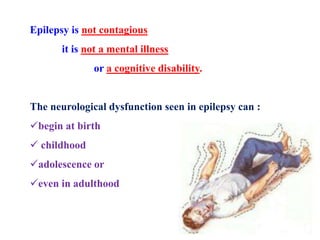
Epilepsy is not contagious
it is not a mental illness
or a cognitive disability.
The neurological dysfunction seen in epilepsy can :
begin at birth
 childhood
adolescence or
even in adulthood
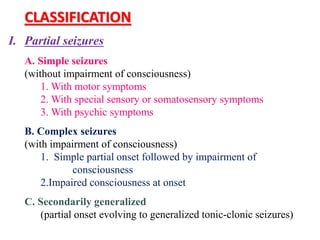
CLASSIFICATION
I. Partial seizures
A. Simple seizures
(without impairment of consciousness)
1. With motor symptoms
2. With special sensory or somatosensory symptoms
3. With psychic symptoms
B. Complex seizures
(with impairment of consciousness)
1. Simple partial onset followed by impairment of
consciousness
2.Impaired consciousness at onset
C. Secondarily generalized
(partial onset evolving to generalized tonic-clonic seizures)
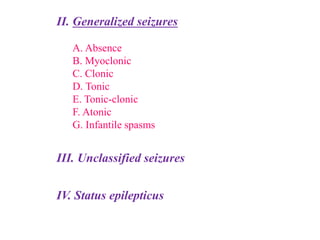
II. Generalized seizures
A. Absence
B. Myoclonic
C. Clonic
D. Tonic
E. Tonic-clonic
F. Atonic
G. Infantile spasms
III. Unclassified seizures
IV. Status epilepticus
PARTIAL SEIZURES:
Common, 80% patients
simple partial seizures:
do not cause loss of consciousness
Signs &symptoms:
motor – convulsive jerking, chewing
motions, lip smacking
Sensory & somatosensory – paresthesias,
auras
Automatic – sweating, flushing, pupil
dilation
Behavioural – hallucinations, dysphasia,
impaired consciousness (rare).
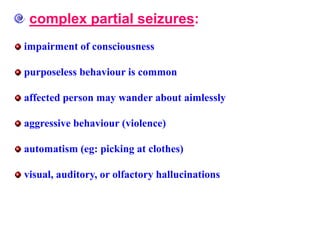
complex partial seizures:
impairment of consciousness
purposeless behaviour is common
affected person may wander about aimlessly
aggressive behaviour (violence)
automatism (eg: picking at clothes)
visual, auditory, or olfactory hallucinations
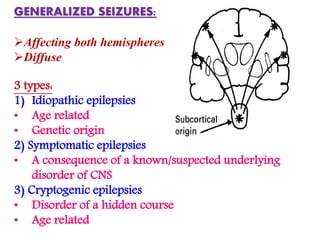
GENERALIZED SEIZURES:
Affecting both hemispheres
Diffuse
3 types:
1) Idiopathic epilepsies
• Age related
• Genetic origin
2) Symptomatic epilepsies
• A consequence of a known/suspected underlying
disorder of CNS
3) Cryptogenic epilepsies
• Disorder of a hidden course
• Age related
ABSENCE SEIZURES (petit mal)
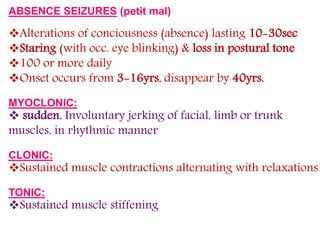
Alterations of conciousness (absence) lasting 10-30sec
Staring (with occ. eye blinking) & loss in postural tone
100 or more daily
Onset occurs from 3-16yrs, disappear by 40yrs.
MYOCLONIC:
 sudden, Involuntary jerking of facial, limb or trunk
muscles, in rhythmic manner
CLONIC:
Sustained muscle contractions alternating with relaxations
TONIC:
Sustained muscle stiffening
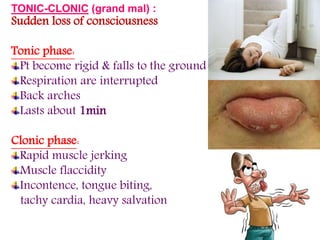
TONIC-CLONIC (grand mal) :
Sudden loss of consciousness
Tonic phase:
Pt become rigid & falls to the ground
Respiration are interrupted
Back arches
Lasts about 1min
Clonic phase:
Rapid muscle jerking
Muscle flaccidity
Incontence, tongue biting,
tachy cardia, heavy salvation
During postictal phase:
Head ache, confusion, nausea, drowsiness, disorientation
May last for hours
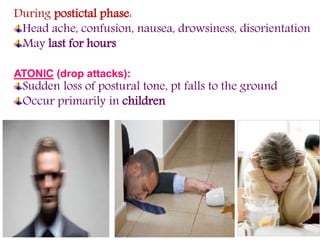
ATONIC (drop attacks):
Sudden loss of postural tone, pt falls to the ground
Occur primarily in children
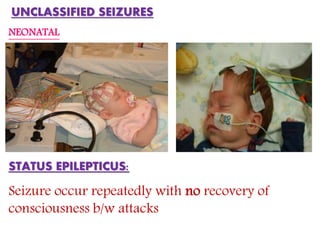
NEONATAL
STATUS EPILEPTICUS:
Seizure occur repeatedly with no recovery of
consciousness b/w attacks
UNCLASSIFIED SEIZURES
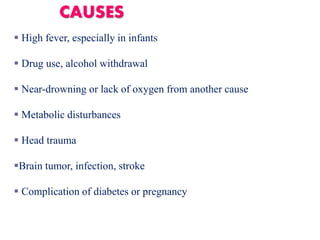
 High fever, especially in infants
 Drug use, alcohol withdrawal
 Near-drowning or lack of oxygen from another cause
 Metabolic disturbances
 Head trauma
Brain tumor, infection, stroke
 Complication of diabetes or pregnancy
CAUSES
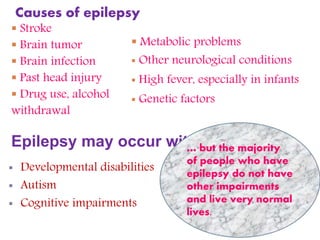
Causes of epilepsy
 Stroke
 Brain tumor
 Brain infection
 Past head injury
 Drug use, alcohol
withdrawal
Epilepsy may occur with:
 Metabolic problems
 Other neurological conditions
 High fever, especially in infants
 Genetic factors
 Developmental disabilities
 Autism
 Cognitive impairments
… but the majority
of people who have
epilepsy do not have
other impairments
and live very normal
lives.
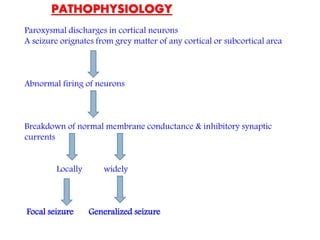
Paroxysmal discharges in cortical neurons
A seizure orignates from grey matter of any cortical or subcortical area
Abnormal firing of neurons
Breakdown of normal membrane conductance & inhibitory synaptic
currents
Locally widely
Focal seizure Generalized seizure
PATHOPHYSIOLOGY
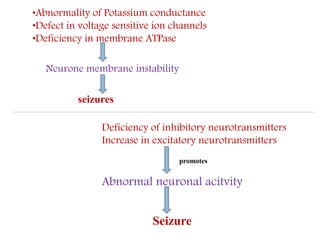
•Abnormality of Potassium conductance
•Defect in voltage sensitive ion channels
•Deficiency in membrane ATPase
seizures
Neurone membrane instability
promotes
Deficiency of inhibitory neurotransmitters
Increase in excitatory neurotransmitters
Abnormal neuronal acitvity
Seizure
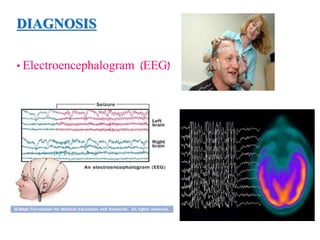
DIAGNOSIS
• Electroencephalogram (EEG)
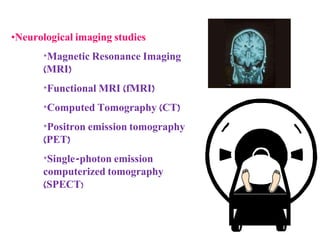
•Neurological imaging studies
*Magnetic Resonance Imaging
(MRI)
*Functional MRI (fMRI)
*Computed Tomography (CT)
*Positron emission tomography
(PET)
*Single-photon emission
computerized tomography
(SPECT)
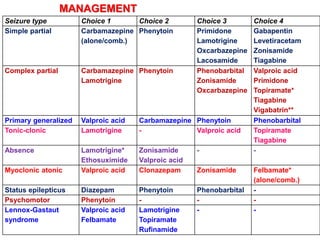
Seizure type Choice 1 Choice 2 Choice 3 Choice 4
Simple partial Carbamazepine
(alone/comb.)
Phenytoin Primidone
Lamotrigine
Oxcarbazepine
Lacosamide
Gabapentin
Levetiracetam
Zonisamide
Tiagabine
Complex partial Carbamazepine
Lamotrigine
Phenytoin Phenobarbital
Zonisamide
Oxcarbazepine
Valproic acid
Primidone
Topiramate*
Tiagabine
Vigabatrin**
Primary generalized Valproic acid Carbamazepine Phenytoin Phenobarbital
Tonic-clonic Lamotrigine - Valproic acid Topiramate
Tiagabine
Absence Lamotrigine*
Ethosuximide
Zonisamide
Valproic acid
- -
Myoclonic atonic Valproic acid Clonazepam Zonisamide Felbamate*
(alone/comb.)
Status epilepticus Diazepam Phenytoin Phenobarbital -
Psychomotor Phenytoin - - -
Lennox-Gastaut
syndrome
Valproic acid
Felbamate
Lamotrigine
Topiramate
Rufinamide
- -
MANAGEMENT
Epilepsy

Epilepsy

  • 1.
    PRESENTED BY; Aiswarya. A.T., Iyear M.Pharm., Dept. of Pharmacy Practice, Grace College of Pharmacy
  • 2.
    A seizure isa paroxysmal event characterized by abnormal, excessive, hypersynchronous discharge of cortical neuron activity. Epilepsy can be defined as a chronic seizure disorder or group of disorders characterized by seizures that usually recur unpredictably in the absence of a consistent provoking factor. Seizure ?? Epilepsy??
  • 3.
    Epilepsy is notcontagious it is not a mental illness or a cognitive disability. The neurological dysfunction seen in epilepsy can : begin at birth  childhood adolescence or even in adulthood
  • 4.
    CLASSIFICATION I. Partial seizures A.Simple seizures (without impairment of consciousness) 1. With motor symptoms 2. With special sensory or somatosensory symptoms 3. With psychic symptoms B. Complex seizures (with impairment of consciousness) 1. Simple partial onset followed by impairment of consciousness 2.Impaired consciousness at onset C. Secondarily generalized (partial onset evolving to generalized tonic-clonic seizures)
  • 5.
    II. Generalized seizures A.Absence B. Myoclonic C. Clonic D. Tonic E. Tonic-clonic F. Atonic G. Infantile spasms III. Unclassified seizures IV. Status epilepticus
  • 6.
    PARTIAL SEIZURES: Common, 80%patients simple partial seizures: do not cause loss of consciousness Signs &symptoms: motor – convulsive jerking, chewing motions, lip smacking Sensory & somatosensory – paresthesias, auras Automatic – sweating, flushing, pupil dilation Behavioural – hallucinations, dysphasia, impaired consciousness (rare).
  • 7.
    complex partial seizures: impairmentof consciousness purposeless behaviour is common affected person may wander about aimlessly aggressive behaviour (violence) automatism (eg: picking at clothes) visual, auditory, or olfactory hallucinations
  • 8.
    GENERALIZED SEIZURES: Affecting bothhemispheres Diffuse 3 types: 1) Idiopathic epilepsies • Age related • Genetic origin 2) Symptomatic epilepsies • A consequence of a known/suspected underlying disorder of CNS 3) Cryptogenic epilepsies • Disorder of a hidden course • Age related
  • 9.
    ABSENCE SEIZURES (petitmal) Alterations of conciousness (absence) lasting 10-30sec Staring (with occ. eye blinking) & loss in postural tone 100 or more daily Onset occurs from 3-16yrs, disappear by 40yrs. MYOCLONIC:  sudden, Involuntary jerking of facial, limb or trunk muscles, in rhythmic manner CLONIC: Sustained muscle contractions alternating with relaxations TONIC: Sustained muscle stiffening
  • 10.
    TONIC-CLONIC (grand mal): Sudden loss of consciousness Tonic phase: Pt become rigid & falls to the ground Respiration are interrupted Back arches Lasts about 1min Clonic phase: Rapid muscle jerking Muscle flaccidity Incontence, tongue biting, tachy cardia, heavy salvation
  • 11.
    During postictal phase: Headache, confusion, nausea, drowsiness, disorientation May last for hours ATONIC (drop attacks): Sudden loss of postural tone, pt falls to the ground Occur primarily in children
  • 12.
    NEONATAL STATUS EPILEPTICUS: Seizure occurrepeatedly with no recovery of consciousness b/w attacks UNCLASSIFIED SEIZURES
  • 13.
     High fever,especially in infants  Drug use, alcohol withdrawal  Near-drowning or lack of oxygen from another cause  Metabolic disturbances  Head trauma Brain tumor, infection, stroke  Complication of diabetes or pregnancy CAUSES
  • 14.
    Causes of epilepsy Stroke  Brain tumor  Brain infection  Past head injury  Drug use, alcohol withdrawal Epilepsy may occur with:  Metabolic problems  Other neurological conditions  High fever, especially in infants  Genetic factors  Developmental disabilities  Autism  Cognitive impairments … but the majority of people who have epilepsy do not have other impairments and live very normal lives.
  • 15.
    Paroxysmal discharges incortical neurons A seizure orignates from grey matter of any cortical or subcortical area Abnormal firing of neurons Breakdown of normal membrane conductance & inhibitory synaptic currents Locally widely Focal seizure Generalized seizure PATHOPHYSIOLOGY
  • 16.
    •Abnormality of Potassiumconductance •Defect in voltage sensitive ion channels •Deficiency in membrane ATPase seizures Neurone membrane instability promotes Deficiency of inhibitory neurotransmitters Increase in excitatory neurotransmitters Abnormal neuronal acitvity Seizure
  • 17.
  • 18.
    •Neurological imaging studies *MagneticResonance Imaging (MRI) *Functional MRI (fMRI) *Computed Tomography (CT) *Positron emission tomography (PET) *Single-photon emission computerized tomography (SPECT)
  • 19.
    Seizure type Choice1 Choice 2 Choice 3 Choice 4 Simple partial Carbamazepine (alone/comb.) Phenytoin Primidone Lamotrigine Oxcarbazepine Lacosamide Gabapentin Levetiracetam Zonisamide Tiagabine Complex partial Carbamazepine Lamotrigine Phenytoin Phenobarbital Zonisamide Oxcarbazepine Valproic acid Primidone Topiramate* Tiagabine Vigabatrin** Primary generalized Valproic acid Carbamazepine Phenytoin Phenobarbital Tonic-clonic Lamotrigine - Valproic acid Topiramate Tiagabine Absence Lamotrigine* Ethosuximide Zonisamide Valproic acid - - Myoclonic atonic Valproic acid Clonazepam Zonisamide Felbamate* (alone/comb.) Status epilepticus Diazepam Phenytoin Phenobarbital - Psychomotor Phenytoin - - - Lennox-Gastaut syndrome Valproic acid Felbamate Lamotrigine Topiramate Rufinamide - - MANAGEMENT