Enzyme Specificity
Presented by-
Dh Sani
GEB,SUST
Enzyme Specificity :
 Enzyme specificity refers to the tendency for enzymes to catalyze a specific set of chemical reactions.
Features of enzyme active site :
 The active site of an enzyme is the region that binds the substrates (and the cofactor, if any). It also
contains the residues that directly participate in the making and breaking the bonds. These residues are
called the catalytic groups. In essence, the interaction of the enzyme and substrate at the active site
promotes the formation of the transition state.
 The active site is a three-dimensional cleft(চিড়) formed by groups that come from different parts of the
amino acid sequence
 The active site takes up a relatively small part of the total volume of an enzyme
 Substrates are bound to enzymes by multiple weak attractions as products needs to be released after the
completion of the reactions. Strong bonding inhibits the process.
 The specificity of binding depends on the precisely(অচিকল) defined arrangement of atoms in an active site
 Active site has a precise(চিচদিষ্ট) amino acid sequence that is never changed. A change in amino acid
sequence in active site generally renders enzyme into a non functional form.
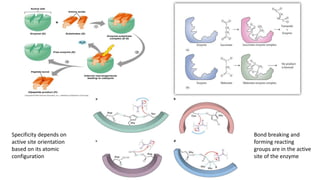
Specificity depends on
active site orientation
based on its atomic
configuration
Bond breaking and
forming reacting
groups are in the active
site of the enzyme
Lock-and-Key Model
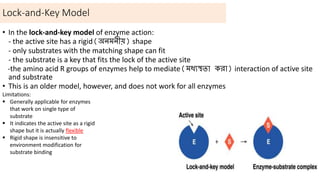
• In the lock-and-key model of enzyme action:
- the active site has a rigid(অিমিীয়) shape
- only substrates with the matching shape can fit
- the substrate is a key that fits the lock of the active site
-the amino acid R groups of enzymes help to mediate(মধ্যস্থতা করা) interaction of active site
and substrate
• This is an older model, however, and does not work for all enzymes
Limitations:
 Generally applicable for enzymes
that work on single type of
substrate
 It indicates the active site as a rigid
shape but it is actually flexible
 Rigid shape is insensitive to
environment modification for
substrate binding
Induced Fit Model
Advantages:
 Support enzymes which can act on different
substrates of different conformations
 Enhance fidelity of molecular recognition in
presence of competitor via conformational
proof reading
 Much accepted as enzymes are not rigid and
different conditions promote differential
interactions. if it was rigid all the actions were
same at always.
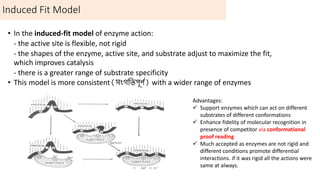
• In the induced-fit model of enzyme action:
- the active site is flexible, not rigid
- the shapes of the enzyme, active site, and substrate adjust to maximize the fit,
which improves catalysis
- there is a greater range of substrate specificity
• This model is more consistent(সংগচতপূর্ি) with a wider range of enzymes
Types of enzyme specificity :
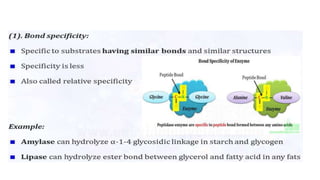
 Relative, low or bond specificity
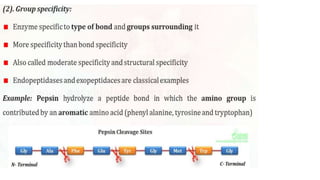
 Moderate, structural or group specificity
 Absolute, high or substrate specificity
 Optical or stereo-specificity
 Dual specificity
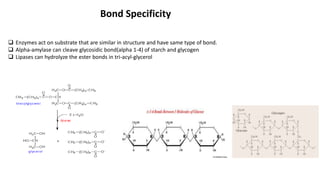
Bond Specificity
 Enzymes act on substrate that are similar in structure and have same type of bond.
 Alpha-amylase can cleave glycosidic bond(alpha 1-4) of starch and glycogen
 Lipases can hydrolyze the ester bonds in tri-acyl-glycerol
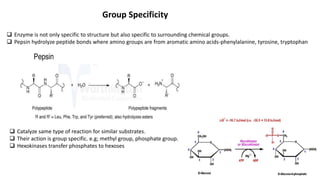
Group Specificity
 Enzyme is not only specific to structure but also specific to surrounding chemical groups.
 Pepsin hydrolyze peptide bonds where amino groups are from aromatic amino acids-phenylalanine, tyrosine, tryptophan
 Catalyze same type of reaction for similar substrates.
 Their action is group specific. e.g; methyl group, phosphate group.
 Hexokinases transfer phosphates to hexoses
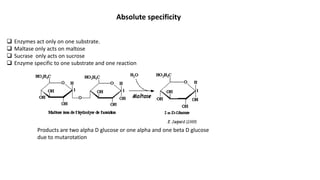
Absolute specificity
 Enzymes act only on one substrate.
 Maltase only acts on maltose
 Sucrase only acts on sucrose
 Enzyme specific to one substrate and one reaction
Products are two alpha D glucose or one alpha and one beta D glucose
due to mutarotation
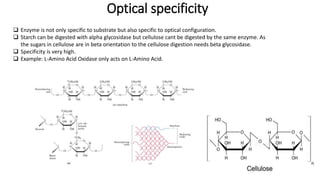
Optical specificity
 Enzyme is not only specific to substrate but also specific to optical configuration.
 Starch can be digested with alpha glycosidase but cellulose cant be digested by the same enzyme. As
the sugars in cellulose are in beta orientation to the cellulose digestion needs beta glycosidase.
 Specificity is very high.
 Example: L-Amino Acid Oxidase only acts on L-Amino Acid.
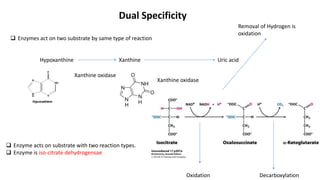
Dual Specificity
 Enzymes act on two substrate by same type of reaction
Hypoxanthine Xanthine Uric acid
Xanthine oxidase
Xanthine oxidase
 Enzyme acts on substrate with two reaction types.
 Enzyme is iso-citrate dehydrogensae
Oxidation Decarboxylation
Removal of Hydrogen is
oxidation

Enzyme specificity

  • 1.
  • 2.
    Enzyme Specificity : Enzyme specificity refers to the tendency for enzymes to catalyze a specific set of chemical reactions. Features of enzyme active site :  The active site of an enzyme is the region that binds the substrates (and the cofactor, if any). It also contains the residues that directly participate in the making and breaking the bonds. These residues are called the catalytic groups. In essence, the interaction of the enzyme and substrate at the active site promotes the formation of the transition state.  The active site is a three-dimensional cleft(চিড়) formed by groups that come from different parts of the amino acid sequence  The active site takes up a relatively small part of the total volume of an enzyme  Substrates are bound to enzymes by multiple weak attractions as products needs to be released after the completion of the reactions. Strong bonding inhibits the process.  The specificity of binding depends on the precisely(অচিকল) defined arrangement of atoms in an active site  Active site has a precise(চিচদিষ্ট) amino acid sequence that is never changed. A change in amino acid sequence in active site generally renders enzyme into a non functional form.
  • 3.
    Specificity depends on activesite orientation based on its atomic configuration Bond breaking and forming reacting groups are in the active site of the enzyme
  • 4.
    Lock-and-Key Model • Inthe lock-and-key model of enzyme action: - the active site has a rigid(অিমিীয়) shape - only substrates with the matching shape can fit - the substrate is a key that fits the lock of the active site -the amino acid R groups of enzymes help to mediate(মধ্যস্থতা করা) interaction of active site and substrate • This is an older model, however, and does not work for all enzymes Limitations:  Generally applicable for enzymes that work on single type of substrate  It indicates the active site as a rigid shape but it is actually flexible  Rigid shape is insensitive to environment modification for substrate binding
  • 5.
    Induced Fit Model Advantages: Support enzymes which can act on different substrates of different conformations  Enhance fidelity of molecular recognition in presence of competitor via conformational proof reading  Much accepted as enzymes are not rigid and different conditions promote differential interactions. if it was rigid all the actions were same at always. • In the induced-fit model of enzyme action: - the active site is flexible, not rigid - the shapes of the enzyme, active site, and substrate adjust to maximize the fit, which improves catalysis - there is a greater range of substrate specificity • This model is more consistent(সংগচতপূর্ি) with a wider range of enzymes
  • 6.
    Types of enzymespecificity :  Relative, low or bond specificity  Moderate, structural or group specificity  Absolute, high or substrate specificity  Optical or stereo-specificity  Dual specificity
  • 8.
    Bond Specificity  Enzymesact on substrate that are similar in structure and have same type of bond.  Alpha-amylase can cleave glycosidic bond(alpha 1-4) of starch and glycogen  Lipases can hydrolyze the ester bonds in tri-acyl-glycerol
  • 10.
    Group Specificity  Enzymeis not only specific to structure but also specific to surrounding chemical groups.  Pepsin hydrolyze peptide bonds where amino groups are from aromatic amino acids-phenylalanine, tyrosine, tryptophan  Catalyze same type of reaction for similar substrates.  Their action is group specific. e.g; methyl group, phosphate group.  Hexokinases transfer phosphates to hexoses
  • 11.
    Absolute specificity  Enzymesact only on one substrate.  Maltase only acts on maltose  Sucrase only acts on sucrose  Enzyme specific to one substrate and one reaction Products are two alpha D glucose or one alpha and one beta D glucose due to mutarotation
  • 12.
    Optical specificity  Enzymeis not only specific to substrate but also specific to optical configuration.  Starch can be digested with alpha glycosidase but cellulose cant be digested by the same enzyme. As the sugars in cellulose are in beta orientation to the cellulose digestion needs beta glycosidase.  Specificity is very high.  Example: L-Amino Acid Oxidase only acts on L-Amino Acid.
  • 13.
    Dual Specificity  Enzymesact on two substrate by same type of reaction Hypoxanthine Xanthine Uric acid Xanthine oxidase Xanthine oxidase  Enzyme acts on substrate with two reaction types.  Enzyme is iso-citrate dehydrogensae Oxidation Decarboxylation Removal of Hydrogen is oxidation