Enzyme Kinetics
by Mahwish Kazmi
• Enzyme kinetics is the study of the mechanism of an
enzyme catalysed reation to determine the rate of the
reaction.
Study of enzyme kinetics is useful for measuring
• concentration of an enzyme in a mixture (by its catalytic
activity),
• its purity (specific activity),
• its catalytic efficiency and/or specificity for different
substrates
• comparison of different forms of the same enzyme in
different tissues or organisms,
• effects of inhibitors (which can give information about
catalytic mechanism, structure of active site, potential
therapeutic agents...)
Michaelis and Menton Equation
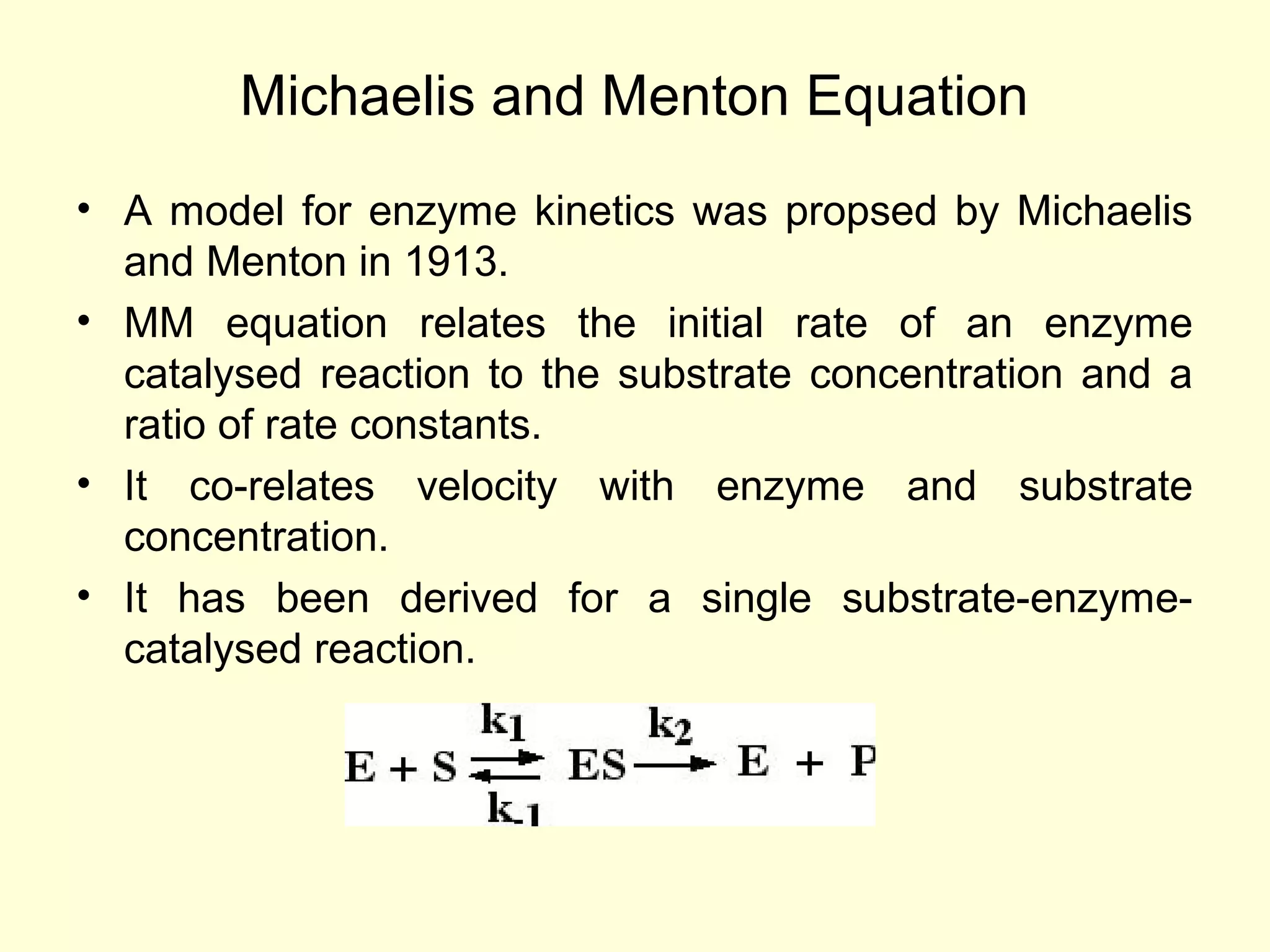
• A model for enzyme kinetics was propsed by Michaelis
and Menton in 1913.
• MM equation relates the initial rate of an enzyme
catalysed reaction to the substrate concentration and a
ratio of rate constants.
• It co-relates velocity with enzyme and substrate
concentration.
• It has been derived for a single substrate-enzyme-
catalysed reaction.
Michaelis and Menton Equation
• In MM expression
Total enzyme concentration= [ET] = [E] + [ES]
Free enzyme conc [E] = [ET] - [ES]
Substrate concentration = [S]
Initial velocity = Vo, Velocity measured immediately after
mixing E + S, at beginning of reaction (initial velocity), is
called Vo.
Maximum velocity = Vmax
Half Vmax = Km (substrate concentration)
Km = substrate concentration that gives Vo = 1/2 Vmax.
At very low [S]:
• Vo is proportional to [S];
doubling [S] → double Vo.
2. In mid-range of [S], Vo is
increasing less as [S]
increases (where Vo is
around 1/2 Vmax).
Km = [S] that gives Vo = 1/2
Vmax.
3. At very high [S], Vo is
independent of [S]:
Vo = Vmax.
Enzyme-catalyzed reactions show a hyperbolic
dependence of Vo on [S]
Derivation
• Initial velocity Vo= k2[ES]
• Rate of formation of [ES] = k1 [E][S]
= k1([ET]-[ES]).[S]
= k1[ET][S] - [ES][S]
• Rate of breakdown of [ES] =k-1[ES] + k2[ES]
= (k-1+k2)[ES]
• Steady state:
Rate of formation = Rate of breakdown
k1[ET][S] - [ES][S] = (k-1+k2)[ES]
• separation of rate constants
k1[ET][S] - [ES][S] = (k-1+k2)[ES]
k1[ET][S] = [ES][S] + (k-1+k2)[ES]
k1[ET][S] = {[S] + (k-1+k2)} [ES]
[ES] = k1[ET][S]
[S] + (k-1+k2)
[ES] = [ET][S]
[S] + k-1+k2
k1
k-1+k2 = Km [ES] = [ET][S] ......... (i)
k1 [S] + Km
• Expressing Vo in term of [ES]:
multiply k2 on both side of eq (i)
k2. [ES] = k2 [ET][S] ...... (ii)
[S] + Km
As we know Vo= k2[ES]
So, eq (ii) becomes
Vo = k2 [ET][S] .....(iii)
[S] + Km
When [S] is greater, then Vo becomes Vmax and
Vmax= k2 [ET]
So, eq (iii) becomes
Vo = Vmax [S]
[S] + Km
Michaelis-Menten equation
explains hyperbolic Vo vs. [S]
curve:
1. At very low [S] ([S] << Km), Vo
approaches (Vmax/Km)[S]. Vmax and
Km are constants, so linear
relationship between Vo and [S]
at low [S].
2. When [S] = Km, Vo = 1/2 Vmax
3. At very high [S], ([S] >> Km), Vo
approaches Vmax (velocity
independent of [S])
Explaination of hyperbolic curve
Significance of MM equation
It describes
• kinetic behaviour of enzymes
• hyperbolic dependence of Vo on [S]
• independance of number of steps involved
• different enzymes have different Km and Vmax.
• Km and Vmaxmay be influenced by pH, temperature.
• Km can be used as a relative measure of the affinity of the
enzyme for each substrate (smaller Km means higher
affinity)
• in a metabolic pathways, Km values may indicate the rate-
limiting step (highest Km means slowest step).
• Vmax is independent of [S] at saturation.
• Turnover number (kcat)
Number of substrate molecules converted into product
by one molecule of enzyme active site per unit time,
when enzyme is fully saturated with substrate.
• units of kcat is s–1
Lysozyme: kcat = 0.5 s–1
Catalase: kcat = 4 x 10⁷
s–1
• kcat/Km is the criterion of substrate specificity, catalytic
efficiency and "kinetic perfection”.
• units of kcat/Km = conc–1
time–1
.
• max. possible kcat/Km for an enzyme = ~ 108
–109
M–1
sec–1
.
Lineweaver-Burk plot
• A more convenient graphical representation of MM
equation
• It is a straight line plot, easier to evaluate than curves.
• Lineweaver-Burk plot is a double reciprocal plot obtained
by taking reciprocal of both sides of MM equation and
rearranging
1 = Km + [S]
V [S] Vmax
1 = Km 1 + 1
V Vmax [S] Vmax
• A plot of 1/V versus 1/[S] is a straight line having a slope
of Kmax/Vmaxand an intercept of 1/Vmax on the y-axis
Inhibition
• Enzyme inhibition is one of the ways in which enzyme
activity is regulated experimentally and naturally.
• Most therapeutic drugs function by inhibition of a specific
enzyme.
• In body, some of the processes controlled by enzyme
inhibition are blood coagulation, blood clot dissolution,
complement activation, conective tissue turnover and
inflammatory reactions.
• It may be reversible or irreversible.
Reversible Inhibition
• It is further subdivided into competitive, noncompetitive
and uncompetitive types.
• In reversible inhibition, equilibrium exists between
inhibitor I and enzyme E as
E+I EI
• The eq. constant for the dissociation of EI complex,
called Ki is given by equation
Ki = [E][I]
[EI]
• Ki is the measure of affinity of the inhibitor for enzyme
simliar to Km.
Competitive inhibition
• The inhibitor is a structural analogue that competes with
the substrate for binding at active site.
• Because the inhibitor binds reversibly to the enzyme,so
when [S] far exceeds [I], the probability that an inhibitor
molecule will bind to the enzyme is minimized and the
reaction exhibits a normal Vmax.
Noncompetitive inhibition
• Inhibitor does not usually bear any structural
resemblance to the subatrate and it binds to the enzyme
at a site distinct from the substrate binding site.
• No competition exists between inhibitor and substrate,
so inhibition cannot be overcome by increase of [S].
• Vmax is reduced by inhibitor but Km is unaffected
because the affinity of S for E is unchanged.
Uncompetitive Inhibition
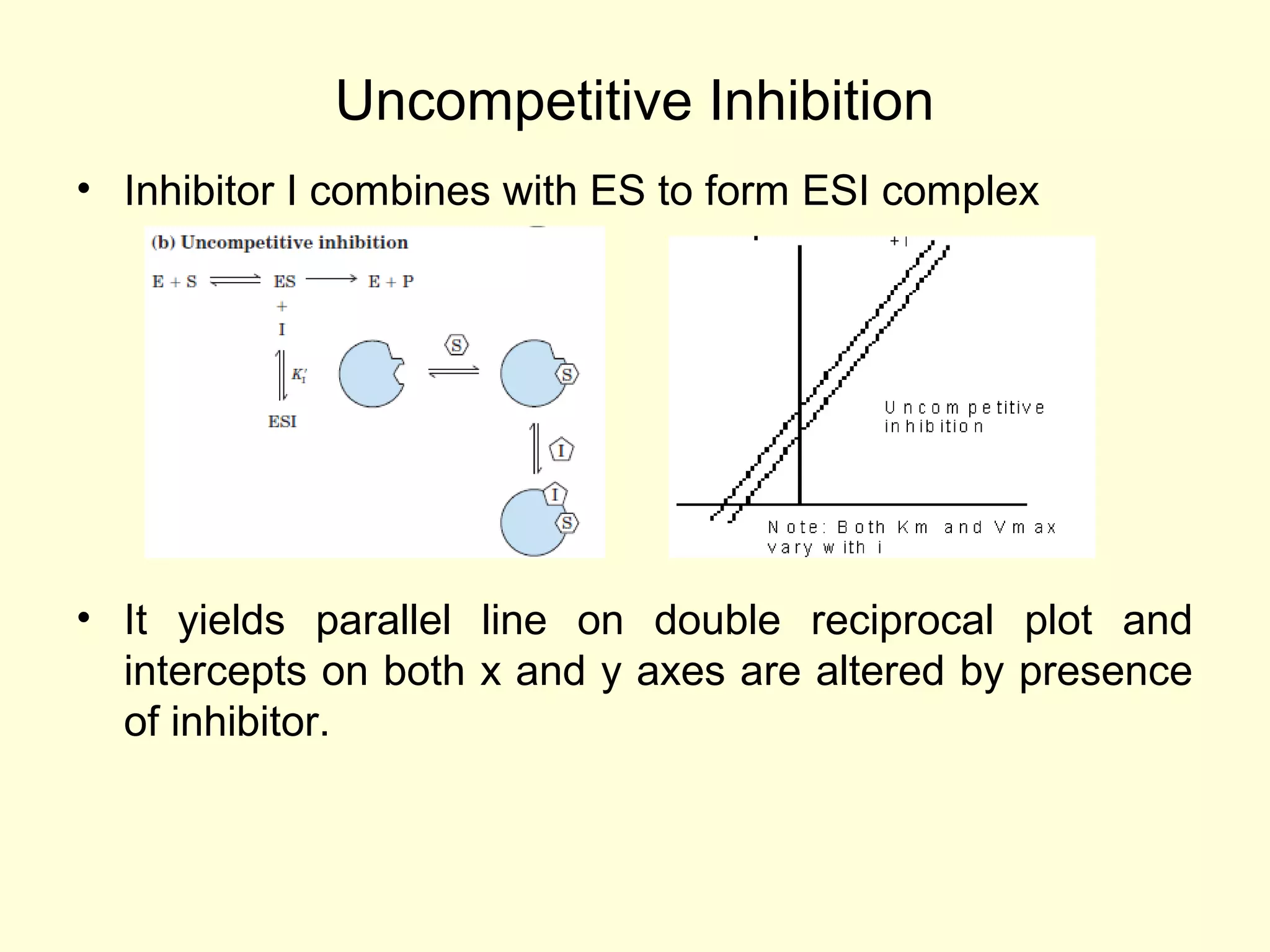
• Inhibitor I combines with ES to form ESI complex
• It yields parallel line on double reciprocal plot and
intercepts on both x and y axes are altered by presence
of inhibitor.

Enzyme kinetics

  • 1.
  • 2.
    • Enzyme kineticsis the study of the mechanism of an enzyme catalysed reation to determine the rate of the reaction. Study of enzyme kinetics is useful for measuring • concentration of an enzyme in a mixture (by its catalytic activity), • its purity (specific activity), • its catalytic efficiency and/or specificity for different substrates • comparison of different forms of the same enzyme in different tissues or organisms, • effects of inhibitors (which can give information about catalytic mechanism, structure of active site, potential therapeutic agents...)
  • 3.
    Michaelis and MentonEquation • A model for enzyme kinetics was propsed by Michaelis and Menton in 1913. • MM equation relates the initial rate of an enzyme catalysed reaction to the substrate concentration and a ratio of rate constants. • It co-relates velocity with enzyme and substrate concentration. • It has been derived for a single substrate-enzyme- catalysed reaction.
  • 4.
    Michaelis and MentonEquation • In MM expression Total enzyme concentration= [ET] = [E] + [ES] Free enzyme conc [E] = [ET] - [ES] Substrate concentration = [S] Initial velocity = Vo, Velocity measured immediately after mixing E + S, at beginning of reaction (initial velocity), is called Vo. Maximum velocity = Vmax Half Vmax = Km (substrate concentration) Km = substrate concentration that gives Vo = 1/2 Vmax.
  • 5.
    At very low[S]: • Vo is proportional to [S]; doubling [S] → double Vo. 2. In mid-range of [S], Vo is increasing less as [S] increases (where Vo is around 1/2 Vmax). Km = [S] that gives Vo = 1/2 Vmax. 3. At very high [S], Vo is independent of [S]: Vo = Vmax. Enzyme-catalyzed reactions show a hyperbolic dependence of Vo on [S]
  • 6.
    Derivation • Initial velocityVo= k2[ES] • Rate of formation of [ES] = k1 [E][S] = k1([ET]-[ES]).[S] = k1[ET][S] - [ES][S] • Rate of breakdown of [ES] =k-1[ES] + k2[ES] = (k-1+k2)[ES] • Steady state: Rate of formation = Rate of breakdown k1[ET][S] - [ES][S] = (k-1+k2)[ES]
  • 7.
    • separation ofrate constants k1[ET][S] - [ES][S] = (k-1+k2)[ES] k1[ET][S] = [ES][S] + (k-1+k2)[ES] k1[ET][S] = {[S] + (k-1+k2)} [ES] [ES] = k1[ET][S] [S] + (k-1+k2) [ES] = [ET][S] [S] + k-1+k2 k1 k-1+k2 = Km [ES] = [ET][S] ......... (i) k1 [S] + Km
  • 8.
    • Expressing Voin term of [ES]: multiply k2 on both side of eq (i) k2. [ES] = k2 [ET][S] ...... (ii) [S] + Km As we know Vo= k2[ES] So, eq (ii) becomes Vo = k2 [ET][S] .....(iii) [S] + Km When [S] is greater, then Vo becomes Vmax and Vmax= k2 [ET] So, eq (iii) becomes Vo = Vmax [S] [S] + Km
  • 9.
    Michaelis-Menten equation explains hyperbolicVo vs. [S] curve: 1. At very low [S] ([S] << Km), Vo approaches (Vmax/Km)[S]. Vmax and Km are constants, so linear relationship between Vo and [S] at low [S]. 2. When [S] = Km, Vo = 1/2 Vmax 3. At very high [S], ([S] >> Km), Vo approaches Vmax (velocity independent of [S]) Explaination of hyperbolic curve
  • 10.
    Significance of MMequation It describes • kinetic behaviour of enzymes • hyperbolic dependence of Vo on [S] • independance of number of steps involved • different enzymes have different Km and Vmax. • Km and Vmaxmay be influenced by pH, temperature. • Km can be used as a relative measure of the affinity of the enzyme for each substrate (smaller Km means higher affinity) • in a metabolic pathways, Km values may indicate the rate- limiting step (highest Km means slowest step). • Vmax is independent of [S] at saturation.
  • 11.
    • Turnover number(kcat) Number of substrate molecules converted into product by one molecule of enzyme active site per unit time, when enzyme is fully saturated with substrate. • units of kcat is s–1 Lysozyme: kcat = 0.5 s–1 Catalase: kcat = 4 x 10⁷ s–1 • kcat/Km is the criterion of substrate specificity, catalytic efficiency and "kinetic perfection”. • units of kcat/Km = conc–1 time–1 . • max. possible kcat/Km for an enzyme = ~ 108 –109 M–1 sec–1 .
  • 12.
    Lineweaver-Burk plot • Amore convenient graphical representation of MM equation • It is a straight line plot, easier to evaluate than curves. • Lineweaver-Burk plot is a double reciprocal plot obtained by taking reciprocal of both sides of MM equation and rearranging 1 = Km + [S] V [S] Vmax 1 = Km 1 + 1 V Vmax [S] Vmax
  • 13.
    • A plotof 1/V versus 1/[S] is a straight line having a slope of Kmax/Vmaxand an intercept of 1/Vmax on the y-axis
  • 14.
    Inhibition • Enzyme inhibitionis one of the ways in which enzyme activity is regulated experimentally and naturally. • Most therapeutic drugs function by inhibition of a specific enzyme. • In body, some of the processes controlled by enzyme inhibition are blood coagulation, blood clot dissolution, complement activation, conective tissue turnover and inflammatory reactions. • It may be reversible or irreversible.
  • 15.
    Reversible Inhibition • Itis further subdivided into competitive, noncompetitive and uncompetitive types. • In reversible inhibition, equilibrium exists between inhibitor I and enzyme E as E+I EI • The eq. constant for the dissociation of EI complex, called Ki is given by equation Ki = [E][I] [EI] • Ki is the measure of affinity of the inhibitor for enzyme simliar to Km.
  • 16.
    Competitive inhibition • Theinhibitor is a structural analogue that competes with the substrate for binding at active site. • Because the inhibitor binds reversibly to the enzyme,so when [S] far exceeds [I], the probability that an inhibitor molecule will bind to the enzyme is minimized and the reaction exhibits a normal Vmax.
  • 17.
    Noncompetitive inhibition • Inhibitordoes not usually bear any structural resemblance to the subatrate and it binds to the enzyme at a site distinct from the substrate binding site. • No competition exists between inhibitor and substrate, so inhibition cannot be overcome by increase of [S]. • Vmax is reduced by inhibitor but Km is unaffected because the affinity of S for E is unchanged.
  • 18.
    Uncompetitive Inhibition • InhibitorI combines with ES to form ESI complex • It yields parallel line on double reciprocal plot and intercepts on both x and y axes are altered by presence of inhibitor.