MIM THIRD Year (2015 – 18)
SEM VI
NAME ROLL NO
MUFADDAL NULLWALA 15-I-131
ENVIRONMENTAL MANAGEMENT
ENERGY AUDIT
JBIMS-
MUFADDAL
List of Topics
1. What is Energy 13. Detailed Energy Audit
2. Type of Energy 14. Steps for Energy Audit (Phase1,2,3)
3. What is Energy Audit 15. Results of Energy Audit (Phase 1,2,3)
4. Definition of Energy Audit 16. Energy Costs in Indian Scenario
5. The Need for Energy Audit 17. Bench Marking Energy Performance
6. Why Energy Audit 18. Measuring Energy Performance
7. Energy Audit Process 19. Matching Energy Usage to Requiremen
8. Audit Programme Advantages 20. Optimizing Energy Input Requirement
9. Approach and Types of Energy
Audit
21. Fuel and Energy Substitution – Steps
towards Conservation
10. Preliminary Energy Audit 22. Case Study – Energy Substitution.
11. Targeted Energy Audit 23. Energy saving calculations:
12. Energy Pyramid 24. References
Energy Audit
JBIMS-
MUFADDAL
What is Energy?
 Energy is the capacity of a physical system to perform
work. Energy exists in several forms such as heat, kinetic
or mechanical energy, light, potential energy, electrical or
other forms.
 According to the law of conservation of energy, the total
energy of a system remains constant, though energy
may transform into another form.
JBIMS-
MUFADDAL
Types of Energy
ENERG
Y
MECHANICA
L ENERGY
THERMAL
ENERGY
THERMAL
ENERGY
NUCLEAR
ENERGY
CHEMICAL
ENERGY
ELECTROMAGNET
IC ENERGY
JBIMS-
MUFADDAL
 “Energy audit” means the verification,
monitoring, and Analysis of use of energy
including submission of technical report
containing recommendations for improving
energy efficiency with cost benefit analysis
and an action plan to reduce energy
consumption.
What is Energy Audit
JBIMS-
MUFADDAL
 Pool of activities (systematic procedure) focused on
analysis of current energy need and consumption going
out of valid technical standards,
 Analysis of problems (weaknesses and deficiencies),
 EA identifies and in detail quantifies effective possibilities
of energy savings tailored to the object being analyzed,
Definition of Energy Audit
JBIMS-
MUFADDAL
In any industry three top operating costs are often found to
be.
1. Material.
2. Labour.
3. Energy (both Electrical & Thermal).
Among the three Energy has highest potential for cost
reduction
Energy Audit will help to understand more about ways
energy is used in industry & help in identifying areas where
waste can occur and where scope for improvement exists.
Energy audit is translation of energy conservation ideas into
reality, by evolving technically feasible solutions with
The need for Energy Audit?
JBIMS-
MUFADDAL
 To minimize costs for energy
 To minimize operational costs
 To minimize costs for repairs and reconstruction
 Increase quality of environment that contributes to
increased work productivity
Why Energy Audit?
JBIMS-
MUFADDAL
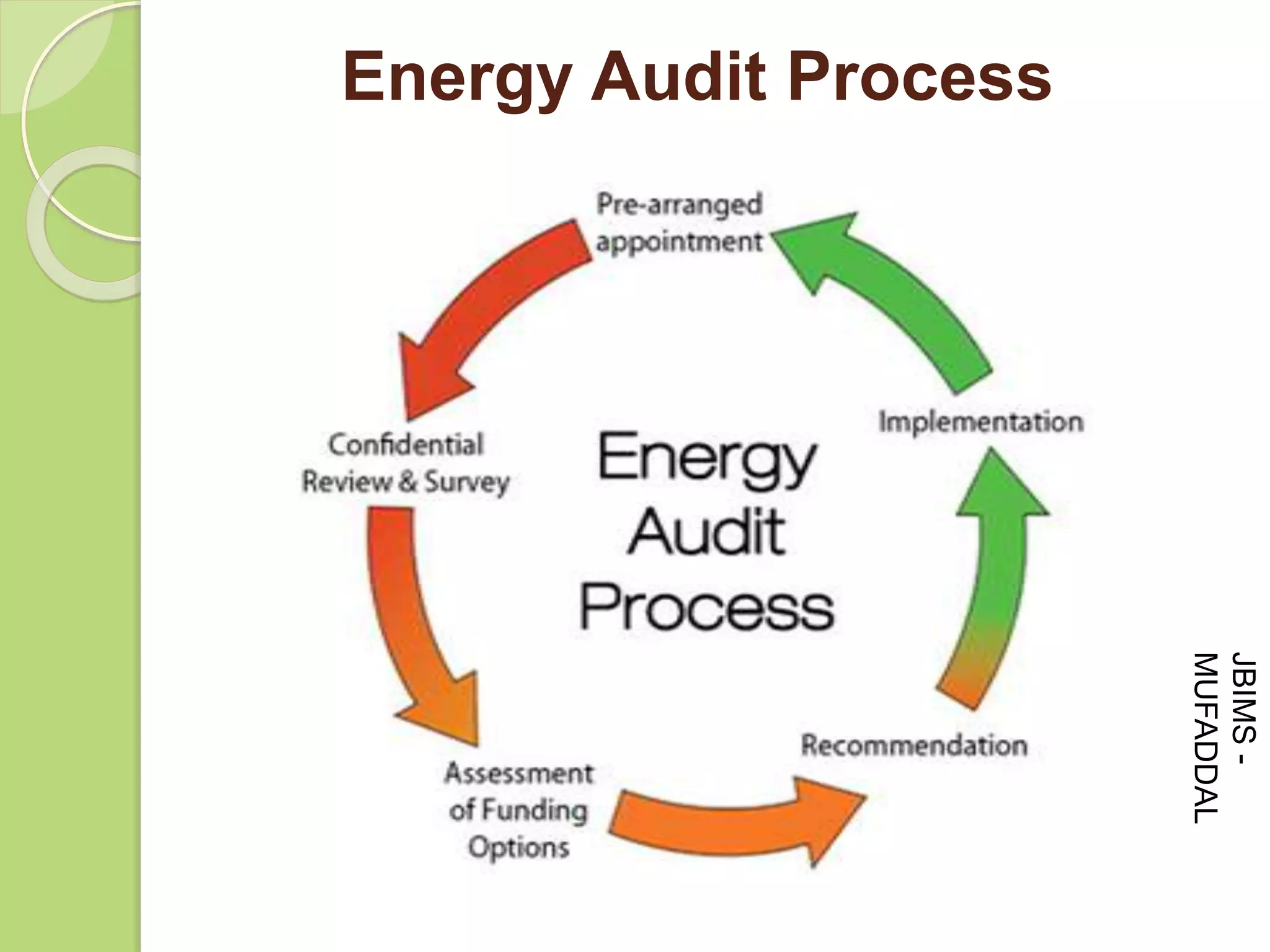
Energy Audit Process
JBIMS-
MUFADDAL
Audit Programme Advantages.
 Review variations in Energy costs.
 Availability of energy.
 Reliability of supply.
 Decide on appropriate energy mix.
 Identification of energy conservation
technologies.
 Retrofit for energy conservation
equipment.
 Benchmarking.
 Plant energy performance
JBIMS-
MUFADDAL
Approach and Type of Energy
Audit
Approach
• Type of industry.
• Depth to which final audit needed.
• How potential.
• Magnitude of cost reduction desired.
Classification of Energy Audit
1. Preliminary Energy Audit.
2. Targeted Energy Audit.
3. Detailed Energy Audit.
JBIMS-
MUFADDAL
• The type of Energy Audit to be performed depends on:
- Function and type of industry
- Depth to which final audit is needed, and
- Potential and magnitude of cost reduction desired
• Thus, Energy Audit can be classified into the following two
types.
i) Preliminary Audit
ii) Detailed Audit
Types of Energy Audits
JBIMS-
MUFADDAL
• Establish energy consumption in the organization
• Estimate the scope for saving
• Identify the most likely (and the easiest areas for attention
• Identify immediate (especially no-/low-cost)
• improvements/ savings
• Set a ‘reference point’
• Identify areas for more detailed study/measurement
•
• Preliminary energy audit uses existing, or easily obtained data
Preliminary Energy Audit
JBIMS-
MUFADDAL
 It is also known as Walk-Through audit & Diagnostic
audit.
 Establish energy consumption, (Bills and Invoices).
 Estimate the scope of energy saving.
 Identify areas more detailed study / measurements.
 Set up baseline or reference point for energy
consumption
 Identify most likely and easiest areas for attention
(unnecessary lighting, higher temp. setting, leakage)/
 Installation / upgrading insulation on equipment.
 Modifying process to reduce energy demand.
 Evaluating waste heat streams for potential waste heat
recovery.
Preliminary Energy Audit
JBIMS-
MUFADDAL
Targeted Energy Audit
 It results from preliminary Energy
Audit.
 It involves detailed survey of target
subjects and analysis of energy flows,
cost associated with targets.
 Final outcome is recommendations
regarding actions to be taken.
 Example: Lighting system, Boiler,
compressed air system, water supply
system.
JBIMS-
MUFADDAL
Energy Pyramid
JBIMS-
MUFADDAL
• It is offers most accurate estimate of energy savings
and cost
• This is based on an inventory of energy using systems,
assumptions of current operating conditions and
calculations of energy use.
• It is comprehensive audit & results in project
implementation plan for facility.
• Analysis Energy balance.
• Detailed energy auditing is carried out in three phases:
Phase I, II and III.
Phase I - Pre Audit Phase
Phase II - Audit Phase
Phase III - Post Audit Phase
Detailed Energy Audit
JBIMS-
MUFADDAL
PHASE:1
1. a. Plan & organise visit
b. Walk through audit of the set up
c. Informal interview with production or plant manager
or incharge.
2. Conduct brief meeting / awareness program on
energy audit with all divisional heads and persons
concerned.
PHASE:II
3. Primary data collection, process flow diagram, energy
utility diagram and collection of any other relevant data.
4. Conduct survey and monitoring
Steps for Energy Audit
JBIMS-
MUFADDAL
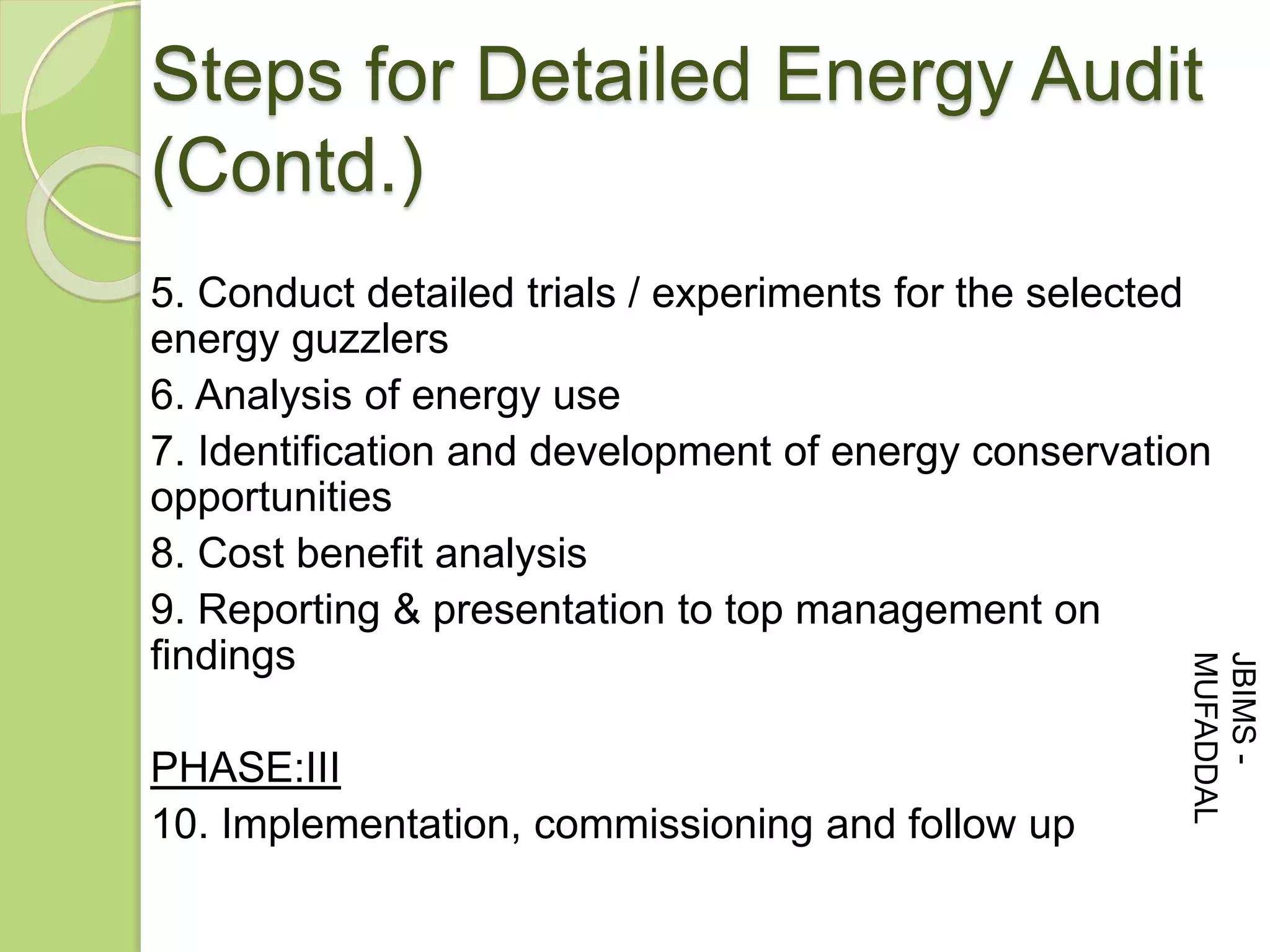
5. Conduct detailed trials / experiments for the selected
energy guzzlers
6. Analysis of energy use
7. Identification and development of energy conservation
opportunities
8. Cost benefit analysis
9. Reporting & presentation to top management on
findings
PHASE:III
10. Implementation, commissioning and follow up
Steps for Detailed Energy Audit
(Contd.)
JBIMS-
MUFADDAL
Results of Energy Audit
Phase 1 - Pre Audit phase
The Outcome of Pre Audit phase should
be.
 Finalize Energy Audit team.
To know the expectation of management
from audit.
To identify main energy consuming area/
plant items to be surveyed.
Plan for Audit with time frame.
Collect Macro data on plant energy
resources.
 Build up awareness & support for
JBIMS-
MUFADDAL
Results of Energy Audit
Phase 1I - Audit phase
The Outcome of Audit phase should be.
Quantity and Type of Raw material
Technology, Process, and Equipment's
used.
Capacity utilization
Efficiencies / yield
Percentage rejection / reprocessing.
Quantity and Types of Wastes
Potential for fuel substitution, process
modification.
Energy Audit Report.
JBIMS-
MUFADDAL
Results of Energy Audit
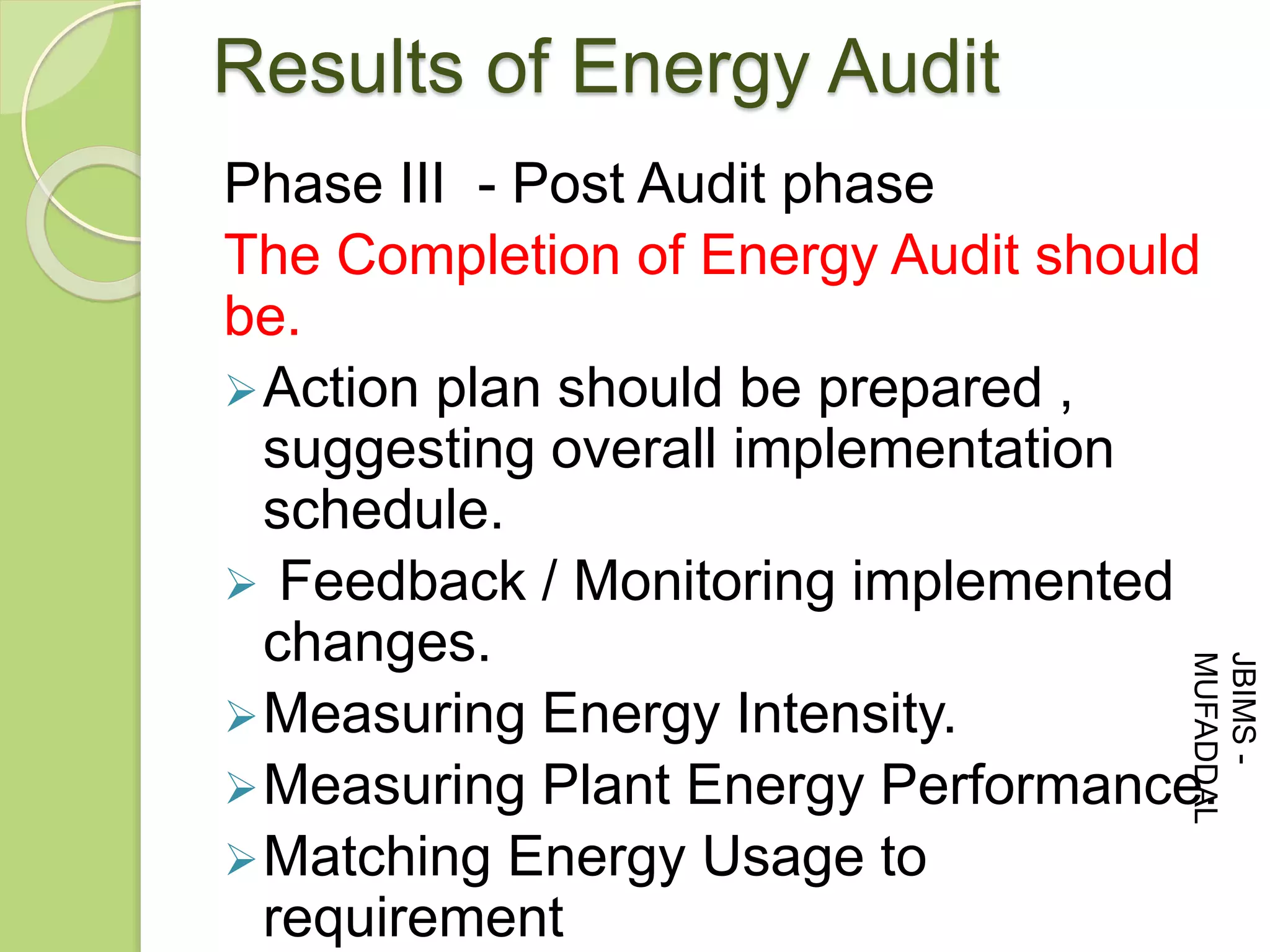
Phase III - Post Audit phase
The Completion of Energy Audit should
be.
Action plan should be prepared ,
suggesting overall implementation
schedule.
 Feedback / Monitoring implemented
changes.
Measuring Energy Intensity.
Measuring Plant Energy Performance.
Matching Energy Usage to
requirement
JBIMS-
MUFADDAL
Common Fuels
Fuel Oil, Low Sulphur Heavy
Stock (LSHS), Light Diesel Oil
(LDO), Liquefied Petroleum Gas
(LPG), Coal, Lignite, Wood
Fuels Cost Inputs & Factors
 Price at source, transport
charge, type of transport,
 Quality of fuel
 Contaminations, Moisture,
Energy content (GCV)
Energy Costs in Indian
Scenario ?
Power Costs
In India, electricity costs vary
substantially not only from
State to State, but also from city
to city and also within consumer
to consumer – though power
does the same work
everywhere.
Reason:
•Tariff Structure
JBIMS-
MUFADDAL
 Benchmarking can be a useful tool for understanding
energy consumption patterns in the industrial sector and
also to take requisite measures for improving energy
efficiency.
 FACTORS INVOLVED:
◦ Scale of operation
◦ Vintage of technology
◦ Raw material specifications and quality
◦ Product specifications and quality
Benchmarking
JBIMS-
MUFADDAL
Benchmarking for Energy
Performance
• Internal Benchmarking
 Historical and trend analysis
• External Benchmarking
 Across similar industries
Scale of operation, vintage of technology, raw
material specification and quality and product
specification and quality
JBIMS-
MUFADDAL
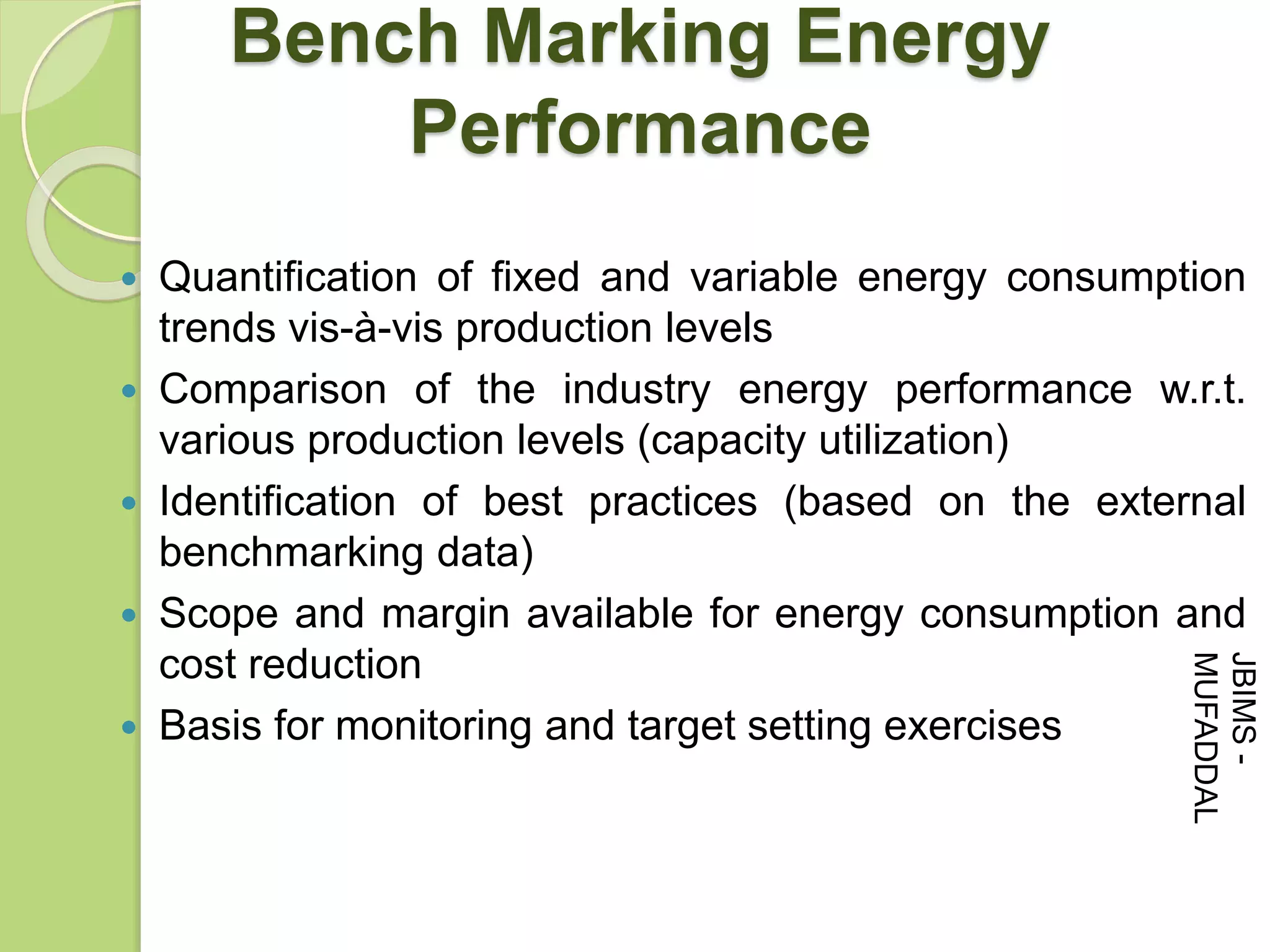
 Quantification of fixed and variable energy consumption
trends vis-à-vis production levels
 Comparison of the industry energy performance w.r.t.
various production levels (capacity utilization)
 Identification of best practices (based on the external
benchmarking data)
 Scope and margin available for energy consumption and
cost reduction
 Basis for monitoring and target setting exercises
Bench Marking Energy
Performance
JBIMS-
MUFADDAL
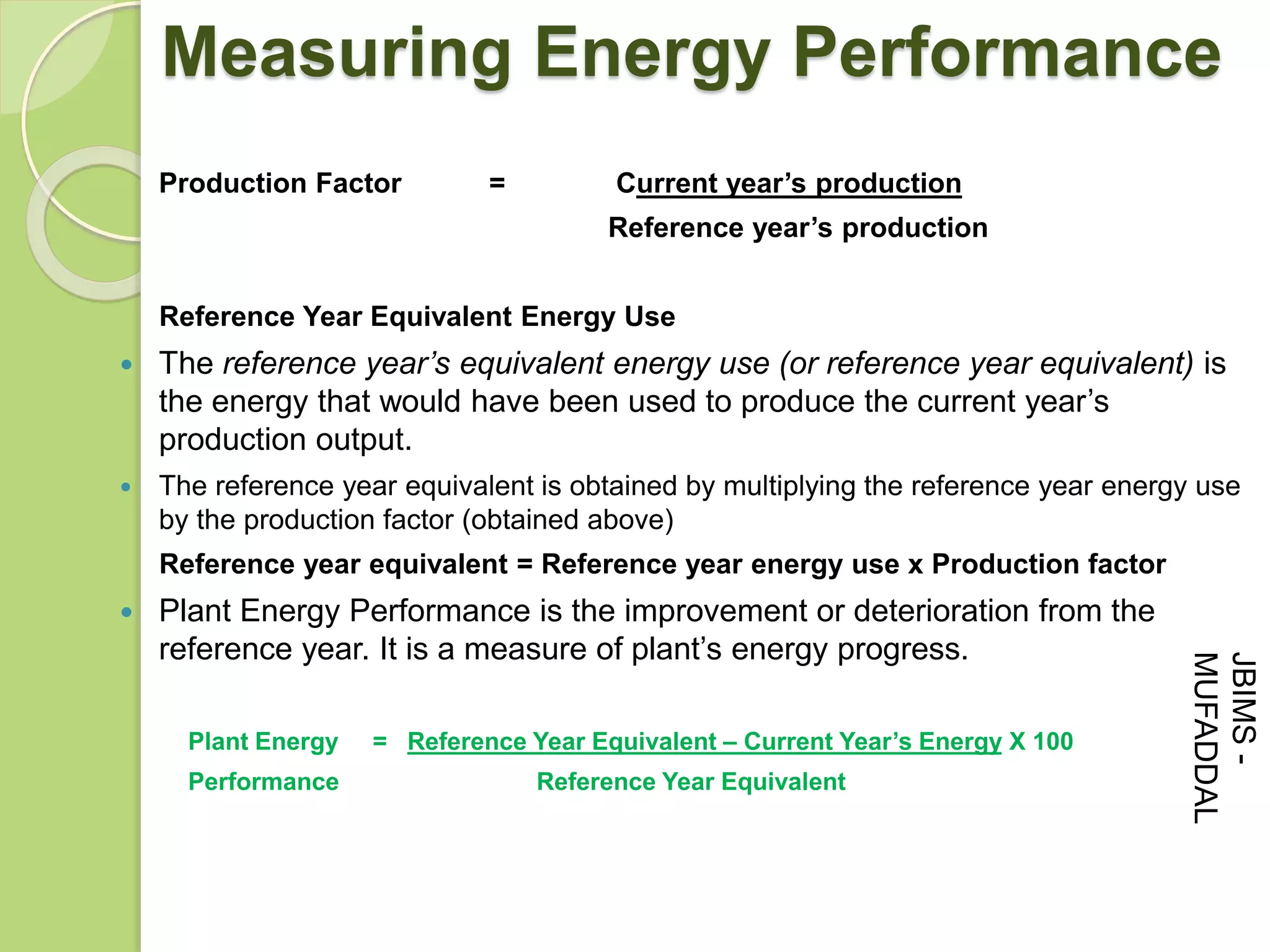
Production Factor = Current year’s production
Reference year’s production
Reference Year Equivalent Energy Use
 The reference year’s equivalent energy use (or reference year equivalent) is
the energy that would have been used to produce the current year’s
production output.
 The reference year equivalent is obtained by multiplying the reference year energy use
by the production factor (obtained above)
Reference year equivalent = Reference year energy use x Production factor
 Plant Energy Performance is the improvement or deterioration from the
reference year. It is a measure of plant’s energy progress.
Plant Energy = Reference Year Equivalent – Current Year’s Energy X 100
Performance Reference Year Equivalent
Measuring Energy Performance
JBIMS-
MUFADDAL
 The mismatch between equipment capacity and user
requirement often leads to inefficiencies due to part load
operations, wastages etc. It is thus essential that proper
energy matching studies are carried out & actions
implemented.
 Examples :
◦ Eliminate throttling
◦ Eliminate damper operations
◦ Fan resizing for better efficiency.
◦ Moderation of chilled water temperature for
process chilling needs
Matching Energy Usage to
Requirement
JBIMS-
MUFADDAL
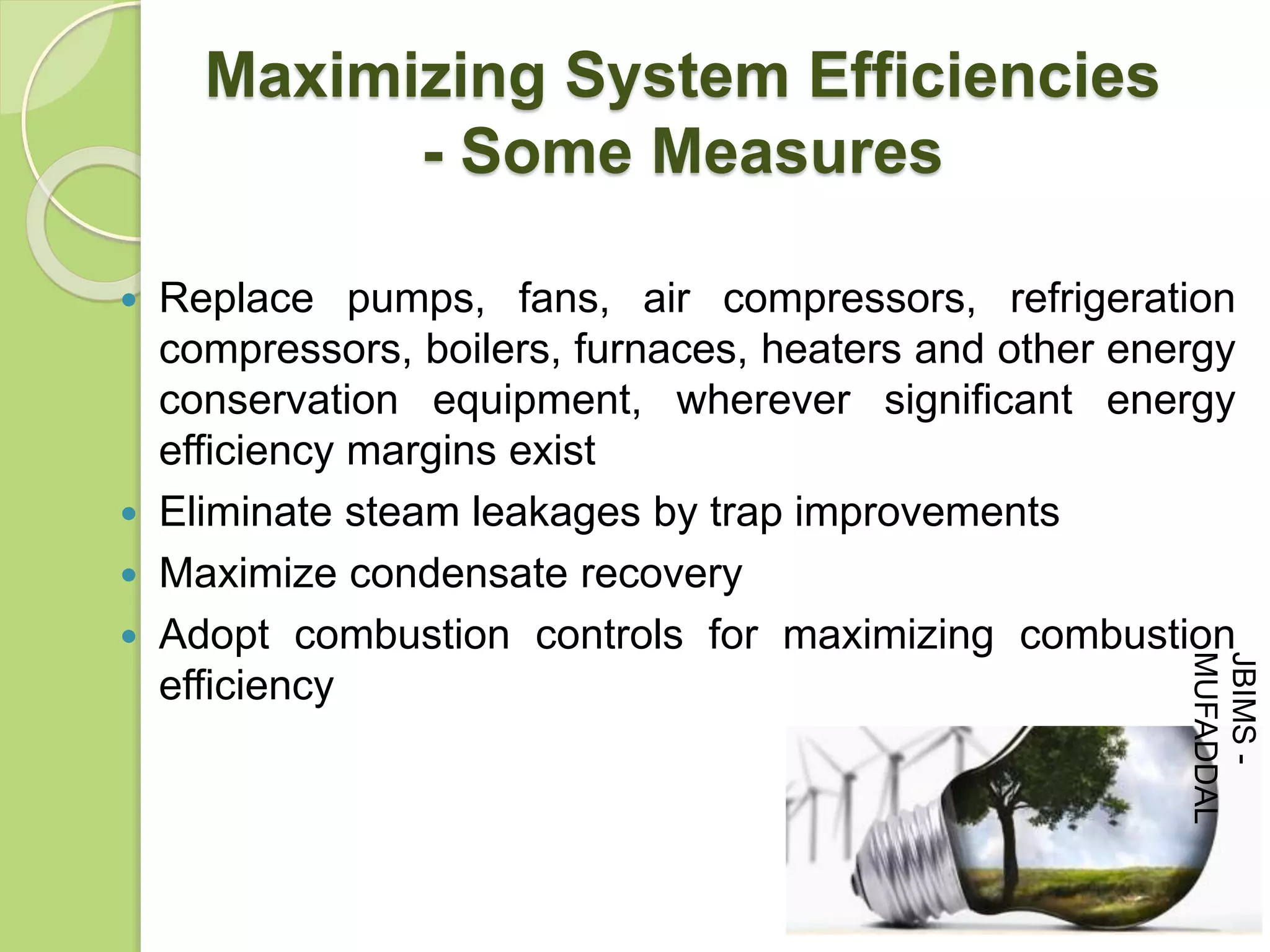
 Replace pumps, fans, air compressors, refrigeration
compressors, boilers, furnaces, heaters and other energy
conservation equipment, wherever significant energy
efficiency margins exist
 Eliminate steam leakages by trap improvements
 Maximize condensate recovery
 Adopt combustion controls for maximizing combustion
efficiency
Maximizing System Efficiencies
- Some Measures
JBIMS-
MUFADDAL
• In order to ensure that the energy given to the system is
being put to optimal use, site specific measures and
checks should be carried out regularly.
• EXAMPLES:
◦ Shuffling of compressors to match needs.
◦ Periodic review of insulation thickness
◦ Identify potential for heat exchanger networking and
process integration.
Optimizing Energy Input
Requirement
JBIMS-
MUFADDAL
Fuel substitution
 Replacement of coal by coconut shells, rice husks, etc
 Replacement of LDO by LSHS
Energy substitution
 Replacement of electric heaters by steam heaters
 Replacement of steam based hot water by solar systems
Fuel and Energy Substitution –
Key steps towards conservation
JBIMS-
MUFADDAL
Case Study:
Example of Fuel Substitution
A textile process industry replaced old fuel oil fired thermic fluid
heater with agro fuel fired heater. The economics of the project
are given below:
Title of Recommendation : Use of Agro Fuel (coconut chips) in place
of Furnace oil in a Boiler
Description of Existing System and its operation : A thermic fluid
heater with furnace oil currently. In the same plant a coconut chip fired
boiler is operating continuously with good performance.
Description of Proposed system and its operation : It was
suggested to replace the oil fired thermic fluid heater with coconut chip
fired boiler as the company has the facilities for handling coconut chip
fired system.
JBIMS-
MUFADDAL
Energy saving calculations:
Old System:
Type of fuel Firing: Furnace Oil
fired heater
GCV: 10,200 kCal/kg
Avg. Thermal Efficiency: 82%
Heat Duty: 15 lakh kCal / hour
Fuel Cost: Rs. 1800 / hour
Operating hours: 25 days * 12
months * 24 hours = 7200 hrs
Annual Fuel Cost: 7200 * 1800 =
Rs 130 lacs
Modified System:
Type of fuel Firing: Coconut
chips fired heater
GCV: 4,200 kCal/kg
Avg. Thermal Efficiency: 72%
Heat Duty: 15 lakh kCal / hour
Fuel Cost: Rs. 700 / hour
Operating hours: 25 days * 12
months * 24 hours = 7200 hrs
Annual Operating Cost: 7200 *
700 = Rs 50 lacs
Annual Savings = 130 – 50 = Rs 80 lacs
Additional auxiliary power and manpower cost for modified system =
Rs 10 lacs
Net Annual Savings = Rs 70 lacs
JBIMS-
MUFADDAL
Energy, Let’s save it!!!
JBIMS-
MUFADDAL
1. NPC energy audit manual and reports
2. Energy management handbook, John Wiley and Sons -
Wayne C. Turner
3. Guide to Energy Management, Cape Hart, Turner and
Kennedy
4. Cleaner Production – Energy Efficiency Manual for GERIAP,
UNEP, Bangkok prepared by National Productivity Council
5. www.eeca.govt.nz
6. www.energyusernews.com
References
JBIMS-
MUFADDAL
THANK YOU
JBIMS-
MUFADDAL

Environmental Management - Energy Audit & Features

  • 1.
    MIM THIRD Year(2015 – 18) SEM VI NAME ROLL NO MUFADDAL NULLWALA 15-I-131 ENVIRONMENTAL MANAGEMENT ENERGY AUDIT JBIMS- MUFADDAL
  • 2.
    List of Topics 1.What is Energy 13. Detailed Energy Audit 2. Type of Energy 14. Steps for Energy Audit (Phase1,2,3) 3. What is Energy Audit 15. Results of Energy Audit (Phase 1,2,3) 4. Definition of Energy Audit 16. Energy Costs in Indian Scenario 5. The Need for Energy Audit 17. Bench Marking Energy Performance 6. Why Energy Audit 18. Measuring Energy Performance 7. Energy Audit Process 19. Matching Energy Usage to Requiremen 8. Audit Programme Advantages 20. Optimizing Energy Input Requirement 9. Approach and Types of Energy Audit 21. Fuel and Energy Substitution – Steps towards Conservation 10. Preliminary Energy Audit 22. Case Study – Energy Substitution. 11. Targeted Energy Audit 23. Energy saving calculations: 12. Energy Pyramid 24. References
  • 3.
  • 4.
    What is Energy? Energy is the capacity of a physical system to perform work. Energy exists in several forms such as heat, kinetic or mechanical energy, light, potential energy, electrical or other forms.  According to the law of conservation of energy, the total energy of a system remains constant, though energy may transform into another form. JBIMS- MUFADDAL
  • 5.
    Types of Energy ENERG Y MECHANICA LENERGY THERMAL ENERGY THERMAL ENERGY NUCLEAR ENERGY CHEMICAL ENERGY ELECTROMAGNET IC ENERGY JBIMS- MUFADDAL
  • 6.
     “Energy audit”means the verification, monitoring, and Analysis of use of energy including submission of technical report containing recommendations for improving energy efficiency with cost benefit analysis and an action plan to reduce energy consumption. What is Energy Audit JBIMS- MUFADDAL
  • 7.
     Pool ofactivities (systematic procedure) focused on analysis of current energy need and consumption going out of valid technical standards,  Analysis of problems (weaknesses and deficiencies),  EA identifies and in detail quantifies effective possibilities of energy savings tailored to the object being analyzed, Definition of Energy Audit JBIMS- MUFADDAL
  • 8.
    In any industrythree top operating costs are often found to be. 1. Material. 2. Labour. 3. Energy (both Electrical & Thermal). Among the three Energy has highest potential for cost reduction Energy Audit will help to understand more about ways energy is used in industry & help in identifying areas where waste can occur and where scope for improvement exists. Energy audit is translation of energy conservation ideas into reality, by evolving technically feasible solutions with The need for Energy Audit? JBIMS- MUFADDAL
  • 9.
     To minimizecosts for energy  To minimize operational costs  To minimize costs for repairs and reconstruction  Increase quality of environment that contributes to increased work productivity Why Energy Audit? JBIMS- MUFADDAL
  • 10.
  • 11.
    Audit Programme Advantages. Review variations in Energy costs.  Availability of energy.  Reliability of supply.  Decide on appropriate energy mix.  Identification of energy conservation technologies.  Retrofit for energy conservation equipment.  Benchmarking.  Plant energy performance JBIMS- MUFADDAL
  • 12.
    Approach and Typeof Energy Audit Approach • Type of industry. • Depth to which final audit needed. • How potential. • Magnitude of cost reduction desired. Classification of Energy Audit 1. Preliminary Energy Audit. 2. Targeted Energy Audit. 3. Detailed Energy Audit. JBIMS- MUFADDAL
  • 13.
    • The typeof Energy Audit to be performed depends on: - Function and type of industry - Depth to which final audit is needed, and - Potential and magnitude of cost reduction desired • Thus, Energy Audit can be classified into the following two types. i) Preliminary Audit ii) Detailed Audit Types of Energy Audits JBIMS- MUFADDAL
  • 14.
    • Establish energyconsumption in the organization • Estimate the scope for saving • Identify the most likely (and the easiest areas for attention • Identify immediate (especially no-/low-cost) • improvements/ savings • Set a ‘reference point’ • Identify areas for more detailed study/measurement • • Preliminary energy audit uses existing, or easily obtained data Preliminary Energy Audit JBIMS- MUFADDAL
  • 15.
     It isalso known as Walk-Through audit & Diagnostic audit.  Establish energy consumption, (Bills and Invoices).  Estimate the scope of energy saving.  Identify areas more detailed study / measurements.  Set up baseline or reference point for energy consumption  Identify most likely and easiest areas for attention (unnecessary lighting, higher temp. setting, leakage)/  Installation / upgrading insulation on equipment.  Modifying process to reduce energy demand.  Evaluating waste heat streams for potential waste heat recovery. Preliminary Energy Audit JBIMS- MUFADDAL

  • 16.
    Targeted Energy Audit It results from preliminary Energy Audit.  It involves detailed survey of target subjects and analysis of energy flows, cost associated with targets.  Final outcome is recommendations regarding actions to be taken.  Example: Lighting system, Boiler, compressed air system, water supply system. JBIMS- MUFADDAL
  • 17.
  • 18.
    • It isoffers most accurate estimate of energy savings and cost • This is based on an inventory of energy using systems, assumptions of current operating conditions and calculations of energy use. • It is comprehensive audit & results in project implementation plan for facility. • Analysis Energy balance. • Detailed energy auditing is carried out in three phases: Phase I, II and III. Phase I - Pre Audit Phase Phase II - Audit Phase Phase III - Post Audit Phase Detailed Energy Audit JBIMS- MUFADDAL
  • 19.
    PHASE:1 1. a. Plan& organise visit b. Walk through audit of the set up c. Informal interview with production or plant manager or incharge. 2. Conduct brief meeting / awareness program on energy audit with all divisional heads and persons concerned. PHASE:II 3. Primary data collection, process flow diagram, energy utility diagram and collection of any other relevant data. 4. Conduct survey and monitoring Steps for Energy Audit JBIMS- MUFADDAL
  • 20.
    5. Conduct detailedtrials / experiments for the selected energy guzzlers 6. Analysis of energy use 7. Identification and development of energy conservation opportunities 8. Cost benefit analysis 9. Reporting & presentation to top management on findings PHASE:III 10. Implementation, commissioning and follow up Steps for Detailed Energy Audit (Contd.) JBIMS- MUFADDAL
  • 21.
    Results of EnergyAudit Phase 1 - Pre Audit phase The Outcome of Pre Audit phase should be.  Finalize Energy Audit team. To know the expectation of management from audit. To identify main energy consuming area/ plant items to be surveyed. Plan for Audit with time frame. Collect Macro data on plant energy resources.  Build up awareness & support for JBIMS- MUFADDAL
  • 22.
    Results of EnergyAudit Phase 1I - Audit phase The Outcome of Audit phase should be. Quantity and Type of Raw material Technology, Process, and Equipment's used. Capacity utilization Efficiencies / yield Percentage rejection / reprocessing. Quantity and Types of Wastes Potential for fuel substitution, process modification. Energy Audit Report. JBIMS- MUFADDAL
  • 23.
    Results of EnergyAudit Phase III - Post Audit phase The Completion of Energy Audit should be. Action plan should be prepared , suggesting overall implementation schedule.  Feedback / Monitoring implemented changes. Measuring Energy Intensity. Measuring Plant Energy Performance. Matching Energy Usage to requirement JBIMS- MUFADDAL
  • 24.
    Common Fuels Fuel Oil,Low Sulphur Heavy Stock (LSHS), Light Diesel Oil (LDO), Liquefied Petroleum Gas (LPG), Coal, Lignite, Wood Fuels Cost Inputs & Factors  Price at source, transport charge, type of transport,  Quality of fuel  Contaminations, Moisture, Energy content (GCV) Energy Costs in Indian Scenario ? Power Costs In India, electricity costs vary substantially not only from State to State, but also from city to city and also within consumer to consumer – though power does the same work everywhere. Reason: •Tariff Structure JBIMS- MUFADDAL
  • 25.
     Benchmarking canbe a useful tool for understanding energy consumption patterns in the industrial sector and also to take requisite measures for improving energy efficiency.  FACTORS INVOLVED: ◦ Scale of operation ◦ Vintage of technology ◦ Raw material specifications and quality ◦ Product specifications and quality Benchmarking JBIMS- MUFADDAL
  • 26.
    Benchmarking for Energy Performance •Internal Benchmarking  Historical and trend analysis • External Benchmarking  Across similar industries Scale of operation, vintage of technology, raw material specification and quality and product specification and quality JBIMS- MUFADDAL
  • 27.
     Quantification offixed and variable energy consumption trends vis-à-vis production levels  Comparison of the industry energy performance w.r.t. various production levels (capacity utilization)  Identification of best practices (based on the external benchmarking data)  Scope and margin available for energy consumption and cost reduction  Basis for monitoring and target setting exercises Bench Marking Energy Performance JBIMS- MUFADDAL
  • 28.
    Production Factor =Current year’s production Reference year’s production Reference Year Equivalent Energy Use  The reference year’s equivalent energy use (or reference year equivalent) is the energy that would have been used to produce the current year’s production output.  The reference year equivalent is obtained by multiplying the reference year energy use by the production factor (obtained above) Reference year equivalent = Reference year energy use x Production factor  Plant Energy Performance is the improvement or deterioration from the reference year. It is a measure of plant’s energy progress. Plant Energy = Reference Year Equivalent – Current Year’s Energy X 100 Performance Reference Year Equivalent Measuring Energy Performance JBIMS- MUFADDAL
  • 29.
     The mismatchbetween equipment capacity and user requirement often leads to inefficiencies due to part load operations, wastages etc. It is thus essential that proper energy matching studies are carried out & actions implemented.  Examples : ◦ Eliminate throttling ◦ Eliminate damper operations ◦ Fan resizing for better efficiency. ◦ Moderation of chilled water temperature for process chilling needs Matching Energy Usage to Requirement JBIMS- MUFADDAL
  • 30.
     Replace pumps,fans, air compressors, refrigeration compressors, boilers, furnaces, heaters and other energy conservation equipment, wherever significant energy efficiency margins exist  Eliminate steam leakages by trap improvements  Maximize condensate recovery  Adopt combustion controls for maximizing combustion efficiency Maximizing System Efficiencies - Some Measures JBIMS- MUFADDAL
  • 31.
    • In orderto ensure that the energy given to the system is being put to optimal use, site specific measures and checks should be carried out regularly. • EXAMPLES: ◦ Shuffling of compressors to match needs. ◦ Periodic review of insulation thickness ◦ Identify potential for heat exchanger networking and process integration. Optimizing Energy Input Requirement JBIMS- MUFADDAL
  • 32.
    Fuel substitution  Replacementof coal by coconut shells, rice husks, etc  Replacement of LDO by LSHS Energy substitution  Replacement of electric heaters by steam heaters  Replacement of steam based hot water by solar systems Fuel and Energy Substitution – Key steps towards conservation JBIMS- MUFADDAL
  • 33.
    Case Study: Example ofFuel Substitution A textile process industry replaced old fuel oil fired thermic fluid heater with agro fuel fired heater. The economics of the project are given below: Title of Recommendation : Use of Agro Fuel (coconut chips) in place of Furnace oil in a Boiler Description of Existing System and its operation : A thermic fluid heater with furnace oil currently. In the same plant a coconut chip fired boiler is operating continuously with good performance. Description of Proposed system and its operation : It was suggested to replace the oil fired thermic fluid heater with coconut chip fired boiler as the company has the facilities for handling coconut chip fired system. JBIMS- MUFADDAL
  • 34.
    Energy saving calculations: OldSystem: Type of fuel Firing: Furnace Oil fired heater GCV: 10,200 kCal/kg Avg. Thermal Efficiency: 82% Heat Duty: 15 lakh kCal / hour Fuel Cost: Rs. 1800 / hour Operating hours: 25 days * 12 months * 24 hours = 7200 hrs Annual Fuel Cost: 7200 * 1800 = Rs 130 lacs Modified System: Type of fuel Firing: Coconut chips fired heater GCV: 4,200 kCal/kg Avg. Thermal Efficiency: 72% Heat Duty: 15 lakh kCal / hour Fuel Cost: Rs. 700 / hour Operating hours: 25 days * 12 months * 24 hours = 7200 hrs Annual Operating Cost: 7200 * 700 = Rs 50 lacs Annual Savings = 130 – 50 = Rs 80 lacs Additional auxiliary power and manpower cost for modified system = Rs 10 lacs Net Annual Savings = Rs 70 lacs JBIMS- MUFADDAL
  • 35.
    Energy, Let’s saveit!!! JBIMS- MUFADDAL
  • 36.
    1. NPC energyaudit manual and reports 2. Energy management handbook, John Wiley and Sons - Wayne C. Turner 3. Guide to Energy Management, Cape Hart, Turner and Kennedy 4. Cleaner Production – Energy Efficiency Manual for GERIAP, UNEP, Bangkok prepared by National Productivity Council 5. www.eeca.govt.nz 6. www.energyusernews.com References JBIMS- MUFADDAL
  • 37.