Sustainable Farming for Tropical
Asian Landscapes (SFITAL)
its journey and pathway
Dr Beria Leimona
Key barriers in transforming sustainable smallholder-centered
value chains and production landscape
Implementation Gaps
 Limited training for smallholders,
especially in non-staple crops
 Weak adoption of agroforestry
(spacing, shading, species)
 Trade-offs between production
and ecology
 Land loss to more profitable
crops and development
Intervention Gaps
 Public–private programs not aligned
 Disconnect across national–local levels
 Generic strategies lack local context - “One-size-fits-all” doesn’t work in the field
Investment Gaps
 Limited or no incentives for
environmental stewardship at
smallholder or district level.
 Existing incentives are small-
scale and not integrated into
public policy or programs.
Accountability Gap
 Weak monitoring and
verification systems
 Limited mechanisms to
track progress or enforce
responsibility, particularly
ecological indicators
 High transaction cost
Alignment
Scale/scope Quality/effectiveness
3
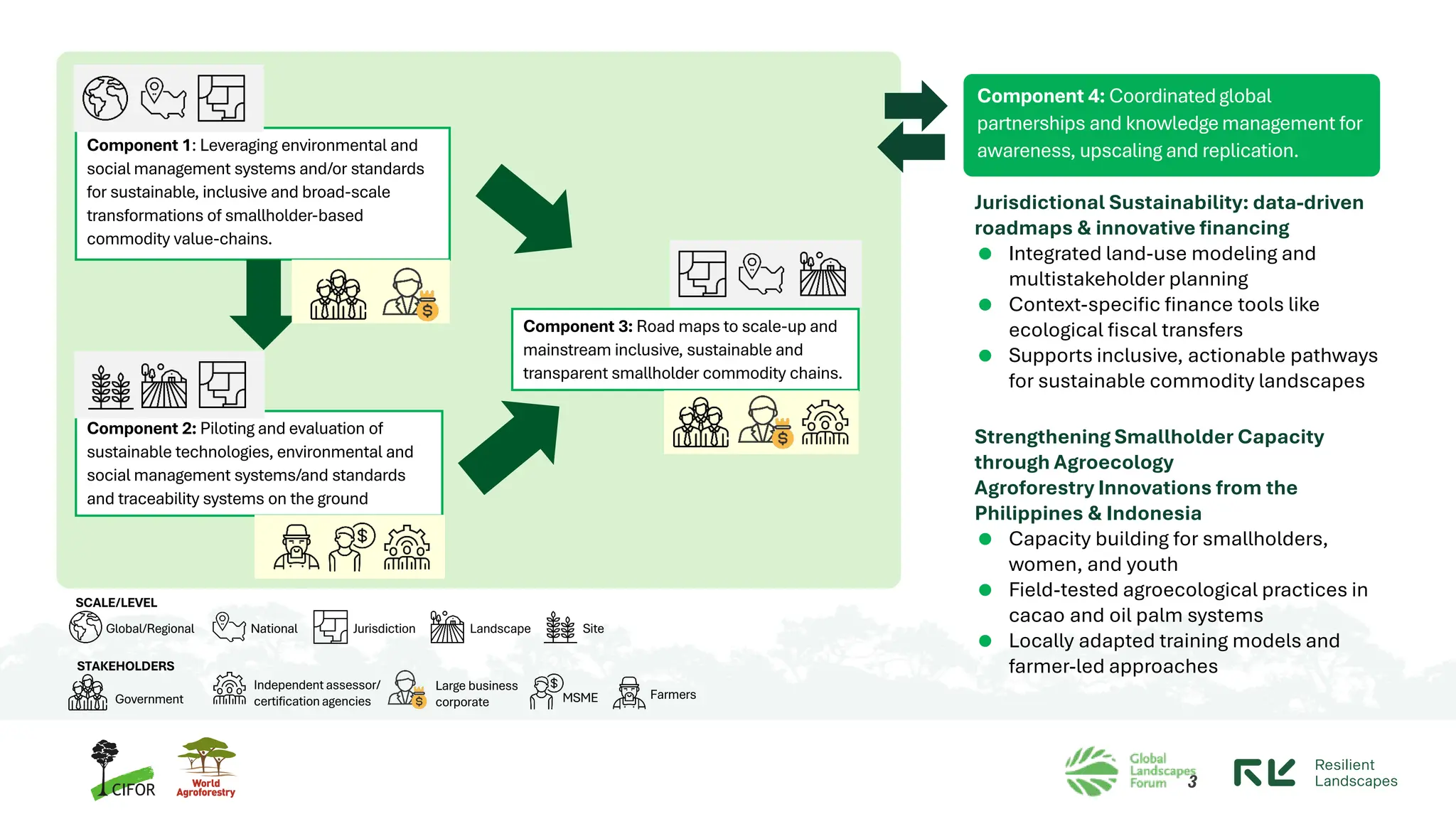
Component 1: Leveraging environmental and
social management systems and/or standards
for sustainable, inclusive and broad-scale
transformations of smallholder-based
commodity value-chains.
Component 2: Piloting and evaluation of
sustainable technologies, environmental and
social management systems/and standards
and traceability systems on the ground
Component 3: Road maps to scale-up and
mainstream inclusive, sustainable and
transparent smallholder commodity chains.
Component 4: Coordinated global
partnerships and knowledge management for
awareness, upscaling and replication.
Global/Regional National Landscape
Jurisdiction Site
SCALE/LEVEL
STAKEHOLDERS
Farmers
Government MSME
Large business
corporate
Independent assessor/
certification agencies
Jurisdictional Sustainability: data-driven
roadmaps & innovative financing
 Integrated land-use modeling and
multistakeholder planning
 Context-specific finance tools like
ecological fiscal transfers
 Supports inclusive, actionable pathways
for sustainable commodity landscapes
Strengthening Smallholder Capacity
through Agroecology
Agroforestry Innovations from the
Philippines & Indonesia
 Capacity building for smallholders,
women, and youth
 Field-tested agroecological practices in
cacao and oil palm systems
 Locally adapted training models and
farmer-led approaches
Enabling jurisdictional sustainability:
Data-driven roadmaps and innovative financing strategies
Dr Betha Lusiana and Dr Rachmat Mulia
1. Integrates land-use, commodity production, and sustainability goals at
the district or provincial level
2. Creates a shared platform for collaboration among government, private
sector, farmers, and communities
3. Ensures alignment with government policies and development planning
4. Supports long-term sustainability beyond project/program cycles
5. Strengthens monitoring, reporting, and verification at the jurisdiction scale
Why
jurisdictional
approach?
Delivering Sustainable
Solutions in Focus
Jurisdictions
Inclusive-integrative process of commodity roadmaps
development
 Multi-stakeholder process to align strategies and
responsibilities.
 Applies thematic geospatial data to develop sustainable
intervention maps and assess impacts and trade-offs
of sustainable interventions.
1
Monitoring and Evaluation Tools for Implementation
 Uses jointly agreed sustainability indicators aligned with
global jurisdictional standards.
 Tools are locally owned and managed to ensure long-term
use and accountability.
Financing Strategies for Roadmap implementation
 Links public policy to on-the-ground actions, enabling
sustainable commodities implementation
 Integrating roadmap strategies with existing and
potential financing
2
3
SFITAL sites
Towards Sustainable Oil Palm in
Labuhan Batu Utara (Labura)
 Sit within North Sumatra, the 3rd largest oil palm–producing province in
Indonesia. The district ranks 2nd in North Sumatra in total oil palm area,
production, and number of independent smallholders.
 Agriculture, forestry, and fisheries contribute 35% to the district’s GRDP,
the highest among all sectors.
 The district lacks an estate crop/oil palm strategy document, as major
plantations contribute little to local revenue and offer limited incentive
for district engagement.
National Strategy on oil palm productivity and sustainability
1. National Action Plan (NAP) on Sustainable mandated every provincial
and districts producing oil palm develop Provincial and District Action
Plan. In 2021, the North Sumatra Province has produced a ratified
Provincial Action Plan. Labura has yet to produce this.
2. Oil Palm Replanting Programme to support oil palm production.
Context and Opportunities
3. Oil Palm Profit-Sharing Fund.
A revenue-sharing mechanism to distribute a
portion of the income derived from palm oil
plantations to regional governments
Development of District Action Plan
for Sustainable Oil Palm
The DAP contains 5 main strategies:
1. Coordination, Data and
Infrastructure Strengthening
2. Farmers Capacity and
Capability Strengthening
3. Environmental Management
and Monitoring
4. Governance and Conflict Resolution
5. ISPO Certification Acceleration
SFITAL
Sustainable Oil Palm Intervention maps
Impact of Sustainable Interventions on Productive Land Area
Land cover maps and land use change
analysis (ICRAF)
Oil Palm suitability maps (ICRAF)
Feasibility analysis of
organic fertilizer (PPKS)
Value chain governance
analysis of palm oil (RA, IPB)
SFITAL provided local stakeholders with
data & information for developing
sustainable oil palm strategies
Digital M&E Platform
In addition to the National M&E Dashboard, a district-level
digital M&E system was developed to enable local
government ownership. It includes SOPs and achievement
graphs to support effective monitoring and evaluation.
Achievement Graphs
Benefits achieved
North Labuhanbatu’s involvement in the national DAP program has increased its visibility at
national level, reflected in:
 Invitations to national and provincial meetings and capacity-building programs.
 Receipt of the Oil Palm Profit-Sharing Fund in 2023–2025, that has been used for sustainable
oil palm activities, including farmer capacity strengthening programme
 Lutra is a major cacao-producing district, with
plantations contributing 22% to GRDP.
 Productivity and soil fertility are declining, pests and
diseases are increasing, and bean chemical
residues exceed limits.
 Cacao also faces growing competition from other
commodities.
Landscape Approach for Sustainable
Cacao in Luwu Utara Utara (Lutra)
Context and Opportunities
 Cacao roadmaps exist at national and regional
exist focusing on boosting farm-level productivity
through improved farmer access to inputs.
 The local government has strong ambitions to
enhance cacao management in the district.
PROCESS Design of
Sustainable Cacao Road Map
Planning
Multi-stakeholder agreement
Implementation
Monitoring
Evaluation
1
The Vision of Sustainable Cacao
Goals
Strategies
Scenarios of
Development
Landscape
Modelling
Monev Tool
Sustainable Cacao Road Map
Integrating Road
Map to regional
development plan
Integrating Road
Map to Commodity
Work plan
Principles, criteria,
sustainability
indicators
2
3
4
5
Land suitability analysis for Cacao
LAND USE DYNAMICS
Potential
Actual
Category Area (ha)
N (Not suitable) 2,504.52
S1 (Very suitable) 2,882,7
S2 (Suitable) 15,136.2
S3 (Marginally suitable) 65.829,24
Potential suitability
Actual suitability
Potential suitability, with
low management
Potential suitability, with
intensive management
The objective: To identify
plausible intervention for
increasing cacao production area
Sustainable Cacao Strategies
Sustainable value chain
Sustainable Land Use Planning and Allocation
Enhancing access for cacao farmers to livelihood capital
Improving productivity and diversification of cacao products
Incentive scheme for sustainable cacao
Each strategy is detailed into activities, targets, and responsible parties. The projected impacts on cacao
production, area, and carbon emissions are also assessed.
Interventions /Indicators
4 interventions, 15 iindicators
11 , 48
4 , 28
3 , 14
5 i, 17
INTERVENTION
MAPS & Projection of Impact
Projection of CO2 Emission
Sustainable Cacao Scenarios can reduce CO2
emission by 97% compared to BAU.
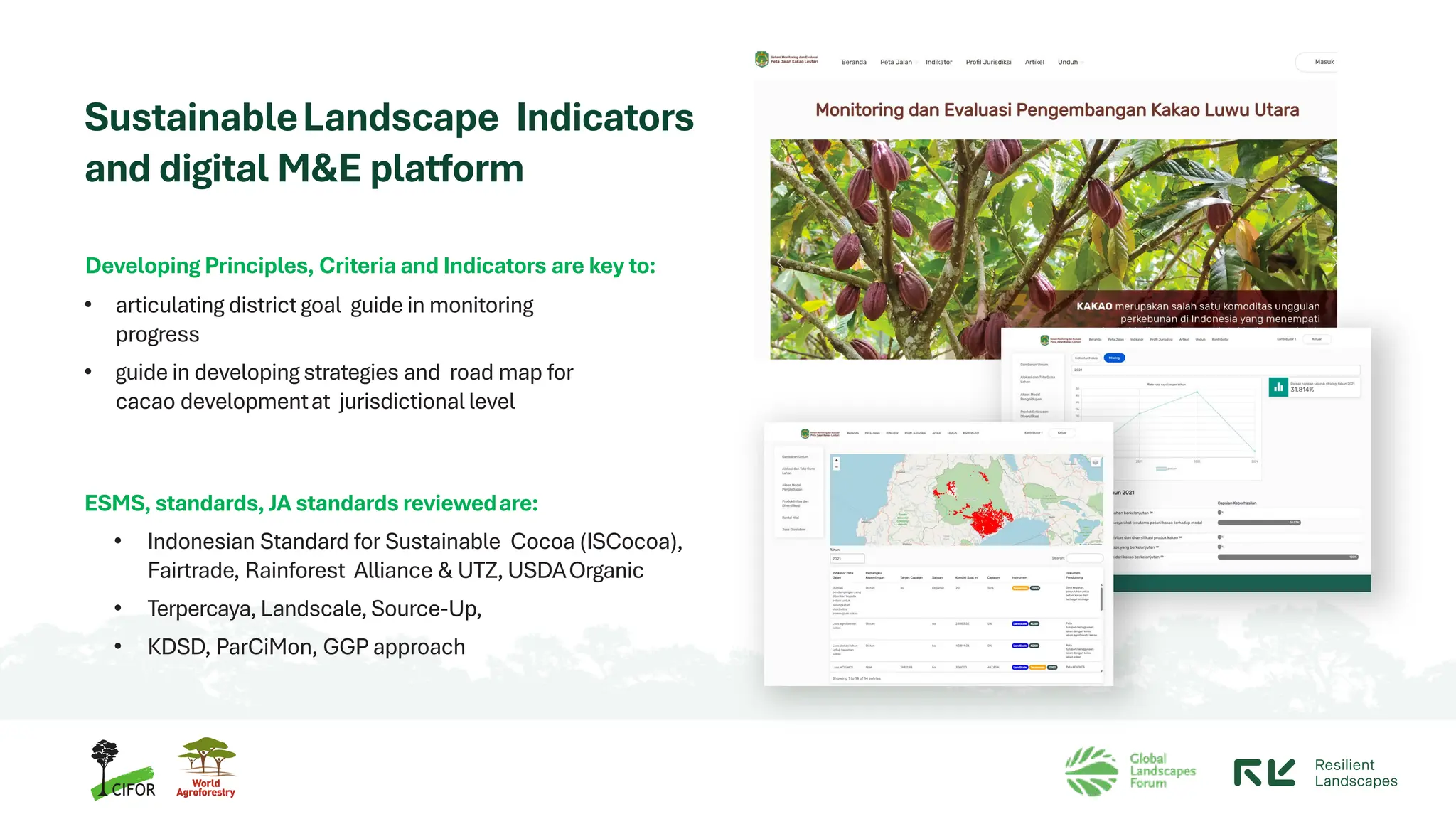
SustainableLandscape Indicators
and digital M&E platform
Developing Principles, Criteria and Indicators are key to:
• articulating district goal guide in monitoring
progress
• guide in developing strategies and road map for
cacao developmentat jurisdictional level
ESMS, standards, JA standards reviewedare:
• Indonesian Standard for Sustainable Cocoa (ISCocoa),
Fairtrade, Rainforest Alliance & UTZ, USDAOrganic
• Terpercaya, Landscale, Source-Up,
• KDSD, ParCiMon, GGP approach
WorldAgroforestry
Ecological Fiscal
Transfer for village-
level implementations
Luwu Utara applied the Ecological Fiscal Transfer (TAKE), providing budget incentives to
villages that successfully manage their environment sustainably. SFITAL with partners
evaluated its implementation and recommended integration of environmental
performance-based indicators linked to allow effective implementation. This has been
enacted in Head of District Regulation No 1/2025.
Improved Incentive Metrics
Actual Fund Allocation
Harnessing sustainable
cacao practices in Davao • Davao region is the ‘cacao capital’ of the Philippines1,
situated in southeastern Mindanao region of the
country
• Production are sub-optimal despite having extensive
suitable land.
• Existing regional and national cacao roadmaps with
strong industry-led cacao network.
Context & opportunities
21
Roadmap strategies and interventions consultation workshop
Led by Provincial Agriculture
Office (PAGRO), private sectors,
governmental offices,
academies, NGOs
22
22
Strategies and interventions for
sustainable cacao development
• Strategy 1: Sustainable land use
allocation for cacao production
• Strategy 2: Improve access of the cacao
farming community to livelihood capitals
• Strategy 3: Increase productivity and
income diversification of cacao farms
• Strategy 4: Sustainable improvement of
supply and market value chain
• Strategy 5: Incentivize ecosystem
services generated at farm- and
landscape scale
• Strategy 6: Support regulation and
governance
Land use interventions
23
23
Evaluating impact and tradeoff of sustainable strategies
More sustainable cacao practices can potentially increase overall farm income by 13-25%, forest protection
can avoid 5,000 ha remaining forests from conversion into crop cultivation
Mainstreaming the roadmap into current development policies
Vision of the roadmap
Provincial Council
Resolution No. 2052,
series of 2024, mandates
the integration of the
roadmap into
the province’s:
Annual Investment Plan
for 2026 onwards; and
Provincial Commodity
Investment Plan
INNOVATING CAPACITY DEVELOPMENT FOR SMALLHOLDER
AGROFORESTRY AND AGROECOLOGICAL PRACTICES:
LESSONS FROM THE PHILIPPINES AND INDONESIA
Endri Martini and Zarrel Gel Noza
CAPACITY STRENGTHENING APPROACHES:
SUSTAINABLE CACAO AND OILPALM PRODUCED BY SMALLHOLDERS
EXISTING
CONDITION OF
SMALLHOLDERS:
• Local knowledge on
best management
practices
• Learning by doing
on farming as a
business
IMPROVED
CAPACITIES OF
SMALLHOLDERS:
• Best
management
practices for
sustainable
production
• Farming as a
business for
better economic
benefits
Approach 1:
Collaborative
extension
Approach 2:
Site-specific
training curricula
Approach 3:
Co-designed
learning plots
Approach 4: E-learning on
innovation on best
management practices
Approach 5: Smallholder
business model
development
Innovative approach 1. Collaborative Extension
DEFINITION
Extension approach that are developed
through collaboration of multiple
agencies who have same goals and
beneficiaries targets.
WHY NEEDED?
• For estate crops (e.g. cacao and
oilpalm), usually there is no specific
formal extension systems developed
by the government, if compared to
food crop.
• Need collaboration of different
agencies to support sustainable
extension approaches.
ROLES OF MULTIPLE
STAKEHOLDERS
• Resources Persons
(Academician or research
agencies)
• Provide facilities (Private
sectors)
• Provide regulation to sustain
partnership in extension
(Government)
• Provide facilitation to farmers
(NGOs)
LESSONS FROM INDONESIA AND THE PHILIPPINES
Aspects Indonesia The Philippines
Stakeholders
involved
Government extension
agencies, Research Agencies
(ICRAF), Certification Body
(Rainforest Alliances) Private
sectors (Mars), Farmer
champions
Government institutions, sister project (DTI
Rapid), associations (Philippines Cacao
Industry Councils, farmer cooperatives),
academies (Davao de Oro State College,
University of the Philippines Mindanao),
private sector (Kennemer Foods
International)
Commodities Cacao, Oilpalm Cacao
Highlight
lessons
• Dividing roles between
multiple partners (private
sectors, certification
body, government
agencies and research
agencies), filling in the
knowledge gaps and
needs for capacities
development.
• Partnering with formal educational
institutions to engage youth in
sustainable cacao cultivation
• The huge role of local municipal
agriculture offices in ensuring the
sustainability of the training outcomes
• Equipping extensionists, not just with
technical knowledge, but also with
communication and facilitation skills
Innovative approach 2: Site-specific training curriculum
Coaching process after the training
Aspects Indonesia The Philippines
Main Issues Low production of cacao and
oilpalm because of lack of:
a. Access to quality seedlings
b. Access to information on
best management
practices to maintain the
commodities
c. Access to finance for
agricultural inputs
Land use conversion to more
profitable land use systems.
Low production of cacao because
of lack of:
a. Access to quality seedlings
b. Access to information on best
management practices to
maintain the commodities
c. Access to finance for
agricultural inputs
Soil degradation issues (erosion
because of slope)
Commodities Cacao, Oilpalm Cacao
Topics for
curriculum
• Agroforestry
• Farming as a business
• Post harvest handling
(cacao)
• Good Agricultural Practices
(incl. soil and water
conservation)
• Cacao farm agribusiness and
financial literacy
• Cacao-based agroecological
practices and potentially
generated ecosystem services
• Develop a business plan of
cacao-based agroecological
practices
• Post harvesting technique and
packaging
Innovative approach 3. Co-designed Learning Plots
Cacao Agroforestry
Learning Plot
Model for
Rejuvenation in
uplands/flatland
Desa Pararra and
Terpedo Jaya,
South Sulawesi
Cacao Agroforestry
Learning Plot Model
In Flooded areas
Desa Rompu, South
Sulawesi
Cacao Agroforestry
Learning Plot Model
By Integrating with
Bee-keeping
Desa Pararra, South
Sulawesi
Cacao Agroforestry
Learning Plot Model
Combination with
Fruit Trees (Durian)
Desa Tete Uri, South
Sulawesi
Learning Plot Definition:
A plot that is designed and established
participatorily by multiple actors (the owner of
the plots, researchers, extension agencies and
private sectors) with the objective to test
technologies and produce best-fit technologies
that match with local contexts
The Principles of Learning Plots Establishment
CO-INVEST CO-DESIGN CO-
LEARNING
Cacao Agroforestry
Learning Plot with
coconut and fruit
trees
Davao de Oro, Davao,
the Philippines
Innovative approach 4.
E-learning on Innovation on Best Management Practices
E-LEARNING
Objectives: to scale up access to best management practices
Targeted participants: Extension agents, sustainable land use
practitioners, academicians, farmer champions
Type of E-learning: Synchronous e-learning, that combined e-
learning with conventional extension systems.
Facilities provided:
a. Training module/materials (videos, posters, booklets)
b. Online certification
c. Discussion forum to maintain two-way communication
Knowledge management platform of SFITAL Philippines:
https://cacaomustahan.com/
Innovative approach 5. Smallholder Business Model Development
Objective: To produce additional economic benefits from
sustainable land use system
Strategies:
1. Identify potential commodities that can provide economic and
environmental benefits.
2. Development of business model development through
participatory process.
3. Assisting market access for the product produced.
Key Lessons
from SFITAL
Participatory & Inclusive Processes
 Farmers engaged in training and decision-making foster ownership.
 Localized solutions increase adoption and sustainability.
Data-Driven Planning & Interventions
 Tools - LUMENS and R-FALLOW guide land-use scenarios.
 Evidence-based strategies balance productivity and ecosystem services.
Collaborative Stakeholder Engagement
 Joint planning with farmers, scientists, and local actors
strengthens implementation.
 Multistakeholder input ensures context-specific strategies.
Upscaling Training & Curriculum Development
 Practical materials for sustainable cacao shared across projects.
 Field-tested tools support learning in farmer academies and beyond.
Leveraging Public &
Private Support
 Ecological fiscal transfers
and cost-sharing (e.g.,
with MARS, KFI) finance
smallholder support.
 Incentives reinforce
commitment to
sustainability indicators.
Incentivizing Local & Sub-
National Adoption
 Support across the cacao
production chain boosts
farmer resilience.
 Roadmaps and fiscal tools
motivate local governments to
adopt sustainability.
Legal & Strategic
Frameworks
 Formalized roadmaps (e.g.,
District Decrees) ensure
long-term accountability.
 Data-enriched strategies
align with regional
development goals.
Key Lessons from SFITAL
Your Logo or Name Here 35
cifor-icraf.org | globallandscapesforum.org | resilient-landscapes.org
The Center for International Forestry Research and World Agroforestry (CIFOR-ICRAF) harnesses the power of trees, forests
and agroforestry landscapes to address the most pressing global challenges of our time – biodiversity loss, climate change,
food security, livelihoods and inequity. CIFOR and ICRAF are CGIAR Research Centers.
Thank you

Sustainable Farming for Tropical Asian Landscapes (SFITAL): Its journey and pathway

  • 1.
    Sustainable Farming forTropical Asian Landscapes (SFITAL) its journey and pathway Dr Beria Leimona
  • 2.
    Key barriers intransforming sustainable smallholder-centered value chains and production landscape Implementation Gaps  Limited training for smallholders, especially in non-staple crops  Weak adoption of agroforestry (spacing, shading, species)  Trade-offs between production and ecology  Land loss to more profitable crops and development Intervention Gaps  Public–private programs not aligned  Disconnect across national–local levels  Generic strategies lack local context - “One-size-fits-all” doesn’t work in the field Investment Gaps  Limited or no incentives for environmental stewardship at smallholder or district level.  Existing incentives are small- scale and not integrated into public policy or programs. Accountability Gap  Weak monitoring and verification systems  Limited mechanisms to track progress or enforce responsibility, particularly ecological indicators  High transaction cost Alignment Scale/scope Quality/effectiveness
  • 3.
    3 Component 1: Leveragingenvironmental and social management systems and/or standards for sustainable, inclusive and broad-scale transformations of smallholder-based commodity value-chains. Component 2: Piloting and evaluation of sustainable technologies, environmental and social management systems/and standards and traceability systems on the ground Component 3: Road maps to scale-up and mainstream inclusive, sustainable and transparent smallholder commodity chains. Component 4: Coordinated global partnerships and knowledge management for awareness, upscaling and replication. Global/Regional National Landscape Jurisdiction Site SCALE/LEVEL STAKEHOLDERS Farmers Government MSME Large business corporate Independent assessor/ certification agencies Jurisdictional Sustainability: data-driven roadmaps & innovative financing  Integrated land-use modeling and multistakeholder planning  Context-specific finance tools like ecological fiscal transfers  Supports inclusive, actionable pathways for sustainable commodity landscapes Strengthening Smallholder Capacity through Agroecology Agroforestry Innovations from the Philippines & Indonesia  Capacity building for smallholders, women, and youth  Field-tested agroecological practices in cacao and oil palm systems  Locally adapted training models and farmer-led approaches
  • 4.
    Enabling jurisdictional sustainability: Data-drivenroadmaps and innovative financing strategies Dr Betha Lusiana and Dr Rachmat Mulia
  • 5.
    1. Integrates land-use,commodity production, and sustainability goals at the district or provincial level 2. Creates a shared platform for collaboration among government, private sector, farmers, and communities 3. Ensures alignment with government policies and development planning 4. Supports long-term sustainability beyond project/program cycles 5. Strengthens monitoring, reporting, and verification at the jurisdiction scale Why jurisdictional approach?
  • 6.
    Delivering Sustainable Solutions inFocus Jurisdictions Inclusive-integrative process of commodity roadmaps development  Multi-stakeholder process to align strategies and responsibilities.  Applies thematic geospatial data to develop sustainable intervention maps and assess impacts and trade-offs of sustainable interventions. 1 Monitoring and Evaluation Tools for Implementation  Uses jointly agreed sustainability indicators aligned with global jurisdictional standards.  Tools are locally owned and managed to ensure long-term use and accountability. Financing Strategies for Roadmap implementation  Links public policy to on-the-ground actions, enabling sustainable commodities implementation  Integrating roadmap strategies with existing and potential financing 2 3
  • 7.
  • 8.
    Towards Sustainable OilPalm in Labuhan Batu Utara (Labura)  Sit within North Sumatra, the 3rd largest oil palm–producing province in Indonesia. The district ranks 2nd in North Sumatra in total oil palm area, production, and number of independent smallholders.  Agriculture, forestry, and fisheries contribute 35% to the district’s GRDP, the highest among all sectors.  The district lacks an estate crop/oil palm strategy document, as major plantations contribute little to local revenue and offer limited incentive for district engagement. National Strategy on oil palm productivity and sustainability 1. National Action Plan (NAP) on Sustainable mandated every provincial and districts producing oil palm develop Provincial and District Action Plan. In 2021, the North Sumatra Province has produced a ratified Provincial Action Plan. Labura has yet to produce this. 2. Oil Palm Replanting Programme to support oil palm production. Context and Opportunities 3. Oil Palm Profit-Sharing Fund. A revenue-sharing mechanism to distribute a portion of the income derived from palm oil plantations to regional governments
  • 9.
    Development of DistrictAction Plan for Sustainable Oil Palm The DAP contains 5 main strategies: 1. Coordination, Data and Infrastructure Strengthening 2. Farmers Capacity and Capability Strengthening 3. Environmental Management and Monitoring 4. Governance and Conflict Resolution 5. ISPO Certification Acceleration SFITAL Sustainable Oil Palm Intervention maps Impact of Sustainable Interventions on Productive Land Area
  • 10.
    Land cover mapsand land use change analysis (ICRAF) Oil Palm suitability maps (ICRAF) Feasibility analysis of organic fertilizer (PPKS) Value chain governance analysis of palm oil (RA, IPB) SFITAL provided local stakeholders with data & information for developing sustainable oil palm strategies
  • 11.
    Digital M&E Platform Inaddition to the National M&E Dashboard, a district-level digital M&E system was developed to enable local government ownership. It includes SOPs and achievement graphs to support effective monitoring and evaluation. Achievement Graphs
  • 12.
    Benefits achieved North Labuhanbatu’sinvolvement in the national DAP program has increased its visibility at national level, reflected in:  Invitations to national and provincial meetings and capacity-building programs.  Receipt of the Oil Palm Profit-Sharing Fund in 2023–2025, that has been used for sustainable oil palm activities, including farmer capacity strengthening programme
  • 13.
     Lutra isa major cacao-producing district, with plantations contributing 22% to GRDP.  Productivity and soil fertility are declining, pests and diseases are increasing, and bean chemical residues exceed limits.  Cacao also faces growing competition from other commodities. Landscape Approach for Sustainable Cacao in Luwu Utara Utara (Lutra) Context and Opportunities  Cacao roadmaps exist at national and regional exist focusing on boosting farm-level productivity through improved farmer access to inputs.  The local government has strong ambitions to enhance cacao management in the district.
  • 14.
    PROCESS Design of SustainableCacao Road Map Planning Multi-stakeholder agreement Implementation Monitoring Evaluation 1 The Vision of Sustainable Cacao Goals Strategies Scenarios of Development Landscape Modelling Monev Tool Sustainable Cacao Road Map Integrating Road Map to regional development plan Integrating Road Map to Commodity Work plan Principles, criteria, sustainability indicators 2 3 4 5
  • 15.
    Land suitability analysisfor Cacao LAND USE DYNAMICS Potential Actual Category Area (ha) N (Not suitable) 2,504.52 S1 (Very suitable) 2,882,7 S2 (Suitable) 15,136.2 S3 (Marginally suitable) 65.829,24 Potential suitability Actual suitability Potential suitability, with low management Potential suitability, with intensive management The objective: To identify plausible intervention for increasing cacao production area
  • 16.
    Sustainable Cacao Strategies Sustainablevalue chain Sustainable Land Use Planning and Allocation Enhancing access for cacao farmers to livelihood capital Improving productivity and diversification of cacao products Incentive scheme for sustainable cacao Each strategy is detailed into activities, targets, and responsible parties. The projected impacts on cacao production, area, and carbon emissions are also assessed. Interventions /Indicators 4 interventions, 15 iindicators 11 , 48 4 , 28 3 , 14 5 i, 17
  • 17.
    INTERVENTION MAPS & Projectionof Impact Projection of CO2 Emission Sustainable Cacao Scenarios can reduce CO2 emission by 97% compared to BAU.
  • 18.
    SustainableLandscape Indicators and digitalM&E platform Developing Principles, Criteria and Indicators are key to: • articulating district goal guide in monitoring progress • guide in developing strategies and road map for cacao developmentat jurisdictional level ESMS, standards, JA standards reviewedare: • Indonesian Standard for Sustainable Cocoa (ISCocoa), Fairtrade, Rainforest Alliance & UTZ, USDAOrganic • Terpercaya, Landscale, Source-Up, • KDSD, ParCiMon, GGP approach WorldAgroforestry
  • 19.
    Ecological Fiscal Transfer forvillage- level implementations Luwu Utara applied the Ecological Fiscal Transfer (TAKE), providing budget incentives to villages that successfully manage their environment sustainably. SFITAL with partners evaluated its implementation and recommended integration of environmental performance-based indicators linked to allow effective implementation. This has been enacted in Head of District Regulation No 1/2025. Improved Incentive Metrics Actual Fund Allocation
  • 20.
    Harnessing sustainable cacao practicesin Davao • Davao region is the ‘cacao capital’ of the Philippines1, situated in southeastern Mindanao region of the country • Production are sub-optimal despite having extensive suitable land. • Existing regional and national cacao roadmaps with strong industry-led cacao network. Context & opportunities
  • 21.
    21 Roadmap strategies andinterventions consultation workshop Led by Provincial Agriculture Office (PAGRO), private sectors, governmental offices, academies, NGOs
  • 22.
    22 22 Strategies and interventionsfor sustainable cacao development • Strategy 1: Sustainable land use allocation for cacao production • Strategy 2: Improve access of the cacao farming community to livelihood capitals • Strategy 3: Increase productivity and income diversification of cacao farms • Strategy 4: Sustainable improvement of supply and market value chain • Strategy 5: Incentivize ecosystem services generated at farm- and landscape scale • Strategy 6: Support regulation and governance Land use interventions
  • 23.
    23 23 Evaluating impact andtradeoff of sustainable strategies More sustainable cacao practices can potentially increase overall farm income by 13-25%, forest protection can avoid 5,000 ha remaining forests from conversion into crop cultivation
  • 24.
    Mainstreaming the roadmapinto current development policies Vision of the roadmap Provincial Council Resolution No. 2052, series of 2024, mandates the integration of the roadmap into the province’s: Annual Investment Plan for 2026 onwards; and Provincial Commodity Investment Plan
  • 25.
    INNOVATING CAPACITY DEVELOPMENTFOR SMALLHOLDER AGROFORESTRY AND AGROECOLOGICAL PRACTICES: LESSONS FROM THE PHILIPPINES AND INDONESIA Endri Martini and Zarrel Gel Noza
  • 26.
    CAPACITY STRENGTHENING APPROACHES: SUSTAINABLECACAO AND OILPALM PRODUCED BY SMALLHOLDERS EXISTING CONDITION OF SMALLHOLDERS: • Local knowledge on best management practices • Learning by doing on farming as a business IMPROVED CAPACITIES OF SMALLHOLDERS: • Best management practices for sustainable production • Farming as a business for better economic benefits Approach 1: Collaborative extension Approach 2: Site-specific training curricula Approach 3: Co-designed learning plots Approach 4: E-learning on innovation on best management practices Approach 5: Smallholder business model development
  • 27.
    Innovative approach 1.Collaborative Extension DEFINITION Extension approach that are developed through collaboration of multiple agencies who have same goals and beneficiaries targets. WHY NEEDED? • For estate crops (e.g. cacao and oilpalm), usually there is no specific formal extension systems developed by the government, if compared to food crop. • Need collaboration of different agencies to support sustainable extension approaches. ROLES OF MULTIPLE STAKEHOLDERS • Resources Persons (Academician or research agencies) • Provide facilities (Private sectors) • Provide regulation to sustain partnership in extension (Government) • Provide facilitation to farmers (NGOs)
  • 28.
    LESSONS FROM INDONESIAAND THE PHILIPPINES Aspects Indonesia The Philippines Stakeholders involved Government extension agencies, Research Agencies (ICRAF), Certification Body (Rainforest Alliances) Private sectors (Mars), Farmer champions Government institutions, sister project (DTI Rapid), associations (Philippines Cacao Industry Councils, farmer cooperatives), academies (Davao de Oro State College, University of the Philippines Mindanao), private sector (Kennemer Foods International) Commodities Cacao, Oilpalm Cacao Highlight lessons • Dividing roles between multiple partners (private sectors, certification body, government agencies and research agencies), filling in the knowledge gaps and needs for capacities development. • Partnering with formal educational institutions to engage youth in sustainable cacao cultivation • The huge role of local municipal agriculture offices in ensuring the sustainability of the training outcomes • Equipping extensionists, not just with technical knowledge, but also with communication and facilitation skills
  • 29.
    Innovative approach 2:Site-specific training curriculum Coaching process after the training Aspects Indonesia The Philippines Main Issues Low production of cacao and oilpalm because of lack of: a. Access to quality seedlings b. Access to information on best management practices to maintain the commodities c. Access to finance for agricultural inputs Land use conversion to more profitable land use systems. Low production of cacao because of lack of: a. Access to quality seedlings b. Access to information on best management practices to maintain the commodities c. Access to finance for agricultural inputs Soil degradation issues (erosion because of slope) Commodities Cacao, Oilpalm Cacao Topics for curriculum • Agroforestry • Farming as a business • Post harvest handling (cacao) • Good Agricultural Practices (incl. soil and water conservation) • Cacao farm agribusiness and financial literacy • Cacao-based agroecological practices and potentially generated ecosystem services • Develop a business plan of cacao-based agroecological practices • Post harvesting technique and packaging
  • 30.
    Innovative approach 3.Co-designed Learning Plots Cacao Agroforestry Learning Plot Model for Rejuvenation in uplands/flatland Desa Pararra and Terpedo Jaya, South Sulawesi Cacao Agroforestry Learning Plot Model In Flooded areas Desa Rompu, South Sulawesi Cacao Agroforestry Learning Plot Model By Integrating with Bee-keeping Desa Pararra, South Sulawesi Cacao Agroforestry Learning Plot Model Combination with Fruit Trees (Durian) Desa Tete Uri, South Sulawesi Learning Plot Definition: A plot that is designed and established participatorily by multiple actors (the owner of the plots, researchers, extension agencies and private sectors) with the objective to test technologies and produce best-fit technologies that match with local contexts The Principles of Learning Plots Establishment CO-INVEST CO-DESIGN CO- LEARNING Cacao Agroforestry Learning Plot with coconut and fruit trees Davao de Oro, Davao, the Philippines
  • 31.
    Innovative approach 4. E-learningon Innovation on Best Management Practices E-LEARNING Objectives: to scale up access to best management practices Targeted participants: Extension agents, sustainable land use practitioners, academicians, farmer champions Type of E-learning: Synchronous e-learning, that combined e- learning with conventional extension systems. Facilities provided: a. Training module/materials (videos, posters, booklets) b. Online certification c. Discussion forum to maintain two-way communication Knowledge management platform of SFITAL Philippines: https://cacaomustahan.com/
  • 32.
    Innovative approach 5.Smallholder Business Model Development Objective: To produce additional economic benefits from sustainable land use system Strategies: 1. Identify potential commodities that can provide economic and environmental benefits. 2. Development of business model development through participatory process. 3. Assisting market access for the product produced.
  • 33.
    Key Lessons from SFITAL Participatory& Inclusive Processes  Farmers engaged in training and decision-making foster ownership.  Localized solutions increase adoption and sustainability. Data-Driven Planning & Interventions  Tools - LUMENS and R-FALLOW guide land-use scenarios.  Evidence-based strategies balance productivity and ecosystem services. Collaborative Stakeholder Engagement  Joint planning with farmers, scientists, and local actors strengthens implementation.  Multistakeholder input ensures context-specific strategies. Upscaling Training & Curriculum Development  Practical materials for sustainable cacao shared across projects.  Field-tested tools support learning in farmer academies and beyond.
  • 34.
    Leveraging Public & PrivateSupport  Ecological fiscal transfers and cost-sharing (e.g., with MARS, KFI) finance smallholder support.  Incentives reinforce commitment to sustainability indicators. Incentivizing Local & Sub- National Adoption  Support across the cacao production chain boosts farmer resilience.  Roadmaps and fiscal tools motivate local governments to adopt sustainability. Legal & Strategic Frameworks  Formalized roadmaps (e.g., District Decrees) ensure long-term accountability.  Data-enriched strategies align with regional development goals. Key Lessons from SFITAL
  • 35.
    Your Logo orName Here 35 cifor-icraf.org | globallandscapesforum.org | resilient-landscapes.org The Center for International Forestry Research and World Agroforestry (CIFOR-ICRAF) harnesses the power of trees, forests and agroforestry landscapes to address the most pressing global challenges of our time – biodiversity loss, climate change, food security, livelihoods and inequity. CIFOR and ICRAF are CGIAR Research Centers. Thank you