Entrepreneurship
lesson series -2
Dr.B.Yerram Raju
Founder Director, Telangana Industrial Health
Clinic Ltd., Government of Telangana,
HYDERABAD
yerramr@gmail.com
Session deals with:
• The Role of Entrepreneurship
• The Myths
• The Processes
• The Typologies
• Risks and Rewards
• Self Assessment of Enterprises
26-Nov-22 yerramraju 2
26-Nov-22 yerramraju 3
Some people in this world
MAKE things happen
Some people in this world
WATCH things happen
Some people in this world
WONDER what’s happening
26-Nov-22 yerramraju 4
Role of Small Enterprises
Seedbed of the Economy
 Small enterprises seen as the seeds from
which large successful corporations grow
– e.g. V-Guard, Nirma, Dr.Reddy Labs, Infosys
 Employment Creators
– Small firms make a more consistent
contribution to job creation
 Stimulators of Competition
 Developers of the Local Economy
26-Nov-22 yerramraju 5
Myths of Entrepreneurship
• The Risk-Taking Myth: “Most successful
entrepreneurs take wild, uncalculated risks in
starting their companies.”
• The High-Tech Invention Myth: “Most
successful entrepreneurs start their companies
with a break-through invention – usually
technological in nature.”
• The Expert Myth: “Most successful
entrepreneurs have strong track records and
years of experience in their industries.”
26-Nov-22 yerramraju 6
Myths of Entrepreneurship
• The Strategic Vision Myth: “Most successful
entrepreneurs have a well-considered business
plan and have researched and developed their
ideas before taking action.”
• The Venture Capital Myth: “Most successful
entrepreneurs start their companies with
millions in venture capital to develop their
idea, buy supplies, and hire employees.”
26-Nov-22 yerramraju 7
ENTREPRENEURSHIP
• The ‘Myths’ of entrepreneurship
– Entrepreneurs are born, not made
– All you need is money to be an
entrepreneur
– All you need is luck to be an entrepreneur
– Entrepreneurs are extreme risk takers
• Let’s debunk them!
26-Nov-22 yerramraju 8
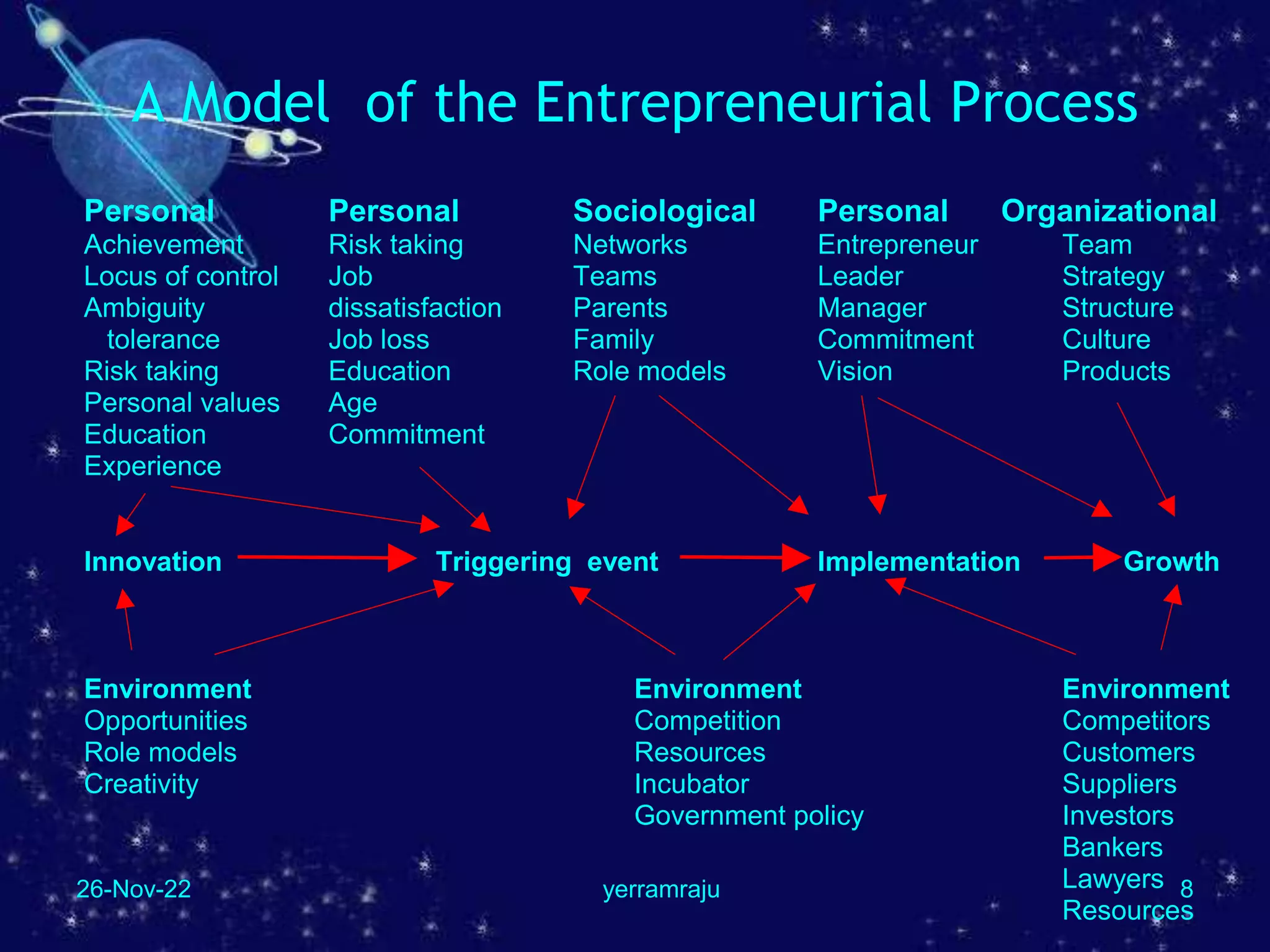
Personal Personal Sociological Personal Organizational
Achievement Risk taking Networks Entrepreneur Team
Locus of control Job Teams Leader Strategy
Ambiguity dissatisfaction Parents Manager Structure
tolerance Job loss Family Commitment Culture
Risk taking Education Role models Vision Products
Personal values Age
Education Commitment
Experience
Innovation Triggering event Implementation Growth
Environment Environment Environment
Opportunities Competition Competitors
Role models Resources Customers
Creativity Incubator Suppliers
Government policy Investors
Bankers
Lawyers
Resources
A Model of the Entrepreneurial Process
26-Nov-22 yerramraju 9
What Makes a Successful
Entrepreneur?
1. Passion
2. Persistence
3. Good Health/Energy
4. Creativity/Innovation
5. Independence/Self-reliance
6. Intuition
7. Self-confidence
8. Market Awareness
9. Lack of Need for Status
10. Ability to Accept Challenges
11. “Hard Work” Ethics
26-Nov-22 yerramraju 10
Risks & Rewards of Entrepreneurship
Risks & Drawbacks
• Failure – One must assume the emotional and financial risks of failure.
• Time – It takes a tremendous amount of time to make a business
successful. Most report 60-70 hours per week as “NORMAL”!
• Family – Because of the strain of operating a business, the family may
suffer.
• Money – Most start-up entrepreneurs have their own money at risk.
Rewards
• Independence – For many, the freedom to act independently is
paramount in their decision to be their own boss.
• Money – The financial return from their own efforts is not limited to
normal work for normal pay.
• Fun – Entrepreneurs describe what they do as Fun…it’s what they WANT
to do!
26-Nov-22 yerramraju 11
TYPOLOGIES
• Team entrepreneurship
• Corporate entrepreneurship
• Social entrepreneurship
• Public sector entrepreneurship
26-Nov-22 yerramraju 12
TEAM ENTREPRENEURSHIP
• Idea or Event - Individual or Team - Idea Evaluation -
Resources Required - Team Development -
Implementation (Cooney - 2001)
• Differences?
– Not a lone action (body of research points to team
entrepreneurship more likely will lead to fast-growth firms)
– Need for personal risk taking is reduced
– Issue of control and ownership
– Good networking abilities
– Sharing information, responsibility and rewards
26-Nov-22 yerramraju 13
CORPORATE
ENTREPRENEURSHIP
• Organisational Characteristics / Precipitating Event / Individual
Characteristics - Decision to act intrapreneurially - Business /
Feasibility Planning - Resource availability - Ability to overcome
barriers - Idea implementation (Hornsby et al - 1993)
• Different worlds: (Carrier - 1994)
– structural context
– relationship related context
– enhancement and rewards
– consequences of dissatisfaction amongst intrapreneurs
• Organisation that: (Luchsinger and Bagby - 1987)
– focuses on results and teamwork,
– rewards innovation and risk taking
– tolerates and learns from mistakes remains flexible
26-Nov-22 yerramraju 14
SOCIAL ENTREPRENEURSHIP
• Guage the commitment - Develop the infrastructure -
Generate and screen ideas - Conduct the feasibility
studies - Plan the venture (Campbell - 1998)
• Unique characteristics: (Waddock and Post - 1991)
– problem complexity
– multiplexity
– crisis
– interdependence
– credibility
– commitment to collective purpose
– end values
26-Nov-22 yerramraju 15
PUBLIC ENTREPRENEURSHIP
• Identify an opportunity - Develop the concept - Assess
the resources required - Acquire the necessary
resources - Manage and harvest the venture
(Morris and Jones - 1999)
• Common Barriers: (Ramamurti - 1986)
– goal ambiguity
– political interference and limited political autonomy
– high visibility
– disincentives for risk taking
– short-term orientation
– rigid personnel practices
26-Nov-22 yerramraju 16
ONGOING SELF ASSESSMENT
ENTREPRENEURIAL OR NOT?
WHERE DO YOU FIT BETWEEN ONE AND TEN?
• Highly motivated to grow and succeed -- Status quo
isn’t so bad, and safer.
• Enjoy self-directed work -- Need a task list from
someone else.
• Lines between work/play blurred -- Work must have a
beginning and end.
• Energetic, enthusiastic -- Times are tough and getting
tougher.
• Creative, lots of new ideas - - Things were better
before.
26-Nov-22 yerramraju 17
Ongoing Self Assessment
ENTREPRENEURIAL or NOT?
WHERE DO YOU FIT BETWEEN ONE AND TEN?
• Takes prudent risks with capital – Looking for a sure
thing.
• Active, involved “owns” the effort – Re-active, does
what seems to be popular.
• Researcher: papers, internet, meetings – Others know
more than I do.
• Into everything, hold me back! – Leave it to the
experts.
• Inquisitive, tries anything once – Rarely departs from
the familiar.
26-Nov-22 yerramraju 18
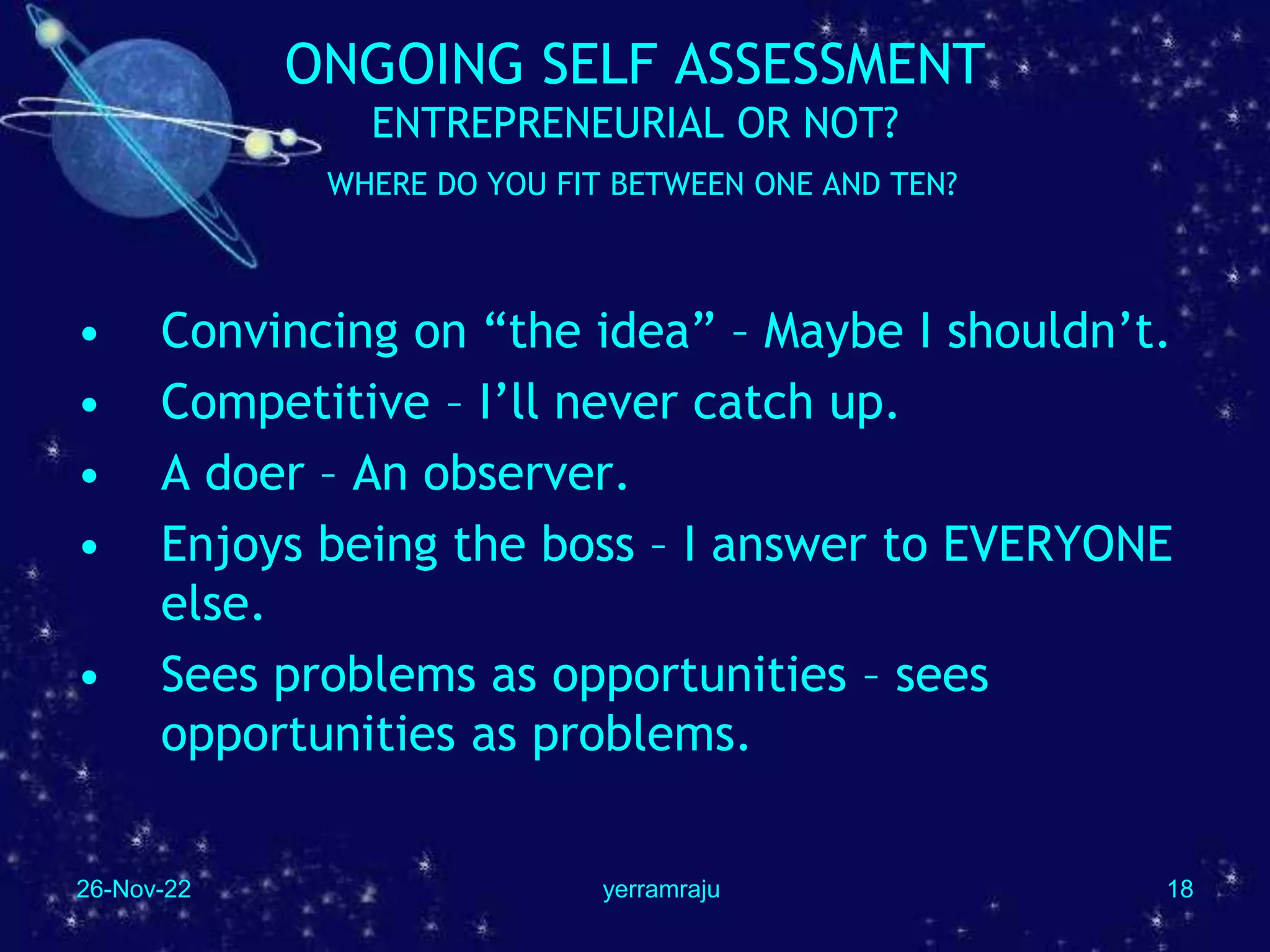
ONGOING SELF ASSESSMENT
ENTREPRENEURIAL OR NOT?
WHERE DO YOU FIT BETWEEN ONE AND TEN?
• Convincing on “the idea” – Maybe I shouldn’t.
• Competitive – I’ll never catch up.
• A doer – An observer.
• Enjoys being the boss – I answer to EVERYONE
else.
• Sees problems as opportunities – sees
opportunities as problems.
THANK YOU

Entrepreneurship Lesson2.ppt

  • 1.
    Entrepreneurship lesson series -2 Dr.B.YerramRaju Founder Director, Telangana Industrial Health Clinic Ltd., Government of Telangana, HYDERABAD yerramr@gmail.com
  • 2.
    Session deals with: •The Role of Entrepreneurship • The Myths • The Processes • The Typologies • Risks and Rewards • Self Assessment of Enterprises 26-Nov-22 yerramraju 2
  • 3.
    26-Nov-22 yerramraju 3 Somepeople in this world MAKE things happen Some people in this world WATCH things happen Some people in this world WONDER what’s happening
  • 4.
    26-Nov-22 yerramraju 4 Roleof Small Enterprises Seedbed of the Economy  Small enterprises seen as the seeds from which large successful corporations grow – e.g. V-Guard, Nirma, Dr.Reddy Labs, Infosys  Employment Creators – Small firms make a more consistent contribution to job creation  Stimulators of Competition  Developers of the Local Economy
  • 5.
    26-Nov-22 yerramraju 5 Mythsof Entrepreneurship • The Risk-Taking Myth: “Most successful entrepreneurs take wild, uncalculated risks in starting their companies.” • The High-Tech Invention Myth: “Most successful entrepreneurs start their companies with a break-through invention – usually technological in nature.” • The Expert Myth: “Most successful entrepreneurs have strong track records and years of experience in their industries.”
  • 6.
    26-Nov-22 yerramraju 6 Mythsof Entrepreneurship • The Strategic Vision Myth: “Most successful entrepreneurs have a well-considered business plan and have researched and developed their ideas before taking action.” • The Venture Capital Myth: “Most successful entrepreneurs start their companies with millions in venture capital to develop their idea, buy supplies, and hire employees.”
  • 7.
    26-Nov-22 yerramraju 7 ENTREPRENEURSHIP •The ‘Myths’ of entrepreneurship – Entrepreneurs are born, not made – All you need is money to be an entrepreneur – All you need is luck to be an entrepreneur – Entrepreneurs are extreme risk takers • Let’s debunk them!
  • 8.
    26-Nov-22 yerramraju 8 PersonalPersonal Sociological Personal Organizational Achievement Risk taking Networks Entrepreneur Team Locus of control Job Teams Leader Strategy Ambiguity dissatisfaction Parents Manager Structure tolerance Job loss Family Commitment Culture Risk taking Education Role models Vision Products Personal values Age Education Commitment Experience Innovation Triggering event Implementation Growth Environment Environment Environment Opportunities Competition Competitors Role models Resources Customers Creativity Incubator Suppliers Government policy Investors Bankers Lawyers Resources A Model of the Entrepreneurial Process
  • 9.
    26-Nov-22 yerramraju 9 WhatMakes a Successful Entrepreneur? 1. Passion 2. Persistence 3. Good Health/Energy 4. Creativity/Innovation 5. Independence/Self-reliance 6. Intuition 7. Self-confidence 8. Market Awareness 9. Lack of Need for Status 10. Ability to Accept Challenges 11. “Hard Work” Ethics
  • 10.
    26-Nov-22 yerramraju 10 Risks& Rewards of Entrepreneurship Risks & Drawbacks • Failure – One must assume the emotional and financial risks of failure. • Time – It takes a tremendous amount of time to make a business successful. Most report 60-70 hours per week as “NORMAL”! • Family – Because of the strain of operating a business, the family may suffer. • Money – Most start-up entrepreneurs have their own money at risk. Rewards • Independence – For many, the freedom to act independently is paramount in their decision to be their own boss. • Money – The financial return from their own efforts is not limited to normal work for normal pay. • Fun – Entrepreneurs describe what they do as Fun…it’s what they WANT to do!
  • 11.
    26-Nov-22 yerramraju 11 TYPOLOGIES •Team entrepreneurship • Corporate entrepreneurship • Social entrepreneurship • Public sector entrepreneurship
  • 12.
    26-Nov-22 yerramraju 12 TEAMENTREPRENEURSHIP • Idea or Event - Individual or Team - Idea Evaluation - Resources Required - Team Development - Implementation (Cooney - 2001) • Differences? – Not a lone action (body of research points to team entrepreneurship more likely will lead to fast-growth firms) – Need for personal risk taking is reduced – Issue of control and ownership – Good networking abilities – Sharing information, responsibility and rewards
  • 13.
    26-Nov-22 yerramraju 13 CORPORATE ENTREPRENEURSHIP •Organisational Characteristics / Precipitating Event / Individual Characteristics - Decision to act intrapreneurially - Business / Feasibility Planning - Resource availability - Ability to overcome barriers - Idea implementation (Hornsby et al - 1993) • Different worlds: (Carrier - 1994) – structural context – relationship related context – enhancement and rewards – consequences of dissatisfaction amongst intrapreneurs • Organisation that: (Luchsinger and Bagby - 1987) – focuses on results and teamwork, – rewards innovation and risk taking – tolerates and learns from mistakes remains flexible
  • 14.
    26-Nov-22 yerramraju 14 SOCIALENTREPRENEURSHIP • Guage the commitment - Develop the infrastructure - Generate and screen ideas - Conduct the feasibility studies - Plan the venture (Campbell - 1998) • Unique characteristics: (Waddock and Post - 1991) – problem complexity – multiplexity – crisis – interdependence – credibility – commitment to collective purpose – end values
  • 15.
    26-Nov-22 yerramraju 15 PUBLICENTREPRENEURSHIP • Identify an opportunity - Develop the concept - Assess the resources required - Acquire the necessary resources - Manage and harvest the venture (Morris and Jones - 1999) • Common Barriers: (Ramamurti - 1986) – goal ambiguity – political interference and limited political autonomy – high visibility – disincentives for risk taking – short-term orientation – rigid personnel practices
  • 16.
    26-Nov-22 yerramraju 16 ONGOINGSELF ASSESSMENT ENTREPRENEURIAL OR NOT? WHERE DO YOU FIT BETWEEN ONE AND TEN? • Highly motivated to grow and succeed -- Status quo isn’t so bad, and safer. • Enjoy self-directed work -- Need a task list from someone else. • Lines between work/play blurred -- Work must have a beginning and end. • Energetic, enthusiastic -- Times are tough and getting tougher. • Creative, lots of new ideas - - Things were better before.
  • 17.
    26-Nov-22 yerramraju 17 OngoingSelf Assessment ENTREPRENEURIAL or NOT? WHERE DO YOU FIT BETWEEN ONE AND TEN? • Takes prudent risks with capital – Looking for a sure thing. • Active, involved “owns” the effort – Re-active, does what seems to be popular. • Researcher: papers, internet, meetings – Others know more than I do. • Into everything, hold me back! – Leave it to the experts. • Inquisitive, tries anything once – Rarely departs from the familiar.
  • 18.
    26-Nov-22 yerramraju 18 ONGOINGSELF ASSESSMENT ENTREPRENEURIAL OR NOT? WHERE DO YOU FIT BETWEEN ONE AND TEN? • Convincing on “the idea” – Maybe I shouldn’t. • Competitive – I’ll never catch up. • A doer – An observer. • Enjoys being the boss – I answer to EVERYONE else. • Sees problems as opportunities – sees opportunities as problems.
  • 19.