Members Kamolpan Tawitsri No.1 Class 6/4 Tipbapah Pisithkul No.4 Class 6/4 Roykrong Sukkerd No.6 Class 6/4 Adviser Mrs.Siripon Boonplianpol
3.
There are tonallanguages around the world such as Red Indian in North and South America, Swedish and Norwegian in Europe, Bantu, Myanmar and Thai in Asia. The Thai language has four tone marks and five tonemes, the low, the falling, the mid, the high and the rising. The advantage of having tones is the existence of many words; different tones give the words different meanings. So it is necessary to utter the word with the tone correctly. This project was created with the purpose of studying the tone recognition by using F0 contours as the indicators, and advancing the Thai tone practicing program. Abstract
4.
key words: tone,tone recognition, F0 contour, average F0 contour The program can be separated into 2 parts, Thai tone practicing for common persons (especially the foreigners) and Thai tone practicing for the hearing deficient persons. The program uses the tone recognition for checking the users’ utterances. When the voice of a program user is inputted, the fundamental frequency of the voice will be analyzed by the program. Then, the program will calculate the coefficients in the polynomial equations that fit the F0 contour. After we have the coefficients in matrix [B], the program will calculate the standard deviation, Baverage and Z-score of [B]. Outputs of the program are the user’s F0 contour compared with the average F0 model, tonal accuracy and degree of loudness.
5.
Introduction Thai isa tonal language. There are five tonemes in Thai, the mid, the low, the falling, the high and the rising. The feature of spee ch, u sed to classify the ton e, is the shape of fundamental frequency (F0) contour, shown in Figure 1. Figure 1 : Average F0 contours of the five Thai tones produced in isolation by a male speaker [3].
6.
Fundamental statistics andmathematics are required for understanding the algorithms of the program; average, standard deviation and Z-score . Average ; N is the number of matrix B Standard Deviation Z-score
7.
Purpose 1. To study the tone recognition system by using fundamental frequency contour as the indicator 2. To advance the tone practice for hearing deficiency program
8.
Limits This programis efficient in a quiet place and the words which are used in practicing are monosyllabic and have long vowels. If the program user is not the congenital deaf, he would have a greater probability to succeed following the method of the program.
9.
Sampling We willask for cooperation from 50 MWIT students (25 males and 25 females) to record their voices. Each student records 15 voice clips, 3 clips per each Thai tone. While we are recording the voices, Thai teacher of MWIT advises the students to utter Thai tones correctly.
10.
Tone Practice Usethe algorithms of tone recognition to check whether the speaker’s tone is correct
Tone Feature: curveof F0 changing (F0 contour) Identity of curve: the coefficient of polynomial that fits the F0 contour Objective: to determine the coefficients of a polynomial that fit the F 0 contour
14.
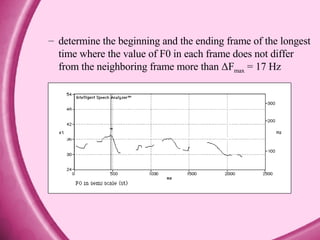
1.1 F0smoothing and segmentation procedure smoothing procedure using median filtering fragment the signal into many frames of length 30 ms (each frame overlaps 10 ms) and extract pitch from each frame using FFT
15.
determine the beginningand the ending frame of the longest time where the value of F0 in each frame does not differ from the neighboring frame more than ΔF max = 17 Hz
16.
1.2 Polynomialregression determine the coefficients b k of a polynomial that fit the segmented F0 contour Let F = be a sequence of segmented F0 of length L Let = be an estimated vector of F is the coefficient of (d-1)-order polynomial regression function …… .(1) where t i = i/L is a normalized time with respect to F i
Create a modelfor each tone by using Gaussian Distribution, find the arithmetic mean and standard deviation of B |w j Null Hypothesis H 0 : The test voice is tone w j . 2. Classification Algorithms
19.
Determine the criticalvalue by the level of significance Reject the H 0 when Let be the feature vector of the test voice Calculate the Z-score of Check Z with the H 0
20.
Loudness measurement Theprogram will calculate the loudness of voice (input) in degree of decibel automatically by Praat, show the curve of intensity of input voice depending on time and show the threshold of speaking. Sensitivity of Human Ear Typical power values of speech sources : Whispered speech 30 dB Average for speech 70 dB Loud speech 83 dB Shouted speech 90 dB
21.
F0Feature Extraction Tone checking Loudness control Tone Practice Loudness Measurement Tone accuracy Level of speech
22.
Conclusion The systemfor monosyllabic Thai tone recognition has been proposed in this paper . We used the coefficient of polynomial regression function as a feature vector of the segmented F 0 contour. In the training phase, we will separate gender and tones into each case. After solving matrix equations we will have many of matrix B. Then, use fundamental statistics to find , S.D. and Z-score. The program will check Z-score of input with H0 by using the critical value in Gaussian Distribution. Figure3 : Block diagram of system
23.
References Tabtong N.and Kitsirikul B., Support Vector Machines for Thai Phoneme Recognition , Machine Intelligence & Knowledge Discovery Laboratory Department of Computer Engineering, Chulalongkorn University Bangkok, International Journal of Uncertainty, Fuzziness and Knowledge-Based Systems : Vol. 9, No. 6 (2001) 803—813. Wattanapong P. and Sukanek S., Continuous Thai Tone Recognition using Tri-Half-Tone Hidden Markov Model ( 2547 ), Available online: https://pindex.ku.ac.th/file_research/g 4365034 kufair.pdf Least square method ( 2002 ), Available online: labnet.sci.ku.ac.th/course_web/computa/4_3LeastSq-2.doc. Jittapankul S., F0 Feature Extraction by Polynomial Regression Function for Monosyllabic Thai Tone Recognition, Digital Signal Processing Research Laboratory, Department of Electrical Engineering, Faculty of Engineering, Chulalongkorn University.



![key words: tone, tone recognition, F0 contour, average F0 contour The program can be separated into 2 parts, Thai tone practicing for common persons (especially the foreigners) and Thai tone practicing for the hearing deficient persons. The program uses the tone recognition for checking the users’ utterances. When the voice of a program user is inputted, the fundamental frequency of the voice will be analyzed by the program. Then, the program will calculate the coefficients in the polynomial equations that fit the F0 contour. After we have the coefficients in matrix [B], the program will calculate the standard deviation, Baverage and Z-score of [B]. Outputs of the program are the user’s F0 contour compared with the average F0 model, tonal accuracy and degree of loudness.](https://image.slidesharecdn.com/eng-1197988475481536-2/85/Eng-4-320.jpg)
![Introduction Thai is a tonal language. There are five tonemes in Thai, the mid, the low, the falling, the high and the rising. The feature of spee ch, u sed to classify the ton e, is the shape of fundamental frequency (F0) contour, shown in Figure 1. Figure 1 : Average F0 contours of the five Thai tones produced in isolation by a male speaker [3].](https://image.slidesharecdn.com/eng-1197988475481536-2/85/Eng-5-320.jpg)