Energy Conservation ACT 2001

1
ENERGY CONSERVATION ACT 2001
•Enacted on 1st October 2001.
•Become effective from 1st March
2002.
•Objective of providing necessary
legal framework for promoting
energy conservation measures in
the country.
•Bureau of Energy Efficiency(BEE)
operationalized from 1st March2002.
2
PURPOSE OF THE EC-ACT 2001
• The purpose of this act is to provide for efficient use of energy
and its conservation.
• Provide a policy framework and direction to national energy conservation
activities.
• Coordinate policies and programs on efficient use of energy with
stakeholders.
• Establish systems and procedures to verify measure and monitor EE
improvements.
• Leverage multilateral, bilateral and private sector support to implement the
EC Act.

• Demonstrate EE delivery systems through public-private partnerships.
• TO PROMOTE ENERGY EFFICIENCY IN THE COUNTRY .

3
IMPORTANT FEATURES OF ENERGY CONSERVATION ACT2001
•Energy Conservation Building Code (ECBC)
•Standards & Labeling (S & L)
•Demand Side Management (DSM)

•Bachat Lamp Yojana (BLY).
•Promoting Energy Efficiency in Small & Medium Enterprise
(SMEs).

•Designated Consumers .
4

•Certification of Energy Managers & Energy Auditors.
1. STANDARDS & LABELING
Evolve minimum energy consumption and performance
standards for notified equipment & appliances.
Prohibit manufacture and sale
Of equipment & appliances
not conforming to standards.
Introduce mandatory labeling
to Enable consumers to make
informed choice.

5
6
2. DESIGNATED CONSUMER
Designated Consumers to :
•Get energy audit by Accredited energy audit firms and energy
audit conducted by an accredited energy auditor.
•Implement cost effective recommendations
•Appoint or designate energy manager

•Comply with energy consumption norms
By regulations BEE to prescribe:
•Qualification and certification procedure for Energy Manager &
Energy Auditors.
•Accreditation procedure for Energy Audit firms.

7
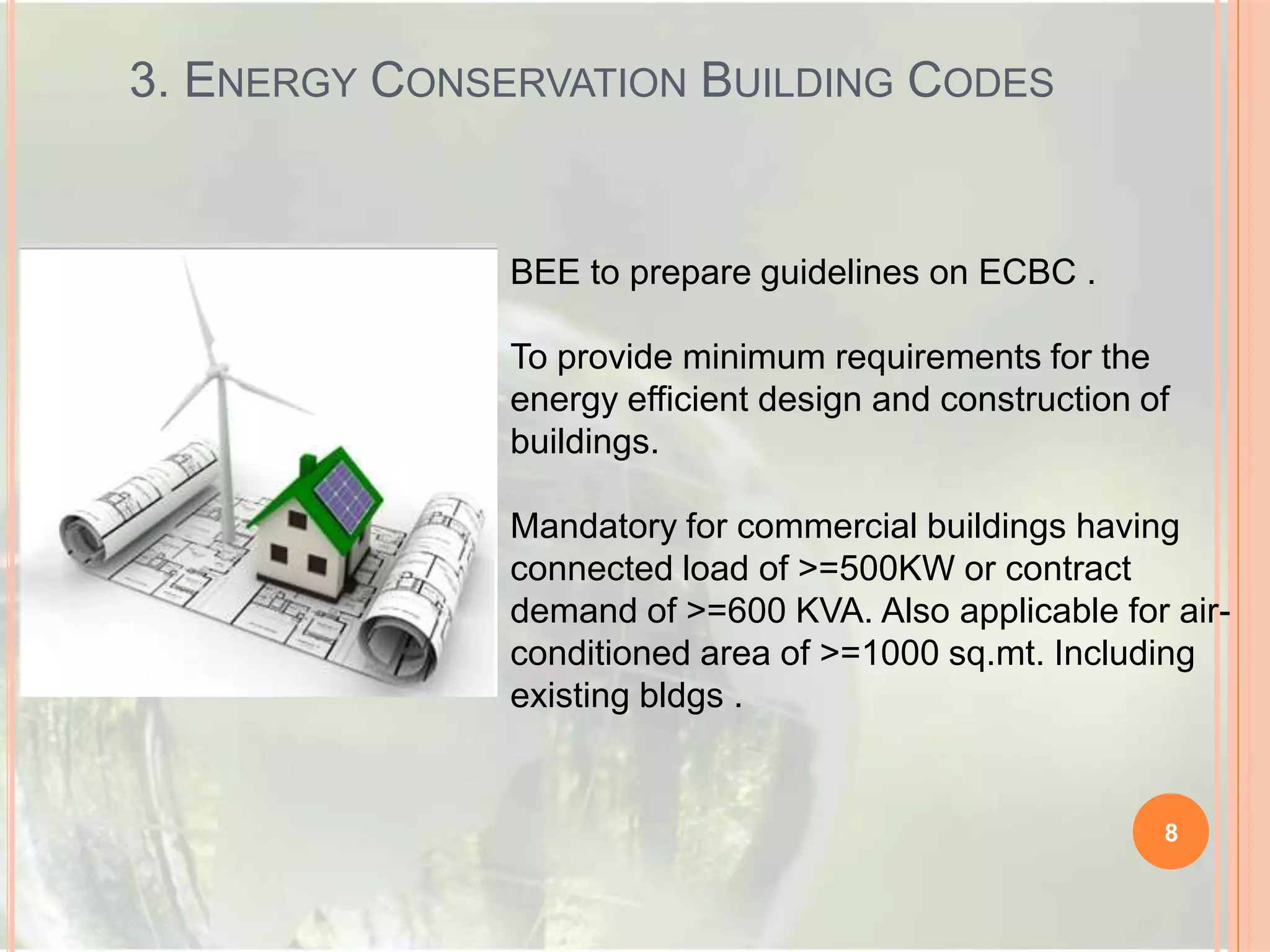
3. ENERGY CONSERVATION BUILDING CODES

BEE to prepare guidelines on ECBC .
To provide minimum requirements for the
energy efficient design and construction of
buildings.
Mandatory for commercial buildings having
connected load of >=500KW or contract
demand of >=600 KVA. Also applicable for airconditioned area of >=1000 sq.mt. Including
existing bldgs .

8
4. ENERGY COSERVATION FUND
To set up Energy Conservation Fund for providing :
Promotion of Energy Service
Companies.
Research & Development
Demonstration.
Creation of testing facilities
Awareness Creation.

9
5. BUREAU OF ENERGY EFFICIENCY
Important Roles include:
Implementation of provisions of
Energy Conservation Act.
Quick coordination.
Policy research.
Promotion of Energy Efficiency.
Development of new financial
instruments.
Development of ESCOs.
The primary objective would be to
reduce energy intensity in Indian
Economy.
Awareness Creation.
10
6. ROLE OF BUREAU OF ENERGY EFFICIENCY

•The Role of BEE WOULD be to prepare standards and
labels of appliances and equipment, develop a list of designated
consumer, specify certification and accreditation
procedure,
preparing building codes, maintain central EC fund, and undertake
promotional activities in co-ordination with central and state level
agency.

•The role would include development of ESCOs. Transforming the
market for energy efficiency and create awareness through
measure including clearing house.

11
7. ROLE OF CENTRAL AND STATE GOVERNMENT
•CENTRAL – to notify rules and regulation under various
provisions of the ACT , provide initial financial assistance to BEE
and EC fund , Coordinate with various State Government for
notification ,penalties and adjudication.
•STATE – to amend energy conservation building codes to
suit the regional and local climatic condition, to designete state
level agency to coordinate , regulate and enforce provisions of the
ACT and constitute a state Energy Conservation Fund for
promotion of energy efficiency.

12
8. BACHAT LAMP YOJNA
(CDM BASED LIGHTING PROJECT FOR HOUSE HOLD)
• First pilot project registered by UNFCCC in
September 2008 .
(National Roll out to be take place shortly)
• Targeted 400 Millions incandescent Lamps
and its replacement to CFLs at the price of
incandescent bulbs to avoid 4000 MW
Capacity Addition.
• The difference in cost would be recovered
through the carbon credits CERs that
accrue because of their lower energy use.

13
9. PENALTIES
Non-Compliance by a Person:
• Amount Not Exceeding Rs.10,00,000/-For Each Offence.
• On Continuous Non – Compliance An Additional
Penalty Up to Rs.10000/- Per Day.
• The initial phase of 5 years would be promotional and
creating infrastructure for implementation of ACT. No penalties
would be effective during this phase.

14
THANK
YOU

15

Energy Conservation Act 2001

  • 1.
  • 2.
    ENERGY CONSERVATION ACT2001 •Enacted on 1st October 2001. •Become effective from 1st March 2002. •Objective of providing necessary legal framework for promoting energy conservation measures in the country. •Bureau of Energy Efficiency(BEE) operationalized from 1st March2002. 2
  • 3.
    PURPOSE OF THEEC-ACT 2001 • The purpose of this act is to provide for efficient use of energy and its conservation. • Provide a policy framework and direction to national energy conservation activities. • Coordinate policies and programs on efficient use of energy with stakeholders. • Establish systems and procedures to verify measure and monitor EE improvements. • Leverage multilateral, bilateral and private sector support to implement the EC Act. • Demonstrate EE delivery systems through public-private partnerships. • TO PROMOTE ENERGY EFFICIENCY IN THE COUNTRY . 3
  • 4.
    IMPORTANT FEATURES OFENERGY CONSERVATION ACT2001 •Energy Conservation Building Code (ECBC) •Standards & Labeling (S & L) •Demand Side Management (DSM) •Bachat Lamp Yojana (BLY). •Promoting Energy Efficiency in Small & Medium Enterprise (SMEs). •Designated Consumers . 4 •Certification of Energy Managers & Energy Auditors.
  • 5.
    1. STANDARDS &LABELING Evolve minimum energy consumption and performance standards for notified equipment & appliances. Prohibit manufacture and sale Of equipment & appliances not conforming to standards. Introduce mandatory labeling to Enable consumers to make informed choice. 5
  • 6.
  • 7.
    2. DESIGNATED CONSUMER DesignatedConsumers to : •Get energy audit by Accredited energy audit firms and energy audit conducted by an accredited energy auditor. •Implement cost effective recommendations •Appoint or designate energy manager •Comply with energy consumption norms By regulations BEE to prescribe: •Qualification and certification procedure for Energy Manager & Energy Auditors. •Accreditation procedure for Energy Audit firms. 7
  • 8.
    3. ENERGY CONSERVATIONBUILDING CODES BEE to prepare guidelines on ECBC . To provide minimum requirements for the energy efficient design and construction of buildings. Mandatory for commercial buildings having connected load of >=500KW or contract demand of >=600 KVA. Also applicable for airconditioned area of >=1000 sq.mt. Including existing bldgs . 8
  • 9.
    4. ENERGY COSERVATIONFUND To set up Energy Conservation Fund for providing : Promotion of Energy Service Companies. Research & Development Demonstration. Creation of testing facilities Awareness Creation. 9
  • 10.
    5. BUREAU OFENERGY EFFICIENCY Important Roles include: Implementation of provisions of Energy Conservation Act. Quick coordination. Policy research. Promotion of Energy Efficiency. Development of new financial instruments. Development of ESCOs. The primary objective would be to reduce energy intensity in Indian Economy. Awareness Creation. 10
  • 11.
    6. ROLE OFBUREAU OF ENERGY EFFICIENCY •The Role of BEE WOULD be to prepare standards and labels of appliances and equipment, develop a list of designated consumer, specify certification and accreditation procedure, preparing building codes, maintain central EC fund, and undertake promotional activities in co-ordination with central and state level agency. •The role would include development of ESCOs. Transforming the market for energy efficiency and create awareness through measure including clearing house. 11
  • 12.
    7. ROLE OFCENTRAL AND STATE GOVERNMENT •CENTRAL – to notify rules and regulation under various provisions of the ACT , provide initial financial assistance to BEE and EC fund , Coordinate with various State Government for notification ,penalties and adjudication. •STATE – to amend energy conservation building codes to suit the regional and local climatic condition, to designete state level agency to coordinate , regulate and enforce provisions of the ACT and constitute a state Energy Conservation Fund for promotion of energy efficiency. 12
  • 13.
    8. BACHAT LAMPYOJNA (CDM BASED LIGHTING PROJECT FOR HOUSE HOLD) • First pilot project registered by UNFCCC in September 2008 . (National Roll out to be take place shortly) • Targeted 400 Millions incandescent Lamps and its replacement to CFLs at the price of incandescent bulbs to avoid 4000 MW Capacity Addition. • The difference in cost would be recovered through the carbon credits CERs that accrue because of their lower energy use. 13
  • 14.
    9. PENALTIES Non-Compliance bya Person: • Amount Not Exceeding Rs.10,00,000/-For Each Offence. • On Continuous Non – Compliance An Additional Penalty Up to Rs.10000/- Per Day. • The initial phase of 5 years would be promotional and creating infrastructure for implementation of ACT. No penalties would be effective during this phase. 14
  • 15.