Parent adopted bedtime strategies
and
corresponding infant behaviour
Emma Brookes
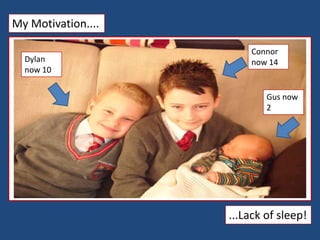
My Motivation....
...Lack of sleep!
Dylan
now 10
Gus now
2
Connor
now 14
Introduction…
• Sleep is essential for basic human survival (Dahl, 1999).
• In Utero breath like actions are
practiced during periods of sleep
(Mirmiran, Maas, and Ariagno, 2003).
• 25%-33% of children between 3 months and 5 years
suffer with some form of dyssomnia (Petit, Touchette, Tremblay,
Boivin, & Montplaisir, 2007).
• By age 2 children will have slept for approximately
10,000 hours (Hill, Hogan, and Karmiloff-Smith, 2007).
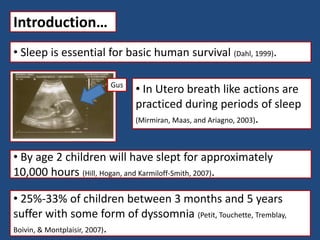
Gus
Previous research…
• Links evident between sleep fragmentation and
reduction in memory, attention and mood in addition
to an increase in hyperactive/problematic behaviours
and mood disturbance (Kheirandish and Gozal, 2006).
• Significant correlations
between sleep dyssomnia and
neurobehavioural functioning
(Sadeh, Gruber and Raviv, 2002) .
• Majority of research centred around adults and
adolescents.
• Sleep based research on young children has
predominantly focused on the dangers of co-sleeping.
• Research made
available to expectant
parents is generally on
the benefits of
breastfeeding.
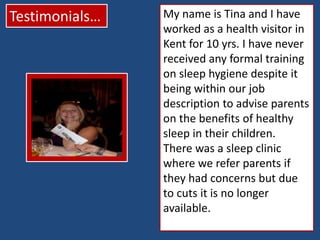
Testimonials… My name is Tina and I have
worked as a health visitor in
Kent for 10 yrs. I have never
received any formal training
on sleep hygiene despite it
being within our job
description to advise parents
on the benefits of healthy
sleep in their children.
There was a sleep clinic
where we refer parents if
they had concerns but due
to cuts it is no longer
available.
My name is Katie and I have
been working as a health
visitor in Glasgow for 4 yrs. I
am the first port of call for
parents if they have issues
regarding their child’s sleep, in
this particular area we have
what is known as the Triple P
programme, we use this to
educate parents about
sleeping patterns and bedtime
routines.
Katie wanted to remain anonymous
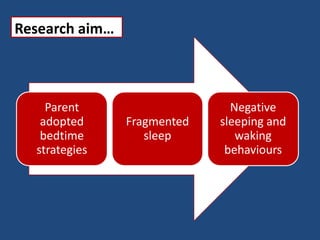
Research aim…
Parent
adopted
bedtime
strategies
Fragmented
sleep
Negative
sleeping and
waking
behaviours
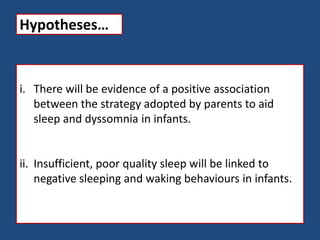
Hypotheses…
i. There will be evidence of a positive association
between the strategy adopted by parents to aid
sleep and dyssomnia in infants.
ii. Insufficient, poor quality sleep will be linked to
negative sleeping and waking behaviours in infants.
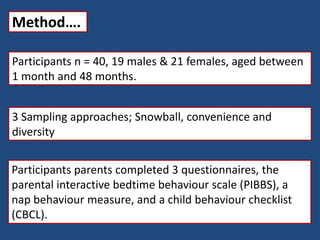
Method….
Participants n = 40, 19 males & 21 females, aged between
1 month and 48 months.
3 Sampling approaches; Snowball, convenience and
diversity
Participants parents completed 3 questionnaires, the
parental interactive bedtime behaviour scale (PIBBS), a
nap behaviour measure, and a child behaviour checklist
(CBCL).
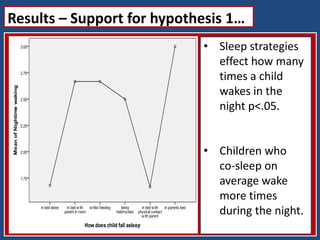
Results – Support for hypothesis 1…
• Sleep strategies
effect how many
times a child
wakes in the
night p<.05.
• Children who
co-sleep on
average wake
more times
during the night.
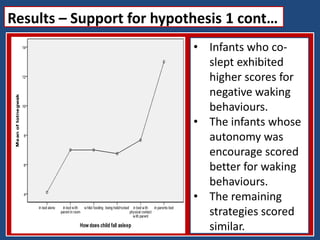
• Infants who co-
slept exhibited
higher scores for
negative waking
behaviours.
• The infants whose
autonomy was
encourage scored
better for waking
behaviours.
• The remaining
strategies scored
similar.
Results – Support for hypothesis 1 cont…
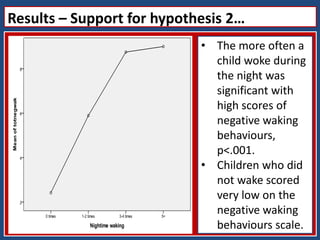
Results – Support for hypothesis 2…
• The more often a
child woke during
the night was
significant with
high scores of
negative waking
behaviours,
p<.001.
• Children who did
not wake scored
very low on the
negative waking
behaviours scale.
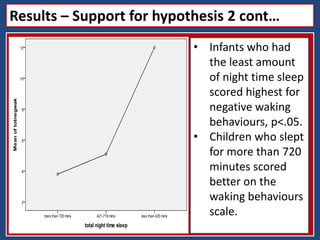
• Infants who had
the least amount
of night time sleep
scored highest for
negative waking
behaviours, p<.05.
• Children who slept
for more than 720
minutes scored
better on the
waking behaviours
scale.
Results – Support for hypothesis 2 cont…
Discussion…
• Unique population.
• Scales accurate and reliable.
• Hypotheses fully supported.
• Particular bedtime strategies resulted in broken sleep.
• Frequent night time wakening resulted in reports of
increased negative sleeping and waking behaviours.
Future direction…
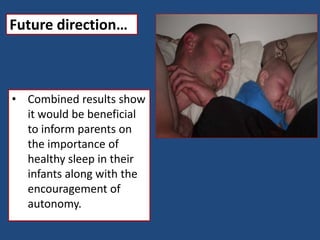
• Combined results show
it would be beneficial
to inform parents on
the importance of
healthy sleep in their
infants along with the
encouragement of
autonomy.
Any
Questions?
References
Dahl, R. E. (1999). The Consequences of Insufficient Sleep for Adolescents: Links between
Sleep and Emotional Regulation. Phi Delta Kappan , 80 (5), 354-359.
Hill, C. M., Hogan, A. M., Karmiloff-Smith, A. (2007). To sleep, perchance to enrich learning.
Archives of Disease in Childhood , 92 (7), 637-643.
Kheirandish, L., Gozal, D. (2006). Neurocognitive dysfunction in children with sleep
disorders. Developmental Science , 9 (4), 388-399.
Mirmiran, M., Maas, Y. G. H., Ariagno, R. L. (2003). Development of fetal and neonatal sleep and
circadian rhythms. Sleep Medicine Reviews , 7 (4), 321-334.
Pappas, S. (2011, August 29). Kids' Sleep Disorders Perplex Most Doctors, Study Finds.
Retrieved November 30, 2012, from Live Science: http://www.livescience.com/15790-
kids-sleep-disorders-perplex-doctors-study-finds.html
Petit, D., Touchette, E., Tremblay, R. E., Boivin, M., Montplaisir, J. (2007). Dyssomnias and
Parasomnias in Early Childhood. Official Journal of the American Academy of
Pediatrics , 119 (5), 1016-1025.
Sadeh, A., Gruber, R., Raviv, A. (2002). Sleep, neurobehavioral functioning, and behavior
problems in school-age children. Child Development , 73 (2), 405-417.

Emma's powerpoint

  • 1.
    Parent adopted bedtimestrategies and corresponding infant behaviour Emma Brookes
  • 2.
    My Motivation.... ...Lack ofsleep! Dylan now 10 Gus now 2 Connor now 14
  • 3.
    Introduction… • Sleep isessential for basic human survival (Dahl, 1999). • In Utero breath like actions are practiced during periods of sleep (Mirmiran, Maas, and Ariagno, 2003). • 25%-33% of children between 3 months and 5 years suffer with some form of dyssomnia (Petit, Touchette, Tremblay, Boivin, & Montplaisir, 2007). • By age 2 children will have slept for approximately 10,000 hours (Hill, Hogan, and Karmiloff-Smith, 2007). Gus
  • 4.
    Previous research… • Linksevident between sleep fragmentation and reduction in memory, attention and mood in addition to an increase in hyperactive/problematic behaviours and mood disturbance (Kheirandish and Gozal, 2006). • Significant correlations between sleep dyssomnia and neurobehavioural functioning (Sadeh, Gruber and Raviv, 2002) .
  • 5.
    • Majority ofresearch centred around adults and adolescents. • Sleep based research on young children has predominantly focused on the dangers of co-sleeping. • Research made available to expectant parents is generally on the benefits of breastfeeding.
  • 6.
    Testimonials… My nameis Tina and I have worked as a health visitor in Kent for 10 yrs. I have never received any formal training on sleep hygiene despite it being within our job description to advise parents on the benefits of healthy sleep in their children. There was a sleep clinic where we refer parents if they had concerns but due to cuts it is no longer available.
  • 7.
    My name isKatie and I have been working as a health visitor in Glasgow for 4 yrs. I am the first port of call for parents if they have issues regarding their child’s sleep, in this particular area we have what is known as the Triple P programme, we use this to educate parents about sleeping patterns and bedtime routines. Katie wanted to remain anonymous
  • 8.
  • 9.
    Hypotheses… i. There willbe evidence of a positive association between the strategy adopted by parents to aid sleep and dyssomnia in infants. ii. Insufficient, poor quality sleep will be linked to negative sleeping and waking behaviours in infants.
  • 10.
    Method…. Participants n =40, 19 males & 21 females, aged between 1 month and 48 months. 3 Sampling approaches; Snowball, convenience and diversity Participants parents completed 3 questionnaires, the parental interactive bedtime behaviour scale (PIBBS), a nap behaviour measure, and a child behaviour checklist (CBCL).
  • 11.
    Results – Supportfor hypothesis 1… • Sleep strategies effect how many times a child wakes in the night p<.05. • Children who co-sleep on average wake more times during the night.
  • 12.
    • Infants whoco- slept exhibited higher scores for negative waking behaviours. • The infants whose autonomy was encourage scored better for waking behaviours. • The remaining strategies scored similar. Results – Support for hypothesis 1 cont…
  • 13.
    Results – Supportfor hypothesis 2… • The more often a child woke during the night was significant with high scores of negative waking behaviours, p<.001. • Children who did not wake scored very low on the negative waking behaviours scale.
  • 14.
    • Infants whohad the least amount of night time sleep scored highest for negative waking behaviours, p<.05. • Children who slept for more than 720 minutes scored better on the waking behaviours scale. Results – Support for hypothesis 2 cont…
  • 15.
    Discussion… • Unique population. •Scales accurate and reliable. • Hypotheses fully supported. • Particular bedtime strategies resulted in broken sleep. • Frequent night time wakening resulted in reports of increased negative sleeping and waking behaviours.
  • 16.
    Future direction… • Combinedresults show it would be beneficial to inform parents on the importance of healthy sleep in their infants along with the encouragement of autonomy.
  • 18.
  • 19.
    References Dahl, R. E.(1999). The Consequences of Insufficient Sleep for Adolescents: Links between Sleep and Emotional Regulation. Phi Delta Kappan , 80 (5), 354-359. Hill, C. M., Hogan, A. M., Karmiloff-Smith, A. (2007). To sleep, perchance to enrich learning. Archives of Disease in Childhood , 92 (7), 637-643. Kheirandish, L., Gozal, D. (2006). Neurocognitive dysfunction in children with sleep disorders. Developmental Science , 9 (4), 388-399. Mirmiran, M., Maas, Y. G. H., Ariagno, R. L. (2003). Development of fetal and neonatal sleep and circadian rhythms. Sleep Medicine Reviews , 7 (4), 321-334. Pappas, S. (2011, August 29). Kids' Sleep Disorders Perplex Most Doctors, Study Finds. Retrieved November 30, 2012, from Live Science: http://www.livescience.com/15790- kids-sleep-disorders-perplex-doctors-study-finds.html Petit, D., Touchette, E., Tremblay, R. E., Boivin, M., Montplaisir, J. (2007). Dyssomnias and Parasomnias in Early Childhood. Official Journal of the American Academy of Pediatrics , 119 (5), 1016-1025. Sadeh, A., Gruber, R., Raviv, A. (2002). Sleep, neurobehavioral functioning, and behavior problems in school-age children. Child Development , 73 (2), 405-417.