Emigration And Political Development Jonathon W Moses
Emigration And Political Development Jonathon W Moses
Emigration And Political Development Jonathon W Moses
Emigration And Political Development Jonathon W Moses
Emigration And Political Development Jonathon W Moses
1.
Emigration And PoliticalDevelopment Jonathon W
Moses download
https://ebookbell.com/product/emigration-and-political-
development-jonathon-w-moses-4704944
Explore and download more ebooks at ebookbell.com
2.
Here are somerecommended products that we believe you will be
interested in. You can click the link to download.
Emigration And Political Development Jonathon W Moses
https://ebookbell.com/product/emigration-and-political-development-
jonathon-w-moses-4716198
Migration And Citizenship Legal Status Rights And Political
Participation Rainer Baubck
https://ebookbell.com/product/migration-and-citizenship-legal-status-
rights-and-political-participation-rainer-baubck-2362136
Citizenship And Immigration Borders Migration And Political Membership
In A Global Age 1st Edition Ann E Cudd
https://ebookbell.com/product/citizenship-and-immigration-borders-
migration-and-political-membership-in-a-global-age-1st-edition-ann-e-
cudd-5605870
Migration And Hybrid Political Regimes Navigating The Legal Landscape
In Russia Rustamjon Urinboyev
https://ebookbell.com/product/migration-and-hybrid-political-regimes-
navigating-the-legal-landscape-in-russia-rustamjon-urinboyev-51826830
3.
Migration And HybridPolitical Regimes Navigating The Legal Landscape
In Russia Rustamjon Urinboyev
https://ebookbell.com/product/migration-and-hybrid-political-regimes-
navigating-the-legal-landscape-in-russia-rustamjon-urinboyev-21988044
Migration Policies And Political Participation Inclusion Or Intrusion
In Western Europe Pontus Odmalm Auth
https://ebookbell.com/product/migration-policies-and-political-
participation-inclusion-or-intrusion-in-western-europe-pontus-odmalm-
auth-5333724
Disentangling Migration And Climate Change Methodologies Political
Discourses And Human Rights 1st Edition Thomas Faist
https://ebookbell.com/product/disentangling-migration-and-climate-
change-methodologies-political-discourses-and-human-rights-1st-
edition-thomas-faist-4178782
The Greek Exodus From Egypt Diaspora Politics And Emigration 19371962
1st Edition Angelos Dalachanis
https://ebookbell.com/product/the-greek-exodus-from-egypt-diaspora-
politics-and-emigration-19371962-1st-edition-angelos-
dalachanis-36307700
Public And Political Discourses Of Migration Amanda Haynes Martin J
Power
https://ebookbell.com/product/public-and-political-discourses-of-
migration-amanda-haynes-martin-j-power-49444618
Emigration and PoliticalDevelopment
Although policy makers, international organizations, and academics
are increasingly aware of the economic effects of emigration, its poten-
tial political effects remain understudied. This book maps the nature
of the relationship that links emigration and political development.
Jonathon W. Moses explores the nature of political development, argu-
ing that emigration influences it. In particular, he introduces a new
cross-national database of annual emigration rates and analyzes specific
cases of international emigration (and out-migration within countries)
under varying political and economic contexts.
Jonathon W. Moses is currently a professor of political science at
the Norwegian University of Science and Technology, where he has
taught since 1993. Moses has published several books including Ways
of Knowing (2007, with Torbjørn Knutsen), International Migration:
Globalization’s Last Frontier (2006), and Norwegian Catch-up: Devel-
opment and Globalization before World War II (2005). He is a co-
editor of European Political Science. Among his research interests are
globalization, international migration, social democracy, and the Euro-
pean Union. Among other places, his articles have appeared in World
Development, Journal of Common Market Studies, and Politics and
Society.
9.
Emigration and PoliticalDevelopment
JONATHON W. MOSES
Norwegian University of Science and Technology
10.
cambridge university press
Cambridge,New York, Melbourne, Madrid, Cape Town,
Singapore, São Paulo, Delhi, Tokyo, Mexico City
Cambridge University Press
32 Avenue of the Americas, New York, ny 10013-2473, usa
www.cambridge.org
Information on this title: www.cambridge.org/9780521173216
C
Jonathon W. Moses 2011
This publication is in copyright. Subject to statutory exception
and to the provisions of relevant collective licensing agreements,
no reproduction of any part may take place without the written
permission of Cambridge University Press.
First published 2011
Printed in the United States of America
A catalog record for this publication is available from the British Library.
Library of Congress Cataloging in Publication data
Moses, Jonathon Wayne, 1962–
Emigration and political development / Jonathon W. Moses.
p. cm.
Includes bibliographical references and index.
isbn 978-0-521-19543-0 (hardback) – isbn 978-0-521-17321-6 (pbk.)
1. Emigration and immigration – Political aspects. 2. Political development. I. Title.
jv6124.m67 2011
320.9 – dc22 2011012922
isbn 978-0-521-19543-0 Hardback
isbn 978-0-521-17321-6 Paperback
Cambridge University Press has no responsibility for the persistence or accuracy of urls
for external or third-party Internet Web sites referred to in this publication and does not
guarantee that any content on such Web sites is, or will remain, accurate or appropriate.
Contents
List of Tablespage viii
List of Figures ix
Preface xi
Acronyms xv
1 Introduction 1
2 Toward Political Development 20
3 Linking Emigration to Political Development 38
4 Global Connections 60
5 The Free Migration Regime before World War I 86
6 Guest-Worker Programs after World War II 117
7 Limited Mobility in the World Today 145
8 Internal Migration 165
9 Fellow Travelers 197
10 Conclusion 220
appendices
I: Case-Selection Matrix 237
II: EMIG 1.2 Overview 238
III: Countries with No Emigration Data 246
IV: Lagging Pattern, Newey-West Models, Truncated TSCS
Data 247
V: Emigration Flows and Political Development, 1976–2006,
EMIG 1.2 Data 248
VI: Emigration Stocks and Political Development, 1980–2006,
UN Data 253
Bibliography 263
Index 285
vii
14.
List of Tables
1.1Sources of International Emigration, 2005 page 3
4.1 Descriptive Characteristics of Component Datasets 63
4.2 Global Time-Series Analysis, No Lags 74
4.3 Global Time-Series Analysis, Expected Lags 77
4.4 Strongest Emigration Effects, Newey-West Models,
Global Data 79
4.5 Strongest Emigration Effects, Newey-West Models, TSCS
Data 82
5.1 Gross Emigration Rates, 1850–1913 88
6.1 Gross Emigration Rates, 1947–76 118
6.2 Share of Mexican Emigrants to the United States, by
Region and State of Origin 128
6.3 Bilateral Guest-Worker Agreements in Europe, by Year
Signed 135
6.4 Migrants in Europe by Countries of Origin/Destination,
December 1975 137
6.5 Characteristics of Europe’s Guest-Worker Sending States 139
7.1 Summary of Emigration Flows and Political
Development, 1976–2006, EMIG 1.2 Data 150
7.2 Summary of Emigration Stocks and Political
Development, 1980–2006, UN Data 154
8.1 Net Black Emigration, per Mil Black Population, by State
1870–1960, Annual Averages 170
8.2 Internal Migration, Selected Countries, Province Level 187
8.3 Inter-Provincial Emigration in China, per Mil,
1995–2005 190
9.1 Foreign Experience of Successful Reformists/
Revolutionaries 211
9.2 Foreign Experience of Leaders for Important Rebellions
and Revolutions, 1850–2009 214
10.1 Results Table 230
viii
15.
List of Figures
4.1Global Emigration Trend, 1850–2005 page 65
4.2 Global Emigration Trend, per Capita, 1850–2005 66
4.3 Three Waves of Democracy and per-Capita Emigration 70
4.4 Cross-Correlogram on EMIG 1.2, Global Data 75
4.5 Lagging Pattern, Prais-Winsten Models, Global Data 78
4.6 Lagging Pattern, Newey-West Models, Global Data 78
4.7 Lagging Pattern, Newey-West Models, TSCS 81
5.1 Norwegian Emigration, per Mil, 1850–2008 91
6.1 Mexican Political Development, 1917–80 125
6.2 Mexican Emigration to the United States, 1910–76 127
7.1 Emigrant Stock on HDI (2007), Scatterplot 158
7.2 Emigrant Stock on Level of Democracy (2006), Scatterplot 158
7.3 GDP/Capita on HDI, Scatterplot with High-Emigration
States 161
7.4 GDP/Capita on Democracy, Scatterplot with
High-Emigration States 162
8.1 Net Emigration from the South, Decade Totals,
1870–1960 167
8.2 Net Emigration Rates from Southern States, 1870–1960,
per Mil, Annual Averages 168
8.3 Average Wage for Picking Cotton, Mississippi, 1930–64 179
8.4 Emigration on Development, Scatterplot, Chinese
Provinces, 1990–2006 191
ix
17.
Preface
Work on thisbook began several years ago when I first became aware
of the inadequate development options available to people in the world’s
poorest places. A teacher of international political economy, I had become
impatient with the meager development rewards generated by trade, for-
eign investment, and aid (not to mention the broader structural reforms
encouraged by the Washington Consensus). Frustrated, my students and
I longed for more responsive, promising, and radical alternatives. It is
in this context that the potential of international migration first caught
my eye.
As my experiences in the developing world began to accrue, so too did
my frustration over the lack of alternatives. Being an emigrant myself, I
was familiar with the complicated social, political, and economic webs
that migrants spin and set when we move across country or around the
globe. In immigrating to Norway, I had learned of the role that pre–World
War I emigration to the New World had played in that country’s economic
and political development. I also knew that Norway’s experiences were
not unique: The first stones in Europe’s nascent democracies and their
constituent welfare state edifices were laid at a time of substantial (and
relatively free) international migration. With time, I began to wonder if
Europe’s political development at the turn of the nineteenth century was
not facilitated by a liberal international migration environment – and
whether we limit development by placing so many obstacles in the path
of today’s international migrants.
Aware of the significant political barriers to liberalizing international
migration, I was driven to find out what potential, if any, international
migration could bring to those who were born on the wrong side of
xi
18.
xii Preface
Heaven’s Door(to use George Borjas’s gripping title). I began my inves-
tigatory journey with small steps, as I was (and continue to be) quite
concerned about the enormous personal risks that individual migrants
and families often take in the process of migrating. Along the way, I
found that many migrants were willing to bear these costs in exchange
for the small doses of hope and opportunity that migration provides
(especially when contrasted against the limited opportunities that people
find at home). Even more curiously, I found emigration generating eco-
nomic rewards in those countries that were casting off some of their most
ambitious young sons and daughters.
My first steps were taken in the realm of economics, where a lack of
data and a reliance on somewhat fanciful models are not seen as handi-
caps or deterrents. In particular, my work with Bjørn Letnes uncovered
the astronomical economic gains the world community might expect to
harvest by matching the international demand for, and supply of, labor
(Moses and Letnes 2004, 2005). However, it did not take long before I
began to speculate about how emigration might affect the political con-
stellations of sending states (e.g., Moses 2005a, 2006). This work made
me recognize the need to look at the effects of emigration in a more
systematic and empirical fashion. After all, it is one thing to find good
reasons for expecting emigration to generate political development – it is
another thing to find evidence of these effects in a broad swath of human
experience. My attempt at doing this now rests in your hands.
In writing this book I have incurred many debts over several years.
Most of these debts are to friends and familiar faces. Indeed, in a project
like this, the biggest cost is always measured in terms of time spent away
from the family. I am privileged in this regard, in that Thandeka, Aurora,
and Maggi have always supported me and my work. Just as impor-
tant, they have never made me feel guilty about spending time with my
other passion. I am likewise fortunate to work in a very accommodating
environment at the Norwegian University of Science and Technology’s
Department of Sociology and Political Science. It is easier to write about
faraway problems when nested in such supportive home environments.
This project is unusual in that I have become indebted to a number
of people whom I have never met and probably never will meet. In par-
ticular, I have benefited from the help of many statistical bureau and
central bank staff from around the globe. It is only because of their gen-
erous assistance and diligent responses to my queries (through phone and
e-mail exchanges) that I have been able to assemble the EMIG database
presented in this book. Too seldom do the collectors and purveyors of
19.
Preface xiii
statistics receivethe recognition they deserve; I am very grateful for their
help.
I am also moved and astonished by their assistance. For someone old
enough to remember the world before e-mail, I find comfort in learning
how delightfully small the world has become (alas, this is more so for
data than it is for workers). In this shrinking world, I have been helped
by complete strangers who have volunteered their time and expertise to a
distant project with little foreseeable return or effect on their own lives.
This has been a heart-warming experience.
In the process of writing and finishing this manuscript I have gotten
to know many new people and found a few new shoulders on which
to lean. Foremost among these are the supporting staff and Syndicate
at Cambridge University Press – especially my editor, Eric Crahan. I
appreciate their help and advice along each step of this long process.
Last, but not least, I have managed to incur a number of intellectual
debts, in various forms, with individual friends and colleagues. A project
like this one has required me to sample from a long smorgasbord of
evidence and approaches. To be successful, I have needed to rely on friends
who could help me track down specialized material or provide other
forms of specialized knowledge. In this regard, I would like to thank Kam
Wing Chan, Thomas Halvorsen, Bjørn Letnes, Adam McKeown, Sabrina
Ramet, Stian Saur, and Indra de Soysa. Other friends and colleagues
have invested significant chunks of time to read through the manuscript.
In particular, I would like to thank Michael Alvarez, Jo Jakobsen, Erik
Jones, and the anonymous reviewers at Cambridge University Press for
their very helpful comments on earlier drafts.
In the end, of course, I alone am responsible for the work before you.
I have relied on these family, friends, colleagues, and strangers to help
build the argument, but none of them can or should be held accountable
for whatever errors and omissions remain in the text. I only hope that
they are few in number.
Trondheim
18 February 2011
21.
Acronyms
AFL/N Workers’ NationalTrade Organization, Norway (Arbeidernes
Faglige Landsorganisasjon), subsequently LO
AFL/US American Federation of Labor/US
AR1 Form of Autoregressive Statistical Model
CCF Cross-Correlation Function
COW Correlates of War
DNA Norwegian Labor Party (Det norske Arbeiderparti)
EC European Community
EEA European Economic Area
EU European Union
GDI Gross Domestic Indicator
GDP Gross Domestic Product
GNI Gross National Income
GNP Gross National Product
HDI Human Development Index
HDR Human Development Report
ILO International Labor Organization
ISI Import-Substitution Industrialization policies
IWW Industrial Workers of the World
Ln Natural logarithm
LO Norwegian Confederation of Trade Unions
(Landsorganiasjonen)
NAF Norwegian Employers’ Organization (Norsk
Arbeidsgiverforening), subsequently NHO
NHO Confederation of Norwegian Enterprises (Næringslivets
Hovedorganisasjon)
NSA Norwegian Social Democratic Labor Party (Norges
Sosialdemokratiske Arbeiderparti)
xv
22.
xvi Acronyms
NW Newey-Weststandard errors
OECD Organization for Economic Cooperation and Development
OEEC Organization for European Economic Cooperation
PCSE Panel-Corrected Standard Errors
PNR National Revolutionary Party, Mexico (Partido Nacional
Revolucionario)
PNS Sinarquista National Party, Mexico (Partido Nacional
Sinarquista)
PRI Institutional Revolutionary Party, Mexico (Partido
Revolucionario Institutional)
PW Prais-Winsten regression
SLP Social Labor Party, U.S.
SPA Socialist Party of America, U.S.
SSRC Social Science Research Council
TSCS Time-Series Cross-Sectional
UK United Kingdom
UN United Nations
UNDP United Nations Development Program
U.S. United States
WWI World War I
WWII World War II
23.
1
Introduction
Roughly 3 percentof the world’s population lives in a country other
than the one in which they were born. Of these 200 million people,
about one-third moved from a developing to a developed country, another
third moved from one developing nation to another, and the last third
moved from the developed world to the developing world. According to
the United Nations (UN 2006), the 10 largest suppliers of international
emigrants in 2005 were (in decreasing order) Mexico, China, Pakistan,
India, Iran, Indonesia, the Philippines, Ukraine, Kazakhstan, and Sudan.
These 10 countries are mostly poor. More to the point, the leadership
in each of these countries is astutely aware of the economic returns associ-
ated with emigration; indeed, most actively promote emigration as part of
their broader development strategies. This awareness is founded on their
own experiences with emigration, a burgeoning academic literature that
links emigration and economic development, and a growing international
effort to understand the economic effects of migration.1
International migration is also being fueled by a growing awareness
of the economic benefits it generates in the receiving countries, which
are frequently at the other end of the economic spectrum from the
sending countries. At the start of the second decade of a new millennium,
1 For example, the UN Secretary-General and a number of governments launched a Global
Commission on International Migration in 2003 (with a resulting report in 2005). The
UN also held its first High-Level Dialogue on International Migration and Development
in September 2006, resulting in the creation of the Global Migration Forum. The World
Bank has also been very active on this front (World Bank 2006), initiating the Interna-
tional Migration and Development Research Program and its subsequent publications
(Özden and Schiff 2006, 2007a). Most recently, the UNDP’s 2009 Human Development
Report focused on “Overcoming Barriers: Human Mobility and Development.”
1
24.
2 Emigration andPolitical Development
advocates tout the role that immigrant labor can play in satisfying critical
economic functions in the developed world, whether harvesting the crops,
shoring up a deficit in health care workers, staffing the technology front,
or adding youth to ageing populations.
Although policy makers, international organizations, and academics
are becoming increasingly aware of the economic effects of migration,
we remain ignorant as to the potential political effects of rising emigrant
stocks. We are beginning to understand how remittances are spent in
local economies, but still have no idea about how (or even if) emigra-
tion spreads political capital. Although we are increasingly aware of the
economic relevance of local hometown associations, we are oblivious as
to when emigration can be a conduit for new political ideas and influ-
ences or when it serves as a venting device used to get rid of troublesome
rabble-rousers. At a time when we are developing sophisticated interna-
tional plans to deal with the economic costs of brain drain, we know
nothing about its political equivalent. Most remarkably, in an era that
celebrates “Democracy’s Century” (Freedom House 2000), we do not
know whether emigration facilitates or deters democratization.
Consider the 10 labor-exporting countries listed in the opening para-
graph. Although this group of countries shares a legacy of economic
underdevelopment, they have very different political constellations. Nei-
ther does there appear to be any clear relationship between the absolute
number of emigrants and a country’s level of political development. As
shown in Table 1.1, the 2008 Freedom House Survey (and its compo-
nent country reports) describes four of these countries (Ukraine, Mexico,
India, and Indonesia) as free; the other six countries are characterized
as being either partly or not free. The largest source country (Mexico) is
listed as free, whereas the second largest (China) is not.
Given their economic situations, we can expect these countries to
continue exporting workers in the foreseeable future.2
The question we
then need to ask is, How will emigration affect the political develop-
ment of these source countries? Will continued emigration undermine or
strengthen India’s democratic traditions? Does emigration from Pakistan
encourage the growth of a nascent democratic culture and institutions,
or does it flame the fires of jihad? To date, these questions have not even
been asked, let alone answered.
2 Whether other countries will continue to accept them remains to be seen in a world
economy in turmoil. Yet the likelihood of accepting future immigrants turns on the
anticipated effects of that migration, including the sort of political effects studied in this
book.
25.
Introduction 3
table 1.1.Sources of International Emigration, 2005
Avg. #
Annual
Emigrants
(2000–5)
Emigration
Rate per
1,000
Population
Political
Rights
Score
Civil
Liberties
Score
Freedom
Status
Ukraine 140,000 2.9 3 2 Free
Mexico 400,000 3.9 2 3 Free
India 280,000 0.3 2 3 Free
Indonesia 200,000 0.9 3 3 Free
Philippines 180,000 2.3 4 3 Partly free
Pakistan 362,000 2.4 6 5 Not free
Kazakhstan 120,000 8.0 6 5 Not free
China 390,000 0.3 7 6 Not free
Iran 276,000 4.1 6 6 Not free
Sudan 104,000 3.0 7 7 Not free
Note: Kazakhstan’s Freedom House scores are for 2007.
Sources: Freedom House (2008); UN (2006).
At one level, the lack of attention to this issue is understandable. For
most of the postwar period we have lived in a world in which formal
limitations on international human mobility were seen to be natural and
long-standing. Large-scale international migration occurred infrequently,
in the wake of extraordinary events, so that questions about the effects of
this migration were often bracketed off as being irrelevant for mainstream
economic and political analyses.
A rising tide of globalization at the close of the 20th century changed
all this, and political economists and policy makers began to consider the
effects of international migration on the receiving country economies, the
sending country economies, and the international economy in general.3
What is remarkable about this expansive literature is that it remains
3 Obviously, this literature is enormous; Moses (2005a: 56–8, 2006: chapter 6) provide
summaries. The first literature is most developed in the United States and is perhaps
best captured by the influential work of George Borjas (1999), but it should not be
limited to him. Other examples include Simon (1989), Smith and Edmonston (1997),
U.S. Department of Labor (1989), and Böhning (1984). More recently, there has been a
renewed focus on the positive impacts of immigrants in the host country; for example,
Legrain (2006), Riley (2008), and Pritchett (2006). Similar efforts can be easily found in
most other OECD countries. The growing literature on the economic effects of emigration
on sending-country economies is surveyed in Özden and Schiff (2007a), World Bank
(2006), and, most recently, UNDP (2009). For the global efficiency gains associated
with international migration, see Winters (2002), Moses and Letnes (2004, 2005), Iregui
(2005), and World Bank (2006).
26.
4 Emigration andPolitical Development
focused on the economic motives and effects of emigration, even though
most international migration is heavily channeled by political constraints
and influences.
After all, today’s potential migrants need to negotiate a number of
political hurdles. In some countries, exit restrictions still prohibit emi-
grants from leaving. In most of the others, residents are now free to leave.
Yet even if a potential migrant lives in a country that allows for free
exit, not a single country is willing to accept immigrants with open arms.
Instead, any potential emigrant faces a myriad of restrictions and qual-
ifications, as richer states effectively filter out all but the wealthiest, the
most (politically) repressed, those with family ties or desired skill sets,
or the most diligent. In the Middle East, where many of today’s inter-
national migrants are now headed, other political barriers channel these
migrant flows. Few other types of international exchange are more politi-
cally determined, and yet much of the literature avoids explicitly political
analyses!
This is not to say that political scientists are not interested in migration
issues – only that their focus, like that of the economists until recently,
has been trained on the effects found in the receiving countries of the
developed world. There is a substantial literature that examines variations
in migration control systems and their relative effectiveness4
and another
that analyzes the political and social effects of immigrants in the developed
world.5
By contrast, however, there is remarkably little work done on the
broader political effects of emigration in the countries of origin. This
book aims to fill that gap in the literature.
Toward that end, this introductory chapter has four tasks, the first two
of which have now been completed. I have tried to convince the reader
of the need for more awareness of the political effects of emigration. As
4 Most of this work focuses on receiving countries, where national controls regimes can
be seen as part of larger nation-building projects (Torpey, 2000), the result of domestic
interest group pressures (Money, 1998, 1999), the rights-based politics of liberal states
(Hollifield, 1992a), state interests broadly defined (Weiner, 1995; Zolberg, 1981), or
changes in the international system (Guiraudon and Lahav, 2000; Hollifield, 1992b;
Sassen, 1996). There are even some, such as Hayter (2004), who argue for the abolition
of such controls. Yet there is another literature that examines the way in which sending
states encourage or discourage emigration. See, for example, Inglés (1963), Dowty (1987),
and some of the more recent work by Nancy Green (Green 2005; Green and Weil 2007).
5 These studies consider the effect of migration on assimilation, national identities, and
conceptions of citizenship (e.g., Honig, 2001; Joppke, 1998, 2000; Soysal, 1994). There
are also older studies that see migrants as a surplus pool of labor (an industrial reserve
army) that is more exploitable politically, because it is unregulated, nonunionized, and
cheap (Castles and Kosack, 1973; Piore, 1979).
27.
Introduction 5
international migrationbecomes a more common and visible consequence
of globalization, it behooves us all – at both the receiving and sending
ends of the migration chain – to have a better understanding of whether
(and when) its political effects are benign or malignant. My second task
has been to show that there is a curious lacuna in the migration literature
around this subject. Whereas economists have become increasingly inter-
ested in the economic effects of emigration, the political effects remain
largely unexamined, at least in any systematic way.
The very existence of such a gap in the literature might lead us to doubt
the existence of a systematic relationship between emigration and political
change. Indeed, policy makers in both sending and receiving countries do
not seem to be aware of or concerned with the potential political effects
of emigration. This brings me to this chapter’s remaining two tasks: to
show that there are sufficient grounds to expect political emigration to
deliver political effects and to introduce a research design that can reveal
those effects. These tasks are more difficult, requiring more elaboration,
so the next two sections are committed to them.
motivations
I can think of three types of reasons for why we might expect emigration to
affect political developments in the country of origin: The first is grounded
in the role that migration has played in studies of economic migration;
the second derives from an established literature that links economic and
political development; and the third is evident in a couple of well-known
historical events. The remainder of the book elaborates on these reasons;
this section presents my motivations for embarking on this study.
Economic Arguments
Economists have long been aware that migration can play an important
role in economic development: Demographic developments play a central
role in explaining the conditions that can foster economic growth (e.g.,
the relative balance among land, capital, and labor costs), and migration
can play an important role in affecting those demographic developments.
Consider, for example, Robert Allen’s (2009: 21) argument about why
the Industrial Revolution began in Britain:
The path to the Industrial Revolution began with the Black Death. The population
fall increased labour mobility by generating many vacant farms, and that mobility
28.
6 Emigration andPolitical Development
undermined serfdom. The low population also created a high wage economy.
The benefits of high consumption were not confined to people: sheep ate better
as well, and their long wool was the basis for England’s early modern worsted
industry – the new draperies. The enormous export of these fabrics through the
port of London led to rapid growth in the city’s population and the rise of the
coal industry to provide the capital with fuel.
This argument does not focus on migration per se, but migration lurks in
the background of the story Allen tells. It is a fascinating narrative, one
that explicitly recognizes the complexity of development: how develop-
ment depends on concomitant changes along several fronts, the need to
focus on the variability of relative costs, and the blend of political and
economic factors that combine to explain development. In this narrative,
the Black Death facilitated mobility (across farms and into cities), and this
mobility affected the price of labor (relative to land, energy, and capital),
thereby encouraging investment in labor-saving machines.
This focus on relative costs and productivity levels is familiar to stu-
dents of Arthur Lewis’s dual-economy approach to development eco-
nomics. In an article from 1954, Lewis asks us to think of developing
economies in terms of two sectors: a small capitalist (or industrial) sec-
tor and a large traditional (or agricultural) sector. Because productivity is
much lower in the traditional sector than in the capitalist sector, economic
development could be facilitated by moving labor out of the traditional
sector and into manufacturing, where it could be employed more produc-
tively. To the extent that it is reasonable to place the traditional sector
in rural areas, and the capitalist sector in urban areas, migration (from
rural to urban areas) therefore becomes a key component for encouraging
economic development. From here it is just a short step to extend this
sort of argument to the study of international migrants.6
Yet the role of migration is also evident in more broad-based app-
roaches to development, such as the capabilities approach associated
with the Nobel Laureate, Amaryta Sen. For Sen (1999: 38), “[o]ne of the
biggest changes in the process of development in many economies involves
the replacement of bonded labor and forced work, which characterizes
6 Lewis’s approach was subsequently applied in a study of international migration by
Charles Kindleberger (1967) to describe the migration of surplus labor in the Maghreb
countries of Northern Africa and Turkey as part of the postwar economic boom in the
European Community. Although Kindleberger’s focus is on the effects in Europe (the
receiving area), not the effects on the (sending) Maghreb, I use it to launch an analysis of
guest-worker programs in Chapter 6.
29.
Introduction 7
parts ofmany traditional agricultures, with a system of free labor con-
tract and unrestrained physical movement.” Although Sen was probably
referring to internal (domestic) restrictions on mobility and labor market
participation, the same argument applies just as forcefully to global labor
mobility.
My initial motivation for studying the political effects of emigration
was found in this consensus among otherwise disparate economists. By
examining different aspects of economic development, economists have
pinpointed the important role that emigration can play (and has played)
in affecting the relative costs of the relevant factors of production. These
relative costs have important political corollaries, as we see in the next
chapter.
Political Arguments
My second source of motivation comes from a wide body of work that
links economic and political factors and effects. This work can be divided
into two very different research traditions. The first draws on a well-
established literature that links economic to political development, in
which economic well-being is shown to increase the likelihood that a
country will be able to transit to and sustain democracy (e.g., Lipset
1959). If international migration facilitates broad-based economic growth
in the countries of origin, and this economic development encourages the
growth of an independent working or middle class, then political devel-
opment might be indirectly linked to emigration. In contrast, emigra-
tion could generate lopsided economic growth in the sending countries,
with more pernicious political effects as a result. Perhaps remittances
are encouraging the growth of smaller enclave economies that deter the
organization of independent classes that can challenge corrupt or unjust
political authorities. We simply do not know which scenario is more
likely. Yet the established links that connect economic to political devel-
opment suggest that we can expect emigration to have an indirect (and
lagged) effect on political development (working through the effect on
economic development).
The work from a second group of political economists provides
grounds for expecting a more direct link between emigration and political
development. This group collects around the work of Charles Tiebout
and Albert Hirschman. Tiebout’s (1956) work examines the way in
which individuals (or consumer-voters) signal their political preferences
by choosing to move from one political jurisdiction to another (within
30.
8 Emigration andPolitical Development
a given country). Hirschman (1970) links this threat of exit with the
capacity to voice support or dissent to explain how organizations can
obtain important information necessary to stave off eventual deteriora-
tion. Neither one of these authors worked on international migration.
Tiebout (and his followers) was skeptical of extending his argument to
higher levels of analysis, and Hirschman’s original work focused on firms
and political parties. Yet both types of analyses can be extended to the
study of international migration. As we see in Chapter 3, it is possible
to employ this broad swath of political economy to establish a baseline
set of expectations that link emigration – either directly or indirectly – to
political development.
Historical Examples
In short, it is not unreasonable to think about the political effects of
emigration as a sort of trailer to the economic growth effects that are now
being documented in a burgeoning literature, and there are several good
theoretical reasons to expect emigration to generate more direct effects
on political development. However, there is a third reason to expect
emigration to affect political development, and this reason can be seen
in the lessons generated from three very different historical examples:
the birth of the American Republic, the fall of East Germany, and the
disintegration of Yugoslavia.
The American Magnet. When the United States declared its independence
at the end of the 18th century, some of its most prominent thinkers
asserted America’s right to transform subjects of European monarchs
into republican citizens, thereby freeing them from any allegiances and
obligations to their erstwhile rulers.7
Migration played a central role in
this struggle, and its political power was evident to authorities on both
sides of the Atlantic.
At issue was the question of political allegiance. At the time, both the
common law doctrine of “perpetual allegiance” and the law of nations
recognized that the subjects of a given realm were obliged to follow its
customs, laws, and reigning monarch. If America was to hold its own,
it needed to break this perpetual bond between sovereign and subject.
At the same time, America needed to provide its residents (no longer
subjects) with a new way of thinking about allegiance and obligations.
7 In Moses (2009), I developed this argument in more detail.
31.
Introduction 9
The newstate under construction could not draw on these traditional
bonds.
Migration, and the recognition of a natural right of expatriation, was
the device used to meet both these needs of the new country.8
Although
we no longer think of changing one’s home at will and acquiring a new
nationality as natural rights, some of early America’s most influential
voices – including Samuel Adams, Tom Paine, and (especially) Thomas
Jefferson – did. Indeed, these thinkers used the right of expatriation as
a means to justify a new type of political community, one based on
individual and truly voluntary consent.
In heralding this right of expatriation, America’s founding thinkers
focused the world’s attention on the political power of migration. This
focus has usually been trained on the role that migration plays in signaling
allegiance (and consent) to the immigrant’s host country, but it also entails
significant political consequences for the sending countries as well. After
all, by choosing to leave a given political community one is clearly (if
tacitly) retracting one’s consent for its underlying contract (or regal bond).
Just as important is the realization that not leaving a community (when
one can) has the effect of amplifying an individual’s tacit consent for that
community.9
Indeed, in the formative years that bracketed the American
Revolution, Americans justified their own nascent political community
by reference to the injustices of existing communities in Europe (a claim
that was supported by the fact that people were fleeing them and thereby
withdrawing their consent).
For the right of expatriation to function in practice, however, it
requires the willingness of at least one state in the international com-
munity to welcome newcomers. America’s willingness to play this role
was evident from the very start of the new country’s history. Less than
two decades after independence, with the Naturalization Acts of 1790
and 1795, this right of expatriation was secured in legislation by the new
Congress. For the first time in human history, a community explicitly
declared that any alien can be considered a citizen of its nation.10
8 A right of expatriation implies a right to change one’s home at will and a right to acquire
a new nationality. See, for example, Borchard (1931).
9 This notion – that a sort of implicit consent lies embedded in the freedom of exit – has
deep roots in Western political theory. In the closing passages of Plato’s Crito, we find
Socrates arguing eloquently for the role that freedom of exit plays in securing consent.
10 I hasten to point out that any alien “being a free white person” was free to join the
new political community. Indentured servants, slaves, and (American) Indians were not
included.
32.
10 Emigration andPolitical Development
There is widespread recognition of the importance of the American
model in inspiring the democratic wave that swept across Europe in
the century that followed. Yet it is less well known that this influence
went beyond serving as a source of inspiration. The very existence of
the United States – an island of republican refuge in a sea of absolutist
monarchies – proved a genuine threat to the established order. For the
first time, dissatisfied subjects had a real opportunity to break their bonds
as subjects to a sovereign and exploit their right of expatriation.
This real possibility to emigrate (secured now by a state that was willing
to embrace immigrants) severely circumscribed the power of existing
states to exploit and mistreat their citizens. As argued by the eminent
French economist and statesman, Anne-Robert-Jacques Turgot (1778:
389), states in Europe would have to improve conditions or risk losing
subjects to the new country:
The asylum which [the American people] opens to the oppressed of all nations
must console the earth. The ease with which it will now be possible to take
advantage of this situation, and thus to escape from the consequences of a bad
government, will oblige the European governments to be just and enlightened.
In short, the United States’ early experience provides us with another
reason to expect that migration (or just the possibility of emigration) can
affect the political development of countries on both ends of the migration
chain. For receiving countries, immigrants provide new political input
with explicit consent. For sending countries, the threat of emigration has
the power to challenge the authority of unjust states, and emigration itself
offers an avenue of recourse for the dissatisfied subject. Individuals found
themselves with two powerful instruments for influencing government:
the threat of emigration and the real possibility of political asylum in
another country.
Turgot’s comment proved prescient, as Europeans flocked to the New
World in the 19th century. Europe experienced its first wave of democratic
reforms in the wake of this political and economic exodus.
The Fall of East Germany. A more recent example can be found beneath
the rubble that was the Berlin Wall. Throughout most of the postwar
period, the Soviet Union and its satellite states in Eastern Europe main-
tained stringent controls on the movement of their peoples. For fear of
ideological contagion, the new Soviet Man (or Woman) was kept at home
by means of a complicated blend of internal and external passports. For
the lucky few who were allowed to travel abroad, the Secretariat of
33.
Introduction 11
the PartyCentral Committee had issued “Basic Rules of Conduct.” It is
against this restrictive backdrop that we can marvel at the radical devel-
opments that occurred in East Germany at the close of the 1980s.
In August 1989, a flood of would-be émigrés from East Germany
tried to escape to the West via Hungary (and on to Austria and then West
Germany). After the Hungarian authorities stopped trying to stave off this
flight, about 30,000 East Germans had escaped to the West by the end
of September. What is unusual about this migration is that these people
were free to employ their right of expatriation: East German citizens
were welcomed as citizens in West Germany. Unlike most subjects of
every modern state, East Germans were able to secure the sort of political
refuge envisioned by America’s founding thinkers.
Although the majority of East Germans may have desired significant
political reforms, it should not surprise us that many were unwilling
to leave their homes, friends, and families. Emigration is a drastic step
to take, which is usually undertaken only by those who have already
exhausted every other means of redress. For the others, active protest is a
more convenient means of signaling dissatisfaction with unjust rule. Not
surprisingly, then, massive throngs of protestors took to the streets of
Leipzig, Dresden, Berlin, and other East German cities to voice their dis-
satisfaction with their government and to signal their intent not to leave.
Therefore while tens of thousands of East Germans were taking flight,
even larger numbers were demonstrating in their home streets – rallying
under the slogan “Wir bleiben hier!” [We stay here!] and demanding
greater input and change at home.
As we now know, this combination of emigration and protest wielded
remarkable political leverage. On November 1, 1989, the East German
cabinet reopened its border with Czechoslovakia. Two days later the
ministers in charge of security and police resigned. After a reported one
million demonstrators jammed the streets of East Berlin, the rest of the
cabinet resigned. Still, people continued to leave East Germany. In
the following week, some 50,000 people were said to have left before the
East German government eventually threw in the towel and announced
the opening of all of its border points. On November 9, the Berlin Wall
fell.11
11 For more background information on these events, see Meyer (2009), Offe (1996), Ekiert
(1996), and Stokes (1993). As we see later, Albert Hirschman’s (1992, 1993) work on
the East German example is particularly relevant. I have also employed this example in
earlier work that shows the political effects of migration. See, e.g., Moses (2005a, 2006:
chapter 5).
34.
12 Emigration andPolitical Development
The Berlin Wall proved to be the Achilles heel of state socialist regimes
in East Germany and across Eastern Europe. A week after the borders
were open, the East German secret police, the dreaded Stasis, was dis-
banded, and the leading role of the Socialist Unity Party was renounced.
Within the next few months, much of Eastern Europe experienced similar
revolutions.
The Flip Side. The early American and recent East German experiences
illustrate the political potential of emigration. Indeed, in Chapter 3 I use
experiences such as these to produce a framework for further study. For
the social scientist, however, it is important not to be blinded by the
allure of promising cases, because it is equally possible to find examples
where repressive and unjust regimes encouraged and even facilitated emi-
gration. Under these conditions, emigration might have a negative effect
on political development.
This is the lesson one can learn from Eric Gordy’s (1999) remarkable
account of how Slobodan Milošević and his Socialist Party of Serbia
remained in power by controlling key aspects of daily life in Serbia. In
effect, Milošević buried any real alternatives to his rule and effectively
silenced the voice of any and all opposition. The effectiveness of this
strategy was enhanced by the flight of thousands of young and educated
Serbs (and non-Serbs), an exodus that sapped the opposition of some of its
more articulate and vibrant members and may have facilitated Milošević’s
increasingly harsh rule.
Of course, Milošević was not the first ruler to employ such tactics. The
history of the Soviet Union is littered with exiled dissidents, as are the
histories of other communist and totalitarian states. In these examples
the sending governments actually encouraged emigration or even forced
people into exile as a way to rid themselves of a pesky opposition. Thus
emigration has a political effect, but one that seems to contradict the
effect we can see in the U.S. and East German examples.
In short, the political effects of emigration seem to cut both ways. This
realization is itself the most important motivation for further study. As the
number of international migrants rises and as countries increasingly use
emigration as part of their (economic) development strategies, we need
to have a better understanding of the conditions under which emigration
facilitates more democratic and just political developments. It is just as
important, however, to know the conditions under which emigration
might have the opposite effect.
35.
Introduction 13
Yet itis difficult to understand how emigration affects political devel-
opment, because the researcher is forced to confront a whole host of con-
ceptual, empirical, political, and ideological challenges. What is needed
is a research design that is sensitive to different contexts – one that can
measure the political effects of emigration (both positive and negative) to
uncover the conditions that link emigration to more developed and just
polities.
the road and challenges ahead
Chapter 2 begins by defining and operationalizing the dependent vari-
able: political development. At first glance, this seems like an easy task.
After all, it is possible to imagine a continuum of possible states – one
that goes from totalitarian states on the one end to democratic states on
the other. It is then possible to describe movement along this continuum
(from totalitarian to democratic) in terms of political development. The
approach is facilitated by indicators derived from several good databases
that measure levels and/or degrees of democratization over several coun-
tries, across time. To test for the political effect of emigration, it is then
fairly easy to compare levels of emigration in a country with subsequent
levels of political development (measured as increased democratization).
In short, this approach is both simple and convenient, and I use it when-
ever possible.
The problem is that this approach and its indicators are woefully
inadequate for many of the tasks at hand. The source of the problem
is that the scope of the phenomenon (political development) is much
broader than the scope of the indicator (democratization). More to the
point, the effects of emigration apply to a much broader spectrum of
cases than are captured by existing indicators for democracy. To find a
more suitable (and broader) measure of political development we have to
consider the scope and nature of the independent variable: emigration.
Migration is first and foremost a local affair. Migration decisions tend
to be made by individuals and families, informed by friends and neigh-
bors. Indeed, much of contemporary migration research points to the
role of social networks in lowering barriers along migration pathways
and channeling resources along predictable conduits.12
These networks
12 E.g., Curran and Saguay (2001), Massey (1990), Massey and Garcia-España (1987),
and Massey and Zenteno (1999).
36.
14 Emigration andPolitical Development
generate chainlike patterns to migration flows: Small numbers of initial
migrants establish a bridgehead in a faraway place, send information back
home to friends and family, and hence encourage more emigration from
that original point of departure. As a consequence, it is possible for one
community to experience high levels of emigration, while a neighboring
(and otherwise similar) community is left unaffected by emigration.
Thus the effects of emigration can vary from community to community,
depending on the spread of these networks or chains. The problem is that
the democratization indicators – like most indicators employed by con-
temporary social scientists – are collected and aggregated at the national
level.13
Although it is possible to think of varying levels of democracy
within a country (e.g., from town to town), there are no comparable indi-
cators that stretch across countries and time. The national indicators that
we use only capture the effects of emigration if a significant proportion
of communities in the state experience emigration. This is a rather high
threshold to cross.
A second problem derives from the very scope of the project. If we
are interested in the general effects of emigration and realize that they
can vary over time and across space, then we need an indicator that is
sensitive to this variation. An indicator that aims to capture the degree
of democratization, for example, does not capture it over time, even at
the national level, because democracy is a remarkably modern concept.
Consequently, reliance on this indicator would confine the study not only
to national levels of analysis but also to a relatively small part of the
historical record. For example, a Freedom House survey (2000) of the
20th century could not find a single state that qualified as a democracy
in the year 1900. An indicator of democratization would therefore prove
problematic for examining the effects of emigration on political develop-
ments in the late 1800s.
Moreover, it is quite possible for emigration to have an effect on
political development in nondemocratic contexts. For example, it is not
unreasonable to expect that migration within contemporary China has
had some sort of political effect on the regions of out-migration: Indeed,
we find evidence of this sort of effect in Chapter 8. However, it makes
little sense to use a national indicator of democratic strength to try and
capture these effects in nondemocratic contexts.
13 The problems associated with methodological nationalism are not new. For more general
references, see Beck and Sznaider (2006) and Chernilo (2006); for more on the problem
as it applies to migration studies, see Wimmer and Schiller (2002a, 2002b, 2003).
37.
Introduction 15
For thesereasons, Chapter 2 develops a more pliable measure of polit-
ical development that draws on the capabilities approaches associated
with (among others) Amartya Sen and Martha Nussbaum, but that can
be operationalized in a way that facilitates both temporal and spatial
comparisons. This measure is broad enough to capture developments in
a large number of varying contexts, across time, and within countries.
In my study, I thus use statistical indicators of democratization – when
they are available and applicable – but turn to more context-sensitive
indicators when they are more suitable.
Once the dependent variable is defined and operationalized, we can
begin to consider how it might be affected by emigration. This is the
task of Chapter 3, which presents a framework to examine the broad
experiences of political development and emigration; this framework tells
us where to look and what to look for in the empirical record. Such a
framework needs to be sensitive to the possibility that emigration can
have both positive and negative effects on political development and that
these effects will likely vary across contexts.
In addition, it needs to reflect the fact that political development can
and has occurred in the absence of emigration. The importance of this
constraint should not be downplayed. We need to be sensitive to the
very real likelihood that emigration can play a permissive – rather than,
say, an initiating or determining – role in political development. In short,
we need to contrast the effects of emigration on development with the
potential for political development in the absence of emigration.
Building on the work of several prominent authors, including Albert
Hirschman (1970) and Charles Tiebout (1956), Chapter 3 outlines four
approaches for examining how emigration can affect political develop-
ment. The first approach looks at the indirect linkage, in which emigra-
tion affects economic growth and this economic growth in turn generates
political development. The remaining approaches examine more direct
linkages, of both the positive and negative sort. In particular, I look at
the individual-level effects associated with the emigrants themselves, the
effects of emigration on the relative power of significant groups (such
as peasants and workers) within the sending country, and the way that
emigration forces communities to compete with one another in offering
better conditions for mobile constituents. These effects can potentially
work in a variety of ways: They can both facilitate and deter political
development.
From the discussion in Chapter 3 a short list of variables can be gen-
erated that are important for explaining the political development effects
38.
16 Emigration andPolitical Development
of emigration. To test the explanatory power of these variables, it is
necessary to use a case-selection strategy that controls for their varia-
tion. The dimensions to be controlled include overarching regime type
(i.e., relatively free, regulated, and limited human-mobility regimes); the
total population of the sending area; sending-area contexts (to control
for geography, level and nature of development, etc.); time (to ensure
proper causal sequencing); and outcome (i.e., to secure sufficient varia-
tion on both dependent and independent variables). The remainder of the
book uses an innovative blend of statistical and case-oriented studies that
are situated in time and space to control for these important forms of
variation.
Thus Chapter 4 examines the changing nature of the relationship
between international emigration and national political development over
time. We know that the number of democratic states ebbs and flows over
time; most famously, Samuel Huntington (1991) speaks of three waves
of democracy. We also know that the number of international migrants
varies significantly over time, in a similar wavelike fashion: International
migration reached record heights before WWI, fell significantly in the
interwar period, and rose again after WWII. Chapter 4 examines whether
and how these trends can be related.
A historical perspective makes it easier to see how the level of inter-
national migration and the number of democratic regimes change over
time. Chapter 4 aims to provide an overall view of their aggregate rela-
tionship from the mid-1800s to the present. To find a correspondence
between global levels of emigration and (1) the spread of democracy and
(2) the extension of political rights and civil liberties, I regress two over-
lapping political databases onto a newly constructed database of global
emigration flows. I then use this correspondence to establish the exis-
tence of distinct international migration regimes and to gauge the length
of the lag that links emigration and political development. I conduct this
analysis with both time-series and pooled time-series data.
The three chapters that follow examine some of the global patterns
uncovered in Chapter 4. These examples are organized as cases under
three regimes of international migration: (1) a period of relatively free
mobility before WWI, (2) a period of highly regulated temporary (or
guest-worker) flows after WWII, and (3) a period of more global yet still
highly regulated flows at the turn of the 21st century.
The first of this set of chapters, Chapter 5, examines the political
development effects of emigration at a time when there were relatively
few formal constraints on international mobility. I look at the case of
39.
Introduction 17
Norway, acountry that experienced the second highest rate of per-capita
emigration before WWI (just below Ireland a half-century earlier, but
higher than in Italy a couple of decades later). In the second to the last
decade of the 19th century, one-tenth of the Norwegian population was
estimated to have left to the New World. At the same time, Norway
introduced a number of broad-based democratic reforms that were aimed
at keeping its remaining workers at home and satisfied. This chapter
shows how these two patterns are intertwined with each other.
Chapter 6 examines the effects of emigration during and immediately
after World War II, when special arrangements were secured to facili-
tate the international migration of “guest workers.” In particular, this
chapter contrasts the lessons of two postwar guest-worker arrangements.
The Bracero Program regulated the flow of temporary contract workers
between Mexico and the United States between 1942 and 1964. The sec-
ond program stretched into the early 1970s and enticed workers from
around the Mediterranean basin to supply the burgeoning needs of post-
war economic growth in Europe. In these disparate examples we find that
the international migration regime allowed sending countries significant
control over the size, nature, and source of their emigrant outflows. This
capacity to control – combined with underlying demographic trends –
seems to determine whether emigration deterred or facilitated subsequent
political development in these countries.
The ability and willingness to control international migration flows are
important characteristics of the recent time period, which is the subject
of study in Chapter 7. New work by the UN has resulted in a more
comprehensive database of international migration, and these data reveal
that very small (often island) states are most prone to very high per-
capita levels of emigration. Although these states tend to be economically
underdeveloped, a trait that helps explain their high-emigrant status, the
analysis in this chapter shows that they actually enjoy a higher level of
political development than one might otherwise expect, given their level
of economic (under) development.
Given that the recent international context described in Chapter 7 has
been characterized by significant political limitations on international
free mobility, Chapter 8 examines the variation of political effects that
result from migration within nation-states. Here too, it is possible to
find both cases where internal migration has been more or less free and
cases where migration has been severely restricted. This chapter examines
the political development effects of the “Southern Diaspora” (Gregory
2005) – the migration of Blacks from the rural U.S. South to northern
40.
18 Emigration andPolitical Development
industrialized cities – to show how this substantial Black migration af-
fected subsequent political development for those who remained.14
Con-
trary to initial expectations, similar effects were found in the wake
of internal migration in contemporary China. Despite significant legal
restrictions on internal mobility, Chinese provinces that have experienced
high levels of emigration have also experienced bigger increases in their
subsequent human development. These two very different cases provide
another means for controlling for regime influence by analyzing the effects
of emigration within a given cultural and historical context.
The final empirical chapter, Chapter 9, examines the political effects
of individual migrants in two ways. The first part analyzes the nature of
these political effects by way of a biographical sketch of Martin Tranmæl,
a Norwegian labor activist whose political and strategic perspective was
influenced by his brief immigration to the United States. By examining
Tranmæl’s biography, we can see how the experiences of the individ-
ual migrant, in an era with relatively free mobility, can act as a polit-
ical conduit linking developments around the globe. To check whether
it is reasonable to generalize from Tranmæl’s experiences, the second
part of the chapter shows that significant foreign experience is a com-
mon attribute of revolutionary political leaders. It does so by examining
the biographies included in two datasets and finds that emigrant expe-
rience is a remarkably common feature in their otherwise very different
backgrounds.
Chapter 10 reflects on the journey traveled throughout this book. We
find that political development is facilitated by emigration, but that the
nature of the relationship is complex and contingent. Three complemen-
tary factors influence political development: (1) the relative size of the
emigrant stream (as a share of the country’s population); (2) the sur-
rounding emigrant regime type (i.e., liberal or restricted); and (3) the
polity’s underlying demographic trends. These are not necessary condi-
tions – but they appear to facilitate political development by shifting the
class balance of the sending community in ways that spur economic and
political innovation and transformation.
In effect, emigration brings about a shift in relative class power
and provides some powerful rhetorical ammunition in the subsequent
14 Although it is common to use out-migration, rather than emigration, when referring to
internal (within-country) flows, my argument holds that the political repercussions from
these flows are identical. For this reason, I buck the consensus and discuss within-country
demographic movements in terms of emigration and immigration – adding “internal”
as a modifier in cases where it may be necessary to clarify.
41.
Introduction 19
struggle. Thethreat of increased emigration and the attractive exam-
ples being offered from abroad force political elites to address perceived
injuries. When these conditions are not in place – when the surrounding
regime does not facilitate migration or when the sending region is under-
going high rates of demographic growth – it seems that political author-
ities can exploit the lure of emigration to siphon off trouble-makers, to
release political pressure in sensitive or tense areas, and to strengthen the
political position of elites in emigrant-sending regions.
42.
2
Toward Political Development
Beforewe can study the political effects of emigration, we need to clarify
what is meant by political development. At first glance, this seems like
a fairly straightforward task. After all, there is a vibrant development
literature in political economy, and much of the policy discourse in the
developing world implies that policy makers adopt policies that can and
will improve the political conditions for the country in question.
However, a closer look reveals remarkably little consensus about what
constitutes political development – or even whether it is a useful concept
for study. Early efforts to define and capture the concept proved largely
unsuccessful, and many political scientists ended up jettisoning it for more
convenient analytical surrogates, such as modernization, nation-building,
democratization, political culture, or even just plain “change.”1
At the same time, a broader development literature became enamored
with the work of economists who were willing to set aside many of the
political scientists’ conceptual caveats and cut directly to the empirical
chase. For most of the post–World War II period then, development
was largely synonymous with growth in national income or production.
Although these sorts of income-based measures have drawn much criti-
cism in recent years, they enjoy one particularly favorable characteristic:
They lend themselves to disaggregation and comparability. In short, it is
possible to measure economic development at various levels (individual,
community, state/province), across countries (employing exchange rate
adjustments), and over time (employing price/inflation adjustments).
1 For a recent review of the continued utility of the early literature on political development,
see Pasquino (2009).
20
43.
Toward Political Development21
We in social science need a comparable indicator for measuring polit-
ical development, one that can capture and value change in a given polit-
ical context. We need a simple, linear measure of political development
that can characterize change over time and across contexts in terms that
are positive (political development) or negative (political decline). In addi-
tion, we need a measure of political development that is pliable enough to
stretch across three types of variation: time, space, and levels of aggrega-
tion. This is no easy feat, because most social scientific indicators are col-
lected at the national level, and few extend very far back in time. Ideally,
we want an indicator that aggregates easily and that facilitates interper-
sonal comparisons, as income does in studies of economic development.
Unfortunately, no such indicator exists, and this is not the place to
develop one. Rather, I propose an umbrella concept of political develop-
ment, based on the capabilities approach associated with Amartya Sen,
Martha Nussbaum, the United Nations Development Program (UNDP),
and others. Not only can this umbrella concept be expanded to cover a
number of particular indicators that are better suited for capturing polit-
ical development in the plethora of contexts where we might expect to
find the effects of emigration; it can also be collapsed down into simple
indicators of democracy, when they are available.
This flexibility provides both handicap and advantage. On the one
hand, employing an umbrella concept limits our ability to compare across
contexts, except in very general terms. On the other hand, the very flex-
ibility of this approach allows us to study the political effects of a given
variable across an expansive range of contexts. Although we cannot com-
pare directly across cases, we can use this broad measure to gauge political
change, over time, in a given context. This pliability allows us to gener-
alize about the political effects of emigration on the basis of a broader
and (much more varied) sample. This chapter introduces such a capabil-
ities approach to political development and uses it to justify a series of
indicators that are used in the chapters that follow. Such an approach
allows us to draw from already established indicators where and when
they exist. At the same time, the capabilities approach can guide and
inform studies in those contexts in which suitable indicators have not yet
been developed.
early inroads
The first attempts to define political development were steeped in semantic
confusion and resulted in several overlapping typologies. For example,
44.
22 Emigration andPolitical Development
in 1966, Lucian Pye catalogued ten definitions before adding his own
synthesis, in which political development expanded the equality of indi-
viduals in relation to their political system, increased the capacity of the
political system in relation to its environment, and increased the differen-
tiation of institutions and structures within the political system. Similarly,
Samuel Huntington (1965) summarized a number of competing defini-
tions of political development in terms of their focus on rationalization,
(national) integration, democratization, and participation (or mobiliza-
tion). More recent efforts have only widened the definitional expanse:
Fred Riggs (1981) catalogued sixty-five different definitions from forty-
nine different works, and Han Park (1984) listed an additional thirteen
definitions!
In light of the plentitude of conceptual vantage points, it is not surpris-
ing that many political scientists had difficulty finding useful indicators
for development and even more became leery of employing the concept
of political development. Instead, comparativists turned to related con-
cepts, such as modernization, that are easier to capture empirically. This
development is clearly evident in the early (1960s) work conducted at the
Social Science Research Council’s (SSRC) Committee on Comparative
Politics, under the stewardship of Gabriel Almond.
Those political scientists who continued to work on the concept of
political development adapted their analytical ambitions accordingly.
Rather than try and capture a complex concept such as political develop-
ment with a rough comparative indicator, these authors came to embrace
the complexity of the concept and moved away from comparative empir-
ical projects that relied on unidimensional indicators. Thus when Lucian
Pye (1963: 16) argued that “no single scale can be used for measuring
the degree of political development,” many others followed suit.2
The
result is that political scientists have not agreed on a general or unified
framework for studying political development.3
While political scientists became intimidated or dazed by the com-
plexity of the development concept, economists trudged ahead unfazed
by the conceptual difficulties. From its inception shortly after WWII, the
field of development economics has been characterized by its “overar-
ching preoccupation with the growth of real income per capita” (Drèze
2 E.g., Almond and Powell (1966: 299ff ) conceived of development along three dimensions,
whereas Rustow and Ward (1964: 6–7) employed eight dimensions, Emerson (1963: 7–8)
developed five categories, and Eisenstadt (1963: 99) relied on four.
3 That is not for lack of trying. See, for example, the work of Stephen Chilton (1988, 1991).
45.
Toward Political Development23
and Sen 1995: 9). Although there are many competing ways of capturing
an income-based measure of development,4
the general tendency is clear
and its influence widespread: Development is understood as economic
growth, or change in well-being.
Although critics of income-based measures enjoy a long and distin-
guished pedigree,5
this simple metric continues to dominate development
studies, and its influence extends far beyond the realm of economics.
By providing a convenient, linear, and simple measure of development,
economists influenced the way that anthropologists, sociologists, political
scientists, geographers, and especially policy makers came to think about
the concept.
Then, in a curious and unlikely turn of events, the initial hesitation
and reluctance of political scientists began to infect the neighboring dis-
cipline of economics. The crude manner in which economists came to
measure (and understand) development was challenged by those who
wanted to return to a notion of development that embraces its complexity
and multidimensionality. These new approaches abhor simple attempts at
measurement or confinement within the boundaries of a single academic
discipline.
capability approaches to development
There are three similar and very broad-based approaches to human devel-
opment that can be used to cordon off a space we can call political devel-
opment. These approaches are associated with a Nobel prize–winning
economist, an influential political philosopher, and an institutional wing
4 The most common measures include GDP/GDI and GNP/GNI. Gross domestic prod-
uct/income (GDP/GDI) is the sum total of all incomes produced in a particular country
in the form of wages, profits, rents, and interest (for activities carried out in that coun-
try). Gross national product/income (GNP/GNI) includes GDP/GDI plus all transfers of
income from other countries (e.g., repatriation of profits on foreign investment, remit-
tances of migrants received, foreign investment inflows) minus all transfers of income to
other countries (e.g., outflows of foreign direct investment and profits of foreign direct
investment, and transfers of income by migrants to families back home).
5 See, e.g., Hicks and Streeten (1979); UNDP (1990); and Sánchez (2000). The most usual
criticisms note the difficulties many developing countries have in producing dependable
accounts and that national income accounts only register monetary exchanges; include
commodities such as nuclear weapons (that hardly count as “goods”) and the costs of
cleaning up “bads” (such as oil spills); treat natural resources as both free and limitless;
and ignore the value of leisure time and the labor exerted at home and in the informal
economy, freedom and human rights, equality, and distribution issues (within a given
country).
46.
24 Emigration andPolitical Development
of the United Nations: Amartya Sen, Martha Nussbaum, and the UNDP,
respectively. Although these approaches’ objectives are broader and more
ambitious than mine, each approach implicitly recognizes the important
role that political development must play in securing broad-based human
development.
Amartya Sen
Perhaps nobody has done more than Amartya Sen to challenge the narrow
way in which economists have conceived of and measured development.
Criticizing simple commodity or welfarist measures of well-being, Sen
argues that agency and human capabilities (in addition to more traditional
measures of utility and welfare) must play a central role in securing
development. This emphasis on agency is best summarized by the title of
his influential 1999 book, Development as Freedom.6
For Sen, development is about removing the constraints and provid-
ing the opportunities necessary for individuals to exercise their reasoned
agency. Development is not just about maximizing economic growth; it is
also about removing “poverty as well as tyranny, poor economic oppor-
tunities as well as systematic social deprivation, neglect of public facilities
as well as intolerance or overactivity of repressive states” (Sen 1999: 3).
This way of looking at development is different from traditional
approaches in at least three important respects. First, it requires that
we delve into the complicated ways in which freedom and development
are related. Second, it requires that we broaden our conceptual horizon
to include social and political (as well as economic) indicators. Finally,
Sen’s approach to development highlights the difficulty of making inter-
national comparisons of development and emphasizes the importance of
contextual studies that allow us to situate and interpret how political,
social, and economic changes affect individual perceptions of well-being.
Let me elaborate on the first of these differences, because a focus on
freedom implies an interest in the more political aspects of development.
Sen argues that freedom and development are associated in two interre-
lated ways. On the one hand, substantive freedoms (such as the right to
participate in politics or the opportunity to receive a basic education) are
constituent components of development (Sen 1999: 5). These freedoms
are sought in themselves and are, in effect, indicators of development.
6 Although the discussion that follows draws from his 1999 book, Sen’s contribution to
the capabilities approach is much broader. See, e.g., Sen (1979, 1984, 1985, and 2000).
47.
Toward Political Development25
Thus developed states enjoy broad-based substantive freedoms, whereas
underdeveloped states do not. The existence of these freedoms is consti-
tutive of development.
At the same time, Sen argues that freedom can contribute to develop-
ment in a more instrumental way. Indeed, he devotes most of his 1999
book, Development as Freedom, to outlining five types of freedom and
the ways in which they are instrumentally related to development. These
freedoms are said to advance the general capability of a person: “Greater
freedom enhances the ability of people to help themselves and also to
influence the world, and these matters are central to the process of devel-
opment” (Sen 1999: 18).
The first of these (instrumental) freedoms is what Sen (1999: 38) refers
to as political freedom, or the opportunities that people have to determine
who should govern and on what principles. Political freedom entails the
kind of political entitlements that we broadly associate with democracy,
including the civil and political rights that allow individuals to scrutinize
and criticize political authority and to enjoy the freedoms of expression,
association, and dissent.
Sen also recognizes the important role played by access to economic
facilities, because a person’s economic entitlements depend critically on
his or her ability to secure resources. For example, the lack of access
to credit restricts the development of economic agents (whether they
are individuals, firms, or families), because they cannot fully use their
economic entitlements for the purposes of consumption, production, or
exchange. Yet the importance of this second freedom is perhaps most
evident with reference to labor markets, which many of the world’s most
desperate inhabitants have difficulty entering:
[T]he crucial challenges of development in many developing countries today
include the need for the freeing up of labor from explicit or implicit bondage
that denies access to the open labor market. (Sen 1999: 7)
The last three categories of freedom can be mentioned briefly without
suggesting that they are less important than the first two. Sen’s third
category of instrumental freedoms concerns social opportunities, or the
arrangements that a society makes for education, health care, and the
like. In the same way that social and legal restrictions inhibit people from
accessing economic facilities, an individual’s poor health or lack of an
education can restrict access to the labor market. Sen’s fourth category,
transparency guarantees, recognizes the importance of openness: People
need to be able to deal with one another under conditions of trust and with
48.
26 Emigration andPolitical Development
guarantees of disclosure and lucidity. Such guarantees play an important
role in combating some of today’s most serious development challenges,
namely corruption and financial irresponsibility. Finally, Sen recognizes
the importance of protective security as a category of freedom that is
important for bringing about development. Without real protection from
abject misery, starvation, and even death, individuals can find themselves
vulnerable to great deprivation in the face of shifting market conditions.
By recognizing freedom as both a constituent part of development and
as an instrument for bringing it about, Sen forces us to change the way
in which we understand and study development. Most important is the
need to move away from singular (economistic) metrics of development
(which facilitate large-N comparisons across space and time) and toward
using contextual interpretations of development across a broad range of
indicators.7
Sen’s work
outlines the need for an integrated analysis of economic, social and political
activities, involving a variety of institutions and many interactive agencies. It
concentrates particularly on the roles and interconnections between certain cru-
cial instrumental freedoms, including economic opportunities, political freedoms,
social facilities, transparency guarantees, and protective security (Sen 1999: xii,
italics in original).
The result is an approach to development that is unabashedly value-
laden, context-specific, and political in orientation. Development is
defined relative to what people can and should be able to do (relative to
their “functionings,” in Sen’s language). In short, “[d]evelopment . . . is a
process of expanding the real freedoms that people enjoy” (Sen 1999: 3).
Martha Nussbaum
Martha Nussbaum’s approach to development derives from her back-
ground as a feminist and Aristotelian scholar. In Women and Human
Development, Nussbaum (2000) offers a capabilities approach to
7 By criticizing a single metric of development, Sen develops an argument about the diffi-
culty of making simple interpersonal comparisons. It recognizes that the utility of a given
commodity (or mix of commodities) can vary significantly across individuals and con-
texts. Therefore a focus on simple economic metrics is problematic, because the utility we
derive as an individual varies with the good. For example, the utility I get from a swim-
ming pool is radically different from the utility that such a pool provides a paraplegic. As
individuals we have different needs, and we obtain our well-being in very different ways.
This same contextual sensitivity is evident in Sen’s discussion of the capability of
appearing in public without shame (e.g., Sen 1984: 28, 332–8). Sen notes how different
our world is from that of Adam Smith, when Smith comments on how it was impossible
to appear in public (in eighteenth-century England) without a linen shirt.
49.
Toward Political Development27
establish a series of fundamental political principles that focus on the
lives of women in developing countries.8
Given her different point of
departure, it is not surprising that Nussbaum’s objectives, language, and
approach differ from Sen’s in several important ways.9
Most evidently, Nussbaum’s project is not limited to creating a
comparative indicator for human development, based on capabilities.
Although this objective is important, Nussbaum’s main intent is to estab-
lish a threshold level of capabilities that can be used as a foundation for
the development of central constitutional principles (Nussbaum 2000:
12). For that reason, she delves into the normative and philosophical
issues involved and provides us with a concrete list of capabilities that
she argues can and should be applied universally. Her ten central human
functional capabilities are as follows: life; bodily health; bodily integrity;
senses, imagination, and thought; emotions; practical reason; affiliation;
other species; play; and control over one’s environment (pp. 78–80). By
providing such a list of capabilities, Nussbaum wishes to focus our atten-
tion on the two activities that are necessary for securing human develop-
ment: “not only promoting appropriate development of their [individual
citizens] internal powers, but also preparing the environment so that it
is favorable for the exercise of practical reasons and the other major
functions” (p. 85).
There is much conceptual overlap between Nussbaum’s list of ten
capabilities and Sen’s five instrumental freedoms. Like Sen’s freedoms,
Nussbaum’s list does not easily translate into a coding book or checklist
for comparing national levels of human development. Yet one cannot
study this list (or Sen’s, for that matter) without recognizing the
important role that basic political rights and institutions play in securing
these capabilities.10
In particular, Nussbaum’s tenth capability (control
over one’s environment) includes “[b]eing able to participate effectively
in political choices that govern one’s life, having the right of political
participation, protections of free speech and association” (2000: 80).
Yet a strong role for politics in securing each of the other capabilities is
also evident.11
8 As with Sen, Nussbaum’s work on capabilities extends far beyond this single book. See,
for example, Nussbaum (1988, 1990, 1995, 2003, and 2005).
9 For comparisons of Sen’s and Nussbaum’s contributions to the capabilities approach,
see, e.g., Clark (2005) and Crocker (1992).
10 Nussbaum (2000: 96ff) explicitly elaborates on the relationship between human rights
and human capabilities.
11 Consider the first capability: life. Nussbaum (2000: 78) elaborates on this capability
by adding, “Being able to live to the end of a human life of normal length; not dying
prematurely, or before one’s life is so reduced as to be not worth living.” To secure this
50.
28 Emigration andPolitical Development
Like Sen, Nussbaum focuses on differences in opportunities across
contexts. These opportunity differentials are particularly important for
explaining the systematic ways in which women suffer across the globe.
Although some differences result from social norms or public policy deci-
sions, others result from natural conditions that cannot be resolved by
a simple vote in the legislature. Yet public policies can be developed to
provide people with the full social bases for these capabilities (Nussbaum
2000: 81–2).
Consider a person’s health. Some share of illness will always result
from poor luck or endowment (e.g., being hit by a car or born with a
handicap). Therefore governments will never be able to ensure that all
citizens will enjoy equal levels of health. However, there are aspects of
health that can be influenced by public policy, and individual endowments
or unlucky situations can be improved by that public policy. In recog-
nizing this, governments can be held responsible for delivering the social
bases of these capabilities: They can make up for the initial differences
that result from natural endowments or bad luck.
Nussbaum (2000: 84–5) refers to these initial differences in terms of
a three-part classification of capabilities. Basic capabilities include the
innate and rudimentary equipment of individuals. Thus to exercise free
speech, one needs to be able to speak – literally. Internal capabilities are
what Nussbaum refers to as “mature conditions of readiness” (p. 84).
They are the developed states that allow a person to exercise a requisite
function (if allowed by the surrounding circumstances and constraints).
Sometimes these states occur naturally, without much external interven-
tion (e.g., one becomes capable of sexual functioning by simply growing
older); more often internal capabilities build on preexisting basic capa-
bilities, but they develop only with support from the surrounding envi-
ronment (e.g., learning how to love).
On top of this pyramid of capabilities is what Nussbaum refers to
as combined capabilities, in which internal capabilities are combined
with suitable external conditions to enable the individual to exercise the
function. Combined capabilities speak to the real opportunities available
to individuals; they combine endowments, potential, and the absence
of restrictions in a way that parallels Isaiah Berlin’s (1969) notion of
capability, the political community has to provide access to a healthy (elaborated on in
the second explicit capability) and secure environment. Of course, there are many ways
to bring about a healthy and secure context for individuals, but each requires specific
political institutions and norms, as well as the implied use of force.
51.
Toward Political Development29
positive freedom.12
Thus a person living in a repressive nondemocratic
regime might be born with a basic capability to speak, and she might have
developed an internal capability that allows her to exercise thought and
speech in accordance with her conscience, but the nature of the political
regime itself inhibits her from actually doing so. In other words, a citizen
in this political context does not enjoy the combined capability to exercise
thought and speech in accordance with her conscience.
Nussbaum’s approach, like Sen’s, focuses on human equality, but it
shies away from complete egalitarianism, or even a Rawlsian maxi-min–
style solution.13
For Nussbaum, this is done by keeping the approach’s
focus on capabilities, not functionings,14
and allowing citizens to be as
free as possible in determining their own courses of action. Although
“it is perfectly true that functions, not simple capabilities, are what ren-
ders a life fully human . . . we could hardly applaud it, no matter what
opportunities it contained. . . . for political purposes it is appropriate that
we shoot for capabilities, and those alone. Citizens must be left free to
determine their own course after that” (Nussbaum 2000: 87).
The Human Development Index
In the capabilities approaches of both Sen and Nussbaum we find a
desire to focus on individual capabilities, a need to create a conceptual
space where it makes sense to compare quality of life across contexts,
and an often implicit criticism of the simple economistic approaches
commonly used to measure development. Both authors want to gener-
ate a framework that facilitates cross-contextual comparisons of human
welfare without succumbing to the shortcomings inherent in the simple
welfare or commodity approaches embraced by economists. In practice,
however, both approaches have a tendency to hover a great distance
above the empirical ground.
12 Positive freedom or liberty is understood to be the possibility of acting in such a way
as to take control of one’s life and realize one’s fundamental purposes. Berlin contrasts
this with a negative conception of liberty that is understood in terms of the absence of
obstacles, barriers, or constraints.
13 A maximum-minimum solution is one that maximizes the opportunities for society’s
least advantaged residents (the minimum).
14 “Functionings” are the things people manage to do or be (e.g., living a long and healthy
life, being a respected member of the community, raising a family, achieving satisfac-
tion in sports/culture). People experience poverty when they are deprived of such basic
capabilities to achieve functionings.
52.
30 Emigration andPolitical Development
A third approach addresses head-on this need for explicit comparative
indicators by providing a concrete empirical approach for measuring
(broad-based) human development. This basic needs approach builds on
the work of Paul Streeten, Frances Steward, and Mahbub ul Haq, among
others; it has resulted in the UNDP’s (1990) Human Development Report.
The first Human Development Report (HDR) introduced the con-
cept of human development in terms of progress toward greater human
well-being. More importantly, the HDR provided a statistical appendix
filled with country-level data on a wide range of development indica-
tors. At the most general level, this approach embodies the capabilities
approaches of both Sen and Nussbaum, emphasizing the end of develop-
ment (progress toward greater human well-being) over the means to that
end (e.g., income per capita). In practice, its resulting index – the Human
Development Index (HDI) – operationalizes these capabilities in terms
of three development objectives: access to health, to education, and to
goods.15
The first (1990) HDR analyzed the record of human development over
three preceding decades and examined the experience of 14 countries in
managing their economic growth and human development. Its conclu-
sions might be summarized in three points. The first was the welcome
realization that many developing countries had been making significant
progress in achieving human development, with the gap between rich and
poor countries narrowing considerably, and that there was no automatic
link between economic growth and human progress. Second, the report
showed how respectable levels of human development were possible even
in countries with very modest levels of incomes. Its third (and often for-
gotten) conclusion was that the developing world was spending too much
of its meager income on military spending.
The HDR then introduced a composite index for human develop-
ment, the HDI, which covered 133 countries in 1987, ranging from Japan
(which topped the list with an index score of 0.996) to Niger (0.116).
Over the years, the HDR has expanded and improved its index, so that
it currently includes rankings for 182 countries with component indices
for a number of important indicators (such as life expectancy, literacy,
school enrollment, and income) that are combined together in a single
15 Sen’s relationship to the HDI is complex. Sen helped draft (and consulted on) the initial
HDR, and he saw it as an important improvement to a naive commodity or welfare
approach to human development. Yet he has also been quite critical of certain aspects.
See Crocker (1992) and Sen (2000).
53.
Toward Political Development31
rough index used to rank countries in terms of human development.
In short, the HDI offers an improvement on base welfare or commod-
ity indicators of development by providing a much broader measure of
development.
Yet the Human Development Report and its component HDI are not
without problems. Three of these are particularly evident in light of the
sort of issues that concern us now. The first is its limited applicability:
Because the index only stretches back to 1987, it cannot be used for
studying the development effects of emigration during earlier periods.
Given that the post-1987 period represents a period with substantial
limitations on international migration, relying on the HDI alone would
seriously constrain our ability to generalize to other periods and contexts.
Second, the HDI is collected to facilitate comparisons across nation-
states. Although this is useful, the development effects of emigration are
not restricted to this level of analysis and may be occurring at lower lev-
els; for example, within nation-states. For this reason, the HDI constricts
the sample not only in time but also in space and does not allow exam-
ination of the possible effects of emigration in important (within-state)
contexts.16
Finally, and most damning from our current perspective, the HDI does
not include any specifically political components. This lacuna has long
been recognized as an important shortcoming. Indeed, already in the
original (1990) report, the UNDP promised more work on the subject of
democratization, noting that a democratic political and social framework
was not necessarily an impediment to the attainment of relatively high
levels of human development. Later, the 2002 report was dedicated to the
issue of democracy and political development. In this report the UNDP
explicitly considered the role that democracy could play in encourag-
ing development and argued that “countries can promote human devel-
opment for all only when they have governance systems that are fully
accountable to all people – and when all people can participate in the
debates and decisions that shape their lives” (UNDP 2002: 3). Like free-
dom for Sen, the UNDP sees democracy as an important development
goal in its own right: “[E]njoying political freedom and participating in
16 This situation has recently begun to change, as data are being gathered at subnational
levels in several countries. For example, see the most recent China Human Development
Report 2007–8 (UNDP 2008: 139) for a province-level breakdown of HDI in that
country. Indeed, I employ this subnational ranking in Chapter 8. Similar figures can be
found for states on both sides of the U.S.-Mexican border, see Anderson and Gerber
(2007).
54.
32 Emigration andPolitical Development
the decisions that shape one’s life are fundamental human rights: they are
part of human development in their own right” (ibid).
Despite recognizing the importance of political development, the
UNDP has not been able (or willing) to incorporate an explicit indi-
cator for political development in its HDI. In failing to include such an
indicator, it is following a long tradition of avoiding this difficult issue.
Although the UNDP report notes that human development is incomplete
without human freedom, it has not been able to agree on an adequate
measure for this important component of development. Mahbub ul Haq
himself is said to have experimented with an index to political freedom,
but apparently without success (Sen 2000: 22). Indeed, Sen (2000: 23)
concludes his overview of “A Decade of Human Development” by not-
ing the need to include democracy in any broader measure of human
development.
measuring political development
Each of the approaches described earlier recognizes the central role played
by politics in obtaining broader based development, but none offers an
indicator that might allow us to compare levels of political development
across varying contexts.
For Sen, political development seems to imply democracy, and democ-
racy provides much of the freedom that is itself constitutive of develop-
ment. Yet democracy also facilitates the other instrumental freedoms that
Sen links to development. In particular, democracy helps protect people
from political and economic catastrophes (such as famines and descents
into chaos) that undermine an individual’s protective security. Finally,
democracy can empower people in ways that allow them to expand their
economic facilities and social opportunities, as well as to secure trans-
parency guarantees.
Likewise, in providing her list of constitutionally guaranteed minimum
capabilities, Nussbaum recognizes (albeit implicitly) the central role that
politics plays in her approach. Although she tends to shy away from
direct references to democracy, Nussbaum’s list of ten central human
functional capabilities depends on a political context that can secure
individual rights and on the possibility of individuals participating in,
and exerting influence on, the choices that govern their lives.
Finally, and most explicitly, the UNDP has always recognized the
need to introduce a political indicator for development, and its experts
have often implied that this could be done with an indicator that captures
law in creatingthe Project Gutenberg™ collection. Despite these
efforts, Project Gutenberg™ electronic works, and the medium
on which they may be stored, may contain “Defects,” such as,
but not limited to, incomplete, inaccurate or corrupt data,
transcription errors, a copyright or other intellectual property
infringement, a defective or damaged disk or other medium, a
computer virus, or computer codes that damage or cannot be
read by your equipment.
1.F.2. LIMITED WARRANTY, DISCLAIMER OF DAMAGES - Except
for the “Right of Replacement or Refund” described in
paragraph 1.F.3, the Project Gutenberg Literary Archive
Foundation, the owner of the Project Gutenberg™ trademark,
and any other party distributing a Project Gutenberg™ electronic
work under this agreement, disclaim all liability to you for
damages, costs and expenses, including legal fees. YOU AGREE
THAT YOU HAVE NO REMEDIES FOR NEGLIGENCE, STRICT
LIABILITY, BREACH OF WARRANTY OR BREACH OF CONTRACT
EXCEPT THOSE PROVIDED IN PARAGRAPH 1.F.3. YOU AGREE
THAT THE FOUNDATION, THE TRADEMARK OWNER, AND ANY
DISTRIBUTOR UNDER THIS AGREEMENT WILL NOT BE LIABLE
TO YOU FOR ACTUAL, DIRECT, INDIRECT, CONSEQUENTIAL,
PUNITIVE OR INCIDENTAL DAMAGES EVEN IF YOU GIVE
NOTICE OF THE POSSIBILITY OF SUCH DAMAGE.
1.F.3. LIMITED RIGHT OF REPLACEMENT OR REFUND - If you
discover a defect in this electronic work within 90 days of
receiving it, you can receive a refund of the money (if any) you
paid for it by sending a written explanation to the person you
received the work from. If you received the work on a physical
medium, you must return the medium with your written
explanation. The person or entity that provided you with the
defective work may elect to provide a replacement copy in lieu
of a refund. If you received the work electronically, the person
or entity providing it to you may choose to give you a second
opportunity to receive the work electronically in lieu of a refund.
57.
If the secondcopy is also defective, you may demand a refund
in writing without further opportunities to fix the problem.
1.F.4. Except for the limited right of replacement or refund set
forth in paragraph 1.F.3, this work is provided to you ‘AS-IS’,
WITH NO OTHER WARRANTIES OF ANY KIND, EXPRESS OR
IMPLIED, INCLUDING BUT NOT LIMITED TO WARRANTIES OF
MERCHANTABILITY OR FITNESS FOR ANY PURPOSE.
1.F.5. Some states do not allow disclaimers of certain implied
warranties or the exclusion or limitation of certain types of
damages. If any disclaimer or limitation set forth in this
agreement violates the law of the state applicable to this
agreement, the agreement shall be interpreted to make the
maximum disclaimer or limitation permitted by the applicable
state law. The invalidity or unenforceability of any provision of
this agreement shall not void the remaining provisions.
1.F.6. INDEMNITY - You agree to indemnify and hold the
Foundation, the trademark owner, any agent or employee of the
Foundation, anyone providing copies of Project Gutenberg™
electronic works in accordance with this agreement, and any
volunteers associated with the production, promotion and
distribution of Project Gutenberg™ electronic works, harmless
from all liability, costs and expenses, including legal fees, that
arise directly or indirectly from any of the following which you
do or cause to occur: (a) distribution of this or any Project
Gutenberg™ work, (b) alteration, modification, or additions or
deletions to any Project Gutenberg™ work, and (c) any Defect
you cause.
Section 2. Information about the Mission
of Project Gutenberg™
58.
Project Gutenberg™ issynonymous with the free distribution of
electronic works in formats readable by the widest variety of
computers including obsolete, old, middle-aged and new
computers. It exists because of the efforts of hundreds of
volunteers and donations from people in all walks of life.
Volunteers and financial support to provide volunteers with the
assistance they need are critical to reaching Project
Gutenberg™’s goals and ensuring that the Project Gutenberg™
collection will remain freely available for generations to come. In
2001, the Project Gutenberg Literary Archive Foundation was
created to provide a secure and permanent future for Project
Gutenberg™ and future generations. To learn more about the
Project Gutenberg Literary Archive Foundation and how your
efforts and donations can help, see Sections 3 and 4 and the
Foundation information page at www.gutenberg.org.
Section 3. Information about the Project
Gutenberg Literary Archive Foundation
The Project Gutenberg Literary Archive Foundation is a non-
profit 501(c)(3) educational corporation organized under the
laws of the state of Mississippi and granted tax exempt status
by the Internal Revenue Service. The Foundation’s EIN or
federal tax identification number is 64-6221541. Contributions
to the Project Gutenberg Literary Archive Foundation are tax
deductible to the full extent permitted by U.S. federal laws and
your state’s laws.
The Foundation’s business office is located at 809 North 1500
West, Salt Lake City, UT 84116, (801) 596-1887. Email contact
links and up to date contact information can be found at the
Foundation’s website and official page at
www.gutenberg.org/contact
59.
Section 4. Informationabout Donations to
the Project Gutenberg Literary Archive
Foundation
Project Gutenberg™ depends upon and cannot survive without
widespread public support and donations to carry out its mission
of increasing the number of public domain and licensed works
that can be freely distributed in machine-readable form
accessible by the widest array of equipment including outdated
equipment. Many small donations ($1 to $5,000) are particularly
important to maintaining tax exempt status with the IRS.
The Foundation is committed to complying with the laws
regulating charities and charitable donations in all 50 states of
the United States. Compliance requirements are not uniform
and it takes a considerable effort, much paperwork and many
fees to meet and keep up with these requirements. We do not
solicit donations in locations where we have not received written
confirmation of compliance. To SEND DONATIONS or determine
the status of compliance for any particular state visit
www.gutenberg.org/donate.
While we cannot and do not solicit contributions from states
where we have not met the solicitation requirements, we know
of no prohibition against accepting unsolicited donations from
donors in such states who approach us with offers to donate.
International donations are gratefully accepted, but we cannot
make any statements concerning tax treatment of donations
received from outside the United States. U.S. laws alone swamp
our small staff.
Please check the Project Gutenberg web pages for current
donation methods and addresses. Donations are accepted in a
number of other ways including checks, online payments and
60.
credit card donations.To donate, please visit:
www.gutenberg.org/donate.
Section 5. General Information About
Project Gutenberg™ electronic works
Professor Michael S. Hart was the originator of the Project
Gutenberg™ concept of a library of electronic works that could
be freely shared with anyone. For forty years, he produced and
distributed Project Gutenberg™ eBooks with only a loose
network of volunteer support.
Project Gutenberg™ eBooks are often created from several
printed editions, all of which are confirmed as not protected by
copyright in the U.S. unless a copyright notice is included. Thus,
we do not necessarily keep eBooks in compliance with any
particular paper edition.
Most people start at our website which has the main PG search
facility: www.gutenberg.org.
This website includes information about Project Gutenberg™,
including how to make donations to the Project Gutenberg
Literary Archive Foundation, how to help produce our new
eBooks, and how to subscribe to our email newsletter to hear
about new eBooks.
61.
Welcome to ourwebsite – the perfect destination for book lovers and
knowledge seekers. We believe that every book holds a new world,
offering opportunities for learning, discovery, and personal growth.
That’s why we are dedicated to bringing you a diverse collection of
books, ranging from classic literature and specialized publications to
self-development guides and children's books.
More than just a book-buying platform, we strive to be a bridge
connecting you with timeless cultural and intellectual values. With an
elegant, user-friendly interface and a smart search system, you can
quickly find the books that best suit your interests. Additionally,
our special promotions and home delivery services help you save time
and fully enjoy the joy of reading.
Join us on a journey of knowledge exploration, passion nurturing, and
personal growth every day!
ebookbell.com






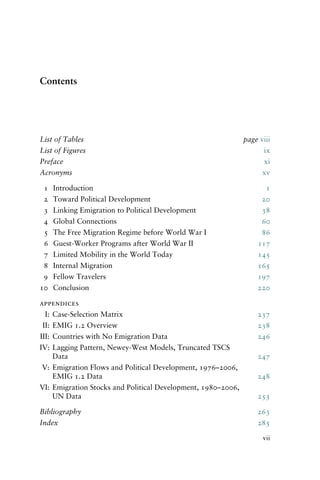
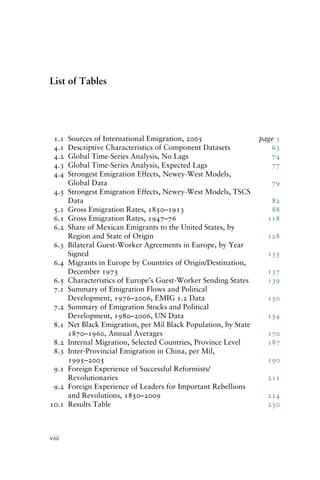
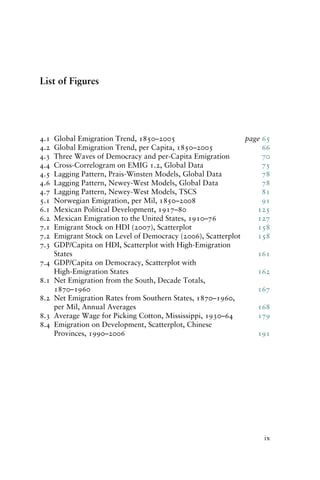


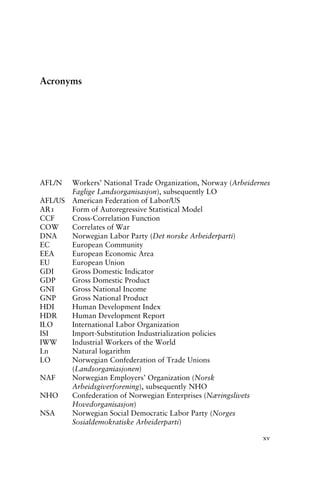
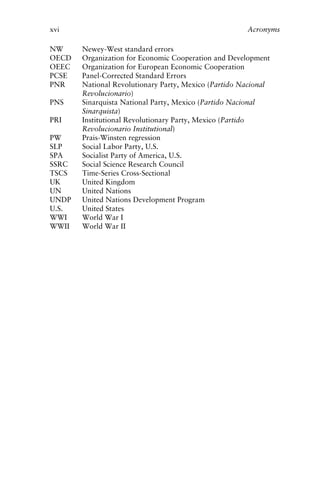
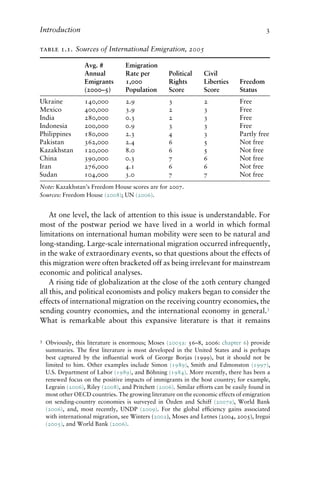
![6 Emigration and Political Development
undermined serfdom. The low population also created a high wage economy.
The benefits of high consumption were not confined to people: sheep ate better
as well, and their long wool was the basis for England’s early modern worsted
industry – the new draperies. The enormous export of these fabrics through the
port of London led to rapid growth in the city’s population and the rise of the
coal industry to provide the capital with fuel.
This argument does not focus on migration per se, but migration lurks in
the background of the story Allen tells. It is a fascinating narrative, one
that explicitly recognizes the complexity of development: how develop-
ment depends on concomitant changes along several fronts, the need to
focus on the variability of relative costs, and the blend of political and
economic factors that combine to explain development. In this narrative,
the Black Death facilitated mobility (across farms and into cities), and this
mobility affected the price of labor (relative to land, energy, and capital),
thereby encouraging investment in labor-saving machines.
This focus on relative costs and productivity levels is familiar to stu-
dents of Arthur Lewis’s dual-economy approach to development eco-
nomics. In an article from 1954, Lewis asks us to think of developing
economies in terms of two sectors: a small capitalist (or industrial) sec-
tor and a large traditional (or agricultural) sector. Because productivity is
much lower in the traditional sector than in the capitalist sector, economic
development could be facilitated by moving labor out of the traditional
sector and into manufacturing, where it could be employed more produc-
tively. To the extent that it is reasonable to place the traditional sector
in rural areas, and the capitalist sector in urban areas, migration (from
rural to urban areas) therefore becomes a key component for encouraging
economic development. From here it is just a short step to extend this
sort of argument to the study of international migrants.6
Yet the role of migration is also evident in more broad-based app-
roaches to development, such as the capabilities approach associated
with the Nobel Laureate, Amaryta Sen. For Sen (1999: 38), “[o]ne of the
biggest changes in the process of development in many economies involves
the replacement of bonded labor and forced work, which characterizes
6 Lewis’s approach was subsequently applied in a study of international migration by
Charles Kindleberger (1967) to describe the migration of surplus labor in the Maghreb
countries of Northern Africa and Turkey as part of the postwar economic boom in the
European Community. Although Kindleberger’s focus is on the effects in Europe (the
receiving area), not the effects on the (sending) Maghreb, I use it to launch an analysis of
guest-worker programs in Chapter 6.](https://image.slidesharecdn.com/2352472-250527111844-d152a129/85/Emigration-And-Political-Development-Jonathon-W-Moses-28-320.jpg)
![10 Emigration and Political Development
There is widespread recognition of the importance of the American
model in inspiring the democratic wave that swept across Europe in
the century that followed. Yet it is less well known that this influence
went beyond serving as a source of inspiration. The very existence of
the United States – an island of republican refuge in a sea of absolutist
monarchies – proved a genuine threat to the established order. For the
first time, dissatisfied subjects had a real opportunity to break their bonds
as subjects to a sovereign and exploit their right of expatriation.
This real possibility to emigrate (secured now by a state that was willing
to embrace immigrants) severely circumscribed the power of existing
states to exploit and mistreat their citizens. As argued by the eminent
French economist and statesman, Anne-Robert-Jacques Turgot (1778:
389), states in Europe would have to improve conditions or risk losing
subjects to the new country:
The asylum which [the American people] opens to the oppressed of all nations
must console the earth. The ease with which it will now be possible to take
advantage of this situation, and thus to escape from the consequences of a bad
government, will oblige the European governments to be just and enlightened.
In short, the United States’ early experience provides us with another
reason to expect that migration (or just the possibility of emigration) can
affect the political development of countries on both ends of the migration
chain. For receiving countries, immigrants provide new political input
with explicit consent. For sending countries, the threat of emigration has
the power to challenge the authority of unjust states, and emigration itself
offers an avenue of recourse for the dissatisfied subject. Individuals found
themselves with two powerful instruments for influencing government:
the threat of emigration and the real possibility of political asylum in
another country.
Turgot’s comment proved prescient, as Europeans flocked to the New
World in the 19th century. Europe experienced its first wave of democratic
reforms in the wake of this political and economic exodus.
The Fall of East Germany. A more recent example can be found beneath
the rubble that was the Berlin Wall. Throughout most of the postwar
period, the Soviet Union and its satellite states in Eastern Europe main-
tained stringent controls on the movement of their peoples. For fear of
ideological contagion, the new Soviet Man (or Woman) was kept at home
by means of a complicated blend of internal and external passports. For
the lucky few who were allowed to travel abroad, the Secretariat of](https://image.slidesharecdn.com/2352472-250527111844-d152a129/85/Emigration-And-Political-Development-Jonathon-W-Moses-32-320.jpg)
![Introduction 11
the Party Central Committee had issued “Basic Rules of Conduct.” It is
against this restrictive backdrop that we can marvel at the radical devel-
opments that occurred in East Germany at the close of the 1980s.
In August 1989, a flood of would-be émigrés from East Germany
tried to escape to the West via Hungary (and on to Austria and then West
Germany). After the Hungarian authorities stopped trying to stave off this
flight, about 30,000 East Germans had escaped to the West by the end
of September. What is unusual about this migration is that these people
were free to employ their right of expatriation: East German citizens
were welcomed as citizens in West Germany. Unlike most subjects of
every modern state, East Germans were able to secure the sort of political
refuge envisioned by America’s founding thinkers.
Although the majority of East Germans may have desired significant
political reforms, it should not surprise us that many were unwilling
to leave their homes, friends, and families. Emigration is a drastic step
to take, which is usually undertaken only by those who have already
exhausted every other means of redress. For the others, active protest is a
more convenient means of signaling dissatisfaction with unjust rule. Not
surprisingly, then, massive throngs of protestors took to the streets of
Leipzig, Dresden, Berlin, and other East German cities to voice their dis-
satisfaction with their government and to signal their intent not to leave.
Therefore while tens of thousands of East Germans were taking flight,
even larger numbers were demonstrating in their home streets – rallying
under the slogan “Wir bleiben hier!” [We stay here!] and demanding
greater input and change at home.
As we now know, this combination of emigration and protest wielded
remarkable political leverage. On November 1, 1989, the East German
cabinet reopened its border with Czechoslovakia. Two days later the
ministers in charge of security and police resigned. After a reported one
million demonstrators jammed the streets of East Berlin, the rest of the
cabinet resigned. Still, people continued to leave East Germany. In
the following week, some 50,000 people were said to have left before the
East German government eventually threw in the towel and announced
the opening of all of its border points. On November 9, the Berlin Wall
fell.11
11 For more background information on these events, see Meyer (2009), Offe (1996), Ekiert
(1996), and Stokes (1993). As we see later, Albert Hirschman’s (1992, 1993) work on
the East German example is particularly relevant. I have also employed this example in
earlier work that shows the political effects of migration. See, e.g., Moses (2005a, 2006:
chapter 5).](https://image.slidesharecdn.com/2352472-250527111844-d152a129/85/Emigration-And-Political-Development-Jonathon-W-Moses-33-320.jpg)
![Toward Political Development 25
Thus developed states enjoy broad-based substantive freedoms, whereas
underdeveloped states do not. The existence of these freedoms is consti-
tutive of development.
At the same time, Sen argues that freedom can contribute to develop-
ment in a more instrumental way. Indeed, he devotes most of his 1999
book, Development as Freedom, to outlining five types of freedom and
the ways in which they are instrumentally related to development. These
freedoms are said to advance the general capability of a person: “Greater
freedom enhances the ability of people to help themselves and also to
influence the world, and these matters are central to the process of devel-
opment” (Sen 1999: 18).
The first of these (instrumental) freedoms is what Sen (1999: 38) refers
to as political freedom, or the opportunities that people have to determine
who should govern and on what principles. Political freedom entails the
kind of political entitlements that we broadly associate with democracy,
including the civil and political rights that allow individuals to scrutinize
and criticize political authority and to enjoy the freedoms of expression,
association, and dissent.
Sen also recognizes the important role played by access to economic
facilities, because a person’s economic entitlements depend critically on
his or her ability to secure resources. For example, the lack of access
to credit restricts the development of economic agents (whether they
are individuals, firms, or families), because they cannot fully use their
economic entitlements for the purposes of consumption, production, or
exchange. Yet the importance of this second freedom is perhaps most
evident with reference to labor markets, which many of the world’s most
desperate inhabitants have difficulty entering:
[T]he crucial challenges of development in many developing countries today
include the need for the freeing up of labor from explicit or implicit bondage
that denies access to the open labor market. (Sen 1999: 7)
The last three categories of freedom can be mentioned briefly without
suggesting that they are less important than the first two. Sen’s third
category of instrumental freedoms concerns social opportunities, or the
arrangements that a society makes for education, health care, and the
like. In the same way that social and legal restrictions inhibit people from
accessing economic facilities, an individual’s poor health or lack of an
education can restrict access to the labor market. Sen’s fourth category,
transparency guarantees, recognizes the importance of openness: People
need to be able to deal with one another under conditions of trust and with](https://image.slidesharecdn.com/2352472-250527111844-d152a129/85/Emigration-And-Political-Development-Jonathon-W-Moses-47-320.jpg)
![26 Emigration and Political Development
guarantees of disclosure and lucidity. Such guarantees play an important
role in combating some of today’s most serious development challenges,
namely corruption and financial irresponsibility. Finally, Sen recognizes
the importance of protective security as a category of freedom that is
important for bringing about development. Without real protection from
abject misery, starvation, and even death, individuals can find themselves
vulnerable to great deprivation in the face of shifting market conditions.
By recognizing freedom as both a constituent part of development and
as an instrument for bringing it about, Sen forces us to change the way
in which we understand and study development. Most important is the
need to move away from singular (economistic) metrics of development
(which facilitate large-N comparisons across space and time) and toward
using contextual interpretations of development across a broad range of
indicators.7
Sen’s work
outlines the need for an integrated analysis of economic, social and political
activities, involving a variety of institutions and many interactive agencies. It
concentrates particularly on the roles and interconnections between certain cru-
cial instrumental freedoms, including economic opportunities, political freedoms,
social facilities, transparency guarantees, and protective security (Sen 1999: xii,
italics in original).
The result is an approach to development that is unabashedly value-
laden, context-specific, and political in orientation. Development is
defined relative to what people can and should be able to do (relative to
their “functionings,” in Sen’s language). In short, “[d]evelopment . . . is a
process of expanding the real freedoms that people enjoy” (Sen 1999: 3).
Martha Nussbaum
Martha Nussbaum’s approach to development derives from her back-
ground as a feminist and Aristotelian scholar. In Women and Human
Development, Nussbaum (2000) offers a capabilities approach to
7 By criticizing a single metric of development, Sen develops an argument about the diffi-
culty of making simple interpersonal comparisons. It recognizes that the utility of a given
commodity (or mix of commodities) can vary significantly across individuals and con-
texts. Therefore a focus on simple economic metrics is problematic, because the utility we
derive as an individual varies with the good. For example, the utility I get from a swim-
ming pool is radically different from the utility that such a pool provides a paraplegic. As
individuals we have different needs, and we obtain our well-being in very different ways.
This same contextual sensitivity is evident in Sen’s discussion of the capability of
appearing in public without shame (e.g., Sen 1984: 28, 332–8). Sen notes how different
our world is from that of Adam Smith, when Smith comments on how it was impossible
to appear in public (in eighteenth-century England) without a linen shirt.](https://image.slidesharecdn.com/2352472-250527111844-d152a129/85/Emigration-And-Political-Development-Jonathon-W-Moses-48-320.jpg)
![Toward Political Development 27
establish a series of fundamental political principles that focus on the
lives of women in developing countries.8
Given her different point of
departure, it is not surprising that Nussbaum’s objectives, language, and
approach differ from Sen’s in several important ways.9
Most evidently, Nussbaum’s project is not limited to creating a
comparative indicator for human development, based on capabilities.
Although this objective is important, Nussbaum’s main intent is to estab-
lish a threshold level of capabilities that can be used as a foundation for
the development of central constitutional principles (Nussbaum 2000:
12). For that reason, she delves into the normative and philosophical
issues involved and provides us with a concrete list of capabilities that
she argues can and should be applied universally. Her ten central human
functional capabilities are as follows: life; bodily health; bodily integrity;
senses, imagination, and thought; emotions; practical reason; affiliation;
other species; play; and control over one’s environment (pp. 78–80). By
providing such a list of capabilities, Nussbaum wishes to focus our atten-
tion on the two activities that are necessary for securing human develop-
ment: “not only promoting appropriate development of their [individual
citizens] internal powers, but also preparing the environment so that it
is favorable for the exercise of practical reasons and the other major
functions” (p. 85).
There is much conceptual overlap between Nussbaum’s list of ten
capabilities and Sen’s five instrumental freedoms. Like Sen’s freedoms,
Nussbaum’s list does not easily translate into a coding book or checklist
for comparing national levels of human development. Yet one cannot
study this list (or Sen’s, for that matter) without recognizing the
important role that basic political rights and institutions play in securing
these capabilities.10
In particular, Nussbaum’s tenth capability (control
over one’s environment) includes “[b]eing able to participate effectively
in political choices that govern one’s life, having the right of political
participation, protections of free speech and association” (2000: 80).
Yet a strong role for politics in securing each of the other capabilities is
also evident.11
8 As with Sen, Nussbaum’s work on capabilities extends far beyond this single book. See,
for example, Nussbaum (1988, 1990, 1995, 2003, and 2005).
9 For comparisons of Sen’s and Nussbaum’s contributions to the capabilities approach,
see, e.g., Clark (2005) and Crocker (1992).
10 Nussbaum (2000: 96ff) explicitly elaborates on the relationship between human rights
and human capabilities.
11 Consider the first capability: life. Nussbaum (2000: 78) elaborates on this capability
by adding, “Being able to live to the end of a human life of normal length; not dying
prematurely, or before one’s life is so reduced as to be not worth living.” To secure this](https://image.slidesharecdn.com/2352472-250527111844-d152a129/85/Emigration-And-Political-Development-Jonathon-W-Moses-49-320.jpg)
![Toward Political Development 31
rough index used to rank countries in terms of human development.
In short, the HDI offers an improvement on base welfare or commod-
ity indicators of development by providing a much broader measure of
development.
Yet the Human Development Report and its component HDI are not
without problems. Three of these are particularly evident in light of the
sort of issues that concern us now. The first is its limited applicability:
Because the index only stretches back to 1987, it cannot be used for
studying the development effects of emigration during earlier periods.
Given that the post-1987 period represents a period with substantial
limitations on international migration, relying on the HDI alone would
seriously constrain our ability to generalize to other periods and contexts.
Second, the HDI is collected to facilitate comparisons across nation-
states. Although this is useful, the development effects of emigration are
not restricted to this level of analysis and may be occurring at lower lev-
els; for example, within nation-states. For this reason, the HDI constricts
the sample not only in time but also in space and does not allow exam-
ination of the possible effects of emigration in important (within-state)
contexts.16
Finally, and most damning from our current perspective, the HDI does
not include any specifically political components. This lacuna has long
been recognized as an important shortcoming. Indeed, already in the
original (1990) report, the UNDP promised more work on the subject of
democratization, noting that a democratic political and social framework
was not necessarily an impediment to the attainment of relatively high
levels of human development. Later, the 2002 report was dedicated to the
issue of democracy and political development. In this report the UNDP
explicitly considered the role that democracy could play in encourag-
ing development and argued that “countries can promote human devel-
opment for all only when they have governance systems that are fully
accountable to all people – and when all people can participate in the
debates and decisions that shape their lives” (UNDP 2002: 3). Like free-
dom for Sen, the UNDP sees democracy as an important development
goal in its own right: “[E]njoying political freedom and participating in
16 This situation has recently begun to change, as data are being gathered at subnational
levels in several countries. For example, see the most recent China Human Development
Report 2007–8 (UNDP 2008: 139) for a province-level breakdown of HDI in that
country. Indeed, I employ this subnational ranking in Chapter 8. Similar figures can be
found for states on both sides of the U.S.-Mexican border, see Anderson and Gerber
(2007).](https://image.slidesharecdn.com/2352472-250527111844-d152a129/85/Emigration-And-Political-Development-Jonathon-W-Moses-53-320.jpg)