Early Embryonic Development
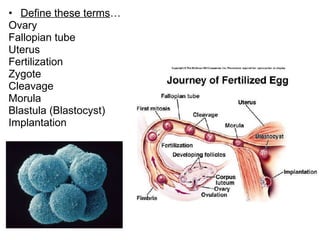
Define these terms … Ovary Fallopian tube  Uterus Fertilization Zygote Cleavage Morula Blastula (Blastocyst) Implantation
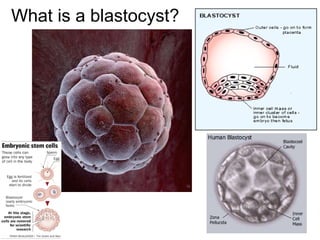
What is a blastocyst?
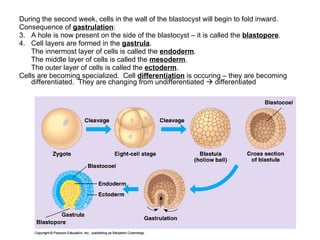
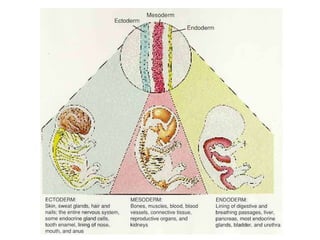
During the second week, cells in the wall of the blastocyst will begin to fold inward. Consequence of  gastrulation : A hole is now present on the side of the blastocyst – it is called the  blastopore . Cell layers are formed in the  gastrula . The innermost layer of cells is called the  endoderm . The middle layer of cells is called the  mesoderm . The outer layer of cells is called the  ectoderm . Cells are becoming specialized.  Cell  differentiation  is occuring – they are becoming differentiated.  They are changing from undifferentiated    differentiated
 
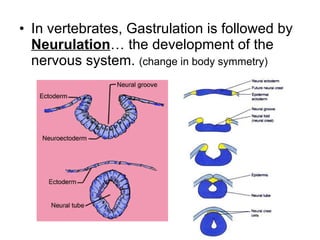
In vertebrates, Gastrulation is followed by  Neurulation … the development of the nervous system.  (change in body symmetry)
By day 21, embryonic membranes have also formed: The  Amnion      develops into a fluid filled sac. (cushions and protects baby) The  Chorion      along with the lining of uterus forms the  Placenta , the embryo’s organ for respiration, nourishment, and excretion.  (The placenta allows the embryo to make use of the mother’s organ systems while its own are developing.)
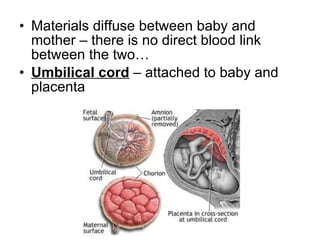
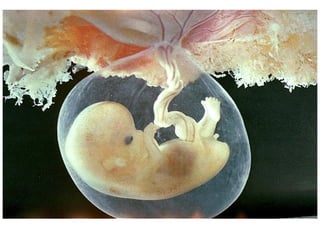
Materials diffuse between baby and mother – there is no direct blood link between the two… Umbilical cord  – attached to baby and placenta


Embryo Develoment

  • 1.
  • 2.
    Define these terms… Ovary Fallopian tube Uterus Fertilization Zygote Cleavage Morula Blastula (Blastocyst) Implantation
  • 3.
    What is ablastocyst?
  • 4.
    During the secondweek, cells in the wall of the blastocyst will begin to fold inward. Consequence of gastrulation : A hole is now present on the side of the blastocyst – it is called the blastopore . Cell layers are formed in the gastrula . The innermost layer of cells is called the endoderm . The middle layer of cells is called the mesoderm . The outer layer of cells is called the ectoderm . Cells are becoming specialized. Cell differentiation is occuring – they are becoming differentiated. They are changing from undifferentiated  differentiated
  • 5.
  • 6.
    In vertebrates, Gastrulationis followed by Neurulation … the development of the nervous system. (change in body symmetry)
  • 7.
    By day 21,embryonic membranes have also formed: The Amnion  develops into a fluid filled sac. (cushions and protects baby) The Chorion  along with the lining of uterus forms the Placenta , the embryo’s organ for respiration, nourishment, and excretion. (The placenta allows the embryo to make use of the mother’s organ systems while its own are developing.)
  • 8.
    Materials diffuse betweenbaby and mother – there is no direct blood link between the two… Umbilical cord – attached to baby and placenta
  • 9.
  • 10.