Technological Catch-up and Indigenous Institutional Infrastructures in Latecomer Natural Resource-related Industries: An Exploration of the Role of EMBRAPA in 
Brazil’s Soybean and Pulp and Paper Industries 
Paulo N. Figueiredo 
University of Brasília ,7 October 2014
RELEVANCE OF THIS STUDY 
In a world of seven billion people, which is expected to reach 8.5 billion by 2030, there has been an unprecedented demand for increase in resource generation and productivity, such as raw materials, food, renewable energy, water and new industrial inputs and a rising demand for agricultural products and natural resources. 
However, worldwide agricultural productivity growth has been slowing down: it is expected only 1% annual growth over the next two decades, much slower than historical trends. 
To meet the 2030 food and fuel demand would require 175 million to 220 million hectares of cropland. 
By 2050 there will be a 35% increase in food demand coming largely from the developing economies, especially from China, India, other Asian countries and Africa (see IFPRI, 2012; FAO, 2014; McKinsey Global Institute, 2011, 2014).
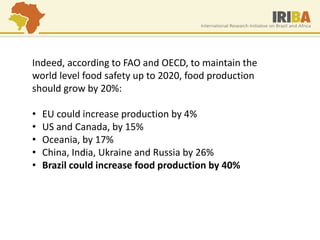
Indeed, according to FAO and OECD, to maintain the world level food safety up to 2020, food production should grow by 20%: 
•EU could increase production by 4% 
•US and Canada, by 15% 
•Oceania, by 17% 
•China, India, Ukraine and Russia by 26% 
•Brazil could increase food production by 40%
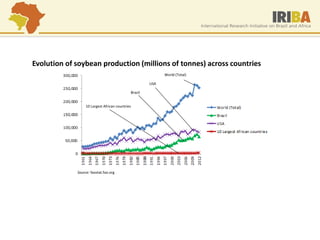
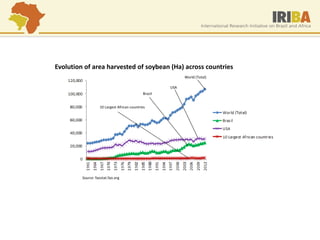
World (Total) 
Brazil 
USA 
10 Largest African countries 
Evolution of soybean production (millions of tonnes) across countries 
Source: faostat.fao.org
World (Total) 
Brazil 
USA 
10 Largest African countries 
Evolution of area harvested of soybean (Ha) across countries 
Source: faostat.fao.org
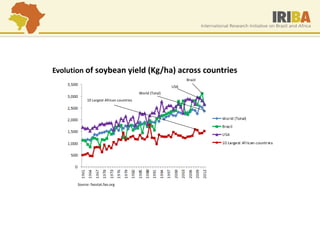
Brazil 
USA 
10 Largest African countries 
World (Total) 
Evolution of soybean yield (Kg/ha) across countries 
Source: faostat.fao.org
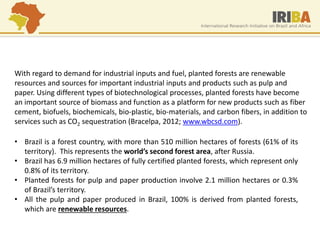
With regard to demand for industrial inputs and fuel, planted forests are renewable resources and sources for important industrial inputs and products such as pulp and paper. Using different types of biotechnological processes, planted forests have become an important source of biomass and function as a platform for new products such as fiber cement, biofuels, biochemicals, bio-plastic, bio-materials, and carbon fibers, in addition to services such as CO2 sequestration (Bracelpa, 2012; www.wbcsd.com). 
•Brazil is a forest country, with more than 510 million hectares of forests (61% of its territory). This represents the world’s second forest area, after Russia. 
•Brazil has 6.9 million hectares of fully certified planted forests, which represent only 0.8% of its territory. 
•Planted forests for pulp and paper production involve 2.1 million hectares or 0.3% of Brazil’s territory. 
•All the pulp and paper produced in Brazil, 100% is derived from planted forests, which are renewable resources.
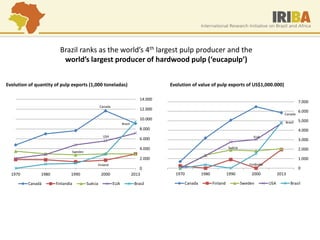
0 
2.000 
4.000 
6.000 
8.000 
10.000 
12.000 
14.000 
1970 
1980 
1990 
2000 
2013 
Canadá 
Finlandia 
Suécia 
EUA 
Brasil 
Canada 
Finland 
Sweden 
USA 
Brazil 
Evolution of quantity of pulp exports (1,000 toneladas) 
0 
1.000 
2.000 
3.000 
4.000 
5.000 
6.000 
7.000 
1970 
1980 
1990 
2000 
2013 
Canada 
Finland 
Sweden 
USA 
Brazil 
Canada 
Finlândia 
Suécia 
EUA 
Brasil 
Evolution of value of pulp exports of US$1,000.000) 
Brazil ranks as the world’s 4th largest pulp producer and the world’s largest producer of hardwood pulp (‘eucapulp’)
However, among policy makers and academic researchers, particularly in natural resource- endowed developing and emerging economies, natural resource-related industries are, generally, encapsulated as mere ‘commodities’. In terms of importance for industrial and economic growth and development, natural resource-related industries are put in a lower position in relation the so-called ‘higher value’ manufacturing goods. These perspectives on natural resource-related industries seem to have been conditioned by approaches that go back to the 1950s – e.g., the ‘deterioration of terms of trade’ (Prebish, 1950; Singer, 1950).
Negative perspectives on natural resource-related industries have also been considered industries that associate them with low economic growth and poverty – e.g. the ‘resource curse’ argument (e.g., Sachs and Warner, 2001), with a low potential for creating links that develop skills and innovative activities with the rest of the local economy – the ‘enclave’ argument (e.g., Humphereys et al., 2007), with an obstacle to deepening innovative industrial capabilities (e.g., Cimoli and Katz, 2003) and with low knowledge content and low opportunities for innovation (e.g., Cimoli and Correa, 2005, Castaldi et al., 2009). 
Additionally, in conventional classifications of industrial innovative activities agricultural and natural resource-industries are reduced to ‘low-tech’ sectors with low knowledge intensity (see OECD, 1999; 2003).
Relevant previous research has shown that today’s natural resource-rich advanced economies have obtained relevant industrial, economic and social development by building proper institutional infrastructures to support innovative activities in their natural resource-related industries (e.g., Lederman and Maloney, 2006; Fagerberg et al, 2009). Resource-endowed developing economies may take advantage of the opportunities opened up by natural resource-related industries to achieve innovative performance and competitiveness (Perez, 2008; ECLAC, 2008) and industrial development diversification (Lorentzen, 2008). Indeed, an exclusive focus on the so-called ‘high technologies industries’ (e.g., aircraft, electronics) can be harmful for countries if innovation in other sectors are ignored (OECD, 2012).
However, there is a dearth of empirical studies, from an intra-industry perspective, that examine how developing and emerging economies have built institutional infrastructures to explore opportunities for innovation and international competitiveness from their natural resources industries. Brazil is a an emerging market economy in which agricultural and natural resources related industries have a significant weight in Brazil’s GDP. Over the past several decades, agriculture and forestry-based pulp and paper industries have been undertaking innovative activities that permitted them to achieve world-leading technological and commercial positions.
Previous research suggests that these achievements have involved industry- level efforts on technological capability building with the support of institutional infrastructures such as public research institutes – e.g., the Brazilian Corporation for Agricultural Research (EMBRAPA), related organisations and government policies (e.g., Ekboir, 2003; Mazzoleni and Nelson, 2007; Figueiredo, 2010).
Therefore, this paper will explore this central question: 
What has been the role of indigenous institutional infrastructures – knowledge- related institutions such as EMBRAPA and government policies – in the technological catch-up of the soybean and forestry-based pulp and paper industries in Brazil?
HOW TO ADDRESS THIS RESEARCH QUESTION? 
This study adopts the perspective of technological catch-up of organizations based in developing/emerging economies (‘latecomers’) in association with the role of institutional infrastructures.
Technological Catch-Up: When latecomers narrow the innovative capability gap with global leaders. In natural resource-related industries latecomer cannot simply immitate existing technologies developed by global leaders. As a result, latecomers that engage in innovative activities in natural resource-related industries, tend to develop a path-creation technological catch-up process.
Technological Capabilities: What are they? 
Technological capabilities involve a stock of knowledge-related resources. This stock 
of resources permits organizations and countries to undertake technological innovation 
activities. 
These resources (capabilities) are accumulated in human capital, technical-physical systems 
and organisational and management processes.
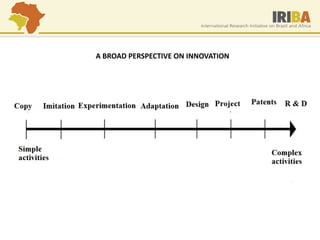
A BROAD PERSPECTIVE ON INNOVATION
Technological capabilities are usually measured by: 
•R&D expenditure 
•gross domestic expenditure of R&D 
•individuals’ qualifications 
•investments in R&D personnel 
•US patenting statistics However, such indicators and proxies are, in most cases, not relevant, when it comes to the measurement of innovative capability building in developing countries: they capture only one fraction of innovative activities.
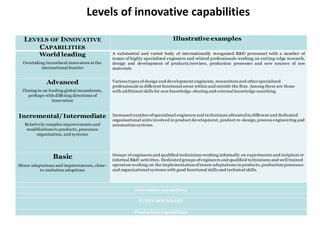
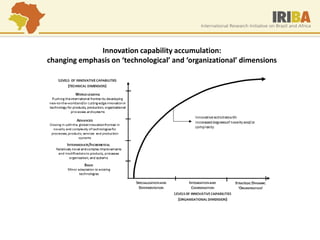
Levels of innovative capabilities 
LEVELSOFINNOVATIVECAPABILITIESIllustrative examples World leadingOvertaking incumbent innovators at the international frontier AsubstantialandvariedbodyofinternationallyrecognizedR&Dpersonnelwithanumberofteamsofhighlyspecializedengineersandrelatedprofessionalsworkingoncutting-edgeresearch, designanddevelopmentofproducts/services,productionprocessesandnewsourcesofrawmaterials. AdvancedClosing in on leading global incumbents, perhaps with differing directions of innovationVarious types of design and development engineers, researchers and other specialised professionals in different functional areas within and outside the firm. Among these are those with additional skills for new knowledge-sharing and external knowledge searching. Incremental/ IntermediateRelatively complex improvements and modifications to products, processes organisation, and systemsIncreased number of specialised engineers and technicians allocated in different and dedicated organisational units involved in product development, product re-design, process engineering and automation systems. BasicMinor adaptations and improvements, close- to-imitation adoptionsGroups of engineers and qualified technicians working informally on experiments and incipient or informal R&D activities. Dedicated groups of engineers and qualified technicians and well trained operators working on the implementation of minor adaptations in products, production processes and organizational systems with good functional skills and technical skills. Innovation capabilitiesFUZZY BOUNDARYProduction Capabilities
Innovation capability accumulation: 
changing emphasis on ‘technological’ and ‘organizational’ dimensions
To address this research question, this article draws on long-term qualitative evidence from the standpoint of EMBRAPA, related institutions and government policies oriented to innovative activities in these two industries. This evidence has been gathered through different sources and techniques (e.g. interviews, consultations to archival records and published material from EMBRAPA and related organizations, Brazilian government and other sources.
Embrapa Acre 
Embrapa Semi arid 
Embrapa Agricultural West 
Embrapa Agrosilvopastoral 
Embrapa Amapá 
Embrapa Western Amazon 
Embrapa Eastern Amazon 
Embrapa Livestock Southeast 
Embrapa Cerrados 
Embrapa Temperate Agriculture 
Embrapa Cocais 
Embrapa Mid North 
Embrapa Pantanal 
Embrapa Rondonia 
Embrapa Roraima 
Embrapa Coastal Tablelands 
Embrapa Semi arid 
Embrapa Technological Information 
Embrapa Poducts & Market 
Embrapa Coffee 
Embrapa Plant Quarantine 
Embrapa Land Management 
Embrapa Rice and Beans 
Embrapa Goats and Sheeps 
Embrapa Forestry 
Embrapa Beef Cattle 
Embrapa Dairy Cattle 
Embrapa Vegetables 
Embrapa Cassava and Tropical Fruits 
Embrapa Maize and Sorghum 
Embrapa Fisheries and Aquaculture 
Embrapa Soybean 
Embrapa Swine and Poultry 
Embrapa Wheat 
Embrapa Grapes and Wine 
Embrapa Cotton 
Embrapa Environment 
Embrapa Agrobiology 
Embrapa Agroenergy 
Embrapa Food Technology 
Embrapa Tropical Agroindustry 
Embrapa Studies and Training 
Embrapa Agricultural IT 
Embrapa Instruments 
Embrapa Satelite Monitoring 
Embrapa Genetic Resources and Biotechnology 
Embrapa Soils 
R&D Department 
Department of Technology Transfer 
Finance Management 
IT Department 
Human Resources Department 
Legal Advisory 
Communication Secretariat 
Strategic Management 
President Office 
International 
Business Secretariat 
Administration of Embrapa’s Biologic Station 
State and Supply Department 
Relations 
Secretariat 
Ecoregional Units 
National Product Centres 
National Thematic Units 
Services Units 
Executive Board Technology Transfer 
Board of 
Administration 
President 
Labex Programme 
Technical Cooperation 
USA 
Europe (France, UK, Germany) 
South America 
China 
Japan (Under construction) 
Africa (Ghana, Mozambique, Mali, Senegal) 
Latin America (Panama, Venezuela) 
Centres more related to this article 
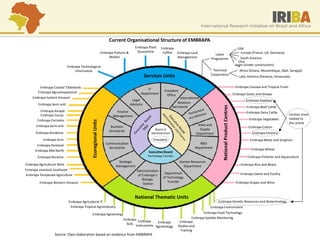
Current Organisational Structure of EMBRAPA 
Source: Own elaboration based on evidence from EMBRAPA
Federal universities and research institutes 
State universities and research institutes 
Other private organization related directly or indirectly to agriculture research 
Other public organizations related directly or indirectly to agricultural research 
State organizations for agricultureres research (OEPAS) 
EMBRAPA 
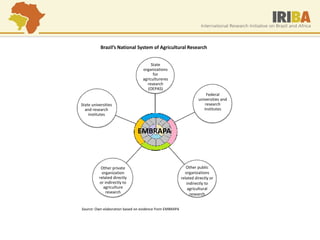
Brazil’s National System of Agricultural Research 
Source: Own elaboration based on evidence from EMBRAPA
Technological Catch-Up in Brazil’s Soybeans Industry: The Role of EMBRAPA and related instutional infrastructures 
This examination is centred on two cases of significant innovative activities: 
•The adoption of ZT in Brazil’s Cerrados 
•The Development of New Soybeans Cultivars
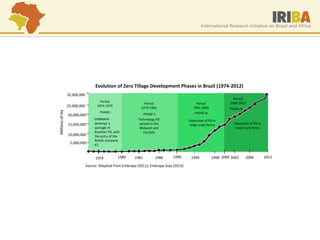
Evolution of Zero Tillage Development Phases in Brazil (1974-2012) 
Source: Adapted from Embrapa (2011); Embrapa Soja (2013) 
5,000,000 
10,000,000 
15,000,000 
20,000,000 
25,000,000 
1974 
1980 
1982 
1986 
1990 
1994 
1998 
2002 
2006 
2012 
Period 1974-1979 
PHASE I 
Period 1979-1991 
PHASE II 
Period 1991-2000 
PHASE III 
Period 2000-2012 
PHASE IV 
Millions of Ha 
32,000,000 
2000 
EMBRAPA develops a package of Brazilian PD, with the entry of the British company ICI 
Technology PD spread in the Midwest and Cerrado 
Expansion of PD in large-scale farms 
Expansion of PD in small-scale farms
2008 
2009 
2010 
2011 
2012 
Total 
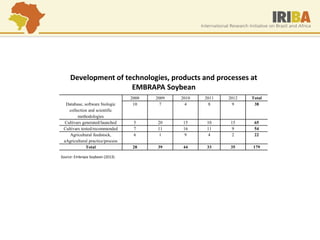
Database, software biologic collection and scientific methodologies 
10 
7 
4 
8 
9 
38 
Cultivars generated/launched 
5 
20 
15 
10 
15 
65 
Cultivars tested/recommended 
7 
11 
16 
11 
9 
54 
Agricultural feedstock, aAgricultural practice/process 
6 
1 
9 
4 
2 
22 
Total 
28 
39 
44 
33 
35 
179 
Development of technologies, products and processes at EMBRAPA Soybean 
Source: Embrapa Soybean (2013).
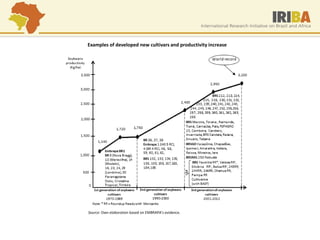
Examples of developed new cultivars and productivity increase 
Source: Own elaboration based on EMBRAPA’s evidence.
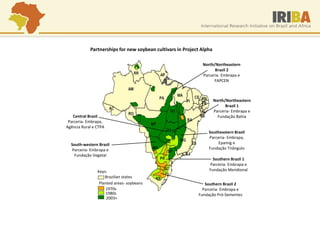
Southern Brazil 1 
Parceria- Embrapa e 
Fundação Meridional 
South-western Brazil Parceria- Embrapa e Fundação Vegetal 
North/Northeastern Brazil 2 Parceria- Embrapa e FAPCEN 
North/Northeastern Brazil 1 Parceria- Embrapa e Fundação Bahia 
Southeastern Brazil 
Parceria- Embrapa, Epamig e 
Fundação Triângulo 
Central Brazil Parceria- Embrapa, Agência Rural e CTPA 
Southern Brazil 2 Parceria- Embrapa e Fundação Pró-Sementes 
Keys: 
Brazilian states 
1970s 
1980s 
2003+ 
Planted areas- soybeans 
Partnerships for new soybean cultivars in Project Alpha
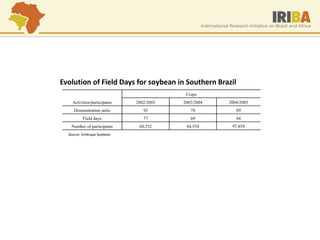
Activities/participants 
Crops 
2002/2003 
2003/2004 
2004/2005 
Demonstration units 
92 
78 
89 
Field days 
77 
69 
84 
Number of participants 
68,552 
84,554 
97,859 
Evolution of Field Days for soybean in Southern Brazil 
Source: Embrapa Soybean
Technological Catch-Up in Brazil’s Eucalyptus-based Pulp and Paper Industry: The Role of EMBRAPA and related instutional infrastructures 
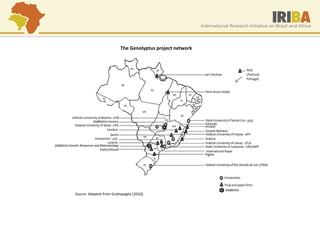
The Genolyptus Project
The Genolyptus project network 
Source: Adapted from Grattapaglia (2010).
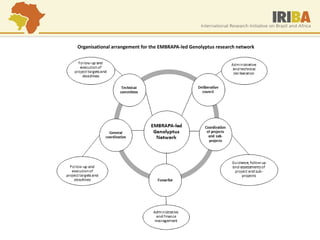
Organisational arrangement for the EMBRAPA-led Genolyptus research network
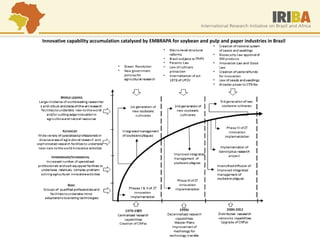
The innovative activities examined in this article have been implemented on the basis of technological capabilities accumulated and catalysed by EMBRAPA with its network of partners. These technological capabilities have a technical dimension centred on human resources, skills, and knowledge bases, and an organizational dimension. As EMBRAPA’s innovative capabilities increased, its organisational structure developed from a centralised approach towards more networked research capabilities. The accumulation and strengthening of this organisational basis over time has been decisive to support innovative activities in these two industries. The accumulation of these innovative technological capabilities have been influenced by intra-organisational efforts and changes in government policies, especially since the 1990s. 
SUMMARY OF MAIN FINDINGS
1- In the soybean industry, EMBRAPA has played a significant role in the implementation of innovative activities ever since the early stages of this industry’s technological capability building process. In the forestry-based pulp and paper industry, EMBRAPA has played a more significant role after leading firms had accumulated world-leading innovative capabilities. 2- An important feature of EMBRAPA’s role in these two industries refers to its application-oriented research, linked with industry’s demands and problems. This evidence has important implications for policy makers in developing/emerging economies because they tend to allocate funding to inventive and innovative activities that are disconnected from demands and needs from the industry and economy. 
Specifically, the study suggests that:
Three major phases in the organisational model to support innovative activities at EMBRAPA: Phase I (1960-1980s): creation and organisational concentration Phase II (1990s): organisational decentralization Phase III (2000-2012): distributed research networks
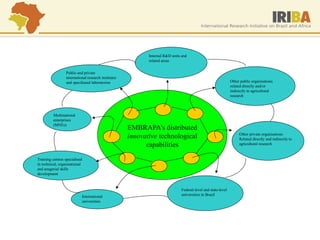
3- The role of EMBRAPA in the innovative activities of these two industries was not based on a linear perspective on innovation (in which innovative activities would trickle down from public research institutes to industry). Neither has EMBRAPA operated individually. Instead, EMBRAPA’s activities have increasingly been undertaken on the basis of a ‘system’ involving extensive partnerships with other public and private research institutes and universities and firms. EMBRAPA thus has operated on the basis of a network of partners. In the soybean industry, specifically, there has been a growing interaction with subsidiaries of multinational enterprises (MNEs), which has increasingly been an important aspect of innovation in the world seeds industry.
Innovative capability accumulation catalysed by EMBRAPA for soybean and pulp and paper industries in Brazil
EMBRAPA’s distributed innovative technological capabilities 
Public and private international research institutes and speciliased laboratories 
Multinational enterprises (MNEs) 
Training centres specialised in technical, organisational and anagerial skills development 
International universities 
Federal-level and state-level universities in Brazil 
Internal R&D units and related areas 
Other public organisations related directly and/or indirectly to agricultural research 
Other private organisations 
Related directly and indirectly to agricultural research
4- The study indicates that innovative activities that generate significant impact on productivity do not necessarily reflect only sophisticated R&D efforts. There are other types of non-R&D innovative activities which are also relevant. The implementation of the zero-tillage (ZT) technology in Brazil’s soybean industry represents an effective creative imitation; there were several inventive activities during the imitation/adaptation to local soil and climate conditions. This evidence supports previous studies about the importance of non-R&D innovative activities to innovative and competitive performance of latecomer organisations. It has implications for the potential emulation of EMBRAPA’s experience by other developing economies: policy makers should adopt a comprehensive perspective on innovation based on a spectrum of activities: from duplicative copy, creative imitation to progressive levels of change and novelty.
5- In addition to EMBRAPA’s efforts and related knowledge-based institutions, government policies have played an important role in the technological catch-up of these two industries. In the soybean industry, there were the support to agricultural expansion (1970s) and intellectual property rights (1990s). In both industries, other policies involved the opening-up of the economy (early 1990s), which brought competition to Brazilian economy and favoured innovative efforts, and the creation of government arrangements for innovation funding. 6- Although well-designed institutional infrastructures are obviously necessary for the achievement of industrial innovation and leadership, a large part of this achievement depends, on the one hand, on the functioning of these institutional infrastructures; on the other hand, such achievements depend on the nature and dynamics of the industry’s own strategic choices and related innovation efforts. Although this appears to be well known, the role of industry -level innovation efforts seems the ignored or underestimated in the design and implementation of industrial innovation policies.
7- The article challenges common generalisations that encapsulate natural resource-related industries in one single category characterised by ‘low knowledge content’ and ‘absence of innovation opportunities’. Instead, by drawing on evidence of the technological and commercial achievements of Brazil’s soybean and forestry-based pulp and paper industries, this article demonstrates a wide range of opportunities for technological innovation and international competitiveness that can be achieved in natural resource-related industries with technological capability building.
Some Implications for other resource-rich countries 
The emulation of the EMBRAPA’s experience by other resource-rich developing and emerging economies, such as those of Africa, may depend on at least two factors. The first refers to the building indigenous technological capabilities to absorb external knowledge and to implement local production-based and innovative activities. In relation to the development of technological capabilities two components deserve careful attention: the formation of a human capital basis and the formation of an organizational basis.
The building of these capabilities involve deliberate and effective efforts by government, cooperatives, farmers and other private firms, rural extension organisations and other stakeholders. The building of technological capabilities does not depend only on availability of funding but mainly on the effectiveness of learning mechanisms. The second factor relates to the building of and/or improvement of components of the institutional framework – involving supporting knowledge-related institutions to provide human capital but also to support innovative activities. They would also involve the design of specific government policies.
Finally, one aspect of the EMBRAPA’s experience seems to have particular relevance to the context of sub-Saharan Africa: it refers to the experience of achieving centralised, or large-scale, coordination and ‘critical mass’ in application-oriented research, while at the same time fostering a decentralised engagement with producers to understand the diversity of problems faced by farmers in different areas.
There is some evidence that African governments are attempting to achieve bigger markets and a pooling of technical resources, through the formation of regional trading areas. These include: SADC (Southern African Development Community); EAC (East African Community) and ECOWAS (Economic Community of West African States). Some of the aspects of the functioning of EMBRAPA, and also its problems and challenges, could perhaps contribute to shed some light on the on how these regional bodies tackle the technical aspects of natural resource management and policy strengthen agricultural research in Africa

Technological catch up: EMBRAPA's role in supporting Brazilian agriculture

  • 1.
    Technological Catch-up andIndigenous Institutional Infrastructures in Latecomer Natural Resource-related Industries: An Exploration of the Role of EMBRAPA in Brazil’s Soybean and Pulp and Paper Industries Paulo N. Figueiredo University of Brasília ,7 October 2014
  • 2.
    RELEVANCE OF THISSTUDY In a world of seven billion people, which is expected to reach 8.5 billion by 2030, there has been an unprecedented demand for increase in resource generation and productivity, such as raw materials, food, renewable energy, water and new industrial inputs and a rising demand for agricultural products and natural resources. However, worldwide agricultural productivity growth has been slowing down: it is expected only 1% annual growth over the next two decades, much slower than historical trends. To meet the 2030 food and fuel demand would require 175 million to 220 million hectares of cropland. By 2050 there will be a 35% increase in food demand coming largely from the developing economies, especially from China, India, other Asian countries and Africa (see IFPRI, 2012; FAO, 2014; McKinsey Global Institute, 2011, 2014).
  • 3.
    Indeed, according toFAO and OECD, to maintain the world level food safety up to 2020, food production should grow by 20%: •EU could increase production by 4% •US and Canada, by 15% •Oceania, by 17% •China, India, Ukraine and Russia by 26% •Brazil could increase food production by 40%
  • 4.
    World (Total) Brazil USA 10 Largest African countries Evolution of soybean production (millions of tonnes) across countries Source: faostat.fao.org
  • 5.
    World (Total) Brazil USA 10 Largest African countries Evolution of area harvested of soybean (Ha) across countries Source: faostat.fao.org
  • 6.
    Brazil USA 10Largest African countries World (Total) Evolution of soybean yield (Kg/ha) across countries Source: faostat.fao.org
  • 7.
    With regard todemand for industrial inputs and fuel, planted forests are renewable resources and sources for important industrial inputs and products such as pulp and paper. Using different types of biotechnological processes, planted forests have become an important source of biomass and function as a platform for new products such as fiber cement, biofuels, biochemicals, bio-plastic, bio-materials, and carbon fibers, in addition to services such as CO2 sequestration (Bracelpa, 2012; www.wbcsd.com). •Brazil is a forest country, with more than 510 million hectares of forests (61% of its territory). This represents the world’s second forest area, after Russia. •Brazil has 6.9 million hectares of fully certified planted forests, which represent only 0.8% of its territory. •Planted forests for pulp and paper production involve 2.1 million hectares or 0.3% of Brazil’s territory. •All the pulp and paper produced in Brazil, 100% is derived from planted forests, which are renewable resources.
  • 8.
    0 2.000 4.000 6.000 8.000 10.000 12.000 14.000 1970 1980 1990 2000 2013 Canadá Finlandia Suécia EUA Brasil Canada Finland Sweden USA Brazil Evolution of quantity of pulp exports (1,000 toneladas) 0 1.000 2.000 3.000 4.000 5.000 6.000 7.000 1970 1980 1990 2000 2013 Canada Finland Sweden USA Brazil Canada Finlândia Suécia EUA Brasil Evolution of value of pulp exports of US$1,000.000) Brazil ranks as the world’s 4th largest pulp producer and the world’s largest producer of hardwood pulp (‘eucapulp’)
  • 9.
    However, among policymakers and academic researchers, particularly in natural resource- endowed developing and emerging economies, natural resource-related industries are, generally, encapsulated as mere ‘commodities’. In terms of importance for industrial and economic growth and development, natural resource-related industries are put in a lower position in relation the so-called ‘higher value’ manufacturing goods. These perspectives on natural resource-related industries seem to have been conditioned by approaches that go back to the 1950s – e.g., the ‘deterioration of terms of trade’ (Prebish, 1950; Singer, 1950).
  • 10.
    Negative perspectives onnatural resource-related industries have also been considered industries that associate them with low economic growth and poverty – e.g. the ‘resource curse’ argument (e.g., Sachs and Warner, 2001), with a low potential for creating links that develop skills and innovative activities with the rest of the local economy – the ‘enclave’ argument (e.g., Humphereys et al., 2007), with an obstacle to deepening innovative industrial capabilities (e.g., Cimoli and Katz, 2003) and with low knowledge content and low opportunities for innovation (e.g., Cimoli and Correa, 2005, Castaldi et al., 2009). Additionally, in conventional classifications of industrial innovative activities agricultural and natural resource-industries are reduced to ‘low-tech’ sectors with low knowledge intensity (see OECD, 1999; 2003).
  • 11.
    Relevant previous researchhas shown that today’s natural resource-rich advanced economies have obtained relevant industrial, economic and social development by building proper institutional infrastructures to support innovative activities in their natural resource-related industries (e.g., Lederman and Maloney, 2006; Fagerberg et al, 2009). Resource-endowed developing economies may take advantage of the opportunities opened up by natural resource-related industries to achieve innovative performance and competitiveness (Perez, 2008; ECLAC, 2008) and industrial development diversification (Lorentzen, 2008). Indeed, an exclusive focus on the so-called ‘high technologies industries’ (e.g., aircraft, electronics) can be harmful for countries if innovation in other sectors are ignored (OECD, 2012).
  • 12.
    However, there isa dearth of empirical studies, from an intra-industry perspective, that examine how developing and emerging economies have built institutional infrastructures to explore opportunities for innovation and international competitiveness from their natural resources industries. Brazil is a an emerging market economy in which agricultural and natural resources related industries have a significant weight in Brazil’s GDP. Over the past several decades, agriculture and forestry-based pulp and paper industries have been undertaking innovative activities that permitted them to achieve world-leading technological and commercial positions.
  • 13.
    Previous research suggeststhat these achievements have involved industry- level efforts on technological capability building with the support of institutional infrastructures such as public research institutes – e.g., the Brazilian Corporation for Agricultural Research (EMBRAPA), related organisations and government policies (e.g., Ekboir, 2003; Mazzoleni and Nelson, 2007; Figueiredo, 2010).
  • 14.
    Therefore, this paperwill explore this central question: What has been the role of indigenous institutional infrastructures – knowledge- related institutions such as EMBRAPA and government policies – in the technological catch-up of the soybean and forestry-based pulp and paper industries in Brazil?
  • 15.
    HOW TO ADDRESSTHIS RESEARCH QUESTION? This study adopts the perspective of technological catch-up of organizations based in developing/emerging economies (‘latecomers’) in association with the role of institutional infrastructures.
  • 16.
    Technological Catch-Up: Whenlatecomers narrow the innovative capability gap with global leaders. In natural resource-related industries latecomer cannot simply immitate existing technologies developed by global leaders. As a result, latecomers that engage in innovative activities in natural resource-related industries, tend to develop a path-creation technological catch-up process.
  • 17.
    Technological Capabilities: Whatare they? Technological capabilities involve a stock of knowledge-related resources. This stock of resources permits organizations and countries to undertake technological innovation activities. These resources (capabilities) are accumulated in human capital, technical-physical systems and organisational and management processes.
  • 18.
    A BROAD PERSPECTIVEON INNOVATION
  • 19.
    Technological capabilities areusually measured by: •R&D expenditure •gross domestic expenditure of R&D •individuals’ qualifications •investments in R&D personnel •US patenting statistics However, such indicators and proxies are, in most cases, not relevant, when it comes to the measurement of innovative capability building in developing countries: they capture only one fraction of innovative activities.
  • 20.
    Levels of innovativecapabilities LEVELSOFINNOVATIVECAPABILITIESIllustrative examples World leadingOvertaking incumbent innovators at the international frontier AsubstantialandvariedbodyofinternationallyrecognizedR&Dpersonnelwithanumberofteamsofhighlyspecializedengineersandrelatedprofessionalsworkingoncutting-edgeresearch, designanddevelopmentofproducts/services,productionprocessesandnewsourcesofrawmaterials. AdvancedClosing in on leading global incumbents, perhaps with differing directions of innovationVarious types of design and development engineers, researchers and other specialised professionals in different functional areas within and outside the firm. Among these are those with additional skills for new knowledge-sharing and external knowledge searching. Incremental/ IntermediateRelatively complex improvements and modifications to products, processes organisation, and systemsIncreased number of specialised engineers and technicians allocated in different and dedicated organisational units involved in product development, product re-design, process engineering and automation systems. BasicMinor adaptations and improvements, close- to-imitation adoptionsGroups of engineers and qualified technicians working informally on experiments and incipient or informal R&D activities. Dedicated groups of engineers and qualified technicians and well trained operators working on the implementation of minor adaptations in products, production processes and organizational systems with good functional skills and technical skills. Innovation capabilitiesFUZZY BOUNDARYProduction Capabilities
  • 21.
    Innovation capability accumulation: changing emphasis on ‘technological’ and ‘organizational’ dimensions
  • 22.
    To address thisresearch question, this article draws on long-term qualitative evidence from the standpoint of EMBRAPA, related institutions and government policies oriented to innovative activities in these two industries. This evidence has been gathered through different sources and techniques (e.g. interviews, consultations to archival records and published material from EMBRAPA and related organizations, Brazilian government and other sources.
  • 23.
    Embrapa Acre EmbrapaSemi arid Embrapa Agricultural West Embrapa Agrosilvopastoral Embrapa Amapá Embrapa Western Amazon Embrapa Eastern Amazon Embrapa Livestock Southeast Embrapa Cerrados Embrapa Temperate Agriculture Embrapa Cocais Embrapa Mid North Embrapa Pantanal Embrapa Rondonia Embrapa Roraima Embrapa Coastal Tablelands Embrapa Semi arid Embrapa Technological Information Embrapa Poducts & Market Embrapa Coffee Embrapa Plant Quarantine Embrapa Land Management Embrapa Rice and Beans Embrapa Goats and Sheeps Embrapa Forestry Embrapa Beef Cattle Embrapa Dairy Cattle Embrapa Vegetables Embrapa Cassava and Tropical Fruits Embrapa Maize and Sorghum Embrapa Fisheries and Aquaculture Embrapa Soybean Embrapa Swine and Poultry Embrapa Wheat Embrapa Grapes and Wine Embrapa Cotton Embrapa Environment Embrapa Agrobiology Embrapa Agroenergy Embrapa Food Technology Embrapa Tropical Agroindustry Embrapa Studies and Training Embrapa Agricultural IT Embrapa Instruments Embrapa Satelite Monitoring Embrapa Genetic Resources and Biotechnology Embrapa Soils R&D Department Department of Technology Transfer Finance Management IT Department Human Resources Department Legal Advisory Communication Secretariat Strategic Management President Office International Business Secretariat Administration of Embrapa’s Biologic Station State and Supply Department Relations Secretariat Ecoregional Units National Product Centres National Thematic Units Services Units Executive Board Technology Transfer Board of Administration President Labex Programme Technical Cooperation USA Europe (France, UK, Germany) South America China Japan (Under construction) Africa (Ghana, Mozambique, Mali, Senegal) Latin America (Panama, Venezuela) Centres more related to this article Current Organisational Structure of EMBRAPA Source: Own elaboration based on evidence from EMBRAPA
  • 24.
    Federal universities andresearch institutes State universities and research institutes Other private organization related directly or indirectly to agriculture research Other public organizations related directly or indirectly to agricultural research State organizations for agricultureres research (OEPAS) EMBRAPA Brazil’s National System of Agricultural Research Source: Own elaboration based on evidence from EMBRAPA
  • 25.
    Technological Catch-Up inBrazil’s Soybeans Industry: The Role of EMBRAPA and related instutional infrastructures This examination is centred on two cases of significant innovative activities: •The adoption of ZT in Brazil’s Cerrados •The Development of New Soybeans Cultivars
  • 26.
    Evolution of ZeroTillage Development Phases in Brazil (1974-2012) Source: Adapted from Embrapa (2011); Embrapa Soja (2013) 5,000,000 10,000,000 15,000,000 20,000,000 25,000,000 1974 1980 1982 1986 1990 1994 1998 2002 2006 2012 Period 1974-1979 PHASE I Period 1979-1991 PHASE II Period 1991-2000 PHASE III Period 2000-2012 PHASE IV Millions of Ha 32,000,000 2000 EMBRAPA develops a package of Brazilian PD, with the entry of the British company ICI Technology PD spread in the Midwest and Cerrado Expansion of PD in large-scale farms Expansion of PD in small-scale farms
  • 27.
    2008 2009 2010 2011 2012 Total Database, software biologic collection and scientific methodologies 10 7 4 8 9 38 Cultivars generated/launched 5 20 15 10 15 65 Cultivars tested/recommended 7 11 16 11 9 54 Agricultural feedstock, aAgricultural practice/process 6 1 9 4 2 22 Total 28 39 44 33 35 179 Development of technologies, products and processes at EMBRAPA Soybean Source: Embrapa Soybean (2013).
  • 28.
    Examples of developednew cultivars and productivity increase Source: Own elaboration based on EMBRAPA’s evidence.
  • 29.
    Southern Brazil 1 Parceria- Embrapa e Fundação Meridional South-western Brazil Parceria- Embrapa e Fundação Vegetal North/Northeastern Brazil 2 Parceria- Embrapa e FAPCEN North/Northeastern Brazil 1 Parceria- Embrapa e Fundação Bahia Southeastern Brazil Parceria- Embrapa, Epamig e Fundação Triângulo Central Brazil Parceria- Embrapa, Agência Rural e CTPA Southern Brazil 2 Parceria- Embrapa e Fundação Pró-Sementes Keys: Brazilian states 1970s 1980s 2003+ Planted areas- soybeans Partnerships for new soybean cultivars in Project Alpha
  • 30.
    Activities/participants Crops 2002/2003 2003/2004 2004/2005 Demonstration units 92 78 89 Field days 77 69 84 Number of participants 68,552 84,554 97,859 Evolution of Field Days for soybean in Southern Brazil Source: Embrapa Soybean
  • 31.
    Technological Catch-Up inBrazil’s Eucalyptus-based Pulp and Paper Industry: The Role of EMBRAPA and related instutional infrastructures The Genolyptus Project
  • 32.
    The Genolyptus projectnetwork Source: Adapted from Grattapaglia (2010).
  • 33.
    Organisational arrangement forthe EMBRAPA-led Genolyptus research network
  • 34.
    The innovative activitiesexamined in this article have been implemented on the basis of technological capabilities accumulated and catalysed by EMBRAPA with its network of partners. These technological capabilities have a technical dimension centred on human resources, skills, and knowledge bases, and an organizational dimension. As EMBRAPA’s innovative capabilities increased, its organisational structure developed from a centralised approach towards more networked research capabilities. The accumulation and strengthening of this organisational basis over time has been decisive to support innovative activities in these two industries. The accumulation of these innovative technological capabilities have been influenced by intra-organisational efforts and changes in government policies, especially since the 1990s. SUMMARY OF MAIN FINDINGS
  • 35.
    1- In thesoybean industry, EMBRAPA has played a significant role in the implementation of innovative activities ever since the early stages of this industry’s technological capability building process. In the forestry-based pulp and paper industry, EMBRAPA has played a more significant role after leading firms had accumulated world-leading innovative capabilities. 2- An important feature of EMBRAPA’s role in these two industries refers to its application-oriented research, linked with industry’s demands and problems. This evidence has important implications for policy makers in developing/emerging economies because they tend to allocate funding to inventive and innovative activities that are disconnected from demands and needs from the industry and economy. Specifically, the study suggests that:
  • 36.
    Three major phasesin the organisational model to support innovative activities at EMBRAPA: Phase I (1960-1980s): creation and organisational concentration Phase II (1990s): organisational decentralization Phase III (2000-2012): distributed research networks
  • 37.
    3- The roleof EMBRAPA in the innovative activities of these two industries was not based on a linear perspective on innovation (in which innovative activities would trickle down from public research institutes to industry). Neither has EMBRAPA operated individually. Instead, EMBRAPA’s activities have increasingly been undertaken on the basis of a ‘system’ involving extensive partnerships with other public and private research institutes and universities and firms. EMBRAPA thus has operated on the basis of a network of partners. In the soybean industry, specifically, there has been a growing interaction with subsidiaries of multinational enterprises (MNEs), which has increasingly been an important aspect of innovation in the world seeds industry.
  • 38.
    Innovative capability accumulationcatalysed by EMBRAPA for soybean and pulp and paper industries in Brazil
  • 39.
    EMBRAPA’s distributed innovativetechnological capabilities Public and private international research institutes and speciliased laboratories Multinational enterprises (MNEs) Training centres specialised in technical, organisational and anagerial skills development International universities Federal-level and state-level universities in Brazil Internal R&D units and related areas Other public organisations related directly and/or indirectly to agricultural research Other private organisations Related directly and indirectly to agricultural research
  • 40.
    4- The studyindicates that innovative activities that generate significant impact on productivity do not necessarily reflect only sophisticated R&D efforts. There are other types of non-R&D innovative activities which are also relevant. The implementation of the zero-tillage (ZT) technology in Brazil’s soybean industry represents an effective creative imitation; there were several inventive activities during the imitation/adaptation to local soil and climate conditions. This evidence supports previous studies about the importance of non-R&D innovative activities to innovative and competitive performance of latecomer organisations. It has implications for the potential emulation of EMBRAPA’s experience by other developing economies: policy makers should adopt a comprehensive perspective on innovation based on a spectrum of activities: from duplicative copy, creative imitation to progressive levels of change and novelty.
  • 41.
    5- In additionto EMBRAPA’s efforts and related knowledge-based institutions, government policies have played an important role in the technological catch-up of these two industries. In the soybean industry, there were the support to agricultural expansion (1970s) and intellectual property rights (1990s). In both industries, other policies involved the opening-up of the economy (early 1990s), which brought competition to Brazilian economy and favoured innovative efforts, and the creation of government arrangements for innovation funding. 6- Although well-designed institutional infrastructures are obviously necessary for the achievement of industrial innovation and leadership, a large part of this achievement depends, on the one hand, on the functioning of these institutional infrastructures; on the other hand, such achievements depend on the nature and dynamics of the industry’s own strategic choices and related innovation efforts. Although this appears to be well known, the role of industry -level innovation efforts seems the ignored or underestimated in the design and implementation of industrial innovation policies.
  • 42.
    7- The articlechallenges common generalisations that encapsulate natural resource-related industries in one single category characterised by ‘low knowledge content’ and ‘absence of innovation opportunities’. Instead, by drawing on evidence of the technological and commercial achievements of Brazil’s soybean and forestry-based pulp and paper industries, this article demonstrates a wide range of opportunities for technological innovation and international competitiveness that can be achieved in natural resource-related industries with technological capability building.
  • 43.
    Some Implications forother resource-rich countries The emulation of the EMBRAPA’s experience by other resource-rich developing and emerging economies, such as those of Africa, may depend on at least two factors. The first refers to the building indigenous technological capabilities to absorb external knowledge and to implement local production-based and innovative activities. In relation to the development of technological capabilities two components deserve careful attention: the formation of a human capital basis and the formation of an organizational basis.
  • 44.
    The building ofthese capabilities involve deliberate and effective efforts by government, cooperatives, farmers and other private firms, rural extension organisations and other stakeholders. The building of technological capabilities does not depend only on availability of funding but mainly on the effectiveness of learning mechanisms. The second factor relates to the building of and/or improvement of components of the institutional framework – involving supporting knowledge-related institutions to provide human capital but also to support innovative activities. They would also involve the design of specific government policies.
  • 45.
    Finally, one aspectof the EMBRAPA’s experience seems to have particular relevance to the context of sub-Saharan Africa: it refers to the experience of achieving centralised, or large-scale, coordination and ‘critical mass’ in application-oriented research, while at the same time fostering a decentralised engagement with producers to understand the diversity of problems faced by farmers in different areas.
  • 46.
    There is someevidence that African governments are attempting to achieve bigger markets and a pooling of technical resources, through the formation of regional trading areas. These include: SADC (Southern African Development Community); EAC (East African Community) and ECOWAS (Economic Community of West African States). Some of the aspects of the functioning of EMBRAPA, and also its problems and challenges, could perhaps contribute to shed some light on the on how these regional bodies tackle the technical aspects of natural resource management and policy strengthen agricultural research in Africa