Aleph Advisors Jan. 31, 2015
1
EM VALUE: READY TO EMERGE
Global Macro Portfolio/ Asset Allocation: Alpha Opportunity in Global Equities
Trade idea Total return swaps Alex Dumortier
Long MSCI Emerging Markets Index +1 (202) 730-6643
alex.dumortier@gmail.com
Short S&P 500 Index
ETFs
Long SPDR S&P 500 ETF (SPY)
Short iShares MSCI Emerging Markets Index (EEM)
Trade type Mean reversion
Expected
timeframe 12-36 months
Expected
return 6% - 12% p.a.
Until recently, the case for emerging markets was often put
overenthusiastically with exaggerated claims, often based on GDP
growth… Sentiment toward emerging markets can shift rapidly,
however.
-- Elroy Dimson, Paul Marsh & Mike Staunton1
Long emerging market equities/ short US equities (or overweight EM
equities/ underweight US equities in an asset allocation framework)
may seem like an obvious or pedestrian trade idea. Perhaps it looks too
good to be true because it’s hiding in plain sight. But don’t let that
disqualify it from receiving your full attention. As we describe below,
the data suggest EM equities offer excellent value right now; long-only
or paired with a short on the pricey US stock market, this situation is
compelling. In a world in which cheap is scarce, emerging markets’
value is ready to emerge!
1 Emerging Markets Revisited, Credit Suisse Global Investment Returns
Yearbook 2014
Aleph Advisors Jan. 31, 2015
2
THESIS
EM equities are undervalued, both on an absolute basis and particularly relative to US equities.
Investors, from bottom-up stockpickers to asset allocators, often underestimate the extent to which
valuation drives returns (and alpha), or at least they behave as if they do. That oversight repeatedly
stung investors over the past four decades when they overpaid for EM shares in the hope of capturing
a piece of these countries’ impressive GDP growth (a well-polished, but fallacious, stock promoters’
story.)
Today, however, investors have a chance to put the emerging markets’ valuation factor to work for
them, rather than against them.
Mind the (valuation) gap
Emerging market shares are cheap on an absolute basis and, certainly, relative to a US stock market
that looks fully priced, at best.
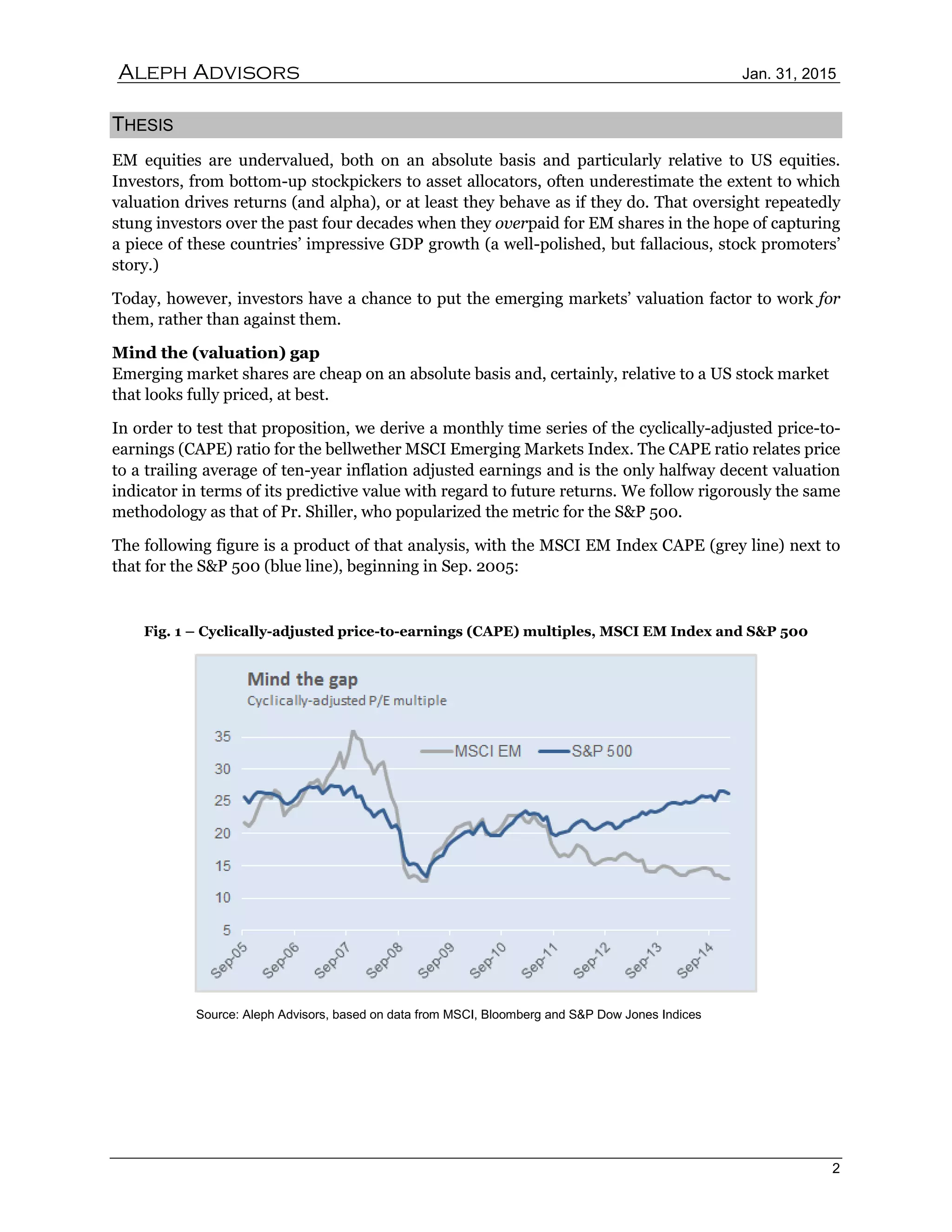
In order to test that proposition, we derive a monthly time series of the cyclically-adjusted price-to-
earnings (CAPE) ratio for the bellwether MSCI Emerging Markets Index. The CAPE ratio relates price
to a trailing average of ten-year inflation adjusted earnings and is the only halfway decent valuation
indicator in terms of its predictive value with regard to future returns. We follow rigorously the same
methodology as that of Pr. Shiller, who popularized the metric for the S&P 500.
The following figure is a product of that analysis, with the MSCI EM Index CAPE (grey line) next to
that for the S&P 500 (blue line), beginning in Sep. 2005:
Fig. 1 – Cyclically-adjusted price-to-earnings (CAPE) multiples, MSCI EM Index and S&P 500
Source: Aleph Advisors, based on data from MSCI, Bloomberg and S&P Dow Jones Indices
Aleph Advisors Jan. 31, 2015
3
Two observations:
 Absolute value: Our series for the MSCI EM Index is less than ten years long -- very short
by historical standards. However, we’re “lucky” in that it contains a great benchmark for severe
undervaluation: the global financial crisis of 2008-2009. Incredibly, more than five years after
Lehman’s bankruptcy, the MSCI EM Index’s CAPE, at just 13.1, is less than 20% above the
crisis low it set on Oct. 27, 2008.
Because our CAPE series is short, a quick look at the history of the MSCI EM Index’s ordinary
P/E ratio on the basis of trailing-twelve-month earnings reveals it is currently at the same level
that it was at the end of Aug. 1998, the month in which Russia devalued the rouble and
defaulted on its debt. Over the subsequent one-, three- and five-year periods, the index then
produced annualized total returns of 72.3%, 9.7% and 11.9%, respectively.
 Relative value: At more than two standard deviations from its average, the current spread
between the S&P 500’s CAPE multiple and that of the MSCI EM Index is the widest it’s been
throughout the entire period starting in Sep. 2005.
For a brief discussion of whether the CAPE has predictive value with regard to returns, please see
Appendix 1.
Aleph Advisors Jan. 31, 2015
4
VARIANT PERCEPTION
3 eye-catching observations
This idea was borne out of three observations:
 One needs to go back to the aftermath of the “Asian contagion” and Russian rouble crises of
1997-1998 to find EM shares underperforming US stocks to a greater extent than they have in
the current period, in terms of trailing three-year returns.
 EM company earnings are below their long-term trend, while US corporate earnings are
substantially above their long-term trend.
 EM equities are currently on offer at the widest valuation discount to US equities in at least a
decade.
Note that these variables – returns, corporate profitability and valuations -- exhibit significant mean
reversion over the medium- to long-term (they’re not short-term trading signals, however.)
EM equities have been in disfavor with investors since the “taper tantrum” of May 2013 when then-
Fed chairman Bernanke suggested that the central bank would begin to wind down QE3. During the
same period, US equities have remained a “go-to” asset class – despite the fact that there now seems
to be a consensus among institutional investors that they are overvalued. Last month’s Russian rouble
crisis and the continuing collapse in the price of oil appear to have reinforced both of those orientations
at the start of the year.
Fund manager sentiment towards US and EM equities shifted significantly at the start
of 2015
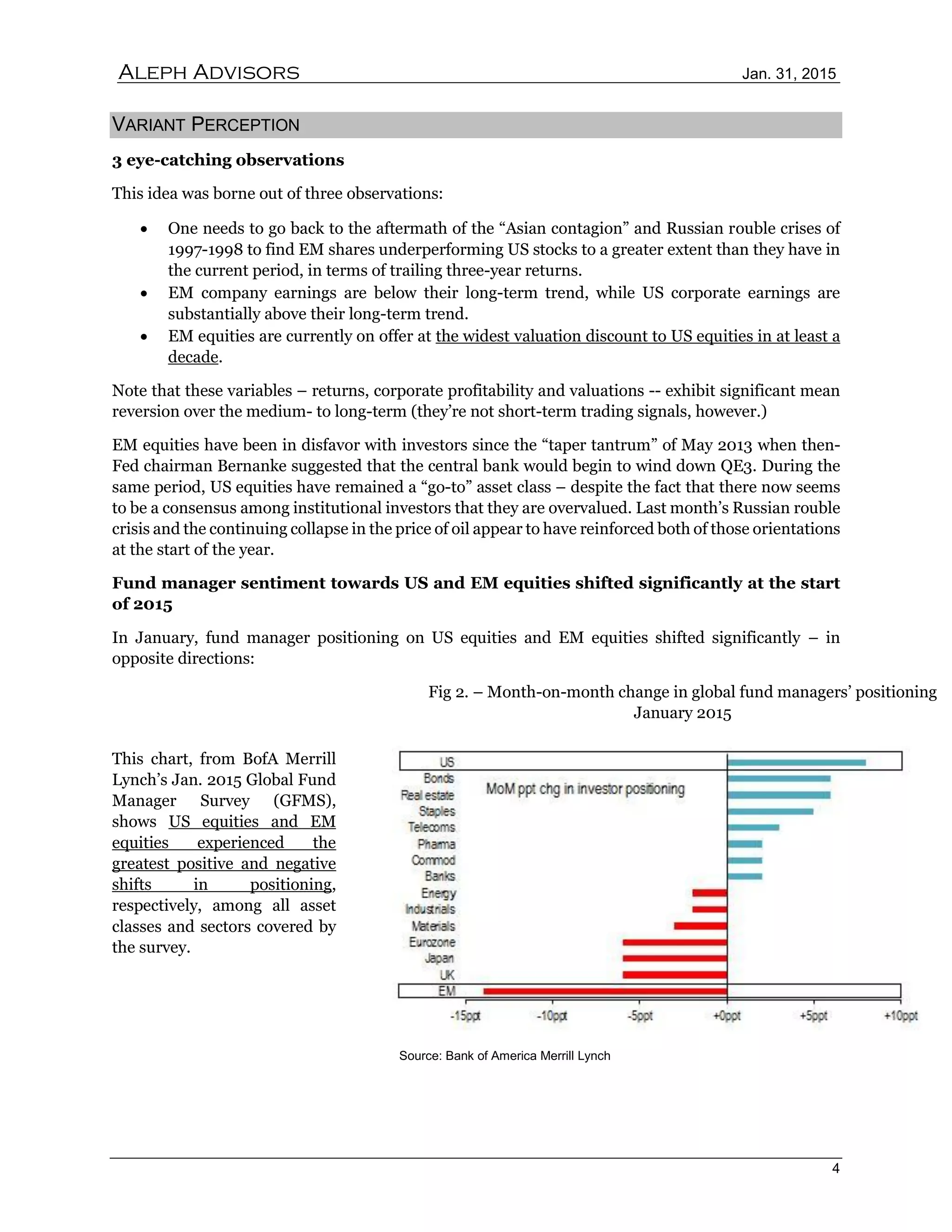
In January, fund manager positioning on US equities and EM equities shifted significantly – in
opposite directions:
This chart, from BofA Merrill
Lynch’s Jan. 2015 Global Fund
Manager Survey (GFMS),
shows US equities and EM
equities experienced the
greatest positive and negative
shifts in positioning,
respectively, among all asset
classes and sectors covered by
the survey.
Fig 2. – Month-on-month change in global fund managers’ positioning
January 2015
Source: Bank of America Merrill Lynch
Aleph Advisors Jan. 31, 2015
5
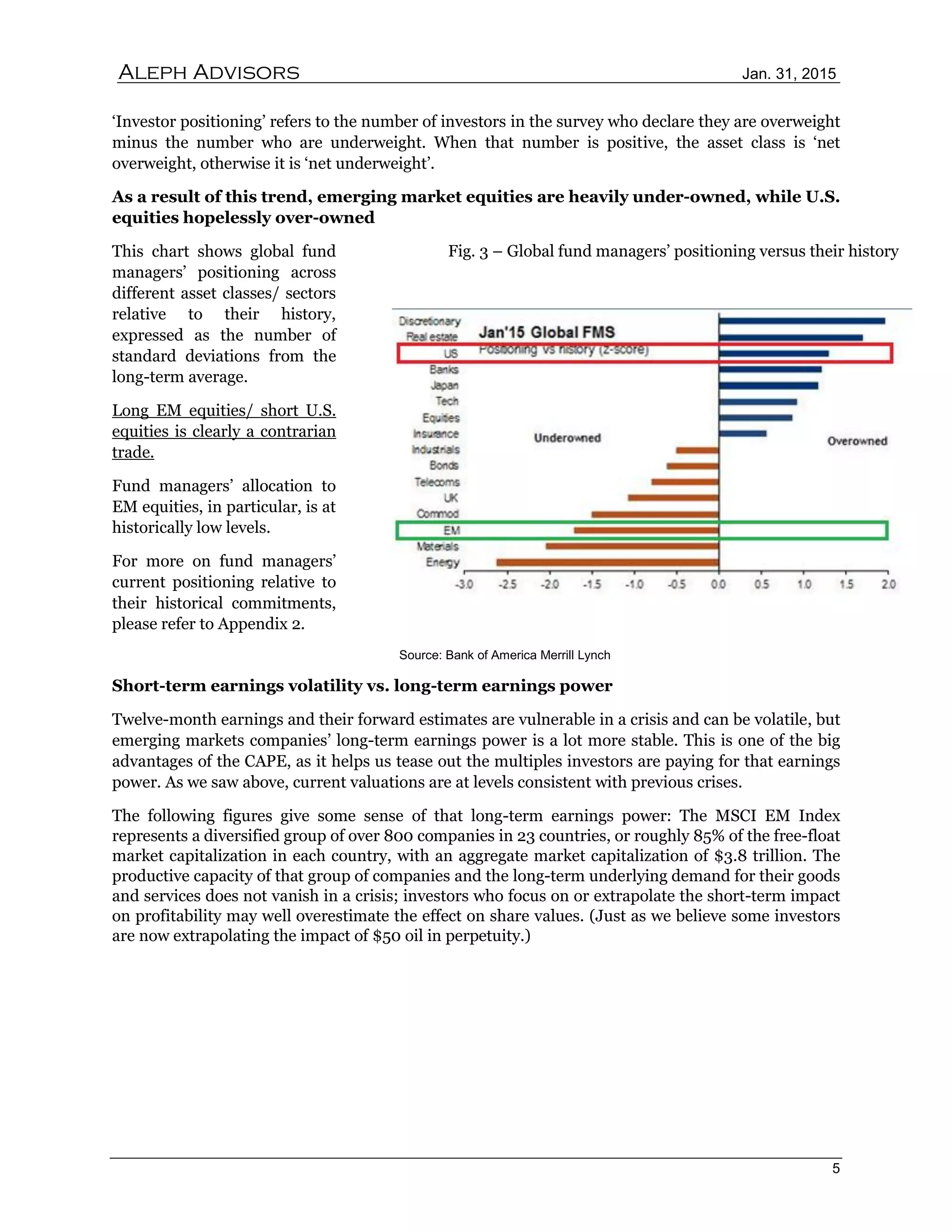
‘Investor positioning’ refers to the number of investors in the survey who declare they are overweight
minus the number who are underweight. When that number is positive, the asset class is ‘net
overweight, otherwise it is ‘net underweight’.
As a result of this trend, emerging market equities are heavily under-owned, while U.S.
equities hopelessly over-owned
This chart shows global fund
managers’ positioning across
different asset classes/ sectors
relative to their history,
expressed as the number of
standard deviations from the
long-term average.
Long EM equities/ short U.S.
equities is clearly a contrarian
trade.
Fund managers’ allocation to
EM equities, in particular, is at
historically low levels.
For more on fund managers’
current positioning relative to
their historical commitments,
please refer to Appendix 2.
Fig. 3 – Global fund managers’ positioning versus their history
Source: Bank of America Merrill Lynch
Short-term earnings volatility vs. long-term earnings power
Twelve-month earnings and their forward estimates are vulnerable in a crisis and can be volatile, but
emerging markets companies’ long-term earnings power is a lot more stable. This is one of the big
advantages of the CAPE, as it helps us tease out the multiples investors are paying for that earnings
power. As we saw above, current valuations are at levels consistent with previous crises.
The following figures give some sense of that long-term earnings power: The MSCI EM Index
represents a diversified group of over 800 companies in 23 countries, or roughly 85% of the free-float
market capitalization in each country, with an aggregate market capitalization of $3.8 trillion. The
productive capacity of that group of companies and the long-term underlying demand for their goods
and services does not vanish in a crisis; investors who focus on or extrapolate the short-term impact
on profitability may well overestimate the effect on share values. (Just as we believe some investors
are now extrapolating the impact of $50 oil in perpetuity.)
Aleph Advisors Jan. 31, 2015
6
RISKS
A “hard landing” of China’s economy is a legitimate risk – China has more than a one-fifth weighting
in the iShares MSCI EM ETF (combine that with Taiwan and the weighting rises to roughly a third.)
Nevertheless, the thrust of my argument – that EM shares are cheap relative to the U.S. market and
more than compensate investors for the risk they bear – applies to China, too. Over the past five years,
the MSCI China Index has trailed the S&P 500 by a full eleven percentage points (annualized).
On the assumption that we’re correct that EM equities are undervalued, a full-blown EM crisis would
bring the threat of sharp, but impermanent, mark-to-market losses, rather than a permanent loss of
capital (which is of greatest concern to a long-term, value-oriented investor.) To reiterate, though:
Valuations are already at crisis levels. Naturally, however, a crisis would push out the expected
timeframe for the trade to be successful.
Another risk in terms of mark-to-market losses is the possibility that the overvaluation of US shares
becomes more pronounced. We see this as entirely possible in the short-term on the basis of the same
factors that created the conditions for this trade. However, given the power of mean reversion in
valuations and what looks like gravity-defying US corporate profitability, the US market’s valuation
looks unsustainable over a longer-term timeframe.
CATALYSTS
There are no obvious catalysts for the EM shares’ undervaluation to reverse; in fact, it’s probably easier
to think of catalysts that would increase the undervaluation in the short term! However, although it
requires patience, fortitude (and understanding limited partners), value is its own catalyst over time.
Alternatively, we venture that an upside correction in the price of oil or the long-anticipated U.S. rate
hike might do the trick.
Aleph Advisors Jan. 31, 2015
7
APPENDIX 1
IS THE CAPE PREDICTIVE OF FUTURE RETURNS FOR EMERGING MARKET EQUITIES?
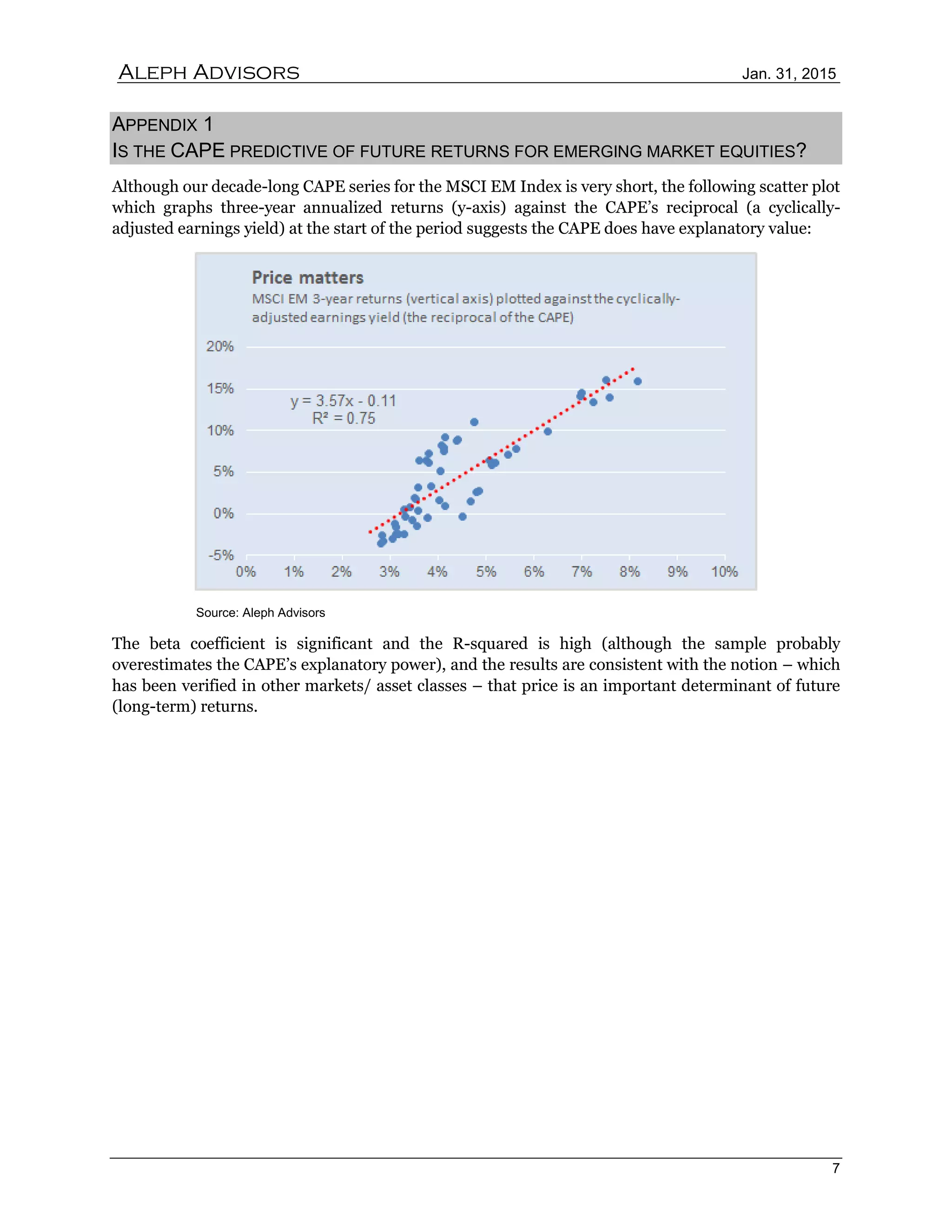
Although our decade-long CAPE series for the MSCI EM Index is very short, the following scatter plot
which graphs three-year annualized returns (y-axis) against the CAPE’s reciprocal (a cyclically-
adjusted earnings yield) at the start of the period suggests the CAPE does have explanatory value:
Source: Aleph Advisors
The beta coefficient is significant and the R-squared is high (although the sample probably
overestimates the CAPE’s explanatory power), and the results are consistent with the notion – which
has been verified in other markets/ asset classes – that price is an important determinant of future
(long-term) returns.
Aleph Advisors Jan. 31, 2015
8
APPENDIX 2
BAML GFMS RESULTS: FUND MANAGERS’ POSITIONING – HISTORICAL SERIES
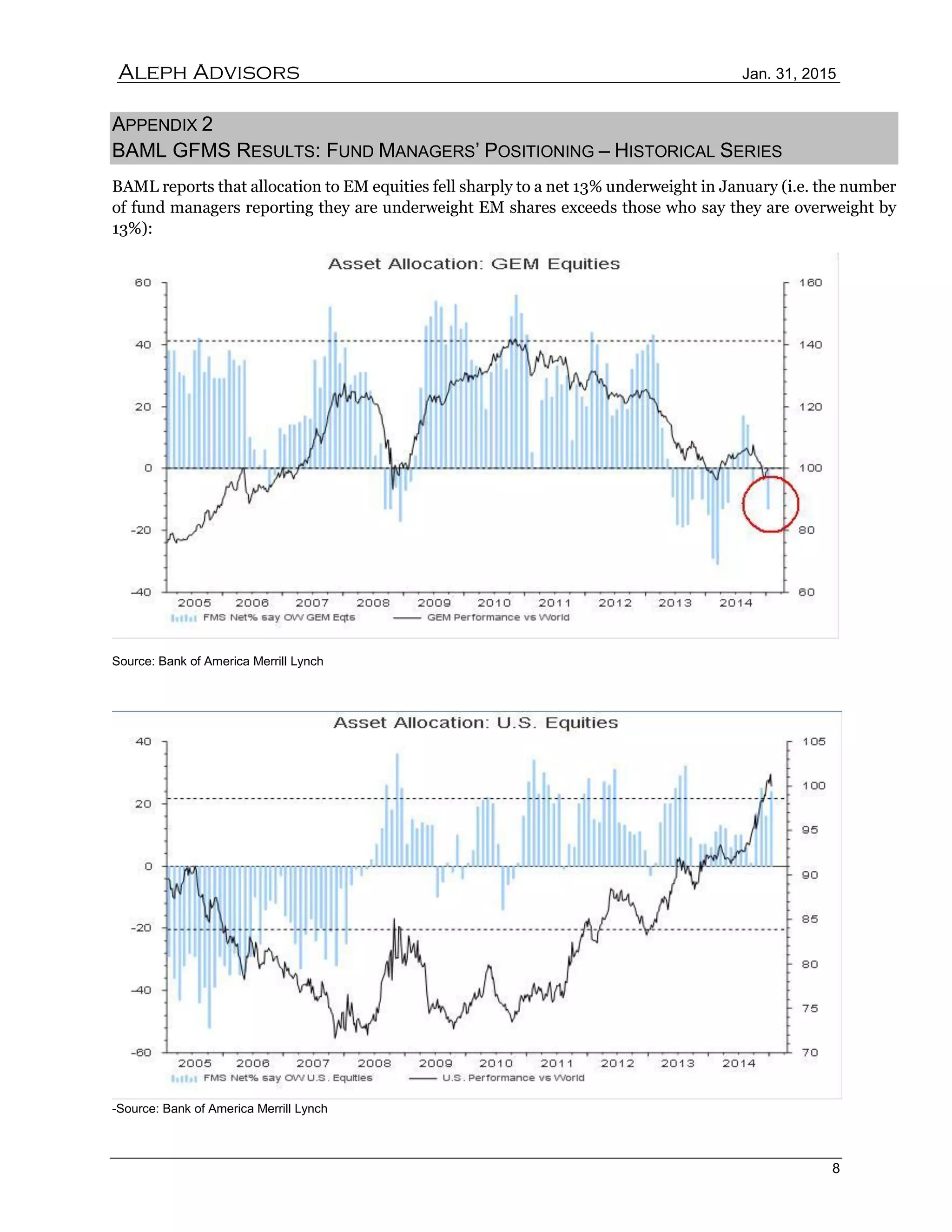
BAML reports that allocation to EM equities fell sharply to a net 13% underweight in January (i.e. the number
of fund managers reporting they are underweight EM shares exceeds those who say they are overweight by
13%):
Source: Bank of America Merrill Lynch
-Source: Bank of America Merrill Lynch
Aleph Advisors Jan. 31, 2015
9
BIBLIOGRAPHY
Bank of America Merrill Lynch Global Fund Manager Survey, Jan. 20, 2015
Bogle: Emerging Markets Cheap for a Reason, Morningstar, Oct. 23, 2014
Emerging Markets Revisited, Dimson, Marsh & Staunton, Credit Suisse Global Investment Returns
Yearbook 2014
I’d Choose Emerging Markets, Wouldn’t You?, Research Affiliates Currents, Jun. 2014
Revealed: The World’s Cheapest Stock Markets, The Telegraph, Jun. 7, 2014

EM Value - Ready to Emerge

  • 1.
    Aleph Advisors Jan.31, 2015 1 EM VALUE: READY TO EMERGE Global Macro Portfolio/ Asset Allocation: Alpha Opportunity in Global Equities Trade idea Total return swaps Alex Dumortier Long MSCI Emerging Markets Index +1 (202) 730-6643 alex.dumortier@gmail.com Short S&P 500 Index ETFs Long SPDR S&P 500 ETF (SPY) Short iShares MSCI Emerging Markets Index (EEM) Trade type Mean reversion Expected timeframe 12-36 months Expected return 6% - 12% p.a. Until recently, the case for emerging markets was often put overenthusiastically with exaggerated claims, often based on GDP growth… Sentiment toward emerging markets can shift rapidly, however. -- Elroy Dimson, Paul Marsh & Mike Staunton1 Long emerging market equities/ short US equities (or overweight EM equities/ underweight US equities in an asset allocation framework) may seem like an obvious or pedestrian trade idea. Perhaps it looks too good to be true because it’s hiding in plain sight. But don’t let that disqualify it from receiving your full attention. As we describe below, the data suggest EM equities offer excellent value right now; long-only or paired with a short on the pricey US stock market, this situation is compelling. In a world in which cheap is scarce, emerging markets’ value is ready to emerge! 1 Emerging Markets Revisited, Credit Suisse Global Investment Returns Yearbook 2014
  • 2.
    Aleph Advisors Jan.31, 2015 2 THESIS EM equities are undervalued, both on an absolute basis and particularly relative to US equities. Investors, from bottom-up stockpickers to asset allocators, often underestimate the extent to which valuation drives returns (and alpha), or at least they behave as if they do. That oversight repeatedly stung investors over the past four decades when they overpaid for EM shares in the hope of capturing a piece of these countries’ impressive GDP growth (a well-polished, but fallacious, stock promoters’ story.) Today, however, investors have a chance to put the emerging markets’ valuation factor to work for them, rather than against them. Mind the (valuation) gap Emerging market shares are cheap on an absolute basis and, certainly, relative to a US stock market that looks fully priced, at best. In order to test that proposition, we derive a monthly time series of the cyclically-adjusted price-to- earnings (CAPE) ratio for the bellwether MSCI Emerging Markets Index. The CAPE ratio relates price to a trailing average of ten-year inflation adjusted earnings and is the only halfway decent valuation indicator in terms of its predictive value with regard to future returns. We follow rigorously the same methodology as that of Pr. Shiller, who popularized the metric for the S&P 500. The following figure is a product of that analysis, with the MSCI EM Index CAPE (grey line) next to that for the S&P 500 (blue line), beginning in Sep. 2005: Fig. 1 – Cyclically-adjusted price-to-earnings (CAPE) multiples, MSCI EM Index and S&P 500 Source: Aleph Advisors, based on data from MSCI, Bloomberg and S&P Dow Jones Indices
  • 3.
    Aleph Advisors Jan.31, 2015 3 Two observations:  Absolute value: Our series for the MSCI EM Index is less than ten years long -- very short by historical standards. However, we’re “lucky” in that it contains a great benchmark for severe undervaluation: the global financial crisis of 2008-2009. Incredibly, more than five years after Lehman’s bankruptcy, the MSCI EM Index’s CAPE, at just 13.1, is less than 20% above the crisis low it set on Oct. 27, 2008. Because our CAPE series is short, a quick look at the history of the MSCI EM Index’s ordinary P/E ratio on the basis of trailing-twelve-month earnings reveals it is currently at the same level that it was at the end of Aug. 1998, the month in which Russia devalued the rouble and defaulted on its debt. Over the subsequent one-, three- and five-year periods, the index then produced annualized total returns of 72.3%, 9.7% and 11.9%, respectively.  Relative value: At more than two standard deviations from its average, the current spread between the S&P 500’s CAPE multiple and that of the MSCI EM Index is the widest it’s been throughout the entire period starting in Sep. 2005. For a brief discussion of whether the CAPE has predictive value with regard to returns, please see Appendix 1.
  • 4.
    Aleph Advisors Jan.31, 2015 4 VARIANT PERCEPTION 3 eye-catching observations This idea was borne out of three observations:  One needs to go back to the aftermath of the “Asian contagion” and Russian rouble crises of 1997-1998 to find EM shares underperforming US stocks to a greater extent than they have in the current period, in terms of trailing three-year returns.  EM company earnings are below their long-term trend, while US corporate earnings are substantially above their long-term trend.  EM equities are currently on offer at the widest valuation discount to US equities in at least a decade. Note that these variables – returns, corporate profitability and valuations -- exhibit significant mean reversion over the medium- to long-term (they’re not short-term trading signals, however.) EM equities have been in disfavor with investors since the “taper tantrum” of May 2013 when then- Fed chairman Bernanke suggested that the central bank would begin to wind down QE3. During the same period, US equities have remained a “go-to” asset class – despite the fact that there now seems to be a consensus among institutional investors that they are overvalued. Last month’s Russian rouble crisis and the continuing collapse in the price of oil appear to have reinforced both of those orientations at the start of the year. Fund manager sentiment towards US and EM equities shifted significantly at the start of 2015 In January, fund manager positioning on US equities and EM equities shifted significantly – in opposite directions: This chart, from BofA Merrill Lynch’s Jan. 2015 Global Fund Manager Survey (GFMS), shows US equities and EM equities experienced the greatest positive and negative shifts in positioning, respectively, among all asset classes and sectors covered by the survey. Fig 2. – Month-on-month change in global fund managers’ positioning January 2015 Source: Bank of America Merrill Lynch
  • 5.
    Aleph Advisors Jan.31, 2015 5 ‘Investor positioning’ refers to the number of investors in the survey who declare they are overweight minus the number who are underweight. When that number is positive, the asset class is ‘net overweight, otherwise it is ‘net underweight’. As a result of this trend, emerging market equities are heavily under-owned, while U.S. equities hopelessly over-owned This chart shows global fund managers’ positioning across different asset classes/ sectors relative to their history, expressed as the number of standard deviations from the long-term average. Long EM equities/ short U.S. equities is clearly a contrarian trade. Fund managers’ allocation to EM equities, in particular, is at historically low levels. For more on fund managers’ current positioning relative to their historical commitments, please refer to Appendix 2. Fig. 3 – Global fund managers’ positioning versus their history Source: Bank of America Merrill Lynch Short-term earnings volatility vs. long-term earnings power Twelve-month earnings and their forward estimates are vulnerable in a crisis and can be volatile, but emerging markets companies’ long-term earnings power is a lot more stable. This is one of the big advantages of the CAPE, as it helps us tease out the multiples investors are paying for that earnings power. As we saw above, current valuations are at levels consistent with previous crises. The following figures give some sense of that long-term earnings power: The MSCI EM Index represents a diversified group of over 800 companies in 23 countries, or roughly 85% of the free-float market capitalization in each country, with an aggregate market capitalization of $3.8 trillion. The productive capacity of that group of companies and the long-term underlying demand for their goods and services does not vanish in a crisis; investors who focus on or extrapolate the short-term impact on profitability may well overestimate the effect on share values. (Just as we believe some investors are now extrapolating the impact of $50 oil in perpetuity.)
  • 6.
    Aleph Advisors Jan.31, 2015 6 RISKS A “hard landing” of China’s economy is a legitimate risk – China has more than a one-fifth weighting in the iShares MSCI EM ETF (combine that with Taiwan and the weighting rises to roughly a third.) Nevertheless, the thrust of my argument – that EM shares are cheap relative to the U.S. market and more than compensate investors for the risk they bear – applies to China, too. Over the past five years, the MSCI China Index has trailed the S&P 500 by a full eleven percentage points (annualized). On the assumption that we’re correct that EM equities are undervalued, a full-blown EM crisis would bring the threat of sharp, but impermanent, mark-to-market losses, rather than a permanent loss of capital (which is of greatest concern to a long-term, value-oriented investor.) To reiterate, though: Valuations are already at crisis levels. Naturally, however, a crisis would push out the expected timeframe for the trade to be successful. Another risk in terms of mark-to-market losses is the possibility that the overvaluation of US shares becomes more pronounced. We see this as entirely possible in the short-term on the basis of the same factors that created the conditions for this trade. However, given the power of mean reversion in valuations and what looks like gravity-defying US corporate profitability, the US market’s valuation looks unsustainable over a longer-term timeframe. CATALYSTS There are no obvious catalysts for the EM shares’ undervaluation to reverse; in fact, it’s probably easier to think of catalysts that would increase the undervaluation in the short term! However, although it requires patience, fortitude (and understanding limited partners), value is its own catalyst over time. Alternatively, we venture that an upside correction in the price of oil or the long-anticipated U.S. rate hike might do the trick.
  • 7.
    Aleph Advisors Jan.31, 2015 7 APPENDIX 1 IS THE CAPE PREDICTIVE OF FUTURE RETURNS FOR EMERGING MARKET EQUITIES? Although our decade-long CAPE series for the MSCI EM Index is very short, the following scatter plot which graphs three-year annualized returns (y-axis) against the CAPE’s reciprocal (a cyclically- adjusted earnings yield) at the start of the period suggests the CAPE does have explanatory value: Source: Aleph Advisors The beta coefficient is significant and the R-squared is high (although the sample probably overestimates the CAPE’s explanatory power), and the results are consistent with the notion – which has been verified in other markets/ asset classes – that price is an important determinant of future (long-term) returns.
  • 8.
    Aleph Advisors Jan.31, 2015 8 APPENDIX 2 BAML GFMS RESULTS: FUND MANAGERS’ POSITIONING – HISTORICAL SERIES BAML reports that allocation to EM equities fell sharply to a net 13% underweight in January (i.e. the number of fund managers reporting they are underweight EM shares exceeds those who say they are overweight by 13%): Source: Bank of America Merrill Lynch -Source: Bank of America Merrill Lynch
  • 9.
    Aleph Advisors Jan.31, 2015 9 BIBLIOGRAPHY Bank of America Merrill Lynch Global Fund Manager Survey, Jan. 20, 2015 Bogle: Emerging Markets Cheap for a Reason, Morningstar, Oct. 23, 2014 Emerging Markets Revisited, Dimson, Marsh & Staunton, Credit Suisse Global Investment Returns Yearbook 2014 I’d Choose Emerging Markets, Wouldn’t You?, Research Affiliates Currents, Jun. 2014 Revealed: The World’s Cheapest Stock Markets, The Telegraph, Jun. 7, 2014