DONE BY: YAZID HAMODAH
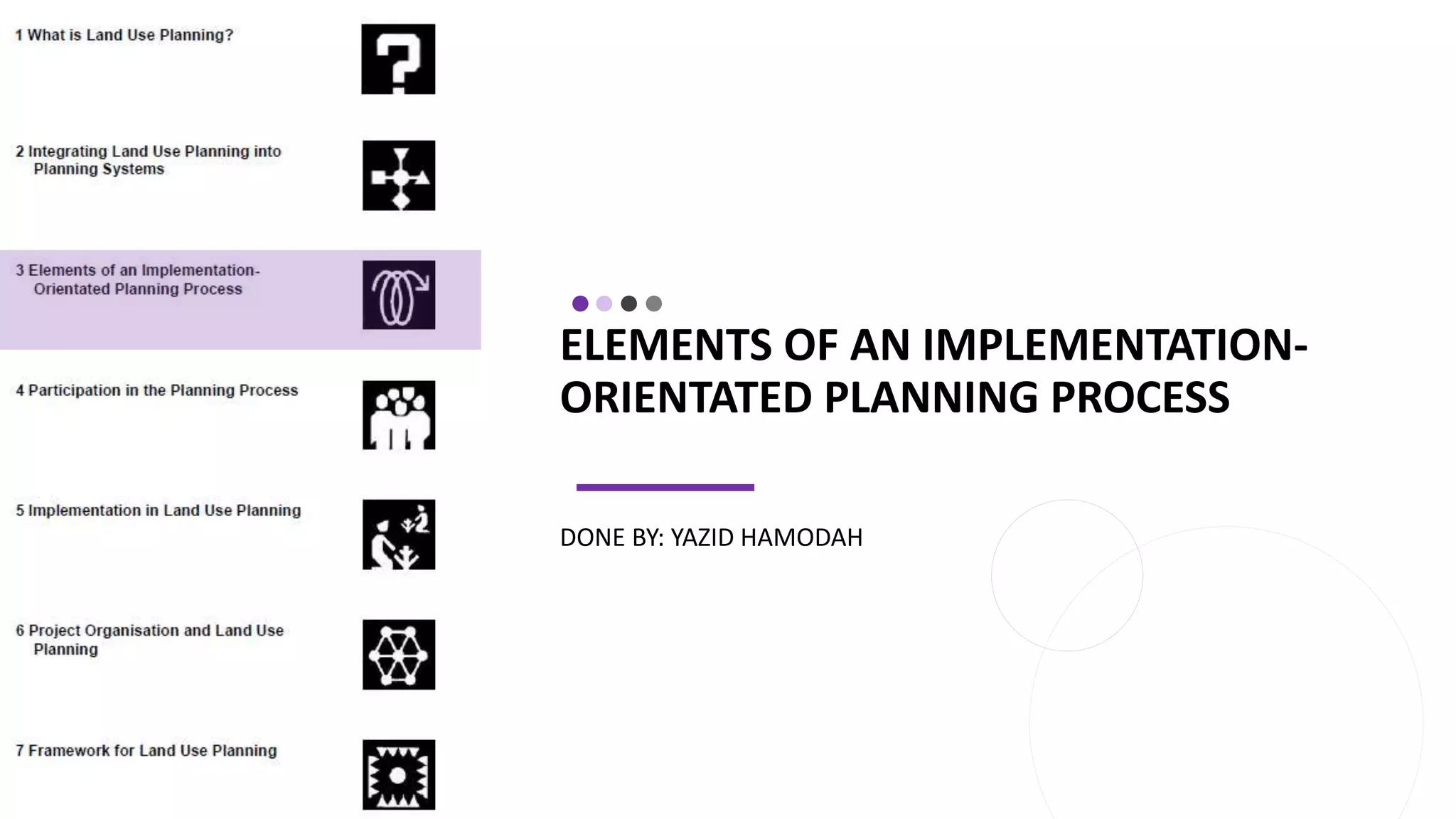
ELEMENTS OF AN IMPLEMENTATION-
ORIENTATED PLANNING PROCESS
2
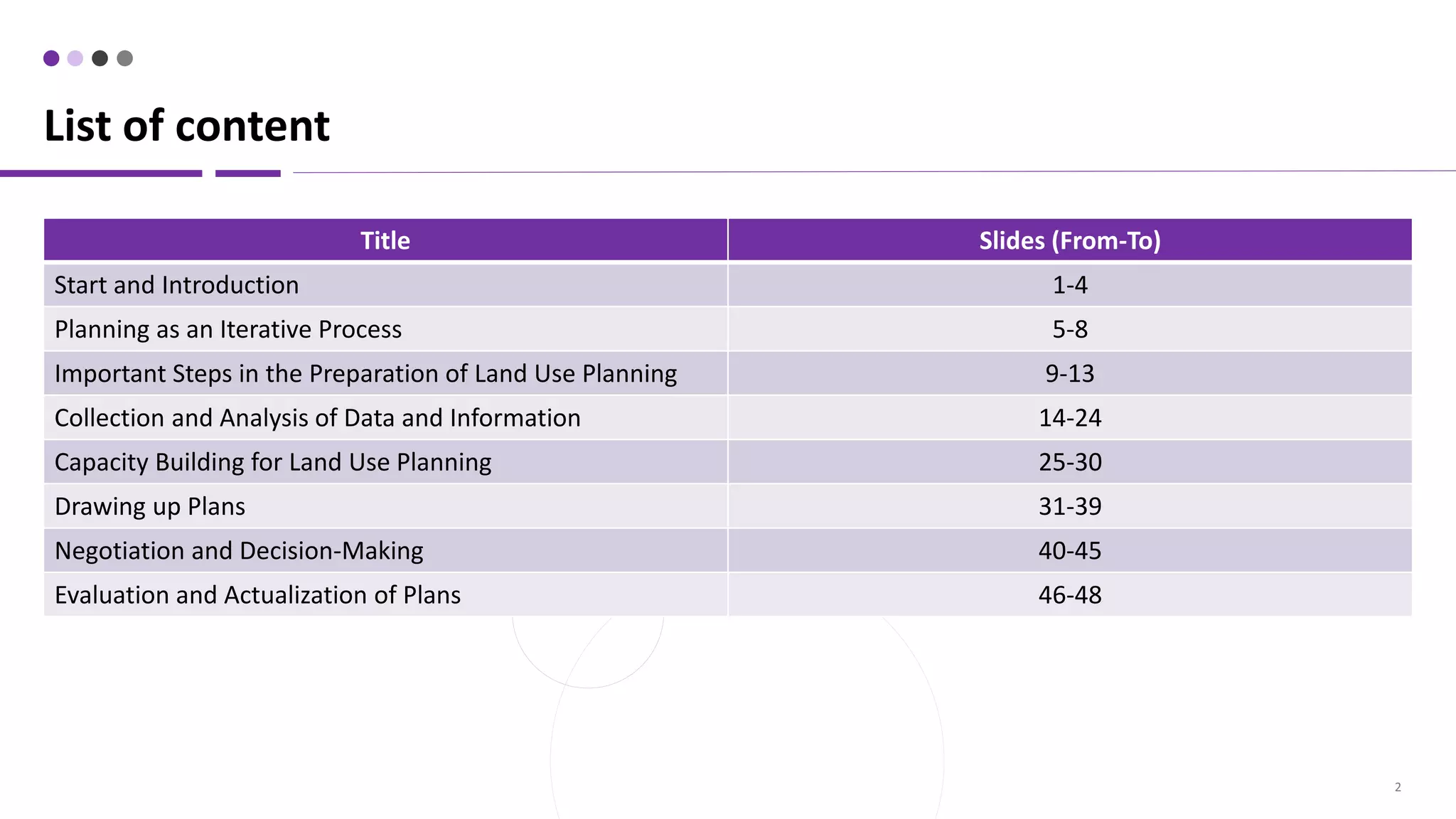
Title Slides (From-To)
Start and Introduction 1-4
Planning as an Iterative Process 5-8
Important Steps in the Preparation of Land Use Planning 9-13
Collection and Analysis of Data and Information 14-24
Capacity Building for Land Use Planning 25-30
Drawing up Plans 31-39
Negotiation and Decision-Making 40-45
Evaluation and Actualization of Plans 46-48
List of content
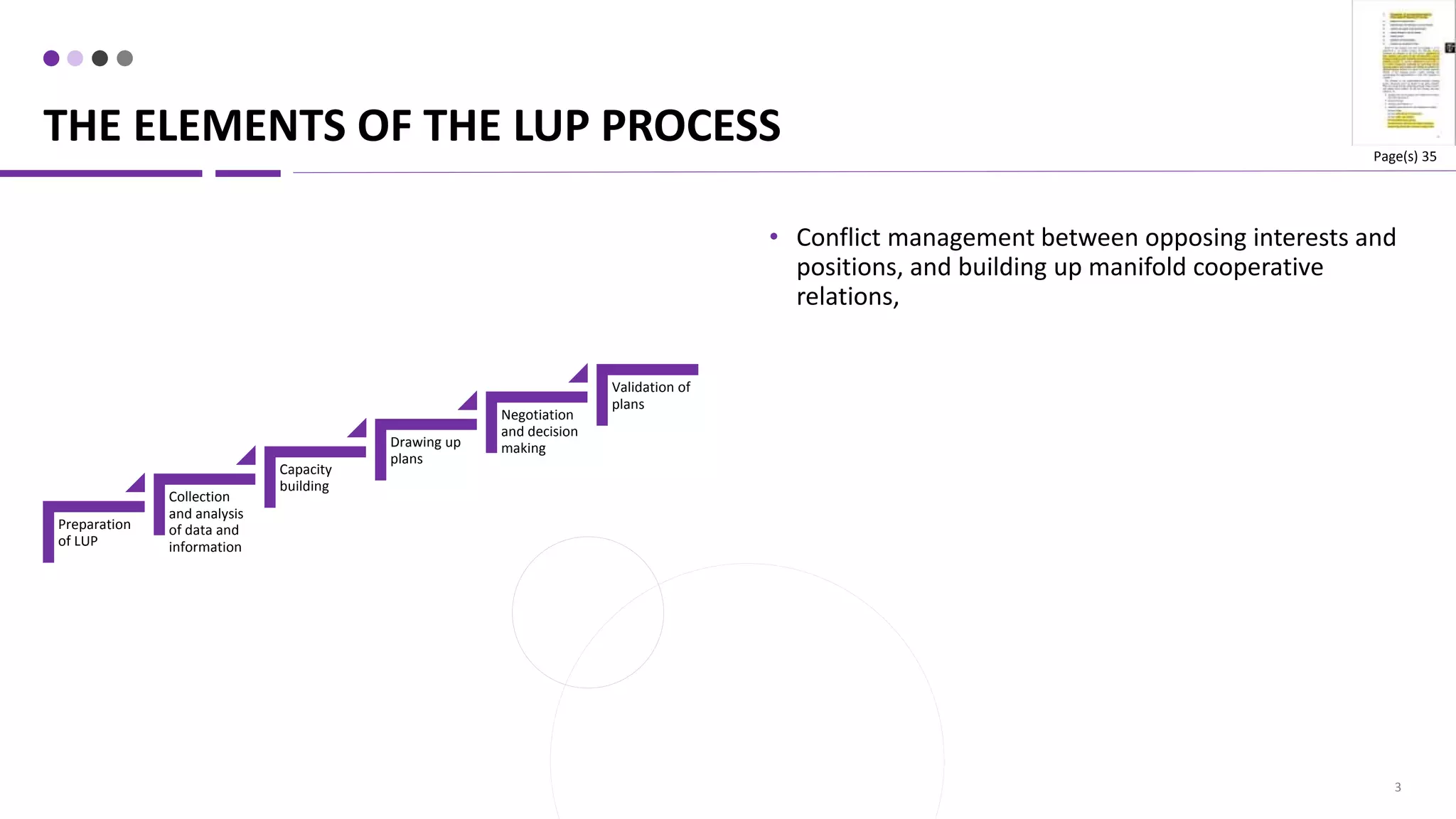
THE ELEMENTS OF THE LUP PROCESS
3
• Conflict management between opposing interests and
positions, and building up manifold cooperative
relations,
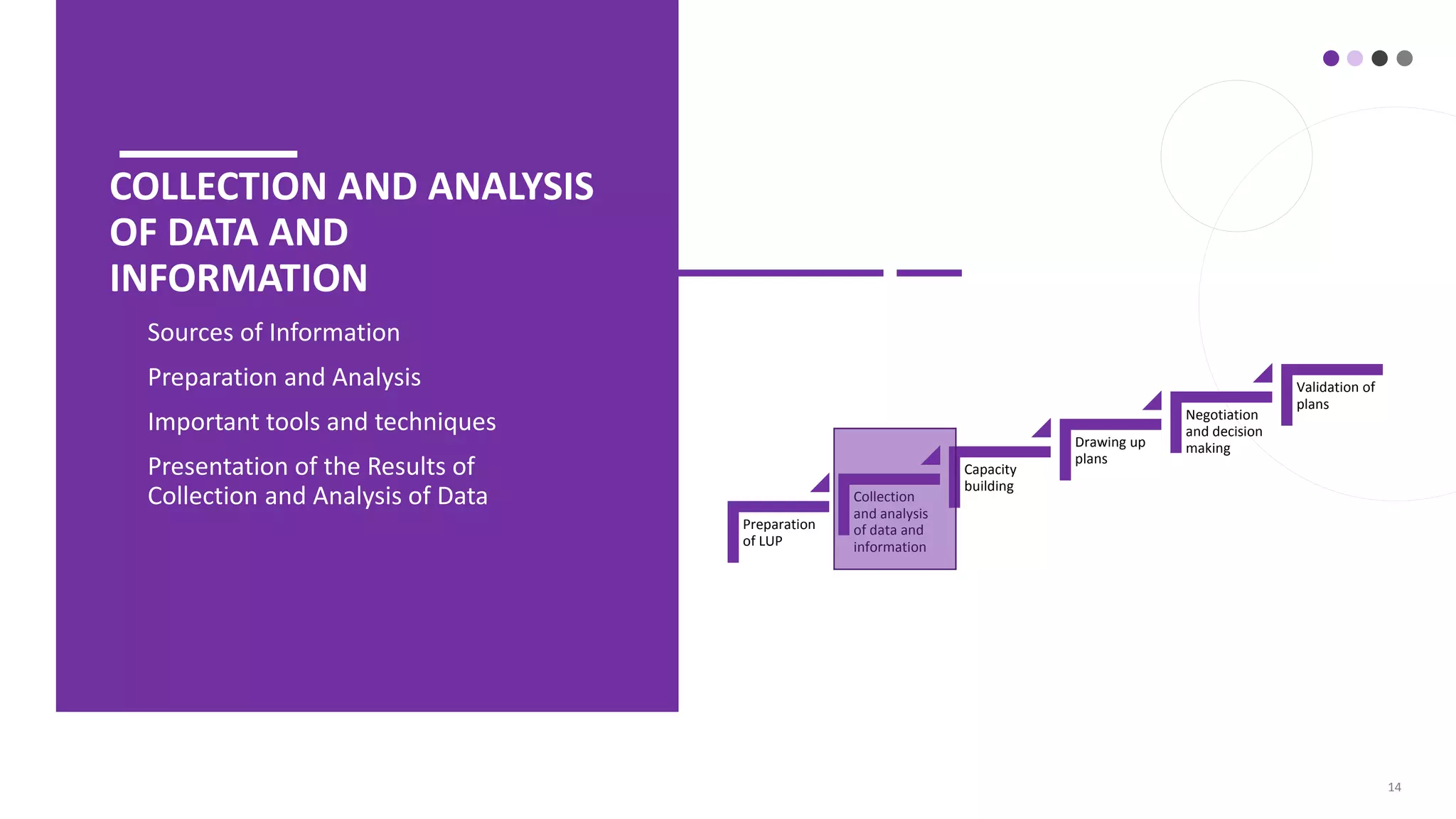
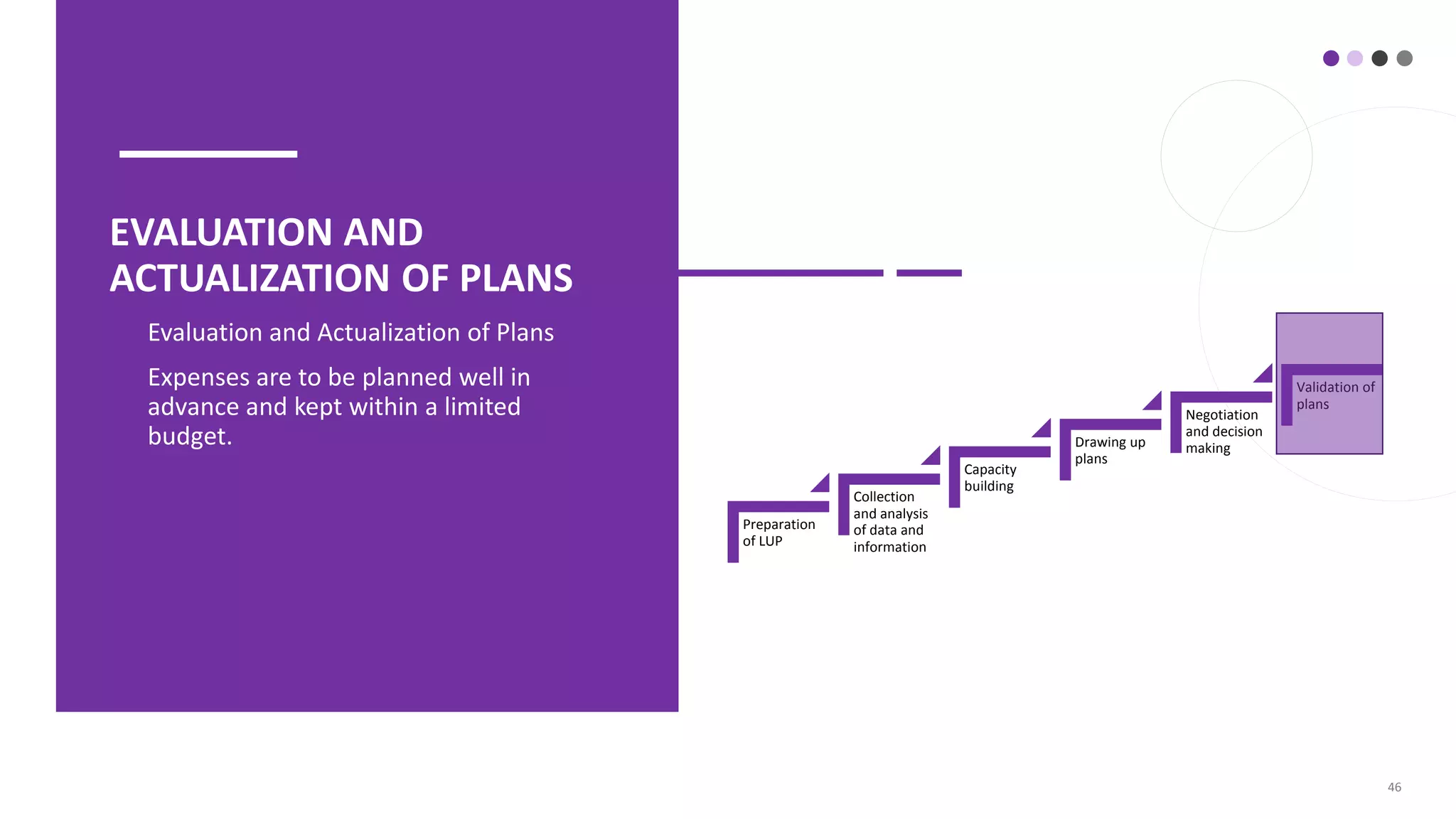
Preparation
of LUP
Collection
and analysis
of data and
information
Capacity
building
Drawing up
plans
Negotiation
and decision
making
Validation of
plans
Page(s) 35
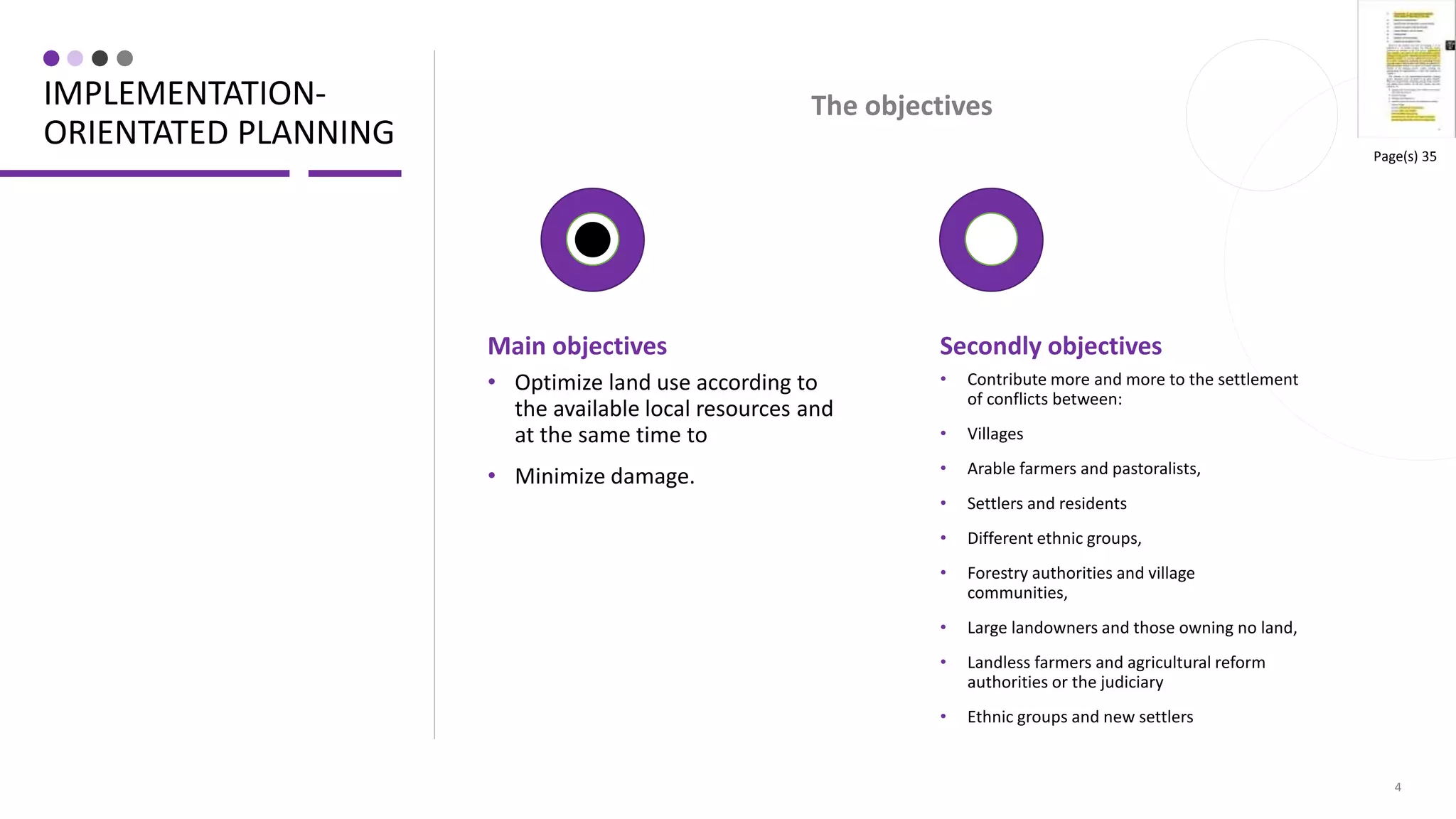
IMPLEMENTATION-
ORIENTATED PLANNING
Main objectives
• Optimize land use according to
the available local resources and
at the same time to
• Minimize damage.
4
Secondly objectives
• Contribute more and more to the settlement
of conflicts between:
• Villages
• Arable farmers and pastoralists,
• Settlers and residents
• Different ethnic groups,
• Forestry authorities and village
communities,
• Large landowners and those owning no land,
• Landless farmers and agricultural reform
authorities or the judiciary
• Ethnic groups and new settlers
The objectives
Page(s) 35
5
PLANNING AS AN
ITERATIVE PROCESS
• Planning as an Iterative Process
• Alternatives
• Two sides
6
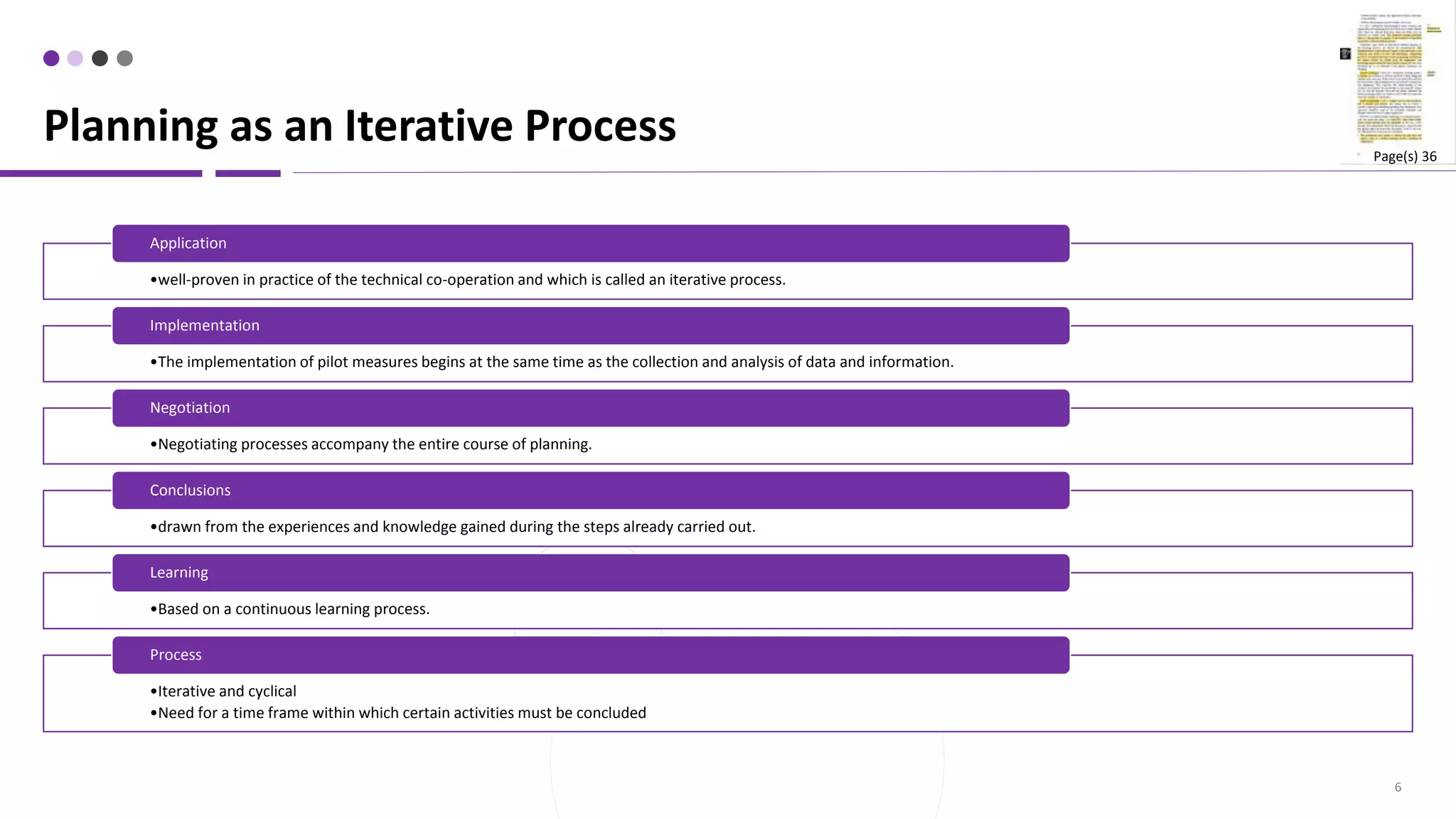
•well-proven in practice of the technical co-operation and which is called an iterative process.
Application
•The implementation of pilot measures begins at the same time as the collection and analysis of data and information.
Implementation
•Negotiating processes accompany the entire course of planning.
Negotiation
•drawn from the experiences and knowledge gained during the steps already carried out.
Conclusions
•Based on a continuous learning process.
Learning
•Iterative and cyclical
•Need for a time frame within which certain activities must be concluded
Process
Planning as an Iterative Process Page(s) 36
7
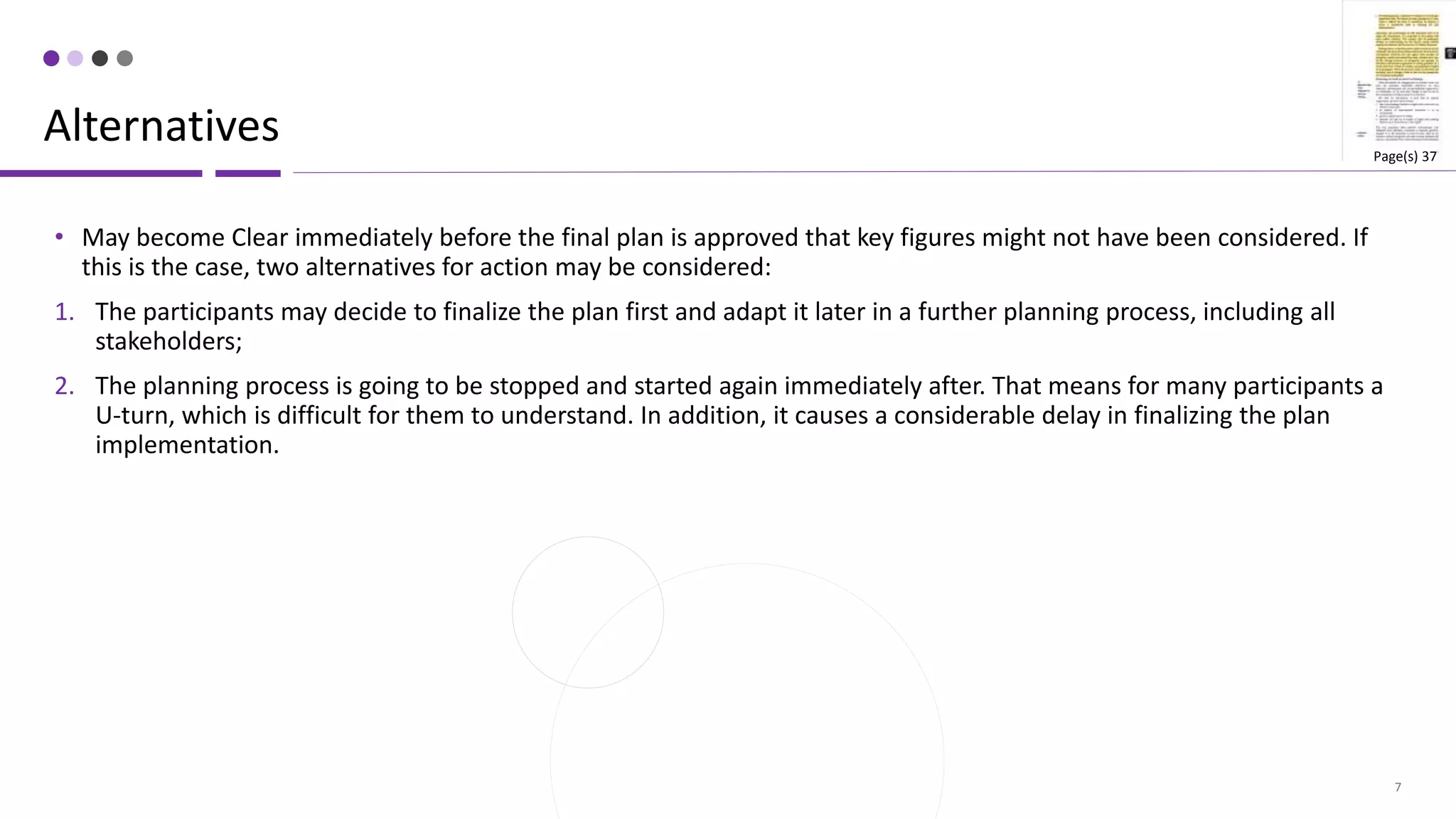
• May become Clear immediately before the final plan is approved that key figures might not have been considered. If
this is the case, two alternatives for action may be considered:
1. The participants may decide to finalize the plan first and adapt it later in a further planning process, including all
stakeholders;
2. The planning process is going to be stopped and started again immediately after. That means for many participants a
U-turn, which is difficult for them to understand. In addition, it causes a considerable delay in finalizing the plan
implementation.
Alternatives Page(s) 37
TWO SIDES
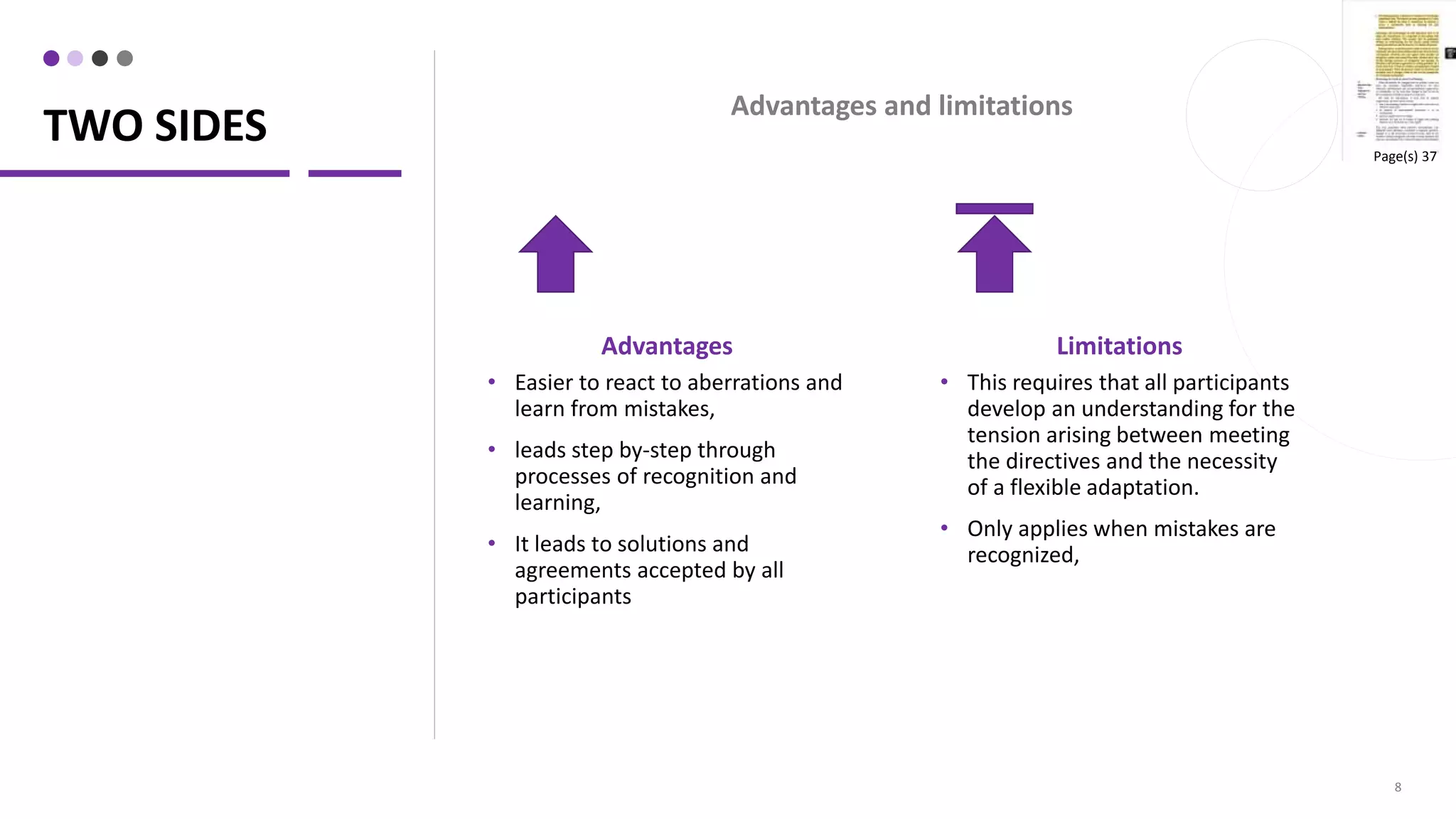
Advantages
• Easier to react to aberrations and
learn from mistakes,
• leads step by-step through
processes of recognition and
learning,
• It leads to solutions and
agreements accepted by all
participants
8
Limitations
• This requires that all participants
develop an understanding for the
tension arising between meeting
the directives and the necessity
of a flexible adaptation.
• Only applies when mistakes are
recognized,
Advantages and limitations
Page(s) 37
9
IMPORTANT STEPS IN THE
PREPARATION OF LAND
USE PLANNING
• Evaluating the Need for Land Use
Planning
• Prerequisites for Land Use Planning
• Determining the Unit of Planning
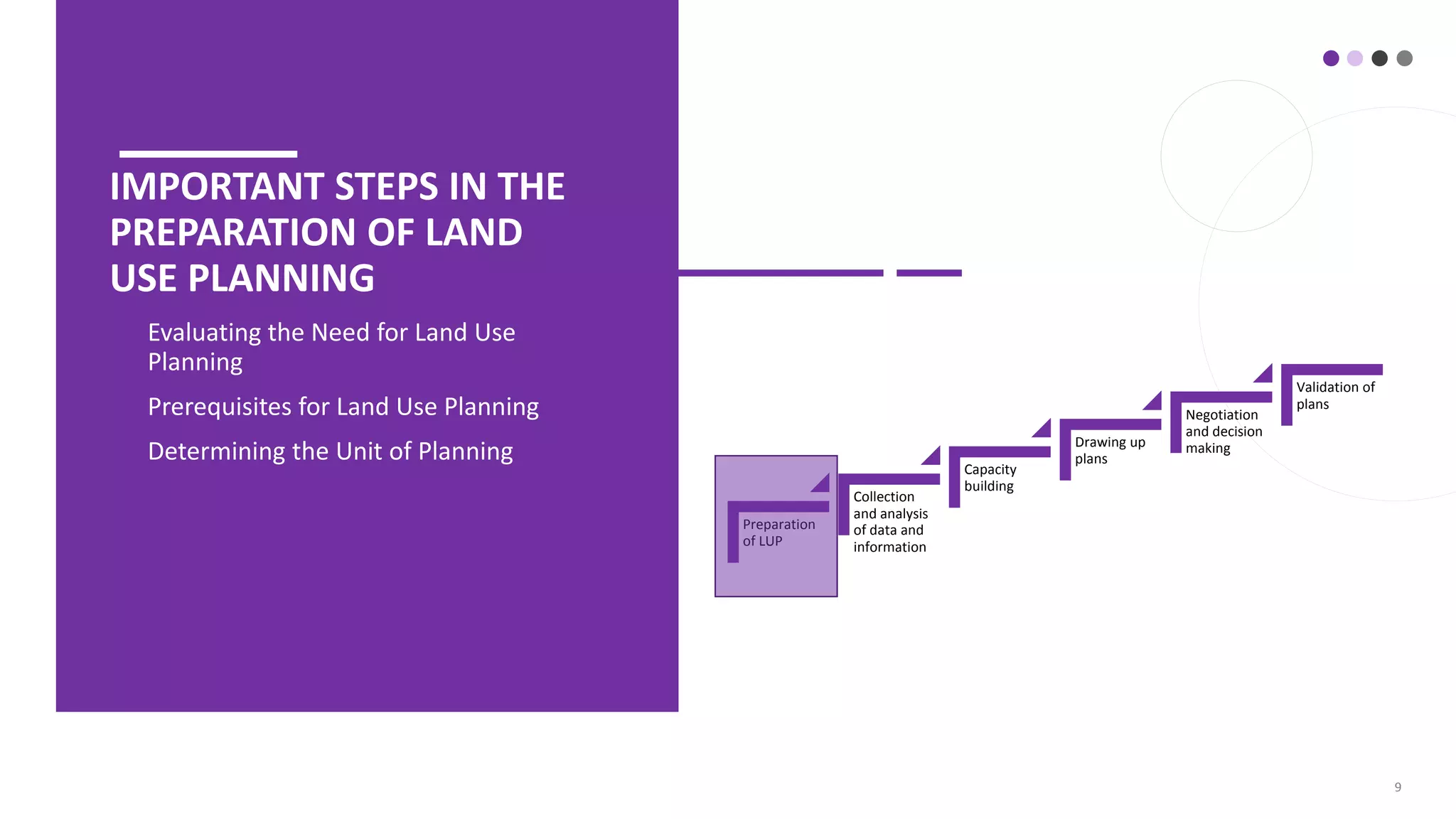
Preparation
of LUP
Collection
and analysis
of data and
information
Capacity
building
Drawing up
plans
Negotiation
and decision
making
Validation of
plans
EVALUATING THE NEED FOR LAND USE PLANNING
10
• Reasons for the need for interventions at local level by
external organizations:
1. Due to the planning objectives at higher level, some
areas are selected as pilot areas,
2. An increase of environmental destruction is to be
counteracted,
3. Land use conflicts are to be settled,
4. Directives for land use in respect of higher level
planning,
5. interests are to be forced (e.g. water supply).
• Initiatives come from:
1. Immediate stakeholders,
2. Authorities,
3. Governmental and non-governmental organizations,
4. Communities.
5. Technical projects in rural areas.
Page(s) 37
PREREQUISITES FOR LAND USE PLANNING
11
Mid-term
• Flexibility in actions by the agency, rejecting of formal or
theoretical working Approaches, turning to a transparent
and participatory working style,
• Extending the possibilities of including nongovernmental
Partners,
• Increased acceptance of participatory working methods
by the participating population, even where these have
no tradition;
• Development of articulated conceptions of land use by
the stakeholders;
• Awareness of disadvantaged groups by supporting
agencies and other governmental authorities, and the will
to change their situation.
Local
• The availability of information on national and regional
plans,
• Directives and regulations, as well as their analysis and
consideration during implementation;
• Clarification of work to be accomplished and
responsibilities during the implementation, as well as a
realistic time plan, in which the priorities and working
rhythms of the rural stakeholders must be taken into
account;
• Ensuring the necessary extension and financial services;
• ·Using all alternatives of compensation where use is
going to be restricted;
• ·Minimal logistical preconditions.
• Freedom of assembly and freedom of speech
Page(s) 38,39
PREREQUISITES FOR LAND USE PLANNING
12
Long-term aspects
• Initial measures aimed at building up trust.
• Balancing between ecological and economic aspects
must be clarified. (ecology = long-term economy)
• Example : Burkina Faso
• Vocabulary,
• Example : Tanzania
Entering into a Dialogue with the
Participants
• Life threatening problems are foremost,
• Find initial points from which effective economic
advantages can be expected in the shortest possible
time.
• Example : Ganga delta – India, and Namibia
Page(s) 40,41,42
DETERMINING THE UNIT OF PLANNING
13
• Criteria:
1. the group consciousness of the target population,
2. Their areas for living and production
3. The territorial boundaries of jurisdiction of the local
organizations and the type of the project.
• Final decision will always depend on the actual
situation.
• Decision must be made together with the population
and the local organizations.
• Sometimes the boundaries of a planning area will
change during the course of implementation from
Mobile user groups ,Nomadic livestock for example.
Page(s) 43
14
COLLECTION AND ANALYSIS
OF DATA AND
INFORMATION
• Sources of Information
• Preparation and Analysis
• Important tools and techniques
• Presentation of the Results of
Collection and Analysis of Data
Preparation
of LUP
Collection
and analysis
of data and
information
Capacity
building
Drawing up
plans
Negotiation
and decision
making
Validation of
plans
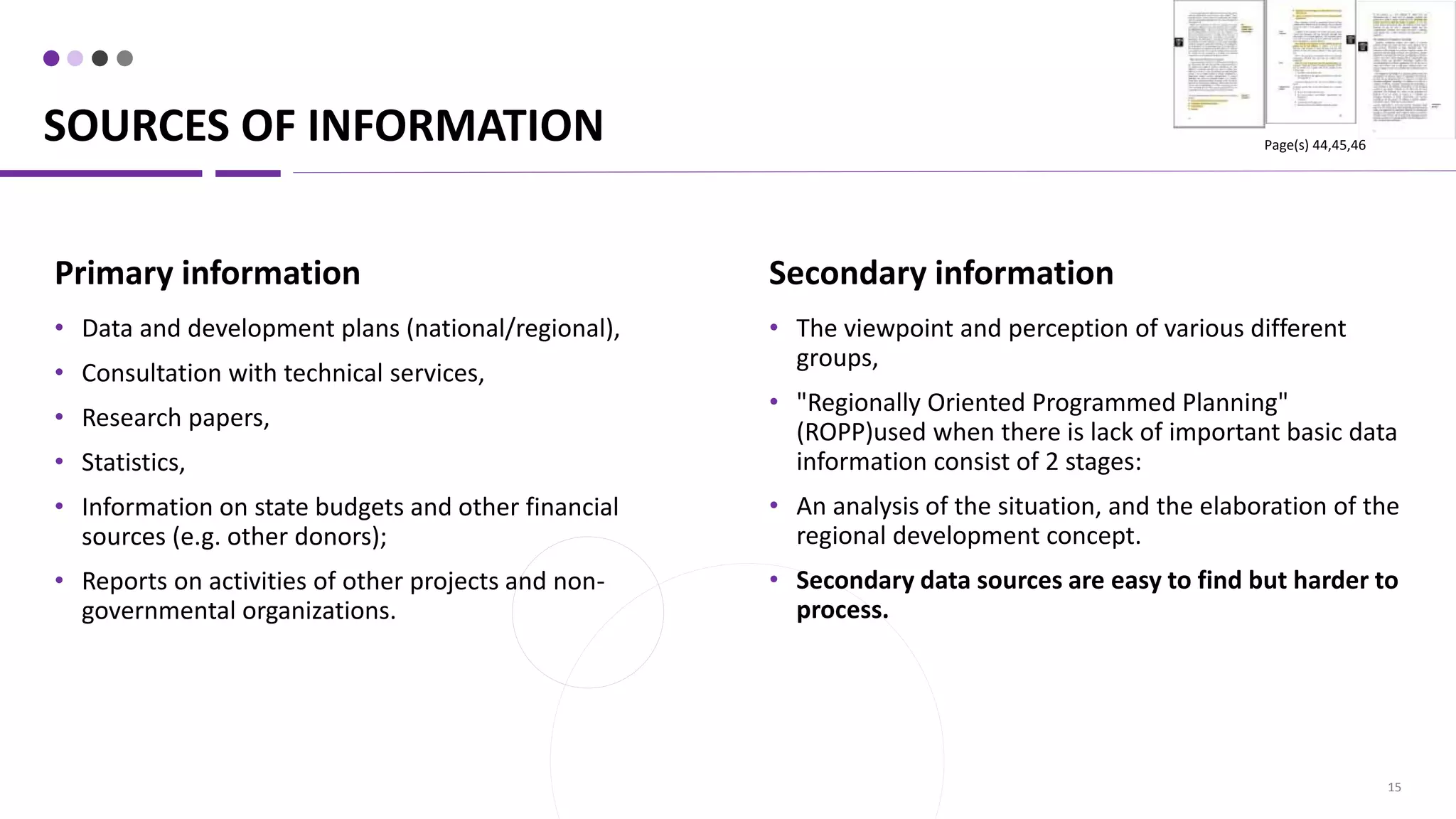
SOURCES OF INFORMATION
15
Secondary information
• The viewpoint and perception of various different
groups,
• "Regionally Oriented Programmed Planning"
(ROPP)used when there is lack of important basic data
information consist of 2 stages:
• An analysis of the situation, and the elaboration of the
regional development concept.
• Secondary data sources are easy to find but harder to
process.
Primary information
• Data and development plans (national/regional),
• Consultation with technical services,
• Research papers,
• Statistics,
• Information on state budgets and other financial
sources (e.g. other donors);
• Reports on activities of other projects and non-
governmental organizations.
Page(s) 44,45,46
16
• Specific data on the entire planning area is required for LUP:
• Data on the available land resources,
• The socio-economic, socio-cultural, organizational and institutional conditions,
• On the history of the region, and the future visions of the different stakeholder groups.
Preparation and Analysis Page(s) 45
17
• information is collected and analyzed jointly by all participating stakeholder groups,
• it is use and action – oriented;
• important local knowledge of the area;
• Provides knowledge on local land use systems,
• Mediates views and values of the participants;
• it can be collected with a clear objective,
• A problem-oriented analysis of the area is possible by transect walks, local soil classifications, etc. and an analysis of
cultural peculiarities and social relations is focused on;
• It helps to overcome existing language barriers, as local vocabulary is documented at the same time.
Important tools and techniques (Active participation) Page(s) 49
18
• For the inventory of the natural potential of the planning area, areas:
1. Of homogenous characteristics,
2. documented on a map,
3. area into units with similar topographical characteristics, edaphic characteristics and similar vegetation cover.
• An example of a possible procedure for a land unit diagnosis, planning and implementation within the framework of
the LUP process, aimed at optimization of land use.
Division into Land Unit Page(s) 51
19
• The identification of agro-ecological zones is frequently applied in mountainous regions in which land use depends
primarily on the elevation.
• The following units can be distinguished:
1. Planning units,
2. Land utilization units,
3. Recourses management units,
4. Units of rural development,
5. Units for protecting food sources,
6. Units for consolidating a social organization.
• Example: Namibia
Identifying Agroecological Zones (AEZ) Page(s) 51
TOPOGRAPHICAL MAPS, AERIAL PHOTOGRAPHS AND GIS IN LAND USE PLANNING
20
• Topographical maps:
• Available to village participants to a limited extent,
• very difficult for them to use,
• The scale is often irrelevant for village land use
planning,
• For the project staff the maps are valuable for locating
the village, drawing up general maps and, in rare
cases, for establishing and/or verifying boundaries.
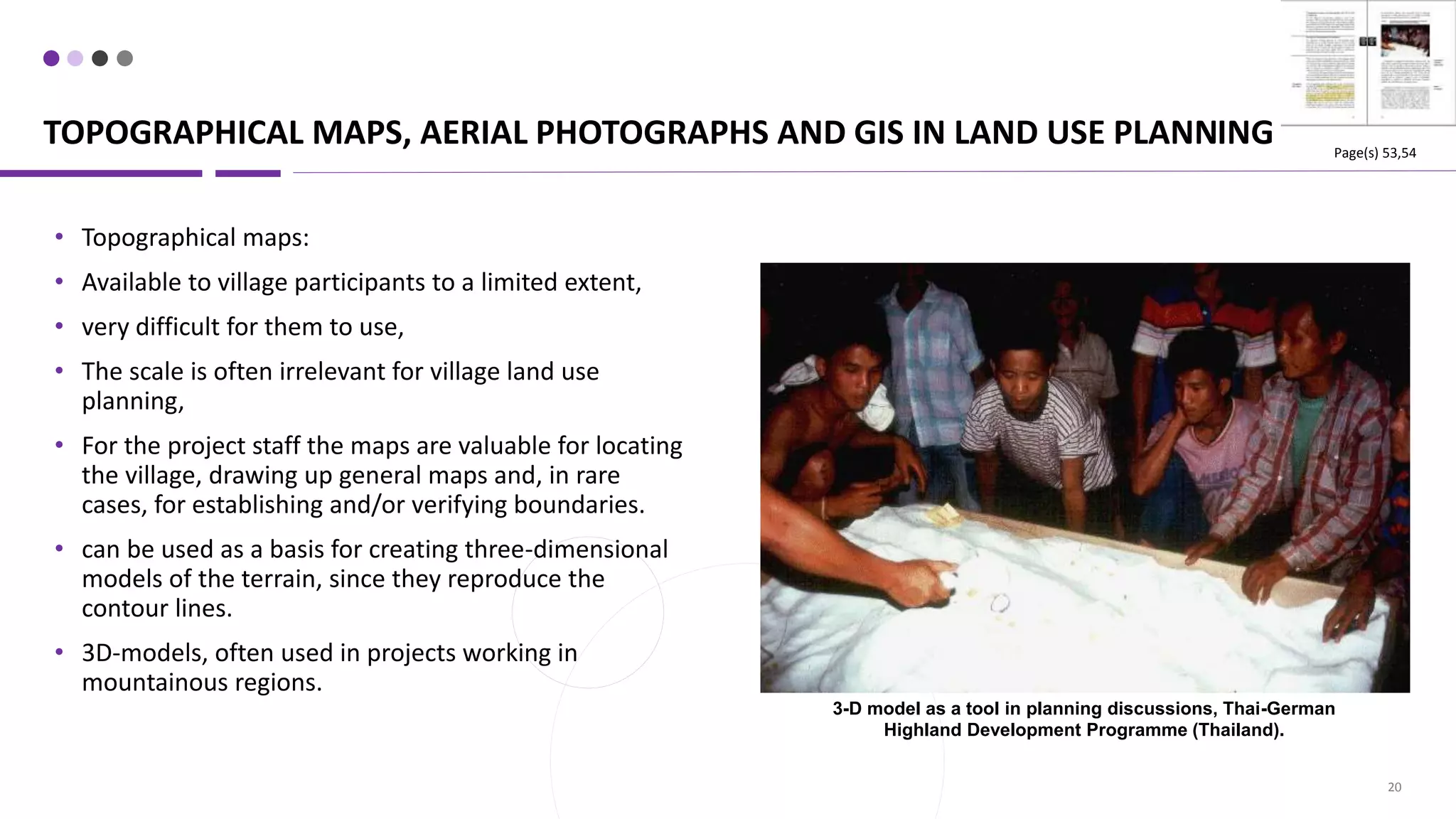
• can be used as a basis for creating three-dimensional
models of the terrain, since they reproduce the
contour lines.
• 3D-models, often used in projects working in
mountainous regions.
3-D model as a tool in planning discussions, Thai-German
Highland Development Programme (Thailand).
Page(s) 53,54
TOPOGRAPHICAL MAPS, AERIAL PHOTOGRAPHS AND GIS IN LAND USE PLANNING
21
• Arial photographs:
• Village people can read them without difficulties,
• The recognition of orientation points makes
everything much easier, it stimulates the process and
is fun for all participants.
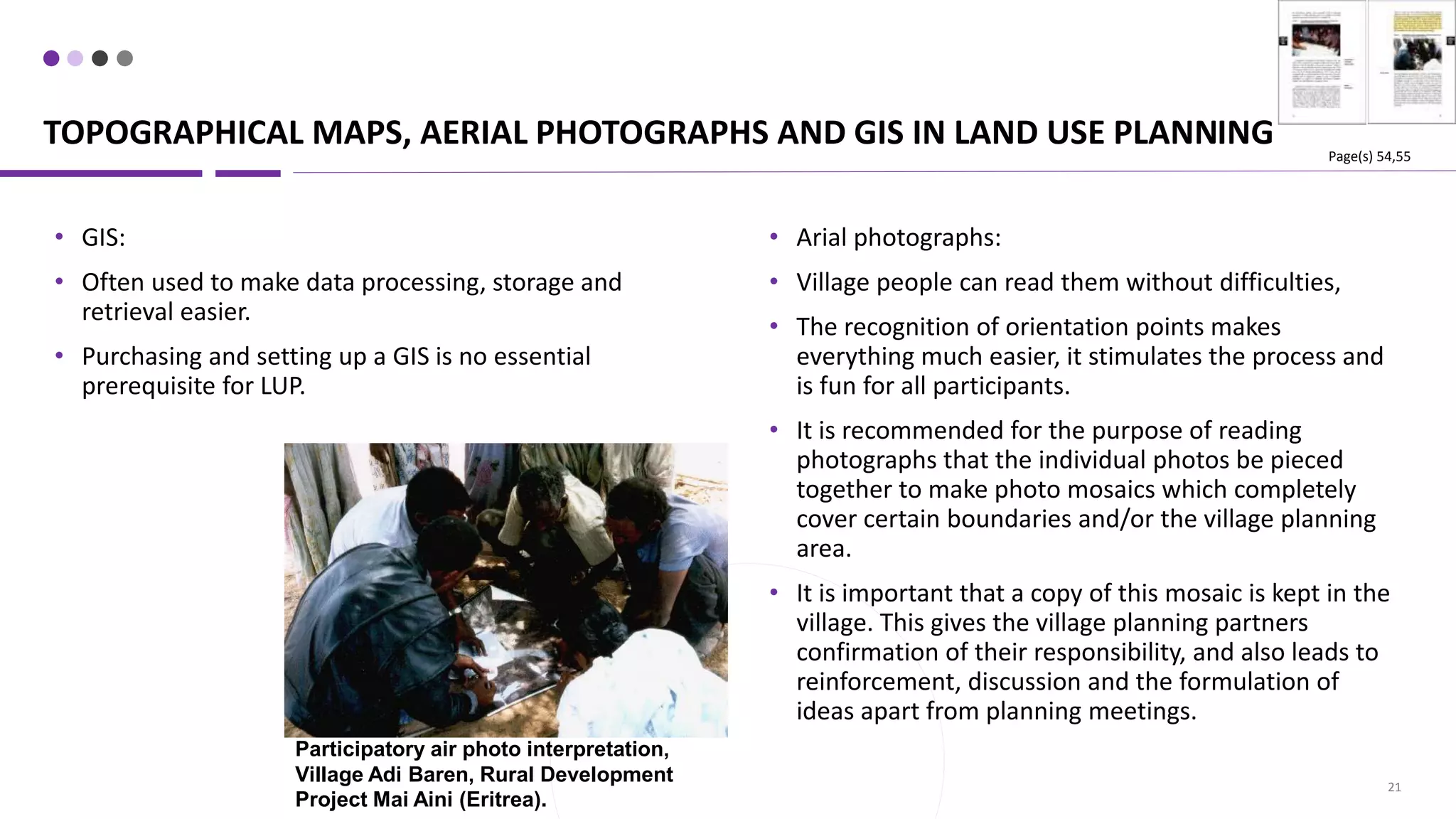
• It is recommended for the purpose of reading
photographs that the individual photos be pieced
together to make photo mosaics which completely
cover certain boundaries and/or the village planning
area.
• It is important that a copy of this mosaic is kept in the
village. This gives the village planning partners
confirmation of their responsibility, and also leads to
reinforcement, discussion and the formulation of
ideas apart from planning meetings.
• GIS:
• Often used to make data processing, storage and
retrieval easier.
• Purchasing and setting up a GIS is no essential
prerequisite for LUP.
Participatory air photo interpretation,
Village Adi Baren, Rural Development
Project Mai Aini (Eritrea).
Page(s) 54,55
22
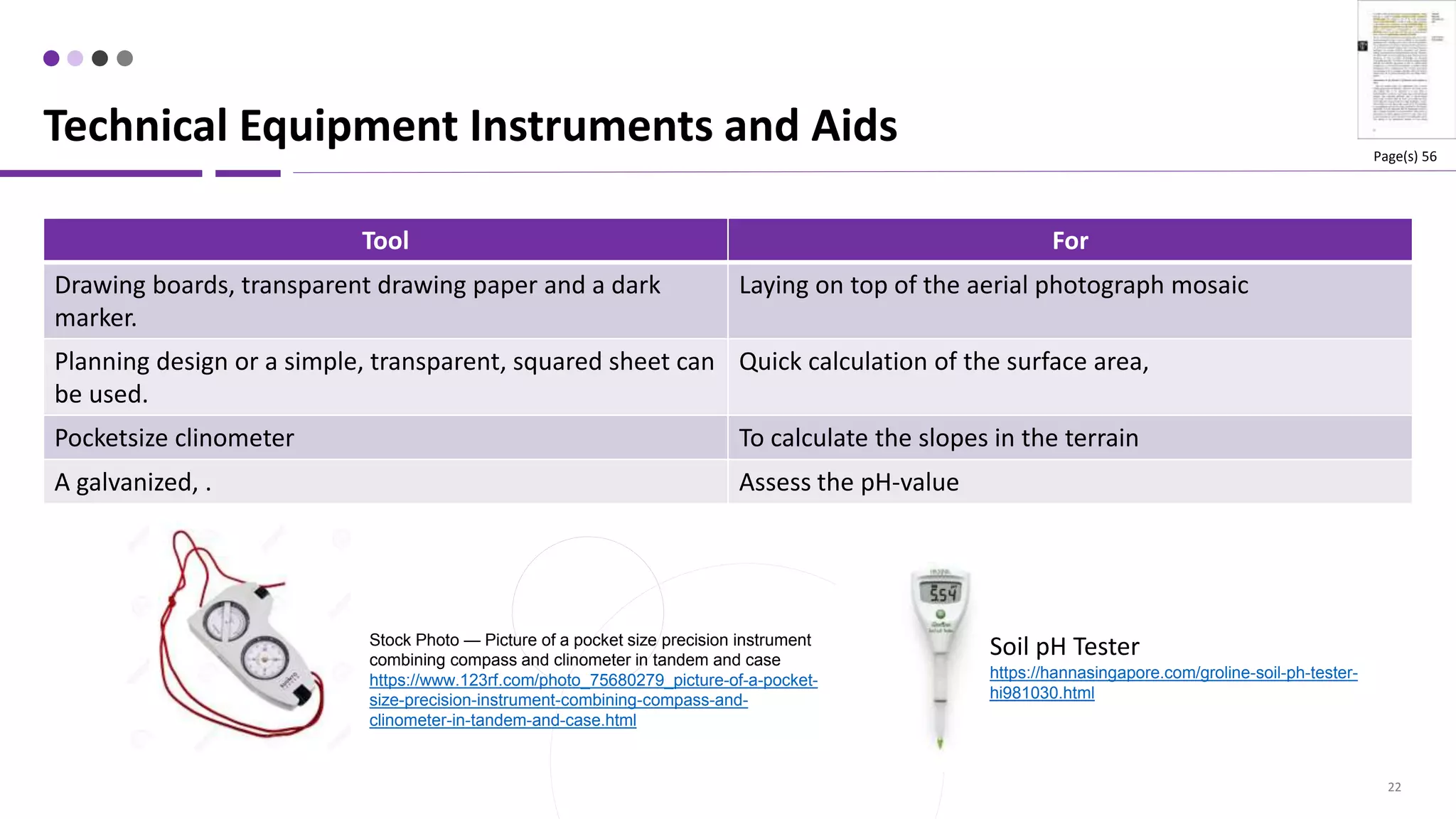
Tool For
Drawing boards, transparent drawing paper and a dark
marker.
Laying on top of the aerial photograph mosaic
Planning design or a simple, transparent, squared sheet can
be used.
Quick calculation of the surface area,
Pocketsize clinometer To calculate the slopes in the terrain
A galvanized, . Assess the pH-value
Technical Equipment Instruments and Aids
Stock Photo — Picture of a pocket size precision instrument
combining compass and clinometer in tandem and case
https://www.123rf.com/photo_75680279_picture-of-a-pocket-
size-precision-instrument-combining-compass-and-
clinometer-in-tandem-and-case.html
Soil pH Tester
https://hannasingapore.com/groline-soil-ph-tester-
hi981030.html
Page(s) 56
23
• Have to be presented in a way, which is understandable to everyone.
• Not only those maps produced by GIS specialists or cartographers, but also the maps prepared by the farmers
themselves.
• It is also important that the participants should be able to identify themselves in the presentation.
• These must be also presented in a form, focused on the stakeholders needs.
• The success of the presentation depends on how strong stakeholders identify themselves with the discussion.
Presentation of the Results of Collection and Analysis of Data Page(s) 56,57
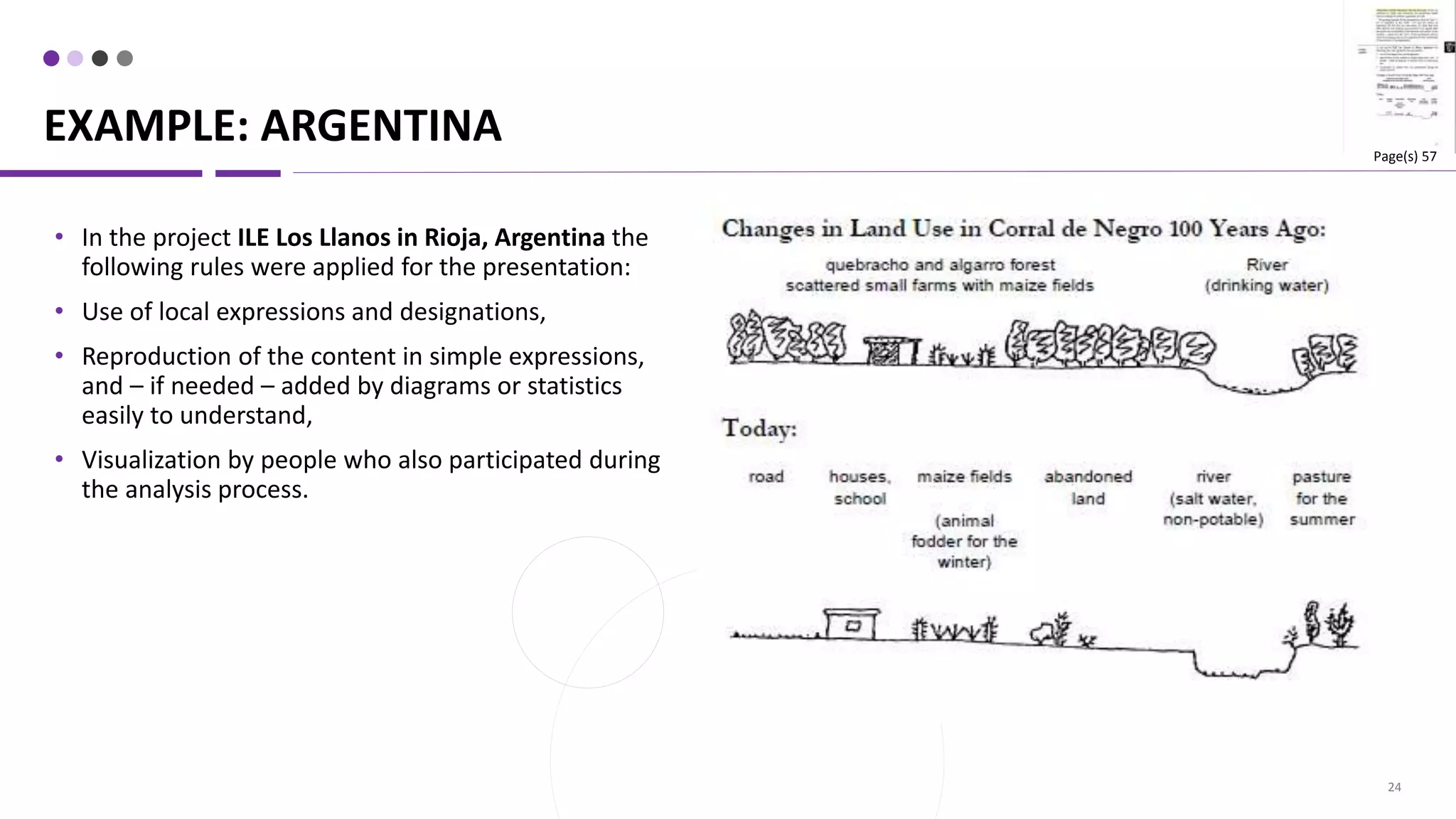
EXAMPLE: ARGENTINA
24
• In the project ILE Los Llanos in Rioja, Argentina the
following rules were applied for the presentation:
• Use of local expressions and designations,
• Reproduction of the content in simple expressions,
and – if needed – added by diagrams or statistics
easily to understand,
• Visualization by people who also participated during
the analysis process.
Page(s) 57
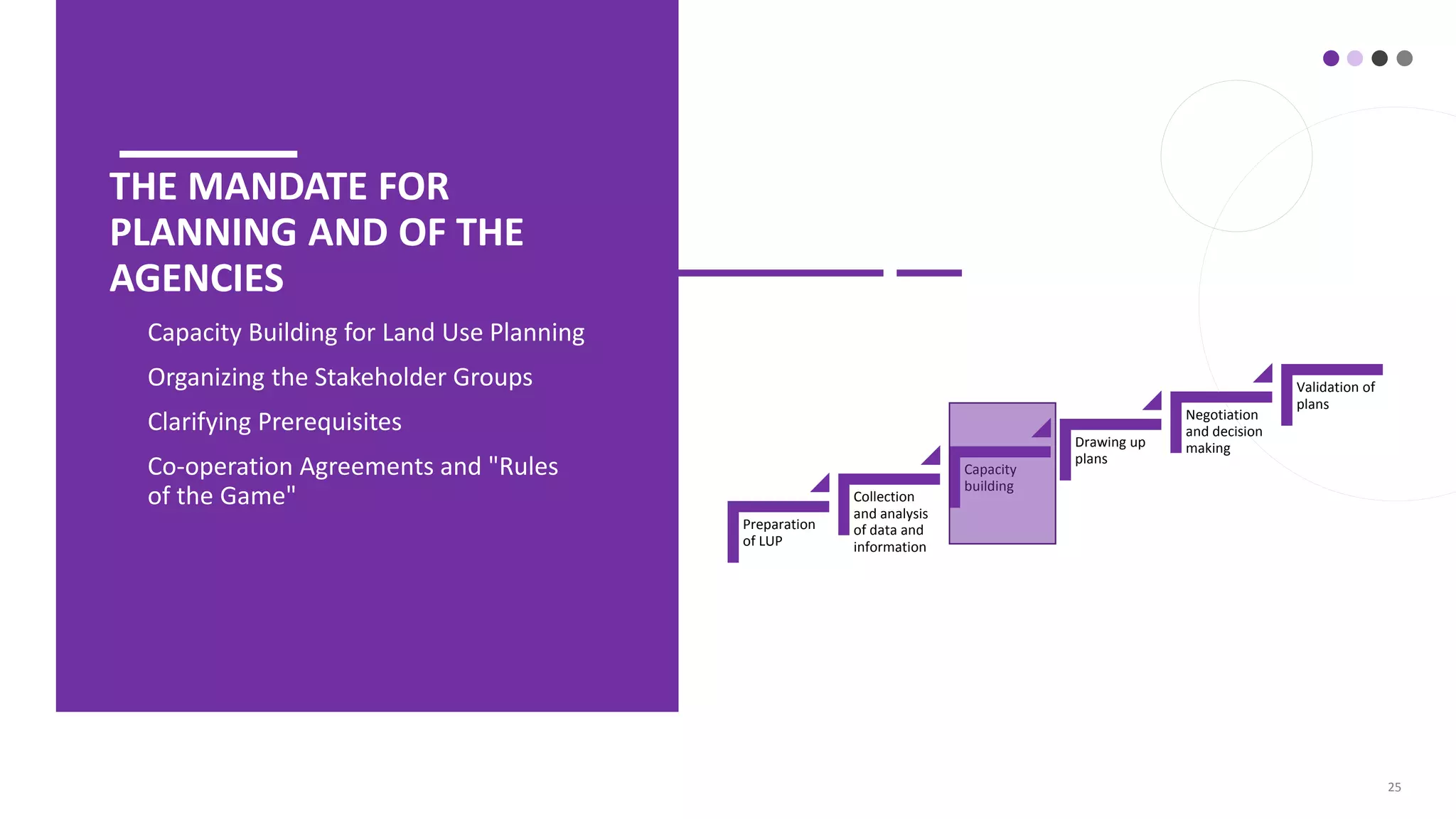
25
THE MANDATE FOR
PLANNING AND OF THE
AGENCIES
• Capacity Building for Land Use Planning
• Organizing the Stakeholder Groups
• Clarifying Prerequisites
• Co-operation Agreements and "Rules
of the Game"
Preparation
of LUP
Collection
and analysis
of data and
information
Capacity
building
Drawing up
plans
Negotiation
and decision
making
Validation of
plans
26
• Planning is an investment and is therefore carried out in order to achieve additional economic revenue.
• One of the aims of land use planning is to achieve an improvement in the economic viability in the planning region.
• Decentralized proceedings in countries in which a decentralized development is already an implemented policy applies
to structures with established responsibilities (mandates).
• Often, projects start their work in the field of land resources management or rural regional development without clear
institutional structures.
• Example : Tanzania -HIAP
Capacity Building for Land Use Planning
Page(s) 58,59,60
CAPACITY BUILDING FOR LAND USE PLANNING
27
Prerequisites can be created by project
support:
• The politically high importance of protection of land
resources;
• The possibility of legal validation for land use
agreements and land use plans;
• Establishing a legal security with respect to land use,
especially in the case of investments to improve land
quality (e.g. through Technical Co-operation projects);
• Possibilities of creating or finding on jobs apart from
agriculture;
• Integrating of LUP into existing planning hierarchies;
• Possibility of arranging the existence of investment
budgets for implementing land use plans
(government, donors, private sector, etc).
Planning agencies must meet the following minimum
requirements:
• Qualified personnel and equipment,
• Motivated and technically competent extension
personnel,
• Long-term financial security.
Page(s) 61
28
• One prerequisite for the success of land use planning is to create conditions which promote the development of
relations based on trust amongst all stakeholders.
• These are often small, but social and/or economic support mechanisms. The implementation of these measures often
extends to later planning phases. Measures aimed at building up trust target the village as a whole and cover
particularly urgent basic needs or measures to avert off physical danger.
• Example: Namibia –A trip to Zimbabwe
Organizing the Stakeholder Groups Page(s) 61,62
29
Question Clarification
For which group or sub-group of stakeholders is the economic support going to be granted?
What are the consequences for the development of a general trust if only one sub-group receives
economic support?
What is the effect of any economic support on the internal development of village organizations
and/or existing conflicts within the village?
According to which criteria is economic support provided? Who sets the criteria up? Are there limits
with respect to the budget? What else can be suggested? Are there any exclusion criteria (e.g. no food
aid)?
Attention should be paid that the measures aimed at building trust are in line with the future working
methods of the project.
Before deciding to promote a certain form of organization at target group level, a project should
carefully examine and consider the impact on other, existing organizational approaches.
Clarifying Prerequisites Page(s) 62,63
30
• Implementing measures, the work allocated and agreed upon should be fixed and recorded in co-operation
agreements.
• A broad linkage with all participants increases the chances of sustainability of the results.
• Participatory planning processes are intended to enable the stakeholders to articulate and represent their interests.
• In addition, it gives them the capacity to organize themselves and to increase their self-confidence.
• The success of participatory LUP depends on a better organization and clear decision-making mechanisms. The
establishment of those mechanisms is often more complicated than expected.
Co-operation Agreements and "Rules of the Game" Page(s) 63
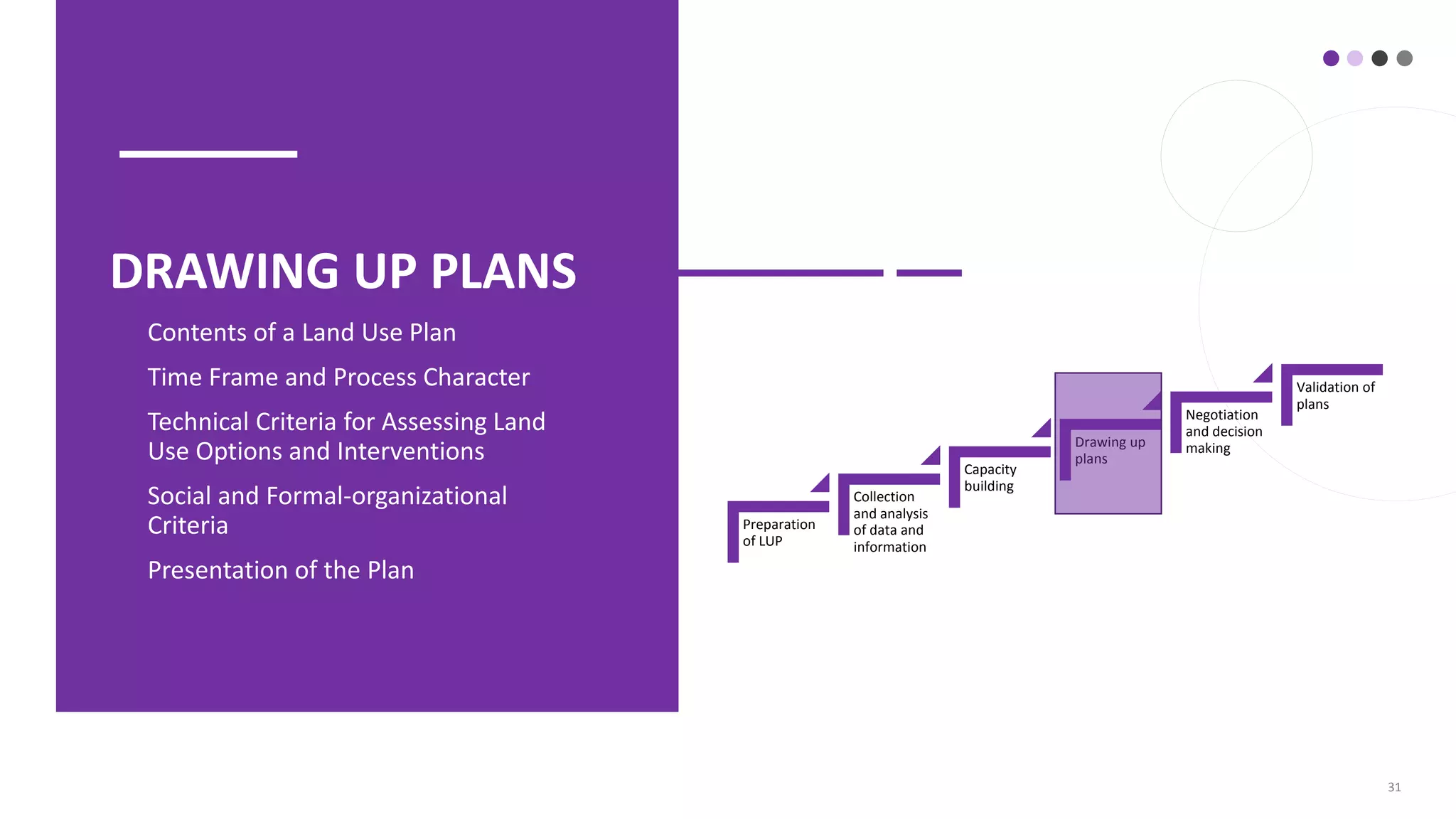
31
DRAWING UP PLANS
• Contents of a Land Use Plan
• Time Frame and Process Character
• Technical Criteria for Assessing Land
Use Options and Interventions
• Social and Formal-organizational
Criteria
• Presentation of the Plan
Preparation
of LUP
Collection
and analysis
of data and
information
Capacity
building
Drawing up
plans
Negotiation
and decision
making
Validation of
plans
32
• Clearly defined objectives of the measures to be implemented,
• Description and presentation of the initial situation and its economic analysis,
• Costs of the intervention,
• Effect of the intervention,
• Who does what work? Who benefits of which use?
• Overall responsibility for carrying out the measures,
• Which authorities participate in what way during the implementation process?
• Which mechanisms are used if agreements are not fulfilled?
• Agreed compensation for restrictions on land use.
Contents of a Land Use Plan Page(s) 64
33
• Experience has shown that under normal initial conditions, a period of 2 to 3 years is required before the first land use
plans are available.
• Must be ensured that not only the content of the plan, but also its form reflects the collaboration process between the
project and the local population.
• The plan drawn up is the result of a negotiation process which is transparent to all.
• LUP is a learning process and can be extended, amended and evaluated within a fixed timeframe.
Time Frame and Process Character Page(s) 65
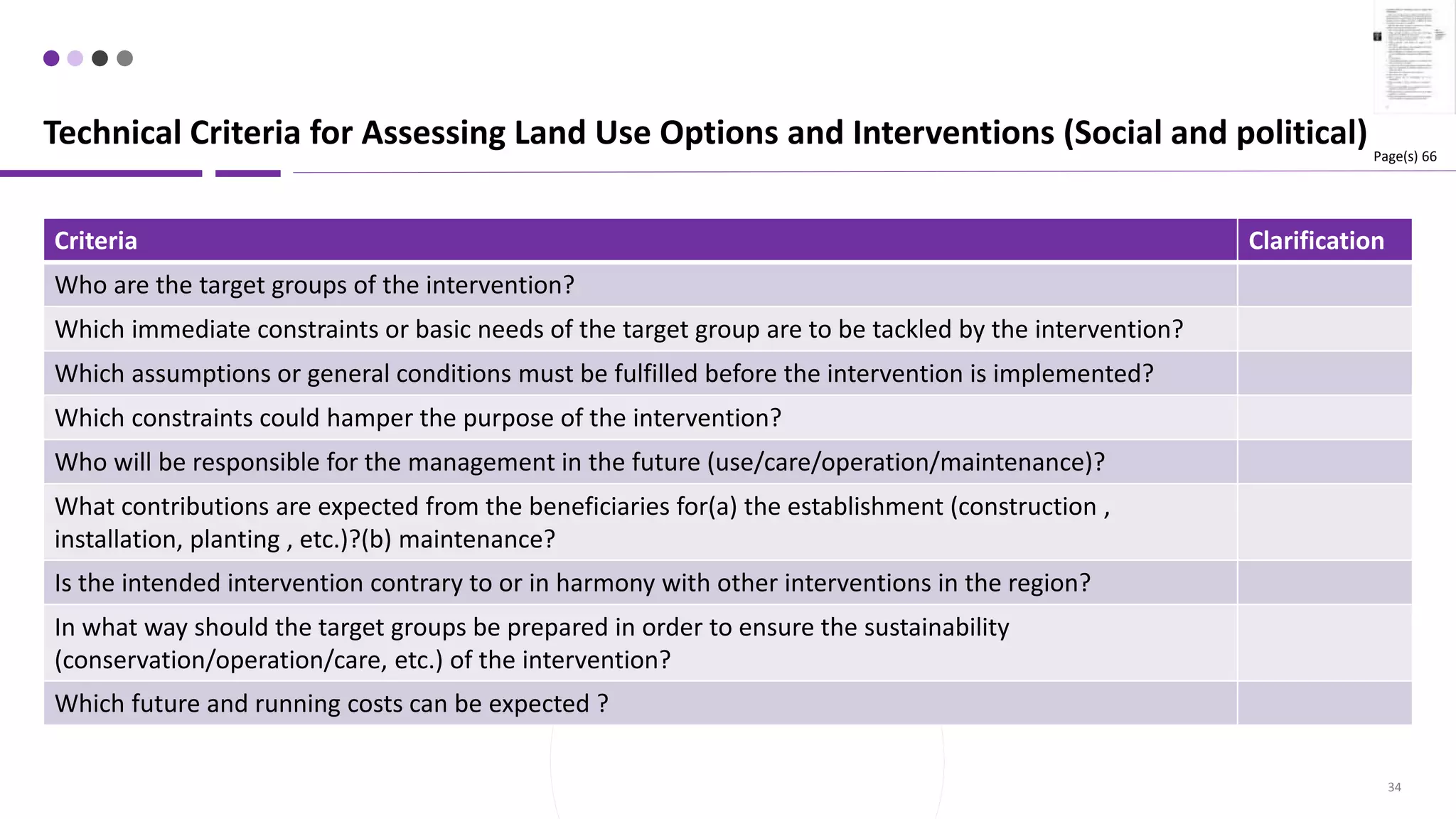
34
Criteria Clarification
Who are the target groups of the intervention?
Which immediate constraints or basic needs of the target group are to be tackled by the intervention?
Which assumptions or general conditions must be fulfilled before the intervention is implemented?
Which constraints could hamper the purpose of the intervention?
Who will be responsible for the management in the future (use/care/operation/maintenance)?
What contributions are expected from the beneficiaries for(a) the establishment (construction ,
installation, planting , etc.)?(b) maintenance?
Is the intended intervention contrary to or in harmony with other interventions in the region?
In what way should the target groups be prepared in order to ensure the sustainability
(conservation/operation/care, etc.) of the intervention?
Which future and running costs can be expected ?
Technical Criteria for Assessing Land Use Options and Interventions (Social and political) Page(s) 66
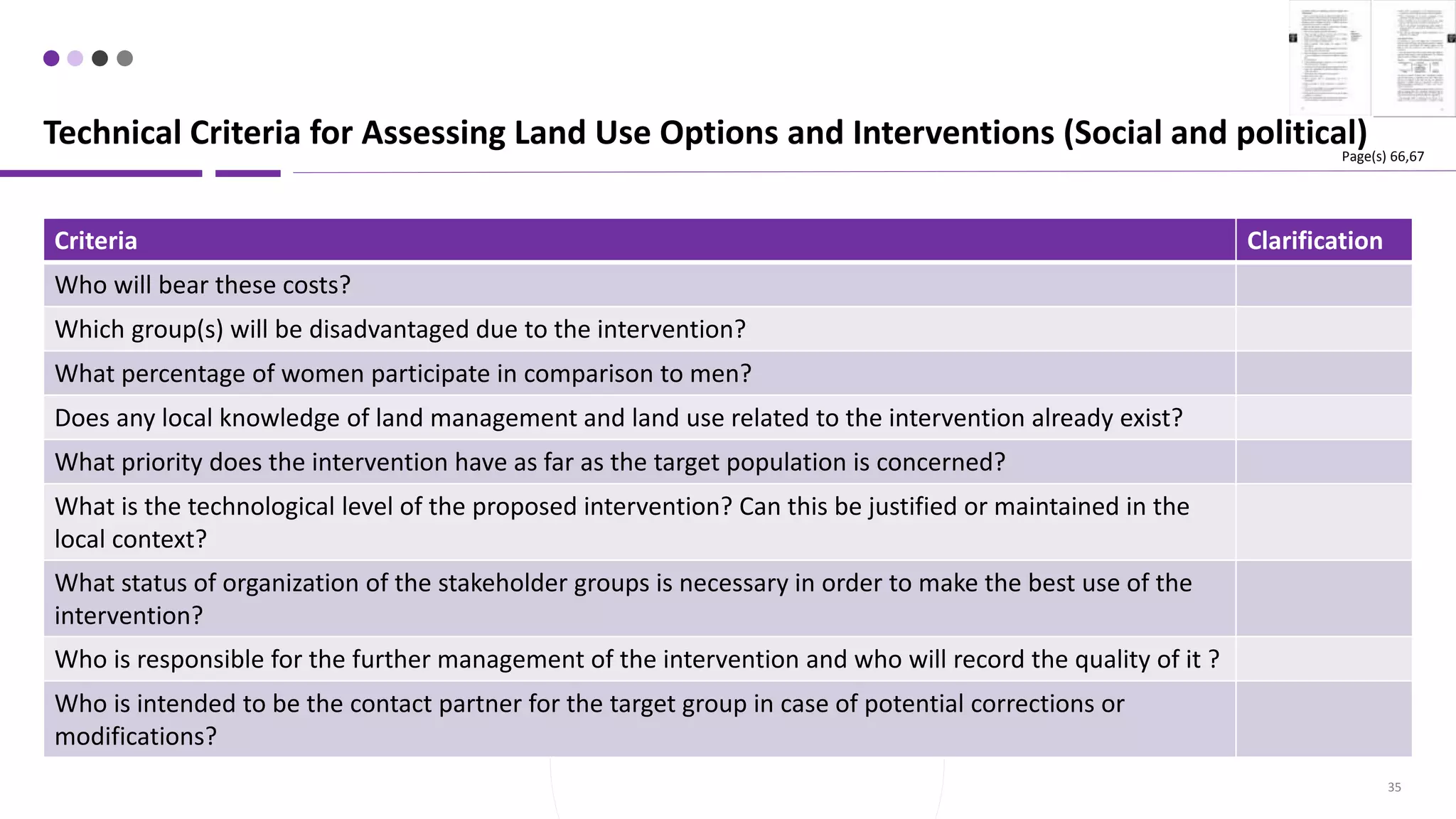
35
Criteria Clarification
Who will bear these costs?
Which group(s) will be disadvantaged due to the intervention?
What percentage of women participate in comparison to men?
Does any local knowledge of land management and land use related to the intervention already exist?
What priority does the intervention have as far as the target population is concerned?
What is the technological level of the proposed intervention? Can this be justified or maintained in the
local context?
What status of organization of the stakeholder groups is necessary in order to make the best use of the
intervention?
Who is responsible for the further management of the intervention and who will record the quality of it ?
Who is intended to be the contact partner for the target group in case of potential corrections or
modifications?
Technical Criteria for Assessing Land Use Options and Interventions (Social and political)
Page(s) 66,67
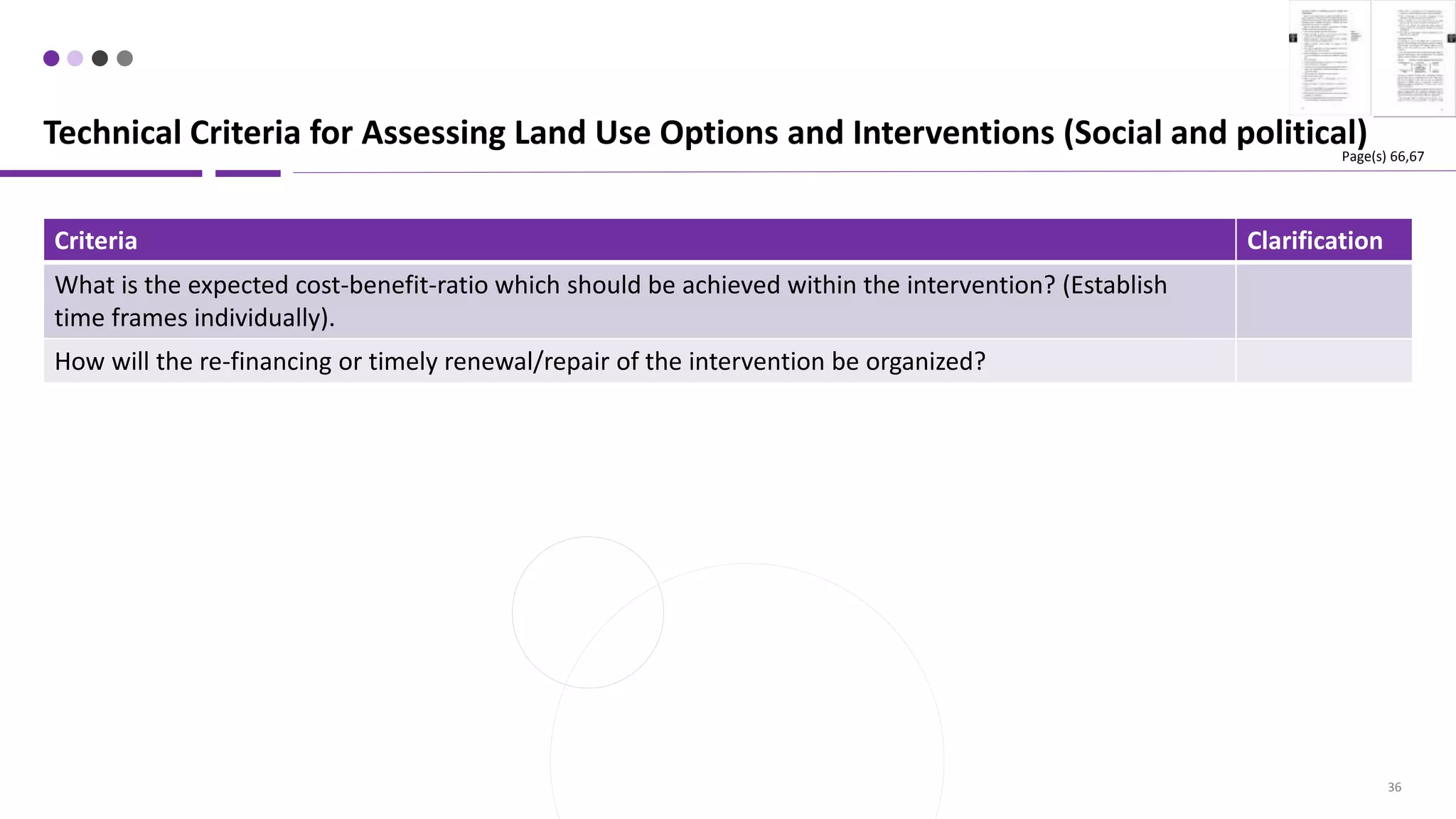
36
Criteria Clarification
What is the expected cost-benefit-ratio which should be achieved within the intervention? (Establish
time frames individually).
How will the re-financing or timely renewal/repair of the intervention be organized?
Technical Criteria for Assessing Land Use Options and Interventions (Social and political)
Page(s) 66,67
TECHNICAL CRITERIA FOR ASSESSING LAND USE OPTIONS AND INTERVENTIONS (AREA)
37
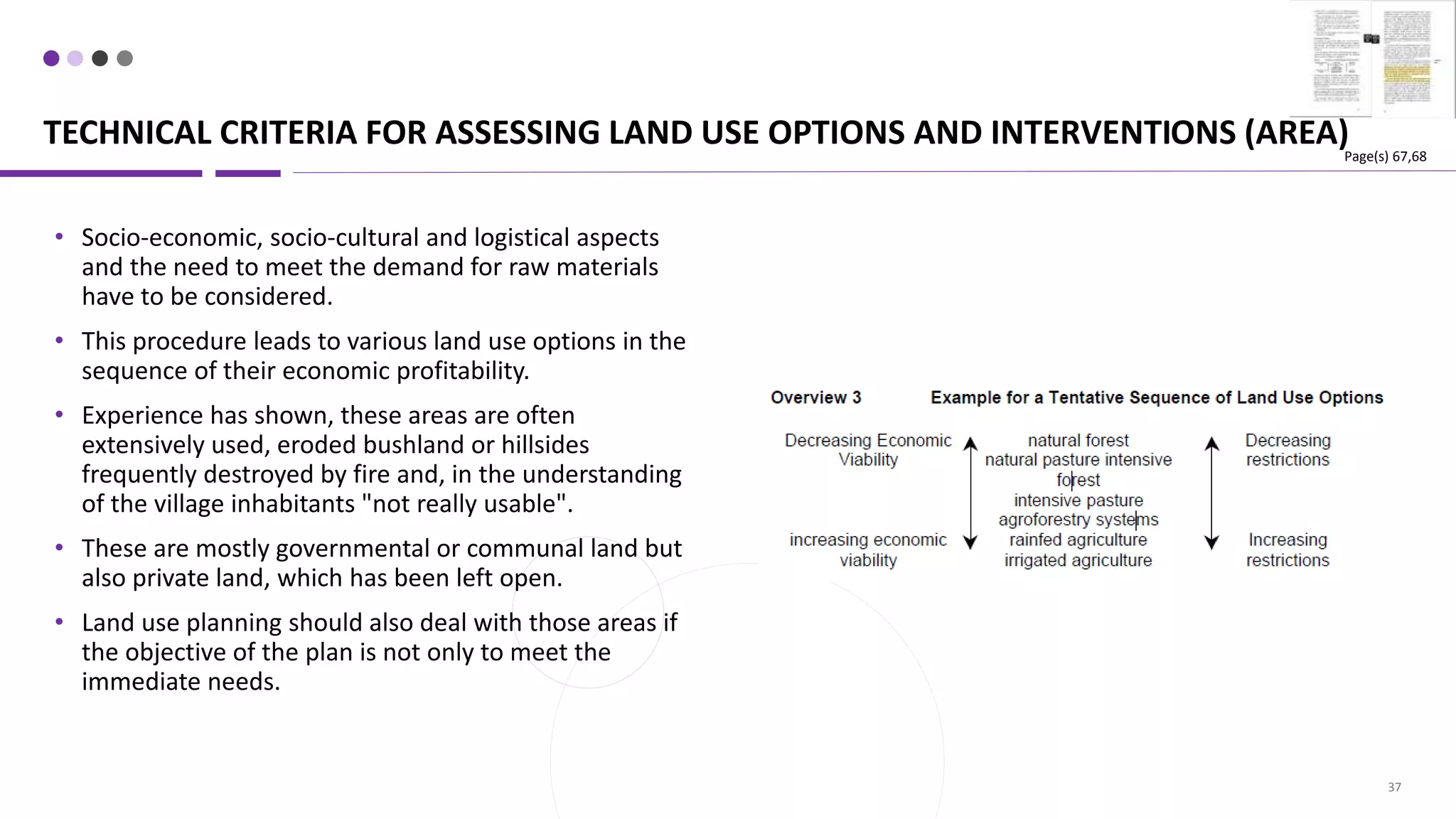
• Socio-economic, socio-cultural and logistical aspects
and the need to meet the demand for raw materials
have to be considered.
• This procedure leads to various land use options in the
sequence of their economic profitability.
• Experience has shown, these areas are often
extensively used, eroded bushland or hillsides
frequently destroyed by fire and, in the understanding
of the village inhabitants "not really usable".
• These are mostly governmental or communal land but
also private land, which has been left open.
• Land use planning should also deal with those areas if
the objective of the plan is not only to meet the
immediate needs.
Page(s) 67,68
38
• Short-term economic use for poor parts of the population,
• The marketability of the products,
• The cultural suitability of proposed technologies,
• The conflict potential of measures,
• The possibility of financing measures and ways of empowering the stakeholders,
• Their potential for self-help and their capacity for co-operation.
Social and Formal-organizational Criteria Page(s) 69
PRESENTATION OF THE PLAN
39
Map parts
• Base map,
• Land units,
• Map on environnemental damage,
• Map on present land use,
• Map on agreed favored land use based on land units,
• Land use plan (proposed land use).
Questions
• To whom will the plan be presented (to an authority, a
ministry, a neighboring village, a financing
institution)?
• What is the purpose of the presentation (financial
means for the implementation, political
influence/conviction, legal amendments, motivation
for others as a pilot case, further education)?
• Who will present the plan (representatives of the
target group, a local female politician, the mayor, an
extensionist)?
• How will the plan be presented (verbally, with visual
tools or in writing)?
Page(s) 69
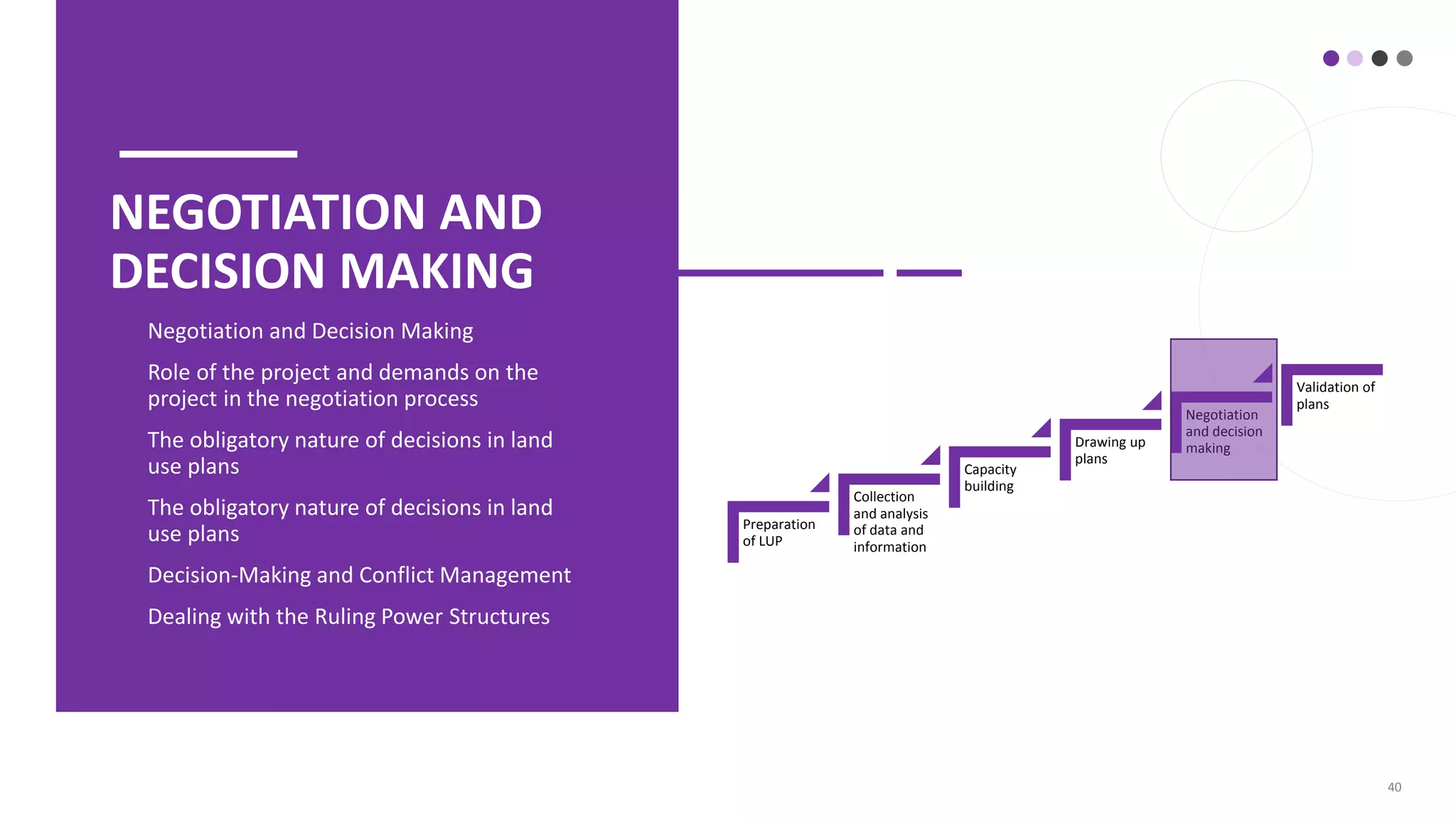
40
NEGOTIATION AND
DECISION MAKING
• Negotiation and Decision Making
• Role of the project and demands on the
project in the negotiation process
• The obligatory nature of decisions in land
use plans
• The obligatory nature of decisions in land
use plans
• Decision-Making and Conflict Management
• Dealing with the Ruling Power Structures
Preparation
of LUP
Collection
and analysis
of data and
information
Capacity
building
Drawing up
plans
Negotiation
and decision
making
Validation of
plans
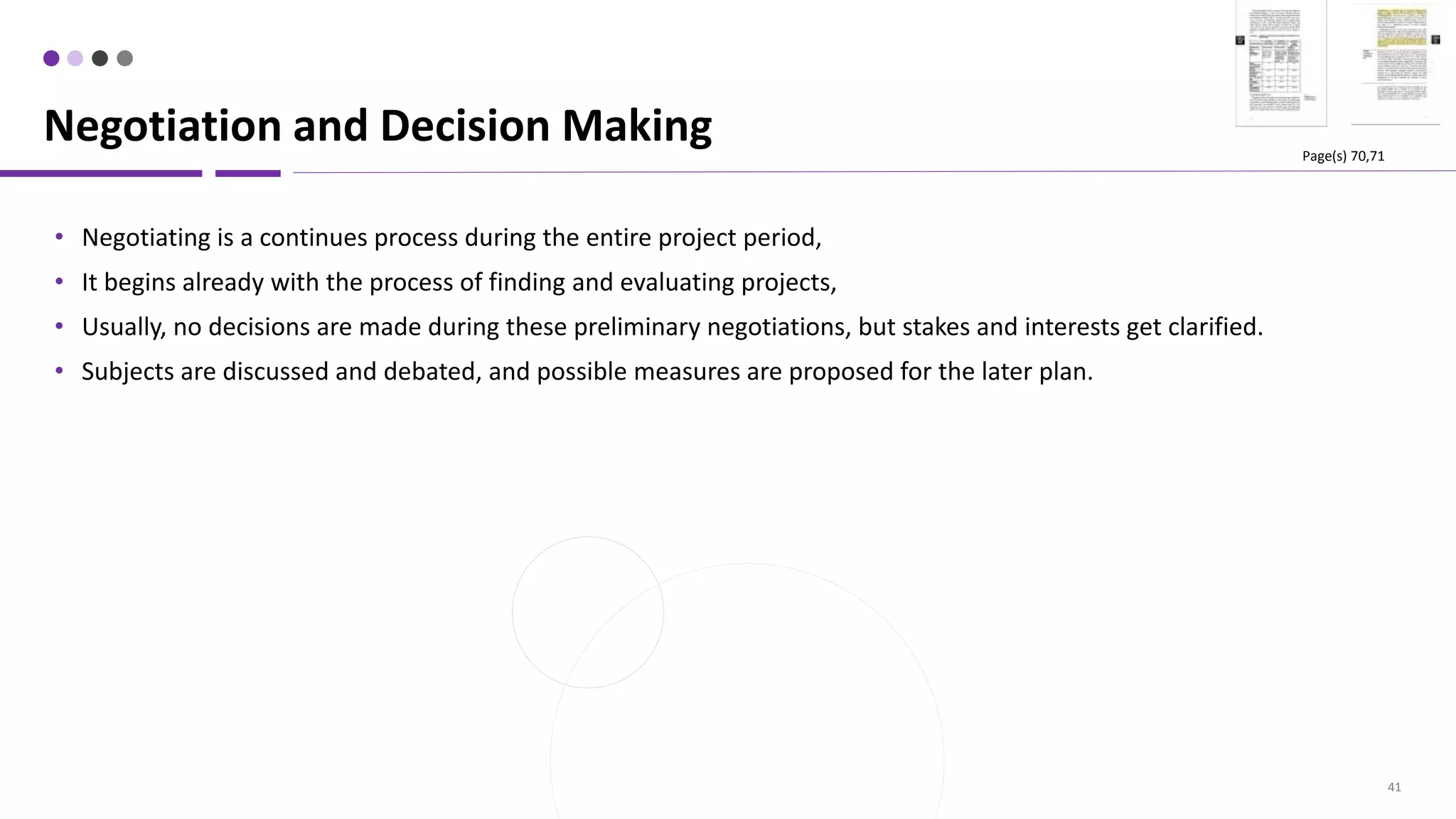
41
• Negotiating is a continues process during the entire project period,
• It begins already with the process of finding and evaluating projects,
• Usually, no decisions are made during these preliminary negotiations, but stakes and interests get clarified.
• Subjects are discussed and debated, and possible measures are proposed for the later plan.
Negotiation and Decision Making Page(s) 70,71
42
• In order to initiate and facilitate negotiation processes, the project needs male and female employees with appropriate
communication skills.
• This is a condition for the ability to understand and respect different viewpoints, problem-solving strategies which may
be new to the project staff, and the local population.
• In this process, the project should avoid to be involved into local power struggles.
• There is not one solution or one way only.
Role of the project and demands on the project in the negotiation process Page(s) 72
43
• It done voluntarily by all stakeholders involved.
• The mechanisms needed to define the obligatory nature should therefore be clarified and agreed on at the earliest
stage in drawing up the plan.
• The use of existing, or the creation of new legal rules, in order to enforce agreements should be avoided as far as
possible.
• At village level there are ways and means to take action against people who infringe on internal village regulations. The
• regulations involve social pressure, but can also mean imposing penalties.
• Example: India – Cattle pounds operations
The obligatory nature of decisions in land use plans Page(s) 73
DECISION-MAKING AND CONFLICT MANAGEMENT
44
• Parties who involve in negotiation process:
1. Those who are directly or indirectly affected,
2. Those who are responsible,
3. Those who competent,
4. Those who can support or motivate, and
5. Those who will impede the process if they are not
included.
• "Cold" conflicts: can literally leave a project cold.
• “Hot“ conflicts: they hardly have any effect on the
planning process. But there are conflicts, there is a
need for action, since there is a potential that parties
will refuse to co-operate.
• Empowering the disadvantaged groups. This can even
be achieved by explicitly inviting landless people or
women to attend meetings. By using participatory
methods, it is ensured that their interests are at least
heard and discussed.
Page(s) 75,76
45
• Negotiation and decision-making processes are determined by social rank and power.
• In practice, this demand is a dilemma for the projects. On the one hand, participatory procedures are intended, if
possible, to give all involved groups the chance to express their interests and to negotiate.
• The project should take on a "neutral" role as moderator or catalyst. On the other hand, power imbalances should be
changed.
• The project should be clear about the fact that dealing with such conflicts can have negative or even dangerous
consequences for the weaker parties involved.
Dealing with the Ruling Power Structures Page(s) 77
46
EVALUATION AND
ACTUALIZATION OF PLANS
• Evaluation and Actualization of Plans
• Expenses are to be planned well in
advance and kept within a limited
budget.
Preparation
of LUP
Collection
and analysis
of data and
information
Capacity
building
Drawing up
plans
Negotiation
and decision
making
Validation of
plans
47
• After a certain time, it becomes necessary to actualize a plan because the general conditions and interests have
changed.
• In order to progressively update the plan, a considerable input of time and attendance by all participants in the
planning and implementation process is required.
• It is therefore recommended that the land use plan is only to be updated after a certain period of time but within the
fixed limits, i.e. every 3 to 4 years.
• A change in the land use plan also requires a revision of the cost of the implementation.
Evaluation and Actualization of Plans Page(s) 78
48
• The project has two options for the plan implementation:
1. It can decide to advise the village of an upper limit of available finances within all technical interventions should be
covered. It therefore also represents the volume of financial investments for land improvement measures, including
new proposals.
2. Additional finances can be found either through the land users themselves or through additional governmental or
international funding, which then enter as a contractual component for a partial implementation of the plan.
Expenses are to be planned well in advance and kept within a limited budget.Page(s) 79
THANK YOU
49

Elements of an Implementation - Orientated Planning Process

  • 1.
    DONE BY: YAZIDHAMODAH ELEMENTS OF AN IMPLEMENTATION- ORIENTATED PLANNING PROCESS
  • 2.
    2 Title Slides (From-To) Startand Introduction 1-4 Planning as an Iterative Process 5-8 Important Steps in the Preparation of Land Use Planning 9-13 Collection and Analysis of Data and Information 14-24 Capacity Building for Land Use Planning 25-30 Drawing up Plans 31-39 Negotiation and Decision-Making 40-45 Evaluation and Actualization of Plans 46-48 List of content
  • 3.
    THE ELEMENTS OFTHE LUP PROCESS 3 • Conflict management between opposing interests and positions, and building up manifold cooperative relations, Preparation of LUP Collection and analysis of data and information Capacity building Drawing up plans Negotiation and decision making Validation of plans Page(s) 35
  • 4.
    IMPLEMENTATION- ORIENTATED PLANNING Main objectives •Optimize land use according to the available local resources and at the same time to • Minimize damage. 4 Secondly objectives • Contribute more and more to the settlement of conflicts between: • Villages • Arable farmers and pastoralists, • Settlers and residents • Different ethnic groups, • Forestry authorities and village communities, • Large landowners and those owning no land, • Landless farmers and agricultural reform authorities or the judiciary • Ethnic groups and new settlers The objectives Page(s) 35
  • 5.
    5 PLANNING AS AN ITERATIVEPROCESS • Planning as an Iterative Process • Alternatives • Two sides
  • 6.
    6 •well-proven in practiceof the technical co-operation and which is called an iterative process. Application •The implementation of pilot measures begins at the same time as the collection and analysis of data and information. Implementation •Negotiating processes accompany the entire course of planning. Negotiation •drawn from the experiences and knowledge gained during the steps already carried out. Conclusions •Based on a continuous learning process. Learning •Iterative and cyclical •Need for a time frame within which certain activities must be concluded Process Planning as an Iterative Process Page(s) 36
  • 7.
    7 • May becomeClear immediately before the final plan is approved that key figures might not have been considered. If this is the case, two alternatives for action may be considered: 1. The participants may decide to finalize the plan first and adapt it later in a further planning process, including all stakeholders; 2. The planning process is going to be stopped and started again immediately after. That means for many participants a U-turn, which is difficult for them to understand. In addition, it causes a considerable delay in finalizing the plan implementation. Alternatives Page(s) 37
  • 8.
    TWO SIDES Advantages • Easierto react to aberrations and learn from mistakes, • leads step by-step through processes of recognition and learning, • It leads to solutions and agreements accepted by all participants 8 Limitations • This requires that all participants develop an understanding for the tension arising between meeting the directives and the necessity of a flexible adaptation. • Only applies when mistakes are recognized, Advantages and limitations Page(s) 37
  • 9.
    9 IMPORTANT STEPS INTHE PREPARATION OF LAND USE PLANNING • Evaluating the Need for Land Use Planning • Prerequisites for Land Use Planning • Determining the Unit of Planning Preparation of LUP Collection and analysis of data and information Capacity building Drawing up plans Negotiation and decision making Validation of plans
  • 10.
    EVALUATING THE NEEDFOR LAND USE PLANNING 10 • Reasons for the need for interventions at local level by external organizations: 1. Due to the planning objectives at higher level, some areas are selected as pilot areas, 2. An increase of environmental destruction is to be counteracted, 3. Land use conflicts are to be settled, 4. Directives for land use in respect of higher level planning, 5. interests are to be forced (e.g. water supply). • Initiatives come from: 1. Immediate stakeholders, 2. Authorities, 3. Governmental and non-governmental organizations, 4. Communities. 5. Technical projects in rural areas. Page(s) 37
  • 11.
    PREREQUISITES FOR LANDUSE PLANNING 11 Mid-term • Flexibility in actions by the agency, rejecting of formal or theoretical working Approaches, turning to a transparent and participatory working style, • Extending the possibilities of including nongovernmental Partners, • Increased acceptance of participatory working methods by the participating population, even where these have no tradition; • Development of articulated conceptions of land use by the stakeholders; • Awareness of disadvantaged groups by supporting agencies and other governmental authorities, and the will to change their situation. Local • The availability of information on national and regional plans, • Directives and regulations, as well as their analysis and consideration during implementation; • Clarification of work to be accomplished and responsibilities during the implementation, as well as a realistic time plan, in which the priorities and working rhythms of the rural stakeholders must be taken into account; • Ensuring the necessary extension and financial services; • ·Using all alternatives of compensation where use is going to be restricted; • ·Minimal logistical preconditions. • Freedom of assembly and freedom of speech Page(s) 38,39
  • 12.
    PREREQUISITES FOR LANDUSE PLANNING 12 Long-term aspects • Initial measures aimed at building up trust. • Balancing between ecological and economic aspects must be clarified. (ecology = long-term economy) • Example : Burkina Faso • Vocabulary, • Example : Tanzania Entering into a Dialogue with the Participants • Life threatening problems are foremost, • Find initial points from which effective economic advantages can be expected in the shortest possible time. • Example : Ganga delta – India, and Namibia Page(s) 40,41,42
  • 13.
    DETERMINING THE UNITOF PLANNING 13 • Criteria: 1. the group consciousness of the target population, 2. Their areas for living and production 3. The territorial boundaries of jurisdiction of the local organizations and the type of the project. • Final decision will always depend on the actual situation. • Decision must be made together with the population and the local organizations. • Sometimes the boundaries of a planning area will change during the course of implementation from Mobile user groups ,Nomadic livestock for example. Page(s) 43
  • 14.
    14 COLLECTION AND ANALYSIS OFDATA AND INFORMATION • Sources of Information • Preparation and Analysis • Important tools and techniques • Presentation of the Results of Collection and Analysis of Data Preparation of LUP Collection and analysis of data and information Capacity building Drawing up plans Negotiation and decision making Validation of plans
  • 15.
    SOURCES OF INFORMATION 15 Secondaryinformation • The viewpoint and perception of various different groups, • "Regionally Oriented Programmed Planning" (ROPP)used when there is lack of important basic data information consist of 2 stages: • An analysis of the situation, and the elaboration of the regional development concept. • Secondary data sources are easy to find but harder to process. Primary information • Data and development plans (national/regional), • Consultation with technical services, • Research papers, • Statistics, • Information on state budgets and other financial sources (e.g. other donors); • Reports on activities of other projects and non- governmental organizations. Page(s) 44,45,46
  • 16.
    16 • Specific dataon the entire planning area is required for LUP: • Data on the available land resources, • The socio-economic, socio-cultural, organizational and institutional conditions, • On the history of the region, and the future visions of the different stakeholder groups. Preparation and Analysis Page(s) 45
  • 17.
    17 • information iscollected and analyzed jointly by all participating stakeholder groups, • it is use and action – oriented; • important local knowledge of the area; • Provides knowledge on local land use systems, • Mediates views and values of the participants; • it can be collected with a clear objective, • A problem-oriented analysis of the area is possible by transect walks, local soil classifications, etc. and an analysis of cultural peculiarities and social relations is focused on; • It helps to overcome existing language barriers, as local vocabulary is documented at the same time. Important tools and techniques (Active participation) Page(s) 49
  • 18.
    18 • For theinventory of the natural potential of the planning area, areas: 1. Of homogenous characteristics, 2. documented on a map, 3. area into units with similar topographical characteristics, edaphic characteristics and similar vegetation cover. • An example of a possible procedure for a land unit diagnosis, planning and implementation within the framework of the LUP process, aimed at optimization of land use. Division into Land Unit Page(s) 51
  • 19.
    19 • The identificationof agro-ecological zones is frequently applied in mountainous regions in which land use depends primarily on the elevation. • The following units can be distinguished: 1. Planning units, 2. Land utilization units, 3. Recourses management units, 4. Units of rural development, 5. Units for protecting food sources, 6. Units for consolidating a social organization. • Example: Namibia Identifying Agroecological Zones (AEZ) Page(s) 51
  • 20.
    TOPOGRAPHICAL MAPS, AERIALPHOTOGRAPHS AND GIS IN LAND USE PLANNING 20 • Topographical maps: • Available to village participants to a limited extent, • very difficult for them to use, • The scale is often irrelevant for village land use planning, • For the project staff the maps are valuable for locating the village, drawing up general maps and, in rare cases, for establishing and/or verifying boundaries. • can be used as a basis for creating three-dimensional models of the terrain, since they reproduce the contour lines. • 3D-models, often used in projects working in mountainous regions. 3-D model as a tool in planning discussions, Thai-German Highland Development Programme (Thailand). Page(s) 53,54
  • 21.
    TOPOGRAPHICAL MAPS, AERIALPHOTOGRAPHS AND GIS IN LAND USE PLANNING 21 • Arial photographs: • Village people can read them without difficulties, • The recognition of orientation points makes everything much easier, it stimulates the process and is fun for all participants. • It is recommended for the purpose of reading photographs that the individual photos be pieced together to make photo mosaics which completely cover certain boundaries and/or the village planning area. • It is important that a copy of this mosaic is kept in the village. This gives the village planning partners confirmation of their responsibility, and also leads to reinforcement, discussion and the formulation of ideas apart from planning meetings. • GIS: • Often used to make data processing, storage and retrieval easier. • Purchasing and setting up a GIS is no essential prerequisite for LUP. Participatory air photo interpretation, Village Adi Baren, Rural Development Project Mai Aini (Eritrea). Page(s) 54,55
  • 22.
    22 Tool For Drawing boards,transparent drawing paper and a dark marker. Laying on top of the aerial photograph mosaic Planning design or a simple, transparent, squared sheet can be used. Quick calculation of the surface area, Pocketsize clinometer To calculate the slopes in the terrain A galvanized, . Assess the pH-value Technical Equipment Instruments and Aids Stock Photo — Picture of a pocket size precision instrument combining compass and clinometer in tandem and case https://www.123rf.com/photo_75680279_picture-of-a-pocket- size-precision-instrument-combining-compass-and- clinometer-in-tandem-and-case.html Soil pH Tester https://hannasingapore.com/groline-soil-ph-tester- hi981030.html Page(s) 56
  • 23.
    23 • Have tobe presented in a way, which is understandable to everyone. • Not only those maps produced by GIS specialists or cartographers, but also the maps prepared by the farmers themselves. • It is also important that the participants should be able to identify themselves in the presentation. • These must be also presented in a form, focused on the stakeholders needs. • The success of the presentation depends on how strong stakeholders identify themselves with the discussion. Presentation of the Results of Collection and Analysis of Data Page(s) 56,57
  • 24.
    EXAMPLE: ARGENTINA 24 • Inthe project ILE Los Llanos in Rioja, Argentina the following rules were applied for the presentation: • Use of local expressions and designations, • Reproduction of the content in simple expressions, and – if needed – added by diagrams or statistics easily to understand, • Visualization by people who also participated during the analysis process. Page(s) 57
  • 25.
    25 THE MANDATE FOR PLANNINGAND OF THE AGENCIES • Capacity Building for Land Use Planning • Organizing the Stakeholder Groups • Clarifying Prerequisites • Co-operation Agreements and "Rules of the Game" Preparation of LUP Collection and analysis of data and information Capacity building Drawing up plans Negotiation and decision making Validation of plans
  • 26.
    26 • Planning isan investment and is therefore carried out in order to achieve additional economic revenue. • One of the aims of land use planning is to achieve an improvement in the economic viability in the planning region. • Decentralized proceedings in countries in which a decentralized development is already an implemented policy applies to structures with established responsibilities (mandates). • Often, projects start their work in the field of land resources management or rural regional development without clear institutional structures. • Example : Tanzania -HIAP Capacity Building for Land Use Planning Page(s) 58,59,60
  • 27.
    CAPACITY BUILDING FORLAND USE PLANNING 27 Prerequisites can be created by project support: • The politically high importance of protection of land resources; • The possibility of legal validation for land use agreements and land use plans; • Establishing a legal security with respect to land use, especially in the case of investments to improve land quality (e.g. through Technical Co-operation projects); • Possibilities of creating or finding on jobs apart from agriculture; • Integrating of LUP into existing planning hierarchies; • Possibility of arranging the existence of investment budgets for implementing land use plans (government, donors, private sector, etc). Planning agencies must meet the following minimum requirements: • Qualified personnel and equipment, • Motivated and technically competent extension personnel, • Long-term financial security. Page(s) 61
  • 28.
    28 • One prerequisitefor the success of land use planning is to create conditions which promote the development of relations based on trust amongst all stakeholders. • These are often small, but social and/or economic support mechanisms. The implementation of these measures often extends to later planning phases. Measures aimed at building up trust target the village as a whole and cover particularly urgent basic needs or measures to avert off physical danger. • Example: Namibia –A trip to Zimbabwe Organizing the Stakeholder Groups Page(s) 61,62
  • 29.
    29 Question Clarification For whichgroup or sub-group of stakeholders is the economic support going to be granted? What are the consequences for the development of a general trust if only one sub-group receives economic support? What is the effect of any economic support on the internal development of village organizations and/or existing conflicts within the village? According to which criteria is economic support provided? Who sets the criteria up? Are there limits with respect to the budget? What else can be suggested? Are there any exclusion criteria (e.g. no food aid)? Attention should be paid that the measures aimed at building trust are in line with the future working methods of the project. Before deciding to promote a certain form of organization at target group level, a project should carefully examine and consider the impact on other, existing organizational approaches. Clarifying Prerequisites Page(s) 62,63
  • 30.
    30 • Implementing measures,the work allocated and agreed upon should be fixed and recorded in co-operation agreements. • A broad linkage with all participants increases the chances of sustainability of the results. • Participatory planning processes are intended to enable the stakeholders to articulate and represent their interests. • In addition, it gives them the capacity to organize themselves and to increase their self-confidence. • The success of participatory LUP depends on a better organization and clear decision-making mechanisms. The establishment of those mechanisms is often more complicated than expected. Co-operation Agreements and "Rules of the Game" Page(s) 63
  • 31.
    31 DRAWING UP PLANS •Contents of a Land Use Plan • Time Frame and Process Character • Technical Criteria for Assessing Land Use Options and Interventions • Social and Formal-organizational Criteria • Presentation of the Plan Preparation of LUP Collection and analysis of data and information Capacity building Drawing up plans Negotiation and decision making Validation of plans
  • 32.
    32 • Clearly definedobjectives of the measures to be implemented, • Description and presentation of the initial situation and its economic analysis, • Costs of the intervention, • Effect of the intervention, • Who does what work? Who benefits of which use? • Overall responsibility for carrying out the measures, • Which authorities participate in what way during the implementation process? • Which mechanisms are used if agreements are not fulfilled? • Agreed compensation for restrictions on land use. Contents of a Land Use Plan Page(s) 64
  • 33.
    33 • Experience hasshown that under normal initial conditions, a period of 2 to 3 years is required before the first land use plans are available. • Must be ensured that not only the content of the plan, but also its form reflects the collaboration process between the project and the local population. • The plan drawn up is the result of a negotiation process which is transparent to all. • LUP is a learning process and can be extended, amended and evaluated within a fixed timeframe. Time Frame and Process Character Page(s) 65
  • 34.
    34 Criteria Clarification Who arethe target groups of the intervention? Which immediate constraints or basic needs of the target group are to be tackled by the intervention? Which assumptions or general conditions must be fulfilled before the intervention is implemented? Which constraints could hamper the purpose of the intervention? Who will be responsible for the management in the future (use/care/operation/maintenance)? What contributions are expected from the beneficiaries for(a) the establishment (construction , installation, planting , etc.)?(b) maintenance? Is the intended intervention contrary to or in harmony with other interventions in the region? In what way should the target groups be prepared in order to ensure the sustainability (conservation/operation/care, etc.) of the intervention? Which future and running costs can be expected ? Technical Criteria for Assessing Land Use Options and Interventions (Social and political) Page(s) 66
  • 35.
    35 Criteria Clarification Who willbear these costs? Which group(s) will be disadvantaged due to the intervention? What percentage of women participate in comparison to men? Does any local knowledge of land management and land use related to the intervention already exist? What priority does the intervention have as far as the target population is concerned? What is the technological level of the proposed intervention? Can this be justified or maintained in the local context? What status of organization of the stakeholder groups is necessary in order to make the best use of the intervention? Who is responsible for the further management of the intervention and who will record the quality of it ? Who is intended to be the contact partner for the target group in case of potential corrections or modifications? Technical Criteria for Assessing Land Use Options and Interventions (Social and political) Page(s) 66,67
  • 36.
    36 Criteria Clarification What isthe expected cost-benefit-ratio which should be achieved within the intervention? (Establish time frames individually). How will the re-financing or timely renewal/repair of the intervention be organized? Technical Criteria for Assessing Land Use Options and Interventions (Social and political) Page(s) 66,67
  • 37.
    TECHNICAL CRITERIA FORASSESSING LAND USE OPTIONS AND INTERVENTIONS (AREA) 37 • Socio-economic, socio-cultural and logistical aspects and the need to meet the demand for raw materials have to be considered. • This procedure leads to various land use options in the sequence of their economic profitability. • Experience has shown, these areas are often extensively used, eroded bushland or hillsides frequently destroyed by fire and, in the understanding of the village inhabitants "not really usable". • These are mostly governmental or communal land but also private land, which has been left open. • Land use planning should also deal with those areas if the objective of the plan is not only to meet the immediate needs. Page(s) 67,68
  • 38.
    38 • Short-term economicuse for poor parts of the population, • The marketability of the products, • The cultural suitability of proposed technologies, • The conflict potential of measures, • The possibility of financing measures and ways of empowering the stakeholders, • Their potential for self-help and their capacity for co-operation. Social and Formal-organizational Criteria Page(s) 69
  • 39.
    PRESENTATION OF THEPLAN 39 Map parts • Base map, • Land units, • Map on environnemental damage, • Map on present land use, • Map on agreed favored land use based on land units, • Land use plan (proposed land use). Questions • To whom will the plan be presented (to an authority, a ministry, a neighboring village, a financing institution)? • What is the purpose of the presentation (financial means for the implementation, political influence/conviction, legal amendments, motivation for others as a pilot case, further education)? • Who will present the plan (representatives of the target group, a local female politician, the mayor, an extensionist)? • How will the plan be presented (verbally, with visual tools or in writing)? Page(s) 69
  • 40.
    40 NEGOTIATION AND DECISION MAKING •Negotiation and Decision Making • Role of the project and demands on the project in the negotiation process • The obligatory nature of decisions in land use plans • The obligatory nature of decisions in land use plans • Decision-Making and Conflict Management • Dealing with the Ruling Power Structures Preparation of LUP Collection and analysis of data and information Capacity building Drawing up plans Negotiation and decision making Validation of plans
  • 41.
    41 • Negotiating isa continues process during the entire project period, • It begins already with the process of finding and evaluating projects, • Usually, no decisions are made during these preliminary negotiations, but stakes and interests get clarified. • Subjects are discussed and debated, and possible measures are proposed for the later plan. Negotiation and Decision Making Page(s) 70,71
  • 42.
    42 • In orderto initiate and facilitate negotiation processes, the project needs male and female employees with appropriate communication skills. • This is a condition for the ability to understand and respect different viewpoints, problem-solving strategies which may be new to the project staff, and the local population. • In this process, the project should avoid to be involved into local power struggles. • There is not one solution or one way only. Role of the project and demands on the project in the negotiation process Page(s) 72
  • 43.
    43 • It donevoluntarily by all stakeholders involved. • The mechanisms needed to define the obligatory nature should therefore be clarified and agreed on at the earliest stage in drawing up the plan. • The use of existing, or the creation of new legal rules, in order to enforce agreements should be avoided as far as possible. • At village level there are ways and means to take action against people who infringe on internal village regulations. The • regulations involve social pressure, but can also mean imposing penalties. • Example: India – Cattle pounds operations The obligatory nature of decisions in land use plans Page(s) 73
  • 44.
    DECISION-MAKING AND CONFLICTMANAGEMENT 44 • Parties who involve in negotiation process: 1. Those who are directly or indirectly affected, 2. Those who are responsible, 3. Those who competent, 4. Those who can support or motivate, and 5. Those who will impede the process if they are not included. • "Cold" conflicts: can literally leave a project cold. • “Hot“ conflicts: they hardly have any effect on the planning process. But there are conflicts, there is a need for action, since there is a potential that parties will refuse to co-operate. • Empowering the disadvantaged groups. This can even be achieved by explicitly inviting landless people or women to attend meetings. By using participatory methods, it is ensured that their interests are at least heard and discussed. Page(s) 75,76
  • 45.
    45 • Negotiation anddecision-making processes are determined by social rank and power. • In practice, this demand is a dilemma for the projects. On the one hand, participatory procedures are intended, if possible, to give all involved groups the chance to express their interests and to negotiate. • The project should take on a "neutral" role as moderator or catalyst. On the other hand, power imbalances should be changed. • The project should be clear about the fact that dealing with such conflicts can have negative or even dangerous consequences for the weaker parties involved. Dealing with the Ruling Power Structures Page(s) 77
  • 46.
    46 EVALUATION AND ACTUALIZATION OFPLANS • Evaluation and Actualization of Plans • Expenses are to be planned well in advance and kept within a limited budget. Preparation of LUP Collection and analysis of data and information Capacity building Drawing up plans Negotiation and decision making Validation of plans
  • 47.
    47 • After acertain time, it becomes necessary to actualize a plan because the general conditions and interests have changed. • In order to progressively update the plan, a considerable input of time and attendance by all participants in the planning and implementation process is required. • It is therefore recommended that the land use plan is only to be updated after a certain period of time but within the fixed limits, i.e. every 3 to 4 years. • A change in the land use plan also requires a revision of the cost of the implementation. Evaluation and Actualization of Plans Page(s) 78
  • 48.
    48 • The projecthas two options for the plan implementation: 1. It can decide to advise the village of an upper limit of available finances within all technical interventions should be covered. It therefore also represents the volume of financial investments for land improvement measures, including new proposals. 2. Additional finances can be found either through the land users themselves or through additional governmental or international funding, which then enter as a contractual component for a partial implementation of the plan. Expenses are to be planned well in advance and kept within a limited budget.Page(s) 79
  • 49.