CASE STUDY :The Solaris Cultural and Leisure Center.
Location: Tallinn, Estonia.
Year of project : 2009 .
Owner : Solaris Keskus AS.
SUPERVISED BY : DR.ESSAM TARRAD
SECTION : 1 ( TEUSDAY )
DONE BY :
YAZID HAMODAH (1300703006) AND MOHAMMAD
ALHANBALI (1300703021).
List of contents
1. About the project.
2. The components of project.
3. Sound Reinforcement System.
4. The Solaris Kino Complex.
5. Nokia Concert Hall.
6. List of references.
About the project
• The Solaris Cultural and Leisure Centre is a new hub for the
performing arts and entertainment in the heart of Estonia’s capital
city ofTallinn.
• Among with the new developments now revitalizing the city’s historic
core is the Solaris Centre, a multifunctional complex with its name
inspired by gleaming glass walls and roof sections that capture the
sun’s energy for light and heat.
The components of project
1. Solaris Centre encompasses the 1,829-seat Concert hall (Nokia
Concert Hall).
2. The Solaris Kino (commercial cinema multiplex)
3. TheTallinn Dance Academy.
4. Book store.
5. Conference facilities.
6. Restaurants and Shops.
Sound Reinforcement System
Nokia Concert Hall
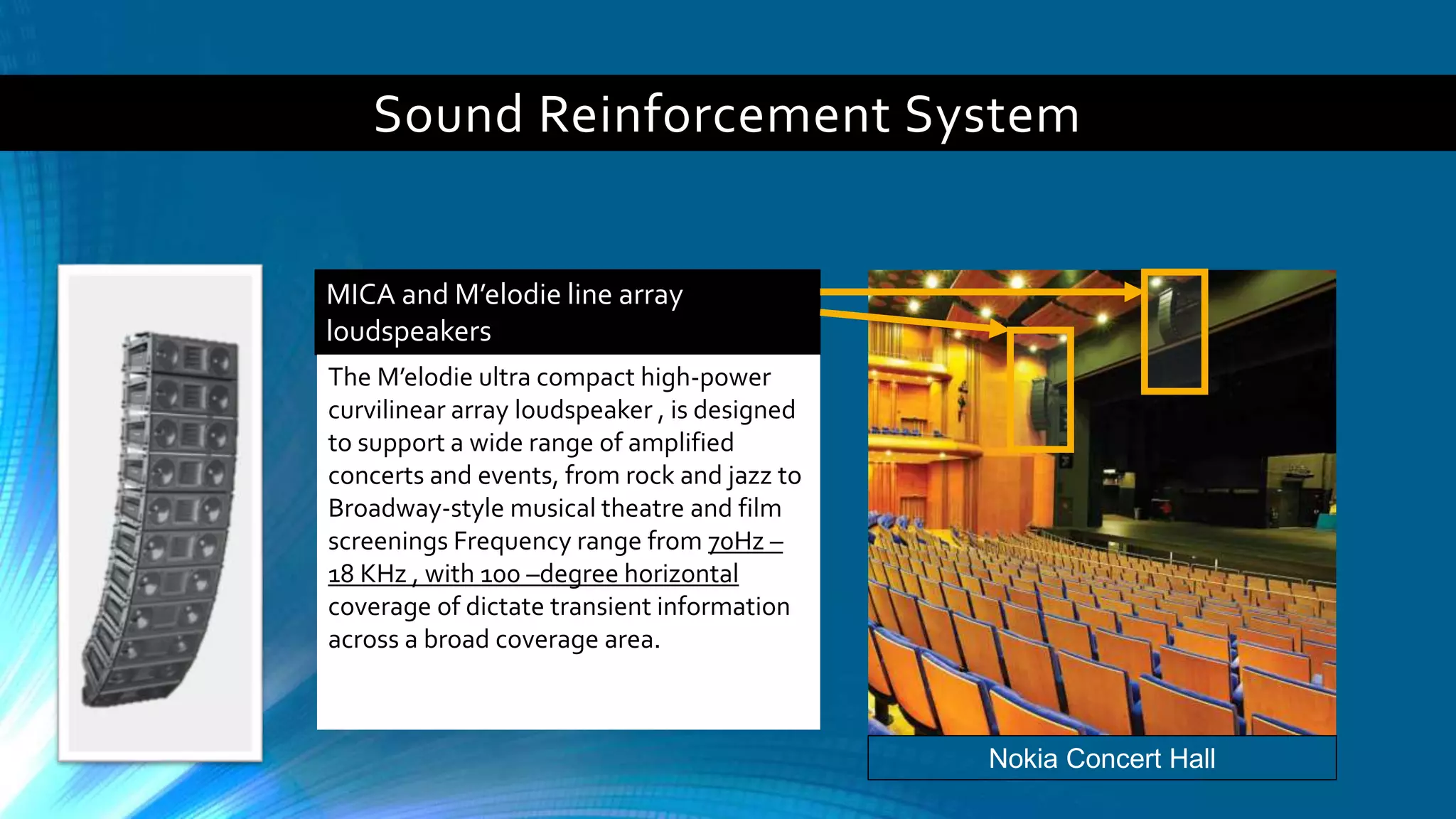
MICA and M’elodie line array
loudspeakers
The M’elodie ultra compact high-power
curvilinear array loudspeaker , is designed
to support a wide range of amplified
concerts and events, from rock and jazz to
Broadway-style musical theatre and film
screenings Frequency range from 70Hz –
18 KHz , with 100 –degree horizontal
coverage of dictate transient information
across a broad coverage area.
Nokia Concert Hall:
Primary Sound Reinforcement System
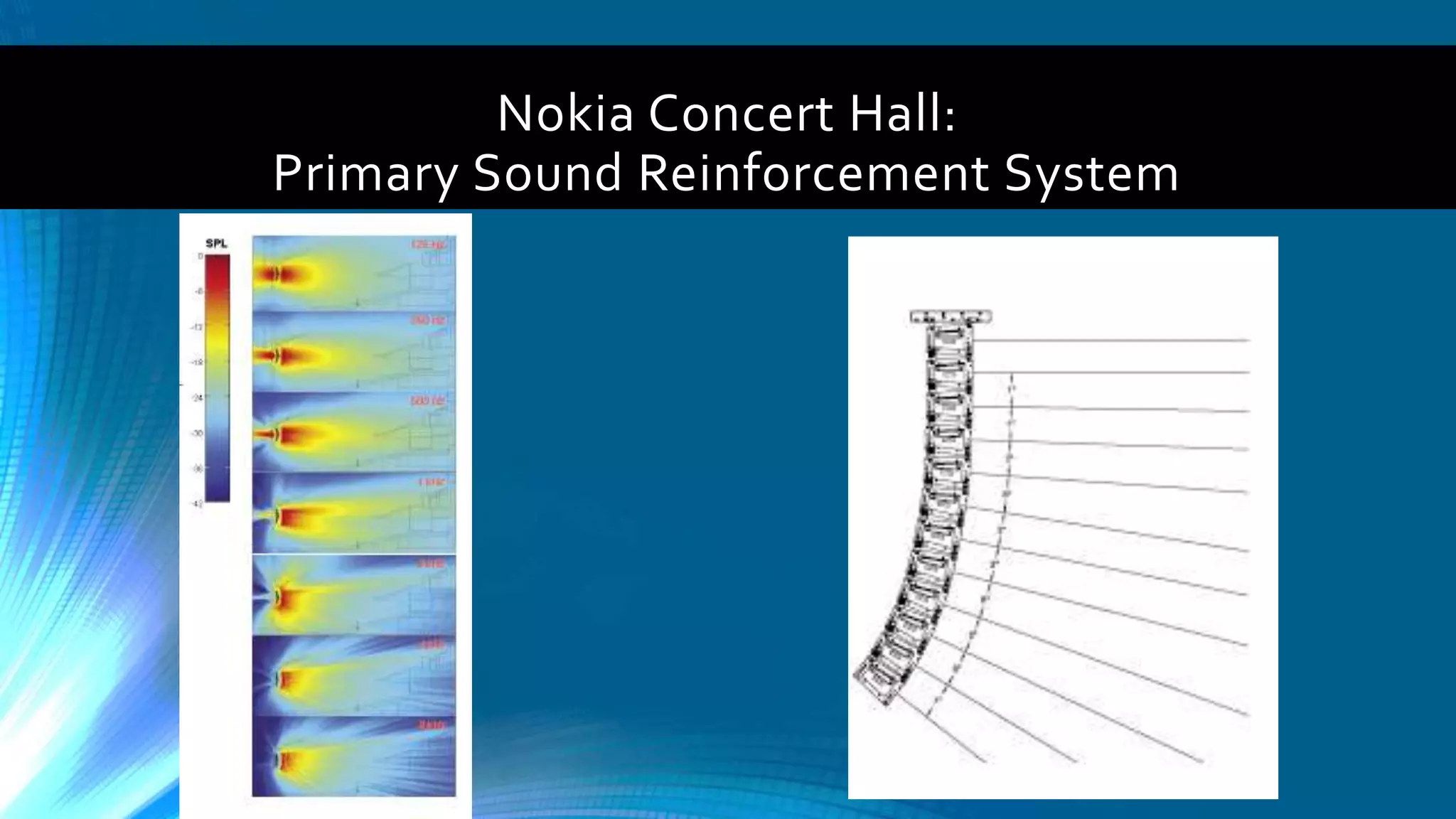
• The main sound reinforcement system is anchored by twin arrays of
ten each MICA line array loudspeakers to the left and right of the
proscenium, with an array of ten M’elodie line array loudspeakers
arcing over the center.The left and right arrays provide ample power
for reinforcing high-energy rock music while exhibiting very low
distortion.The center array of M’elodie loudspeakers also provides
ample headroom for high-decibel artists, but more importantly it
affords extraordinary clarity for both spoken word presentation and
the primary vocal channel in musical theatre productions.
Nokia Concert Hall:
Primary Sound Reinforcement System
The Solaris Kino Complex
Screen 1 of Solaris Kino Complex
Cinema System
• Introduced in 2009, Meyer Sound's EXP is the first cinema system
of its kind, created exclusively for the unique demands of cinema
applications from post-production to exhibition.
• The Solaris cinema center comprises seven Solaris Kino
commercial cinemas as well as two Artist art cinemas. Meyer
Sound EXP is installed in all nine movie exhibition halls to deliver
the Remarkable sonic power and fidelity to keep patrons returning
for an engaging and immersive movie experience.
• With greater headroom, lower distortion, flatter frequency and
phase response, and superior uniformity, Meyer Sound EXP
systems give audiences a movie-going experience that keeps them
coming back.
•
The Solaris Kino Complex
Expected resultsRequirementsChallenges
Enhanced audience
experience.
Maintain room-to-room
isolation.
Wide variance in room sizes.
Compatible with digital
cinema soundtracks.
Suited to both commercial
cinema and art films.
Consistent sound across all
room sizes.
The capacity of screens and number of sound devices
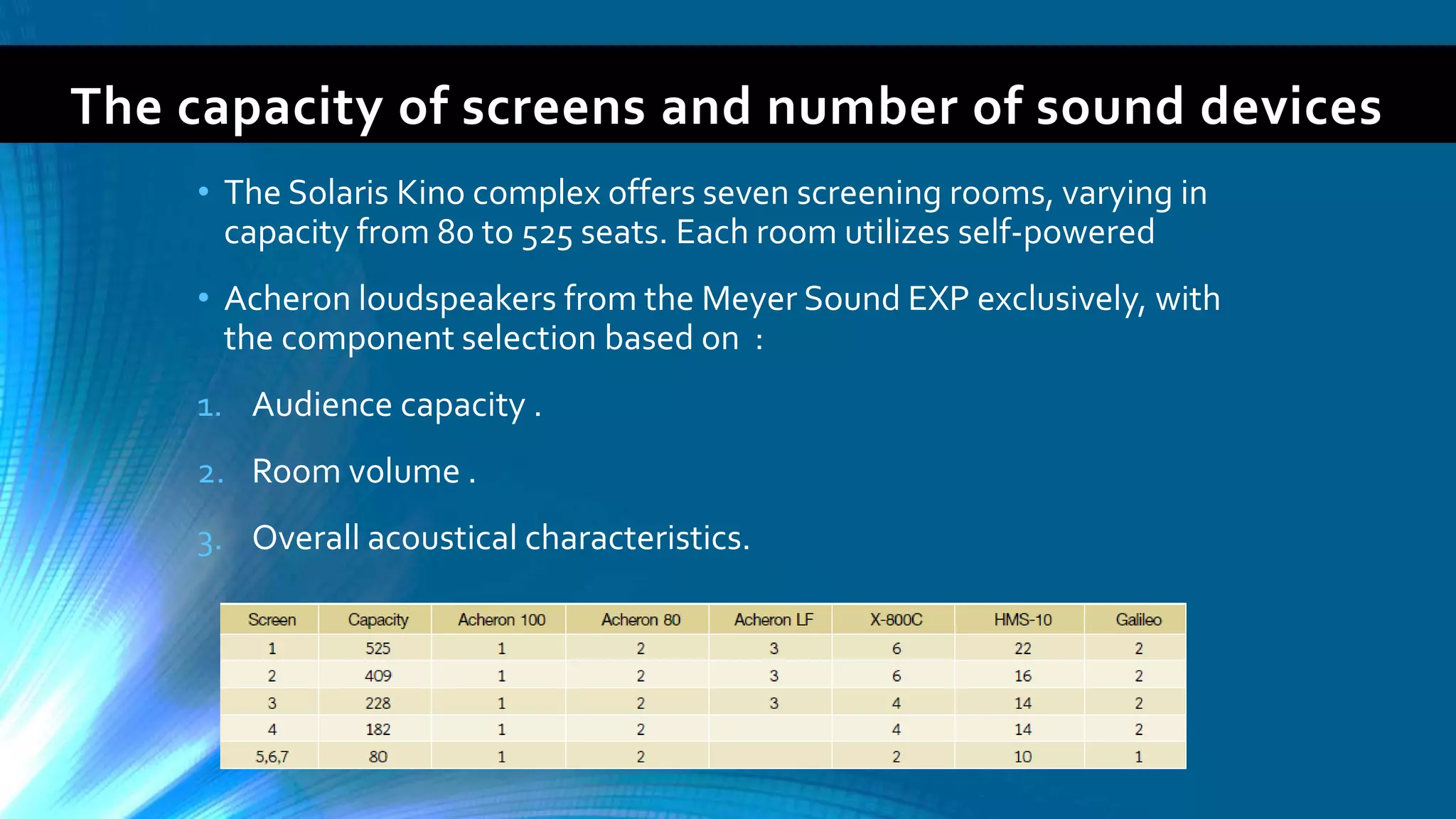
• The Solaris Kino complex offers seven screening rooms, varying in
capacity from 80 to 525 seats. Each room utilizes self-powered
• Acheron loudspeakers from the Meyer Sound EXP exclusively, with
the component selection based on :
1. Audience capacity .
2. Room volume .
3. Overall acoustical characteristics.
The Solaris Kino Complex
• The systems were configured using the acoustic predictions with
MAPP Online Cinema Acoustical Prediction.
• The THX-certified Acheron loudspeakers have ample power to carry
clear high-frequency sounds (above 580 Hz) to the far row seats of
the largest cinema.
• Of equal importance to power is the extraordinary linearity of the
self-powered Acheron design: the frequency response curve and
phase linearity remain constant, regardless of the output level.
Acheron at 4kHz; Section and center plan in MAPP Cinema
prediction
The Solaris Kino Complex
The lower frequencies demand the most, additional low frequency support is
provided in the larger rooms.
For the low frequency region between 37 Hz and 370 Hz, the Acheron LF is mounted
below the Acheron 80 or Acheron 100, and seamlessly blends with the response of
its full range unit.
Sound System
• This X-800C, a high-powered cinema subwoofer equipped with dual 18-inch
drivers and on-board amplification with 2480 watts of peak power output.
• All screening rooms utilize the self-powered HMS-10 two-way loudspeakers
for surround channel reproduction.
• The goals of selection :
1. Minimizes installation costs.
2. Makes each loudspeaker individually addressable .
3. Therefore ready to accommodate both current and future multichannel
formats.
Sound loudspeakers and sound system
PictureAdditional informationOutputFrequencyUsageType
horizontal horn :80 and 100
degree.
Vertical horn : 50 degree
1685 W (3370 Wpeak)580 HzOptimized for
installation behind
perforated screens
Acheron 80/Acheron 100
Screen Channel
Loudspeakers
----2250W (4500 W peak)37-3750 Hzdesigned for pairing with
Acheron 80 and 100
screen channel
loudspeakers in larger
rooms
that require additional
low frequency
headroom.
Acheron LF Screen
Channel Loudspeaker
----1240W (2480 W peak)20 Hz at leastoffers excellent phase
coherence for smooth
transitioning between
screen channel bass and
low-frequency effects.
X-800C High-Power
Cinema Subwoofer
symmetrical 80-
degree horn
128db Maximum peak55Hz to
18KHz
complement the
Acheron screen
channel
loudspeakers
HMS-10 Cinema
Surround
Loudspeaker
Loudspeakers selection based on
1. Headroom.
2. Acheron screen channel loudspeakers.
3. The line (includes surrounds, subwoofers, and electronics )
specifically designed for cinema applications.
The aim of selection
1. Clarity.
2. Power.
3. Transparency for cinema sound.
4. Minimize costs.
5. accommodate both current and future multichannel formats.
Nokia Concert Hall
Nokia Concert Hall
BenefitsRequirementsChallenges
Constellation can vary perceived
intimacy, loudness, clarity,
envelopment, and warmth
Intelligibility for meetings, dramatic
theatre
Event types range from corporate
presentations to choral concerts
Five settings for different usesClarity for musical performancesIntentionally “dry” physical
acoustics not ideal to some uses
Cinema surround sound enabled
through Constellation loudspeakers
Improved audibility for musicians
and performers
Stage house area has no physical
acoustic shell to help musicians hear
each other
Better interaction between
performersfostered by “virtual
orchestra shell”
Ability to easily change acoustical
characteristics for a variety of
events
Mechanical solutions unsuitable due
to cost,
difficult implementation, and
limited benefits
Expanded breadth of performable
repertoire
increases hall receipts
Integration of the active acoustic
system with theatre’s main sound
system
Longer reverberation times possible
with smaller room volume, reducing
construction costs, HVAC costs, and
energy consumption
Preservation of the hall’s aesthetics
Nokia Concert Hall
• 1,829-seat multipurpose
Concert Hall.
• The aim of design : host
the widest possible variety
of performances, special
events, and conferences .
Constellation System :
•189 Stella-4C loudspeakers
•22 Stella-8C loudspeakers
•17 UPM-1P loudspeakers
•12 UPJunior loudspeakers
•22 UP-4XP loudspeakers
•12 UMS-1P subwoofers
•56 OmnidirectionalConstellation microphones
•16 Cardioid Constellation microphones
•1 MS-Constellation processor
•6 MS-VRAS processors
•5 MS-Expansion processors
•1 Lemur touch-screen controller
A 21st Century Approach to Venue Acoustics
• In the past, performance spaces were acoustically designed for a
specific purpose: theatres were optimized for plays, concert halls for
music, lecture halls for speech, and cinemas for surround sound.
• But today’s venues must cater to a wide variety of performance types
and community events, and an acoustical signature ideal for one type
of performance can impair the enjoyment of another.
• This dilemma usually resulted in compromises, with acoustics
designed to be minimally acceptable for all performances, but ideal
for none.
Constellation System Configuration
• The incorporation of UMS-1P subwoofers enables Constellation to reproduce a
full bandwidth reverberation envelope.
• The frequency balance of electronically augmented reverberation faithfully
tracks the curve of the physical acoustics.
Constellation System Configuration
The Outcome
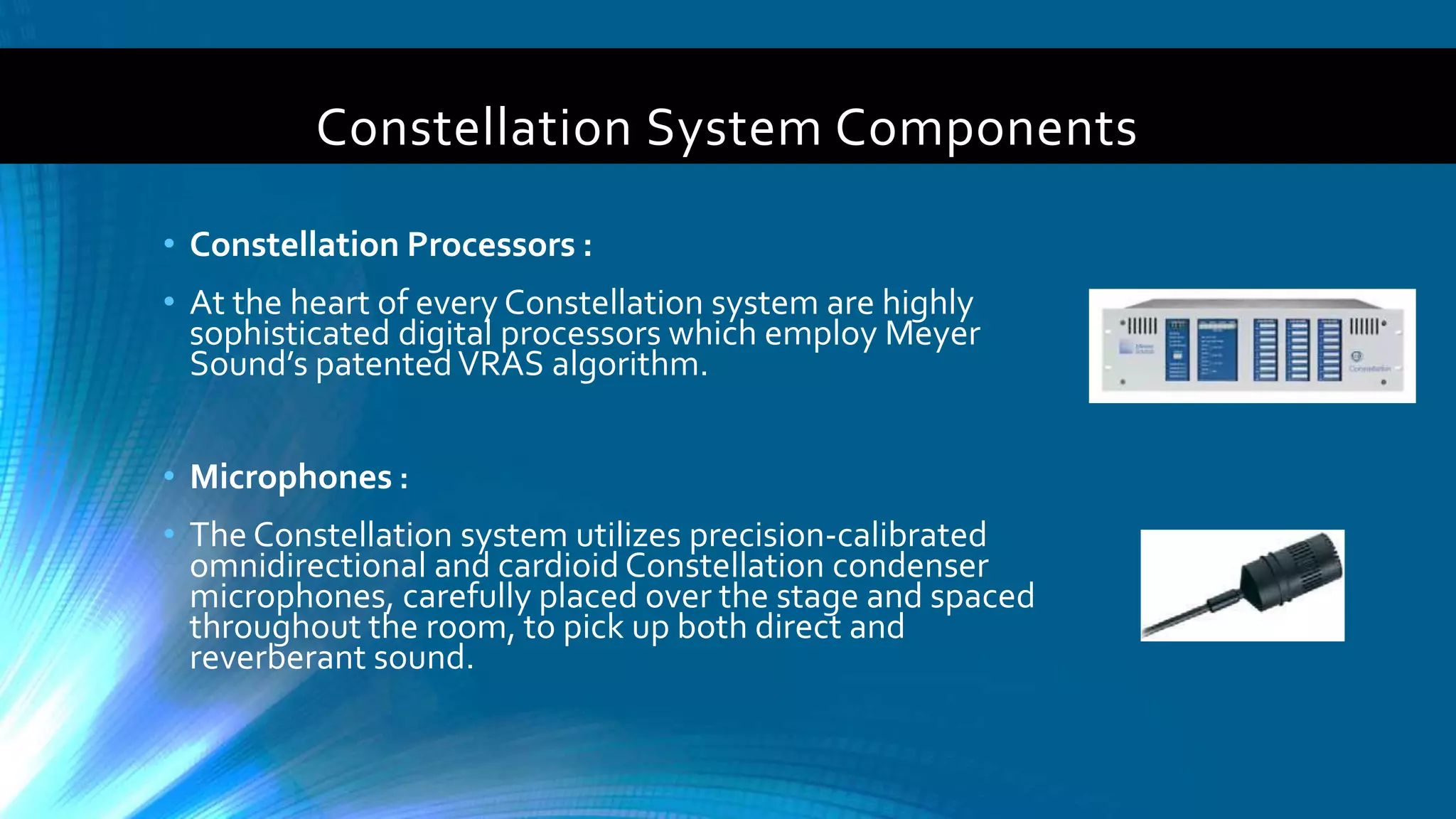
Constellation System Components
• Constellation Processors :
• At the heart of every Constellation system are highly
sophisticated digital processors which employ Meyer
Sound’s patentedVRAS algorithm.
• Microphones :
• The Constellation system utilizes precision-calibrated
omnidirectional and cardioid Constellation condenser
microphones, carefully placed over the stage and spaced
throughout the room, to pick up both direct and
reverberant sound.
Constellate ion System Components
• Loudspeakers :
• Effectively reproducing the
characteristics of a natural acoustical
environment requires loudspeakers of
extraordinary linearity and consistency.
• Lemur touch-screen controller :
• A Lemur touch-screen controller serves
as the control interface for selecting the
appropriate setting from the pre-
programmed Constellation presets.
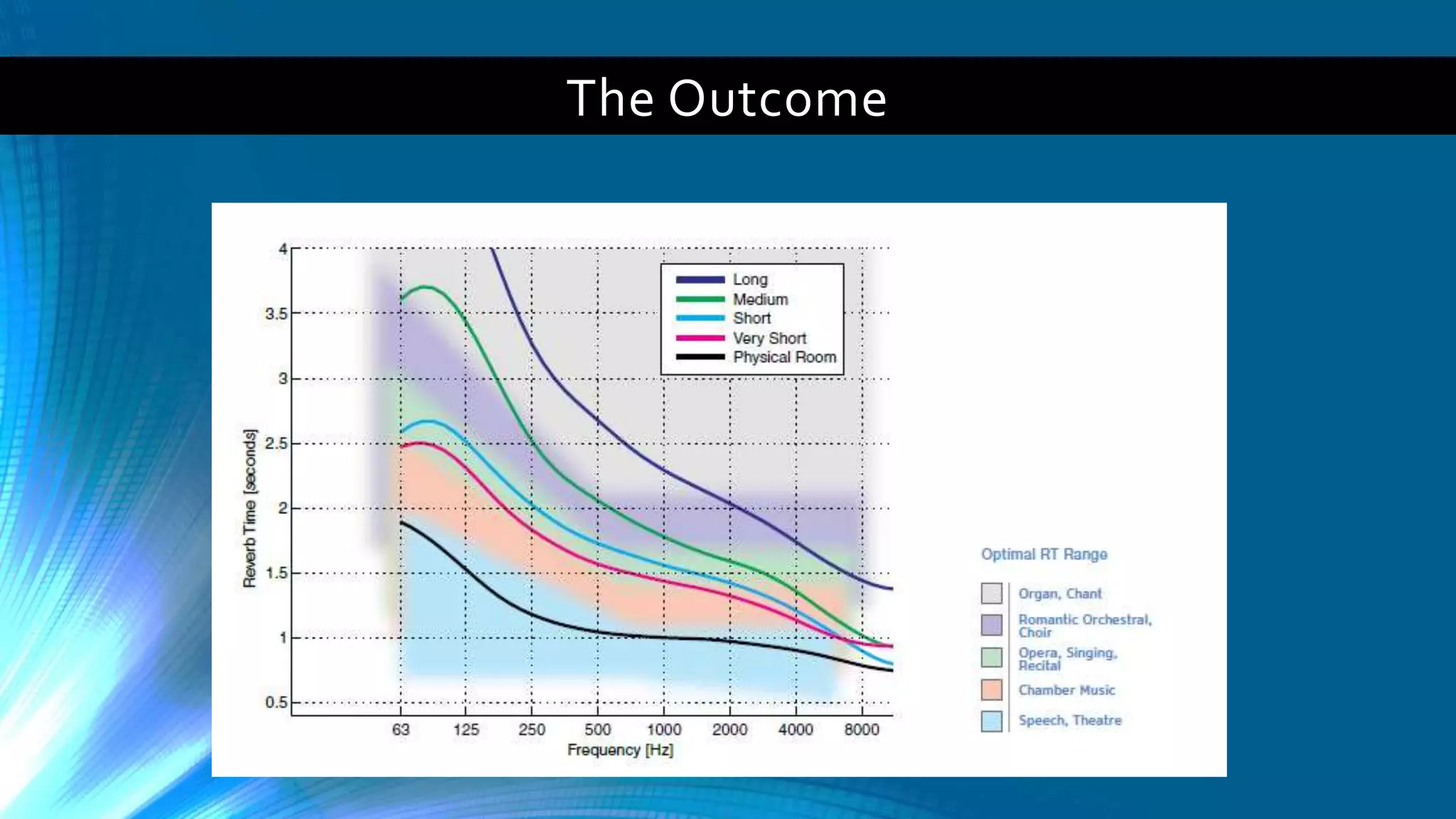
The Outcome
• Optimized Acoustics for Each Performance :
• Five Constellation presets are programmed by the Constellation
design team to vary in their reverberation times and early reflection
content.
• Physical acoustics (off) :This selection is optimum for louder
amplified music, and for most spoken word applications when the PA
system is used for reinforcement.
• Very Short : This preset is appropriate for chamber music
performances, and works well for musical theatre applications. With
emphasis on early reflections, a very short reverb time also provides
theVoice Lift feature: spoken word can be heard throughout the hall
without use of the main PA system.
The Outcome
• Short : This setting also works with chamber music, and applies well
to solo vocal and instrumental performances, small ensembles, and
opera.
• Medium : Romantic orchestral and choral music are best served by
the longer reverberation times and fuller low frequency response of
this setting.
• Long : This acoustical characteristic expands orchestral music for a
“Wagnerian” effect, with deep, sonorous low frequencies particularly
appropriate for pipe organ and early music chants.
Adaptable Features
• Constellation technology allows implementation of a variety of acoustical
effects, both in the audience seating area and on stage.
• Some features require additional loudspeakers, microphones or processors,
while others are implemented in the software presets.
• Of course, not all features are necessary or appropriate for every venue.
• Ensemble :
• Constellation Ensemble provides an electronic version of the traditional
orchestra shell, improving the listening experience — and often the
performances — of musicians on stage. Because it is not a fixed shape and
does not require any setup, Ensemble provides increased flexibility and
reduced labor costs.
Adaptable Features
• VoiceLift :
• Constellation’sVoiceLift feature significantly boosts intelligibility for
events where the audience needs to understand presenters clearly.
By augmenting the early reflections that bring presence and
immediacy to the spoken word,VoiceLift ensures that every word is
heard clearly without the use of a sound reinforcement system.
• Crowd Enhancement :
• Constellation allows everybody at an event — whether a church
congregation or fans at a sporting event — to feel fully engaged in
their surroundings. In church services, the reverberant field created
by Constellation reinforces congregational singing, moving
worshippers to a greater sense of active participation.
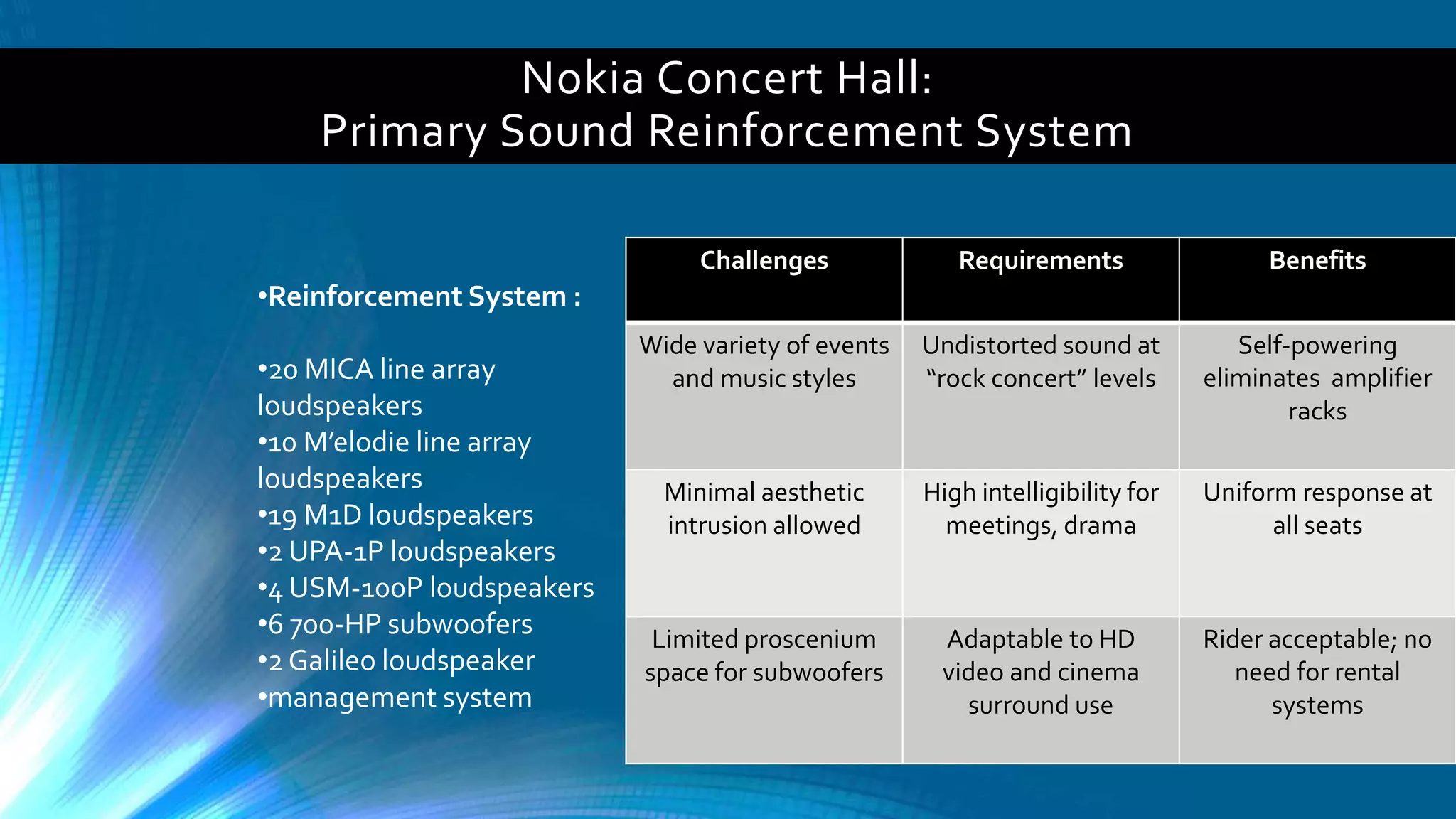
Nokia Concert Hall:
Primary Sound Reinforcement System
BenefitsRequirementsChallenges
Self-powering
eliminates amplifier
racks
Undistorted sound at
“rock concert” levels
Wide variety of events
and music styles
Uniform response at
all seats
High intelligibility for
meetings, drama
Minimal aesthetic
intrusion allowed
Rider acceptable; no
need for rental
systems
Adaptable to HD
video and cinema
surround use
Limited proscenium
space for subwoofers
•Reinforcement System :
•20 MICA line array
loudspeakers
•10 M’elodie line array
loudspeakers
•19 M1D loudspeakers
•2 UPA-1P loudspeakers
•4 USM-100P loudspeakers
•6 700-HP subwoofers
•2 Galileo loudspeaker
•management system
Nokia Concert Hall:
Primary Sound Reinforcement System
• Signal delay, equalization,
matrixing, and distribution are
carried out by a Galileo loudspeaker
management system with two
Galileo 616 processors, with setup
and control via the companion
Compass control software. All
loudspeakers in the system are self-
powered, and are interconnected,
monitored, and controlled with
Meyer Sound’s RMS remote
monitoring system.
List of references
• Mayer sound devices Datasheets (EXP and M series ).
1. Acheron 80/Acheron 100 Loudspeaker .
2. Acheron LF Loudspeaker .
3. X-800 Loudspeaker .
4. HMS-10 Cinema Surround Loudspeaker.
5. M’elodie ultra compact high-power curvilinear array loudspeaker
• Meyer Sound Laboratories, Inc. (CASE STUDY :The Solaris Cultural
and Leisure Centre ).

Case study-29 nov

  • 1.
    CASE STUDY :TheSolaris Cultural and Leisure Center. Location: Tallinn, Estonia. Year of project : 2009 . Owner : Solaris Keskus AS. SUPERVISED BY : DR.ESSAM TARRAD SECTION : 1 ( TEUSDAY ) DONE BY : YAZID HAMODAH (1300703006) AND MOHAMMAD ALHANBALI (1300703021).
  • 2.
    List of contents 1.About the project. 2. The components of project. 3. Sound Reinforcement System. 4. The Solaris Kino Complex. 5. Nokia Concert Hall. 6. List of references.
  • 3.
    About the project •The Solaris Cultural and Leisure Centre is a new hub for the performing arts and entertainment in the heart of Estonia’s capital city ofTallinn. • Among with the new developments now revitalizing the city’s historic core is the Solaris Centre, a multifunctional complex with its name inspired by gleaming glass walls and roof sections that capture the sun’s energy for light and heat.
  • 4.
    The components ofproject 1. Solaris Centre encompasses the 1,829-seat Concert hall (Nokia Concert Hall). 2. The Solaris Kino (commercial cinema multiplex) 3. TheTallinn Dance Academy. 4. Book store. 5. Conference facilities. 6. Restaurants and Shops.
  • 5.
    Sound Reinforcement System NokiaConcert Hall MICA and M’elodie line array loudspeakers The M’elodie ultra compact high-power curvilinear array loudspeaker , is designed to support a wide range of amplified concerts and events, from rock and jazz to Broadway-style musical theatre and film screenings Frequency range from 70Hz – 18 KHz , with 100 –degree horizontal coverage of dictate transient information across a broad coverage area.
  • 6.
    Nokia Concert Hall: PrimarySound Reinforcement System • The main sound reinforcement system is anchored by twin arrays of ten each MICA line array loudspeakers to the left and right of the proscenium, with an array of ten M’elodie line array loudspeakers arcing over the center.The left and right arrays provide ample power for reinforcing high-energy rock music while exhibiting very low distortion.The center array of M’elodie loudspeakers also provides ample headroom for high-decibel artists, but more importantly it affords extraordinary clarity for both spoken word presentation and the primary vocal channel in musical theatre productions.
  • 7.
    Nokia Concert Hall: PrimarySound Reinforcement System
  • 8.
    The Solaris KinoComplex Screen 1 of Solaris Kino Complex
  • 9.
    Cinema System • Introducedin 2009, Meyer Sound's EXP is the first cinema system of its kind, created exclusively for the unique demands of cinema applications from post-production to exhibition. • The Solaris cinema center comprises seven Solaris Kino commercial cinemas as well as two Artist art cinemas. Meyer Sound EXP is installed in all nine movie exhibition halls to deliver the Remarkable sonic power and fidelity to keep patrons returning for an engaging and immersive movie experience. • With greater headroom, lower distortion, flatter frequency and phase response, and superior uniformity, Meyer Sound EXP systems give audiences a movie-going experience that keeps them coming back. •
  • 10.
    The Solaris KinoComplex Expected resultsRequirementsChallenges Enhanced audience experience. Maintain room-to-room isolation. Wide variance in room sizes. Compatible with digital cinema soundtracks. Suited to both commercial cinema and art films. Consistent sound across all room sizes.
  • 11.
    The capacity ofscreens and number of sound devices • The Solaris Kino complex offers seven screening rooms, varying in capacity from 80 to 525 seats. Each room utilizes self-powered • Acheron loudspeakers from the Meyer Sound EXP exclusively, with the component selection based on : 1. Audience capacity . 2. Room volume . 3. Overall acoustical characteristics.
  • 12.
    The Solaris KinoComplex • The systems were configured using the acoustic predictions with MAPP Online Cinema Acoustical Prediction. • The THX-certified Acheron loudspeakers have ample power to carry clear high-frequency sounds (above 580 Hz) to the far row seats of the largest cinema. • Of equal importance to power is the extraordinary linearity of the self-powered Acheron design: the frequency response curve and phase linearity remain constant, regardless of the output level.
  • 13.
    Acheron at 4kHz;Section and center plan in MAPP Cinema prediction
  • 14.
    The Solaris KinoComplex The lower frequencies demand the most, additional low frequency support is provided in the larger rooms. For the low frequency region between 37 Hz and 370 Hz, the Acheron LF is mounted below the Acheron 80 or Acheron 100, and seamlessly blends with the response of its full range unit.
  • 15.
    Sound System • ThisX-800C, a high-powered cinema subwoofer equipped with dual 18-inch drivers and on-board amplification with 2480 watts of peak power output. • All screening rooms utilize the self-powered HMS-10 two-way loudspeakers for surround channel reproduction. • The goals of selection : 1. Minimizes installation costs. 2. Makes each loudspeaker individually addressable . 3. Therefore ready to accommodate both current and future multichannel formats.
  • 16.
    Sound loudspeakers andsound system PictureAdditional informationOutputFrequencyUsageType horizontal horn :80 and 100 degree. Vertical horn : 50 degree 1685 W (3370 Wpeak)580 HzOptimized for installation behind perforated screens Acheron 80/Acheron 100 Screen Channel Loudspeakers ----2250W (4500 W peak)37-3750 Hzdesigned for pairing with Acheron 80 and 100 screen channel loudspeakers in larger rooms that require additional low frequency headroom. Acheron LF Screen Channel Loudspeaker ----1240W (2480 W peak)20 Hz at leastoffers excellent phase coherence for smooth transitioning between screen channel bass and low-frequency effects. X-800C High-Power Cinema Subwoofer symmetrical 80- degree horn 128db Maximum peak55Hz to 18KHz complement the Acheron screen channel loudspeakers HMS-10 Cinema Surround Loudspeaker
  • 17.
    Loudspeakers selection basedon 1. Headroom. 2. Acheron screen channel loudspeakers. 3. The line (includes surrounds, subwoofers, and electronics ) specifically designed for cinema applications. The aim of selection 1. Clarity. 2. Power. 3. Transparency for cinema sound. 4. Minimize costs. 5. accommodate both current and future multichannel formats.
  • 18.
  • 19.
    Nokia Concert Hall BenefitsRequirementsChallenges Constellationcan vary perceived intimacy, loudness, clarity, envelopment, and warmth Intelligibility for meetings, dramatic theatre Event types range from corporate presentations to choral concerts Five settings for different usesClarity for musical performancesIntentionally “dry” physical acoustics not ideal to some uses Cinema surround sound enabled through Constellation loudspeakers Improved audibility for musicians and performers Stage house area has no physical acoustic shell to help musicians hear each other Better interaction between performersfostered by “virtual orchestra shell” Ability to easily change acoustical characteristics for a variety of events Mechanical solutions unsuitable due to cost, difficult implementation, and limited benefits Expanded breadth of performable repertoire increases hall receipts Integration of the active acoustic system with theatre’s main sound system Longer reverberation times possible with smaller room volume, reducing construction costs, HVAC costs, and energy consumption Preservation of the hall’s aesthetics
  • 20.
    Nokia Concert Hall •1,829-seat multipurpose Concert Hall. • The aim of design : host the widest possible variety of performances, special events, and conferences . Constellation System : •189 Stella-4C loudspeakers •22 Stella-8C loudspeakers •17 UPM-1P loudspeakers •12 UPJunior loudspeakers •22 UP-4XP loudspeakers •12 UMS-1P subwoofers •56 OmnidirectionalConstellation microphones •16 Cardioid Constellation microphones •1 MS-Constellation processor •6 MS-VRAS processors •5 MS-Expansion processors •1 Lemur touch-screen controller
  • 21.
    A 21st CenturyApproach to Venue Acoustics • In the past, performance spaces were acoustically designed for a specific purpose: theatres were optimized for plays, concert halls for music, lecture halls for speech, and cinemas for surround sound. • But today’s venues must cater to a wide variety of performance types and community events, and an acoustical signature ideal for one type of performance can impair the enjoyment of another. • This dilemma usually resulted in compromises, with acoustics designed to be minimally acceptable for all performances, but ideal for none.
  • 22.
  • 23.
    • The incorporationof UMS-1P subwoofers enables Constellation to reproduce a full bandwidth reverberation envelope. • The frequency balance of electronically augmented reverberation faithfully tracks the curve of the physical acoustics. Constellation System Configuration
  • 24.
  • 25.
    Constellation System Components •Constellation Processors : • At the heart of every Constellation system are highly sophisticated digital processors which employ Meyer Sound’s patentedVRAS algorithm. • Microphones : • The Constellation system utilizes precision-calibrated omnidirectional and cardioid Constellation condenser microphones, carefully placed over the stage and spaced throughout the room, to pick up both direct and reverberant sound.
  • 26.
    Constellate ion SystemComponents • Loudspeakers : • Effectively reproducing the characteristics of a natural acoustical environment requires loudspeakers of extraordinary linearity and consistency. • Lemur touch-screen controller : • A Lemur touch-screen controller serves as the control interface for selecting the appropriate setting from the pre- programmed Constellation presets.
  • 27.
    The Outcome • OptimizedAcoustics for Each Performance : • Five Constellation presets are programmed by the Constellation design team to vary in their reverberation times and early reflection content. • Physical acoustics (off) :This selection is optimum for louder amplified music, and for most spoken word applications when the PA system is used for reinforcement. • Very Short : This preset is appropriate for chamber music performances, and works well for musical theatre applications. With emphasis on early reflections, a very short reverb time also provides theVoice Lift feature: spoken word can be heard throughout the hall without use of the main PA system.
  • 28.
    The Outcome • Short: This setting also works with chamber music, and applies well to solo vocal and instrumental performances, small ensembles, and opera. • Medium : Romantic orchestral and choral music are best served by the longer reverberation times and fuller low frequency response of this setting. • Long : This acoustical characteristic expands orchestral music for a “Wagnerian” effect, with deep, sonorous low frequencies particularly appropriate for pipe organ and early music chants.
  • 29.
    Adaptable Features • Constellationtechnology allows implementation of a variety of acoustical effects, both in the audience seating area and on stage. • Some features require additional loudspeakers, microphones or processors, while others are implemented in the software presets. • Of course, not all features are necessary or appropriate for every venue. • Ensemble : • Constellation Ensemble provides an electronic version of the traditional orchestra shell, improving the listening experience — and often the performances — of musicians on stage. Because it is not a fixed shape and does not require any setup, Ensemble provides increased flexibility and reduced labor costs.
  • 30.
    Adaptable Features • VoiceLift: • Constellation’sVoiceLift feature significantly boosts intelligibility for events where the audience needs to understand presenters clearly. By augmenting the early reflections that bring presence and immediacy to the spoken word,VoiceLift ensures that every word is heard clearly without the use of a sound reinforcement system. • Crowd Enhancement : • Constellation allows everybody at an event — whether a church congregation or fans at a sporting event — to feel fully engaged in their surroundings. In church services, the reverberant field created by Constellation reinforces congregational singing, moving worshippers to a greater sense of active participation.
  • 31.
    Nokia Concert Hall: PrimarySound Reinforcement System BenefitsRequirementsChallenges Self-powering eliminates amplifier racks Undistorted sound at “rock concert” levels Wide variety of events and music styles Uniform response at all seats High intelligibility for meetings, drama Minimal aesthetic intrusion allowed Rider acceptable; no need for rental systems Adaptable to HD video and cinema surround use Limited proscenium space for subwoofers •Reinforcement System : •20 MICA line array loudspeakers •10 M’elodie line array loudspeakers •19 M1D loudspeakers •2 UPA-1P loudspeakers •4 USM-100P loudspeakers •6 700-HP subwoofers •2 Galileo loudspeaker •management system
  • 32.
    Nokia Concert Hall: PrimarySound Reinforcement System • Signal delay, equalization, matrixing, and distribution are carried out by a Galileo loudspeaker management system with two Galileo 616 processors, with setup and control via the companion Compass control software. All loudspeakers in the system are self- powered, and are interconnected, monitored, and controlled with Meyer Sound’s RMS remote monitoring system.
  • 33.
    List of references •Mayer sound devices Datasheets (EXP and M series ). 1. Acheron 80/Acheron 100 Loudspeaker . 2. Acheron LF Loudspeaker . 3. X-800 Loudspeaker . 4. HMS-10 Cinema Surround Loudspeaker. 5. M’elodie ultra compact high-power curvilinear array loudspeaker • Meyer Sound Laboratories, Inc. (CASE STUDY :The Solaris Cultural and Leisure Centre ).