EUREE 306
Electrical Measurements
K Manohar
Assistant Professor
Dept. of EEE
GIT.GITAM University
Visakhapatnam -530 043
EUREE 306 – Electrical Measurements
1. Indicating Instruments :
Principle – different types of control and damping arrangements in indicating instruments– Permanent
Magnet Moving Coil – Moving Iron – Electrostatic and dynamometer type meters – Ammeters and
Voltmeters – Errors in indicating instruments – Rectifier type meter – factors influencing its performance
– extension of instrument range – shunts for ammeters – voltmeter multipliers.
2. Watt meters, energy meters and other measuring instruments:
Dynamometer type wattmeter – Errors and compensation-measurement of 1-f power by 3voltmeter and
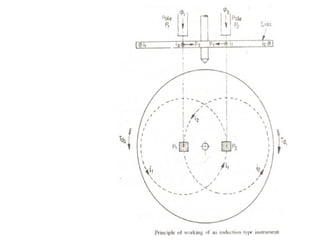
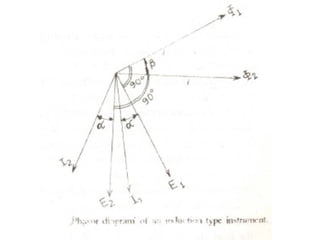
3 ammeter & 3-f power by two wattmeter method – Single phase Energy meters – single phase
induction type energy meter – errors and compensation– calibration of wattmeter and energy meter –
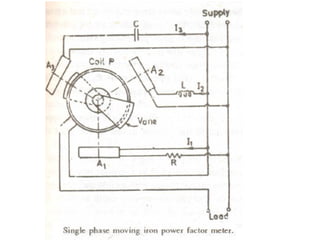
frequency meters; Mechanical& Electrical resonance type– power factor meters; Dynamometer type,
Moving iron type.
3. Bridges:
Wheatstone bridge – Kelvin double bridge – Megger – Measurement of inductance using Maxwell, hays
bridge and Anderson bridges measurement of capacitance using Schering Bridge.
4. Potentiometers:
General principle –Vernier dial principle standardization – ac potentiometers – coordinate and polar
types – application of dc and ac potentiometers.
5. Instrument transformers:
Introduction - Current transformer: phasor diagram – ratio and phase angle error –Testing. Potential
Transformer; Phasor Diagram – Ratio and Phase angle error- Testing.
UNIT 1: INDICATING INSTRUMENTS
Principle – different types of control and damping arrangements in
indicating instruments– Permanent Magnet Moving Coil – Moving Iron –
Electrostatic and dynamometer type meters – Ammeters and Voltmeters
– Errors in indicating instruments – Rectifier type meter – factors
influencing its performance – extension of instrument range – shunts for
ammeters – voltmeter multipliers.
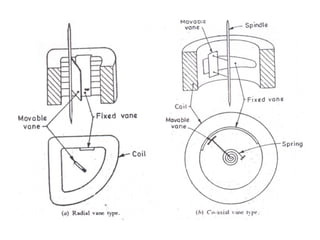
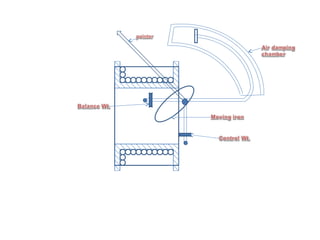
Moving Iron Type Instruments
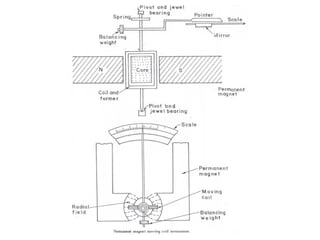
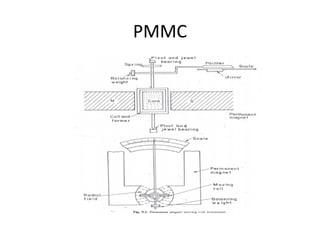
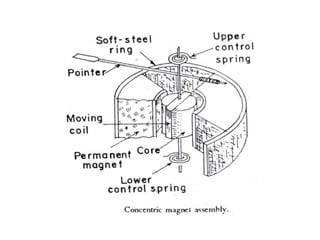
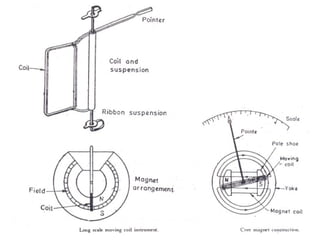
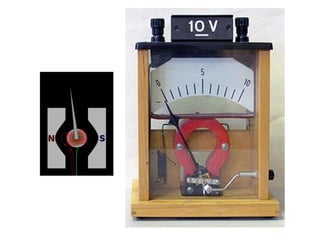
PMMC
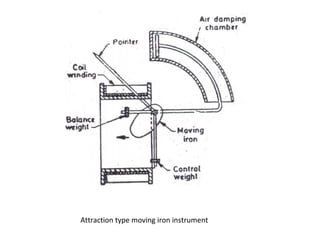
Attraction type moving iron instrument
UNIT :3 Watt meters, energy meters and other measuring instruments:
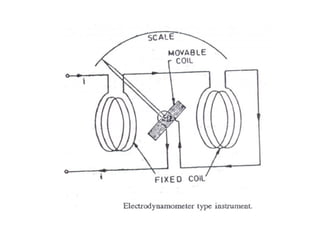
Dynamometer type wattmeter – Errors and compensation-
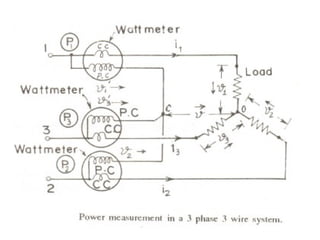
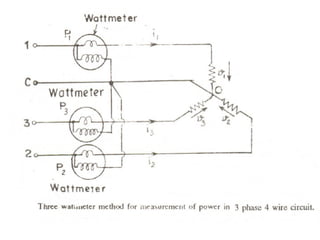
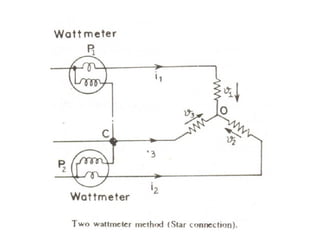
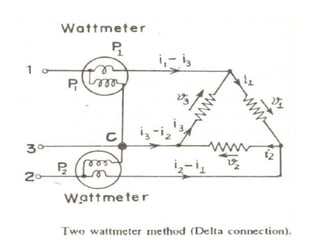
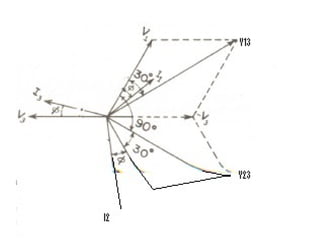
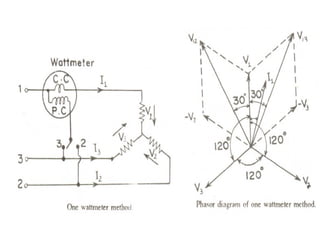
measurement of 1-f power by 3voltmeter and 3 ammeter & 3-f power
by two wattmeter method – Single phase Energy meters – single
phase induction type energy meter – errors and compensation–
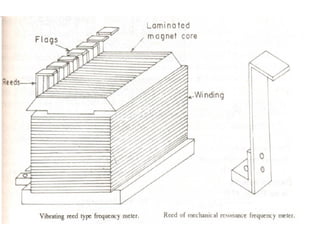
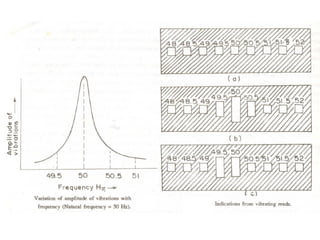
calibration of wattmeter and energy meter – frequency meters;
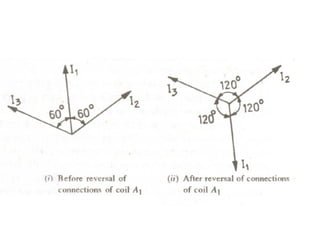
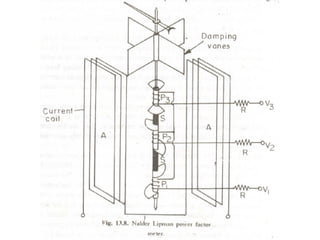
Mechanical& Electrical resonance type– power factor meters;
Dynamometer type, Moving iron type.
Moving Iron Type Instruments
POWER MEASUREMENT
Ballistic Galvanometer
And experiment of finding the fixed
capacity of condenser and also
mutual inductance of two coils.
Trisha Banerjee @
2010
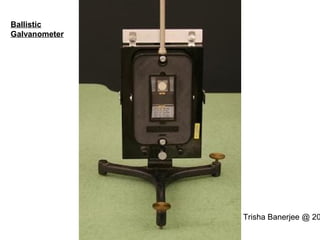
Ballistic
Galvanometer
Trisha Banerjee @ 20
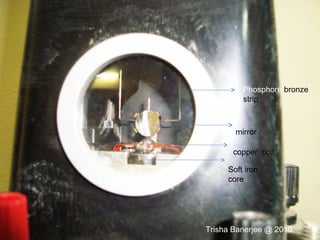
Phosphore bronze
strip
mirror
copper coil
Soft iron
core
Trisha Banerjee @ 2010
Brief construction :-
The ballistic galvanometer is usually employed to measure the quantity of charge flowing in a given circuit
due to transient current.
it consists of a coil of copper wire wound on a non conducting frame which is suspended by a phosphor bronze strip
between the poles of strong permanent magnet horse – shoe shape magnet . In order to increase the magnetic flux
in the gap , the cylindrical soft iron – core is placed with in the coil. The pole pieces of the magnet are cylindrical
concave in shape so that the magnetic field is radial in the narrow annular gap and is also perpendicular to the coil
surface . The whole apparatus is covered in a shell to avoid disturbance from outside .Three leveling screws are
provided below the base of the galvanometer . The deflection of the coil is measured by lamp and scale arrangement .
Note:- When large damping is present , the motion of the coil is non oscillatory and the moving coil galvanometer
become dead beat . The construction and working of such a galvanometer is different from moving coil galvanometer.
Trisha Banerjee @ 2010
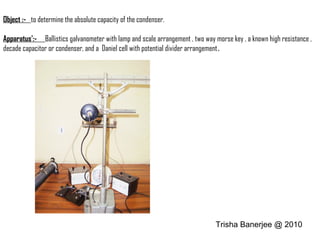
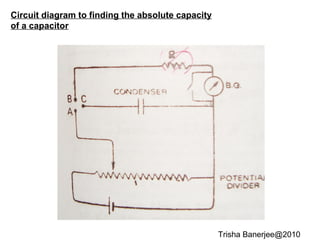
Object :- to determine the absolute capacity of the condenser.
Apparatus':- Ballistics galvanometer with lamp and scale arrangement , two way morse key , a known high resistance ,
decade capacitor or condenser, and a Daniel cell with potential divider arrangement.
Trisha Banerjee @ 2010
Trisha Banerjee@2010
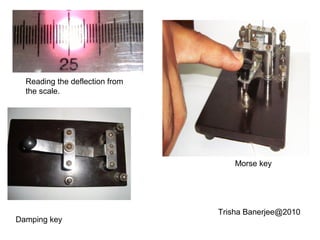
Morse key
Reading the deflection from
the scale.
Damping key
Morse key:-
It consists of a metal lever BCA and three terminals ABC fixed on a wooden base.
A and B are connected to the metal studs just below the end a and B of the metal lever while C is connected to the metal
support at the middle of the metal lever, connections between A and C is made on the releasing , the connections between
A and C is made while A is cut off.
Trisha Banerjee@2010
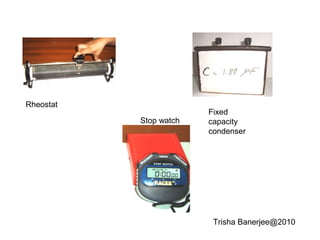
Fixed
capacity
condenser
Rheostat
Stop watch
Trisha Banerjee@2010
Circuit diagram to finding the absolute capacity
of a capacitor
Trisha Banerjee@2010
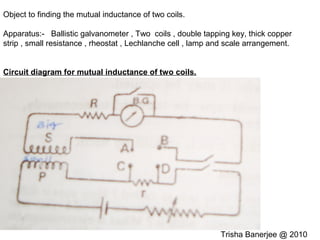
Object to finding the mutual inductance of two coils.
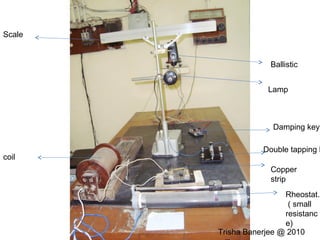
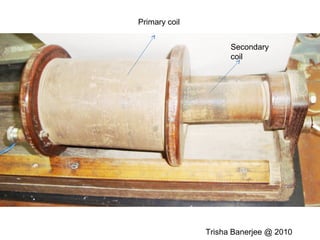
Apparatus:- Ballistic galvanometer , Two coils , double tapping key, thick copper
strip , small resistance , rheostat , Lechlanche cell , lamp and scale arrangement.
Circuit diagram for mutual inductance of two coils.
Trisha Banerjee @ 2010
Scale
Ballistic
Lamp
Damping key
Double tapping k
Copper
strip
Rheostat.
( small
resistanc
e)
coil
Trisha Banerjee @ 2010
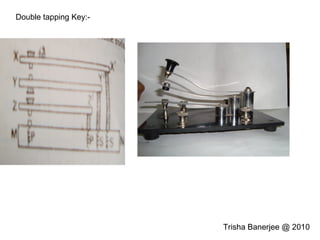
Double tapping Key:-
Trisha Banerjee @ 2010
Double Tapping Key:-
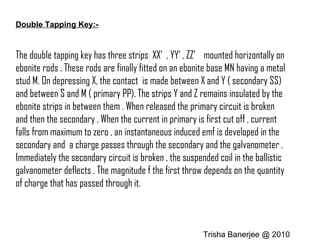
The double tapping key has three strips XX’ , YY’ , ZZ’ mounted horizontally on
ebonite rods . These rods are finally fitted on an ebonite base MN having a metal
stud M. On depressing X, the contact is made between X and Y ( secondary SS)
and between S and M ( primary PP). The strips Y and Z remains insulated by the
ebonite strips in between them . When released the primary circuit is broken
and then the secondary . When the current in primary is first cut off , current
falls from maximum to zero , an instantaneous induced emf is developed in the
secondary and a charge passes through the secondary and the galvanometer .
Immediately the secondary circuit is broken , the suspended coil in the ballistic
galvanometer deflects . The magnitude f the first throw depends on the quantity
of charge that has passed through it.
Trisha Banerjee @ 2010
Primary coil
Secondary
coil
Trisha Banerjee @ 2010
CALIBRATION OF WATTMETER AND ENERGY METER
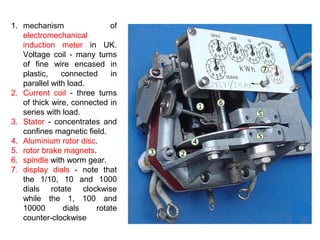
1. mechanism of
electromechanical
induction meter in UK.
Voltage coil - many turns
of fine wire encased in
plastic, connected in
parallel with load.
2. Current coil - three turns
of thick wire, connected in
series with load.
3. Stator - concentrates and
confines magnetic field.
4. Aluminium rotor disc.
5. rotor brake magnets.
6. spindle with worm gear.
7. display dials - note that
the 1/10, 10 and 1000
dials rotate clockwise
while the 1, 100 and
10000 dials rotate
counter-clockwise
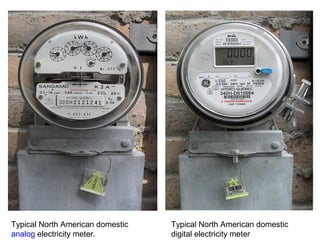
Typical North American domestic
analog electricity meter.
Typical North American domestic
digital electricity meter
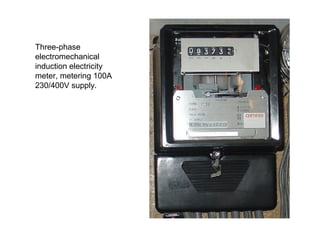
Three-phase
electromechanical
induction electricity
meter, metering 100A
230/400V supply.
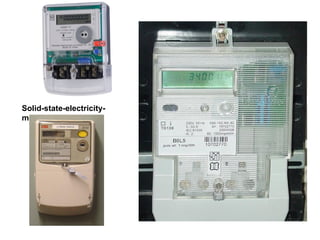
Solid-state-electricity-
meter
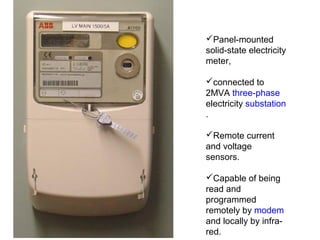
Panel-mounted
solid-state electricity
meter,
connected to
2MVA three-phase
electricity substation
.
Remote current
and voltage
sensors.
Capable of being
read and
programmed
remotely by modem
and locally by infra-
red.
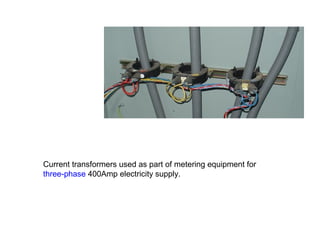
Current transformers used as part of metering equipment for
three-phase 400Amp electricity supply.
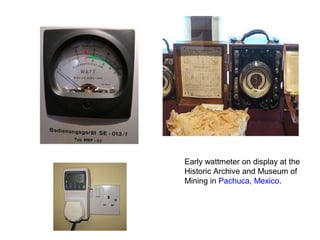
Early wattmeter on display at the
Historic Archive and Museum of
Mining in Pachuca, Mexico.
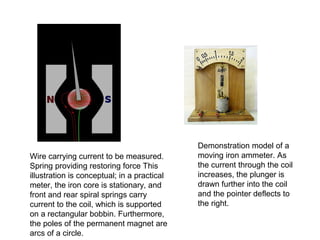
Demonstration model of a
moving iron ammeter. As
the current through the coil
increases, the plunger is
drawn further into the coil
and the pointer deflects to
the right.
Wire carrying current to be measured.
Spring providing restoring force This
illustration is conceptual; in a practical
meter, the iron core is stationary, and
front and rear spiral springs carry
current to the coil, which is supported
on a rectangular bobbin. Furthermore,
the poles of the permanent magnet are
arcs of a circle.
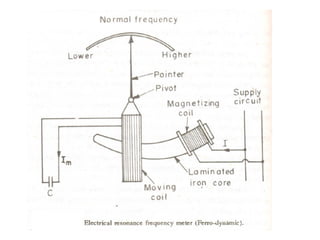
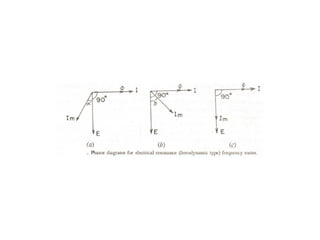
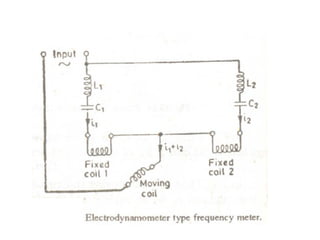
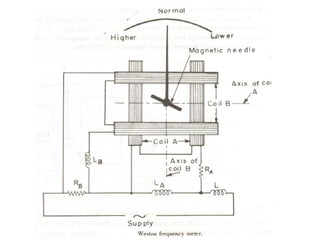
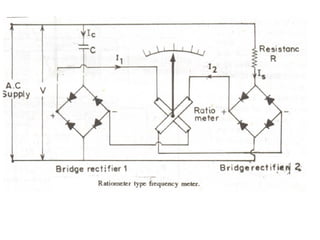
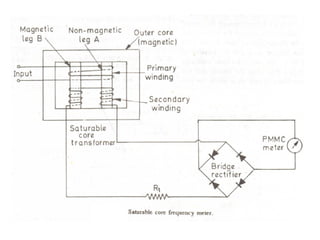
Unit 2: Frequency Measurement:
– frequency meters; Mechanical& Electrical
resonance type– power factor meters;
Dynamometer type, Moving iron type.
Electrical Measurements

Electrical Measurements

  • 1.
    EUREE 306 Electrical Measurements KManohar Assistant Professor Dept. of EEE GIT.GITAM University Visakhapatnam -530 043
  • 2.
    EUREE 306 –Electrical Measurements 1. Indicating Instruments : Principle – different types of control and damping arrangements in indicating instruments– Permanent Magnet Moving Coil – Moving Iron – Electrostatic and dynamometer type meters – Ammeters and Voltmeters – Errors in indicating instruments – Rectifier type meter – factors influencing its performance – extension of instrument range – shunts for ammeters – voltmeter multipliers. 2. Watt meters, energy meters and other measuring instruments: Dynamometer type wattmeter – Errors and compensation-measurement of 1-f power by 3voltmeter and 3 ammeter & 3-f power by two wattmeter method – Single phase Energy meters – single phase induction type energy meter – errors and compensation– calibration of wattmeter and energy meter – frequency meters; Mechanical& Electrical resonance type– power factor meters; Dynamometer type, Moving iron type. 3. Bridges: Wheatstone bridge – Kelvin double bridge – Megger – Measurement of inductance using Maxwell, hays bridge and Anderson bridges measurement of capacitance using Schering Bridge. 4. Potentiometers: General principle –Vernier dial principle standardization – ac potentiometers – coordinate and polar types – application of dc and ac potentiometers. 5. Instrument transformers: Introduction - Current transformer: phasor diagram – ratio and phase angle error –Testing. Potential Transformer; Phasor Diagram – Ratio and Phase angle error- Testing.
  • 3.
    UNIT 1: INDICATINGINSTRUMENTS Principle – different types of control and damping arrangements in indicating instruments– Permanent Magnet Moving Coil – Moving Iron – Electrostatic and dynamometer type meters – Ammeters and Voltmeters – Errors in indicating instruments – Rectifier type meter – factors influencing its performance – extension of instrument range – shunts for ammeters – voltmeter multipliers.
  • 4.
    Moving Iron TypeInstruments
  • 25.
  • 28.
    Attraction type movingiron instrument
  • 38.
    UNIT :3 Wattmeters, energy meters and other measuring instruments: Dynamometer type wattmeter – Errors and compensation- measurement of 1-f power by 3voltmeter and 3 ammeter & 3-f power by two wattmeter method – Single phase Energy meters – single phase induction type energy meter – errors and compensation– calibration of wattmeter and energy meter – frequency meters; Mechanical& Electrical resonance type– power factor meters; Dynamometer type, Moving iron type.
  • 39.
    Moving Iron TypeInstruments
  • 59.
  • 67.
    Ballistic Galvanometer And experimentof finding the fixed capacity of condenser and also mutual inductance of two coils. Trisha Banerjee @ 2010
  • 68.
  • 69.
    Phosphore bronze strip mirror copper coil Softiron core Trisha Banerjee @ 2010
  • 70.
    Brief construction :- Theballistic galvanometer is usually employed to measure the quantity of charge flowing in a given circuit due to transient current. it consists of a coil of copper wire wound on a non conducting frame which is suspended by a phosphor bronze strip between the poles of strong permanent magnet horse – shoe shape magnet . In order to increase the magnetic flux in the gap , the cylindrical soft iron – core is placed with in the coil. The pole pieces of the magnet are cylindrical concave in shape so that the magnetic field is radial in the narrow annular gap and is also perpendicular to the coil surface . The whole apparatus is covered in a shell to avoid disturbance from outside .Three leveling screws are provided below the base of the galvanometer . The deflection of the coil is measured by lamp and scale arrangement . Note:- When large damping is present , the motion of the coil is non oscillatory and the moving coil galvanometer become dead beat . The construction and working of such a galvanometer is different from moving coil galvanometer. Trisha Banerjee @ 2010
  • 71.
    Object :- todetermine the absolute capacity of the condenser. Apparatus':- Ballistics galvanometer with lamp and scale arrangement , two way morse key , a known high resistance , decade capacitor or condenser, and a Daniel cell with potential divider arrangement. Trisha Banerjee @ 2010
  • 72.
    Trisha Banerjee@2010 Morse key Readingthe deflection from the scale. Damping key
  • 73.
    Morse key:- It consistsof a metal lever BCA and three terminals ABC fixed on a wooden base. A and B are connected to the metal studs just below the end a and B of the metal lever while C is connected to the metal support at the middle of the metal lever, connections between A and C is made on the releasing , the connections between A and C is made while A is cut off. Trisha Banerjee@2010
  • 74.
  • 75.
    Circuit diagram tofinding the absolute capacity of a capacitor Trisha Banerjee@2010
  • 76.
    Object to findingthe mutual inductance of two coils. Apparatus:- Ballistic galvanometer , Two coils , double tapping key, thick copper strip , small resistance , rheostat , Lechlanche cell , lamp and scale arrangement. Circuit diagram for mutual inductance of two coils. Trisha Banerjee @ 2010
  • 77.
    Scale Ballistic Lamp Damping key Double tappingk Copper strip Rheostat. ( small resistanc e) coil Trisha Banerjee @ 2010
  • 78.
  • 79.
    Double Tapping Key:- Thedouble tapping key has three strips XX’ , YY’ , ZZ’ mounted horizontally on ebonite rods . These rods are finally fitted on an ebonite base MN having a metal stud M. On depressing X, the contact is made between X and Y ( secondary SS) and between S and M ( primary PP). The strips Y and Z remains insulated by the ebonite strips in between them . When released the primary circuit is broken and then the secondary . When the current in primary is first cut off , current falls from maximum to zero , an instantaneous induced emf is developed in the secondary and a charge passes through the secondary and the galvanometer . Immediately the secondary circuit is broken , the suspended coil in the ballistic galvanometer deflects . The magnitude f the first throw depends on the quantity of charge that has passed through it. Trisha Banerjee @ 2010
  • 80.
  • 81.
    CALIBRATION OF WATTMETERAND ENERGY METER
  • 82.
    1. mechanism of electromechanical inductionmeter in UK. Voltage coil - many turns of fine wire encased in plastic, connected in parallel with load. 2. Current coil - three turns of thick wire, connected in series with load. 3. Stator - concentrates and confines magnetic field. 4. Aluminium rotor disc. 5. rotor brake magnets. 6. spindle with worm gear. 7. display dials - note that the 1/10, 10 and 1000 dials rotate clockwise while the 1, 100 and 10000 dials rotate counter-clockwise
  • 84.
    Typical North Americandomestic analog electricity meter. Typical North American domestic digital electricity meter
  • 85.
  • 86.
  • 87.
    Panel-mounted solid-state electricity meter, connected to 2MVAthree-phase electricity substation . Remote current and voltage sensors. Capable of being read and programmed remotely by modem and locally by infra- red.
  • 89.
    Current transformers usedas part of metering equipment for three-phase 400Amp electricity supply.
  • 90.
    Early wattmeter ondisplay at the Historic Archive and Museum of Mining in Pachuca, Mexico.
  • 93.
    Demonstration model ofa moving iron ammeter. As the current through the coil increases, the plunger is drawn further into the coil and the pointer deflects to the right. Wire carrying current to be measured. Spring providing restoring force This illustration is conceptual; in a practical meter, the iron core is stationary, and front and rear spiral springs carry current to the coil, which is supported on a rectangular bobbin. Furthermore, the poles of the permanent magnet are arcs of a circle.
  • 99.
    Unit 2: FrequencyMeasurement: – frequency meters; Mechanical& Electrical resonance type– power factor meters; Dynamometer type, Moving iron type.