e-learning &
education system
DEPARTMENT OF COMPUTER SCIENCE
 SUBMMITED BY:
 SUMIT KUSHWAH
 Enroll.(0108CS131054)
 ALBEL SINGH BHARGAV
 Enroll.(0108CS131005)
 VIVIDH SHUKLA
 Enroll.(0108CS131059)
 SUBMITTED TO:
 MR. GAGAN SIR
 MS.RITU SHUKLA MEM
What is e-learning?
 eLearning is learning utilizing electronic technologies to access educational
curriculum outside of a traditional classroom. In most cases, it refers to a
course, program or degree delivered completely online.
e-learning defined
 If someone is learning in a way that uses information and communications
technologies (ICTs), they are using e-learning
 e-Learning is a broader concept [than online learning], encompassing a wide
set of applications and processes which use all available electronic media to
deliver vocational education and training more flexibly…
 the general intent to support a broad range of electronic media (internet,
intranets, extranets, satellite broadcast, audio/video tape, interactive TV and
CD-ROM) to make vocational learning more flexible for clients
Meaning of e-learning
“There are two great equalisers in life - the internet and education. By combining
the two, e-learning will be the great equaliser in the next century. By eliminating
barriers of time, distance, and socio-economic status, individuals can now take
charge of their own lifelong learning.”
For more info. Visit www.eLearningNC.gov
e-learning defined
 There are many terms used to describe learning that is delivered online, via the internet,
ranging from Distance Education, to computerized electronic learning, online learning, internet
learning and many others. We define eLearning as courses that are specifically delivered via the
internet to somewhere other than the classroom where the professor is teaching. It is not a
course delivered via a DVD or CD-ROM, video tape or over a television channel. It is interactive
in that you can also communicate with your teachers, professors or other students in your class.
Sometimes it is delivered live, where you can “electronically” raise your hand and interact in
real time and sometimes it is a lecture that has been prerecorded. There is always a teacher or
professor interacting /communicating with you and grading your participation, your assignments
and your tests. eLearning has been proven to be a successful method of training and education is
becoming a way of life for many citizens in North Carolina.
POPULAR MYTHS ABOUT e-LEARNING
 e-learning saves money.
 e-learning for anyone, anywhere, any time.
 e-learning is what net generation wants.
 e-learning replaces face-to-face learning.
 e-learning can replace teachers.
 e-learning is about speed.
 e-learning is about flexibility.
 e-learning is about multitasking.
 e-learning is facilitated, not taught.
Education trends
Past Education Trend
 Delivery of lecture using chalk and blackboard.
 Researches based upon published materials. E.g. newspaper article,
research paper, books, etc.
 Formation of group for combine studies.
 Education focused more on theory, less practical.
 Needed extensive time to do researches.
 Growing trend of education for better future.
 Computers and internet as new invention.
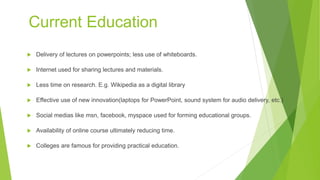
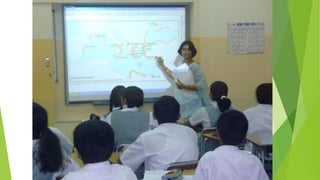
Current Education
 Delivery of lectures on powerpoints; less use of whiteboards.
 Internet used for sharing lectures and materials.
 Less time on research. E.g. Wikipedia as a digital library
 Effective use of new innovation(laptops for PowerPoint, sound system for audio delivery, etc.)
 Social medias like msn, facebook, myspace used for forming educational groups.
 Availability of online course ultimately reducing time.
 Colleges are famous for providing practical education.
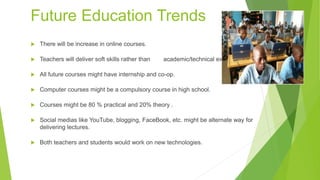
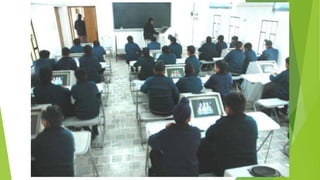
Future Education Trends
 There will be increase in online courses.
 Teachers will deliver soft skills rather than academic/technical expertise.
 All future courses might have internship and co-op.
 Computer courses might be a compulsory course in high school.
 Courses might be 80 % practical and 20% theory .
 Social medias like YouTube, blogging, FaceBook, etc. might be alternate way for
delivering lectures.
 Both teachers and students would work on new technologies.
Facts & Figures
 Asia will be the next biggest E-learning market as it’s estimated an annual
growth rate of 17.3% in next five years, the highest rate in the world
 72% of companies in the US reported the E-learning keeps them on top of
their industry changes.
 Over 77% of corporations in the US use E-learning as training process.
 The US and Europe account for over 70% of the global eLearning industry.
 More than 41% of global Fortune 500 companies now are using E-learning to
train and instruct employees
Facts & Figures
 . 4,600,00 college students are currently taking at least one of their classes
online and by 2015 this number will increase to 18,650,000. By 2019, half of
ALL classes will be done online
Facts & Figures
 . 4,600,00 college students are currently taking at least one of their classes
online and by 2015 this number will increase to 18,650,000. By 2019, half of
ALL classes will be done online
 A study by IBM shows that companies who use E-learning have the potential
to increase productivity by up to 50%.
Facts & Figures
 . 4,600,00 college students are currently taking at least one of their classes
online and by 2015 this number will increase to 18,650,000. By 2019, half of
ALL classes will be done online
 A study by IBM shows that companies who use E-learning have the potential
to increase productivity by up to 50%.
 E-learning classes can save averagely 25% to 60% of time duration than
traditional classes.
Facts & Figures
 . 4,600,00 college students are currently taking at least one of their classes
online and by 2015 this number will increase to 18,650,000. By 2019, half of
ALL classes will be done online
 A study by IBM shows that companies who use E-learning have the potential
to increase productivity by up to 50%.
 E-learning classes can save averagely 25% to 60% of time duration than
traditional classes.
 E-learning is one of the fastest growing businesses in the world
today, and it is likely to double in size before 2016.
E-Learning:
Advantages & Disadvantages
Advantages
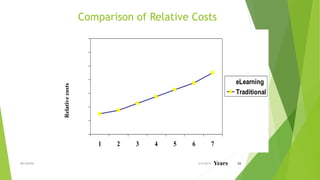
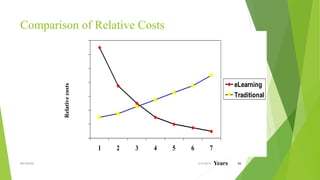
 E-learning is more cost saving & cost effective than traditional learning;
Comparison of Relative Costs
0
20
40
60
80
100
120
140
1 2 3 4 5 6 7
eLearning
Traditional
2/4/2015MH KAVEH 23
Relativecosts
Years
Comparison of Relative Costs
0
20
40
60
80
100
120
140
1 2 3 4 5 6 7
eLearning
Traditional
2/4/2015MH KAVEH 24
Relativecosts
Years
Advantages of e-Learning
 Flexibility
 E-learning has the advantage of taking class anytime anywhere.
 E-learning delivers teaching material and learning activities in a flexible format.
 Potential to develop tailored personalised learning resources (the adaptive
curriculum).
 More efficient training of a globally dispersed audience, by e-learning.
Advantages of e-Learning
 E-learning encourages students to take personal responsibility for their own
learning.
 Helps students develop skills for self-directed learning.
 When learners succeed, it builds self-knowledge and self-confidence in them.
 Developing skills and confidence in handling difficult tasks and problem
solving
Advantages of e-Learning
 Expert knowledge is communicated, but more importantly captured, with
good e-learning and knowledge management systems.
 Access by learners to teachers and resources, worldwide
 Aiding equal opportunities
 Immediate access to information
2/4/2015MH KAVEH 27
Disadvantages
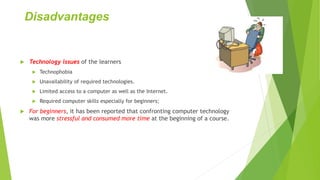
 Technology issues of the learners
 Technophobia
 Unavailability of required technologies.
 Limited access to a computer as well as the Internet.
 Required computer skills especially for beginners;
 For beginners, it has been reported that confronting computer technology
was more stressful and consumed more time at the beginning of a course.
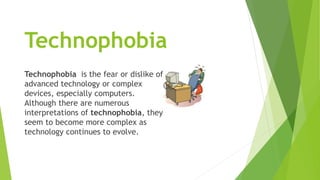
Technophobia
Technophobia is the fear or dislike of
advanced technology or complex
devices, especially computers.
Although there are numerous
interpretations of technophobia, they
seem to become more complex as
technology continues to evolve.
Disadvantages
 Feeling isolated and missing social contact
 Feeling that they communicate largely with a machine rather than other
human beings
 Possible inadequate opportunity to discuss and interact with teachers
Thank you 4 your attention
Comments & questions

e-learning sati

  • 1.
  • 2.
    DEPARTMENT OF COMPUTERSCIENCE  SUBMMITED BY:  SUMIT KUSHWAH  Enroll.(0108CS131054)  ALBEL SINGH BHARGAV  Enroll.(0108CS131005)  VIVIDH SHUKLA  Enroll.(0108CS131059)  SUBMITTED TO:  MR. GAGAN SIR  MS.RITU SHUKLA MEM
  • 3.
    What is e-learning? eLearning is learning utilizing electronic technologies to access educational curriculum outside of a traditional classroom. In most cases, it refers to a course, program or degree delivered completely online.
  • 4.
    e-learning defined  Ifsomeone is learning in a way that uses information and communications technologies (ICTs), they are using e-learning  e-Learning is a broader concept [than online learning], encompassing a wide set of applications and processes which use all available electronic media to deliver vocational education and training more flexibly…  the general intent to support a broad range of electronic media (internet, intranets, extranets, satellite broadcast, audio/video tape, interactive TV and CD-ROM) to make vocational learning more flexible for clients
  • 5.
    Meaning of e-learning “Thereare two great equalisers in life - the internet and education. By combining the two, e-learning will be the great equaliser in the next century. By eliminating barriers of time, distance, and socio-economic status, individuals can now take charge of their own lifelong learning.” For more info. Visit www.eLearningNC.gov
  • 6.
    e-learning defined  Thereare many terms used to describe learning that is delivered online, via the internet, ranging from Distance Education, to computerized electronic learning, online learning, internet learning and many others. We define eLearning as courses that are specifically delivered via the internet to somewhere other than the classroom where the professor is teaching. It is not a course delivered via a DVD or CD-ROM, video tape or over a television channel. It is interactive in that you can also communicate with your teachers, professors or other students in your class. Sometimes it is delivered live, where you can “electronically” raise your hand and interact in real time and sometimes it is a lecture that has been prerecorded. There is always a teacher or professor interacting /communicating with you and grading your participation, your assignments and your tests. eLearning has been proven to be a successful method of training and education is becoming a way of life for many citizens in North Carolina.
  • 8.
    POPULAR MYTHS ABOUTe-LEARNING  e-learning saves money.  e-learning for anyone, anywhere, any time.  e-learning is what net generation wants.  e-learning replaces face-to-face learning.  e-learning can replace teachers.  e-learning is about speed.  e-learning is about flexibility.  e-learning is about multitasking.  e-learning is facilitated, not taught.
  • 9.
  • 10.
    Past Education Trend Delivery of lecture using chalk and blackboard.  Researches based upon published materials. E.g. newspaper article, research paper, books, etc.  Formation of group for combine studies.  Education focused more on theory, less practical.  Needed extensive time to do researches.  Growing trend of education for better future.  Computers and internet as new invention.
  • 12.
    Current Education  Deliveryof lectures on powerpoints; less use of whiteboards.  Internet used for sharing lectures and materials.  Less time on research. E.g. Wikipedia as a digital library  Effective use of new innovation(laptops for PowerPoint, sound system for audio delivery, etc.)  Social medias like msn, facebook, myspace used for forming educational groups.  Availability of online course ultimately reducing time.  Colleges are famous for providing practical education.
  • 14.
    Future Education Trends There will be increase in online courses.  Teachers will deliver soft skills rather than academic/technical expertise.  All future courses might have internship and co-op.  Computer courses might be a compulsory course in high school.  Courses might be 80 % practical and 20% theory .  Social medias like YouTube, blogging, FaceBook, etc. might be alternate way for delivering lectures.  Both teachers and students would work on new technologies.
  • 16.
    Facts & Figures Asia will be the next biggest E-learning market as it’s estimated an annual growth rate of 17.3% in next five years, the highest rate in the world  72% of companies in the US reported the E-learning keeps them on top of their industry changes.  Over 77% of corporations in the US use E-learning as training process.  The US and Europe account for over 70% of the global eLearning industry.  More than 41% of global Fortune 500 companies now are using E-learning to train and instruct employees
  • 17.
    Facts & Figures . 4,600,00 college students are currently taking at least one of their classes online and by 2015 this number will increase to 18,650,000. By 2019, half of ALL classes will be done online
  • 18.
    Facts & Figures . 4,600,00 college students are currently taking at least one of their classes online and by 2015 this number will increase to 18,650,000. By 2019, half of ALL classes will be done online  A study by IBM shows that companies who use E-learning have the potential to increase productivity by up to 50%.
  • 19.
    Facts & Figures . 4,600,00 college students are currently taking at least one of their classes online and by 2015 this number will increase to 18,650,000. By 2019, half of ALL classes will be done online  A study by IBM shows that companies who use E-learning have the potential to increase productivity by up to 50%.  E-learning classes can save averagely 25% to 60% of time duration than traditional classes.
  • 20.
    Facts & Figures . 4,600,00 college students are currently taking at least one of their classes online and by 2015 this number will increase to 18,650,000. By 2019, half of ALL classes will be done online  A study by IBM shows that companies who use E-learning have the potential to increase productivity by up to 50%.  E-learning classes can save averagely 25% to 60% of time duration than traditional classes.  E-learning is one of the fastest growing businesses in the world today, and it is likely to double in size before 2016.
  • 21.
  • 22.
    Advantages  E-learning ismore cost saving & cost effective than traditional learning;
  • 23.
    Comparison of RelativeCosts 0 20 40 60 80 100 120 140 1 2 3 4 5 6 7 eLearning Traditional 2/4/2015MH KAVEH 23 Relativecosts Years
  • 24.
    Comparison of RelativeCosts 0 20 40 60 80 100 120 140 1 2 3 4 5 6 7 eLearning Traditional 2/4/2015MH KAVEH 24 Relativecosts Years
  • 25.
    Advantages of e-Learning Flexibility  E-learning has the advantage of taking class anytime anywhere.  E-learning delivers teaching material and learning activities in a flexible format.  Potential to develop tailored personalised learning resources (the adaptive curriculum).  More efficient training of a globally dispersed audience, by e-learning.
  • 26.
    Advantages of e-Learning E-learning encourages students to take personal responsibility for their own learning.  Helps students develop skills for self-directed learning.  When learners succeed, it builds self-knowledge and self-confidence in them.  Developing skills and confidence in handling difficult tasks and problem solving
  • 27.
    Advantages of e-Learning Expert knowledge is communicated, but more importantly captured, with good e-learning and knowledge management systems.  Access by learners to teachers and resources, worldwide  Aiding equal opportunities  Immediate access to information 2/4/2015MH KAVEH 27
  • 28.
    Disadvantages  Technology issuesof the learners  Technophobia  Unavailability of required technologies.  Limited access to a computer as well as the Internet.  Required computer skills especially for beginners;  For beginners, it has been reported that confronting computer technology was more stressful and consumed more time at the beginning of a course.
  • 29.
    Technophobia Technophobia is thefear or dislike of advanced technology or complex devices, especially computers. Although there are numerous interpretations of technophobia, they seem to become more complex as technology continues to evolve.
  • 30.
    Disadvantages  Feeling isolatedand missing social contact  Feeling that they communicate largely with a machine rather than other human beings  Possible inadequate opportunity to discuss and interact with teachers
  • 31.
    Thank you 4your attention Comments & questions