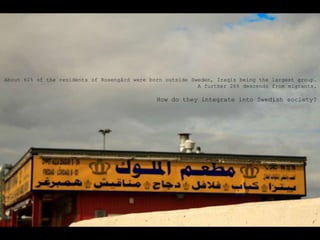
About 60% of theresidents of RosengårdwerebornoutsideSweden, Iraqisbeingthelargestgroup.A further 26% descendsfrommigrants.How do theyintegrateintoSwedishsociety?
PuttingRosengård back onthe(mental) maps
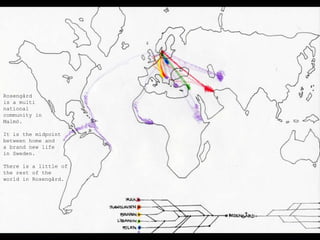
Rosengårdis a multinationalcommunity inMalmö. Itisthemidpointbetween home anda brand new lifein Sweden.Thereis a little oftherest of theworld in Rosengård.
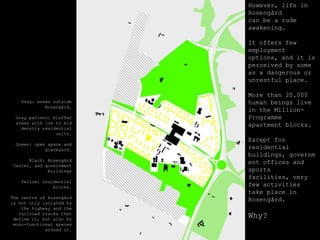
However, life in Rosengårdcan be a rudeawakening.Itoffersfewemploymentoptions, and itisperceivedbysome as a dangerousorunrestful place.More than 20.000 humanbeingslive in theMillion-Programmeapartment blocks.Exceptforresidentialbuildings, governmentoffices and sportsfacilities, veryfewactivitiestake place in Rosengård.Why?Gray: areasoutsideRosengård.Gray pattern: blufferareaswithlowtomiddensityresidentialunits.Green: open space and graveyard.Black: Rosengård Center, and governmentbuildingsYellow: residential blocks.The centre of Rosengårdisnotonlyisolatedbythehighway and therailroadtracksthat define it, butalsoby mono-functionalspacesaroundit.
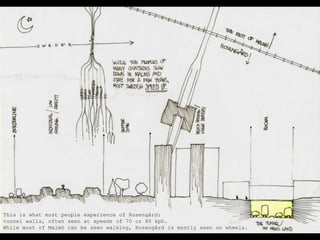
Thisiswhatmostpeopleexperience of Rosengård: tunnelwalls, oftenseen at speeds of 70 or 80 kph.Whilemost of Malmö can beseenwalking, Rosengårdismostlyseenonwheels.
Knittingthe web.
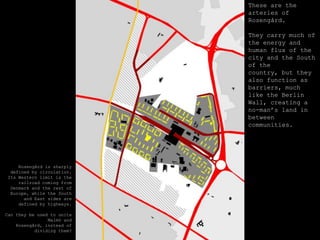
These are thearteries of Rosengård. Theycarrymuch of theenergy and human flux of thecity and the South of the country, buttheyalsofunction as barriers, muchliketheBerlin Wall, creating a no-man’sland in betweencommunities.Rosengårdissharplydefinedbycirculation. Its Western limitistherailroadcomingfromDenmark and therest of Europe, whilethe South and East sides are definedbyhighways. Can theybeusedtounite Malmö and Rosengård, instead of dividingthem?
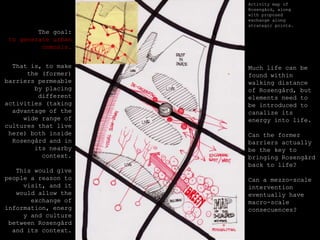
Activitymap of Rosengård, alongwithproposedexchangealongstrategicpoints. Thegoal: togenerateurban osmosis. Thatis, tomakethe (former) barriers permeablebyplacingdifferentactivities (takingadvantage of thewiderange of culturesthatlivehere) bothinsideRosengård and in itsnearbycontext.Thiswouldgivepeople a reasontovisit, and itwouldallowtheexchange of information, energy and culturebetweenRosengård and itscontext.Muchlife can befoundwithinwalkingdistance of Rosengård, butelementsneedtobeintroducedtocanalizeitsenergyintolife.Can theformerbarriersactuallybethekeytobringingRosengård back tolife?Can a mezzo-scaleinterventioneventuallyhave macro-scaleconsecuences?

Elasticity in Rosengård

  • 1.
    About 60% oftheresidents of RosengårdwerebornoutsideSweden, Iraqisbeingthelargestgroup.A further 26% descendsfrommigrants.How do theyintegrateintoSwedishsociety?
  • 2.
  • 3.
    Rosengårdis a multinationalcommunityinMalmö. Itisthemidpointbetween home anda brand new lifein Sweden.Thereis a little oftherest of theworld in Rosengård.
  • 4.
    However, life inRosengårdcan be a rudeawakening.Itoffersfewemploymentoptions, and itisperceivedbysome as a dangerousorunrestful place.More than 20.000 humanbeingslive in theMillion-Programmeapartment blocks.Exceptforresidentialbuildings, governmentoffices and sportsfacilities, veryfewactivitiestake place in Rosengård.Why?Gray: areasoutsideRosengård.Gray pattern: blufferareaswithlowtomiddensityresidentialunits.Green: open space and graveyard.Black: Rosengård Center, and governmentbuildingsYellow: residential blocks.The centre of Rosengårdisnotonlyisolatedbythehighway and therailroadtracksthat define it, butalsoby mono-functionalspacesaroundit.
  • 5.
    Thisiswhatmostpeopleexperience of Rosengård:tunnelwalls, oftenseen at speeds of 70 or 80 kph.Whilemost of Malmö can beseenwalking, Rosengårdismostlyseenonwheels.
  • 6.
  • 7.
    These are thearteriesof Rosengård. Theycarrymuch of theenergy and human flux of thecity and the South of the country, buttheyalsofunction as barriers, muchliketheBerlin Wall, creating a no-man’sland in betweencommunities.Rosengårdissharplydefinedbycirculation. Its Western limitistherailroadcomingfromDenmark and therest of Europe, whilethe South and East sides are definedbyhighways. Can theybeusedtounite Malmö and Rosengård, instead of dividingthem?
  • 8.
    Activitymap of Rosengård,alongwithproposedexchangealongstrategicpoints. Thegoal: togenerateurban osmosis. Thatis, tomakethe (former) barriers permeablebyplacingdifferentactivities (takingadvantage of thewiderange of culturesthatlivehere) bothinsideRosengård and in itsnearbycontext.Thiswouldgivepeople a reasontovisit, and itwouldallowtheexchange of information, energy and culturebetweenRosengård and itscontext.Muchlife can befoundwithinwalkingdistance of Rosengård, butelementsneedtobeintroducedtocanalizeitsenergyintolife.Can theformerbarriersactuallybethekeytobringingRosengård back tolife?Can a mezzo-scaleinterventioneventuallyhave macro-scaleconsecuences?