N° d’ordre : D. U. : 1588
                                        E D S P I C : 325


                                                                       Université Blaise Pascal - Clermont II

                                                                    Ecole Doctorale
                                                     Sciences Pour l’Ingénieur de Clermont-Ferrand

                                                                                  Thèse
                                                                                 Présentée par


                                                     Eladio Teófilo Ocaña Anaya
                                                            Master en Ciencias, mención matemática,
                                                        Universidad Nacional de Ingenieria de Lima (Peru)
tel-00675318, version 1 - 29 Feb 2012


                                                                          pour obtenir le grade de


                                          D o c t e u r d’ U n i v e r s i t é
                                                                       SPECIALITE : Sciences de l’ingénieur
                                                                                  Titre de la thèse


                                         Un schéma de dualité pour les problèmes d’inéquations
                                                            variationnelles

                                                Soutenue publiquement à Lima le 7 octobre 2005 devant le jury :

                                        Président
                                                Professeur Juan-Enrique Martinez-Legáz, Universitat Autonoma de Barcelona, Espagne.

                                        Rapporteurs et examinateurs
                                                Professeur Alfred Auslender, Université Claude Bernard, Lyon.
                                                Docteur Claudia Sagastizabal, Instituto Nacional de Matemática Pura e Aplicada,
                                                   Rio de Janeiro, Brésil.

                                        Examinateur
                                                Professeur Marc Lassonde, Université des Antilles-Guyane, Pointe à Pitre.

                                        Co-directeurs de la thèse
                                                Professeur Jean-Pierre Crouzeix, Université Blaise Pascal, Clermont.
                                                Professeur Wilfredo Sosa Sandoval, Universidad Nacional de Ingenieria, Lima.
tel-00675318, version 1 - 29 Feb 2012


                                                                                         Dedicatoria

                                                                         A la memoria de mis padres:
                                                   Martin y Guadalupe, prematuramente desaparecidos.
                                        As´ como para mis hermanos: Domitila, Juan, David y Armando.
                                          ı
AGRADECIMIENTOS


                                            Agradezco profundamente a mis directores, prof. Jean Pierre Crouzeix
                                        y prof. Wilfredo Sosa Sandoval, no solamente por ayudarme y aconsejarme
tel-00675318, version 1 - 29 Feb 2012


                                        pacientemente a trav´s de este programa de Doctorado, sino que tambi´n
                                                              e                                                  e
                                        por sus aclaraciones y sabios consejos.
                                            Adem´s quiero agradecer a Marie Crouzeix, por su amplio apoyo durante
                                                    a
                                        mi estad´ en Clermont, a Ingrid y a todos los profesores y compa˜eros de
                                                  ıa                                                        n
                                        estudios tanto del IMCA como a los de la Universidad Blaise Pascal.
                                            Agradezco tambi´n a las siguientes instituciones que hicieron posible la
                                                             e
                                        realizaci´n de este trabajo de investigaci´n: ICTP de Trieste, Italia; CON-
                                                  o                               o
                                        CYTEC de Lima, Per´; Embajada de Francia en el Per´; Universidad Blaise
                                                               u                              u
                                        Pascal, Clermont-Ferrand, Francia; IMCA y la Universidad Nacional de In-
                                        genier´ de Lima, Per´.
                                               ıa             u


                                                                             i
´
                                                                       RESUME
                                            Dans cette th`se, nous avont pre´sent´ un sch´ma g´n´ral de dualit´ pour
                                                           e                  e    e       e      e e          e
                                        des probl`mes d’in´quations variationelles monotones. Cet sch´ma est ana-
                                                  e           e                                          e
                                        logue le sch´ma classique de dualit´ dans la programmation convexe en
                                                       e                        e
                                        ajoutant des variables de perturbation.
                                            Afin d’arriver ´ cet objetif, avant nous avons approfondi quelques pro-
                                                             a
                                        pri´t´s et caract´risations des multi-applicationes (sous-ensemble) monotones
                                           ee            e
                                        et maximal monotones sur un point de vue global et local. En particulier,
                                        nous donnons un algorithme pour construire une extension maximal mono-
                                        tone d’une multi-application mnotone (sous-ensemble) arbitraire.
                                            Nous avons sp´cifiquement ´tudi´ les sous-espaces affine monotone. Dans
                                                            e            e    e
tel-00675318, version 1 - 29 Feb 2012


                                        ce cas particulier, la construction d’une extension maximal monotone peut
                                        ˆtre construit par un nombre fini d’´tapes.
                                        e                                     e
                                            Finalement, des applications de notre sch´ma de dualit´ quelques classes
                                                                                       e              e
                                        des probl`mes d’in´quations variationnels sont discut´es.
                                                  e           e                                 e

                                                                     ABSTRACT
                                            In this thesis, we construct a general duality scheme for monotone varia-
                                        tional inequality problems. This scheme is analogous to the classical duality
                                        scheme in convex programming in the sense that the duality is obtained by
                                        adding perturbation variables.
                                            In order to reach this goal, we have before deepened some properties and
                                        characterizations of monotone and maximal monotone multi-valued maps
                                        (subsets) on a global and a local point of view. In particular, we give an
                                        algorithm for constructing a maximal monotone extension of an arbitrary
                                        monotone map.
                                            We have specifically studied monotone affine subspaces. In this particular
                                        case, the construction of a maximal monotone extension can be processed
                                        within a finite number of steps.
                                            Finally, applications of our duality scheme to some classes of variational
                                        inequality problems are discussed.


                                                                              ii
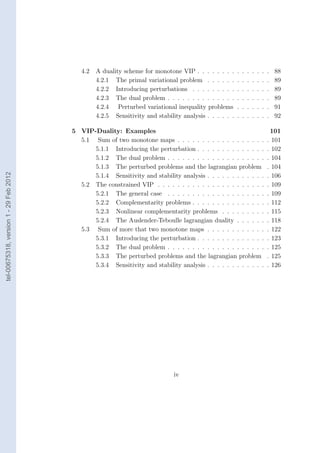
Contents

                                        Introduction                                                                                       1

                                        1 Notation and background of convex analysis                              7
tel-00675318, version 1 - 29 Feb 2012


                                          1.1 Preliminaries and notation . . . . . . . . . . . . . . . . . . . . 7
                                          1.2 Convex analysis . . . . . . . . . . . . . . . . . . . . . . . . . . 8
                                          1.3 The duality scheme in convex programming . . . . . . . . . . 11

                                        2 Monotonicity and maximal monotonicity                                                           19
                                          2.1 Definitions and notation . . . . . . . . . .     .   .   .   .   .   .   .   .   .   .   .   20
                                          2.2 Monotonicity on a product space . . . . .       .   .   .   .   .   .   .   .   .   .   .   24
                                          2.3 More on Γ . . . . . . . . . . . . . . . . . .   .   .   .   .   .   .   .   .   .   .   .   26
                                          2.4 Restriction of a maximal monotone map .         .   .   .   .   .   .   .   .   .   .   .   46
                                          2.5 Dealing with relative interiors . . . . . . .   .   .   .   .   .   .   .   .   .   .   .   49
                                          2.6 Strict and strong monotonicity . . . . . . .    .   .   .   .   .   .   .   .   .   .   .   58
                                          2.7 Maximal monotone extensions . . . . . . .       .   .   .   .   .   .   .   .   .   .   .   63

                                        3 Monotonicity of affine subspaces                                                                67
                                          3.1 Monotone affine subspaces . . . . . . . . . . . . . . . . . . .                           . 68
                                          3.2 A characterization of maximal mononotonicity for affine sub-
                                              spaces . . . . . . . . . . . . . . . . . . . . . . . . . . . . . .                      . 71
                                          3.3 Construction of an affine maximal monotone extension . . .                                . 75
                                          3.4 Restriction of an affine monotone subspace . . . . . . . . . .                            . 78

                                        4 A duality scheme for VIP.                                                           81
                                          4.1 VIP associated with convex optimization problems                    . . . . . . 82

                                                                              iii
4.2   A duality scheme for monotone VIP . . . . . . . .      .   .   .   .   .   .   .   88
                                                 4.2.1 The primal variational problem . . . . . .       .   .   .   .   .   .   .   89
                                                 4.2.2 Introducing perturbations . . . . . . . . .      .   .   .   .   .   .   .   89
                                                 4.2.3 The dual problem . . . . . . . . . . . . . .     .   .   .   .   .   .   .   89
                                                 4.2.4 Perturbed variational inequality problems        .   .   .   .   .   .   .   91
                                                 4.2.5 Sensitivity and stability analysis . . . . . .   .   .   .   .   .   .   .   92

                                        5 VIP-Duality: Examples                                                                  101
                                          5.1 Sum of two monotone maps . . . . . . . . . . . . . . . . . .                      . 101
                                              5.1.1 Introducing the perturbation . . . . . . . . . . . . . .                    . 102
                                              5.1.2 The dual problem . . . . . . . . . . . . . . . . . . . .                    . 104
                                              5.1.3 The perturbed problems and the lagrangian problem                           . 104
tel-00675318, version 1 - 29 Feb 2012


                                              5.1.4 Sensitivity and stability analysis . . . . . . . . . . . .                  . 106
                                          5.2 The constrained VIP . . . . . . . . . . . . . . . . . . . . . .                   . 109
                                              5.2.1 The general case . . . . . . . . . . . . . . . . . . . .                    . 109
                                              5.2.2 Complementarity problems . . . . . . . . . . . . . . .                      . 112
                                              5.2.3 Nonlinear complementarity problems . . . . . . . . .                        . 115
                                              5.2.4 The Auslender-Teboulle lagrangian duality . . . . . .                       . 118
                                          5.3 Sum of more that two monotone maps . . . . . . . . . . . .                        . 122
                                              5.3.1 Introducing the perturbation . . . . . . . . . . . . . .                    . 123
                                              5.3.2 The dual problem . . . . . . . . . . . . . . . . . . . .                    . 125
                                              5.3.3 The perturbed problems and the lagrangian problem                           . 125
                                              5.3.4 Sensitivity and stability analysis . . . . . . . . . . . .                  . 126


                                                                              iv
Introduction
                                        The finite-dimensional variational inequality problem (VIP)

                                              Find x ∈ C such that ∃ x∗ ∈ Γ(¯) with x∗ , x − x ≥ 0 ∀ x ∈ C,
tel-00675318, version 1 - 29 Feb 2012


                                                   ¯                 ¯      x       ¯        ¯
                                                                                                                 −→
                                        where C is a non-empty closed convex subset of R n and Γ : R n −→ R n
                                        a multi-valued map, provides a broad unifying setting of the study of op-
                                        timization and equilibrium problems and serves as the main computational
                                        framework for the practical solution of a host of continuum problems in
                                        mathematical sciences.
                                            The subject of variational inequalities has its origin in the calculus of
                                        variations associated with the minimization of infinite-dimensional functions.
                                        The systematic study of the subject began in the early 1960s with the seminal
                                        work of the Italian mathematician Guido Stampacchia and his collaborators,
                                        who used the variational inequality as an analytic tool for studying free
                                        boundary problems defined by non-linear partial diferential operators arising
                                        from unilateral problems in elasticity and plasticity theory and in mechanics.
                                        Some of the earliest papers on variational inequalities are [16, 21, 22, 40, 41].
                                        In particular, the first theorem of existence and uniqueness of the solution of
                                        VIs was proved in [40].
                                            The development of the finite-dimensional variational inequality and non-
                                        linear inequality problem also began in the early 1960 but followed a different
                                        path. Indeed, the non-linear complementarity problem was first identified in
                                        the 1964 Ph.D. thesis of Richard W. Cottle [8], who studied under the su-
                                        pervision of the eminent George B. Dantzig, “father of linear programming”.

                                                                               1
A brief account of the history prior to 1990 can be found in the introduction
                                        in the survey paper [15].
                                            Related to monotone maps, Kachurovskii [17] was apparently the first to
                                        note that the gradients of differentiable convex functions are monotone maps,
                                        and he coined the term “monotonicity” for this property. Really, though, the
                                        theory of monotone mapping began with papers of Minty [25], [26], where
                                        the concept was studied directly in its full scope and the significance of
                                        maximality was brought to light.
                                            His discovery of maximal monotonicity as a powerful tool was one of
                                        the main impulses, however, along with the introduction of sub-gradients
                                        of convex functions, that led to the resurgence of multivalued mapping as
                                        acceptable objects of discourse, especially in variational analysis.
tel-00675318, version 1 - 29 Feb 2012


                                            The need for enlarging the graph of a monotone mapping in order to
                                        achieve maximal monotonicity, even if this meant that the graph would no
                                        longer be function-like, was clear to him from his previous work with opti-
                                        mization problems in networks, Minty [24], which revolved around the one
                                        dimensional case of this phenomenon; cf. 12.9 [39].
                                            Much of the early research on monotone mapping was centered on infinite
                                        dimensional applications to integral equations and differential equations. The
                                        survey of Kachurovskii [18] and the book of Br´zis [4] present this aspect well.
                                                                                        e
                                        But finite-dimensional applications to numerical optimization has also come
                                        to be widespread particularly in schemes of decomposition, see for example
                                        [7] and references therein.
                                            Duality framework related to variational inequality problems has been
                                        established by many researchers [1],[2],[11],[14],[27],[37],[38]. For example, in
                                        [27] Mosco studied problems of the form

                                                           Find x ∈ R n such that 0 ∈ Γ(¯) + ∂g(¯),
                                                                ¯                       x       x                    (1)

                                        where Γ is considered maximal monotone and g a proper lsc convex function
                                        and show that one can always associate a dual problem with (1) defined by

                                                      Find u∗ ∈ R n such that 0 ∈ −Γ− (−¯∗ ) + ∂g ∗ (¯∗ ),
                                                           ¯                            u            u               (2)

                                        where g ∗ denotes the Fenchel conjugate of g.

                                                                               2
In this article, he shows that x solves (1) if and only if u∗ ∈ Γ(x) solve
                                        (2).
                                            The above dual formulation and dual terminology is justified by the fact
                                        that this scheme is akin to the Fenchel duality scheme used in convex op-
                                        timization problems. Indeed, if Γ is the subdifferential of some proper lsc
                                        convex function f , the formulations (under appropiate regularity conditions
                                        [35]) (1) and (2) are nothing else but the optimality conditions for the Fenchel
                                        primal-dual pair of convex optimization problems
                                             min{ f (x) + g(x) : x ∈ R n },      min{ f ∗ (−u∗ ) + g ∗ (u∗ ) : u∗ ∈ R n }.
                                        In contrast with this author, Auslender and Teboulle [2] established a dual
                                        framework related to Lagrangian duality (formally equivalent to Mosco’s
tel-00675318, version 1 - 29 Feb 2012


                                        scheme), in order to produce two methods of multipliers with interior multi-
                                        plier updates based on the dual and primal-dual formulations of VIP.
                                            This duality formulation takes its inspiration in the classical Lagrangian
                                        duality framework for constrained optimization problems. In this case the
                                        closed convex subset C is explicitly defined by
                                                          C := { x ∈ R n : fi (x) ≤ 0, i = 1, · · · , m },
                                        where fi : R n → R ∪ {+∞}, i = 1, · · · , m, are given proper lsc convex
                                        functions.
                                            In this context, the dual framework established by Auslender and Teboulle
                                        is defined as
                                                                           
                                                                            ∃ x ∈ R n with u∗ ≥ 0 and
                                                                                           ¯
                                                                           
                                               Find u∗ ∈ R m such that
                                                    ¯                            0 ∈ Γ(x) + m u∗ ∂fi (x)
                                                                                              i=1 ¯i                   (DV P )
                                                                           
                                                                                  0 ∈ −F (x) + NR m (¯∗ ),
                                                                           
                                                                           
                                                                                                   +
                                                                                                     u
                                        where F (x) = (f1 (x), · · · , fm (x))t . Associated to VIP and DVP, they also
                                        introduce a primal-dual formulation defined by
                                                     Find (¯, u∗ ) ∈ R n × R m such that (0, 0) ∈ S(¯, u∗ ),
                                                           x ¯                                      x ¯                  (SP )
                                                             −→
                                        where S : R n × R m −→ R n × R m is a multivalued map defined by
                                                                                 m
                                          S(x, u∗ ) = { (x∗ , u) : x∗ ∈ Γ(x) +         u∗ ∂fi (x), u ∈ −F (x) + NR m (u∗ ) }.
                                                                                        i                          +
                                                                                 i=1


                                                                                  3
These three formulations (under Slater’s condition for the constraint set C)
                                        has the following relations: x solves VIP if and only if there exists u∗ ∈ R m
                                        such that (x, u∗ ) solves SP. In this case u∗ solves DVP.
                                            The duality scheme we have introduced in this work (Chapter 4) takes
                                        also its inspiration in the duality in convex optimization but by adding per-
                                        turbation variables. But before we observed that the monotonicity of a mul-
                                                                 −→
                                        tivalued map Γ : R n −→ R n is a property lying on its graph which is a
                                        subset of R n × R n . In particular, the inverse map Γ−1 , which shares the
                                        same graph than Γ, is monotone when Γ is so. Consequently we say that
                                        the graph is monotone. Thus, given the variational inequality problem VIP
                                        (primal problem)

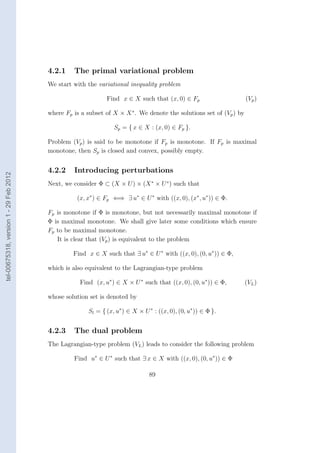
                                                              Find x ∈ R n such that (x, 0) ∈ Fp ,                 (Vp )
tel-00675318, version 1 - 29 Feb 2012


                                        where Fp is a monotone subset of R n × R n , we introduce a perturbed subset
                                        Φ ⊂ (R n × R m ) × (R n × R m ) which is such that

                                                (x, x∗ ) ∈ Fp ⇐⇒ ∃ u∗ ∈ R m such that ((x, 0), (x∗ , u∗ )) ∈ Φ.

                                        Then (Vp ) is equivalent to

                                                 Find x ∈ R n such that ∃ u∗ ∈ R m with ((x, 0), (0, u∗ )) ∈ Φ.    (Vp )

                                        This last formulation leads to consider the following problem

                                           Find (x, u∗ ) ∈ R n × R m such that ∃ u∗ ∈ R m with ((x, 0), (0, u∗ )) ∈ Φ

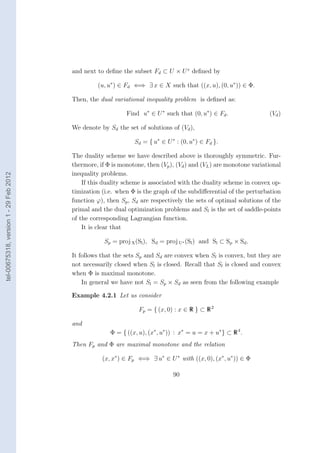
                                        and next to define the subset Fd ⊂ R m × R m defined by

                                                (u, u∗ ) ∈ Fd ⇐⇒ ∃ x ∈ R n such that ((x, 0), (x∗ , u∗ )) ∈ Φ.

                                        Our dual variational inequality problem is defined as

                                                             Find u∗ ∈ R n such that (0, u∗ ) ∈ Fd .               (Vd )

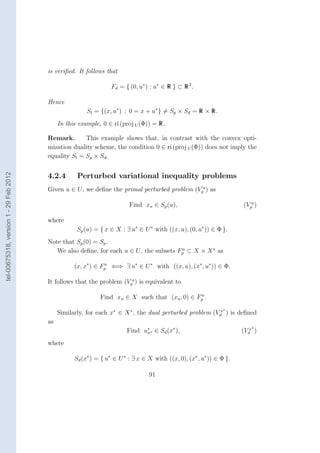
                                        Perturbed problems associated to (Vp ) and (Vd ) are also discussed. These
                                        problems are formulated as follows: For any u ∈ R m and x∗ ∈ R n the primal
                                                                                                     ∗
                                        perturbed problem (Vpu ) and the dual perturbed problem (Vdx ) are

                                                 Find x ∈ R n such that ∃ u∗ ∈ R m with ((x, u), (0, u∗ )) ∈ Φ

                                                                               4
and

                                                Find u∗ ∈ R m such that ∃ x ∈ R n with ((x, 0), (x∗ , u∗ )) ∈ Φ,

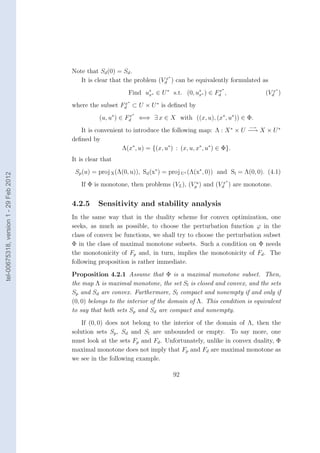
                                        respectively. If Φ is monotone, all the variational problems considered above
                                        are monotone.
                                            As particular examples (Chapter 5) we recover the dual frameworks stud-
                                        ied by Mosco [27] and Auslender and Teboulle [2].


                                            The thesis is divided into 5 chapters:
                                            The first chapter is devoted to set up notations and review some facts
                                        of convex analysis; we describe in details the duality scheme in convex pro-
tel-00675318, version 1 - 29 Feb 2012


                                        gramming. Some facts on multivalued maps are also reviewed.
                                            In Chapter 2, we develop some new general theoretical results on mono-
                                        tone and maximal monotone multi-valued maps (subsets) which will be nee-
                                        ded in our further analysis but are also of interest by themselves. Indeed,
                                        in contrast to the existing literature, new general tools of multi-valued maps
                                        (subsets) are considered in order to characterize and/or study the behaviour
                                        of monotone and maximal monotone from a global and a local point of view.
                                        In this sense, many important results related to monotone and maximal
                                        monotone are recovered as direct consequences of this new approach. In sec-
                                        tion 2.4, we present an algorithm to construct a maximal monotone extension
                                        of an arbitrary monotone map (subset).
                                            Chapter 3, is devoted to the study of monotone and maximal monotone
                                        affine subspaces. Monotonicity and maximal monotonicity of affine subspaces
                                        are explicitly characterized by means of the eigenvalues of bordered matrices
                                        associated to these subspaces. From this characterization, we prove that any
                                        maximal monotone affine subspace can be written (under permutations of
                                        variables) as the graph of an affine map associated to a positive semi-definite
                                        matrix. The algorithm developed in the previous chapter for constructing a
                                        maximal monotone extension is significantly refined. For such subsets, the
                                        maximal monotone affine extension thus constructed is obtained in a finite
                                        number of steps.

                                                                              5
In chapter 4, we develop our duality scheme. Primal perturbed problems,
                                        the dual problem, perturbed dual problems and the Lagrangian problem are
                                        formulated. A natural condition related to the stability for these problems
                                        is given.
                                            In Chapter 5 we apply our duality scheme to some classes of variational
                                        inequality problems: complementarity problems, non-linear complementarity
                                        problems, etc.
tel-00675318, version 1 - 29 Feb 2012


                                                                            6
Chapter 1

                                        Notation and background of
                                        convex analysis
tel-00675318, version 1 - 29 Feb 2012


                                        1.1      Preliminaries and notation
                                        In this thesis, we assume that X and U are two finite dimensional linear
                                        spaces. Among other reasons for limiting our study to finite dimensional
                                        spaces is the fact that we shall make use frequently the concept of relative
                                        interior, we know that this concept is well adapted in a finite dimensional
                                        setting (the relative interior of a convex C ⊂ R n is convex and non-empty
                                        when C is non-empty), but, it does not work in the infinite dimensional
                                        setting. Of course variational inequality problems appear in the infinite di-
                                        mensional setting, but their treatment needs complex technical requirements
                                        that we want avoid in this first approach of duality for variational inequality
                                        problems.
                                            We denote by X ∗ and U ∗ the dual spaces of X and U . Of course X = X ∗
                                        and U = U ∗ but in order to put in evidence the distinct roles played by these
                                        spaces, we use the four symbols X, U , X ∗ and U ∗ . In this spirit ·, · denotes
                                        both the duality product between the space and its dual and the classical
                                        inner product on the space.
                                            Given C ⊂ X, we denote by cl (C), int (C), ri (C), bd (C), rbd (C), co (C),
                                        co (C) and aff (C) the closure, the interior, the relative interior, the boundary,

                                                                               7
the relative boundary, the convex hull, the closure of the convex hull and the
                                        affine hull of a set C, respectively.
                                            The orthogonal subspace to C ⊂ X is defined by

                                                         C ⊥ := { y ∈ X : y, x = 0 for all x ∈ C }.

                                           Given a ∈ X, we denote by N (a) the family of neighborhoods of a.
                                           Given a closed set C ⊂ X, we denote by proj C (x) the projection of x onto
                                        C, which is the set of all points in C that are the closest to x for a given
                                        norm, that is

                                                       proj C (x) := { y ∈ C : x − y = inf x − y }.
                                                                       ¯           ¯
                                                                                          y∈C

                                        Unless otherwise specified, the norm used is the Euclidean norm. For this
tel-00675318, version 1 - 29 Feb 2012


                                        norm, when C is closed and convex, proj C (x) is reduced to a singleton. In
                                        fact, this property can be used to characterize the closed convex subsets of
                                        X. Indeed C is closed and convex if and only if the projection operator
                                        proj C (·), is single-valued on X [5], [28].
                                            Given a closed convex set C, the normal cone and the tangent cone to C
                                        at x, denoted respectively by NC (x) and TC (x) are defined by
                                                            
                                                            
                                                            
                                                                { x∗ : x∗ , y − x ≤ 0, ∀ y ∈ C }     if x ∈ C,
                                                NC (x) :=
                                                            
                                                                               ∅
                                                            
                                                            
                                                                                                      if not
                                        and
                                                                                                         xk − x
                                         TC (x) = { v : ∃ {xk } ⊂ C, {tk } ⊂ R, xk → x, tk → 0+ and             → v }.
                                                                                                           tk
                                           We shall use the following convention:

                                                                A + ∅ = ∅ + A = ∅, for any set A.


                                        1.2     Convex analysis
                                        Given f : X → (−∞, +∞], we say that f is convex if its epigraph

                                                            epi (f) = { (x, α) ∈ X × R : f(x) ≤ α }

                                                                               8
is convex in X × R. We say that f is concave if (−f ) is convex. We say that
                                        f is lower semi-continuous (lsc in short) at x if for every λ ∈ R such that
                                                                                           ¯
                                        f (¯) > λ there exists a neighborhood V ∈ N (¯) such that x ∈ V , implies
                                           x                                                  x
                                        f (x) > λ. f is said to be lsc if it is lsc at every point of X. This is equivalent
                                        to saying that its epigraph is closed in X × R. The function f is said to be
                                        upper semi-continuous (usc in short) if (−f ) is lsc. A convex function f is
                                        said to be proper if f (x) > −∞ for every x ∈ X and its domain

                                                                   dom (f) = { x ∈ X : f(x) < +∞ }

                                        is nonempty. Note that if f is a convex function, then dom (f) is a convex
                                        set.
                                            Given f : X → (−∞, +∞], its Fenchel-conjugate is
tel-00675318, version 1 - 29 Feb 2012


                                                                    f ∗ (x∗ ) = sup[ x∗ , x − f (x)],
                                                                              x∈X

                                        and its biconjugate is

                                               f ∗∗ (x) = sup [ x∗ , x − f ∗ (x∗ )] = sup inf [ x∗ , x − z + f (z)].
                                                         x∗ ∈X ∗                        x∗ ∈X ∗ z∈X

                                        By construction f ∗ and f ∗∗ are two convex and lsc functions, and f ∗∗ (x) ≤
                                        f (x) for all x ∈ X. A crucial property is the following (see for instance
                                        [3],[10],[35], etc.).

                                        Proposition 1.2.1 Assume that f is a proper convex function on X and lsc
                                        at x. Then f ∗∗ (¯) = f (¯).
                                           ¯             x       x

                                            Assume that f is a proper convex function and x ∈ X. The subdifferential
                                        of f at x is the set ∂f (x) defined by

                                               ∂f (x) = { x∗ ∈ X ∗ : f (x) + x∗ , y − x ≤ f (y), for all y ∈ X }

                                        or equivalently, using the definition of the conjugate,

                                                        ∂f (x) = { x∗ ∈ X ∗ : f (x) + f ∗ (x∗ ) ≤ x∗ , x }.

                                        Clearly, ∂f (x) = ∅ if x ∈ dom (f) or if f is not lsc at x.
                                                                 /

                                                                                    9
By construction, the set ∂f (x) is closed and convex for all x ∈ X. Also
                                        ∂f (x) is bounded and nonempty on the interior of dom (f).
                                            The domain of ∂f and its graph are the sets

                                                                  dom (∂f) = { x ∈ X : ∂f(x) = ∅ },

                                                          graph (∂f) = { (x, x∗ ) ∈ X × X∗ : x∗ ∈ ∂f(x) }.
                                        Clearly dom (∂f) ⊂ dom (f) but in general these sets do not coincide, more-
                                        over dom (∂f), unlike dom (f), may be not convex when f is convex as seen
                                        from the following example taken from [35]

                                        Example 1.2.1 Let us define f : R 2 → R by
                                                                                                 √
tel-00675318, version 1 - 29 Feb 2012


                                                                        
                                                                        
                                                                        
                                                                               max{|x1 |, 1 −       x2 }   if x2 ≥ 0,
                                                       f (x1 , x2 ) =
                                                                        
                                                                                        +∞
                                                                        
                                                                        
                                                                                                            if not .

                                        It is easily seen that f is convex proper and lsc,

                                                         dom (∂f) = (R × [0, +∞[ )  ( ] − 1, +1[×{0})

                                        which is not convex and do not coincide with dom (f).

                                            However it is known that, for a convex function f , the interior (the relative
                                        interior) of dom (∂f) is convex and coincides with the interior (the relative
                                        interior) of dom(f ).
                                            Another very important property of the sub-differential of a convex func-
                                        tion f is the property called cyclic-monotonicity, i.e., for any finite family
                                        {(xi , x∗ ), i = i0 , i1 , · · · , ik+1 } contained in the graph of ∂f such that i0 = ik+1 ,
                                                i
                                        the following inequality holds:
                                                                            k
                                                                                  x∗i , xji+1 − xji ≤ 0.
                                                                                   j
                                                                            i=0

                                        In particular, for every x∗ ∈ ∂f (x1 ) and x∗ ∈ ∂f (x2 ), we have
                                                                  1                 2


                                                                             x∗ − x∗ , x1 − x2 ≥ 0,
                                                                              1    2


                                                                                         10
which corresponds to the classical monotonicity of ∂f .
                                              Now, a few words on the continuity properties of the subdifferential. Re-
                                                                             −→
                                          call that a multivalued map Γ : X −→ X ∗ is said to be closed if its graph

                                                                 graph (Γ) = { (x, x∗ ) : x∗ ∈ Γ(x) }

                                          is a closed subset of X × X ∗ . The map Γ is said to be usc at x if for all open
                                                                                                         ¯
                                          subset Ω of X such that Ω ⊃ Γ(¯) there exists a neighborhood V ∈ N (¯)
                                                                             x                                          x
                                          such that Γ(V ) ⊂ Ω. It is known that the subdifferential of a proper convex
                                          function f is usc at any x ∈ int (dom(f)). Furthermore if in addition f is lsc,
                                          then the map ∂f is closed.


                                          1.3      The duality scheme in convex program-
tel-00675318, version 1 - 29 Feb 2012


                                                   ming
                                          Because our duality scheme for monotone variational inequality problems
                                          takes its inspiration in the duality scheme for convex optimization problems,
                                          we describe this scheme in detail.
                                             An optimization problem in X is of the form:
                                                                              ˜
                                                                      m = min[f (x) : x ∈ C],                          (PC )
                                                 ˜
                                          where f : X → (−∞, +∞] and C is a nonempty subset of X. If C is convex
                                              ˜
                                          and f is convex, then we are faced with a convex optimization problem.

                                        Step 1. The primal problem :
                                                It consists to replace the constrained problem (PC ) by an equivalent,
                                                apparently unconstrained, problem:

                                                                         m = min[f (x) : x ∈ X],                         (P )
                                                             ˜
                                                with f (x) = f (x) + δC (x), where δC , is the indicator function of C, i.e.,
                                                                                 
                                                                                 
                                                                                 
                                                                                         0   if x ∈ C,
                                                                      δC (x) =
                                                                                 
                                                                                     +∞       if x ∈ C.
                                                                                 
                                                                                 
                                                                                                   /

                                                                                     11
˜                                                           ˜
                                               If f is convex and C is convex, then f is convex. Also, if f is lsc and C
                                               is closed, then f is lsc. More details on these properties can be found,
                                               for instance, in [3],[10],[35], etc. Of course (PC ) and (P ) have the same
                                               set of optimal solutions. (P ) is called the primal problem.

                                        Step 2. The perturbations :
                                               In this step, we introduce a perturbation function ϕ : X × U →
                                               (−∞, +∞] such that

                                                                    ϕ(x, 0) = f (x),    for all x ∈ X.

                                               Then, we consider the associated perturbed problems
tel-00675318, version 1 - 29 Feb 2012


                                                                    h(u) = min[ϕ(x, u) : x ∈ X].                     (Pu )

                                               The problems (Pu ) are called the primal perturbed problems.
                                               If ϕ is convex on X × U then the problems (Pu ) are convex and the
                                               function h is convex on U . Unfortunately h may be not lsc when ϕ is
                                               lsc.
                                               Denote by S(u) the set of optimal solutions of (Pu ). Then S(0) is
                                               nothing else but the set of optimal solutions of (P ). If ϕ is convex on
                                               X × U , then, for all u ∈ U , S(u) is a convex (may be empty) subset of
                                               X. If ϕ is lsc on X × U , then S(u) is closed.

                                        Step 3. The dual problem :
                                               Let us consider the Fenchel-conjugate function h∗ of h.

                                                        h∗ (u∗ ) = sup[ u, u∗ − h(u)]
                                                                      u
                                                                    sup[ 0, x + u∗ , u − ϕ(x, u)] = ϕ∗ (0, u∗ ).
                                                                     x,u


                                               Then, the biconjugate is

                                                                   h∗∗ (u) = sup[ u∗ , u − ϕ∗ (0, u∗ )].
                                                                              u∗


                                                                                   12
By construction, h∗∗ is convex and lsc on U . Furthermore h∗∗ (u) ≤ h(u)
                                               for all u. In particular

                                                                      md = h∗∗ (0) ≤ h(0) = m.

                                               Let us define the function d : U → [−∞, +∞] by

                                                                    d(u∗ ) = ϕ∗ (0, u∗ ), ∀ u∗ ∈ U.

                                               Then the dual problem is

                                                                     −md = −h∗∗ (0) = inf d(u∗ ).
                                                                                        ∗
                                                                                                                    (D)
                                                                                           u

                                               By construction, the function d is convex and lsc. Therefore (D) is a
tel-00675318, version 1 - 29 Feb 2012


                                               convex optimization problem.
                                               There is no duality gap (md = m), if h is a proper convex function
                                               which is lsc at 0.
                                               By analogy with the construction of the primal perturbed problems, we
                                               introduce the dual perturbed problems as

                                                                        k(x∗ ) = inf ϕ∗ (x∗ , u∗ )
                                                                                   ∗
                                                                                                                  (Dx∗ )
                                                                                  u

                                               and we denote by T (x∗ ) the sets of optimal solutions of these problems.
                                               The function k is convex but not necessarily lsc. The sets T (x∗ ) are
                                               closed and convex but they may be empty. In particular T (0) is the
                                               set of optimal solutions of (D). Furthermore,

                                                                          k ∗ (x) = ϕ∗∗ (x, 0).

                                               In the particular case where ϕ is a proper lsc convex function on X × U
                                               (this implies that f is convex and lsc on X), ϕ∗∗ = ϕ. It results that
                                               (P ) is the dual of (D) and the duality scheme we have described is
                                               thoroughly symmetric.

                                        Step 4. The Lagrangian function :

                                                                                13
Let us define on X × U ∗ the function

                                                                 L(x, u∗ ) = inf [ −u, u∗ + ϕx (u)]
                                                                              u

                                        where the function ϕx is defined by

                                                             ϕx (u) = ϕ(x, u), for all (x, u) ∈ X × U.

                                        By construction, for any fixed x, the function u∗ → L(x, u∗ ) is concave
                                        and usc because it is an infimum of affine functions. On the other
                                        hand, if ϕ is convex on X × U , then, for any fixed u∗ , the function
                                        x → L(x, u∗ ) is convex on X.
                                        Because the classical sup-inf inequality, we have
tel-00675318, version 1 - 29 Feb 2012


                                                                sup inf L(x, u∗ ) ≤ inf sup L(x, u∗ ).
                                                                     x               x
                                                                 u∗                            u∗

                                        Let us compute these two terms.
                                         We begin with the term on the right hand side.

                                           inf sup L(x, u∗ ) = inf sup inf [ 0 − u, u∗ + ϕx (u)] = inf (ϕx )∗∗ (0).
                                            x                   x       u                           x
                                                  u∗                      u∗

                                        We know that (ϕx )∗∗ ≤ ϕx . Hence we have the following relation

                                             inf sup L(x, u∗ ) = inf (ϕx )∗∗ (0) ≤ inf ϕx (0) = inf ϕ(x, 0) = m.
                                              x    u∗                 x                    x            x

                                         Next, we deal with the term on the left.

                                                  sup inf L(x, u∗ ) = sup inf [ x, 0 − u, u∗ + ϕx (u)],
                                                  u∗    x                      u∗ (x,u)
                                                                      = sup[−ϕ (0, u∗ )] = − inf d(u∗ ) = md .
                                                                                       ∗
                                                                                               ∗
                                                                               u∗                   u

                                        Thus the sup-inf inequality becomes

                                             md = sup inf L(x, u∗ ) ≤ inf sup L(x, u∗ ) = inf (ϕx )∗∗ (0) ≤ m.
                                                       x               x                   x
                                                        u∗                           u∗

                                        Furthermore, if for each x the function ϕx is proper and convex on U
                                        and lsc at 0, then

                                                               (ϕx )∗∗ (0) = ϕx (0) = ϕ(x, 0) = f (x).

                                                                                    14
In this case
                                                                   inf sup L(x, u∗ ) = inf f (x) = m.
                                                                    x                   x
                                                                        u∗

                                        Step 5. Optimal solutions and saddle points :
                                               By definition, (¯, u∗ ) is said to be a saddle point of L if
                                                              x ¯

                                                     L(¯, u∗ ) ≤ L(¯, u∗ ) ≤ L(x, u∗ ), for all (x, u∗ ) ∈ X × U ∗ .
                                                       x           x ¯            ¯

                                               The fundamental property of saddle points is that (¯, u∗ ) is a saddle
                                                                                                  x ¯
                                               point of L if and only if

                                                                  sup inf L(x, u∗ ) = inf sup L(x, u∗ ),
                                                                   u∗   x                   x    u∗

                                               x is an optimal solution of
                                               ¯
tel-00675318, version 1 - 29 Feb 2012


                                                                              inf [ sup L(x, u∗ ) ]
                                                                               x   u∗

                                               and u∗ is an optimal solution of
                                                   ¯

                                                                             sup[ inf L(x, u∗ ) ].
                                                                              u∗    x


                                               In the case where ϕx is proper convex and lsc on U for all x (this is
                                               true in particular when ϕ proper convex and lsc on X × U ), (¯, u∗ ) is
                                                                                                              x ¯
                                               a saddle point of L if and only if m = md (there is no duality gap), x¯
                                                                                    ∗
                                               is an optimal solution of (P ) and u is an optimal solution of (D). In
                                                                                  ¯
                                               this case, if SP denotes the saddle points set of L, then

                                                                             SP ⊂ S(0) × T (0).

                                               The equality holds if 0 ∈ ri (proj U (dom (ϕ))).
                                               The following example shows that the previous inclusion can be strict
                                               when 0 ∈ bd (proj U (dom (ϕ))).

                                               Example 1.3.1 Take X = U = R. Define f : X → R ∪ +∞ by
                                                                               
                                                                               
                                                                               
                                                                                       1       if x ≥ 0,
                                                                     f (x) =
                                                                               
                                                                                    +∞
                                                                               
                                                                               
                                                                                                if not .

                                                                                   15
The function ϕ : X × U → R ∪ +∞ defined by
                                                                                 √
                                                                               e− xu
                                                                                          if x, u ≥ 0,
                                                                              
                                                                  ϕ(x, u) =
                                                                              
                                                                                  +∞
                                                                              
                                                                              
                                                                                           if not

                                                is a perturbation of f with 0 ∈ bd (proj U (dom (ϕ))). By definition
                                                                                  
                                                                                  
                                                                                  
                                                                                      0    if u∗ ≤ 0,
                                                                  ϕ∗ (0, u∗ ) =
                                                                                  
                                                                                      +∞    if u∗ > 0.
                                                                                  
                                                                                  


                                                This imply that h(0) = 1 > h∗∗ (0) = 0 and therefore
tel-00675318, version 1 - 29 Feb 2012


                                                                (0, 0) ∈ S(0) × T (0) but (0, 0) ∈ SP.
                                                                                                 /

                                        Step 6. Sensitivity analysis :
                                                  If the perturbation function ϕ is convex, m > −∞ and h is bounded
                                                from above on an open convex neighborhood V of 0, then h is convex
                                                and continuous on V . It follows that

                                                                     h∗∗ (u) = h(u), for all u ∈ V.

                                                Then, the set of optimal solutions of the dual problem (QC ) is nothing
                                                else but ∂h(0) which is convex, compact, not empty. Furthermore, the
                                                                      −→
                                                multivalued map u −→ ∂h(u) is usc on V . On the other hand, if ϕ is
                                                convex, proper and lsc on R n × R m , then ϕ∗∗ = ϕ and x is a solution
                                                                                                           ¯
                                                of (P C ) if and only if x ∈ ∂k ∗∗ (0). Next, if md < ∞ and k is bounded
                                                                         ¯
                                                from above on an open convex neighborhood W of 0, then k is convex
                                                and continuous on W . It follows that

                                                                   k ∗∗ (x∗ ) = k(x∗ ), for all x∗ ∈ W.

                                                Then, the optimal solution set of (P C ) is ∂k(0) which is convex, com-
                                                                                                  −→
                                                pact, not empty and the multivalued map x∗ −→ ∂k(x∗ ) is usc on
                                                W.

                                                                                  16
Next, we analyse the behavior of the solution set S(u) of the perturbed
                                        problem (Pu ) under small perturbations u. In all what follows we as-
                                        sume again that ϕ is convex, proper and lsc on R n × R m and h is
                                        bounded from above on an open convex neighborhood V of 0. Since

                                                            S(u) = {x : ϕ(x, u) − h(u) ≤ 0}

                                        and h is continuous on V , the map S is closed on V , this means that
                                        if we have a sequence {(xk , uk )} converging to (¯, 0)) with xk ∈ S(uk ),
                                                                                          x
                                                                          ∗
                                        then x ∈ S(0). Let u ∈ V and u ∈ ∂h(u), then x ∈ S(u) if and only if
                                              ¯

                                                ϕ(x, u) = h(u) = u∗ , u − h∗ (u∗ ) = u∗ , u − ϕ∗ (0, u∗ ).

                                        Thus,
tel-00675318, version 1 - 29 Feb 2012


                                                 x ∈ S(u) ⇔ (x, u) ∈ ∂ϕ∗ (0, u∗ ) ⇔ (0, u∗ ) ∈ ∂ϕ(x, u).

                                        Without no additional assumptions, the sets S(u) may be empty or
                                        unbounded.
                                        In addition to the previous assumptions, we suppose now that the set
                                        {0} × ∂h(0) is contained in the interior of dom (ϕ∗ ) and we consider
                                        the set

                                                  K1 = {v ∗ : ∃u∗ ∈ ∂h(0) such that v ∗ − u∗ ≤ 1},

                                        K1 is bounded and not empty. There exists W ⊂ V neighborhood of 0
                                        in U such that

                                            ∂h(u) ⊂ K1 and {0} × ∂h(u) ⊂ int (dom ϕ∗ )          for all u ∈ W.

                                        Then a bounded set K2 ⊂ X × U exists so that

                                            ∅ = ∂ϕ∗ (0, u∗ ) ⊂ K2 ,   for all u ∈ W and for all u∗ ∈ ∂h(u).

                                        One deduces that some bounded set K3 ⊂ X exists so that

                                                            ∅ = S(u) ⊂ K3 ,    for all u ∈ W.

                                        It follows that the multivalued map S is usc in a neighborhood of 0.


                                                                        17
tel-00675318, version 1 - 29 Feb 2012


18
Chapter 2

                                        Monotonicity and maximal
                                        monotonicity
tel-00675318, version 1 - 29 Feb 2012


                                        If one asks someone to define the convexity of a function, one generally
                                        obtains an analytical definition. But the true essence of convexity is of a ge-
                                        ometrical nature: a function is convex if its epigraph is convex. In the same
                                                                                                   −→
                                        manner, the monotonicity of a multivalued map Γ : X −→ X ∗ is in fact a
                                        property on its graph F = {(x, x∗ ) : x∗ ∈ Γ(x)} ⊂ X × X ∗ . Thus a good
                                        and rich approach to monotonicity is geometric and consists in working on
                                        sets (the graphs of maps) instead of the classical analytical approach where
                                        mappings are favoured. As an illustration, the inverse map Γ− is monotone if
                                        and only if Γ is so because the two maps share the same graph. Another illus-
                                        tration is maximal monotonicity, a subset F of X × X ∗ is maximal monotone
                                        if any monotone subset G containing F coincides with F . The definition of
                                        maximal monotonicity of multivalued maps follows. Monotonicity and max-
                                        imal monotonicity of subsets are preserved when appropriate permutations
                                        of variables are done, this will be an essential trick for the duality scheme
                                        for variational inequality problems introduced in Chapter 4 and applied in
                                        Chapter 5.
                                            Convexity and monotonicity are intimately related. The sub-differential
                                        of a convex function is maximal monotone, but all maximal monotone maps
                                        are not issued from convex functions, a necessary condition is cyclic mono-

                                                                             19
tonicity. This condition cannot be translated in terms of graphs. This illus-
                                        trates the fact that monotonicity is a larger concept than convexity.
                                            In order to study the maximal monotonicity of a subset F , it is useful to
                                        introduce the subset F ⊂ X × X ∗ defined by
                                                  F = { (x, x∗ ) : x∗ − y ∗ , x − y ≥ 0 for all (y, y ∗ ) ∈ F }.
                                        If G is a monotone subset containing F , then G is contained in F , i.e., F
                                        contains all monotone extensions of F (it results that a subset F is maximal
                                        monotone if and only if F and F coincide). With F is associated the map
                                                −→
                                        Γ : X −→ X ∗ , Γ is maximal monotone if and only if Γ and Γ coincide. The
                                        properties of Γ are studied in section 2.3. Another essential tool introduced
                                        in this subsection in order to study the maximal monotonicity of a monotone
                                                                    −→
tel-00675318, version 1 - 29 Feb 2012


                                        map Γ is the map ΓS : X −→ X ∗ defined by
                                                            graph (ΓS ) = cl [graph (Γ) ∩ (S × X∗ )]
                                        where S is a subset of dom (Γ). A fundamental property is: if V is an open
                                        convex set contained in the convex hull of domain of Γ such that cl (V ∩ S) =
                                        cl (V), then
                                                              Γ(x) = co (ΓS (x)) for all x ∈ V.
                                        We shall use this property in section 2.7 to construct a maximal extension
                                        of a monotone map.
                                                                            −→
                                            In section 2.4, given Γ : X × U −→ X ∗ × U ∗ and a fixed point u ∈ U , we
                                                                                                          ¯
                                                                 −→    ∗
                                        study the map Σu : X −→ X defined by
                                                          ¯

                                                   Σu (x) = { x∗ : ∃ u∗ ∈ U ∗ such that (x∗ , u∗ ) ∈ Γ(x, u) }.
                                                    ¯                                                     ¯
                                        The geometric meaning of this map is that its graph is the projection onto
                                        X × X ∗ of a restriction of the graph of Γ. The introduction of this restriction
                                        is a major tool in the construction of the duality scheme given in chapter 4.


                                        2.1      Definitions and notation
                                        Definition 2.1.1 A set F ⊂ X × X ∗ is said to be monotone if
                                                       x∗ − y ∗ , x − y ≥ 0 for all (x, x∗ ), (y, y ∗ ) ∈ F

                                                                               20
and it is said maximal monotone if for any monotone subset G of X × X ∗
                                        such that F ⊂ G we have F = G.

                                        Given F ⊂ X × X ∗ , we denote by F the subset

                                            F := { (x, x∗ ) ∈ X × X ∗ : x∗ − y ∗ , x − y ≥ 0 for all (y, y ∗ ) ∈ F }.

                                        This set F is closed since it is an intersection of closed sets.
                                           We have the following fundamental result.

                                        Proposition 2.1.1 Assume that F and G are two subsets of X × X ∗ .

                                          a) If F ⊂ G then G ⊂ F .
tel-00675318, version 1 - 29 Feb 2012


                                          b) F is monotone if and only if F ⊂ F .

                                          c) If F ⊂ G and G is monotone then F is monotone and G ⊂ F .

                                          d) F is maximal monotone if and only if F = F .

                                        Proof.

                                          a) Either G = ∅ or there exists (x, x∗ ) ∈ G, then x∗ − y ∗ , x − y ≥ 0, for
                                             all (y, y ∗ ) ∈ G. Since F ⊂ G, x∗ − y ∗ , x − y ≥ 0 for all (y, y ∗ ) ∈ F .
                                             This implies that (x, x∗ ) ∈ F .

                                          b) ⇒) Let (x, x∗ ) ∈ F . Since F is monotone, then x∗ − y ∗ , x − y ≥ 0
                                                for all (y, y ∗ ) ∈ F . This implies that (x, x∗ ) ∈ F .
                                              ⇐) Let (x, x∗ ), (y, y ∗ ) ∈ F . Since F ⊂ F , then x∗ − y ∗ , x − y ≥ 0.
                                                 Thus, F is monotone.

                                          c) Monotonicity of F follows clearly from the monotonicity of G, and
                                             therefore G ⊂ F follows from a) and b).

                                          d) ⇒) If F is maximal monotone, it is monotone and F ⊂ F by b). In
                                                order to prove the reverse inclusion, assume, for contradiction,
                                                that there exists (x, x∗ ) ∈ F  F . Then G = F ∪ {(x, x∗ )} is a
                                                monotone set, a contradiction with F maximal monotone.

                                                                               21
⇐) Assume that F = F . Then F is monotone. If G is a monotone
                                                 set such that G ⊃ F , then using part c), one has G ⊂ F = F .

                                        Proposition 2.1.2 Let F ⊂ X × X ∗ , then:
                                          a) F is monotone if and only if cl (F) is monotone.

                                          b) If F is maximal monotone then it is closed.

                                        Proof.
                                          a) Let (x, x∗ ), (y, y ∗ ) ∈ cl (F). Then, there exist two sequences in F ,
                                             {(xn , x∗ )} and {(yn , yn )} such that (xn , xn ) → (x, x∗ ) and (yn , yn ) →
                                                       n
                                                                        ∗                   ∗                         ∗

                                             (y, y ∗ ). For all n, yn − x∗ , yn − xn ≥ 0. Passing to the limit one
                                                                       ∗
                                                                             n
                                                               ∗     ∗
tel-00675318, version 1 - 29 Feb 2012


                                             obtains that y − x , y − x ≥ 0, which implies that cl (F) is monotone.
                                             Conversely, the inclusion F ⊂ cl (F) implies the monotonicity of F
                                             when cl (F) is monotone.

                                          b) Follows from the fact that F = F .

                                           Given G ⊂ X × X ∗ , we denote by Γ and Γ− the multivalued maps defined
                                        respectively on X and X ∗ by

                                                              Γ(x) := {x∗ ∈ X ∗ : (x, x∗ ) ∈ G},
                                                            Γ− (x∗ ) := {x ∈ X : (x, x∗ ) ∈ G}.

                                        Thus G can be considered as the graph of both Γ and Γ− .
                                          Remark. The maps Γ and Γ− are said to be monotone when G is
                                        monotone, maximal monotone when G is maximal monotone.
                                          The domains of Γ and Γ− are the sets

                                                        dom (Γ) := {x : Γ(x) = ∅} = proj X (G),
                                                       dom (Γ− ) := {x∗ : Γ− (x∗ ) = ∅} = proj X∗ (G).

                                        Similarly, we define the multivalued maps

                                                               Γ(x) := {x∗ ∈ X ∗ : (x, x∗ ) ∈ G},
                                                           (Γ− )(x∗ ) := {x ∈ X : (x, x∗ ) ∈ G}.

                                                                               22
It is clear that (Γ)− = (Γ− ).
                                          In view of Proposition 2.1.1, the equality Γ = Γ holds if and only if the
                                        multivalued map Γ is maximal monotone. Same fact for Γ− and (Γ− ).

                                        Proposition 2.1.3 Let G ⊂ X × X ∗ . Then, for any x and x∗ the sets Γ(x)
                                        and (Γ− )(x∗ ) are two closed convex sets. In particular, Γ(x) and Γ− (x∗ ) are
                                        closed convex sets when G is maximal monotone.

                                        Proof. By definition,

                                                          Γ(x) =              { x∗ : x∗ − y ∗ , x − y ≥ 0 }
                                                                   (y,y ∗ )∈G

                                        and
tel-00675318, version 1 - 29 Feb 2012


                                                         Γ− (x∗ ) =             { x : x∗ − y ∗ , x − y ≥ 0 }.
                                                                      (y,y ∗ )∈G

                                        These sets are closed and convex as intersections of half spaces.
                                            Subdifferentials of proper convex lower semi-continuous functions are
                                        maximal monotone maps (see for instance [35]). But a maximal monotone
                                        map is not necessarily associated with a convex function as shown in the
                                        following example.

                                        Example 2.1.1 The map Γ : R 2 → R 2 defined by
                                                                                             
                                                                         x1   −x2 
                                                                      Γ     =        ,
                                                                         x2     x1

                                        is maximal monotone. Indeed, by definition,
                                                                                     
                                                              x∗        x
                                                              1  ∈ Γ  1  if and only if
                                                               ∗
                                                              x2        x2

                                               x∗ x1 + x∗ x2 − (x1 + x2 )y1 + (x1 − x∗ )y2 ≥ 0, ∀ (y1 , y2 ) ∈ R 2 ,
                                                1       2
                                                                 ∗
                                                                                     2

                                        which implies that
                                                                                                
                                                               x∗
                                                               1 =
                                                                      −x2       x1 
                                                                ∗
                                                                            = Γ      .
                                                               x2     x1         x2

                                                                                       23
By Proposition 2.1.1, Γ is maximal monotone. But, there is no convex func-
                                        tion f such that ∂f (x) = Γ(x) ∀x ∈ R 2 . Indeed, a necessary and sufficient
                                        condition for the existence of a convex function such that ∂f (x) = Γ(x) for
                                        all x, is Γ cyclically-monotone. Here consider the points: (1, 0), (0, 1) and
                                        (1, 1) in graph (Γ). Then

                                                x∗ , x1 − x0 = 0,
                                                 0                  x∗ , x2 − x1 = 1 and
                                                                     1                      x∗ , x3 − x2 = 0.
                                                                                             2


                                        Hence, Γ is not cyclically-monotone.


                                        2.2     Monotonicity on a product space
tel-00675318, version 1 - 29 Feb 2012


                                        In this section, we do an immediate, but fundamental observation which
                                        will be essential for the construction of the duality scheme for variational
                                        inequality problems.
                                            Assume that Φ is a subset of the space (X × U ) × (X ∗ × U ∗ ). Φ can be
                                        considered also as a subset of any of the following spaces

                                           • (X × U ∗ ) × (X ∗ × U ),

                                           • (X ∗ × U ) × (X × U ∗ ),

                                           • (X ∗ × U ∗ ) × (X × U ),

                                           • (U × X) × (U ∗ × X ∗ ),

                                           • (U × X ∗ ) × (U ∗ × X),

                                           • (U ∗ × X) × (U × X ∗ ),

                                           • (U ∗ × X ∗ ) × (U × X).

                                          If Φ considered as a subset of one of these spaces is (maximal)
                                        monotone, it is so for each of them.

                                                                               24
This is no more true for cyclic monotonicity. To see that, consider the
                                        function ϕ : R × R → (−∞, +∞] defined by
                                                                               
                                                                               
                                                                               
                                                                                   0    if x = u,
                                                                   ϕ(x, u) =
                                                                               
                                                                               
                                                                               
                                                                                   +∞    if not .

                                        Next, consider for Φ the graph of the subdifferential of ϕ.

                                                  Φ = graph (∂ϕ) = { ((x, u), (x∗ , u∗ )) ∈ R 4 : x = u, u∗ = −x∗ }

                                        and
                                                         Ψ = { ((x, u∗ ), (x∗ , u)) ∈ R 4 : x = u, u∗ = −x∗ }.
tel-00675318, version 1 - 29 Feb 2012


                                        Φ is maximal cyclically monotone, Ψ is maximal monotone but not cyclically
                                        monotone. Indeed Ψ corresponds to the map Γ defined in example 2.1.1.
                                            However it is easy to see that F ⊂ X × X ∗ is cyclically monotone if and
                                        only if the set F − ⊂ X ∗ × X defined by (x∗ , x) ∈ F − ⇐⇒ (x, x∗ ) ∈ F is
                                        cyclically monotone.
                                            It is very important to know if the monotonicity or maximal monotonicity
                                        holds when we analyze only some projections over appropriate subspaces. In
                                        this sense we present the following proposition.

                                        Proposition 2.2.1 Assume that Φ is a given subset of (X ×U )×(X ∗ ×U ∗ ).
                                        Define E = proj X×X∗ (Φ) and F = proj U×U∗ (Φ). If E and F are (maximal)
                                        monotone, then Φ is (maximal) monotone.

                                        Proof. It is clear that monotonicity of Φ follows from the monotonicity of
                                        E and F . Next, assume that E and F are maximal monotone. In view of
                                        Proposition 2.1.1, it is suffices to show that the inclusion Φ ⊂ Φ is verified.
                                        Let (x, u, x∗ , u∗ ) ∈ Φ. By definition

                                              x∗ − y ∗ , x − y + u∗ − v ∗ , u − v ≥ 0 for all (y, y ∗ ) ∈ E, (v, v ∗ ) ∈ F.

                                        Assume, for contradiction, that (x, x∗ ) ∈ E, then a vector (¯, y ∗ ) ∈ E exists
                                                                                 /                   y ¯
                                                  ∗    ∗                                     ∗    ∗
                                        so that x − y , x − y < 0 and consequently u − v , u − v > 0, for
                                                      ¯       ¯

                                                                                   25
all (v, v ∗ ) ∈ F . One deduce that (u, u∗ ) ∈ F = F . Take (y, v, y ∗ , v ∗ ) =
                                        (¯, u, y ∗ , u∗ ) ∈ Φ, then one has
                                         y     ¯

                                                   x∗ − y ∗ , x − y = x∗ − y ∗ , x − y + u∗ − u∗ , u − u ≥ 0,
                                                        ¯         ¯        ¯         ¯

                                        in contradiction with the inequality above. One obtains that Φ is maximal
                                        monotone.


                                        2.3      More on Γ
                                                                    −→                                     ¯
                                        Proposition 2.3.1 Let Γ : X −→ X ∗ be a multivalued map. Let Σ and Σ
                                        be defined by
tel-00675318, version 1 - 29 Feb 2012


                                                                     ¯
                                                Σ(x) = co (Γ(x)) and Σ(x) = co (Γ(x))                           for any         x ∈ X.

                                                                                                             ¯
                                        Then Σ is monotone if and only if Γ is so, the same result holds for Σ.
                                                                                 −→
                                        Proof. Assume that Γ : R n −→ R n is monotone. Take any (x, x∗ ), (y, y ∗ ) ∈
                                        graph (Σ). Then there exist x∗ ∈ Γ(x), yi ∈ Γ(y), ti ≥ 0, si ≥ 0, i = 0, · · · , n
                                                                     i
                                                                                ∗

                                        such that
                                                            n            n                      n                      n
                                                                                      ∗
                                                     1=           ti =         si , x =              ti x∗
                                                                                                         i
                                                                                                                 ∗
                                                                                                             and y =              ∗
                                                                                                                             si y i .
                                                            i=0          i=0                   i=0                     i=0

                                        The monotonicity of Γ implies

                                                             x∗ − yj , x − y ≥ 0 for all i, j = 0, · · · , n.
                                                              i
                                                                   ∗


                                        Thus,
                                                                                      n        n
                                                        ∗         ∗
                                                       x − y ,x − y =                     ti         sj x∗ − yj , x − y ≥ 0,
                                                                                                         i
                                                                                                              ∗

                                                                                   i=0         j=0

                                        and the monotonicity of Σ follows. Conversely, since the graph of Σ contains
                                        the graph of Γ, monotonicity of Σ implies monotonicity of Γ.
                                            If Σ is monotone, the graph of Γ is a monotone subset, this is also the
                                                                                                     ¯
                                        case of the closure of the graph which contains the graph of Σ. The converse
                                        is immediate.

                                                                                               26
−→
                                        Proposition 2.3.2 Let Γ : X −→ X ∗ be a monotone multivalued map.
                                        Denote C = co dom (Γ). Assume that x ∈ dom (Γ) ∩ C. Then, NC (¯)
                                                                                 ¯                     x
                                        coincides with the recession cone of Γ(¯), i.e.,
                                                                               x

                                                                       NC (¯) = (Γ(¯))∞ .
                                                                           x       x

                                        It follows that
                                                             Γ(x) = Γ(x) + NC (x) for all x ∈ C.

                                        Proof. Clearly, w∗ ∈ NC (¯) if and only if
                                                                 x

                                           x∗ + tw∗ − y ∗ , x − y ≥ 0 for all (y, y ∗ ) ∈ graph (Γ), t ≥ 0, x∗ ∈ Γ(¯).
                                                            ¯                                                      x

                                        Thus, NC (¯) consists of the vectors w∗ such that
                                                  x
tel-00675318, version 1 - 29 Feb 2012


                                                          x∗ + tw∗ ∈ Γ(¯) for all x∗ ∈ Γ(¯), t ≥ 0.
                                                                       x                 x

                                        In other words
                                                                       NC (¯) = (Γ(¯))∞ ,
                                                                           x       x
                                        because Γ(¯) is closed and convex.
                                                  x
                                           In the next results, it is assumed that Γ is monotone and the interior of
                                        the convex hull of the domain of Γ is not empty. In a forthcoming section,
                                        these results will be generalized by considering the relative interior.
                                                                                                        −→
                                        Theorem 2.3.1 Assume that the multivalued map Γ : X −→ X ∗ is mono-
                                        tone and D = co (dom (Γ)) has nonempty interior. Then for all x ∈ int (D)
                                                                                                      ¯
                                                                       ∗
                                        there exists a compact K ⊂ X and a neighbourhood V of x such that
                                                                                                     ¯
                                        ∅ = Γ(x) ⊂ K for all x ∈ V .

                                        Proof. Assume that X = R n . Let G be the graph of Γ. Since x belongs
                                                                                                            ¯
                                                                                                           ¯
                                        to the interior of the convex hull of the domain of Γ, there exist ti > 0 and
                                               ∗
                                        (xi , xi ) ∈ G for i = 0, 1, · · · , n such that
                                                                         n                   n
                                                                    x=
                                                                    ¯          ¯
                                                                               ti xi , 1 =         ¯
                                                                                                   ti
                                                                         i=0                 i=0

                                           and the n vectors (xi − x0 ), i = 1, 2, · · · , n, are linearly independent .

                                                                                    27
Let some                       ¯
                                                    > 0 be such that < ti for i = 0, 1, · · · , n. Let V be defined by
                                                                        n                      n
                                                    V = {x =                 ti xi : 1 =           ti       and         ≤ ti for all i}.
                                                                       i=0                 i=0

                                        Then V is a neighbourhood of x. Given c ∈ R n and x ∈ V , let us define
                                                                     ¯

                                                                      α(c, x) = sup [ c, x∗ : x∗ ∈ Γ(x) ].

                                        Then,
                                                                              −∞ ≤ α(c, x) ≤ β(c, x)
                                        where

                                          β(c, x) = sup [ c, x∗ : x∗ , xi − x ≤ x∗ , xi − x , i = 0, 1, 2, · · · , n ].
                                                                                 i                                                            (Pe )
                                                      x∗
tel-00675318, version 1 - 29 Feb 2012


                                        The dual of the linear program (Pe ) is the problem
                                                                 n                                                  n
                                            β(c, x) = inf [           ui x∗ , xi − x : ui ≥ 0 and
                                                                          i                                              ui (xi − x) = c ].   (De )
                                                           u
                                                                i=0                                                i=0

                                        Because x belongs to V and V is contained in the interior of the convex hull
                                        of the (n + 1) points xi , (De ) is feasible and therefore β(c, x) = β(c, x).
                                            Next, let us consider the linear program
                                                                       n                                n
                                                               min [         ui : ui ≥ 0 and                  ui (xi − x) = c ].              (2.1)
                                                                       i=0                              i=0

                                        As (De ), this problem is feasible. We shall show that this problem has one
                                        unique optimal solution that we will denote by u(c, x). Furthermore we shall
                                        prove that the function (c, x) → u(c, x) is continuous on X × V . Indeed, the
                                        n vectors (xi − x), i = 1, 2, · · · , n are linearly independent. Thus, there exist
                                        uniquely defined λi (c, x) ∈ R, i = 1, 2, · · · , n such that
                                                                                    n
                                                                              c=         λi (c, x)(xi − x).                                   (2.2)
                                                                                   i=1

                                        Also, there are uniquely defined γi (c, x) > 0, i = 1, 2, · · · , n such that
                                                                                           n
                                                                        (x − x0 ) =            γi (c, x)(xi − x).                             (2.3)
                                                                                         i=1


                                                                                               28
Thus, u is feasible for problem (2.1) if and only if

                                                        u ≥ 0 and λi (c, x) = ui − u0 γi (c, x), i = 1, 2, · · · , n                 (2.4)

                                        and therefore

                                                        u0 ≥ 0 and λi (c, x) + u0 γi (c, x) ≥ 0, i = 1, 2, · · · , n.

                                        Problem (2.1) becomes
                                                          n
                                                                                                      λi (c, x)
                                        inf [ u0 (1 +         γi (c, x)) : u0 ≥ max{0, max [ −                  : i = 1, 2, · · · , n ]} ].
                                         u
                                         0
                                                        i=1
                                                                                               i      γi (c, x)
                                                  n
                                        Since     i=1   γi (c, x)) > 0, the previous problem has one unique optimal solu-
                                        tion,
                                                                              λi (c, x)
tel-00675318, version 1 - 29 Feb 2012


                                                        u0 (c, x) = max{0, max [ −       : i = 1, 2, · · · , n ]}. (2.5)
                                                                        i      γi (c, x)
                                        Hence problem (2.1) has one unique optimal solution denoted by u(c, x).
                                           In order to prove the continuity of u(c, x), define the n × n matrix

                                                                   A(x) = [ x1 − x, x2 − x, · · · , xn − x ].

                                        By definition, A(x) is nonsingular for all x ∈ V and the function x → A(x)
                                        is continuous on X. Thus from equations (2.2) and (2.3), the functions

                                             (c, x) → λ(c, x) = [A(x)]−1 c and (c, x) → γ(c, x) = [A(x)]−1 (x − x0 )

                                        are continuous on X × V . Hence, from (2.4) and (2.5), the function (c, x) →
                                        u(c, x) is continuous on X × V .
                                            Next, define
                                                                                 n
                                                                     ρ(c, x) =         ui (c, x) x∗ , xi − x ,
                                                                                                  i
                                                                                 i=0
                                              M = sup [ ρ(c, x) : x ∈ V, c ≤ 1 ]                   and K = {x∗ : x∗ ≤ M }.
                                                    x,c

                                        Then for all c such that c ≤ 1 and for all x ∈ V , one has

                                             α(c, x) = sup[ c, x∗ : x∗ ∈ Γ(x) ]
                                                              x∗
                                                        ≤ sup [ c, x∗ : x∗ , xi − x ≤ x∗ , xi − x , i = 0, 1, 2, · · · , n ]
                                                                                       i
                                                              x∗

                                                        = β(c, x) = β(c, x) ≤ ρ(c, x) ≤ M.

                                                                                         29
Thus,

                                         sup       x∗ ≤ sup [ x∗ : x∗ , xi −x ≤ x∗ , xi −x , i = 0, 1, 2, · · · , n ] ≤ M.
                                                                                 i
                                        x∗ ∈Γ(x)          x∗


                                        Then, for all x ∈ V
                                            ˜
                                            Γ(x) ⊂ {x∗ : x∗ , xi − x ≤ x∗ , xi − x , i = 0, 1, 2, · · · , n} ⊂ K.
                                                                        i                                                               (2.6)

                                        Therefore the boundedness of Γ on V follows.
                                           Next, we shall prove that Γ(¯) is not empty. Assume, for contradiction,
                                                                       x
                                             ˜ x
                                        that Γ(¯) is empty. Since
                                                         ˜ x
                                                     ∅ = Γ(¯) =                   {¯∗ ∈ R n : x∗ − x∗ , x − x ≥ 0} ⊂ K
                                                                                   x          ¯         ¯
                                                                      (x,x∗ )∈F
tel-00675318, version 1 - 29 Feb 2012


                                        and K is compact, there exist (xj , x∗ ) ∈ F , j = n + 1, n + 2, · · · , n + q such
                                                                             j
                                        that
                                                    ∅=(             {¯∗ : x∗ − x∗ , x − xj ≥ 0}) ∩ K.
                                                                     x       ¯      j ¯
                                                                j=n+1,···,n+q

                                        Next, in view of (2.6),

                                                               ∅=                     {¯∗ : x∗ − x∗ , x − xj ≥ 0}.
                                                                                       x    ¯     j ¯                                   (2.7)
                                                                      j=0,···,n+q

                                        Consider the (n + q + 1) × n matrix A = (¯ − x0 , x − x1 , · · · , x − xn+q ) and
                                                                                  x       ¯                ¯
                                                                                            ∗
                                        the (n + q + 1) vector a with components aj = xj , x − xj , then (2.7) is
                                                                                              ¯
                                        equivalent to
                                                              ∃ x∗ ∈ R n such that At x∗ ≥ a.
                                        This condition is equivalent to (theorem on alternatives, see for instance [35],
                                        Section 22)

                                                      ∃ u ∈ R n+q+1 such that u ≥ 0, Au = 0 and a, u > 0.

                                        Without loss of generality, we assume that                           ui = 1. Then Au = 0 implies
                                        x = ui xi . Next, a, u > 0 implies
                                        ¯
                                                               n+q              n+q                    n+q
                                                        0<           uj x ∗ ,
                                                                          j           ui x i − x j =                   ∗
                                                                                                             u i u j x j , xi − x j .
                                                               j=0              i=0                    i,j


                                                                                             30
Hence
                                                                       n+q
                                                                0<−          u i u j x ∗ − x ∗ , xi − x j .
                                                                                       i     j
                                                                       i,j

                                        In contradiction with

                                                                   x∗ − x∗ , xi − xj ≥ 0, ∀ i, j
                                                                    i    j


                                        which is implied by F monotone.
                                            As an immediate consequence of this result we have the convexity of the
                                        interior and of the closure of the domain of a maximal monotone map.
                                                                                      −→
                                        Corollary 2.3.1 Assume that Γ : X −→ X ∗ is a maximal monotone map
                                        and that aff (dom (Γ)) = X. then the interior and the closure of dom (Γ) are
tel-00675318, version 1 - 29 Feb 2012


                                        convex subsets. Moreover

                                          cl (int (dom (Γ))) = cl (dom (Γ)) and int (cl (dom (Γ))) = int (dom (Γ)).

                                        Proof. Since Γ is maximal monotone, Γ = Γ. By Theorem 2.3.1,

                                                        int (co (dom (Γ))) ⊂ dom (Γ) ⊂ co (dom (Γ)).

                                        This implies that

                                                                int (co (dom (Γ))) = int (dom (Γ))

                                        and
                                                      cl (int (dom (Γ))) = co (dom (Γ)) = cl (dom (Γ)).
                                        On the other hand, since

                                                            int (co (dom (Γ))) = int (co (dom (Γ)))

                                        we obtain
                                                                int (cl (dom (Γ))) = int (dom(Γ)).
                                        The result is proved.
                                           The next result is more general than Corollary 2.3.1 since the map Γ is
                                        not assumed to be maximal.

                                                                                   31
Theorem 2.3.2 With the assumptions and notations of Theorem 2.3.1, the
                                        interior and the closure of dom (Γ) are convex sets. Moreover
                                          cl (int (dom(Γ))) = cl (dom(Γ)) and int (cl(dom(Γ))) = int (dom(Γ)).
                                        Proof. Let x, y ∈ cl (dom (Γ)) and α ∈ (0, 1). We will prove that
                                                   ¯ ¯
                                                            z = α¯ + (1 − α)¯ ∈ cl (int (dom (Γ))).
                                                            ¯    x          y
                                        Let {xk } and {yk } be two sequences in dom (Γ) converging to x and y respec-
                                                                                                      ¯     ¯
                                        tively. Consider zk = αxk +(1−α)yk , then zk ∈ co (dom (Γ)). We distinguish
                                        the two following cases.
                                           i) ∃ k0 ∈ IN such that ∀ k ≥ k0 , there exists x∗ ∈ Γ(xk ) and yk ∈ Γ(yk )
                                                                                           k
                                                                                                           ∗

                                        with
tel-00675318, version 1 - 29 Feb 2012


                                                                   x∗ − yk , xk − yk ≥ 0.
                                                                    k
                                                                         ∗

                                                       −→
                                        Define Σk : X −→ X ∗ such that
                                                      graph (Σk ) = graph (Γ) ∪ {(xk , x∗ )} ∪ {(yk , yk )}.
                                                                                        k
                                                                                                       ∗


                                        By definition, Σk is monotone, then Theorem 2.3.1 and Proposition 2.1.1
                                        imply
                                           zk ∈ cl (int (co (dom (Σk )))) ⊂ cl (int (dom (Σk ))) ⊂ cl (int (dom (Γ))).
                                        Passing to the limit, we obtain z ∈ cl (int (dom (Γ))).
                                                                        ¯
                                           ii) Otherwise, since Γ(xk ) and Γ(yk ) are nonempty, ∀ k0 ∈ IN, ∃ k ≥ k0
                                        such that there exist x∗ ∈ Γ(xk ) and yk ∈ Γ(yk ) with
                                                               k
                                                                               ∗


                                                                     x∗ − yk , xk − yk < 0.
                                                                      k
                                                                           ∗


                                        Take zk = αx∗ + (1 − α)yk . Let us prove that zk ∈ Γ(zk ). For that, consider
                                              ∗
                                                      k
                                                                  ∗                    ∗

                                        any (w, w∗ ) ∈ graph (Γ) and prove that A = zk − w∗ , zk − w ≥ 0.
                                                                                       ∗


                                             A =     αx∗ − αyk + yk − w∗ , (1 − α)yk − (1 − α)xk + xk − w
                                                       k
                                                             ∗    ∗


                                                 = α(1 − α) x∗ − yk , yk − xk + α x∗ − w∗ + w∗ − yk , xk − w
                                                             k
                                                                  ∗
                                                                                   k
                                                                                                  ∗


                                                     +(1 − α) yk − w∗ , yk − w + w − xk + yk − w∗ , xk − w
                                                               ∗                           ∗


                                                 = α(1 − α) x∗ − yk , yk − xk + α x∗ − w∗ , xk − w
                                                             k
                                                                  ∗
                                                                                   k

                                                     +(1 − α) yk − w∗ , yk − w .
                                                               ∗


                                                                               32
Thus, for any (w, w∗ ) ∈ graph (Γ), zk − w∗ , zk − w ≥ 0 , and therefore
                                                                                ∗
                                                                             −→
                                        (zk , zk ) ∈ graph (Γ). Define Σk : X −→ X ∗ by
                                               ∗


                                                              graph (Σk ) = graph (Γ) ∪ {(zk , z∗ )}.
                                                                                                k


                                        By definition, Σk is monotone, then Theorem 2.3.1 and Proposition 2.1.1
                                        imply

                                            zk ∈ cl (int (co (dom (Σk )))) ⊂ cl (int (dom (Σk ))) ⊂ cl (int (dom (Γ))).

                                        Passing to the limit we obtain that z ∈ cl (int (dom (Γ))).
                                                                               ¯
                                            Summarizing, we have proved that for any x, y ∈ cl (dom (Γ)) and α ∈
                                                                                           ¯ ¯
                                        (0, 1), z = α¯ + (1 − α)¯ ∈ cl (int (dom (Γ))) ⊂ cl (dom (Γ)). We deduce that
                                                ¯    x          y
tel-00675318, version 1 - 29 Feb 2012


                                        cl (dom (Γ)) is convex. Furthermore, taking x = y ∈ cl (dom (Γ)), we obtain
                                                                                        ¯ ¯
                                        that
                                                               cl (int (dom (Γ))) = cl (dom (Γ)).               (2.8)
                                        iii) We now prove that int (dom (Γ)) is convex. Let x, y ∈ int (dom (Γ))
                                                                                                 ¯ ¯
                                        and α ∈ (0, 1). Let us prove that z = α¯ + (1 − α)¯ ∈ int (dom (Γ)).
                                                                              ¯       x           y
                                                                                                               ¯
                                        Since x, y ∈ int (dom (Γ)) and int (co (dom (Γ))) = ∅, there exists t > 0
                                               ¯ ¯
                                                         ¯ ¯x                   ¯ ¯y
                                        such that x = x + t(¯ − a) and y = y + t(¯ − a) belong to int (dom (Γ))
                                        with a ∈ int (co (dom (Γ))). Repeating the two previous cases with x and
                                        y, we obtain that z = αx + (1 − α)y ∈ cl (int (dom (Γ))). This implies that
                                        there exists z ∈ dom (Γ) such that z ∈ int (co (dom (Γ) ∪ {ˆ})). Next, define
                                                     ˆ                     ¯                       z
                                                −→     ∗
                                        Γ1 : X −→ X such that

                                                            graph (Γ1 ) = graph (Γ) ∪ ({ˆ} × Γ(ˆ)).
                                                                                        z      z

                                        Then z ∈ int (dom (Γ1 )). Therefore z ∈ int (dom (Γ)). Hence the convexity
                                                ¯                             ¯
                                        of int (dom (Γ)) follows, and therefore from (2.8), one has

                                                               int (dom (Γ)) = int (cl (dom (Γ))).

                                        From i), ii) and iii), the result follows.
                                          Now, we are turn our interest in some genericity properties of monotone
                                        maps.

                                                                                33
−→
                                        Definition 2.3.1 Let Γ : X −→ X ∗ be a monotone multivalued map and
                                                                                                  −→
                                        S ⊂ dom (Γ). We associate with Γ and S the map ΓS : X −→ X ∗ defined
                                        by
                                                        graph (ΓS ) = cl [graph (Γ) ∩ (S × X∗ )].
                                        Since Γ is monotone and the closedness of monotone subsets are monotone,
                                        it follows that ΓS is also monotone.
                                                         ¯                     ¯
                                            Next, given x ∈ C = co (dom Γ) and d ∈ TC (¯), we define
                                                                                       x

                                                          x ¯                        ¯               ¯
                                                        γ(¯, d) = lim inf inf [ x∗ , d : x∗ ∈ Γ(¯ + td) ]
                                                                            ∗
                                                                                                x
                                                                    t→0+     x

                                        and

                                                  x ¯                 inf [ x∗ , d : x∗ ∈ Γ(¯ + td), x + td ∈ S ].
tel-00675318, version 1 - 29 Feb 2012


                                              γS (¯, d) = lim inf                           x        ¯
                                                         (d,t)→(d,0+ ) x∗
                                                                ¯


                                           Then, we have the following results.
                                                                       −→
                                        Theorem 2.3.3 Let Γ : X −→ X ∗ be a monotone multivalued map. Denote
                                        D = co (dom (Γ)). Assume that int (D) = ∅ and we are given S ⊂ dom (Γ)
                                        and an open convex subset V of D such that cl (V ∩ S) = cl (V). Then,

                                          a) Γ(x) = co (ΓS (x)), ∀ x ∈ V.

                                          b) Γ is monotone on V .

                                        It follows that any maximal monotone map containing Γ coincides with Γ on
                                        V.

                                        Proof. i) It is clear that graph (ΓS ) ⊂ cl (graph (Γ)) ⊂ graph (Γ). Let x ∈¯
                                        V ⊂ int (D). By Theorem 2.3.1, there exist a compact K and a neighborhood
                                        Vx of x, Vx ⊂ V such that for all x ∈ Vx , ΓS (x) ⊂ Γ(x) ⊂ K. For such x, the
                                          ¯   ¯ ¯                                 ¯
                                        set ΓS (x) is bounded, it is closed since graph (ΓS ) is closed. Therefore, one
                                        has
                                                          co (ΓS (x)) = co (ΓS (x)) ⊂ Γ(x), ∀ x ∈ Vx .
                                                                                                     ¯

                                           ii) Next, we prove that Γ(¯) ⊂ co (ΓS (¯)). Assume, for contradiction,
                                                                       x          x
                                                           ∗                  ∗
                                        that there exists a ∈ Γ(¯) such that a ∈ co (ΓS (¯)). In view of separation
                                                                x               /        x

                                                                                 34
theorems (see for instance [35], section 11), there exists a vector d, d = 1,
                                        such that
                                                           sup[ d, ξ ∗ − a∗ : ξ ∗ ∈ co (ΓS (¯)) ] < 0.
                                                                                            x                    (2.9)
                                        Since cl (V ∩ S) = cl (V), there exist a sequence of vectors {dk } ∈ X and a
                                        sequence of positive real numbers {tk } such that

                                                xk = x + tk dk ∈ S ∩ Vx , dk → d and tk → 0 as k → +∞.
                                                     ¯                ¯


                                        Let x∗ ∈ Γ(xk ), then x∗ ∈ K. Without loss of generality, we assume that the
                                             k                 k
                                        whole sequence {x∗ } converges to some x∗ . Then x∗ ∈ ΓS (¯).
                                                           k                   ¯          ¯        x
                                           On the other hand, since

                                               a∗ ∈ Γ(¯) = { x∗ : x∗ − x∗ , x − x ≥ 0, ∀(x, x∗ ) ∈ graph (Γ) }
tel-00675318, version 1 - 29 Feb 2012


                                                      x      ¯         ¯        ¯

                                        and for all k, (xk , x∗ ) ∈ graph (Γ), then
                                                              k

                                                                              1 ∗
                                                             x∗ − a∗ , dk =
                                                              k                 x − a∗ , xk − x ≥ 0.
                                                                                              ¯
                                                                              tk k
                                        Thus, for every k
                                                                         x∗ − a∗ , dk ≥ 0.
                                                                          k

                                        Passing to the limit, we obtain x∗ − a∗ , d ≥ 0, in contradiction with (2.9).
                                                                            ¯
                                           iii) It remains to prove that Γ is monotone on V . It suffices to show that
                                        ΓS is monotone on V . Let x∗ ∈ ΓS (x) and y ∗ ∈ ΓS (y). Then, there exist
                                        two sequences {(xk , x∗ )} and {(yk , yk )} in graph (Γ) that converge to (x, x∗ )
                                                                k
                                                                                ∗

                                        and (y, y ∗ ) respectively. Since Γ is monotone, one has x∗ − yk , xk − yk ≥ 0.
                                                                                                    k
                                                                                                         ∗

                                        Passing to the limit, we obtain

                                                                       x∗ − y ∗ , x − y ≥ 0

                                        as required.

                                                                         −→
                                        Corollary 2.3.2 Let Γ : X −→ X ∗ be a monotone multivalued map and
                                        x ∈ int (dom(Γ)). Assume that Γ(¯) is a convex subset of X ∗ and the map Γ
                                        ¯                                x
                                        is closed on a neighborhood W of x. Then Γ(¯) = Γ(¯).
                                                                         ¯          x      x

                                                                                35
Proof. Choose for W a convex open neighborhood, next set S = W in
                                        the theorem. The closedness of Γ implies that ΓS (¯) = Γ(¯), and therefore
                                                                                          x      x
                                        Γ(¯) = Γ(¯) as required.
                                          x       x


                                        Theorem 2.3.4 Under the assumptions of Theorem 2.3.3, it holds, for all
                                                  ¯
                                        x ∈ V and d ∈ X:
                                        ¯

                                                 a)              x ¯
                                                               γ(¯, d) =                    ¯               ¯
                                                                             lim inf [ x∗ , d : x∗ ∈ Γ(¯ + td) ].
                                                                                                       x
                                                                            t→0+ x∗

                                                 b)              x ¯
                                                               γ(¯, d) =                    ¯               ¯
                                                                             lim sup [ x∗ , d : x∗ ∈ Γ(¯ + td) ].
                                                                                                       x
                                                                            t→0+ x∗

                                                 c)              x ¯               ∗¯
                                                               γ(¯, d) = sup [ x , d : x∗ ∈ Γ(¯) ].
                                                                                              x
                                                 d)              x ¯         x ¯
                                                               γ(¯, d) = γS (¯, d).
tel-00675318, version 1 - 29 Feb 2012


                                        Proof.

                                                                                             ¯ ¯       ¯
                                        a,b) Let t1 , t2 be such that 0 < t1 < t2 and x + t1 d, x + t2 d ∈ V . Since Γ is
                                                                                      ¯
                                                                                    ¯ ∗
                                             monotone on V , for all x∗ ∈ Γ(¯ + t1 d), x2 ∈ Γ(¯ + t2 d),
                                                                              x                 x       ¯
                                                                        1

                                                                                             ¯
                                                                        (t2 − t1 ) x∗ − x∗ , d ≥ 0
                                                                                    2    1


                                             and therefore

                                                                  ¯        ¯                   ¯
                                                             x∗ , d ≥ x∗ , d , ∀ x∗ ∈ Γ(¯ + ti d), i = 1, 2.
                                                                                        x
                                                              2        1          i


                                             It follows that

                                                           ¯                 ¯                ¯                 ¯
                                                 sup[ x∗ , d : x∗ ∈ Γ(¯ + t2 d) ] ≥ inf[ x∗ , d : x2 ∈ Γ(¯ + t2 d) ] ≥
                                                                      x                            ∗
                                                                                                         x
                                                       2        2                         2


                                                             ¯          x      ¯                ¯          x      ¯
                                                 ≥ sup[ x∗ , d : x∗ ∈ Γ(¯ + t1 d) ] ≥ inf[ x∗ , d : x∗ ∈ Γ(¯ + t1 d) ].
                                                         1        1                         1        1

                                             Hence

                                                            x ¯
                                                          γ(¯, d) =                     ¯               ¯
                                                                         lim inf [ x∗ , d : x∗ ∈ Γ(¯ + td) ]
                                                                                                   x
                                                                         t→0+ x∗

                                                                    =                   ¯               ¯
                                                                         lim sup [ x∗ , d : x∗ ∈ Γ(¯ + td) ].
                                                                                                   x
                                                                         t→0+ x∗


                                                                                36
¯                     ¯
                                        c) For any t > 0 such that x + td ∈ V and x∗ ∈ Γ(¯ + td) one has
                                                                   ¯                     x
                                                                                   t


                                                            ¯  1               ¯ ¯
                                                  x∗ − x∗ , d = x∗ − x∗ , x + td − x ≥ 0 for all x∗ ∈ Γ(¯),
                                                   t                      ¯                             x
                                                               t t
                                           and therefore
                                                                      x ¯                ¯
                                                                    γ(¯, d) ≥ sup [ x∗ , d : x∗ ∈ Γ(¯) ].
                                                                                                    x
                                           Now suppose, for contradiction, that the converse inequality does not
                                           hold. Then there exists λ such that

                                                                    x ¯                    ¯
                                                                  γ(¯, d) > λ > sup [ x∗ , d : x∗ ∈ Γ(¯) ].
                                                                                                      x

                                                                             ¯                              ¯ ¯ ¯
                                           Since Γ is usc in x, there exists t > 0 such that for all t ∈]0, t[, x +td ∈ V
                                                             ¯
                                           and
tel-00675318, version 1 - 29 Feb 2012


                                                                               ¯                 ¯
                                                                λ > sup [ x∗ , d : x∗ ∈ Γ(¯ + td) ].
                                                                                          x
                                                                          x∗

                                           Then
                                                                              ¯               ¯        x ¯
                                                       λ ≥ lim inf sup [ x∗ , d : x∗ ∈ Γ(¯ + td) ] ≥ γ(¯, d).
                                                                                         x
                                                              t→0+      x∗

                                           In contradiction with the assumption on λ.

                                        d) We shall prove that

                                             x ¯
                                           γ(¯, d) =         lim inf inf [ x∗ , d : x∗ ∈ Γ(¯ + td), x + td ∈ x∗ ∈ S ]
                                                                                           x        ¯        ¯
                                                           (d,t)→(d,0+ ) x∗
                                                                  ¯

                                                      =      lim sup sup [ x∗ , d : x∗ ∈ Γ(¯ + td), x + td ∈ S ],
                                                                                           x        ¯
                                                           (d,t)→(d,0+ ) x∗
                                                                  ¯


                                           from what the result will follow. By definition, for all t > 0
                                                             1 ∗
                                            x∗ − x∗ , d =
                                                 ¯             x − x∗ , (¯ + td) − x ≥ 0 ∀x∗ ∈ Γ(¯ + td), x∗ ∈ Γ(¯).
                                                                   ¯ x             ¯             x        ¯      x
                                                             t
                                           Then

                                           inf [ x∗ , d : x∗ ∈ Γ(¯ + td), x + td ∈ S ] ≥ x∗ , d
                                             ∗
                                                                 x        ¯              ¯                  for all x∗ ∈ Γ(¯),
                                                                                                                    ¯      x
                                            x


                                           and therefore, for all x∗ ∈ Γ(¯),
                                                                  ¯      x

                                                            ∗
                                                                                x        ¯              ¯ ¯
                                                  lim inf inf [ x∗ , d : x∗ ∈ Γ(¯ + td), x + td ∈ S ] ≥ x∗ , d .
                                                       ¯
                                                (d,t)→(d,0+ ) x


                                                                                  37
Then, it follows from c),

                                                                               x        ¯                x ¯
                                                 lim inf inf [ x∗ , d : x∗ ∈ Γ(¯ + td), x + td ∈ S ] ≥ γ(¯, d). (2.10)
                                               (d,t)→(d,0+ ) x∗
                                                      ¯


                                             On the other hand, since Γ is usc in x, given > 0, there exist δ > 0
                                                                                  ¯
                                                                                            ¯
                                             and an open bounded convex neighborhood Wd of d, such that t ∈ (0, δ)
                                                                                          ¯

                                             and d ∈ Wd , implies x + td ∈ V and
                                                       ¯          ¯

                                                              Γ(¯ + td) ⊂ Γ(¯) + B1 (0), ∀ x + td ∈ V ∩ S ,
                                                                x           x              ¯

                                             where B1 (0) is the Euclidean unit ball of X ∗ . It follows from c),

                                                                              x        ¯                x ¯
                                                lim sup sup [ x∗ , d : x∗ ∈ Γ(¯ + td), x + td ∈ S ] ≤ γ(¯, d) + M,
                                               (d,t)→(d,0+ ) x∗
                                                      ¯
tel-00675318, version 1 - 29 Feb 2012


                                             for some M > 0. Taking → 0+ ,

                                                               t        t              ¯                x ¯
                                                lim sup sup [ x∗ , d : x∗ ∈ Γ(¯ + td), x + td ∈ S ] ≤ γ(¯, d). (2.11)
                                                                              x
                                                     ¯
                                              (d,t)→(d,0+ )

                                             The result follow from (2.10) and (2.11).

                                            The two latter results were concerned with points in the interior of C =
                                        co (dom Γ). Next, we consider points belonging to the boundary of C. We
                                        begin with the following proposition.
                                                                             −→
                                        Proposition 2.3.3 Let Γ : X −→ X ∗ be a monotone multivalued map.
                                        Assume that int (C) = ∅, x ∈ bd (C) and there exist a subset S ⊂ dom (Γ)
                                                                 ¯
                                        and a neighborhood V of x satisfying cl (V ∩ S) = cl (V ∩ C).
                                                                ¯
                                            Assume also that there exists a sequence {(xk , x∗ )}k∈IN ⊂ (S × X∗ ) ∩
                                                                                             k
                                                                  ¯                              ¯
                                        graph (Γ) such that xk = x + tk dk , tk → 0+ , dk → d ∈ int (TC (¯)) and
                                                                                                           x
                                          ∗
                                         xk → +∞. Then,

                                          a) ΓS (¯) = Γ(¯) = ∅,
                                                 x      x

                                          b) γS (¯, d) = γ(¯, d) = −∞, ∀ d ∈ int (TC (¯)),
                                                 x         x                          x

                                          c) For all (xk , x∗ ) ∈ graph (Γ) with {xk } converging to x one has x∗ →
                                                            k                                        ¯          k
                                             +∞.

                                                                                  38
Proof.
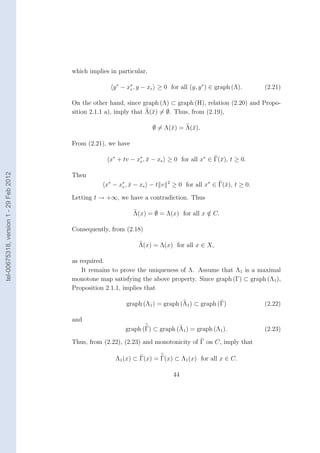
                                          a) Since ΓS (¯) ⊂ Γ(¯), we shall prove that Γ(¯) = ∅. Assume for con-
                                                       x       x                         x
                                                                            ∗
                                             tradiction that there exists x ∈ Γ(¯). Without loss of generality, we
                                                                          ¯     x
                                                                              x∗
                                             assume that the whole sequence { x∗ }k∈IN converges to some w∗ . Since
                                                                               k
                                                                               k
                                             xk ∈ S ⊂ dom (Γ) and x∗ ∈ Γ(xk )
                                                                      k

                                                        x∗   z∗
                                                         k
                                                           − ∗ , xk − z ≥ 0, ∀z ∈ int (C), z∗ ∈ Γ(z).
                                                        x∗
                                                         k   xk
                                             Passing to the limit we obtain,

                                                                     w∗ , x − z ≥ 0, ∀z ∈ C.
                                                                          ¯

                                                                      x                    ¯
                                             It follows that w∗ ∈ NC (¯). Since w∗ = 1 and d ∈ int (TC (¯)) one
                                                                                                        x
tel-00675318, version 1 - 29 Feb 2012


                                             has
                                                                                ¯
                                                                           w∗ , d < 0.                    (2.12)
                                             On the other hand, (xk , x∗ ) ∈ graph (Γ) and (¯, x∗ ) ∈ graph (Γ). Then
                                                                       k                    x ¯
                                                          x∗   x∗
                                                               ¯           1
                                                           k
                                                           ∗
                                                             − ∗ , dk =              x∗ − x∗ , xk − x ≥ 0.
                                                                                      k   ¯         ¯
                                                          xk   xk       tk x∗k
                                                                                  ¯
                                             Passing to the limit, we obtain w∗ , d ≥ 0, in contradiction with (2.12).

                                          b) Let d ∈ int (TC (¯)). Consider a sequence {(xk , x∗ )}k∈IN ⊂ graph (Γ)
                                                              x                                k
                                             such that xk = x + tk dk , tk → 0+ and dk → d. We shall prove that
                                                            ¯

                                                                   β = lim sup x∗ , dk = −∞,
                                                                                k
                                                                         k→+∞

                                             from what the result will follow. We assume, for contradiction, that
                                             −∞ < β. Since Γ(¯) = ∅ and, by definition, the graph of Γ is closed,
                                                                 x
                                                                    ∗
                                             the whole sequence xk converges to +∞ as k → +∞. Without loss
                                                                                             x∗
                                             of generality, assume that the whole sequence { x∗ }k∈IN converges to
                                                                                              k
                                                                                                 k

                                             some w∗ . Since Γ is monotone on int (C) ∩ S ∩ V, w∗ ∈ NC (¯), and
                                                                                                           x
                                                         ∗
                                             therefore w , d < 0. Thus, there exists k0 ∈ IN, such that k ≥ k0 ,
                                             implies
                                                                     β−1       x∗
                                                                                k
                                                                        ∗
                                                                           ≤        , dk < 0.
                                                                      xk       x∗
                                                                                k
                                             Passing to the limit, obtain 0 ≤ w∗ , d < 0, a contradiction.

                                                                               39
c) Follows from a) and from the fact that graph (Γ) is closed.

                                           The following result establishes a formulation of Γ on the boundary of
                                        the convex hull of dom (Γ).
                                                                    −→
                                        Theorem 2.3.5 Let Γ : X −→ X ∗ be a monotone multivalued map. Denote
                                        by C the closure of the convex hull of dom (Γ). Assume that int (C) = ∅, that
                                        x ∈ bd (C) and that there exist a subset S ⊂ dom (Γ) and a neighborhood
                                        ¯
                                        V ∈ N (¯) satisfying cl (V ∩ S) = cl (V ∩ C). Then,
                                               x

                                                                Γ(¯) = co (ΓS (¯))) + NC (¯).
                                                                  x            x          x

                                        Proof. i) We prove that co (ΓS (¯)) + NC (¯) ⊂ Γ(¯). Indeed, by definition,
                                                                        x         x      x
tel-00675318, version 1 - 29 Feb 2012


                                                          graph (ΓS ) ⊂ cl (graph (Γ)) ⊂ graph (Γ).

                                        Thus, ΓS (¯) ⊂ Γ(¯) and therefore co (ΓS (¯)) ⊂ Γ(¯) because Γ(¯) is closed
                                                   x     x                        x       x            x
                                        and convex. On the other hand, by Proposition 2.3.2, Γ(¯) = Γ(¯) + NC (¯).
                                                                                               x      x         x
                                        It follows that
                                                               co (ΓS (¯)) + NC (¯) ⊂ Γ(¯).
                                                                       x         x      x
                                           ii) We prove that co (ΓS (¯)) + NC (¯) is closed. In view of the result on
                                                                     x         x
                                        the closure of the sum of two closed convex sets, it is enough to prove that

                                                              −NC (¯) ∩ [co (ΓS (¯))]∞ = {0}.
                                                                   x             x

                                        Since co (ΓS (¯)) ⊂ Γ(¯), Proposition 2.3.2 implies
                                                      x       x

                                                             [co (ΓS (¯))]∞ ⊂ (Γ(¯))∞ ⊂ NC (¯).
                                                                      x          x          x

                                        Next, − NC (¯) ∩ NC (¯) = {0}, because int (C) = ∅. Therefore,
                                                    x        x

                                                    −NC (¯) ∩ [co (ΓS (¯))]∞ ⊂ −NC (¯) ∩ NC (¯) = {0},
                                                         x             x            x        x

                                        as required.
                                        iii) We prove that Γ(¯) ⊂ co (ΓS (¯)) + NC (¯). Assume, for contradic-
                                                                x           x         x
                                                                  ∗                 ∗
                                        tion, that there exists x ∈ Γ(¯) such that x ∈ co (ΓS (¯)) + NC (¯). Since
                                                                ¯     x            ¯ /         x         x

                                                                             40
co (ΓS (¯)) + NC (¯) is closed and convex, applying separation theorems (see
                                                x          x
                                                                                              ¯ ¯
                                        for instance [35], section 11), there exists a vector d, d = 1 such that

                                                     ¯                     x    ∗
                                                                                        x      ¯¯
                                                sup[ d, x∗ + x∗ : x∗ ∈ ΓS (¯), x2 ∈ NC (¯) ] < d, x∗ .             (2.13)
                                                         1    2    1


                                        Since NC (¯) is a cone,
                                                  x

                                                                            ¯
                                                                  0 = sup [ d, x∗ : x∗ ∈ NC (¯) ].
                                                                                             x                     (2.14)
                                                                                2    2

                                                ¯
                                        Hence d ∈ TC (¯). On the other hand, combining (2.14) and (2.13) one
                                                      x
                                        obtains
                                                                ¯
                                                          sup [ d, x∗ − x∗ : x1 ∈ ΓS (¯) ] < 0.
                                                                        ¯     ∗
                                                                                      x
                                        We shall show that there exists some d ∈ int (TC (¯)) such that
                                                                                          x
tel-00675318, version 1 - 29 Feb 2012


                                                                sup [ d, x∗ − x∗ : x∗ ∈ ΓS (¯) ] < 0.
                                                                              ¯     2       x

                                        Take some v ∈ int (TC (¯)). For all positive integer k, set
                                                               x

                                                                         ¯ 1
                                                                    dk = d + v ∈ int (TC (¯)).
                                                                                          x
                                                                            k
                                        We shall prove that for k large enough

                                                             sup [ dk , x∗ − x∗ : x∗ ∈ ΓS (¯) ] < 0.
                                                                             ¯             x

                                        If not, for all k, there exists x∗ ∈ ΓS (¯) such that
                                                                         k       x
                                                             1                      ¯
                                                               + dk , x∗ − x∗ ≥ 0 > d, x∗ − x∗ .
                                                                       k   ¯            k   ¯                      (2.15)
                                                             k
                                        Since ΓS (¯) is closed, it follows that x∗ → +∞ as k → +∞. Without loss
                                                  x                              k
                                                                           x∗
                                        of generality, we assume that x∗ converges to w∗ . Then, proceeding as in
                                                                            k
                                                                            k
                                        the proof Proposition 2.3.3 a), w∗ ∈ NC (¯). The relations in (2.15) imply
                                                                                   x
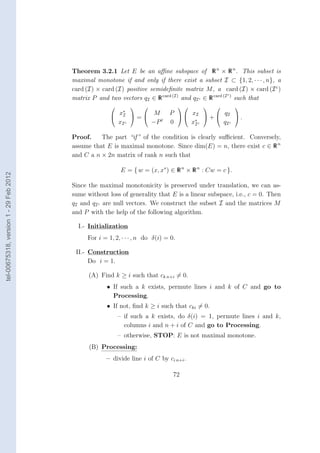
                                               1       x∗
                                                        k  x∗
                                                           ¯                      1 1   1   x∗
                                                                                             k  x∗
                                                                                                ¯
                                                ∗
                                                  + v, ∗ − ∗               = k[      ∗
                                                                                       + v, ∗ − ∗         ] > 0.
                                               xk      xk  xk                     k xk  k   xk  xk

                                        Passing to the limit,
                                                                             v, w∗ ≥ 0,

                                                                                  41
a contradiction. Hence there exists d ∈ int (TC (¯)) such that
                                                                                         x

                                                               sup [ d, x∗ : x∗ ∈ ΓS (¯) ] < d, x∗ .
                                                                         2    2       x         ¯            (2.16)

                                        Next, let us consider a sequence {(xk , x∗ )} ⊂ (S × X∗ ) ∩ graph (Γ) such
                                                                                 k
                                        that xk = x + tk dk , tk → 0+ , dk → d. Since d ∈ int (TC (¯)) and, by
                                                    ¯                                                  x
                                        assumption, Γ(¯) is not empty, Proposition 2.3.3 implies that the sequence
                                                       x
                                        {x∗ } is bounded. Without loss of generality it can be assumed that x∗
                                          k                                                                      k
                                                           ∗          ∗
                                        converges to some x . Then x ∈ ΓS (¯).
                                                                            x
                                                                       ∗
                                            On the other hand, since x ∈ Γ(¯),
                                                                     ¯     x

                                                                        1 ∗
                                                       x∗ − x∗ , dk =
                                                       ¯     k             x − x∗ , xk − x ≤ 0, ∀ k ∈ IN.
                                                                           ¯    k        ¯
                                                                        tk
tel-00675318, version 1 - 29 Feb 2012


                                        Passing to the limit

                                                               x∗ − x∗ , d ≤ 0,
                                                               ¯                   with x∗ ∈ ΓS (¯),
                                                                                                 x

                                        a contradiction with (2.16). Hence

                                                                  Γ(¯) ⊂ co (ΓS (¯)) + NC (¯),
                                                                    x            x         x

                                        as required.
                                           We summarize the different results above in the following theorem.

                                                                        −→
                                        Theorem 2.3.6 Let Γ : X −→ X ∗ be a monotone multivalued map. Denote
                                        by C the closure of the convex hull of dom (Γ). Assume that int (C) = ∅ and
                                        that there exists S ⊂ dom (Γ) such that cl (S) = C. Then, the multivalued
                                                     −→
                                        map Λ : X −→ X ∗ defined by
                                                                  
                                                                   co (ΓS (x)) + NC (x)
                                                                  
                                                                                            if x ∈ C,
                                                         Λ(x) =
                                                                  
                                                                               ∅             if x ∈ C,
                                                                  
                                                                  
                                                                                                  /

                                        is the unique maximal monotone map containing Γ with domain contained
                                        in C.

                                                                                  42
Proof.    By construction Λ is monotone on X. Theorems 2.3.3 and 2.3.5
                                        imply
                                                            Λ(x) = Γ(x) + NC (x) for all x ∈ X.                (2.17)

                                           In order to prove the maximality of Λ, by Proposition 2.1.1 c) we must
                                        prove that
                                                                Λ(x) = Λ(x) for all x ∈ X.
                                        We first show that
                                                                 Λ(x) = Λ(x) for all x ∈ C.                    (2.18)
                                        Indeed, since, by construction, graph (Γ) ⊂ graph (Λ), (2.17) and Proposition
                                        2.1.1 c) imply
tel-00675318, version 1 - 29 Feb 2012


                                                        Λ(x) ⊂ Λ(x) ⊂ Γ(x) ⊂ Λ(x) for all x ∈ C.

                                        Thus,
                                                              Λ(x) = Λ(x) = Γ(x) for all x ∈ C.                (2.19)
                                        Next, we prove that
                                                                   Λ(x) = ∅ for all x ∈ C.
                                                                                      /
                                                                                                                 −→
                                        Assume, for contradiction, that Λ(˜) = ∅, for some x ∈ C. Define H : X −→
                                                                          x                ˜ /
                                         ∗
                                        X by
                                                          graph (H) = graph (Λ) ∪ ({˜} × Λ(˜)).
                                                                                      x      x
                                        By definition, H is monotone. Denote by D the convex hull of C ∪ {˜}. In
                                                                                                         x
                                        view of Theorem 2.3.1,

                                                                H(z) = ∅ for all z ∈ int (D).                  (2.20)

                                        Consider x ∈ bd (C) ∩ int (D) and 0 = v ∈ NC (¯), such that
                                                 ¯                                    x

                                                                     xe = x + v ∈ int (D).
                                                                          ¯

                                        Take x∗ ∈ H(xe ). By definition,
                                              e


                                                       y ∗ − x∗ , y − xe ≥ 0 for all (y, y ∗ ) ∈ graph (H),
                                                              e


                                                                               43
which implies in particular,

                                                       y ∗ − x∗ , y − xe ≥ 0 for all (y, y ∗ ) ∈ graph (Λ).
                                                              e                                                    (2.21)

                                        On the other hand, since graph (Λ) ⊂ graph (H), relation (2.20) and Propo-
                                        sition 2.1.1 a), imply that Λ(¯) = ∅. Thus, from (2.19),
                                                                      x

                                                                       ∅ = Λ(¯) = Λ(¯).
                                                                             x      x

                                        From (2.21), we have

                                                     x∗ + tv − x∗ , x − xe ≥ 0 for all x∗ ∈ Γ(¯), t ≥ 0.
                                                                e ¯                           x
tel-00675318, version 1 - 29 Feb 2012


                                        Then
                                                    x∗ − x ∗ , x − x e − t v
                                                           e ¯
                                                                               2
                                                                                   ≥ 0 for all x∗ ∈ Γ(¯), t ≥ 0.
                                                                                                      x

                                        Letting t → +∞, we have a contradiction. Thus

                                                               Λ(x) = ∅ = Λ(x) for all x ∈ C.
                                                                                         /

                                        Consequently, from (2.18)

                                                                 Λ(x) = Λ(x) for all x ∈ X,

                                        as required.
                                            It remains to prove the uniqueness of Λ. Assume that Λ1 is a maximal
                                        monotone map satisfying the above property. Since graph (Γ) ⊂ graph (Λ1 ),
                                        Proposition 2.1.1, implies that

                                                            graph (Λ1 ) = graph (Λ1 ) ⊂ graph (Γ)                  (2.22)

                                        and
                                                            graph (Γ) ⊂ graph (Λ1 ) = graph (Λ1 ).                 (2.23)

                                        Thus, from (2.22), (2.23) and monotonicity of Γ on C, imply that

                                                        Λ1 (x) ⊂ Γ(x) = Γ(x) ⊂ Λ1 (x) for all x ∈ C.

                                                                                   44
Hence, the maximality of Λ1 , implies that

                                              Λ1 (x) = Λ1 (x) + NC (x) = Γ(x) + NC (x) = Λ(x) for all x ∈ X

                                        and the uniqueness follows.
                                           Remark. The above theorem is an extension of the well known result
                                        on convex functions (see for instance [35]): assume that f is proper, convex,
                                        lower semicontinuous and such that int (dom (f)) = ∅. Then

                                                            ∂f (x) = co (S(x)) + K(x) for all x,

                                        where K(x) is the normal cone to dom (f) at x (empty if x ∈ dom (f)) and
                                                                                                      /
                                        S(x) is the set of all limits of sequences of the form { f (xk )} such that f
tel-00675318, version 1 - 29 Feb 2012


                                        is differentiable at xk and {xk } tends to x. We will see later, that maximal
                                        monotone maps are reduced to a point almost everywhere on the interior of
                                        their domain.
                                            As a direct consequence of this theorem we have the well known result
                                        on the sum of two maximal monotone maps.
                                                                           −→
                                        Proposition 2.3.4 Let Γi : X −→ X ∗ , i = 1, 2, be two maximal monotone
                                        maps. Assume that int (dom (Γ1 ))∩int (dom (Γ2 )) = ∅. Then the multivalued
                                                  −→
                                        map Γ : X −→ X ∗ defined by

                                                                      Γ(x) = Γ1 (x) + Γ2 (x)

                                        is also maximal monotone.

                                        Proof. Denote by C the closure of dom (Γ) = dom (Γ1 ) ∩ dom (Γ2 ). It is
                                        clear C is convex with nonempty interior. Consider S ⊂ int (C) such that
                                        cl (S) = C. In view of Theorem 2.3.6, we shall prove that

                                                         co (ΓS (x)) + NC (x) ⊂ Γ(x) for all x ∈ X.
                                                                                         ∗
                                            We first prove that Γ is closed. Let {(xk , xk )} ⊂ graph (Γ) such that
                                        (xk , x∗ ) → (x, x∗ ). Then there exist two sequences {x∗ } and {x∗ } with
                                               k                                                1k        2k
                                        x∗ ∈ Γ1 (xk ), x∗ ∈ Γ2 (xk ) and x∗ + x∗ = x∗ .
                                         1k              2k               1k    2k


                                                                                45
We claim that {x∗ } (and therefore also {x∗ }) is bounded. Assume,
                                                              1k                           2k
                                                                                  ∗
                                        for contradiction, that the sequence of {x1k } is unbounded. Without loss of
                                                                                                               x∗
                                        generality we assume that the sequence { x∗ } converges to +∞ and { x1k }
                                                                                    1k                          ∗
                                                                                                                    1k
                                                       ∗                                               x∗
                                        converges to w . Then {     x∗
                                                                     2k   } converges to +∞ and {      } converges to
                                                                                                        2k
                                                                                                       x∗
                                                                                                        2k
                                        −w . Then w belongs to the normal cone of dom (Γ1 ) at x and −w∗ belongs
                                            ∗           ∗

                                        to the normal cone of dom (Γ2 ). This is a contradiction with int (dom (Γ1 )) ∩
                                        int (dom (Γ2 )) = ∅. Since the two sequences {x∗ } and {x∗ } are bounded we
                                                                                         1k       2k
                                        obtain that Γ is closed.
                                            It is clear that, for all x ∈ X, Γ(x) is convex. Thus the closedness of Γ
                                        and the definition of ΓS imply the inclusion above.
tel-00675318, version 1 - 29 Feb 2012


                                        2.4     Restriction of a maximal monotone map
                                                                                     −→
                                        In this section, we are given Γ : X × U −→ X ∗ × U ∗ and a fixed point u ∈ U .
                                                                                                              ¯
                                                         −→   ∗
                                        Define Σu : X −→ X by
                                                  ¯


                                                   Σu (x) = { x∗ : ∃ u∗ ∈ U ∗ such that (x∗ , u∗ ) ∈ Γ(x, u) }.
                                                    ¯                                                     ¯

                                        The graph of Σu is nothing else that the projection on X × X ∗ of the set
                                                      ¯


                                                              graph (Γ) ∩ (X × {¯} × X∗ × U∗ ).
                                                                                u

                                        The domain of Σu is such that
                                                       ¯


                                                           dom (Σu ) × {¯} = dom (Γ) ∩ (X × {¯}).
                                                                 ¯      u                    u                    (2.24)

                                           We shall study some properties of the map Σu .
                                                                                        ¯
                                           It is clear that Σu is monotone if Γ is monotone. If u ∈ proj U (dom (Γ))
                                                             ¯                                  ¯ /
                                        then Σu (x) = ∅ for all x ∈ X. In the next theorem we assume that Γ is
                                                ¯
                                        maximal monotone.

                                                                           −→
                                        Theorem 2.4.1 Let Γ : X × U −→ X ∗ × U ∗ be a maximal monotone multi-
                                        valued map and let (¯, u) ∈ int (dom (Γ)). Then, there exists a neighborhood
                                                             x ¯
                                        V of x such that Σu (x) = Σu (x) for every x ∈ V .
                                             ¯            ¯         ¯


                                                                                46
Proof. Let V × W be an open convex neighborhood of (¯, u) contained in
                                                                                             x ¯
                                                                                   ∗   ∗
                                        the interior of dom (Γ) and a compact K ⊂ X × U such that

                                                             Γ(x, u) ⊂ K for all (x, u) ∈ V × W.                  (2.25)

                                        Such V, W and K exist in view of Theorem 2.3.1. For any x ∈ V , Σu (x)       ¯
                                        is a convex subset of U ∗ because Γ(x, u) is a convex subset of X ∗ × U ∗ .
                                                                                   ¯
                                        We shall prove that that Σu is closed on V . Assume that x ∈ V and the
                                                                      ¯
                                                           ∗
                                        sequence {(xk , xk )} ⊂ (V × X ∗ ) ∩ graph (Σu ) converges to (x, x∗ ). We must
                                                                                       ¯
                                                          ∗
                                        prove that (x, x ) belongs to the graph of Σu . By definition of Σu , a sequence
                                                                                       ¯                    ¯
                                           ∗       ∗                    ∗  ∗                               ∗
                                        {uk } ⊂ U exists such that (xk , uk ) ∈ Γ(xk , u). The sequence {uk } is bounded
                                                                                       ¯
                                                                  ∗
                                        because of (2.25). Let u be a cluster point of the sequence. Without loss of
                                        generality, we assume that the whole sequence ((xk , u), (x∗ , u∗ )) converges to
tel-00675318, version 1 - 29 Feb 2012


                                                                                                ¯    k  k
                                        ((x, u), (x , u )). Then, the maximal monotonicity of Γ implies that (x∗ , u∗ ) ∈
                                             ¯     ∗   ∗

                                        Γ(x, u). Next, the definition of Σu implies that (x, x∗ ) belongs to graph (Σu ),
                                              ¯                             ¯                                          ¯
                                        and therefore Σu is closed on V . Next apply Corollary 2.3.2 to Σu .
                                                           ¯                                                  ¯

                                           The next result gives some information on the domain of Σu .
                                                                                                    ¯

                                                                                     −→
                                        Lemma 2.4.1 Assume that Γ : X × U −→ X ∗ × U ∗ is maximal mono-
                                        tone and the interior of its domain is nonempty. Assume also that u ∈   ¯
                                        proj U (int (dom (Γ))). Then the sets int (dom (Σu )) and cl (dom (Σu )) are
                                                                                         ¯                  ¯
                                        convex and

                                                          cl (int (dom (Σu ))) = cl (dom (Σu )),
                                                                         ¯                 ¯

                                                              int (dom (Σu )) = int (cl (dom (Σu ))).
                                                                         ¯                     ¯


                                           Furthermore, x ∈ bd (dom (Σu )) if and only if (x, u) ∈ bd (dom (Γ)).
                                                                      ¯                       ¯

                                        Proof. Since Γ is maximal monotone, cl (int (dom (Γ)) = cl (dom (Γ)) and
                                        int (cl (dom (Γ))) = int (dom (Γ)). Combine with relation (2.24).
                                        For the main result of this section, one needs the following lemma.

                                        Lemma 2.4.2 Let K be a closed convex subset of R n × R p and let C = { x ∈
                                        R n : (x, 0) ∈ K }. Assume that (0, 0) ∈ bd (K) and there exists x such that

                                                                               47
(x, 0) ∈ int (K). Then 0 ∈ bd (C) and the following relation holds between
                                        the normal cones at (0, 0) ∈ K and 0 to C

                                                x∗ ∈ NC (0) ⇐⇒ ∃ u∗ ∈ R p such that (x∗ , u∗ ) ∈ NK (0, 0).

                                        Proof. It is clear that if (x∗ , u∗ ) ∈ NK (0, 0) then x∗ ∈ NC (0). To show
                                        the converse statement, assume that x∗ ∈ NC (0), x∗ = 0. Then, because
                                        0 ∈ bd (C),
                                                                0 = inf [ −x∗ , x : x ∈ C ].
                                                                     x
                                                                                                                (P )
                                        Let us consider a convex function g : R n × R p →] − ∞, +∞[ such that

                                                  g(x, 0) < 0, K = { (x, u) : g(x, u) ≤ 0 } ⊂ int (dom (g)).
tel-00675318, version 1 - 29 Feb 2012


                                        Such a function is easily constructed. Then (P) can be written as

                                                       0 = inf [ −x∗ , x + 0, u : g(x, u) ≤ 0, u = 0 ].           (P )
                                                            x,u

                                        Because the Slater condition holds for this convex problem and (0, 0) is so-
                                        lution, there is λ ≥ 0, (z ∗ , v ∗ ) ∈ ∂g(0, 0) and w∗ ∈ R p such that

                                                                  −x∗ + λz ∗ = 0, λv ∗ + w∗ = 0.

                                        Then, because x∗ = 0, λ > 0 and λ−1 (x∗ , −w∗ ) ∈ NK (0, 0). It follows that
                                        (x∗ , −w∗ ) ∈ NK (0, 0).
                                           Now, we can prove the following basic result.
                                                                                    −→
                                        Theorem 2.4.2 Assume that Γ : X × U −→ X ∗ × U ∗ is maximal monotone
                                        and the interior of its domain is nonempty. Let u ∈ proj U (int (dom (Γ))).
                                                                                        ¯
                                        Then, Σu is maximal monotone on X.
                                                ¯

                                        Proof. i) Let x ∈ int (dom(Σu )), then (x, u) ∈ int (dom (Γ)). Theorem 2.4.1
                                                                        ¯           ¯
                                        implies that Σu (x) = Σu (x). We have proved that Σu is maximal monotone
                                                        ¯        ¯                             ¯
                                        on the interior of its domain.
                                            ii) Next, consider some x in the boundary of the domain of Σu . Proceeding
                                                                                                        ¯
                                        as in Theorem 2.4.1 we see that Σu (x) is convex. We shall prove that Σu
                                                                              ¯                                      ¯
                                                                                         ∗
                                        is closed in x. Consider any sequence {(xk , xk )} ⊂ graph (Σu ) converging
                                                                                                        ¯


                                                                               48
to (x, x∗ ). Then a sequence {u∗ } ⊂ U ∗ exists such that (x∗ , u∗ ) ∈ Γ(xk , u).
                                                                          k                            k   k          ¯
                                                                            ∗
                                        We claim that the sequence {uk } is bounded. Otherwise, there exists a
                                        subsequence with u∗l → +∞. Let w∗ be a cluster point of the sequence
                                                                k
                                            ∗ −1 ∗
                                        { u kl    ukl }. For simplification and without loss of generality, we assume
                                        that the whole sequence { uk −1 u∗ } converges to w∗ . Proceeding as in the
                                                                        ∗
                                                                              k
                                        proof of Proposition 2.3.3 a), we deduce that (0, w∗ ) belongs to the normal
                                        cone at (x, u) to dom (Γ).
                                                      ¯
                                            Choose x such that (¯, u) ∈ int (dom (Γ)) and > 0 small enough in order
                                                      ¯            x ¯
                                        that (¯, u + w∗ ) still belongs to dom (Γ). Since (0, w∗ ) belongs to the normal
                                               x ¯
                                        cone
                                                                0 < = (0, w∗ ), (¯ − x, w∗ ) ≤ 0,
                                                                                 x
                                        which is not possible.
tel-00675318, version 1 - 29 Feb 2012


                                           Thus, the sequence {u∗ } is bounded, without loss of generality we assume
                                                                k
                                        that the whole sequence {((xk , u), (x∗ , u∗ ))} converges to ((x, u), (x∗ , u∗ )).
                                                                         ¯    k    k                       ¯
                                        Then, the maximal monotonicity of Γ implies that (x∗ , u∗ ) ∈ Γ(x, u) and¯
                                                   ∗
                                        therefore x ∈ Σ(x). We deduce that Σu is closed on the whole space.
                                                                                 ¯
                                           Combining with Lemma 2.4.2 and Theorem 2.3.6, we obtain the maximal
                                        monotonicity.


                                        2.5      Dealing with relative interiors
                                        Until now, we have assumed that the affine hull of dom (Γ) is the whole
                                        space. Next, we shall generalize the previous results to the case where Γ is
                                        still monotone, dom (Γ) = ∅ but aff (dom (Γ)) = X. From now, we assume
                                        that
                                          aff (dom (Γ)) = a + L with a ∈ dom (Γ) and L is a linear subspace of X.
                                        Proposition 2.5.1 Assume that Γ is maximal monotone, then
                                          a) Γ(x) = Γ(x) + L⊥ for all x ∈ dom (Γ)
                                                                  −→
                                          b) there exists Σ : L −→ L maximal monotone such that
                                              Σ(l) = {l∗ ∈ L : l∗ ∈ Γ(a+l)} and Γ(a+l) = Σ(l)+L⊥ for all l ∈ L.

                                                                                49
c) the relative interior and the closure of dom (Γ) are convex sets. More-
                                             over

                                               cl (ri (dom (Γ))) = cl (dom (Γ)) and ri (cl (dom (Γ))) = ri (dom (Γ)).

                                        It follows that Σ can be also written as

                                                     Σ(l) = {l∗ ∈ L : ∃ l1 ∈ L⊥ with l∗ + l1 ∈ Γ(a + l)}.
                                                                         ∗                 ∗


                                        Proof.

                                          a) Let y ∗ ∈ L⊥ . Then y ∗ , x − x = 0 for all x, x ∈ dom (Γ).
                                                                           ¯                ¯
                                             Let x∗ ∈ Γ(¯), then for all (x, x∗ ) ∈ graph (Γ),
                                                 ¯      x
tel-00675318, version 1 - 29 Feb 2012


                                                           0 ≤ x∗ − x∗ , x − x = x∗ + y ∗ − x∗ , x − x .
                                                               ¯         ¯       ¯               ¯

                                             It follows that x∗ + y ∗ ∈ Γ(¯) = Γ(¯).
                                                             ¯            x      x

                                          b) i) Since L + L⊥ = X = X ∗ , it follows from definition of Σ that

                                                               Γ(a + l) = Σ(l) + L⊥ for all l ∈ L.

                                             ii) By definition, Σ is monotone. Assume that z ∗ ∈ Σ(z). Then

                                                           z ∗ − l∗ , z − l ≥ 0 for all (l, l∗ ) ∈ graph (Σ).

                                             Next, since Γ(a + l) = Σ(l) + L⊥ , for all (a + l, x∗ ) ∈ graph (Σ) and
                                             w ∗ ∈ L⊥
                                                             z ∗ − (x∗ − w∗ ), (a + z) − (a + l) ≥ 0.
                                             This implies that z ∈ L and therefore

                                                  z ∗ − x∗ , (a + z) − (a + l) ≥ 0 for all (a + l, x∗ ) ∈ graph (Σ).

                                             Thus z ∗ ∈ Γ(z + a) = Γ(a + z). Therefore z ∗ ∈ Σ(z).

                                          c) By definition, ri (dom (Γ)) = a + int (dom (Σ)) and cl (dom (Γ)) = a +
                                             cl (dom (Σ)). The result follows from the maximality monotonicity of
                                             Σ and Corollary 2.3.1.


                                                                               50
Next, we shall construct a maximal monotone extension of a monotone
                                        map. Recall that there are several ways to construct such extensions and
                                        there is no uniqueness of these extensions. We illustrate this plurality in the
                                        following example.

                                                                                      −→
                                        Example 2.5.1 Let us consider Γ : R 2 −→ R 2 be such that
                                                                          
                                                                           {(0, 0)}       if x1 = x2 ,
                                                            Γ(x1 , x2 ) = 
                                                                               ∅           otherwise .

                                                                                        −→
                                        Γ is monotone. Next, consider Γ1 , Γ2 : R 2 −→ R 2 be defined by
                                                                     
                                                                      { t(1, −1) : t ∈ R }      if x1 = x2 ,
tel-00675318, version 1 - 29 Feb 2012


                                                     Γ1 (x1 , x2 ) =
                                                                               ∅                 otherwise

                                        and
                                                        Γ2 (x1 , x2 ) = { (0, 0) } for all (x1 , x2 ) ∈ R 2 .

                                        Γ1 and Γ2 are two maximal monotone extensions of Γ. aff (dom (Γ1 ) =
                                        aff (dom (Γ)) and aff (dom (Γ2 ) = R 2 = aff (dom (Γ)).

                                           In this work we shall construct maximal monotone extensions preserving
                                        the affine hulls of the domain.
                                           We begin with the following proposition.

                                                                          −→                                    −→
                                        Proposition 2.5.2 Let Γ : X −→ X ∗ monotone. Define Σ : L −→ L∗ = L
                                        by
                                                 l∗ ∈ Σ(l) ⇐⇒ ∃ l⊥ ∈ L⊥ such that l∗ + l⊥ ∈ Γ(a + l).
                                                                   ∗                    ∗


                                        Then

                                          a) The multivalued map Σ is monotone

                                          b) We have the following relation between Γ and Σ

                                                                Γ(a + l) = Σ(l) + L⊥ for all l ∈ L.

                                                                                 51
c) If indeed Σ is such that

                                                                 Γ(a + l) = Σ(l) + L⊥ for all l ∈ L.

                                               Then Σ is maximal monotone if and only if Γ it so.

                                        Proof. Monotonicity of Σ is easily shown. Let us prove b). Let ¯∗ ∈ Γ(a+¯
                                                                                                       l        l).
                                        Then, by definition of Γ,
                                                ¯∗ − l∗ , (a + ¯ − (a + l) ≥ 0 for all l ∈ dom (Σ), l∗ ∈ Γ(a + l).
                                                l              l)

                                        By definition of Σ, last inequality implies that
                                        ¯∗ − (l∗ − l∗ ), ¯ − l ≥ 0 ∀ (l, l∗ ) ∈ graph (Σ), l∗ ∈ L⊥ s.t. l∗ + l∗ ∈ Γ(a + l).
                                        l           ⊥ l                                     ⊥                 ⊥
tel-00675318, version 1 - 29 Feb 2012


                                        Then
                                                          ¯∗ − l∗ , ¯ − l ≥ 0 for all (l, l∗ ) ∈ graph (Σ).
                                                          l         l
                                        Thus ¯∗ ∈ Σ(¯ and therefore Γ(a + ¯ ⊂ Σ(¯ = Σ(¯ + L⊥ .
                                             l      l),                   l)    l)     l)
                                                            ¯∗ ∈ Σ(¯ and ¯∗ ∈ L⊥ . Then
                                          Next, assume that l       l)    l⊥
                                                          ¯∗ − l∗ , ¯ − l ≥ 0 for all (l, l∗ ) ∈ graph (Σ)
                                                          l         l

                                        and
                                                            ¯∗ , ¯ − l ≥ 0 for all (l, l∗ ) ∈ graph (Σ).
                                                            l⊥ l
                                        Thus, for all (a + l, l∗ ) ∈ graph (Γ), l∗ ∈ L⊥ such that l∗ − l⊥ ∈ Σ(l),
                                                                                 ⊥
                                                                                                        ∗


                                                                   ¯∗ + ¯∗ − (l∗ − l∗ ), ¯ − l ≥ 0.
                                                                   l    l⊥          ⊥ l

                                        Then
                                                      ¯∗ + ¯∗ − l∗ , ¯ − l ≥ 0 for all (a + l, l∗ ) ∈ graph (Γ).
                                                      l    l⊥        l
                                        Therefore ¯∗ + ¯⊥ ∈ Γ(a + l), and the reverse inclusion follows.
                                                  l    l∗
                                           We now prove c). The maximal monotonicity of Γ implies the maximal
                                        monotonicity of Σ, see Proposition 2.5.1. In order to prove the converse, we
                                        first prove that dom (Γ) ⊂ aff (dom (Γ)). Indeed, given (¯, x∗ ) ∈ graph (Γ),
                                                                                                   x ¯
                                        one has

                                                    x∗ − l∗ , x − (a + l) ≥ 0 for all (a + l, l∗ ) ∈ graph (Γ).
                                                    ¯         ¯

                                                                                 52
Hence

                                             x∗ − (l∗ + l⊥ ), x − (a + l) ≥ 0 for all (l, l∗ ) ∈ graph (Σ), l∗ ∈ L⊥ .
                                             ¯           ∗
                                                              ¯                                              ⊥


                                        Therefore the inclusion follows. Thus, for all l ∈ L so that a + l ∈ dom (Γ),

                                                       Γ(a + l) = Σ(l) + L⊥ = Σ(l) + L⊥ = Γ(a + l),

                                        and the maximality of Γ follows.
                                            The above proposition implies in particular that if Σmax is a maximal
                                                                                      −→
                                        extension of Σ, the multivalued map Γmax : X −→ X ∗ defined by Γmax (x) =
                                        Σmax (x − a) + L⊥ is also a maximal extension of Γ.
                                            As an application of Theorem 2.4.2 and Proposition 2.5.2, we have the
tel-00675318, version 1 - 29 Feb 2012


                                        following extension of Proposition 2.3.4.
                                                                           −→
                                        Proposition 2.5.3 Let Γi : X −→ X ∗ , i = 1, 2, be two maximal monotone
                                        maps. Assume that ri (dom (Γ1 )) ∩ ri (dom (Γ2 )) = ∅. Then the multivalued
                                                  −→
                                        map Γ : X −→ X ∗ defined by

                                                  Γ(x) = Γ1 (x) + Γ2 (x)      for all x ∈ dom (Γ1 ) ∩ dom (Γ2 )

                                        is also maximal monotone.

                                        Proof. Fix a ∈ ri (dom (Γ1 )) ∩ ri (dom (Γ2 )). Then, there exists two linear
                                        subspaces L1 and L2 such that aff (dom (Γ1 )) = a + L1 and aff (dom (Γ2 )) =
                                        L2 .
                                             Take L = E0 = L1 ∩ L2 , E1 = L⊥ ∩ L1 , E2 = L⊥ ∩ L2 and E3 = L⊥ ∩ L⊥ .
                                                                                                             1     2
                                        Then aff (dom (Γ)) = a + L . Any x ∈ X can be uniquely expressed as

                                                    x = a + l0 + l1 + l2 + l3    with li ∈ Ei , i = 0, 1, 2, 3.
                                                                                                                −→
                                            For i = 1, 2 we consider the maximal monotone map Σi : Li −→ Li which
                                        is such that Γi (a + l) = Σi (l) + L⊥ for any l ∈ Li , next we consider the map
                                                                            i
                                               −→
                                        Σi : L −→ L which is such that

                                                   Σi (l) = { l∗ : ∃ ξ ∗ ∈ Ei such that (l∗ , ξ ∗ ) ∈ Σi (l, 0) }.

                                                                                 53
These map are maximal monotone in view of Theorem 2.4.2. Next, Propo-
                                        sition 2.3.4 implies that the sum Σ = Σ1 + Σ2 is maximal monotone on
                                        L.
                                            Let x ∈ dom (Γ). Let l ∈ L be such that x = a + l. Then,

                                              Γ1 (x) = {x∗ = l0 + l1 + l2 + l3 : (l0 , l1 ) ∈ Σ1 (l, 0), l2 ∈ E2 , l3 ∈ E3 },
                                                              ∗    ∗    ∗    ∗     ∗ ∗                    ∗         ∗


                                        and

                                           Γ2 (x) = {x∗ = t∗ + t∗ + t∗ + t∗ : (t∗ , t∗ ) ∈ Σ2 (l, 0), t1 ∈ E1 , t3 ∈ E3 }.
                                                           0    1    2    3     0 2
                                                                                                       ∗         ∗


                                        We deduce that
tel-00675318, version 1 - 29 Feb 2012


                                                            Γ(x) = {x∗ = a∗ + b∗ : a∗ ∈ Σ(l), b∗ ∈ L⊥ }.

                                        From what we deduce that Γ is maximal monotone.
                                           The following result is well known.
                                                                             −→
                                        Corollary 2.5.1 Let F : X −→ X ∗ be a monotone multivalued map and
                                        α > 0. F is maximal monotone if and only if Γ = F + αI is maximal
                                        monotone.

                                        Proof. ⇒) Follows from Proposition 2.5.3, since αI is maximal monotone.
                                        ⇐) Since F is monotone, it is enough to prove that graph (F) ⊂ graph (F).
                                        Let x∗ ∈ F (x). By definition,

                                                          x∗ − y ∗ , x − y ≥ 0 for all (y, y ∗ ) ∈ graph (F),

                                        and therefore, for every (z, z ∗ ) ∈ graph (Γ),

                                                (x∗ + αx) − z ∗ , x − z = α x − z        2
                                                                                             + x∗ − (z ∗ − αz), x − z ≥ 0.

                                        The maximality of Γ implies that x∗ + αx ∈ Γ(x), and therefore x∗ ∈ F (x),
                                        as required.
                                           The next result is an extension of Theorem 2.3.1.

                                                                                    54
Proposition 2.5.4 Assume in Theorem 2.3.1 that dom (Γ) = ∅ but int (D)
                                        not necessarily not empty. Then Γ is nonempty on ri (D). Actually, for all
                                        x ∈ ri (D) there exist a compact K ⊂ X ∗ and a neighborhood V of x such
                                        ¯                                                                   ¯
                                                               ⊥
                                        that ∅ = Γ(x) ⊂ K + L for all x ∈ V ∩ D, where L is a linear subspace such
                                        that aff (dom (Γ)) = a + L, a ∈ dom (Γ).
                                                                                                             ˆ
                                        Proof. Define Σ as in Proposition 2.5.2. Then the convex hull D of dom (Σ)
                                                                                 ¯                         ¯           ˆ
                                        has not empty interior. It is clear that x ∈ ri (D) if and only if x −a ∈ int (D).
                                                                              ˆ      ∗
                                        Thus by Theorem 2.3.1, a compact K ⊂ L and a neighborhood V exist suchˆ
                                                    ˆ               ˆ
                                        that Σ(x) ⊂ K for all x ∈ V . The result follows from Proposition 2.5.2.
                                           Next, we generalize Theorem 2.3.3.

                                        Proposition 2.5.5 With the same notations in Proposition 2.5.2, consider
tel-00675318, version 1 - 29 Feb 2012


                                               −→
                                        Γ : X −→ X ∗ be a proper monotone map. Assume that there exist S ⊂
                                        dom (Γ) and a relative open subset V ⊂ C such that cl (V ∩ S) = cl (V).
                                               ˆ ˆ                    ˆ             ˆ
                                        Denote S, V ⊂ L such that a + S = S and a + V = V . Then
                                                                                                                   ˆ
                                        co (ΓS (a + l)) + L⊥ ⊂ Γ(a + l) = Σ(l) + L⊥ = co (ΣS (l)) + L⊥ for all l ∈ V.
                                                                                           ˆ

                                          It follows that Γ is monotone on V and therefore any maximal monotone
                                        map containing Γ + L⊥ coincides with Γ on V .

                                        Proof. Since graph (Γ) is a closed subset, the inclusion

                                                                  co (ΓS (a + l)) + L⊥ ⊂ Γ(a + l)

                                        is clearly verified. On the other hand, Proposition 2.5.2 and Theorem 2.3.3
                                        imply that
                                                                                                       ˆ
                                                   Γ(a + l) = Σ(l) + L⊥ = co (ΣS (l)) + L⊥ for all l ∈ V.
                                                                               ˆ

                                        Therefore, the result follows.
                                          The inclusion in Proposition 2.5.5 can be strict. Indeed, consider Γ :
                                         2 −→
                                        R −→ R 2 defined by
                                                                 
                                                                  {( 1 (−1, 1)}    if x = y, 0 < |x| ≤ 1,
                                                                 
                                                                     x
                                                       Γ(x, y)
                                                                 
                                                                         ∅
                                                                 
                                                                 
                                                                                         otherwise .

                                                                                   55
Taking any dense subset S of co (dom (Γ)) and a = (0, 0), we obtain

                                                      Γ(0, 0) = { t(−1, 1) : t ∈ R }, but ΓS (0, 0) = ∅.

                                           The next proposition generalizes Theorem 2.3.5 when the interior of C is
                                        not assumed to be not empty.

                                        Proposition 2.5.6 With the same notations of Proposition 2.5.5, assume in
                                        Theorem 2.3.5 that Γ is a proper monotone map with int (C) not necessarily
                                        not empty. Then
                                                            Γ(a + ¯ = co ΣS (¯ + NC (a + ¯
                                                                   l)      ˆ l)          l),
                                        where a + ¯ ∈ rbd (C).
                                                  l
tel-00675318, version 1 - 29 Feb 2012


                                        Proof. Denote C = C − a. Then ¯ ∈ bd (C). By Theorem 2.3.5,
                                                      ˆ               l       ˆ

                                                                   Σ(¯ = co ΣS (¯ + NC (¯
                                                                     l)      ˆ l)    ˆ l).


                                        The result follows from Proposition 2.5.2 and from the fact that NC (a + ¯ =
                                                                                                                 l)
                                            ¯ + L⊥ .
                                        NC (l)
                                         ˆ

                                            Similarly to Theorem 2.3.6, we have the following result on maximal
                                        monotone extensions of monotone maps when the interior of the convex hull
                                        of their respective domains is not assumed to be not empty.
                                            This result is a direct consequence of Theorem 2.3.6 and Proposition 2.5.2.

                                        Theorem 2.5.1 With the same notation of Proposition 2.5.5, assume that
                                                −→
                                        Γ : X −→ X ∗ is a monotone multivalued map. Denote by C the closure of
                                                                         ˆ
                                        the convex hull of dom (Γ) and C = C − a. Let S ⊂ dom (Γ) be such that
                                                                                    −→
                                        cl (S) = C. Then, the multivalued map Λ : X −→ X ∗ defined by

                                                                                                       ˆ
                                                                  
                                                                   co (Σ ˆ (l)) + NC (a + l)
                                                                  
                                                                        S                      if l ∈ C,
                                                     Λ(a + l) =
                                                                  
                                                                                ∅                    / ˆ
                                                                                                if l ∈ C,
                                                                  
                                                                  


                                        is the unique maximal monotone map containing Γ with domain contained
                                        in C.

                                                                               56
Finally, the following proposition is an extension of Theorem 2.4.2.
                                                                                         −→
                                        Proposition 2.5.7 Assume that Γ : X × U −→ X ∗ × U ∗ is maximal mono-
                                                                                                            −→
                                        tone and u ∈ proj U (ri (dom (Γ))). Then the multivalued map Σu : X −→ X ∗
                                                 ¯                                                    ¯
                                        defined by
                                                    Σu (x) = { x∗ : ∃ u∗ ∈ U ∗ such that (x∗ , u∗ ) ∈ Γ(x, u) }
                                                     ¯                                                     ¯
                                        is maximal monotone.
                                            It follows that the relative interior and the closure of dom (Σu ) are convex
                                                                                                           ¯
                                        and satisfy the following relations
                                        cl (ri (dom (Σu ))) = cl (dom (Σu ))
                                                      ¯                 ¯      and    ri (cl (dom (Σu ))) = ri (dom (Σu )).
                                                                                                    ¯                 ¯

                                        Furthermore,
tel-00675318, version 1 - 29 Feb 2012


                                                       x ∈ rbd (dom (Σu )) ⇐⇒ (x, u) ∈ rbd (dom (Γ)).
                                                                      ¯           ¯
                                        Proof. In order to simplify the notations, assume, without loss of generality,
                                        that (0, 0) ∈ ri (dom (Γ)) and u = 0.
                                                                       ¯
                                           The linear subspace L = aff (dom (Γ)) can be written as
                                                            L = { (x, u) ∈ X × U : Ax + Bu = 0 },
                                        where A and B are two matrices of appropriate order. Then
                                                                       L⊥ = img ([A, B]t )
                                        and aff (dom (Σ0 )) = ker(A).
                                                        −→
                                           Define Σ : L −→ L∗ = L by
                                                                    Γ(x, u) = Σ(x, u) + L⊥ ,
                                        then Σ is maximal monotone, by Proposition 2.5.1 b). This implies that the
                                                                    −→
                                        multivalued map Σ0 : ker(A) −→ ker(A) defined by
                                               Σ0 (x) = { x∗ : ∃ u∗ ∈ proj U∗ (L∗ ) such that (x∗ , u∗ ) ∈ Σ(x, 0) }
                                        is also maximal monotone.
                                            By definition,
                                                            Σ0 = Σ0 + img (At ) = Σ0 + (ker(A))⊥ ,
                                        from what we deduce that Σ0 is maximal monotone.


                                                                                57
2.6       Strict and strong monotonicity
                                                                              −→
                                        Proposition 2.6.1 Let Γ : X −→ X ∗ be a monotone multivalued map

                                          a) If Γ is strictly monotone, then Γ− is single valued on its domain,

                                          b) If Γ is strongly monotone with modulus α > 0, then Γ− is                      1
                                                                                                                           α
                                                                                                                               −
                                             Lipschitz. Furthermore,

                                                                            Γ(C) =         Γ(x) = X ∗ ,
                                                                                     x∈C

                                               where C = co (dom (Γ)).
                                               In particular maximal strongly monotone maps are surjective.
tel-00675318, version 1 - 29 Feb 2012


                                        Proof.

                                          a)     Let (x∗ , x), (y ∗ , y) ∈ graph (Γ− ). By definition,

                                                                      x∗ − y ∗ , x − y > 0,       if x = y.

                                               Hence Γ− is single valued on its domain.

                                          b) Let (x∗ , x), (y ∗ , y) ∈ graph (Γ− ). By definition,

                                                          α x−y       2
                                                                          ≤ x∗ − y ∗ , x − y ≤ x ∗ − y ∗      x−y ,

                                               and therefore
                                                                                          1 ∗
                                                                             x−y ≤          x − y∗ .
                                                                                          α
                                               Hence Γ− is     1
                                                               α
                                                                   − Lipschitz.
                                                                                                                      −→
                                               Now, we shall prove that Γ(C) = X ∗ . For that, define F : X −→ X ∗
                                               by F (x) = Γ(x) − αx. Since Γ is strongly monotone with modulus
                                               α, F is monotone. By Theorem 2.5.1 a maximal monotone F con-
                                               taining F exists such that dom (F) ⊂ co (dom (F)) = C. Since F isˆ
                                               maximal monotone, Corollary 2.5.1 implies that the multivalued map
                                               ˆ     ˆ
                                               Γ = F + αI is strongly maximal monotone and is contained in Γ.
                                                             ˆ         ˆ
                                               Clearly, dom (Γ) = dom (F). Thus, in order to prove that Γ( C) = X ∗ ,

                                                                                     58
ˆ
                                             we shall prove that dom (Γ− ) = X∗ . To do that, it is enough to prove
                                                  ˆ           ˆ
                                             that C = dom (Γ ) is both open and closed, indeed a subset of R n
                                                                −

                                             which is both closed and open is either the empty set or the whole set.
                                                            ˆ                                            ˆ
                                             i) Proof that C is open: Assume, for contradiction, that C is not open.
                                                                           ˆ       ˆ         ˆ
                                             Then there exists some x∗ ∈ C ∩ bd (C). Thus Γ− (x∗ ) is not empty and
                                             by Proposition 2.3.2, its recession cone is Nco (C) (x∗ ). It follows that
                                                                                               ˆ
                                             ˆ                                                   ˆ
                                             Γ (x ) is unbounded, contradicting the fact that Γ− is single-valued on
                                               − ∗

                                              ˆ
                                             C.
                                                            ˆ                                                       ˆ
                                             ii) Proof that C is closed. Consider a sequence {(x∗ , xk )} ⊂ graph (Γ− )
                                                                                                  k
                                                                                               ˆ
                                             such that {x∗ } converges to some x∗ . Let y ∗ ∈ C. Then,
                                                          k


                                                                 ˆ          ˆ           1 ∗
                                                                 Γ− (xk ) − Γ− (y ∗ ) ≤   x − y∗ ,
tel-00675318, version 1 - 29 Feb 2012


                                                                                        α k
                                                                         ˆ
                                             and therefore the sequence {Γ− (xk )} has cluster points. Let x be such
                                                                                  ˆ                             ˆ
                                             a point. The closedness of graph (Γ− ) implies (x∗ , x) ∈ graph (Γ− ).
                                                     ∗
                                             Hence x ∈ C.ˆ


                                        Remark. For proper convex lower semicontinuous functions there exists an
                                        (almost) equivalence between their strict convexity and the differentiability
                                        of their conjugates: if f is strictly convex then ∂f ∗ is single-valued on its
                                        domain; conversely, if ∂f ∗ is single-valued on its domain, then f is strictly
                                        convex on the relative interior of its domain.
                                            Example 2.1.1 shows that the equivalence does not hold for maximal
                                        monotone maps, the strict monotonicity corresponding to the strict mono-
                                        tonicity and the maps to the subdifferentials. In this example Γ and Γ− are
                                        maximal monotone and single-valued but they are not strictly monotone.
                                            The following result gives a characterization of maximal strictly monotone
                                        maps.

                                                                         −→
                                        Proposition 2.6.2 Let Γ : X −→ X ∗ be a strictly monotone map. It is
                                        maximal monotone if and only if it is closed and its dom (Γ− ) is open and
                                        convex.

                                                                              59
Proof.      Assume that Γ is maximal monotone. Then Γ is closed and
                                        from Proposition 2.6.1 dom (Γ− ) is open and convex. Conversely, in view
                                        of Proposition 2.6.1 and the closedness of Γ, one has, for S = dom (Γ− ),
                                        that                         
                                                                      Γ− (x∗ ) if x ∈ dom (Γ− ),
                                                                     
                                                                     
                                                           −    ∗
                                                        (Γ )S (x ) =
                                                                     
                                                                          ∅      if x ∈ dom (Γ− ).
                                                                     
                                                                     
                                                                                      /
                                        Thus, by Theorem 2.3.6, Γ− and, hence, Γ are maximal monotone.
                                           Next, we shall state a well known result which provides a very impor-
                                        tant characterization of maximal monotone maps. This result is a direct
                                        consequence of Proposition 2.6.1.
tel-00675318, version 1 - 29 Feb 2012


                                                                                                 −→
                                        Proposition 2.6.3 (Minty Theorem) Let F : X −→ X ∗ be a monotone
                                        map. F is maximal monotone if and only if dom (Γ− ) = X∗ , where Γ =
                                        F + I.

                                        Proof. ⇒) Γ is strongly monotone with modulus 1. Since F is maximal
                                        monotone, Γ is also maximal monotone, and therefore, from Proposition
                                        2.6.1, dom (Γ− ) = X∗ .
                                        ⇐) We shall prove that any (x, x∗ ) ∈ graph (F) belongs to graph (F) too.
                                        Since dom (Γ− ) = X∗ , there exists (ξ, ξ ∗ ) ∈ graph (F) such that x∗ +x = ξ ∗ +ξ.
                                        By definition of F ,

                                                            0 ≤ x∗ − ξ ∗ , x − ξ = − x − ξ, x − ξ ,

                                        and therefore (x, x∗ ) = (ξ, ξ ∗ ) ∈ graph (F).

                                                                            −→
                                        Proposition 2.6.4 Let Γ : X −→ X ∗ be a monotone map with bounded
                                        domain. Then Γ(C) = X ∗ , where C = co (dom (Γ)).

                                        Proof. By same argument of Proposition 2.6.1 b), there exists a maximal
                                                          ˆ                                ˆ
                                        monotone map Γ containing Γ such that dom (Γ) ⊂ C. Clearly dom (Γ) is      ˆ
                                                             ˆ
                                        bounded and that Γ is contained in Γ. Thus, in order to prove that Γ(C) =
                                                                       ˆ
                                        X ∗ , we shall prove that dom (Γ− ) = X∗ . As in the proof of Proposition 2.6.1,

                                                                                 60
ˆ         ˆ
                                        we shall show that C = dom (Γ− ) is both open and closed.
                                                                             ˆ                              ˆ
                                        i) Assume, for contradiction, that C is not open. Take some x∗ ∈ C ∩bd (C).ˆ
                                                ˆ
                                        Then Γ− (x∗ ) is not empty and, by Proposition 2.3.2, its recession cone is
                                                                          ˆ
                                        Nco (C) (x∗ ). This implies that Γ− (x∗ ) is unbounded, contradicting the fact
                                             ˆ
                                                      ˆ
                                        that dom (Γ) is bounded.
                                                           ˆ
                                        ii) Proof that C is closed. Consider a sequence {(x∗ , xk )} ⊂ graph (Γ− )ˆ
                                                                                                 k
                                                                                           ˆ
                                        such that {x∗ } converges to some x∗ . Since dom (Γ) is bounded, the sequence
                                                        k
                                                                                                                  ˆ
                                        {xk } has cluster points. Let x be such a point. The closedness of graph (Γ− )
                                                                  ˆ
                                        implies (x∗ , x) ∈ graph (Γ− ). Hence x∗ ∈ C.ˆ

                                                                        −→
                                        Proposition 2.6.5 Let Γ : X −→ X ∗ be a maximal monotone map. Assume
                                        that for all sequence {(xk , x∗ )} ⊂ graph (Γ) such that xk → +∞ we have
tel-00675318, version 1 - 29 Feb 2012


                                                                      k
                                         x∗ → +∞. Then dom (Γ− ) = X∗ .
                                          k


                                        Proof. We first recall that for all x∗ ∈ X ∗ , Γ− (x∗ ) is bounded. As in the
                                                                                       ˆ
                                        previous proposition, we shall show that C = dom (Γ− ) is both open and
                                        closed.
                                                                                ˆ                            ˆ
                                        i) Assume, for contradiction, that C is not open. Take some x∗ ∈ C ∩bd (C).  ˆ
                                        Thus Γ− (x∗ ) is not empty and, by Proposition 2.3.2, its recession cone is
                                        Nco C) (x∗ ). It follows that Γ− (x∗ ) is unbounded, contradicting the fact that
                                             ˆ
                                        dom (Γ) is bounded.
                                                          ˆ
                                        ii) Proof that C is closed. Consider a sequence {(x∗ , xk )} ⊂ graph (Γ− ) such
                                                                                              k
                                        that {x∗ }k∈IN converges to some x∗ . By assumption, the sequence {xk } has
                                                 k
                                        cluster points. Let x be such a point. The closedness of graph (Γ− ) implies
                                        (x∗ , x) ∈ graph (Γ− ). Hence x∗ ∈ C.  ˆ

                                                                           −→
                                        Proposition 2.6.6 Let Γ : X −→ X ∗ be a maximal monotone map such
                                        that x ∈ ri (dom (Γ)). Assume that for all sequence {(xk , x∗ )} ⊂ graph (Γ)
                                             ˆ                                                      k
                                        with xk → +∞ we have

                                                                   lim sup x∗ , xk − x > 0.
                                                                            k        ˆ
                                                                    k→+∞


                                        Then Γ− (0) is a nonempty compact set.

                                                                                61
Proof. Define the set

                                                      A = { x ∈ dom (Γ) : ∃ x∗ ∈ Γ(x), x∗ , x − x ≤ 0 }.
                                                                                                ˆ

                                        Clearly, A is bounded and Γ− (0) ⊂ A. Consider r > 0 such that the Eu-
                                                                                         −→
                                        clidean ball Br (ˆ) contains A. Define F : X −→ X ∗ by F (x) = Γ(x) +
                                                          x
                                        NB2r (ˆ) (x). Since x ∈ ri (dom (Γ)) ∩ B2r (ˆ), F is maximal monotone and
                                              x             ˆ                       x
                                        therefore, since dom (F) is bounded, there exists x ∈ B2r (ˆ) such that
                                                                                          ¯        x

                                                                 0 ∈ F (¯) = Γ(¯) + NB2r (ˆ) (¯).
                                                                        x      x          x x


                                        Let x∗ ∈ NB (¯) such that −¯∗ ∈ Γ(¯). Let us prove that x ∈ A. For that,
                                             ¯        x               x       x                   ¯
                                        assume, for contradiction, that x ∈ A. Since x ∈ NB (¯), x∗ , x − x ≥ 0, for
                                                                          ¯/         ¯ ∗
                                                                                             x ¯ ¯
tel-00675318, version 1 - 29 Feb 2012


                                                                                         ∗
                                        all x ∈ B. In particular, for x = x, we have x , x − x ≥ 0. On the other
                                                                            ˆ           ¯ ¯ ˆ
                                                                    ∗           ∗
                                        hand, since x ∈ A and −¯ ∈ Γ(¯), x , x − x < 0, which is not possible.
                                                    ¯ /           x        x ¯ ¯ ˆ
                                                                        ∗
                                        Hence x ∈ A, and therefore x = 0. Thus, 0 ∈ Γ(¯), as required.
                                               ¯                      ¯                    x

                                                                      −→
                                        Theorem 2.6.1 Let Γ : X −→ X ∗ be a maximal monotone multivalued map
                                        such that C = int (dom(Γ)) = ∅. Then Γ is single-valued almost everywhere
                                        (in the Lebesgue sense) on C.

                                        Proof. The result, when dim(X) = 1, is a well known result on monotonic
                                        functions of one real variable, see for instance Natanson [29]. Assume that
                                        dim(X) = n > 1. For every i = 1, · · · , n, let us define, for every x ∈ C,

                                                          θi (x) = max [ x∗ − y ∗ , ei : x∗ , y ∗ ∈ Γ(x) ],

                                        where for i = 1, · · · , n, ei denotes the ith canonical vector in X. Since Γ(x)
                                        is compact for all x ∈ C and the map Γ is usc, the function θi is upper
                                        semicontinuous and therefore measurable on C. Thus the set Di = {x ∈ C :
                                        θi (x) ≤ 0} is measurable because C is convex and open.
                                             Let x ∈ D = ∩i=1 Di . If x∗ , y ∗ ∈ Γ(x), then |x∗ − yi | ≤ 0 for all i. Hence
                                                             n
                                                                                              i
                                                                                                   ∗

                                        x∗ = y ∗ . Thus D is the set of x ∈ C such that Γ(x) is reduced to a singleton.
                                        D and their complement Dc = ∪n Di are measurable. We shall prove that
                                                                              i=1
                                                                                   c

                                        for all i, meas (Dc ) = 0, from what it is deduced that meas (Dc ) = 0. We give
                                                          i


                                                                                 62
the proof for i = n. In fact, we shall prove that meas (Dc ∩ P) = 0, for all
                                        P of the type P = n [¯i , xi + ], with > 0, from what the result follows.
                                                             i=1 x ¯
                                                                                        c
                                        Denotes by 1Dn the characteristic function of Dn defined by
                                                       c

                                                                              
                                                                                                  c
                                                                               1         if x ∈ Dn ,
                                                                    1Dn (x) =
                                                                      c
                                                                               0              / c
                                                                                          if x ∈ Dn .
                                        By Fubini’s theorem,
                                                                                          xn +
                                                                                          ¯
                                           meas (Dc ∩ P) =
                                                  n                1Dc (x)dx =
                                                                     n
                                                                                     [           1Dc (x)dxn ]dx1 · · · dxn−1 ,
                                                                                                   n
                                                                                                                                 (2.26)
                                                               P                 Q       xn
                                                                                         ¯

                                        where Q = {y = (x1 , · · · , xn−1 ) ∈ R n−1 : ∃ xn with (x1 , · · · , xn−1 , xn ) ∈ P ∩
                                        C}. For y ∈ Q, let us define
                                                              D(y) = {xn ∈ R : (y, xn ) ∈ Dn ∩ P }.
tel-00675318, version 1 - 29 Feb 2012


                                                                                                                                   −→
                                        By definition, D(y) is the set of points where the multivalued map hy : R −→
                                        R defined by
                                                                  hy (t) = Γ(y, xn + t), en
                                                                                 ¯
                                        is reduced to a singleton. This map hy is monotone. Applying again the result
                                        on monotonic functions of one real variable, we obtain that meas ([D(y)]c ) =
                                        0. Report in (2.26), we deduce that meas (Dc ∩ P) = 0.
                                                                                     n


                                        2.7      Maximal monotone extensions
                                                                                                          ¯
                                        Let G be a subset of X × X ∗ . If G is not monotone, there is no G monotone
                                        containing G. If G is monotone, with an argument based on the axiom of
                                        choice, it is possible to prove that there exists a maximal monotone extension
                                        of G. This extension is not unique as seen in the following example:
                                        Example 2.7.1 G = {(−1, −1), (1, 1)} ⊂ R 2 , G is monotone. The two
                                        following sets
                                                           G1 = {(x, x∗ ) ∈ R 2 : x∗ = x} ,
                                                           G2 = ] − ∞, 1] × {−1} ∪ {1} × [−1, ∞[
                                        are maximal monotone, and they both contain G.

                                                                                  63
The axiom of choice is not constructive. We shall show how to construct a
                                        maximal monotone extension.
                                                        −→
                                            Let F : X −→ X ∗ be a monotone map. Denote by C, the closure of
                                        the convex hull of dom (F). We assume that int (C) is nonempty and we are
                                        given a countable set S = {x0 , x1 , · · · , xn , · · ·} ⊂ int (C) such that cl (S) = C.
                                        In the construction, by convention, A + ∅ = ∅.
                                        Algorithm:
                                                                 −→
                                        Step 0 Define F0 : X −→ X ∗ by
                                                                        
                                                                         F (x) + NC (x)
                                                                        
                                                                                               if x ∈ C,
                                                             F0 (x) =
                                                                        
                                                                                     ∅
                                                                        
                                                                        
                                                                                                  if not .
tel-00675318, version 1 - 29 Feb 2012


                                        By construction F0 is monotone and dom (F0 ) = dom (F).

                                        Step k In the previous steps a monotone map Fk has been obtained with
                                        graph (Fk ) ⊃ graph (F).
                                           • If dom (Fk ) ⊃ S, by Theorem 2.3.6, the multivalued map
                                                                                −→
                                                                            x −→ Fk (x) + NC (x)

                                              is maximal monotone. STOP.

                                           • If not, take

                                                              p(k) = min[ p ∈ IN : xp ∈ S ∩ (dom (Fk ))c ],

                                              and define
                                                                            
                                                                            
                                                                            
                                                                                Fk (x)       if x ∈ dom (Fk ),
                                                                            
                                                                            
                                                                            
                                                                            
                                                                            
                                                                            
                                                              Fk+1 (x) =        Fk (xp(k) )   if x = xp(k) ,
                                                                            
                                                                            
                                                                            
                                                                            
                                                                            
                                                                            
                                                                            
                                                                                     ∅        otherwise .
                                                                            
                                                                            


                                              By construction, Fk+1 is monotone,

                                                                 graph (F) ⊂ graph (Fk ) ⊂ graph (Fk+1 )

                                                                                     64
and
                                                       dom (Fk+1 ) = dom (Fk ) ∪ {xp(k) } ⊂ C.
                                        Do k = k + 1 and go back to step k.
                                        End of algorithm
                                                                                −→
                                        Take D = ∪k dom (Fk ). Define Γ : X −→ X ∗ by
                                                                 
                                                                  Fk (x)
                                                                 
                                                                             if x ∈ dom (Fk ),
                                                        Γ(x) =
                                                                 
                                                                     ∅        if x ∈ D.
                                                                 
                                                                 
                                                                                   /

                                         Γ is monotone and C ⊃ dom (Γ) = D ⊃ S. Thus, in view of Theorem
                                                                         −→
                                        2.3.6, the multivalued map Σ : X −→ X ∗ defined by Σ(x) = Γ(x) +
tel-00675318, version 1 - 29 Feb 2012


                                        NC (x) is maximal monotone. Its graph contains the graph of F and
                                        cl (dom (Σ)) = C.


                                                                         65
tel-00675318, version 1 - 29 Feb 2012


66
Chapter 3

                                        Monotonicity and maximal
                                        monotonicity of affine
tel-00675318, version 1 - 29 Feb 2012


                                        subspaces

                                        Monotone linear variational inequality problems constitute an important
                                        class of variational inequality problems. They are of the form:

                                                   Find x ∈ C such that
                                                        ¯                   A¯ − c, y − x ≥ 0 ∀ y ∈ C,
                                                                             x          ¯

                                        where c ∈ R n , A is a n × n positive semidefinite matrix and C ⊂ R n is a
                                        polyhedral convex subset. Linear and quadratic optimization programs can
                                        be formulated in this way.
                                            The map Γ : R n → R n defined by Γ(x) = Ax − c is maximal monotone,
                                        its graph
                                                        E = { (x, x∗ ) ∈ R n × R n : Ax + (−I)x∗ = c },
                                        where I denotes the identity matrix of order n, is a maximal monotone affine
                                        subspace of R n × R n .
                                           In this chapter, we generalize the above representation to subspaces of
                                        the form
                                                         E = { (x, x∗ ) ∈ R n × R n : Ax + Bx∗ = c },
                                        where A and B are two p × n matrices and c ∈ R p .

                                                                            67
It is clear that any affine subspace of R n × R n can be written in this way.
                                            In sections 3.1 and 3.2 we characterize the monotonicity and the maximal
                                        monotonicity of these subspaces. An important result shows that at any
                                        maximal monotone subset is associated a permutation of the variables and a
                                        positive subdefinite matrix. Based on this result, we give a finite algorithm
                                        to obtain a maximal monotone affine extension of a monotone map subspace.
                                        The linearity structure allows a quite simpler construction than the one given
                                        in Chapter 2 for non affine subspaces.
                                            The last section is concerned with the restriction of an affine monotone
                                        subspace.


                                        3.1     Monotone affine subspaces
tel-00675318, version 1 - 29 Feb 2012


                                        In this section we consider subsets of R n × R n of the form

                                                         E = { (x, x∗ ) ∈ R n × R n : Ax + Bx∗ = c },

                                        where c ∈ R p , A and B are two p × n matrices.
                                            Without loss of generality, we assume that there is no redundance in the
                                        linear system, i.e., the p × 2n matrix C = [A, B] is of rank p.
                                            By definition, the set E is monotone if and only if

                                                     inf[ x2 − x∗ , x2 − x1 : (xi , x∗ ) ∈ E, i = 1, 2 ] ≥ 0.
                                                           ∗
                                                                1                    i

                                        Denote P the 2n × 2n matrix defined by
                                                                                       
                                                                            0         I 
                                                                       P =               ,
                                                                            I         0
                                        where I is the identity matrix of order n; then the monotonicity of E is
                                        equivalent to
                                                                inf [ P u, u : Cu = 0 ] = 0,
                                                                 u
                                        which is also equivalent to the following condition:

                                                                Cu = 0      =⇒        P u, u ≥ 0.               (P SD)

                                           Then we have the following characterization of monotone affine subspaces.

                                                                                 68
Theorem 3.1.1      1. The subset E is monotone if and only if p ≥ n and
                                            the p × p matrix M = AB t + BAt has exactly p − n positive eigenvalues.

                                          2. The subset E is maximal monotone if and only if p = n and E is
                                             monotone.

                                        Proof.

                                          1. Let us consider the inertia of the (2n + p) × (2n + p) bordered matrix
                                                                                           
                                                                              P        Ct 
                                                                         T =               .
                                                                              C        0
tel-00675318, version 1 - 29 Feb 2012


                                             This inertia In (T) is the triple

                                                                        In (T) = (ν+ , ν− , ν0 ),

                                             where ν+ , ν− and ν0 denote respectively the numbers of positive, nega-
                                             tive and zero eigenvalues of T ( ν+ +ν− +ν0 = 2n+p ). By construction,
                                             since rank (C) = p, we have µ− ≥ p. Then condition (PSD) (see [6],
                                             [9]) is equivalent to say that ν− is exactly p. Moreover, in view of a
                                             result on the Schur’s Complement (see [6], [9]),

                                                             In (T) = In (P) + In (0 − CP−1 Ct )
                                                                      = (n, n, 0) + In (−ABt − BAt ).

                                             Thus, F is monotone if and only if p ≥ n and the matrix M has exactly
                                             p − n positive eigenvalues.

                                          2. By Proposition 2.1.1, E monotone is maximal monotone if and only if

                                                                (¯, x∗ ) ∈ E
                                                                 x ¯             =⇒     A¯ + B x∗ = c,
                                                                                         x     ¯

                                             where

                                                 E = { (x, x∗ ) ∈ R n × R n : x∗ − ξ ∗ , x − ξ ≥ 0, Aξ + Bξ ∗ = c }.

                                                                                 69
Set c = c − A¯ − B x∗ , then E monotone is maximal monotone if and
                                            ¯           x     ¯
                                        only if it satisfies the following condition

                                                         inf [ P u, u : Cu = c ] ≥ 0
                                                                             ¯             =⇒     c = 0.
                                                                                                  ¯                    (3.1)
                                                            u

                                        It is known that a quadratic function which is bounded from below
                                        on a convex polyhedral set reaches its minimum at some feasible point
                                        u (see [13]). Then according to the KKT optimality condition, there
                                        ¯
                                        exists a vector v such that P u = C t v . Then
                                                        ¯             ¯       ¯

                                                u = P −1 C t v = P C t v
                                                ¯            ¯         ¯      and    c = C u = CP C t v = M v .
                                                                                     ¯     ¯          ¯     ¯

                                        Note that
                                                                 P u, u = C t v , P C t v = M v , v .
                                                                   ¯ ¯        ¯         ¯     ¯ ¯                      (3.2)
tel-00675318, version 1 - 29 Feb 2012


                                        If p = n and the subset E is monotone and the symmetric matrix M is
                                        negative semidefinite. The left hand side relation in (3.1) and relation
                                        (3.2) imply that 0 ≤ M v , v ≤ 0 and therefore c = M v = 0. The
                                                                  ¯ ¯                      ¯       ¯
                                        sufficient condition follows.
                                        Next, assume that E is monotone and p > n. Since M is symmetric,
                                        there exist a p × p orthogonal matrix Q (QQt = I), n × n negative
                                        semidefinite diagonal matrix D1 and a (p − n) × (p − n) positive definite
                                        diagonal matrix D2 , such that
                                                                                             
                                                                               D1       0 
                                                                     QM Qt =               .
                                                                               0        D2

                                        Define
                                                                                                                    
                                                            A1    B1                                             c1 
                                         C = QC =                     ,     M = CP C t     and c = Qc =              .
                                                            A2    B2                                              c2

                                        Then
                                                                                                               
                                                        A1 B1 + B1 At
                                                            t
                                                                    1         A1 B2 + B1 At
                                                                                  t
                                                                                          2             D1   0
                                                                                                               
                                            M =
                                               
                                                                                              =
                                                                                               
                                                                                                                  .
                                                                                                                  
                                                        A2 B1 + B2 At
                                                            t
                                                                    1         A2 B2 + B2 At
                                                                                  t
                                                                                          2             0    D2

                                                                              70
This implies that the n × n matrix

                                                                            A1 B1 + B1 At = D1
                                                                                t
                                                                                        1


                                              has no positive eigenvalues and the n × 2n matrix [A1 , B1 ] has rank n.
                                              It follows from part 2 of the proof that the subset

                                                             E1 = {(x, x∗ ) ∈ R n × R n : A1 x + B1 x∗ = c1 }

                                              is maximal monotone. Since p > n and [A, B] is of rank p, this set
                                              strictly contains the set

                                                  E = {(x, x∗ ) ∈ R n × R n : A1 x + B1 x∗ = c1 , A2 x + B2 x∗ = c2 },
tel-00675318, version 1 - 29 Feb 2012


                                              which is obviously equal to E. The theorem follows.

                                        As immediate consequences of this theorem, we deduce the following results.

                                        Corollary 3.1.1 Assume that C = [A, B] has rank p.

                                           i) If p < n, then E is not monotone.

                                          ii) If p > n, then E is not maximal monotone.

                                         iii) If E is monotone, dim(E) ≤ n.

                                          iv) E is maximal monotone if and only if E is monotone and dim(E) = n.


                                        3.2        A characterization of maximal monono-
                                                  tonicity for affine subspaces
                                        The following result says that any affine maximal monotone subspace can
                                        be written, under appropriate permutation of its variables, as the graph
                                        of an affine map. Before, the following notations are useful: For a subset
                                        I ⊂ {1, 2, · · · , n}, denotes I c = { i ∈ {1, 2, · · · , n} : i ∈ I } and for x ∈ R n ,
                                                                                                         /
                                                                               t
                                        denotes xI = (xi1 , xi2 , · · · , xir ) , where {i1 < i2 < · · · < ir } = I. Finally, for
                                        a matrix C, denotes by cij the element in the ith line and jth column of C.

                                                                                   71
Theorem 3.2.1 Let E be an affine subspace of R n × R n . This subset is
                                        maximal monotone if and only if there exist a subset I ⊂ {1, 2, · · · , n}, a
                                        card (I) × card (I) positive semidefinite matrix M , a card (I) × card (I c )
                                                                                                     c
                                        matrix P and two vectors qI ∈ R card (I) and qI c ∈ R card (I ) such that
                                                                                                 
                                                        x∗
                                                       I =
                                                               M              P   x I   qI 
                                                                                         +       .
                                                       xI c   −P t            0     x∗ c
                                                                                     I      qI c

                                        Proof.    The part “if ” of the condition is clearly sufficient. Conversely,
                                        assume that E is maximal monotone. Since dim(E) = n, there exist c ∈ R n
                                        and C a n × 2n matrix of rank n such that

                                                           E = { w = (x, x∗ ) ∈ R n × R n : Cw = c }.
tel-00675318, version 1 - 29 Feb 2012


                                        Since the maximal monotonicity is preserved under translation, we can as-
                                        sume without loss of generality that E is a linear subspace, i.e., c = 0. Then
                                        qI and qI c are null vectors. We construct the subset I and the matrices M
                                        and P with the help of the following algorithm.

                                          I.- Initialization
                                             For i = 1, 2, · · · , n do δ(i) = 0.

                                         II.- Construction
                                              Do i = 1.

                                              (A) Find k ≥ i such that ck n+i = 0.
                                                     • If such a k exists, permute lines i and k of C and go to
                                                       Processing.
                                                     • If not, find k ≥ i such that cki = 0.
                                                          – if such a k exists, do δ(i) = 1, permute lines i and k,
                                                            columns i and n + i of C and go to Processing.
                                                          – otherwise, STOP: E is not maximal monotone.
                                              (B) Processing:
                                                    – divide line i of C by ci n+i .

                                                                                72
– for k = i and j = 1, 2, · · · , 2n do ckj = ckj − ck n+i cij .
                                                   If i < n, increase i by one and go to (A).
                                                   If not, the algorithm is finished.

                                        Justification of the algorithm

                                        a) The algorithm cannot stop at step i ≤ n.
                                        We shall prove that we have a contradiction with E monotone if i ≤ n. Be-
                                        cause in previous steps, j = 1, · · · , i − 1, some permutation between columns
                                        j and n + j may have occurred, and for simplicity, we construct the vectors
                                        z and z ∗ as follows
                                                                               
                                                                                        ∗
                                                                                (xj , xj )
                                                                               
                                                                                                     if δ(j) = 0,
tel-00675318, version 1 - 29 Feb 2012


                                                                     ∗
                                                              (zj , zj )   =
                                                                               
                                                                                   (x∗ , xj )
                                                                               
                                                                               
                                                                                     j                if δ(j) = 1.

                                        Let us define
                                                           E = { w = (z, z ∗ ) ∈ R n × R n : Cw = 0 },
                                        where
                                                                                                              
                                                                  D                a   F1         I     b F2
                                                                 t
                                                                                       ft               0 gt  ,
                                                                                                             
                                                              C=
                                                                 e                0              0          
                                                                  P                0   Q1         0     0 Q2

                                        D, P , Fk and Qk , k = 1, 2, are respectively (i − 1) × (i − 1), (n − i) × (i − 1),
                                        (i − 1) × (n − i) and (n − i) × (n − i) matrices, the vectors a, b and e are in
                                        R i−1 , f and g in R n−i . Finally, I denotes the identity matrix of order i − 1.
                                        Because E is maximal monotone, E is so.
                                            For k = 1, 2, · · · , n, define
                                                                                                       
                                                                                                       b k − ak    if k < i,
                                                        0    if k = i,
                                                                                                       
                                                                                                       
                                                                                              ∗
                                                  zk =                            and       zk   =        −1       if k = i,
                                                         1    if k = i.                                
                                                                                                       
                                                                                                            0        if k > i.

                                        It is clear that the vector (z, z ∗ ) belongs to E and that z, z ∗ = −1. This is
                                        in contradiction with E monotone.

                                                                                        73
b) The algorithm goes to its end.
                                        Define I ⊂ {1, 2, · · · , n} by

                                                                        i ∈ I ⇐⇒ δ(i) = 0.

                                        Then the linear subspace E is of form

                                                     E = { w = ((xI , x∗ c ), (x∗ , xI c )) ∈ R n × R n : Cw = 0 },
                                                                       I        I

                                        where                                                       
                                                                        −M            −P       I   0 
                                                                    C=                                ,
                                                                        −Qt            0       0   I
                                        M is a card (I) × card (I) matrix, P and Q are two card (I) × card (I c )
tel-00675318, version 1 - 29 Feb 2012


                                        matrices. No confusion being possible, I stands both the identity matrices
                                        of order card (I) and card (I c ).
                                            Thus, (x, x∗ ) ∈ E if and only if we have
                                                                                                      
                                                                  x∗
                                                                 I =
                                                                        M              P   xI 
                                                                                                  .
                                                                 xI c   Qt             0     x∗ c
                                                                                              I

                                        Since E is monotone,

                                                    M xI , xI + (P t + Qt )xI , x∗ c ≥ 0 for all (xI , x∗ c ) ∈ R n .
                                                                                 I                      I

                                        Set x∗ c = 0, we deduce that M is positive semidefinite. Next, given any
                                             I
                                        xI ∈ R card (I) set x∗ c = −(P t + Qt )xI , we deduce that P t + Qt = 0.
                                                             I

                                        Remark. Since rank (P) ≤ min{card (I), card (I c )}), there exists a non-
                                        singular card (I) × card (I) matrix Q such that
                                                                                              
                                                                                  I        0 
                                                                         P tQ =               ,
                                                                                  0        0

                                        where the order of the identity matrix is the rank of P .
                                           Set
                                                             −1                                              
                                          y
                                         I =
                                                Q 0                   x         y∗
                                                                      I  and  I  = 
                                                                                         Qt                    0   x∗ 
                                                                                                                      I
                                           ∗                            ∗
                                                                                                                          .
                                         yI c   0 I                   xI c      yI c     0                     I     xI c

                                                                                  74
Denote                                                   
                                                                 qI   Qt                  0   qI 
                                                             q=      =
                                                                 qI c   0                   I     qI c
                                        and
                                                                                                                         
                                                                                              M11   M12   I   0
                                                                                                                         
                                              Qt        0  M          P  Q 0                  M21   M22   0   0     
                                          C=                                     =                                      .
                                                                                                                         
                                              0         I    −P t       0    0 I   
                                                                                                   −I     0    0   0     
                                                                                                                          
                                                                                                     0     0    0   0

                                        Then the affine subspace E defined by

                                              E = { (w, w∗ ) = ((yI , yI c ), (yI , yI c )) ∈ R n × R n : w∗ = Cw + q }
                                                                       ∗        ∗
tel-00675318, version 1 - 29 Feb 2012


                                        is also maximal monotone.


                                        3.3      Construction of an affine maximal mono-
                                                 tone extension
                                        Assume that E is an affine monotone, but not maximal monotone, subspace.
                                        Then dim(E) < n, by Corollary 3.1.1 iii). We know that any monotone
                                        subset has maximal monotone extensions, by the axiom of choice. But a
                                        maximal extension of an affine subspace is not necessarily an affine subspace
                                        as the following example shows.
                                        Example 3.3.1 Consider E = { (x, x∗ ) ∈ R 2 × R 2 : Ax + Bx∗ = 0 }, where
                                        A and B are the 3 × 2 matrices
                                                                                                       
                                                                1 −1                              1 0
                                                                                                   
                                                          A =  1 −1 
                                                                                 and      B =  0 1 .
                                                                                                     
                                                                1 −1                              0 0
                                        The matrix C = [A, B] has rank 3. Easy computations lead to
                                                                                                     
                                                                            2 0   1
                                                                  t    t
                                                                                   
                                                                           0 −2 −1 
                                                            M = AB + BA =          
                                                                            1 −1 0

                                                                                   75
√           √
                                        whose eigenvalues are: − 6, 0 and 6. In view of Theorem 3.1.1, the set
                                        E is monotone but not maximal monotone.
                                           Next, define the closed convex polyhedral K = { (x1 , x2 ) ∈ R 2 : x1 ≤ x2 }.
                                        By definition, the normal cone NK is a maximal monotone map on R 2 . Its
                                        graph contains E. Clearly, this extension is not an affine subspace.

                                             In Section 2.7, we have shown how to construct a maximal monotone
                                        extension of an arbitrary monotone map (subset). Of course this construction
                                        can be used for a monotone affine subspace, but it does not lead to an affine
                                        extension. We shall show below how to construct one. Furthermore, in this
                                        particular case the construction becomes quite simpler.
                                             Because the (maximal) monotonicity of E is preserved under translations,
                                        it is enough to work on linear subspaces, thus in the following discussion, we
tel-00675318, version 1 - 29 Feb 2012


                                        consider the subset

                                                         E = { (x, x∗ ) ∈ R n × R n : Ax + Bx∗ = 0 }.

                                        As usual, we denote by E the set

                                                     E = { (ξ, ξ ∗ ) : ξ ∗ − x∗ , ξ − x ≥ 0, ∀ (x, x∗ ) ∈ E }.

                                        Since (0, 0) belongs to E,

                                                                (ξ, ξ ∗ ) ∈ E =⇒      ξ, ξ ∗ ≥ 0.

                                           The following lemma gives a monotone linear extension of E.

                                        Lemma 3.3.1 Assume that E is monotone and take any (ξ, ξ ∗ ) ∈ E. Then
                                        the linear subspace

                                                       E = { (x, x∗ ) + λ(ξ, ξ ∗ ) : (x, x∗ ) ∈ E, λ ∈ R }

                                        is monotone.

                                        Proof. The set E is monotone if and only if for all (x1 , x∗ ), (x2 , x∗ ) ∈ E
                                                                                                   1           2
                                        and for all λ1 , λ2 ∈ R

                                                    (x∗ − x∗ ) + (λ2 − λ1 )ξ ∗ , (x2 − x1 ) + (λ2 − λ1 )ξ ≥ 0.
                                                      2    1                                                      (3.3)

                                                                                76
It is clear that inequality (3.3) holds when λ1 = λ2 . If λ1 = λ2 , this inequality
                                        is equivalent to
                                                               (x∗ − x∗ )        (x2 − x1 )
                                                                  2     1
                                                                           − ξ∗,            − ξ ≥ 0,
                                                               (λ2 − λ1 )        (λ2 − λ1 )
                                        which is true, since E is a linear subspace and (ξ, ξ ∗ ) ∈ E.
                                          We shall use this result to design an algorithm which constructs a maximal
                                        monotone linear subspace containing E in a finite number of steps.

                                        Algorithm.

                                        Step 0.     Take E0 = E.

                                        Step k. In the previous steps, a monotone linear subspace Ek−1 has been
tel-00675318, version 1 - 29 Feb 2012


                                        constructed with Ek−1 ⊃ E.

                                           • If dim(Ek−1 ) = n, Corollary 3.1.1 implies that Ek−1 is maximal mono-
                                             tone. STOP.

                                           • Otherwise, by Proposition 2.1.1 there exists an element (xk , x∗ ) ∈
                                                                                                            k
                                             Ek−1  Ek−1 . Define
                                                                      Ek = Ek−1 + Fk ,
                                              where
                                                                      Fk = { λ(xk , x∗ ) : λ ∈ R }.
                                                                                     k

                                              By Lemma 3.3.1, the linear subspace Ek is monotone. By construction

                                                         dim(E) ≤ dim(Ek−1 ) < dim(Ek ) = dim(Ek−1 ) + 1.

                                           • Do k = k + 1 and go back to Step k.

                                           As a corollary of this result and Theorem 3.2.1, we have the following
                                        characterization of monotone affine subspaces.

                                        Proposition 3.3.1 An affine linear subspace E is monotone if and only if
                                        there exist a subset I ⊂ {1, 2, · · · , n}, a card (I) × card (I) positive semidefi-
                                        nite matrix M , a card (I)×card (I c ) matrix P and two vectors qI ∈ R card (I)

                                                                                77
c)
                                        and qI c ∈ R card (I        such that
                                                                                                         
                                                                x∗       M                   P   x I   qI 
                                              (x, x∗ ) ∈ E =⇒  I  =                                  +       .
                                                               xI c     −P t                 0     x∗ c
                                                                                                    I      qI c

                                        Proof.   By the previous construction, there exists a maximal monotone
                                        affine subspace containing E. Apply Theorem 3.2.1.
                                        Remark. The difference between Proposition 3.3.1 and Theorem 3.2.1 is
                                        that the implication is one way for monotonicity and both ways for maximal
                                        monotonicity.


                                        3.4       Restriction of an affine monotone sub-
tel-00675318, version 1 - 29 Feb 2012


                                                  space
                                        In this section we assume that X = X ∗ = R n and U = U ∗ = R m and
                                        Φ ⊂ (X × U ) × (X ∗ × U ∗ ) is an affine subspace. As in section 2.4, given
                                        u ∈ proj U Φ, we consider the subspace
                                        ¯

                                           Φu = {(x, x∗ ) ∈ X × X ∗ : ∃ u∗ ∈ U ∗ such that ((x, u), (x∗ , u∗ )) ∈ Φ }.
                                            ¯                                                   ¯

                                        Proposition 3.4.1 Assume that Φ is (maximal) monotone. If we fixed u ∈
                                                                                                          ¯
                                        proj U Φ. Then Φu is a (maximal) monotone affine subspace.
                                                        ¯


                                        Proof. Φ can be set as

                                                     Φ = { ((x, u), (x∗ , u∗ )) : Ax + Bu + Cx∗ + Du∗ = c },

                                        where A and C are p×n matrices, B and D are p×m matrices and c ∈ R p . As
                                        usual, we assume that c = 0 and that the matrix C = [A, B, C, D] has rank
                                        p. For simplicity, we assume that u = 0. It is clear that the monotonicity
                                                                                      ¯
                                        of Φ0 follows from the monotonicity of Φ. Next, assume that Φ is maximal
                                        monotone. By Theorem 3.1.1, p = n + m. Thanks to the remark just after
                                        Theorem 3.2.1, we can assume that the linear subspace Φ is of the following
                                        form
                                                  ((xI , xI c , uJ , uJ c ), (x∗ , x∗ c , u∗ , u∗ c )) ∈ Φ if and only if
                                                                               I    I      J    J


                                                                                        78
                                                                                
                                                 x∗ 1
                                                   I                 M11    M12   M13      M14   I   0       0   0        xI1
                                                   ∗
                                                                                                                             
                                             
                                                u J1    
                                                         
                                                           
                                                                    M21    M22   M23      M24   0   I       0   0   
                                                                                                                        u J1    
                                                                                                                                  
                                                 x∗ 2                                                                     xI2
                                                                                                                             
                                             
                                                  I
                                                         
                                                         
                                                           
                                                                    M31    M32   M33      M34   0   0       0   0   
                                                                                                                     
                                                                                                                                  
                                                                                                                                  
                                                 u∗ 2                M41    M42   M43      M44   0   0       0   0        u J2
                                                                                                                             
                                             
                                                  J      
                                                         =
                                                                                                                     
                                                                                                                     
                                                                                                                                  
                                                                                                                                  ,
                                                                                                                            ∗
                                             
                                                xI1 c
                                                         
                                                         
                                                           
                                                                    −I      0     0        0    0   0       0   0   
                                                                                                                        xI1 c
                                                                                                                                  
                                                                                                                                  
                                                                                                                           ∗
                                                                                                                             
                                             
                                                uJ1c    
                                                         
                                                           
                                                                     0     −I     0        0    0   0       0   0   
                                                                                                                        uJ1c    
                                                                                                                                  
                                                                                                                            ∗
                                                                                                                             
                                             
                                                xI2 c   
                                                         
                                                           
                                                                     0      0     0        0    0   0       0   0   
                                                                                                                        xI2 c
                                                                                                                                  
                                                                                                                                  
                                                 uJ2c                 0      0     0        0    0   0       0   0         ∗
                                                                                                                          uJ2c
                                        where

                                                 I1 ∪ I2 = I ⊂ { 1, 2, · · · , n }, J1 ∪ J2 = J ⊂ { 1, 2, · · · , m },
tel-00675318, version 1 - 29 Feb 2012


                                        I1 ∪ I2 = I c , J1c ∪ J2c = J c and I1 ∩ I2 J1 ∩ J2 = I1 ∩ I2 = J1c ∩ J2c = ∅.
                                         c    c                                                c    c


                                        Thus, ((xI , xI c ), (x∗ , x∗ c )) belongs to Φ0 if and only if
                                                               I    I
                                                                                                                
                                                                 x∗ 1
                                                                  I             M11   M13    I   0           xI1
                                                                                                                
                                                                  ∗                                          xI2
                                                                xI2          M31   M33    0   0                 
                                                                        =                                          .
                                                                                                                
                                                                                                             x∗ 1
                                                                                                    
                                                             
                                                                xI1c   
                                                                        
                                                                          
                                                                               −I     0     0   0   
                                                                                                            Ic
                                                                                                                     
                                                                                                                     
                                                                                                              ∗
                                                                 xI2c            0     0     0   0           xI2c


                                        For this (x, x∗ ) a possible value for (0, u∗ ) is
                                                                                                                    
                                                                                                        xI1
                                                                                                                     
                                                              u∗
                                                              J1  = 
                                                                        M21           M23    0 0           xI2     
                                                                                                                     .
                                                                                                                    
                                                                ∗                                            x∗ 1
                                                                                                  
                                                              u J2      M41           M43    0 0            Ic
                                                                                                                     
                                                                                                                     
                                                                                                              ∗
                                                                                                             xI2c


                                        Thus we have shown that dim(Φ0 ) ≥ n. Since Φ0 is monotone, it is maximal
                                        monotone with dim(Φ0 ) = n.
                                           Remark. Since Φ is an affine subspace, the condition u ∈ proj U (Φ) is
                                                                                                      ¯
                                        equivalent to u ∈ proj U (ri (proj X×U (Φ))). Thus, Proposition 3.4.1 can also
                                                      ¯
                                        be seen as a corollary of Proposition 2.5.7.


                                                                                      79
tel-00675318, version 1 - 29 Feb 2012


80
Chapter 4

                                        A duality scheme for
tel-00675318, version 1 - 29 Feb 2012


                                        variational inequality problems

                                        We begin this chapter formulating the convex duality scheme for optimization
                                        problems in terms of a duality scheme involving variational inequality prob-
                                        lems. Then, we show how this scheme can be extended to general monotone
                                        variational inequality problems not issued from optimization problems.

                                           The construction of the scheme is expressed in terms of monotone subsets
                                        and their projections. We have seen that projections preserve monotonicity
                                        but not maximality. Thus, preservation of maximality is a key question.

                                           As in convex duality, associated to the original problem (called primal),
                                        by using perturbations, one obtains a dual, a perturbed primal, a perturbed
                                        dual, and a lagrangian-type problems. Duality is symmetric, that is to say,
                                        under a maximality type condition, the dual of the dual problem is the primal
                                        problem. Finally, we conclude with Section 4.2.5, related to a sensitivity
                                        analysis, that is to say, we study the behavior of the set of solutions of the
                                        problem under small perturbations.

                                                                             81
4.1     The duality scheme for variational ine-
                                                quality problems resulting from convex
                                                optimization problems
                                        In this section, we shall traduce the duality scheme for optimization problems
                                        in terms of variational inequality problems. As in chapter 1, one considers
                                        the problem:

                                                      Find x ∈ X such that f (¯) ≤ f (x), ∀ x ∈ X,
                                                           ¯                  x                                   (P )

                                        where f : X →] − ∞, +∞] is a proper lsc convex function. Next, let ϕ :
                                        X × U →] − ∞, +∞] be a lsc convex function such that
tel-00675318, version 1 - 29 Feb 2012


                                                                  ϕ(x, 0) = f (x), ∀ x ∈ X.

                                        By construction ϕ is proper since dom (ϕ) ⊃ dom (f) × {0}. Next, for each
                                        u ∈ U , define ϕu : X →] − ∞, +∞] by

                                                                 ϕu (x) = ϕ(x, u), ∀ x ∈ X.

                                        These functions are convex and lsc. The function ϕu is proper if and only if
                                        u ∈ proj U (dom (ϕ)). The perturbed problems are:

                                                    Find xu ∈ X such that ϕu (¯u ) ≤ ϕu (x), ∀ x ∈ X.
                                                         ¯                    x                                  (Pu )

                                           Next, let F , Φ and Φu be the graphs of ∂f , ∂ϕ and ∂ϕu , respectively.
                                        Since f , ϕ and ϕu are proper, convex and lsc functions, the sets F , Φ and
                                        Φu are cyclically maximal monotone.
                                           The problems (P ) and (Pu ) are respectively equivalent to the following
                                        Variational Inequality Problems (VIP):

                                                             Find x ∈ X such that (¯, 0) ∈ F
                                                                  ¯                x                              (V )

                                        and
                                                           Find xu ∈ X such that (¯u , 0) ∈ Φu .
                                                                ¯                 x                              (Vu ).

                                                                             82
It is natural to say that problem (P ) ( (Pu ) ) is nondegenerate if the
                                        function f ( ϕu ) is proper. Thus, we say that dom (f) and dom (ϕu ) are
                                        the domains of nondegeneracy of (P ) and (Pu ), respectively. By analogy,
                                        we say that the problems (V ) and (Vu ) are nondegenerate when F and Φu
                                        are nonempty. The sets, proj X (F) and proj X (Φu ) are called the domains of
                                        nondegeneracy of (V ) and (Vu ), respectively. Unfortunately, the domains of
                                        nondegeneracy of (P) and (V) ( (Pu ) and (Vu ) ) do not coincide in general as
                                        shown by the following example:

                                        Example 4.1.1 Take X = R and define f : X →] − ∞, +∞] by
                                                                            √
                                                                            − x
                                                                                     if x ≥ 0,
                                                                           
                                                                 f (x) =
tel-00675318, version 1 - 29 Feb 2012


                                                                           
                                                                               +∞
                                                                           
                                                                           
                                                                                      otherwise.

                                        Then,     dom (f) = [ 0, +∞ [      and   dom (F) = ] 0, +∞ [.

                                           The following proposition is rather immediate.

                                        Proposition 4.1.1 Assume that ϕ : X × U →] − ∞, +∞] is a proper lsc
                                        convex function. Then

                                          a)     proj X (Φ) ⊂ proj X (dom(ϕ)).

                                          b)     ri (proj X Φ) = ri (proj X (dom(ϕ))), this set is convex.

                                          c)     cl (proj X Φ) = cl (proj X (dom (ϕ))), this set is convex.

                                          d)     proj U (Φ) ⊂ {u : proj X (Φu ) = ∅} = proj U (dom (ϕ)).

                                          e)     ri (proj U Φ) = ri ({u : proj X (Φu ) = ∅}) = ri (proj U (dom(ϕ))), this set
                                               is convex.

                                          f)     cl (proj U Φ) = cl ({u : proj X (Φu ) = ∅}) = cl (proj U (dom(ϕ))), this
                                               set is convex.

                                        Proof.

                                                                                 83
a) By definition, x ∈ proj X (Φ) if and only if there exists u ∈ U such that
                                             (x, u) ∈ dom (∂ϕ). This implies, in particular, that (x, u) ∈ dom (ϕ)
                                             which is equivalent to say that x ∈ proj X (dom (ϕ)).

                                          b) By (a), ri (proj X (Φ)) ⊂ ri (proj X (dom (ϕ))). The converse inclusion
                                             follows from the relation ri (proj X (dom (ϕ))) = proj X (ri (dom (ϕ))),
                                             which is due to the fact that the projection on a linear space is linear.

                                          c) By (a), cl (proj X (Φ)) ⊂ cl (proj X (dom (ϕ))). On the other hand,
                                             since cl (proj X (dom (ϕ))) = cl (ri (proj X (dom (ϕ)))), part b) implies
                                             that cl (ri (proj X (dom (ϕ)))) = cl (ri (proj X (Φ))) ⊂ cl (proj X (Φ)), and
                                             therefore the converse inclusion follows.
tel-00675318, version 1 - 29 Feb 2012


                                          d) By definition, u ∈ proj U (Φ) if and only if there exists (x, x∗ , u∗ ) ∈ X ×
                                             X ∗ × U ∗ such that (x∗ , u∗ ) ∈ ∂ϕ(x, u). This implies that x∗ ∈ ∂ϕu (x),
                                             and therefore proj X (Φu ) = ∅. Next, assume that proj X (Φu ) = ∅.
                                             Then there exists (x, x∗ ) ∈ X × X ∗ such that x∗ ∈ ∂ϕu (x). Hence
                                             (x, u) ∈ dom (ϕ), and therefore u ∈ proj U (dom (ϕ)).

                                          e) Similarly to b), ri (proj U (Φ)) = ri (proj U (dom (ϕ))). Thus, e) follows
                                             from d).

                                          f) Similarly to c), cl (proj U (Φ)) = cl (proj U (dom (ϕ))). Thus, f ) follows
                                             from d).

                                           The following proposition establishes a relation between Φ and Φu .

                                        Proposition 4.1.2 Assume that ϕ : X × U →] − ∞, +∞] is a proper lsc
                                        convex function. Then,

                                          a) Φu ⊃ proj X×X∗ [Φ ∩ ((X × {u}) × (X∗ × U∗ ))];

                                          b) If u ∈ ri (proj U Φ), then

                                                          Φu = proj X×X∗ [Φ ∩ ((X × {u}) × (X∗ × U∗ ))].

                                                                               84
Proof.     a) follows from the definitions of Φ and Φu . Let us prove b).
                                        Assume that (¯, x∗ ) ∈ Φu , then, 0 ∈ ∂[ϕu (.) − x∗ , . ](¯). Next, define
                                                       x ¯                                 ¯      x
                                        ψ : X × U →] − ∞, +∞] such that ψ(x, u) = ϕ(x, u) − x∗ , x . ψ is proper
                                                                                                 ¯
                                        lsc and convex function. Associate with ψ the minimization problem

                                                                         h(u) = inf ψ(x, u).                          (P1 )
                                                                                      x


                                        Then, the dual optimization problem of (P1 ) is:

                                                                 h∗∗ (u) = sup[ u∗ , u − ϕ∗ (¯∗ , u∗ )].
                                                                                             x                        (Q1 )
                                                                            u∗


                                        Since u ∈ ri (dom (h)), h(u) = h∗∗ (u) and ∂h(u) = ∅. Thus, for any u∗ ∈
                                                                                                            ¯
tel-00675318, version 1 - 29 Feb 2012


                                        ∂h(u),

                                        ϕ(¯, u)− x∗ , x = min ψ(x, u) = sup[ u∗ , u −ϕ∗ (¯∗ , u∗ )] = u∗ , u −ϕ∗ (¯∗ , u∗ )
                                          x      ¯ ¯                                     x            ¯           x ¯
                                                             x                   u∗


                                        i.e.
                                                                         (¯∗ , u∗ ) ∈ ∂ϕ(¯, u).
                                                                          x ¯            x

                                        This shows that

                                                        Φu ⊂ proj X×X∗ [Φ ∩ ((X × {u}) × (X∗ × U∗ ))],

                                        and therefore the equality follows.
                                            Remark. Since Φu is the graph of the subdifferential of a proper lsc
                                        convex function, the sets ri (proj X (Φu )) and cl (proj X (Φu )) are convex when
                                        u ∈ ri (proj U (Φ)). This is also the case when u ∈ proj U (Φ) because in
                                                                                                 /
                                        this case the two sets are empty. When u belongs to the boundary of the
                                        projection of Φ on U , the following set

                                                           cl (proj X [Φ ∩ ((X × {u}) × (X∗ × U∗ ))])

                                        may be not convex. This explains why b) does not hold in general.
                                          Let us provide an example of such a situation.

                                                                                      85
Example 4.1.2 Take X = U = R. Define ϕ : X × U →] − ∞, +∞] by
                                                                            √
                                                               max[ x2 , 1 − u ] if u ≥ 0,
                                                              
                                                              
                                                      ϕ(x, u)
                                                              
                                                                      +∞
                                                              
                                                              
                                                                                  if not.

                                        The function ϕ is proper convex and lsc (see example 1.2.1). Take u = 0.
                                        Then,

                                        Φ0 = { (x, 2x) : |x| > 1 }∪({−1}×[ −2, 0 ])∪{ (x, 0) : |x| < 1 }∪({1}×[ 0, 2 ])

                                        and

                                                 proj X×X∗ [Φ ∩ ((X × {0}) × (X∗ × U∗ ))] = { (x, 2x) : |x| ≥ 1 }.
tel-00675318, version 1 - 29 Feb 2012


                                        Hence
                                                              ri (proj X (Φ0 )) = cl (proj X (Φ0 )) = X
                                        and
                                                   cl (proj X [Φ ∩ ((X × {0}) × (X∗ × U∗ ))]) = X  ] − 1, +1[.
                                            The first set is convex, but the second one is not. In this example u = 0
                                        belongs to the boundary of proj U (Φ).

                                        According to Proposition 4.1.2, when 0 ∈ ri (proj U (Φ)) (u ∈ ri (proj U (Φ))),
                                        the variational inequality problem (V) ((Vu )) can be formulated as

                                                     Find x ∈ X such that ∃ u∗ ∈ U ∗ with (x, 0, 0, u∗ ) ∈ Φ,        (V 0 )

                                                ( Find xu ∈ X such that ∃ u∗ ∈ U ∗ with (xu , u, 0, u∗ ) ∈ Φ).       (V u )
                                           Next, we shall consider a dual formulation of problem (V). Here, again
                                        we refer the duality scheme in optimization problem.
                                           The dual optimization problem associated to (P ) is

                                                      Find u∗ ∈ U ∗ such that d(¯∗ ) ≤ d(u∗ ), ∀ u∗ ∈ U ∗ ,
                                                           ¯                    u                                     (D)

                                        where the function d : U ∗ → [−∞, +∞] is defined by

                                                             d(u∗ ) = ϕ∗ (0, u∗ ) = ϕ∗ (u∗ ), ∀ u∗ ∈ U ∗ .
                                                                                     0


                                                                                  86
The variational formulation of (D) is

                                                               Find u∗ ∈ U ∗ such that (0, u∗ ) ∈ G,
                                                                    ¯                      ¯                           (DV )

                                        where
                                                                 G− = graph (∂d) = graph (∂ϕ0 ).
                                                                                            ∗


                                        We say that (DV) is a dual variational inequality problem associated to (V ).
                                           Assume that 0 ∈ ri (proj X∗ (Φ)). Then, in the same way that we have
                                        done for the primal problems (V) and (V0 ), we reformulate (DV) in terms of
                                        Φ as

                                                 Find u∗ ∈ U ∗ such that ∃ x ∈ X with (x, 0, 0, u∗ ) ∈ Φ.
                                                      ¯                                                               (DV 0 )
tel-00675318, version 1 - 29 Feb 2012


                                              Also, the perturbed variational inequality problems associated to (DV)
                                        are
                                                              Find u∗ ∈ U ∗ such that (0, u∗ ) ∈ Gx∗ ,
                                                                   ¯                      ¯                           (DVx∗ )
                                        where (Gx∗ )− = graph (∂ϕ∗∗ ) and the function ϕ∗ ∗ is defined by
                                                                 x                      x


                                                                  ϕ∗ ∗ (u∗ ) = ϕ∗ (x∗ , u∗ ), ∀ u∗ ∈ U ∗ .
                                                                   x


                                        Here, the elements x∗ belonging to proj X∗ (Φ) are taken as the dual pertur-
                                        bation parameters.
                                           The dual perturbed optimization problems associated to (D) are

                                                Find u∗ ∗ ∈ U ∗ such that ϕ∗ ∗ (¯∗ ∗ ) ≤ ϕ∗ ∗ (u∗ ∗ ), ∀ u∗ ∈ U ∗ ,
                                                     ¯x                    x ux           x     x                      (Dx∗ )

                                        which, if x∗ ∈ ri (proj X∗ (Φ)), are equivalent, in terms of Φ, to:
                                                                                                                           ∗
                                               Find u∗ ∗ ∈ U ∗ such that ∃ x ∈ X with (x, 0, x∗ , u∗ ∗ ) ∈ Φ.
                                                    ¯x                                            ¯x                  (DV x )

                                           Our next step consists in giving a variational inequality formulation for
                                        the lagrangian. Recall that the lagrangian function L : X × U ∗ → [−∞, +∞]
                                        associated to the perturbation function ϕ : X × U →] − ∞, +∞] is defined
                                        by
                                                            L(x, u∗ ) = inf [ −u, u∗ + ϕ(x, u) ].
                                                                             u∈U


                                                                                    87
The saddle-points of L are the points (¯, u∗ ) ∈ X × U ∗ such that
                                                                               x ¯

                                                     L(¯, u∗ ) ≤ L(¯, u∗ ) ≤ L(x, u∗ ), ∀ (x, u∗ ) ∈ X × U ∗ .
                                                       x           x ¯            ¯

                                        The saddle-points of L are associated to the convex optimization problems
                                        (P) and (D) as follows: (¯, u∗ ) is a saddle point of L if and only if x is
                                                                   x ¯                                         ¯
                                                                       ∗
                                        a solution of problem (P), u is a solution of problem (D) and there is no
                                                                     ¯
                                                                ∗
                                        duality gap. Thus, (¯, u ) is a saddle point of L if and only if
                                                            x ¯

                                                             ϕ(¯, 0) + ϕ∗ (0, u∗ ) = (¯, 0), (0, u∗ ) .
                                                               x              ¯       x          ¯

                                        In terms of Φ, (¯, u∗ ) is a saddle point of L if and only if
                                                        x ¯

                                                                      ((¯, 0), (0, u∗ )) ∈ Φ.
                                                                        x          ¯
tel-00675318, version 1 - 29 Feb 2012


                                           Thus, the variational inequality saddle point problem is

                                               Find (¯, u∗ ) ∈ X × U ∗ such that ((¯, 0), (0, u∗ )) ∈ Φ,
                                                     x ¯                           x          ¯                  (SP V )

                                        which can be equivalently formulated as

                                                Find (¯, u∗ ) ∈ X × U ∗ such that ((¯, u∗ ), (0, 0)) ∈ Ψ,
                                                      x ¯                           x ¯                           (SV )

                                        where the set Ψ is defined by

                                                       ((x, u∗ ), (x∗ , u)) ∈ Ψ ⇐⇒ ((x, u)(x∗ , u∗ )) ∈ Φ.

                                            Unfortunately, the cyclic monotonicity property is not preserved in gen-
                                        eral when permutations are done on the variables (see example 2.1.1 and the
                                        discussion that follows). Therefore, (SV) is not necessarily associated to a
                                        convex optimization problem when (SPV) is so.


                                        4.2      A duality scheme for monotone variatio-
                                                 nal inequality problems
                                        As mentioned, variational inequality problems are not necessarily associated
                                        with optimization problems. In this section, we describe a duality scheme
                                        working in the general case of variational inequality problems. This scheme
                                        is inspired by the scheme described in the previous section.

                                                                                88
4.2.1    The primal variational problem
                                        We start with the variational inequality problem

                                                              Find x ∈ X such that (x, 0) ∈ Fp                      (Vp )

                                        where Fp is a subset of X × X ∗ . We denote the solutions set of (Vp ) by

                                                                 Sp = { x ∈ X : (x, 0) ∈ Fp }.

                                        Problem (Vp ) is said to be monotone if Fp is monotone. If Fp is maximal
                                        monotone, then Sp is closed and convex, possibly empty.


                                        4.2.2    Introducing perturbations
tel-00675318, version 1 - 29 Feb 2012


                                        Next, we consider Φ ⊂ (X × U ) × (X ∗ × U ∗ ) such that

                                                  (x, x∗ ) ∈ Fp ⇐⇒ ∃ u∗ ∈ U ∗ with ((x, 0), (x∗ , u∗ )) ∈ Φ.

                                        Fp is monotone if Φ is monotone, but not necessarily maximal monotone if
                                        Φ is maximal monotone. We shall give later some conditions which ensure
                                        Fp to be maximal monotone.
                                           It is clear that (Vp ) is equivalent to the problem

                                                 Find x ∈ X such that ∃ u∗ ∈ U ∗ with ((x, 0), (0, u∗ )) ∈ Φ,

                                        which is also equivalent to the Lagrangian-type problem

                                                   Find (x, u∗ ) ∈ X × U ∗ such that ((x, 0), (0, u∗ )) ∈ Φ,        (VL )

                                        whose solution set is denoted by

                                                       Sl = { (x, u∗ ) ∈ X × U ∗ : ((x, 0), (0, u∗ )) ∈ Φ }.


                                        4.2.3    The dual problem
                                        The Lagrangian-type problem (VL ) leads to consider the following problem

                                                 Find u∗ ∈ U ∗ such that ∃ x ∈ X with ((x, 0), (0, u∗ )) ∈ Φ

                                                                                89
and next to define the subset Fd ⊂ U × U ∗ defined by

                                                 (u, u∗ ) ∈ Fd ⇐⇒ ∃ x ∈ X such that ((x, u), (0, u∗ )) ∈ Φ.

                                        Then, the dual variational inequality problem is defined as:

                                                            Find u∗ ∈ U ∗ such that (0, u∗ ) ∈ Fd .                (Vd )

                                        We denote by Sd the set of solutions of (Vd ),

                                                               Sd = { u∗ ∈ U ∗ : (0, u∗ ) ∈ Fd }.

                                        The duality scheme we have described above is thoroughly symmetric. Fur-
                                        thermore, if Φ is monotone, then (Vp ), (Vd ) and (VL ) are monotone variational
                                        inequality problems.
tel-00675318, version 1 - 29 Feb 2012


                                            If this duality scheme is associated with the duality scheme in convex op-
                                        timization (i.e. when Φ is the graph of the subdifferential of the perturbation
                                        function ϕ), then Sp , Sd are respectively the sets of optimal solutions of the
                                        primal and the dual optimization problems and Sl is the set of saddle-points
                                        of the corresponding Lagrangian function.
                                            It is clear that

                                                    Sp = proj X (Sl ), Sd = proj U∗ (Sl ) and Sl ⊂ Sp × Sd .

                                        It follows that the sets Sp and Sd are convex when Sl is convex, but they are
                                        not necessarily closed when Sl is closed. Recall that Sl is closed and convex
                                        when Φ is maximal monotone.
                                            In general we have not Sl = Sp × Sd as seen from the following example

                                        Example 4.2.1 Let us consider

                                                                 Fp = { (x, 0) : x ∈ R } ⊂ R 2

                                        and
                                                      Φ = { ((x, u), (x∗ , u∗ )) : x∗ = u = x + u∗ } ⊂ R 4 .
                                        Then Fp and Φ are maximal monotone and the relation

                                                   (x, x∗ ) ∈ Fp ⇐⇒ ∃ u∗ ∈ U ∗ with ((x, 0), (x∗ , u∗ )) ∈ Φ

                                                                               90
is verified. It follows that

                                                                  Fd = { (0, u∗ ) : u∗ ∈ R } ⊂ R 2 .

                                        Hence
                                                        Sl = {(x, u∗ ) : 0 = x + u∗ } = Sp × Sd = R × R.
                                             In this example, 0 ∈ ri (proj U (Φ)) = R.

                                        Remark.       This example shows that, in contrast with the convex opti-
                                        mization duality scheme, the condition 0 ∈ ri (proj U (Φ)) does not imply the
                                        equality Sl = Sp × Sd .
tel-00675318, version 1 - 29 Feb 2012


                                        4.2.4       Perturbed variational inequality problems
                                        Given u ∈ U , we define the primal perturbed problem (Vpu ) as

                                                                         Find xu ∈ Sp (u),                            (Vpu )

                                        where
                                                    Sp (u) = { x ∈ X : ∃ u∗ ∈ U ∗ with ((x, u), (0, u∗ )) ∈ Φ }.
                                        Note that Sp (0) = Sp .
                                           We also define, for each u ∈ U , the subsets Fp ⊂ X × X ∗ as
                                                                                        u


                                                   (x, x∗ ) ∈ Fp ⇐⇒ ∃ u∗ ∈ U ∗ with ((x, u), (x∗ , u∗ )) ∈ Φ.
                                                               u


                                        It follows that the problem (Vpu ) is equivalent to
                                                                                               u
                                                             Find xu ∈ X such that (xu , 0) ∈ Fp .
                                                                                                                ∗
                                             Similarly, for each x∗ ∈ X ∗ , the dual perturbed problem (Vdx ) is defined
                                        as
                                                                                                                          ∗
                                                                        Find u∗ ∗ ∈ Sd (x∗ ),
                                                                              x                                       (Vdx )
                                        where

                                                   Sd (x∗ ) = { u∗ ∈ U ∗ : ∃ x ∈ X with ((x, 0), (x∗ , u∗ )) ∈ Φ }.

                                                                                 91
Note that Sd (0) = Sd .
                                                                            ∗
                                           It is clear that the problem (Vdx ) can be equivalently formulated as
                                                                                                    ∗                   ∗
                                                              Find u∗ ∗ ∈ U ∗ s.t. (0, u∗ ∗ ) ∈ Fd ,
                                                                    x                   x
                                                                                                 x
                                                                                                                    (Vdx )
                                                              ∗
                                        where the subset Fd ⊂ U × U ∗ is defined by
                                                          x

                                                                   ∗
                                                   (u, u∗ ) ∈ Fd
                                                               x
                                                                       ⇐⇒ ∃ x ∈ X with ((x, u), (x∗ , u∗ )) ∈ Φ.
                                                                                                              −→
                                           It is convenient to introduce the following map: Λ : X ∗ × U −→ X × U ∗
                                        defined by
                                                          Λ(x∗ , u) = {(x, u∗ ) : (x, u, x∗ , u∗ ) ∈ Φ}.
                                        It is clear that
                                         Sp (u) = proj X (Λ(0, u)), Sd (x∗ ) = proj U∗ (Λ(x∗ , 0)) and Sl = Λ(0, 0). (4.1)
tel-00675318, version 1 - 29 Feb 2012


                                                                                                        ∗
                                           If Φ is monotone, then problems (VL ), (Vpu ) and (Vdx ) are monotone.


                                        4.2.5     Sensitivity and stability analysis
                                        In the same way that in the duality scheme for convex optimization, one
                                        seeks, as much as possible, to choose the perturbation function ϕ in the
                                        class of convex lsc functions, we shall try to choose the perturbation subset
                                        Φ in the class of maximal monotone subsets. Such a condition on Φ needs
                                        the monotonicity of Fp and, in turn, implies the monotonicity of Fd . The
                                        following proposition is rather immediate.
                                        Proposition 4.2.1 Assume that Φ is a maximal monotone subset. Then,
                                        the map Λ is maximal monotone, the set Sl is closed and convex, and the sets
                                        Sp and Sd are convex. Furthermore, Sl compact and nonempty if and only if
                                        (0, 0) belongs to the interior of the domain of Λ. This condition is equivalent
                                        to say that both sets Sp and Sd are compact and nonempty.
                                            If (0, 0) does not belong to the interior of the domain of Λ, then the
                                        solution sets Sp , Sd and Sl are unbounded or empty. To say more, one
                                        must look at the sets Fp and Fd . Unfortunately, unlike in convex duality, Φ
                                        maximal monotone does not imply that Fp and Fd are maximal monotone as
                                        we see in the following example.

                                                                                   92
Example 4.2.2 (see Example 4.1.2) Consider for Φ, the graph of the sub-
                                        differential of the function ϕ : X × U →] − ∞, +∞] defined by
                                                                                   √
                                                                      max[ x2 , 1 − u ]
                                                                                            if u ≥ 0,
                                                                     
                                                         ϕ(x, u) =
                                                                     
                                                                               +∞
                                                                     
                                                                     
                                                                                            if not.

                                        Then
                                                                     Fp = {(x, 2x) : |x| ≥ 1},

                                        which is monotone but not maximal monotone. In this particular example,
                                        0 ∈ bd (proj U (Φ)).
tel-00675318, version 1 - 29 Feb 2012


                                           Linear and convex quadratic programming are two cases where the con-
                                        vex optimization duality scheme works with minimal assumptions. The cor-
                                        responding case in our scheme is the case where Φ is affine.

                                        Proposition 4.2.2 Assume that Φ is a maximal monotone affine subspace
                                                                                                        x∗
                                        and (u, x∗ ) ∈ proj U (Φ) × proj X∗ (Φ). Then, the sets Fp and Fd are maximal
                                                                                                 u

                                        monotone affine subspace and solutions sets Sl , Sp (u) and Sd (x∗ ) are also
                                        affine subspaces.

                                        Proof. The assumptions are equivalent to assumptions in Proposition 3.4.1,
                                                              u       x∗
                                        so, we deduce that Fp and Fd are maximal monotone affine subspaces. On
                                        the other hand, by definition, for all (x∗ , u) ∈ X ∗ × U , the sets Λ(x∗ , u) are
                                        affine subspaces. Thus, the sets Sl , Sp (u) and Sd (x∗ ) are affine subspaces,
                                        because, by (4.1), are projection of affine subspaces.
                                           For the treatment of the nonaffine case, the following classical result is
                                        useful, see for instance [10].

                                        Proposition 4.2.3 Given f : R n → R p linear and C ⊂ R n such that ri (C)
                                        and cl (C) are convex. If ri (cl (C)) = ri (C), then f (ri (C)) = ri (f(C)).

                                        The projection onto a linear space is linear. We obtain the following results
                                        on primal and dual problems.

                                                                                93
Proposition 4.2.4 Assume that Φ ⊂ (X × U ) × (X ∗ × U ∗ ) is a maximal
                                        monotone subset and the interior of the domain of Λ is not empty. Assume
                                        in addition that 0 ∈ int (proj U (Φ)). Then, there exists an open neighborhood
                                                                                          u
                                        N of 0 ∈ U such that for each u ∈ N the set Fp is maximal monotone and
                                        the solution set Sp (u) is closed and convex.

                                            Proof.     The map Λ is maximal monotone and therefore its domain
                                        verify the conditions in Proposition 4.2.3. Hence,

                                                ri (proj U (Φ)) = ri (proj U (dom (Λ))) = proj U (ri (dom (Λ))).

                                        Since by assumption, int (dom (Λ)) = ∅, the relative interior above is the
                                        interior. Then, there exists an open neighborhood N of 0 such that N ⊂
tel-00675318, version 1 - 29 Feb 2012


                                        proj U (int (dom (Λ))). Thus, for all u ∈ N , the assumptions of Theorem
                                        2.4.2 hold, we deduce the maximal monotonicity of the multivalued map Γu
                                        defined by

                                                 x∗ ∈ Γu (x) ⇐⇒ ∃ u∗ ∈ U ∗ such that (x, u∗ ) ∈ Λ(x∗ , u).

                                        Its graph Fp , is maximal monotone. Since Sp (u) = Γ− (0) this set is closed
                                                   u
                                                                                            u
                                        and convex
                                           Because the duality scheme is symmetric, we have the following result,
                                        which no proof is required.

                                        Proposition 4.2.5 Assume that Φ ⊂ (X × U ) × (X ∗ × U ∗ ) is maximal
                                        monotone and the interior of the domain of Λ is not empty. Assume in
                                        addition that 0 ∈ int (proj X∗ (Φ)). Then, there exists an open neighborhood
                                                                                     x∗
                                        W of 0 such that for each x∗ ∈ W the set Fd is maximal monotone and the
                                        set Sd (x∗ ) is closed and convex.

                                                                                                       −→
                                           Next, define the following multivalued maps, Σp : X ∗ −→ X and Σd :
                                          −→
                                        U −→ U ∗ by

                                               graph (Σp ) = { (x∗ , x) : (x, x∗ ) ∈ F0 } and graph (Σd ) = F0 .
                                                                                      p                      d


                                                                              94
It is clear that

                                                     dom (Σp ) = dom (Sd ) and dom (Σd ) = dom (Sp ).

                                            The following two propositions give other characterizations (see Proposi-
                                        tion 4.2.1) for the condition (0, 0) ∈ int (dom (Λ)).

                                        Proposition 4.2.6 With the same assumptions of Proposition 4.2.4, the fol-
                                        lowing three statements are equivalent:

                                          i) (0, 0) ∈ int (dom (Λ)).

                                          ii) 0 ∈ int (dom (Σp )) = int (dom (Sd )).
tel-00675318, version 1 - 29 Feb 2012


                                         iii) There exists a compact K ⊂ X such that ∅ = Sp (0) ⊂ K.

                                        Proof. a) By assumption, the multivalued map Λ is maximal monotone
                                        and 0 ∈ proj U (int (dom (Λ))), which is exactly the assumption of Proposi-
                                        tion 2.4.2, from what we deduce that the multivalued map Σp is maximal
                                        monotone and the equivalence between i) and ii) follows.
                                            b) By definition,
                                                                       Sp (0) = Σp (0).
                                        Since Σp is maximal monotone, the condition 0 ∈ int (dom (Σp )) is equivalent
                                        to the existence of a compact subset K ⊂ X such that ∅ = Σp (0) ⊂ K, from
                                        what the equivalence between i) and ii) follows.
                                            The dual version of this proposition is the following, for which no proof
                                        is required.

                                        Proposition 4.2.7 With the same assumptions of Proposition 4.2.5, the fol-
                                        lowing three statements are equivalent:

                                          i) (0, 0) ∈ int (dom (Λ)).

                                          ii) 0 ∈ int (dom (Σd )) = int (dom (Sp )).

                                         iii) There exists a compact T ⊂ U ∗ such that ∅ = Sd (0) ⊂ T .

                                                                               95
As a simple consequence of these last results we have the following:

                                        Corollary 4.2.1 With the same assumption of Proposition 4.2.4 or Proposi-
                                        tion 4.2.5, we have that Sp (0) is convex, compact and not empty if and only if
                                        Sd (0) it so. Furthermore, there exists an open neighborhood N ×W ⊂ U ×X ∗
                                                                                                                x∗
                                        of (0, 0), such that, for each (u, x∗ ) ∈ N × W , the subsets Fp and Fd are
                                                                                                       u

                                        maximal monotone.

                                           Next, we shall study the behavior of the primal and dual perturbed prob-
                                        lems in a neighborhood of u = 0.

                                        Theorem 4.2.1 Assume that Φ ⊂ (X ×U )×(X ∗ ×U ∗ ) is maximal monotone
                                        and (0, 0) ∈ int (dom (Λ)). Then, there exist K, a compact subset of X, T ,
tel-00675318, version 1 - 29 Feb 2012


                                        a compact subset of U ∗ , V , an open convex neighborhood of 0 in U , and W ,
                                        an open convex neighborhood of 0 in X ∗ , such that

                                          a) For all (u, x∗ ) ∈ V × W , ∅ = Sp (u) ⊂ K and ∅ = Sd (x∗ ) ⊂ T .

                                          b) The multivalued maps Sp and Sd are usc on V and W , respectively.

                                        Proof. By assumption, the multivalued map Λ is maximal monotone and
                                        (0, 0) ∈ int (dom (Λ)), from what we deduce that a compact subset K of X,
                                        a compact subset T of U ∗ , an open convex neighborhood V of 0 in U , and
                                        an open convex neighborhood W of 0 in X ∗ exist, satisfying

                                                         ∅ = Λ(x∗ , u) ⊂ K × T, ∀ (x∗ , u) ∈ W × V.

                                           By (4.1),

                                                  Sp (u) = proj X [Λ(0, u)] and Sd (x∗ ) = proj U∗ [Λ(x∗ , 0)],

                                        from what we obtain, for all (x∗ , u) ∈ W × V ,

                                                           ∅ = Sp (u) ⊂ K    and ∅ = Sd (x∗ ) ⊂ T.

                                        Hence a) follows.
                                           Next, the upper semicontinuity in b) follows from the fact that Λ is usc
                                        on W × V and the projections proj X and proj U∗ are continuous functions.

                                                                               96
To finish this chapter, we will generalize the above results when interior
                                        is replaced by relative interior.
                                            We first note that if the subset Φ ⊂ (X × U ) × (U ∗ × X ∗ ) is maximal
                                        monotone, the following conditions are equivalent:

                                           i) 0 ∈ proj U (ri (dom (Λ))).

                                          ii) 0 ∈ proj U (ri (proj U×X (Φ))).

                                         iii) 0 ∈ ri proj U (Φ).

                                        Similar equivalences are obtained when projecting onto X ∗ .

                                           We start with the generalization of Propositions 4.2.4 and 4.2.5.
tel-00675318, version 1 - 29 Feb 2012


                                        Proposition 4.2.8 Assume that Φ ⊂ (X × U ) × (X ∗ × U ∗ ) is a maximal
                                        monotone subset and 0 ∈ ri (proj U (Φ)) (respectively 0 ∈ ri (proj X∗ (Φ))).
                                        Then there exists a relative open neighborhood N (respectively W ) of zero
                                        such that for each u ∈ N (respectively x∗ ∈ W ) the subset Fp (respectively
                                                                                                      u
                                            ∗
                                        Fd ) is maximal monotone and the solution subset Sp (u) (respectively Sd (x∗ ))
                                          x

                                        is closed and convex.

                                        Proof.       The assumptions imply that Λ is maximal monotone and 0 ∈
                                        proj U (ri (dom (Λ))) (respectively 0 ∈ proj X∗ (ri (dom (Λ)))), from what de-
                                        duce that a relative open neighborhood N (respectively W ) of 0 exists such
                                        that N ⊂ proj U (ri (dom (Λ))) (respectively N ⊂ proj X∗ (ri (dom (Λ)))). The
                                        result follows from Proposition 2.5.7 applied with Γ = Λ.
                                           Remark. A similar proof shows that if 0 ∈ int (proj U (Φ)) (respectively
                                        0 ∈ int (proj X∗ (Φ))), the relative open neighborhood N (respectively W )
                                        becomes indeed an open subset. We shall use this remark in the next chapter.

                                        Proposition 4.2.9 Assume that Φ ⊂ (X × U ) × (X ∗ × U ∗ ) is maximal
                                        monotone and 0 ∈ ri (proj U (Φ)). Denote by Lp , the linear subspace parallel
                                        to aff (dom (Σp )). Then the following three statements are equivalent

                                           i) (0, 0) ∈ ri (dom (Λ)).

                                                                                97
ii) 0 ∈ ri (dom (Σp )) = ri (dom (Sd )).
                                                                                                       ⊥
                                         iii) There exists a compact K ⊂ X such that ∅ = Sp (0) ⊂ K + Lp .

                                        Proof. a) By assumption, the multivalued map Λ is maximal monotone
                                        and 0 ∈ proj U (ri (dom (Λ))), which are exactly the assumptions of Propo-
                                        sition 2.5.7, from what we deduce that the multivalued map Σp is maximal
                                        monotone and the equivalence between i) and ii) holds.
                                            b) By definition,
                                                                       Sp (0) = Σp (0).
                                        The maximal monotonicity of Σp implies that the multivalued map Σ0 :
                                                                                                         p
                                           −→
                                        Lp −→ Lp , defined by
tel-00675318, version 1 - 29 Feb 2012


                                                                 Σp (x∗ ) = Σ0 (x∗ − a∗ ) + L⊥ ,
                                                                             p               p


                                        for some fixed a∗ ∈ dom (Σp ), is maximal monotone.
                                            The assumption 0 ∈ ri (dom (Σp )) is equivalent to −a∗ ∈ int (dom (Σ0 )),
                                                                                                                p
                                        and therefore, by Theorem 2.3.1, the existence of a compact K ⊂ Lp ⊂ X
                                        such that
                                                                    ∅ = Σ0 (−a∗ ) ⊂ K.
                                                                          p

                                           Taking a∗ = 0, we deduce the equivalence between ii) and iii).
                                            Similarly to Theorem 4.2.7, the dual version of proposition 4.2.9 is the
                                        following result.

                                        Proposition 4.2.10 Assume that Φ ⊂ (X × U ) × (X ∗ × U ∗ ) is maximal
                                        monotone and 0 ∈ ri (proj X∗ (Φ)). Denote by Ld , the linear subspace parallel
                                        to aff (dom (Σd )). Then the following three statements are equivalent

                                           i) (0, 0) ∈ ri (dom (Λ)).

                                          ii) 0 ∈ ri (dom (Σd )) = ri (dom (Sp )).

                                         iii) There exists a compact T ⊂ U ∗ such that ∅ = Sd (0) ⊂ T + L⊥ .
                                                                                                         d


                                           Finally, we generalize Proposition 4.2.1.

                                                                               98
Proposition 4.2.11 Assume that Φ ⊂ (X × U ) × (X ∗ × U ∗ ) is maxi-
                                        mal monotone and (0, 0) ∈ ri (dom (Λ)). Denotes by Lp and Ld the par-
                                        allel subspace to aff (proj X∗ (F0 )) = aff (dom (Σp )) and aff (proj U (F0 )) =
                                                                        p                                      d
                                        aff (dom (Σd )), respectively. Then, there exist K, a compact subset of X, T ,
                                        a compact subset of U ∗ , V , a relative open convex neighborhood of 0 in U ,
                                        and W , a relative open convex neighborhood of 0 in X ∗ such that
                                          a) For all (u, x∗ ) ∈ V × W , ∅ = Sp (u) = Sp (u) + Lp ⊂ K + Lp and
                                                                                               ⊥        ⊥

                                             ∅ = Sd (x∗ ) = Sd (x∗ ) + L⊥ ⊂ T + L⊥ .
                                                                        d        d

                                          b) The multivalued maps Sp and Sd are usc on V and W , respectively.
                                        Proof. By assumption, Λ is maximal monotone and (0, 0) ∈ ri (dom(Λ)).
                                          Denote by L, the affine hull of dom (Λ). Then
tel-00675318, version 1 - 29 Feb 2012


                                                            L = { (x∗ , u) ∈ X ∗ × U : Ax∗ + Bu = 0 },
                                        for some matrices A and B of appropriate order. This implies that
                                              L⊥ = img ([A, B]t ), proj X (L⊥ ) = L⊥
                                                                                   p    and proj U∗ (L⊥ ) = L⊥ .
                                                                                                             d      (4.2)
                                        By Proposition 2.5.4, there exist a compact subset K of X, a compact subset
                                        T of U ∗ , an open convex neighborhood V of 0 in U and an open convex
                                        neighborhood W of 0 in X ∗ exist satisfying
                                           ∅ = Λ(x∗ , u) = Λ(x∗ , u) + L⊥ ⊂ K × T + L⊥ , ∀ (x∗ , u) ∈ W × V.        (4.3)
                                           By (4.1),
                                                    Sp (u) = proj X [Λ(0, u)] and Sd (x∗ ) = proj U∗ [Λ(x∗ , 0)].
                                           Relations (4.2) and (4.3) imply that for all (u, x∗ ) ∈ V × W ,
                                                                                      ⊥        ⊥
                                                               ∅ = Sp (u) = Sp (u) + Lp ⊂ K + Lp
                                        and
                                                              ∅ = Sd (x∗ ) = Sd (x∗ ) + Ld ⊂ T + Ld ,
                                                                                         ⊥        ⊥


                                        from the what a) is verified. On the other hand, since the multivalued map
                                        Λ is usc on W × V and the projections proj X and proj U∗ are continuous
                                        functions, the upper semicontinuity in b) is verified.


                                                                                 99
tel-00675318, version 1 - 29 Feb 2012


100
Chapter 5

                                        Applications of the VIP-duality
                                        scheme
tel-00675318, version 1 - 29 Feb 2012


                                        In this chapter we apply our duality scheme, described in the last chapter,
                                        to some variational inequality problems associated to monotone multivalued
                                        maps.
                                            In Section 5.1, we deal with problems involving the sum of two monotone
                                        maps. Many problems can be set under this formulation, we shall discuss
                                        some of them in Section 5.2.
                                            In the last section of this chapter, we also apply our duality scheme to
                                        the sum of more that two monotone maps.


                                        5.1      Sum of two monotone maps
                                                                                                        −→
                                        In this section, we are given two multivalued maps Γ1 , Γ2 : X −→ X ∗ and
                                                                    −→
                                        we consider the sum Γ : X −→ X ∗ which is defined as follows

                                                                   Γ(x) = Γ1 (x) + Γ2 (x)

                                        with, by convention, A + ∅ = ∅ for all A ⊂ X ∗ .
                                           Then, we consider the variational inequality problem:

                                                          Find x ∈ dom (Γ) such that 0 ∈ Γ(¯).
                                                               ¯                           x                    (V )

                                                                            101
We assume that dom (Γ) = dom (Γ1 ) ∩ dom (Γ2 ) is not empty.
                                        In order to set the problem in our formulation, let us define

                                          Fp = {(x, x∗ ) : ∃ x∗ , x∗ ∈ X ∗ s.t. x∗ = x1 + x∗ , x∗ ∈ Γi (x) , i = 1, 2 }.
                                                              1    2
                                                                                      ∗
                                                                                           2    i


                                        Then (V ) can be formulated as

                                                                Find x ∈ X such that (¯, 0) ∈ Fp .
                                                                     ¯                x                                     (Vp )


                                        5.1.1     Introducing the perturbation
                                        Take U = X × X, U ∗ = X ∗ × X ∗ and define Φ ⊂ (X × U ) × (X ∗ × U ∗ ) as

                                        Φ = { ((x, u1 , u2 ), (x∗ , u∗ , u∗ )) : u∗ + u∗ = x∗ and u∗ ∈ Γi (x + ui ) , i = 1, 2 }.
tel-00675318, version 1 - 29 Feb 2012


                                                                     1    2       1    2           i


                                        It is clear that

                                                 (x, x∗ ) ∈ Fp ⇐⇒ ∃ u∗ ∈ U ∗ such that ((x, 0), (x∗ , u∗ )) ∈ Φ.

                                           The following proposition shows that the (maximal) monotonicity of Γ1
                                        and Γ2 imply the (maximal) monotonicity of Φ.

                                        Proposition 5.1.1 Assume that the multivalued maps Γ1 and Γ2 are mono-
                                        tone, then the subset Φ is monotone. If Γ1 and Γ2 are maximal monotone,
                                        then Φ is maximal monotone.

                                        Proof. a) Assume that Γ1 and Γ2 are monotone. Let ((x, u), (x∗ , u∗ )) and
                                        ((y, v), (y ∗ , v ∗ )) be two elements belonging to Φ. We shall prove that
                                                                                     2
                                                        A = y ∗ − x∗ , y − x +            vi − u∗ , vi − ui ≥ 0.
                                                                                           ∗
                                                                                                i
                                                                                    i=1

                                        Since y ∗ − x∗ , y − x = v1 − u∗ , y − x + v2 − u∗ , y − x ,
                                                                  ∗
                                                                       1
                                                                                    ∗
                                                                                         2

                                                                     2
                                                              A=          vi − u∗ , (y + vi ) − (x + ui ) .
                                                                           ∗
                                                                                i
                                                                    i=1

                                        By construction, (x+ui , u∗ ) and (y+vi , vi ) belong to the graph of Γi , i = 1, 2,
                                                                  i
                                                                                   ∗

                                        therefore A ≥ 0.

                                                                                   102
b) Assume now that Γ1 and Γ2 are maximal monotone. Let us consider
                                                                        −→
                                        the multivalued map Σ : U ∗ × X −→ U × X ∗ defined by

                                                             Σ(u∗ , x) = {(u, x∗ ) : ((x, u), (x∗ , u∗ ) ∈ Φ}.

                                        Then,
                                                    Σ(u∗ , u∗ , x) = [Γ− (u∗ ) − x] × [Γ− (u∗ ) − x] × {u∗ + u∗ },
                                                       1    2          1   1            2   2            1    2

                                        and
                                                                dom (Σ) = dom (Γ− ) × dom (Γ− ) × X.
                                                                                1           2

                                        Since the graph of Σ corresponds to Φ after permutation of variables, Φ
                                        is maximal monotone if and only if Σ is maximal monotone. For this, by
                                        Proposition 2.1.1, it is enough to prove that
tel-00675318, version 1 - 29 Feb 2012


                                                    Σ(u∗ , u∗ , x) = [Γ− (u∗ ) − x] × [Γ− (u∗ ) − x] × {u∗ + u∗ }.
                                                       1    2          1   1            2   2            1    2

                                        Assume that (u1 , u2 , x∗ ) ∈ Σ(u∗ , u∗ , x). Then, for all (v1 , v1 ) ∈ graph (Γ1 ),
                                                                          1   2
                                                                                                           ∗

                                               ∗
                                        (v2 , v2 ) ∈ graph (Γ2 ) and y ∈ X, one has B ≥ 0, where

                                         B = u∗ − v1 , u1 − v1 + y + u∗ − v2 , u2 − v2 + y + x∗ − v1 − v2 , x − y .
                                              1
                                                   ∗
                                                                      2
                                                                           ∗                       ∗    ∗


                                        Easy computations give

                                        B = u∗ − v1 , u1 − v1 + u∗ − v2 , u2 − v2 + x∗ − v1 − v2 , x − x∗ − u∗ − u∗ , y .
                                             1
                                                  ∗
                                                                 2
                                                                      ∗                   ∗    ∗
                                                                                                             1    2

                                                   ∗                            ∗
                                        Let (v1 , v1 ) ∈ graph (Γ1 ) and (v2 , v2 ) ∈ graph (Γ2 ) be fixed. Since B ≥ 0 for
                                        all y ∈ X, one obtains
                                                                           x ∗ = u∗ + u∗ .
                                                                                    1    2

                                        Using this identity for x∗ in the last expression of B, we see that

                                                        u∗ − vi , (ui + x) − vi ≥ 0, ∀(vi , vi ) ∈ graph (Γi ), i = 1, 2.
                                                         i
                                                              ∗                              ∗

                                                i=1,2

                                        Assume for contradiction that u1 + x ∈ Γ− (u∗ ), then there exists (v1 , v1 ) ∈
                                                                                     / 1 1                             ∗

                                        graph (Γ1 ) so that u∗ −v1 , (u1 +x) −v1 < 0 and consequently u∗ −v2 , (u2 +
                                                              1
                                                                     ∗
                                                                                                                 2
                                                                                                                     ∗

                                                                           ∗
                                        x) − v2 > 0 whenever (v2 , v2 ) ∈ graph (Γ2 ). One deduces that u2 + x ∈
                                        Γ− (u∗ ). Next, take (v2 , v2 ) = (u2 +x, u∗ ), then one has u∗ −v2 , (u2 +x)−v2 =
                                         2   2
                                                                    ∗
                                                                                   2                  2
                                                                                                          ∗

                                        0 in contradiction with the inequality above.
                                            One obtains that Σ is maximal monotone.

                                                                                   103
5.1.2      The dual problem
                                        According to the duality scheme, the subset Fd is defined by the relation

                                                   (u, u∗ ) ∈ Fd ⇐⇒ ∃ x ∈ X such that ((x, u), (0, u∗ )) ∈ Φ.

                                        In the present case,

                                        Fd = { (u, u∗ ) : ∃ x ∈ X such that u∗ + u∗ = 0 and u∗ ∈ Γi (x + ui ), i = 1, 2 }.
                                                                             1    2          i


                                        The dual VIP problem can be equivalently formulated as :
                                                                                 
                                                                                  ∃ x ∈ X with u∗ + u∗ = 0
                                                                                                  ¯1 ¯2
                                          Find u∗ = (¯∗ , u∗ ) ∈ U ∗ such that
                                               ¯     u1 ¯ 2                                                       , (Vd )
                                                                                  and u∗ ∈ Γi (x), i = 1, 2,
                                                                                       ¯i
tel-00675318, version 1 - 29 Feb 2012


                                                       Find u∗ ∈ X ∗ such that Γ− (¯∗ ) ∩ Γ− (−¯∗ ) = ∅
                                                            ¯                   1 u        2   u                     (Vd )
                                        or again
                                                       Find u∗ ∈ X ∗ such that 0 ∈ Γ− (¯∗ ) − Γ− (−¯∗ ).
                                                            ¯                       1 u        2   u                 (Vd )
                                           Let us introduce the maps Σ1 and Σ2 defined by

                                                         Σ1 (u∗ ) = Γ1 (u∗ ), Σ2 (u∗ ) = −Γ− (−u∗ ) ∀ u∗ ,
                                                                     −
                                                                                           2


                                        then problem (Vd ) is also equivalent to

                                                        Find u∗ ∈ X ∗ such that 0 ∈ Σ1 (¯∗ ) + Σ2 (¯∗ ),
                                                             ¯                          u          u                 (Vd )

                                        which is exactly of the same form that the primal problem (Vp ). This imply
                                        that the duality is thoroughly symmetric.
                                            It is easily seen that Σ1 and Σ2 are (maximal) monotone when Γ1 and Γ2
                                        are so.


                                        5.1.3      The perturbed problems and the lagrangian pro-
                                                   blem
                                                                                                            u
                                        Given the perturbation variable u = (u1 , u2 ) ∈ X × X, the subset Fp is

                                                        Fp = { (x, x∗ ) : x∗ ∈ Γ1 (x + u1 ) + Γ2 (x + u2 ) }
                                                         u


                                                                                104
and, therefore, the primal perturbed problem (Vpu ) becomes
                                                     Find x ∈ X such that 0 ∈ Γ1 (¯ + u1 ) + Γ2 (¯ + u2 ).
                                                          ¯                       x              x                        (Vpu )
                                                                                                                    ∗
                                           Next, given the perturbation variable x∗ ∈ X ∗ , the subset Fd is
                                                                                                        x
                                                                                                               
                                                       x∗
                                                                              ∃ x ∈ X with u∗ + u2 = x∗ 
                                                                                                     ∗
                                                     Fd =        (u, u∗ ) :                   1
                                                                             and u∗ ∈ Γi (x + ui ), i = 1, 2, 
                                                                                    i
                                                                                                 ∗
                                        and therefore the dual perturbed problem (Vdx ) becomes
                                                                        
                                                                         ∃ x ∈ X with u∗ + u∗ = x∗
                                                                                       ¯1 ¯2                                  ∗
                                                Find u∗ ∈ U ∗ such that
                                                     ¯                            ∗
                                                                                                                          (Vdx )
                                                                         and u ∈ Γi (x), i = 1, 2,
                                                                                ¯        i

                                           which can be equivalently formulated as
                                                                                                                              ∗
                                                     Find u∗ ∈ X ∗ such that Γ− (¯∗ ) ∩ Γ− (x∗ − u∗ ) = ∅
                                                          ¯                   1 u                ¯                        (Vdx )
tel-00675318, version 1 - 29 Feb 2012


                                                                                         2
                                                                                                                              ∗
                                                    Find u∗ ∈ X ∗ such that 0 ∈ Γ− (¯∗ ) − Γ− (x∗ − u∗ ).
                                                         ¯                       1 u        2       ¯                     (Vdx )
                                                                                                     ∗
                                            Given x∗ , the set of solutions of problem (Vdx ) is not empty whenever
                                        x∗ ∈ img (Γ1 + Γ2 ) = img (Γ) which, for example, is verified (see propositions
                                        2.6.1 and 2.6.4) under any of the following conditions:
                                           i) Γ is a strongly maximal monotone map,

                                          ii) Γ is maximal monotone and dom (Γ) is bounded.
                                           Finally, the multivalued map Λ becomes
                                         Λ(x∗ , u) = { (x, u∗ ) : u∗ ∈ Γ1 (x + u1 ), u2 ∈ Γ2 (x + u2 ) and u∗ + u∗ = x∗ }
                                                                   1
                                                                                      ∗
                                                                                                            1    2

                                        and, therefore, problem (VL ) is formulated as
                                                                                         
                                                                                           u∗ + u∗ = 0 and
                                                                                            ¯1 ¯2
                                              Find (¯, u∗ ) ∈ X × U ∗ such that
                                                    x ¯                                                                    (VL )
                                                                                          u∗ ∈ Γi (¯), i = 1, 2.
                                                                                           ¯i       x
                                                                                             ∗
                                           The solutions sets of problems (Vpu ), (Vdx ) and (VL ) are, respectively,
                                                      Sp (u) = {x ∈ X : 0 ∈ Γ1 (x + u1 ) + Γ2 (x + u2 ) },
                                                 Sd (x∗ ) = {(v ∗ , x∗ − v ∗ ) ∈ U ∗ : 0 ∈ Γ− (v ∗ ) − Γ− (x∗ − v ∗ ) }
                                                                                            1           2

                                        and
                                              Sl = {(x, (v ∗ , −v ∗ )) ∈ X × U ∗ : v ∗ ∈ Γ1 (x) and − v ∗ ∈ Γ2 (x) }.

                                                                                  105
5.1.4     Sensitivity and stability analysis
                                        Let us consider the following conditions:

                                                              Γ1 and Γ2 are maximal monotone                    (M m)

                                                              int (dom (Γ1 )) ∩ int (dom (Γ2 )) = ∅             (Dsp)

                                        and the weaker form

                                                              ri (dom (Γ1 )) ∩ ri (dom (Γ2 )) = ∅.              (Dwp)

                                            We have already seen that condition (M m) implies that Φ is maximal
                                        monotone, by Proposition 2.5.3, hence Sl is closed and convex. We turn our
tel-00675318, version 1 - 29 Feb 2012


                                        interest on the solutions sets of the (perturbed) primal problems. For that
                                        we prove the following proposition.

                                        Proposition 5.1.2 Assume that conditions (M m) and (Dsp) hold. Then
                                        0 ∈ proj U (int (proj X×U (Φ))).

                                        Proof. Let x ∈ int (dom (Γ1 ))) ∩ int (dom (Γ2 ))), then there exist N neigh-
                                                       ˜
                                        borhood of x and V neighborhood of 0 such that x ∈ N and u1 , u2 ∈ V
                                                    ˜
                                        imply x + u1 , x + u2 ∈ int (dom (Γ1 ))) ∩ int (dom (Γ2 ))). Hence N × V × V is
                                        contained in int (proj X×U (Φ))). The result follows.
                                                                                                        u
                                            Applying Proposition 4.2.4, one obtains that the subset Fp is maximal
                                        monotone and the solution set Sp (u) is closed and convex (eventually, empty
                                        or unbounded) for u in an open neighborhood of 0 ∈ U . It is worth notic-
                                                   0
                                        ing that Fp is nothing else but the graph of the map Γ which is consequently
                                        maximal monotone. We recover in this way the result already quoted in
                                        Proposition 2.3.4. This way appears more elegant.
                                            A similar result is obtained when condition (Dsp) is replaced by (Dwp).
                                        No proof is required.

                                        Proposition 5.1.3 Assume that conditions (M m) and (Dwp) hold. Then
                                        0 ∈ proj U (ri (proj X×U (Φ))).

                                                                              106
Next, we deal with the (perturbed) dual problems. We have seen that
                                        the dual has the same form of the primal. Conditions (Dsp) and (Dwp) are
                                        transformed in
                                                             dom (Γ− ) ∩ −int (dom (Γ− )) = ∅
                                                                    1                2                    (Dsd)
                                        and the weaker form

                                                               dom (Γ− ) ∩ −ri (dom (Γ− )) = ∅,
                                                                     1                2                           (Dwd)

                                        then we have the following result.

                                        Proposition 5.1.4 Assume that conditions (M m) and (Dsd) hold. Then
                                        0 ∈ int (proj X∗ (Φ)).
tel-00675318, version 1 - 29 Feb 2012


                                        Proof. Let v ∗ ∈ dom (Γ− ) ∩ −int (dom (Γ− )), then there exists an open
                                                                 1                 2
                                        convex neighborhood W of 0 in X such that x∗ ∈ W implies x∗ − v ∗ ∈
                                                                           ∗

                                        dom (Γ− ), from what W ⊂ proj X∗ (Φ). The result follows.
                                              2
                                                                                                             x∗
                                           Note, that from Propositions 5.1.4 and 4.2.8, that the subset Fd is max-
                                        imal monotone and the solution set Sd (x∗ ) is closed and convex for x∗ in an
                                        open neighborhood of 0 ∈ X ∗ .
                                           A similar result is obtaining when interior is replaced by relative interior,
                                                                                                       x∗
                                        but, in this case, in view of Proposition 4.2.8, the subsets Fd are maximal
                                        monotone and the subsets Sd (x∗ ) are closed and convex, for x∗ belonging
                                        only in a relative open neighborhood of 0 ∈ X ∗ .

                                        Proposition 5.1.5 Assume that conditions (M m) and (Dwd) hold. Then
                                        0 ∈ ri (proj X∗ (Φ)).

                                        Remark.
                                        i) In general, by definition of Φ, int (proj X∗ ×U∗ (Φ)) = ∅.
                                        ii) The condition (Dsd) does not imply, in general, that int (proj X∗ ×U (Φ)) =
                                        ∅. For that, consider, for example, that Γ− and Γ− are constant (say Γ− ≡ u1
                                                                                  1        2                     1    ¯
                                              −
                                        and Γ2 ≡ u2 ). In this case,
                                                   ¯

                                                              dom (Γ− ) = −int (dom (Γ− )) = X∗
                                                                    1                 2


                                                                              107
and

                                        proj X∗ ×U (Φ) = { (¯1 − x, u2 − x, u∗ + u∗ ) : x ∈ X, u∗ ∈ dom (Γ− ), i = 1, 2 },
                                                            u       ¯        1    2             i         i


                                        which, obviously, has empty interior.
                                            Next, we will specialize the conditions in Theorem 4.2.1 in order to es-
                                        tablish the stability property of primal and dual perturbed problems.
                                            In the following proposition, which is rather immediate, one assumes that
                                        the multivalued maps Γ = Γ1 + Γ2 and Σ = Σ1 + Σ2 are maximal monotone,
                                        where Σ1 and Σ2 are defined by Σ1 ≡ Γ1 and Σ2 (v ∗ ) = −Γ− (−v ∗ ), ∀ v ∗ ∈
                                                                                   −
                                                                                                      2
                                          ∗
                                        X .
tel-00675318, version 1 - 29 Feb 2012


                                        Proposition 5.1.6 In the following six statements, we have the following
                                        equivalences: a ⇔ b ⇔ c and a ⇔ b ⇔ c .

                                          a) The solution set Sp (0) is bounded and not empty.

                                          b) 0 ∈ int (img (Γ)).

                                                                                     − ∗       − ∗     ∗
                                          c) ∃ W ∈ N (0) such that        v ∗ ∈X ∗ [Γ1 (v ) ∩ Γ2 (x − v )]   = ∅, ∀ x∗ ∈ W .

                                         a’) The solution set Sd (0) is bounded and not empty.

                                          b’) 0 ∈ int (img (Σ)).

                                          c’) ∃ V ∈ N (0) such that       z∈X [Γ1 (z)   ∩ −Γ2 (z − x)] = ∅,     ∀x ∈ V .

                                           Applying Proposition 4.2.1 and Theorem 4.2.1, one obtains that, under
                                                                                                                ˆ ˆ
                                        conditions b) ( or c) and b ) (or c ), there exist an open neighborhood V × W ⊂
                                               ∗                                               ∗
                                        U × X of (0, 0) and a compact K × L ⊂ X × U such that:

                                           • ∅ = Sp (u) ⊂ K and ∅ = Sd (x∗ ) ⊂ L,                      ˆ   ˆ
                                                                                          ∀ (u, x∗ ) ∈ V × W

                                                                                       ˆ     ˆ
                                           • The multivalued maps Sp and Sd are usc on V and W , respectively.

                                                                               108
5.2     The constrained VIP
                                        In this section we shall consider some particular examples that can be for-
                                        mulated as sum of two maximal monotone multivalued maps. Indeed, every
                                        variational inequality problem constrained to some closed convex subset, and,
                                        associated to a maximal monotone map, can be formulated in this framework.
                                            We start with the general version.


                                        5.2.1    The general case
                                        In this part we consider the following variational inequality problem VIP.

                                          Find x ∈ C such that ∃ x∗ ∈ Γ1 (¯) with
                                               ¯                 ¯        x                x∗ , x − x ≥ 0, ∀ x ∈ C, (V )
                                                                                           ¯        ¯
tel-00675318, version 1 - 29 Feb 2012


                                        where C is a closed convex subset of X, and Γ1 a given maximal monotone
                                        multivalued map, such that, dom (Γ1 ) ∩ C = ∅.
                                           Consider Γ2 = NC , the normal cone map associated to C, which, by
                                        definition, is maximal monotone, and Γ = Γ1 + Γ2 .
                                           Then (V) can be formulated as:

                                                              Find x ∈ C such that 0 ∈ Γ(¯).
                                                                   ¯                     x

                                           Thus, we are faced with the problem considered in the last section.
                                                                   −        −                              −
                                           It is easily seen that Γ2 (0) = NC (0) = C and for x∗ = 0, NC (x∗ ) is
                                        (eventually empty or unbounded) a closed convex subset of bd (C). Moreover

                                                                           NC (x∗ ) = bd (C).
                                                                            −

                                                                   x∗ =0

                                           In this setting, the set Fp becomes

                                                   Fp = {(x, x∗ ) : ∃ z ∗ ∈ Γ1 (x) with x∗ − z ∗ ∈ NC (x) }.

                                        Then (V ) can also be formulated as

                                                             Find x ∈ X such that (¯, 0) ∈ Fp .
                                                                  ¯                x                               (Vp )

                                        Introducing the perturbation.

                                                                                109
Define Φ ⊂ (X × U ) × (X ∗ × U ∗ ) as:

                                        Φ = {((x, u1 , u2 ), (x∗ , u∗ , u∗ )) : u∗ ∈ Γ1 (x + u1 ), u∗ = x∗ − u1 ∈ NC (x + u2 )}.
                                                                    1    2       1                  2
                                                                                                              ∗


                                           Since, by assumption, Γ1 and Γ2 are maximal monotone, Proposition 5.1.1
                                        implies that Φ is maximal monotone and, therefore, the monotonicity of Fp .


                                        The dual problem.

                                           According to our duality scheme, the subset Fd , in this case becomes

                                        Fd = { (u, u∗ ) : ∃ x ∈ X s.t. u∗ ∈ Γ1 (x + u1 ) and u∗ = −u∗ ∈ NC (x + u2 ) },
                                                                        1                     2     1
tel-00675318, version 1 - 29 Feb 2012


                                        which, by the monotonicity of Φ, is also monotone.
                                           The dual VIP problem can be equivalently formulated as:
                                                                                  
                                                                                   ∃ x ∈ X with u∗ ∈ Γ (x)
                                                                                                 ¯1    1
                                             Find u∗ = (¯∗ , u∗ ) ∈ U ∗ such that 
                                                  ¯     u1 ¯ 2                             ∗     ∗
                                                                                                                           (Vd )
                                                                                     and u = −u ∈ NC (x),
                                                                                         ¯      2       1


                                                       Find u∗ ∈ X ∗ such that Γ− (¯∗ ) ∩ NC (−¯∗ ) = ∅
                                                            ¯                   1 u
                                                                                           −
                                                                                               u                           (Vd )
                                        or again

                                                       Find u∗ ∈ X ∗ such that 0 ∈ Γ− (¯∗ ) − NC (−¯∗ ).
                                                            ¯                       1 u
                                                                                               −
                                                                                                   u                       (Vd )
                                                    −
                                           Since NC (0) = C, the second one of these formulations of (Vd ) implies in
                                        particular that

                                                       0 ∈ Γ1 (C) ⇐⇒ 0 is a solution of problem (Vd ).

                                            The third one of these formulations is a dual framework studied by Mosco,
                                        in [27].

                                        The perturbed problems and the lagrangian problem.
                                                                                                  u
                                           Given the perturbation variable u ∈ X × X, the subset Fp is

                                                        Fp = { (x, x∗ ) : x∗ ∈ Γ1 (x + u1 ) + NC (x + u2 ) },
                                                         u


                                                                                  110
and, therefore, the primal perturbed problem (Vpu ) becomes

                                                       Find x ∈ X such that 0 ∈ Γ1 (¯ + u1 ) + NC (¯ + u2 ).
                                                            ¯                       x              x                (Vpu )
                                                                                                               ∗
                                           Next, given the perturbation variable x∗ ∈ X ∗ , the subset Fd is
                                                                                                        x

                                                                                                              
                                                  x∗
                                                                        ∃ x ∈ X with u∗ + u2 = x∗ ,
                                                                                              ∗             
                                                Fd     = (u, u∗ ) : ∗                    1
                                                                                                              ,
                                                                   u1 ∈ Γ1 (x + u1 ) and u∗ ∈ NC (x + u2 ) 
                                                                                           2

                                                                                               ∗
                                        and, therefore, the dual perturbed problem (Vdx ) becomes
                                                                                 
                                                                                   ∃ x ∈ X with u∗ ∈ Γ1 (x)
                                                                                                 ¯1                    ∗
                                          Find u∗ = (¯∗ , u∗ ) ∈ U ∗ such that
                                               ¯     u1 ¯ 2                                                        (Vdx )
                                                                                  and u∗ = x∗ − u∗ ∈ NC (x),
                                                                                        ¯2        1
tel-00675318, version 1 - 29 Feb 2012


                                           which can be equivalently formulated as
                                                                                                                       ∗
                                                       Find u∗ ∈ X ∗ such that Γ− (¯∗ ) ∩ NC (x∗ − u∗ ) = ∅
                                                            ¯                   1 u
                                                                                           −
                                                                                                   ¯               (Vdx )
                                                                                                                       ∗
                                                     Find u∗ ∈ X ∗ such that 0 ∈ Γ− (¯∗ ) − NC (x∗ − u∗ ).
                                                          ¯                       1 u
                                                                                             −
                                                                                                     ¯             (Vdx )

                                                                 −
                                        Again, the fact that NC (0) = C, the second one of these formulations of
                                            ∗
                                        (Vdx ) implies in particular that
                                                                                                           ∗
                                                     w∗ ∈ Γ1 (C) ⇐⇒ w∗ is a solution of problem (Vdw ).

                                           Finally, the multivalued map Λ becomes

                                        Λ(x∗ , u) = { (x, u∗ ) : u∗ ∈ Γ1 (x + u1 ), u∗ ∈ NC (x + u2 ) and u1 + u2 = x∗ },
                                                                  1                  2
                                                                                                           ∗    ∗


                                        and therefore, the problem (VL ) is formulated as:
                                                                                       
                                                                                         u∗ ∈ Γ1 (¯) and
                                                                                          ¯1       x
                                               Find (¯, u∗ ) ∈ X × U ∗ such that
                                                     x ¯                                                             (VL )
                                                                                        u∗ = −¯∗ ∈ NC (¯).
                                                                                         ¯2    u1       x
                                                                                           ∗
                                           The solutions sets of problems (Vpu ), (Vdx ) and (VL ) are:

                                                        Sp (u) = {x ∈ X : 0 ∈ Γ1 (x + u1 ) + NC (x + u2 ) },

                                                                                 111
Sd (x∗ ) = {(v ∗ , x∗ − v ∗ ) ∈ U ∗ : 0 ∈ Γ− (v ∗ ) − NC (x∗ − v ∗ ) }
                                                                                             1
                                                                                                         −


                                        and

                                               Sl = {(x, (v ∗ , −v ∗ )) ∈ X × U ∗ : v ∗ ∈ Γ1 (x) and − v ∗ ∈ NC (x) }.

                                           Since Φ is maximal monotone, the subset Sl is (eventually, empty or
                                        unbounded) closed and convex.

                                        Sensitivity and stability analysis.

                                           In the present case, conditions (Dsp), (Dwp), (Dsd) and (Dwd) become:

                                                                   int (dom (Γ1 ))) ∩ int (C) = ∅,                         (Dsp)
tel-00675318, version 1 - 29 Feb 2012


                                                                     ri (dom (Γ1 ))) ∩ ri (C) = ∅,                         (Dwp)
                                                                 dom (Γ− ) ∩ −int (img (NC )) = ∅,
                                                                       1                                                   (Dsd)
                                                                  dom (Γ− ) ∩ −ri (img (NC )) = ∅.
                                                                        1                                                  (Dwd)
                                            For example, if the subset C is bounded, the condition (Dsd) is clearly
                                        verified, in this case, img (NC ) = X∗ ; see Proposition 2.6.4.


                                        5.2.2      Complementarity problems
                                        In this example assume that C is a closed convex cone. Then,

                                                  NC (0) = C ∗ and for x = 0, NC (x) is contained in bd (C∗ ),
                                        where C ∗ is the polar cone of C defined by

                                                            C ∗ := { x∗ ∈ X ∗ : x∗ , x ≤ 0, ∀ x ∈ C }.

                                        By definition,
                                                                  NC (x∗ ) = NC ∗ (x∗ ) ∀ x∗ ∈ X ∗ .
                                                                   −


                                            The cone −C ∗ is called the positive cone of C and is denoted by C + . In
                                        this setting, problem (V) from the previous section becomes

                                              Find x ∈ C such that ∃ x∗ ∈ Γ1 (¯) ∩ C + with
                                                   ¯                 ¯        x                           x∗ , x = 0.
                                                                                                          ¯ ¯              (CP )

                                                                                  112
(CP ) is called a general complementarity problem. As usual, we assume that
                                        Γ1 is maximal monotone and dom (Γ1 ) ∩ C = ∅.
                                           In the present case, the subset Fp becomes

                                                     Fp = {(x, x∗ ) : ∃ z ∗ ∈ Γ1 (x) with x∗ − z ∗ ∈ NC (x) }.

                                        Then (V ) can also be formulated as

                                                                Find x ∈ X such that (¯, 0) ∈ Fp .
                                                                     ¯                x                                    (Vp )

                                        Introducing the perturbation.

                                           In this case the perturbed set Φ becomes:
tel-00675318, version 1 - 29 Feb 2012


                                        Φ = {((x, u1 , u2 ), (x∗ , u∗ , u∗ )) : u∗ ∈ Γ1 (x + u1 ), u∗ = x∗ − u∗ ∈ NC (x + u2 )}.
                                                                    1    2       1                  2         1


                                           Since Γ1 and Γ2 = NC are maximal monotone, Proposition 5.1.1 implies
                                        that Φ is maximal monotone and, therefore ensures the monotonicity of Fp .

                                        The dual problem.

                                           According to the duality scheme, the subset Fd becomes

                                        Fd = { (u, u∗ ) : ∃ x ∈ X s.t. u∗ ∈ Γ1 (x + u1 ) and u∗ = −u∗ ∈ NC (x + u2 ) },
                                                                        1                     2     1


                                        which, by the monotonicity of Φ, is also monotone.
                                           The dual VIP problem can be equivalently formulated as:
                                                                                  
                                                                                   ∃ x ∈ X with u∗ ∈ Γ (x)
                                                                                                 ¯1    1
                                             Find u∗ = (¯∗ , u∗ ) ∈ U ∗ such that
                                                  ¯     u1 ¯ 2                             ∗     ∗
                                                                                                                           (Vd )
                                                                                   and u = −u ∈ NC (x),
                                                                                         ¯      2       1


                                                       Find u∗ ∈ X ∗ such that Γ− (¯∗ ) ∩ NC ∗ (−¯∗ ) = ∅
                                                            ¯                   1 u              u                         (Vd )

                                                        Find u∗ ∈ X ∗ such that 0 ∈ Γ1 (¯∗ ) + NC + (¯∗ )
                                                             ¯                       −
                                                                                        u            u                     (Vd )
                                        or again

                                              Find u∗ ∈ C + such that ∃ u ∈ Γ− (¯∗ ) ∩ C with
                                                   ¯                    ¯    1 u                            u∗ , u = 0.
                                                                                                            ¯ ¯            (Vd )

                                                                                  113
Since NC ∗ (0) = C, the second one of these formulations of (Vd ) implies
                                        in particular that

                                                        0 ∈ Γ1 (C) ⇐⇒ 0 is a solution of problem (Vd ).

                                        The perturbed problems and the lagrangian problem.
                                                                                                  u
                                           Given the perturbation variable u ∈ X × X, the subset Fp is

                                                        Fp = { (x, x∗ ) : x∗ ∈ Γ1 (x + u1 ) + NC (x + u2 ) },
                                                         u


                                        and therefore, the primal perturbed problem (Vpu ) becomes

                                                      Find x ∈ X such that 0 ∈ Γ1 (¯ + u1 ) + NC (¯ + u2 ).
                                                           ¯                       x              x                     (Vpu )
tel-00675318, version 1 - 29 Feb 2012


                                                                                                                    ∗
                                           Next, given the perturbation variable x∗ ∈ X ∗ , the subset Fd is
                                                                                                        x

                                                                                                                   
                                                   x∗
                                                                         ∃ x ∈ X with u∗ + u∗ = x∗ ,        
                                                 Fd     = (u, u∗ ) : ∗                    1    2
                                                                    u1 ∈ Γ1 (x + u1 ) and u∗ ∈ NC (x + u2 ) 
                                                                                            2

                                        or, equivalently,
                                             ∗
                                          Fd = { (u, u∗ ) : [Γ− (u∗ ) − u1 ] ∩ [NC ∗ (u∗ ) − u2 ] = ∅ and u∗ + u∗ = x∗ },
                                           x
                                                              1   1                    2                   1    2
                                                                                            ∗
                                        and therefore, the dual perturbed problem (Vdx ) becomes
                                                                                 
                                                                                   ∃ x ∈ X with u∗ ∈ Γ1 (x)
                                                                                                 ¯1                         ∗
                                          Find u∗ = (¯∗ , u∗ ) ∈ U ∗ such that
                                               ¯     u1 ¯ 2                                                             (Vdx )
                                                                                  and u∗ = x∗ − u∗ ∈ NC (x),
                                                                                        ¯2        1

                                        which can be equivalently formulated as
                                                                                                                            ∗
                                                      Find u∗ ∈ X ∗ such that Γ− (¯∗ ) ∩ NC ∗ (x∗ − u∗ ) = ∅
                                                           ¯                   1 u                  ¯                   (Vdx )
                                                                                                                            ∗
                                                 Find u∗ ∈ X ∗ such that 0 ∈ Γ− (¯∗ ) + NC + (¯∗ − x∗ )
                                                      ¯                       1 u             u                         (Vdx )
                                                                                                                            ∗
                                          Find u∗ ∈ C + such that ∃ u ∈ Γ− (¯x∗ +x∗ )∩C with ux∗ , u = 0. (Vdx )
                                               ¯                    ¯    1 u                 ¯ ¯


                                        Again, by the fact that NC ∗ (0) = C, the second one of these formulations of
                                            ∗
                                        (Vdx ) implies in particular that
                                                                                                                ∗
                                                    w∗ ∈ Γ1 (C) ⇐⇒ w∗ is a solution of problem (Vdw ).

                                                                                 114
Finally, the multivalued map Λ becomes

                                        Λ(x∗ , u) = { (x, u∗ ) : u∗ ∈ Γ1 (x + u1 ), u∗ ∈ NC (x + u2 ) and u∗ + u∗ = x∗ },
                                                                  1                  2                     1    2


                                        and, therefore, problem (VL ) is formulated as:
                                                                                          
                                                                                            u∗ ∈ Γ1 (¯) and
                                                                                             ¯1       x
                                                Find (¯, u∗ ) ∈ X × U ∗ such that
                                                      x ¯                                  u∗ = −¯∗ ∈ NC (¯).
                                                                                                                             (VL )
                                                                                            ¯2    u1       x
                                                                                              ∗
                                           The solutions sets of problems (Vpu ), (Vdx ) and (VL ), become:

                                                       Sp (u) = {x ∈ X : 0 ∈ Γ1 (x + u1 ) + NC (x + u2 ) },

                                                 Sd (x∗ ) = {(v ∗ , x∗ − v ∗ ) ∈ U ∗ : 0 ∈ Γ− (v ∗ ) + NC + (v ∗ − x∗ ) }
tel-00675318, version 1 - 29 Feb 2012


                                                                                            1

                                        and

                                              Sl = {(x, (v ∗ , −v ∗ )) ∈ X × U ∗ : v ∗ ∈ Γ1 (x) and − v ∗ ∈ NC (x) }.

                                        Sensitivity and stability analysis.

                                           In the present case, conditions (Dsp), (Dwp), (Dsd) and (Dwd) are:

                                                                   int (dom (Γ1 ))) ∩ int (C) = ∅,                          (Dsp)

                                                                     ri (dom (Γ1 ))) ∩ ri (C) = ∅,                          (Dwp)
                                                                     dom (Γ− ) ∩ int (C+ ) = ∅,
                                                                           1                                                (Dsd)
                                                                      dom (Γ− ) ∩ ri (C+ ) = ∅.
                                                                            1                                               (Dwd)


                                        5.2.3     Nonlinear complementarity problems
                                        Let us assume in this case that C = R n , the nonnegative orthant in R n .
                                                                              +
                                                ∗      n      n
                                        Then C = R − = −R + . Also, we assume that Γ1 is maximal monotone and
                                        dom (Γ1 ) ∩ R n = ∅.
                                                      +
                                           In this setting problem (V) is

                                              Find x ∈ C such that ∃ x∗ ∈ Γ1 (¯) ∩ R n with
                                                   ¯                 ¯        x      +                     x∗ , x = 0.
                                                                                                           ¯ ¯              (CP )

                                                                                  115
The set Fp is

                                                     Fp = {(x, x∗ ) : ∃ z ∗ ∈ Γ1 (x) with x∗ − z ∗ ∈ NR n (x) }.
                                                                                                        +


                                        Then (V ) can also be formulated as

                                                               Find x ∈ X such that (¯, 0) ∈ Fp .
                                                                    ¯                x                                  (Vp )

                                        Introducing the perturbation.

                                           In this case the perturbed subset Φ becomes

                                        Φ = {((x, u1 , u2 ), (x∗ , u∗ , u∗ )) : u∗ ∈ Γ1 (x+u1 ), u∗ = x∗ −u∗ ∈ NR n (x+u2 )}.
                                                                    1    2       1                2        1      +
tel-00675318, version 1 - 29 Feb 2012


                                           Again, in view of Proposition 5.1.1, the maximality of Γ1 and Γ2 = NR n
                                                                                                                 +

                                        implies the maximality of Φ and therefore the monotonicity of Fp .

                                        The dual problem.

                                           According to the duality scheme, the subset Fd becomes

                                        Fd = { (u, u∗ ) : ∃ x ∈ X s.t. u∗ ∈ Γ1 (x + u1 ) and u∗ = −u∗ ∈ NR n (x + u2 ) },
                                                                        1                     2     1      +


                                        which, by the monotonicity of Φ, is also monotone.
                                           The dual VIP problem can be equivalently formulated as:
                                                                                 
                                                                                  ∃ x ∈ X with u∗ ∈ Γ (x)
                                                                                                ¯1    1
                                            Find u∗ = (¯∗ , u∗ ) ∈ U ∗ such that
                                                 ¯     u1 ¯ 2                                                           (Vd )
                                                                                  and u∗ = −u∗ ∈ NR n (x),
                                                                                        ¯    2       1        +


                                                      Find u∗ ∈ X ∗ such that Γ− (¯∗ ) ∩ −NR n (−¯∗ ) = ∅
                                                           ¯                   1 u           +
                                                                                                 u                      (Vd )
                                                        Find u∗ ∈ X ∗ such that 0 ∈ Γ− (¯∗ ) + NR n (¯∗ ),
                                                             ¯                       1 u          +
                                                                                                     u                  (Vd )
                                        or, again,

                                             Find u∗ ∈ R n such that ∃ u ∈ Γ− (¯∗ ) ∩ R n with
                                                  ¯      +             ¯    1 u         +                u∗ , u = 0.
                                                                                                         ¯ ¯            (Vd )

                                           The second one of these formulations of (Vd ) implies in particular that

                                                       0 ∈ Γ1 (R n ) ⇐⇒ 0 is a solution of problem (Vd ).
                                                                 +


                                                                                116
The perturbed problems and the lagrangian problem.
                                                                                                  u
                                           Given the perturbation variable u ∈ X × X, the subset Fp is

                                                      Fp = { (x, x∗ ) : x∗ ∈ Γ1 (x + u1 ) + NR n (x + u2 ) },
                                                       u
                                                                                               +


                                        and therefore, the primal perturbed problem (Vpu ) becomes

                                                    Find x ∈ X such that 0 ∈ Γ1 (¯ + u1 ) + NR n (¯ + u2 ).
                                                         ¯                       x             +
                                                                                                  x                     (Vpu )
                                                                                                                ∗
                                           Next, given the perturbation variable x∗ ∈ X ∗ , the subset Fd is
                                                                                                        x

                                                                                                                   
                                                                                           ∗
                                                  x∗
                                                                       ∃ x ∈ X with      u1
                                                                                          + =x ,u∗     ∗            
                                                 Fd =  (u, u∗ ) : ∗                      ∗
                                                                                                 2
                                                                   u1 ∈ Γ1 (x + u1 ) and u2 ∈ NR n (x + u2 ) 
                                                                                                 +
tel-00675318, version 1 - 29 Feb 2012


                                        or equivalently
                                             ∗
                                          Fd = { (u, u∗ ) : [Γ− (u∗ ) − u1 ] ∩ [NR n (u∗ ) − u2 ] = ∅ and u∗ + u∗ = x∗ },
                                           x
                                                              1   1                −   2                   1    2

                                                                                           ∗
                                        and therefore, the dual perturbed problem (Vdx ) becomes
                                                                               
                                                                                 ∃ x ∈ X with u∗ ∈ Γ1 (x)
                                                                                               ¯1                           ∗
                                             Find u∗ = (¯1 , u∗ ) ∈ U ∗ s.t.
                                                  ¯     u∗ ¯ 2                                                          (Vdx )
                                                                                and u = x − u∗ ∈ NR n (x),
                                                                                      ∗
                                                                                     ¯2    ∗
                                                                                                1      +


                                        which can be equivalently formulated as
                                                                                                                            ∗
                                                 Find u∗ ∈ X ∗ such that Γ− (¯∗ ) ∩ −NR n (¯∗ − x∗ ) = ∅
                                                      ¯                   1 u           +
                                                                                           u                            (Vdx )
                                                                                                                            ∗
                                                 Find u∗ ∈ X ∗ such that 0 ∈ Γ− (¯∗ ) + NR n (¯∗ − x∗ )
                                                      ¯                       1 u          +
                                                                                              u                         (Vdx )
                                                                                                                            ∗
                                          Find u∗ ∈ R n such that ∃ u ∈ Γ− (¯x∗ +x∗ )∩R n with ux∗ , u = 0. (Vdx )
                                               ¯      +             ¯    1 u            +      ¯ ¯

                                                                                                 ∗
                                        Again, the second one of these formulations of (Vdx ) implies in particular
                                        that
                                                                                                      ∗
                                                  w∗ ∈ Γ1 (R n ) ⇐⇒ w∗ is a solution of problem (Vdw ).
                                                             +

                                           Finally, the multivalued map Λ becomes

                                        Λ(x∗ , u) = { (x, u∗ ) : u∗ ∈ Γ1 (x + u1 ), u∗ ∈ NR n (x + u2 ) and u∗ + u∗ = x∗ },
                                                                  1                  2      +                1    2


                                                                                   117
and therefore, the problem (VL ) is formulated as:
                                                                                         
                                                                                            u∗ ∈ Γ1 (¯) and
                                                                                              ¯1      x
                                               Find (¯, u∗ ) ∈ X × U ∗ such that
                                                     x ¯                                    ∗      ∗
                                                                                                                                (VL )
                                                                                          u = −¯ ∈ NR n (¯).
                                                                                           ¯2     u1        x
                                                                                                          +

                                                                                                                            ∗
                                            In this particular example, the solutions sets of problems (Vpu ), (Vdx ) and
                                        (VL ), become:

                                                      Sp (u) = {x ∈ X : 0 ∈ Γ1 (x + u1 ) + NR n (x + u2 ) },
                                                                                              +


                                                 Sd (x∗ ) = {(v ∗ , x∗ − v ∗ ) ∈ U ∗ : 0 ∈ Γ− (v ∗ ) + NR n (v ∗ − x∗ ) }
                                                                                            1             +


                                        and

                                              Sl = {(x, (v ∗ , −v ∗ )) ∈ X × U ∗ : v ∗ ∈ Γ1 (x) and − v ∗ ∈ NR n (x) }.
tel-00675318, version 1 - 29 Feb 2012


                                                                                                               +


                                        Sensitivity and stability analysis.

                                           In the present case, conditions (Dsp), (Dwp), (Dsd) and (Dwd) are:

                                                                  int (dom (Γ1 ))) ∩ int (R n ) = ∅,
                                                                                            +                               (Dsp)

                                                                   ri (dom (Γ1 ))) ∩ int (R n ) = ∅,
                                                                                            +                               (Dwp)
                                                            dom (Γ− ) ∩ int (R n ) = ∅.
                                                                  1            +                                (Dsd) = (Dwd)


                                        5.2.4     The Auslender-Teboulle lagrangian duality
                                        In this example consider C = ∩r Ck , where Ck is the closed convex set
                                                                           k=1
                                        defined by Ck = { x ∈ X : gk (x) ≤ 0 }, with gk given proper lsc convex
                                        function. Denote NCk the normal cone to Ck .
                                            Again, assume that the multivalued map Γ1 is maximal monotone and
                                        dom (Γ1 ) ∩ C = ∅.
                                            By duality in linear programming, a vector x∗ belongs to NCk (x) if and
                                        only if gk (x) ≤ 0 and there exists a real number µ∗ ≥ 0 for which x∗ =
                                                                                               k
                                        µ∗ ∂gk (x) and µ∗ gk (x) = 0.
                                          k             k
                                            Then (see [35], Corollary 28.2.1) under Slater’s condition

                                                          ∃ x ∈ X such that gk (x) < 0, k = 1, 2, · · · , r,                    (5.1)

                                                                                  118
r
                                        NC (x) =     k=1   NCk (x), and, therefore, the following relation
                                                                           
                                                                            ∃ w ∗ ∈ R r such that
                                                                           
                                                                           
                                                                           
                                                                            z ∈ r w ∗ ∂g (x),
                                                                            ∗
                                                               ∗                      j=1 j   j
                                                              z ∈ NC (x) ⇔                                                      (5.2)
                                                                            w ∗ ≥ 0, g(x) ≤ 0,
                                                                           
                                                                           
                                                                           
                                                                                  w∗ , g(x) = 0,
                                                                           
                                                                           

                                        holds, where g(x) = (g1 (x), g2 (x), · · · , gr (x))t .
                                            The above relation, implying, that existence of z ∗ belonging to normal
                                        cone NC (x), is equivalent to the existence of w∗ ∈ R r satisfying expression
                                        (5.2).
                                            The set Fp is defined as:

                                                                Fp = { (x, x∗ ) : x∗ ∈ Γ1 (x) + NC (x) }
tel-00675318, version 1 - 29 Feb 2012


                                        or, under assumption (5.1), as
                                                                                                                   
                                                              
                                                              
                                                                                   ∃ w∗ ∈ R r such that            
                                                                                                                    
                                                                                                                    
                                                       Fp =      (x, x∗ ) :     x∗ ∈ Γ1 (x) + r wj ∂gj (x),
                                                                                                j=1
                                                                                                     ∗
                                                                                                                        .
                                                                                                                   
                                                                                      g(x) ∈ NR n (w∗ )
                                                              
                                                                                                                   
                                                                                                                    
                                                                                                 +


                                           In this setting, under assumption (5.1), problem (Vp ) becomes:
                                                                                        
                                                                                        
                                                                                        
                                                                                            ∃ w∗ ∈ R r for which
                                                     Find x ∈ X such that                 0 ∈ Γ1 (x) + r wj ∂gj (x),
                                                                                                             ∗                       ˆ
                                                                                                                                    (Vp )
                                                                                                        j=1
                                                                                               g(x) ∈ NR n (w∗ ).
                                                                                        
                                                                                        
                                                                                                          +


                                        Introducing the perturbation.

                                           In this case, the perturbed subset Φ becomes

                                        Φ = {((x, u1 , u2 ), (x∗ , u∗ , u∗ )) : u∗ ∈ Γ1 (x+u1 ), u∗ = x∗ −u∗ ∈ NR n (x+u2 )}
                                                                    1    2       1                2        1      +


                                        or, under assumption (5.1),
                                                                                                                               
                                                 
                                                 
                                                                                                 ∃ w∗ ∈ R r such that          
                                                                                                                                
                                                                                                                                
                                                                                                                               
                                                                                                    u∗ ∈ Γ1 (x + u1 ),
                                                 
                                                                                                                               
                                                                                                                                
                                            Φ=     ((x, u1 , u2 ), (x∗ , u∗ , u∗ )) :
                                                                          1    2
                                                                                                     1
                                                                                                                                    .
                                                 
                                                 
                                                                                              u∗ ∈ r wj ∂gj (x + u2 ),
                                                                                                2      j=1
                                                                                                            ∗                   
                                                                                                                                
                                                                                                                                
                                                                                                                               
                                                                                            g(x) ∈ NR n (w∗ ), u∗ + u∗ = x∗ .
                                                 
                                                                                                                               
                                                                                                                                
                                                                                                       +        1      2


                                                                                         119
In view of Proposition 5.1.1, the maximality of Γ1 and Γ2 = NC implies
                                        the maximality of Φ and therefore the monotonicity of Fp .

                                        The dual problem.

                                           According to the duality scheme, the subset Fd becomes

                                        Fd = { (u, u∗ ) : ∃ x ∈ X s.t. u∗ ∈ Γ1 (x + u1 ) and u∗ = −u∗ ∈ NC (x + u2 ) },
                                                                        1                     2     1


                                        which, by the monotonicity of Φ, it is also monotone. Thus, under assump-
                                        tion (5.1), the dual problem (Vd ) can be equivalently formulated as:
                                                                                
                                                                                
                                                                                
                                                                                    ∃ x ∈ X for which
                                                   Find w ∈∗
                                                                Rr               0 ∈ Γ1 (x) + r wj ∂gj (x),
                                                                                                    ∗                       ˆ
tel-00675318, version 1 - 29 Feb 2012


                                                                 +   such that                 j=1                         (Vd )
                                                                               
                                                                                      g(x) ∈ NR n (w∗ ).
                                                                               
                                                                               
                                                                                                +


                                           In this case, the vectors of the form (v ∗ , −v ∗ ) ∈ X ∗ × X ∗ for which
                                                                                       r
                                                                   v ∗ ∈ Γ1 (x) ∩ −          ∗
                                                                                            wj ∂gj (x),
                                                                                      j=1


                                        are solutions of our original dual problem, i.e., ((0, 0), (v ∗ , −v ∗ )) ∈ Fd .

                                        The perturbed problems and the lagrangian problem.
                                                                                                  u
                                           Given the perturbation variable u ∈ X × X, the subset Fp is

                                                        Fp = { (x, x∗ ) : x∗ ∈ Γ1 (¯ + u1 ) + NC (¯ + u2 ) }
                                                         u
                                                                                   x              x

                                        and therefore, the primal perturbed problem becomes:

                                                      Find x ∈ X such that 0 ∈ Γ1 (¯ + u1 ) + NC (¯ + u2 ),
                                                           ¯                       x              x                        (Vpu )

                                        which, under assumption (5.1), is equivalent to:
                                                                       
                                                                       
                                                                       
                                                                                 ∃ w∗ ∈ R r for which
                                           Find x ∈ X such that          0 ∈ Γ1 (x + u1 ) + r wj ∂gj (x + u2 ),
                                                                                                    ∗                       ˆ
                                                                                                                           (Vpu )
                                                                                             j=1
                                                                                 g(x + u2 ) ∈ NR r (w∗ ).
                                                                       
                                                                       
                                                                                                  +


                                                                                 120
∗
                                            Next, given the perturbation variable x∗ ∈ X ∗ , the subset Fd is
                                                                                                         x

                                              ∗
                                           Fd = { (u, u∗ ) : [Γ− (u∗ ) − u1 ] ∩ [NC (u∗ ) − u2 ] = ∅ and u∗ + u∗ = x∗ }
                                            x
                                                               1   1
                                                                                  −
                                                                                      2                   1    2

                                        and, therefore, the dual perturbed problem becomes:
                                                                                                                             ∗
                                          Find u∗ ∈ U ∗ such that [Γ− (u∗ )] ∩ [NC (u∗ )] = ∅ and u∗ + u∗ = x∗ , (Vdx )
                                               ¯                    1   1
                                                                                 −
                                                                                     2             1    2

                                        which, under assumption (5.1), is equivalent to:
                                                                               
                                                                               
                                                                               
                                                                                    ∃ x ∈ X for which
                                                                                                                             ∗
                                              Find w ∈  ∗
                                                            Rr   such that       x ∈ Γ1 (x) + r wj ∂gj (x),
                                                                                   ∗                ∗                   ˆ
                                                                                                                       (Vdx )
                                                             +                                j=1
                                                                                      g(x) ∈ NR r (w∗ ).
                                                                               
                                                                               
                                                                                                +


                                            In this case, vectors of the form (v ∗ , −v ∗ ) ∈ X ∗ × X ∗ for which
tel-00675318, version 1 - 29 Feb 2012


                                                                                               r
                                                                 v ∗ ∈ [Γ1 (x) − x∗ ] ∩ −            ∗
                                                                                                    wj ∂gj (x),
                                                                                              j=1

                                                                                   ∗
                                        are such that, ((0, 0), (v ∗ , −v ∗ )) ∈ Fd .
                                                                                  x


                                                                                              −→
                                            Finally, the multifunction Λ : X ∗ × U −→ X × U ∗ is defined by

                                                                              Λ(x∗ , u) =

                                         { (x, u∗ ) ∈ X × U ∗ : u∗ ∈ Γ1 (x + u1 ), u∗ ∈ NC (x + u2 ) and u∗ + u∗ = x∗ }
                                                                 1                  2                     1    2

                                        and therefore, the lagrangian problem becomes
                                                                                              
                                                                                                u∗ ∈ Γ1 (¯) and
                                                                                                 ¯1       x
                                                  Find (¯, u∗ ) ∈ X × U ∗ such that
                                                        x ¯                                      ∗      ∗
                                                                                                                        (VL )
                                                                                               u = −¯ ∈ NC (¯),
                                                                                                ¯2    u1       x

                                        which, under assumption (5.1), is equivalent to:
                                                                                  
                                                                                   0 ∈ Γ (x) + r w ∗ ∂g (x),
                                                                                         1                   j           ˆ
                                            Find (x, w∗ ) ∈ X × R r
                                                                  +     such that               j=1 j
                                                                                                                        (VL )
                                                                                                   r (w ∗ ).
                                                                                         g(x) ∈ NR +

                                            In this case, the vectors of the form (x, (v ∗ , −v ∗ )) ∈ X × U ∗ , for which
                                                                                          r
                                                                   v ∗ ∈ [Γ1 (x)] ∩ −           ∗
                                                                                               wj ∂gj (x),
                                                                                         j=1


                                                                                   121
belong to Λ(0, 0).

                                                                          ˆ     ˆ         ˆ
                                           The formulations of problems (Vp ), (Vd ) and (VL ) are, respectively, the
                                        well known formulations of primal problem, dual problem, and primal-dual
                                        problem developed by Auslender and Teboulle, in [2].


                                        5.3       Sum of more that two monotone maps
                                        In this section we shall apply our duality scheme to the sum of more that
                                        two monotone maps. Thus, this section can be seen as a generalization of
                                        Section 5.1.
                                           Consider X = X ∗ = R n and for i = 1, 2, · · · , q, Yi = Yi∗ = R ri and the
tel-00675318, version 1 - 29 Feb 2012


                                                                  −→
                                        multivalued maps Γi : Yi −→ Yi∗ .
                                                         −→
                                           Define Γ : X −→ X ∗ by
                                                                             q
                                                                   Γ(x) =         At Γi (Ai x + ai ),
                                                                                   i
                                                                            i=1


                                        where for i = 1, 2, · · · , q, Ai is a ri × n surjective matrix and ai ∈ R ri .
                                           It is clear that if the multivalued maps Γi , i = 1, 2, · · · , q, are monotone,
                                        then the multivalued map Γ is also monotone.
                                           We shall apply the duality scheme to the following problem

                                                                Find x ∈ X such that 0 ∈ Γ(¯).
                                                                     ¯                     x                           (V )

                                           Assume that dom (Γ) is not empty. Denote Fp = graph (Γ), then
                                                                                                             
                                                                    for i = 1, 2, · · · , q, ∃ yi ∈ Yi∗ with 
                                                                                                 ∗
                                                  Fp = (x, x∗ ) : ∗
                                                                 yi ∈ Γi (Ai x + ai ) and q At yi = x∗ 
                                                                                                   i=1 i
                                                                                                         ∗


                                        and therefore the problem (V ) can be written as

                                                               Find x ∈ X such that (¯, 0) ∈ Fp .
                                                                    ¯                x                                (Vp )

                                                                                  122
5.3.1       Introducing the perturbation
                                        Take
                                                    U = U1 × U2 × · · · × Uq and U ∗ = U1 × U2 × · · · × Uq ,
                                                                                        ∗    ∗            ∗


                                        where for i = 1, 2, · · · , q, Ui = Ui∗ = R ri .
                                           Let us introduce the perturbed subset Ψ ⊂ (X × U ) × (X ∗ × U ∗ ),
                                                                                                                        
                                                                                             q
                                                                                         At u∗ = x∗ and                  
                                               Ψ = ((x, u), (x∗ , u∗ )) : ∗                 i=1
                                                                                            i i
                                                                                                                            .
                                                                           ui ∈ Γi (Ai x + ai + ui ), i = 1, 2, · · · , q 

                                        By definition,

                                                 (x, x∗ ) ∈ Fp ⇐⇒ ∃ u∗ ∈ U ∗ such that ((x, 0), (x∗ , u∗ )) ∈ Ψ.
tel-00675318, version 1 - 29 Feb 2012


                                           With the same techniques used to prove Proposition 5.1.1 we can prove
                                        the following proposition

                                        Proposition 5.3.1 Assume that the multivalued maps Γi for i = 1, 2, · · · , q,
                                        are monotone, then the subset Ψ is monotone. If the Γi ’s are maximal mono-
                                        tone, then Ψ is also maximal monotone.

                                        Proof. a) Assume that the multivalued maps Γi , i = 1, 2, · · · , q are mono-
                                        tone. Let ((x, u), (x∗ , u∗ )) and ((y, v), (y ∗ , v ∗ )) be two elements belonging to
                                        Φ. We shall prove that
                                                                                        q
                                                         B = y ∗ − x∗ , y − x +              vi − u∗ , vi − ui ≥ 0.
                                                                                              ∗
                                                                                                   i
                                                                                       i=1
                                                                         q
                                        Since y ∗ − x∗ , y − x =         i=1   vi − u∗ , Ai y − Ai x ,
                                                                                ∗
                                                                                     i
                                                               q
                                                                    ∗    ∗
                                                        B=         vi − ui , (Ai y + ai + vi ) − (Ai x + ai + ui ) .
                                                             i=1

                                        By construction, (Ai x + ai + ui , u∗ ) and (Ai y + ai + vi , vi ) belong to Ei for
                                                                               i
                                                                                                       ∗

                                        i = 1, 2, · · · , q, therefore B ≥ 0.
                                           b) Assume now that the Γi ’s are maximal monotone. Let us consider the
                                                                            −→
                                        multivalued map Σ : U ∗ × X −→ U × X ∗ defined by

                                                             Σ(u∗ , x) = {(u, x∗ ) : ((x, u), (x∗ , u∗ ) ∈ Ψ}.

                                                                                      123
Then,
                                                                                                                                                q
                                        Σ(u∗ , · · · , u∗ , x) = [Γ− (u∗ )−A1 x−a1 ]×· · ·×[Γ− (u∗ )−Aq x−aq ]×{
                                           1            q          1   1                     q   q                                                   At u∗ }.
                                                                                                                                                      i i
                                                                                                                                               i=1

                                        Since the graph of Σ corresponds to Φ after permutation of variables, Φ is
                                        maximal monotone if and only if Σ is maximal monotone. For this, it is
                                        enough to prove that
                                                                                                                                                q
                                        Σ(u∗ , · · · , u∗ , x) = [Γ− (u∗ )−A1 x−a1 ]×· · ·×[Γ− (u∗ )−Aq x−aq ]×{
                                           1            q          1   1                     q   q                                                   At u∗ }.
                                                                                                                                                      i i
                                                                                                                                               i=1


                                        Assume that (u1 , u2 , · · · , uq , x∗ ) ∈ Σ(u∗ , u∗ , · · · , u∗ , x). Then, for all (vi , vi ) ∈
                                                                                      1    2            q
                                                                                                                                     ∗

                                        graph (Γi ), i = 1, 2, · · · , q and y ∈ X one has, B ≥ 0, where
tel-00675318, version 1 - 29 Feb 2012


                                                          q                                                                q
                                                   B=             u∗
                                                                   i   −    ∗
                                                                           vi , ui   + Ai y + a i − v i + x −     ∗
                                                                                                                                 i
                                                                                                                                     ∗
                                                                                                                                At v i , x − y .
                                                         i=1                                                              i=1

                                        Easy computations give
                                                    q                                                   q                        q
                                              B=         u∗
                                                          i   −    ∗
                                                                  vi , ui   + ai − v i + x −    ∗
                                                                                                              i
                                                                                                                  ∗
                                                                                                             At v i , x   +           At u i − x ∗ , y ,
                                                                                                                                       i
                                                                                                                                           ∗

                                                   i=1                                                 i=1                      i=1

                                        from what                                               q
                                                                                        x∗ =         At u ∗ .
                                                                                                      i i
                                                                                               i=1

                                        Using this relation in the last expression of B, we see that
                                          q
                                               u∗ − vi , (ui + Ai x + ai ) − vi ≥ 0, ∀(vi , vi ) ∈ graph (Γi ), i = 1, 2 · · · , q.
                                                i
                                                     ∗                                       ∗

                                         i=1

                                        Assume for contradiction that u1 + x ∈ Γ− (u∗ ), then there exists (v1 , v1 ) ∈
                                                                                    / 1 1                             ∗

                                        graph (Γ1 ) satisfying u∗ − v1 , (u1 + x) − v1 < 0 and consequently, for some
                                                                  1
                                                                       ∗

                                                          i
                                                              ∗                                             ∗
                                        index i = 1, u∗ − vi , (ui + Ai x + ai ) − vi > 0 whenever (vi , vi ) ∈ graph (Γi ).
                                        One deduces that ui + Ai x + ai ∈ Γ− (u∗ ). Next, take (vi , vi ) = (ui + Ai x +
                                                                                 i   i
                                                                                                          ∗

                                              i                  i
                                                                      ∗
                                        ai , u∗ ), then one has u∗ − vi , (ui + Ai x + ai ) − vi = 0 in contradiction with
                                        the inequality above.
                                             One obtains that Σ is maximal monotone.

                                                                                               124
5.3.2      The dual problem
                                        According to the duality scheme, the subset Fd is defined by the relation

                                                  (u, u∗ ) ∈ Fd ⇐⇒ ∃ x ∈ X such that ((x, u), (0, u∗ )) ∈ Φ,

                                        in the present case,
                                                                                                                     
                                                                ∃ x ∈ X such that q At ui = 0 and 
                                                                                                 ∗
                                                 Fd = (u, u∗ ) :                        i=1 i
                                                                                                                   .
                                                                 u∗ ∈ Γi (Ai x + ai + ui ), i = 1, 2, · · · , q 
                                                                   i


                                           The dual problem is formulated as:
tel-00675318, version 1 - 29 Feb 2012


                                                                     
                                                                      ∃ x ∈ X with    q      t ∗
                                                                                       i=0 Ai ui = 0 and
                                                                                               ¯
                                             Find u∗ ∈ U ∗ such that  ∗
                                                  ¯                                                                           (Vd )
                                                                       u ∈ Γi (Ai x + ai ), i = 0, 1, · · · , q,
                                                                       ¯      i


                                        which can also be formulated as
                                                                q                     q
                                           Find u∗ ∈ U ∗ s.t
                                                ¯                    At u∗ = 0 and
                                                                      i ¯i                 [A† (Γ− (¯∗ ) − ai ) + ker(Ai )] = ∅,
                                                                                             i   i ui
                                                               i=1                   i=1


                                        where A† denotes the Moore-Penrose pseudoinverse of matrix A, which, if A
                                        is surjective, has the expression A† = At (AAt )−1 .


                                        5.3.3      The perturbed problems and the lagrangian pro-
                                                   blem
                                                                                               u
                                        Given the perturbation variable u ∈ X × X, the subset Fp is
                                                                                                                         
                                                                    for i = 1, 2, · · · , q, ∃ yi ∈ Yi∗ with
                                                                                                 ∗            
                                                Fp = (x, x∗ ) : ∗
                                                 u
                                                               yi ∈ Γi (Ai x + ai + ui ) and q At yi = x∗ 
                                                                                                     i=1 i
                                                                                                            ∗


                                        and therefore the primal perturbed problem (Vpu ) can be written as
                                                               
                                                                     for i = 0, 1, · · · , q, ∃ yi ∈ Y ∗ with
                                                                                                  ∗
                                            Find xu ∈ X s.t
                                                 ¯                                                    q                       (Vpu )
                                                                y ∗ ∈ Γi (Ai xu + ai + ui ) and
                                                                              ¯                            t ∗
                                                                  i                                   i=0 Ai yi = 0.


                                                                                  125
∗
                                           Next, given the perturbation variable x∗ ∈ X ∗ , the subset Fd is
                                                                                                        x

                                                                                                                                
                                                                                                               q          ∗   ∗
                                                    ∗
                                                                                ∃ x ∈ X such that                   At u i
                                                                                                                  = x and 
                                                Fd = (u, u∗ ) :
                                                 x                                                             i=1    i
                                                                                  u∗ ∈ Γi (Ai x + ai + ui ), i = 1, 2, · · · , q 
                                                                                    i


                                        and therefore, the dual perturbed problem becomes:
                                                                 
                                                                  ∃ x ∈ X with     q      t ∗      ∗
                                                   ∗  ∗                             i=0 Ai ui = x and
                                                                                            ¯                                                  ∗
                                            Find u ∈ U such that
                                                 ¯                                                                                        (Vdx )
                                                                  u∗ ∈ Γi (Ai x + ai ), i = 0, 1, · · · , q,
                                                                    ¯                    i


                                        which is equivalent to

                                                                        q                          q
                                                                             At u ∗      ∗
                                                                                                       [A† (Γi (¯∗ ) − ai ) + ker(Ai )] = ∅.
                                                                                                             −
tel-00675318, version 1 - 29 Feb 2012


                                          Find xu ∈ X s.t.
                                               ¯                              i ¯i    = x and            i      ui
                                                                       i=1                      i=1

                                                                                                       −→
                                           Finally, the multifunction Λ : X ∗ × U −→ X × U ∗ is defined by
                                                                                                                                     
                                                                                                   q
                                                                                      At u∗ = x∗ and                  
                                                Λ(x∗ , u) = (x, u∗ ) : ∗                i i       i=1
                                                                        ui ∈ Γi (Ai x + ai + ui ), i = 1, 2, · · · , q 

                                        and therefore, the Lagrangian problem becomes
                                                                                        
                                                                                                         q
                                                        ∗                    ∗
                                                                                                      At u∗ = 0 and
                                                                                                         i ¯i
                                                                                                         i=1
                                           Find (¯, u ) ∈ X × U s.t.
                                                 x ¯                                                                                       (VL )
                                                                                         u∗ ∈ Γi (Ai x + ai ), i = 1, 2, · · · , q.
                                                                                          ¯i          ¯

                                        5.3.4      Sensitivity and stability analysis
                                        In this general case, let us consider the following conditions:

                                                                      Γ1 , Γ2 · · · , Γq are maximal monotone                             (M m)
                                                                 q
                                                                      { x ∈ X : Ai x + ai ∈ int (dom (Γi )) } = ∅                         (Dsp)
                                                                i=1

                                        and the weaker form
                                                                 q
                                                                      { x ∈ X : Ai x + ai ∈ ri (dom (Γi )) } = ∅.                         (Dwp)
                                                                i=1


                                                                                             126
We have already seen that condition (M m) implies that Φ is maximal
                                        monotone, hence Sl is closed and convex. Similarly to Proposition 5.1.2, we
                                        obtain the following sufficient condition in order to establish the maximality
                                            u
                                        of Fp , for u belonging in some open neighborhood of 0.

                                        Proposition 5.3.2 Assume that conditions (M m) and (Dsp) hold. Then
                                        0 ∈ proj U (int (proj X×U (Φ))).

                                        Proof. Let x ∈ q { x ∈ X : Ai x + ai ∈ int (dom (Γi )) }, then there exist
                                                          ˜     i=1
                                        N neighborhood of x and V neighborhood of 0 such that for all x ∈ N and
                                                                 ˜
                                        i = 1, 2 · · · , q, ui ∈ V , imply that Ai x + ui + ai ∈ int (dom (Γi ))). Hence
                                        N × [ q V ] is contained in int (proj X×U (Φ))). The result follows.
                                                i=1
tel-00675318, version 1 - 29 Feb 2012


                                            If condition (Dsp) is replaced by (Dwp), we obtain that the maximality
                                             u
                                        of Fp is only verified for u belonging in some relative open neighborhood of
                                        0 ∈ U . Indeed, we have the following proposition.

                                        Proposition 5.3.3 Assume that conditions (M m) and (Dwp) hold. Then
                                        0 ∈ proj U (ri (proj X×U (Φ))).


                                                                              127
tel-00675318, version 1 - 29 Feb 2012


128
Bibliography

                                        [1] H. Attouch and M. Thera, A general duality principle for the sum of
                                            two operators, J. Convex Anal., 3, 1996, 1-24.

                                        [2] A. Auslender and M. Teboulle, Lagrangian duality and related multiplier
tel-00675318, version 1 - 29 Feb 2012


                                            methods for variational inequality problems, SIAM J. Optimization 10,
                                            2000, 1097-1115.

                                        [3] A. Auslender and M. Teboulle, Asymptotic cones and functions in op-
                                            timization and variational inequalities, Springer-Verlag, New York Inc.,
                                            2003.

                                        [4] H. Br´zis, Op´rateurs Maximaux Monotones et Semi-groEspacesupes de
                                                  e      e
                                            Contractions dans les Espaces de Hilbert, North Holland, Amsterdam,
                                            1973.

                                        [5] L. N. Bunt, Bijdrage tot de Theorie der Convexe Puntverzamelingen,
                                            thesis, University of Groningen, Groningen, the Netherlands, 1934.

                                        [6] Chabrillac Y. and Crouzeix J.-P., Definiteness and semi-definiteness of
                                            quadratic forms revisited, Linear Algebra and its Applications 63, 1984,
                                            283-292.

                                        [7] G. H.-G. Chen and R. T. Rockafellar Converence rates in forward-
                                            backward splitting, SIAM Journal on Optimization 7, 1997,-.

                                        [8] R. W. Cottle , Nonlinear Programs with positively Bounded Jacobians,
                                            Ph.D. thesis, Departament of Mathematics, University of California,
                                            Berkeley 1964.

                                                                           129
[9] R. W. Cottle , Manifestations of the Schur complement, Linear Algebra
                                             and its Applications 8, 1974, 189-211.

                                        [10] J.-P. Crouzeix, E. Oca˜a, W. Sosa, An´lisis Convexo, Monograf´ del
                                                                   n              a                       ıas
                                             IMCA 33, Lima, Per´, 2003.
                                                                 u

                                        [11] J. Eckstein and Ferris, Smooth methods of multipliers for complemen-
                                             tarity problems, Research report RRR 27-96, RUTCOR, Rutgers Uni-
                                             versity, New Brunswick, NJ, 1997.

                                        [12] F. Facchinei and J.S. Pang, Finite dimensional variational inequalities
                                             and complementarity problems, Vol.1 and Vol.2, Springer-Verlag, New
                                             York Inc., 2003.
tel-00675318, version 1 - 29 Feb 2012


                                        [13] M. Frank and P. Wolfe, An algorithm for quadratic programming, Naval
                                             Research Logistics Quarterly 3, 1956, 95-110.

                                        [14] D. Gabay, Applications of the method of multipliers to variational in-
                                             equalities, in Augmented Lagrangian methods: Applications to the so-
                                             lution of boundary value problems, M. Fortain and R. Glowinski, eds.,
                                             North-Holland, Amsterdam, 1983, 299-331.

                                        [15] P. T. Harker and J.S. Pang, Finite dimensional variational inequality
                                             problem and nonlinear complementarity problems: A survey of theory,
                                             algorithms and applications, Mathematical Programming Series B 48,
                                             1990, 161-220.

                                        [16] P. Hartman and G. Stampacchia, On some nonlinear elliptic differential
                                             functional equations, Acta mathematica 115, 1966, 153-188.

                                        [17] R.I. Kachurovskii, On monotone operators and convex functionals, Us-
                                             pekhi Matematicheskikh Nauk 15, 1960, 213-215.

                                        [18] R.I. Kachurovskii, Nonlinear monotone operators in Banach spaces,
                                             Uspekhi Matematicheskikh Nauk 23, 1968, 121-168.

                                                                            130
[19] D. Kinderlehrer and G. Stampacchia An introduction to variational
                                             inequalities and their applications, Academic Press, New York, 1980.

                                        [20] C. Lescarret, Cas d’addition des applications maximales dans un espace
                                             de Hilbert, C. R. Acad. Sci. Paris, 261, 1965, 1160-1163.

                                        [21] J. L. Lions and G. Stampacchia, Variational inequalities, Communica-
                                             tions on Pure and Applied Mathematics, 20, 1967, 493-519.

                                        [22] O. G. Mancino and G. Stampacchia, Convex programming and varia-
                                             tional inequalities, Journal of Optimization Theory and Applications,
                                             9, 1972, 3-23.
tel-00675318, version 1 - 29 Feb 2012


                                        [23] P. Marcotte, In´quations variationnelles: motivation, algorithmes de
                                                               e
                                             r´solution et quelques applications, cours donn´ ` Zinal, Suisse en 1997,
                                              e                                             ea
                                             available on http://www.iro.umontreal.ca/∼marcotte/ARTIPS/zinal.

                                        [24] G.J. Minty, Monotone Networks, Proceeding of the Royal Society of
                                             London (Serie A) 257, 1960, 194-212.

                                        [25] G.J. Minty, On the maximal domain of a monotone function, Michigan
                                             Mathematical Journal, 8, 135-137.

                                        [26] G.J. Minty, Monotone (nonlinear) operators in Hilbert Space, Duke
                                             Mathematics Journal 29, 1962, 341-346.

                                        [27] U. Mosco, Dual variational inequalities, J. Math. Anal. Appl., 40, 1972,
                                             202-206.

                                        [28] T. S. Motzkin, Sur quelque propri´t´s caract´ristiques des ensembles
                                                                               ee          e
                                             convexes, Rend. Accad. Naz. Lincei, 21, 1935, 562-567.

                                        [29] I.P. Natanson Theory of functions of a real variable, Vol.1 and Vol.2,
                                             FREDERICK UNGAR PUBLISHING CO. NEW YORK, 1964.

                                        [30] J. Parida and A. Sen, A class of nonlinear complementarity problems
                                             for multifunctions, J. Optim. Theory. Appl., 53, 1987, 105-113.

                                                                             131
[31] J. Parida and A. Sen, A variational-like inequality for multifunctions
                                             with applications, J. Math. Anal. Appl., 124, 1987, 73-81.

                                        [32] T. Pennanen, Dualization of generalized equations of maximal monotone
                                             type, SIAM J. Optimization 10, 2000, 809-835.

                                        [33] R. R. Phelps, Convex functions, Monotone Operators, and Differentia-
                                             bility, Lecture notes in mathematics, 1364, Springer, New York, 1989.

                                        [34] S. M. Robinson, Some continuity properties of polyhedral multifunctions,
                                             Math. Program. Study., 14, 1981, 206-214.

                                        [35] R.T. Rockafellar Convex Analysis, Princeton University Press, Prince-
                                             ton, New Jersey, 1970.
tel-00675318, version 1 - 29 Feb 2012


                                        [36] R.T. Rockafellar On the maximality of sums of nonlinear monotone
                                             operators, Trans. Amer. Math. Soc., 149, 1970, 75-88.

                                        [37] R.T. Rockafellar Monotone operators and the proximal point algorithm,
                                             SIAM J. Control Optim. 14, 1976, 877-898.

                                        [38] R.T. Rockafellar Monotone operators and augmented Lagrangians in
                                             nonlinear programming, in Nonlinear Programming 3, O. L. Mangasar-
                                             ian and J.B. Rosen, eds., Academic Press, New York, 1978, 1-25.

                                        [39] R.T. Rockafellar and R.J.B Wets. Variational Analysis, Springer-Verlag,
                                             New York, 1998.

                                        [40] G. Stampacchia Formes bilineares coercives sur les ensembles convexes,
                                             Comptes Rendus Academie Sciences Paris, 258, 1964, 4413-4416.

                                        [41] G. Stampacchia Variational inequalities, In theory and Applications
                                             of Monotone Operators (Proc. NATO Advanced Study Inst., Venice,
                                             1968), Edizioni “Oderisi” (Gubbio 1969), 101-192.

                                        [42] J. C. Yao, Variational inequalities with generalized monotone operators,
                                             Math. Oper. Res., 19, 1994, 691-705.


                                                                            132

Eladio

  • 1.
    N° d’ordre :D. U. : 1588 E D S P I C : 325 Université Blaise Pascal - Clermont II Ecole Doctorale Sciences Pour l’Ingénieur de Clermont-Ferrand Thèse Présentée par Eladio Teófilo Ocaña Anaya Master en Ciencias, mención matemática, Universidad Nacional de Ingenieria de Lima (Peru) tel-00675318, version 1 - 29 Feb 2012 pour obtenir le grade de D o c t e u r d’ U n i v e r s i t é SPECIALITE : Sciences de l’ingénieur Titre de la thèse Un schéma de dualité pour les problèmes d’inéquations variationnelles Soutenue publiquement à Lima le 7 octobre 2005 devant le jury : Président Professeur Juan-Enrique Martinez-Legáz, Universitat Autonoma de Barcelona, Espagne. Rapporteurs et examinateurs Professeur Alfred Auslender, Université Claude Bernard, Lyon. Docteur Claudia Sagastizabal, Instituto Nacional de Matemática Pura e Aplicada, Rio de Janeiro, Brésil. Examinateur Professeur Marc Lassonde, Université des Antilles-Guyane, Pointe à Pitre. Co-directeurs de la thèse Professeur Jean-Pierre Crouzeix, Université Blaise Pascal, Clermont. Professeur Wilfredo Sosa Sandoval, Universidad Nacional de Ingenieria, Lima.
  • 2.
    tel-00675318, version 1- 29 Feb 2012 Dedicatoria A la memoria de mis padres: Martin y Guadalupe, prematuramente desaparecidos. As´ como para mis hermanos: Domitila, Juan, David y Armando. ı
  • 3.
    AGRADECIMIENTOS Agradezco profundamente a mis directores, prof. Jean Pierre Crouzeix y prof. Wilfredo Sosa Sandoval, no solamente por ayudarme y aconsejarme tel-00675318, version 1 - 29 Feb 2012 pacientemente a trav´s de este programa de Doctorado, sino que tambi´n e e por sus aclaraciones y sabios consejos. Adem´s quiero agradecer a Marie Crouzeix, por su amplio apoyo durante a mi estad´ en Clermont, a Ingrid y a todos los profesores y compa˜eros de ıa n estudios tanto del IMCA como a los de la Universidad Blaise Pascal. Agradezco tambi´n a las siguientes instituciones que hicieron posible la e realizaci´n de este trabajo de investigaci´n: ICTP de Trieste, Italia; CON- o o CYTEC de Lima, Per´; Embajada de Francia en el Per´; Universidad Blaise u u Pascal, Clermont-Ferrand, Francia; IMCA y la Universidad Nacional de In- genier´ de Lima, Per´. ıa u i
  • 4.
    ´ RESUME Dans cette th`se, nous avont pre´sent´ un sch´ma g´n´ral de dualit´ pour e e e e e e e des probl`mes d’in´quations variationelles monotones. Cet sch´ma est ana- e e e logue le sch´ma classique de dualit´ dans la programmation convexe en e e ajoutant des variables de perturbation. Afin d’arriver ´ cet objetif, avant nous avons approfondi quelques pro- a pri´t´s et caract´risations des multi-applicationes (sous-ensemble) monotones ee e et maximal monotones sur un point de vue global et local. En particulier, nous donnons un algorithme pour construire une extension maximal mono- tone d’une multi-application mnotone (sous-ensemble) arbitraire. Nous avons sp´cifiquement ´tudi´ les sous-espaces affine monotone. Dans e e e tel-00675318, version 1 - 29 Feb 2012 ce cas particulier, la construction d’une extension maximal monotone peut ˆtre construit par un nombre fini d’´tapes. e e Finalement, des applications de notre sch´ma de dualit´ quelques classes e e des probl`mes d’in´quations variationnels sont discut´es. e e e ABSTRACT In this thesis, we construct a general duality scheme for monotone varia- tional inequality problems. This scheme is analogous to the classical duality scheme in convex programming in the sense that the duality is obtained by adding perturbation variables. In order to reach this goal, we have before deepened some properties and characterizations of monotone and maximal monotone multi-valued maps (subsets) on a global and a local point of view. In particular, we give an algorithm for constructing a maximal monotone extension of an arbitrary monotone map. We have specifically studied monotone affine subspaces. In this particular case, the construction of a maximal monotone extension can be processed within a finite number of steps. Finally, applications of our duality scheme to some classes of variational inequality problems are discussed. ii
  • 5.
    Contents Introduction 1 1 Notation and background of convex analysis 7 tel-00675318, version 1 - 29 Feb 2012 1.1 Preliminaries and notation . . . . . . . . . . . . . . . . . . . . 7 1.2 Convex analysis . . . . . . . . . . . . . . . . . . . . . . . . . . 8 1.3 The duality scheme in convex programming . . . . . . . . . . 11 2 Monotonicity and maximal monotonicity 19 2.1 Definitions and notation . . . . . . . . . . . . . . . . . . . . . 20 2.2 Monotonicity on a product space . . . . . . . . . . . . . . . . 24 2.3 More on Γ . . . . . . . . . . . . . . . . . . . . . . . . . . . . . 26 2.4 Restriction of a maximal monotone map . . . . . . . . . . . . 46 2.5 Dealing with relative interiors . . . . . . . . . . . . . . . . . . 49 2.6 Strict and strong monotonicity . . . . . . . . . . . . . . . . . . 58 2.7 Maximal monotone extensions . . . . . . . . . . . . . . . . . . 63 3 Monotonicity of affine subspaces 67 3.1 Monotone affine subspaces . . . . . . . . . . . . . . . . . . . . 68 3.2 A characterization of maximal mononotonicity for affine sub- spaces . . . . . . . . . . . . . . . . . . . . . . . . . . . . . . . 71 3.3 Construction of an affine maximal monotone extension . . . . 75 3.4 Restriction of an affine monotone subspace . . . . . . . . . . . 78 4 A duality scheme for VIP. 81 4.1 VIP associated with convex optimization problems . . . . . . 82 iii
  • 6.
    4.2 A duality scheme for monotone VIP . . . . . . . . . . . . . . . 88 4.2.1 The primal variational problem . . . . . . . . . . . . . 89 4.2.2 Introducing perturbations . . . . . . . . . . . . . . . . 89 4.2.3 The dual problem . . . . . . . . . . . . . . . . . . . . . 89 4.2.4 Perturbed variational inequality problems . . . . . . . 91 4.2.5 Sensitivity and stability analysis . . . . . . . . . . . . . 92 5 VIP-Duality: Examples 101 5.1 Sum of two monotone maps . . . . . . . . . . . . . . . . . . . 101 5.1.1 Introducing the perturbation . . . . . . . . . . . . . . . 102 5.1.2 The dual problem . . . . . . . . . . . . . . . . . . . . . 104 5.1.3 The perturbed problems and the lagrangian problem . 104 tel-00675318, version 1 - 29 Feb 2012 5.1.4 Sensitivity and stability analysis . . . . . . . . . . . . . 106 5.2 The constrained VIP . . . . . . . . . . . . . . . . . . . . . . . 109 5.2.1 The general case . . . . . . . . . . . . . . . . . . . . . 109 5.2.2 Complementarity problems . . . . . . . . . . . . . . . . 112 5.2.3 Nonlinear complementarity problems . . . . . . . . . . 115 5.2.4 The Auslender-Teboulle lagrangian duality . . . . . . . 118 5.3 Sum of more that two monotone maps . . . . . . . . . . . . . 122 5.3.1 Introducing the perturbation . . . . . . . . . . . . . . . 123 5.3.2 The dual problem . . . . . . . . . . . . . . . . . . . . . 125 5.3.3 The perturbed problems and the lagrangian problem . 125 5.3.4 Sensitivity and stability analysis . . . . . . . . . . . . . 126 iv
  • 7.
    Introduction The finite-dimensional variational inequality problem (VIP) Find x ∈ C such that ∃ x∗ ∈ Γ(¯) with x∗ , x − x ≥ 0 ∀ x ∈ C, tel-00675318, version 1 - 29 Feb 2012 ¯ ¯ x ¯ ¯ −→ where C is a non-empty closed convex subset of R n and Γ : R n −→ R n a multi-valued map, provides a broad unifying setting of the study of op- timization and equilibrium problems and serves as the main computational framework for the practical solution of a host of continuum problems in mathematical sciences. The subject of variational inequalities has its origin in the calculus of variations associated with the minimization of infinite-dimensional functions. The systematic study of the subject began in the early 1960s with the seminal work of the Italian mathematician Guido Stampacchia and his collaborators, who used the variational inequality as an analytic tool for studying free boundary problems defined by non-linear partial diferential operators arising from unilateral problems in elasticity and plasticity theory and in mechanics. Some of the earliest papers on variational inequalities are [16, 21, 22, 40, 41]. In particular, the first theorem of existence and uniqueness of the solution of VIs was proved in [40]. The development of the finite-dimensional variational inequality and non- linear inequality problem also began in the early 1960 but followed a different path. Indeed, the non-linear complementarity problem was first identified in the 1964 Ph.D. thesis of Richard W. Cottle [8], who studied under the su- pervision of the eminent George B. Dantzig, “father of linear programming”. 1
  • 8.
    A brief accountof the history prior to 1990 can be found in the introduction in the survey paper [15]. Related to monotone maps, Kachurovskii [17] was apparently the first to note that the gradients of differentiable convex functions are monotone maps, and he coined the term “monotonicity” for this property. Really, though, the theory of monotone mapping began with papers of Minty [25], [26], where the concept was studied directly in its full scope and the significance of maximality was brought to light. His discovery of maximal monotonicity as a powerful tool was one of the main impulses, however, along with the introduction of sub-gradients of convex functions, that led to the resurgence of multivalued mapping as acceptable objects of discourse, especially in variational analysis. tel-00675318, version 1 - 29 Feb 2012 The need for enlarging the graph of a monotone mapping in order to achieve maximal monotonicity, even if this meant that the graph would no longer be function-like, was clear to him from his previous work with opti- mization problems in networks, Minty [24], which revolved around the one dimensional case of this phenomenon; cf. 12.9 [39]. Much of the early research on monotone mapping was centered on infinite dimensional applications to integral equations and differential equations. The survey of Kachurovskii [18] and the book of Br´zis [4] present this aspect well. e But finite-dimensional applications to numerical optimization has also come to be widespread particularly in schemes of decomposition, see for example [7] and references therein. Duality framework related to variational inequality problems has been established by many researchers [1],[2],[11],[14],[27],[37],[38]. For example, in [27] Mosco studied problems of the form Find x ∈ R n such that 0 ∈ Γ(¯) + ∂g(¯), ¯ x x (1) where Γ is considered maximal monotone and g a proper lsc convex function and show that one can always associate a dual problem with (1) defined by Find u∗ ∈ R n such that 0 ∈ −Γ− (−¯∗ ) + ∂g ∗ (¯∗ ), ¯ u u (2) where g ∗ denotes the Fenchel conjugate of g. 2
  • 9.
    In this article,he shows that x solves (1) if and only if u∗ ∈ Γ(x) solve (2). The above dual formulation and dual terminology is justified by the fact that this scheme is akin to the Fenchel duality scheme used in convex op- timization problems. Indeed, if Γ is the subdifferential of some proper lsc convex function f , the formulations (under appropiate regularity conditions [35]) (1) and (2) are nothing else but the optimality conditions for the Fenchel primal-dual pair of convex optimization problems min{ f (x) + g(x) : x ∈ R n }, min{ f ∗ (−u∗ ) + g ∗ (u∗ ) : u∗ ∈ R n }. In contrast with this author, Auslender and Teboulle [2] established a dual framework related to Lagrangian duality (formally equivalent to Mosco’s tel-00675318, version 1 - 29 Feb 2012 scheme), in order to produce two methods of multipliers with interior multi- plier updates based on the dual and primal-dual formulations of VIP. This duality formulation takes its inspiration in the classical Lagrangian duality framework for constrained optimization problems. In this case the closed convex subset C is explicitly defined by C := { x ∈ R n : fi (x) ≤ 0, i = 1, · · · , m }, where fi : R n → R ∪ {+∞}, i = 1, · · · , m, are given proper lsc convex functions. In this context, the dual framework established by Auslender and Teboulle is defined as   ∃ x ∈ R n with u∗ ≥ 0 and  ¯  Find u∗ ∈ R m such that ¯ 0 ∈ Γ(x) + m u∗ ∂fi (x) i=1 ¯i (DV P )  0 ∈ −F (x) + NR m (¯∗ ),   + u where F (x) = (f1 (x), · · · , fm (x))t . Associated to VIP and DVP, they also introduce a primal-dual formulation defined by Find (¯, u∗ ) ∈ R n × R m such that (0, 0) ∈ S(¯, u∗ ), x ¯ x ¯ (SP ) −→ where S : R n × R m −→ R n × R m is a multivalued map defined by m S(x, u∗ ) = { (x∗ , u) : x∗ ∈ Γ(x) + u∗ ∂fi (x), u ∈ −F (x) + NR m (u∗ ) }. i + i=1 3
  • 10.
    These three formulations(under Slater’s condition for the constraint set C) has the following relations: x solves VIP if and only if there exists u∗ ∈ R m such that (x, u∗ ) solves SP. In this case u∗ solves DVP. The duality scheme we have introduced in this work (Chapter 4) takes also its inspiration in the duality in convex optimization but by adding per- turbation variables. But before we observed that the monotonicity of a mul- −→ tivalued map Γ : R n −→ R n is a property lying on its graph which is a subset of R n × R n . In particular, the inverse map Γ−1 , which shares the same graph than Γ, is monotone when Γ is so. Consequently we say that the graph is monotone. Thus, given the variational inequality problem VIP (primal problem) Find x ∈ R n such that (x, 0) ∈ Fp , (Vp ) tel-00675318, version 1 - 29 Feb 2012 where Fp is a monotone subset of R n × R n , we introduce a perturbed subset Φ ⊂ (R n × R m ) × (R n × R m ) which is such that (x, x∗ ) ∈ Fp ⇐⇒ ∃ u∗ ∈ R m such that ((x, 0), (x∗ , u∗ )) ∈ Φ. Then (Vp ) is equivalent to Find x ∈ R n such that ∃ u∗ ∈ R m with ((x, 0), (0, u∗ )) ∈ Φ. (Vp ) This last formulation leads to consider the following problem Find (x, u∗ ) ∈ R n × R m such that ∃ u∗ ∈ R m with ((x, 0), (0, u∗ )) ∈ Φ and next to define the subset Fd ⊂ R m × R m defined by (u, u∗ ) ∈ Fd ⇐⇒ ∃ x ∈ R n such that ((x, 0), (x∗ , u∗ )) ∈ Φ. Our dual variational inequality problem is defined as Find u∗ ∈ R n such that (0, u∗ ) ∈ Fd . (Vd ) Perturbed problems associated to (Vp ) and (Vd ) are also discussed. These problems are formulated as follows: For any u ∈ R m and x∗ ∈ R n the primal ∗ perturbed problem (Vpu ) and the dual perturbed problem (Vdx ) are Find x ∈ R n such that ∃ u∗ ∈ R m with ((x, u), (0, u∗ )) ∈ Φ 4
  • 11.
    and Find u∗ ∈ R m such that ∃ x ∈ R n with ((x, 0), (x∗ , u∗ )) ∈ Φ, respectively. If Φ is monotone, all the variational problems considered above are monotone. As particular examples (Chapter 5) we recover the dual frameworks stud- ied by Mosco [27] and Auslender and Teboulle [2]. The thesis is divided into 5 chapters: The first chapter is devoted to set up notations and review some facts of convex analysis; we describe in details the duality scheme in convex pro- tel-00675318, version 1 - 29 Feb 2012 gramming. Some facts on multivalued maps are also reviewed. In Chapter 2, we develop some new general theoretical results on mono- tone and maximal monotone multi-valued maps (subsets) which will be nee- ded in our further analysis but are also of interest by themselves. Indeed, in contrast to the existing literature, new general tools of multi-valued maps (subsets) are considered in order to characterize and/or study the behaviour of monotone and maximal monotone from a global and a local point of view. In this sense, many important results related to monotone and maximal monotone are recovered as direct consequences of this new approach. In sec- tion 2.4, we present an algorithm to construct a maximal monotone extension of an arbitrary monotone map (subset). Chapter 3, is devoted to the study of monotone and maximal monotone affine subspaces. Monotonicity and maximal monotonicity of affine subspaces are explicitly characterized by means of the eigenvalues of bordered matrices associated to these subspaces. From this characterization, we prove that any maximal monotone affine subspace can be written (under permutations of variables) as the graph of an affine map associated to a positive semi-definite matrix. The algorithm developed in the previous chapter for constructing a maximal monotone extension is significantly refined. For such subsets, the maximal monotone affine extension thus constructed is obtained in a finite number of steps. 5
  • 12.
    In chapter 4,we develop our duality scheme. Primal perturbed problems, the dual problem, perturbed dual problems and the Lagrangian problem are formulated. A natural condition related to the stability for these problems is given. In Chapter 5 we apply our duality scheme to some classes of variational inequality problems: complementarity problems, non-linear complementarity problems, etc. tel-00675318, version 1 - 29 Feb 2012 6
  • 13.
    Chapter 1 Notation and background of convex analysis tel-00675318, version 1 - 29 Feb 2012 1.1 Preliminaries and notation In this thesis, we assume that X and U are two finite dimensional linear spaces. Among other reasons for limiting our study to finite dimensional spaces is the fact that we shall make use frequently the concept of relative interior, we know that this concept is well adapted in a finite dimensional setting (the relative interior of a convex C ⊂ R n is convex and non-empty when C is non-empty), but, it does not work in the infinite dimensional setting. Of course variational inequality problems appear in the infinite di- mensional setting, but their treatment needs complex technical requirements that we want avoid in this first approach of duality for variational inequality problems. We denote by X ∗ and U ∗ the dual spaces of X and U . Of course X = X ∗ and U = U ∗ but in order to put in evidence the distinct roles played by these spaces, we use the four symbols X, U , X ∗ and U ∗ . In this spirit ·, · denotes both the duality product between the space and its dual and the classical inner product on the space. Given C ⊂ X, we denote by cl (C), int (C), ri (C), bd (C), rbd (C), co (C), co (C) and aff (C) the closure, the interior, the relative interior, the boundary, 7
  • 14.
    the relative boundary,the convex hull, the closure of the convex hull and the affine hull of a set C, respectively. The orthogonal subspace to C ⊂ X is defined by C ⊥ := { y ∈ X : y, x = 0 for all x ∈ C }. Given a ∈ X, we denote by N (a) the family of neighborhoods of a. Given a closed set C ⊂ X, we denote by proj C (x) the projection of x onto C, which is the set of all points in C that are the closest to x for a given norm, that is proj C (x) := { y ∈ C : x − y = inf x − y }. ¯ ¯ y∈C Unless otherwise specified, the norm used is the Euclidean norm. For this tel-00675318, version 1 - 29 Feb 2012 norm, when C is closed and convex, proj C (x) is reduced to a singleton. In fact, this property can be used to characterize the closed convex subsets of X. Indeed C is closed and convex if and only if the projection operator proj C (·), is single-valued on X [5], [28]. Given a closed convex set C, the normal cone and the tangent cone to C at x, denoted respectively by NC (x) and TC (x) are defined by     { x∗ : x∗ , y − x ≤ 0, ∀ y ∈ C } if x ∈ C, NC (x) :=  ∅   if not and xk − x TC (x) = { v : ∃ {xk } ⊂ C, {tk } ⊂ R, xk → x, tk → 0+ and → v }. tk We shall use the following convention: A + ∅ = ∅ + A = ∅, for any set A. 1.2 Convex analysis Given f : X → (−∞, +∞], we say that f is convex if its epigraph epi (f) = { (x, α) ∈ X × R : f(x) ≤ α } 8
  • 15.
    is convex inX × R. We say that f is concave if (−f ) is convex. We say that f is lower semi-continuous (lsc in short) at x if for every λ ∈ R such that ¯ f (¯) > λ there exists a neighborhood V ∈ N (¯) such that x ∈ V , implies x x f (x) > λ. f is said to be lsc if it is lsc at every point of X. This is equivalent to saying that its epigraph is closed in X × R. The function f is said to be upper semi-continuous (usc in short) if (−f ) is lsc. A convex function f is said to be proper if f (x) > −∞ for every x ∈ X and its domain dom (f) = { x ∈ X : f(x) < +∞ } is nonempty. Note that if f is a convex function, then dom (f) is a convex set. Given f : X → (−∞, +∞], its Fenchel-conjugate is tel-00675318, version 1 - 29 Feb 2012 f ∗ (x∗ ) = sup[ x∗ , x − f (x)], x∈X and its biconjugate is f ∗∗ (x) = sup [ x∗ , x − f ∗ (x∗ )] = sup inf [ x∗ , x − z + f (z)]. x∗ ∈X ∗ x∗ ∈X ∗ z∈X By construction f ∗ and f ∗∗ are two convex and lsc functions, and f ∗∗ (x) ≤ f (x) for all x ∈ X. A crucial property is the following (see for instance [3],[10],[35], etc.). Proposition 1.2.1 Assume that f is a proper convex function on X and lsc at x. Then f ∗∗ (¯) = f (¯). ¯ x x Assume that f is a proper convex function and x ∈ X. The subdifferential of f at x is the set ∂f (x) defined by ∂f (x) = { x∗ ∈ X ∗ : f (x) + x∗ , y − x ≤ f (y), for all y ∈ X } or equivalently, using the definition of the conjugate, ∂f (x) = { x∗ ∈ X ∗ : f (x) + f ∗ (x∗ ) ≤ x∗ , x }. Clearly, ∂f (x) = ∅ if x ∈ dom (f) or if f is not lsc at x. / 9
  • 16.
    By construction, theset ∂f (x) is closed and convex for all x ∈ X. Also ∂f (x) is bounded and nonempty on the interior of dom (f). The domain of ∂f and its graph are the sets dom (∂f) = { x ∈ X : ∂f(x) = ∅ }, graph (∂f) = { (x, x∗ ) ∈ X × X∗ : x∗ ∈ ∂f(x) }. Clearly dom (∂f) ⊂ dom (f) but in general these sets do not coincide, more- over dom (∂f), unlike dom (f), may be not convex when f is convex as seen from the following example taken from [35] Example 1.2.1 Let us define f : R 2 → R by √ tel-00675318, version 1 - 29 Feb 2012     max{|x1 |, 1 − x2 } if x2 ≥ 0, f (x1 , x2 ) =  +∞   if not . It is easily seen that f is convex proper and lsc, dom (∂f) = (R × [0, +∞[ ) ( ] − 1, +1[×{0}) which is not convex and do not coincide with dom (f). However it is known that, for a convex function f , the interior (the relative interior) of dom (∂f) is convex and coincides with the interior (the relative interior) of dom(f ). Another very important property of the sub-differential of a convex func- tion f is the property called cyclic-monotonicity, i.e., for any finite family {(xi , x∗ ), i = i0 , i1 , · · · , ik+1 } contained in the graph of ∂f such that i0 = ik+1 , i the following inequality holds: k x∗i , xji+1 − xji ≤ 0. j i=0 In particular, for every x∗ ∈ ∂f (x1 ) and x∗ ∈ ∂f (x2 ), we have 1 2 x∗ − x∗ , x1 − x2 ≥ 0, 1 2 10
  • 17.
    which corresponds tothe classical monotonicity of ∂f . Now, a few words on the continuity properties of the subdifferential. Re- −→ call that a multivalued map Γ : X −→ X ∗ is said to be closed if its graph graph (Γ) = { (x, x∗ ) : x∗ ∈ Γ(x) } is a closed subset of X × X ∗ . The map Γ is said to be usc at x if for all open ¯ subset Ω of X such that Ω ⊃ Γ(¯) there exists a neighborhood V ∈ N (¯) x x such that Γ(V ) ⊂ Ω. It is known that the subdifferential of a proper convex function f is usc at any x ∈ int (dom(f)). Furthermore if in addition f is lsc, then the map ∂f is closed. 1.3 The duality scheme in convex program- tel-00675318, version 1 - 29 Feb 2012 ming Because our duality scheme for monotone variational inequality problems takes its inspiration in the duality scheme for convex optimization problems, we describe this scheme in detail. An optimization problem in X is of the form: ˜ m = min[f (x) : x ∈ C], (PC ) ˜ where f : X → (−∞, +∞] and C is a nonempty subset of X. If C is convex ˜ and f is convex, then we are faced with a convex optimization problem. Step 1. The primal problem : It consists to replace the constrained problem (PC ) by an equivalent, apparently unconstrained, problem: m = min[f (x) : x ∈ X], (P ) ˜ with f (x) = f (x) + δC (x), where δC , is the indicator function of C, i.e.,     0 if x ∈ C, δC (x) =  +∞ if x ∈ C.   / 11
  • 18.
    ˜ ˜ If f is convex and C is convex, then f is convex. Also, if f is lsc and C is closed, then f is lsc. More details on these properties can be found, for instance, in [3],[10],[35], etc. Of course (PC ) and (P ) have the same set of optimal solutions. (P ) is called the primal problem. Step 2. The perturbations : In this step, we introduce a perturbation function ϕ : X × U → (−∞, +∞] such that ϕ(x, 0) = f (x), for all x ∈ X. Then, we consider the associated perturbed problems tel-00675318, version 1 - 29 Feb 2012 h(u) = min[ϕ(x, u) : x ∈ X]. (Pu ) The problems (Pu ) are called the primal perturbed problems. If ϕ is convex on X × U then the problems (Pu ) are convex and the function h is convex on U . Unfortunately h may be not lsc when ϕ is lsc. Denote by S(u) the set of optimal solutions of (Pu ). Then S(0) is nothing else but the set of optimal solutions of (P ). If ϕ is convex on X × U , then, for all u ∈ U , S(u) is a convex (may be empty) subset of X. If ϕ is lsc on X × U , then S(u) is closed. Step 3. The dual problem : Let us consider the Fenchel-conjugate function h∗ of h. h∗ (u∗ ) = sup[ u, u∗ − h(u)] u sup[ 0, x + u∗ , u − ϕ(x, u)] = ϕ∗ (0, u∗ ). x,u Then, the biconjugate is h∗∗ (u) = sup[ u∗ , u − ϕ∗ (0, u∗ )]. u∗ 12
  • 19.
    By construction, h∗∗is convex and lsc on U . Furthermore h∗∗ (u) ≤ h(u) for all u. In particular md = h∗∗ (0) ≤ h(0) = m. Let us define the function d : U → [−∞, +∞] by d(u∗ ) = ϕ∗ (0, u∗ ), ∀ u∗ ∈ U. Then the dual problem is −md = −h∗∗ (0) = inf d(u∗ ). ∗ (D) u By construction, the function d is convex and lsc. Therefore (D) is a tel-00675318, version 1 - 29 Feb 2012 convex optimization problem. There is no duality gap (md = m), if h is a proper convex function which is lsc at 0. By analogy with the construction of the primal perturbed problems, we introduce the dual perturbed problems as k(x∗ ) = inf ϕ∗ (x∗ , u∗ ) ∗ (Dx∗ ) u and we denote by T (x∗ ) the sets of optimal solutions of these problems. The function k is convex but not necessarily lsc. The sets T (x∗ ) are closed and convex but they may be empty. In particular T (0) is the set of optimal solutions of (D). Furthermore, k ∗ (x) = ϕ∗∗ (x, 0). In the particular case where ϕ is a proper lsc convex function on X × U (this implies that f is convex and lsc on X), ϕ∗∗ = ϕ. It results that (P ) is the dual of (D) and the duality scheme we have described is thoroughly symmetric. Step 4. The Lagrangian function : 13
  • 20.
    Let us defineon X × U ∗ the function L(x, u∗ ) = inf [ −u, u∗ + ϕx (u)] u where the function ϕx is defined by ϕx (u) = ϕ(x, u), for all (x, u) ∈ X × U. By construction, for any fixed x, the function u∗ → L(x, u∗ ) is concave and usc because it is an infimum of affine functions. On the other hand, if ϕ is convex on X × U , then, for any fixed u∗ , the function x → L(x, u∗ ) is convex on X. Because the classical sup-inf inequality, we have tel-00675318, version 1 - 29 Feb 2012 sup inf L(x, u∗ ) ≤ inf sup L(x, u∗ ). x x u∗ u∗ Let us compute these two terms. We begin with the term on the right hand side. inf sup L(x, u∗ ) = inf sup inf [ 0 − u, u∗ + ϕx (u)] = inf (ϕx )∗∗ (0). x x u x u∗ u∗ We know that (ϕx )∗∗ ≤ ϕx . Hence we have the following relation inf sup L(x, u∗ ) = inf (ϕx )∗∗ (0) ≤ inf ϕx (0) = inf ϕ(x, 0) = m. x u∗ x x x Next, we deal with the term on the left. sup inf L(x, u∗ ) = sup inf [ x, 0 − u, u∗ + ϕx (u)], u∗ x u∗ (x,u) = sup[−ϕ (0, u∗ )] = − inf d(u∗ ) = md . ∗ ∗ u∗ u Thus the sup-inf inequality becomes md = sup inf L(x, u∗ ) ≤ inf sup L(x, u∗ ) = inf (ϕx )∗∗ (0) ≤ m. x x x u∗ u∗ Furthermore, if for each x the function ϕx is proper and convex on U and lsc at 0, then (ϕx )∗∗ (0) = ϕx (0) = ϕ(x, 0) = f (x). 14
  • 21.
    In this case inf sup L(x, u∗ ) = inf f (x) = m. x x u∗ Step 5. Optimal solutions and saddle points : By definition, (¯, u∗ ) is said to be a saddle point of L if x ¯ L(¯, u∗ ) ≤ L(¯, u∗ ) ≤ L(x, u∗ ), for all (x, u∗ ) ∈ X × U ∗ . x x ¯ ¯ The fundamental property of saddle points is that (¯, u∗ ) is a saddle x ¯ point of L if and only if sup inf L(x, u∗ ) = inf sup L(x, u∗ ), u∗ x x u∗ x is an optimal solution of ¯ tel-00675318, version 1 - 29 Feb 2012 inf [ sup L(x, u∗ ) ] x u∗ and u∗ is an optimal solution of ¯ sup[ inf L(x, u∗ ) ]. u∗ x In the case where ϕx is proper convex and lsc on U for all x (this is true in particular when ϕ proper convex and lsc on X × U ), (¯, u∗ ) is x ¯ a saddle point of L if and only if m = md (there is no duality gap), x¯ ∗ is an optimal solution of (P ) and u is an optimal solution of (D). In ¯ this case, if SP denotes the saddle points set of L, then SP ⊂ S(0) × T (0). The equality holds if 0 ∈ ri (proj U (dom (ϕ))). The following example shows that the previous inclusion can be strict when 0 ∈ bd (proj U (dom (ϕ))). Example 1.3.1 Take X = U = R. Define f : X → R ∪ +∞ by     1 if x ≥ 0, f (x) =  +∞   if not . 15
  • 22.
    The function ϕ: X × U → R ∪ +∞ defined by  √  e− xu  if x, u ≥ 0,  ϕ(x, u) =  +∞   if not is a perturbation of f with 0 ∈ bd (proj U (dom (ϕ))). By definition     0 if u∗ ≤ 0, ϕ∗ (0, u∗ ) =  +∞ if u∗ > 0.   This imply that h(0) = 1 > h∗∗ (0) = 0 and therefore tel-00675318, version 1 - 29 Feb 2012 (0, 0) ∈ S(0) × T (0) but (0, 0) ∈ SP. / Step 6. Sensitivity analysis : If the perturbation function ϕ is convex, m > −∞ and h is bounded from above on an open convex neighborhood V of 0, then h is convex and continuous on V . It follows that h∗∗ (u) = h(u), for all u ∈ V. Then, the set of optimal solutions of the dual problem (QC ) is nothing else but ∂h(0) which is convex, compact, not empty. Furthermore, the −→ multivalued map u −→ ∂h(u) is usc on V . On the other hand, if ϕ is convex, proper and lsc on R n × R m , then ϕ∗∗ = ϕ and x is a solution ¯ of (P C ) if and only if x ∈ ∂k ∗∗ (0). Next, if md < ∞ and k is bounded ¯ from above on an open convex neighborhood W of 0, then k is convex and continuous on W . It follows that k ∗∗ (x∗ ) = k(x∗ ), for all x∗ ∈ W. Then, the optimal solution set of (P C ) is ∂k(0) which is convex, com- −→ pact, not empty and the multivalued map x∗ −→ ∂k(x∗ ) is usc on W. 16
  • 23.
    Next, we analysethe behavior of the solution set S(u) of the perturbed problem (Pu ) under small perturbations u. In all what follows we as- sume again that ϕ is convex, proper and lsc on R n × R m and h is bounded from above on an open convex neighborhood V of 0. Since S(u) = {x : ϕ(x, u) − h(u) ≤ 0} and h is continuous on V , the map S is closed on V , this means that if we have a sequence {(xk , uk )} converging to (¯, 0)) with xk ∈ S(uk ), x ∗ then x ∈ S(0). Let u ∈ V and u ∈ ∂h(u), then x ∈ S(u) if and only if ¯ ϕ(x, u) = h(u) = u∗ , u − h∗ (u∗ ) = u∗ , u − ϕ∗ (0, u∗ ). Thus, tel-00675318, version 1 - 29 Feb 2012 x ∈ S(u) ⇔ (x, u) ∈ ∂ϕ∗ (0, u∗ ) ⇔ (0, u∗ ) ∈ ∂ϕ(x, u). Without no additional assumptions, the sets S(u) may be empty or unbounded. In addition to the previous assumptions, we suppose now that the set {0} × ∂h(0) is contained in the interior of dom (ϕ∗ ) and we consider the set K1 = {v ∗ : ∃u∗ ∈ ∂h(0) such that v ∗ − u∗ ≤ 1}, K1 is bounded and not empty. There exists W ⊂ V neighborhood of 0 in U such that ∂h(u) ⊂ K1 and {0} × ∂h(u) ⊂ int (dom ϕ∗ ) for all u ∈ W. Then a bounded set K2 ⊂ X × U exists so that ∅ = ∂ϕ∗ (0, u∗ ) ⊂ K2 , for all u ∈ W and for all u∗ ∈ ∂h(u). One deduces that some bounded set K3 ⊂ X exists so that ∅ = S(u) ⊂ K3 , for all u ∈ W. It follows that the multivalued map S is usc in a neighborhood of 0. 17
  • 24.
    tel-00675318, version 1- 29 Feb 2012 18
  • 25.
    Chapter 2 Monotonicity and maximal monotonicity tel-00675318, version 1 - 29 Feb 2012 If one asks someone to define the convexity of a function, one generally obtains an analytical definition. But the true essence of convexity is of a ge- ometrical nature: a function is convex if its epigraph is convex. In the same −→ manner, the monotonicity of a multivalued map Γ : X −→ X ∗ is in fact a property on its graph F = {(x, x∗ ) : x∗ ∈ Γ(x)} ⊂ X × X ∗ . Thus a good and rich approach to monotonicity is geometric and consists in working on sets (the graphs of maps) instead of the classical analytical approach where mappings are favoured. As an illustration, the inverse map Γ− is monotone if and only if Γ is so because the two maps share the same graph. Another illus- tration is maximal monotonicity, a subset F of X × X ∗ is maximal monotone if any monotone subset G containing F coincides with F . The definition of maximal monotonicity of multivalued maps follows. Monotonicity and max- imal monotonicity of subsets are preserved when appropriate permutations of variables are done, this will be an essential trick for the duality scheme for variational inequality problems introduced in Chapter 4 and applied in Chapter 5. Convexity and monotonicity are intimately related. The sub-differential of a convex function is maximal monotone, but all maximal monotone maps are not issued from convex functions, a necessary condition is cyclic mono- 19
  • 26.
    tonicity. This conditioncannot be translated in terms of graphs. This illus- trates the fact that monotonicity is a larger concept than convexity. In order to study the maximal monotonicity of a subset F , it is useful to introduce the subset F ⊂ X × X ∗ defined by F = { (x, x∗ ) : x∗ − y ∗ , x − y ≥ 0 for all (y, y ∗ ) ∈ F }. If G is a monotone subset containing F , then G is contained in F , i.e., F contains all monotone extensions of F (it results that a subset F is maximal monotone if and only if F and F coincide). With F is associated the map −→ Γ : X −→ X ∗ , Γ is maximal monotone if and only if Γ and Γ coincide. The properties of Γ are studied in section 2.3. Another essential tool introduced in this subsection in order to study the maximal monotonicity of a monotone −→ tel-00675318, version 1 - 29 Feb 2012 map Γ is the map ΓS : X −→ X ∗ defined by graph (ΓS ) = cl [graph (Γ) ∩ (S × X∗ )] where S is a subset of dom (Γ). A fundamental property is: if V is an open convex set contained in the convex hull of domain of Γ such that cl (V ∩ S) = cl (V), then Γ(x) = co (ΓS (x)) for all x ∈ V. We shall use this property in section 2.7 to construct a maximal extension of a monotone map. −→ In section 2.4, given Γ : X × U −→ X ∗ × U ∗ and a fixed point u ∈ U , we ¯ −→ ∗ study the map Σu : X −→ X defined by ¯ Σu (x) = { x∗ : ∃ u∗ ∈ U ∗ such that (x∗ , u∗ ) ∈ Γ(x, u) }. ¯ ¯ The geometric meaning of this map is that its graph is the projection onto X × X ∗ of a restriction of the graph of Γ. The introduction of this restriction is a major tool in the construction of the duality scheme given in chapter 4. 2.1 Definitions and notation Definition 2.1.1 A set F ⊂ X × X ∗ is said to be monotone if x∗ − y ∗ , x − y ≥ 0 for all (x, x∗ ), (y, y ∗ ) ∈ F 20
  • 27.
    and it issaid maximal monotone if for any monotone subset G of X × X ∗ such that F ⊂ G we have F = G. Given F ⊂ X × X ∗ , we denote by F the subset F := { (x, x∗ ) ∈ X × X ∗ : x∗ − y ∗ , x − y ≥ 0 for all (y, y ∗ ) ∈ F }. This set F is closed since it is an intersection of closed sets. We have the following fundamental result. Proposition 2.1.1 Assume that F and G are two subsets of X × X ∗ . a) If F ⊂ G then G ⊂ F . tel-00675318, version 1 - 29 Feb 2012 b) F is monotone if and only if F ⊂ F . c) If F ⊂ G and G is monotone then F is monotone and G ⊂ F . d) F is maximal monotone if and only if F = F . Proof. a) Either G = ∅ or there exists (x, x∗ ) ∈ G, then x∗ − y ∗ , x − y ≥ 0, for all (y, y ∗ ) ∈ G. Since F ⊂ G, x∗ − y ∗ , x − y ≥ 0 for all (y, y ∗ ) ∈ F . This implies that (x, x∗ ) ∈ F . b) ⇒) Let (x, x∗ ) ∈ F . Since F is monotone, then x∗ − y ∗ , x − y ≥ 0 for all (y, y ∗ ) ∈ F . This implies that (x, x∗ ) ∈ F . ⇐) Let (x, x∗ ), (y, y ∗ ) ∈ F . Since F ⊂ F , then x∗ − y ∗ , x − y ≥ 0. Thus, F is monotone. c) Monotonicity of F follows clearly from the monotonicity of G, and therefore G ⊂ F follows from a) and b). d) ⇒) If F is maximal monotone, it is monotone and F ⊂ F by b). In order to prove the reverse inclusion, assume, for contradiction, that there exists (x, x∗ ) ∈ F F . Then G = F ∪ {(x, x∗ )} is a monotone set, a contradiction with F maximal monotone. 21
  • 28.
    ⇐) Assume thatF = F . Then F is monotone. If G is a monotone set such that G ⊃ F , then using part c), one has G ⊂ F = F . Proposition 2.1.2 Let F ⊂ X × X ∗ , then: a) F is monotone if and only if cl (F) is monotone. b) If F is maximal monotone then it is closed. Proof. a) Let (x, x∗ ), (y, y ∗ ) ∈ cl (F). Then, there exist two sequences in F , {(xn , x∗ )} and {(yn , yn )} such that (xn , xn ) → (x, x∗ ) and (yn , yn ) → n ∗ ∗ ∗ (y, y ∗ ). For all n, yn − x∗ , yn − xn ≥ 0. Passing to the limit one ∗ n ∗ ∗ tel-00675318, version 1 - 29 Feb 2012 obtains that y − x , y − x ≥ 0, which implies that cl (F) is monotone. Conversely, the inclusion F ⊂ cl (F) implies the monotonicity of F when cl (F) is monotone. b) Follows from the fact that F = F . Given G ⊂ X × X ∗ , we denote by Γ and Γ− the multivalued maps defined respectively on X and X ∗ by Γ(x) := {x∗ ∈ X ∗ : (x, x∗ ) ∈ G}, Γ− (x∗ ) := {x ∈ X : (x, x∗ ) ∈ G}. Thus G can be considered as the graph of both Γ and Γ− . Remark. The maps Γ and Γ− are said to be monotone when G is monotone, maximal monotone when G is maximal monotone. The domains of Γ and Γ− are the sets dom (Γ) := {x : Γ(x) = ∅} = proj X (G), dom (Γ− ) := {x∗ : Γ− (x∗ ) = ∅} = proj X∗ (G). Similarly, we define the multivalued maps Γ(x) := {x∗ ∈ X ∗ : (x, x∗ ) ∈ G}, (Γ− )(x∗ ) := {x ∈ X : (x, x∗ ) ∈ G}. 22
  • 29.
    It is clearthat (Γ)− = (Γ− ). In view of Proposition 2.1.1, the equality Γ = Γ holds if and only if the multivalued map Γ is maximal monotone. Same fact for Γ− and (Γ− ). Proposition 2.1.3 Let G ⊂ X × X ∗ . Then, for any x and x∗ the sets Γ(x) and (Γ− )(x∗ ) are two closed convex sets. In particular, Γ(x) and Γ− (x∗ ) are closed convex sets when G is maximal monotone. Proof. By definition, Γ(x) = { x∗ : x∗ − y ∗ , x − y ≥ 0 } (y,y ∗ )∈G and tel-00675318, version 1 - 29 Feb 2012 Γ− (x∗ ) = { x : x∗ − y ∗ , x − y ≥ 0 }. (y,y ∗ )∈G These sets are closed and convex as intersections of half spaces. Subdifferentials of proper convex lower semi-continuous functions are maximal monotone maps (see for instance [35]). But a maximal monotone map is not necessarily associated with a convex function as shown in the following example. Example 2.1.1 The map Γ : R 2 → R 2 defined by     x1   −x2  Γ = , x2 x1 is maximal monotone. Indeed, by definition,     x∗ x  1  ∈ Γ  1  if and only if ∗ x2 x2 x∗ x1 + x∗ x2 − (x1 + x2 )y1 + (x1 − x∗ )y2 ≥ 0, ∀ (y1 , y2 ) ∈ R 2 , 1 2 ∗ 2 which implies that       x∗  1 = −x2  x1  ∗ = Γ . x2 x1 x2 23
  • 30.
    By Proposition 2.1.1,Γ is maximal monotone. But, there is no convex func- tion f such that ∂f (x) = Γ(x) ∀x ∈ R 2 . Indeed, a necessary and sufficient condition for the existence of a convex function such that ∂f (x) = Γ(x) for all x, is Γ cyclically-monotone. Here consider the points: (1, 0), (0, 1) and (1, 1) in graph (Γ). Then x∗ , x1 − x0 = 0, 0 x∗ , x2 − x1 = 1 and 1 x∗ , x3 − x2 = 0. 2 Hence, Γ is not cyclically-monotone. 2.2 Monotonicity on a product space tel-00675318, version 1 - 29 Feb 2012 In this section, we do an immediate, but fundamental observation which will be essential for the construction of the duality scheme for variational inequality problems. Assume that Φ is a subset of the space (X × U ) × (X ∗ × U ∗ ). Φ can be considered also as a subset of any of the following spaces • (X × U ∗ ) × (X ∗ × U ), • (X ∗ × U ) × (X × U ∗ ), • (X ∗ × U ∗ ) × (X × U ), • (U × X) × (U ∗ × X ∗ ), • (U × X ∗ ) × (U ∗ × X), • (U ∗ × X) × (U × X ∗ ), • (U ∗ × X ∗ ) × (U × X). If Φ considered as a subset of one of these spaces is (maximal) monotone, it is so for each of them. 24
  • 31.
    This is nomore true for cyclic monotonicity. To see that, consider the function ϕ : R × R → (−∞, +∞] defined by     0 if x = u, ϕ(x, u) =    +∞ if not . Next, consider for Φ the graph of the subdifferential of ϕ. Φ = graph (∂ϕ) = { ((x, u), (x∗ , u∗ )) ∈ R 4 : x = u, u∗ = −x∗ } and Ψ = { ((x, u∗ ), (x∗ , u)) ∈ R 4 : x = u, u∗ = −x∗ }. tel-00675318, version 1 - 29 Feb 2012 Φ is maximal cyclically monotone, Ψ is maximal monotone but not cyclically monotone. Indeed Ψ corresponds to the map Γ defined in example 2.1.1. However it is easy to see that F ⊂ X × X ∗ is cyclically monotone if and only if the set F − ⊂ X ∗ × X defined by (x∗ , x) ∈ F − ⇐⇒ (x, x∗ ) ∈ F is cyclically monotone. It is very important to know if the monotonicity or maximal monotonicity holds when we analyze only some projections over appropriate subspaces. In this sense we present the following proposition. Proposition 2.2.1 Assume that Φ is a given subset of (X ×U )×(X ∗ ×U ∗ ). Define E = proj X×X∗ (Φ) and F = proj U×U∗ (Φ). If E and F are (maximal) monotone, then Φ is (maximal) monotone. Proof. It is clear that monotonicity of Φ follows from the monotonicity of E and F . Next, assume that E and F are maximal monotone. In view of Proposition 2.1.1, it is suffices to show that the inclusion Φ ⊂ Φ is verified. Let (x, u, x∗ , u∗ ) ∈ Φ. By definition x∗ − y ∗ , x − y + u∗ − v ∗ , u − v ≥ 0 for all (y, y ∗ ) ∈ E, (v, v ∗ ) ∈ F. Assume, for contradiction, that (x, x∗ ) ∈ E, then a vector (¯, y ∗ ) ∈ E exists / y ¯ ∗ ∗ ∗ ∗ so that x − y , x − y < 0 and consequently u − v , u − v > 0, for ¯ ¯ 25
  • 32.
    all (v, v∗ ) ∈ F . One deduce that (u, u∗ ) ∈ F = F . Take (y, v, y ∗ , v ∗ ) = (¯, u, y ∗ , u∗ ) ∈ Φ, then one has y ¯ x∗ − y ∗ , x − y = x∗ − y ∗ , x − y + u∗ − u∗ , u − u ≥ 0, ¯ ¯ ¯ ¯ in contradiction with the inequality above. One obtains that Φ is maximal monotone. 2.3 More on Γ −→ ¯ Proposition 2.3.1 Let Γ : X −→ X ∗ be a multivalued map. Let Σ and Σ be defined by tel-00675318, version 1 - 29 Feb 2012 ¯ Σ(x) = co (Γ(x)) and Σ(x) = co (Γ(x)) for any x ∈ X. ¯ Then Σ is monotone if and only if Γ is so, the same result holds for Σ. −→ Proof. Assume that Γ : R n −→ R n is monotone. Take any (x, x∗ ), (y, y ∗ ) ∈ graph (Σ). Then there exist x∗ ∈ Γ(x), yi ∈ Γ(y), ti ≥ 0, si ≥ 0, i = 0, · · · , n i ∗ such that n n n n ∗ 1= ti = si , x = ti x∗ i ∗ and y = ∗ si y i . i=0 i=0 i=0 i=0 The monotonicity of Γ implies x∗ − yj , x − y ≥ 0 for all i, j = 0, · · · , n. i ∗ Thus, n n ∗ ∗ x − y ,x − y = ti sj x∗ − yj , x − y ≥ 0, i ∗ i=0 j=0 and the monotonicity of Σ follows. Conversely, since the graph of Σ contains the graph of Γ, monotonicity of Σ implies monotonicity of Γ. If Σ is monotone, the graph of Γ is a monotone subset, this is also the ¯ case of the closure of the graph which contains the graph of Σ. The converse is immediate. 26
  • 33.
    −→ Proposition 2.3.2 Let Γ : X −→ X ∗ be a monotone multivalued map. Denote C = co dom (Γ). Assume that x ∈ dom (Γ) ∩ C. Then, NC (¯) ¯ x coincides with the recession cone of Γ(¯), i.e., x NC (¯) = (Γ(¯))∞ . x x It follows that Γ(x) = Γ(x) + NC (x) for all x ∈ C. Proof. Clearly, w∗ ∈ NC (¯) if and only if x x∗ + tw∗ − y ∗ , x − y ≥ 0 for all (y, y ∗ ) ∈ graph (Γ), t ≥ 0, x∗ ∈ Γ(¯). ¯ x Thus, NC (¯) consists of the vectors w∗ such that x tel-00675318, version 1 - 29 Feb 2012 x∗ + tw∗ ∈ Γ(¯) for all x∗ ∈ Γ(¯), t ≥ 0. x x In other words NC (¯) = (Γ(¯))∞ , x x because Γ(¯) is closed and convex. x In the next results, it is assumed that Γ is monotone and the interior of the convex hull of the domain of Γ is not empty. In a forthcoming section, these results will be generalized by considering the relative interior. −→ Theorem 2.3.1 Assume that the multivalued map Γ : X −→ X ∗ is mono- tone and D = co (dom (Γ)) has nonempty interior. Then for all x ∈ int (D) ¯ ∗ there exists a compact K ⊂ X and a neighbourhood V of x such that ¯ ∅ = Γ(x) ⊂ K for all x ∈ V . Proof. Assume that X = R n . Let G be the graph of Γ. Since x belongs ¯ ¯ to the interior of the convex hull of the domain of Γ, there exist ti > 0 and ∗ (xi , xi ) ∈ G for i = 0, 1, · · · , n such that n n x= ¯ ¯ ti xi , 1 = ¯ ti i=0 i=0 and the n vectors (xi − x0 ), i = 1, 2, · · · , n, are linearly independent . 27
  • 34.
    Let some ¯ > 0 be such that < ti for i = 0, 1, · · · , n. Let V be defined by n n V = {x = ti xi : 1 = ti and ≤ ti for all i}. i=0 i=0 Then V is a neighbourhood of x. Given c ∈ R n and x ∈ V , let us define ¯ α(c, x) = sup [ c, x∗ : x∗ ∈ Γ(x) ]. Then, −∞ ≤ α(c, x) ≤ β(c, x) where β(c, x) = sup [ c, x∗ : x∗ , xi − x ≤ x∗ , xi − x , i = 0, 1, 2, · · · , n ]. i (Pe ) x∗ tel-00675318, version 1 - 29 Feb 2012 The dual of the linear program (Pe ) is the problem n n β(c, x) = inf [ ui x∗ , xi − x : ui ≥ 0 and i ui (xi − x) = c ]. (De ) u i=0 i=0 Because x belongs to V and V is contained in the interior of the convex hull of the (n + 1) points xi , (De ) is feasible and therefore β(c, x) = β(c, x). Next, let us consider the linear program n n min [ ui : ui ≥ 0 and ui (xi − x) = c ]. (2.1) i=0 i=0 As (De ), this problem is feasible. We shall show that this problem has one unique optimal solution that we will denote by u(c, x). Furthermore we shall prove that the function (c, x) → u(c, x) is continuous on X × V . Indeed, the n vectors (xi − x), i = 1, 2, · · · , n are linearly independent. Thus, there exist uniquely defined λi (c, x) ∈ R, i = 1, 2, · · · , n such that n c= λi (c, x)(xi − x). (2.2) i=1 Also, there are uniquely defined γi (c, x) > 0, i = 1, 2, · · · , n such that n (x − x0 ) = γi (c, x)(xi − x). (2.3) i=1 28
  • 35.
    Thus, u isfeasible for problem (2.1) if and only if u ≥ 0 and λi (c, x) = ui − u0 γi (c, x), i = 1, 2, · · · , n (2.4) and therefore u0 ≥ 0 and λi (c, x) + u0 γi (c, x) ≥ 0, i = 1, 2, · · · , n. Problem (2.1) becomes n λi (c, x) inf [ u0 (1 + γi (c, x)) : u0 ≥ max{0, max [ − : i = 1, 2, · · · , n ]} ]. u 0 i=1 i γi (c, x) n Since i=1 γi (c, x)) > 0, the previous problem has one unique optimal solu- tion, λi (c, x) tel-00675318, version 1 - 29 Feb 2012 u0 (c, x) = max{0, max [ − : i = 1, 2, · · · , n ]}. (2.5) i γi (c, x) Hence problem (2.1) has one unique optimal solution denoted by u(c, x). In order to prove the continuity of u(c, x), define the n × n matrix A(x) = [ x1 − x, x2 − x, · · · , xn − x ]. By definition, A(x) is nonsingular for all x ∈ V and the function x → A(x) is continuous on X. Thus from equations (2.2) and (2.3), the functions (c, x) → λ(c, x) = [A(x)]−1 c and (c, x) → γ(c, x) = [A(x)]−1 (x − x0 ) are continuous on X × V . Hence, from (2.4) and (2.5), the function (c, x) → u(c, x) is continuous on X × V . Next, define n ρ(c, x) = ui (c, x) x∗ , xi − x , i i=0 M = sup [ ρ(c, x) : x ∈ V, c ≤ 1 ] and K = {x∗ : x∗ ≤ M }. x,c Then for all c such that c ≤ 1 and for all x ∈ V , one has α(c, x) = sup[ c, x∗ : x∗ ∈ Γ(x) ] x∗ ≤ sup [ c, x∗ : x∗ , xi − x ≤ x∗ , xi − x , i = 0, 1, 2, · · · , n ] i x∗ = β(c, x) = β(c, x) ≤ ρ(c, x) ≤ M. 29
  • 36.
    Thus, sup x∗ ≤ sup [ x∗ : x∗ , xi −x ≤ x∗ , xi −x , i = 0, 1, 2, · · · , n ] ≤ M. i x∗ ∈Γ(x) x∗ Then, for all x ∈ V ˜ Γ(x) ⊂ {x∗ : x∗ , xi − x ≤ x∗ , xi − x , i = 0, 1, 2, · · · , n} ⊂ K. i (2.6) Therefore the boundedness of Γ on V follows. Next, we shall prove that Γ(¯) is not empty. Assume, for contradiction, x ˜ x that Γ(¯) is empty. Since ˜ x ∅ = Γ(¯) = {¯∗ ∈ R n : x∗ − x∗ , x − x ≥ 0} ⊂ K x ¯ ¯ (x,x∗ )∈F tel-00675318, version 1 - 29 Feb 2012 and K is compact, there exist (xj , x∗ ) ∈ F , j = n + 1, n + 2, · · · , n + q such j that ∅=( {¯∗ : x∗ − x∗ , x − xj ≥ 0}) ∩ K. x ¯ j ¯ j=n+1,···,n+q Next, in view of (2.6), ∅= {¯∗ : x∗ − x∗ , x − xj ≥ 0}. x ¯ j ¯ (2.7) j=0,···,n+q Consider the (n + q + 1) × n matrix A = (¯ − x0 , x − x1 , · · · , x − xn+q ) and x ¯ ¯ ∗ the (n + q + 1) vector a with components aj = xj , x − xj , then (2.7) is ¯ equivalent to ∃ x∗ ∈ R n such that At x∗ ≥ a. This condition is equivalent to (theorem on alternatives, see for instance [35], Section 22) ∃ u ∈ R n+q+1 such that u ≥ 0, Au = 0 and a, u > 0. Without loss of generality, we assume that ui = 1. Then Au = 0 implies x = ui xi . Next, a, u > 0 implies ¯ n+q n+q n+q 0< uj x ∗ , j ui x i − x j = ∗ u i u j x j , xi − x j . j=0 i=0 i,j 30
  • 37.
    Hence n+q 0<− u i u j x ∗ − x ∗ , xi − x j . i j i,j In contradiction with x∗ − x∗ , xi − xj ≥ 0, ∀ i, j i j which is implied by F monotone. As an immediate consequence of this result we have the convexity of the interior and of the closure of the domain of a maximal monotone map. −→ Corollary 2.3.1 Assume that Γ : X −→ X ∗ is a maximal monotone map and that aff (dom (Γ)) = X. then the interior and the closure of dom (Γ) are tel-00675318, version 1 - 29 Feb 2012 convex subsets. Moreover cl (int (dom (Γ))) = cl (dom (Γ)) and int (cl (dom (Γ))) = int (dom (Γ)). Proof. Since Γ is maximal monotone, Γ = Γ. By Theorem 2.3.1, int (co (dom (Γ))) ⊂ dom (Γ) ⊂ co (dom (Γ)). This implies that int (co (dom (Γ))) = int (dom (Γ)) and cl (int (dom (Γ))) = co (dom (Γ)) = cl (dom (Γ)). On the other hand, since int (co (dom (Γ))) = int (co (dom (Γ))) we obtain int (cl (dom (Γ))) = int (dom(Γ)). The result is proved. The next result is more general than Corollary 2.3.1 since the map Γ is not assumed to be maximal. 31
  • 38.
    Theorem 2.3.2 Withthe assumptions and notations of Theorem 2.3.1, the interior and the closure of dom (Γ) are convex sets. Moreover cl (int (dom(Γ))) = cl (dom(Γ)) and int (cl(dom(Γ))) = int (dom(Γ)). Proof. Let x, y ∈ cl (dom (Γ)) and α ∈ (0, 1). We will prove that ¯ ¯ z = α¯ + (1 − α)¯ ∈ cl (int (dom (Γ))). ¯ x y Let {xk } and {yk } be two sequences in dom (Γ) converging to x and y respec- ¯ ¯ tively. Consider zk = αxk +(1−α)yk , then zk ∈ co (dom (Γ)). We distinguish the two following cases. i) ∃ k0 ∈ IN such that ∀ k ≥ k0 , there exists x∗ ∈ Γ(xk ) and yk ∈ Γ(yk ) k ∗ with tel-00675318, version 1 - 29 Feb 2012 x∗ − yk , xk − yk ≥ 0. k ∗ −→ Define Σk : X −→ X ∗ such that graph (Σk ) = graph (Γ) ∪ {(xk , x∗ )} ∪ {(yk , yk )}. k ∗ By definition, Σk is monotone, then Theorem 2.3.1 and Proposition 2.1.1 imply zk ∈ cl (int (co (dom (Σk )))) ⊂ cl (int (dom (Σk ))) ⊂ cl (int (dom (Γ))). Passing to the limit, we obtain z ∈ cl (int (dom (Γ))). ¯ ii) Otherwise, since Γ(xk ) and Γ(yk ) are nonempty, ∀ k0 ∈ IN, ∃ k ≥ k0 such that there exist x∗ ∈ Γ(xk ) and yk ∈ Γ(yk ) with k ∗ x∗ − yk , xk − yk < 0. k ∗ Take zk = αx∗ + (1 − α)yk . Let us prove that zk ∈ Γ(zk ). For that, consider ∗ k ∗ ∗ any (w, w∗ ) ∈ graph (Γ) and prove that A = zk − w∗ , zk − w ≥ 0. ∗ A = αx∗ − αyk + yk − w∗ , (1 − α)yk − (1 − α)xk + xk − w k ∗ ∗ = α(1 − α) x∗ − yk , yk − xk + α x∗ − w∗ + w∗ − yk , xk − w k ∗ k ∗ +(1 − α) yk − w∗ , yk − w + w − xk + yk − w∗ , xk − w ∗ ∗ = α(1 − α) x∗ − yk , yk − xk + α x∗ − w∗ , xk − w k ∗ k +(1 − α) yk − w∗ , yk − w . ∗ 32
  • 39.
    Thus, for any(w, w∗ ) ∈ graph (Γ), zk − w∗ , zk − w ≥ 0 , and therefore ∗ −→ (zk , zk ) ∈ graph (Γ). Define Σk : X −→ X ∗ by ∗ graph (Σk ) = graph (Γ) ∪ {(zk , z∗ )}. k By definition, Σk is monotone, then Theorem 2.3.1 and Proposition 2.1.1 imply zk ∈ cl (int (co (dom (Σk )))) ⊂ cl (int (dom (Σk ))) ⊂ cl (int (dom (Γ))). Passing to the limit we obtain that z ∈ cl (int (dom (Γ))). ¯ Summarizing, we have proved that for any x, y ∈ cl (dom (Γ)) and α ∈ ¯ ¯ (0, 1), z = α¯ + (1 − α)¯ ∈ cl (int (dom (Γ))) ⊂ cl (dom (Γ)). We deduce that ¯ x y tel-00675318, version 1 - 29 Feb 2012 cl (dom (Γ)) is convex. Furthermore, taking x = y ∈ cl (dom (Γ)), we obtain ¯ ¯ that cl (int (dom (Γ))) = cl (dom (Γ)). (2.8) iii) We now prove that int (dom (Γ)) is convex. Let x, y ∈ int (dom (Γ)) ¯ ¯ and α ∈ (0, 1). Let us prove that z = α¯ + (1 − α)¯ ∈ int (dom (Γ)). ¯ x y ¯ Since x, y ∈ int (dom (Γ)) and int (co (dom (Γ))) = ∅, there exists t > 0 ¯ ¯ ¯ ¯x ¯ ¯y such that x = x + t(¯ − a) and y = y + t(¯ − a) belong to int (dom (Γ)) with a ∈ int (co (dom (Γ))). Repeating the two previous cases with x and y, we obtain that z = αx + (1 − α)y ∈ cl (int (dom (Γ))). This implies that there exists z ∈ dom (Γ) such that z ∈ int (co (dom (Γ) ∪ {ˆ})). Next, define ˆ ¯ z −→ ∗ Γ1 : X −→ X such that graph (Γ1 ) = graph (Γ) ∪ ({ˆ} × Γ(ˆ)). z z Then z ∈ int (dom (Γ1 )). Therefore z ∈ int (dom (Γ)). Hence the convexity ¯ ¯ of int (dom (Γ)) follows, and therefore from (2.8), one has int (dom (Γ)) = int (cl (dom (Γ))). From i), ii) and iii), the result follows. Now, we are turn our interest in some genericity properties of monotone maps. 33
  • 40.
    −→ Definition 2.3.1 Let Γ : X −→ X ∗ be a monotone multivalued map and −→ S ⊂ dom (Γ). We associate with Γ and S the map ΓS : X −→ X ∗ defined by graph (ΓS ) = cl [graph (Γ) ∩ (S × X∗ )]. Since Γ is monotone and the closedness of monotone subsets are monotone, it follows that ΓS is also monotone. ¯ ¯ Next, given x ∈ C = co (dom Γ) and d ∈ TC (¯), we define x x ¯ ¯ ¯ γ(¯, d) = lim inf inf [ x∗ , d : x∗ ∈ Γ(¯ + td) ] ∗ x t→0+ x and x ¯ inf [ x∗ , d : x∗ ∈ Γ(¯ + td), x + td ∈ S ]. tel-00675318, version 1 - 29 Feb 2012 γS (¯, d) = lim inf x ¯ (d,t)→(d,0+ ) x∗ ¯ Then, we have the following results. −→ Theorem 2.3.3 Let Γ : X −→ X ∗ be a monotone multivalued map. Denote D = co (dom (Γ)). Assume that int (D) = ∅ and we are given S ⊂ dom (Γ) and an open convex subset V of D such that cl (V ∩ S) = cl (V). Then, a) Γ(x) = co (ΓS (x)), ∀ x ∈ V. b) Γ is monotone on V . It follows that any maximal monotone map containing Γ coincides with Γ on V. Proof. i) It is clear that graph (ΓS ) ⊂ cl (graph (Γ)) ⊂ graph (Γ). Let x ∈¯ V ⊂ int (D). By Theorem 2.3.1, there exist a compact K and a neighborhood Vx of x, Vx ⊂ V such that for all x ∈ Vx , ΓS (x) ⊂ Γ(x) ⊂ K. For such x, the ¯ ¯ ¯ ¯ set ΓS (x) is bounded, it is closed since graph (ΓS ) is closed. Therefore, one has co (ΓS (x)) = co (ΓS (x)) ⊂ Γ(x), ∀ x ∈ Vx . ¯ ii) Next, we prove that Γ(¯) ⊂ co (ΓS (¯)). Assume, for contradiction, x x ∗ ∗ that there exists a ∈ Γ(¯) such that a ∈ co (ΓS (¯)). In view of separation x / x 34
  • 41.
    theorems (see forinstance [35], section 11), there exists a vector d, d = 1, such that sup[ d, ξ ∗ − a∗ : ξ ∗ ∈ co (ΓS (¯)) ] < 0. x (2.9) Since cl (V ∩ S) = cl (V), there exist a sequence of vectors {dk } ∈ X and a sequence of positive real numbers {tk } such that xk = x + tk dk ∈ S ∩ Vx , dk → d and tk → 0 as k → +∞. ¯ ¯ Let x∗ ∈ Γ(xk ), then x∗ ∈ K. Without loss of generality, we assume that the k k whole sequence {x∗ } converges to some x∗ . Then x∗ ∈ ΓS (¯). k ¯ ¯ x On the other hand, since a∗ ∈ Γ(¯) = { x∗ : x∗ − x∗ , x − x ≥ 0, ∀(x, x∗ ) ∈ graph (Γ) } tel-00675318, version 1 - 29 Feb 2012 x ¯ ¯ ¯ and for all k, (xk , x∗ ) ∈ graph (Γ), then k 1 ∗ x∗ − a∗ , dk = k x − a∗ , xk − x ≥ 0. ¯ tk k Thus, for every k x∗ − a∗ , dk ≥ 0. k Passing to the limit, we obtain x∗ − a∗ , d ≥ 0, in contradiction with (2.9). ¯ iii) It remains to prove that Γ is monotone on V . It suffices to show that ΓS is monotone on V . Let x∗ ∈ ΓS (x) and y ∗ ∈ ΓS (y). Then, there exist two sequences {(xk , x∗ )} and {(yk , yk )} in graph (Γ) that converge to (x, x∗ ) k ∗ and (y, y ∗ ) respectively. Since Γ is monotone, one has x∗ − yk , xk − yk ≥ 0. k ∗ Passing to the limit, we obtain x∗ − y ∗ , x − y ≥ 0 as required. −→ Corollary 2.3.2 Let Γ : X −→ X ∗ be a monotone multivalued map and x ∈ int (dom(Γ)). Assume that Γ(¯) is a convex subset of X ∗ and the map Γ ¯ x is closed on a neighborhood W of x. Then Γ(¯) = Γ(¯). ¯ x x 35
  • 42.
    Proof. Choose forW a convex open neighborhood, next set S = W in the theorem. The closedness of Γ implies that ΓS (¯) = Γ(¯), and therefore x x Γ(¯) = Γ(¯) as required. x x Theorem 2.3.4 Under the assumptions of Theorem 2.3.3, it holds, for all ¯ x ∈ V and d ∈ X: ¯ a) x ¯ γ(¯, d) = ¯ ¯ lim inf [ x∗ , d : x∗ ∈ Γ(¯ + td) ]. x t→0+ x∗ b) x ¯ γ(¯, d) = ¯ ¯ lim sup [ x∗ , d : x∗ ∈ Γ(¯ + td) ]. x t→0+ x∗ c) x ¯ ∗¯ γ(¯, d) = sup [ x , d : x∗ ∈ Γ(¯) ]. x d) x ¯ x ¯ γ(¯, d) = γS (¯, d). tel-00675318, version 1 - 29 Feb 2012 Proof. ¯ ¯ ¯ a,b) Let t1 , t2 be such that 0 < t1 < t2 and x + t1 d, x + t2 d ∈ V . Since Γ is ¯ ¯ ∗ monotone on V , for all x∗ ∈ Γ(¯ + t1 d), x2 ∈ Γ(¯ + t2 d), x x ¯ 1 ¯ (t2 − t1 ) x∗ − x∗ , d ≥ 0 2 1 and therefore ¯ ¯ ¯ x∗ , d ≥ x∗ , d , ∀ x∗ ∈ Γ(¯ + ti d), i = 1, 2. x 2 1 i It follows that ¯ ¯ ¯ ¯ sup[ x∗ , d : x∗ ∈ Γ(¯ + t2 d) ] ≥ inf[ x∗ , d : x2 ∈ Γ(¯ + t2 d) ] ≥ x ∗ x 2 2 2 ¯ x ¯ ¯ x ¯ ≥ sup[ x∗ , d : x∗ ∈ Γ(¯ + t1 d) ] ≥ inf[ x∗ , d : x∗ ∈ Γ(¯ + t1 d) ]. 1 1 1 1 Hence x ¯ γ(¯, d) = ¯ ¯ lim inf [ x∗ , d : x∗ ∈ Γ(¯ + td) ] x t→0+ x∗ = ¯ ¯ lim sup [ x∗ , d : x∗ ∈ Γ(¯ + td) ]. x t→0+ x∗ 36
  • 43.
    ¯ ¯ c) For any t > 0 such that x + td ∈ V and x∗ ∈ Γ(¯ + td) one has ¯ x t ¯ 1 ¯ ¯ x∗ − x∗ , d = x∗ − x∗ , x + td − x ≥ 0 for all x∗ ∈ Γ(¯), t ¯ x t t and therefore x ¯ ¯ γ(¯, d) ≥ sup [ x∗ , d : x∗ ∈ Γ(¯) ]. x Now suppose, for contradiction, that the converse inequality does not hold. Then there exists λ such that x ¯ ¯ γ(¯, d) > λ > sup [ x∗ , d : x∗ ∈ Γ(¯) ]. x ¯ ¯ ¯ ¯ Since Γ is usc in x, there exists t > 0 such that for all t ∈]0, t[, x +td ∈ V ¯ and tel-00675318, version 1 - 29 Feb 2012 ¯ ¯ λ > sup [ x∗ , d : x∗ ∈ Γ(¯ + td) ]. x x∗ Then ¯ ¯ x ¯ λ ≥ lim inf sup [ x∗ , d : x∗ ∈ Γ(¯ + td) ] ≥ γ(¯, d). x t→0+ x∗ In contradiction with the assumption on λ. d) We shall prove that x ¯ γ(¯, d) = lim inf inf [ x∗ , d : x∗ ∈ Γ(¯ + td), x + td ∈ x∗ ∈ S ] x ¯ ¯ (d,t)→(d,0+ ) x∗ ¯ = lim sup sup [ x∗ , d : x∗ ∈ Γ(¯ + td), x + td ∈ S ], x ¯ (d,t)→(d,0+ ) x∗ ¯ from what the result will follow. By definition, for all t > 0 1 ∗ x∗ − x∗ , d = ¯ x − x∗ , (¯ + td) − x ≥ 0 ∀x∗ ∈ Γ(¯ + td), x∗ ∈ Γ(¯). ¯ x ¯ x ¯ x t Then inf [ x∗ , d : x∗ ∈ Γ(¯ + td), x + td ∈ S ] ≥ x∗ , d ∗ x ¯ ¯ for all x∗ ∈ Γ(¯), ¯ x x and therefore, for all x∗ ∈ Γ(¯), ¯ x ∗ x ¯ ¯ ¯ lim inf inf [ x∗ , d : x∗ ∈ Γ(¯ + td), x + td ∈ S ] ≥ x∗ , d . ¯ (d,t)→(d,0+ ) x 37
  • 44.
    Then, it followsfrom c), x ¯ x ¯ lim inf inf [ x∗ , d : x∗ ∈ Γ(¯ + td), x + td ∈ S ] ≥ γ(¯, d). (2.10) (d,t)→(d,0+ ) x∗ ¯ On the other hand, since Γ is usc in x, given > 0, there exist δ > 0 ¯ ¯ and an open bounded convex neighborhood Wd of d, such that t ∈ (0, δ) ¯ and d ∈ Wd , implies x + td ∈ V and ¯ ¯ Γ(¯ + td) ⊂ Γ(¯) + B1 (0), ∀ x + td ∈ V ∩ S , x x ¯ where B1 (0) is the Euclidean unit ball of X ∗ . It follows from c), x ¯ x ¯ lim sup sup [ x∗ , d : x∗ ∈ Γ(¯ + td), x + td ∈ S ] ≤ γ(¯, d) + M, (d,t)→(d,0+ ) x∗ ¯ tel-00675318, version 1 - 29 Feb 2012 for some M > 0. Taking → 0+ , t t ¯ x ¯ lim sup sup [ x∗ , d : x∗ ∈ Γ(¯ + td), x + td ∈ S ] ≤ γ(¯, d). (2.11) x ¯ (d,t)→(d,0+ ) The result follow from (2.10) and (2.11). The two latter results were concerned with points in the interior of C = co (dom Γ). Next, we consider points belonging to the boundary of C. We begin with the following proposition. −→ Proposition 2.3.3 Let Γ : X −→ X ∗ be a monotone multivalued map. Assume that int (C) = ∅, x ∈ bd (C) and there exist a subset S ⊂ dom (Γ) ¯ and a neighborhood V of x satisfying cl (V ∩ S) = cl (V ∩ C). ¯ Assume also that there exists a sequence {(xk , x∗ )}k∈IN ⊂ (S × X∗ ) ∩ k ¯ ¯ graph (Γ) such that xk = x + tk dk , tk → 0+ , dk → d ∈ int (TC (¯)) and x ∗ xk → +∞. Then, a) ΓS (¯) = Γ(¯) = ∅, x x b) γS (¯, d) = γ(¯, d) = −∞, ∀ d ∈ int (TC (¯)), x x x c) For all (xk , x∗ ) ∈ graph (Γ) with {xk } converging to x one has x∗ → k ¯ k +∞. 38
  • 45.
    Proof. a) Since ΓS (¯) ⊂ Γ(¯), we shall prove that Γ(¯) = ∅. Assume for con- x x x ∗ tradiction that there exists x ∈ Γ(¯). Without loss of generality, we ¯ x x∗ assume that the whole sequence { x∗ }k∈IN converges to some w∗ . Since k k xk ∈ S ⊂ dom (Γ) and x∗ ∈ Γ(xk ) k x∗ z∗ k − ∗ , xk − z ≥ 0, ∀z ∈ int (C), z∗ ∈ Γ(z). x∗ k xk Passing to the limit we obtain, w∗ , x − z ≥ 0, ∀z ∈ C. ¯ x ¯ It follows that w∗ ∈ NC (¯). Since w∗ = 1 and d ∈ int (TC (¯)) one x tel-00675318, version 1 - 29 Feb 2012 has ¯ w∗ , d < 0. (2.12) On the other hand, (xk , x∗ ) ∈ graph (Γ) and (¯, x∗ ) ∈ graph (Γ). Then k x ¯ x∗ x∗ ¯ 1 k ∗ − ∗ , dk = x∗ − x∗ , xk − x ≥ 0. k ¯ ¯ xk xk tk x∗k ¯ Passing to the limit, we obtain w∗ , d ≥ 0, in contradiction with (2.12). b) Let d ∈ int (TC (¯)). Consider a sequence {(xk , x∗ )}k∈IN ⊂ graph (Γ) x k such that xk = x + tk dk , tk → 0+ and dk → d. We shall prove that ¯ β = lim sup x∗ , dk = −∞, k k→+∞ from what the result will follow. We assume, for contradiction, that −∞ < β. Since Γ(¯) = ∅ and, by definition, the graph of Γ is closed, x ∗ the whole sequence xk converges to +∞ as k → +∞. Without loss x∗ of generality, assume that the whole sequence { x∗ }k∈IN converges to k k some w∗ . Since Γ is monotone on int (C) ∩ S ∩ V, w∗ ∈ NC (¯), and x ∗ therefore w , d < 0. Thus, there exists k0 ∈ IN, such that k ≥ k0 , implies β−1 x∗ k ∗ ≤ , dk < 0. xk x∗ k Passing to the limit, obtain 0 ≤ w∗ , d < 0, a contradiction. 39
  • 46.
    c) Follows froma) and from the fact that graph (Γ) is closed. The following result establishes a formulation of Γ on the boundary of the convex hull of dom (Γ). −→ Theorem 2.3.5 Let Γ : X −→ X ∗ be a monotone multivalued map. Denote by C the closure of the convex hull of dom (Γ). Assume that int (C) = ∅, that x ∈ bd (C) and that there exist a subset S ⊂ dom (Γ) and a neighborhood ¯ V ∈ N (¯) satisfying cl (V ∩ S) = cl (V ∩ C). Then, x Γ(¯) = co (ΓS (¯))) + NC (¯). x x x Proof. i) We prove that co (ΓS (¯)) + NC (¯) ⊂ Γ(¯). Indeed, by definition, x x x tel-00675318, version 1 - 29 Feb 2012 graph (ΓS ) ⊂ cl (graph (Γ)) ⊂ graph (Γ). Thus, ΓS (¯) ⊂ Γ(¯) and therefore co (ΓS (¯)) ⊂ Γ(¯) because Γ(¯) is closed x x x x x and convex. On the other hand, by Proposition 2.3.2, Γ(¯) = Γ(¯) + NC (¯). x x x It follows that co (ΓS (¯)) + NC (¯) ⊂ Γ(¯). x x x ii) We prove that co (ΓS (¯)) + NC (¯) is closed. In view of the result on x x the closure of the sum of two closed convex sets, it is enough to prove that −NC (¯) ∩ [co (ΓS (¯))]∞ = {0}. x x Since co (ΓS (¯)) ⊂ Γ(¯), Proposition 2.3.2 implies x x [co (ΓS (¯))]∞ ⊂ (Γ(¯))∞ ⊂ NC (¯). x x x Next, − NC (¯) ∩ NC (¯) = {0}, because int (C) = ∅. Therefore, x x −NC (¯) ∩ [co (ΓS (¯))]∞ ⊂ −NC (¯) ∩ NC (¯) = {0}, x x x x as required. iii) We prove that Γ(¯) ⊂ co (ΓS (¯)) + NC (¯). Assume, for contradic- x x x ∗ ∗ tion, that there exists x ∈ Γ(¯) such that x ∈ co (ΓS (¯)) + NC (¯). Since ¯ x ¯ / x x 40
  • 47.
    co (ΓS (¯))+ NC (¯) is closed and convex, applying separation theorems (see x x ¯ ¯ for instance [35], section 11), there exists a vector d, d = 1 such that ¯ x ∗ x ¯¯ sup[ d, x∗ + x∗ : x∗ ∈ ΓS (¯), x2 ∈ NC (¯) ] < d, x∗ . (2.13) 1 2 1 Since NC (¯) is a cone, x ¯ 0 = sup [ d, x∗ : x∗ ∈ NC (¯) ]. x (2.14) 2 2 ¯ Hence d ∈ TC (¯). On the other hand, combining (2.14) and (2.13) one x obtains ¯ sup [ d, x∗ − x∗ : x1 ∈ ΓS (¯) ] < 0. ¯ ∗ x We shall show that there exists some d ∈ int (TC (¯)) such that x tel-00675318, version 1 - 29 Feb 2012 sup [ d, x∗ − x∗ : x∗ ∈ ΓS (¯) ] < 0. ¯ 2 x Take some v ∈ int (TC (¯)). For all positive integer k, set x ¯ 1 dk = d + v ∈ int (TC (¯)). x k We shall prove that for k large enough sup [ dk , x∗ − x∗ : x∗ ∈ ΓS (¯) ] < 0. ¯ x If not, for all k, there exists x∗ ∈ ΓS (¯) such that k x 1 ¯ + dk , x∗ − x∗ ≥ 0 > d, x∗ − x∗ . k ¯ k ¯ (2.15) k Since ΓS (¯) is closed, it follows that x∗ → +∞ as k → +∞. Without loss x k x∗ of generality, we assume that x∗ converges to w∗ . Then, proceeding as in k k the proof Proposition 2.3.3 a), w∗ ∈ NC (¯). The relations in (2.15) imply x 1 x∗ k x∗ ¯ 1 1 1 x∗ k x∗ ¯ ∗ + v, ∗ − ∗ = k[ ∗ + v, ∗ − ∗ ] > 0. xk xk xk k xk k xk xk Passing to the limit, v, w∗ ≥ 0, 41
  • 48.
    a contradiction. Hencethere exists d ∈ int (TC (¯)) such that x sup [ d, x∗ : x∗ ∈ ΓS (¯) ] < d, x∗ . 2 2 x ¯ (2.16) Next, let us consider a sequence {(xk , x∗ )} ⊂ (S × X∗ ) ∩ graph (Γ) such k that xk = x + tk dk , tk → 0+ , dk → d. Since d ∈ int (TC (¯)) and, by ¯ x assumption, Γ(¯) is not empty, Proposition 2.3.3 implies that the sequence x {x∗ } is bounded. Without loss of generality it can be assumed that x∗ k k ∗ ∗ converges to some x . Then x ∈ ΓS (¯). x ∗ On the other hand, since x ∈ Γ(¯), ¯ x 1 ∗ x∗ − x∗ , dk = ¯ k x − x∗ , xk − x ≤ 0, ∀ k ∈ IN. ¯ k ¯ tk tel-00675318, version 1 - 29 Feb 2012 Passing to the limit x∗ − x∗ , d ≤ 0, ¯ with x∗ ∈ ΓS (¯), x a contradiction with (2.16). Hence Γ(¯) ⊂ co (ΓS (¯)) + NC (¯), x x x as required. We summarize the different results above in the following theorem. −→ Theorem 2.3.6 Let Γ : X −→ X ∗ be a monotone multivalued map. Denote by C the closure of the convex hull of dom (Γ). Assume that int (C) = ∅ and that there exists S ⊂ dom (Γ) such that cl (S) = C. Then, the multivalued −→ map Λ : X −→ X ∗ defined by   co (ΓS (x)) + NC (x)   if x ∈ C, Λ(x) =  ∅ if x ∈ C,   / is the unique maximal monotone map containing Γ with domain contained in C. 42
  • 49.
    Proof. By construction Λ is monotone on X. Theorems 2.3.3 and 2.3.5 imply Λ(x) = Γ(x) + NC (x) for all x ∈ X. (2.17) In order to prove the maximality of Λ, by Proposition 2.1.1 c) we must prove that Λ(x) = Λ(x) for all x ∈ X. We first show that Λ(x) = Λ(x) for all x ∈ C. (2.18) Indeed, since, by construction, graph (Γ) ⊂ graph (Λ), (2.17) and Proposition 2.1.1 c) imply tel-00675318, version 1 - 29 Feb 2012 Λ(x) ⊂ Λ(x) ⊂ Γ(x) ⊂ Λ(x) for all x ∈ C. Thus, Λ(x) = Λ(x) = Γ(x) for all x ∈ C. (2.19) Next, we prove that Λ(x) = ∅ for all x ∈ C. / −→ Assume, for contradiction, that Λ(˜) = ∅, for some x ∈ C. Define H : X −→ x ˜ / ∗ X by graph (H) = graph (Λ) ∪ ({˜} × Λ(˜)). x x By definition, H is monotone. Denote by D the convex hull of C ∪ {˜}. In x view of Theorem 2.3.1, H(z) = ∅ for all z ∈ int (D). (2.20) Consider x ∈ bd (C) ∩ int (D) and 0 = v ∈ NC (¯), such that ¯ x xe = x + v ∈ int (D). ¯ Take x∗ ∈ H(xe ). By definition, e y ∗ − x∗ , y − xe ≥ 0 for all (y, y ∗ ) ∈ graph (H), e 43
  • 50.
    which implies inparticular, y ∗ − x∗ , y − xe ≥ 0 for all (y, y ∗ ) ∈ graph (Λ). e (2.21) On the other hand, since graph (Λ) ⊂ graph (H), relation (2.20) and Propo- sition 2.1.1 a), imply that Λ(¯) = ∅. Thus, from (2.19), x ∅ = Λ(¯) = Λ(¯). x x From (2.21), we have x∗ + tv − x∗ , x − xe ≥ 0 for all x∗ ∈ Γ(¯), t ≥ 0. e ¯ x tel-00675318, version 1 - 29 Feb 2012 Then x∗ − x ∗ , x − x e − t v e ¯ 2 ≥ 0 for all x∗ ∈ Γ(¯), t ≥ 0. x Letting t → +∞, we have a contradiction. Thus Λ(x) = ∅ = Λ(x) for all x ∈ C. / Consequently, from (2.18) Λ(x) = Λ(x) for all x ∈ X, as required. It remains to prove the uniqueness of Λ. Assume that Λ1 is a maximal monotone map satisfying the above property. Since graph (Γ) ⊂ graph (Λ1 ), Proposition 2.1.1, implies that graph (Λ1 ) = graph (Λ1 ) ⊂ graph (Γ) (2.22) and graph (Γ) ⊂ graph (Λ1 ) = graph (Λ1 ). (2.23) Thus, from (2.22), (2.23) and monotonicity of Γ on C, imply that Λ1 (x) ⊂ Γ(x) = Γ(x) ⊂ Λ1 (x) for all x ∈ C. 44
  • 51.
    Hence, the maximalityof Λ1 , implies that Λ1 (x) = Λ1 (x) + NC (x) = Γ(x) + NC (x) = Λ(x) for all x ∈ X and the uniqueness follows. Remark. The above theorem is an extension of the well known result on convex functions (see for instance [35]): assume that f is proper, convex, lower semicontinuous and such that int (dom (f)) = ∅. Then ∂f (x) = co (S(x)) + K(x) for all x, where K(x) is the normal cone to dom (f) at x (empty if x ∈ dom (f)) and / S(x) is the set of all limits of sequences of the form { f (xk )} such that f tel-00675318, version 1 - 29 Feb 2012 is differentiable at xk and {xk } tends to x. We will see later, that maximal monotone maps are reduced to a point almost everywhere on the interior of their domain. As a direct consequence of this theorem we have the well known result on the sum of two maximal monotone maps. −→ Proposition 2.3.4 Let Γi : X −→ X ∗ , i = 1, 2, be two maximal monotone maps. Assume that int (dom (Γ1 ))∩int (dom (Γ2 )) = ∅. Then the multivalued −→ map Γ : X −→ X ∗ defined by Γ(x) = Γ1 (x) + Γ2 (x) is also maximal monotone. Proof. Denote by C the closure of dom (Γ) = dom (Γ1 ) ∩ dom (Γ2 ). It is clear C is convex with nonempty interior. Consider S ⊂ int (C) such that cl (S) = C. In view of Theorem 2.3.6, we shall prove that co (ΓS (x)) + NC (x) ⊂ Γ(x) for all x ∈ X. ∗ We first prove that Γ is closed. Let {(xk , xk )} ⊂ graph (Γ) such that (xk , x∗ ) → (x, x∗ ). Then there exist two sequences {x∗ } and {x∗ } with k 1k 2k x∗ ∈ Γ1 (xk ), x∗ ∈ Γ2 (xk ) and x∗ + x∗ = x∗ . 1k 2k 1k 2k 45
  • 52.
    We claim that{x∗ } (and therefore also {x∗ }) is bounded. Assume, 1k 2k ∗ for contradiction, that the sequence of {x1k } is unbounded. Without loss of x∗ generality we assume that the sequence { x∗ } converges to +∞ and { x1k } 1k ∗ 1k ∗ x∗ converges to w . Then { x∗ 2k } converges to +∞ and { } converges to 2k x∗ 2k −w . Then w belongs to the normal cone of dom (Γ1 ) at x and −w∗ belongs ∗ ∗ to the normal cone of dom (Γ2 ). This is a contradiction with int (dom (Γ1 )) ∩ int (dom (Γ2 )) = ∅. Since the two sequences {x∗ } and {x∗ } are bounded we 1k 2k obtain that Γ is closed. It is clear that, for all x ∈ X, Γ(x) is convex. Thus the closedness of Γ and the definition of ΓS imply the inclusion above. tel-00675318, version 1 - 29 Feb 2012 2.4 Restriction of a maximal monotone map −→ In this section, we are given Γ : X × U −→ X ∗ × U ∗ and a fixed point u ∈ U . ¯ −→ ∗ Define Σu : X −→ X by ¯ Σu (x) = { x∗ : ∃ u∗ ∈ U ∗ such that (x∗ , u∗ ) ∈ Γ(x, u) }. ¯ ¯ The graph of Σu is nothing else that the projection on X × X ∗ of the set ¯ graph (Γ) ∩ (X × {¯} × X∗ × U∗ ). u The domain of Σu is such that ¯ dom (Σu ) × {¯} = dom (Γ) ∩ (X × {¯}). ¯ u u (2.24) We shall study some properties of the map Σu . ¯ It is clear that Σu is monotone if Γ is monotone. If u ∈ proj U (dom (Γ)) ¯ ¯ / then Σu (x) = ∅ for all x ∈ X. In the next theorem we assume that Γ is ¯ maximal monotone. −→ Theorem 2.4.1 Let Γ : X × U −→ X ∗ × U ∗ be a maximal monotone multi- valued map and let (¯, u) ∈ int (dom (Γ)). Then, there exists a neighborhood x ¯ V of x such that Σu (x) = Σu (x) for every x ∈ V . ¯ ¯ ¯ 46
  • 53.
    Proof. Let V× W be an open convex neighborhood of (¯, u) contained in x ¯ ∗ ∗ the interior of dom (Γ) and a compact K ⊂ X × U such that Γ(x, u) ⊂ K for all (x, u) ∈ V × W. (2.25) Such V, W and K exist in view of Theorem 2.3.1. For any x ∈ V , Σu (x) ¯ is a convex subset of U ∗ because Γ(x, u) is a convex subset of X ∗ × U ∗ . ¯ We shall prove that that Σu is closed on V . Assume that x ∈ V and the ¯ ∗ sequence {(xk , xk )} ⊂ (V × X ∗ ) ∩ graph (Σu ) converges to (x, x∗ ). We must ¯ ∗ prove that (x, x ) belongs to the graph of Σu . By definition of Σu , a sequence ¯ ¯ ∗ ∗ ∗ ∗ ∗ {uk } ⊂ U exists such that (xk , uk ) ∈ Γ(xk , u). The sequence {uk } is bounded ¯ ∗ because of (2.25). Let u be a cluster point of the sequence. Without loss of generality, we assume that the whole sequence ((xk , u), (x∗ , u∗ )) converges to tel-00675318, version 1 - 29 Feb 2012 ¯ k k ((x, u), (x , u )). Then, the maximal monotonicity of Γ implies that (x∗ , u∗ ) ∈ ¯ ∗ ∗ Γ(x, u). Next, the definition of Σu implies that (x, x∗ ) belongs to graph (Σu ), ¯ ¯ ¯ and therefore Σu is closed on V . Next apply Corollary 2.3.2 to Σu . ¯ ¯ The next result gives some information on the domain of Σu . ¯ −→ Lemma 2.4.1 Assume that Γ : X × U −→ X ∗ × U ∗ is maximal mono- tone and the interior of its domain is nonempty. Assume also that u ∈ ¯ proj U (int (dom (Γ))). Then the sets int (dom (Σu )) and cl (dom (Σu )) are ¯ ¯ convex and cl (int (dom (Σu ))) = cl (dom (Σu )), ¯ ¯ int (dom (Σu )) = int (cl (dom (Σu ))). ¯ ¯ Furthermore, x ∈ bd (dom (Σu )) if and only if (x, u) ∈ bd (dom (Γ)). ¯ ¯ Proof. Since Γ is maximal monotone, cl (int (dom (Γ)) = cl (dom (Γ)) and int (cl (dom (Γ))) = int (dom (Γ)). Combine with relation (2.24). For the main result of this section, one needs the following lemma. Lemma 2.4.2 Let K be a closed convex subset of R n × R p and let C = { x ∈ R n : (x, 0) ∈ K }. Assume that (0, 0) ∈ bd (K) and there exists x such that 47
  • 54.
    (x, 0) ∈int (K). Then 0 ∈ bd (C) and the following relation holds between the normal cones at (0, 0) ∈ K and 0 to C x∗ ∈ NC (0) ⇐⇒ ∃ u∗ ∈ R p such that (x∗ , u∗ ) ∈ NK (0, 0). Proof. It is clear that if (x∗ , u∗ ) ∈ NK (0, 0) then x∗ ∈ NC (0). To show the converse statement, assume that x∗ ∈ NC (0), x∗ = 0. Then, because 0 ∈ bd (C), 0 = inf [ −x∗ , x : x ∈ C ]. x (P ) Let us consider a convex function g : R n × R p →] − ∞, +∞[ such that g(x, 0) < 0, K = { (x, u) : g(x, u) ≤ 0 } ⊂ int (dom (g)). tel-00675318, version 1 - 29 Feb 2012 Such a function is easily constructed. Then (P) can be written as 0 = inf [ −x∗ , x + 0, u : g(x, u) ≤ 0, u = 0 ]. (P ) x,u Because the Slater condition holds for this convex problem and (0, 0) is so- lution, there is λ ≥ 0, (z ∗ , v ∗ ) ∈ ∂g(0, 0) and w∗ ∈ R p such that −x∗ + λz ∗ = 0, λv ∗ + w∗ = 0. Then, because x∗ = 0, λ > 0 and λ−1 (x∗ , −w∗ ) ∈ NK (0, 0). It follows that (x∗ , −w∗ ) ∈ NK (0, 0). Now, we can prove the following basic result. −→ Theorem 2.4.2 Assume that Γ : X × U −→ X ∗ × U ∗ is maximal monotone and the interior of its domain is nonempty. Let u ∈ proj U (int (dom (Γ))). ¯ Then, Σu is maximal monotone on X. ¯ Proof. i) Let x ∈ int (dom(Σu )), then (x, u) ∈ int (dom (Γ)). Theorem 2.4.1 ¯ ¯ implies that Σu (x) = Σu (x). We have proved that Σu is maximal monotone ¯ ¯ ¯ on the interior of its domain. ii) Next, consider some x in the boundary of the domain of Σu . Proceeding ¯ as in Theorem 2.4.1 we see that Σu (x) is convex. We shall prove that Σu ¯ ¯ ∗ is closed in x. Consider any sequence {(xk , xk )} ⊂ graph (Σu ) converging ¯ 48
  • 55.
    to (x, x∗). Then a sequence {u∗ } ⊂ U ∗ exists such that (x∗ , u∗ ) ∈ Γ(xk , u). k k k ¯ ∗ We claim that the sequence {uk } is bounded. Otherwise, there exists a subsequence with u∗l → +∞. Let w∗ be a cluster point of the sequence k ∗ −1 ∗ { u kl ukl }. For simplification and without loss of generality, we assume that the whole sequence { uk −1 u∗ } converges to w∗ . Proceeding as in the ∗ k proof of Proposition 2.3.3 a), we deduce that (0, w∗ ) belongs to the normal cone at (x, u) to dom (Γ). ¯ Choose x such that (¯, u) ∈ int (dom (Γ)) and > 0 small enough in order ¯ x ¯ that (¯, u + w∗ ) still belongs to dom (Γ). Since (0, w∗ ) belongs to the normal x ¯ cone 0 < = (0, w∗ ), (¯ − x, w∗ ) ≤ 0, x which is not possible. tel-00675318, version 1 - 29 Feb 2012 Thus, the sequence {u∗ } is bounded, without loss of generality we assume k that the whole sequence {((xk , u), (x∗ , u∗ ))} converges to ((x, u), (x∗ , u∗ )). ¯ k k ¯ Then, the maximal monotonicity of Γ implies that (x∗ , u∗ ) ∈ Γ(x, u) and¯ ∗ therefore x ∈ Σ(x). We deduce that Σu is closed on the whole space. ¯ Combining with Lemma 2.4.2 and Theorem 2.3.6, we obtain the maximal monotonicity. 2.5 Dealing with relative interiors Until now, we have assumed that the affine hull of dom (Γ) is the whole space. Next, we shall generalize the previous results to the case where Γ is still monotone, dom (Γ) = ∅ but aff (dom (Γ)) = X. From now, we assume that aff (dom (Γ)) = a + L with a ∈ dom (Γ) and L is a linear subspace of X. Proposition 2.5.1 Assume that Γ is maximal monotone, then a) Γ(x) = Γ(x) + L⊥ for all x ∈ dom (Γ) −→ b) there exists Σ : L −→ L maximal monotone such that Σ(l) = {l∗ ∈ L : l∗ ∈ Γ(a+l)} and Γ(a+l) = Σ(l)+L⊥ for all l ∈ L. 49
  • 56.
    c) the relativeinterior and the closure of dom (Γ) are convex sets. More- over cl (ri (dom (Γ))) = cl (dom (Γ)) and ri (cl (dom (Γ))) = ri (dom (Γ)). It follows that Σ can be also written as Σ(l) = {l∗ ∈ L : ∃ l1 ∈ L⊥ with l∗ + l1 ∈ Γ(a + l)}. ∗ ∗ Proof. a) Let y ∗ ∈ L⊥ . Then y ∗ , x − x = 0 for all x, x ∈ dom (Γ). ¯ ¯ Let x∗ ∈ Γ(¯), then for all (x, x∗ ) ∈ graph (Γ), ¯ x tel-00675318, version 1 - 29 Feb 2012 0 ≤ x∗ − x∗ , x − x = x∗ + y ∗ − x∗ , x − x . ¯ ¯ ¯ ¯ It follows that x∗ + y ∗ ∈ Γ(¯) = Γ(¯). ¯ x x b) i) Since L + L⊥ = X = X ∗ , it follows from definition of Σ that Γ(a + l) = Σ(l) + L⊥ for all l ∈ L. ii) By definition, Σ is monotone. Assume that z ∗ ∈ Σ(z). Then z ∗ − l∗ , z − l ≥ 0 for all (l, l∗ ) ∈ graph (Σ). Next, since Γ(a + l) = Σ(l) + L⊥ , for all (a + l, x∗ ) ∈ graph (Σ) and w ∗ ∈ L⊥ z ∗ − (x∗ − w∗ ), (a + z) − (a + l) ≥ 0. This implies that z ∈ L and therefore z ∗ − x∗ , (a + z) − (a + l) ≥ 0 for all (a + l, x∗ ) ∈ graph (Σ). Thus z ∗ ∈ Γ(z + a) = Γ(a + z). Therefore z ∗ ∈ Σ(z). c) By definition, ri (dom (Γ)) = a + int (dom (Σ)) and cl (dom (Γ)) = a + cl (dom (Σ)). The result follows from the maximality monotonicity of Σ and Corollary 2.3.1. 50
  • 57.
    Next, we shallconstruct a maximal monotone extension of a monotone map. Recall that there are several ways to construct such extensions and there is no uniqueness of these extensions. We illustrate this plurality in the following example. −→ Example 2.5.1 Let us consider Γ : R 2 −→ R 2 be such that   {(0, 0)} if x1 = x2 , Γ(x1 , x2 ) =  ∅ otherwise . −→ Γ is monotone. Next, consider Γ1 , Γ2 : R 2 −→ R 2 be defined by   { t(1, −1) : t ∈ R } if x1 = x2 , tel-00675318, version 1 - 29 Feb 2012 Γ1 (x1 , x2 ) =  ∅ otherwise and Γ2 (x1 , x2 ) = { (0, 0) } for all (x1 , x2 ) ∈ R 2 . Γ1 and Γ2 are two maximal monotone extensions of Γ. aff (dom (Γ1 ) = aff (dom (Γ)) and aff (dom (Γ2 ) = R 2 = aff (dom (Γ)). In this work we shall construct maximal monotone extensions preserving the affine hulls of the domain. We begin with the following proposition. −→ −→ Proposition 2.5.2 Let Γ : X −→ X ∗ monotone. Define Σ : L −→ L∗ = L by l∗ ∈ Σ(l) ⇐⇒ ∃ l⊥ ∈ L⊥ such that l∗ + l⊥ ∈ Γ(a + l). ∗ ∗ Then a) The multivalued map Σ is monotone b) We have the following relation between Γ and Σ Γ(a + l) = Σ(l) + L⊥ for all l ∈ L. 51
  • 58.
    c) If indeedΣ is such that Γ(a + l) = Σ(l) + L⊥ for all l ∈ L. Then Σ is maximal monotone if and only if Γ it so. Proof. Monotonicity of Σ is easily shown. Let us prove b). Let ¯∗ ∈ Γ(a+¯ l l). Then, by definition of Γ, ¯∗ − l∗ , (a + ¯ − (a + l) ≥ 0 for all l ∈ dom (Σ), l∗ ∈ Γ(a + l). l l) By definition of Σ, last inequality implies that ¯∗ − (l∗ − l∗ ), ¯ − l ≥ 0 ∀ (l, l∗ ) ∈ graph (Σ), l∗ ∈ L⊥ s.t. l∗ + l∗ ∈ Γ(a + l). l ⊥ l ⊥ ⊥ tel-00675318, version 1 - 29 Feb 2012 Then ¯∗ − l∗ , ¯ − l ≥ 0 for all (l, l∗ ) ∈ graph (Σ). l l Thus ¯∗ ∈ Σ(¯ and therefore Γ(a + ¯ ⊂ Σ(¯ = Σ(¯ + L⊥ . l l), l) l) l) ¯∗ ∈ Σ(¯ and ¯∗ ∈ L⊥ . Then Next, assume that l l) l⊥ ¯∗ − l∗ , ¯ − l ≥ 0 for all (l, l∗ ) ∈ graph (Σ) l l and ¯∗ , ¯ − l ≥ 0 for all (l, l∗ ) ∈ graph (Σ). l⊥ l Thus, for all (a + l, l∗ ) ∈ graph (Γ), l∗ ∈ L⊥ such that l∗ − l⊥ ∈ Σ(l), ⊥ ∗ ¯∗ + ¯∗ − (l∗ − l∗ ), ¯ − l ≥ 0. l l⊥ ⊥ l Then ¯∗ + ¯∗ − l∗ , ¯ − l ≥ 0 for all (a + l, l∗ ) ∈ graph (Γ). l l⊥ l Therefore ¯∗ + ¯⊥ ∈ Γ(a + l), and the reverse inclusion follows. l l∗ We now prove c). The maximal monotonicity of Γ implies the maximal monotonicity of Σ, see Proposition 2.5.1. In order to prove the converse, we first prove that dom (Γ) ⊂ aff (dom (Γ)). Indeed, given (¯, x∗ ) ∈ graph (Γ), x ¯ one has x∗ − l∗ , x − (a + l) ≥ 0 for all (a + l, l∗ ) ∈ graph (Γ). ¯ ¯ 52
  • 59.
    Hence x∗ − (l∗ + l⊥ ), x − (a + l) ≥ 0 for all (l, l∗ ) ∈ graph (Σ), l∗ ∈ L⊥ . ¯ ∗ ¯ ⊥ Therefore the inclusion follows. Thus, for all l ∈ L so that a + l ∈ dom (Γ), Γ(a + l) = Σ(l) + L⊥ = Σ(l) + L⊥ = Γ(a + l), and the maximality of Γ follows. The above proposition implies in particular that if Σmax is a maximal −→ extension of Σ, the multivalued map Γmax : X −→ X ∗ defined by Γmax (x) = Σmax (x − a) + L⊥ is also a maximal extension of Γ. As an application of Theorem 2.4.2 and Proposition 2.5.2, we have the tel-00675318, version 1 - 29 Feb 2012 following extension of Proposition 2.3.4. −→ Proposition 2.5.3 Let Γi : X −→ X ∗ , i = 1, 2, be two maximal monotone maps. Assume that ri (dom (Γ1 )) ∩ ri (dom (Γ2 )) = ∅. Then the multivalued −→ map Γ : X −→ X ∗ defined by Γ(x) = Γ1 (x) + Γ2 (x) for all x ∈ dom (Γ1 ) ∩ dom (Γ2 ) is also maximal monotone. Proof. Fix a ∈ ri (dom (Γ1 )) ∩ ri (dom (Γ2 )). Then, there exists two linear subspaces L1 and L2 such that aff (dom (Γ1 )) = a + L1 and aff (dom (Γ2 )) = L2 . Take L = E0 = L1 ∩ L2 , E1 = L⊥ ∩ L1 , E2 = L⊥ ∩ L2 and E3 = L⊥ ∩ L⊥ . 1 2 Then aff (dom (Γ)) = a + L . Any x ∈ X can be uniquely expressed as x = a + l0 + l1 + l2 + l3 with li ∈ Ei , i = 0, 1, 2, 3. −→ For i = 1, 2 we consider the maximal monotone map Σi : Li −→ Li which is such that Γi (a + l) = Σi (l) + L⊥ for any l ∈ Li , next we consider the map i −→ Σi : L −→ L which is such that Σi (l) = { l∗ : ∃ ξ ∗ ∈ Ei such that (l∗ , ξ ∗ ) ∈ Σi (l, 0) }. 53
  • 60.
    These map aremaximal monotone in view of Theorem 2.4.2. Next, Propo- sition 2.3.4 implies that the sum Σ = Σ1 + Σ2 is maximal monotone on L. Let x ∈ dom (Γ). Let l ∈ L be such that x = a + l. Then, Γ1 (x) = {x∗ = l0 + l1 + l2 + l3 : (l0 , l1 ) ∈ Σ1 (l, 0), l2 ∈ E2 , l3 ∈ E3 }, ∗ ∗ ∗ ∗ ∗ ∗ ∗ ∗ and Γ2 (x) = {x∗ = t∗ + t∗ + t∗ + t∗ : (t∗ , t∗ ) ∈ Σ2 (l, 0), t1 ∈ E1 , t3 ∈ E3 }. 0 1 2 3 0 2 ∗ ∗ We deduce that tel-00675318, version 1 - 29 Feb 2012 Γ(x) = {x∗ = a∗ + b∗ : a∗ ∈ Σ(l), b∗ ∈ L⊥ }. From what we deduce that Γ is maximal monotone. The following result is well known. −→ Corollary 2.5.1 Let F : X −→ X ∗ be a monotone multivalued map and α > 0. F is maximal monotone if and only if Γ = F + αI is maximal monotone. Proof. ⇒) Follows from Proposition 2.5.3, since αI is maximal monotone. ⇐) Since F is monotone, it is enough to prove that graph (F) ⊂ graph (F). Let x∗ ∈ F (x). By definition, x∗ − y ∗ , x − y ≥ 0 for all (y, y ∗ ) ∈ graph (F), and therefore, for every (z, z ∗ ) ∈ graph (Γ), (x∗ + αx) − z ∗ , x − z = α x − z 2 + x∗ − (z ∗ − αz), x − z ≥ 0. The maximality of Γ implies that x∗ + αx ∈ Γ(x), and therefore x∗ ∈ F (x), as required. The next result is an extension of Theorem 2.3.1. 54
  • 61.
    Proposition 2.5.4 Assumein Theorem 2.3.1 that dom (Γ) = ∅ but int (D) not necessarily not empty. Then Γ is nonempty on ri (D). Actually, for all x ∈ ri (D) there exist a compact K ⊂ X ∗ and a neighborhood V of x such ¯ ¯ ⊥ that ∅ = Γ(x) ⊂ K + L for all x ∈ V ∩ D, where L is a linear subspace such that aff (dom (Γ)) = a + L, a ∈ dom (Γ). ˆ Proof. Define Σ as in Proposition 2.5.2. Then the convex hull D of dom (Σ) ¯ ¯ ˆ has not empty interior. It is clear that x ∈ ri (D) if and only if x −a ∈ int (D). ˆ ∗ Thus by Theorem 2.3.1, a compact K ⊂ L and a neighborhood V exist suchˆ ˆ ˆ that Σ(x) ⊂ K for all x ∈ V . The result follows from Proposition 2.5.2. Next, we generalize Theorem 2.3.3. Proposition 2.5.5 With the same notations in Proposition 2.5.2, consider tel-00675318, version 1 - 29 Feb 2012 −→ Γ : X −→ X ∗ be a proper monotone map. Assume that there exist S ⊂ dom (Γ) and a relative open subset V ⊂ C such that cl (V ∩ S) = cl (V). ˆ ˆ ˆ ˆ Denote S, V ⊂ L such that a + S = S and a + V = V . Then ˆ co (ΓS (a + l)) + L⊥ ⊂ Γ(a + l) = Σ(l) + L⊥ = co (ΣS (l)) + L⊥ for all l ∈ V. ˆ It follows that Γ is monotone on V and therefore any maximal monotone map containing Γ + L⊥ coincides with Γ on V . Proof. Since graph (Γ) is a closed subset, the inclusion co (ΓS (a + l)) + L⊥ ⊂ Γ(a + l) is clearly verified. On the other hand, Proposition 2.5.2 and Theorem 2.3.3 imply that ˆ Γ(a + l) = Σ(l) + L⊥ = co (ΣS (l)) + L⊥ for all l ∈ V. ˆ Therefore, the result follows. The inclusion in Proposition 2.5.5 can be strict. Indeed, consider Γ : 2 −→ R −→ R 2 defined by   {( 1 (−1, 1)} if x = y, 0 < |x| ≤ 1,   x Γ(x, y)  ∅   otherwise . 55
  • 62.
    Taking any densesubset S of co (dom (Γ)) and a = (0, 0), we obtain Γ(0, 0) = { t(−1, 1) : t ∈ R }, but ΓS (0, 0) = ∅. The next proposition generalizes Theorem 2.3.5 when the interior of C is not assumed to be not empty. Proposition 2.5.6 With the same notations of Proposition 2.5.5, assume in Theorem 2.3.5 that Γ is a proper monotone map with int (C) not necessarily not empty. Then Γ(a + ¯ = co ΣS (¯ + NC (a + ¯ l) ˆ l) l), where a + ¯ ∈ rbd (C). l tel-00675318, version 1 - 29 Feb 2012 Proof. Denote C = C − a. Then ¯ ∈ bd (C). By Theorem 2.3.5, ˆ l ˆ Σ(¯ = co ΣS (¯ + NC (¯ l) ˆ l) ˆ l). The result follows from Proposition 2.5.2 and from the fact that NC (a + ¯ = l) ¯ + L⊥ . NC (l) ˆ Similarly to Theorem 2.3.6, we have the following result on maximal monotone extensions of monotone maps when the interior of the convex hull of their respective domains is not assumed to be not empty. This result is a direct consequence of Theorem 2.3.6 and Proposition 2.5.2. Theorem 2.5.1 With the same notation of Proposition 2.5.5, assume that −→ Γ : X −→ X ∗ is a monotone multivalued map. Denote by C the closure of ˆ the convex hull of dom (Γ) and C = C − a. Let S ⊂ dom (Γ) be such that −→ cl (S) = C. Then, the multivalued map Λ : X −→ X ∗ defined by ˆ   co (Σ ˆ (l)) + NC (a + l)   S if l ∈ C, Λ(a + l) =  ∅ / ˆ if l ∈ C,   is the unique maximal monotone map containing Γ with domain contained in C. 56
  • 63.
    Finally, the followingproposition is an extension of Theorem 2.4.2. −→ Proposition 2.5.7 Assume that Γ : X × U −→ X ∗ × U ∗ is maximal mono- −→ tone and u ∈ proj U (ri (dom (Γ))). Then the multivalued map Σu : X −→ X ∗ ¯ ¯ defined by Σu (x) = { x∗ : ∃ u∗ ∈ U ∗ such that (x∗ , u∗ ) ∈ Γ(x, u) } ¯ ¯ is maximal monotone. It follows that the relative interior and the closure of dom (Σu ) are convex ¯ and satisfy the following relations cl (ri (dom (Σu ))) = cl (dom (Σu )) ¯ ¯ and ri (cl (dom (Σu ))) = ri (dom (Σu )). ¯ ¯ Furthermore, tel-00675318, version 1 - 29 Feb 2012 x ∈ rbd (dom (Σu )) ⇐⇒ (x, u) ∈ rbd (dom (Γ)). ¯ ¯ Proof. In order to simplify the notations, assume, without loss of generality, that (0, 0) ∈ ri (dom (Γ)) and u = 0. ¯ The linear subspace L = aff (dom (Γ)) can be written as L = { (x, u) ∈ X × U : Ax + Bu = 0 }, where A and B are two matrices of appropriate order. Then L⊥ = img ([A, B]t ) and aff (dom (Σ0 )) = ker(A). −→ Define Σ : L −→ L∗ = L by Γ(x, u) = Σ(x, u) + L⊥ , then Σ is maximal monotone, by Proposition 2.5.1 b). This implies that the −→ multivalued map Σ0 : ker(A) −→ ker(A) defined by Σ0 (x) = { x∗ : ∃ u∗ ∈ proj U∗ (L∗ ) such that (x∗ , u∗ ) ∈ Σ(x, 0) } is also maximal monotone. By definition, Σ0 = Σ0 + img (At ) = Σ0 + (ker(A))⊥ , from what we deduce that Σ0 is maximal monotone. 57
  • 64.
    2.6 Strict and strong monotonicity −→ Proposition 2.6.1 Let Γ : X −→ X ∗ be a monotone multivalued map a) If Γ is strictly monotone, then Γ− is single valued on its domain, b) If Γ is strongly monotone with modulus α > 0, then Γ− is 1 α − Lipschitz. Furthermore, Γ(C) = Γ(x) = X ∗ , x∈C where C = co (dom (Γ)). In particular maximal strongly monotone maps are surjective. tel-00675318, version 1 - 29 Feb 2012 Proof. a) Let (x∗ , x), (y ∗ , y) ∈ graph (Γ− ). By definition, x∗ − y ∗ , x − y > 0, if x = y. Hence Γ− is single valued on its domain. b) Let (x∗ , x), (y ∗ , y) ∈ graph (Γ− ). By definition, α x−y 2 ≤ x∗ − y ∗ , x − y ≤ x ∗ − y ∗ x−y , and therefore 1 ∗ x−y ≤ x − y∗ . α Hence Γ− is 1 α − Lipschitz. −→ Now, we shall prove that Γ(C) = X ∗ . For that, define F : X −→ X ∗ by F (x) = Γ(x) − αx. Since Γ is strongly monotone with modulus α, F is monotone. By Theorem 2.5.1 a maximal monotone F con- taining F exists such that dom (F) ⊂ co (dom (F)) = C. Since F isˆ maximal monotone, Corollary 2.5.1 implies that the multivalued map ˆ ˆ Γ = F + αI is strongly maximal monotone and is contained in Γ. ˆ ˆ Clearly, dom (Γ) = dom (F). Thus, in order to prove that Γ( C) = X ∗ , 58
  • 65.
    ˆ we shall prove that dom (Γ− ) = X∗ . To do that, it is enough to prove ˆ ˆ that C = dom (Γ ) is both open and closed, indeed a subset of R n − which is both closed and open is either the empty set or the whole set. ˆ ˆ i) Proof that C is open: Assume, for contradiction, that C is not open. ˆ ˆ ˆ Then there exists some x∗ ∈ C ∩ bd (C). Thus Γ− (x∗ ) is not empty and by Proposition 2.3.2, its recession cone is Nco (C) (x∗ ). It follows that ˆ ˆ ˆ Γ (x ) is unbounded, contradicting the fact that Γ− is single-valued on − ∗ ˆ C. ˆ ˆ ii) Proof that C is closed. Consider a sequence {(x∗ , xk )} ⊂ graph (Γ− ) k ˆ such that {x∗ } converges to some x∗ . Let y ∗ ∈ C. Then, k ˆ ˆ 1 ∗ Γ− (xk ) − Γ− (y ∗ ) ≤ x − y∗ , tel-00675318, version 1 - 29 Feb 2012 α k ˆ and therefore the sequence {Γ− (xk )} has cluster points. Let x be such ˆ ˆ a point. The closedness of graph (Γ− ) implies (x∗ , x) ∈ graph (Γ− ). ∗ Hence x ∈ C.ˆ Remark. For proper convex lower semicontinuous functions there exists an (almost) equivalence between their strict convexity and the differentiability of their conjugates: if f is strictly convex then ∂f ∗ is single-valued on its domain; conversely, if ∂f ∗ is single-valued on its domain, then f is strictly convex on the relative interior of its domain. Example 2.1.1 shows that the equivalence does not hold for maximal monotone maps, the strict monotonicity corresponding to the strict mono- tonicity and the maps to the subdifferentials. In this example Γ and Γ− are maximal monotone and single-valued but they are not strictly monotone. The following result gives a characterization of maximal strictly monotone maps. −→ Proposition 2.6.2 Let Γ : X −→ X ∗ be a strictly monotone map. It is maximal monotone if and only if it is closed and its dom (Γ− ) is open and convex. 59
  • 66.
    Proof. Assume that Γ is maximal monotone. Then Γ is closed and from Proposition 2.6.1 dom (Γ− ) is open and convex. Conversely, in view of Proposition 2.6.1 and the closedness of Γ, one has, for S = dom (Γ− ), that   Γ− (x∗ ) if x ∈ dom (Γ− ),   − ∗ (Γ )S (x ) =  ∅ if x ∈ dom (Γ− ).   / Thus, by Theorem 2.3.6, Γ− and, hence, Γ are maximal monotone. Next, we shall state a well known result which provides a very impor- tant characterization of maximal monotone maps. This result is a direct consequence of Proposition 2.6.1. tel-00675318, version 1 - 29 Feb 2012 −→ Proposition 2.6.3 (Minty Theorem) Let F : X −→ X ∗ be a monotone map. F is maximal monotone if and only if dom (Γ− ) = X∗ , where Γ = F + I. Proof. ⇒) Γ is strongly monotone with modulus 1. Since F is maximal monotone, Γ is also maximal monotone, and therefore, from Proposition 2.6.1, dom (Γ− ) = X∗ . ⇐) We shall prove that any (x, x∗ ) ∈ graph (F) belongs to graph (F) too. Since dom (Γ− ) = X∗ , there exists (ξ, ξ ∗ ) ∈ graph (F) such that x∗ +x = ξ ∗ +ξ. By definition of F , 0 ≤ x∗ − ξ ∗ , x − ξ = − x − ξ, x − ξ , and therefore (x, x∗ ) = (ξ, ξ ∗ ) ∈ graph (F). −→ Proposition 2.6.4 Let Γ : X −→ X ∗ be a monotone map with bounded domain. Then Γ(C) = X ∗ , where C = co (dom (Γ)). Proof. By same argument of Proposition 2.6.1 b), there exists a maximal ˆ ˆ monotone map Γ containing Γ such that dom (Γ) ⊂ C. Clearly dom (Γ) is ˆ ˆ bounded and that Γ is contained in Γ. Thus, in order to prove that Γ(C) = ˆ X ∗ , we shall prove that dom (Γ− ) = X∗ . As in the proof of Proposition 2.6.1, 60
  • 67.
    ˆ ˆ we shall show that C = dom (Γ− ) is both open and closed. ˆ ˆ i) Assume, for contradiction, that C is not open. Take some x∗ ∈ C ∩bd (C).ˆ ˆ Then Γ− (x∗ ) is not empty and, by Proposition 2.3.2, its recession cone is ˆ Nco (C) (x∗ ). This implies that Γ− (x∗ ) is unbounded, contradicting the fact ˆ ˆ that dom (Γ) is bounded. ˆ ii) Proof that C is closed. Consider a sequence {(x∗ , xk )} ⊂ graph (Γ− )ˆ k ˆ such that {x∗ } converges to some x∗ . Since dom (Γ) is bounded, the sequence k ˆ {xk } has cluster points. Let x be such a point. The closedness of graph (Γ− ) ˆ implies (x∗ , x) ∈ graph (Γ− ). Hence x∗ ∈ C.ˆ −→ Proposition 2.6.5 Let Γ : X −→ X ∗ be a maximal monotone map. Assume that for all sequence {(xk , x∗ )} ⊂ graph (Γ) such that xk → +∞ we have tel-00675318, version 1 - 29 Feb 2012 k x∗ → +∞. Then dom (Γ− ) = X∗ . k Proof. We first recall that for all x∗ ∈ X ∗ , Γ− (x∗ ) is bounded. As in the ˆ previous proposition, we shall show that C = dom (Γ− ) is both open and closed. ˆ ˆ i) Assume, for contradiction, that C is not open. Take some x∗ ∈ C ∩bd (C). ˆ Thus Γ− (x∗ ) is not empty and, by Proposition 2.3.2, its recession cone is Nco C) (x∗ ). It follows that Γ− (x∗ ) is unbounded, contradicting the fact that ˆ dom (Γ) is bounded. ˆ ii) Proof that C is closed. Consider a sequence {(x∗ , xk )} ⊂ graph (Γ− ) such k that {x∗ }k∈IN converges to some x∗ . By assumption, the sequence {xk } has k cluster points. Let x be such a point. The closedness of graph (Γ− ) implies (x∗ , x) ∈ graph (Γ− ). Hence x∗ ∈ C. ˆ −→ Proposition 2.6.6 Let Γ : X −→ X ∗ be a maximal monotone map such that x ∈ ri (dom (Γ)). Assume that for all sequence {(xk , x∗ )} ⊂ graph (Γ) ˆ k with xk → +∞ we have lim sup x∗ , xk − x > 0. k ˆ k→+∞ Then Γ− (0) is a nonempty compact set. 61
  • 68.
    Proof. Define theset A = { x ∈ dom (Γ) : ∃ x∗ ∈ Γ(x), x∗ , x − x ≤ 0 }. ˆ Clearly, A is bounded and Γ− (0) ⊂ A. Consider r > 0 such that the Eu- −→ clidean ball Br (ˆ) contains A. Define F : X −→ X ∗ by F (x) = Γ(x) + x NB2r (ˆ) (x). Since x ∈ ri (dom (Γ)) ∩ B2r (ˆ), F is maximal monotone and x ˆ x therefore, since dom (F) is bounded, there exists x ∈ B2r (ˆ) such that ¯ x 0 ∈ F (¯) = Γ(¯) + NB2r (ˆ) (¯). x x x x Let x∗ ∈ NB (¯) such that −¯∗ ∈ Γ(¯). Let us prove that x ∈ A. For that, ¯ x x x ¯ assume, for contradiction, that x ∈ A. Since x ∈ NB (¯), x∗ , x − x ≥ 0, for ¯/ ¯ ∗ x ¯ ¯ tel-00675318, version 1 - 29 Feb 2012 ∗ all x ∈ B. In particular, for x = x, we have x , x − x ≥ 0. On the other ˆ ¯ ¯ ˆ ∗ ∗ hand, since x ∈ A and −¯ ∈ Γ(¯), x , x − x < 0, which is not possible. ¯ / x x ¯ ¯ ˆ ∗ Hence x ∈ A, and therefore x = 0. Thus, 0 ∈ Γ(¯), as required. ¯ ¯ x −→ Theorem 2.6.1 Let Γ : X −→ X ∗ be a maximal monotone multivalued map such that C = int (dom(Γ)) = ∅. Then Γ is single-valued almost everywhere (in the Lebesgue sense) on C. Proof. The result, when dim(X) = 1, is a well known result on monotonic functions of one real variable, see for instance Natanson [29]. Assume that dim(X) = n > 1. For every i = 1, · · · , n, let us define, for every x ∈ C, θi (x) = max [ x∗ − y ∗ , ei : x∗ , y ∗ ∈ Γ(x) ], where for i = 1, · · · , n, ei denotes the ith canonical vector in X. Since Γ(x) is compact for all x ∈ C and the map Γ is usc, the function θi is upper semicontinuous and therefore measurable on C. Thus the set Di = {x ∈ C : θi (x) ≤ 0} is measurable because C is convex and open. Let x ∈ D = ∩i=1 Di . If x∗ , y ∗ ∈ Γ(x), then |x∗ − yi | ≤ 0 for all i. Hence n i ∗ x∗ = y ∗ . Thus D is the set of x ∈ C such that Γ(x) is reduced to a singleton. D and their complement Dc = ∪n Di are measurable. We shall prove that i=1 c for all i, meas (Dc ) = 0, from what it is deduced that meas (Dc ) = 0. We give i 62
  • 69.
    the proof fori = n. In fact, we shall prove that meas (Dc ∩ P) = 0, for all P of the type P = n [¯i , xi + ], with > 0, from what the result follows. i=1 x ¯ c Denotes by 1Dn the characteristic function of Dn defined by c  c  1 if x ∈ Dn , 1Dn (x) = c  0 / c if x ∈ Dn . By Fubini’s theorem, xn + ¯ meas (Dc ∩ P) = n 1Dc (x)dx = n [ 1Dc (x)dxn ]dx1 · · · dxn−1 , n (2.26) P Q xn ¯ where Q = {y = (x1 , · · · , xn−1 ) ∈ R n−1 : ∃ xn with (x1 , · · · , xn−1 , xn ) ∈ P ∩ C}. For y ∈ Q, let us define D(y) = {xn ∈ R : (y, xn ) ∈ Dn ∩ P }. tel-00675318, version 1 - 29 Feb 2012 −→ By definition, D(y) is the set of points where the multivalued map hy : R −→ R defined by hy (t) = Γ(y, xn + t), en ¯ is reduced to a singleton. This map hy is monotone. Applying again the result on monotonic functions of one real variable, we obtain that meas ([D(y)]c ) = 0. Report in (2.26), we deduce that meas (Dc ∩ P) = 0. n 2.7 Maximal monotone extensions ¯ Let G be a subset of X × X ∗ . If G is not monotone, there is no G monotone containing G. If G is monotone, with an argument based on the axiom of choice, it is possible to prove that there exists a maximal monotone extension of G. This extension is not unique as seen in the following example: Example 2.7.1 G = {(−1, −1), (1, 1)} ⊂ R 2 , G is monotone. The two following sets G1 = {(x, x∗ ) ∈ R 2 : x∗ = x} , G2 = ] − ∞, 1] × {−1} ∪ {1} × [−1, ∞[ are maximal monotone, and they both contain G. 63
  • 70.
    The axiom ofchoice is not constructive. We shall show how to construct a maximal monotone extension. −→ Let F : X −→ X ∗ be a monotone map. Denote by C, the closure of the convex hull of dom (F). We assume that int (C) is nonempty and we are given a countable set S = {x0 , x1 , · · · , xn , · · ·} ⊂ int (C) such that cl (S) = C. In the construction, by convention, A + ∅ = ∅. Algorithm: −→ Step 0 Define F0 : X −→ X ∗ by   F (x) + NC (x)   if x ∈ C, F0 (x) =  ∅   if not . tel-00675318, version 1 - 29 Feb 2012 By construction F0 is monotone and dom (F0 ) = dom (F). Step k In the previous steps a monotone map Fk has been obtained with graph (Fk ) ⊃ graph (F). • If dom (Fk ) ⊃ S, by Theorem 2.3.6, the multivalued map −→ x −→ Fk (x) + NC (x) is maximal monotone. STOP. • If not, take p(k) = min[ p ∈ IN : xp ∈ S ∩ (dom (Fk ))c ], and define     Fk (x) if x ∈ dom (Fk ),       Fk+1 (x) = Fk (xp(k) ) if x = xp(k) ,        ∅ otherwise .   By construction, Fk+1 is monotone, graph (F) ⊂ graph (Fk ) ⊂ graph (Fk+1 ) 64
  • 71.
    and dom (Fk+1 ) = dom (Fk ) ∪ {xp(k) } ⊂ C. Do k = k + 1 and go back to step k. End of algorithm −→ Take D = ∪k dom (Fk ). Define Γ : X −→ X ∗ by   Fk (x)   if x ∈ dom (Fk ), Γ(x) =  ∅ if x ∈ D.   / Γ is monotone and C ⊃ dom (Γ) = D ⊃ S. Thus, in view of Theorem −→ 2.3.6, the multivalued map Σ : X −→ X ∗ defined by Σ(x) = Γ(x) + tel-00675318, version 1 - 29 Feb 2012 NC (x) is maximal monotone. Its graph contains the graph of F and cl (dom (Σ)) = C. 65
  • 72.
    tel-00675318, version 1- 29 Feb 2012 66
  • 73.
    Chapter 3 Monotonicity and maximal monotonicity of affine tel-00675318, version 1 - 29 Feb 2012 subspaces Monotone linear variational inequality problems constitute an important class of variational inequality problems. They are of the form: Find x ∈ C such that ¯ A¯ − c, y − x ≥ 0 ∀ y ∈ C, x ¯ where c ∈ R n , A is a n × n positive semidefinite matrix and C ⊂ R n is a polyhedral convex subset. Linear and quadratic optimization programs can be formulated in this way. The map Γ : R n → R n defined by Γ(x) = Ax − c is maximal monotone, its graph E = { (x, x∗ ) ∈ R n × R n : Ax + (−I)x∗ = c }, where I denotes the identity matrix of order n, is a maximal monotone affine subspace of R n × R n . In this chapter, we generalize the above representation to subspaces of the form E = { (x, x∗ ) ∈ R n × R n : Ax + Bx∗ = c }, where A and B are two p × n matrices and c ∈ R p . 67
  • 74.
    It is clearthat any affine subspace of R n × R n can be written in this way. In sections 3.1 and 3.2 we characterize the monotonicity and the maximal monotonicity of these subspaces. An important result shows that at any maximal monotone subset is associated a permutation of the variables and a positive subdefinite matrix. Based on this result, we give a finite algorithm to obtain a maximal monotone affine extension of a monotone map subspace. The linearity structure allows a quite simpler construction than the one given in Chapter 2 for non affine subspaces. The last section is concerned with the restriction of an affine monotone subspace. 3.1 Monotone affine subspaces tel-00675318, version 1 - 29 Feb 2012 In this section we consider subsets of R n × R n of the form E = { (x, x∗ ) ∈ R n × R n : Ax + Bx∗ = c }, where c ∈ R p , A and B are two p × n matrices. Without loss of generality, we assume that there is no redundance in the linear system, i.e., the p × 2n matrix C = [A, B] is of rank p. By definition, the set E is monotone if and only if inf[ x2 − x∗ , x2 − x1 : (xi , x∗ ) ∈ E, i = 1, 2 ] ≥ 0. ∗ 1 i Denote P the 2n × 2n matrix defined by   0 I  P = , I 0 where I is the identity matrix of order n; then the monotonicity of E is equivalent to inf [ P u, u : Cu = 0 ] = 0, u which is also equivalent to the following condition: Cu = 0 =⇒ P u, u ≥ 0. (P SD) Then we have the following characterization of monotone affine subspaces. 68
  • 75.
    Theorem 3.1.1 1. The subset E is monotone if and only if p ≥ n and the p × p matrix M = AB t + BAt has exactly p − n positive eigenvalues. 2. The subset E is maximal monotone if and only if p = n and E is monotone. Proof. 1. Let us consider the inertia of the (2n + p) × (2n + p) bordered matrix   P Ct  T = . C 0 tel-00675318, version 1 - 29 Feb 2012 This inertia In (T) is the triple In (T) = (ν+ , ν− , ν0 ), where ν+ , ν− and ν0 denote respectively the numbers of positive, nega- tive and zero eigenvalues of T ( ν+ +ν− +ν0 = 2n+p ). By construction, since rank (C) = p, we have µ− ≥ p. Then condition (PSD) (see [6], [9]) is equivalent to say that ν− is exactly p. Moreover, in view of a result on the Schur’s Complement (see [6], [9]), In (T) = In (P) + In (0 − CP−1 Ct ) = (n, n, 0) + In (−ABt − BAt ). Thus, F is monotone if and only if p ≥ n and the matrix M has exactly p − n positive eigenvalues. 2. By Proposition 2.1.1, E monotone is maximal monotone if and only if (¯, x∗ ) ∈ E x ¯ =⇒ A¯ + B x∗ = c, x ¯ where E = { (x, x∗ ) ∈ R n × R n : x∗ − ξ ∗ , x − ξ ≥ 0, Aξ + Bξ ∗ = c }. 69
  • 76.
    Set c =c − A¯ − B x∗ , then E monotone is maximal monotone if and ¯ x ¯ only if it satisfies the following condition inf [ P u, u : Cu = c ] ≥ 0 ¯ =⇒ c = 0. ¯ (3.1) u It is known that a quadratic function which is bounded from below on a convex polyhedral set reaches its minimum at some feasible point u (see [13]). Then according to the KKT optimality condition, there ¯ exists a vector v such that P u = C t v . Then ¯ ¯ ¯ u = P −1 C t v = P C t v ¯ ¯ ¯ and c = C u = CP C t v = M v . ¯ ¯ ¯ ¯ Note that P u, u = C t v , P C t v = M v , v . ¯ ¯ ¯ ¯ ¯ ¯ (3.2) tel-00675318, version 1 - 29 Feb 2012 If p = n and the subset E is monotone and the symmetric matrix M is negative semidefinite. The left hand side relation in (3.1) and relation (3.2) imply that 0 ≤ M v , v ≤ 0 and therefore c = M v = 0. The ¯ ¯ ¯ ¯ sufficient condition follows. Next, assume that E is monotone and p > n. Since M is symmetric, there exist a p × p orthogonal matrix Q (QQt = I), n × n negative semidefinite diagonal matrix D1 and a (p − n) × (p − n) positive definite diagonal matrix D2 , such that   D1 0  QM Qt =  . 0 D2 Define     A1 B1  c1  C = QC =  , M = CP C t and c = Qc =  . A2 B2 c2 Then     A1 B1 + B1 At t 1 A1 B2 + B1 At t 2 D1 0     M =  =   .  A2 B1 + B2 At t 1 A2 B2 + B2 At t 2 0 D2 70
  • 77.
    This implies thatthe n × n matrix A1 B1 + B1 At = D1 t 1 has no positive eigenvalues and the n × 2n matrix [A1 , B1 ] has rank n. It follows from part 2 of the proof that the subset E1 = {(x, x∗ ) ∈ R n × R n : A1 x + B1 x∗ = c1 } is maximal monotone. Since p > n and [A, B] is of rank p, this set strictly contains the set E = {(x, x∗ ) ∈ R n × R n : A1 x + B1 x∗ = c1 , A2 x + B2 x∗ = c2 }, tel-00675318, version 1 - 29 Feb 2012 which is obviously equal to E. The theorem follows. As immediate consequences of this theorem, we deduce the following results. Corollary 3.1.1 Assume that C = [A, B] has rank p. i) If p < n, then E is not monotone. ii) If p > n, then E is not maximal monotone. iii) If E is monotone, dim(E) ≤ n. iv) E is maximal monotone if and only if E is monotone and dim(E) = n. 3.2 A characterization of maximal monono- tonicity for affine subspaces The following result says that any affine maximal monotone subspace can be written, under appropriate permutation of its variables, as the graph of an affine map. Before, the following notations are useful: For a subset I ⊂ {1, 2, · · · , n}, denotes I c = { i ∈ {1, 2, · · · , n} : i ∈ I } and for x ∈ R n , / t denotes xI = (xi1 , xi2 , · · · , xir ) , where {i1 < i2 < · · · < ir } = I. Finally, for a matrix C, denotes by cij the element in the ith line and jth column of C. 71
  • 78.
    Theorem 3.2.1 LetE be an affine subspace of R n × R n . This subset is maximal monotone if and only if there exist a subset I ⊂ {1, 2, · · · , n}, a card (I) × card (I) positive semidefinite matrix M , a card (I) × card (I c ) c matrix P and two vectors qI ∈ R card (I) and qI c ∈ R card (I ) such that        x∗  I = M P   x I   qI  + . xI c −P t 0 x∗ c I qI c Proof. The part “if ” of the condition is clearly sufficient. Conversely, assume that E is maximal monotone. Since dim(E) = n, there exist c ∈ R n and C a n × 2n matrix of rank n such that E = { w = (x, x∗ ) ∈ R n × R n : Cw = c }. tel-00675318, version 1 - 29 Feb 2012 Since the maximal monotonicity is preserved under translation, we can as- sume without loss of generality that E is a linear subspace, i.e., c = 0. Then qI and qI c are null vectors. We construct the subset I and the matrices M and P with the help of the following algorithm. I.- Initialization For i = 1, 2, · · · , n do δ(i) = 0. II.- Construction Do i = 1. (A) Find k ≥ i such that ck n+i = 0. • If such a k exists, permute lines i and k of C and go to Processing. • If not, find k ≥ i such that cki = 0. – if such a k exists, do δ(i) = 1, permute lines i and k, columns i and n + i of C and go to Processing. – otherwise, STOP: E is not maximal monotone. (B) Processing: – divide line i of C by ci n+i . 72
  • 79.
    – for k= i and j = 1, 2, · · · , 2n do ckj = ckj − ck n+i cij . If i < n, increase i by one and go to (A). If not, the algorithm is finished. Justification of the algorithm a) The algorithm cannot stop at step i ≤ n. We shall prove that we have a contradiction with E monotone if i ≤ n. Be- cause in previous steps, j = 1, · · · , i − 1, some permutation between columns j and n + j may have occurred, and for simplicity, we construct the vectors z and z ∗ as follows  ∗  (xj , xj )   if δ(j) = 0, tel-00675318, version 1 - 29 Feb 2012 ∗ (zj , zj ) =  (x∗ , xj )   j if δ(j) = 1. Let us define E = { w = (z, z ∗ ) ∈ R n × R n : Cw = 0 }, where   D a F1 I b F2  t ft 0 gt  ,  C=  e 0 0  P 0 Q1 0 0 Q2 D, P , Fk and Qk , k = 1, 2, are respectively (i − 1) × (i − 1), (n − i) × (i − 1), (i − 1) × (n − i) and (n − i) × (n − i) matrices, the vectors a, b and e are in R i−1 , f and g in R n−i . Finally, I denotes the identity matrix of order i − 1. Because E is maximal monotone, E is so. For k = 1, 2, · · · , n, define    b k − ak if k < i,  0 if k = i,   ∗ zk =  and zk = −1 if k = i, 1 if k = i.   0 if k > i. It is clear that the vector (z, z ∗ ) belongs to E and that z, z ∗ = −1. This is in contradiction with E monotone. 73
  • 80.
    b) The algorithmgoes to its end. Define I ⊂ {1, 2, · · · , n} by i ∈ I ⇐⇒ δ(i) = 0. Then the linear subspace E is of form E = { w = ((xI , x∗ c ), (x∗ , xI c )) ∈ R n × R n : Cw = 0 }, I I where   −M −P I 0  C= , −Qt 0 0 I M is a card (I) × card (I) matrix, P and Q are two card (I) × card (I c ) tel-00675318, version 1 - 29 Feb 2012 matrices. No confusion being possible, I stands both the identity matrices of order card (I) and card (I c ). Thus, (x, x∗ ) ∈ E if and only if we have      x∗  I = M P   xI  . xI c Qt 0 x∗ c I Since E is monotone, M xI , xI + (P t + Qt )xI , x∗ c ≥ 0 for all (xI , x∗ c ) ∈ R n . I I Set x∗ c = 0, we deduce that M is positive semidefinite. Next, given any I xI ∈ R card (I) set x∗ c = −(P t + Qt )xI , we deduce that P t + Qt = 0. I Remark. Since rank (P) ≤ min{card (I), card (I c )}), there exists a non- singular card (I) × card (I) matrix Q such that   I 0  P tQ =  , 0 0 where the order of the identity matrix is the rank of P . Set    −1        y  I = Q 0  x y∗  I  and  I  =  Qt 0   x∗  I ∗ ∗ . yI c 0 I xI c yI c 0 I xI c 74
  • 81.
    Denote      qI   Qt 0   qI  q= = qI c 0 I qI c and       M11 M12 I 0   Qt 0  M P  Q 0   M21 M22 0 0  C= = .   0 I −P t 0 0 I   −I 0 0 0   0 0 0 0 Then the affine subspace E defined by E = { (w, w∗ ) = ((yI , yI c ), (yI , yI c )) ∈ R n × R n : w∗ = Cw + q } ∗ ∗ tel-00675318, version 1 - 29 Feb 2012 is also maximal monotone. 3.3 Construction of an affine maximal mono- tone extension Assume that E is an affine monotone, but not maximal monotone, subspace. Then dim(E) < n, by Corollary 3.1.1 iii). We know that any monotone subset has maximal monotone extensions, by the axiom of choice. But a maximal extension of an affine subspace is not necessarily an affine subspace as the following example shows. Example 3.3.1 Consider E = { (x, x∗ ) ∈ R 2 × R 2 : Ax + Bx∗ = 0 }, where A and B are the 3 × 2 matrices     1 −1 1 0     A =  1 −1    and B =  0 1 .   1 −1 0 0 The matrix C = [A, B] has rank 3. Easy computations lead to   2 0 1 t t    0 −2 −1  M = AB + BA =   1 −1 0 75
  • 82.
    √ whose eigenvalues are: − 6, 0 and 6. In view of Theorem 3.1.1, the set E is monotone but not maximal monotone. Next, define the closed convex polyhedral K = { (x1 , x2 ) ∈ R 2 : x1 ≤ x2 }. By definition, the normal cone NK is a maximal monotone map on R 2 . Its graph contains E. Clearly, this extension is not an affine subspace. In Section 2.7, we have shown how to construct a maximal monotone extension of an arbitrary monotone map (subset). Of course this construction can be used for a monotone affine subspace, but it does not lead to an affine extension. We shall show below how to construct one. Furthermore, in this particular case the construction becomes quite simpler. Because the (maximal) monotonicity of E is preserved under translations, it is enough to work on linear subspaces, thus in the following discussion, we tel-00675318, version 1 - 29 Feb 2012 consider the subset E = { (x, x∗ ) ∈ R n × R n : Ax + Bx∗ = 0 }. As usual, we denote by E the set E = { (ξ, ξ ∗ ) : ξ ∗ − x∗ , ξ − x ≥ 0, ∀ (x, x∗ ) ∈ E }. Since (0, 0) belongs to E, (ξ, ξ ∗ ) ∈ E =⇒ ξ, ξ ∗ ≥ 0. The following lemma gives a monotone linear extension of E. Lemma 3.3.1 Assume that E is monotone and take any (ξ, ξ ∗ ) ∈ E. Then the linear subspace E = { (x, x∗ ) + λ(ξ, ξ ∗ ) : (x, x∗ ) ∈ E, λ ∈ R } is monotone. Proof. The set E is monotone if and only if for all (x1 , x∗ ), (x2 , x∗ ) ∈ E 1 2 and for all λ1 , λ2 ∈ R (x∗ − x∗ ) + (λ2 − λ1 )ξ ∗ , (x2 − x1 ) + (λ2 − λ1 )ξ ≥ 0. 2 1 (3.3) 76
  • 83.
    It is clearthat inequality (3.3) holds when λ1 = λ2 . If λ1 = λ2 , this inequality is equivalent to (x∗ − x∗ ) (x2 − x1 ) 2 1 − ξ∗, − ξ ≥ 0, (λ2 − λ1 ) (λ2 − λ1 ) which is true, since E is a linear subspace and (ξ, ξ ∗ ) ∈ E. We shall use this result to design an algorithm which constructs a maximal monotone linear subspace containing E in a finite number of steps. Algorithm. Step 0. Take E0 = E. Step k. In the previous steps, a monotone linear subspace Ek−1 has been tel-00675318, version 1 - 29 Feb 2012 constructed with Ek−1 ⊃ E. • If dim(Ek−1 ) = n, Corollary 3.1.1 implies that Ek−1 is maximal mono- tone. STOP. • Otherwise, by Proposition 2.1.1 there exists an element (xk , x∗ ) ∈ k Ek−1 Ek−1 . Define Ek = Ek−1 + Fk , where Fk = { λ(xk , x∗ ) : λ ∈ R }. k By Lemma 3.3.1, the linear subspace Ek is monotone. By construction dim(E) ≤ dim(Ek−1 ) < dim(Ek ) = dim(Ek−1 ) + 1. • Do k = k + 1 and go back to Step k. As a corollary of this result and Theorem 3.2.1, we have the following characterization of monotone affine subspaces. Proposition 3.3.1 An affine linear subspace E is monotone if and only if there exist a subset I ⊂ {1, 2, · · · , n}, a card (I) × card (I) positive semidefi- nite matrix M , a card (I)×card (I c ) matrix P and two vectors qI ∈ R card (I) 77
  • 84.
    c) and qI c ∈ R card (I such that        x∗ M P   x I   qI  (x, x∗ ) ∈ E =⇒  I  =  + . xI c −P t 0 x∗ c I qI c Proof. By the previous construction, there exists a maximal monotone affine subspace containing E. Apply Theorem 3.2.1. Remark. The difference between Proposition 3.3.1 and Theorem 3.2.1 is that the implication is one way for monotonicity and both ways for maximal monotonicity. 3.4 Restriction of an affine monotone sub- tel-00675318, version 1 - 29 Feb 2012 space In this section we assume that X = X ∗ = R n and U = U ∗ = R m and Φ ⊂ (X × U ) × (X ∗ × U ∗ ) is an affine subspace. As in section 2.4, given u ∈ proj U Φ, we consider the subspace ¯ Φu = {(x, x∗ ) ∈ X × X ∗ : ∃ u∗ ∈ U ∗ such that ((x, u), (x∗ , u∗ )) ∈ Φ }. ¯ ¯ Proposition 3.4.1 Assume that Φ is (maximal) monotone. If we fixed u ∈ ¯ proj U Φ. Then Φu is a (maximal) monotone affine subspace. ¯ Proof. Φ can be set as Φ = { ((x, u), (x∗ , u∗ )) : Ax + Bu + Cx∗ + Du∗ = c }, where A and C are p×n matrices, B and D are p×m matrices and c ∈ R p . As usual, we assume that c = 0 and that the matrix C = [A, B, C, D] has rank p. For simplicity, we assume that u = 0. It is clear that the monotonicity ¯ of Φ0 follows from the monotonicity of Φ. Next, assume that Φ is maximal monotone. By Theorem 3.1.1, p = n + m. Thanks to the remark just after Theorem 3.2.1, we can assume that the linear subspace Φ is of the following form ((xI , xI c , uJ , uJ c ), (x∗ , x∗ c , u∗ , u∗ c )) ∈ Φ if and only if I I J J 78
  • 85.
        x∗ 1 I M11 M12 M13 M14 I 0 0 0 xI1 ∗        u J1     M21 M22 M23 M24 0 I 0 0   u J1   x∗ 2 xI2        I     M31 M32 M33 M34 0 0 0 0     u∗ 2 M41 M42 M43 M44 0 0 0 0 u J2        J   =    , ∗   xI1 c     −I 0 0 0 0 0 0 0   xI1 c   ∗        uJ1c     0 −I 0 0 0 0 0 0   uJ1c   ∗        xI2 c     0 0 0 0 0 0 0 0   xI2 c   uJ2c 0 0 0 0 0 0 0 0 ∗ uJ2c where I1 ∪ I2 = I ⊂ { 1, 2, · · · , n }, J1 ∪ J2 = J ⊂ { 1, 2, · · · , m }, tel-00675318, version 1 - 29 Feb 2012 I1 ∪ I2 = I c , J1c ∪ J2c = J c and I1 ∩ I2 J1 ∩ J2 = I1 ∩ I2 = J1c ∩ J2c = ∅. c c c c Thus, ((xI , xI c ), (x∗ , x∗ c )) belongs to Φ0 if and only if I I      x∗ 1 I M11 M13 I 0 xI1      ∗ xI2  xI2   M31 M33 0 0   = .      x∗ 1     xI1c     −I 0 0 0   Ic   ∗ xI2c 0 0 0 0 xI2c For this (x, x∗ ) a possible value for (0, u∗ ) is       xI1  u∗  J1  =  M21 M23 0 0  xI2  .   ∗ x∗ 1  u J2 M41 M43 0 0  Ic   ∗ xI2c Thus we have shown that dim(Φ0 ) ≥ n. Since Φ0 is monotone, it is maximal monotone with dim(Φ0 ) = n. Remark. Since Φ is an affine subspace, the condition u ∈ proj U (Φ) is ¯ equivalent to u ∈ proj U (ri (proj X×U (Φ))). Thus, Proposition 3.4.1 can also ¯ be seen as a corollary of Proposition 2.5.7. 79
  • 86.
    tel-00675318, version 1- 29 Feb 2012 80
  • 87.
    Chapter 4 A duality scheme for tel-00675318, version 1 - 29 Feb 2012 variational inequality problems We begin this chapter formulating the convex duality scheme for optimization problems in terms of a duality scheme involving variational inequality prob- lems. Then, we show how this scheme can be extended to general monotone variational inequality problems not issued from optimization problems. The construction of the scheme is expressed in terms of monotone subsets and their projections. We have seen that projections preserve monotonicity but not maximality. Thus, preservation of maximality is a key question. As in convex duality, associated to the original problem (called primal), by using perturbations, one obtains a dual, a perturbed primal, a perturbed dual, and a lagrangian-type problems. Duality is symmetric, that is to say, under a maximality type condition, the dual of the dual problem is the primal problem. Finally, we conclude with Section 4.2.5, related to a sensitivity analysis, that is to say, we study the behavior of the set of solutions of the problem under small perturbations. 81
  • 88.
    4.1 The duality scheme for variational ine- quality problems resulting from convex optimization problems In this section, we shall traduce the duality scheme for optimization problems in terms of variational inequality problems. As in chapter 1, one considers the problem: Find x ∈ X such that f (¯) ≤ f (x), ∀ x ∈ X, ¯ x (P ) where f : X →] − ∞, +∞] is a proper lsc convex function. Next, let ϕ : X × U →] − ∞, +∞] be a lsc convex function such that tel-00675318, version 1 - 29 Feb 2012 ϕ(x, 0) = f (x), ∀ x ∈ X. By construction ϕ is proper since dom (ϕ) ⊃ dom (f) × {0}. Next, for each u ∈ U , define ϕu : X →] − ∞, +∞] by ϕu (x) = ϕ(x, u), ∀ x ∈ X. These functions are convex and lsc. The function ϕu is proper if and only if u ∈ proj U (dom (ϕ)). The perturbed problems are: Find xu ∈ X such that ϕu (¯u ) ≤ ϕu (x), ∀ x ∈ X. ¯ x (Pu ) Next, let F , Φ and Φu be the graphs of ∂f , ∂ϕ and ∂ϕu , respectively. Since f , ϕ and ϕu are proper, convex and lsc functions, the sets F , Φ and Φu are cyclically maximal monotone. The problems (P ) and (Pu ) are respectively equivalent to the following Variational Inequality Problems (VIP): Find x ∈ X such that (¯, 0) ∈ F ¯ x (V ) and Find xu ∈ X such that (¯u , 0) ∈ Φu . ¯ x (Vu ). 82
  • 89.
    It is naturalto say that problem (P ) ( (Pu ) ) is nondegenerate if the function f ( ϕu ) is proper. Thus, we say that dom (f) and dom (ϕu ) are the domains of nondegeneracy of (P ) and (Pu ), respectively. By analogy, we say that the problems (V ) and (Vu ) are nondegenerate when F and Φu are nonempty. The sets, proj X (F) and proj X (Φu ) are called the domains of nondegeneracy of (V ) and (Vu ), respectively. Unfortunately, the domains of nondegeneracy of (P) and (V) ( (Pu ) and (Vu ) ) do not coincide in general as shown by the following example: Example 4.1.1 Take X = R and define f : X →] − ∞, +∞] by  √  − x  if x ≥ 0,  f (x) = tel-00675318, version 1 - 29 Feb 2012  +∞   otherwise. Then, dom (f) = [ 0, +∞ [ and dom (F) = ] 0, +∞ [. The following proposition is rather immediate. Proposition 4.1.1 Assume that ϕ : X × U →] − ∞, +∞] is a proper lsc convex function. Then a) proj X (Φ) ⊂ proj X (dom(ϕ)). b) ri (proj X Φ) = ri (proj X (dom(ϕ))), this set is convex. c) cl (proj X Φ) = cl (proj X (dom (ϕ))), this set is convex. d) proj U (Φ) ⊂ {u : proj X (Φu ) = ∅} = proj U (dom (ϕ)). e) ri (proj U Φ) = ri ({u : proj X (Φu ) = ∅}) = ri (proj U (dom(ϕ))), this set is convex. f) cl (proj U Φ) = cl ({u : proj X (Φu ) = ∅}) = cl (proj U (dom(ϕ))), this set is convex. Proof. 83
  • 90.
    a) By definition,x ∈ proj X (Φ) if and only if there exists u ∈ U such that (x, u) ∈ dom (∂ϕ). This implies, in particular, that (x, u) ∈ dom (ϕ) which is equivalent to say that x ∈ proj X (dom (ϕ)). b) By (a), ri (proj X (Φ)) ⊂ ri (proj X (dom (ϕ))). The converse inclusion follows from the relation ri (proj X (dom (ϕ))) = proj X (ri (dom (ϕ))), which is due to the fact that the projection on a linear space is linear. c) By (a), cl (proj X (Φ)) ⊂ cl (proj X (dom (ϕ))). On the other hand, since cl (proj X (dom (ϕ))) = cl (ri (proj X (dom (ϕ)))), part b) implies that cl (ri (proj X (dom (ϕ)))) = cl (ri (proj X (Φ))) ⊂ cl (proj X (Φ)), and therefore the converse inclusion follows. tel-00675318, version 1 - 29 Feb 2012 d) By definition, u ∈ proj U (Φ) if and only if there exists (x, x∗ , u∗ ) ∈ X × X ∗ × U ∗ such that (x∗ , u∗ ) ∈ ∂ϕ(x, u). This implies that x∗ ∈ ∂ϕu (x), and therefore proj X (Φu ) = ∅. Next, assume that proj X (Φu ) = ∅. Then there exists (x, x∗ ) ∈ X × X ∗ such that x∗ ∈ ∂ϕu (x). Hence (x, u) ∈ dom (ϕ), and therefore u ∈ proj U (dom (ϕ)). e) Similarly to b), ri (proj U (Φ)) = ri (proj U (dom (ϕ))). Thus, e) follows from d). f) Similarly to c), cl (proj U (Φ)) = cl (proj U (dom (ϕ))). Thus, f ) follows from d). The following proposition establishes a relation between Φ and Φu . Proposition 4.1.2 Assume that ϕ : X × U →] − ∞, +∞] is a proper lsc convex function. Then, a) Φu ⊃ proj X×X∗ [Φ ∩ ((X × {u}) × (X∗ × U∗ ))]; b) If u ∈ ri (proj U Φ), then Φu = proj X×X∗ [Φ ∩ ((X × {u}) × (X∗ × U∗ ))]. 84
  • 91.
    Proof. a) follows from the definitions of Φ and Φu . Let us prove b). Assume that (¯, x∗ ) ∈ Φu , then, 0 ∈ ∂[ϕu (.) − x∗ , . ](¯). Next, define x ¯ ¯ x ψ : X × U →] − ∞, +∞] such that ψ(x, u) = ϕ(x, u) − x∗ , x . ψ is proper ¯ lsc and convex function. Associate with ψ the minimization problem h(u) = inf ψ(x, u). (P1 ) x Then, the dual optimization problem of (P1 ) is: h∗∗ (u) = sup[ u∗ , u − ϕ∗ (¯∗ , u∗ )]. x (Q1 ) u∗ Since u ∈ ri (dom (h)), h(u) = h∗∗ (u) and ∂h(u) = ∅. Thus, for any u∗ ∈ ¯ tel-00675318, version 1 - 29 Feb 2012 ∂h(u), ϕ(¯, u)− x∗ , x = min ψ(x, u) = sup[ u∗ , u −ϕ∗ (¯∗ , u∗ )] = u∗ , u −ϕ∗ (¯∗ , u∗ ) x ¯ ¯ x ¯ x ¯ x u∗ i.e. (¯∗ , u∗ ) ∈ ∂ϕ(¯, u). x ¯ x This shows that Φu ⊂ proj X×X∗ [Φ ∩ ((X × {u}) × (X∗ × U∗ ))], and therefore the equality follows. Remark. Since Φu is the graph of the subdifferential of a proper lsc convex function, the sets ri (proj X (Φu )) and cl (proj X (Φu )) are convex when u ∈ ri (proj U (Φ)). This is also the case when u ∈ proj U (Φ) because in / this case the two sets are empty. When u belongs to the boundary of the projection of Φ on U , the following set cl (proj X [Φ ∩ ((X × {u}) × (X∗ × U∗ ))]) may be not convex. This explains why b) does not hold in general. Let us provide an example of such a situation. 85
  • 92.
    Example 4.1.2 TakeX = U = R. Define ϕ : X × U →] − ∞, +∞] by  √  max[ x2 , 1 − u ] if u ≥ 0,   ϕ(x, u)  +∞   if not. The function ϕ is proper convex and lsc (see example 1.2.1). Take u = 0. Then, Φ0 = { (x, 2x) : |x| > 1 }∪({−1}×[ −2, 0 ])∪{ (x, 0) : |x| < 1 }∪({1}×[ 0, 2 ]) and proj X×X∗ [Φ ∩ ((X × {0}) × (X∗ × U∗ ))] = { (x, 2x) : |x| ≥ 1 }. tel-00675318, version 1 - 29 Feb 2012 Hence ri (proj X (Φ0 )) = cl (proj X (Φ0 )) = X and cl (proj X [Φ ∩ ((X × {0}) × (X∗ × U∗ ))]) = X ] − 1, +1[. The first set is convex, but the second one is not. In this example u = 0 belongs to the boundary of proj U (Φ). According to Proposition 4.1.2, when 0 ∈ ri (proj U (Φ)) (u ∈ ri (proj U (Φ))), the variational inequality problem (V) ((Vu )) can be formulated as Find x ∈ X such that ∃ u∗ ∈ U ∗ with (x, 0, 0, u∗ ) ∈ Φ, (V 0 ) ( Find xu ∈ X such that ∃ u∗ ∈ U ∗ with (xu , u, 0, u∗ ) ∈ Φ). (V u ) Next, we shall consider a dual formulation of problem (V). Here, again we refer the duality scheme in optimization problem. The dual optimization problem associated to (P ) is Find u∗ ∈ U ∗ such that d(¯∗ ) ≤ d(u∗ ), ∀ u∗ ∈ U ∗ , ¯ u (D) where the function d : U ∗ → [−∞, +∞] is defined by d(u∗ ) = ϕ∗ (0, u∗ ) = ϕ∗ (u∗ ), ∀ u∗ ∈ U ∗ . 0 86
  • 93.
    The variational formulationof (D) is Find u∗ ∈ U ∗ such that (0, u∗ ) ∈ G, ¯ ¯ (DV ) where G− = graph (∂d) = graph (∂ϕ0 ). ∗ We say that (DV) is a dual variational inequality problem associated to (V ). Assume that 0 ∈ ri (proj X∗ (Φ)). Then, in the same way that we have done for the primal problems (V) and (V0 ), we reformulate (DV) in terms of Φ as Find u∗ ∈ U ∗ such that ∃ x ∈ X with (x, 0, 0, u∗ ) ∈ Φ. ¯ (DV 0 ) tel-00675318, version 1 - 29 Feb 2012 Also, the perturbed variational inequality problems associated to (DV) are Find u∗ ∈ U ∗ such that (0, u∗ ) ∈ Gx∗ , ¯ ¯ (DVx∗ ) where (Gx∗ )− = graph (∂ϕ∗∗ ) and the function ϕ∗ ∗ is defined by x x ϕ∗ ∗ (u∗ ) = ϕ∗ (x∗ , u∗ ), ∀ u∗ ∈ U ∗ . x Here, the elements x∗ belonging to proj X∗ (Φ) are taken as the dual pertur- bation parameters. The dual perturbed optimization problems associated to (D) are Find u∗ ∗ ∈ U ∗ such that ϕ∗ ∗ (¯∗ ∗ ) ≤ ϕ∗ ∗ (u∗ ∗ ), ∀ u∗ ∈ U ∗ , ¯x x ux x x (Dx∗ ) which, if x∗ ∈ ri (proj X∗ (Φ)), are equivalent, in terms of Φ, to: ∗ Find u∗ ∗ ∈ U ∗ such that ∃ x ∈ X with (x, 0, x∗ , u∗ ∗ ) ∈ Φ. ¯x ¯x (DV x ) Our next step consists in giving a variational inequality formulation for the lagrangian. Recall that the lagrangian function L : X × U ∗ → [−∞, +∞] associated to the perturbation function ϕ : X × U →] − ∞, +∞] is defined by L(x, u∗ ) = inf [ −u, u∗ + ϕ(x, u) ]. u∈U 87
  • 94.
    The saddle-points ofL are the points (¯, u∗ ) ∈ X × U ∗ such that x ¯ L(¯, u∗ ) ≤ L(¯, u∗ ) ≤ L(x, u∗ ), ∀ (x, u∗ ) ∈ X × U ∗ . x x ¯ ¯ The saddle-points of L are associated to the convex optimization problems (P) and (D) as follows: (¯, u∗ ) is a saddle point of L if and only if x is x ¯ ¯ ∗ a solution of problem (P), u is a solution of problem (D) and there is no ¯ ∗ duality gap. Thus, (¯, u ) is a saddle point of L if and only if x ¯ ϕ(¯, 0) + ϕ∗ (0, u∗ ) = (¯, 0), (0, u∗ ) . x ¯ x ¯ In terms of Φ, (¯, u∗ ) is a saddle point of L if and only if x ¯ ((¯, 0), (0, u∗ )) ∈ Φ. x ¯ tel-00675318, version 1 - 29 Feb 2012 Thus, the variational inequality saddle point problem is Find (¯, u∗ ) ∈ X × U ∗ such that ((¯, 0), (0, u∗ )) ∈ Φ, x ¯ x ¯ (SP V ) which can be equivalently formulated as Find (¯, u∗ ) ∈ X × U ∗ such that ((¯, u∗ ), (0, 0)) ∈ Ψ, x ¯ x ¯ (SV ) where the set Ψ is defined by ((x, u∗ ), (x∗ , u)) ∈ Ψ ⇐⇒ ((x, u)(x∗ , u∗ )) ∈ Φ. Unfortunately, the cyclic monotonicity property is not preserved in gen- eral when permutations are done on the variables (see example 2.1.1 and the discussion that follows). Therefore, (SV) is not necessarily associated to a convex optimization problem when (SPV) is so. 4.2 A duality scheme for monotone variatio- nal inequality problems As mentioned, variational inequality problems are not necessarily associated with optimization problems. In this section, we describe a duality scheme working in the general case of variational inequality problems. This scheme is inspired by the scheme described in the previous section. 88
  • 95.
    4.2.1 The primal variational problem We start with the variational inequality problem Find x ∈ X such that (x, 0) ∈ Fp (Vp ) where Fp is a subset of X × X ∗ . We denote the solutions set of (Vp ) by Sp = { x ∈ X : (x, 0) ∈ Fp }. Problem (Vp ) is said to be monotone if Fp is monotone. If Fp is maximal monotone, then Sp is closed and convex, possibly empty. 4.2.2 Introducing perturbations tel-00675318, version 1 - 29 Feb 2012 Next, we consider Φ ⊂ (X × U ) × (X ∗ × U ∗ ) such that (x, x∗ ) ∈ Fp ⇐⇒ ∃ u∗ ∈ U ∗ with ((x, 0), (x∗ , u∗ )) ∈ Φ. Fp is monotone if Φ is monotone, but not necessarily maximal monotone if Φ is maximal monotone. We shall give later some conditions which ensure Fp to be maximal monotone. It is clear that (Vp ) is equivalent to the problem Find x ∈ X such that ∃ u∗ ∈ U ∗ with ((x, 0), (0, u∗ )) ∈ Φ, which is also equivalent to the Lagrangian-type problem Find (x, u∗ ) ∈ X × U ∗ such that ((x, 0), (0, u∗ )) ∈ Φ, (VL ) whose solution set is denoted by Sl = { (x, u∗ ) ∈ X × U ∗ : ((x, 0), (0, u∗ )) ∈ Φ }. 4.2.3 The dual problem The Lagrangian-type problem (VL ) leads to consider the following problem Find u∗ ∈ U ∗ such that ∃ x ∈ X with ((x, 0), (0, u∗ )) ∈ Φ 89
  • 96.
    and next todefine the subset Fd ⊂ U × U ∗ defined by (u, u∗ ) ∈ Fd ⇐⇒ ∃ x ∈ X such that ((x, u), (0, u∗ )) ∈ Φ. Then, the dual variational inequality problem is defined as: Find u∗ ∈ U ∗ such that (0, u∗ ) ∈ Fd . (Vd ) We denote by Sd the set of solutions of (Vd ), Sd = { u∗ ∈ U ∗ : (0, u∗ ) ∈ Fd }. The duality scheme we have described above is thoroughly symmetric. Fur- thermore, if Φ is monotone, then (Vp ), (Vd ) and (VL ) are monotone variational inequality problems. tel-00675318, version 1 - 29 Feb 2012 If this duality scheme is associated with the duality scheme in convex op- timization (i.e. when Φ is the graph of the subdifferential of the perturbation function ϕ), then Sp , Sd are respectively the sets of optimal solutions of the primal and the dual optimization problems and Sl is the set of saddle-points of the corresponding Lagrangian function. It is clear that Sp = proj X (Sl ), Sd = proj U∗ (Sl ) and Sl ⊂ Sp × Sd . It follows that the sets Sp and Sd are convex when Sl is convex, but they are not necessarily closed when Sl is closed. Recall that Sl is closed and convex when Φ is maximal monotone. In general we have not Sl = Sp × Sd as seen from the following example Example 4.2.1 Let us consider Fp = { (x, 0) : x ∈ R } ⊂ R 2 and Φ = { ((x, u), (x∗ , u∗ )) : x∗ = u = x + u∗ } ⊂ R 4 . Then Fp and Φ are maximal monotone and the relation (x, x∗ ) ∈ Fp ⇐⇒ ∃ u∗ ∈ U ∗ with ((x, 0), (x∗ , u∗ )) ∈ Φ 90
  • 97.
    is verified. Itfollows that Fd = { (0, u∗ ) : u∗ ∈ R } ⊂ R 2 . Hence Sl = {(x, u∗ ) : 0 = x + u∗ } = Sp × Sd = R × R. In this example, 0 ∈ ri (proj U (Φ)) = R. Remark. This example shows that, in contrast with the convex opti- mization duality scheme, the condition 0 ∈ ri (proj U (Φ)) does not imply the equality Sl = Sp × Sd . tel-00675318, version 1 - 29 Feb 2012 4.2.4 Perturbed variational inequality problems Given u ∈ U , we define the primal perturbed problem (Vpu ) as Find xu ∈ Sp (u), (Vpu ) where Sp (u) = { x ∈ X : ∃ u∗ ∈ U ∗ with ((x, u), (0, u∗ )) ∈ Φ }. Note that Sp (0) = Sp . We also define, for each u ∈ U , the subsets Fp ⊂ X × X ∗ as u (x, x∗ ) ∈ Fp ⇐⇒ ∃ u∗ ∈ U ∗ with ((x, u), (x∗ , u∗ )) ∈ Φ. u It follows that the problem (Vpu ) is equivalent to u Find xu ∈ X such that (xu , 0) ∈ Fp . ∗ Similarly, for each x∗ ∈ X ∗ , the dual perturbed problem (Vdx ) is defined as ∗ Find u∗ ∗ ∈ Sd (x∗ ), x (Vdx ) where Sd (x∗ ) = { u∗ ∈ U ∗ : ∃ x ∈ X with ((x, 0), (x∗ , u∗ )) ∈ Φ }. 91
  • 98.
    Note that Sd(0) = Sd . ∗ It is clear that the problem (Vdx ) can be equivalently formulated as ∗ ∗ Find u∗ ∗ ∈ U ∗ s.t. (0, u∗ ∗ ) ∈ Fd , x x x (Vdx ) ∗ where the subset Fd ⊂ U × U ∗ is defined by x ∗ (u, u∗ ) ∈ Fd x ⇐⇒ ∃ x ∈ X with ((x, u), (x∗ , u∗ )) ∈ Φ. −→ It is convenient to introduce the following map: Λ : X ∗ × U −→ X × U ∗ defined by Λ(x∗ , u) = {(x, u∗ ) : (x, u, x∗ , u∗ ) ∈ Φ}. It is clear that Sp (u) = proj X (Λ(0, u)), Sd (x∗ ) = proj U∗ (Λ(x∗ , 0)) and Sl = Λ(0, 0). (4.1) tel-00675318, version 1 - 29 Feb 2012 ∗ If Φ is monotone, then problems (VL ), (Vpu ) and (Vdx ) are monotone. 4.2.5 Sensitivity and stability analysis In the same way that in the duality scheme for convex optimization, one seeks, as much as possible, to choose the perturbation function ϕ in the class of convex lsc functions, we shall try to choose the perturbation subset Φ in the class of maximal monotone subsets. Such a condition on Φ needs the monotonicity of Fp and, in turn, implies the monotonicity of Fd . The following proposition is rather immediate. Proposition 4.2.1 Assume that Φ is a maximal monotone subset. Then, the map Λ is maximal monotone, the set Sl is closed and convex, and the sets Sp and Sd are convex. Furthermore, Sl compact and nonempty if and only if (0, 0) belongs to the interior of the domain of Λ. This condition is equivalent to say that both sets Sp and Sd are compact and nonempty. If (0, 0) does not belong to the interior of the domain of Λ, then the solution sets Sp , Sd and Sl are unbounded or empty. To say more, one must look at the sets Fp and Fd . Unfortunately, unlike in convex duality, Φ maximal monotone does not imply that Fp and Fd are maximal monotone as we see in the following example. 92
  • 99.
    Example 4.2.2 (seeExample 4.1.2) Consider for Φ, the graph of the sub- differential of the function ϕ : X × U →] − ∞, +∞] defined by  √  max[ x2 , 1 − u ]  if u ≥ 0,  ϕ(x, u) =  +∞   if not. Then Fp = {(x, 2x) : |x| ≥ 1}, which is monotone but not maximal monotone. In this particular example, 0 ∈ bd (proj U (Φ)). tel-00675318, version 1 - 29 Feb 2012 Linear and convex quadratic programming are two cases where the con- vex optimization duality scheme works with minimal assumptions. The cor- responding case in our scheme is the case where Φ is affine. Proposition 4.2.2 Assume that Φ is a maximal monotone affine subspace x∗ and (u, x∗ ) ∈ proj U (Φ) × proj X∗ (Φ). Then, the sets Fp and Fd are maximal u monotone affine subspace and solutions sets Sl , Sp (u) and Sd (x∗ ) are also affine subspaces. Proof. The assumptions are equivalent to assumptions in Proposition 3.4.1, u x∗ so, we deduce that Fp and Fd are maximal monotone affine subspaces. On the other hand, by definition, for all (x∗ , u) ∈ X ∗ × U , the sets Λ(x∗ , u) are affine subspaces. Thus, the sets Sl , Sp (u) and Sd (x∗ ) are affine subspaces, because, by (4.1), are projection of affine subspaces. For the treatment of the nonaffine case, the following classical result is useful, see for instance [10]. Proposition 4.2.3 Given f : R n → R p linear and C ⊂ R n such that ri (C) and cl (C) are convex. If ri (cl (C)) = ri (C), then f (ri (C)) = ri (f(C)). The projection onto a linear space is linear. We obtain the following results on primal and dual problems. 93
  • 100.
    Proposition 4.2.4 Assumethat Φ ⊂ (X × U ) × (X ∗ × U ∗ ) is a maximal monotone subset and the interior of the domain of Λ is not empty. Assume in addition that 0 ∈ int (proj U (Φ)). Then, there exists an open neighborhood u N of 0 ∈ U such that for each u ∈ N the set Fp is maximal monotone and the solution set Sp (u) is closed and convex. Proof. The map Λ is maximal monotone and therefore its domain verify the conditions in Proposition 4.2.3. Hence, ri (proj U (Φ)) = ri (proj U (dom (Λ))) = proj U (ri (dom (Λ))). Since by assumption, int (dom (Λ)) = ∅, the relative interior above is the interior. Then, there exists an open neighborhood N of 0 such that N ⊂ tel-00675318, version 1 - 29 Feb 2012 proj U (int (dom (Λ))). Thus, for all u ∈ N , the assumptions of Theorem 2.4.2 hold, we deduce the maximal monotonicity of the multivalued map Γu defined by x∗ ∈ Γu (x) ⇐⇒ ∃ u∗ ∈ U ∗ such that (x, u∗ ) ∈ Λ(x∗ , u). Its graph Fp , is maximal monotone. Since Sp (u) = Γ− (0) this set is closed u u and convex Because the duality scheme is symmetric, we have the following result, which no proof is required. Proposition 4.2.5 Assume that Φ ⊂ (X × U ) × (X ∗ × U ∗ ) is maximal monotone and the interior of the domain of Λ is not empty. Assume in addition that 0 ∈ int (proj X∗ (Φ)). Then, there exists an open neighborhood x∗ W of 0 such that for each x∗ ∈ W the set Fd is maximal monotone and the set Sd (x∗ ) is closed and convex. −→ Next, define the following multivalued maps, Σp : X ∗ −→ X and Σd : −→ U −→ U ∗ by graph (Σp ) = { (x∗ , x) : (x, x∗ ) ∈ F0 } and graph (Σd ) = F0 . p d 94
  • 101.
    It is clearthat dom (Σp ) = dom (Sd ) and dom (Σd ) = dom (Sp ). The following two propositions give other characterizations (see Proposi- tion 4.2.1) for the condition (0, 0) ∈ int (dom (Λ)). Proposition 4.2.6 With the same assumptions of Proposition 4.2.4, the fol- lowing three statements are equivalent: i) (0, 0) ∈ int (dom (Λ)). ii) 0 ∈ int (dom (Σp )) = int (dom (Sd )). tel-00675318, version 1 - 29 Feb 2012 iii) There exists a compact K ⊂ X such that ∅ = Sp (0) ⊂ K. Proof. a) By assumption, the multivalued map Λ is maximal monotone and 0 ∈ proj U (int (dom (Λ))), which is exactly the assumption of Proposi- tion 2.4.2, from what we deduce that the multivalued map Σp is maximal monotone and the equivalence between i) and ii) follows. b) By definition, Sp (0) = Σp (0). Since Σp is maximal monotone, the condition 0 ∈ int (dom (Σp )) is equivalent to the existence of a compact subset K ⊂ X such that ∅ = Σp (0) ⊂ K, from what the equivalence between i) and ii) follows. The dual version of this proposition is the following, for which no proof is required. Proposition 4.2.7 With the same assumptions of Proposition 4.2.5, the fol- lowing three statements are equivalent: i) (0, 0) ∈ int (dom (Λ)). ii) 0 ∈ int (dom (Σd )) = int (dom (Sp )). iii) There exists a compact T ⊂ U ∗ such that ∅ = Sd (0) ⊂ T . 95
  • 102.
    As a simpleconsequence of these last results we have the following: Corollary 4.2.1 With the same assumption of Proposition 4.2.4 or Proposi- tion 4.2.5, we have that Sp (0) is convex, compact and not empty if and only if Sd (0) it so. Furthermore, there exists an open neighborhood N ×W ⊂ U ×X ∗ x∗ of (0, 0), such that, for each (u, x∗ ) ∈ N × W , the subsets Fp and Fd are u maximal monotone. Next, we shall study the behavior of the primal and dual perturbed prob- lems in a neighborhood of u = 0. Theorem 4.2.1 Assume that Φ ⊂ (X ×U )×(X ∗ ×U ∗ ) is maximal monotone and (0, 0) ∈ int (dom (Λ)). Then, there exist K, a compact subset of X, T , tel-00675318, version 1 - 29 Feb 2012 a compact subset of U ∗ , V , an open convex neighborhood of 0 in U , and W , an open convex neighborhood of 0 in X ∗ , such that a) For all (u, x∗ ) ∈ V × W , ∅ = Sp (u) ⊂ K and ∅ = Sd (x∗ ) ⊂ T . b) The multivalued maps Sp and Sd are usc on V and W , respectively. Proof. By assumption, the multivalued map Λ is maximal monotone and (0, 0) ∈ int (dom (Λ)), from what we deduce that a compact subset K of X, a compact subset T of U ∗ , an open convex neighborhood V of 0 in U , and an open convex neighborhood W of 0 in X ∗ exist, satisfying ∅ = Λ(x∗ , u) ⊂ K × T, ∀ (x∗ , u) ∈ W × V. By (4.1), Sp (u) = proj X [Λ(0, u)] and Sd (x∗ ) = proj U∗ [Λ(x∗ , 0)], from what we obtain, for all (x∗ , u) ∈ W × V , ∅ = Sp (u) ⊂ K and ∅ = Sd (x∗ ) ⊂ T. Hence a) follows. Next, the upper semicontinuity in b) follows from the fact that Λ is usc on W × V and the projections proj X and proj U∗ are continuous functions. 96
  • 103.
    To finish thischapter, we will generalize the above results when interior is replaced by relative interior. We first note that if the subset Φ ⊂ (X × U ) × (U ∗ × X ∗ ) is maximal monotone, the following conditions are equivalent: i) 0 ∈ proj U (ri (dom (Λ))). ii) 0 ∈ proj U (ri (proj U×X (Φ))). iii) 0 ∈ ri proj U (Φ). Similar equivalences are obtained when projecting onto X ∗ . We start with the generalization of Propositions 4.2.4 and 4.2.5. tel-00675318, version 1 - 29 Feb 2012 Proposition 4.2.8 Assume that Φ ⊂ (X × U ) × (X ∗ × U ∗ ) is a maximal monotone subset and 0 ∈ ri (proj U (Φ)) (respectively 0 ∈ ri (proj X∗ (Φ))). Then there exists a relative open neighborhood N (respectively W ) of zero such that for each u ∈ N (respectively x∗ ∈ W ) the subset Fp (respectively u ∗ Fd ) is maximal monotone and the solution subset Sp (u) (respectively Sd (x∗ )) x is closed and convex. Proof. The assumptions imply that Λ is maximal monotone and 0 ∈ proj U (ri (dom (Λ))) (respectively 0 ∈ proj X∗ (ri (dom (Λ)))), from what de- duce that a relative open neighborhood N (respectively W ) of 0 exists such that N ⊂ proj U (ri (dom (Λ))) (respectively N ⊂ proj X∗ (ri (dom (Λ)))). The result follows from Proposition 2.5.7 applied with Γ = Λ. Remark. A similar proof shows that if 0 ∈ int (proj U (Φ)) (respectively 0 ∈ int (proj X∗ (Φ))), the relative open neighborhood N (respectively W ) becomes indeed an open subset. We shall use this remark in the next chapter. Proposition 4.2.9 Assume that Φ ⊂ (X × U ) × (X ∗ × U ∗ ) is maximal monotone and 0 ∈ ri (proj U (Φ)). Denote by Lp , the linear subspace parallel to aff (dom (Σp )). Then the following three statements are equivalent i) (0, 0) ∈ ri (dom (Λ)). 97
  • 104.
    ii) 0 ∈ri (dom (Σp )) = ri (dom (Sd )). ⊥ iii) There exists a compact K ⊂ X such that ∅ = Sp (0) ⊂ K + Lp . Proof. a) By assumption, the multivalued map Λ is maximal monotone and 0 ∈ proj U (ri (dom (Λ))), which are exactly the assumptions of Propo- sition 2.5.7, from what we deduce that the multivalued map Σp is maximal monotone and the equivalence between i) and ii) holds. b) By definition, Sp (0) = Σp (0). The maximal monotonicity of Σp implies that the multivalued map Σ0 : p −→ Lp −→ Lp , defined by tel-00675318, version 1 - 29 Feb 2012 Σp (x∗ ) = Σ0 (x∗ − a∗ ) + L⊥ , p p for some fixed a∗ ∈ dom (Σp ), is maximal monotone. The assumption 0 ∈ ri (dom (Σp )) is equivalent to −a∗ ∈ int (dom (Σ0 )), p and therefore, by Theorem 2.3.1, the existence of a compact K ⊂ Lp ⊂ X such that ∅ = Σ0 (−a∗ ) ⊂ K. p Taking a∗ = 0, we deduce the equivalence between ii) and iii). Similarly to Theorem 4.2.7, the dual version of proposition 4.2.9 is the following result. Proposition 4.2.10 Assume that Φ ⊂ (X × U ) × (X ∗ × U ∗ ) is maximal monotone and 0 ∈ ri (proj X∗ (Φ)). Denote by Ld , the linear subspace parallel to aff (dom (Σd )). Then the following three statements are equivalent i) (0, 0) ∈ ri (dom (Λ)). ii) 0 ∈ ri (dom (Σd )) = ri (dom (Sp )). iii) There exists a compact T ⊂ U ∗ such that ∅ = Sd (0) ⊂ T + L⊥ . d Finally, we generalize Proposition 4.2.1. 98
  • 105.
    Proposition 4.2.11 Assumethat Φ ⊂ (X × U ) × (X ∗ × U ∗ ) is maxi- mal monotone and (0, 0) ∈ ri (dom (Λ)). Denotes by Lp and Ld the par- allel subspace to aff (proj X∗ (F0 )) = aff (dom (Σp )) and aff (proj U (F0 )) = p d aff (dom (Σd )), respectively. Then, there exist K, a compact subset of X, T , a compact subset of U ∗ , V , a relative open convex neighborhood of 0 in U , and W , a relative open convex neighborhood of 0 in X ∗ such that a) For all (u, x∗ ) ∈ V × W , ∅ = Sp (u) = Sp (u) + Lp ⊂ K + Lp and ⊥ ⊥ ∅ = Sd (x∗ ) = Sd (x∗ ) + L⊥ ⊂ T + L⊥ . d d b) The multivalued maps Sp and Sd are usc on V and W , respectively. Proof. By assumption, Λ is maximal monotone and (0, 0) ∈ ri (dom(Λ)). Denote by L, the affine hull of dom (Λ). Then tel-00675318, version 1 - 29 Feb 2012 L = { (x∗ , u) ∈ X ∗ × U : Ax∗ + Bu = 0 }, for some matrices A and B of appropriate order. This implies that L⊥ = img ([A, B]t ), proj X (L⊥ ) = L⊥ p and proj U∗ (L⊥ ) = L⊥ . d (4.2) By Proposition 2.5.4, there exist a compact subset K of X, a compact subset T of U ∗ , an open convex neighborhood V of 0 in U and an open convex neighborhood W of 0 in X ∗ exist satisfying ∅ = Λ(x∗ , u) = Λ(x∗ , u) + L⊥ ⊂ K × T + L⊥ , ∀ (x∗ , u) ∈ W × V. (4.3) By (4.1), Sp (u) = proj X [Λ(0, u)] and Sd (x∗ ) = proj U∗ [Λ(x∗ , 0)]. Relations (4.2) and (4.3) imply that for all (u, x∗ ) ∈ V × W , ⊥ ⊥ ∅ = Sp (u) = Sp (u) + Lp ⊂ K + Lp and ∅ = Sd (x∗ ) = Sd (x∗ ) + Ld ⊂ T + Ld , ⊥ ⊥ from the what a) is verified. On the other hand, since the multivalued map Λ is usc on W × V and the projections proj X and proj U∗ are continuous functions, the upper semicontinuity in b) is verified. 99
  • 106.
    tel-00675318, version 1- 29 Feb 2012 100
  • 107.
    Chapter 5 Applications of the VIP-duality scheme tel-00675318, version 1 - 29 Feb 2012 In this chapter we apply our duality scheme, described in the last chapter, to some variational inequality problems associated to monotone multivalued maps. In Section 5.1, we deal with problems involving the sum of two monotone maps. Many problems can be set under this formulation, we shall discuss some of them in Section 5.2. In the last section of this chapter, we also apply our duality scheme to the sum of more that two monotone maps. 5.1 Sum of two monotone maps −→ In this section, we are given two multivalued maps Γ1 , Γ2 : X −→ X ∗ and −→ we consider the sum Γ : X −→ X ∗ which is defined as follows Γ(x) = Γ1 (x) + Γ2 (x) with, by convention, A + ∅ = ∅ for all A ⊂ X ∗ . Then, we consider the variational inequality problem: Find x ∈ dom (Γ) such that 0 ∈ Γ(¯). ¯ x (V ) 101
  • 108.
    We assume thatdom (Γ) = dom (Γ1 ) ∩ dom (Γ2 ) is not empty. In order to set the problem in our formulation, let us define Fp = {(x, x∗ ) : ∃ x∗ , x∗ ∈ X ∗ s.t. x∗ = x1 + x∗ , x∗ ∈ Γi (x) , i = 1, 2 }. 1 2 ∗ 2 i Then (V ) can be formulated as Find x ∈ X such that (¯, 0) ∈ Fp . ¯ x (Vp ) 5.1.1 Introducing the perturbation Take U = X × X, U ∗ = X ∗ × X ∗ and define Φ ⊂ (X × U ) × (X ∗ × U ∗ ) as Φ = { ((x, u1 , u2 ), (x∗ , u∗ , u∗ )) : u∗ + u∗ = x∗ and u∗ ∈ Γi (x + ui ) , i = 1, 2 }. tel-00675318, version 1 - 29 Feb 2012 1 2 1 2 i It is clear that (x, x∗ ) ∈ Fp ⇐⇒ ∃ u∗ ∈ U ∗ such that ((x, 0), (x∗ , u∗ )) ∈ Φ. The following proposition shows that the (maximal) monotonicity of Γ1 and Γ2 imply the (maximal) monotonicity of Φ. Proposition 5.1.1 Assume that the multivalued maps Γ1 and Γ2 are mono- tone, then the subset Φ is monotone. If Γ1 and Γ2 are maximal monotone, then Φ is maximal monotone. Proof. a) Assume that Γ1 and Γ2 are monotone. Let ((x, u), (x∗ , u∗ )) and ((y, v), (y ∗ , v ∗ )) be two elements belonging to Φ. We shall prove that 2 A = y ∗ − x∗ , y − x + vi − u∗ , vi − ui ≥ 0. ∗ i i=1 Since y ∗ − x∗ , y − x = v1 − u∗ , y − x + v2 − u∗ , y − x , ∗ 1 ∗ 2 2 A= vi − u∗ , (y + vi ) − (x + ui ) . ∗ i i=1 By construction, (x+ui , u∗ ) and (y+vi , vi ) belong to the graph of Γi , i = 1, 2, i ∗ therefore A ≥ 0. 102
  • 109.
    b) Assume nowthat Γ1 and Γ2 are maximal monotone. Let us consider −→ the multivalued map Σ : U ∗ × X −→ U × X ∗ defined by Σ(u∗ , x) = {(u, x∗ ) : ((x, u), (x∗ , u∗ ) ∈ Φ}. Then, Σ(u∗ , u∗ , x) = [Γ− (u∗ ) − x] × [Γ− (u∗ ) − x] × {u∗ + u∗ }, 1 2 1 1 2 2 1 2 and dom (Σ) = dom (Γ− ) × dom (Γ− ) × X. 1 2 Since the graph of Σ corresponds to Φ after permutation of variables, Φ is maximal monotone if and only if Σ is maximal monotone. For this, by Proposition 2.1.1, it is enough to prove that tel-00675318, version 1 - 29 Feb 2012 Σ(u∗ , u∗ , x) = [Γ− (u∗ ) − x] × [Γ− (u∗ ) − x] × {u∗ + u∗ }. 1 2 1 1 2 2 1 2 Assume that (u1 , u2 , x∗ ) ∈ Σ(u∗ , u∗ , x). Then, for all (v1 , v1 ) ∈ graph (Γ1 ), 1 2 ∗ ∗ (v2 , v2 ) ∈ graph (Γ2 ) and y ∈ X, one has B ≥ 0, where B = u∗ − v1 , u1 − v1 + y + u∗ − v2 , u2 − v2 + y + x∗ − v1 − v2 , x − y . 1 ∗ 2 ∗ ∗ ∗ Easy computations give B = u∗ − v1 , u1 − v1 + u∗ − v2 , u2 − v2 + x∗ − v1 − v2 , x − x∗ − u∗ − u∗ , y . 1 ∗ 2 ∗ ∗ ∗ 1 2 ∗ ∗ Let (v1 , v1 ) ∈ graph (Γ1 ) and (v2 , v2 ) ∈ graph (Γ2 ) be fixed. Since B ≥ 0 for all y ∈ X, one obtains x ∗ = u∗ + u∗ . 1 2 Using this identity for x∗ in the last expression of B, we see that u∗ − vi , (ui + x) − vi ≥ 0, ∀(vi , vi ) ∈ graph (Γi ), i = 1, 2. i ∗ ∗ i=1,2 Assume for contradiction that u1 + x ∈ Γ− (u∗ ), then there exists (v1 , v1 ) ∈ / 1 1 ∗ graph (Γ1 ) so that u∗ −v1 , (u1 +x) −v1 < 0 and consequently u∗ −v2 , (u2 + 1 ∗ 2 ∗ ∗ x) − v2 > 0 whenever (v2 , v2 ) ∈ graph (Γ2 ). One deduces that u2 + x ∈ Γ− (u∗ ). Next, take (v2 , v2 ) = (u2 +x, u∗ ), then one has u∗ −v2 , (u2 +x)−v2 = 2 2 ∗ 2 2 ∗ 0 in contradiction with the inequality above. One obtains that Σ is maximal monotone. 103
  • 110.
    5.1.2 The dual problem According to the duality scheme, the subset Fd is defined by the relation (u, u∗ ) ∈ Fd ⇐⇒ ∃ x ∈ X such that ((x, u), (0, u∗ )) ∈ Φ. In the present case, Fd = { (u, u∗ ) : ∃ x ∈ X such that u∗ + u∗ = 0 and u∗ ∈ Γi (x + ui ), i = 1, 2 }. 1 2 i The dual VIP problem can be equivalently formulated as :   ∃ x ∈ X with u∗ + u∗ = 0 ¯1 ¯2 Find u∗ = (¯∗ , u∗ ) ∈ U ∗ such that ¯ u1 ¯ 2 , (Vd )  and u∗ ∈ Γi (x), i = 1, 2, ¯i tel-00675318, version 1 - 29 Feb 2012 Find u∗ ∈ X ∗ such that Γ− (¯∗ ) ∩ Γ− (−¯∗ ) = ∅ ¯ 1 u 2 u (Vd ) or again Find u∗ ∈ X ∗ such that 0 ∈ Γ− (¯∗ ) − Γ− (−¯∗ ). ¯ 1 u 2 u (Vd ) Let us introduce the maps Σ1 and Σ2 defined by Σ1 (u∗ ) = Γ1 (u∗ ), Σ2 (u∗ ) = −Γ− (−u∗ ) ∀ u∗ , − 2 then problem (Vd ) is also equivalent to Find u∗ ∈ X ∗ such that 0 ∈ Σ1 (¯∗ ) + Σ2 (¯∗ ), ¯ u u (Vd ) which is exactly of the same form that the primal problem (Vp ). This imply that the duality is thoroughly symmetric. It is easily seen that Σ1 and Σ2 are (maximal) monotone when Γ1 and Γ2 are so. 5.1.3 The perturbed problems and the lagrangian pro- blem u Given the perturbation variable u = (u1 , u2 ) ∈ X × X, the subset Fp is Fp = { (x, x∗ ) : x∗ ∈ Γ1 (x + u1 ) + Γ2 (x + u2 ) } u 104
  • 111.
    and, therefore, theprimal perturbed problem (Vpu ) becomes Find x ∈ X such that 0 ∈ Γ1 (¯ + u1 ) + Γ2 (¯ + u2 ). ¯ x x (Vpu ) ∗ Next, given the perturbation variable x∗ ∈ X ∗ , the subset Fd is x   x∗  ∃ x ∈ X with u∗ + u2 = x∗  ∗ Fd = (u, u∗ ) : 1  and u∗ ∈ Γi (x + ui ), i = 1, 2,  i ∗ and therefore the dual perturbed problem (Vdx ) becomes   ∃ x ∈ X with u∗ + u∗ = x∗ ¯1 ¯2 ∗ Find u∗ ∈ U ∗ such that ¯ ∗ (Vdx )  and u ∈ Γi (x), i = 1, 2, ¯ i which can be equivalently formulated as ∗ Find u∗ ∈ X ∗ such that Γ− (¯∗ ) ∩ Γ− (x∗ − u∗ ) = ∅ ¯ 1 u ¯ (Vdx ) tel-00675318, version 1 - 29 Feb 2012 2 ∗ Find u∗ ∈ X ∗ such that 0 ∈ Γ− (¯∗ ) − Γ− (x∗ − u∗ ). ¯ 1 u 2 ¯ (Vdx ) ∗ Given x∗ , the set of solutions of problem (Vdx ) is not empty whenever x∗ ∈ img (Γ1 + Γ2 ) = img (Γ) which, for example, is verified (see propositions 2.6.1 and 2.6.4) under any of the following conditions: i) Γ is a strongly maximal monotone map, ii) Γ is maximal monotone and dom (Γ) is bounded. Finally, the multivalued map Λ becomes Λ(x∗ , u) = { (x, u∗ ) : u∗ ∈ Γ1 (x + u1 ), u2 ∈ Γ2 (x + u2 ) and u∗ + u∗ = x∗ } 1 ∗ 1 2 and, therefore, problem (VL ) is formulated as   u∗ + u∗ = 0 and ¯1 ¯2 Find (¯, u∗ ) ∈ X × U ∗ such that x ¯ (VL )  u∗ ∈ Γi (¯), i = 1, 2. ¯i x ∗ The solutions sets of problems (Vpu ), (Vdx ) and (VL ) are, respectively, Sp (u) = {x ∈ X : 0 ∈ Γ1 (x + u1 ) + Γ2 (x + u2 ) }, Sd (x∗ ) = {(v ∗ , x∗ − v ∗ ) ∈ U ∗ : 0 ∈ Γ− (v ∗ ) − Γ− (x∗ − v ∗ ) } 1 2 and Sl = {(x, (v ∗ , −v ∗ )) ∈ X × U ∗ : v ∗ ∈ Γ1 (x) and − v ∗ ∈ Γ2 (x) }. 105
  • 112.
    5.1.4 Sensitivity and stability analysis Let us consider the following conditions: Γ1 and Γ2 are maximal monotone (M m) int (dom (Γ1 )) ∩ int (dom (Γ2 )) = ∅ (Dsp) and the weaker form ri (dom (Γ1 )) ∩ ri (dom (Γ2 )) = ∅. (Dwp) We have already seen that condition (M m) implies that Φ is maximal monotone, by Proposition 2.5.3, hence Sl is closed and convex. We turn our tel-00675318, version 1 - 29 Feb 2012 interest on the solutions sets of the (perturbed) primal problems. For that we prove the following proposition. Proposition 5.1.2 Assume that conditions (M m) and (Dsp) hold. Then 0 ∈ proj U (int (proj X×U (Φ))). Proof. Let x ∈ int (dom (Γ1 ))) ∩ int (dom (Γ2 ))), then there exist N neigh- ˜ borhood of x and V neighborhood of 0 such that x ∈ N and u1 , u2 ∈ V ˜ imply x + u1 , x + u2 ∈ int (dom (Γ1 ))) ∩ int (dom (Γ2 ))). Hence N × V × V is contained in int (proj X×U (Φ))). The result follows. u Applying Proposition 4.2.4, one obtains that the subset Fp is maximal monotone and the solution set Sp (u) is closed and convex (eventually, empty or unbounded) for u in an open neighborhood of 0 ∈ U . It is worth notic- 0 ing that Fp is nothing else but the graph of the map Γ which is consequently maximal monotone. We recover in this way the result already quoted in Proposition 2.3.4. This way appears more elegant. A similar result is obtained when condition (Dsp) is replaced by (Dwp). No proof is required. Proposition 5.1.3 Assume that conditions (M m) and (Dwp) hold. Then 0 ∈ proj U (ri (proj X×U (Φ))). 106
  • 113.
    Next, we dealwith the (perturbed) dual problems. We have seen that the dual has the same form of the primal. Conditions (Dsp) and (Dwp) are transformed in dom (Γ− ) ∩ −int (dom (Γ− )) = ∅ 1 2 (Dsd) and the weaker form dom (Γ− ) ∩ −ri (dom (Γ− )) = ∅, 1 2 (Dwd) then we have the following result. Proposition 5.1.4 Assume that conditions (M m) and (Dsd) hold. Then 0 ∈ int (proj X∗ (Φ)). tel-00675318, version 1 - 29 Feb 2012 Proof. Let v ∗ ∈ dom (Γ− ) ∩ −int (dom (Γ− )), then there exists an open 1 2 convex neighborhood W of 0 in X such that x∗ ∈ W implies x∗ − v ∗ ∈ ∗ dom (Γ− ), from what W ⊂ proj X∗ (Φ). The result follows. 2 x∗ Note, that from Propositions 5.1.4 and 4.2.8, that the subset Fd is max- imal monotone and the solution set Sd (x∗ ) is closed and convex for x∗ in an open neighborhood of 0 ∈ X ∗ . A similar result is obtaining when interior is replaced by relative interior, x∗ but, in this case, in view of Proposition 4.2.8, the subsets Fd are maximal monotone and the subsets Sd (x∗ ) are closed and convex, for x∗ belonging only in a relative open neighborhood of 0 ∈ X ∗ . Proposition 5.1.5 Assume that conditions (M m) and (Dwd) hold. Then 0 ∈ ri (proj X∗ (Φ)). Remark. i) In general, by definition of Φ, int (proj X∗ ×U∗ (Φ)) = ∅. ii) The condition (Dsd) does not imply, in general, that int (proj X∗ ×U (Φ)) = ∅. For that, consider, for example, that Γ− and Γ− are constant (say Γ− ≡ u1 1 2 1 ¯ − and Γ2 ≡ u2 ). In this case, ¯ dom (Γ− ) = −int (dom (Γ− )) = X∗ 1 2 107
  • 114.
    and proj X∗ ×U (Φ) = { (¯1 − x, u2 − x, u∗ + u∗ ) : x ∈ X, u∗ ∈ dom (Γ− ), i = 1, 2 }, u ¯ 1 2 i i which, obviously, has empty interior. Next, we will specialize the conditions in Theorem 4.2.1 in order to es- tablish the stability property of primal and dual perturbed problems. In the following proposition, which is rather immediate, one assumes that the multivalued maps Γ = Γ1 + Γ2 and Σ = Σ1 + Σ2 are maximal monotone, where Σ1 and Σ2 are defined by Σ1 ≡ Γ1 and Σ2 (v ∗ ) = −Γ− (−v ∗ ), ∀ v ∗ ∈ − 2 ∗ X . tel-00675318, version 1 - 29 Feb 2012 Proposition 5.1.6 In the following six statements, we have the following equivalences: a ⇔ b ⇔ c and a ⇔ b ⇔ c . a) The solution set Sp (0) is bounded and not empty. b) 0 ∈ int (img (Γ)). − ∗ − ∗ ∗ c) ∃ W ∈ N (0) such that v ∗ ∈X ∗ [Γ1 (v ) ∩ Γ2 (x − v )] = ∅, ∀ x∗ ∈ W . a’) The solution set Sd (0) is bounded and not empty. b’) 0 ∈ int (img (Σ)). c’) ∃ V ∈ N (0) such that z∈X [Γ1 (z) ∩ −Γ2 (z − x)] = ∅, ∀x ∈ V . Applying Proposition 4.2.1 and Theorem 4.2.1, one obtains that, under ˆ ˆ conditions b) ( or c) and b ) (or c ), there exist an open neighborhood V × W ⊂ ∗ ∗ U × X of (0, 0) and a compact K × L ⊂ X × U such that: • ∅ = Sp (u) ⊂ K and ∅ = Sd (x∗ ) ⊂ L, ˆ ˆ ∀ (u, x∗ ) ∈ V × W ˆ ˆ • The multivalued maps Sp and Sd are usc on V and W , respectively. 108
  • 115.
    5.2 The constrained VIP In this section we shall consider some particular examples that can be for- mulated as sum of two maximal monotone multivalued maps. Indeed, every variational inequality problem constrained to some closed convex subset, and, associated to a maximal monotone map, can be formulated in this framework. We start with the general version. 5.2.1 The general case In this part we consider the following variational inequality problem VIP. Find x ∈ C such that ∃ x∗ ∈ Γ1 (¯) with ¯ ¯ x x∗ , x − x ≥ 0, ∀ x ∈ C, (V ) ¯ ¯ tel-00675318, version 1 - 29 Feb 2012 where C is a closed convex subset of X, and Γ1 a given maximal monotone multivalued map, such that, dom (Γ1 ) ∩ C = ∅. Consider Γ2 = NC , the normal cone map associated to C, which, by definition, is maximal monotone, and Γ = Γ1 + Γ2 . Then (V) can be formulated as: Find x ∈ C such that 0 ∈ Γ(¯). ¯ x Thus, we are faced with the problem considered in the last section. − − − It is easily seen that Γ2 (0) = NC (0) = C and for x∗ = 0, NC (x∗ ) is (eventually empty or unbounded) a closed convex subset of bd (C). Moreover NC (x∗ ) = bd (C). − x∗ =0 In this setting, the set Fp becomes Fp = {(x, x∗ ) : ∃ z ∗ ∈ Γ1 (x) with x∗ − z ∗ ∈ NC (x) }. Then (V ) can also be formulated as Find x ∈ X such that (¯, 0) ∈ Fp . ¯ x (Vp ) Introducing the perturbation. 109
  • 116.
    Define Φ ⊂(X × U ) × (X ∗ × U ∗ ) as: Φ = {((x, u1 , u2 ), (x∗ , u∗ , u∗ )) : u∗ ∈ Γ1 (x + u1 ), u∗ = x∗ − u1 ∈ NC (x + u2 )}. 1 2 1 2 ∗ Since, by assumption, Γ1 and Γ2 are maximal monotone, Proposition 5.1.1 implies that Φ is maximal monotone and, therefore, the monotonicity of Fp . The dual problem. According to our duality scheme, the subset Fd , in this case becomes Fd = { (u, u∗ ) : ∃ x ∈ X s.t. u∗ ∈ Γ1 (x + u1 ) and u∗ = −u∗ ∈ NC (x + u2 ) }, 1 2 1 tel-00675318, version 1 - 29 Feb 2012 which, by the monotonicity of Φ, is also monotone. The dual VIP problem can be equivalently formulated as:   ∃ x ∈ X with u∗ ∈ Γ (x) ¯1 1 Find u∗ = (¯∗ , u∗ ) ∈ U ∗ such that  ¯ u1 ¯ 2 ∗ ∗ (Vd ) and u = −u ∈ NC (x), ¯ 2 1 Find u∗ ∈ X ∗ such that Γ− (¯∗ ) ∩ NC (−¯∗ ) = ∅ ¯ 1 u − u (Vd ) or again Find u∗ ∈ X ∗ such that 0 ∈ Γ− (¯∗ ) − NC (−¯∗ ). ¯ 1 u − u (Vd ) − Since NC (0) = C, the second one of these formulations of (Vd ) implies in particular that 0 ∈ Γ1 (C) ⇐⇒ 0 is a solution of problem (Vd ). The third one of these formulations is a dual framework studied by Mosco, in [27]. The perturbed problems and the lagrangian problem. u Given the perturbation variable u ∈ X × X, the subset Fp is Fp = { (x, x∗ ) : x∗ ∈ Γ1 (x + u1 ) + NC (x + u2 ) }, u 110
  • 117.
    and, therefore, theprimal perturbed problem (Vpu ) becomes Find x ∈ X such that 0 ∈ Γ1 (¯ + u1 ) + NC (¯ + u2 ). ¯ x x (Vpu ) ∗ Next, given the perturbation variable x∗ ∈ X ∗ , the subset Fd is x   x∗  ∃ x ∈ X with u∗ + u2 = x∗ , ∗  Fd = (u, u∗ ) : ∗ 1 ,  u1 ∈ Γ1 (x + u1 ) and u∗ ∈ NC (x + u2 )  2 ∗ and, therefore, the dual perturbed problem (Vdx ) becomes   ∃ x ∈ X with u∗ ∈ Γ1 (x) ¯1 ∗ Find u∗ = (¯∗ , u∗ ) ∈ U ∗ such that ¯ u1 ¯ 2 (Vdx )  and u∗ = x∗ − u∗ ∈ NC (x), ¯2 1 tel-00675318, version 1 - 29 Feb 2012 which can be equivalently formulated as ∗ Find u∗ ∈ X ∗ such that Γ− (¯∗ ) ∩ NC (x∗ − u∗ ) = ∅ ¯ 1 u − ¯ (Vdx ) ∗ Find u∗ ∈ X ∗ such that 0 ∈ Γ− (¯∗ ) − NC (x∗ − u∗ ). ¯ 1 u − ¯ (Vdx ) − Again, the fact that NC (0) = C, the second one of these formulations of ∗ (Vdx ) implies in particular that ∗ w∗ ∈ Γ1 (C) ⇐⇒ w∗ is a solution of problem (Vdw ). Finally, the multivalued map Λ becomes Λ(x∗ , u) = { (x, u∗ ) : u∗ ∈ Γ1 (x + u1 ), u∗ ∈ NC (x + u2 ) and u1 + u2 = x∗ }, 1 2 ∗ ∗ and therefore, the problem (VL ) is formulated as:   u∗ ∈ Γ1 (¯) and ¯1 x Find (¯, u∗ ) ∈ X × U ∗ such that x ¯ (VL )  u∗ = −¯∗ ∈ NC (¯). ¯2 u1 x ∗ The solutions sets of problems (Vpu ), (Vdx ) and (VL ) are: Sp (u) = {x ∈ X : 0 ∈ Γ1 (x + u1 ) + NC (x + u2 ) }, 111
  • 118.
    Sd (x∗ )= {(v ∗ , x∗ − v ∗ ) ∈ U ∗ : 0 ∈ Γ− (v ∗ ) − NC (x∗ − v ∗ ) } 1 − and Sl = {(x, (v ∗ , −v ∗ )) ∈ X × U ∗ : v ∗ ∈ Γ1 (x) and − v ∗ ∈ NC (x) }. Since Φ is maximal monotone, the subset Sl is (eventually, empty or unbounded) closed and convex. Sensitivity and stability analysis. In the present case, conditions (Dsp), (Dwp), (Dsd) and (Dwd) become: int (dom (Γ1 ))) ∩ int (C) = ∅, (Dsp) tel-00675318, version 1 - 29 Feb 2012 ri (dom (Γ1 ))) ∩ ri (C) = ∅, (Dwp) dom (Γ− ) ∩ −int (img (NC )) = ∅, 1 (Dsd) dom (Γ− ) ∩ −ri (img (NC )) = ∅. 1 (Dwd) For example, if the subset C is bounded, the condition (Dsd) is clearly verified, in this case, img (NC ) = X∗ ; see Proposition 2.6.4. 5.2.2 Complementarity problems In this example assume that C is a closed convex cone. Then, NC (0) = C ∗ and for x = 0, NC (x) is contained in bd (C∗ ), where C ∗ is the polar cone of C defined by C ∗ := { x∗ ∈ X ∗ : x∗ , x ≤ 0, ∀ x ∈ C }. By definition, NC (x∗ ) = NC ∗ (x∗ ) ∀ x∗ ∈ X ∗ . − The cone −C ∗ is called the positive cone of C and is denoted by C + . In this setting, problem (V) from the previous section becomes Find x ∈ C such that ∃ x∗ ∈ Γ1 (¯) ∩ C + with ¯ ¯ x x∗ , x = 0. ¯ ¯ (CP ) 112
  • 119.
    (CP ) iscalled a general complementarity problem. As usual, we assume that Γ1 is maximal monotone and dom (Γ1 ) ∩ C = ∅. In the present case, the subset Fp becomes Fp = {(x, x∗ ) : ∃ z ∗ ∈ Γ1 (x) with x∗ − z ∗ ∈ NC (x) }. Then (V ) can also be formulated as Find x ∈ X such that (¯, 0) ∈ Fp . ¯ x (Vp ) Introducing the perturbation. In this case the perturbed set Φ becomes: tel-00675318, version 1 - 29 Feb 2012 Φ = {((x, u1 , u2 ), (x∗ , u∗ , u∗ )) : u∗ ∈ Γ1 (x + u1 ), u∗ = x∗ − u∗ ∈ NC (x + u2 )}. 1 2 1 2 1 Since Γ1 and Γ2 = NC are maximal monotone, Proposition 5.1.1 implies that Φ is maximal monotone and, therefore ensures the monotonicity of Fp . The dual problem. According to the duality scheme, the subset Fd becomes Fd = { (u, u∗ ) : ∃ x ∈ X s.t. u∗ ∈ Γ1 (x + u1 ) and u∗ = −u∗ ∈ NC (x + u2 ) }, 1 2 1 which, by the monotonicity of Φ, is also monotone. The dual VIP problem can be equivalently formulated as:   ∃ x ∈ X with u∗ ∈ Γ (x) ¯1 1 Find u∗ = (¯∗ , u∗ ) ∈ U ∗ such that ¯ u1 ¯ 2 ∗ ∗ (Vd )  and u = −u ∈ NC (x), ¯ 2 1 Find u∗ ∈ X ∗ such that Γ− (¯∗ ) ∩ NC ∗ (−¯∗ ) = ∅ ¯ 1 u u (Vd ) Find u∗ ∈ X ∗ such that 0 ∈ Γ1 (¯∗ ) + NC + (¯∗ ) ¯ − u u (Vd ) or again Find u∗ ∈ C + such that ∃ u ∈ Γ− (¯∗ ) ∩ C with ¯ ¯ 1 u u∗ , u = 0. ¯ ¯ (Vd ) 113
  • 120.
    Since NC ∗(0) = C, the second one of these formulations of (Vd ) implies in particular that 0 ∈ Γ1 (C) ⇐⇒ 0 is a solution of problem (Vd ). The perturbed problems and the lagrangian problem. u Given the perturbation variable u ∈ X × X, the subset Fp is Fp = { (x, x∗ ) : x∗ ∈ Γ1 (x + u1 ) + NC (x + u2 ) }, u and therefore, the primal perturbed problem (Vpu ) becomes Find x ∈ X such that 0 ∈ Γ1 (¯ + u1 ) + NC (¯ + u2 ). ¯ x x (Vpu ) tel-00675318, version 1 - 29 Feb 2012 ∗ Next, given the perturbation variable x∗ ∈ X ∗ , the subset Fd is x   x∗  ∃ x ∈ X with u∗ + u∗ = x∗ ,  Fd = (u, u∗ ) : ∗ 1 2  u1 ∈ Γ1 (x + u1 ) and u∗ ∈ NC (x + u2 )  2 or, equivalently, ∗ Fd = { (u, u∗ ) : [Γ− (u∗ ) − u1 ] ∩ [NC ∗ (u∗ ) − u2 ] = ∅ and u∗ + u∗ = x∗ }, x 1 1 2 1 2 ∗ and therefore, the dual perturbed problem (Vdx ) becomes   ∃ x ∈ X with u∗ ∈ Γ1 (x) ¯1 ∗ Find u∗ = (¯∗ , u∗ ) ∈ U ∗ such that ¯ u1 ¯ 2 (Vdx )  and u∗ = x∗ − u∗ ∈ NC (x), ¯2 1 which can be equivalently formulated as ∗ Find u∗ ∈ X ∗ such that Γ− (¯∗ ) ∩ NC ∗ (x∗ − u∗ ) = ∅ ¯ 1 u ¯ (Vdx ) ∗ Find u∗ ∈ X ∗ such that 0 ∈ Γ− (¯∗ ) + NC + (¯∗ − x∗ ) ¯ 1 u u (Vdx ) ∗ Find u∗ ∈ C + such that ∃ u ∈ Γ− (¯x∗ +x∗ )∩C with ux∗ , u = 0. (Vdx ) ¯ ¯ 1 u ¯ ¯ Again, by the fact that NC ∗ (0) = C, the second one of these formulations of ∗ (Vdx ) implies in particular that ∗ w∗ ∈ Γ1 (C) ⇐⇒ w∗ is a solution of problem (Vdw ). 114
  • 121.
    Finally, the multivaluedmap Λ becomes Λ(x∗ , u) = { (x, u∗ ) : u∗ ∈ Γ1 (x + u1 ), u∗ ∈ NC (x + u2 ) and u∗ + u∗ = x∗ }, 1 2 1 2 and, therefore, problem (VL ) is formulated as:   u∗ ∈ Γ1 (¯) and ¯1 x Find (¯, u∗ ) ∈ X × U ∗ such that x ¯  u∗ = −¯∗ ∈ NC (¯). (VL ) ¯2 u1 x ∗ The solutions sets of problems (Vpu ), (Vdx ) and (VL ), become: Sp (u) = {x ∈ X : 0 ∈ Γ1 (x + u1 ) + NC (x + u2 ) }, Sd (x∗ ) = {(v ∗ , x∗ − v ∗ ) ∈ U ∗ : 0 ∈ Γ− (v ∗ ) + NC + (v ∗ − x∗ ) } tel-00675318, version 1 - 29 Feb 2012 1 and Sl = {(x, (v ∗ , −v ∗ )) ∈ X × U ∗ : v ∗ ∈ Γ1 (x) and − v ∗ ∈ NC (x) }. Sensitivity and stability analysis. In the present case, conditions (Dsp), (Dwp), (Dsd) and (Dwd) are: int (dom (Γ1 ))) ∩ int (C) = ∅, (Dsp) ri (dom (Γ1 ))) ∩ ri (C) = ∅, (Dwp) dom (Γ− ) ∩ int (C+ ) = ∅, 1 (Dsd) dom (Γ− ) ∩ ri (C+ ) = ∅. 1 (Dwd) 5.2.3 Nonlinear complementarity problems Let us assume in this case that C = R n , the nonnegative orthant in R n . + ∗ n n Then C = R − = −R + . Also, we assume that Γ1 is maximal monotone and dom (Γ1 ) ∩ R n = ∅. + In this setting problem (V) is Find x ∈ C such that ∃ x∗ ∈ Γ1 (¯) ∩ R n with ¯ ¯ x + x∗ , x = 0. ¯ ¯ (CP ) 115
  • 122.
    The set Fpis Fp = {(x, x∗ ) : ∃ z ∗ ∈ Γ1 (x) with x∗ − z ∗ ∈ NR n (x) }. + Then (V ) can also be formulated as Find x ∈ X such that (¯, 0) ∈ Fp . ¯ x (Vp ) Introducing the perturbation. In this case the perturbed subset Φ becomes Φ = {((x, u1 , u2 ), (x∗ , u∗ , u∗ )) : u∗ ∈ Γ1 (x+u1 ), u∗ = x∗ −u∗ ∈ NR n (x+u2 )}. 1 2 1 2 1 + tel-00675318, version 1 - 29 Feb 2012 Again, in view of Proposition 5.1.1, the maximality of Γ1 and Γ2 = NR n + implies the maximality of Φ and therefore the monotonicity of Fp . The dual problem. According to the duality scheme, the subset Fd becomes Fd = { (u, u∗ ) : ∃ x ∈ X s.t. u∗ ∈ Γ1 (x + u1 ) and u∗ = −u∗ ∈ NR n (x + u2 ) }, 1 2 1 + which, by the monotonicity of Φ, is also monotone. The dual VIP problem can be equivalently formulated as:   ∃ x ∈ X with u∗ ∈ Γ (x) ¯1 1 Find u∗ = (¯∗ , u∗ ) ∈ U ∗ such that ¯ u1 ¯ 2 (Vd )  and u∗ = −u∗ ∈ NR n (x), ¯ 2 1 + Find u∗ ∈ X ∗ such that Γ− (¯∗ ) ∩ −NR n (−¯∗ ) = ∅ ¯ 1 u + u (Vd ) Find u∗ ∈ X ∗ such that 0 ∈ Γ− (¯∗ ) + NR n (¯∗ ), ¯ 1 u + u (Vd ) or, again, Find u∗ ∈ R n such that ∃ u ∈ Γ− (¯∗ ) ∩ R n with ¯ + ¯ 1 u + u∗ , u = 0. ¯ ¯ (Vd ) The second one of these formulations of (Vd ) implies in particular that 0 ∈ Γ1 (R n ) ⇐⇒ 0 is a solution of problem (Vd ). + 116
  • 123.
    The perturbed problemsand the lagrangian problem. u Given the perturbation variable u ∈ X × X, the subset Fp is Fp = { (x, x∗ ) : x∗ ∈ Γ1 (x + u1 ) + NR n (x + u2 ) }, u + and therefore, the primal perturbed problem (Vpu ) becomes Find x ∈ X such that 0 ∈ Γ1 (¯ + u1 ) + NR n (¯ + u2 ). ¯ x + x (Vpu ) ∗ Next, given the perturbation variable x∗ ∈ X ∗ , the subset Fd is x   ∗ x∗  ∃ x ∈ X with u1 + =x ,u∗ ∗  Fd =  (u, u∗ ) : ∗ ∗ 2 u1 ∈ Γ1 (x + u1 ) and u2 ∈ NR n (x + u2 )  + tel-00675318, version 1 - 29 Feb 2012 or equivalently ∗ Fd = { (u, u∗ ) : [Γ− (u∗ ) − u1 ] ∩ [NR n (u∗ ) − u2 ] = ∅ and u∗ + u∗ = x∗ }, x 1 1 − 2 1 2 ∗ and therefore, the dual perturbed problem (Vdx ) becomes   ∃ x ∈ X with u∗ ∈ Γ1 (x) ¯1 ∗ Find u∗ = (¯1 , u∗ ) ∈ U ∗ s.t. ¯ u∗ ¯ 2 (Vdx )  and u = x − u∗ ∈ NR n (x), ∗ ¯2 ∗ 1 + which can be equivalently formulated as ∗ Find u∗ ∈ X ∗ such that Γ− (¯∗ ) ∩ −NR n (¯∗ − x∗ ) = ∅ ¯ 1 u + u (Vdx ) ∗ Find u∗ ∈ X ∗ such that 0 ∈ Γ− (¯∗ ) + NR n (¯∗ − x∗ ) ¯ 1 u + u (Vdx ) ∗ Find u∗ ∈ R n such that ∃ u ∈ Γ− (¯x∗ +x∗ )∩R n with ux∗ , u = 0. (Vdx ) ¯ + ¯ 1 u + ¯ ¯ ∗ Again, the second one of these formulations of (Vdx ) implies in particular that ∗ w∗ ∈ Γ1 (R n ) ⇐⇒ w∗ is a solution of problem (Vdw ). + Finally, the multivalued map Λ becomes Λ(x∗ , u) = { (x, u∗ ) : u∗ ∈ Γ1 (x + u1 ), u∗ ∈ NR n (x + u2 ) and u∗ + u∗ = x∗ }, 1 2 + 1 2 117
  • 124.
    and therefore, theproblem (VL ) is formulated as:   u∗ ∈ Γ1 (¯) and ¯1 x Find (¯, u∗ ) ∈ X × U ∗ such that x ¯ ∗ ∗ (VL )  u = −¯ ∈ NR n (¯). ¯2 u1 x + ∗ In this particular example, the solutions sets of problems (Vpu ), (Vdx ) and (VL ), become: Sp (u) = {x ∈ X : 0 ∈ Γ1 (x + u1 ) + NR n (x + u2 ) }, + Sd (x∗ ) = {(v ∗ , x∗ − v ∗ ) ∈ U ∗ : 0 ∈ Γ− (v ∗ ) + NR n (v ∗ − x∗ ) } 1 + and Sl = {(x, (v ∗ , −v ∗ )) ∈ X × U ∗ : v ∗ ∈ Γ1 (x) and − v ∗ ∈ NR n (x) }. tel-00675318, version 1 - 29 Feb 2012 + Sensitivity and stability analysis. In the present case, conditions (Dsp), (Dwp), (Dsd) and (Dwd) are: int (dom (Γ1 ))) ∩ int (R n ) = ∅, + (Dsp) ri (dom (Γ1 ))) ∩ int (R n ) = ∅, + (Dwp) dom (Γ− ) ∩ int (R n ) = ∅. 1 + (Dsd) = (Dwd) 5.2.4 The Auslender-Teboulle lagrangian duality In this example consider C = ∩r Ck , where Ck is the closed convex set k=1 defined by Ck = { x ∈ X : gk (x) ≤ 0 }, with gk given proper lsc convex function. Denote NCk the normal cone to Ck . Again, assume that the multivalued map Γ1 is maximal monotone and dom (Γ1 ) ∩ C = ∅. By duality in linear programming, a vector x∗ belongs to NCk (x) if and only if gk (x) ≤ 0 and there exists a real number µ∗ ≥ 0 for which x∗ = k µ∗ ∂gk (x) and µ∗ gk (x) = 0. k k Then (see [35], Corollary 28.2.1) under Slater’s condition ∃ x ∈ X such that gk (x) < 0, k = 1, 2, · · · , r, (5.1) 118
  • 125.
    r NC (x) = k=1 NCk (x), and, therefore, the following relation   ∃ w ∗ ∈ R r such that     z ∈ r w ∗ ∂g (x),  ∗ ∗ j=1 j j z ∈ NC (x) ⇔ (5.2)  w ∗ ≥ 0, g(x) ≤ 0,    w∗ , g(x) = 0,   holds, where g(x) = (g1 (x), g2 (x), · · · , gr (x))t . The above relation, implying, that existence of z ∗ belonging to normal cone NC (x), is equivalent to the existence of w∗ ∈ R r satisfying expression (5.2). The set Fp is defined as: Fp = { (x, x∗ ) : x∗ ∈ Γ1 (x) + NC (x) } tel-00675318, version 1 - 29 Feb 2012 or, under assumption (5.1), as      ∃ w∗ ∈ R r such that    Fp = (x, x∗ ) : x∗ ∈ Γ1 (x) + r wj ∂gj (x), j=1 ∗ .   g(x) ∈ NR n (w∗ )     + In this setting, under assumption (5.1), problem (Vp ) becomes:     ∃ w∗ ∈ R r for which Find x ∈ X such that 0 ∈ Γ1 (x) + r wj ∂gj (x), ∗ ˆ (Vp )  j=1 g(x) ∈ NR n (w∗ ).   + Introducing the perturbation. In this case, the perturbed subset Φ becomes Φ = {((x, u1 , u2 ), (x∗ , u∗ , u∗ )) : u∗ ∈ Γ1 (x+u1 ), u∗ = x∗ −u∗ ∈ NR n (x+u2 )} 1 2 1 2 1 + or, under assumption (5.1),      ∃ w∗ ∈ R r such that      u∗ ∈ Γ1 (x + u1 ),     Φ= ((x, u1 , u2 ), (x∗ , u∗ , u∗ )) : 1 2 1 .    u∗ ∈ r wj ∂gj (x + u2 ), 2 j=1 ∗      g(x) ∈ NR n (w∗ ), u∗ + u∗ = x∗ .     + 1 2 119
  • 126.
    In view ofProposition 5.1.1, the maximality of Γ1 and Γ2 = NC implies the maximality of Φ and therefore the monotonicity of Fp . The dual problem. According to the duality scheme, the subset Fd becomes Fd = { (u, u∗ ) : ∃ x ∈ X s.t. u∗ ∈ Γ1 (x + u1 ) and u∗ = −u∗ ∈ NC (x + u2 ) }, 1 2 1 which, by the monotonicity of Φ, it is also monotone. Thus, under assump- tion (5.1), the dual problem (Vd ) can be equivalently formulated as:     ∃ x ∈ X for which Find w ∈∗ Rr 0 ∈ Γ1 (x) + r wj ∂gj (x), ∗ ˆ tel-00675318, version 1 - 29 Feb 2012 + such that j=1 (Vd )  g(x) ∈ NR n (w∗ ).   + In this case, the vectors of the form (v ∗ , −v ∗ ) ∈ X ∗ × X ∗ for which r v ∗ ∈ Γ1 (x) ∩ − ∗ wj ∂gj (x), j=1 are solutions of our original dual problem, i.e., ((0, 0), (v ∗ , −v ∗ )) ∈ Fd . The perturbed problems and the lagrangian problem. u Given the perturbation variable u ∈ X × X, the subset Fp is Fp = { (x, x∗ ) : x∗ ∈ Γ1 (¯ + u1 ) + NC (¯ + u2 ) } u x x and therefore, the primal perturbed problem becomes: Find x ∈ X such that 0 ∈ Γ1 (¯ + u1 ) + NC (¯ + u2 ), ¯ x x (Vpu ) which, under assumption (5.1), is equivalent to:     ∃ w∗ ∈ R r for which Find x ∈ X such that 0 ∈ Γ1 (x + u1 ) + r wj ∂gj (x + u2 ), ∗ ˆ (Vpu )  j=1 g(x + u2 ) ∈ NR r (w∗ ).   + 120
  • 127.
    Next, given the perturbation variable x∗ ∈ X ∗ , the subset Fd is x ∗ Fd = { (u, u∗ ) : [Γ− (u∗ ) − u1 ] ∩ [NC (u∗ ) − u2 ] = ∅ and u∗ + u∗ = x∗ } x 1 1 − 2 1 2 and, therefore, the dual perturbed problem becomes: ∗ Find u∗ ∈ U ∗ such that [Γ− (u∗ )] ∩ [NC (u∗ )] = ∅ and u∗ + u∗ = x∗ , (Vdx ) ¯ 1 1 − 2 1 2 which, under assumption (5.1), is equivalent to:     ∃ x ∈ X for which ∗ Find w ∈ ∗ Rr such that x ∈ Γ1 (x) + r wj ∂gj (x), ∗ ∗ ˆ (Vdx ) +  j=1 g(x) ∈ NR r (w∗ ).   + In this case, vectors of the form (v ∗ , −v ∗ ) ∈ X ∗ × X ∗ for which tel-00675318, version 1 - 29 Feb 2012 r v ∗ ∈ [Γ1 (x) − x∗ ] ∩ − ∗ wj ∂gj (x), j=1 ∗ are such that, ((0, 0), (v ∗ , −v ∗ )) ∈ Fd . x −→ Finally, the multifunction Λ : X ∗ × U −→ X × U ∗ is defined by Λ(x∗ , u) = { (x, u∗ ) ∈ X × U ∗ : u∗ ∈ Γ1 (x + u1 ), u∗ ∈ NC (x + u2 ) and u∗ + u∗ = x∗ } 1 2 1 2 and therefore, the lagrangian problem becomes   u∗ ∈ Γ1 (¯) and ¯1 x Find (¯, u∗ ) ∈ X × U ∗ such that x ¯ ∗ ∗ (VL )  u = −¯ ∈ NC (¯), ¯2 u1 x which, under assumption (5.1), is equivalent to:   0 ∈ Γ (x) + r w ∗ ∂g (x), 1 j ˆ Find (x, w∗ ) ∈ X × R r + such that  j=1 j (VL ) r (w ∗ ). g(x) ∈ NR + In this case, the vectors of the form (x, (v ∗ , −v ∗ )) ∈ X × U ∗ , for which r v ∗ ∈ [Γ1 (x)] ∩ − ∗ wj ∂gj (x), j=1 121
  • 128.
    belong to Λ(0,0). ˆ ˆ ˆ The formulations of problems (Vp ), (Vd ) and (VL ) are, respectively, the well known formulations of primal problem, dual problem, and primal-dual problem developed by Auslender and Teboulle, in [2]. 5.3 Sum of more that two monotone maps In this section we shall apply our duality scheme to the sum of more that two monotone maps. Thus, this section can be seen as a generalization of Section 5.1. Consider X = X ∗ = R n and for i = 1, 2, · · · , q, Yi = Yi∗ = R ri and the tel-00675318, version 1 - 29 Feb 2012 −→ multivalued maps Γi : Yi −→ Yi∗ . −→ Define Γ : X −→ X ∗ by q Γ(x) = At Γi (Ai x + ai ), i i=1 where for i = 1, 2, · · · , q, Ai is a ri × n surjective matrix and ai ∈ R ri . It is clear that if the multivalued maps Γi , i = 1, 2, · · · , q, are monotone, then the multivalued map Γ is also monotone. We shall apply the duality scheme to the following problem Find x ∈ X such that 0 ∈ Γ(¯). ¯ x (V ) Assume that dom (Γ) is not empty. Denote Fp = graph (Γ), then    for i = 1, 2, · · · , q, ∃ yi ∈ Yi∗ with  ∗ Fp = (x, x∗ ) : ∗  yi ∈ Γi (Ai x + ai ) and q At yi = x∗  i=1 i ∗ and therefore the problem (V ) can be written as Find x ∈ X such that (¯, 0) ∈ Fp . ¯ x (Vp ) 122
  • 129.
    5.3.1 Introducing the perturbation Take U = U1 × U2 × · · · × Uq and U ∗ = U1 × U2 × · · · × Uq , ∗ ∗ ∗ where for i = 1, 2, · · · , q, Ui = Ui∗ = R ri . Let us introduce the perturbed subset Ψ ⊂ (X × U ) × (X ∗ × U ∗ ),   q  At u∗ = x∗ and  Ψ = ((x, u), (x∗ , u∗ )) : ∗ i=1 i i . ui ∈ Γi (Ai x + ai + ui ), i = 1, 2, · · · , q  By definition, (x, x∗ ) ∈ Fp ⇐⇒ ∃ u∗ ∈ U ∗ such that ((x, 0), (x∗ , u∗ )) ∈ Ψ. tel-00675318, version 1 - 29 Feb 2012 With the same techniques used to prove Proposition 5.1.1 we can prove the following proposition Proposition 5.3.1 Assume that the multivalued maps Γi for i = 1, 2, · · · , q, are monotone, then the subset Ψ is monotone. If the Γi ’s are maximal mono- tone, then Ψ is also maximal monotone. Proof. a) Assume that the multivalued maps Γi , i = 1, 2, · · · , q are mono- tone. Let ((x, u), (x∗ , u∗ )) and ((y, v), (y ∗ , v ∗ )) be two elements belonging to Φ. We shall prove that q B = y ∗ − x∗ , y − x + vi − u∗ , vi − ui ≥ 0. ∗ i i=1 q Since y ∗ − x∗ , y − x = i=1 vi − u∗ , Ai y − Ai x , ∗ i q ∗ ∗ B= vi − ui , (Ai y + ai + vi ) − (Ai x + ai + ui ) . i=1 By construction, (Ai x + ai + ui , u∗ ) and (Ai y + ai + vi , vi ) belong to Ei for i ∗ i = 1, 2, · · · , q, therefore B ≥ 0. b) Assume now that the Γi ’s are maximal monotone. Let us consider the −→ multivalued map Σ : U ∗ × X −→ U × X ∗ defined by Σ(u∗ , x) = {(u, x∗ ) : ((x, u), (x∗ , u∗ ) ∈ Ψ}. 123
  • 130.
    Then, q Σ(u∗ , · · · , u∗ , x) = [Γ− (u∗ )−A1 x−a1 ]×· · ·×[Γ− (u∗ )−Aq x−aq ]×{ 1 q 1 1 q q At u∗ }. i i i=1 Since the graph of Σ corresponds to Φ after permutation of variables, Φ is maximal monotone if and only if Σ is maximal monotone. For this, it is enough to prove that q Σ(u∗ , · · · , u∗ , x) = [Γ− (u∗ )−A1 x−a1 ]×· · ·×[Γ− (u∗ )−Aq x−aq ]×{ 1 q 1 1 q q At u∗ }. i i i=1 Assume that (u1 , u2 , · · · , uq , x∗ ) ∈ Σ(u∗ , u∗ , · · · , u∗ , x). Then, for all (vi , vi ) ∈ 1 2 q ∗ graph (Γi ), i = 1, 2, · · · , q and y ∈ X one has, B ≥ 0, where tel-00675318, version 1 - 29 Feb 2012 q q B= u∗ i − ∗ vi , ui + Ai y + a i − v i + x − ∗ i ∗ At v i , x − y . i=1 i=1 Easy computations give q q q B= u∗ i − ∗ vi , ui + ai − v i + x − ∗ i ∗ At v i , x + At u i − x ∗ , y , i ∗ i=1 i=1 i=1 from what q x∗ = At u ∗ . i i i=1 Using this relation in the last expression of B, we see that q u∗ − vi , (ui + Ai x + ai ) − vi ≥ 0, ∀(vi , vi ) ∈ graph (Γi ), i = 1, 2 · · · , q. i ∗ ∗ i=1 Assume for contradiction that u1 + x ∈ Γ− (u∗ ), then there exists (v1 , v1 ) ∈ / 1 1 ∗ graph (Γ1 ) satisfying u∗ − v1 , (u1 + x) − v1 < 0 and consequently, for some 1 ∗ i ∗ ∗ index i = 1, u∗ − vi , (ui + Ai x + ai ) − vi > 0 whenever (vi , vi ) ∈ graph (Γi ). One deduces that ui + Ai x + ai ∈ Γ− (u∗ ). Next, take (vi , vi ) = (ui + Ai x + i i ∗ i i ∗ ai , u∗ ), then one has u∗ − vi , (ui + Ai x + ai ) − vi = 0 in contradiction with the inequality above. One obtains that Σ is maximal monotone. 124
  • 131.
    5.3.2 The dual problem According to the duality scheme, the subset Fd is defined by the relation (u, u∗ ) ∈ Fd ⇐⇒ ∃ x ∈ X such that ((x, u), (0, u∗ )) ∈ Φ, in the present case,    ∃ x ∈ X such that q At ui = 0 and  ∗ Fd = (u, u∗ ) : i=1 i .  u∗ ∈ Γi (Ai x + ai + ui ), i = 1, 2, · · · , q  i The dual problem is formulated as: tel-00675318, version 1 - 29 Feb 2012   ∃ x ∈ X with q t ∗ i=0 Ai ui = 0 and ¯ Find u∗ ∈ U ∗ such that  ∗ ¯ (Vd ) u ∈ Γi (Ai x + ai ), i = 0, 1, · · · , q, ¯ i which can also be formulated as q q Find u∗ ∈ U ∗ s.t ¯ At u∗ = 0 and i ¯i [A† (Γ− (¯∗ ) − ai ) + ker(Ai )] = ∅, i i ui i=1 i=1 where A† denotes the Moore-Penrose pseudoinverse of matrix A, which, if A is surjective, has the expression A† = At (AAt )−1 . 5.3.3 The perturbed problems and the lagrangian pro- blem u Given the perturbation variable u ∈ X × X, the subset Fp is    for i = 1, 2, · · · , q, ∃ yi ∈ Yi∗ with ∗  Fp = (x, x∗ ) : ∗ u  yi ∈ Γi (Ai x + ai + ui ) and q At yi = x∗  i=1 i ∗ and therefore the primal perturbed problem (Vpu ) can be written as   for i = 0, 1, · · · , q, ∃ yi ∈ Y ∗ with ∗ Find xu ∈ X s.t ¯ q (Vpu )  y ∗ ∈ Γi (Ai xu + ai + ui ) and ¯ t ∗ i i=0 Ai yi = 0. 125
  • 132.
    Next, given the perturbation variable x∗ ∈ X ∗ , the subset Fd is x   q ∗ ∗ ∗  ∃ x ∈ X such that At u i = x and  Fd = (u, u∗ ) : x i=1 i u∗ ∈ Γi (Ai x + ai + ui ), i = 1, 2, · · · , q  i and therefore, the dual perturbed problem becomes:   ∃ x ∈ X with q t ∗ ∗ ∗ ∗ i=0 Ai ui = x and ¯ ∗ Find u ∈ U such that ¯ (Vdx )  u∗ ∈ Γi (Ai x + ai ), i = 0, 1, · · · , q, ¯ i which is equivalent to q q At u ∗ ∗ [A† (Γi (¯∗ ) − ai ) + ker(Ai )] = ∅. − tel-00675318, version 1 - 29 Feb 2012 Find xu ∈ X s.t. ¯ i ¯i = x and i ui i=1 i=1 −→ Finally, the multifunction Λ : X ∗ × U −→ X × U ∗ is defined by   q  At u∗ = x∗ and  Λ(x∗ , u) = (x, u∗ ) : ∗ i i i=1 ui ∈ Γi (Ai x + ai + ui ), i = 1, 2, · · · , q  and therefore, the Lagrangian problem becomes  q ∗ ∗  At u∗ = 0 and i ¯i i=1 Find (¯, u ) ∈ X × U s.t. x ¯ (VL )  u∗ ∈ Γi (Ai x + ai ), i = 1, 2, · · · , q. ¯i ¯ 5.3.4 Sensitivity and stability analysis In this general case, let us consider the following conditions: Γ1 , Γ2 · · · , Γq are maximal monotone (M m) q { x ∈ X : Ai x + ai ∈ int (dom (Γi )) } = ∅ (Dsp) i=1 and the weaker form q { x ∈ X : Ai x + ai ∈ ri (dom (Γi )) } = ∅. (Dwp) i=1 126
  • 133.
    We have alreadyseen that condition (M m) implies that Φ is maximal monotone, hence Sl is closed and convex. Similarly to Proposition 5.1.2, we obtain the following sufficient condition in order to establish the maximality u of Fp , for u belonging in some open neighborhood of 0. Proposition 5.3.2 Assume that conditions (M m) and (Dsp) hold. Then 0 ∈ proj U (int (proj X×U (Φ))). Proof. Let x ∈ q { x ∈ X : Ai x + ai ∈ int (dom (Γi )) }, then there exist ˜ i=1 N neighborhood of x and V neighborhood of 0 such that for all x ∈ N and ˜ i = 1, 2 · · · , q, ui ∈ V , imply that Ai x + ui + ai ∈ int (dom (Γi ))). Hence N × [ q V ] is contained in int (proj X×U (Φ))). The result follows. i=1 tel-00675318, version 1 - 29 Feb 2012 If condition (Dsp) is replaced by (Dwp), we obtain that the maximality u of Fp is only verified for u belonging in some relative open neighborhood of 0 ∈ U . Indeed, we have the following proposition. Proposition 5.3.3 Assume that conditions (M m) and (Dwp) hold. Then 0 ∈ proj U (ri (proj X×U (Φ))). 127
  • 134.
    tel-00675318, version 1- 29 Feb 2012 128
  • 135.
    Bibliography [1] H. Attouch and M. Thera, A general duality principle for the sum of two operators, J. Convex Anal., 3, 1996, 1-24. [2] A. Auslender and M. Teboulle, Lagrangian duality and related multiplier tel-00675318, version 1 - 29 Feb 2012 methods for variational inequality problems, SIAM J. Optimization 10, 2000, 1097-1115. [3] A. Auslender and M. Teboulle, Asymptotic cones and functions in op- timization and variational inequalities, Springer-Verlag, New York Inc., 2003. [4] H. Br´zis, Op´rateurs Maximaux Monotones et Semi-groEspacesupes de e e Contractions dans les Espaces de Hilbert, North Holland, Amsterdam, 1973. [5] L. N. Bunt, Bijdrage tot de Theorie der Convexe Puntverzamelingen, thesis, University of Groningen, Groningen, the Netherlands, 1934. [6] Chabrillac Y. and Crouzeix J.-P., Definiteness and semi-definiteness of quadratic forms revisited, Linear Algebra and its Applications 63, 1984, 283-292. [7] G. H.-G. Chen and R. T. Rockafellar Converence rates in forward- backward splitting, SIAM Journal on Optimization 7, 1997,-. [8] R. W. Cottle , Nonlinear Programs with positively Bounded Jacobians, Ph.D. thesis, Departament of Mathematics, University of California, Berkeley 1964. 129
  • 136.
    [9] R. W.Cottle , Manifestations of the Schur complement, Linear Algebra and its Applications 8, 1974, 189-211. [10] J.-P. Crouzeix, E. Oca˜a, W. Sosa, An´lisis Convexo, Monograf´ del n a ıas IMCA 33, Lima, Per´, 2003. u [11] J. Eckstein and Ferris, Smooth methods of multipliers for complemen- tarity problems, Research report RRR 27-96, RUTCOR, Rutgers Uni- versity, New Brunswick, NJ, 1997. [12] F. Facchinei and J.S. Pang, Finite dimensional variational inequalities and complementarity problems, Vol.1 and Vol.2, Springer-Verlag, New York Inc., 2003. tel-00675318, version 1 - 29 Feb 2012 [13] M. Frank and P. Wolfe, An algorithm for quadratic programming, Naval Research Logistics Quarterly 3, 1956, 95-110. [14] D. Gabay, Applications of the method of multipliers to variational in- equalities, in Augmented Lagrangian methods: Applications to the so- lution of boundary value problems, M. Fortain and R. Glowinski, eds., North-Holland, Amsterdam, 1983, 299-331. [15] P. T. Harker and J.S. Pang, Finite dimensional variational inequality problem and nonlinear complementarity problems: A survey of theory, algorithms and applications, Mathematical Programming Series B 48, 1990, 161-220. [16] P. Hartman and G. Stampacchia, On some nonlinear elliptic differential functional equations, Acta mathematica 115, 1966, 153-188. [17] R.I. Kachurovskii, On monotone operators and convex functionals, Us- pekhi Matematicheskikh Nauk 15, 1960, 213-215. [18] R.I. Kachurovskii, Nonlinear monotone operators in Banach spaces, Uspekhi Matematicheskikh Nauk 23, 1968, 121-168. 130
  • 137.
    [19] D. Kinderlehrerand G. Stampacchia An introduction to variational inequalities and their applications, Academic Press, New York, 1980. [20] C. Lescarret, Cas d’addition des applications maximales dans un espace de Hilbert, C. R. Acad. Sci. Paris, 261, 1965, 1160-1163. [21] J. L. Lions and G. Stampacchia, Variational inequalities, Communica- tions on Pure and Applied Mathematics, 20, 1967, 493-519. [22] O. G. Mancino and G. Stampacchia, Convex programming and varia- tional inequalities, Journal of Optimization Theory and Applications, 9, 1972, 3-23. tel-00675318, version 1 - 29 Feb 2012 [23] P. Marcotte, In´quations variationnelles: motivation, algorithmes de e r´solution et quelques applications, cours donn´ ` Zinal, Suisse en 1997, e ea available on http://www.iro.umontreal.ca/∼marcotte/ARTIPS/zinal. [24] G.J. Minty, Monotone Networks, Proceeding of the Royal Society of London (Serie A) 257, 1960, 194-212. [25] G.J. Minty, On the maximal domain of a monotone function, Michigan Mathematical Journal, 8, 135-137. [26] G.J. Minty, Monotone (nonlinear) operators in Hilbert Space, Duke Mathematics Journal 29, 1962, 341-346. [27] U. Mosco, Dual variational inequalities, J. Math. Anal. Appl., 40, 1972, 202-206. [28] T. S. Motzkin, Sur quelque propri´t´s caract´ristiques des ensembles ee e convexes, Rend. Accad. Naz. Lincei, 21, 1935, 562-567. [29] I.P. Natanson Theory of functions of a real variable, Vol.1 and Vol.2, FREDERICK UNGAR PUBLISHING CO. NEW YORK, 1964. [30] J. Parida and A. Sen, A class of nonlinear complementarity problems for multifunctions, J. Optim. Theory. Appl., 53, 1987, 105-113. 131
  • 138.
    [31] J. Paridaand A. Sen, A variational-like inequality for multifunctions with applications, J. Math. Anal. Appl., 124, 1987, 73-81. [32] T. Pennanen, Dualization of generalized equations of maximal monotone type, SIAM J. Optimization 10, 2000, 809-835. [33] R. R. Phelps, Convex functions, Monotone Operators, and Differentia- bility, Lecture notes in mathematics, 1364, Springer, New York, 1989. [34] S. M. Robinson, Some continuity properties of polyhedral multifunctions, Math. Program. Study., 14, 1981, 206-214. [35] R.T. Rockafellar Convex Analysis, Princeton University Press, Prince- ton, New Jersey, 1970. tel-00675318, version 1 - 29 Feb 2012 [36] R.T. Rockafellar On the maximality of sums of nonlinear monotone operators, Trans. Amer. Math. Soc., 149, 1970, 75-88. [37] R.T. Rockafellar Monotone operators and the proximal point algorithm, SIAM J. Control Optim. 14, 1976, 877-898. [38] R.T. Rockafellar Monotone operators and augmented Lagrangians in nonlinear programming, in Nonlinear Programming 3, O. L. Mangasar- ian and J.B. Rosen, eds., Academic Press, New York, 1978, 1-25. [39] R.T. Rockafellar and R.J.B Wets. Variational Analysis, Springer-Verlag, New York, 1998. [40] G. Stampacchia Formes bilineares coercives sur les ensembles convexes, Comptes Rendus Academie Sciences Paris, 258, 1964, 4413-4416. [41] G. Stampacchia Variational inequalities, In theory and Applications of Monotone Operators (Proc. NATO Advanced Study Inst., Venice, 1968), Edizioni “Oderisi” (Gubbio 1969), 101-192. [42] J. C. Yao, Variational inequalities with generalized monotone operators, Math. Oper. Res., 19, 1994, 691-705. 132