Redox equilibria and Martian basaltic meteorites
Martian basaltic meteorites ≥ 31 pieces of igneous rocks with crystallization ages of 150-180 Ma,   1.3 Ga, and  > 4.3 Ga “ Left” Mars 0.5   -   20 Ma ago
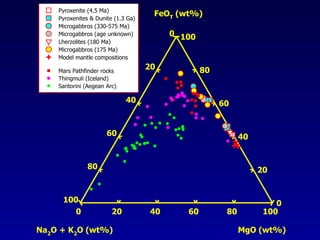
Martian meteorite Shergottites:  microgabbros   with and without Ol phenocrysts or xenocrysts (bulk mg# = 0.24-0.60) and lherzolites (bulk mg# = 0.68-0.75). Nakhlites:  Pyroxenites (bulk mg# = 0.50-0.72). Chassignites:  Dunite   (bulk mg# = 0.68).
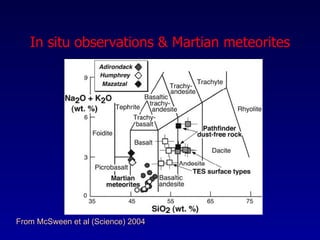
In situ observations & Martian meteorites From McSween et al (Science) 2004
 
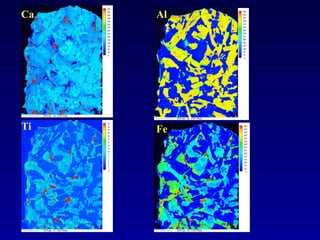
Fe Al Ti Ca
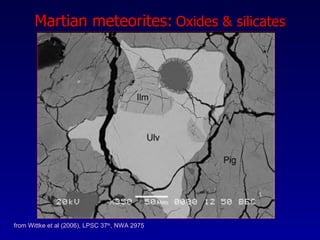
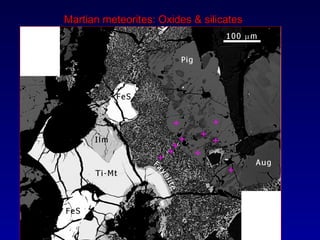
Martian meteorites:   Oxides & silicates from Wittke et al (2006), LPSC 37 th , NWA 2975
Martian meteorites: Oxides & silicates
Martian meteorites and oxygen fugacity Wadhwa ( Science, 2001 ): basalts oxidize through assimilation of an altered by aqueous fluids and incompatible-element enriched crust Herd et al. ( GCA 2002 ) modeled the variation in  f  O 2  as mixing between mantle-like and crust-like reservoirs Herd  (M&PS 2003)   argued that fractional crystallization of a magma ocean would result in a mantle comprised of a reduced, cumulate portion, and an oxidized, trapped-liquid portion – the long-term incompatible-element depleted and enriched components, respectively. In this model, the  f  O 2  of a martian basalt is a function of the relative involvement of the two components during partial melting of mantle sources.
Martian meteorites and oxygen fugacity Phase equilibria &  f  O 2  variations (internal buffering):  Oxide-silicate reactions may result in relative oxidation during cooling Fe metal-bearing rocks may exhibit relative reduction during cooling
 
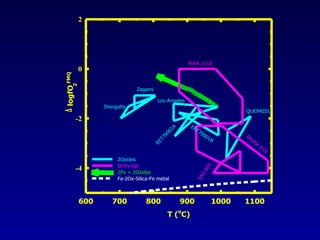
Observations Ti oxide pairs record “snapshots” of the evolution of  f  O 2  with respect to T If modeled properly, oxide-silicate equilibria will give a more dynamic view of the evolution of  f  O 2  with respect to T, and in this case they appear to record relative oxidation with cooling In contrast, in Fe metal-bearing lunar basalts the equilibria among Fe metal, oxides, and silicates suggest relative reduction with cooling
Conclusions Oxygen fugacity in Martian basaltic meteorites is buffered internally  The observed range and variations likely result from phase equilibria control and not mixing of reduced and oxidized components

Egu 2006 Talk

  • 1.
    Redox equilibria andMartian basaltic meteorites
  • 2.
    Martian basaltic meteorites≥ 31 pieces of igneous rocks with crystallization ages of 150-180 Ma, 1.3 Ga, and > 4.3 Ga “ Left” Mars 0.5 - 20 Ma ago
  • 3.
    Martian meteorite Shergottites: microgabbros with and without Ol phenocrysts or xenocrysts (bulk mg# = 0.24-0.60) and lherzolites (bulk mg# = 0.68-0.75). Nakhlites: Pyroxenites (bulk mg# = 0.50-0.72). Chassignites: Dunite (bulk mg# = 0.68).
  • 4.
    In situ observations& Martian meteorites From McSween et al (Science) 2004
  • 5.
  • 6.
  • 7.
    Martian meteorites: Oxides & silicates from Wittke et al (2006), LPSC 37 th , NWA 2975
  • 8.
  • 9.
    Martian meteorites andoxygen fugacity Wadhwa ( Science, 2001 ): basalts oxidize through assimilation of an altered by aqueous fluids and incompatible-element enriched crust Herd et al. ( GCA 2002 ) modeled the variation in f O 2 as mixing between mantle-like and crust-like reservoirs Herd (M&PS 2003) argued that fractional crystallization of a magma ocean would result in a mantle comprised of a reduced, cumulate portion, and an oxidized, trapped-liquid portion – the long-term incompatible-element depleted and enriched components, respectively. In this model, the f O 2 of a martian basalt is a function of the relative involvement of the two components during partial melting of mantle sources.
  • 10.
    Martian meteorites andoxygen fugacity Phase equilibria & f O 2 variations (internal buffering): Oxide-silicate reactions may result in relative oxidation during cooling Fe metal-bearing rocks may exhibit relative reduction during cooling
  • 11.
  • 12.
    Observations Ti oxidepairs record “snapshots” of the evolution of f O 2 with respect to T If modeled properly, oxide-silicate equilibria will give a more dynamic view of the evolution of f O 2 with respect to T, and in this case they appear to record relative oxidation with cooling In contrast, in Fe metal-bearing lunar basalts the equilibria among Fe metal, oxides, and silicates suggest relative reduction with cooling
  • 13.
    Conclusions Oxygen fugacityin Martian basaltic meteorites is buffered internally The observed range and variations likely result from phase equilibria control and not mixing of reduced and oxidized components

Editor's Notes

  • #7 10x12 cm thin section of Los Angeles.
  • #9 Mineral reactions. Px exsolution.