Introduction to PRiSM™
Projects Integrating Sustainable Methods
Triantafyllos Katsarelis
Dipl. Civil Engineer NTUA, DS Grenoble INP, ΜΒΑ
Project Manager IPMA Level C, Quality Systems Manager EOQ
Scientific Associate School of Civil Engineers NTUA
Organizational & Project Management Excellence Consulting Professional
全面的 Lecture at hma ● “Green Project Management” ● Athens ● September 2013
About your guest lecturer
Education
 Diploma in Civil Engineering, National Technical University of Athens
 Post-Graduate Diploma in Hydraulic Engineering, Grenoble INP
 MBA, NTUA & AUEB
Certifications
 Project Manager, IPMA – Level C
 Quality Systems Manager EOQ
 Assessor International Project Excellence Award IPMA
 Assessor European Excellence EFQM
 Auditor ISO 9001
Member of...
 PM Greece – National Partner of IPMA (Statutory member)
 Hellenic Management Association, Governing Committee of the Institute "Production &
Operations Management”
 Technical Chamber of Greece – former Permanent Committee for Standardisation, Certification &
Quality Management
Contact neaoktana@ hotmail.com 210 6532107
http://www.linkedin.com/pub/triantafyllos-katsarelis-pm-c-ipma-dipl-eng-mba/32/251/b07
Sustainability is not simply about changing
an Organization’s culture or constraining
the field in which they work, it is largely a
decision based on ethics and social
awareness that we have a responsibility to
create a better world one project at a time.
 Balancing (or harmonizing) Social, Environmental
and Economic interests.
 Both the short an the long term.
 Local and global.
 Consuming income, not capital.
 Transparency and accountability.
 Personal values and ethics.
Sustainability is about…
 Is a sustainability based project management organization that
accredits professionals and programs, and provides innovation to
the project management profession.
 Is comprised of subject matter experts in project management,
academia, and environmental management, a consortium
actively advancing the practical application of sustainable
methods and committed to aligning with organizations that share
the same values.
 Presents as a foundational enhancement the concept of
PRiSM™: "Projects integrating Sustainable Methods" which is a
green project management delivery method and conceptual
curriculum basis.
Green Project Management
 Project management is essentially about change.
 Organizations are embracing Social Responsibility and their
practices are changing to adopt new models.
 By applying a simple framework that align with international
standards, organizational goals, and ethics, project
management can deliver greater value at the macro level.
 GPM’s goal is to evolve project management and to improve
delivery capability without compromising the ability of
future generations to meet their own needs.
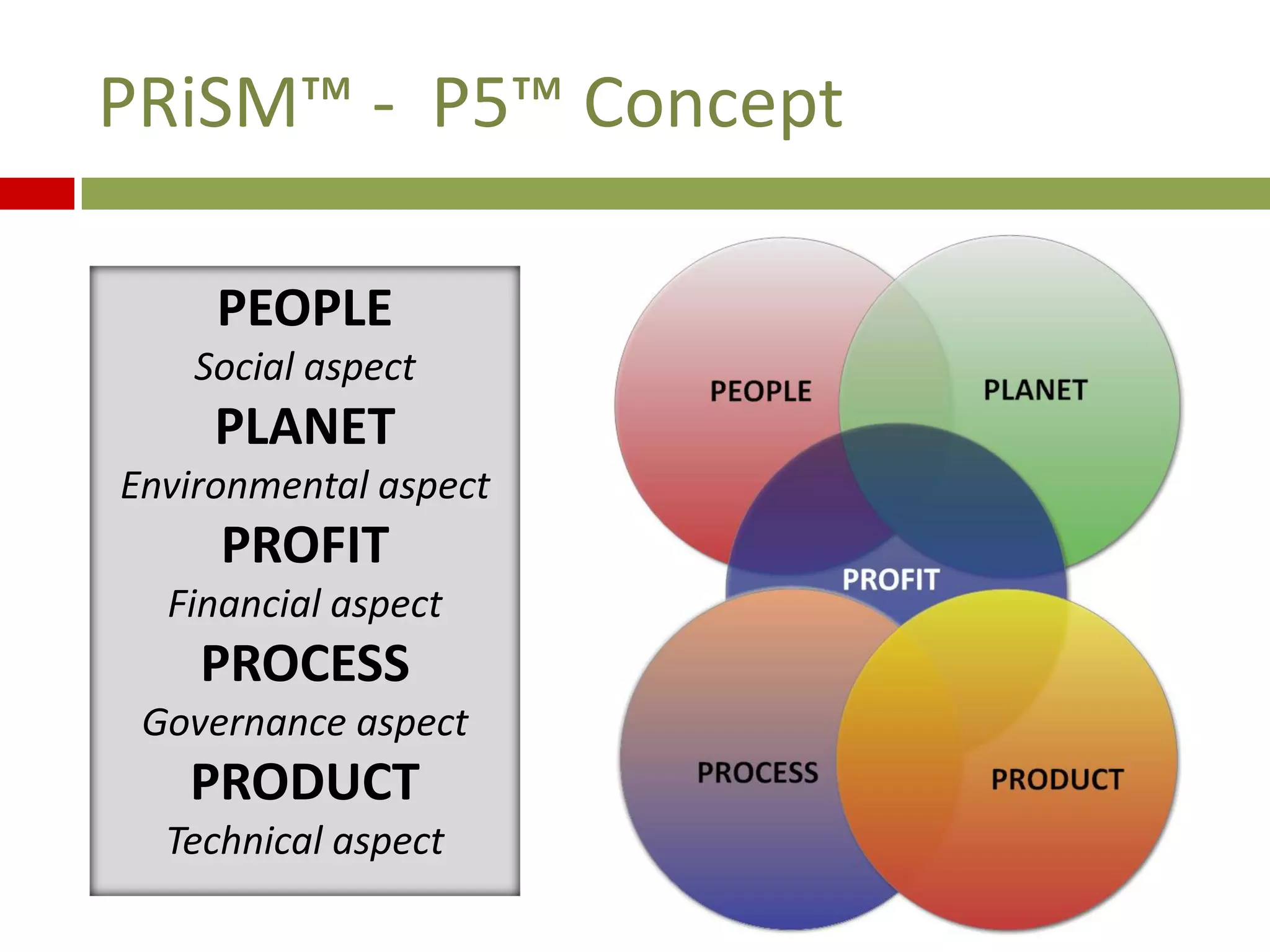
 The approach focus on five key areas, known as P5™, or “5Ps”
to sustainable project management through PRiSM™.
 Sustainability starts with Project Management!
Sustainability in Project Management
 PRiSM™ = Projects integrating Sustainable Methods.
 It is the sustainability based project delivery framework which
incorporates tangible tools and methods to manage the balance
between finite resources, social responsibility, and delivering
“green” project outcomes.
 It is a structured project management methodology that
highlights areas of sustainability and integrates them into the
traditional core project phases.
 It establishes a framework of considerations derived from ISOs
21500, 14001, 26000, 50001, 9001, 31000 and OHSAS 18001.
 It focuses on specific areas and incorporate best practices to
answer the question:
“How do I apply sustainability to my projects?”
PRiSM™
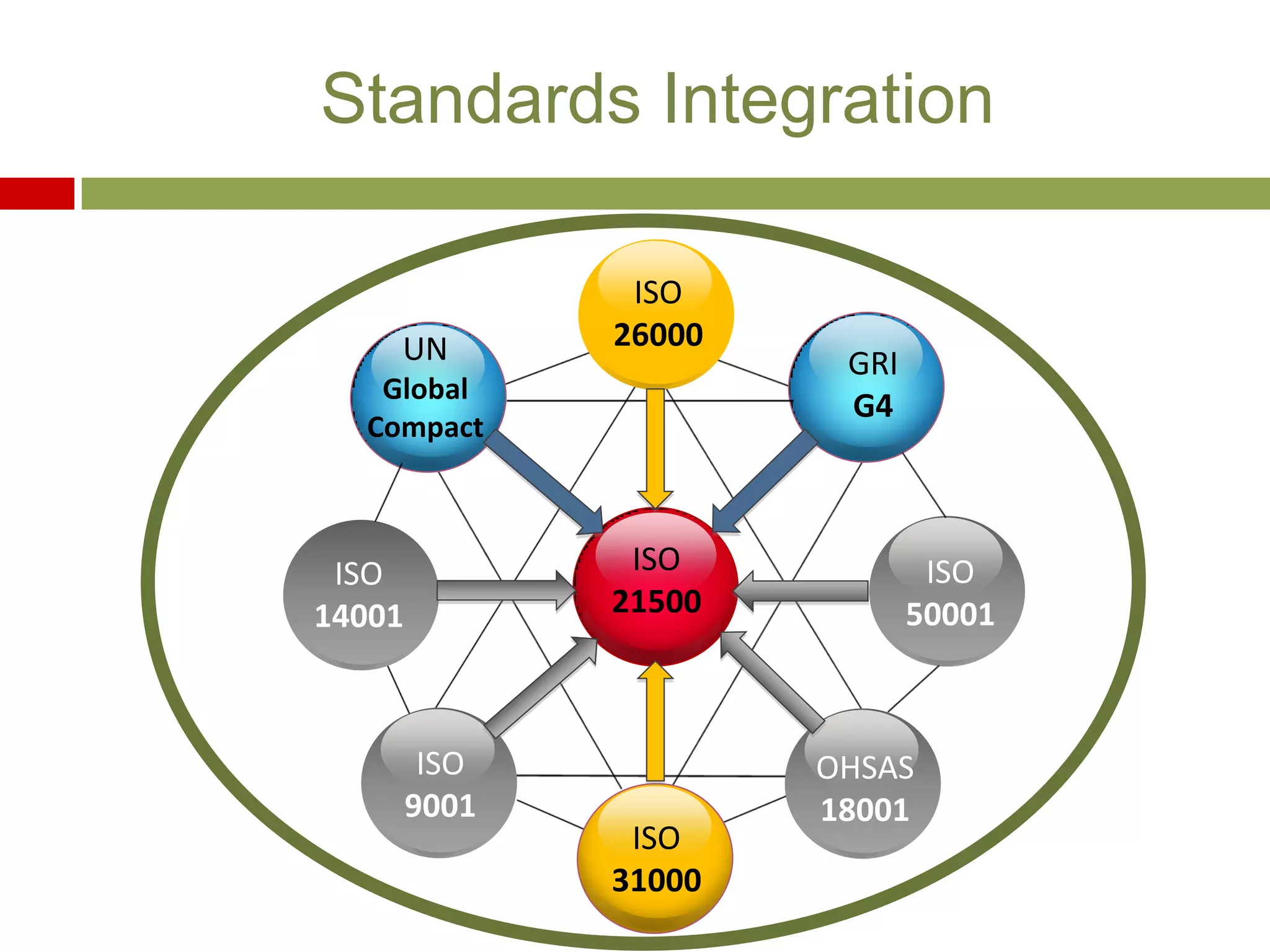
Standards Integration
ISO
26000
ISO
21500
ISO
31000
UN
Global
Compact
GRI
G4
ISO
14001
ISO
50001
ISO
9001
OHSAS
18001
ISO & OHSAS│ Normative Standards
ISOs 9001, 14001 & 50001
OHSAS 18001
ISO 26000 │ Guidance on Social Responsibility
ISO 26000:2010
Social Responsibility
UN Global Compact
Global Reporting Initiative – G4
ISO 31000 │ Risk Management- Principles & Guidelines
ISO 31000:2009
Risk Management
ISO 21500 │ Guidance on Project Management
ISO 21500:2012
Project Management
PRISM™│ Projects Integrating Sustainable Methods
PRiSM™
Green Project Management
PEOPLE
Social aspect
PLANET
Environmental aspect
PROFIT
Financial aspect
PROCESS
Governance aspect
PRODUCT
Technical aspect
PRiSM™ - P5™ Concept
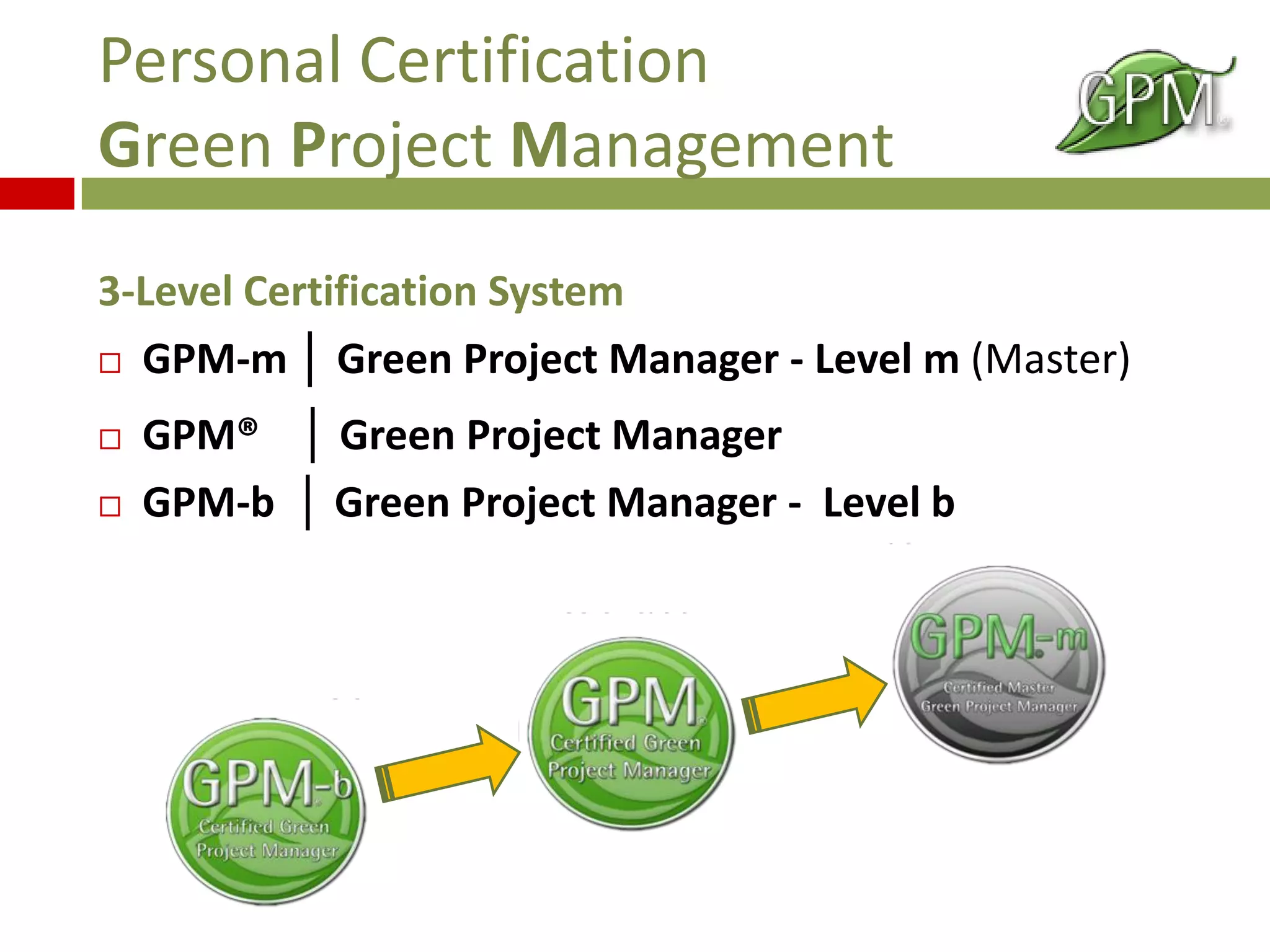
Personal Certification
Green Project Management
3-Level Certification System
 GPM-m │ Green Project Manager - Level m (Master)
 GPM® │ Green Project Manager
 GPM-b │ Green Project Manager - Level b
全面的
Hira gana
Integrated – Comprehensive
The logo – message of the lecture

Invited lecture at hma - Eede 1 gpm_prs_short

  • 1.
    Introduction to PRiSM™ ProjectsIntegrating Sustainable Methods Triantafyllos Katsarelis Dipl. Civil Engineer NTUA, DS Grenoble INP, ΜΒΑ Project Manager IPMA Level C, Quality Systems Manager EOQ Scientific Associate School of Civil Engineers NTUA Organizational & Project Management Excellence Consulting Professional 全面的 Lecture at hma ● “Green Project Management” ● Athens ● September 2013
  • 2.
    About your guestlecturer Education  Diploma in Civil Engineering, National Technical University of Athens  Post-Graduate Diploma in Hydraulic Engineering, Grenoble INP  MBA, NTUA & AUEB Certifications  Project Manager, IPMA – Level C  Quality Systems Manager EOQ  Assessor International Project Excellence Award IPMA  Assessor European Excellence EFQM  Auditor ISO 9001 Member of...  PM Greece – National Partner of IPMA (Statutory member)  Hellenic Management Association, Governing Committee of the Institute "Production & Operations Management”  Technical Chamber of Greece – former Permanent Committee for Standardisation, Certification & Quality Management Contact neaoktana@ hotmail.com 210 6532107 http://www.linkedin.com/pub/triantafyllos-katsarelis-pm-c-ipma-dipl-eng-mba/32/251/b07
  • 3.
    Sustainability is notsimply about changing an Organization’s culture or constraining the field in which they work, it is largely a decision based on ethics and social awareness that we have a responsibility to create a better world one project at a time.
  • 4.
     Balancing (orharmonizing) Social, Environmental and Economic interests.  Both the short an the long term.  Local and global.  Consuming income, not capital.  Transparency and accountability.  Personal values and ethics. Sustainability is about…
  • 5.
     Is asustainability based project management organization that accredits professionals and programs, and provides innovation to the project management profession.  Is comprised of subject matter experts in project management, academia, and environmental management, a consortium actively advancing the practical application of sustainable methods and committed to aligning with organizations that share the same values.  Presents as a foundational enhancement the concept of PRiSM™: "Projects integrating Sustainable Methods" which is a green project management delivery method and conceptual curriculum basis. Green Project Management
  • 6.
     Project managementis essentially about change.  Organizations are embracing Social Responsibility and their practices are changing to adopt new models.  By applying a simple framework that align with international standards, organizational goals, and ethics, project management can deliver greater value at the macro level.  GPM’s goal is to evolve project management and to improve delivery capability without compromising the ability of future generations to meet their own needs.  The approach focus on five key areas, known as P5™, or “5Ps” to sustainable project management through PRiSM™.  Sustainability starts with Project Management! Sustainability in Project Management
  • 7.
     PRiSM™ =Projects integrating Sustainable Methods.  It is the sustainability based project delivery framework which incorporates tangible tools and methods to manage the balance between finite resources, social responsibility, and delivering “green” project outcomes.  It is a structured project management methodology that highlights areas of sustainability and integrates them into the traditional core project phases.  It establishes a framework of considerations derived from ISOs 21500, 14001, 26000, 50001, 9001, 31000 and OHSAS 18001.  It focuses on specific areas and incorporate best practices to answer the question: “How do I apply sustainability to my projects?” PRiSM™
  • 8.
  • 9.
    ISO & OHSAS│Normative Standards ISOs 9001, 14001 & 50001 OHSAS 18001
  • 10.
    ISO 26000 │Guidance on Social Responsibility ISO 26000:2010 Social Responsibility
  • 11.
  • 12.
  • 13.
    ISO 31000 │Risk Management- Principles & Guidelines ISO 31000:2009 Risk Management
  • 14.
    ISO 21500 │Guidance on Project Management ISO 21500:2012 Project Management
  • 15.
    PRISM™│ Projects IntegratingSustainable Methods PRiSM™ Green Project Management
  • 16.
    PEOPLE Social aspect PLANET Environmental aspect PROFIT Financialaspect PROCESS Governance aspect PRODUCT Technical aspect PRiSM™ - P5™ Concept
  • 17.
    Personal Certification Green ProjectManagement 3-Level Certification System  GPM-m │ Green Project Manager - Level m (Master)  GPM® │ Green Project Manager  GPM-b │ Green Project Manager - Level b
  • 18.
    全面的 Hira gana Integrated –Comprehensive The logo – message of the lecture