Economies of Cities and Regions

Is a relaxed policy on foreign ownership of land
   and foreign direct investment optimal for a
      developing country and its economy?
Background
•Foreign direct investment has grown significantly over the past 20
years, rising from US$59 billion to US$651 billion HOWEVER the
majority of foreign direct investment is NOT to developing countries.


• Peaked 1997-1998 at around 40 per cent of all direct foreign
investment around the globe’ . However it fell drastically at the turn of
the century.


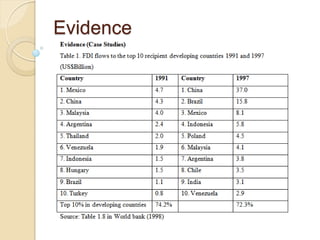
•Recent years Argentina, Brazil, and China have accounted for almost
half of FDI


•Common     Factors?
Positive theoretical impacts of FDI
   FDI is normally regarded as amongst ‘the most stable
    forms of capital inflow’.

   FDI can have a positive net transfer on the capital
    account which will lead to a net increase in total
    investment and economic growth.

   FDI has long been regarded
    to be a major vehicle
    of technology transfer.

   FDI has a considerable
    positive effect on total
    factor productivity (TFP)
    growth
Evidence
Case Studies
•   BRAZIL:

•The studies credits the recent
success in attracting FDI is due to
changes in the legislation governing
such flows.

•Particularly the changes in legislation relating to the
Brazilian privatization programme.

• The study proclaims that government policy on ‘lower
barriers to trade, FDI and portfolio capital flows’ coupled
with decreased transport and communications costs,
has resulted in the expansion of options available to
firms as to where to produce and sell.
Case Studies
PHILIPPINES:

•Policies towards foreign investment
 ‘provided incentives but placed
restrictions on the degree of foreign equity
 participation in preferred non-pioneer areas of investment’ and
allowed for nationalization in new, undiscovered areas.

• The enactment of the Foreign Investment Act in 1991, the
‘restrictions on foreign equity participation were greatly relaxed in
an attempt to offer conditions widely comparable to those
prevailing in neighboring economies’

• As a result, full foreign equity ownership is now permitted in most
industries. Subsequently growth since 1990 has grown steadily,
with 1990’s averaging 3.1% and 2000’s averaging 4.6%.

•It
  is important to note that of course this increase is not solely
because of relaxed FDI
Negative Impacts of FDI
•Foreign investors have the ability to exploit workers in poor
countries by ‘initiating a "race to the bottom" in environmental
and labour standards’ .

• An underlying assumption is often that what is ‘good for
growth is good for the poor, although the growth-poverty
relationship is far more contentious than this would suggest’.

• Fourteen studies were reviewed by Chase-
Dunn and all conclusively reported that
‘FDI did lead to an increase in inequality’ .
•FDI can temporarily affect the balance of
payments indirectly through the trade
balance.
•Finally, FDI can affect tax revenues,
through the competition to offer tax
breaks to foreign investors.
Conclusion
•The extent to which foreign investment can help or harm developing
countries ‘largely depends upon what governments and firms choose
to do’ (OECD 1999). There are clearly major economic benefits and
drawbacks from relaxed policies on FDI. Ultimately it’s up to
implementation of sound, reasonable government policies.


• Overall FDI has the ability to increase developing countries economic
growth, promote education, worker training and develop further
infrastructure. Hence it should be promoted by developing country’s
governments; however regulations should be put in place to avoid the
negative spin-offs of FDI.

Edward cramer

  • 1.
    Economies of Citiesand Regions Is a relaxed policy on foreign ownership of land and foreign direct investment optimal for a developing country and its economy?
  • 2.
    Background •Foreign direct investmenthas grown significantly over the past 20 years, rising from US$59 billion to US$651 billion HOWEVER the majority of foreign direct investment is NOT to developing countries. • Peaked 1997-1998 at around 40 per cent of all direct foreign investment around the globe’ . However it fell drastically at the turn of the century. •Recent years Argentina, Brazil, and China have accounted for almost half of FDI •Common Factors?
  • 3.
    Positive theoretical impactsof FDI  FDI is normally regarded as amongst ‘the most stable forms of capital inflow’.  FDI can have a positive net transfer on the capital account which will lead to a net increase in total investment and economic growth.  FDI has long been regarded to be a major vehicle of technology transfer.  FDI has a considerable positive effect on total factor productivity (TFP) growth
  • 4.
  • 5.
    Case Studies • BRAZIL: •The studies credits the recent success in attracting FDI is due to changes in the legislation governing such flows. •Particularly the changes in legislation relating to the Brazilian privatization programme. • The study proclaims that government policy on ‘lower barriers to trade, FDI and portfolio capital flows’ coupled with decreased transport and communications costs, has resulted in the expansion of options available to firms as to where to produce and sell.
  • 6.
    Case Studies PHILIPPINES: •Policies towardsforeign investment ‘provided incentives but placed restrictions on the degree of foreign equity participation in preferred non-pioneer areas of investment’ and allowed for nationalization in new, undiscovered areas. • The enactment of the Foreign Investment Act in 1991, the ‘restrictions on foreign equity participation were greatly relaxed in an attempt to offer conditions widely comparable to those prevailing in neighboring economies’ • As a result, full foreign equity ownership is now permitted in most industries. Subsequently growth since 1990 has grown steadily, with 1990’s averaging 3.1% and 2000’s averaging 4.6%. •It is important to note that of course this increase is not solely because of relaxed FDI
  • 7.
    Negative Impacts ofFDI •Foreign investors have the ability to exploit workers in poor countries by ‘initiating a "race to the bottom" in environmental and labour standards’ . • An underlying assumption is often that what is ‘good for growth is good for the poor, although the growth-poverty relationship is far more contentious than this would suggest’. • Fourteen studies were reviewed by Chase- Dunn and all conclusively reported that ‘FDI did lead to an increase in inequality’ . •FDI can temporarily affect the balance of payments indirectly through the trade balance. •Finally, FDI can affect tax revenues, through the competition to offer tax breaks to foreign investors.
  • 8.
    Conclusion •The extent towhich foreign investment can help or harm developing countries ‘largely depends upon what governments and firms choose to do’ (OECD 1999). There are clearly major economic benefits and drawbacks from relaxed policies on FDI. Ultimately it’s up to implementation of sound, reasonable government policies. • Overall FDI has the ability to increase developing countries economic growth, promote education, worker training and develop further infrastructure. Hence it should be promoted by developing country’s governments; however regulations should be put in place to avoid the negative spin-offs of FDI.