
the process of receiving or giving
systematic instruction
is the effective use of
technological tools in learning.
As a concept, it concerns an array
of tools, such as media, machines
and networking hardware, as well as
considering theoretical perspectives
for their effective application
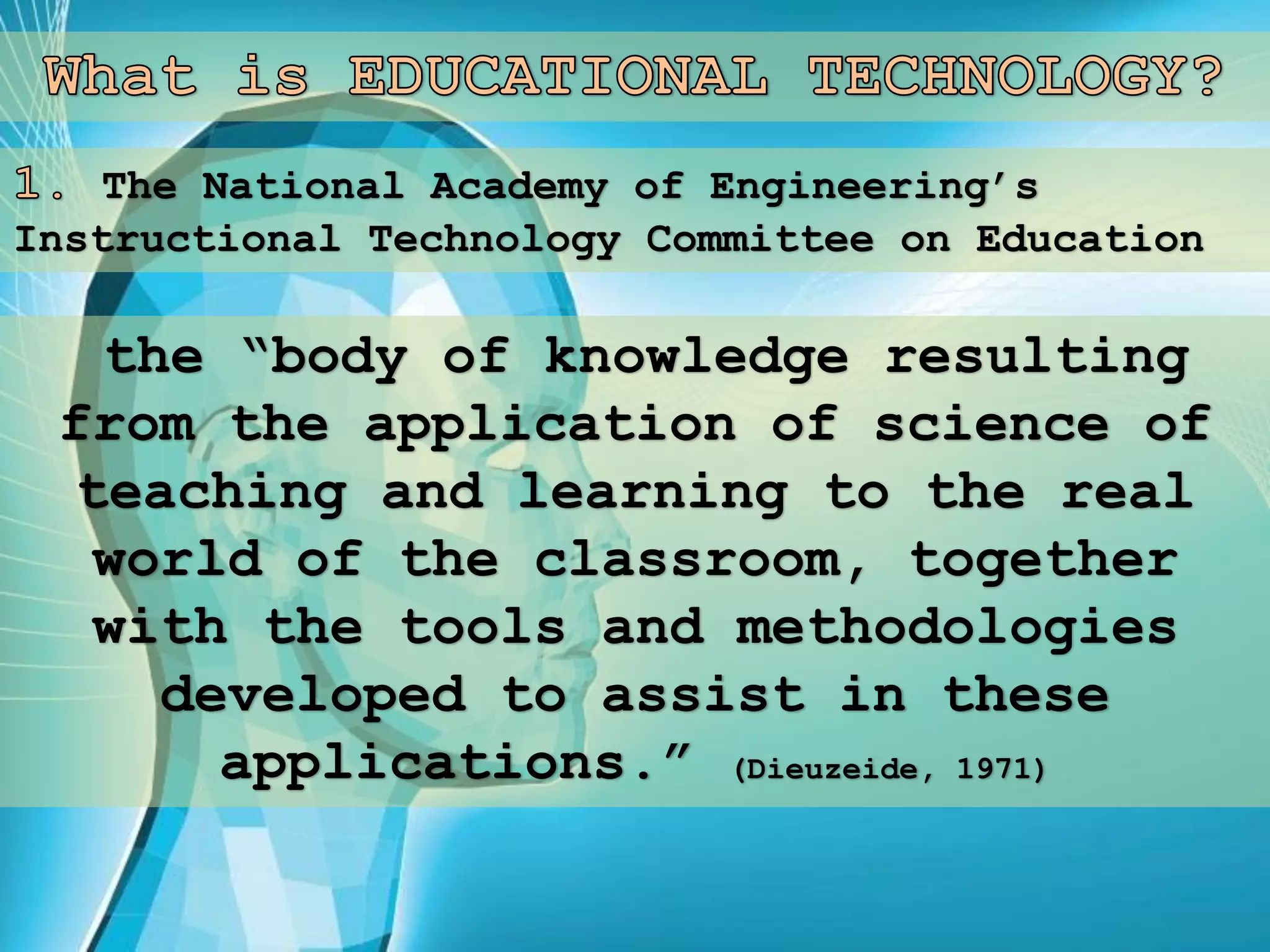
The National Academy of Engineering’s
Instructional Technology Committee on Education
the “body of knowledge resulting
from the application of science of
teaching and learning to the real
world of the classroom, together
with the tools and methodologies
developed to assist in these
applications.” (Dieuzeide, 1971)
Cleary, et al., 1976
“is concerned with the overall
methodology and set of techniques
employed in the application of
instructional principles”
Collier, et al., 1971
“involves the application of
systems, techniques and aids to
improve the process of human
learning.”
Collier, et al., 1971
Four Features:
1.Definition of objectives to be
achieved by the learner
2.The application of principles of
learning to the analysis and
structuring of the subject matter
to be learned
3.The selection and use of
appropriate media for presentation
4.The use of appropriate methods of
assessing student performance to
evaluate the effectiveness of
courses and materials.
Silverman, 1968
Two conceptions of Educational
Technology (ET):
-Which focuses on both procedures
and devices
-which focuses on analyzing
instructional problems, constructing
and selecting evaluation
instruments, and on production
techniques and devices, all in terms
of reaching desired outcomes
AEC Task Force, 1977
“is a complex, integrated process
involving people, procedures, ideas,
devices and organization, for
analyzing problems, and devising,
implementing, evaluating and
managing solutions to those problems
involved in all aspects of human
learning”
Educational Technology- Basic Concepts and Definitions

Educational Technology- Basic Concepts and Definitions

  • 3.
    the process ofreceiving or giving systematic instruction
  • 4.
    is the effectiveuse of technological tools in learning. As a concept, it concerns an array of tools, such as media, machines and networking hardware, as well as considering theoretical perspectives for their effective application
  • 5.
    The National Academyof Engineering’s Instructional Technology Committee on Education the “body of knowledge resulting from the application of science of teaching and learning to the real world of the classroom, together with the tools and methodologies developed to assist in these applications.” (Dieuzeide, 1971)
  • 6.
    Cleary, et al.,1976 “is concerned with the overall methodology and set of techniques employed in the application of instructional principles”
  • 7.
    Collier, et al.,1971 “involves the application of systems, techniques and aids to improve the process of human learning.”
  • 8.
    Collier, et al.,1971 Four Features: 1.Definition of objectives to be achieved by the learner 2.The application of principles of learning to the analysis and structuring of the subject matter to be learned 3.The selection and use of appropriate media for presentation 4.The use of appropriate methods of assessing student performance to evaluate the effectiveness of courses and materials.
  • 9.
    Silverman, 1968 Two conceptionsof Educational Technology (ET):
  • 10.
    -Which focuses onboth procedures and devices -which focuses on analyzing instructional problems, constructing and selecting evaluation instruments, and on production techniques and devices, all in terms of reaching desired outcomes
  • 11.
    AEC Task Force,1977 “is a complex, integrated process involving people, procedures, ideas, devices and organization, for analyzing problems, and devising, implementing, evaluating and managing solutions to those problems involved in all aspects of human learning”