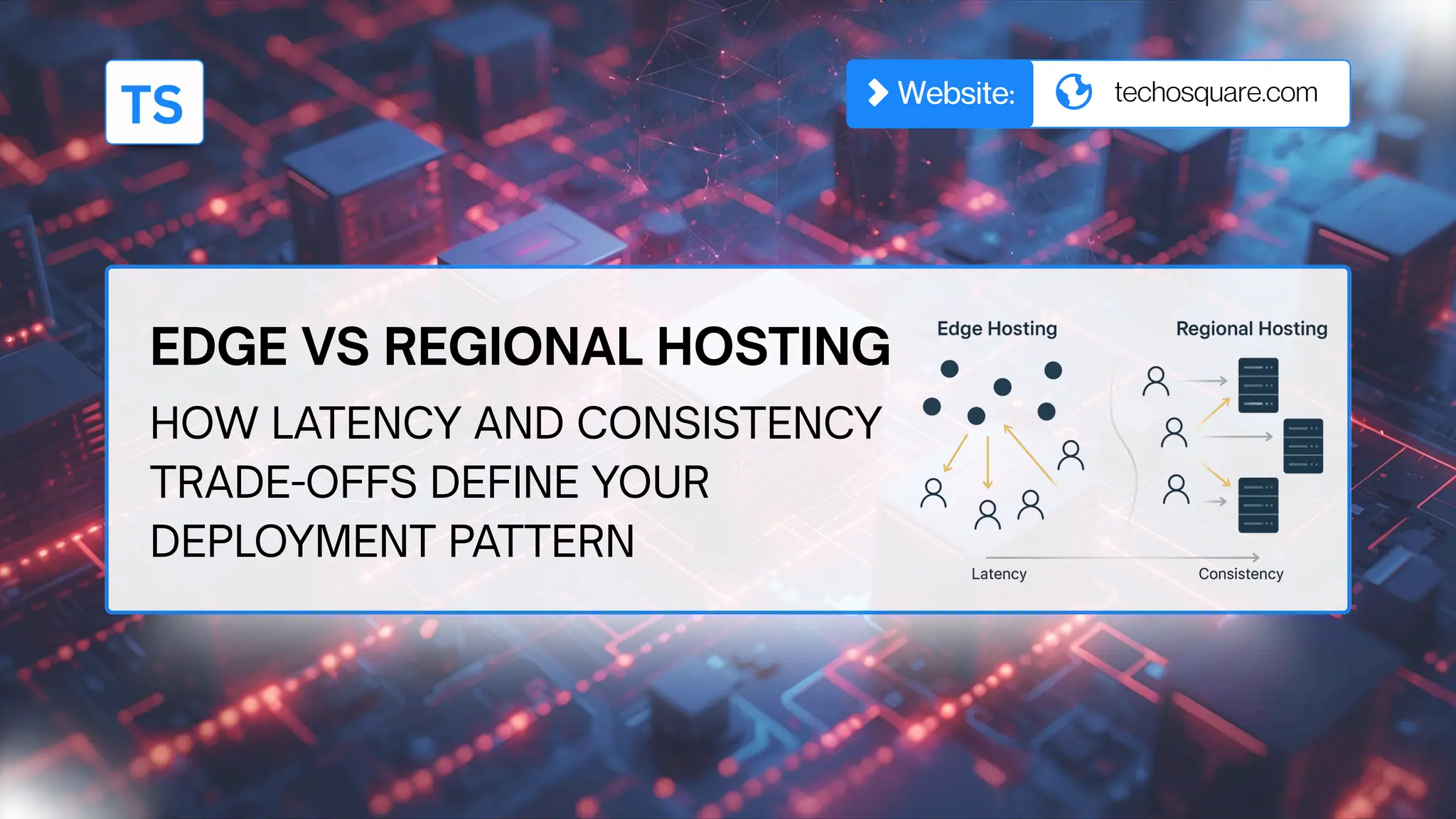
EDGE VS REGIONAL HOSTING
HOW LATENCY AND CONSISTENCY
TRADE-OFFS DEFINE YOUR
DEPLOYMENT PATTERN
Website: techosquare.com
INTRODUCTION
This presentation helps you make data-
driven decisions between edge and regional
hosting by balancing latency and database
consistency. Learn to analyze performance
metrics, define clear criteria, and validate
choices through controlled testing—no
assumptions, only actionable insights.
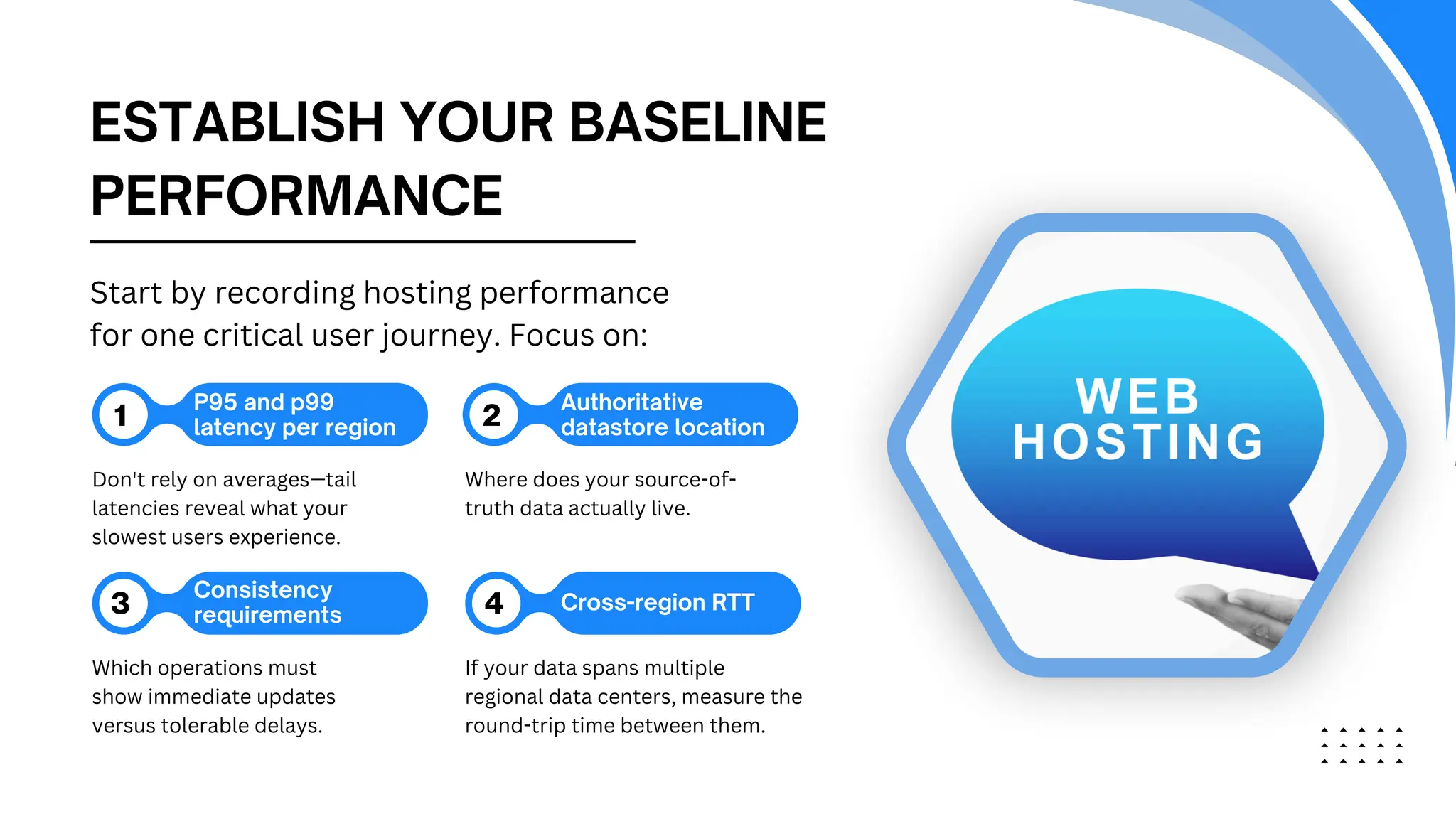
ESTABLISH YOUR BASELINE
PERFORMANCE
P95 and p99
latency per region
1 2
3 4 Cross-region RTT
Don't rely on averages—tail
latencies reveal what your
slowest users experience.
Where does your source-of-
truth data actually live.
Which operations must
show immediate updates
versus tolerable delays.
If your data spans multiple
regional data centers, measure the
round-trip time between them.
Start by recording hosting performance
for one critical user journey. Focus on:
Authoritative
datastore location
Consistency
requirements
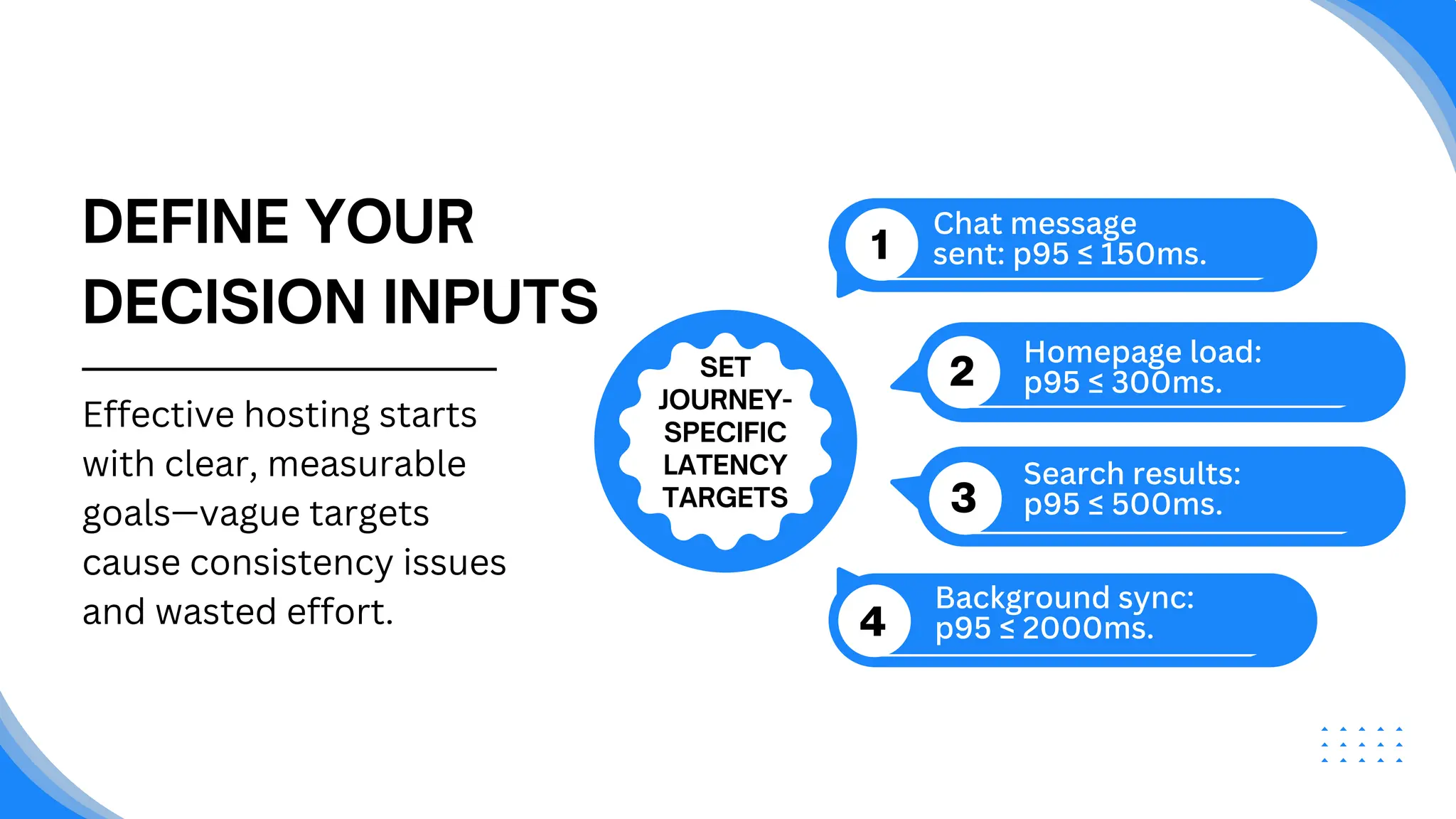
SET
JOURNEY-
SPECIFIC
LATENCY
TARGETS
1
2
3
4
Chat message
sent: p95 ≤ 150ms.
Homepage load:
p95 ≤ 300ms.
Search results:
p95 ≤ 500ms.
DEFINE YOUR
DECISION INPUTS
Effective hosting starts
with clear, measurable
goals—vague targets
cause consistency issues
and wasted effort. Background sync:
p95 ≤ 2000ms.
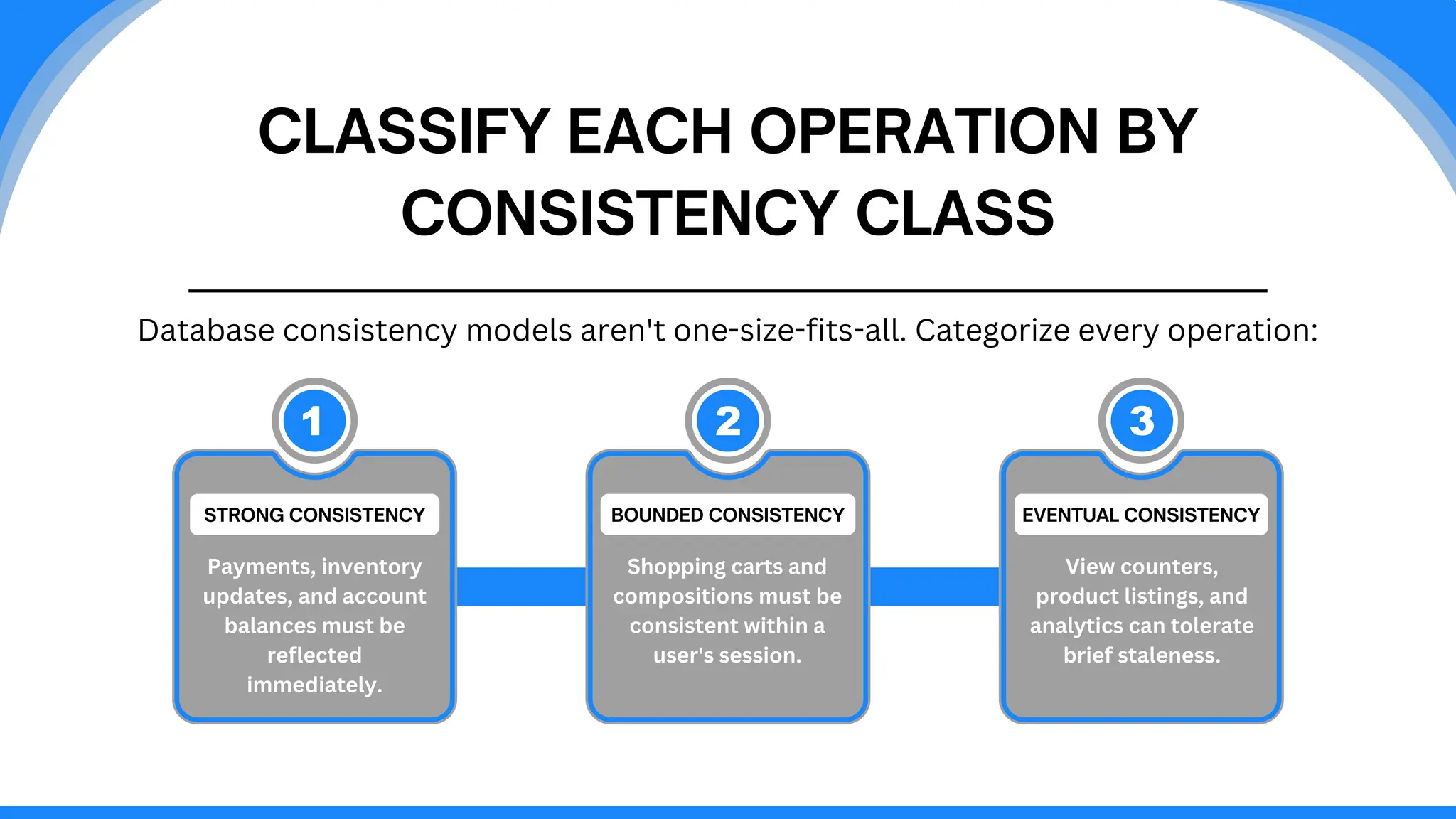
CLASSIFY EACH OPERATION BY
CONSISTENCY CLASS
Database consistency models aren't one-size-fits-all. Categorize every operation:
STRONG CONSISTENCY
Payments, inventory
updates, and account
balances must be
reflected
immediately.
BOUNDED CONSISTENCY
Shopping carts and
compositions must be
consistent within a
user's session.
EVENTUAL CONSISTENCY
View counters,
product listings, and
analytics can tolerate
brief staleness.
CLASSIFY OPERATIONS
BY CONSISTENCY NEED
List every operation behind your critical journey and mark
its consistency requirements. This operation-level analysis
determines your cloud deployment patterns.
MAPPING OPERATIONS TO DEPLOYMENT ZONES
Strong consistency operations must remain near
authoritative data, while eventual consistency can run at
the edge, preventing production consistency issues.
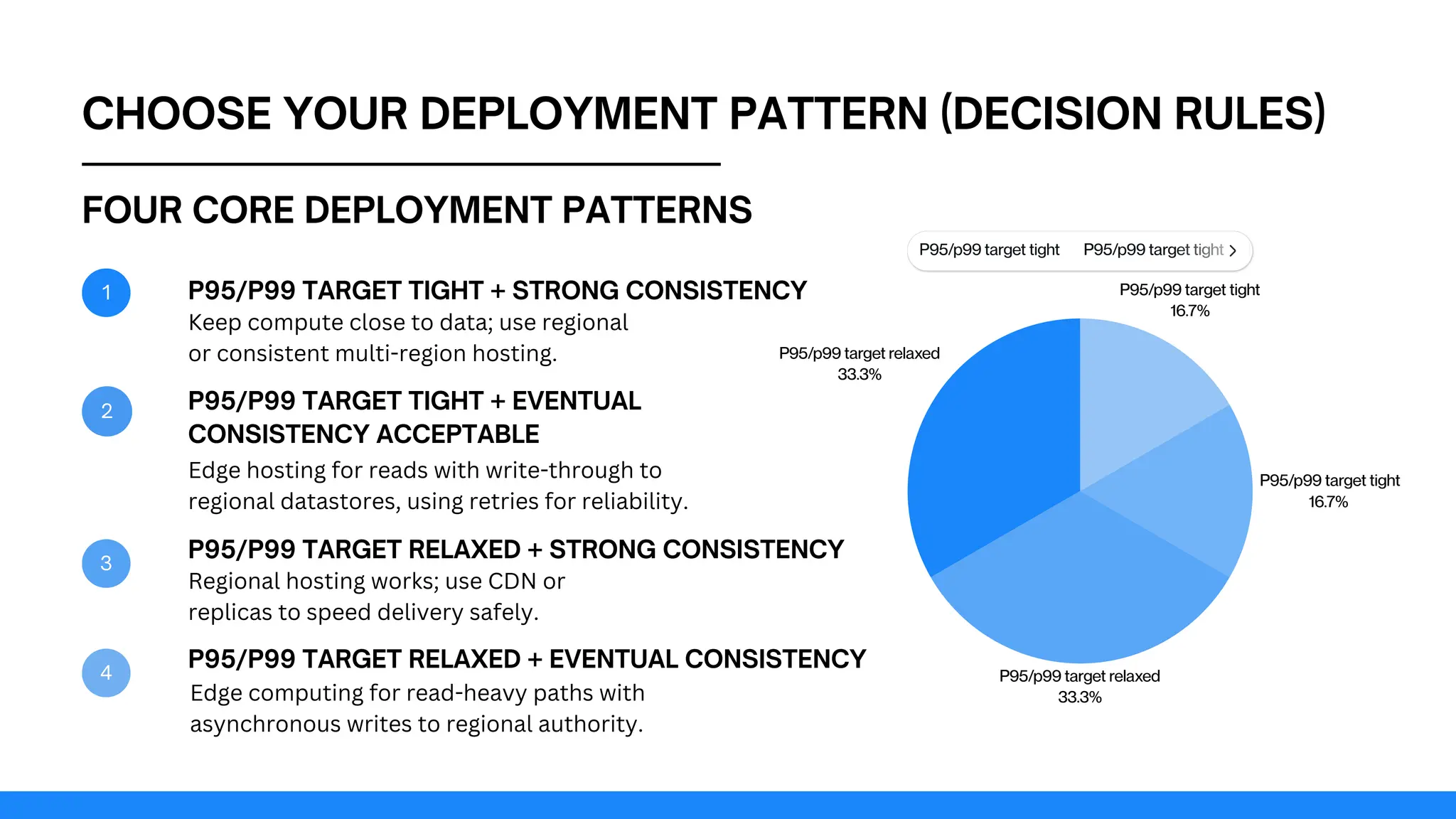
CHOOSE YOUR DEPLOYMENT PATTERN (DECISION RULES)
1
2
3
4
FOUR CORE DEPLOYMENT PATTERNS
P95/P99 TARGET TIGHT + STRONG CONSISTENCY
P95/P99 TARGET TIGHT + EVENTUAL
CONSISTENCY ACCEPTABLE
P95/P99 TARGET RELAXED + STRONG CONSISTENCY
Keep compute close to data; use regional
or consistent multi-region hosting.
Edge hosting for reads with write-through to
regional datastores, using retries for reliability.
Regional hosting works; use CDN or
replicas to speed delivery safely.
P95/P99 TARGET RELAXED + EVENTUAL CONSISTENCY
Edge computing for read-heavy paths with
asynchronous writes to regional authority.
P95/p99 target tight P95/p99 target tight P
P95/p99 target relaxed
33.3%
P95/p99 target relaxed
33.3%
P95/p99 target tight
16.7%
P95/p99 target tight
16.7%
UNDERSTANDING EDGE
DATA REALITIES
Edge hosting solutions introduce
replication delays that you must design
for explicitly. Eventually consistent
edge stores can take seconds for writes
to become visible globally—ignoring this
creates subtle but critical bugs.
OPTIMIZE REGION PLACEMENT
AND PROXIMITY
Choose regional data centers based on actual user
distribution and where your authoritative data
must live for compliance or operational reasons.
AVOIDING THE "MORE REGIONS" TRAP
Adding global PoPs increases cost and complexity
if RTT dominates. Strong multi-region hosting adds
unavoidable latency; include in trade-off analysis.
DECISION RULE TEMPLATE
(COPY-PASTEABLE)
Document your decisions using this one-sentence
template with actual numbers:
"For [feature name], choose [edge/regional/hybrid] because p95 target = [X]ms
and consistency = [strong/bounded/session/eventual]."
Examples:
For product search, choose edge because p95 target = 200ms
and consistency = eventual (5s staleness acceptable).
For checkout payment, choose regional because p95 target =
800ms and consistency = strong.
For user profile reads, choose hybrid (edge with regional write-
through) because p95 target = 150ms and consistency = session.
CONCLUSION
Choosing between edge and regional hosting
requires real performance data, clear
consistency mapping, and controlled
testing. Regularly review metrics and evolve
decisions as needs change. Techosquare can
help optimize your setup strategically,
ensuring performance without unnecessary
complexity or premature optimization.
THANK YOU
For Your Attention
Company Contact
www.techosqare.com
Website:
+91 (172) 4639432
Phone Number:

Edge vs Regional Hosting How Latency and Consistency Trade-Offs Define Your Deployment Pattern (1).pdf

  • 1.
    EDGE VS REGIONALHOSTING HOW LATENCY AND CONSISTENCY TRADE-OFFS DEFINE YOUR DEPLOYMENT PATTERN Website: techosquare.com
  • 2.
    INTRODUCTION This presentation helpsyou make data- driven decisions between edge and regional hosting by balancing latency and database consistency. Learn to analyze performance metrics, define clear criteria, and validate choices through controlled testing—no assumptions, only actionable insights.
  • 3.
    ESTABLISH YOUR BASELINE PERFORMANCE P95and p99 latency per region 1 2 3 4 Cross-region RTT Don't rely on averages—tail latencies reveal what your slowest users experience. Where does your source-of- truth data actually live. Which operations must show immediate updates versus tolerable delays. If your data spans multiple regional data centers, measure the round-trip time between them. Start by recording hosting performance for one critical user journey. Focus on: Authoritative datastore location Consistency requirements
  • 4.
    SET JOURNEY- SPECIFIC LATENCY TARGETS 1 2 3 4 Chat message sent: p95≤ 150ms. Homepage load: p95 ≤ 300ms. Search results: p95 ≤ 500ms. DEFINE YOUR DECISION INPUTS Effective hosting starts with clear, measurable goals—vague targets cause consistency issues and wasted effort. Background sync: p95 ≤ 2000ms.
  • 5.
    CLASSIFY EACH OPERATIONBY CONSISTENCY CLASS Database consistency models aren't one-size-fits-all. Categorize every operation: STRONG CONSISTENCY Payments, inventory updates, and account balances must be reflected immediately. BOUNDED CONSISTENCY Shopping carts and compositions must be consistent within a user's session. EVENTUAL CONSISTENCY View counters, product listings, and analytics can tolerate brief staleness.
  • 6.
    CLASSIFY OPERATIONS BY CONSISTENCYNEED List every operation behind your critical journey and mark its consistency requirements. This operation-level analysis determines your cloud deployment patterns. MAPPING OPERATIONS TO DEPLOYMENT ZONES Strong consistency operations must remain near authoritative data, while eventual consistency can run at the edge, preventing production consistency issues.
  • 7.
    CHOOSE YOUR DEPLOYMENTPATTERN (DECISION RULES) 1 2 3 4 FOUR CORE DEPLOYMENT PATTERNS P95/P99 TARGET TIGHT + STRONG CONSISTENCY P95/P99 TARGET TIGHT + EVENTUAL CONSISTENCY ACCEPTABLE P95/P99 TARGET RELAXED + STRONG CONSISTENCY Keep compute close to data; use regional or consistent multi-region hosting. Edge hosting for reads with write-through to regional datastores, using retries for reliability. Regional hosting works; use CDN or replicas to speed delivery safely. P95/P99 TARGET RELAXED + EVENTUAL CONSISTENCY Edge computing for read-heavy paths with asynchronous writes to regional authority. P95/p99 target tight P95/p99 target tight P P95/p99 target tight P95/p99 target tight P P95/p99 target relaxed 33.3% P95/p99 target relaxed 33.3% P95/p99 target tight 16.7% P95/p99 target tight 16.7%
  • 8.
    UNDERSTANDING EDGE DATA REALITIES Edgehosting solutions introduce replication delays that you must design for explicitly. Eventually consistent edge stores can take seconds for writes to become visible globally—ignoring this creates subtle but critical bugs.
  • 9.
    OPTIMIZE REGION PLACEMENT ANDPROXIMITY Choose regional data centers based on actual user distribution and where your authoritative data must live for compliance or operational reasons. AVOIDING THE "MORE REGIONS" TRAP Adding global PoPs increases cost and complexity if RTT dominates. Strong multi-region hosting adds unavoidable latency; include in trade-off analysis.
  • 10.
    DECISION RULE TEMPLATE (COPY-PASTEABLE) Documentyour decisions using this one-sentence template with actual numbers: "For [feature name], choose [edge/regional/hybrid] because p95 target = [X]ms and consistency = [strong/bounded/session/eventual]." Examples: For product search, choose edge because p95 target = 200ms and consistency = eventual (5s staleness acceptable). For checkout payment, choose regional because p95 target = 800ms and consistency = strong. For user profile reads, choose hybrid (edge with regional write- through) because p95 target = 150ms and consistency = session.
  • 11.
    CONCLUSION Choosing between edgeand regional hosting requires real performance data, clear consistency mapping, and controlled testing. Regularly review metrics and evolve decisions as needs change. Techosquare can help optimize your setup strategically, ensuring performance without unnecessary complexity or premature optimization.
  • 12.
    THANK YOU For YourAttention Company Contact www.techosqare.com Website: +91 (172) 4639432 Phone Number: