EDGE ARTIFICIAL
INTELLIGENCE IN SMART
CITY DEVELOPMENT
DR PROMISE ELECHI
INTRODUCTION
With the increasing interests
in smart city development
around the globe, edge
artificial intelligence with
machine learning capabilities
is set to play an important
role.
Experts have stated that the
combination of edge
computing and machine
learning is set to change the
game for home automation,
traffic management, building
security, infrastructure
management, and city
parking systems.
WHAT IS EDGE AI
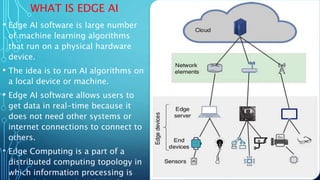
• Edge AI software is large number
of machine learning algorithms
that run on a physical hardware
device.
• The idea is to run AI algorithms on
a local device or machine.
• Edge AI software allows users to
get data in real-time because it
does not need other systems or
internet connections to connect to
others.
• Edge Computing is a part of a
distributed computing topology in
which information processing is
HOW DOES EDGE AI
WORK
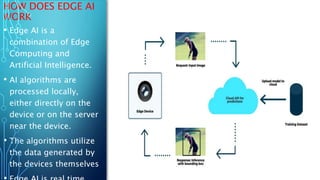
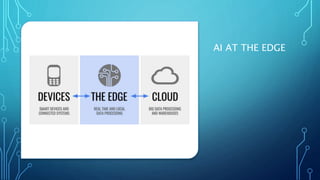
• Edge AI is a
combination of Edge
Computing and
Artificial Intelligence.
• AI algorithms are
processed locally,
either directly on the
device or on the server
near the device.
• The algorithms utilize
the data generated by
the devices themselves
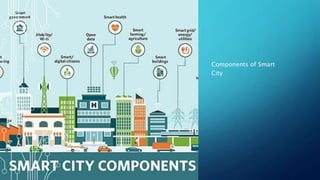
Components of Smart
City
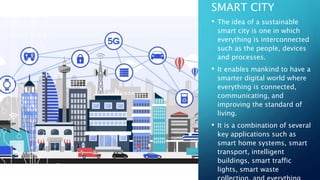
SMART CITY
• The idea of a sustainable
smart city is one in which
everything is interconnected
such as the people, devices
and processes.
• It enables mankind to have a
smarter digital world where
everything is connected,
communicating, and
improving the standard of
living.
• It is a combination of several
key applications such as
smart home systems, smart
transport, intelligent
buildings, smart traffic
lights, smart waste
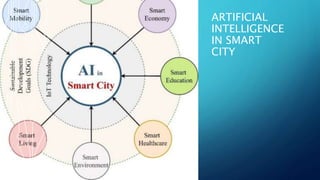
ARTIFICIAL
INTELLIGENCE
IN SMART
CITY
AI AT THE EDGE
WHY EDGE COMPUTING?
New Internet of Things (IoT)
applications are empowering
smart city activities around the
world however, it has also led to
an increase in the cost and
latency as all this data must be
sent to the cloud or centralized
data centres for further analysis
and processing.
For any sort of sustainable
improvement, IoT deployments
need to process data and bring
the decision-making closer to
the source of the data (at the
edge), thus cutting the costs and
time associated with cloud data
transfers.
...
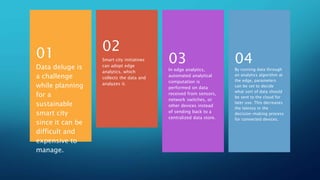
Data deluge is
a challenge
while planning
for a
sustainable
smart city
since it can be
difficult and
expensive to
manage.
01 Smart city initiatives
can adopt edge
analytics, which
collects the data and
analyzes it.
02
In edge analytics,
automated analytical
computation is
performed on data
received from sensors,
network switches, or
other devices instead
of sending back to a
centralized data store.
03
By running data through
an analytics algorithm at
the edge, parameters
can be set to decide
what sort of data should
be sent to the cloud for
later use. This decreases
the latency in the
decision-making process
for connected devices.
04
EDGE INTELLIGENCE FOR
SMART CITIES
• Edge intelligence can be simply described as
edge computing with machine learning.
• Edge intelligence brings data pre-processing
and decision-making capabilities closer to the
data source, which reduces data deluge and
delays in communication.
• Thus, the time and cost can be saved with the
edge intelligence structure, which would be a
key performance indicator for smart city
management.
ADVANTAGES OF
EDGE
INTELLIGENCE
• Near real-time decision making
• Lower latency
• Reduced communication cost
• Autonomy
• Fully distributed computing model and local
identity
• Enhanced quality of data
• Reduced data volume
• Pre-processed data so that only decisions or
alarms can be forwarded to the cloud servers,
rather than raw data
COMPONENTS OF EDGE INTELLIGENCE
Edge analytics
Machine
learning at the
edge
Pattern
Recognition at
the edge
EDGE ANALYTICS
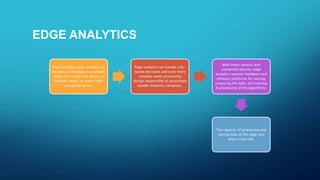
Edge analytics gives analytics of
the data at the edge of a network
either at or close to a sensor, a
network switch, or some other
connected device.
Edge analytics can handle rule-
based decisions and even more
complex event processing
design responsible to proactively
handle incidents/situations.
With smart sensors and
connected devices, edge
analytics requires hardware and
software platforms for storing,
preparing the data, and training
& processing of the algorithms.
The capacity of processing and
storing data at the edge also
plays a key role.
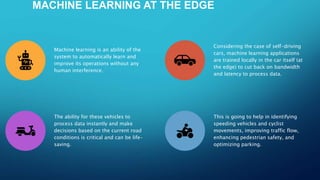
MACHINE LEARNING AT THE EDGE
Machine learning is an ability of the
system to automatically learn and
improve its operations without any
human interference.
Considering the case of self-driving
cars, machine learning applications
are trained locally in the car itself (at
the edge) to cut back on bandwidth
and latency to process data.
The ability for these vehicles to
process data instantly and make
decisions based on the current road
conditions is critical and can be life-
saving.
This is going to help in identifying
speeding vehicles and cyclist
movements, improving traffic flow,
enhancing pedestrian safety, and
optimizing parking.
PATTERN RECOGNITION AT
THE EDGE
• For the pattern recognition, machines are trained exactly
the way human brain thinks and recognizes the patterns by
analysing various aspects of the object.
• Pattern recognition in AI is where machines are trained to
recognize the required images based on a particular
pattern.
• Learning and predicting traffic and parking patterns and
other logistical data at the edge can be possible.
• For instance, if the system spots some event happening at
an intersection A, it will predict the real-time impact at other
intersections.
DESIGN REQUIREMENTS FOR MOVING
TOWARDS THE EDGE
•credibility and trust
•autonomy
•machine learning capabilities
•self-organization
•self-configuration
•self-discovery
There are various
properties and
requirements
that need to be
considered when
adopting edge
intelligence, such
as:
...
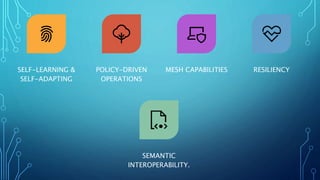
SELF-LEARNING &
SELF-ADAPTING
POLICY-DRIVEN
OPERATIONS
MESH CAPABILITIES RESILIENCY
SEMANTIC
INTEROPERABILITY.
APPLICATIONS
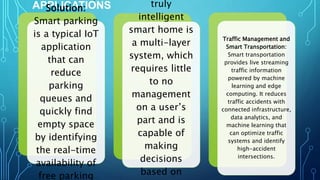
Solution:
Smart parking
is a typical IoT
application
that can
reduce
parking
queues and
quickly find
empty space
by identifying
the real-time
availability of
free parking
truly
intelligent
smart home is
a multi-layer
system, which
requires little
to no
management
on a user’s
part and is
capable of
making
decisions
based on
Traffic Management and
Smart Transportation:
Smart transportation
provides live streaming
traffic information
powered by machine
learning and edge
computing. It reduces
traffic accidents with
connected infrastructure,
data analytics, and
machine learning that
can optimize traffic
systems and identify
high-accident
intersections.
...
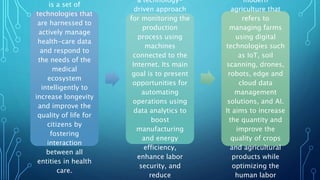
is a set of
technologies that
are harnessed to
actively manage
health-care data
and respond to
the needs of the
medical
ecosystem
intelligently to
increase longevity
and improve the
quality of life for
citizens by
fostering
interaction
between all
entities in health
care.
a technology-
driven approach
for monitoring the
production
process using
machines
connected to the
Internet. Its main
goal is to present
opportunities for
automating
operations using
data analytics to
boost
manufacturing
and energy
efficiency,
enhance labor
security, and
reduce
modern
agriculture that
refers to
managing farms
using digital
technologies such
as IoT, soil
scanning, drones,
robots, edge and
cloud data
management
solutions, and AI.
It aims to increase
the quantity and
improve the
quality of crops
and agricultural
products while
optimizing the
human labor
CONCLUSIO
N
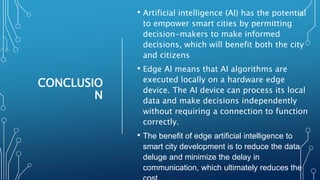
• Artificial intelligence (AI) has the potential
to empower smart cities by permitting
decision-makers to make informed
decisions, which will benefit both the city
and citizens
• Edge AI means that AI algorithms are
executed locally on a hardware edge
device. The AI device can process its local
data and make decisions independently
without requiring a connection to function
correctly.
• The benefit of edge artificial intelligence to
smart city development is to reduce the data
deluge and minimize the delay in
communication, which ultimately reduces the
SOURCES
• Badidi, E. (2022) Edge AI and Blockchain for Smart Sustainable
Cities: Promise and Potential, Sustainability,14, 7609,
https://doi.org/10.3390/su14137609
• https://medium.com/@Buzztify/importance-of-edge-
intelligence-in-smart-city-projects-51b6d6e3fa6d
THANK YOU

Edge Artificial Intelligence in smart city development

  • 1.
    EDGE ARTIFICIAL INTELLIGENCE INSMART CITY DEVELOPMENT DR PROMISE ELECHI
  • 2.
    INTRODUCTION With the increasinginterests in smart city development around the globe, edge artificial intelligence with machine learning capabilities is set to play an important role. Experts have stated that the combination of edge computing and machine learning is set to change the game for home automation, traffic management, building security, infrastructure management, and city parking systems.
  • 3.
    WHAT IS EDGEAI • Edge AI software is large number of machine learning algorithms that run on a physical hardware device. • The idea is to run AI algorithms on a local device or machine. • Edge AI software allows users to get data in real-time because it does not need other systems or internet connections to connect to others. • Edge Computing is a part of a distributed computing topology in which information processing is
  • 4.
    HOW DOES EDGEAI WORK • Edge AI is a combination of Edge Computing and Artificial Intelligence. • AI algorithms are processed locally, either directly on the device or on the server near the device. • The algorithms utilize the data generated by the devices themselves
  • 6.
  • 7.
    SMART CITY • Theidea of a sustainable smart city is one in which everything is interconnected such as the people, devices and processes. • It enables mankind to have a smarter digital world where everything is connected, communicating, and improving the standard of living. • It is a combination of several key applications such as smart home systems, smart transport, intelligent buildings, smart traffic lights, smart waste
  • 8.
  • 9.
  • 10.
    WHY EDGE COMPUTING? NewInternet of Things (IoT) applications are empowering smart city activities around the world however, it has also led to an increase in the cost and latency as all this data must be sent to the cloud or centralized data centres for further analysis and processing. For any sort of sustainable improvement, IoT deployments need to process data and bring the decision-making closer to the source of the data (at the edge), thus cutting the costs and time associated with cloud data transfers.
  • 11.
    ... Data deluge is achallenge while planning for a sustainable smart city since it can be difficult and expensive to manage. 01 Smart city initiatives can adopt edge analytics, which collects the data and analyzes it. 02 In edge analytics, automated analytical computation is performed on data received from sensors, network switches, or other devices instead of sending back to a centralized data store. 03 By running data through an analytics algorithm at the edge, parameters can be set to decide what sort of data should be sent to the cloud for later use. This decreases the latency in the decision-making process for connected devices. 04
  • 12.
    EDGE INTELLIGENCE FOR SMARTCITIES • Edge intelligence can be simply described as edge computing with machine learning. • Edge intelligence brings data pre-processing and decision-making capabilities closer to the data source, which reduces data deluge and delays in communication. • Thus, the time and cost can be saved with the edge intelligence structure, which would be a key performance indicator for smart city management.
  • 13.
    ADVANTAGES OF EDGE INTELLIGENCE • Nearreal-time decision making • Lower latency • Reduced communication cost • Autonomy • Fully distributed computing model and local identity • Enhanced quality of data • Reduced data volume • Pre-processed data so that only decisions or alarms can be forwarded to the cloud servers, rather than raw data
  • 14.
    COMPONENTS OF EDGEINTELLIGENCE Edge analytics Machine learning at the edge Pattern Recognition at the edge
  • 15.
    EDGE ANALYTICS Edge analyticsgives analytics of the data at the edge of a network either at or close to a sensor, a network switch, or some other connected device. Edge analytics can handle rule- based decisions and even more complex event processing design responsible to proactively handle incidents/situations. With smart sensors and connected devices, edge analytics requires hardware and software platforms for storing, preparing the data, and training & processing of the algorithms. The capacity of processing and storing data at the edge also plays a key role.
  • 16.
    MACHINE LEARNING ATTHE EDGE Machine learning is an ability of the system to automatically learn and improve its operations without any human interference. Considering the case of self-driving cars, machine learning applications are trained locally in the car itself (at the edge) to cut back on bandwidth and latency to process data. The ability for these vehicles to process data instantly and make decisions based on the current road conditions is critical and can be life- saving. This is going to help in identifying speeding vehicles and cyclist movements, improving traffic flow, enhancing pedestrian safety, and optimizing parking.
  • 17.
    PATTERN RECOGNITION AT THEEDGE • For the pattern recognition, machines are trained exactly the way human brain thinks and recognizes the patterns by analysing various aspects of the object. • Pattern recognition in AI is where machines are trained to recognize the required images based on a particular pattern. • Learning and predicting traffic and parking patterns and other logistical data at the edge can be possible. • For instance, if the system spots some event happening at an intersection A, it will predict the real-time impact at other intersections.
  • 18.
    DESIGN REQUIREMENTS FORMOVING TOWARDS THE EDGE •credibility and trust •autonomy •machine learning capabilities •self-organization •self-configuration •self-discovery There are various properties and requirements that need to be considered when adopting edge intelligence, such as:
  • 19.
  • 20.
    APPLICATIONS Solution: Smart parking is atypical IoT application that can reduce parking queues and quickly find empty space by identifying the real-time availability of free parking truly intelligent smart home is a multi-layer system, which requires little to no management on a user’s part and is capable of making decisions based on Traffic Management and Smart Transportation: Smart transportation provides live streaming traffic information powered by machine learning and edge computing. It reduces traffic accidents with connected infrastructure, data analytics, and machine learning that can optimize traffic systems and identify high-accident intersections.
  • 21.
    ... is a setof technologies that are harnessed to actively manage health-care data and respond to the needs of the medical ecosystem intelligently to increase longevity and improve the quality of life for citizens by fostering interaction between all entities in health care. a technology- driven approach for monitoring the production process using machines connected to the Internet. Its main goal is to present opportunities for automating operations using data analytics to boost manufacturing and energy efficiency, enhance labor security, and reduce modern agriculture that refers to managing farms using digital technologies such as IoT, soil scanning, drones, robots, edge and cloud data management solutions, and AI. It aims to increase the quantity and improve the quality of crops and agricultural products while optimizing the human labor
  • 22.
    CONCLUSIO N • Artificial intelligence(AI) has the potential to empower smart cities by permitting decision-makers to make informed decisions, which will benefit both the city and citizens • Edge AI means that AI algorithms are executed locally on a hardware edge device. The AI device can process its local data and make decisions independently without requiring a connection to function correctly. • The benefit of edge artificial intelligence to smart city development is to reduce the data deluge and minimize the delay in communication, which ultimately reduces the
  • 23.
    SOURCES • Badidi, E.(2022) Edge AI and Blockchain for Smart Sustainable Cities: Promise and Potential, Sustainability,14, 7609, https://doi.org/10.3390/su14137609 • https://medium.com/@Buzztify/importance-of-edge- intelligence-in-smart-city-projects-51b6d6e3fa6d
  • 24.