1
AI on the Edge
Lifecycle of AI solution to edge computing
Usman Qayyum
Additional Director (AI)
PhD (AI & Robotics)
Post-doc (Self-driving Cars)
mrusmanqayyum@hotmail.com
2
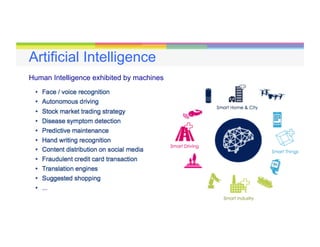
Artificial Intelligence
Human Intelligence exhibited by machines
3
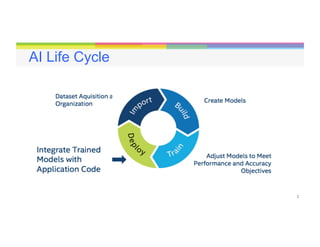
AI Life Cycle
4
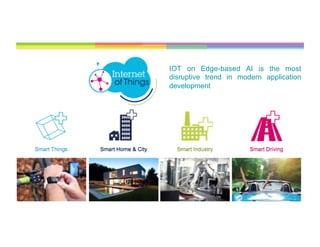
IOT on Edge-based AI is the most
disruptive trend in modern application
development
5
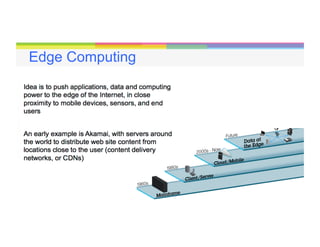
Edge Computing
6
7
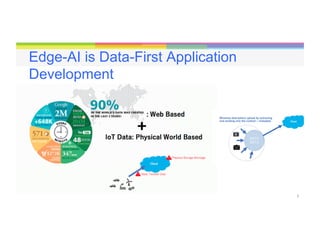
Edge-AI is Data-First Application
Development
8
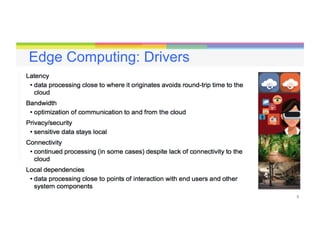
Edge Computing: Drivers
9
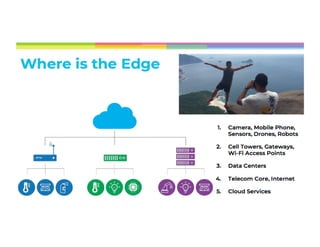
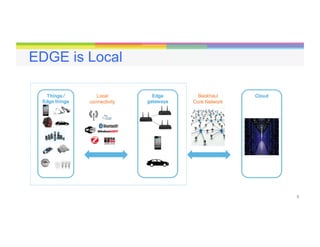
EDGE is Local
10
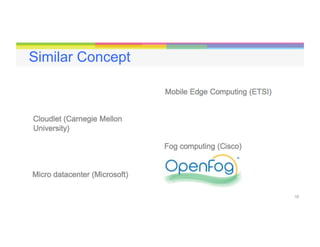
Similar Concept
11
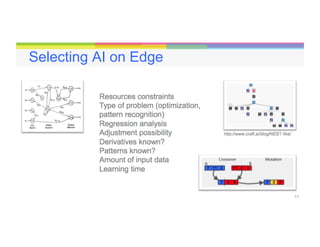
Selecting AI on Edge
12
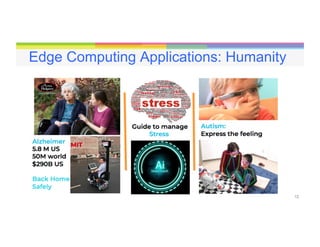
Edge Computing Applications: Humanity
13
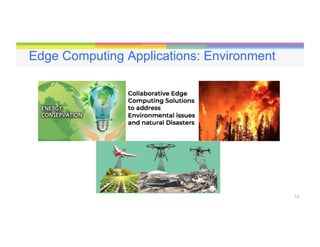
Edge Computing Applications: Environment
14
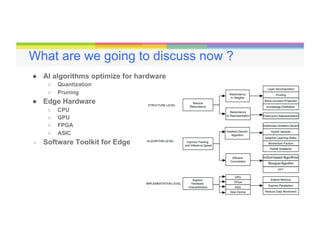
What are we going to discuss now ?
●  AI algorithms optimize for hardware
○  Quantization
○  Pruning
●  Edge Hardware
○  CPU
○  GPU
○  FPGA
○  ASIC
○  Software Toolkit for Edge
15
16
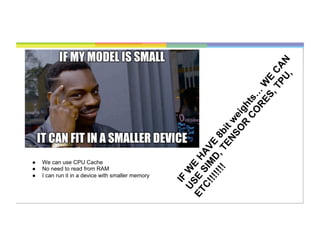
●  We can use CPU Cache
●  No need to read from RAM
●  I can run it in a device with smaller memory
17
What can I do to optimize?
COMPUTE LESS
COMPUTE FASTER
MOVE LESS DATA
18
What can I do to optimize?
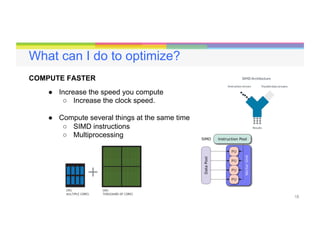
COMPUTE FASTER
●  Increase the speed you compute
○  Increase the clock speed.
●  Compute several things at the same time
○  SIMD instructions
○  Multiprocessing
19
What can I do to optimize?
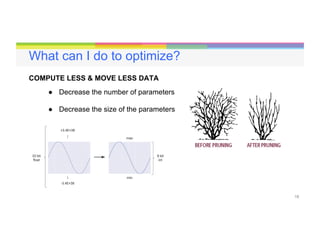
COMPUTE LESS & MOVE LESS DATA
●  Decrease the number of parameters
●  Decrease the size of the parameters
20
What can I do to optimize?
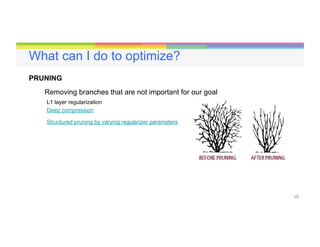
PRUNING
Removing branches that are not important for our goal
L1 layer regularization
Structured pruning by varying regularizer parameters
Deep compression
21
What can I do to optimize?
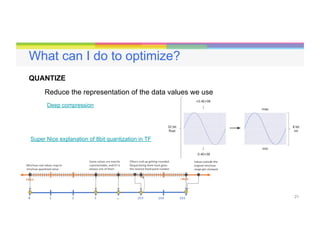
QUANTIZE
Reduce the representation of the data values we use
Deep compression
Super Nice explanation of 8bit quantization in TF
22
LET’S SEE SOME HARDWARE
23
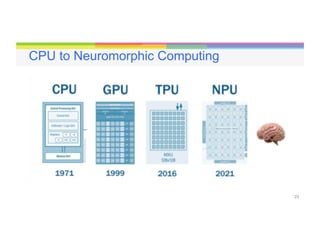
CPU to Neuromorphic Computing
24
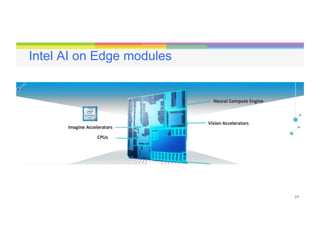
Intel AI on Edge modules
25
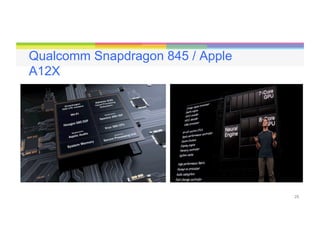
Qualcomm Snapdragon 845 / Apple
A12X
26
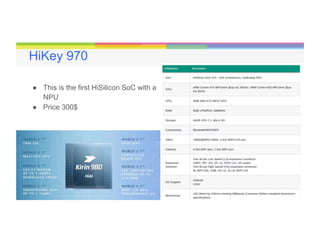
HiKey 970
●  This is the first HiSilicon SoC with a
NPU
●  Price 300$
27
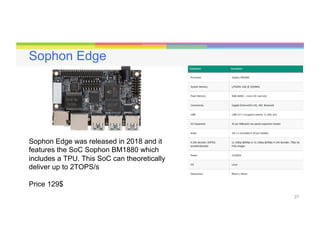
Sophon Edge
Sophon Edge was released in 2018 and it
features the SoC Sophon BM1880 which
includes a TPU. This SoC can theoretically
deliver up to 2TOPS/s
Price 129$
28
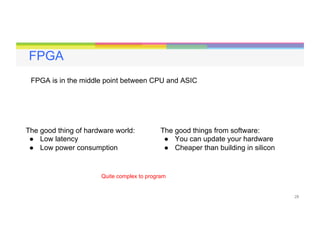
FPGA
FPGA is in the middle point between CPU and ASIC
The good thing of hardware world:
●  Low latency
●  Low power consumption
The good things from software:
●  You can update your hardware
●  Cheaper than building in silicon
Quite complex to program
29
FPGA
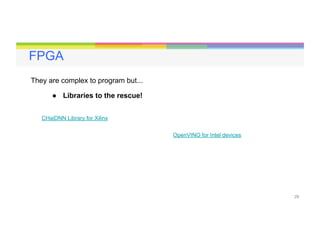
They are complex to program but...
●  Libraries to the rescue!
CHaiDNN Library for Xilinx
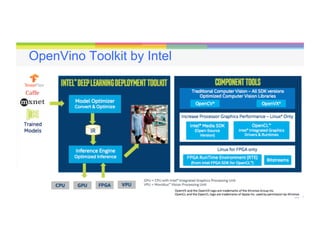
OpenVINO for Intel devices
30
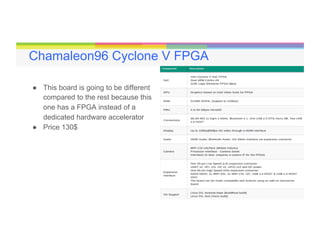
Chamaleon96 Cyclone V FPGA
●  This board is going to be different
compared to the rest because this
one has a FPGA instead of a
dedicated hardware accelerator
●  Price 130$
31
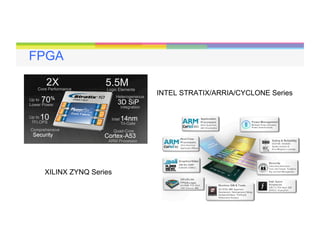
FPGA
INTEL STRATIX/ARRIA/CYCLONE Series
XILINX ZYNQ Series
32
Let’s talk about some hardware
33
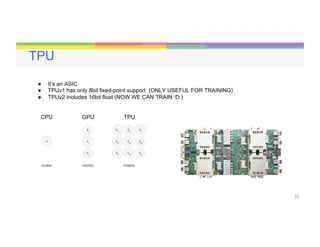
TPU
CPU GPU TPU
●  It’s an ASIC
●  TPUv1 has only 8bit fixed-point support (ONLY USEFUL FOR TRAINING)
●  TPUv2 includes 16bit float (NOW WE CAN TRAIN :D )
34
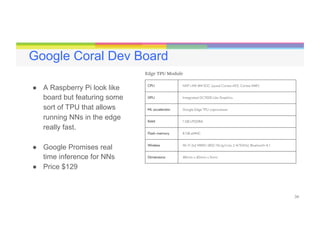
Google Coral Dev Board
●  A Raspberry Pi look like
board but featuring some
sort of TPU that allows
running NNs in the edge
really fast.
●  Google Promises real
time inference for NNs
●  Price $129
35
36
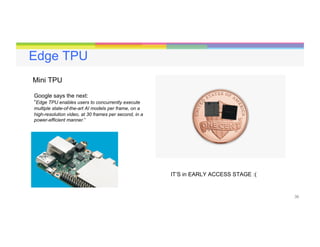
Mini TPU
Google says the next:
“Edge TPU enables users to concurrently execute
multiple state-of-the-art AI models per frame, on a
high-resolution video, at 30 frames per second, in a
power-efficient manner.”
IT’S in EARLY ACCESS STAGE :(
Edge TPU
37
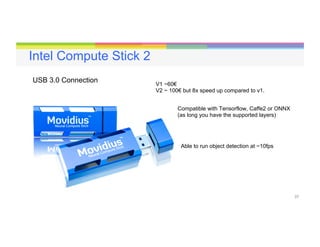
Intel Compute Stick 2
USB 3.0 Connection
Able to run object detection at ~10fps
Compatible with Tensorflow, Caffe2 or ONNX
(as long you have the supported layers)
V1 ~60€
V2 ~ 100€ but 8x speed up compared to v1.
38
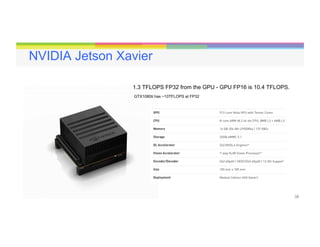
1.3 TFLOPS FP32 from the GPU - GPU FP16 is 10.4 TFLOPS.
NVIDIA Jetson Xavier
GTX1080ti has ~10TFLOPS at FP32
39
OpenVino Toolkit by Intel
40
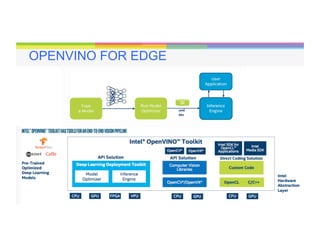
OPENVINO FOR EDGE
41
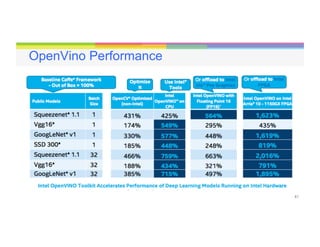
OpenVino Performance
42
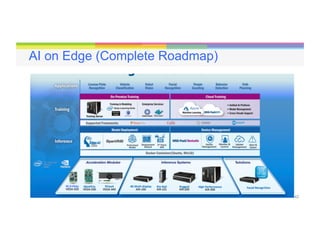
AI on Edge (Complete Roadmap)
43
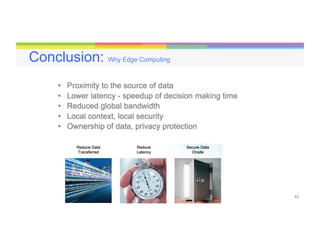
Conclusion: Why Edge Computing
44
Thanks for your attention.
AI on the Edge
Usman Qayyum
Additional Director (AI)
PhD (AI & Robotics)
Post-doc (Self-driving Cars)
mrusmanqayyum@hotmail.com

Artificial intelligence on the Edge