Economic Report Of The President Us Government
Printing Office download
https://ebookbell.com/product/economic-report-of-the-president-
us-government-printing-office-2296152
Explore and download more ebooks at ebookbell.com
Here are some recommended products that we believe you will be
interested in. You can click the link to download.
Economic Report Of The President 2009 Economic Report Of The President
Transmitted To The Congress Executive Office Of The President
https://ebookbell.com/product/economic-report-of-the-
president-2009-economic-report-of-the-president-transmitted-to-the-
congress-executive-office-of-the-president-2187084
Transport And Economic Development Report Of The Hundred And
Nineteenth Round Table On Transport Economics Held In Paris On 29th
And 30rd March 2001 Oecd
https://ebookbell.com/product/transport-and-economic-development-
report-of-the-hundred-and-nineteenth-round-table-on-transport-
economics-held-in-paris-on-29th-and-30rd-march-2001-oecd-6779976
Role Of Direct And Indirect Taxes In The Federal Reserve System A
Conference Report Of The Nber And The Brookings Institution National
Bureau Of Economic Research John F Due
https://ebookbell.com/product/role-of-direct-and-indirect-taxes-in-
the-federal-reserve-system-a-conference-report-of-the-nber-and-the-
brookings-institution-national-bureau-of-economic-research-john-f-
due-51957078
Report Of The Hundred And Eighteenth Round Table On Transport
Economics Held In Paris On 30th November1st December 2000 On The
Following Topic Tolls On Interurban Road Infrastructure An Economic
Evaluation Oecd
https://ebookbell.com/product/report-of-the-hundred-and-eighteenth-
round-table-on-transport-economics-held-in-paris-on-30th-november1st-
december-2000-on-the-following-topic-tolls-on-interurban-road-
infrastructure-an-economic-evaluation-oecd-6778094
The Financial Crisis Inquiry Report Authorized Edition Final Report Of
The National Commission On The Causes Of The Financial And Economic
Crisis In The United States 1st Edition Financial Crisis Inquiry
Commission
https://ebookbell.com/product/the-financial-crisis-inquiry-report-
authorized-edition-final-report-of-the-national-commission-on-the-
causes-of-the-financial-and-economic-crisis-in-the-united-states-1st-
edition-financial-crisis-inquiry-commission-2621534
National Systems Of Transport Infrastructure Planning Report Of The
One Hundred And Twenty Eight Round Table On Transport Econmics Held In
Paris On 26th27th February 2004 Ecmt Round Tables European Conference
Of Ministers Of Tran
https://ebookbell.com/product/national-systems-of-transport-
infrastructure-planning-report-of-the-one-hundred-and-twenty-eight-
round-table-on-transport-econmics-held-in-paris-on-26th27th-
february-2004-ecmt-round-tables-european-conference-of-ministers-of-
tran-1989116
The State Of Economic Inclusion Report 2021 The Potential To Scale 1st
Edition World Bank Colin Andrews Ins Arvalo Snchez Sarang Chaudhary
Timothy Clay Puja Vasudeva Dutta Janet Heisey Sadna Samaranayake Aude
De Montesquiou
https://ebookbell.com/product/the-state-of-economic-inclusion-
report-2021-the-potential-to-scale-1st-edition-world-bank-colin-
andrews-ins-arvalo-snchez-sarang-chaudhary-timothy-clay-puja-vasudeva-
dutta-janet-heisey-sadna-samaranayake-aude-de-montesquiou-51883058
Report On The State Of The European Union Volume 3 Crisis In The Eu
Economic Governance Jeanpaul Fitoussi
https://ebookbell.com/product/report-on-the-state-of-the-european-
union-volume-3-crisis-in-the-eu-economic-governance-jeanpaul-
fitoussi-5361956
Report On The State Of The European Union Volume 3 Crisis In The Eu
Economic Governance Jeanpaul Fitoussi
https://ebookbell.com/product/report-on-the-state-of-the-european-
union-volume-3-crisis-in-the-eu-economic-governance-jeanpaul-
fitoussi-1814682
economic
report
of
the
president
•
february
2010
transmitted to the congress february 2010
together with the annual report
of the council of economic advisers
ec onomic
rep ort
of the
president
coverPROOF.indd 1 12/28/09 10:48 AM
For sale by the Superintendent of Documents, U.S. Government Printing Office
Internet: bookstore.gpo.gov Phone: toll free (866) 512-1800; DC area (202) 512-1800
Fax: (202) 512-2104 Mail: Stop IDCC, Washington, DC 20402-0001
ISBN 978-0-16-084824-7
transmitted to the congress
february 2010
together with
the annual report
of the
council of economic advisers
united states government printing office
washington : 2010
e c o n o m i c
rep ort
of the
president
iii
C O N T E N T S
ECONOMIC REPORT OF THE PRESIDENT ........................................... 1
ANNUAL REPORT OF THE COUNCIL OF ECONOMIC ADVISERS* 11
CHAPTER 1. TO RESCUE, REBALANCE, AND REBUILD .............. 25
CHAPTER 2. RESCUING THE ECONOMY FROM THE GREAT
RECESSION ........................................................................ 39
CHAPTER 3 CRISIS AND RECOVERY IN THE WORLD
ECONOMY ........................................................................ 81
CHAPTER 4. SAVING AND INVESTMENT ....................................... 113
CHAPTER 5. ADDRESSING THE LONG-RUN FISCAL
CHALLENGE ..................................................................... 137
CHAPTER 6. BUILDING A SAFER FINANCIAL SYSTEM .............. 159
CHAPTER 7. REFORMING HEALTH CARE ...................................... 181
CHAPTER 8. STRENGTHENING THE AMERICAN LABOR
FORCE ................................................................................. 213
CHAPTER 9. TRANSFORMING THE ENERGY SECTOR AND
ADDRESSING CLIMATE CHANGE ............................ 235
CHAPTER 10. FOSTERING PRODUCTIVITY GROWTH
THROUGH INNOVATION AND TRADE ................. 259
REFERENCES ............................................................................................... 285
APPENDIX A. REPORT TO THE PRESIDENT ON THE
ACTIVITIES OF THE COUNCIL OF
ECONOMIC ADVISERS DURING 2009 ...................... 305
APPENDIX B. STATISTICAL TABLES RELATING TO INCOME,
EMPLOYMENT, AND PRODUCTION ....................... 319
____________
*For a detailed table of contents of the Council’s Report, see page 15.
Page
economic report
of the
president
Economic Report of the President | 3
economic report of the president
To the Congress of the United States:
As we begin a new year, the American people are still experiencing
the effects of a recession as deep and painful as any we have known in
generations. Traveling across this country, I have met countless men and
women who have lost jobs these past two years. I have met small business
owners struggling to pay for health care for their workers; seniors unable
to afford prescriptions; parents worried about paying the bills and saving
for their children’s future and their own retirement. And the effects of this
recession come in the aftermath of a decade of declining economic security
for the middle class and those who aspire to it.
At the same time, over the past two years, we have also seen reason
for hope: the resilience of the American people who have held fast—
even in the face of hardship—to an unrelenting faith in the promise of
our country.
It is that determination that has helped the American people
overcome difficult periods in our Nation’s history. And it is this persever-
ance that remains our great strength today. After all, our workers are as
productive as ever. American businesses are still leaders in innovation.
Our potential is still unrivaled. Our task as a Nation—and our mission
as an Administration—is to harness that innovative spirit, that productive
energy, and that potential in order to create jobs, raise incomes, and foster
economic growth that is sustained and broadly shared. It’s not enough
to move the economy from recession to recovery. We must rebuild the
economy on a new and stronger foundation.
I can report that over the past year, this work has begun. In the
coming year, this work continues. But to understand where we must go
in the next year and beyond, it is important to remember where we began
one year ago.
4 | Economic Report of the President
Last January, years of irresponsible risk-taking and debt-fueled
speculation—unchecked by sound oversight—led to the near-collapse
of our financial system. We were losing an average of 700,000 jobs each
month. Over the course of one year, $13 trillion of Americans’ household
wealth had evaporated as stocks, pensions, and home values plummeted.
Our gross domestic product was falling at the fastest rate in a quarter
century. The flow of credit, vital to the functioning of businesses large and
small, had ground to a halt. The fear among economists, from across the
political spectrum, was that we could sink into a second Great Depression.
Immediately, we took a series of difficult steps to prevent that
catastrophe for American families and businesses. We acted to get lending
flowing again so ordinary Americans could get financing to buy homes
and cars, to go to college, and to start businesses of their own; and so
businesses, large and small, could access loans to make payroll, buy equip-
ment, hire workers, and expand. We enacted measures to stem the tide of
foreclosures in our housing market, helping responsible homeowners stay
in their homes and helping to stop the broader decline in home values.
To achieve this, and to prevent an economic collapse, we were forced
to use authority enacted under the previous Administration to extend
assistance to some of the very banks and financial institutions whose
actions had helped precipitate the turmoil. We also took steps to prevent
the collapse of the American auto industry, which faced a crisis partly
of its own making, to prevent another round of widespread job losses in
an already fragile time. These decisions were not popular, but they were
necessary. Indeed, the decision to stabilize the financial system helped to
avert a larger catastrophe, and thanks to the efficient management of the
rescue—with added transparency and accountability—we have recovered
most of the money provided to banks.
In addition, even as we worked to address the crises in our banking
sector, in our housing market, and in our auto industry, we also began
attacking our economic crisis on a broader front. Less than one month
after taking office, we enacted the most sweeping economic recovery
package in history: the American Recovery and Reinvestment Act of
2009. The Recovery Act not only provided tax cuts to small businesses and
95 percent of working families and provided emergency relief to those out
of work or without health insurance; it also began to lay a new foundation
for long-term growth. With investments in health care, education, infra-
structure, and clean energy, the Recovery Act has saved or created roughly
two million jobs so far, and it has begun the hard work of transforming our
economy to thrive in the modern, global era.
Economic Report of the President | 5
Because of these and other steps, we can safely say that we’ve avoided
the depression many feared. Our economy is growing again, and the
growth over the last three months was the strongest in six years. But while
economic growth is important, it means nothing to somebody who has
lost a job and can’t find another. For Americans looking for work, a good
job is the only good news that matters. And that’s why our work is far
from complete.
It is true that the steps we have taken have slowed the flood of job
losses from 691,000 per month in the first quarter of 2009 to 69,000 in the
last quarter. But stemming the tide of job loss isn’t enough. More than
7 million jobs have been lost since the recession began two years ago. This
represents not only a terrible human tragedy, but also a very deep hole
from which we’ll have to climb out. Until jobs are being created to replace
those we’ve lost—until America is back at work—my Administration will
not rest and this recovery will not be finished.
That’s why I am continuing to call on the Congress to pass a jobs bill.
I’ve proposed a package that includes tax relief for small businesses to spur
hiring, that accelerates construction on roads, bridges, and waterways,
and that creates incentives for homeowners to invest in energy efficiency,
because this will create jobs, save families money, and reduce pollution
that harms our environment.
It is also essential that as we promote private sector hiring, we
continue to take steps to prevent layoffs of critical public servants like
teachers, firefighters, and police officers, whose jobs are threatened by
State and local budget shortfalls. To do otherwise would not only worsen
unemployment and hamper our recovery; it would also undermine our
communities. And we cannot forget the millions of people who have lost
their jobs. The Recovery Act provided support for these families hardest-
hit by this recession, and that support must continue.
At the same time, long before this crisis hit, middle-class families
were under growing strain. For decades, Washington failed to address
fundamental weaknesses in the economy: rising health care costs, growing
dependence on foreign oil, an education system unable to prepare all of
our children for the jobs of the future. In recent years, spending bills and
tax cuts for the very wealthiest were approved without paying for any of
it, leaving behind a mountain of debt. And while Wall Street gambled
without regard for the consequences, Washington looked the other way.
As a result, the economy may have been working for some at the
very top, but it was not working for all American families. Year after year,
folks were forced to work longer hours, spend more time away from their
6 | Economic Report of the President
loved ones, all while their incomes flat-lined and their sense of economic
security evaporated. Growth in our country was neither sustained nor
broadly shared. Instead of a prosperity powered by smart ideas and sound
investments, growth was fueled in large part by a rapid rise in consumer
borrowing and consumer spending.
Beneath the statistics are the stories of hardship I’ve heard all
across America—hardships that began long before this recession hit two
years ago. For too many, there has long been a sense that the American
dream—a chance to make your own way, to work hard and support your
family, save for college and retirement, own a home—was slipping away.
And this sense of anxiety has been combined with a deep frustration that
Washington either didn’t notice, or didn’t care enough to act.
These weaknesses have not only made our economy more
susceptible to the kind of crisis we have been through. They have also
meant that even in good times the economy did not produce nearly enough
gains for middle-class families. Typical American families saw their stan-
dards of living stagnate, rather than rise as they had for generations. That
is why, in the aftermath of this crisis, and after years of inaction, what is
clear is that we cannot go back to business as usual.
That is why, as we strive to meet the crisis of the moment, we are
continuing to lay a new foundation for prosperity: a foundation on which
the middle class can prosper and grow, where if you are willing to work
hard, you can find a good job, afford a home, send your children to world-
class schools, afford high-quality health care, and enjoy retirement security
in your later years. This is the heart of the American Dream, and it is at
the core of our efforts to not only rebuild this economy—but to rebuild it
stronger than before. And this work has already begun.
Already, we have made historic strides to reform and improve our
education system. We have launched a Race to the Top in which schools
are competing to create the most innovative programs, especially in math
and science. We have already made college more affordable, even as we
seek to increase student aid by ending a wasteful subsidy that serves only
to line the pockets of lenders with tens of billions of taxpayer dollars. And
I’ve proposed a new American Graduation Initiative and set this goal: by
2020, America will once again have the highest proportion of college grad-
uates in the world. For we know that in this new century, growth will be
powered not by what consumers can borrow and spend, but what talented,
skilled workers can create and export.
Already, we have made historic strides to improve our health care
system, essential to our economic prosperity. The burdens this system
Economic Report of the President | 7
places on workers, businesses, and governments is simply unsustainable.
And beyond the economic cost—which is vast—there is also a terrible
human toll. That’s why we’ve extended health insurance to millions more
children; invested in health information technology through the Recovery
Act to improve care and reduce costly errors; and provided the largest
boost to medical research in our history. And I continue to fight to pass
real, meaningful health insurance reforms that will get costs under control
for families, businesses, and governments, protect people from the worst
practices of insurance companies, and make coverage more affordable and
secure for people with insurance, as well as those without it.
Already, we have begun to build a new clean energy economy. The
Recovery Act included the largest investment in clean energy in history,
investments that are today creating jobs across America in the industries
that will power our future: developing wind energy, solar technology, and
clean energy vehicles. But this work has only just begun. Other countries
around the world understand that the nation that leads the clean energy
economy will be the nation that leads the global economy. I want America
to be that nation. That is why we are working toward legislation that will
create new incentives to finally make renewable energy the profitable
kind of energy in America. It’s not only essential for our planet and our
security, it’s essential for our economy.
But this is not all we must do. For growth to be truly sustainable—
for our prosperity to be truly shared and our living standards to actually
rise—we need to move beyond an economy that is fueled by budget deficits
and consumer demand. In other words, in order to create jobs and raise
incomes for the middle class over the long run, we need to export more
and borrow less from around the world, and we need to save more money
and take on less debt here at home. As we rebuild, we must also rebalance.
In order to achieve this, we’ll need to grow this economy by growing our
capacity to innovate in burgeoning industries, while putting a stop to irre-
sponsible budget policies and financial dealings that have led us into such
a deep fiscal and economic hole.
That begins with policies that will promote innovation throughout
our economy. To spur the discoveries that will power new jobs, new busi-
nesses—and perhaps new industries—I have challenged both the public
sector and the private sector to devote more resources to research and
development. And to achieve this, my budget puts us on a path to double
investment in key research agencies and makes the research and experi-
mentation tax credit permanent. We are also pursuing policies that will
help us export more of our goods around the world, especially by small
8 | Economic Report of the President
businesses and farmers. And by harnessing the growth potential of inter-
national trade—while ensuring that other countries play by the rules and
that all Americans share in the benefits—we will support millions of good,
high-paying jobs.
But hand in hand with increasing our reliance on the Nation’s
ingenuity is decreasing our reliance on the Nation’s credit card, as well as
reining in the excess and abuse in our financial sector that led large firms
to take on extraordinary risks and extraordinary liabilities.
When my Administration took office, the surpluses our Nation
had enjoyed at the start of the last decade had disappeared as a result of
the failure to pay for two large tax cuts, two wars, and a new entitlement
program. And decades of neglect of rising health care costs had put our
budget on an unsustainable path.
In the long term, we cannot have sustainable and durable economic
growth without getting our fiscal house in order. That is why even as we
increased our short-term deficit to rescue the economy, we have refused
to go along with business as usual, taking responsibility for every dollar we
spend. Last year, we combed the budget, cutting waste and excess wher-
ever we could, a process that will continue in the coming years. We are
pursuing health insurance reforms that are essential to reining in deficits.
I’ve called for a fee to be paid by the largest financial firms so that the
American people are fully repaid for bailing out the financial sector. And
I’ve proposed a freeze on nonsecurity discretionary spending for three
years, a bipartisan commission to address the long-term structural imbal-
ance between expenditures and revenues, and the enactment of “pay-go”
rules so that Congress has to account for every dollar it spends.
In addition, I’ve proposed a set of common sense reforms to prevent
future financial crises. For while the financial system is far stronger today
than it was one year ago, it is still operating under the same rules that led
to its near-collapse. These are rules that allowed firms to act contrary to
the interests of customers; to hide their exposure to debt through complex
financial dealings that few understood; to benefit from taxpayer-insured
deposits while making speculative investments to increase their own
profits; and to take on risks so vast that they posed a threat to the entire
economy and the jobs of tens of millions of Americans.
That is why we are seeking reforms to empower consumers with
the benefit of a new consumer watchdog charged with making sure that
financial information is clear and transparent; to close loopholes that
allowed big financial firms to trade risky financial products like credit
defaults swaps and other derivatives without any oversight; to identify
Economic Report of the President | 9
system-wide risks that could cause a financial meltdown; to strengthen
capital and liquidity requirements to make the system more stable; and to
ensure that the failure of any large firm does not take the economy down
with it. Never again will the American taxpayer be held hostage by a bank
that is “too big to fail.”
Through these reforms, we seek not to undermine our markets but
to make them stronger: to promote a vibrant, fair, and transparent finan-
cial system that is far more resistant to the reckless, irresponsible activities
that might lead to another meltdown. And these kinds of reforms are in
the shared interest of firms on Wall Street and families on Main Street.
These have been a very tough two years. American families and
businesses have paid a heavy price for failures of responsibility from Wall
Street to Washington. Our task now is to move beyond these failures, to
take responsibility for our future once more. That is how we will create
new jobs in new industries, harnessing the incredible generative and
creative capacity of our people. That is how we’ll achieve greater economic
security and opportunity for middle-class families in this country. That
is how in this new century we will rebuild our economy stronger than
ever before.
the white house
february 2010
the annual report
of the
council of economic advisers
13
letter of transmittal
Council of Economic Advisers
Washington, D.C., February 11, 2010
Mr. President:
The Council of Economic Advisers herewith submits its 2010
Annual Report in accordance of the Employment Act of 1946 as amended
by the Full Employment and Balanced Growth Act of 1978.
Sincerely,
Christina D. Romer
Chair
Austan Goolsbee
Member
Cecilia Elena Rouse
Member
15
C O N T E N T S
CHAPTER 1. TO RESCUE, REBALANCE, AND REBUILD ......... 25
Rescuing an Economy in Freefall ............................................ 26
Rescuing the Economy from the Great Recession ........................ 28
Crisis and Recovery in the World Economy ................................ 29
Rebalancing the Economy on the Path to Full
Employment ...................................................................................... 29
Saving and Investment .................................................................. 29
Addressing the Long-Run Fiscal Challenge ................................. 31
Building a Safer Financial System ............................................... 32
Rebuilding a Stronger Economy .............................................. 33
Reforming Health Care ................................................................. 33
Strengthening the American Labor Force .................................... 35
Transforming the Energy Sector and Addressing Climate
Change ............................................................................................ 36
Fostering Productivity Growth Through Innovation and
Trade .............................................................................................. 37
Conclusion ........................................................................................ 38
CHAPTER 2. RESCUING THE ECONOMY FROM THE
GREAT RECESSION ................................................................................ 39
An Economy in Freefall ............................................................... 39
The Run-Up to the Recession ........................................................ 40
The Downturn ............................................................................... 41
Wall Street and Main Street ......................................................... 44
The Unprecedented Policy Response ...................................... 46
Monetary Policy ............................................................................. 47
Financial Rescue ............................................................................ 49
Fiscal Stimulus ............................................................................... 51
Housing Policy ............................................................................... 55
The Effects of the Policies ........................................................ 56
Page
16 | Annual Report of the Council of Economic Advisers
The Financial Sector ...................................................................... 57
Housing ........................................................................................... 60
Overall Economic Activity ............................................................. 63
The Labor Market .......................................................................... 68
The Challenges Ahead .................................................................. 72
Deteriorating Forecasts .................................................................. 72
The Administration Forecast ......................................................... 75
Responsible Policies to Spur Job Creation ..................................... 78
Conclusion ......................................................................................... 79
CHAPTER 3. CRISIS AND RECOVERY IN THE WORLD
ECONOMY ................................................................................................. 81
International Dimensions of the Crisis ................................ 82
Spread of the Financial Shock ....................................................... 82
The Collapse of World Trade ........................................................ 87
The Collapse in Financial Flows ................................................... 89
The Decline in Output Around the Globe .................................... 90
Policy Responses Around the Globe ........................................ 93
Monetary Policy in the Crisis ........................................................ 93
Central Bank Liquidity Swaps ....................................................... 96
Fiscal Policy in the Crisis ............................................................... 98
Trade Policy in the Crisis ............................................................... 100
The Role of International Institutions ................................ 100
The G-20 ......................................................................................... 100
The International Monetary Fund ................................................ 101
The Beginning of Recovery Around the Globe ................... 102
The Impact of Fiscal Policy ............................................................ 104
The World Economy in the Near Term ........................................ 106
Global Imbalances in the Crisis ..................................................... 108
Conclusion ......................................................................................... 111
CHAPTER 4. SAVING AND INVESTMENT ..................................... 113
The Path of Consumption Spending ...................................... 114
The Determinants of Saving .......................................................... 115
Implications for Recent and Future Saving Behavior .................. 117
The Future of the Housing Market and
Construction .................................................................................... 120
The Housing Market ...................................................................... 121
Contents | 17
Commercial Real Estate ................................................................. 123
Business Investment ....................................................................... 126
Investment in the Recovery ............................................................ 126
Investment in the Long Run .......................................................... 127
The Current Account ................................................................... 129
Determinants of the Current Account .......................................... 129
The Current Account in the Recovery and in the Long Run ....... 132
Steps to Encourage Exports ............................................................ 133
Conclusion ......................................................................................... 135
CHAPTER 5. ADDRESSING THE LONG-RUN FISCAL
CHALLENGE .............................................................................................. 137
The Long-Run Fiscal Challenge ............................................... 137
Sources of the Long-Run Fiscal Challenge .................................... 139
The Role of the Recovery Act and Other Rescue Operations ....... 143
An Anchor for Fiscal Policy ...................................................... 144
The Effects of Budget Deficits ........................................................ 145
Feasible Long-Run Fiscal Policies .................................................. 146
The Choice of a Fiscal Anchor ....................................................... 148
Reaching the Fiscal Target ........................................................ 149
General Principles .......................................................................... 149
Comprehensive Health Care Reform ............................................ 150
Restoring Balance to the Tax Code ............................................... 151
Eliminating Wasteful Spending ..................................................... 155
Conclusion: The Distance Still to Go ................................... 156
CHAPTER 6. BUILDING A SAFER FINANCIAL SYSTEM ........... 159
What Is Financial Intermediation? ......................................... 160
The Economics of Financial Intermediation ................................ 160
Types of Financial Intermediaries ................................................. 163
The Regulation of Financial Intermediation in the
United States .................................................................................... 166
Financial Crises: The Collapse of Financial
Intermediation ................................................................................. 170
Confidence Contagion .................................................................... 170
Counterparty Contagion ................................................................ 172
Coordination Contagion ................................................................ 173
Preventing Future Crises: Regulatory Reform ................. 174
18 | Annual Report of the Council of Economic Advisers
Promote Robust Supervision and Regulation of Financial
Firms ............................................................................................... 175
Establish Comprehensive Regulation of Financial Markets ........ 176
Provide the Government with the Tools It Needs to Manage
Financial Crises .............................................................................. 178
Raise International Regulatory Standards and Improve
International Cooperation ............................................................. 179
Protect Consumers and Investors from Financial Abuse ............ 179
Conclusion ......................................................................................... 180
CHAPTER 7. REFORMING HEALTH CARE .................................... 181
The Current State of the U.S. Health Care Sector ......... 182
Rising Health Spending in the United States ................................ 182
Market Failures in the Current U.S. Health Care System:
Theoretical Background ................................................................. 185
System-Wide Evidence of Inefficient Spending ............................ 188
Declining Coverage and Strains on Particular Groups and
Sectors .............................................................................................. 191
Health Policies Enacted in 2009 ............................................... 196
Expansion of the CHIP Program ................................................... 197
Subsidized COBRA Coverage ........................................................ 197
Temporary Federal Medical Assistance Percentage (FMAP)
Increase ........................................................................................... 199
Recovery Act Measures to Improve the Quality and Efficiency
of Health Care ................................................................................ 201
2009 Health Reform Legislation ............................................... 202
Insurance Market Reforms: Strengthening and Securing
Coverage .......................................................................................... 202
Expansions in Health Insurance Coverage Through the
Exchange ......................................................................................... 205
Economic and Health Benefits of Expanding Health
Insurance Coverage ........................................................................ 206
Reducing the Growth Rate of Health Care Costs in the Public
and Private Sectors ......................................................................... 207
The Economic Benefits of Slowing the Growth Rate of Health
Care Costs ....................................................................................... 210
Conclusion ......................................................................................... 211
Contents | 19
CHAPTER 8. STRENGTHENING THE AMERICAN
LABOR FORCE .......................................................................................... 213
Challenges Facing American Workers .................................. 214
Unemployment ............................................................................... 214
Sectoral Change .............................................................................. 216
Stagnating Incomes for Middle-Class Families ............................ 217
Policies to Support Workers ...................................................... 219
Education and Training: The Groundwork for
Long-Term Prosperity ................................................................... 221
Benefits of Education ..................................................................... 221
Trends in U.S. Educational Attainment ....................................... 222
U.S. Student Achievement ............................................................. 226
A Path Toward Improved Educational Performance ...... 227
Postsecondary Education ............................................................... 228
Training and Adult Education ...................................................... 229
Elementary and Secondary Education .......................................... 231
Early Childhood Education ........................................................... 233
Conclusion ......................................................................................... 234
CHAPTER 9. TRANSFORMING THE ENERGY SECTOR
AND ADDRESSING CLIMATE CHANGE .......................................... 235
Greenhouse Gas Emissions, Climate, and Economic
Well-Being ......................................................................................... 236
Greenhouse Gases ........................................................................... 237
Temperature Change ...................................................................... 238
Impact on Economic Well-Being ................................................... 239
Jump-Starting the Transition to Clean Energy ................. 243
Recovery Act Investments in Clean Energy .................................. 243
Short-Run Macroeconomic Effects of the Clean Energy
Investments ..................................................................................... 246
Other Domestic Actions to Mitigate Climate
Change ................................................................................................. 247
Market-Based Approaches to Advance the Clean
Energy Transformation and Address Climate Change ... 248
Cap-and-Trade Program Basics .................................................... 248
Ways to Contain Costs in an Effective Cap-and-Trade
System .............................................................................................. 250
20 | Annual Report of the Council of Economic Advisers
Coverage of Gases and Industries .................................................. 253
The American Clean Energy and Security Act ............................. 254
International Action on Climate Change Is Needed ....... 255
Partnerships with Major Developed and Emerging
Economies ....................................................................................... 256
Phasing Out Fossil Fuel Subsidies ................................................. 257
Conclusion ......................................................................................... 257
CHAPTER 10. FOSTERING PRODUCTIVITY GROWTH
THROUGH INNOVATION AND TRADE ......................................... 259
The Role of Productivity Growth in Driving Living
Standards ........................................................................................... 261
Recent Trends in Productivity in the United States ..................... 262
Sources of Productivity Growth ..................................................... 264
Fostering Productivity Growth Through Innovation ... 266
The Importance of Basic Research ................................................ 267
Private Research and Experimentation ........................................ 269
Protection of Intellectual Property Rights ..................................... 270
Spurring Progress in National Priority Areas .............................. 272
Increasing Openness and Transparency ....................................... 272
Trade as an Engine of Productivity Growth and
Higher Living Standards ............................................................. 274
The United States and International Trade ................................. 275
Sources of Productivity Growth from International Trade ......... 276
Encouraging Trade and Enforcing Trade Agreements ................ 280
Ensuring the Gains from Productivity Growth
Are Widely Shared ......................................................................... 282
Conclusion ......................................................................................... 284
REFERENCES ............................................................................................. 285
appendixes
A. Report to the President on the Activities of the Council of
Economic Advisers During 2009 .................................................. 305
B. Statistical Tables Relating to Income, Employment, and
Production ...................................................................................... 319
Contents | 21
list of figures
1-1. House Prices Adjusted for Inflation ............................................. 27
1-2. Monthly Change in Payroll Employment .................................... 28
1-3. Personal Consumption Expenditures as a Share of GDP .......... 30
1-4. Actual and Projected Budget Surpluses in January 2009
under Previous Policy ..................................................................... 31
1-5. Real Median Family Income .......................................................... 33
1-6. Total Compensation Including and Excluding Health
Insurance ........................................................................................... 34
1-7. Mean Years of Schooling by Birth Cohort ................................... 36
1-8. R&D Spending as a Percent of GDP ............................................. 37
2-1. House Prices Adjusted for Inflation ............................................. 40
2-2. Income and Consumption Around the 2008 Tax Rebate ......... 42
2-3. TED Spread and Moody’s BAA-AAA Spread Through
December 2008 ................................................................................. 43
2-4. Assets on the Federal Reserve’s Balance Sheet ............................ 48
2-5. TED Spread and Moody’s BAA-AAA Spread Through
December 2009 ................................................................................. 57
2-6. S&P 500 Stock Price Index ............................................................. 58
2-7. Monthly Gross SBA 7(a) and 504 Loan Approvals .................... 60
2-8. 30-Year Fixed Rate Mortgage Rate ............................................... 61
2-9. FHFA and LoanPerformance National House Price Indexes ... 63
2-10. Real GDP Growth ............................................................................ 64
2-11. Real GDP: Actual and Statistical Baseline Projection ............... 65
2-12. Contributions to Real GDP Growth ............................................. 66
2-13. Average Monthly Change in Employment .................................. 68
2-14. Estimated Effect of the Recovery Act on Employment .............. 69
2-15. Contributions to the Change in Employment ............................. 71
2-16. Okun’s Law, 2000-2009 ................................................................... 74
3-1. Interbank Market Rates .................................................................. 83
3-2. Nominal Trade-Weighted Dollar Index ....................................... 85
3-3. OECD Exports-to-GDP Ratio ....................................................... 87
3-4. Vertical Specialization and the Collapse in Trade ...................... 88
3-5. Cross-Border Gross Purchases and Sales of Long-Term
Assets ................................................................................................. 90
3-6. Industrial Production in Advanced Economies .......................... 91
3-7. Industrial Production in Emerging Economies .......................... 92
3-8. Headline Inflation, 12-Month Change ......................................... 93
3-9. Policy Rates in Economies with Major Central Banks ............... 94
22 | Annual Report of the Council of Economic Advisers
3-10. Change in Central Bank Assets ..................................................... 95
3-11. Central Bank Liquidity Swaps of the Federal Reserve ................ 97
3-12. Tax Share and Discretionary Stimulus ......................................... 99
3-13. Outperforming Expectations and Stimulus ................................. 105
3-14. OECD Countries: GDP and Unemployment ............................. 108
3-15. Current Account Deficits or Surpluses ........................................ 110
4-1. Personal Consumption Expenditures as a Share of GDP .......... 114
4-2. Personal Saving Rate Versus Wealth Ratio .................................. 115
4-3. Personal Saving Rate: Actual Versus Model ............................... 118
4-4. Actual Personal Saving Versus Counterfactual Personal
Saving ................................................................................................. 119
4-5. Single-Family Housing Starts ......................................................... 121
4-6. Homeownership Rate ...................................................................... 122
4-7. Fixed Investment in Structures by Type ...................................... 124
4-8. Commercial Real Estate Prices and Loan Delinquencies .......... 125
4-9. Nonstructures Investment as a Share of Nominal GDP ............ 128
4-10. Saving, Investment, and the Current Account as a Percent
of GDP ............................................................................................... 132
4-11. Growth of U.S. Exports and Rest-of-World Income:
1960-2008 .......................................................................................... 134
5-1. Actual and Projected Budget Surpluses in January 2009
under Previous Policy ..................................................................... 138
5-2. Actual and Projected Government Debt Held by the Public
under Previous Policy ..................................................................... 139
5-3. Budgetary Cost of Previous Administration Policy ................... 141
5-4. Causes of Rising Spending on Medicare, Medicaid, and
Social Security .................................................................................. 142
5-5. Budget Comparison: January 2001 and January 2009 .............. 143
5-6. Effect of the Recovery Act on the Deficit ..................................... 144
5-7. Top Statutory Tax Rates ................................................................. 153
5-8. Evolution of Average Tax Rates .................................................... 154
6-1. Financial Intermediation: Saving into Investment .................... 161
6-2. Financial Sector Assets .................................................................... 163
6-3. Share of Financial Sector Assets by Type ..................................... 164
6-4. Confidence Contagion .................................................................... 171
6-5. Counterparty Contagion ................................................................ 173
6-6. Coordination Contagion ................................................................ 174
7-1. National Health Expenditures as a Share of GDP ...................... 183
7-2. Total Compensation Including and Excluding Health
Insurance ........................................................................................... 184
Contents | 23
7-3. Child and Infant Mortality Across G-7 Countries ..................... 190
7-4. Insurance Rates of Non-Elderly Adults ........................................ 192
7-5. Percent of Americans Uninsured by Age ..................................... 193
7-6. Share of Non-Elderly Individuals Uninsured by Poverty
Status .................................................................................................. 194
7-7. Medicare Part D Out-of-Pocket Costs by Total Prescription
Drug Spending ................................................................................. 195
7-8. Share Uninsured among Adults Aged 18 and Over ................... 198
7-9. Monthly Medicaid Enrollment Across the States ....................... 200
8-1. Unemployment and Underemployment Rates ........................... 214
8-2. Unemployment Rates by Race ....................................................... 215
8-3. Real Median Family Income and Median Individual
Earnings ............................................................................................ 218
8-4. Share of Pre-Tax Income Going to the Top 10 Percent of
Families ............................................................................................. 219
8-5. Total Wage and Salary Income by Educational Group ............. 222
8-6. Mean Years of Schooling by Birth Cohort ................................... 224
8-7. Educational Attainment by Birth Cohort, 2007 .......................... 225
8-8. Long-Term Trend Math Performance ......................................... 227
9-1. Projected Global Carbon Dioxide Concentrations with No
Additional Action ............................................................................ 238
9-2. Recovery Act Clean Energy Appropriations by Category ......... 246
9-3. United States, China, and World Carbon Dioxide
Emissions .......................................................................................... 255
10-1. Non-Farm Labor Productivity and Per Capita Income ............. 261
10-2. Labor Productivity Growth since 1947 ........................................ 262
10-3. R&D Spending as a Percent of GDP ............................................. 270
10-4. Exports as a Share of GDP ............................................................. 275
10-5. Intra-Industry Trade, U.S. Manufacturing .................................. 278
list of tables
2-1. Cyclically Sensitive Elements of Labor Market Adjustment ..... 70
2-2. Forecast and Actual Macroeconomic Outcomes ........................ 73
2-3. Administration Economic Forecast .............................................. 75
3-1. 2009 Fiscal Stimulus as Share of GDP, G-20 Members ............. 98
3-2. Stimulus and Growth in Advanced G-20 Countries .................. 104
5-1. Government Debt-to-GDP Ratio in Selected OECD
Countries (percent) ......................................................................... 147
24 | Annual Report of the Council of Economic Advisers
list of boxes
2-1. Potential Real GDP Growth ........................................................... 76
4-1. Unemployment and the Current Account ................................... 130
7-1. The Impact of Health Reform on State and Local
Governments .................................................................................... 208
8-1. The Recession’s Impact on the Education System ...................... 224
8-2. Community Colleges: A Crucial Component of Our
Higher Education System ............................................................... 230
9-1. Climate Change in the United States and Potential Impacts .... 240
9-2. Expected Consumption Loss Associated with Temperature
Increase .............................................................................................. 241
9-3. The European Union’s Experience with Emissions Trading .... 252
10-1. Overview of the Administration’s Innovation Agenda .............. 266
25
C H A P T E R 1
TO RESCUE, REBALANCE,
AND REBUILD
President Obama took office at a time of economic crisis. The recession
that began in December 2007 had accelerated following the financial
crisis in September 2008. By January 2009, 11.9 million people were unem-
ployed and real gross domestic product (GDP) was falling at a breakneck
pace. The possibility of a second Great Depression was frighteningly real.
In the first months of the Administration, the President and Congress
took unprecedented actions to restore demand, stabilize financial markets,
and put people back to work. Just 28 days after his inauguration, the
President signed the American Recovery and Reinvestment Act of 2009, the
boldest countercyclical fiscal stimulus in American history. The Financial
Stability Plan, announced in February, included wide-ranging measures to
strengthen the banking system, increase consumer and business lending,
and stem foreclosures and support the housing market. These and a host of
other actions stabilized the financial system, supported those most directly
affected by the recession, and walked the economy back from the brink.
But the Administration always knew that stabilizing the economy
would not be enough. The problems that led to the crisis were years in the
making. Continued action will be necessary to return the economy to full
employment. In the process, an important rebalancing will need to occur.
For too many years, America’s growth and prosperity were fed by a boom in
consumer spending stemming from rising asset prices and easy credit. The
Federal Government had likewise been living beyond its means, resulting in
large and growing budget deficits. And our regulatory system had failed to
keep up with financial innovation, allowing risky practices to endanger the
system and the economy. For this reason, the Administration has sought to
help restore the economy to health on a foundation of greater investment,
fiscal responsibility, and a well-functioning and secure financial system.
26 | Chapter 1
Even this important rebalancing would not be sufficient. In addition
to the problems that had set the stage for the crisis, long-term challenges had
been ignored and the U.S. economy was failing at some of its central tasks.
Our health care system was beset by steadily rising costs, and millions of
Americans either had no health insurance at all or were unsure whether their
coverage would be there when they needed it. Middle-class families had seen
their real incomes stagnate during the previous eight years, while those at
the top of the income distribution had seen their incomes soar. A failure to
slow the consumption of fossil fuels had contributed to global warming and
continued dependence on foreign oil. And a country built on its record of
innovation was failing to invest enough in research and development.
The President has dedicated his Administration to dealing with these
long-run problems as well. As the new decade opens, Congress has come
closer than ever before to passing landmark legislation reforming the health
insurance system. This legislation would make health insurance more secure
for those who have it and affordable for those who do not, and it would slow
the growth rate of health care costs. Over the past year, the Administration
has also worked with Congress to make important new investments to
sustain and improve K-12 education and community colleges, jump-start the
transition to a clean energy economy, and spur innovation through increased
research and development. These and numerous other initiatives will help
to rebuild the American economy stronger than before and put us on the
path to sustained growth and prosperity. Enacting these policies will help
to ensure that our children and grandchildren inherit a country as full of
promise and as economically secure as ever in our history.
Rescuing an Economy in Freefall
In December 2007, the American economy entered what at first
seemed likely to be a mild recession. As Figure 1-1 shows, real house prices
(that is, house prices adjusted for inflation) had risen to unprecedented levels,
almost doubling between 1997 and 2006. The rapid run-up in prices was
accompanied by a residential construction boom and the proliferation of
complex mortgages and mortgage-related financial assets. The fall of national
house prices starting in early 2007, and the associated declines in the values
of mortgage-backed and other related assets, led to a slowdown in the growth
of consumer spending, increases in mortgage defaults and home foreclosures,
significant strains on financial institutions, and reduced credit availability.
To Rescue, Rebalance, and Rebuild | 27
By early 2008, the economy was contracting. Employment fell by
an average of 137,000 jobs per month over the first eight months of 2008.
Real GDP rose only anemically from the third quarter of 2007 to the second
quarter of 2008.
Then in September 2008, the character of the downturn worsened
dramatically. The collapse of Lehman Brothers and the near-collapse of
American International Group (AIG) led to a seizing up of financial markets
and plummeting consumer and business confidence. Parts of the financial
system froze, and assets once assumed to be completely safe, such as money-
market mutual funds, became unstable and subject to runs. Credit spreads,
a common indicator of credit market stress, spiked to unprecedented levels
in the fall of 2008. The value of the stock market plunged 24 percent in
September and October, and another 15 percent by the end of January. As
Figure 1-2 shows, over the final four months of 2008 and the first month of
2009, the economy lost, on average, a staggering 544,000 jobs per month, the
highest level of job loss since the demobilization at the end of World War
II. Real GDP fell at an increasingly rapid pace: an annual rate of 2.7 percent
in the third quarter of 2008, 5.4 percent in the fourth quarter of 2008, and
6.4 percent in the first quarter of 2009.
50
75
100
125
150
175
200
1909 1919 1929 1939 1949 1959 1969 1979 1989 1999 2009
Figure 1-1
House Prices Adjusted for Inflation
Index (1900=100)
Sources: Shiller (2005); recent data from http://www.econ.yale.edu/~shiller/data/Fig2-1.xls.
28 | Chapter 1
Rescuing the Economy from the Great Recession
Thus, the first imperative of the new Administration upon taking
office had to be to turn around an economy in freefall. Chapter 2 describes
the unprecedented policy actions the Administration has taken, together
with Congress and the Federal Reserve, to address the immediate crisis. The
large fiscal stimulus in the American Recovery and Reinvestment Act, the
programs to stabilize financial markets and restart lending, and the policies
to assist small businesses and distressed homeowners have all played a role
in generating one of the sharpest economic turnarounds in post–World War
II history. Real GDP is growing again, job loss has moderated greatly, house
prices appear to have stabilized, and credit spreads have almost returned
to normal levels. A wide range of evidence indicates that in the absence of
the aggressive policy actions, the recession and the attendant suffering of
ordinary Americans would have been far more severe and could have led
to catastrophe.
Yet, because the economy’s downward momentum was so great and
the barriers to robust growth from the weakened financial conditions of
households and financial institutions are so strong, the economy remains
distressed and many families continue to struggle. A change from freefall to
growing GDP and moderating job losses is a dramatic improvement, but it
is not nearly enough. Chapter 2 therefore also examines the challenges that
-800
-600
-400
-200
0
200
400
Figure 1-2
Monthly Change in Payroll Employment
Thousands, seasonally adjusted
Dec-2007
Sep-2008
Jan-2009
2005 2006 2007 2008 2009
Source: Department of Labor (Bureau of Labor Statistics), Current Employment Statistics
survey Series CES0000000001.
To Rescue, Rebalance, and Rebuild | 29
remain in achieving a full recovery. It discusses some possible additional
measures to spur private sector job creation.
Crisis and Recovery in the World Economy
In the early fall of 2008, there was hope that the impact of the crisis
on the rest of the world would be limited. Those hopes were dashed during
the months that followed. In the fourth quarter of 2008 and the first quarter
of 2009, real GDP fell sharply—often at double-digit rates—in the United
Kingdom, Germany, Japan, Taiwan, and elsewhere. The surprisingly rapid
spread of the downturn to the rest of the world reduced the demand for U.S.
exports sharply, and so magnified our economic contraction.
The worldwide crisis required a worldwide response. Chapter 3
describes both the actions taken by individual countries and those taken
through international institutions and cooperation. As described in the
leaders’ statement from the September summit of the Group of Twenty
(G-20) nations, the result was “the largest and most coordinated fiscal and
monetary stimulus ever undertaken” (Group of Twenty 2009). Just as the
actions in the United States have begun to turn the domestic economy
around, these international actions appear to have put the worst of the global
crisis behind us. But the firmness of the budding recovery varies consider-
ably across countries, and significant challenges still remain.
Rebalancing the Economy on the
Path to Full Employment
The path from budding recovery to full employment will surely be
a difficult one. The problems that sowed the seeds of the financial crisis
need to be dealt with so that the economy emerges from the recession with
a stronger, more durable prosperity. There needs to be a rebalancing of
the economy away from low personal saving and large government budget
deficits and toward investment. Our financial system must be strengthened
both to provide the lending needed to support the recovery and to reduce
the risk of future crises.
Saving and Investment
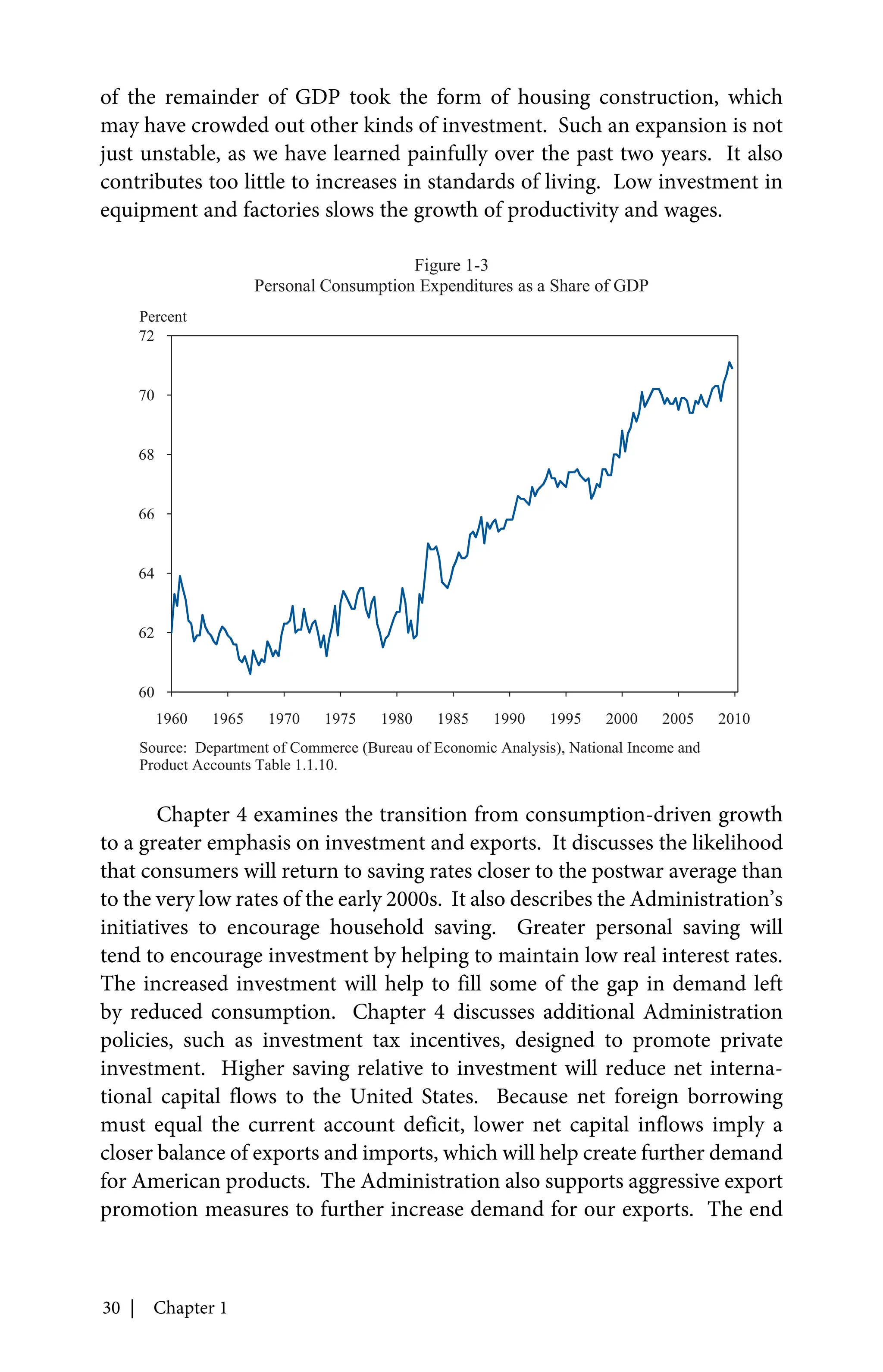
The expansion of the 2000s was fueled in part by high consumption.
As Figure 1-3 shows, the share of GDP that takes the form of consumption
has been on a generally upward trend for decades and reached unprec-
edented heights in the 2000s. The personal saving rate fell to exceptionally
low levels, and trade deficits were large and persistent. A substantial amount
30 | Chapter 1
of the remainder of GDP took the form of housing construction, which
may have crowded out other kinds of investment. Such an expansion is not
just unstable, as we have learned painfully over the past two years. It also
contributes too little to increases in standards of living. Low investment in
equipment and factories slows the growth of productivity and wages.
Chapter 4 examines the transition from consumption-driven growth
to a greater emphasis on investment and exports. It discusses the likelihood
that consumers will return to saving rates closer to the postwar average than
to the very low rates of the early 2000s. It also describes the Administration’s
initiatives to encourage household saving. Greater personal saving will
tend to encourage investment by helping to maintain low real interest rates.
The increased investment will help to fill some of the gap in demand left
by reduced consumption. Chapter 4 discusses additional Administration
policies, such as investment tax incentives, designed to promote private
investment. Higher saving relative to investment will reduce net interna-
tional capital flows to the United States. Because net foreign borrowing
must equal the current account deficit, lower net capital inflows imply a
closer balance of exports and imports, which will help create further demand
for American products. The Administration also supports aggressive export
promotion measures to further increase demand for our exports. The end
60
62
64
66
68
70
72
1960 1965 1970 1975 1980 1985 1990 1995 2000 2005 2010
Figure 1-3
Personal Consumption Expenditures as a Share of GDP
Percent
Source: Department of Commerce (Bureau of Economic Analysis), National Income and
Product Accounts Table 1.1.10.
To Rescue, Rebalance, and Rebuild | 31
result of this rebalancing will be an economy that is more stable, more
investment-oriented, and more export-oriented, and thus better for our
future standards of living.
Addressing the Long-Run Fiscal Challenge
A key part of the rebalancing that must occur as the economy returns
to full employment and beyond involves taming the Federal budget deficit.
Figure 1-4 shows the actual and projected path of the budget surplus based
on estimates released by the Congressional Budget Office (CBO) in January
2009, just before President Obama took office. As the figure makes clear,
the budget surpluses of the late 1990s turned to substantial deficits in the
2000s, and the deficits were projected to grow even more sharply over the
next three decades. As discussed in Chapter 5, the change to deficits in the
2000s largely reflects policy actions that were not paid for, such as the 2001
and 2003 tax cuts and the introduction of the Medicare prescription drug
benefit. The projection of steadily increasing future deficits is largely due to
the continuation of the decades-long trend of rising health care costs.
-20
-15
-10
-5
0
5
1990 2000 2010 2020 2030 2040
Figure 1-4
Actual and Projected Budget Surpluses in January 2009 under Previous Policy
Percent of GDP
Projected
Actual
Note: CBO baseline surplus projection adjusted for CBO’s estimates of costs of continued
war spending, continuation of the 2001 and 2003 tax cuts, preventing scheduled cuts in
Medicare’s physician payment rates, and holding other discretionary outlays constant as a
share of GDP.
Sources: Congressional Budget Office (2009a, 2009b).
32 | Chapter 1
Chapter 5 describes the likely consequences of these projected deficits
over time and the importance of restoring fiscal discipline. It also discusses
the President’s plan for facing this challenge. A period of severe economic
weakness is no time for a large fiscal contraction. Instead, the Nation must
tackle the long-run deficit problem through actions that address the under-
lying sources of the problem over time. The single most important step that
can be taken to reduce future deficits is to adopt health care reform that slows
the growth rate of costs without compromising the quality of care. In addi-
tion, the President’s fiscal 2011 budget includes other significant measures,
such as allowing President Bush’s tax cuts for the highest-income earners
to expire, reforming international tax rules to discourage tax avoidance and
encourage investment in the United States, and imposing a three-year freeze
in nonsecurity discretionary spending; alongside a proposal for a bipartisan
commission process to address the long-run gap between revenues and
expenditures.
Building a Safer Financial System
Risky credit practices both encouraged some of the imprudent rise in
consumption and homebuilding in the previous decade and set the stage for
the financial crisis. Chapter 6 analyzes the role that financial intermediaries
play in the economy and diagnoses what went wrong during the meltdown
of financial markets. The crisis showed that the Nation’s financial regula-
tory structure, much of which had not been fundamentally changed since
the 1930s, failed to keep up with the evolution of financial markets. The
current system provided too little protection for the economy from actions
that could threaten financial stability and too little protection for ordinary
Americans in their dealings with sophisticated and powerful financial insti-
tutions and other providers of credit. Strengthening our financial system is
thus a key element of the rebalancing needed to assure stable, robust growth.
Chapter 6 discusses financial regulatory modernization. What is
needed is a system where capital requirements and sensible rules are set
in a way to control excessive risk-taking; where regulators can consider
risks to the system as a whole and not just to individual institutions; where
institutions cannot choose their regulators; where regulators no longer face
the unacceptable choice between the disorganized, catastrophic failure of a
financial institution and a taxpayer-funded bailout; and where a dedicated
agency has consumer protection as its central mandate. For this reason, the
President put forward a comprehensive plan for financial regulatory reform
last June and is working with Congress to ensure passage of these critical
reforms this year.
To Rescue, Rebalance, and Rebuild | 33
Rebuilding a Stronger Economy
Even before the crisis, the economy faced significant long-term
challenges. As a result, it was doing poorly at providing rising standards of
living for the vast majority of Americans. Figure 1-5 shows the evolution of
before-tax real median family income since 1960. Beginning around 1970,
slower productivity growth and rising income inequality caused incomes
for most families to grow only slowly. After a half-decade of higher growth
in the 1990s, the real income of the typical American family actually fell
between 2000 and 2006.
A central focus of Administration policy both over the past year
and for the years to come is to build a firmer foundation for the economy.
The President is committed to policies that will raise living standards for
all Americans.
Reforming Health Care
Health care is a key challenge that long predates the current economic
crisis. The existing system has left many Americans who have health insur-
ance inadequately covered, poorly protected against insurance industry
30,000
40,000
50,000
60,000
70,000
1960 1965 1970 1975 1980 1985 1990 1995 2000 2005
Figure 1-5
Real Median Family Income
2008 dollars
Notes: Income measure is total money income excluding capital gains and before taxes.
Annual income deflated using CPI-U-RS.
Source: Department of Commerce (Census Bureau), Current Population Survey, Annual
Social and Economic Supplement, Historical Income Table F-12.
34 | Chapter 1
abuses, and fearful of losing the insurance they have. And it has left tens of
millions of Americans with no insurance coverage at all. The system also
delivers too little benefit at too high a cost. Comparisons across countries
and, especially, across regions of the United States reveal large differences
in health care spending that are not associated with differences in health
outcomes and that cannot be fully explained by factors such as differences
in demographics, health status, income, or medical care prices. These large
differences in spending suggest that up to nearly 30 percent of health care
spending could be saved without adverse health consequences. The unnec-
essary growth of health care costs is eroding the growth of take-home pay
and is central to our long-run fiscal challenges. These adverse effects will
only become more severe if cost growth is not slowed.
To illustrate what could happen to workers’ earnings in the absence
of reform, Figure 1-6 shows the historical and projected paths of real total
compensation per worker (which includes nonwage benefits such as health
insurance) and total compensation net of health insurance premiums. As
health insurance premiums absorb a growing fraction of workers’ compen-
sation, the remaining portion of compensation levels off and then starts
to decline.
30,000
40,000
50,000
60,000
70,000
80,000
90,000
100,000
110,000
120,000
1999 2003 2007 2011 2015 2019 2023 2027 2031 2035 2039
Estimated annual total compensation
net of health insurance premiums
Projected
Figure 1-6
Total Compensation Including and Excluding Health Insurance
2008 dollars per person
Actual
Note: Health insurance premiums include the employee- and employer-paid portions.
Sources: Actual data from Department of Labor (Bureau of Labor Statistics); Kaiser Family
Foundation and Health Research and Educational Trust (2009); Department of Health and
Human Services (Agency for Healthcare Research and Quality, Center for Financing, Access,
and Cost Trends), 2008 Medical Expenditure Panel Survey-Insurance Component. Projections
based on CEA calculations.
To Rescue, Rebalance, and Rebuild | 35
Chapter 7 describes the actions the Administration and Congress
took in 2009 to begin the process of improvement, including an expansion
of the Children’s Health Insurance Program to provide access to health care
for millions of children and important investments in the modernization
of the health care system through the Recovery Act. It also describes the
key elements of successful health insurance reform and discusses the prog-
ress that has been made on reform legislation. Successful reform involves
making insurance more secure for those who have it and expanding coverage
to those who lack it. It must include delivery system reforms, reductions
in waste and improper payments in the Medicare system, and changes in
consumer and firm incentives that will slow the growth rate of costs substan-
tially, while maintaining and even improving quality. Slowing the growth
rate of health care costs will have benefits throughout the economy: it will
raise standards of living for families, help reduce the Federal budget deficit
relative to what it otherwise would be, benefit state and local governments,
and encourage job growth and improved macroeconomic performance.
Strengthening the American Labor Force
American workers have suffered greatly in the current recession.
As described in Chapter 8, long-term unemployment is at record levels.
The unemployment rate, which was 10 percent for the country as a
whole in December, is far higher for blacks, Hispanics, and other demo-
graphic groups. The decline in house prices has eroded the nest eggs
that many Americans had been counting on for their retirement. The
Administration has initiated many actions to help support workers and
their families through the recession and beyond. These actions range
from extended and expanded unemployment insurance, to measures
to make health insurance more affordable, to initiatives to promote
retirement saving.
American workers also face the persistent problem of stagnating
incomes. A key determinant of growth in standards of living is the rate of
increase in the education and skills of our workforce. More and more jobs
require education and training beyond the high school level, along with the
ability to complete tasks that are open-ended and interactive. But, as Figure
1-7 shows, the years of education U.S. workers have brought to the labor
market have risen little in the past four decades. And, as is well known, U.S.
students lag behind those from many other countries in their performance
on standardized tests.
Chapter 8 describes the Administration’s initiatives to improve the
skills of our workers. The Administration is pursuing reform to eliminate
wasteful subsidies to student loan providers, the savings from which will fund
36 | Chapter 1
new investments in education. The Administration has proposed a major
initiative to support and improve community colleges, which are a neglected
but critical link in our education system. It has also proposed increasing Pell
Grants, and is taking steps to simplify the student aid application process so
that eligible students are no longer discouraged by a complicated process
from even applying for aid. All of these actions will help to achieve one of
the President’s key educational goals for the country—that the proportion of
adults with a college degree be the largest in the world by 2020.
Transforming the Energy Sector and Addressing Climate Change
Climate change and energy independence present a very different
long-run challenge. Continued reliance on fossil fuels is leading to the
buildup of greenhouse gases in the atmosphere and is changing our climate.
Left unaddressed, these trends will have increasingly severe consequences
over time. What is more, the United States imports the majority of the oil
it uses, much of it from sources that are potentially subject to disruption.
Chapter 9 analyzes how economic policy can play a critical role in
moving the United States toward a clean energy economy that is less depen-
dent on fossil fuels and fossil fuel imports. Slowing climate change requires
7
8
9
10
11
12
13
14
1900 1910 1920 1930 1940 1950 1960 1970 1980 1990 2000
Figure 1-7
Mean Years of Schooling by Birth Cohort
Years of schooling
Year of 21 birthday
Notes: Years of schooling at 30 years of age. Methodology described in Goldin and Katz
(2007).
Sources: Department of Commerce (Bureau of the Census), 1940-2000 Census IPUMS, 2005
CPS MORG; Goldin and Katz (2007).
st
To Rescue, Rebalance, and Rebuild | 37
slowing the emission of greenhouse gases. A market-based approach,
such as that supported by the Administration and currently working its
way through Congress, can provide the signals needed to accomplish this
slowing of emissions efficiently and with minimal disruptions.
The support for research and development (R&D) and incentives
for investment in clean energy technologies and energy efficiency in the
Recovery Act and the President’s budget, as well as in the energy and climate
legislation, can help foster the transition to a clean energy economy and
spur growth in vital new industries. These new industries have the potential
to reinvigorate the American manufacturing sector and generate secure,
high-quality jobs.
Fostering Productivity Growth Through Innovation and Trade
The ultimate driver of growth in average standards of living is
productivity growth. Increased investment in capital and in the skills of our
workforce are two important sources of that growth. Chapter 10 examines
two other sources of productivity gains: innovation and international trade.
Innovation comes from many sources. But a central one is investment
in R&D. Figure 1-8 shows the share of GDP devoted to R&D over the past
50 years. In the mid-1960s, R&D constituted a larger share of total spending
2.0
2.1
2.2
2.3
2.4
2.5
2.6
2.7
2.8
2.9
3.0
1960 1970 1980 1990 2000
Figure 1-8
R&D Spending as a Percent of GDP
Percent
Note: Data for 2008 are preliminary.
Sources: National Science Foundation, Science and Engineering Indicators 2010 Tables 4-1
and 4-7.
38 | Chapter 1
than it has in the past decade. And in some other countries, such as Korea,
Sweden, and Japan, R&D spending is a larger fraction of GDP than in the
United States. The President is committed to raising the share of output
devoted to R&D to 3 percent, so that America can continue to be a leader
in new technologies and American workers and businesses can benefit from
more rapid economic growth.
Through the Recovery Act and other measures, the Administration
is investing both directly in basic scientific research and development and
in the infrastructure to support that research. Most innovation, however,
comes from the private sector. Here, the Administration is providing critical
incentives for R&D both in general and in such vital areas as clean energy
technologies. The Administration is also pursuing a wide range of policies
to support the small businesses that contribute so much to technological
progress—policies ranging from programs to maintain the flow of credit to
small businesses to health insurance reform that will help level the playing
field between small and large businesses.
Finally, international trade can be an important source of productivity
growth and incentives for innovation. Trade has the potential to allow the
U.S. economy to expand output in areas where it is more productive and
to enable higher-productivity firms to expand. Access to a world market
encourages American firms to invest in the research needed to become tech-
nological leaders. Through these routes, a free and fair trade regime can play
an important part in lifting living standards in the long run. But for trade to
play this role, it is essential to enforce existing trade rules and pursue policies
that ensure that the benefits of trade are widely shared.
Conclusion
The past year has been one of great challenge for all Americans.
Nearly every family has been touched in some way by the fallout from the
crisis in financial markets, the drying up of credit, and the rise in unem-
ployment. These challenges, moreover, have come after a decade in which
ordinary Americans have seen their living standards stagnate, their health
insurance become less secure, and their environment deteriorate.
The rest of this Report describes in more detail the actions the
President has taken to end the recession, foster stable growth by rebalancing
production and demand, and rebuild the foundation of the American
economy. More fundamentally, it describes the work that remains to be
done to create the prosperous, dynamic economy the American people need
and deserve.
39
C H A P T E R 2
RESCUING THE ECONOMY
FROM THE GREAT RECESSION
The first and most fundamental task the Administration faced when
President Obama took office was to rescue an economy in freefall. In
November 2008, employment was declining at a rate of more than half a
million jobs per month, and credit markets were stretched almost to the
breaking point. As the economy entered 2009, the decline accelerated, with
job loss in January reaching almost three-quarters of a million. The President
responded by working with Congress to take unprecedented actions. These
steps, together with measures taken by the Federal Reserve and other finan-
cial regulators, have succeeded in stabilizing the economy and beginning
the process of healing a severely shaken economic and financial system. But
much work remains. With high unemployment and continued job losses, it
is clear that recovery must remain the key focus of 2010.
An Economy in Freefall
According to the National Bureau of Economic Research, the United
States entered a recession in December 2007. Unlike most postwar reces-
sions, this downturn was not caused by tight monetary policy aimed at
curbing inflation. Although economists will surely analyze this downturn
extensively in the years to come, there is widespread consensus that its
central precipitating factor was a boom and bust in asset prices, especially
house prices. The boom was fueled in part by irresponsible and in some
cases predatory lending practices, risky investment strategies, faulty credit
ratings, and lax regulation. When the boom ended, the result was wide-
spread defaults and crippling blows to key financial institutions, magnifying
the decline in house prices and causing enormous spillovers to the remainder
of the economy.
40 | Chapter 2
The Run-Up to the Recession
The rise in house prices during the boom was remarkable. As Figure
2-1 shows, real house prices almost doubled between 1997 and 2006. By
2006, they were more than 50 percent above the highest level they had
reached in the 20th century.
Stock prices also rose rapidly. The Standard and Poor’s (S&P) 500,
for example, rose 101 percent between its low in 2002 and its high in 2007.
That rise, though dramatic, was not unprecedented. Indeed, in the five
years before its peak in March 2000, during the “tech bubble,” the S&P 500
rose 205 percent, while the more technology-focused NASDAQ index rose
506 percent.
The run-up in asset prices was associated with a surge in construc-
tion and consumer spending. Residential construction rose sharply as
developers responded to the increase in housing demand. From the fourth
quarter of 2001 to the fourth quarter of 2005, the residential investment
component of real GDP rose at an average annual rate of nearly 8 percent.
Similarly, consumers responded to the increases in the value of their assets
by continuing to spend freely. Saving rates, which had been declining since
the early 1980s, fell to about 2 percent during the two years before the reces-
sion. This spending was facilitated by low interest rates and easy credit, with
household borrowing rising faster than incomes.
50
75
100
125
150
175
200
1909 1919 1929 1939 1949 1959 1969 1979 1989 1999 2009
Figure 2-1
House Prices Adjusted for Inflation
Index (1900=100)
Sources: Shiller (2005); recent data from http://www.econ.yale.edu/~shiller/data/Fig2-1.xls.
Rescuing the Economy from the Great Recession | 41
The Downturn
House prices began to drop in some markets in 2006, and then
nationally beginning in 2007. This process was gradual at first, with prices
measured using the LoanPerformance house price index declining just
3½ percent nationally between January and June 2007. Lenders had lent
aggressively during the boom, often providing mortgages whose soundness
hinged on continued house price appreciation. As a result, the compara-
tively modest decline in house prices threatened large losses on subprime
residential mortgages (the riskiest class of mortgages), as well as on the
slightly higher-quality “Alt-A” mortgages. As the availability of mortgage
credit tightened, the downward pressure on real estate prices intensified.
National house prices declined 6 percent between June and December 2007.
The negative feedback between credit availability and the housing
marketweighedonhouseholdandbusinessconfidence,restrainingconsumer
spending and business investment. Although residential construction
led the slowdown in real activity through 2007, by early 2008 outlays for
consumer goods and services and business equipment and software had
decelerated sharply, and total employment was beginning to decline. Real
gross domestic product (GDP) fell slightly in the first quarter of 2008.
In February 2008, Congress passed a temporary tax cut. Figure 2-2
shows real after-tax (or disposable) income and consumer spending before
and after rebate checks were issued. Consumption was maintained despite
a tremendous decline in household wealth over the same period. Total
household and nonprofit net worth declined 9.1 percent between June
2007 and June 2008. Microeconomic studies of consumer behavior in this
episode confirm the role of the tax rebate in maintaining spending (Broda
and Parker 2008; Sahm, Shapiro, and Slemrod 2009). The fact that real GDP
reversed course and grew in the second quarter of 2008 is further tribute
to the helpfulness of the policy. But, in part because of the lack of robust,
sustained stimulus, growth did not continue.
Financial institutions had invested heavily in assets whose values were
tied to the value of mortgages. For many reasons—the opacity of the instru-
ments, the complexity of financial institutions’ balance sheets and their
“off-balance-sheet” exposures, the failure of credit-rating agencies to accu-
rately identify the riskiness of the assets, and poor regulatory oversight—the
extent of the institutions’ exposure to mortgage default risk was obscured.
When mortgage defaults rose, the result was unexpectedly large losses to
many financial institutions.
In the fall of 2008, the nature of the downturn changed dramatically.
More rapid declines in asset prices generated further loss of confidence
in the ability of some of the world’s largest financial institutions to honor
42 | Chapter 2
their obligations. In September, the Lehman Brothers investment bank
declared bankruptcy, and other large financial firms (including American
International Group, Washington Mutual, and Merrill Lynch) were forced
to seek government aid or to merge with stronger institutions. What
followed was a rush to liquidity and a cascading of retrenchment that had
many of the features of a classic financial panic.
Risk spreads shot up to extraordinary levels. Figure 2-3 shows both
the TED spread and Moody’s BAA-AAA spread. The TED spread is the
difference between the rate on short-term loans among banks and a safe
short-term Treasury interest rate. The BAA-AAA spread is the difference
between the interest rates on high-grade and medium-grade corporate
bonds. Both spreads rose dramatically during the heart of the panic. Indeed,
one way to put the spike in the BAA-AAA spread in perspective is to note
that the same spread barely moved during the Great Crash of the stock
market in 1929, and rose by only about half as much during the first wave of
banking panics in 1930 as it did in the fall of 2008.
The same loss of confidence shown by the rise in credit spreads
translated into declining asset prices of all sorts. The S&P 500 declined
29 percent in the second half of 2008. Real house prices tumbled another
11 percent over the same period (see Figure 2-1). All told, household and
9,000
9,200
9,400
9,600
9,800
10,000
10,200
10,400
Jan-2007 Jul-2007 Jan-2008 Jul-2008 Jan-2009 Jul-2009
Figure 2-2
Income and Consumption Around the 2008 Tax Rebate
Billions of 2005 dollars, seasonally adjusted annual rate
Disposable Personal Income
Personal Consumption Expenditures
Sources: Department of Commerce (Bureau of Economic Analysis), National Income and
Product Accounts Table 2.6, line 30, and Table 2.8.6, line 1.
Rescuing the Economy from the Great Recession | 43
nonprofit net worth declined 20 percent between December 2007 and
December 2008, or by about $13 trillion. Again, a useful way to calibrate
the size of this shock is to note that in 1929, household wealth declined only
3 percent—about one-seventh as much as in 2008. This is another indica-
tion that the shocks hitting the U.S. economy in 2008 were enormous.
The decline in wealth had a severe impact on consumer spending.
This key component of aggregate demand, which accounts for roughly
70 percent of GDP and is traditionally quite stable, declined at an annual
rate of 3.5 percent in the third quarter of 2008 and 3.1 percent in the fourth
quarter. Some of this large decline may have also reflected the surge in
uncertainty about future incomes. Not only did asset prices fall sharply,
leading to the decline in wealth; they also became dramatically more vola-
tile. The standard deviation of daily stock returns in the fourth quarter, for
example, was 4.3 percentage points, even larger than in the first months of
the Great Depression.
The financial panic led to a precipitous decline in lending. Bank
credit continued to rise over the latter portion of 2008, as households and
firms that had lost access to other forms of credit turned to banks. However,
bank loans declined sharply in the first and second quarters of 2009 as banks
tightened their terms and standards. Other sources of credit showed even
0
1
2
3
4
5
Dec-2005 Jun-2006 Dec-2006 Jun-2007 Dec-2007 Jun-2008 Dec-2008
Figure 2-3
TED Spread and Moody’s BAA-AAA Spread Through December2008
Percentage points
Aug. 20, 2007
Oct. 10, 2008
BAA-AAA
TED
Notes: The TED spread is defined as the three-month London Interbank Offered Rate
(Libor) less the yield on the three-month U.S. Treasury security. Moody’s BAA-AAA
spread is the difference between Moody's indexes of yields on AAA and BAA rated
corporate bonds.
Source: Bloomberg.
44 | Chapter 2
more substantial declines. One particularly important market is that for
commercial paper (short-term notes issued by firms to finance key operating
costs such as payroll and inventory). The market for lower-tier nonfinancial
(A2/P2) commercial paper collapsed in the fall of 2008, with the average
daily value of new issues falling from $8.0 billion in the second quarter of
2008 to $4.3 billion in the fourth quarter. In addition, securitization of
automobile loans, credit card receivables, student loans, and commercial
mortgages ground to a halt.
This freezing of credit markets, together with the decline in wealth
and confidence, caused consumer spending and residential investment to
fall sharply. Real GDP declined at an annual rate of 2.7 percent in the third
quarter of 2008, 5.4 percent in the fourth quarter, and 6.4 percent in the
first quarter of 2009. Industrial production, which had been falling steadily
over the first eight months of 2008, plummeted in the final four months—
dropping at an annual rate of 18 percent.
Many industries were battered by the financial crisis and the resulting
economic downturn. The American automobile industry was hit particu-
larly hard. Sales of light motor vehicles, which had exceeded 16 million
units every year from 1999 to 2007, fell to an annual rate of only 9.5 million
in the first quarter of 2009. Employment in the motor vehicle and parts
industry declined by 240,000 over the 12 months through January 2009.
Two domestic manufacturers, General Motors (GM) and Chrysler, required
emergency loans in late December 2008 and early January 2009 to avoid
disorderly bankruptcy.
The most disturbing manifestation of the rapid slowdown in the
economy was the dramatic increase in job loss. Over the first months of
2008, job losses were typically between 100,000 and 200,000 per month.
In October, the economy lost 380,000 jobs; in November, 597,000 jobs.
By January, the economy was losing jobs at a rate of 741,000 per month.
Commensurate with this terrible rate of job loss, the unemployment rate
rose rapidly—from 6.2 percent in September 2008 to 7.7 percent in January
2009. It then continued to rise by roughly one-half of a percentage point per
month through the winter and spring; it reached 9.4 percent in May, and
ended the year at 10.0 percent.
Wall Street and Main Street
As described in more detail later, policymakers have focused much
of their response to the crisis on stabilizing the financial system. Many
Americans are troubled by these policies. Because to a large extent it was
the actions of credit market participants that led to the crisis, people ask why
policymakers should take actions focused on restoring credit markets.
Rescuing the Economy from the Great Recession | 45
The basic reason for these policies is that the health of credit markets
is critically important to the functioning of our economy. Large firms use
commercial paper to finance their biweekly payrolls and pay suppliers for
materials to keep production lines going. Small firms rely on bank loans to
meet their payrolls and pay for supplies while they wait for payment of their
accounts receivable. Home purchases depend on mortgages; automobile
purchases depend on car loans; college educations depend on student loans;
and purchases of everyday items depend on credit cards.
The events of the past two years provide a dramatic demonstration
of the importance of credit in the modern economy. As the President said
in his inaugural address, “Our workers are no less productive than when
this crisis began. Our minds are no less inventive, our goods and services
no less needed.” Yet developments in financial markets—rises and falls
in home and equity prices and in the availability of credit—have led to a
collapse of spending, and hence to a precipitous decline in output and to
unemployment for millions.
Numerous academic studies before the crisis had also shown that the
availability of credit is critical to investment, hiring, and production. One
study, for example, found that when a parent company earns high profits
and so has less need to rely on credit, the additional funds lead to higher
investment by subsidiaries in completely unrelated lines of business (Lamont
1997). Another found that when a small change in a firm’s circumstances
frees up a large amount of funds that would otherwise have to go to pension
contributions, the result is a large change in spending on capital goods
(Rauh 2006). Other studies have shown that when the Federal Reserve
tightens monetary policy, small firms, which typically have more difficulty
obtaining financing, are hit especially hard (Gertler and Gilchrist 1994), and
firms without access to public debt markets cut their inventories much more
sharply than firms that have such access (Kashyap, Lamont, and Stein 1994).
Research before the crisis had also found that financial market disrup-
tions could affect the real economy. Ben Bernanke, who is now Chairman
of the Federal Reserve, demonstrated a link between the disruption of
lending caused by bank failures and the worsening of the Great Depression
(Bernanke 1983). A smaller but more modern example is provided by the
impact of Japan’s financial crisis in the 1990s on the United States: construc-
tion lending, new construction, and construction employment were more
adversely affected in U.S. states where subsidiaries of Japanese banks had
a larger role, and thus where credit availability was more affected by the
collapse of Japan’s bubble (Peek and Rosengren 2000). That a financial
disruption in a trading partner can have a detectable adverse impact on our
economy through its impact on credit availability suggests that the effect of
46 | Chapter 2
a full-fledged financial crisis at home would be enormous—an implication
that, sadly, has proven to be correct.
Finally, microeconomic evidence from the recent crisis also shows the
importance of the financial system to the real economy. For example, firms
that happened to have long-term debt coming due after the crisis began,
and thus faced high costs of refinancing, cut their investment much more
than firms that did not (Almeida et al. 2009). Another study found that a
majority of corporate chief financial officers surveyed reported that their
firms faced financing constraints during the crisis, and that the constrained
firms on average planned to reduce investment spending, research and
development, and employment sharply compared with the unconstrained
firms (Campello, Graham, and Harvey 2009).
In short, the goal of the policies to stabilize the financial system was
not to help financial institutions. The goal was to help ordinary Americans.
When the financial system is not working, individuals and businesses cannot
get credit, demand and production plummet, and job losses skyrocket.
Thus, an essential step in healing the real economy is to heal the financial
system. The alternative of letting financial institutions suffer the conse-
quences of their mistakes would have led to a collapse of credit markets and
vastly greater suffering for millions and millions of Americans.
The policies to rescue the financial sector were, however, costly, and
often had the side effect of benefiting the very institutions whose irrespon-
sible actions contributed to the crisis. That is one reason that the President
has endorsed a Financial Crisis Responsibility Fee on the largest financial
firms to repay the Federal Government for its extraordinary actions. As
discussed in Chapter 6, the Administration has also proposed a compre-
hensive plan for financial regulatory reform that will help ensure that Wall
Street does not return to the risky practices that were a central cause of the
recent crisis.
The Unprecedented Policy Response
Given the magnitude of the shocks that hit the economy in the fall of
2008 and the winter of 2009, the downturn could have turned into a second
Great Depression. That it has not is a tribute to the aggressive and effec-
tive policy response. This response involved the Federal Reserve and other
financial regulators, the Administration, and Congress. The policy tools
were similarly multifaceted, including monetary policy, financial market
interventions, fiscal policy, and policies targeted specifically at housing.
Rescuing the Economy from the Great Recession | 47
Monetary Policy
The first line of defense against a weak economy is the interest rate
policy of the independent Federal Reserve. By increasing or decreasing the
quantity of reserves it supplies to the banking system, the Federal Reserve
can lower or raise the Federal funds rate, which is the interest rate at which
banks lend to one another. The funds rate influences other interest rates
in the economy and so has important effects on economic activity. Using
changes in the target level of the funds rate as their main tool of counter-
cyclical policy, monetary policymakers had kept inflation low and the real
economy remarkably stable for more than two decades.
The Federal Reserve has used interest rate policy aggressively in the
recent episode. The target level of the funds rate at the beginning of 2007
was 5¼ percent. The Federal Reserve cut the target by 1 percentage point
over the last four months of 2007 and by an additional 2¼ percentage points
over the first four months of 2008. After the events of September, it cut the
target in three additional steps in October and December, bringing it to its
current level of 0 to ¼ percent.
Conventional interest rate policy, however, could do little to deal
with the enormous disruptions to credit markets. As a result, the Federal
Reserve has used a range of unconventional tools to address those disrup-
tions directly. For example, in March 2008, it created the Primary Dealer
Credit Facility and the Term Securities Lending Facility to provide liquidity
support for primary dealers (that is, financial institutions that trade directly
with the Federal Reserve) and the key financial markets in which they
operate. In October 2008, when the critical market for commercial paper
threatened to stop functioning, the Federal Reserve responded by setting up
the Commercial Paper Funding Facility to backstop the market.
Once the Federal Reserve’s target for the funds rate was effectively
lowered to zero in December 2008, there was another reason to use uncon-
ventional tools. Nominal interest rates generally cannot fall below zero:
because holding currency guarantees a nominal return of zero, no one is
willing to make loans at a negative nominal interest rate. As a result, when
the Federal funds rate is zero, supplying more reserves does not drive it
lower. Statistical estimates suggest that based on the Federal Reserve’s usual
response to inflation and unemployment, the subdued level of inflation and
the weak state of the economy would have led the central bank to reduce its
target for the funds rate by about an additional 5 percentage points if it could
have (Rudebusch 2009).
This desire to provide further stimulus, coupled with the inability to
use conventional interest rate policy, led the Federal Reserve to undertake
large-scale asset purchases to reduce long-term interest rates. In March
48 | Chapter 2
2009, the Federal Reserve announced plans to purchase up to $300 billion of
long-term Treasury debt; it also announced plans to increase its purchases
of the debt of Fannie Mae, Freddie Mac, and the Federal Home Loan Banks
(the government-sponsored enterprises, or GSEs, that support the mortgage
market) to up to $200 billion, and its purchases of agency (that is, Fannie
Mae, Freddie Mac, and Ginnie Mae) mortgage-backed securities to up to
$1.25 trillion.
Finally, the Federal Reserve has attempted to manage expectations by
providing information about its goals and the likely path of policy. Officials
have consistently stressed their commitment to ensuring that inflation
neither falls substantially below nor rises substantially above its usual level.
In addition, the Federal Reserve has repeatedly stated that economic condi-
tions “are likely to warrant exceptionally low levels of the Federal funds
rate for an extended period.” To the extent this statement provides market
participants with information they did not already have, it is likely to keep
longer-term interest rates lower than they otherwise would be.
One effect of the Federal Reserve’s unconventional policies has been
an enormous expansion of the quantity of assets on the Federal Reserve’s
balance sheet. Figure 2-4 shows the evolution of Federal Reserve asset hold-
ings since the beginning of 2007. One can see both that asset holdings nearly
tripled between January and December 2008 and that there was a dramatic
move away from short-term Treasury securities.
0
400
800
1,200
1,600
2,000
2,400
Jan-2007 Jul-2007 Jan-2008 Jul-2008 Jan-2009 Jul-2009
Other
Long-term treasuries and agency debt
Short-term treasuries
Figure 2-4
Assets on the Federal Reserve’s Balance Sheet
Billions of dollars
Notes: Agency debt refers to obligations of Fannie Mae, Freddie Mac, and the Federal Home
Loan Banks. Agency mortgage-backed securities are also included in this category.
Source: Federal Reserve Board, H.4.1 Table 1.
Rescuing the Economy from the Great Recession | 49
The flip side of the large increase in the Federal Reserve’s asset
holdings is a large increase in the quantity of reserves it has supplied to the
financial system. Some observers have expressed concern that the large
expansion in reserves could lead to inflation. In this regard, two key points
should be kept in mind. First, as already described, most statistical models
suggest that the Federal Reserve’s target interest rate would be substan-
tially lower than it is today if it were not constrained by the fact that the
Federal funds rate cannot fall below zero. As a result, monetary policy is
in fact unusually tight given the state of the economy, not unusually loose.
Second, the Federal Reserve has the tools it needs to prevent the reserves
from leading to inflation. It can drain the reserves from the financial system
through sales of the assets it has acquired or other actions. Indeed, despite
the weak state of the economy, the return of credit market conditions toward
normal is leading to the natural unwinding of some of the exceptional credit
market programs. Another reliable way the Federal Reserve can keep the
reserves from creating inflationary pressure is by using its relatively new
ability to raise the interest rate it pays on reserves: banks will be unwilling
to lend the reserves at low interest rates if they can obtain a higher return on
their balances held at the Federal Reserve.
Financial Rescue
Efforts to stabilize the financial system have been a central part of
the policy response. As just discussed, even before the financial crisis in
September 2008, the Federal Reserve was taking steps to ease pressures
on credit markets. The events of the fall led to even stronger actions. On
September 7, Fannie Mae and Freddie Mac were placed in conservator-
ship under the Federal Housing Finance Agency to prevent a potentially
severe disruption of mortgage lending. On September 16, concern about
the potentially catastrophic effects of a disorderly failure of American
International Group (AIG) caused the Federal Reserve to extend the firm an
$85 billion line of credit. On September 19, concerns about the possibility
of runs on money-market mutual funds led the Treasury to announce a
temporary guarantee program for these funds.
On October 3, Congress passed and President Bush signed the
Emergency Economic Stabilization Act of 2008. This Act provided up
to $700 billion for the Troubled Asset Relief Program (TARP) for the
purchase of distressed assets and for capital injections into financial institu-
tions, although the second $350 billion required presidential notification
to Congress and could be disallowed by a vote of both houses. The initial
$350 billion was used mainly to purchase preferred equity shares in finan-
cial institutions, thereby providing the institutions with more capital to help
them withstand the crisis.
50 | Chapter 2
At President-Elect Obama’s request, President Bush notified Congress
on January 12, 2009 of his plan to release the second $350 billion of TARP
funds. With strong support from the incoming Administration, the Senate
defeated a resolution disapproving the release. These funds provided policy-
makers with critical resources needed to ensure financial stability.
On February 10, 2009, Secretary of the Treasury Timothy Geithner
announced the Administration’s Financial Stability Plan. The plan repre-
sented a new, comprehensive approach to the financial rescue that sought
to tackle the interlocking sources of instability and increase credit flows.
An overarching theme was a focus on transparency and accountability to
rebuild confidence in financial markets and protect taxpayer resources.
A key element of the plan was the Supervisory Capital Assessment
Program (or “stress test”). The purpose was to assess the capital needs of
the country’s 19 largest financial institutions should economic and finan-
cial conditions deteriorate further. Institutions that were found to need an
additional capital buffer would be encouraged to raise private capital and
would be provided with temporary government capital if those efforts did
not succeed. This program was intended not just to examine the capital
positions of the institutions and ensure that they obtained more capital if
needed, but also to strengthen private investors’ confidence in the soundness
of the institutions’ balance sheets, and so strengthen the institutions’ ability
to obtain private capital.
Another element of the plan was the Consumer and Business Lending
Initiative, which was aimed at maintaining the flow of credit. In November
2008, the Federal Reserve had created the Term Asset-Backed Securities
Loan Facility to help counteract the dramatic decline in securitized lending.
In the February announcement of the Financial Stability Plan, the Treasury
greatly expanded the resources of the not-yet-implemented facility. The
Treasury increased its commitment to $100 billion to leverage up to $1 tril-
lion of lending for businesses and households. By facilitating securitization,
the program was designed to help unfreeze credit and lower interest rates
for auto loans, credit card loans, student loans, and small business loans
guaranteed by the Small Business Administration (SBA).
A third element of the plan was a Treasury partnership with the
Federal Deposit Insurance Corporation and the Federal Reserve to create
the Public-Private Investment Program. A central purpose was to remove
troubled assets from the balance sheets of financial institutions, thereby
reducing uncertainty about their financial strength and increasing their
ability to raise capital and hence their willingness to lend. Partnership with
the private sector served two important objectives: it leveraged scarce public
funds, and it used private competition and incentives to ensure that the
government did not overpay for assets.
Exploring the Variety of Random
Documents with Different Content
Magellan from the thievish habits of the natives) came in sight,
Guam being probably the first port of call. Here the fleet rested,
watered, revictualled and refitted; on the 9th of March they started
again westward; and on the 16th of March sighted the southern
point of Samar Island in the archipelago, since 1542 called the
Philippines, but named by Magellan, its first discoverer, after St
Lazarus. On the 7th of April the squadron arrived at Cebu, south-
west of Samar, in the heart of the Philippines; here Magellan
contracted a close friendship and alliance with the treacherous
native sovereign, who professed Christianity the better to please and
utilize his Catholic friends. Undertaking an expedition to conquer, for
the Catholic faith and the king of Cebu, the neighbouring island of
Mactan, Magellan was killed there in a fight with the islanders (April
27, 1521). The king of Cebu after this got into his power several of
the leading personages of the squadron, including Juan Serrano, one
of the two admirals elected to replace Magellan, and murdered
them. The survivors, burning one of the three remaining vessels, left
the Philippines, and made their way to the Moluccas (Nov. 6),
visiting Borneo on the way (July 9-Sept. 27, 1521). At Tidor a heavy
cargo of cloves was taken in; the “Trinidad,” becoming leaky, stayed
behind with her crew; and the “Vittoria,” under Juan Sebastian del
Cano, proceeded to Europe alone (Dec. 21, 1521). To double the
Cape of Good Hope the “Vittoria” reached between 40° and 41° S.
(April 7-16, 1522) and suffered from contrary winds, heavy seas,
scurvy and starvation. In the Cape Verde Islands (July 9-15, 1522)
thirteen of the crew were detained prisoners by the Portuguese.
Only thirty-one men returned with del Cano to Seville in the first
vessel that had ever made the tour of the earth. Though Magellan
had not quite reached the Spice Islands when he fell at Mactan, his
task had then been accomplished. He had already reached and
passed the longitude of the Moluccas, where he had already been;
the way home from the Philippines by the Indian Ocean and the
Cape of Good Hope was perfectly known to the Portuguese, himself
included. Magellan’s name has never received its due recognition in
general history. It ranks with those of Columbus, Marco Polo, and
Henry the Navigator. The circumnavigation of the globe is as great
an event as the discovery of America. Magellan achieved what
Columbus planned—the linking of west Europe with east Asia by
direct transit over the western ocean. Had America not intervened,
the project of 1492 must have failed; by 1519 European pioneers
had formed a more adequate notion of the task and its magnitude.
Magellan’s Straits, the Magellanic clouds (not first observed by
him), and Magellan’s Land—a name long given to Patagonia and that
hypothetical southern continent of which Tierra del Fuego was
considered only a portion, and now again bestowed by Chile on her
territory in the extreme south—preserve the memory of the first
circumnavigator. The largest of the oceans has also kept the
flattering name given to it by the man who first crossed it.
No record of his exploits was left by Magellan himself; and
contemporary accounts are less detailed and consistent than
could be wished. The best is that of Antonio Pigafetta, a
volunteer in the fleet. It is printed in Ramusio, and exists in four
early MS. copies, one in Italian and three in French. The latter
was perhaps the original language of this work, which was
addressed by Pigafetta, as a knight of Rhodes, to the Frenchman
Villiers de l’Isle Adam, grand master of the order of the Hospital
of St John. But this view is rejected by J. A. Robertson (see
below), who believes the Ambrosian MS. to be the ultimate text.
See the Primo viaggio intorno al mondo, otherwise the
Navigation et descouvrement de la Indie supérieure faicte par
moi Anthoyne Pigapheta, Vincentin, chevallier de Rhodes,
probably published in 1524 (in August of that year Pigafetta
obtained leave to print his book in Venice). Of the three French
MSS., two are in the Bibliothèque Nationale, Paris (5650 and
24,224 Fr.), the latter is wrongly supposed by Thomassy,
followed by Lord Stanley of Alderley, to have been the copy
presented by Pigafetta to the regent of France, Marie Louise of
Savoy, mother of Francis I. The third French MS., often called
the MS. of Nancy, first noticed by Thomassy in 1841, was
bought by Sir Thomas Phillipps at Libri’s sale, and became MS.
Phillipps 16,405. The Italian MS. is in the Ambrosian library at
Milan. From this Carlo Amoretti, prefect of the Ambrosiana,
published his Italian edition of Pigafetta in 1800; a French
translation of this, by Amoretti himself, was issued by H. J.
Jansen, 1801. An English version of Pigafetta was made by
Richard Eden in his Decades of the Newe Worlde (London,
1555). The earliest printed edition, apparently a summary of the
Italian MS., was issued in French by Simon de Colines of Paris
about 1525. The earliest Italian edition is of 1534 (or 1536).
Other authorities are: (1) The narrative of an unknown
Portuguese in Ramusio’s Navigationi et viaggi; (2) the Derrotero
or Log-Book in the Seville Archives, supposed to be the work of
Francisco Albo, contramaestre of Magellan’s flagship, the
“Trinidad”: this consists mainly of nautical observations; (3) the
narrative of the so-called Genoese pilot, written in excellent
Portuguese, and printed in vol. iv. of the Collecão de noticias of
the Lisbon Academy; (4) various informaciones and other papers
in the Seville Archives, especially bearing on the mutiny; (5) the
letter of Maximilian of Transylvania, under-secretary to Charles
V., to the cardinal of Salzburg; (6) the references in Correa and
Herrera, often based on good information, and adding points of
interest to other records. Of these (1)-(3), (5), and an instance
of (6) are translated in the Hakluyt Society’s volume. Magellan’s
two wills (i) executed at Belem on the 17th of December 1504,
on the eve of his departure with Almeida, (ii) executed at Seville
on the 24th of August, 1519, just before starting on his voyage
round the world, are both of some value for his life.
See also Lord Stanley of Alderley, The First Voyage round the
World by Magellan, translated from ... Pigafetta, &c., Hakluyt
Society (London, 1874); Diego de Barros Arana, Vida e viagems
de Fernão de Magalhães, a trans. of the Spanish life by
Fernando de Magalhães Villas Boas (Lisbon, 1881); F. H. H.
Guillemard, Life of Magellan (London, 1890); Magellan ... the
original text of the Ambrosian MS. (of Pigafetta), with English
translation, notes, bibliography, &c., by J. A. Robertson
(Cleveland, U.S.A., 1906). Before the appearance of this
indispensable work, the best edition of Pigafetta had been in vol.
iii. part 5 of the Raccolta di documenti e studi pubblicati nella r.
commissione colombiana, edited by Andrea da Mosto (Rome,
Ministry of Public Instruction, 1894). (C. R. B.)
MAGELLANIC CLOUDS (named after Ferdinand
Magellan), two cloud-like condensations of stars in the southern
constellation of Mensa about 69° S. Dec. and between 5° and 5° 40′
of R. A. They are remarkable in the resemblance of their stars as
regards spectra and physical constitution to the stars of the Milky
Way, though entirely detached from that object.
MAGENTA, a town of Lombardy, Italy, in the province of Milan,
16 m. by rail W. of Milan city, 364 ft. about sea-level situated in the
midst of rice-fields. Pop. (1901), 8012. It manufactures silks and
matches, and is famous for the battle (1859) in which the allied
French and Piedmontese defeated the Austrians (see Italian Wars). A
memorial chapel and a monument were erected on the battle-field in
1862. A crimson-purple aniline dye, discovered about the time of the
battle, was given from it the name of “magenta.”
MAGGIORE, LAGO (Lacus Verbanus of the Romans; Fr. Lac
Majeur; Ger. Langensee), the most extensive of the lakes that
extend along the foot of the Alps in Lombardy, N. Italy. Its area is
about 83 sq. m., its length 37 m., its greatest width 5½ m., and its
greatest depth 1198 ft., while its surface is 646 ft. about sea-level. It
is mainly formed by the Ticino (Tessin) River, flowing in at the north
and out at the south end, on its way to join the Po, but on the west
the lake receives a very important tributary, the Toce or Tosa River,
which flows down through the Val d’Ossola from the mountains
around the Simplon Pass. Other important affluents are the Maggia
(N.W.) and the Tresa (E.). The upper end of the lake (about 16 sq.
m.) is in the Swiss canton of Ticino (Tessin). Locarno, at the
northern or Swiss end, is 14 m. by rail S.W. of Bellinzona on the St
Gotthard line. There is a railway along the south-eastern shore, from
Magadino (10½ m. S.W. of Bellinzona) to Sesto Calende (36½ m.),
at the southern end of the lake and 20 m. by rail from Novara. The
east shore of the lake is reached at Luino by a steam tramway from
Ponte Tresa on the lake of Lugano (8 m.), while the direct Simplon
line runs along the west shore of the lake for 15½ m. from near
Pallanza past Baveno and Stresa to Arona, which is 23 m. by rail
from Novara. On the east shore are Luino (Ital. Luvino) and Laveno.
On the west shore are (reckoning from N. to S.) Cannobio, Pallanza,
Baveno, Stresa and Arona. Opposite (S.E.) Baveno are the famous
Borromean Islands, on the largest of which (Isola Bella) are very
remarkable gardens (formed about 1617), wherein many tropical
plants flourish abundantly, while south-west of Baveno rises the
glorious view-point of the Monte Mottarone (4892 ft.) between Lago
Maggiore and the northern end of the Lake of Orta. In the morning
the tramontana wind blows from the north down the lake, while in
the afternoon the inverna, blowing from the south, prevails. The first
steamer was placed on the lake in 1826.
(W. A. B. C.)
MAGIC1 (i.e. “art magic”; Lat. ars magica), the general term for
the practice and power of wonder-working, as depending on the
employment of supposed supernatural agencies. Etymologically the
Gr. μαγεία meant the science and religion of the magi, or priests of
Zoroaster, as known among the Greeks; in this sense it was opposed
to γοητεία (? necromancy) and φαρμακεία (the use of drugs); but
this distinction was not universally recognized, and γοητεία is often
used as a synonym of μαγεία. There is no general agreement as to
the proper definition of “magic,” which depends on the view taken of
“religion.”
I.—Nature of Magic
Theories of Magic.—Existing theories of magic may be classified as
objective or subjective. The objective school regards magic as a
thing by itself, entirely distinct from religion, recognizable by certain
characteristics, and traceable to a definite psychological origin.
Magic, on this view, is a system of savage science based on
imaginary laws supposed to operate with the regularity ascribed to
natural laws by the science of to-day. If practices prima facie magical
form part of the recognized ritual of religion, it is because the older
ideas have persisted and at most assumed a veneer of religion. For
the subjective school, on the other hand, only those rites are
magical which their practitioners qualify with the name of magic;
there is no inherent quality which makes a rite magical; practices
based on a belief in the law of sympathy may be religious as well as
magical; rites may pass from the category of religion to that of
magic when public recognition is withdrawn from them.
a. For E. B. Tylor the distinguishing characteristic of magic is
its unreality; it is a confused mass of beliefs and practices, and
their unity consists in the absence of the ordinary nexus of
natural cause and effect. Under the general head of magic he
distinguishes (i) a spiritual and (ii) a non-spiritual element. (i)
The former is made up of such rites as involve the intervention
of spiritual beings, ghosts of the dead, demons or gods; hence,
in Tylor’s view, this form of magic is merely an inferior branch of
religion. (ii) The non-spiritual part, but for which the category of
magic would be unnecessary, depends on imagined powers and
correspondences in nature; it is merely imperfect reasoning, the
mistaking of an ideal connexion for a real one. When the
American Indian medicine man draws the picture of a deer on a
piece of bark and expects that shooting at it will cause him to
kill a real deer the next day, he mistakes a connexion which
exists only in the mind of the sorcerer for a real bond
independent of the human mind.
b. In J. G. Frazer’s view all magic is based on the law of
sympathy—i.e. the assumption that things act on one another at
a distance through a secret link, due either to the fact that there
is some similarity between them or to the fact that they have at
one time been in contact, or that one has formed part of the
other. These two branches of “sympathetic magic” Frazer
denominates “homoeopathic magic” and “contagious magic.”
Homoeopathic or imitative (mimetic) magic may be practised by
itself, but contagious magic generally involves the application of
the imitative principle. (i) One of the most familiar applications
of the former is the belief that an enemy may be destroyed or
injured by destroying or injuring an image of him. (ii) Under the
head of contagious magic are included such beliefs as that which
causes the peasant to anoint the weapon with which he has
been injured, which, according to Frazer, is founded on the
supposition that the blood on the weapon continues to feel with
the blood in the body. (iii) Implicitly Frazer seems to distinguish
a third kind of magic; “the rain-charm,” he says, “operates partly
or wholly through the dead ... in Halmahera there is a practice
of throwing stones on a grave, in order that the ghost may fall
into a passion and avenge the disturbance, as he imagines, by
sending heavy rain.” Here there is no assumption of an
invariable course of nature set in motion by magical rites; save
that it is coercive and not propitiatory, the practice does not
differ from ordinary religious rites.
In his theory of the origin of magic Frazer follows the
associationist school. But, as R. R. Marett has pointed out in a
criticism of the associationist position, it is proved beyond
question that even in the individual mind association by
similarity, contiguity or contrast, is but the passive condition, the
important element being interest and attention. Frazer assumes
that magic has everywhere preceded religion: man tried to
control nature by using what he conceived to be immutable
laws; failing in this he came to believe in the existence of higher
powers whom he could propitiate but not coerce; with this
transformation religion appeared on the scene; the priest
supplanted the magician, at least in part, and the first blows
were struck in the perennial warfare of magic and religion.
Frazer recognizes, however, that magical and religious rites are
at the present day, and have been in historical times, frequently
intermingled; it should be noted that for him religion means
propitiation and that he does not recognize the existence of
anything beyond magic among the aborigines of Australia. His
theory is based on a selection of facts, and not on the whole
body of beliefs and rites recognized as magical, among which
are many wherein spirits figure. Frazer’s position appears to be
that such rites are relatively late and may be neglected in
framing a definition of magic. It may be perfectly true that the
idea of magic has been progressively extended; but belief in
transformation is also for Dr Frazer magical; this belief is
certainly primitive; yet sympathy will not explain it, as it should
if Frazer’s theory is correct.
c. L. Marillier distinguished three classes of magic: (i) the
magic of the word or act; (ii) the magic of the human being,
independent of rite or formula, &c.; (iii) the magic which
demands at once a human being of special powers (or in a
special state) and the use of certain forms. (i) Under the first
head he included such rites as mimetic dances, rain-making,
disease-making, and sympathetic magic generally. Some of
these rites are conceived to affect the course of nature directly,
as by influencing winds or the sun, others do so through the
intermediary of a god or spirit, who controls the course of
nature, and is himself coerced by man with magical acts and
incantations. (ii) Other rites cannot be performed by all and
sundry: ceremonial purity, initiation or other conditions may be
needed to make the charm effective. (iii) Individuals are found
who are invested with magical power (mana), whose will rules
the universe, whose simple words bring rain or sunshine, and
whose presence gives fertility to the fields. Sometimes this
power is an attribute of the individual, sometimes it is bound up
with the office which he fills. In many cases the magical powers
of both men and other objects, animate and inanimate, are put
down to the fact that a god resides in them.
d. Hubert and Mauss have made the most complete and
systematic study of magic which has yet appeared. They hold
that, implicitly at any rate, magic is everywhere distinguished
from other systems of social facts; in order to be magical an act
or belief must be common to the whole of a society; the acts
which the whole of a group does not regard as efficacious are
not, for this school of thought, magical: consequently the
practices of gamesters, &c., do not come under the head of
magic. Magic is essentially traditional; a distinguishing
characteristic of primitive thought is that the individual mind is
markedly unoriginal; and this feature is as prominent, if not
more so, in magic as in technology or any other important
element in human life. The correspondence between magic and
technology can be traced far; for the gestures of the craftsman
are as strictly prescribed as the ritual acts of the magician or
priest: but in magic the results of the gestures are not of the
same order as the results of the craftsman’s movements, and
herein lies the distinction between magic and technic. The
distinction between magic and religion is to be sought not in the
sympathetic character of the former, nor in any supposed
necessary sequence of cause and effect, nor yet in its maleficent
character. Religion is prescribed, official, an organized cult.
Magic is prohibited, secret; at most it is permitted, without being
prescribed. Three important laws may be traced in the
machinery of magical operations—magical power flows along
channels determined by the contiguity, similarity or contrast of
the object of the act and the object to be affected; but these
laws do not suffice to explain magic: equally insufficient are the
demonological theory and the theory of properties inherent in
the objects used in magical operations. The underlying idea of
magic is dynamical; to this power may be given the name of
mana (see below), of which sanctity is a special development.
This mana operates in a milieu different from the ordinary
material world; distance is no obstacle to contact; wishes are
immediately realized; but law reigns in the milieu in question,
necessary relations are conceived as existing. The notion of time
as it is found in the world of magic is even more alien from
European ideas; the notion of sanctity enters into it, but time in
magic and religion is qualitative rather than quantitative. The
homogeneity of periods of time not depending on their duration,
conventional numbers are employed; successive periods of time
apparently equal are not so for the primitive consciousness; and
both in magic and religion periods are homogeneous by reason
of occupying the same position in the calendar.
e. For A. Lehmann magic is the practice of superstitions, and
his explanation of magic is purely psychological. Relying mainly
on modern spiritualism for his examples, he traces magic back
to illusions, prejudices and false precepts due to strained
attention. This is ultimately also the view of Hubert and Mauss,
who hold that “at the root of magic are states of consciousness
which generate illusions; and that these states are not individual
but collective and arise from the amalgamation of the ideas of a
given person with those current in the society of which he forms
a part.” The reunion of a group supplies a soil in which illusions
flourish readily, and it is important to note that in magic and
religion attention is above all necessary for the success of a rite,
witness the frequent rule imposing silence; but this
concentration of attention is precisely calculated to favour
illusions; it is indeed the ordinary condition of successful
hypnotism; even in civilized countries collective hallucinations
without verbal suggestion are not unknown.
f. R. R. Marett regards religion and magic as two forms of a
social phenomenon originally one and indivisible; primitive man
had an institution which dealt with the supernatural, and in this
institution were the germs of both magic and religion, which
were gradually differentiated; magic and religion differ in
respectability; religion is always the higher, the accepted cult;
but between what is definitely religious and what is definitely
magical lies a mass of indeterminate elements, such as “white-
magic,” which do not attain to the public recognition of religion,
nor suffer the condemnation meted out to the indisputably
magical. For primitive man the abnormal was the supernormal,
and the supernormal was the supernatural, the object of fear;
this is especially evident when we consider the case of taboo; it
may be regarded as a public scare for which no particular
individual is responsible, which becomes traditional along fairly
constant lines, growing as it goes. Mana was attributed to taboo
objects, among which were men in any way abnormal, whether
as geniuses or idiots; and such men were expected to exercise
their powers for the good of society; hence came into existence
the professional medicine man; man originally argued from
cause to effect and not vice versa. Priest and magician were
originally one; but the former, learning humility in the face of
might greater than his own, discarded the spell for the prayer
and prostrated himself before a higher power.
Definition of Magic.—To arrive at a definition of magic we may
either follow the a priori road mapped out by Frazer and decline to
recognize the distinction actually drawn by various societies between
magical and religious practices; or we may ask what magic and
corresponding terms actually connote. Frazer’s method ignores the
fact that magic, like religion, is an institution, i.e. a product of
society, not of any single individual; there is no more reason to
suppose that a child reared in isolation would develop any kind of
magical practices than that it would invent for itself a religion; but if
this is the case, the associationist account of magic cannot be true.
It is therefore by an analysis of actually existing practices that we
must define and limit the term magic. There is, however, a serious
difficulty in the way of determining the attitude of non-European
peoples towards religio-magical practices; general terms are things
of slow growth; it is therefore prima facie improbable that peoples in
the lower stages of culture will have anything corresponding to our
terms “religion” and “magic”; moreover, if we are right in assuming
the fundamental unity of the two, it is by no means certain that they
have even the consciousness of any distinction. Even when this
consciousness is present, it by no means follows that the whole of
the field is mapped out according to our categories; there will be a
large indeterminate area which is neither magical nor religious. This
suggests that the consciousness of the educated Occidental, for
which the spheres of magic and religion in civilized society are
sharply defined and contrasted, should be the ultimate arbiter; but
here again we are confronted by a difficulty, for, to the educated
man, the characteristic of magic is its unreality, and this does not
help us to distinguish primitive magic and religion.
We must, it appears, determine the relation of magic to religion by
an analysis of the conceptions of those who believe in both; but in
so doing we must consider that, like all other institutions, magic has
a history. Even if we go back to the 16th century and take the view
of magic then held by the average European, it is still a complex
idea. When we ask what the most primitive races now on the earth
regard as magic, we are applying to their ideas a touchstone made
for a very different age and culture; as well might we ask what their
theory of knowledge is. If, however, we reverse the process and ask
what elements of primitive institutions correspond most nearly to
later conceptions of magic, we can at once say that the forbidden
and private arts are the prototypes of the magic of later times. Magic
is therefore the practice of maleficent arts which involve the use of
religio-magical power, with perhaps a secondary idea of the use of
private arts, which are to benefit, not the community as a whole, but
a single individual. Religion in the lower stages of culture is
essentially the tribal creed which all practise and in which all believe;
if therefore an individual has a cult of his own, even if otherwise
indistinguishable from a public cult, it is for this very reason on a
lower plane, and probably corresponds in a degree to what is later
regarded as magic. But our information as to the attitude of the
uncivilized towards magico-religious rites in general is seldom
sufficiently clear; our terminology is influenced by the prepossession
of alien observers whose accounts cannot be assumed to correspond
to the native view of the case.
Magico-religious Force.—The mere fact that we cannot draw an
exact line between magic and religion suggests that they may have
some fundamental feature in common. Both terms have greatly
changed their connotation in the course of their existence; religio
seems to have meant originally καταδεσμός (magical spell), and
Pliny says that μαγεία is a deceptive art compounded of medicine,
religion and astrology. Among the Greeks, on the other hand,
μαγεία occupied a respectable position. More important is the fact
that taboo (q.v.) is both religious and magical. There is a universal
tendency to regard as magical the religions of alien races, as well as
national religions which have been superseded; Leland tells us that
witchcraft in Italy is known as la vecchia religione. An examination of
the ideas of primitive peoples shows that there is a widely found
notion of a power which manifests itself both in religion and magic.
Observers have often been content to describe ceremonies without
attempting to penetrate to the fundamental ideas which underlie
them; this is particularly the case with magic, and only recently have
anthropologists realized that in many primitive societies exists a
fairly well-defined idea of magico-religious power, to which the
generic name of mana, from the Melanesian word, has been given.
a. Mana in Melanesia is a force, a being, an action, a quality,
or a state; it is transmissible and contagious, and is hence
associated with taboo; it may be regarded as material and seen
in the form of flames or heard; it is the power which is inherent
in certain spirits, among which are included such of the dead as
are denominated tindalos; it may also be a force inherent in
some inanimate object, such as a stone which causes the yams
to grow, but it is a spiritual force and does not act mechanically;
it is the power of the magician and of the rite; the magic
formula is itself mana. There seem to be a variety of manas, but
probably the underlying idea is essentially one, though it does
not follow that the Melanesians have arrived at the
consciousness of this unity. Hubert and Mauss go even further
and regard all force as mana; it is a quality added to objects
without prejudice to their other qualities, one which
supplements without destroying their mechanical action.
b. Similar ideas are found in other areas. (i) The continental
Malays have a word Kramât (hrm), which means sacred or
magical; in Indo-China the Bahnars use the word deng; in
Madagascar hasina seems to embody in part the same notion.
(ii) In Africa the idea is less apparent; perhaps the ngai of the
Tanganika tribes comes nearest to the notion of mana; on the
Congo nkici has a similar but more restricted sense. (iii) In
Australia there are two, or perhaps three, kinds of magical
power distinguished by the aborigines; all over the continent we
find the maleficent power, boolya in West Australia, arungquiltha
in the central tribes, koochie in New South Wales; the central
tribes have certain objects termed churinga, to which magical
power (which we may term churinga) is attributed; the power of
magicians is held to reside in certain stones, called atnongara,
and in this we must, provisionally at any rate, see a third kind of
magical power: churinga is beneficent and seems to originate
with the mythical ancestors, whereas arungquiltha is of
immediate origin, created by means of incantations or acquired
by contact with certain objects; the power of the magicians
seems to proceed from the ancestors in like manner. (iv) In
America these ideas are widely found; the orenda of the Hurons
has been elaborately described by J. N. B. Hewitt; everything in
nature, and particularly all animate objects, have their orenda;
so have gods and spirits; and natural phenomena are the
product of the orenda of their spirits. Orenda is distinct from the
things to which it is attached; the cry of birds, the rustle of the
trees, the soughing of the wind, are expressions of their orenda;
the voice of the magician is orenda, so are the prayer and the
spell, and in fact all rites; orenda is above all the power of the
medicine man. Among the Algonquins we find the word manitu,
among the Sioux wakanda, mahowa, &c., among the Shoshones
pokunt; all of which seem to carry, at least in part, the same
signification. In Central America, according to Hubert and Mauss,
naual or nagual is the corresponding term. (v) Traces of similar
ideas may be found in more advanced nations; the Hindu
brahman is identified by Hubert and Mauss as the correlative of
mana; in Greece φύσις is possibly the echo of a similar idea; but
we are yet far from having adequately fathomed the dynamical
theories of pre-scientific days.
Origin of Magic.—The associationist theory of magic sets out with
the assumption that primitive man began with general conceptions;
he started with certain means at his disposal—the law of sympathy—
by which he could, in his own belief, influence the outer world. But it
is more probable that he argued from concrete instances and arrived
little by little at abstract ideas of magical power.
a. Death and disease are universally regarded by uncivilized
people as due to so-called “magic,” i.e. to non-natural causes.
Primitive man was familiar with the wounds and bruises caused
by physical means; he would naturally attribute any pain not so
caused to the operation of analogous but invisible weapons, and
eventually attempt to discover how he himself could apply on his
own behalf the forces thus used against him. Similarly he may
have asked himself to what causes were to be attributed the
superiority of one man over another; he may have decided the
problem by referring it to the superior power of the one, and
then inquired in what way this power could in individual
instances be increased. In fact we may say generally that man
probably explained the already existing and happening by
reference to the supernormal, and then endeavoured to guide
the supernormal for his own benefit, direct or indirect.
b. Ritual, however (the primitive magico-religious plasm), is
negative as well as positive. The corpse is uncanny, and man’s
dread of the corpse may well have been an early development;
this dread, become traditional, with accretions of various sorts,
crystallized into taboo, the magico-religious prohibition. The
notion of the uncanny, once arrived at, may have been exploited
positively; psychical abnormalities are present among savage
races in very different degrees; but if they were developed at an
early stage in human history they doubtless suggested the
possibility that man might exploit them for the collective
advantage. But it by no means follows that beneficent rites were
originally regarded as magical; and it should be noted that the
initiator of the so-called magician in Australia is often the god of
the tribe or nation. The limits of magic or its correlatives in the
lower stages of culture are thus far undecided.
c. Magic as it represents itself to the Occidental mind of the
present day, and perhaps to the great part of the inhabitants of
the world, seems to be a thing of gradual growth. (i) In the
earlier stages there was probably no animistic feature about
magic; it was essentially “the prohibited.” (ii) Then with the rise
of animistic beliefs and practices came the association of the
magician with demons—the spirits of the dead, or of animals, or
unattached spirits—upon whose co-operation the powers of the
magician are often now held to depend. These spirits were not
in the position of gods; such recognition, worship, or cult as they
received was often not a social institution, but the work of
individuals, liable to fall into desuetude at the death of the
individual, if not earlier. (iii) Again, the magical tends to be the
less important and eventually the less respectable; therefore
ancient cults which are conquered, like the religion of Rome by
Christianity, come to be reckoned as within the sphere of magic
and witchcraft. (iv) All non-animistic practices tend to become
ipso facto magical; many ritual prohibitions fall under the head
of negative magic. Religion is predominantly animistic, and with
the rise of gods magic and religion become antagonistic. Thus
rites of a neutral character, such as leechcraft, and perhaps
agricultural ceremonies which are not absorbed by religion, tend
to acquire the reputation of being magical, as also do all amulets
and talismans, and, in fact, everything not directly associated
with religion. We therefore arrive at a period when magic is
distinguished as white, i.e. the laudable, or at least permitted
form, and black, i.e. the prohibited form.
Magic and Demonology.—Primitive psychology tends to
anthropomorphize and personify; it is in many of its stages inclined
to an animistic philosophy. To this is due in part the difficulty of
distinguishing magic from religion. In many rites there is no obvious
indication that a spirit or personal being is concerned. A portion of
the ceremonies in which the spirits of the dead are concerned falls
under the head of religion (see Ancestor Worship), but in the very
name “necromancy” (νεκρος, corpse) lies an implication of magic;
and dealings with the departed are viewed in this light in many parts
of the world, sometimes concurrently with a cult of ancestors. Side
by side with the human souls we find demons (see Demonology); but
on the whole only a small proportion of the world of spirits is
recognized as powerful in magic; others, such as disease-spirits, are
objects, not sources, of magical influence. Magic is sometimes made
to depend upon the activity of demons and spirits, and it is true that
the magician usually if not invariably has a spirit helper, often an
animal; but there is no evidence that magical power had ever been
confined to those who are thus aided. It is not easy to define the
relation of fetishism (q.v.) to magic.
Magic and Science.—It is a commonplace that the sciences have
developed from non-scientific beginnings; the root of astronomy is to
be sought in astrology (q.v.), of chemistry in alchemy (q.v.), of
leechcraft in the practices of the savage magician, who depends for
much of his success on suggestion, conscious or unconscious, but
also relies on a pharmacopeia of no mean extent. The dynamical
theory of magic and religion brings primitive man from one point of
view far nearer to the modern man of science than was previously
suspected, we may fairly say that the Australians have an idea not
unlike that of the transformation and conservation of energy, that
this energy they store in accumulators, transmit by means of
conductors, and so on. The discovery of these complicated ideas
only serves to show how far the present-day peoples in the lower
stages of culture have travelled from the primitive man who knew
neither magic nor religion. But it is perhaps less in respect of
abstract ideas than by its concrete investigations into properties,
experiment and otherwise that magic has been the forerunner of
science.
Magic and Divination.—Magic is an attempt to influence the course
of events, divination (q.v.) to foresee them; but divination is
frequently regarded as magical. It is certain that a large part of
divination is religious, and the knowledge is explained as a message
from the gods; but necromancy, the practice of discovering the
future by consulting the dead, is in many respects essentially
magical. Perhaps the magical character of divination may be in part
explained, when we regard it as a group of practices in many
varieties of which animism plays no part; for non-animistic
ceremonies tend to be regarded as magical (cf. rain-making). Thus,
heteroscopic divination seems to involve the idea of what may be
termed a return current of magico-religious force; the event is not
influenced, but itself determines the issue of the diviner’s
experiment.
II.—Laws and Ritual of Magic
The practice of magic involves the belief in the operation of certain
laws, and demands certain conditions. The number of positive rites
is not unlimited; a certain rite tends to become stable and is finally
used for all sorts of purposes; and each magician tends to specialize
in this respect. Just as there are well-marked schools of magic, and
the rain-maker is not the same as the fetish-man, so within the
school there are various groups, differentiated not by the purposes
at which they aim nor by the powers they claim to possess, but by
the ceremonies which they practise. Chief among the laws lying at
the base of magical practice is that of sympathy.
Sympathy.—That the law of sympathy is an essential element of
magic is admitted equally by the associationist school and by its
critics. Under the head of sympathy are embraced the laws of
contiguity or contagion, of similarity or homoeopathy, and of
contrariety or antipathy.
a. In its simplest form the law of contiguity asserts that
whatever has once formed part of a body continues to form part
of it or to represent it for magical purposes; thus, by obtaining
possession of the parings of a person’s nails, or the clippings of
his hair, and by working magic upon them, it is held to be
possible to produce on the actual human body the effects which
are in reality produced on the object of the magical rite. As is
clear by the well-known case of the “life index,” the current of
magical power may pass in either direction; if the life of a man is
supposed to be bound up with the life of a tree, so that any
injury to the tree reacts on the man, it is equally believed that
the death of the man will not fail to be manifest by the state of
the tree. In particular this sympathetic relation is predicated of
wizards or witches and their animal familiars; it is then known by
the name of “repercussion.” It is not only upon parts of the body
that contagious magic can be worked; anything which has been
in contact with the body, such as clothes, anything which has
been in part assimilated by the body, such as the remains of
food, and even representations of the body or of parts of it such
as footprints, &c., may be used as objects of magical rites, in
order to transmit to the human being some influence, maleficent
or otherwise. The contact demanded may be actual, or mediate,
for in Australia it suffices to connect the magician and his patient
by a thread in order that the disease may be removed. (i) The
use of clothes for magical purposes gives us perhaps the clue to
the widespread custom of “rag-trees”; in nearly every part of the
world it is the practice to suspend wool or rags to trees
associated with some spirit, or, in Christian countries, with some
saint, in order to reap a benefit; similarly nails are driven into
trees or images; pins are dropped into wells, stones are cast
upon cairns, and missiles aimed at various holy objects; but it
cannot be assumed that the same explanation lies at the root of
the whole group of practices. (ii) This law may perhaps be taken
as the explanation of the “couvade”; in many parts of the world
relatives, and in particular the father of a new-born child, are
compelled to practise various abstinences, in order that the
health of the child may not be affected, membership of the
same family therefore establishes a sympathetic relation. (iii) In
this direct transference of qualities is exemplified another
magical process, which may also be referred to the operation of
the law of sympathy; it is a world-wide belief that the
assimilation of food involves the transference to the eater of the
qualities, or of some of them, inherent in the source of the food;
a South African warrior, for example, may not eat hedgehog,
because the animal is held to be cowardly and the eater would
himself become a coward; on the other hand, the flesh of lions
is fit meat for brave men, because they at the same time
transfer its courage to themselves.
b. The law of homoeopathy takes two forms. (i) The magician
may proceed on the assumption that like produces like; he may,
for example, take an image of wax or wood, and subject it to
heat or other influences under the belief that it represents the
human being against whom his malefice is directed, and that
without any contact, real or pretended; so that any results
produced on the image, which may be replaced by an animal or
a portion of one, are equally produced in the human being.
There need not even be any resemblance between the
representation and the person or thing represented; a pot may
serve to represent a village; hence step by step we pass from
the representation to the symbol. (ii) The law of homoeopathy
also manifests itself in the formula similia similibus curantur; the
Brahman in India treated dropsy with ablutions, not in order to
add to, but to subtract from, the quantity of liquid in the
patient’s body. So, too, the yellow turmeric was held to be a
specific for jaundice.
c. Here we approach the third class of sympathetic rites; it is
clear that a remedy produces the contrary, when it cures the
like; conversely, like by producing like expels its contrary.
Some statements of the law of sympathy suggest that it is
absolute in its application. It is true that the current of magical
power is sometimes held to be transmitted along lines indicated by
the law of sympathy, without the intervention of any volition, human
or otherwise; thus, the crow which carries stray hairs away to weave
them into the structure of its nest is nowhere supposed to be
engaged in a magical process; but it is commonly held that the
person whose hair is thus used will suffer from headache or other
maladies; this seems to indicate that the law of sympathy operates
mechanically in certain directions, though the belief may also be
explained as a secondary growth. In general the operation of these
laws is limited in the extreme. For example, the medieval doctrine
known as the Law of Signatures asserted that the effects of
remedies were correlated to their external qualities; bear’s grease is
good for baldness, because the bear is a hairy animal. But the
transference was held to terminate with the acquisition by the man
of this single quality; in some magical books powdered mummy is
recommended as a means of prolonging life, but it is simply the age
of the remedy which is to benefit the patient; the magician who
removes a patient’s pains or diseases does not transfer them to
himself; the child whose parents eat forbidden foods is held to be
affected by their transgression, while they themselves come off
unharmed. The magical effects are limited by exclusive attention and
abstraction; and this is true not only of the kind of effect produced
but also as to the direction in which it is held to be produced.
Welcome to our website – the perfect destination for book lovers and
knowledge seekers. We believe that every book holds a new world,
offering opportunities for learning, discovery, and personal growth.
That’s why we are dedicated to bringing you a diverse collection of
books, ranging from classic literature and specialized publications to
self-development guides and children's books.
More than just a book-buying platform, we strive to be a bridge
connecting you with timeless cultural and intellectual values. With an
elegant, user-friendly interface and a smart search system, you can
quickly find the books that best suit your interests. Additionally,
our special promotions and home delivery services help you save time
and fully enjoy the joy of reading.
Join us on a journey of knowledge exploration, passion nurturing, and
personal growth every day!
ebookbell.com

Economic Report Of The President Us Government Printing Office

  • 1.
    Economic Report OfThe President Us Government Printing Office download https://ebookbell.com/product/economic-report-of-the-president- us-government-printing-office-2296152 Explore and download more ebooks at ebookbell.com
  • 2.
    Here are somerecommended products that we believe you will be interested in. You can click the link to download. Economic Report Of The President 2009 Economic Report Of The President Transmitted To The Congress Executive Office Of The President https://ebookbell.com/product/economic-report-of-the- president-2009-economic-report-of-the-president-transmitted-to-the- congress-executive-office-of-the-president-2187084 Transport And Economic Development Report Of The Hundred And Nineteenth Round Table On Transport Economics Held In Paris On 29th And 30rd March 2001 Oecd https://ebookbell.com/product/transport-and-economic-development- report-of-the-hundred-and-nineteenth-round-table-on-transport- economics-held-in-paris-on-29th-and-30rd-march-2001-oecd-6779976 Role Of Direct And Indirect Taxes In The Federal Reserve System A Conference Report Of The Nber And The Brookings Institution National Bureau Of Economic Research John F Due https://ebookbell.com/product/role-of-direct-and-indirect-taxes-in- the-federal-reserve-system-a-conference-report-of-the-nber-and-the- brookings-institution-national-bureau-of-economic-research-john-f- due-51957078 Report Of The Hundred And Eighteenth Round Table On Transport Economics Held In Paris On 30th November1st December 2000 On The Following Topic Tolls On Interurban Road Infrastructure An Economic Evaluation Oecd https://ebookbell.com/product/report-of-the-hundred-and-eighteenth- round-table-on-transport-economics-held-in-paris-on-30th-november1st- december-2000-on-the-following-topic-tolls-on-interurban-road- infrastructure-an-economic-evaluation-oecd-6778094
  • 3.
    The Financial CrisisInquiry Report Authorized Edition Final Report Of The National Commission On The Causes Of The Financial And Economic Crisis In The United States 1st Edition Financial Crisis Inquiry Commission https://ebookbell.com/product/the-financial-crisis-inquiry-report- authorized-edition-final-report-of-the-national-commission-on-the- causes-of-the-financial-and-economic-crisis-in-the-united-states-1st- edition-financial-crisis-inquiry-commission-2621534 National Systems Of Transport Infrastructure Planning Report Of The One Hundred And Twenty Eight Round Table On Transport Econmics Held In Paris On 26th27th February 2004 Ecmt Round Tables European Conference Of Ministers Of Tran https://ebookbell.com/product/national-systems-of-transport- infrastructure-planning-report-of-the-one-hundred-and-twenty-eight- round-table-on-transport-econmics-held-in-paris-on-26th27th- february-2004-ecmt-round-tables-european-conference-of-ministers-of- tran-1989116 The State Of Economic Inclusion Report 2021 The Potential To Scale 1st Edition World Bank Colin Andrews Ins Arvalo Snchez Sarang Chaudhary Timothy Clay Puja Vasudeva Dutta Janet Heisey Sadna Samaranayake Aude De Montesquiou https://ebookbell.com/product/the-state-of-economic-inclusion- report-2021-the-potential-to-scale-1st-edition-world-bank-colin- andrews-ins-arvalo-snchez-sarang-chaudhary-timothy-clay-puja-vasudeva- dutta-janet-heisey-sadna-samaranayake-aude-de-montesquiou-51883058 Report On The State Of The European Union Volume 3 Crisis In The Eu Economic Governance Jeanpaul Fitoussi https://ebookbell.com/product/report-on-the-state-of-the-european- union-volume-3-crisis-in-the-eu-economic-governance-jeanpaul- fitoussi-5361956 Report On The State Of The European Union Volume 3 Crisis In The Eu Economic Governance Jeanpaul Fitoussi https://ebookbell.com/product/report-on-the-state-of-the-european- union-volume-3-crisis-in-the-eu-economic-governance-jeanpaul- fitoussi-1814682
  • 5.
    economic report of the president • february 2010 transmitted to thecongress february 2010 together with the annual report of the council of economic advisers ec onomic rep ort of the president coverPROOF.indd 1 12/28/09 10:48 AM
  • 6.
    For sale bythe Superintendent of Documents, U.S. Government Printing Office Internet: bookstore.gpo.gov Phone: toll free (866) 512-1800; DC area (202) 512-1800 Fax: (202) 512-2104 Mail: Stop IDCC, Washington, DC 20402-0001 ISBN 978-0-16-084824-7 transmitted to the congress february 2010 together with the annual report of the council of economic advisers united states government printing office washington : 2010 e c o n o m i c rep ort of the president
  • 8.
    iii C O NT E N T S ECONOMIC REPORT OF THE PRESIDENT ........................................... 1 ANNUAL REPORT OF THE COUNCIL OF ECONOMIC ADVISERS* 11 CHAPTER 1. TO RESCUE, REBALANCE, AND REBUILD .............. 25 CHAPTER 2. RESCUING THE ECONOMY FROM THE GREAT RECESSION ........................................................................ 39 CHAPTER 3 CRISIS AND RECOVERY IN THE WORLD ECONOMY ........................................................................ 81 CHAPTER 4. SAVING AND INVESTMENT ....................................... 113 CHAPTER 5. ADDRESSING THE LONG-RUN FISCAL CHALLENGE ..................................................................... 137 CHAPTER 6. BUILDING A SAFER FINANCIAL SYSTEM .............. 159 CHAPTER 7. REFORMING HEALTH CARE ...................................... 181 CHAPTER 8. STRENGTHENING THE AMERICAN LABOR FORCE ................................................................................. 213 CHAPTER 9. TRANSFORMING THE ENERGY SECTOR AND ADDRESSING CLIMATE CHANGE ............................ 235 CHAPTER 10. FOSTERING PRODUCTIVITY GROWTH THROUGH INNOVATION AND TRADE ................. 259 REFERENCES ............................................................................................... 285 APPENDIX A. REPORT TO THE PRESIDENT ON THE ACTIVITIES OF THE COUNCIL OF ECONOMIC ADVISERS DURING 2009 ...................... 305 APPENDIX B. STATISTICAL TABLES RELATING TO INCOME, EMPLOYMENT, AND PRODUCTION ....................... 319 ____________ *For a detailed table of contents of the Council’s Report, see page 15. Page
  • 9.
  • 10.
    Economic Report ofthe President | 3 economic report of the president To the Congress of the United States: As we begin a new year, the American people are still experiencing the effects of a recession as deep and painful as any we have known in generations. Traveling across this country, I have met countless men and women who have lost jobs these past two years. I have met small business owners struggling to pay for health care for their workers; seniors unable to afford prescriptions; parents worried about paying the bills and saving for their children’s future and their own retirement. And the effects of this recession come in the aftermath of a decade of declining economic security for the middle class and those who aspire to it. At the same time, over the past two years, we have also seen reason for hope: the resilience of the American people who have held fast— even in the face of hardship—to an unrelenting faith in the promise of our country. It is that determination that has helped the American people overcome difficult periods in our Nation’s history. And it is this persever- ance that remains our great strength today. After all, our workers are as productive as ever. American businesses are still leaders in innovation. Our potential is still unrivaled. Our task as a Nation—and our mission as an Administration—is to harness that innovative spirit, that productive energy, and that potential in order to create jobs, raise incomes, and foster economic growth that is sustained and broadly shared. It’s not enough to move the economy from recession to recovery. We must rebuild the economy on a new and stronger foundation. I can report that over the past year, this work has begun. In the coming year, this work continues. But to understand where we must go in the next year and beyond, it is important to remember where we began one year ago.
  • 11.
    4 | EconomicReport of the President Last January, years of irresponsible risk-taking and debt-fueled speculation—unchecked by sound oversight—led to the near-collapse of our financial system. We were losing an average of 700,000 jobs each month. Over the course of one year, $13 trillion of Americans’ household wealth had evaporated as stocks, pensions, and home values plummeted. Our gross domestic product was falling at the fastest rate in a quarter century. The flow of credit, vital to the functioning of businesses large and small, had ground to a halt. The fear among economists, from across the political spectrum, was that we could sink into a second Great Depression. Immediately, we took a series of difficult steps to prevent that catastrophe for American families and businesses. We acted to get lending flowing again so ordinary Americans could get financing to buy homes and cars, to go to college, and to start businesses of their own; and so businesses, large and small, could access loans to make payroll, buy equip- ment, hire workers, and expand. We enacted measures to stem the tide of foreclosures in our housing market, helping responsible homeowners stay in their homes and helping to stop the broader decline in home values. To achieve this, and to prevent an economic collapse, we were forced to use authority enacted under the previous Administration to extend assistance to some of the very banks and financial institutions whose actions had helped precipitate the turmoil. We also took steps to prevent the collapse of the American auto industry, which faced a crisis partly of its own making, to prevent another round of widespread job losses in an already fragile time. These decisions were not popular, but they were necessary. Indeed, the decision to stabilize the financial system helped to avert a larger catastrophe, and thanks to the efficient management of the rescue—with added transparency and accountability—we have recovered most of the money provided to banks. In addition, even as we worked to address the crises in our banking sector, in our housing market, and in our auto industry, we also began attacking our economic crisis on a broader front. Less than one month after taking office, we enacted the most sweeping economic recovery package in history: the American Recovery and Reinvestment Act of 2009. The Recovery Act not only provided tax cuts to small businesses and 95 percent of working families and provided emergency relief to those out of work or without health insurance; it also began to lay a new foundation for long-term growth. With investments in health care, education, infra- structure, and clean energy, the Recovery Act has saved or created roughly two million jobs so far, and it has begun the hard work of transforming our economy to thrive in the modern, global era.
  • 12.
    Economic Report ofthe President | 5 Because of these and other steps, we can safely say that we’ve avoided the depression many feared. Our economy is growing again, and the growth over the last three months was the strongest in six years. But while economic growth is important, it means nothing to somebody who has lost a job and can’t find another. For Americans looking for work, a good job is the only good news that matters. And that’s why our work is far from complete. It is true that the steps we have taken have slowed the flood of job losses from 691,000 per month in the first quarter of 2009 to 69,000 in the last quarter. But stemming the tide of job loss isn’t enough. More than 7 million jobs have been lost since the recession began two years ago. This represents not only a terrible human tragedy, but also a very deep hole from which we’ll have to climb out. Until jobs are being created to replace those we’ve lost—until America is back at work—my Administration will not rest and this recovery will not be finished. That’s why I am continuing to call on the Congress to pass a jobs bill. I’ve proposed a package that includes tax relief for small businesses to spur hiring, that accelerates construction on roads, bridges, and waterways, and that creates incentives for homeowners to invest in energy efficiency, because this will create jobs, save families money, and reduce pollution that harms our environment. It is also essential that as we promote private sector hiring, we continue to take steps to prevent layoffs of critical public servants like teachers, firefighters, and police officers, whose jobs are threatened by State and local budget shortfalls. To do otherwise would not only worsen unemployment and hamper our recovery; it would also undermine our communities. And we cannot forget the millions of people who have lost their jobs. The Recovery Act provided support for these families hardest- hit by this recession, and that support must continue. At the same time, long before this crisis hit, middle-class families were under growing strain. For decades, Washington failed to address fundamental weaknesses in the economy: rising health care costs, growing dependence on foreign oil, an education system unable to prepare all of our children for the jobs of the future. In recent years, spending bills and tax cuts for the very wealthiest were approved without paying for any of it, leaving behind a mountain of debt. And while Wall Street gambled without regard for the consequences, Washington looked the other way. As a result, the economy may have been working for some at the very top, but it was not working for all American families. Year after year, folks were forced to work longer hours, spend more time away from their
  • 13.
    6 | EconomicReport of the President loved ones, all while their incomes flat-lined and their sense of economic security evaporated. Growth in our country was neither sustained nor broadly shared. Instead of a prosperity powered by smart ideas and sound investments, growth was fueled in large part by a rapid rise in consumer borrowing and consumer spending. Beneath the statistics are the stories of hardship I’ve heard all across America—hardships that began long before this recession hit two years ago. For too many, there has long been a sense that the American dream—a chance to make your own way, to work hard and support your family, save for college and retirement, own a home—was slipping away. And this sense of anxiety has been combined with a deep frustration that Washington either didn’t notice, or didn’t care enough to act. These weaknesses have not only made our economy more susceptible to the kind of crisis we have been through. They have also meant that even in good times the economy did not produce nearly enough gains for middle-class families. Typical American families saw their stan- dards of living stagnate, rather than rise as they had for generations. That is why, in the aftermath of this crisis, and after years of inaction, what is clear is that we cannot go back to business as usual. That is why, as we strive to meet the crisis of the moment, we are continuing to lay a new foundation for prosperity: a foundation on which the middle class can prosper and grow, where if you are willing to work hard, you can find a good job, afford a home, send your children to world- class schools, afford high-quality health care, and enjoy retirement security in your later years. This is the heart of the American Dream, and it is at the core of our efforts to not only rebuild this economy—but to rebuild it stronger than before. And this work has already begun. Already, we have made historic strides to reform and improve our education system. We have launched a Race to the Top in which schools are competing to create the most innovative programs, especially in math and science. We have already made college more affordable, even as we seek to increase student aid by ending a wasteful subsidy that serves only to line the pockets of lenders with tens of billions of taxpayer dollars. And I’ve proposed a new American Graduation Initiative and set this goal: by 2020, America will once again have the highest proportion of college grad- uates in the world. For we know that in this new century, growth will be powered not by what consumers can borrow and spend, but what talented, skilled workers can create and export. Already, we have made historic strides to improve our health care system, essential to our economic prosperity. The burdens this system
  • 14.
    Economic Report ofthe President | 7 places on workers, businesses, and governments is simply unsustainable. And beyond the economic cost—which is vast—there is also a terrible human toll. That’s why we’ve extended health insurance to millions more children; invested in health information technology through the Recovery Act to improve care and reduce costly errors; and provided the largest boost to medical research in our history. And I continue to fight to pass real, meaningful health insurance reforms that will get costs under control for families, businesses, and governments, protect people from the worst practices of insurance companies, and make coverage more affordable and secure for people with insurance, as well as those without it. Already, we have begun to build a new clean energy economy. The Recovery Act included the largest investment in clean energy in history, investments that are today creating jobs across America in the industries that will power our future: developing wind energy, solar technology, and clean energy vehicles. But this work has only just begun. Other countries around the world understand that the nation that leads the clean energy economy will be the nation that leads the global economy. I want America to be that nation. That is why we are working toward legislation that will create new incentives to finally make renewable energy the profitable kind of energy in America. It’s not only essential for our planet and our security, it’s essential for our economy. But this is not all we must do. For growth to be truly sustainable— for our prosperity to be truly shared and our living standards to actually rise—we need to move beyond an economy that is fueled by budget deficits and consumer demand. In other words, in order to create jobs and raise incomes for the middle class over the long run, we need to export more and borrow less from around the world, and we need to save more money and take on less debt here at home. As we rebuild, we must also rebalance. In order to achieve this, we’ll need to grow this economy by growing our capacity to innovate in burgeoning industries, while putting a stop to irre- sponsible budget policies and financial dealings that have led us into such a deep fiscal and economic hole. That begins with policies that will promote innovation throughout our economy. To spur the discoveries that will power new jobs, new busi- nesses—and perhaps new industries—I have challenged both the public sector and the private sector to devote more resources to research and development. And to achieve this, my budget puts us on a path to double investment in key research agencies and makes the research and experi- mentation tax credit permanent. We are also pursuing policies that will help us export more of our goods around the world, especially by small
  • 15.
    8 | EconomicReport of the President businesses and farmers. And by harnessing the growth potential of inter- national trade—while ensuring that other countries play by the rules and that all Americans share in the benefits—we will support millions of good, high-paying jobs. But hand in hand with increasing our reliance on the Nation’s ingenuity is decreasing our reliance on the Nation’s credit card, as well as reining in the excess and abuse in our financial sector that led large firms to take on extraordinary risks and extraordinary liabilities. When my Administration took office, the surpluses our Nation had enjoyed at the start of the last decade had disappeared as a result of the failure to pay for two large tax cuts, two wars, and a new entitlement program. And decades of neglect of rising health care costs had put our budget on an unsustainable path. In the long term, we cannot have sustainable and durable economic growth without getting our fiscal house in order. That is why even as we increased our short-term deficit to rescue the economy, we have refused to go along with business as usual, taking responsibility for every dollar we spend. Last year, we combed the budget, cutting waste and excess wher- ever we could, a process that will continue in the coming years. We are pursuing health insurance reforms that are essential to reining in deficits. I’ve called for a fee to be paid by the largest financial firms so that the American people are fully repaid for bailing out the financial sector. And I’ve proposed a freeze on nonsecurity discretionary spending for three years, a bipartisan commission to address the long-term structural imbal- ance between expenditures and revenues, and the enactment of “pay-go” rules so that Congress has to account for every dollar it spends. In addition, I’ve proposed a set of common sense reforms to prevent future financial crises. For while the financial system is far stronger today than it was one year ago, it is still operating under the same rules that led to its near-collapse. These are rules that allowed firms to act contrary to the interests of customers; to hide their exposure to debt through complex financial dealings that few understood; to benefit from taxpayer-insured deposits while making speculative investments to increase their own profits; and to take on risks so vast that they posed a threat to the entire economy and the jobs of tens of millions of Americans. That is why we are seeking reforms to empower consumers with the benefit of a new consumer watchdog charged with making sure that financial information is clear and transparent; to close loopholes that allowed big financial firms to trade risky financial products like credit defaults swaps and other derivatives without any oversight; to identify
  • 16.
    Economic Report ofthe President | 9 system-wide risks that could cause a financial meltdown; to strengthen capital and liquidity requirements to make the system more stable; and to ensure that the failure of any large firm does not take the economy down with it. Never again will the American taxpayer be held hostage by a bank that is “too big to fail.” Through these reforms, we seek not to undermine our markets but to make them stronger: to promote a vibrant, fair, and transparent finan- cial system that is far more resistant to the reckless, irresponsible activities that might lead to another meltdown. And these kinds of reforms are in the shared interest of firms on Wall Street and families on Main Street. These have been a very tough two years. American families and businesses have paid a heavy price for failures of responsibility from Wall Street to Washington. Our task now is to move beyond these failures, to take responsibility for our future once more. That is how we will create new jobs in new industries, harnessing the incredible generative and creative capacity of our people. That is how we’ll achieve greater economic security and opportunity for middle-class families in this country. That is how in this new century we will rebuild our economy stronger than ever before. the white house february 2010
  • 17.
    the annual report ofthe council of economic advisers
  • 18.
    13 letter of transmittal Councilof Economic Advisers Washington, D.C., February 11, 2010 Mr. President: The Council of Economic Advisers herewith submits its 2010 Annual Report in accordance of the Employment Act of 1946 as amended by the Full Employment and Balanced Growth Act of 1978. Sincerely, Christina D. Romer Chair Austan Goolsbee Member Cecilia Elena Rouse Member
  • 19.
    15 C O NT E N T S CHAPTER 1. TO RESCUE, REBALANCE, AND REBUILD ......... 25 Rescuing an Economy in Freefall ............................................ 26 Rescuing the Economy from the Great Recession ........................ 28 Crisis and Recovery in the World Economy ................................ 29 Rebalancing the Economy on the Path to Full Employment ...................................................................................... 29 Saving and Investment .................................................................. 29 Addressing the Long-Run Fiscal Challenge ................................. 31 Building a Safer Financial System ............................................... 32 Rebuilding a Stronger Economy .............................................. 33 Reforming Health Care ................................................................. 33 Strengthening the American Labor Force .................................... 35 Transforming the Energy Sector and Addressing Climate Change ............................................................................................ 36 Fostering Productivity Growth Through Innovation and Trade .............................................................................................. 37 Conclusion ........................................................................................ 38 CHAPTER 2. RESCUING THE ECONOMY FROM THE GREAT RECESSION ................................................................................ 39 An Economy in Freefall ............................................................... 39 The Run-Up to the Recession ........................................................ 40 The Downturn ............................................................................... 41 Wall Street and Main Street ......................................................... 44 The Unprecedented Policy Response ...................................... 46 Monetary Policy ............................................................................. 47 Financial Rescue ............................................................................ 49 Fiscal Stimulus ............................................................................... 51 Housing Policy ............................................................................... 55 The Effects of the Policies ........................................................ 56 Page
  • 20.
    16 | AnnualReport of the Council of Economic Advisers The Financial Sector ...................................................................... 57 Housing ........................................................................................... 60 Overall Economic Activity ............................................................. 63 The Labor Market .......................................................................... 68 The Challenges Ahead .................................................................. 72 Deteriorating Forecasts .................................................................. 72 The Administration Forecast ......................................................... 75 Responsible Policies to Spur Job Creation ..................................... 78 Conclusion ......................................................................................... 79 CHAPTER 3. CRISIS AND RECOVERY IN THE WORLD ECONOMY ................................................................................................. 81 International Dimensions of the Crisis ................................ 82 Spread of the Financial Shock ....................................................... 82 The Collapse of World Trade ........................................................ 87 The Collapse in Financial Flows ................................................... 89 The Decline in Output Around the Globe .................................... 90 Policy Responses Around the Globe ........................................ 93 Monetary Policy in the Crisis ........................................................ 93 Central Bank Liquidity Swaps ....................................................... 96 Fiscal Policy in the Crisis ............................................................... 98 Trade Policy in the Crisis ............................................................... 100 The Role of International Institutions ................................ 100 The G-20 ......................................................................................... 100 The International Monetary Fund ................................................ 101 The Beginning of Recovery Around the Globe ................... 102 The Impact of Fiscal Policy ............................................................ 104 The World Economy in the Near Term ........................................ 106 Global Imbalances in the Crisis ..................................................... 108 Conclusion ......................................................................................... 111 CHAPTER 4. SAVING AND INVESTMENT ..................................... 113 The Path of Consumption Spending ...................................... 114 The Determinants of Saving .......................................................... 115 Implications for Recent and Future Saving Behavior .................. 117 The Future of the Housing Market and Construction .................................................................................... 120 The Housing Market ...................................................................... 121
  • 21.
    Contents | 17 CommercialReal Estate ................................................................. 123 Business Investment ....................................................................... 126 Investment in the Recovery ............................................................ 126 Investment in the Long Run .......................................................... 127 The Current Account ................................................................... 129 Determinants of the Current Account .......................................... 129 The Current Account in the Recovery and in the Long Run ....... 132 Steps to Encourage Exports ............................................................ 133 Conclusion ......................................................................................... 135 CHAPTER 5. ADDRESSING THE LONG-RUN FISCAL CHALLENGE .............................................................................................. 137 The Long-Run Fiscal Challenge ............................................... 137 Sources of the Long-Run Fiscal Challenge .................................... 139 The Role of the Recovery Act and Other Rescue Operations ....... 143 An Anchor for Fiscal Policy ...................................................... 144 The Effects of Budget Deficits ........................................................ 145 Feasible Long-Run Fiscal Policies .................................................. 146 The Choice of a Fiscal Anchor ....................................................... 148 Reaching the Fiscal Target ........................................................ 149 General Principles .......................................................................... 149 Comprehensive Health Care Reform ............................................ 150 Restoring Balance to the Tax Code ............................................... 151 Eliminating Wasteful Spending ..................................................... 155 Conclusion: The Distance Still to Go ................................... 156 CHAPTER 6. BUILDING A SAFER FINANCIAL SYSTEM ........... 159 What Is Financial Intermediation? ......................................... 160 The Economics of Financial Intermediation ................................ 160 Types of Financial Intermediaries ................................................. 163 The Regulation of Financial Intermediation in the United States .................................................................................... 166 Financial Crises: The Collapse of Financial Intermediation ................................................................................. 170 Confidence Contagion .................................................................... 170 Counterparty Contagion ................................................................ 172 Coordination Contagion ................................................................ 173 Preventing Future Crises: Regulatory Reform ................. 174
  • 22.
    18 | AnnualReport of the Council of Economic Advisers Promote Robust Supervision and Regulation of Financial Firms ............................................................................................... 175 Establish Comprehensive Regulation of Financial Markets ........ 176 Provide the Government with the Tools It Needs to Manage Financial Crises .............................................................................. 178 Raise International Regulatory Standards and Improve International Cooperation ............................................................. 179 Protect Consumers and Investors from Financial Abuse ............ 179 Conclusion ......................................................................................... 180 CHAPTER 7. REFORMING HEALTH CARE .................................... 181 The Current State of the U.S. Health Care Sector ......... 182 Rising Health Spending in the United States ................................ 182 Market Failures in the Current U.S. Health Care System: Theoretical Background ................................................................. 185 System-Wide Evidence of Inefficient Spending ............................ 188 Declining Coverage and Strains on Particular Groups and Sectors .............................................................................................. 191 Health Policies Enacted in 2009 ............................................... 196 Expansion of the CHIP Program ................................................... 197 Subsidized COBRA Coverage ........................................................ 197 Temporary Federal Medical Assistance Percentage (FMAP) Increase ........................................................................................... 199 Recovery Act Measures to Improve the Quality and Efficiency of Health Care ................................................................................ 201 2009 Health Reform Legislation ............................................... 202 Insurance Market Reforms: Strengthening and Securing Coverage .......................................................................................... 202 Expansions in Health Insurance Coverage Through the Exchange ......................................................................................... 205 Economic and Health Benefits of Expanding Health Insurance Coverage ........................................................................ 206 Reducing the Growth Rate of Health Care Costs in the Public and Private Sectors ......................................................................... 207 The Economic Benefits of Slowing the Growth Rate of Health Care Costs ....................................................................................... 210 Conclusion ......................................................................................... 211
  • 23.
    Contents | 19 CHAPTER8. STRENGTHENING THE AMERICAN LABOR FORCE .......................................................................................... 213 Challenges Facing American Workers .................................. 214 Unemployment ............................................................................... 214 Sectoral Change .............................................................................. 216 Stagnating Incomes for Middle-Class Families ............................ 217 Policies to Support Workers ...................................................... 219 Education and Training: The Groundwork for Long-Term Prosperity ................................................................... 221 Benefits of Education ..................................................................... 221 Trends in U.S. Educational Attainment ....................................... 222 U.S. Student Achievement ............................................................. 226 A Path Toward Improved Educational Performance ...... 227 Postsecondary Education ............................................................... 228 Training and Adult Education ...................................................... 229 Elementary and Secondary Education .......................................... 231 Early Childhood Education ........................................................... 233 Conclusion ......................................................................................... 234 CHAPTER 9. TRANSFORMING THE ENERGY SECTOR AND ADDRESSING CLIMATE CHANGE .......................................... 235 Greenhouse Gas Emissions, Climate, and Economic Well-Being ......................................................................................... 236 Greenhouse Gases ........................................................................... 237 Temperature Change ...................................................................... 238 Impact on Economic Well-Being ................................................... 239 Jump-Starting the Transition to Clean Energy ................. 243 Recovery Act Investments in Clean Energy .................................. 243 Short-Run Macroeconomic Effects of the Clean Energy Investments ..................................................................................... 246 Other Domestic Actions to Mitigate Climate Change ................................................................................................. 247 Market-Based Approaches to Advance the Clean Energy Transformation and Address Climate Change ... 248 Cap-and-Trade Program Basics .................................................... 248 Ways to Contain Costs in an Effective Cap-and-Trade System .............................................................................................. 250
  • 24.
    20 | AnnualReport of the Council of Economic Advisers Coverage of Gases and Industries .................................................. 253 The American Clean Energy and Security Act ............................. 254 International Action on Climate Change Is Needed ....... 255 Partnerships with Major Developed and Emerging Economies ....................................................................................... 256 Phasing Out Fossil Fuel Subsidies ................................................. 257 Conclusion ......................................................................................... 257 CHAPTER 10. FOSTERING PRODUCTIVITY GROWTH THROUGH INNOVATION AND TRADE ......................................... 259 The Role of Productivity Growth in Driving Living Standards ........................................................................................... 261 Recent Trends in Productivity in the United States ..................... 262 Sources of Productivity Growth ..................................................... 264 Fostering Productivity Growth Through Innovation ... 266 The Importance of Basic Research ................................................ 267 Private Research and Experimentation ........................................ 269 Protection of Intellectual Property Rights ..................................... 270 Spurring Progress in National Priority Areas .............................. 272 Increasing Openness and Transparency ....................................... 272 Trade as an Engine of Productivity Growth and Higher Living Standards ............................................................. 274 The United States and International Trade ................................. 275 Sources of Productivity Growth from International Trade ......... 276 Encouraging Trade and Enforcing Trade Agreements ................ 280 Ensuring the Gains from Productivity Growth Are Widely Shared ......................................................................... 282 Conclusion ......................................................................................... 284 REFERENCES ............................................................................................. 285 appendixes A. Report to the President on the Activities of the Council of Economic Advisers During 2009 .................................................. 305 B. Statistical Tables Relating to Income, Employment, and Production ...................................................................................... 319
  • 25.
    Contents | 21 listof figures 1-1. House Prices Adjusted for Inflation ............................................. 27 1-2. Monthly Change in Payroll Employment .................................... 28 1-3. Personal Consumption Expenditures as a Share of GDP .......... 30 1-4. Actual and Projected Budget Surpluses in January 2009 under Previous Policy ..................................................................... 31 1-5. Real Median Family Income .......................................................... 33 1-6. Total Compensation Including and Excluding Health Insurance ........................................................................................... 34 1-7. Mean Years of Schooling by Birth Cohort ................................... 36 1-8. R&D Spending as a Percent of GDP ............................................. 37 2-1. House Prices Adjusted for Inflation ............................................. 40 2-2. Income and Consumption Around the 2008 Tax Rebate ......... 42 2-3. TED Spread and Moody’s BAA-AAA Spread Through December 2008 ................................................................................. 43 2-4. Assets on the Federal Reserve’s Balance Sheet ............................ 48 2-5. TED Spread and Moody’s BAA-AAA Spread Through December 2009 ................................................................................. 57 2-6. S&P 500 Stock Price Index ............................................................. 58 2-7. Monthly Gross SBA 7(a) and 504 Loan Approvals .................... 60 2-8. 30-Year Fixed Rate Mortgage Rate ............................................... 61 2-9. FHFA and LoanPerformance National House Price Indexes ... 63 2-10. Real GDP Growth ............................................................................ 64 2-11. Real GDP: Actual and Statistical Baseline Projection ............... 65 2-12. Contributions to Real GDP Growth ............................................. 66 2-13. Average Monthly Change in Employment .................................. 68 2-14. Estimated Effect of the Recovery Act on Employment .............. 69 2-15. Contributions to the Change in Employment ............................. 71 2-16. Okun’s Law, 2000-2009 ................................................................... 74 3-1. Interbank Market Rates .................................................................. 83 3-2. Nominal Trade-Weighted Dollar Index ....................................... 85 3-3. OECD Exports-to-GDP Ratio ....................................................... 87 3-4. Vertical Specialization and the Collapse in Trade ...................... 88 3-5. Cross-Border Gross Purchases and Sales of Long-Term Assets ................................................................................................. 90 3-6. Industrial Production in Advanced Economies .......................... 91 3-7. Industrial Production in Emerging Economies .......................... 92 3-8. Headline Inflation, 12-Month Change ......................................... 93 3-9. Policy Rates in Economies with Major Central Banks ............... 94
  • 26.
    22 | AnnualReport of the Council of Economic Advisers 3-10. Change in Central Bank Assets ..................................................... 95 3-11. Central Bank Liquidity Swaps of the Federal Reserve ................ 97 3-12. Tax Share and Discretionary Stimulus ......................................... 99 3-13. Outperforming Expectations and Stimulus ................................. 105 3-14. OECD Countries: GDP and Unemployment ............................. 108 3-15. Current Account Deficits or Surpluses ........................................ 110 4-1. Personal Consumption Expenditures as a Share of GDP .......... 114 4-2. Personal Saving Rate Versus Wealth Ratio .................................. 115 4-3. Personal Saving Rate: Actual Versus Model ............................... 118 4-4. Actual Personal Saving Versus Counterfactual Personal Saving ................................................................................................. 119 4-5. Single-Family Housing Starts ......................................................... 121 4-6. Homeownership Rate ...................................................................... 122 4-7. Fixed Investment in Structures by Type ...................................... 124 4-8. Commercial Real Estate Prices and Loan Delinquencies .......... 125 4-9. Nonstructures Investment as a Share of Nominal GDP ............ 128 4-10. Saving, Investment, and the Current Account as a Percent of GDP ............................................................................................... 132 4-11. Growth of U.S. Exports and Rest-of-World Income: 1960-2008 .......................................................................................... 134 5-1. Actual and Projected Budget Surpluses in January 2009 under Previous Policy ..................................................................... 138 5-2. Actual and Projected Government Debt Held by the Public under Previous Policy ..................................................................... 139 5-3. Budgetary Cost of Previous Administration Policy ................... 141 5-4. Causes of Rising Spending on Medicare, Medicaid, and Social Security .................................................................................. 142 5-5. Budget Comparison: January 2001 and January 2009 .............. 143 5-6. Effect of the Recovery Act on the Deficit ..................................... 144 5-7. Top Statutory Tax Rates ................................................................. 153 5-8. Evolution of Average Tax Rates .................................................... 154 6-1. Financial Intermediation: Saving into Investment .................... 161 6-2. Financial Sector Assets .................................................................... 163 6-3. Share of Financial Sector Assets by Type ..................................... 164 6-4. Confidence Contagion .................................................................... 171 6-5. Counterparty Contagion ................................................................ 173 6-6. Coordination Contagion ................................................................ 174 7-1. National Health Expenditures as a Share of GDP ...................... 183 7-2. Total Compensation Including and Excluding Health Insurance ........................................................................................... 184
  • 27.
    Contents | 23 7-3.Child and Infant Mortality Across G-7 Countries ..................... 190 7-4. Insurance Rates of Non-Elderly Adults ........................................ 192 7-5. Percent of Americans Uninsured by Age ..................................... 193 7-6. Share of Non-Elderly Individuals Uninsured by Poverty Status .................................................................................................. 194 7-7. Medicare Part D Out-of-Pocket Costs by Total Prescription Drug Spending ................................................................................. 195 7-8. Share Uninsured among Adults Aged 18 and Over ................... 198 7-9. Monthly Medicaid Enrollment Across the States ....................... 200 8-1. Unemployment and Underemployment Rates ........................... 214 8-2. Unemployment Rates by Race ....................................................... 215 8-3. Real Median Family Income and Median Individual Earnings ............................................................................................ 218 8-4. Share of Pre-Tax Income Going to the Top 10 Percent of Families ............................................................................................. 219 8-5. Total Wage and Salary Income by Educational Group ............. 222 8-6. Mean Years of Schooling by Birth Cohort ................................... 224 8-7. Educational Attainment by Birth Cohort, 2007 .......................... 225 8-8. Long-Term Trend Math Performance ......................................... 227 9-1. Projected Global Carbon Dioxide Concentrations with No Additional Action ............................................................................ 238 9-2. Recovery Act Clean Energy Appropriations by Category ......... 246 9-3. United States, China, and World Carbon Dioxide Emissions .......................................................................................... 255 10-1. Non-Farm Labor Productivity and Per Capita Income ............. 261 10-2. Labor Productivity Growth since 1947 ........................................ 262 10-3. R&D Spending as a Percent of GDP ............................................. 270 10-4. Exports as a Share of GDP ............................................................. 275 10-5. Intra-Industry Trade, U.S. Manufacturing .................................. 278 list of tables 2-1. Cyclically Sensitive Elements of Labor Market Adjustment ..... 70 2-2. Forecast and Actual Macroeconomic Outcomes ........................ 73 2-3. Administration Economic Forecast .............................................. 75 3-1. 2009 Fiscal Stimulus as Share of GDP, G-20 Members ............. 98 3-2. Stimulus and Growth in Advanced G-20 Countries .................. 104 5-1. Government Debt-to-GDP Ratio in Selected OECD Countries (percent) ......................................................................... 147
  • 28.
    24 | AnnualReport of the Council of Economic Advisers list of boxes 2-1. Potential Real GDP Growth ........................................................... 76 4-1. Unemployment and the Current Account ................................... 130 7-1. The Impact of Health Reform on State and Local Governments .................................................................................... 208 8-1. The Recession’s Impact on the Education System ...................... 224 8-2. Community Colleges: A Crucial Component of Our Higher Education System ............................................................... 230 9-1. Climate Change in the United States and Potential Impacts .... 240 9-2. Expected Consumption Loss Associated with Temperature Increase .............................................................................................. 241 9-3. The European Union’s Experience with Emissions Trading .... 252 10-1. Overview of the Administration’s Innovation Agenda .............. 266
  • 29.
    25 C H AP T E R 1 TO RESCUE, REBALANCE, AND REBUILD President Obama took office at a time of economic crisis. The recession that began in December 2007 had accelerated following the financial crisis in September 2008. By January 2009, 11.9 million people were unem- ployed and real gross domestic product (GDP) was falling at a breakneck pace. The possibility of a second Great Depression was frighteningly real. In the first months of the Administration, the President and Congress took unprecedented actions to restore demand, stabilize financial markets, and put people back to work. Just 28 days after his inauguration, the President signed the American Recovery and Reinvestment Act of 2009, the boldest countercyclical fiscal stimulus in American history. The Financial Stability Plan, announced in February, included wide-ranging measures to strengthen the banking system, increase consumer and business lending, and stem foreclosures and support the housing market. These and a host of other actions stabilized the financial system, supported those most directly affected by the recession, and walked the economy back from the brink. But the Administration always knew that stabilizing the economy would not be enough. The problems that led to the crisis were years in the making. Continued action will be necessary to return the economy to full employment. In the process, an important rebalancing will need to occur. For too many years, America’s growth and prosperity were fed by a boom in consumer spending stemming from rising asset prices and easy credit. The Federal Government had likewise been living beyond its means, resulting in large and growing budget deficits. And our regulatory system had failed to keep up with financial innovation, allowing risky practices to endanger the system and the economy. For this reason, the Administration has sought to help restore the economy to health on a foundation of greater investment, fiscal responsibility, and a well-functioning and secure financial system.
  • 30.
    26 | Chapter1 Even this important rebalancing would not be sufficient. In addition to the problems that had set the stage for the crisis, long-term challenges had been ignored and the U.S. economy was failing at some of its central tasks. Our health care system was beset by steadily rising costs, and millions of Americans either had no health insurance at all or were unsure whether their coverage would be there when they needed it. Middle-class families had seen their real incomes stagnate during the previous eight years, while those at the top of the income distribution had seen their incomes soar. A failure to slow the consumption of fossil fuels had contributed to global warming and continued dependence on foreign oil. And a country built on its record of innovation was failing to invest enough in research and development. The President has dedicated his Administration to dealing with these long-run problems as well. As the new decade opens, Congress has come closer than ever before to passing landmark legislation reforming the health insurance system. This legislation would make health insurance more secure for those who have it and affordable for those who do not, and it would slow the growth rate of health care costs. Over the past year, the Administration has also worked with Congress to make important new investments to sustain and improve K-12 education and community colleges, jump-start the transition to a clean energy economy, and spur innovation through increased research and development. These and numerous other initiatives will help to rebuild the American economy stronger than before and put us on the path to sustained growth and prosperity. Enacting these policies will help to ensure that our children and grandchildren inherit a country as full of promise and as economically secure as ever in our history. Rescuing an Economy in Freefall In December 2007, the American economy entered what at first seemed likely to be a mild recession. As Figure 1-1 shows, real house prices (that is, house prices adjusted for inflation) had risen to unprecedented levels, almost doubling between 1997 and 2006. The rapid run-up in prices was accompanied by a residential construction boom and the proliferation of complex mortgages and mortgage-related financial assets. The fall of national house prices starting in early 2007, and the associated declines in the values of mortgage-backed and other related assets, led to a slowdown in the growth of consumer spending, increases in mortgage defaults and home foreclosures, significant strains on financial institutions, and reduced credit availability.
  • 31.
    To Rescue, Rebalance,and Rebuild | 27 By early 2008, the economy was contracting. Employment fell by an average of 137,000 jobs per month over the first eight months of 2008. Real GDP rose only anemically from the third quarter of 2007 to the second quarter of 2008. Then in September 2008, the character of the downturn worsened dramatically. The collapse of Lehman Brothers and the near-collapse of American International Group (AIG) led to a seizing up of financial markets and plummeting consumer and business confidence. Parts of the financial system froze, and assets once assumed to be completely safe, such as money- market mutual funds, became unstable and subject to runs. Credit spreads, a common indicator of credit market stress, spiked to unprecedented levels in the fall of 2008. The value of the stock market plunged 24 percent in September and October, and another 15 percent by the end of January. As Figure 1-2 shows, over the final four months of 2008 and the first month of 2009, the economy lost, on average, a staggering 544,000 jobs per month, the highest level of job loss since the demobilization at the end of World War II. Real GDP fell at an increasingly rapid pace: an annual rate of 2.7 percent in the third quarter of 2008, 5.4 percent in the fourth quarter of 2008, and 6.4 percent in the first quarter of 2009. 50 75 100 125 150 175 200 1909 1919 1929 1939 1949 1959 1969 1979 1989 1999 2009 Figure 1-1 House Prices Adjusted for Inflation Index (1900=100) Sources: Shiller (2005); recent data from http://www.econ.yale.edu/~shiller/data/Fig2-1.xls.
  • 32.
    28 | Chapter1 Rescuing the Economy from the Great Recession Thus, the first imperative of the new Administration upon taking office had to be to turn around an economy in freefall. Chapter 2 describes the unprecedented policy actions the Administration has taken, together with Congress and the Federal Reserve, to address the immediate crisis. The large fiscal stimulus in the American Recovery and Reinvestment Act, the programs to stabilize financial markets and restart lending, and the policies to assist small businesses and distressed homeowners have all played a role in generating one of the sharpest economic turnarounds in post–World War II history. Real GDP is growing again, job loss has moderated greatly, house prices appear to have stabilized, and credit spreads have almost returned to normal levels. A wide range of evidence indicates that in the absence of the aggressive policy actions, the recession and the attendant suffering of ordinary Americans would have been far more severe and could have led to catastrophe. Yet, because the economy’s downward momentum was so great and the barriers to robust growth from the weakened financial conditions of households and financial institutions are so strong, the economy remains distressed and many families continue to struggle. A change from freefall to growing GDP and moderating job losses is a dramatic improvement, but it is not nearly enough. Chapter 2 therefore also examines the challenges that -800 -600 -400 -200 0 200 400 Figure 1-2 Monthly Change in Payroll Employment Thousands, seasonally adjusted Dec-2007 Sep-2008 Jan-2009 2005 2006 2007 2008 2009 Source: Department of Labor (Bureau of Labor Statistics), Current Employment Statistics survey Series CES0000000001.
  • 33.
    To Rescue, Rebalance,and Rebuild | 29 remain in achieving a full recovery. It discusses some possible additional measures to spur private sector job creation. Crisis and Recovery in the World Economy In the early fall of 2008, there was hope that the impact of the crisis on the rest of the world would be limited. Those hopes were dashed during the months that followed. In the fourth quarter of 2008 and the first quarter of 2009, real GDP fell sharply—often at double-digit rates—in the United Kingdom, Germany, Japan, Taiwan, and elsewhere. The surprisingly rapid spread of the downturn to the rest of the world reduced the demand for U.S. exports sharply, and so magnified our economic contraction. The worldwide crisis required a worldwide response. Chapter 3 describes both the actions taken by individual countries and those taken through international institutions and cooperation. As described in the leaders’ statement from the September summit of the Group of Twenty (G-20) nations, the result was “the largest and most coordinated fiscal and monetary stimulus ever undertaken” (Group of Twenty 2009). Just as the actions in the United States have begun to turn the domestic economy around, these international actions appear to have put the worst of the global crisis behind us. But the firmness of the budding recovery varies consider- ably across countries, and significant challenges still remain. Rebalancing the Economy on the Path to Full Employment The path from budding recovery to full employment will surely be a difficult one. The problems that sowed the seeds of the financial crisis need to be dealt with so that the economy emerges from the recession with a stronger, more durable prosperity. There needs to be a rebalancing of the economy away from low personal saving and large government budget deficits and toward investment. Our financial system must be strengthened both to provide the lending needed to support the recovery and to reduce the risk of future crises. Saving and Investment The expansion of the 2000s was fueled in part by high consumption. As Figure 1-3 shows, the share of GDP that takes the form of consumption has been on a generally upward trend for decades and reached unprec- edented heights in the 2000s. The personal saving rate fell to exceptionally low levels, and trade deficits were large and persistent. A substantial amount
  • 34.
    30 | Chapter1 of the remainder of GDP took the form of housing construction, which may have crowded out other kinds of investment. Such an expansion is not just unstable, as we have learned painfully over the past two years. It also contributes too little to increases in standards of living. Low investment in equipment and factories slows the growth of productivity and wages. Chapter 4 examines the transition from consumption-driven growth to a greater emphasis on investment and exports. It discusses the likelihood that consumers will return to saving rates closer to the postwar average than to the very low rates of the early 2000s. It also describes the Administration’s initiatives to encourage household saving. Greater personal saving will tend to encourage investment by helping to maintain low real interest rates. The increased investment will help to fill some of the gap in demand left by reduced consumption. Chapter 4 discusses additional Administration policies, such as investment tax incentives, designed to promote private investment. Higher saving relative to investment will reduce net interna- tional capital flows to the United States. Because net foreign borrowing must equal the current account deficit, lower net capital inflows imply a closer balance of exports and imports, which will help create further demand for American products. The Administration also supports aggressive export promotion measures to further increase demand for our exports. The end 60 62 64 66 68 70 72 1960 1965 1970 1975 1980 1985 1990 1995 2000 2005 2010 Figure 1-3 Personal Consumption Expenditures as a Share of GDP Percent Source: Department of Commerce (Bureau of Economic Analysis), National Income and Product Accounts Table 1.1.10.
  • 35.
    To Rescue, Rebalance,and Rebuild | 31 result of this rebalancing will be an economy that is more stable, more investment-oriented, and more export-oriented, and thus better for our future standards of living. Addressing the Long-Run Fiscal Challenge A key part of the rebalancing that must occur as the economy returns to full employment and beyond involves taming the Federal budget deficit. Figure 1-4 shows the actual and projected path of the budget surplus based on estimates released by the Congressional Budget Office (CBO) in January 2009, just before President Obama took office. As the figure makes clear, the budget surpluses of the late 1990s turned to substantial deficits in the 2000s, and the deficits were projected to grow even more sharply over the next three decades. As discussed in Chapter 5, the change to deficits in the 2000s largely reflects policy actions that were not paid for, such as the 2001 and 2003 tax cuts and the introduction of the Medicare prescription drug benefit. The projection of steadily increasing future deficits is largely due to the continuation of the decades-long trend of rising health care costs. -20 -15 -10 -5 0 5 1990 2000 2010 2020 2030 2040 Figure 1-4 Actual and Projected Budget Surpluses in January 2009 under Previous Policy Percent of GDP Projected Actual Note: CBO baseline surplus projection adjusted for CBO’s estimates of costs of continued war spending, continuation of the 2001 and 2003 tax cuts, preventing scheduled cuts in Medicare’s physician payment rates, and holding other discretionary outlays constant as a share of GDP. Sources: Congressional Budget Office (2009a, 2009b).
  • 36.
    32 | Chapter1 Chapter 5 describes the likely consequences of these projected deficits over time and the importance of restoring fiscal discipline. It also discusses the President’s plan for facing this challenge. A period of severe economic weakness is no time for a large fiscal contraction. Instead, the Nation must tackle the long-run deficit problem through actions that address the under- lying sources of the problem over time. The single most important step that can be taken to reduce future deficits is to adopt health care reform that slows the growth rate of costs without compromising the quality of care. In addi- tion, the President’s fiscal 2011 budget includes other significant measures, such as allowing President Bush’s tax cuts for the highest-income earners to expire, reforming international tax rules to discourage tax avoidance and encourage investment in the United States, and imposing a three-year freeze in nonsecurity discretionary spending; alongside a proposal for a bipartisan commission process to address the long-run gap between revenues and expenditures. Building a Safer Financial System Risky credit practices both encouraged some of the imprudent rise in consumption and homebuilding in the previous decade and set the stage for the financial crisis. Chapter 6 analyzes the role that financial intermediaries play in the economy and diagnoses what went wrong during the meltdown of financial markets. The crisis showed that the Nation’s financial regula- tory structure, much of which had not been fundamentally changed since the 1930s, failed to keep up with the evolution of financial markets. The current system provided too little protection for the economy from actions that could threaten financial stability and too little protection for ordinary Americans in their dealings with sophisticated and powerful financial insti- tutions and other providers of credit. Strengthening our financial system is thus a key element of the rebalancing needed to assure stable, robust growth. Chapter 6 discusses financial regulatory modernization. What is needed is a system where capital requirements and sensible rules are set in a way to control excessive risk-taking; where regulators can consider risks to the system as a whole and not just to individual institutions; where institutions cannot choose their regulators; where regulators no longer face the unacceptable choice between the disorganized, catastrophic failure of a financial institution and a taxpayer-funded bailout; and where a dedicated agency has consumer protection as its central mandate. For this reason, the President put forward a comprehensive plan for financial regulatory reform last June and is working with Congress to ensure passage of these critical reforms this year.
  • 37.
    To Rescue, Rebalance,and Rebuild | 33 Rebuilding a Stronger Economy Even before the crisis, the economy faced significant long-term challenges. As a result, it was doing poorly at providing rising standards of living for the vast majority of Americans. Figure 1-5 shows the evolution of before-tax real median family income since 1960. Beginning around 1970, slower productivity growth and rising income inequality caused incomes for most families to grow only slowly. After a half-decade of higher growth in the 1990s, the real income of the typical American family actually fell between 2000 and 2006. A central focus of Administration policy both over the past year and for the years to come is to build a firmer foundation for the economy. The President is committed to policies that will raise living standards for all Americans. Reforming Health Care Health care is a key challenge that long predates the current economic crisis. The existing system has left many Americans who have health insur- ance inadequately covered, poorly protected against insurance industry 30,000 40,000 50,000 60,000 70,000 1960 1965 1970 1975 1980 1985 1990 1995 2000 2005 Figure 1-5 Real Median Family Income 2008 dollars Notes: Income measure is total money income excluding capital gains and before taxes. Annual income deflated using CPI-U-RS. Source: Department of Commerce (Census Bureau), Current Population Survey, Annual Social and Economic Supplement, Historical Income Table F-12.
  • 38.
    34 | Chapter1 abuses, and fearful of losing the insurance they have. And it has left tens of millions of Americans with no insurance coverage at all. The system also delivers too little benefit at too high a cost. Comparisons across countries and, especially, across regions of the United States reveal large differences in health care spending that are not associated with differences in health outcomes and that cannot be fully explained by factors such as differences in demographics, health status, income, or medical care prices. These large differences in spending suggest that up to nearly 30 percent of health care spending could be saved without adverse health consequences. The unnec- essary growth of health care costs is eroding the growth of take-home pay and is central to our long-run fiscal challenges. These adverse effects will only become more severe if cost growth is not slowed. To illustrate what could happen to workers’ earnings in the absence of reform, Figure 1-6 shows the historical and projected paths of real total compensation per worker (which includes nonwage benefits such as health insurance) and total compensation net of health insurance premiums. As health insurance premiums absorb a growing fraction of workers’ compen- sation, the remaining portion of compensation levels off and then starts to decline. 30,000 40,000 50,000 60,000 70,000 80,000 90,000 100,000 110,000 120,000 1999 2003 2007 2011 2015 2019 2023 2027 2031 2035 2039 Estimated annual total compensation Estimated annual total compensation net of health insurance premiums Projected Figure 1-6 Total Compensation Including and Excluding Health Insurance 2008 dollars per person Actual Note: Health insurance premiums include the employee- and employer-paid portions. Sources: Actual data from Department of Labor (Bureau of Labor Statistics); Kaiser Family Foundation and Health Research and Educational Trust (2009); Department of Health and Human Services (Agency for Healthcare Research and Quality, Center for Financing, Access, and Cost Trends), 2008 Medical Expenditure Panel Survey-Insurance Component. Projections based on CEA calculations.
  • 39.
    To Rescue, Rebalance,and Rebuild | 35 Chapter 7 describes the actions the Administration and Congress took in 2009 to begin the process of improvement, including an expansion of the Children’s Health Insurance Program to provide access to health care for millions of children and important investments in the modernization of the health care system through the Recovery Act. It also describes the key elements of successful health insurance reform and discusses the prog- ress that has been made on reform legislation. Successful reform involves making insurance more secure for those who have it and expanding coverage to those who lack it. It must include delivery system reforms, reductions in waste and improper payments in the Medicare system, and changes in consumer and firm incentives that will slow the growth rate of costs substan- tially, while maintaining and even improving quality. Slowing the growth rate of health care costs will have benefits throughout the economy: it will raise standards of living for families, help reduce the Federal budget deficit relative to what it otherwise would be, benefit state and local governments, and encourage job growth and improved macroeconomic performance. Strengthening the American Labor Force American workers have suffered greatly in the current recession. As described in Chapter 8, long-term unemployment is at record levels. The unemployment rate, which was 10 percent for the country as a whole in December, is far higher for blacks, Hispanics, and other demo- graphic groups. The decline in house prices has eroded the nest eggs that many Americans had been counting on for their retirement. The Administration has initiated many actions to help support workers and their families through the recession and beyond. These actions range from extended and expanded unemployment insurance, to measures to make health insurance more affordable, to initiatives to promote retirement saving. American workers also face the persistent problem of stagnating incomes. A key determinant of growth in standards of living is the rate of increase in the education and skills of our workforce. More and more jobs require education and training beyond the high school level, along with the ability to complete tasks that are open-ended and interactive. But, as Figure 1-7 shows, the years of education U.S. workers have brought to the labor market have risen little in the past four decades. And, as is well known, U.S. students lag behind those from many other countries in their performance on standardized tests. Chapter 8 describes the Administration’s initiatives to improve the skills of our workers. The Administration is pursuing reform to eliminate wasteful subsidies to student loan providers, the savings from which will fund
  • 40.
    36 | Chapter1 new investments in education. The Administration has proposed a major initiative to support and improve community colleges, which are a neglected but critical link in our education system. It has also proposed increasing Pell Grants, and is taking steps to simplify the student aid application process so that eligible students are no longer discouraged by a complicated process from even applying for aid. All of these actions will help to achieve one of the President’s key educational goals for the country—that the proportion of adults with a college degree be the largest in the world by 2020. Transforming the Energy Sector and Addressing Climate Change Climate change and energy independence present a very different long-run challenge. Continued reliance on fossil fuels is leading to the buildup of greenhouse gases in the atmosphere and is changing our climate. Left unaddressed, these trends will have increasingly severe consequences over time. What is more, the United States imports the majority of the oil it uses, much of it from sources that are potentially subject to disruption. Chapter 9 analyzes how economic policy can play a critical role in moving the United States toward a clean energy economy that is less depen- dent on fossil fuels and fossil fuel imports. Slowing climate change requires 7 8 9 10 11 12 13 14 1900 1910 1920 1930 1940 1950 1960 1970 1980 1990 2000 Figure 1-7 Mean Years of Schooling by Birth Cohort Years of schooling Year of 21 birthday Notes: Years of schooling at 30 years of age. Methodology described in Goldin and Katz (2007). Sources: Department of Commerce (Bureau of the Census), 1940-2000 Census IPUMS, 2005 CPS MORG; Goldin and Katz (2007). st
  • 41.
    To Rescue, Rebalance,and Rebuild | 37 slowing the emission of greenhouse gases. A market-based approach, such as that supported by the Administration and currently working its way through Congress, can provide the signals needed to accomplish this slowing of emissions efficiently and with minimal disruptions. The support for research and development (R&D) and incentives for investment in clean energy technologies and energy efficiency in the Recovery Act and the President’s budget, as well as in the energy and climate legislation, can help foster the transition to a clean energy economy and spur growth in vital new industries. These new industries have the potential to reinvigorate the American manufacturing sector and generate secure, high-quality jobs. Fostering Productivity Growth Through Innovation and Trade The ultimate driver of growth in average standards of living is productivity growth. Increased investment in capital and in the skills of our workforce are two important sources of that growth. Chapter 10 examines two other sources of productivity gains: innovation and international trade. Innovation comes from many sources. But a central one is investment in R&D. Figure 1-8 shows the share of GDP devoted to R&D over the past 50 years. In the mid-1960s, R&D constituted a larger share of total spending 2.0 2.1 2.2 2.3 2.4 2.5 2.6 2.7 2.8 2.9 3.0 1960 1970 1980 1990 2000 Figure 1-8 R&D Spending as a Percent of GDP Percent Note: Data for 2008 are preliminary. Sources: National Science Foundation, Science and Engineering Indicators 2010 Tables 4-1 and 4-7.
  • 42.
    38 | Chapter1 than it has in the past decade. And in some other countries, such as Korea, Sweden, and Japan, R&D spending is a larger fraction of GDP than in the United States. The President is committed to raising the share of output devoted to R&D to 3 percent, so that America can continue to be a leader in new technologies and American workers and businesses can benefit from more rapid economic growth. Through the Recovery Act and other measures, the Administration is investing both directly in basic scientific research and development and in the infrastructure to support that research. Most innovation, however, comes from the private sector. Here, the Administration is providing critical incentives for R&D both in general and in such vital areas as clean energy technologies. The Administration is also pursuing a wide range of policies to support the small businesses that contribute so much to technological progress—policies ranging from programs to maintain the flow of credit to small businesses to health insurance reform that will help level the playing field between small and large businesses. Finally, international trade can be an important source of productivity growth and incentives for innovation. Trade has the potential to allow the U.S. economy to expand output in areas where it is more productive and to enable higher-productivity firms to expand. Access to a world market encourages American firms to invest in the research needed to become tech- nological leaders. Through these routes, a free and fair trade regime can play an important part in lifting living standards in the long run. But for trade to play this role, it is essential to enforce existing trade rules and pursue policies that ensure that the benefits of trade are widely shared. Conclusion The past year has been one of great challenge for all Americans. Nearly every family has been touched in some way by the fallout from the crisis in financial markets, the drying up of credit, and the rise in unem- ployment. These challenges, moreover, have come after a decade in which ordinary Americans have seen their living standards stagnate, their health insurance become less secure, and their environment deteriorate. The rest of this Report describes in more detail the actions the President has taken to end the recession, foster stable growth by rebalancing production and demand, and rebuild the foundation of the American economy. More fundamentally, it describes the work that remains to be done to create the prosperous, dynamic economy the American people need and deserve.
  • 43.
    39 C H AP T E R 2 RESCUING THE ECONOMY FROM THE GREAT RECESSION The first and most fundamental task the Administration faced when President Obama took office was to rescue an economy in freefall. In November 2008, employment was declining at a rate of more than half a million jobs per month, and credit markets were stretched almost to the breaking point. As the economy entered 2009, the decline accelerated, with job loss in January reaching almost three-quarters of a million. The President responded by working with Congress to take unprecedented actions. These steps, together with measures taken by the Federal Reserve and other finan- cial regulators, have succeeded in stabilizing the economy and beginning the process of healing a severely shaken economic and financial system. But much work remains. With high unemployment and continued job losses, it is clear that recovery must remain the key focus of 2010. An Economy in Freefall According to the National Bureau of Economic Research, the United States entered a recession in December 2007. Unlike most postwar reces- sions, this downturn was not caused by tight monetary policy aimed at curbing inflation. Although economists will surely analyze this downturn extensively in the years to come, there is widespread consensus that its central precipitating factor was a boom and bust in asset prices, especially house prices. The boom was fueled in part by irresponsible and in some cases predatory lending practices, risky investment strategies, faulty credit ratings, and lax regulation. When the boom ended, the result was wide- spread defaults and crippling blows to key financial institutions, magnifying the decline in house prices and causing enormous spillovers to the remainder of the economy.
  • 44.
    40 | Chapter2 The Run-Up to the Recession The rise in house prices during the boom was remarkable. As Figure 2-1 shows, real house prices almost doubled between 1997 and 2006. By 2006, they were more than 50 percent above the highest level they had reached in the 20th century. Stock prices also rose rapidly. The Standard and Poor’s (S&P) 500, for example, rose 101 percent between its low in 2002 and its high in 2007. That rise, though dramatic, was not unprecedented. Indeed, in the five years before its peak in March 2000, during the “tech bubble,” the S&P 500 rose 205 percent, while the more technology-focused NASDAQ index rose 506 percent. The run-up in asset prices was associated with a surge in construc- tion and consumer spending. Residential construction rose sharply as developers responded to the increase in housing demand. From the fourth quarter of 2001 to the fourth quarter of 2005, the residential investment component of real GDP rose at an average annual rate of nearly 8 percent. Similarly, consumers responded to the increases in the value of their assets by continuing to spend freely. Saving rates, which had been declining since the early 1980s, fell to about 2 percent during the two years before the reces- sion. This spending was facilitated by low interest rates and easy credit, with household borrowing rising faster than incomes. 50 75 100 125 150 175 200 1909 1919 1929 1939 1949 1959 1969 1979 1989 1999 2009 Figure 2-1 House Prices Adjusted for Inflation Index (1900=100) Sources: Shiller (2005); recent data from http://www.econ.yale.edu/~shiller/data/Fig2-1.xls.
  • 45.
    Rescuing the Economyfrom the Great Recession | 41 The Downturn House prices began to drop in some markets in 2006, and then nationally beginning in 2007. This process was gradual at first, with prices measured using the LoanPerformance house price index declining just 3½ percent nationally between January and June 2007. Lenders had lent aggressively during the boom, often providing mortgages whose soundness hinged on continued house price appreciation. As a result, the compara- tively modest decline in house prices threatened large losses on subprime residential mortgages (the riskiest class of mortgages), as well as on the slightly higher-quality “Alt-A” mortgages. As the availability of mortgage credit tightened, the downward pressure on real estate prices intensified. National house prices declined 6 percent between June and December 2007. The negative feedback between credit availability and the housing marketweighedonhouseholdandbusinessconfidence,restrainingconsumer spending and business investment. Although residential construction led the slowdown in real activity through 2007, by early 2008 outlays for consumer goods and services and business equipment and software had decelerated sharply, and total employment was beginning to decline. Real gross domestic product (GDP) fell slightly in the first quarter of 2008. In February 2008, Congress passed a temporary tax cut. Figure 2-2 shows real after-tax (or disposable) income and consumer spending before and after rebate checks were issued. Consumption was maintained despite a tremendous decline in household wealth over the same period. Total household and nonprofit net worth declined 9.1 percent between June 2007 and June 2008. Microeconomic studies of consumer behavior in this episode confirm the role of the tax rebate in maintaining spending (Broda and Parker 2008; Sahm, Shapiro, and Slemrod 2009). The fact that real GDP reversed course and grew in the second quarter of 2008 is further tribute to the helpfulness of the policy. But, in part because of the lack of robust, sustained stimulus, growth did not continue. Financial institutions had invested heavily in assets whose values were tied to the value of mortgages. For many reasons—the opacity of the instru- ments, the complexity of financial institutions’ balance sheets and their “off-balance-sheet” exposures, the failure of credit-rating agencies to accu- rately identify the riskiness of the assets, and poor regulatory oversight—the extent of the institutions’ exposure to mortgage default risk was obscured. When mortgage defaults rose, the result was unexpectedly large losses to many financial institutions. In the fall of 2008, the nature of the downturn changed dramatically. More rapid declines in asset prices generated further loss of confidence in the ability of some of the world’s largest financial institutions to honor
  • 46.
    42 | Chapter2 their obligations. In September, the Lehman Brothers investment bank declared bankruptcy, and other large financial firms (including American International Group, Washington Mutual, and Merrill Lynch) were forced to seek government aid or to merge with stronger institutions. What followed was a rush to liquidity and a cascading of retrenchment that had many of the features of a classic financial panic. Risk spreads shot up to extraordinary levels. Figure 2-3 shows both the TED spread and Moody’s BAA-AAA spread. The TED spread is the difference between the rate on short-term loans among banks and a safe short-term Treasury interest rate. The BAA-AAA spread is the difference between the interest rates on high-grade and medium-grade corporate bonds. Both spreads rose dramatically during the heart of the panic. Indeed, one way to put the spike in the BAA-AAA spread in perspective is to note that the same spread barely moved during the Great Crash of the stock market in 1929, and rose by only about half as much during the first wave of banking panics in 1930 as it did in the fall of 2008. The same loss of confidence shown by the rise in credit spreads translated into declining asset prices of all sorts. The S&P 500 declined 29 percent in the second half of 2008. Real house prices tumbled another 11 percent over the same period (see Figure 2-1). All told, household and 9,000 9,200 9,400 9,600 9,800 10,000 10,200 10,400 Jan-2007 Jul-2007 Jan-2008 Jul-2008 Jan-2009 Jul-2009 Figure 2-2 Income and Consumption Around the 2008 Tax Rebate Billions of 2005 dollars, seasonally adjusted annual rate Disposable Personal Income Personal Consumption Expenditures Sources: Department of Commerce (Bureau of Economic Analysis), National Income and Product Accounts Table 2.6, line 30, and Table 2.8.6, line 1.
  • 47.
    Rescuing the Economyfrom the Great Recession | 43 nonprofit net worth declined 20 percent between December 2007 and December 2008, or by about $13 trillion. Again, a useful way to calibrate the size of this shock is to note that in 1929, household wealth declined only 3 percent—about one-seventh as much as in 2008. This is another indica- tion that the shocks hitting the U.S. economy in 2008 were enormous. The decline in wealth had a severe impact on consumer spending. This key component of aggregate demand, which accounts for roughly 70 percent of GDP and is traditionally quite stable, declined at an annual rate of 3.5 percent in the third quarter of 2008 and 3.1 percent in the fourth quarter. Some of this large decline may have also reflected the surge in uncertainty about future incomes. Not only did asset prices fall sharply, leading to the decline in wealth; they also became dramatically more vola- tile. The standard deviation of daily stock returns in the fourth quarter, for example, was 4.3 percentage points, even larger than in the first months of the Great Depression. The financial panic led to a precipitous decline in lending. Bank credit continued to rise over the latter portion of 2008, as households and firms that had lost access to other forms of credit turned to banks. However, bank loans declined sharply in the first and second quarters of 2009 as banks tightened their terms and standards. Other sources of credit showed even 0 1 2 3 4 5 Dec-2005 Jun-2006 Dec-2006 Jun-2007 Dec-2007 Jun-2008 Dec-2008 Figure 2-3 TED Spread and Moody’s BAA-AAA Spread Through December2008 Percentage points Aug. 20, 2007 Oct. 10, 2008 BAA-AAA TED Notes: The TED spread is defined as the three-month London Interbank Offered Rate (Libor) less the yield on the three-month U.S. Treasury security. Moody’s BAA-AAA spread is the difference between Moody's indexes of yields on AAA and BAA rated corporate bonds. Source: Bloomberg.
  • 48.
    44 | Chapter2 more substantial declines. One particularly important market is that for commercial paper (short-term notes issued by firms to finance key operating costs such as payroll and inventory). The market for lower-tier nonfinancial (A2/P2) commercial paper collapsed in the fall of 2008, with the average daily value of new issues falling from $8.0 billion in the second quarter of 2008 to $4.3 billion in the fourth quarter. In addition, securitization of automobile loans, credit card receivables, student loans, and commercial mortgages ground to a halt. This freezing of credit markets, together with the decline in wealth and confidence, caused consumer spending and residential investment to fall sharply. Real GDP declined at an annual rate of 2.7 percent in the third quarter of 2008, 5.4 percent in the fourth quarter, and 6.4 percent in the first quarter of 2009. Industrial production, which had been falling steadily over the first eight months of 2008, plummeted in the final four months— dropping at an annual rate of 18 percent. Many industries were battered by the financial crisis and the resulting economic downturn. The American automobile industry was hit particu- larly hard. Sales of light motor vehicles, which had exceeded 16 million units every year from 1999 to 2007, fell to an annual rate of only 9.5 million in the first quarter of 2009. Employment in the motor vehicle and parts industry declined by 240,000 over the 12 months through January 2009. Two domestic manufacturers, General Motors (GM) and Chrysler, required emergency loans in late December 2008 and early January 2009 to avoid disorderly bankruptcy. The most disturbing manifestation of the rapid slowdown in the economy was the dramatic increase in job loss. Over the first months of 2008, job losses were typically between 100,000 and 200,000 per month. In October, the economy lost 380,000 jobs; in November, 597,000 jobs. By January, the economy was losing jobs at a rate of 741,000 per month. Commensurate with this terrible rate of job loss, the unemployment rate rose rapidly—from 6.2 percent in September 2008 to 7.7 percent in January 2009. It then continued to rise by roughly one-half of a percentage point per month through the winter and spring; it reached 9.4 percent in May, and ended the year at 10.0 percent. Wall Street and Main Street As described in more detail later, policymakers have focused much of their response to the crisis on stabilizing the financial system. Many Americans are troubled by these policies. Because to a large extent it was the actions of credit market participants that led to the crisis, people ask why policymakers should take actions focused on restoring credit markets.
  • 49.
    Rescuing the Economyfrom the Great Recession | 45 The basic reason for these policies is that the health of credit markets is critically important to the functioning of our economy. Large firms use commercial paper to finance their biweekly payrolls and pay suppliers for materials to keep production lines going. Small firms rely on bank loans to meet their payrolls and pay for supplies while they wait for payment of their accounts receivable. Home purchases depend on mortgages; automobile purchases depend on car loans; college educations depend on student loans; and purchases of everyday items depend on credit cards. The events of the past two years provide a dramatic demonstration of the importance of credit in the modern economy. As the President said in his inaugural address, “Our workers are no less productive than when this crisis began. Our minds are no less inventive, our goods and services no less needed.” Yet developments in financial markets—rises and falls in home and equity prices and in the availability of credit—have led to a collapse of spending, and hence to a precipitous decline in output and to unemployment for millions. Numerous academic studies before the crisis had also shown that the availability of credit is critical to investment, hiring, and production. One study, for example, found that when a parent company earns high profits and so has less need to rely on credit, the additional funds lead to higher investment by subsidiaries in completely unrelated lines of business (Lamont 1997). Another found that when a small change in a firm’s circumstances frees up a large amount of funds that would otherwise have to go to pension contributions, the result is a large change in spending on capital goods (Rauh 2006). Other studies have shown that when the Federal Reserve tightens monetary policy, small firms, which typically have more difficulty obtaining financing, are hit especially hard (Gertler and Gilchrist 1994), and firms without access to public debt markets cut their inventories much more sharply than firms that have such access (Kashyap, Lamont, and Stein 1994). Research before the crisis had also found that financial market disrup- tions could affect the real economy. Ben Bernanke, who is now Chairman of the Federal Reserve, demonstrated a link between the disruption of lending caused by bank failures and the worsening of the Great Depression (Bernanke 1983). A smaller but more modern example is provided by the impact of Japan’s financial crisis in the 1990s on the United States: construc- tion lending, new construction, and construction employment were more adversely affected in U.S. states where subsidiaries of Japanese banks had a larger role, and thus where credit availability was more affected by the collapse of Japan’s bubble (Peek and Rosengren 2000). That a financial disruption in a trading partner can have a detectable adverse impact on our economy through its impact on credit availability suggests that the effect of
  • 50.
    46 | Chapter2 a full-fledged financial crisis at home would be enormous—an implication that, sadly, has proven to be correct. Finally, microeconomic evidence from the recent crisis also shows the importance of the financial system to the real economy. For example, firms that happened to have long-term debt coming due after the crisis began, and thus faced high costs of refinancing, cut their investment much more than firms that did not (Almeida et al. 2009). Another study found that a majority of corporate chief financial officers surveyed reported that their firms faced financing constraints during the crisis, and that the constrained firms on average planned to reduce investment spending, research and development, and employment sharply compared with the unconstrained firms (Campello, Graham, and Harvey 2009). In short, the goal of the policies to stabilize the financial system was not to help financial institutions. The goal was to help ordinary Americans. When the financial system is not working, individuals and businesses cannot get credit, demand and production plummet, and job losses skyrocket. Thus, an essential step in healing the real economy is to heal the financial system. The alternative of letting financial institutions suffer the conse- quences of their mistakes would have led to a collapse of credit markets and vastly greater suffering for millions and millions of Americans. The policies to rescue the financial sector were, however, costly, and often had the side effect of benefiting the very institutions whose irrespon- sible actions contributed to the crisis. That is one reason that the President has endorsed a Financial Crisis Responsibility Fee on the largest financial firms to repay the Federal Government for its extraordinary actions. As discussed in Chapter 6, the Administration has also proposed a compre- hensive plan for financial regulatory reform that will help ensure that Wall Street does not return to the risky practices that were a central cause of the recent crisis. The Unprecedented Policy Response Given the magnitude of the shocks that hit the economy in the fall of 2008 and the winter of 2009, the downturn could have turned into a second Great Depression. That it has not is a tribute to the aggressive and effec- tive policy response. This response involved the Federal Reserve and other financial regulators, the Administration, and Congress. The policy tools were similarly multifaceted, including monetary policy, financial market interventions, fiscal policy, and policies targeted specifically at housing.
  • 51.
    Rescuing the Economyfrom the Great Recession | 47 Monetary Policy The first line of defense against a weak economy is the interest rate policy of the independent Federal Reserve. By increasing or decreasing the quantity of reserves it supplies to the banking system, the Federal Reserve can lower or raise the Federal funds rate, which is the interest rate at which banks lend to one another. The funds rate influences other interest rates in the economy and so has important effects on economic activity. Using changes in the target level of the funds rate as their main tool of counter- cyclical policy, monetary policymakers had kept inflation low and the real economy remarkably stable for more than two decades. The Federal Reserve has used interest rate policy aggressively in the recent episode. The target level of the funds rate at the beginning of 2007 was 5¼ percent. The Federal Reserve cut the target by 1 percentage point over the last four months of 2007 and by an additional 2¼ percentage points over the first four months of 2008. After the events of September, it cut the target in three additional steps in October and December, bringing it to its current level of 0 to ¼ percent. Conventional interest rate policy, however, could do little to deal with the enormous disruptions to credit markets. As a result, the Federal Reserve has used a range of unconventional tools to address those disrup- tions directly. For example, in March 2008, it created the Primary Dealer Credit Facility and the Term Securities Lending Facility to provide liquidity support for primary dealers (that is, financial institutions that trade directly with the Federal Reserve) and the key financial markets in which they operate. In October 2008, when the critical market for commercial paper threatened to stop functioning, the Federal Reserve responded by setting up the Commercial Paper Funding Facility to backstop the market. Once the Federal Reserve’s target for the funds rate was effectively lowered to zero in December 2008, there was another reason to use uncon- ventional tools. Nominal interest rates generally cannot fall below zero: because holding currency guarantees a nominal return of zero, no one is willing to make loans at a negative nominal interest rate. As a result, when the Federal funds rate is zero, supplying more reserves does not drive it lower. Statistical estimates suggest that based on the Federal Reserve’s usual response to inflation and unemployment, the subdued level of inflation and the weak state of the economy would have led the central bank to reduce its target for the funds rate by about an additional 5 percentage points if it could have (Rudebusch 2009). This desire to provide further stimulus, coupled with the inability to use conventional interest rate policy, led the Federal Reserve to undertake large-scale asset purchases to reduce long-term interest rates. In March
  • 52.
    48 | Chapter2 2009, the Federal Reserve announced plans to purchase up to $300 billion of long-term Treasury debt; it also announced plans to increase its purchases of the debt of Fannie Mae, Freddie Mac, and the Federal Home Loan Banks (the government-sponsored enterprises, or GSEs, that support the mortgage market) to up to $200 billion, and its purchases of agency (that is, Fannie Mae, Freddie Mac, and Ginnie Mae) mortgage-backed securities to up to $1.25 trillion. Finally, the Federal Reserve has attempted to manage expectations by providing information about its goals and the likely path of policy. Officials have consistently stressed their commitment to ensuring that inflation neither falls substantially below nor rises substantially above its usual level. In addition, the Federal Reserve has repeatedly stated that economic condi- tions “are likely to warrant exceptionally low levels of the Federal funds rate for an extended period.” To the extent this statement provides market participants with information they did not already have, it is likely to keep longer-term interest rates lower than they otherwise would be. One effect of the Federal Reserve’s unconventional policies has been an enormous expansion of the quantity of assets on the Federal Reserve’s balance sheet. Figure 2-4 shows the evolution of Federal Reserve asset hold- ings since the beginning of 2007. One can see both that asset holdings nearly tripled between January and December 2008 and that there was a dramatic move away from short-term Treasury securities. 0 400 800 1,200 1,600 2,000 2,400 Jan-2007 Jul-2007 Jan-2008 Jul-2008 Jan-2009 Jul-2009 Other Long-term treasuries and agency debt Short-term treasuries Figure 2-4 Assets on the Federal Reserve’s Balance Sheet Billions of dollars Notes: Agency debt refers to obligations of Fannie Mae, Freddie Mac, and the Federal Home Loan Banks. Agency mortgage-backed securities are also included in this category. Source: Federal Reserve Board, H.4.1 Table 1.
  • 53.
    Rescuing the Economyfrom the Great Recession | 49 The flip side of the large increase in the Federal Reserve’s asset holdings is a large increase in the quantity of reserves it has supplied to the financial system. Some observers have expressed concern that the large expansion in reserves could lead to inflation. In this regard, two key points should be kept in mind. First, as already described, most statistical models suggest that the Federal Reserve’s target interest rate would be substan- tially lower than it is today if it were not constrained by the fact that the Federal funds rate cannot fall below zero. As a result, monetary policy is in fact unusually tight given the state of the economy, not unusually loose. Second, the Federal Reserve has the tools it needs to prevent the reserves from leading to inflation. It can drain the reserves from the financial system through sales of the assets it has acquired or other actions. Indeed, despite the weak state of the economy, the return of credit market conditions toward normal is leading to the natural unwinding of some of the exceptional credit market programs. Another reliable way the Federal Reserve can keep the reserves from creating inflationary pressure is by using its relatively new ability to raise the interest rate it pays on reserves: banks will be unwilling to lend the reserves at low interest rates if they can obtain a higher return on their balances held at the Federal Reserve. Financial Rescue Efforts to stabilize the financial system have been a central part of the policy response. As just discussed, even before the financial crisis in September 2008, the Federal Reserve was taking steps to ease pressures on credit markets. The events of the fall led to even stronger actions. On September 7, Fannie Mae and Freddie Mac were placed in conservator- ship under the Federal Housing Finance Agency to prevent a potentially severe disruption of mortgage lending. On September 16, concern about the potentially catastrophic effects of a disorderly failure of American International Group (AIG) caused the Federal Reserve to extend the firm an $85 billion line of credit. On September 19, concerns about the possibility of runs on money-market mutual funds led the Treasury to announce a temporary guarantee program for these funds. On October 3, Congress passed and President Bush signed the Emergency Economic Stabilization Act of 2008. This Act provided up to $700 billion for the Troubled Asset Relief Program (TARP) for the purchase of distressed assets and for capital injections into financial institu- tions, although the second $350 billion required presidential notification to Congress and could be disallowed by a vote of both houses. The initial $350 billion was used mainly to purchase preferred equity shares in finan- cial institutions, thereby providing the institutions with more capital to help them withstand the crisis.
  • 54.
    50 | Chapter2 At President-Elect Obama’s request, President Bush notified Congress on January 12, 2009 of his plan to release the second $350 billion of TARP funds. With strong support from the incoming Administration, the Senate defeated a resolution disapproving the release. These funds provided policy- makers with critical resources needed to ensure financial stability. On February 10, 2009, Secretary of the Treasury Timothy Geithner announced the Administration’s Financial Stability Plan. The plan repre- sented a new, comprehensive approach to the financial rescue that sought to tackle the interlocking sources of instability and increase credit flows. An overarching theme was a focus on transparency and accountability to rebuild confidence in financial markets and protect taxpayer resources. A key element of the plan was the Supervisory Capital Assessment Program (or “stress test”). The purpose was to assess the capital needs of the country’s 19 largest financial institutions should economic and finan- cial conditions deteriorate further. Institutions that were found to need an additional capital buffer would be encouraged to raise private capital and would be provided with temporary government capital if those efforts did not succeed. This program was intended not just to examine the capital positions of the institutions and ensure that they obtained more capital if needed, but also to strengthen private investors’ confidence in the soundness of the institutions’ balance sheets, and so strengthen the institutions’ ability to obtain private capital. Another element of the plan was the Consumer and Business Lending Initiative, which was aimed at maintaining the flow of credit. In November 2008, the Federal Reserve had created the Term Asset-Backed Securities Loan Facility to help counteract the dramatic decline in securitized lending. In the February announcement of the Financial Stability Plan, the Treasury greatly expanded the resources of the not-yet-implemented facility. The Treasury increased its commitment to $100 billion to leverage up to $1 tril- lion of lending for businesses and households. By facilitating securitization, the program was designed to help unfreeze credit and lower interest rates for auto loans, credit card loans, student loans, and small business loans guaranteed by the Small Business Administration (SBA). A third element of the plan was a Treasury partnership with the Federal Deposit Insurance Corporation and the Federal Reserve to create the Public-Private Investment Program. A central purpose was to remove troubled assets from the balance sheets of financial institutions, thereby reducing uncertainty about their financial strength and increasing their ability to raise capital and hence their willingness to lend. Partnership with the private sector served two important objectives: it leveraged scarce public funds, and it used private competition and incentives to ensure that the government did not overpay for assets.
  • 55.
    Exploring the Varietyof Random Documents with Different Content
  • 56.
    Magellan from thethievish habits of the natives) came in sight, Guam being probably the first port of call. Here the fleet rested, watered, revictualled and refitted; on the 9th of March they started again westward; and on the 16th of March sighted the southern point of Samar Island in the archipelago, since 1542 called the Philippines, but named by Magellan, its first discoverer, after St Lazarus. On the 7th of April the squadron arrived at Cebu, south- west of Samar, in the heart of the Philippines; here Magellan contracted a close friendship and alliance with the treacherous native sovereign, who professed Christianity the better to please and utilize his Catholic friends. Undertaking an expedition to conquer, for the Catholic faith and the king of Cebu, the neighbouring island of Mactan, Magellan was killed there in a fight with the islanders (April 27, 1521). The king of Cebu after this got into his power several of the leading personages of the squadron, including Juan Serrano, one of the two admirals elected to replace Magellan, and murdered them. The survivors, burning one of the three remaining vessels, left the Philippines, and made their way to the Moluccas (Nov. 6), visiting Borneo on the way (July 9-Sept. 27, 1521). At Tidor a heavy cargo of cloves was taken in; the “Trinidad,” becoming leaky, stayed behind with her crew; and the “Vittoria,” under Juan Sebastian del Cano, proceeded to Europe alone (Dec. 21, 1521). To double the Cape of Good Hope the “Vittoria” reached between 40° and 41° S. (April 7-16, 1522) and suffered from contrary winds, heavy seas, scurvy and starvation. In the Cape Verde Islands (July 9-15, 1522) thirteen of the crew were detained prisoners by the Portuguese. Only thirty-one men returned with del Cano to Seville in the first vessel that had ever made the tour of the earth. Though Magellan had not quite reached the Spice Islands when he fell at Mactan, his task had then been accomplished. He had already reached and
  • 57.
    passed the longitudeof the Moluccas, where he had already been; the way home from the Philippines by the Indian Ocean and the Cape of Good Hope was perfectly known to the Portuguese, himself included. Magellan’s name has never received its due recognition in general history. It ranks with those of Columbus, Marco Polo, and Henry the Navigator. The circumnavigation of the globe is as great an event as the discovery of America. Magellan achieved what Columbus planned—the linking of west Europe with east Asia by direct transit over the western ocean. Had America not intervened, the project of 1492 must have failed; by 1519 European pioneers had formed a more adequate notion of the task and its magnitude. Magellan’s Straits, the Magellanic clouds (not first observed by him), and Magellan’s Land—a name long given to Patagonia and that hypothetical southern continent of which Tierra del Fuego was considered only a portion, and now again bestowed by Chile on her territory in the extreme south—preserve the memory of the first circumnavigator. The largest of the oceans has also kept the flattering name given to it by the man who first crossed it. No record of his exploits was left by Magellan himself; and contemporary accounts are less detailed and consistent than could be wished. The best is that of Antonio Pigafetta, a volunteer in the fleet. It is printed in Ramusio, and exists in four early MS. copies, one in Italian and three in French. The latter was perhaps the original language of this work, which was addressed by Pigafetta, as a knight of Rhodes, to the Frenchman Villiers de l’Isle Adam, grand master of the order of the Hospital of St John. But this view is rejected by J. A. Robertson (see below), who believes the Ambrosian MS. to be the ultimate text. See the Primo viaggio intorno al mondo, otherwise the
  • 58.
    Navigation et descouvrementde la Indie supérieure faicte par moi Anthoyne Pigapheta, Vincentin, chevallier de Rhodes, probably published in 1524 (in August of that year Pigafetta obtained leave to print his book in Venice). Of the three French MSS., two are in the Bibliothèque Nationale, Paris (5650 and 24,224 Fr.), the latter is wrongly supposed by Thomassy, followed by Lord Stanley of Alderley, to have been the copy presented by Pigafetta to the regent of France, Marie Louise of Savoy, mother of Francis I. The third French MS., often called the MS. of Nancy, first noticed by Thomassy in 1841, was bought by Sir Thomas Phillipps at Libri’s sale, and became MS. Phillipps 16,405. The Italian MS. is in the Ambrosian library at Milan. From this Carlo Amoretti, prefect of the Ambrosiana, published his Italian edition of Pigafetta in 1800; a French translation of this, by Amoretti himself, was issued by H. J. Jansen, 1801. An English version of Pigafetta was made by Richard Eden in his Decades of the Newe Worlde (London, 1555). The earliest printed edition, apparently a summary of the Italian MS., was issued in French by Simon de Colines of Paris about 1525. The earliest Italian edition is of 1534 (or 1536). Other authorities are: (1) The narrative of an unknown Portuguese in Ramusio’s Navigationi et viaggi; (2) the Derrotero or Log-Book in the Seville Archives, supposed to be the work of Francisco Albo, contramaestre of Magellan’s flagship, the “Trinidad”: this consists mainly of nautical observations; (3) the narrative of the so-called Genoese pilot, written in excellent Portuguese, and printed in vol. iv. of the Collecão de noticias of the Lisbon Academy; (4) various informaciones and other papers in the Seville Archives, especially bearing on the mutiny; (5) the letter of Maximilian of Transylvania, under-secretary to Charles
  • 59.
    V., to thecardinal of Salzburg; (6) the references in Correa and Herrera, often based on good information, and adding points of interest to other records. Of these (1)-(3), (5), and an instance of (6) are translated in the Hakluyt Society’s volume. Magellan’s two wills (i) executed at Belem on the 17th of December 1504, on the eve of his departure with Almeida, (ii) executed at Seville on the 24th of August, 1519, just before starting on his voyage round the world, are both of some value for his life. See also Lord Stanley of Alderley, The First Voyage round the World by Magellan, translated from ... Pigafetta, &c., Hakluyt Society (London, 1874); Diego de Barros Arana, Vida e viagems de Fernão de Magalhães, a trans. of the Spanish life by Fernando de Magalhães Villas Boas (Lisbon, 1881); F. H. H. Guillemard, Life of Magellan (London, 1890); Magellan ... the original text of the Ambrosian MS. (of Pigafetta), with English translation, notes, bibliography, &c., by J. A. Robertson (Cleveland, U.S.A., 1906). Before the appearance of this indispensable work, the best edition of Pigafetta had been in vol. iii. part 5 of the Raccolta di documenti e studi pubblicati nella r. commissione colombiana, edited by Andrea da Mosto (Rome, Ministry of Public Instruction, 1894). (C. R. B.) MAGELLANIC CLOUDS (named after Ferdinand Magellan), two cloud-like condensations of stars in the southern
  • 60.
    constellation of Mensaabout 69° S. Dec. and between 5° and 5° 40′ of R. A. They are remarkable in the resemblance of their stars as regards spectra and physical constitution to the stars of the Milky Way, though entirely detached from that object. MAGENTA, a town of Lombardy, Italy, in the province of Milan, 16 m. by rail W. of Milan city, 364 ft. about sea-level situated in the midst of rice-fields. Pop. (1901), 8012. It manufactures silks and matches, and is famous for the battle (1859) in which the allied French and Piedmontese defeated the Austrians (see Italian Wars). A memorial chapel and a monument were erected on the battle-field in 1862. A crimson-purple aniline dye, discovered about the time of the battle, was given from it the name of “magenta.” MAGGIORE, LAGO (Lacus Verbanus of the Romans; Fr. Lac Majeur; Ger. Langensee), the most extensive of the lakes that extend along the foot of the Alps in Lombardy, N. Italy. Its area is
  • 61.
    about 83 sq.m., its length 37 m., its greatest width 5½ m., and its greatest depth 1198 ft., while its surface is 646 ft. about sea-level. It is mainly formed by the Ticino (Tessin) River, flowing in at the north and out at the south end, on its way to join the Po, but on the west the lake receives a very important tributary, the Toce or Tosa River, which flows down through the Val d’Ossola from the mountains around the Simplon Pass. Other important affluents are the Maggia (N.W.) and the Tresa (E.). The upper end of the lake (about 16 sq. m.) is in the Swiss canton of Ticino (Tessin). Locarno, at the northern or Swiss end, is 14 m. by rail S.W. of Bellinzona on the St Gotthard line. There is a railway along the south-eastern shore, from Magadino (10½ m. S.W. of Bellinzona) to Sesto Calende (36½ m.), at the southern end of the lake and 20 m. by rail from Novara. The east shore of the lake is reached at Luino by a steam tramway from Ponte Tresa on the lake of Lugano (8 m.), while the direct Simplon line runs along the west shore of the lake for 15½ m. from near Pallanza past Baveno and Stresa to Arona, which is 23 m. by rail from Novara. On the east shore are Luino (Ital. Luvino) and Laveno. On the west shore are (reckoning from N. to S.) Cannobio, Pallanza, Baveno, Stresa and Arona. Opposite (S.E.) Baveno are the famous Borromean Islands, on the largest of which (Isola Bella) are very remarkable gardens (formed about 1617), wherein many tropical plants flourish abundantly, while south-west of Baveno rises the glorious view-point of the Monte Mottarone (4892 ft.) between Lago Maggiore and the northern end of the Lake of Orta. In the morning the tramontana wind blows from the north down the lake, while in the afternoon the inverna, blowing from the south, prevails. The first steamer was placed on the lake in 1826. (W. A. B. C.)
  • 62.
    MAGIC1 (i.e. “artmagic”; Lat. ars magica), the general term for the practice and power of wonder-working, as depending on the employment of supposed supernatural agencies. Etymologically the Gr. μαγεία meant the science and religion of the magi, or priests of Zoroaster, as known among the Greeks; in this sense it was opposed to γοητεία (? necromancy) and φαρμακεία (the use of drugs); but this distinction was not universally recognized, and γοητεία is often used as a synonym of μαγεία. There is no general agreement as to the proper definition of “magic,” which depends on the view taken of “religion.” I.—Nature of Magic Theories of Magic.—Existing theories of magic may be classified as objective or subjective. The objective school regards magic as a thing by itself, entirely distinct from religion, recognizable by certain characteristics, and traceable to a definite psychological origin. Magic, on this view, is a system of savage science based on imaginary laws supposed to operate with the regularity ascribed to natural laws by the science of to-day. If practices prima facie magical form part of the recognized ritual of religion, it is because the older ideas have persisted and at most assumed a veneer of religion. For the subjective school, on the other hand, only those rites are magical which their practitioners qualify with the name of magic;
  • 63.
    there is noinherent quality which makes a rite magical; practices based on a belief in the law of sympathy may be religious as well as magical; rites may pass from the category of religion to that of magic when public recognition is withdrawn from them. a. For E. B. Tylor the distinguishing characteristic of magic is its unreality; it is a confused mass of beliefs and practices, and their unity consists in the absence of the ordinary nexus of natural cause and effect. Under the general head of magic he distinguishes (i) a spiritual and (ii) a non-spiritual element. (i) The former is made up of such rites as involve the intervention of spiritual beings, ghosts of the dead, demons or gods; hence, in Tylor’s view, this form of magic is merely an inferior branch of religion. (ii) The non-spiritual part, but for which the category of magic would be unnecessary, depends on imagined powers and correspondences in nature; it is merely imperfect reasoning, the mistaking of an ideal connexion for a real one. When the American Indian medicine man draws the picture of a deer on a piece of bark and expects that shooting at it will cause him to kill a real deer the next day, he mistakes a connexion which exists only in the mind of the sorcerer for a real bond independent of the human mind. b. In J. G. Frazer’s view all magic is based on the law of sympathy—i.e. the assumption that things act on one another at a distance through a secret link, due either to the fact that there is some similarity between them or to the fact that they have at one time been in contact, or that one has formed part of the other. These two branches of “sympathetic magic” Frazer denominates “homoeopathic magic” and “contagious magic.” Homoeopathic or imitative (mimetic) magic may be practised by
  • 64.
    itself, but contagiousmagic generally involves the application of the imitative principle. (i) One of the most familiar applications of the former is the belief that an enemy may be destroyed or injured by destroying or injuring an image of him. (ii) Under the head of contagious magic are included such beliefs as that which causes the peasant to anoint the weapon with which he has been injured, which, according to Frazer, is founded on the supposition that the blood on the weapon continues to feel with the blood in the body. (iii) Implicitly Frazer seems to distinguish a third kind of magic; “the rain-charm,” he says, “operates partly or wholly through the dead ... in Halmahera there is a practice of throwing stones on a grave, in order that the ghost may fall into a passion and avenge the disturbance, as he imagines, by sending heavy rain.” Here there is no assumption of an invariable course of nature set in motion by magical rites; save that it is coercive and not propitiatory, the practice does not differ from ordinary religious rites. In his theory of the origin of magic Frazer follows the associationist school. But, as R. R. Marett has pointed out in a criticism of the associationist position, it is proved beyond question that even in the individual mind association by similarity, contiguity or contrast, is but the passive condition, the important element being interest and attention. Frazer assumes that magic has everywhere preceded religion: man tried to control nature by using what he conceived to be immutable laws; failing in this he came to believe in the existence of higher powers whom he could propitiate but not coerce; with this transformation religion appeared on the scene; the priest supplanted the magician, at least in part, and the first blows were struck in the perennial warfare of magic and religion.
  • 65.
    Frazer recognizes, however,that magical and religious rites are at the present day, and have been in historical times, frequently intermingled; it should be noted that for him religion means propitiation and that he does not recognize the existence of anything beyond magic among the aborigines of Australia. His theory is based on a selection of facts, and not on the whole body of beliefs and rites recognized as magical, among which are many wherein spirits figure. Frazer’s position appears to be that such rites are relatively late and may be neglected in framing a definition of magic. It may be perfectly true that the idea of magic has been progressively extended; but belief in transformation is also for Dr Frazer magical; this belief is certainly primitive; yet sympathy will not explain it, as it should if Frazer’s theory is correct. c. L. Marillier distinguished three classes of magic: (i) the magic of the word or act; (ii) the magic of the human being, independent of rite or formula, &c.; (iii) the magic which demands at once a human being of special powers (or in a special state) and the use of certain forms. (i) Under the first head he included such rites as mimetic dances, rain-making, disease-making, and sympathetic magic generally. Some of these rites are conceived to affect the course of nature directly, as by influencing winds or the sun, others do so through the intermediary of a god or spirit, who controls the course of nature, and is himself coerced by man with magical acts and incantations. (ii) Other rites cannot be performed by all and sundry: ceremonial purity, initiation or other conditions may be needed to make the charm effective. (iii) Individuals are found who are invested with magical power (mana), whose will rules the universe, whose simple words bring rain or sunshine, and
  • 66.
    whose presence givesfertility to the fields. Sometimes this power is an attribute of the individual, sometimes it is bound up with the office which he fills. In many cases the magical powers of both men and other objects, animate and inanimate, are put down to the fact that a god resides in them. d. Hubert and Mauss have made the most complete and systematic study of magic which has yet appeared. They hold that, implicitly at any rate, magic is everywhere distinguished from other systems of social facts; in order to be magical an act or belief must be common to the whole of a society; the acts which the whole of a group does not regard as efficacious are not, for this school of thought, magical: consequently the practices of gamesters, &c., do not come under the head of magic. Magic is essentially traditional; a distinguishing characteristic of primitive thought is that the individual mind is markedly unoriginal; and this feature is as prominent, if not more so, in magic as in technology or any other important element in human life. The correspondence between magic and technology can be traced far; for the gestures of the craftsman are as strictly prescribed as the ritual acts of the magician or priest: but in magic the results of the gestures are not of the same order as the results of the craftsman’s movements, and herein lies the distinction between magic and technic. The distinction between magic and religion is to be sought not in the sympathetic character of the former, nor in any supposed necessary sequence of cause and effect, nor yet in its maleficent character. Religion is prescribed, official, an organized cult. Magic is prohibited, secret; at most it is permitted, without being prescribed. Three important laws may be traced in the machinery of magical operations—magical power flows along
  • 67.
    channels determined bythe contiguity, similarity or contrast of the object of the act and the object to be affected; but these laws do not suffice to explain magic: equally insufficient are the demonological theory and the theory of properties inherent in the objects used in magical operations. The underlying idea of magic is dynamical; to this power may be given the name of mana (see below), of which sanctity is a special development. This mana operates in a milieu different from the ordinary material world; distance is no obstacle to contact; wishes are immediately realized; but law reigns in the milieu in question, necessary relations are conceived as existing. The notion of time as it is found in the world of magic is even more alien from European ideas; the notion of sanctity enters into it, but time in magic and religion is qualitative rather than quantitative. The homogeneity of periods of time not depending on their duration, conventional numbers are employed; successive periods of time apparently equal are not so for the primitive consciousness; and both in magic and religion periods are homogeneous by reason of occupying the same position in the calendar. e. For A. Lehmann magic is the practice of superstitions, and his explanation of magic is purely psychological. Relying mainly on modern spiritualism for his examples, he traces magic back to illusions, prejudices and false precepts due to strained attention. This is ultimately also the view of Hubert and Mauss, who hold that “at the root of magic are states of consciousness which generate illusions; and that these states are not individual but collective and arise from the amalgamation of the ideas of a given person with those current in the society of which he forms a part.” The reunion of a group supplies a soil in which illusions flourish readily, and it is important to note that in magic and
  • 68.
    religion attention isabove all necessary for the success of a rite, witness the frequent rule imposing silence; but this concentration of attention is precisely calculated to favour illusions; it is indeed the ordinary condition of successful hypnotism; even in civilized countries collective hallucinations without verbal suggestion are not unknown. f. R. R. Marett regards religion and magic as two forms of a social phenomenon originally one and indivisible; primitive man had an institution which dealt with the supernatural, and in this institution were the germs of both magic and religion, which were gradually differentiated; magic and religion differ in respectability; religion is always the higher, the accepted cult; but between what is definitely religious and what is definitely magical lies a mass of indeterminate elements, such as “white- magic,” which do not attain to the public recognition of religion, nor suffer the condemnation meted out to the indisputably magical. For primitive man the abnormal was the supernormal, and the supernormal was the supernatural, the object of fear; this is especially evident when we consider the case of taboo; it may be regarded as a public scare for which no particular individual is responsible, which becomes traditional along fairly constant lines, growing as it goes. Mana was attributed to taboo objects, among which were men in any way abnormal, whether as geniuses or idiots; and such men were expected to exercise their powers for the good of society; hence came into existence the professional medicine man; man originally argued from cause to effect and not vice versa. Priest and magician were originally one; but the former, learning humility in the face of might greater than his own, discarded the spell for the prayer and prostrated himself before a higher power.
  • 69.
    Definition of Magic.—Toarrive at a definition of magic we may either follow the a priori road mapped out by Frazer and decline to recognize the distinction actually drawn by various societies between magical and religious practices; or we may ask what magic and corresponding terms actually connote. Frazer’s method ignores the fact that magic, like religion, is an institution, i.e. a product of society, not of any single individual; there is no more reason to suppose that a child reared in isolation would develop any kind of magical practices than that it would invent for itself a religion; but if this is the case, the associationist account of magic cannot be true. It is therefore by an analysis of actually existing practices that we must define and limit the term magic. There is, however, a serious difficulty in the way of determining the attitude of non-European peoples towards religio-magical practices; general terms are things of slow growth; it is therefore prima facie improbable that peoples in the lower stages of culture will have anything corresponding to our terms “religion” and “magic”; moreover, if we are right in assuming the fundamental unity of the two, it is by no means certain that they have even the consciousness of any distinction. Even when this consciousness is present, it by no means follows that the whole of the field is mapped out according to our categories; there will be a large indeterminate area which is neither magical nor religious. This suggests that the consciousness of the educated Occidental, for which the spheres of magic and religion in civilized society are sharply defined and contrasted, should be the ultimate arbiter; but here again we are confronted by a difficulty, for, to the educated man, the characteristic of magic is its unreality, and this does not help us to distinguish primitive magic and religion. We must, it appears, determine the relation of magic to religion by an analysis of the conceptions of those who believe in both; but in
  • 70.
    so doing wemust consider that, like all other institutions, magic has a history. Even if we go back to the 16th century and take the view of magic then held by the average European, it is still a complex idea. When we ask what the most primitive races now on the earth regard as magic, we are applying to their ideas a touchstone made for a very different age and culture; as well might we ask what their theory of knowledge is. If, however, we reverse the process and ask what elements of primitive institutions correspond most nearly to later conceptions of magic, we can at once say that the forbidden and private arts are the prototypes of the magic of later times. Magic is therefore the practice of maleficent arts which involve the use of religio-magical power, with perhaps a secondary idea of the use of private arts, which are to benefit, not the community as a whole, but a single individual. Religion in the lower stages of culture is essentially the tribal creed which all practise and in which all believe; if therefore an individual has a cult of his own, even if otherwise indistinguishable from a public cult, it is for this very reason on a lower plane, and probably corresponds in a degree to what is later regarded as magic. But our information as to the attitude of the uncivilized towards magico-religious rites in general is seldom sufficiently clear; our terminology is influenced by the prepossession of alien observers whose accounts cannot be assumed to correspond to the native view of the case. Magico-religious Force.—The mere fact that we cannot draw an exact line between magic and religion suggests that they may have some fundamental feature in common. Both terms have greatly changed their connotation in the course of their existence; religio seems to have meant originally καταδεσμός (magical spell), and Pliny says that μαγεία is a deceptive art compounded of medicine, religion and astrology. Among the Greeks, on the other hand,
  • 71.
    μαγεία occupied arespectable position. More important is the fact that taboo (q.v.) is both religious and magical. There is a universal tendency to regard as magical the religions of alien races, as well as national religions which have been superseded; Leland tells us that witchcraft in Italy is known as la vecchia religione. An examination of the ideas of primitive peoples shows that there is a widely found notion of a power which manifests itself both in religion and magic. Observers have often been content to describe ceremonies without attempting to penetrate to the fundamental ideas which underlie them; this is particularly the case with magic, and only recently have anthropologists realized that in many primitive societies exists a fairly well-defined idea of magico-religious power, to which the generic name of mana, from the Melanesian word, has been given. a. Mana in Melanesia is a force, a being, an action, a quality, or a state; it is transmissible and contagious, and is hence associated with taboo; it may be regarded as material and seen in the form of flames or heard; it is the power which is inherent in certain spirits, among which are included such of the dead as are denominated tindalos; it may also be a force inherent in some inanimate object, such as a stone which causes the yams to grow, but it is a spiritual force and does not act mechanically; it is the power of the magician and of the rite; the magic formula is itself mana. There seem to be a variety of manas, but probably the underlying idea is essentially one, though it does not follow that the Melanesians have arrived at the consciousness of this unity. Hubert and Mauss go even further and regard all force as mana; it is a quality added to objects without prejudice to their other qualities, one which supplements without destroying their mechanical action.
  • 72.
    b. Similar ideasare found in other areas. (i) The continental Malays have a word Kramât (hrm), which means sacred or magical; in Indo-China the Bahnars use the word deng; in Madagascar hasina seems to embody in part the same notion. (ii) In Africa the idea is less apparent; perhaps the ngai of the Tanganika tribes comes nearest to the notion of mana; on the Congo nkici has a similar but more restricted sense. (iii) In Australia there are two, or perhaps three, kinds of magical power distinguished by the aborigines; all over the continent we find the maleficent power, boolya in West Australia, arungquiltha in the central tribes, koochie in New South Wales; the central tribes have certain objects termed churinga, to which magical power (which we may term churinga) is attributed; the power of magicians is held to reside in certain stones, called atnongara, and in this we must, provisionally at any rate, see a third kind of magical power: churinga is beneficent and seems to originate with the mythical ancestors, whereas arungquiltha is of immediate origin, created by means of incantations or acquired by contact with certain objects; the power of the magicians seems to proceed from the ancestors in like manner. (iv) In America these ideas are widely found; the orenda of the Hurons has been elaborately described by J. N. B. Hewitt; everything in nature, and particularly all animate objects, have their orenda; so have gods and spirits; and natural phenomena are the product of the orenda of their spirits. Orenda is distinct from the things to which it is attached; the cry of birds, the rustle of the trees, the soughing of the wind, are expressions of their orenda; the voice of the magician is orenda, so are the prayer and the spell, and in fact all rites; orenda is above all the power of the medicine man. Among the Algonquins we find the word manitu,
  • 73.
    among the Siouxwakanda, mahowa, &c., among the Shoshones pokunt; all of which seem to carry, at least in part, the same signification. In Central America, according to Hubert and Mauss, naual or nagual is the corresponding term. (v) Traces of similar ideas may be found in more advanced nations; the Hindu brahman is identified by Hubert and Mauss as the correlative of mana; in Greece φύσις is possibly the echo of a similar idea; but we are yet far from having adequately fathomed the dynamical theories of pre-scientific days. Origin of Magic.—The associationist theory of magic sets out with the assumption that primitive man began with general conceptions; he started with certain means at his disposal—the law of sympathy— by which he could, in his own belief, influence the outer world. But it is more probable that he argued from concrete instances and arrived little by little at abstract ideas of magical power. a. Death and disease are universally regarded by uncivilized people as due to so-called “magic,” i.e. to non-natural causes. Primitive man was familiar with the wounds and bruises caused by physical means; he would naturally attribute any pain not so caused to the operation of analogous but invisible weapons, and eventually attempt to discover how he himself could apply on his own behalf the forces thus used against him. Similarly he may have asked himself to what causes were to be attributed the superiority of one man over another; he may have decided the problem by referring it to the superior power of the one, and then inquired in what way this power could in individual instances be increased. In fact we may say generally that man probably explained the already existing and happening by
  • 74.
    reference to thesupernormal, and then endeavoured to guide the supernormal for his own benefit, direct or indirect. b. Ritual, however (the primitive magico-religious plasm), is negative as well as positive. The corpse is uncanny, and man’s dread of the corpse may well have been an early development; this dread, become traditional, with accretions of various sorts, crystallized into taboo, the magico-religious prohibition. The notion of the uncanny, once arrived at, may have been exploited positively; psychical abnormalities are present among savage races in very different degrees; but if they were developed at an early stage in human history they doubtless suggested the possibility that man might exploit them for the collective advantage. But it by no means follows that beneficent rites were originally regarded as magical; and it should be noted that the initiator of the so-called magician in Australia is often the god of the tribe or nation. The limits of magic or its correlatives in the lower stages of culture are thus far undecided. c. Magic as it represents itself to the Occidental mind of the present day, and perhaps to the great part of the inhabitants of the world, seems to be a thing of gradual growth. (i) In the earlier stages there was probably no animistic feature about magic; it was essentially “the prohibited.” (ii) Then with the rise of animistic beliefs and practices came the association of the magician with demons—the spirits of the dead, or of animals, or unattached spirits—upon whose co-operation the powers of the magician are often now held to depend. These spirits were not in the position of gods; such recognition, worship, or cult as they received was often not a social institution, but the work of individuals, liable to fall into desuetude at the death of the
  • 75.
    individual, if notearlier. (iii) Again, the magical tends to be the less important and eventually the less respectable; therefore ancient cults which are conquered, like the religion of Rome by Christianity, come to be reckoned as within the sphere of magic and witchcraft. (iv) All non-animistic practices tend to become ipso facto magical; many ritual prohibitions fall under the head of negative magic. Religion is predominantly animistic, and with the rise of gods magic and religion become antagonistic. Thus rites of a neutral character, such as leechcraft, and perhaps agricultural ceremonies which are not absorbed by religion, tend to acquire the reputation of being magical, as also do all amulets and talismans, and, in fact, everything not directly associated with religion. We therefore arrive at a period when magic is distinguished as white, i.e. the laudable, or at least permitted form, and black, i.e. the prohibited form. Magic and Demonology.—Primitive psychology tends to anthropomorphize and personify; it is in many of its stages inclined to an animistic philosophy. To this is due in part the difficulty of distinguishing magic from religion. In many rites there is no obvious indication that a spirit or personal being is concerned. A portion of the ceremonies in which the spirits of the dead are concerned falls under the head of religion (see Ancestor Worship), but in the very name “necromancy” (νεκρος, corpse) lies an implication of magic; and dealings with the departed are viewed in this light in many parts of the world, sometimes concurrently with a cult of ancestors. Side by side with the human souls we find demons (see Demonology); but on the whole only a small proportion of the world of spirits is recognized as powerful in magic; others, such as disease-spirits, are objects, not sources, of magical influence. Magic is sometimes made to depend upon the activity of demons and spirits, and it is true that
  • 76.
    the magician usuallyif not invariably has a spirit helper, often an animal; but there is no evidence that magical power had ever been confined to those who are thus aided. It is not easy to define the relation of fetishism (q.v.) to magic. Magic and Science.—It is a commonplace that the sciences have developed from non-scientific beginnings; the root of astronomy is to be sought in astrology (q.v.), of chemistry in alchemy (q.v.), of leechcraft in the practices of the savage magician, who depends for much of his success on suggestion, conscious or unconscious, but also relies on a pharmacopeia of no mean extent. The dynamical theory of magic and religion brings primitive man from one point of view far nearer to the modern man of science than was previously suspected, we may fairly say that the Australians have an idea not unlike that of the transformation and conservation of energy, that this energy they store in accumulators, transmit by means of conductors, and so on. The discovery of these complicated ideas only serves to show how far the present-day peoples in the lower stages of culture have travelled from the primitive man who knew neither magic nor religion. But it is perhaps less in respect of abstract ideas than by its concrete investigations into properties, experiment and otherwise that magic has been the forerunner of science. Magic and Divination.—Magic is an attempt to influence the course of events, divination (q.v.) to foresee them; but divination is frequently regarded as magical. It is certain that a large part of divination is religious, and the knowledge is explained as a message from the gods; but necromancy, the practice of discovering the future by consulting the dead, is in many respects essentially magical. Perhaps the magical character of divination may be in part
  • 77.
    explained, when weregard it as a group of practices in many varieties of which animism plays no part; for non-animistic ceremonies tend to be regarded as magical (cf. rain-making). Thus, heteroscopic divination seems to involve the idea of what may be termed a return current of magico-religious force; the event is not influenced, but itself determines the issue of the diviner’s experiment. II.—Laws and Ritual of Magic The practice of magic involves the belief in the operation of certain laws, and demands certain conditions. The number of positive rites is not unlimited; a certain rite tends to become stable and is finally used for all sorts of purposes; and each magician tends to specialize in this respect. Just as there are well-marked schools of magic, and the rain-maker is not the same as the fetish-man, so within the school there are various groups, differentiated not by the purposes at which they aim nor by the powers they claim to possess, but by the ceremonies which they practise. Chief among the laws lying at the base of magical practice is that of sympathy. Sympathy.—That the law of sympathy is an essential element of magic is admitted equally by the associationist school and by its critics. Under the head of sympathy are embraced the laws of contiguity or contagion, of similarity or homoeopathy, and of contrariety or antipathy. a. In its simplest form the law of contiguity asserts that whatever has once formed part of a body continues to form part of it or to represent it for magical purposes; thus, by obtaining possession of the parings of a person’s nails, or the clippings of his hair, and by working magic upon them, it is held to be
  • 78.
    possible to produceon the actual human body the effects which are in reality produced on the object of the magical rite. As is clear by the well-known case of the “life index,” the current of magical power may pass in either direction; if the life of a man is supposed to be bound up with the life of a tree, so that any injury to the tree reacts on the man, it is equally believed that the death of the man will not fail to be manifest by the state of the tree. In particular this sympathetic relation is predicated of wizards or witches and their animal familiars; it is then known by the name of “repercussion.” It is not only upon parts of the body that contagious magic can be worked; anything which has been in contact with the body, such as clothes, anything which has been in part assimilated by the body, such as the remains of food, and even representations of the body or of parts of it such as footprints, &c., may be used as objects of magical rites, in order to transmit to the human being some influence, maleficent or otherwise. The contact demanded may be actual, or mediate, for in Australia it suffices to connect the magician and his patient by a thread in order that the disease may be removed. (i) The use of clothes for magical purposes gives us perhaps the clue to the widespread custom of “rag-trees”; in nearly every part of the world it is the practice to suspend wool or rags to trees associated with some spirit, or, in Christian countries, with some saint, in order to reap a benefit; similarly nails are driven into trees or images; pins are dropped into wells, stones are cast upon cairns, and missiles aimed at various holy objects; but it cannot be assumed that the same explanation lies at the root of the whole group of practices. (ii) This law may perhaps be taken as the explanation of the “couvade”; in many parts of the world relatives, and in particular the father of a new-born child, are
  • 79.
    compelled to practisevarious abstinences, in order that the health of the child may not be affected, membership of the same family therefore establishes a sympathetic relation. (iii) In this direct transference of qualities is exemplified another magical process, which may also be referred to the operation of the law of sympathy; it is a world-wide belief that the assimilation of food involves the transference to the eater of the qualities, or of some of them, inherent in the source of the food; a South African warrior, for example, may not eat hedgehog, because the animal is held to be cowardly and the eater would himself become a coward; on the other hand, the flesh of lions is fit meat for brave men, because they at the same time transfer its courage to themselves. b. The law of homoeopathy takes two forms. (i) The magician may proceed on the assumption that like produces like; he may, for example, take an image of wax or wood, and subject it to heat or other influences under the belief that it represents the human being against whom his malefice is directed, and that without any contact, real or pretended; so that any results produced on the image, which may be replaced by an animal or a portion of one, are equally produced in the human being. There need not even be any resemblance between the representation and the person or thing represented; a pot may serve to represent a village; hence step by step we pass from the representation to the symbol. (ii) The law of homoeopathy also manifests itself in the formula similia similibus curantur; the Brahman in India treated dropsy with ablutions, not in order to add to, but to subtract from, the quantity of liquid in the patient’s body. So, too, the yellow turmeric was held to be a specific for jaundice.
  • 80.
    c. Here weapproach the third class of sympathetic rites; it is clear that a remedy produces the contrary, when it cures the like; conversely, like by producing like expels its contrary. Some statements of the law of sympathy suggest that it is absolute in its application. It is true that the current of magical power is sometimes held to be transmitted along lines indicated by the law of sympathy, without the intervention of any volition, human or otherwise; thus, the crow which carries stray hairs away to weave them into the structure of its nest is nowhere supposed to be engaged in a magical process; but it is commonly held that the person whose hair is thus used will suffer from headache or other maladies; this seems to indicate that the law of sympathy operates mechanically in certain directions, though the belief may also be explained as a secondary growth. In general the operation of these laws is limited in the extreme. For example, the medieval doctrine known as the Law of Signatures asserted that the effects of remedies were correlated to their external qualities; bear’s grease is good for baldness, because the bear is a hairy animal. But the transference was held to terminate with the acquisition by the man of this single quality; in some magical books powdered mummy is recommended as a means of prolonging life, but it is simply the age of the remedy which is to benefit the patient; the magician who removes a patient’s pains or diseases does not transfer them to himself; the child whose parents eat forbidden foods is held to be affected by their transgression, while they themselves come off unharmed. The magical effects are limited by exclusive attention and abstraction; and this is true not only of the kind of effect produced but also as to the direction in which it is held to be produced.
  • 81.
    Welcome to ourwebsite – the perfect destination for book lovers and knowledge seekers. We believe that every book holds a new world, offering opportunities for learning, discovery, and personal growth. That’s why we are dedicated to bringing you a diverse collection of books, ranging from classic literature and specialized publications to self-development guides and children's books. More than just a book-buying platform, we strive to be a bridge connecting you with timeless cultural and intellectual values. With an elegant, user-friendly interface and a smart search system, you can quickly find the books that best suit your interests. Additionally, our special promotions and home delivery services help you save time and fully enjoy the joy of reading. Join us on a journey of knowledge exploration, passion nurturing, and personal growth every day! ebookbell.com