Economic Anthropology: Systems of Exchange Reciprocity, Redistribution, Market Transactions
Distribution: Exchange Relations Once produced, goods and services must be distributed Three ways by which goods are distributed Reciprocity:  direct exchange of goods and services Redistribution:  Flow  of goods and services to central authority, then returned in different form Market exchange:  buying and selling through price mechanism
Imperatives of Exchange: Background  Marcel Mauss:  The Gift Preface: “When two groups of men meet, they may  move away or in case of mistrust they may resort to arms or else they may come to terms” Coming to terms, he called “total prestations” or an obligation that has the force of law in the absence of  law
Obligations of the Gift Obligation to give To extend social ties to other person or groups Obligation to receive To accept the relationship Refusal is rejection of offered relationship Induces hostilities Obligation to repay Failure to repay renders one a beggar
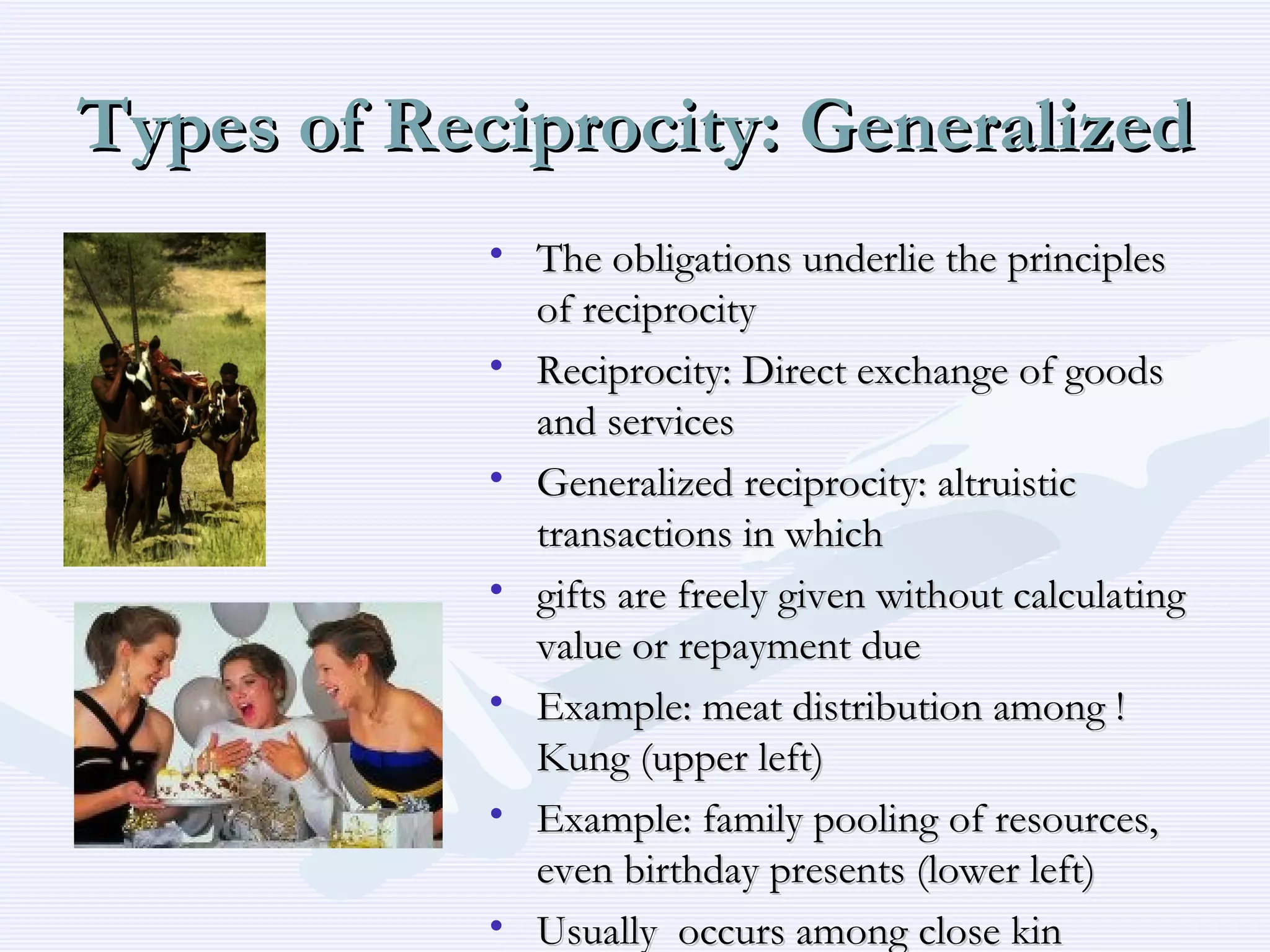
Types of Reciprocity: Generalized The obligations underlie the principles of reciprocity Reciprocity: Direct exchange of goods and services Generalized reciprocity: altruistic  transactions in which gifts are freely given without calculating value or repayment due Example: meat distribution among !Kung (upper left) Example: family pooling of resources, even birthday presents (lower left) Usually  occurs among close kin
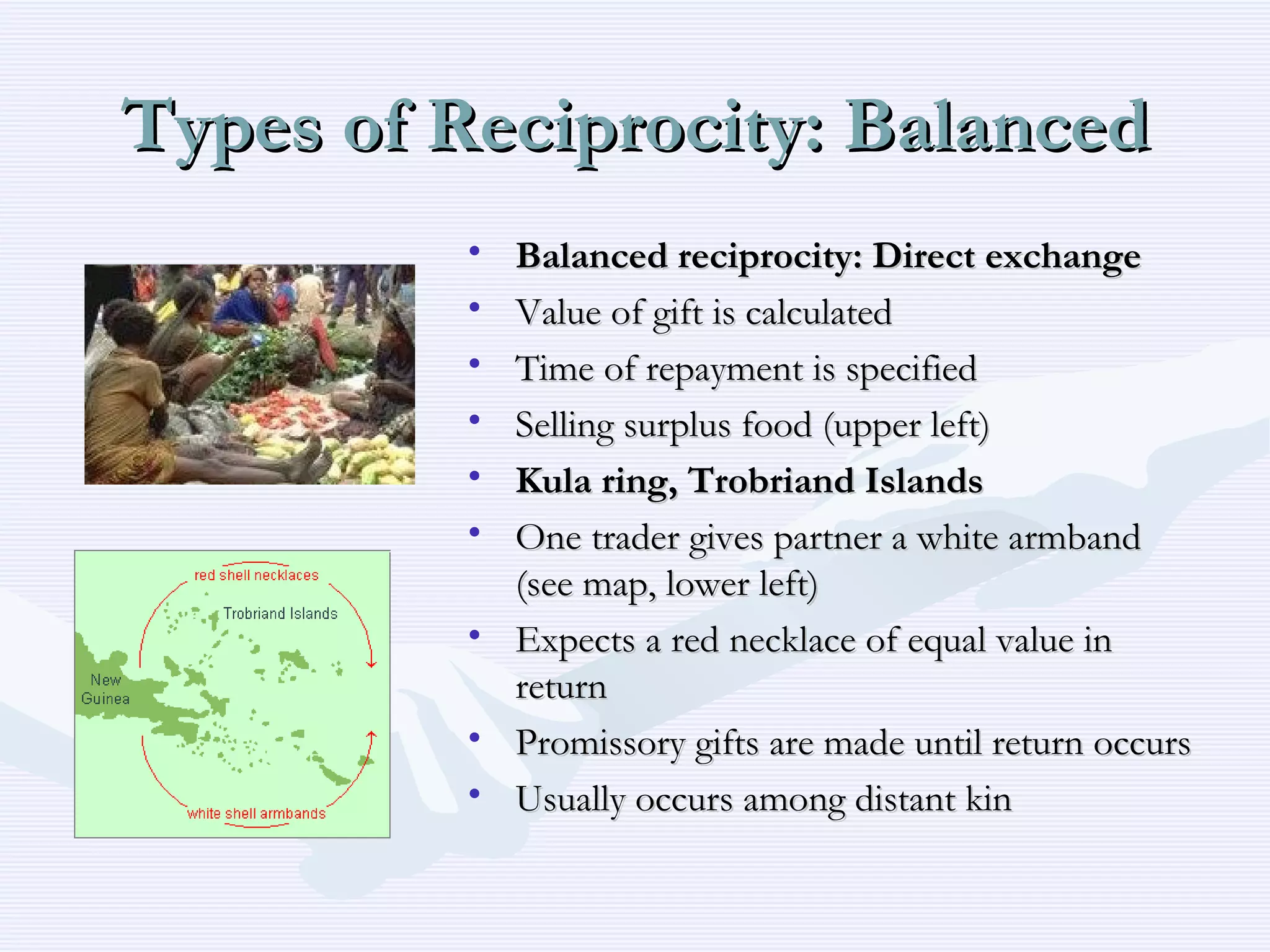
Types of Reciprocity: Balanced Balanced reciprocity: Direct exchange Value of gift is calculated Time of repayment is specified Selling surplus food (upper left) Kula ring, Trobriand Islands   One trader gives partner a white armband (see map, lower left) Expects a red necklace of equal value in return Promissory gifts are made until return occurs Usually occurs among distant kin
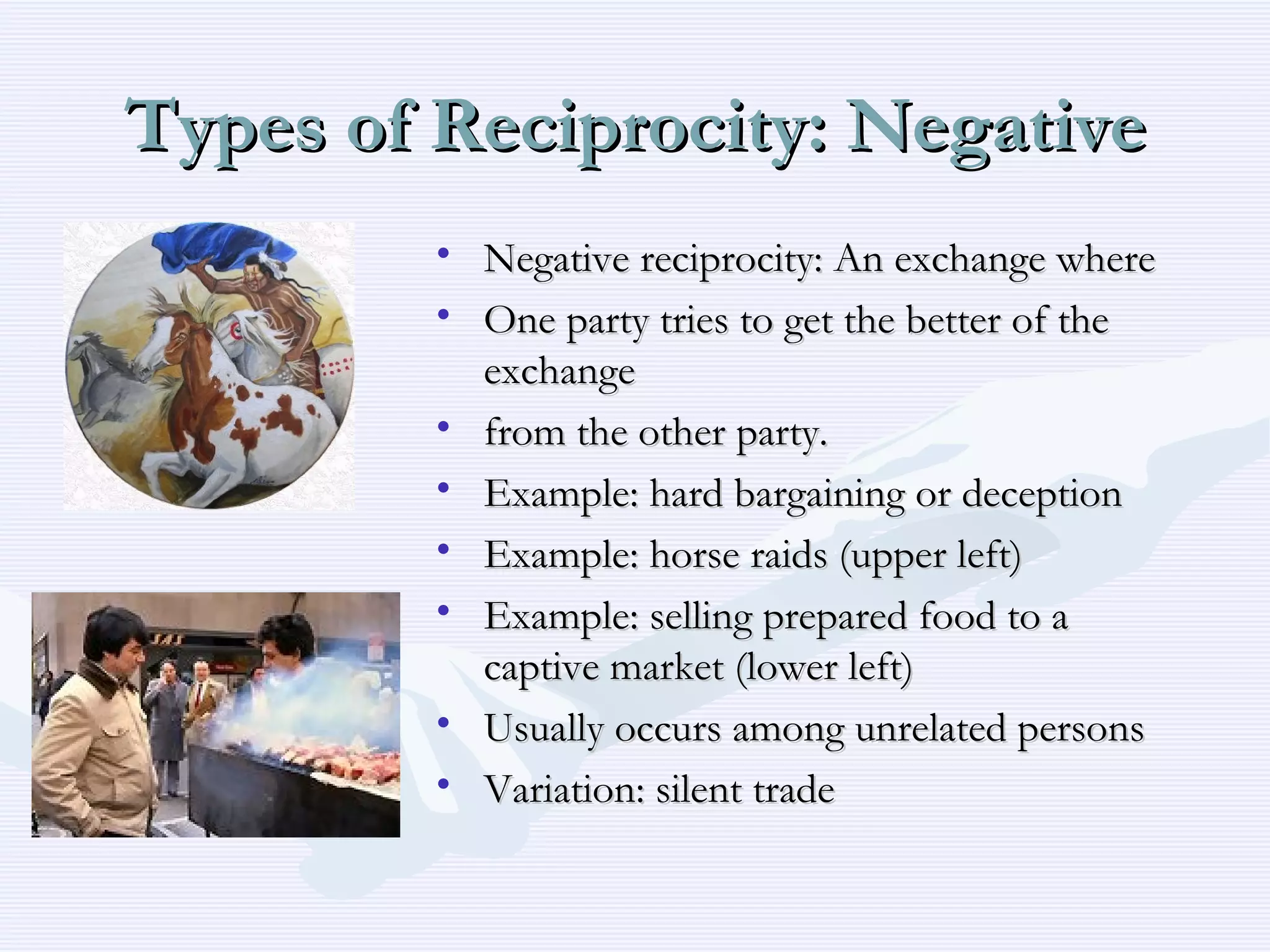
Types of Reciprocity: Negative Negative reciprocity: An exchange where One party tries to get the better of the exchange from the other party. Example: hard bargaining or deception Example: horse raids (upper left) Example: selling prepared food to a captive market (lower left) Usually occurs among unrelated persons Variation: silent trade
Case Study: Big Man Complex Big men are headmen with a following Following created by doing a favor (e.g. lending pigs) Favor is difficult to repay Individually, exchange is reciprocity Collectively, has appearance of redistribution
Big Men’s Power: Limits Cannot enforce the obligations Subject to competition to other big men Exchange feasts every 10 years with another big man equal in status
Redistribution Process whereby goods and services Flow to a central authority (king, chief, government) Where they are sorted, counted, and Reallocated Classic example: Potlatch of Northwest Coast(see picture) Historical example: administered trade
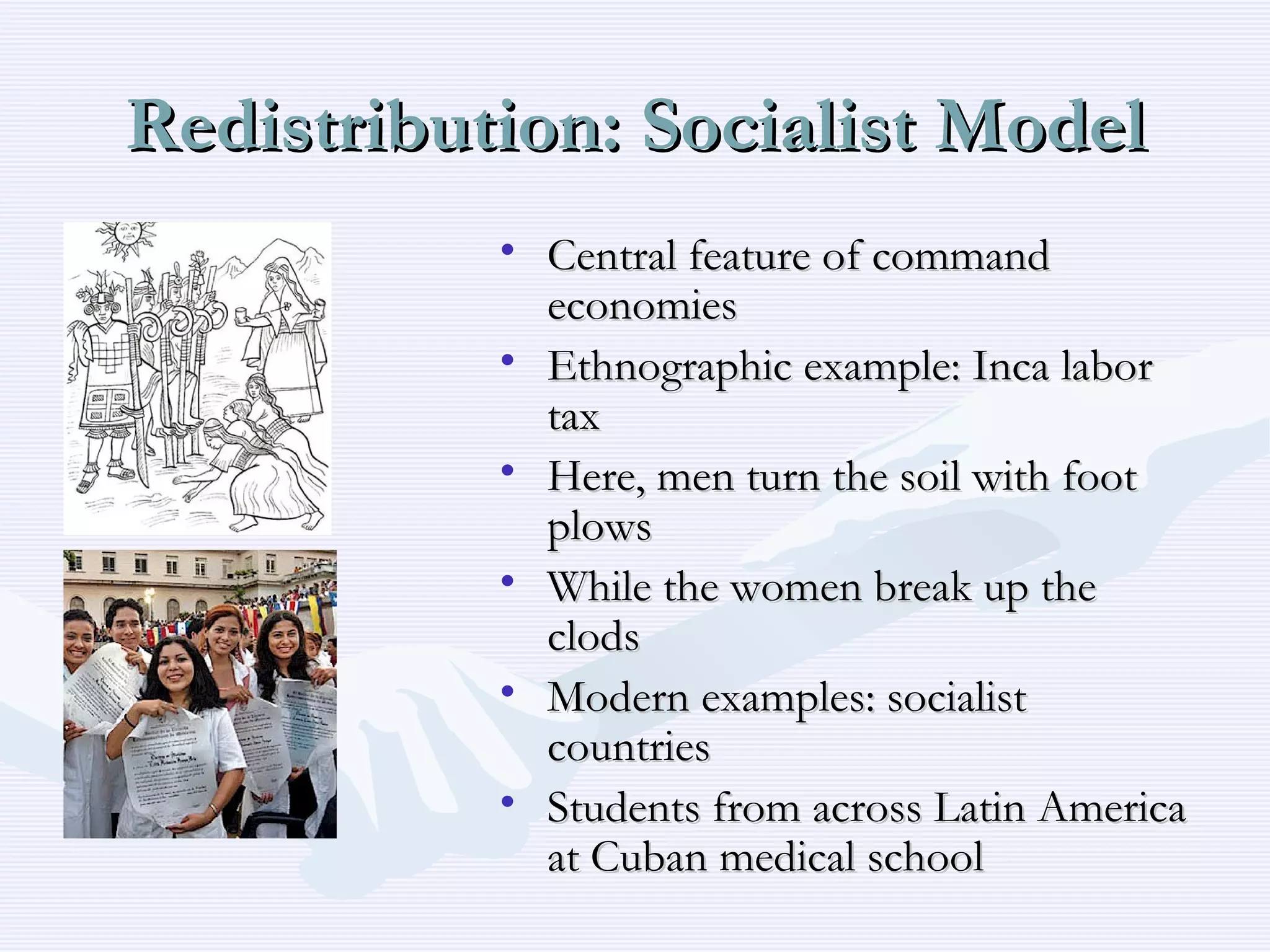
Redistribution: Socialist Model Central feature of command economies Ethnographic example: Inca labor tax Here, men turn the soil with foot plows While the women break up the clods Modern examples: socialist countries Students from across Latin America at Cuban medical school
Market Exchange Exchange of goods among many buyers and sellers Directly, by  barter,  or Indirectly, by money and pricing Example: Yoruba market in Nigeria (upper left); Haitian market woman (lower left) Markets include Crowds of buyers and sellers Instant information on prices Freedom of market entry and exit
Market Exchange: Actors Actors are: Supplier, whose willingness to sell is directly proportional to price increases Purchaser, whose willingness to buy (demand) is directly proportional to price decreases Interaction lead to price equilibrium--no profit
Example: Regional Guatemalan Markets  Case Study: San Francisco el Alto Entry: seller pay small tax; buyers pay none Many buyers and sellers  Price is constant  topic of conversation Profit is minimal Regional specialization guarantee buyers for product
Conclusion Economy entails distribution of goods and services Still, economy is embedded in society Big man complex involves politics Maintains power by persuasion, negotiation Kula ring is also embedded in prestige Interconnections will be seen in other topics: social groups and politics

Economic Anthropology: Systems of Exchange

  • 1.
    Economic Anthropology: Systemsof Exchange Reciprocity, Redistribution, Market Transactions
  • 2.
    Distribution: Exchange RelationsOnce produced, goods and services must be distributed Three ways by which goods are distributed Reciprocity: direct exchange of goods and services Redistribution: Flow of goods and services to central authority, then returned in different form Market exchange: buying and selling through price mechanism
  • 3.
    Imperatives of Exchange:Background Marcel Mauss: The Gift Preface: “When two groups of men meet, they may move away or in case of mistrust they may resort to arms or else they may come to terms” Coming to terms, he called “total prestations” or an obligation that has the force of law in the absence of law
  • 4.
    Obligations of theGift Obligation to give To extend social ties to other person or groups Obligation to receive To accept the relationship Refusal is rejection of offered relationship Induces hostilities Obligation to repay Failure to repay renders one a beggar
  • 5.
    Types of Reciprocity:Generalized The obligations underlie the principles of reciprocity Reciprocity: Direct exchange of goods and services Generalized reciprocity: altruistic transactions in which gifts are freely given without calculating value or repayment due Example: meat distribution among !Kung (upper left) Example: family pooling of resources, even birthday presents (lower left) Usually occurs among close kin
  • 6.
    Types of Reciprocity:Balanced Balanced reciprocity: Direct exchange Value of gift is calculated Time of repayment is specified Selling surplus food (upper left) Kula ring, Trobriand Islands One trader gives partner a white armband (see map, lower left) Expects a red necklace of equal value in return Promissory gifts are made until return occurs Usually occurs among distant kin
  • 7.
    Types of Reciprocity:Negative Negative reciprocity: An exchange where One party tries to get the better of the exchange from the other party. Example: hard bargaining or deception Example: horse raids (upper left) Example: selling prepared food to a captive market (lower left) Usually occurs among unrelated persons Variation: silent trade
  • 8.
    Case Study: BigMan Complex Big men are headmen with a following Following created by doing a favor (e.g. lending pigs) Favor is difficult to repay Individually, exchange is reciprocity Collectively, has appearance of redistribution
  • 9.
    Big Men’s Power:Limits Cannot enforce the obligations Subject to competition to other big men Exchange feasts every 10 years with another big man equal in status
  • 10.
    Redistribution Process wherebygoods and services Flow to a central authority (king, chief, government) Where they are sorted, counted, and Reallocated Classic example: Potlatch of Northwest Coast(see picture) Historical example: administered trade
  • 11.
    Redistribution: Socialist ModelCentral feature of command economies Ethnographic example: Inca labor tax Here, men turn the soil with foot plows While the women break up the clods Modern examples: socialist countries Students from across Latin America at Cuban medical school
  • 12.
    Market Exchange Exchangeof goods among many buyers and sellers Directly, by barter, or Indirectly, by money and pricing Example: Yoruba market in Nigeria (upper left); Haitian market woman (lower left) Markets include Crowds of buyers and sellers Instant information on prices Freedom of market entry and exit
  • 13.
    Market Exchange: ActorsActors are: Supplier, whose willingness to sell is directly proportional to price increases Purchaser, whose willingness to buy (demand) is directly proportional to price decreases Interaction lead to price equilibrium--no profit
  • 14.
    Example: Regional GuatemalanMarkets Case Study: San Francisco el Alto Entry: seller pay small tax; buyers pay none Many buyers and sellers Price is constant topic of conversation Profit is minimal Regional specialization guarantee buyers for product
  • 15.
    Conclusion Economy entailsdistribution of goods and services Still, economy is embedded in society Big man complex involves politics Maintains power by persuasion, negotiation Kula ring is also embedded in prestige Interconnections will be seen in other topics: social groups and politics