Econolytics The Econopython Revolution A Crash
Course For Python Programming In Economics
Bisette download
https://ebookbell.com/product/econolytics-the-econopython-
revolution-a-crash-course-for-python-programming-in-economics-
bisette-55839760
Explore and download more ebooks at ebookbell.com
Here are some recommended products that we believe you will be
interested in. You can click the link to download.
The Ecopolitics Of Consumption The Food Trade H Louise Davis Karyn
Pilgrim Madhudaya Sinha
https://ebookbell.com/product/the-ecopolitics-of-consumption-the-food-
trade-h-louise-davis-karyn-pilgrim-madhudaya-sinha-51434486
Tropical Forests International Jungle The Underside Of Global
Ecopolitics Marieclaude Smouts Auth
https://ebookbell.com/product/tropical-forests-international-jungle-
the-underside-of-global-ecopolitics-marieclaude-smouts-auth-5384524
Renaissance Ecopolitics From Shakespeare To Bacon Rethinking
Cosmopolis 1st Edition Elizabeth Gruber
https://ebookbell.com/product/renaissance-ecopolitics-from-
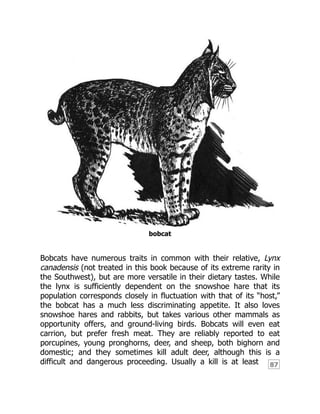
shakespeare-to-bacon-rethinking-cosmopolis-1st-edition-elizabeth-
gruber-34803690
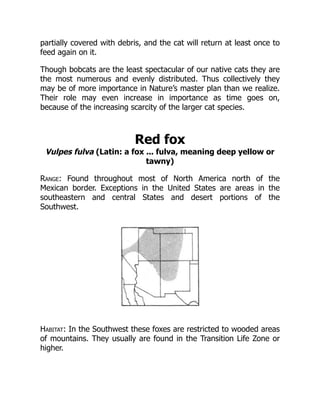
Bilateral Ecopolitics Continuity And Change In Canadianamerican
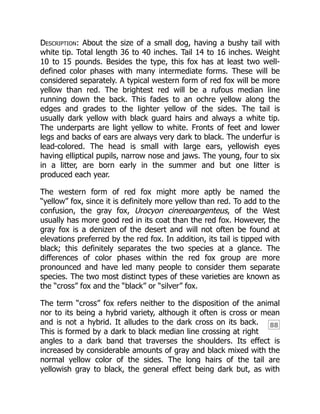
Environmental Relations Philippe Le Prestre
https://ebookbell.com/product/bilateral-ecopolitics-continuity-and-
change-in-canadianamerican-environmental-relations-philippe-le-
prestre-43409084
Green Shakespeare From Ecopolitics To Ecocriticism Egan Gabriel
https://ebookbell.com/product/green-shakespeare-from-ecopolitics-to-
ecocriticism-egan-gabriel-1641876
Another Random Document on
Scribd Without Any Related Topics
75
the enemy. There is one Achilles heel, however, in this otherwise
almost perfect defense. It is the unprotected underparts, which at
times of danger are always kept pressed against the ground or
against a tree trunk. A few carnivores, among them the mountain
lion and the fisher, are known to kill the porcupine by flipping it over
on its back and tearing it open. Even these large predators seldom
escape unscathed, however, and both lions and fishers are known to
have died from the effects of quills accidentally taken into the
digestive tract.
To those who have heard that porcupines live only on bark and
always girdle the host trees, it may come as a surprise to find that
this is only partly true. Although “bark” is eaten to some extent
throughout the year, it is seldom the main diet. When a great deal is
taken from one tree, it is gnawed off in an aimless pattern which
may or may not girdle the tree. During the spring and summer, a
porcupine becomes a browser on tender leaves and twigs in the
undergrowth. In autumn and winter, it feeds more on mistletoe and
pine needles than on bark. With its low reproduction rate, there is
little danger of it eating up our forests, unless its natural enemies
are removed.
Northern pocket gopher
Thomomys talpoides (Greek: thomos, a heap and mys,
mouse. Latin: talpa, a mole)
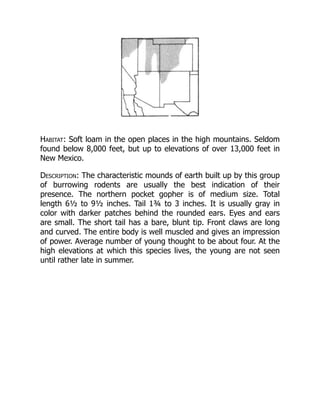
Range: From northwestern United States and southwestern Canada
to as far south as northern Arizona and northwestern New Mexico.
Habitat: Soft loam in the open places in the high mountains. Seldom
found below 8,000 feet, but up to elevations of over 13,000 feet in
New Mexico.
Description: The characteristic mounds of earth built up by this group
of burrowing rodents are usually the best indication of their
presence. The northern pocket gopher is of medium size. Total
length 6½ to 9½ inches. Tail 1¾ to 3 inches. It is usually gray in
color with darker patches behind the rounded ears. Eyes and ears
are small. The short tail has a bare, blunt tip. Front claws are long
and curved. The entire body is well muscled and gives an impression
of power. Average number of young thought to be about four. At the
high elevations at which this species lives, the young are not seen
until rather late in summer.
76
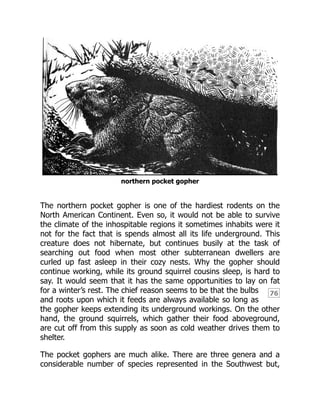
northern pocket gopher
The northern pocket gopher is one of the hardiest rodents on the
North American Continent. Even so, it would not be able to survive
the climate of the inhospitable regions it sometimes inhabits were it
not for the fact that is spends almost all its life underground. This
creature does not hibernate, but continues busily at the task of
searching out food when most other subterranean dwellers are
curled up fast asleep in their cozy nests. Why the gopher should
continue working, while its ground squirrel cousins sleep, is hard to
say. It would seem that it has the same opportunities to lay on fat
for a winter’s rest. The chief reason seems to be that the bulbs
and roots upon which it feeds are always available so long as
the gopher keeps extending its underground workings. On the other
hand, the ground squirrels, which gather their food aboveground,
are cut off from this supply as soon as cold weather drives them to
shelter.
The pocket gophers are much alike. There are three genera and a
considerable number of species represented in the Southwest but,
except for variations due to climate and terrain, their habits are
similar. Burrows usually are constructed in deep loam or alluvial
soils. These tunnels seem to follow an aimless pattern. Their course
is marked by mounds of earth thrown out of the workings at
irregular intervals. When the gopher is engaged in throwing out this
excavated earth, the entrance to the tunnel is left open until the job
is completed, then tightly plugged to prevent enemies from entering.
The tunnels themselves are rather small in diameter, considering the
size of the gopher, for if it wishes to retrace its steps and there is no
gallery near at hand in which to turn around, it can run backward
almost as easily as forward. There are usually numerous rooms
excavated along the course of the tunnels. In one is a warm nest
constructed of grass and fibers. Others are utilized for storage rooms
and at least one is reserved as a toilet, thereby keeping the rest of
the workings sanitary. When the ground is covered with snow the
northern pocket gopher especially is quite likely to extend its
activities aboveground. Here it builds its tunnels through the snow
and often packs them tightly with earth brought up from below. This
remains as earth casts, when the snow melts and forms a
characteristic mark of its presence.
Chief foods of pocket gophers are the bulbs, tubers, and fibrous
roots encountered in the course of their diggings. Whenever an
especially abundant supply is found, the surplus is stored away as
insurance against the time when future excavation produces nothing.
Gophers also eat leaves and stems whenever available. Some plants
are pulled down through the roof of the tunnel by the roots, and
some are gathered near its mouth, although these trips “outside” are
fraught with danger. Coyotes, foxes, and bobcats all are willing to
chance an encounter with this doughty little scrapper for the sake of
the tasty meal he will furnish.
Little is known of gopher family life. For the most part, they are
solitary individuals, avoiding others of their kind. At breeding time,
however, they may travel some distance across country to find a
mate. These trips usually are carried out under cover of darkness.
77
78
The young average four in number. They are born late in the spring
and do not leave to make their own homes until early autumn.
Physically the gopher exhibits a striking adaptation to its way of life.
The fur is thick and warm. It keeps soil particles from working into
the skin at the same time it protects the wearer from the chill of his
underground workings. The heavy, curved front claws are admirable
digging tools. In especially hard soil, the large strong incisors are
also pressed into service for this purpose. To remove the dirt from
the tunnel, the gopher becomes an animal bulldozer. The front legs
are employed as a blade pushing the soil, while the powerful hind
legs push the body and load towards the nearest tunnel opening.
The pockets from which this creature gets its common name
are never used for hauling earth. They are hair-lined pouches
located in each cheek and utilized for carrying food to the
storerooms. There they are emptied by placing the forefeet behind
them and pushing forward. Last, by virtue of its location, but
certainly not least in usefulness, is the short, almost hairless tail. It is
used as a tactile organ to feel out the way when the gopher runs
backwards through the tunnels. In some respects, it is of more use
than the eyes although the gopher uses these too, as can be
attested by the quickness with which it detects any movement near
the mouth of its tunnel.
The gopher’s place in Nature seems to be akin to that of the
earthworm. By turning over the soil, the gopher enables it to more
readily absorb water and air. At the same time, fertility is increased
by the addition of buried plants and animal matter. This is indeed a
fair exchange for the plants it destroys in its quest for food.
79
CARNIVORES
Including the Insectivores and
Chiropterans
This group is distinguished from other animals by having
canine teeth in both jaws. The function of these teeth is to
catch and hold other animals, for carnivores are the predators. This
is the most highly developed branch of the animal world and reaches
a peak of specialization in man who, while lacking some of the
physical qualifications of the other predators, has developed a brain
which has enabled him to gain and keep ascendancy over all other
animals. Considered with the group in this book are two other
orders, the Insectivora and the Chiroptera. These orders embrace
the mammals in North America that live principally on worms or
insects rather than on other mammals. They are the shrews and
bats, respectively.
Since carnivores are the hunters rather than the hunted, they enjoy
far greater mobility than, for instance, the rodents. It is not
necessary that they have a burrow in which to escape the attacks of
other animals, for it is unusual for them to prey upon each other.
Most of the predators remain in one area only from choice or, in the
case of adult females, in order to rear the young. Few of them
hibernate; bears and skunks do spend a considerable time during
the cold weather in a torpor, but it is an uneasy sleep at best, as
anyone who has disturbed these animals at this time can attest. As
far as the Chiroptera are concerned, some species of bats hibernate
and others migrate to a warmer climate to spend the winter. Since
most of the predators are active all winter, while many of the
rodents are in hibernation, this can be a period of famine for
80
carnivores. At the same time, it is a season of increased danger for
those species which are still active and upon which these predators
prey.
Because these hunters are continually stalking other animals, their
habitats are as varied as those of their quarries. Thus, the mountain
lion is a creature of the rimrock, where he can most conveniently
find deer browsing on mountain-mahogany; while his smaller cousin,
the bobcat, stalks smaller animals in the slope chaparral. The wild
dogs hunt plains and brushy country for ground squirrels and
rabbits. In the weasel family we find the marten in the treetops
pursuing squirrels, the weasel hunting mice in the meadow, and
mink and otter pursuing prey near to or in the water, Some species,
such as the bears, are omnivorous and may be encountered almost
anywhere that a plentiful supply of food of any kind can be found.
Practically all of the species, excepting bats and skunks, can be
considered diurnal as well as nocturnal, but the majority are most
active during the hours between dusk and sunrise.
Since the carnivores’ purpose in Nature’s scheme is to control the
vegetable eaters, it follows that each predator must be somewhat
superior, either physically or mentally, or both, to the species upon
which it preys. The associations between pursuer and pursued may
be casual with species such as the coyote, which preys on a great
number of smaller species, or they may be sharply defined as with
the lynx, which in certain localities depends almost entirely upon the
snowshoe hare for food. The apparent ferocity with which some
predators will kill, not only enough for a meal, but much more
than they need, cannot as yet be explained. This habit is most
pronounced in the weasel family. It may be that more than ordinary
control is called for in the case of their host species, rodents in most
cases. Whatever the reason, this wanton killing has not upset the
balance which these species maintain. Man, the most ruthless and
intelligent predator of all, is the only species which has been
successful in exterminating others.
The predators hold a favored place in the esteem of most
naturalists. At first, sympathy for the weak and indignation against
the strong are perfectly natural human feelings. As the necessity for
control and the wonderful way in which Nature attains a balance
becomes apparent, the role of the predator becomes more and more
appreciated by the student.
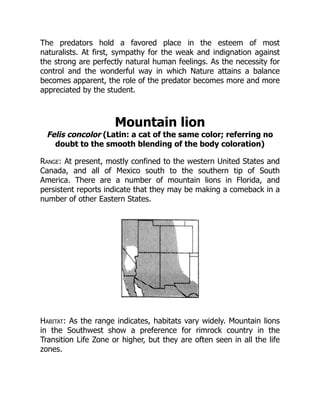
Mountain lion
Felis concolor (Latin: a cat of the same color; referring no
doubt to the smooth blending of the body coloration)
Range: At present, mostly confined to the western United States and
Canada, and all of Mexico south to the southern tip of South
America. There are a number of mountain lions in Florida, and
persistent reports indicate that they may be making a comeback in a
number of other Eastern States.
Habitat: As the range indicates, habitats vary widely. Mountain lions
in the Southwest show a preference for rimrock country in the
Transition Life Zone or higher, but they are often seen in all the life
zones.
81
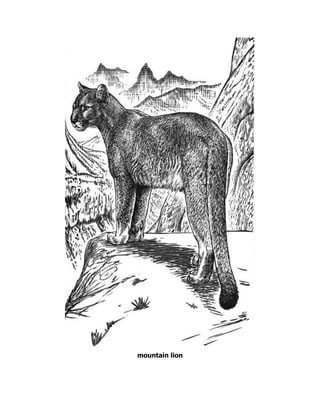
Description: A huge, tawny cat with long, heavy tail. The long tail is a
field mark identifying the young, which, having a spotted coat,
otherwise resemble young bobcats to some degree. Total length 72
to 90 inches. Tail 30 to 36 inches. Weight 80 to 200 pounds. Color
may vary from tawny gray to brownish red over most of the body,
the underparts being lighter. The head and ears appear small in
proportion to the lean muscular body. The teeth are large, the
canines being especially massive. Like most members of the cat
family, the mountain lion has large feet with long, sharp claws. The
tracks show the imprint of four toes together with a large pad in the
center of the foot. The young may be born at any time of the year.
Only one litter is born every 2 to 3 years, and the average number of
young is three.
Probably no species of mammal in the New World equals the
mountain lion in farflung distribution. From the Yukon to Patagonia,
this elusive carnivore can still be found in considerable numbers in
spite of aggressive campaigns against it. In the United States, it is
the chief representative of the wild cats, a group noted for fierce and
predacious habits. Fortunate indeed is the person who sees one of
these great felines in the wild. This may not be as difficult as one
might imagine because mountain lions often travel through
comparatively well settled areas. It is especially possible in the
Southwest, for the four-State area covered by this book contains the
heaviest population of mountain lions in the United States. However,
the comparative abundance of this carnivore has not resulted in a
better understanding of it. The mountain lion is still one of the least
known and most maligned creatures of our times.
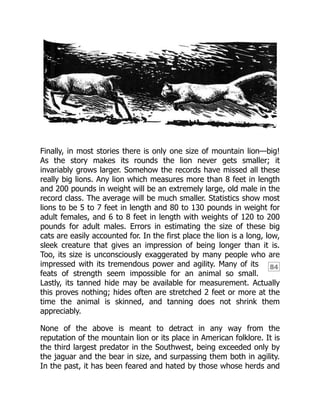
mountain lion
82
The Mexicans know this cosmopolite as “leon.” In Brazil it is
called “onca.” Perhaps the most distinguished name, and
rating as the first in New World history, is “puma,” given it by the
Incas. Early American settlers of the east coast called it “panther,”
“painter,” and “catamount.” In the northwestern United States, it is
known as “cougar” and in the Southwest, as mountain lion. Although
there is but the one species concolor, there are a number of
subspecies. About 15 are now recognized, most of them
geographical races and not markedly different from the species. Four
of these subspecies are found in the four States with which we are
concerned. One of the most interesting is hippolestes which inhabits
the State of Colorado. Translated from the Greek this is “horse thief,”
an appropriate epithet indeed for this ghostly marauder. As might be
expected from their vast distribution, the several subspecies have a
tremendous vertical range. In the Southwest they are found from
near sea level in southwestern Arizona to the tops of the highest
peaks in Colorado.
In the more than four centuries that have elapsed since the white
man first set foot on soil of the New World, a great mass of folklore
concerning the mountain lion has accumulated. Half fact, half fiction,
these tales have been repeated from one generation to another and
few details have been lost in the telling; indeed, in most cases,
several have been added. Most common are those which describe its
fierceness and its attacks on man. In the main, these tales are lurid
and convincing, but they do not stand up under scientific scrutiny. It
is true that such attacks have occurred; one of the most recent and
best verified was that on a 13-year old boy in Okanogan County,
Washington, in 1924. It resulted in the death and partial devouring
of the unfortunate youngster. Yet sensational as this incident was, it
resulted in publicity far out of proportion to its importance. In fact,
articles concerning this case are still appearing at intervals. The truth
of the matter is that very few authentic cases of mountain lion
attacks upon humans have ever occurred in the United States, and
that most of these could have been caused by the mountain lion’s
being rabid. Certainly such attacks are not typical behavior of the
83
normal animal. As far as man is concerned, the lion will take flight
whenever possible, and even when cornered it is not nearly so
pugnacious as its little cousin, the bobcat.
Other stories about the mountain lion often emphasize the
bloodcurdling screams with which it preludes its stalk of some
unfortunate person deep in the forest. The facts are that there is no
reason to believe that lions cannot or do not scream, but most
authorities agree that such vocal expressions are most likely to be
made by an old male courting his lady love or warning away a
rival. The cats are creatures of stealth and cunning that creep
upon their prey as noiselessly as possible. Lions would hardly
announce their presence with the sort of screams with which they
are credited. It seems safe to say that at least 90 percent of these
alleged screams can be traced to owls or amorous bobcats.
Oftentimes these sounds have been linked to large tracks found in
the vicinity as proof that a mountain lion was in the area. This has
led one author to remark that “the witness usually is unable to
distinguish the track of a large dog from that of a mountain lion.” In
addition, the infrequent screams made by captive mountain lions
indicate that such sounds in Nature would be far from spectacular.
They consist of a sound that is more like a whistle than the
demoniacal wail so often ascribed to the wild animal.
Many stories are told of a person, usually a pioneer ancestor, who
has been followed by a mountain lion. In most cases this person has
returned to the area suitably armed and with witnesses who found
tracks of the beast together with those of their friend. Strange to
say, such incidents are not at all uncommon. They have been
recorded and verified a number of times. In these cases the animal
often has made no effort at concealment but has followed the
person quite openly. Despite this boldness it seems there is no
sinister motive, merely a naive and surprising curiosity on the part of
the big cat as to what kind of creature man is. It is most unfortunate
that so little data have been recorded in these instances, yet this is
quite understandable under the circumstances.
84
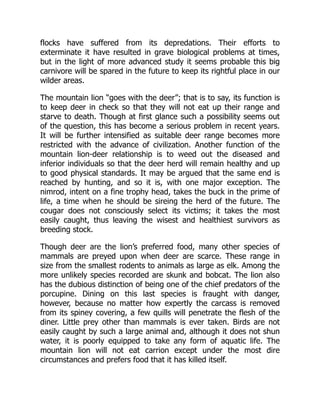
Finally, in most stories there is only one size of mountain lion—big!
As the story makes its rounds the lion never gets smaller; it
invariably grows larger. Somehow the records have missed all these
really big lions. Any lion which measures more than 8 feet in length
and 200 pounds in weight will be an extremely large, old male in the
record class. The average will be much smaller. Statistics show most
lions to be 5 to 7 feet in length and 80 to 130 pounds in weight for
adult females, and 6 to 8 feet in length with weights of 120 to 200
pounds for adult males. Errors in estimating the size of these big
cats are easily accounted for. In the first place the lion is a long, low,
sleek creature that gives an impression of being longer than it is.
Too, its size is unconsciously exaggerated by many people who are
impressed with its tremendous power and agility. Many of its
feats of strength seem impossible for an animal so small.
Lastly, its tanned hide may be available for measurement. Actually
this proves nothing; hides often are stretched 2 feet or more at the
time the animal is skinned, and tanning does not shrink them
appreciably.
None of the above is meant to detract in any way from the
reputation of the mountain lion or its place in American folklore. It is
the third largest predator in the Southwest, being exceeded only by
the jaguar and the bear in size, and surpassing them both in agility.
In the past, it has been feared and hated by those whose herds and
flocks have suffered from its depredations. Their efforts to
exterminate it have resulted in grave biological problems at times,
but in the light of more advanced study it seems probable this big
carnivore will be spared in the future to keep its rightful place in our
wilder areas.
The mountain lion “goes with the deer”; that is to say, its function is
to keep deer in check so that they will not eat up their range and
starve to death. Though at first glance such a possibility seems out
of the question, this has become a serious problem in recent years.
It will be further intensified as suitable deer range becomes more
restricted with the advance of civilization. Another function of the
mountain lion-deer relationship is to weed out the diseased and
inferior individuals so that the deer herd will remain healthy and up
to good physical standards. It may be argued that the same end is
reached by hunting, and so it is, with one major exception. The
nimrod, intent on a fine trophy head, takes the buck in the prime of
life, a time when he should be sireing the herd of the future. The
cougar does not consciously select its victims; it takes the most
easily caught, thus leaving the wisest and healthiest survivors as
breeding stock.
Though deer are the lion’s preferred food, many other species of
mammals are preyed upon when deer are scarce. These range in
size from the smallest rodents to animals as large as elk. Among the
more unlikely species recorded are skunk and bobcat. The lion also
has the dubious distinction of being one of the chief predators of the
porcupine. Dining on this last species is fraught with danger,
however, because no matter how expertly the carcass is removed
from its spiney covering, a few quills will penetrate the flesh of the
diner. Little prey other than mammals is ever taken. Birds are not
easily caught by such a large animal and, although it does not shun
water, it is poorly equipped to take any form of aquatic life. The
mountain lion will not eat carrion except under the most dire
circumstances and prefers food that it has killed itself.
85
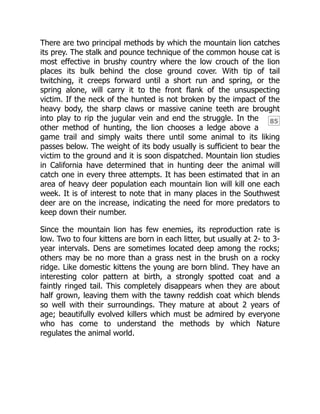
There are two principal methods by which the mountain lion catches
its prey. The stalk and pounce technique of the common house cat is
most effective in brushy country where the low crouch of the lion
places its bulk behind the close ground cover. With tip of tail
twitching, it creeps forward until a short run and spring, or the
spring alone, will carry it to the front flank of the unsuspecting
victim. If the neck of the hunted is not broken by the impact of the
heavy body, the sharp claws or massive canine teeth are brought
into play to rip the jugular vein and end the struggle. In the
other method of hunting, the lion chooses a ledge above a
game trail and simply waits there until some animal to its liking
passes below. The weight of its body usually is sufficient to bear the
victim to the ground and it is soon dispatched. Mountain lion studies
in California have determined that in hunting deer the animal will
catch one in every three attempts. It has been estimated that in an
area of heavy deer population each mountain lion will kill one each
week. It is of interest to note that in many places in the Southwest
deer are on the increase, indicating the need for more predators to
keep down their number.
Since the mountain lion has few enemies, its reproduction rate is
low. Two to four kittens are born in each litter, but usually at 2- to 3-
year intervals. Dens are sometimes located deep among the rocks;
others may be no more than a grass nest in the brush on a rocky
ridge. Like domestic kittens the young are born blind. They have an
interesting color pattern at birth, a strongly spotted coat and a
faintly ringed tail. This completely disappears when they are about
half grown, leaving them with the tawny reddish coat which blends
so well with their surroundings. They mature at about 2 years of
age; beautifully evolved killers which must be admired by everyone
who has come to understand the methods by which Nature
regulates the animal world.
Bobcat
Lynx rufus (Latin: name of animal, and rufus, reddish)
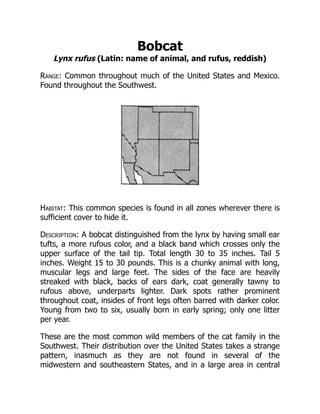
Range: Common throughout much of the United States and Mexico.
Found throughout the Southwest.
Habitat: This common species is found in all zones wherever there is
sufficient cover to hide it.
Description: A bobcat distinguished from the lynx by having small ear
tufts, a more rufous color, and a black band which crosses only the
upper surface of the tail tip. Total length 30 to 35 inches. Tail 5
inches. Weight 15 to 30 pounds. This is a chunky animal with long,
muscular legs and large feet. The sides of the face are heavily
streaked with black, backs of ears dark, coat generally tawny to
rufous above, underparts lighter. Dark spots rather prominent
throughout coat, insides of front legs often barred with darker color.
Young from two to six, usually born in early spring; only one litter
per year.
These are the most common wild members of the cat family in the
Southwest. Their distribution over the United States takes a strange
pattern, inasmuch as they are not found in several of the
midwestern and southeastern States, and in a large area in central
86
Mexico. In all there are a dozen subspecies of Lynx rufus in North
America. They are tough little predators, among the last to
retreat before the advance of civilization. In fact, they may
often be found on the very fringes of our larger cities, existing on
the rats that infest the city dump.
In the wilder areas, which are the bobcat’s appropriate home, its
tracks are distinguishable from those of the larger Felidae only by
their smaller size. Like the larger members of the cat family, it is
equipped with a set of strong retractile and extremely sharp claws.
Although there are five toes on each front foot and only four on the
hind feet, the tracks of both feet are similar. This is because the fifth
toe, corresponding to our thumb, is so high on the inside of the
foreleg that normally it does not touch the ground. During normal
travel the claws are always in the retracted position and never show
in the tracks. All native cats have a tendency to place the hind feet
in the tracks left by the front feet, so that in effect each track is a
double print. This may be one of the reasons a cat’s approach is so
silent!
87
bobcat
Bobcats have numerous traits in common with their relative, Lynx
canadensis (not treated in this book because of its extreme rarity in
the Southwest), but are more versatile in their dietary tastes. While
the lynx is sufficiently dependent on the snowshoe hare that its
population corresponds closely in fluctuation with that of its “host,”
the bobcat has a much less discriminating appetite. It also loves
snowshoe hares and rabbits, but takes various other mammals as
opportunity offers, and ground-living birds. Bobcats will even eat
carrion, but prefer fresh meat. They are reliably reported to eat
porcupines, young pronghorns, deer, and sheep, both bighorn and
domestic; and they sometimes kill adult deer, although this is a
difficult and dangerous proceeding. Usually a kill is at least
partially covered with debris, and the cat will return at least once to
feed again on it.
Though bobcats are the least spectacular of our native cats they are
the most numerous and evenly distributed. Thus collectively they
may be of more importance in Nature’s master plan than we realize.
Their role may even increase in importance as time goes on,
because of the increasing scarcity of the larger cat species.
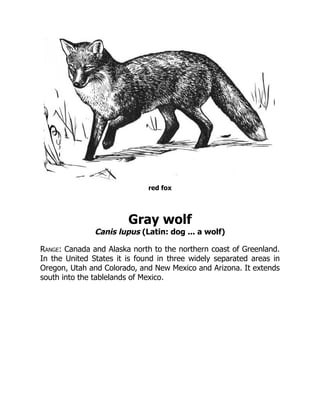
Red fox
Vulpes fulva (Latin: a fox ... fulva, meaning deep yellow or
tawny)
Range: Found throughout most of North America north of the
Mexican border. Exceptions in the United States are areas in the
southeastern and central States and desert portions of the
Southwest.
Habitat: In the Southwest these foxes are restricted to wooded areas
of mountains. They usually are found in the Transition Life Zone or
higher.
88
Description: About the size of a small dog, having a bushy tail with
white tip. Total length 36 to 40 inches. Tail 14 to 16 inches. Weight
10 to 15 pounds. Besides the type, this fox has at least two well-
defined color phases with many intermediate forms. These will be
considered separately. A typical western form of red fox will be more
yellow than red. The brightest red will be a rufous median line
running down the back. This fades to an ochre yellow along the
edges and grades to the lighter yellow of the sides. The tail is
usually dark yellow with black guard hairs and always a white tip.
The underparts are light yellow to white. Fronts of feet and lower
legs and backs of ears are always very dark to black. The underfur is
lead-colored. The head is small with large ears, yellowish eyes
having elliptical pupils, narrow nose and jaws. The young, four to six
in a litter, are born early in the summer and but one litter is
produced each year.
The western form of red fox might more aptly be named the
“yellow” fox, since it is definitely more yellow than red. To add to the
confusion, the gray fox, Urocyon cinereoargenteus, of the West
usually has more good red in its coat than the red fox. However, the
gray fox is a denizen of the desert and will not often be found at
elevations preferred by the red fox. In addition, its tail is tipped with
black; this definitely separates the two species at a glance. The
differences of color phases within the red fox group are more
pronounced and have led many people to consider them separate
species. The two most distinct types of these varieties are known as
the “cross” fox and the “black” or “silver” fox.
The term “cross” fox refers neither to the disposition of the animal
nor to its being a hybrid variety, although it often is cross or mean
and is not a hybrid. It alludes to the dark cross on its back.
This is formed by a dark to black median line crossing at right
angles to a dark band that traverses the shoulders. Its effect is
increased by considerable amounts of gray and black mixed with the
normal yellow color of the sides. The long hairs of the tail are
yellowish gray to black, the general effect being dark but, as with
the type, the tip is pure white. As might be expected, there are
many gradations between this color phase and the type, some of
them being among the most striking and beautiful foxes in the
world.
The “black” or “silver” fox is a melanistic form of the red fox. In the
most striking form it is a smooth shining black, the general
sombreness of its coat being relieved by a sprinkling of silvery white
guard hairs. These are thickest in the area of the shoulders, on the
posterior portion of the back, and on the top and sides of the head.
The underparts, though black, lack the lustrous “finish” so evident
on the back and sides. The tip of the tail is pure white in this form
also. This is the “silver” fox of commerce, an animal which through
selective breeding has become standardized in the fur industry.
Nevertheless, the black color is a recessive character, as evidenced
by the throw-backs that often make their appearance in otherwise
black litters. Without constant vigilance on the part of breeders, the
“silver” fox would soon become a rarity again. The Mendelian law
cannot be cancelled out by a few generations of selective breeding.
The foxes are the smallest canines native to the United States.
Though they look much larger because of their long fur and bushy
tail, the average red fox will not outweigh a large house cat. They
make up for this lack of size, however, by being exceedingly quick in
their movements. They are thus able to catch many of the small
mammals which outmaneuver coyotes and wolves. Rabbits are
about the largest mammals with which they can cope, but mice,
woodrats, pikas, and ground squirrels are all a common part of their
diet. In addition, they take many large insects and ground nesting
birds and eggs whenever possible. Foxes are not as omnivorous as
coyotes, but they relish berries and stone fruits and sometimes raid
watermelon patches.
The social life of foxes is most interesting. The family is a closely knit
unit which as a rule does not break up until the young are well able
to care for themselves. Foxes are monogamous; that is, they
89
normally choose their mates for life. Dens may be in burrows dug in
the soil or in deep crevices in the rocks. They are usually in some
spot where there is a good view of the surrounding territory. The
pups are born rather early in the spring and by early summer will be
playing around in the den entrance, although they do not venture to
any distance until much later. Should the den be approached while
the young are in it, the female often will be very bold in her
attempts to lead the intruders away from it. As soon as the young
are weaned the male joins his mate in bringing food to them. By
early fall, the family is hunting together.
The red fox has been a symbol of sagacity and cunning since long
before Aesop. Much of this reputation is well earned, as witness their
stubborn withdrawal as civilization surrounds them. Yet sometime
one wonders if their wisdom is not overrated. I am reminded of an
old female who every year whelped her young in the mouth of
a tile drain which drained a marshy piece of ground that had
since become dry. The upper end of the tile was buried some 15 feet
below the surface of the ground. My friend would watch the area
until the pups were about half grown. Then he would block the
entrance to the tile with a box trap and catch them as hunger drove
them out to the bait. This went on for several years, the old vixen
never seeming to learn from bitter experience that her family would
be taken away from her.
red fox
Gray wolf
Canis lupus (Latin: dog ... a wolf)
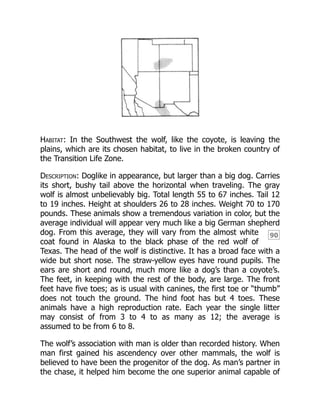
Range: Canada and Alaska north to the northern coast of Greenland.
In the United States it is found in three widely separated areas in
Oregon, Utah and Colorado, and New Mexico and Arizona. It extends
south into the tablelands of Mexico.
90
Habitat: In the Southwest the wolf, like the coyote, is leaving the
plains, which are its chosen habitat, to live in the broken country of
the Transition Life Zone.
Description: Doglike in appearance, but larger than a big dog. Carries
its short, bushy tail above the horizontal when traveling. The gray
wolf is almost unbelievably big. Total length 55 to 67 inches. Tail 12
to 19 inches. Height at shoulders 26 to 28 inches. Weight 70 to 170
pounds. These animals show a tremendous variation in color, but the
average individual will appear very much like a big German shepherd
dog. From this average, they will vary from the almost white
coat found in Alaska to the black phase of the red wolf of
Texas. The head of the wolf is distinctive. It has a broad face with a
wide but short nose. The straw-yellow eyes have round pupils. The
ears are short and round, much more like a dog’s than a coyote’s.
The feet, in keeping with the rest of the body, are large. The front
feet have five toes; as is usual with canines, the first toe or “thumb”
does not touch the ground. The hind foot has but 4 toes. These
animals have a high reproduction rate. Each year the single litter
may consist of from 3 to 4 to as many as 12; the average is
assumed to be from 6 to 8.
The wolf’s association with man is older than recorded history. When
man first gained his ascendency over other mammals, the wolf is
believed to have been the progenitor of the dog. As man’s partner in
the chase, it helped him become the one superior animal capable of
exterminating it. At the present time, man has come close to doing
just that. Only a few of these magnificent wild dogs remain in the
United States. Those are concentrated mainly in the Southwest, and
some of them undoubtedly have come across the border from
Mexico. Before long the species probably will become extinct in this
country, but the large numbers remaining in Alaska and Canada
should persist for many years.
Much of the public antipathy for wolves comes from literature. Who,
as a child, has not thrilled to the danger that surrounded Little Red
Riding Hood, and rejoiced at the ultimate end of the arch villain?
Long before animated cartooning took over nursery rhymes,
children’s books were well thumbmarked at the page where the “big
bad wolf huffed and puffed and blew the house down.” To “keep the
wolf from the door” is an expression as full of meaning today as it
was in the 15th century when the animal became extinct in England.
The wolf has always been a symbol of taking ruthlessly. The genus
lupinus (Latin: wolf), a beautiful group of plants of the pea family, is
so called because early botanists thought it robbed the soil. The
“wolf” so often encountered at house parties is included in this class.
None of these characterizations gives a good impression, and all are
indicative of man’s feeling toward the wolf. It is most unfortunate
that man so often condemns anything which interferes with his own
economic progress. Nature has a place for the wolf, a specialized
task for which it is admirably adapted.
In the days before the white man, bison roamed the western plains
in great herds which were constantly followed by packs of wolves
and coyotes. As long as the bison remained close together they were
relatively safe, but woe to the sick or weak that lagged behind.
These were quickly pulled down, and after wolves had eaten the
choicest portions, the coyotes and vultures moved in for the rest.
When the white man exterminated the bison, the wolves’ host was
gone and they turned to the logical substitute, the white man’s
cattle. This could have but one result. In the predator control
campaign which followed, a wedge was driven through the wolf
91
population of the Southwest, leaving one group isolated in Utah and
Colorado and another in southern Arizona and New Mexico.
The latter group is actually formed by immigration of wolves
from Mexico. It fluctuates in numbers as the animals move back and
forth across the border in response to local conditions. During the
extermination program, the behavior of the wolf was affected to a
considerable extent.
Accounts of early travelers stress the easy familiarity with which the
gray wolf accepted their presence. When a wayfarer shot a bison,
the wolf sat down within easy range and waited until the choicest
cuts had been taken away. It then moved in for its share. Since that
time the wolf has become one of the most wary and cunning of our
wild creatures. Gifted with a keen intelligence, it has found that only
by complete isolation can it escape the methods devised for its
destruction. To this end, it has moved from the plains into the more
inaccessible places in the mountains. Few will ever see a wolf in the
Southwest again, and I consider myself fortunate to have seen this
gray ghost of the plains in years long past, and to have heard its
deep howl break the silence of a cold winter night.
Welcome to our website – the perfect destination for book lovers and
knowledge seekers. We believe that every book holds a new world,
offering opportunities for learning, discovery, and personal growth.
That’s why we are dedicated to bringing you a diverse collection of
books, ranging from classic literature and specialized publications to
self-development guides and children's books.
More than just a book-buying platform, we strive to be a bridge
connecting you with timeless cultural and intellectual values. With an
elegant, user-friendly interface and a smart search system, you can
quickly find the books that best suit your interests. Additionally,
our special promotions and home delivery services help you save time
and fully enjoy the joy of reading.
Join us on a journey of knowledge exploration, passion nurturing, and
personal growth every day!
ebookbell.com

Econolytics The Econopython Revolution A Crash Course For Python Programming In Economics Bisette


  • 1.
    Econolytics The EconopythonRevolution A Crash Course For Python Programming In Economics Bisette download https://ebookbell.com/product/econolytics-the-econopython- revolution-a-crash-course-for-python-programming-in-economics- bisette-55839760 Explore and download more ebooks at ebookbell.com

  • 2.
    Here are somerecommended products that we believe you will be interested in. You can click the link to download. The Ecopolitics Of Consumption The Food Trade H Louise Davis Karyn Pilgrim Madhudaya Sinha https://ebookbell.com/product/the-ecopolitics-of-consumption-the-food- trade-h-louise-davis-karyn-pilgrim-madhudaya-sinha-51434486 Tropical Forests International Jungle The Underside Of Global Ecopolitics Marieclaude Smouts Auth https://ebookbell.com/product/tropical-forests-international-jungle- the-underside-of-global-ecopolitics-marieclaude-smouts-auth-5384524 Renaissance Ecopolitics From Shakespeare To Bacon Rethinking Cosmopolis 1st Edition Elizabeth Gruber https://ebookbell.com/product/renaissance-ecopolitics-from- shakespeare-to-bacon-rethinking-cosmopolis-1st-edition-elizabeth- gruber-34803690 Bilateral Ecopolitics Continuity And Change In Canadianamerican Environmental Relations Philippe Le Prestre https://ebookbell.com/product/bilateral-ecopolitics-continuity-and- change-in-canadianamerican-environmental-relations-philippe-le- prestre-43409084
  • 3.
    Green Shakespeare FromEcopolitics To Ecocriticism Egan Gabriel https://ebookbell.com/product/green-shakespeare-from-ecopolitics-to- ecocriticism-egan-gabriel-1641876
  • 4.
    Another Random Documenton Scribd Without Any Related Topics
  • 5.
    75 the enemy. Thereis one Achilles heel, however, in this otherwise almost perfect defense. It is the unprotected underparts, which at times of danger are always kept pressed against the ground or against a tree trunk. A few carnivores, among them the mountain lion and the fisher, are known to kill the porcupine by flipping it over on its back and tearing it open. Even these large predators seldom escape unscathed, however, and both lions and fishers are known to have died from the effects of quills accidentally taken into the digestive tract. To those who have heard that porcupines live only on bark and always girdle the host trees, it may come as a surprise to find that this is only partly true. Although “bark” is eaten to some extent throughout the year, it is seldom the main diet. When a great deal is taken from one tree, it is gnawed off in an aimless pattern which may or may not girdle the tree. During the spring and summer, a porcupine becomes a browser on tender leaves and twigs in the undergrowth. In autumn and winter, it feeds more on mistletoe and pine needles than on bark. With its low reproduction rate, there is little danger of it eating up our forests, unless its natural enemies are removed. Northern pocket gopher Thomomys talpoides (Greek: thomos, a heap and mys, mouse. Latin: talpa, a mole) Range: From northwestern United States and southwestern Canada to as far south as northern Arizona and northwestern New Mexico.
  • 6.
    Habitat: Soft loamin the open places in the high mountains. Seldom found below 8,000 feet, but up to elevations of over 13,000 feet in New Mexico. Description: The characteristic mounds of earth built up by this group of burrowing rodents are usually the best indication of their presence. The northern pocket gopher is of medium size. Total length 6½ to 9½ inches. Tail 1¾ to 3 inches. It is usually gray in color with darker patches behind the rounded ears. Eyes and ears are small. The short tail has a bare, blunt tip. Front claws are long and curved. The entire body is well muscled and gives an impression of power. Average number of young thought to be about four. At the high elevations at which this species lives, the young are not seen until rather late in summer.
  • 7.
    76 northern pocket gopher Thenorthern pocket gopher is one of the hardiest rodents on the North American Continent. Even so, it would not be able to survive the climate of the inhospitable regions it sometimes inhabits were it not for the fact that is spends almost all its life underground. This creature does not hibernate, but continues busily at the task of searching out food when most other subterranean dwellers are curled up fast asleep in their cozy nests. Why the gopher should continue working, while its ground squirrel cousins sleep, is hard to say. It would seem that it has the same opportunities to lay on fat for a winter’s rest. The chief reason seems to be that the bulbs and roots upon which it feeds are always available so long as the gopher keeps extending its underground workings. On the other hand, the ground squirrels, which gather their food aboveground, are cut off from this supply as soon as cold weather drives them to shelter. The pocket gophers are much alike. There are three genera and a considerable number of species represented in the Southwest but,
  • 8.
    except for variationsdue to climate and terrain, their habits are similar. Burrows usually are constructed in deep loam or alluvial soils. These tunnels seem to follow an aimless pattern. Their course is marked by mounds of earth thrown out of the workings at irregular intervals. When the gopher is engaged in throwing out this excavated earth, the entrance to the tunnel is left open until the job is completed, then tightly plugged to prevent enemies from entering. The tunnels themselves are rather small in diameter, considering the size of the gopher, for if it wishes to retrace its steps and there is no gallery near at hand in which to turn around, it can run backward almost as easily as forward. There are usually numerous rooms excavated along the course of the tunnels. In one is a warm nest constructed of grass and fibers. Others are utilized for storage rooms and at least one is reserved as a toilet, thereby keeping the rest of the workings sanitary. When the ground is covered with snow the northern pocket gopher especially is quite likely to extend its activities aboveground. Here it builds its tunnels through the snow and often packs them tightly with earth brought up from below. This remains as earth casts, when the snow melts and forms a characteristic mark of its presence. Chief foods of pocket gophers are the bulbs, tubers, and fibrous roots encountered in the course of their diggings. Whenever an especially abundant supply is found, the surplus is stored away as insurance against the time when future excavation produces nothing. Gophers also eat leaves and stems whenever available. Some plants are pulled down through the roof of the tunnel by the roots, and some are gathered near its mouth, although these trips “outside” are fraught with danger. Coyotes, foxes, and bobcats all are willing to chance an encounter with this doughty little scrapper for the sake of the tasty meal he will furnish. Little is known of gopher family life. For the most part, they are solitary individuals, avoiding others of their kind. At breeding time, however, they may travel some distance across country to find a mate. These trips usually are carried out under cover of darkness.
  • 9.
    77 78 The young averagefour in number. They are born late in the spring and do not leave to make their own homes until early autumn. Physically the gopher exhibits a striking adaptation to its way of life. The fur is thick and warm. It keeps soil particles from working into the skin at the same time it protects the wearer from the chill of his underground workings. The heavy, curved front claws are admirable digging tools. In especially hard soil, the large strong incisors are also pressed into service for this purpose. To remove the dirt from the tunnel, the gopher becomes an animal bulldozer. The front legs are employed as a blade pushing the soil, while the powerful hind legs push the body and load towards the nearest tunnel opening. The pockets from which this creature gets its common name are never used for hauling earth. They are hair-lined pouches located in each cheek and utilized for carrying food to the storerooms. There they are emptied by placing the forefeet behind them and pushing forward. Last, by virtue of its location, but certainly not least in usefulness, is the short, almost hairless tail. It is used as a tactile organ to feel out the way when the gopher runs backwards through the tunnels. In some respects, it is of more use than the eyes although the gopher uses these too, as can be attested by the quickness with which it detects any movement near the mouth of its tunnel. The gopher’s place in Nature seems to be akin to that of the earthworm. By turning over the soil, the gopher enables it to more readily absorb water and air. At the same time, fertility is increased by the addition of buried plants and animal matter. This is indeed a fair exchange for the plants it destroys in its quest for food.
  • 10.
    79 CARNIVORES Including the Insectivoresand Chiropterans This group is distinguished from other animals by having canine teeth in both jaws. The function of these teeth is to catch and hold other animals, for carnivores are the predators. This is the most highly developed branch of the animal world and reaches a peak of specialization in man who, while lacking some of the physical qualifications of the other predators, has developed a brain which has enabled him to gain and keep ascendancy over all other animals. Considered with the group in this book are two other orders, the Insectivora and the Chiroptera. These orders embrace the mammals in North America that live principally on worms or insects rather than on other mammals. They are the shrews and bats, respectively. Since carnivores are the hunters rather than the hunted, they enjoy far greater mobility than, for instance, the rodents. It is not necessary that they have a burrow in which to escape the attacks of other animals, for it is unusual for them to prey upon each other. Most of the predators remain in one area only from choice or, in the case of adult females, in order to rear the young. Few of them hibernate; bears and skunks do spend a considerable time during the cold weather in a torpor, but it is an uneasy sleep at best, as anyone who has disturbed these animals at this time can attest. As far as the Chiroptera are concerned, some species of bats hibernate and others migrate to a warmer climate to spend the winter. Since most of the predators are active all winter, while many of the rodents are in hibernation, this can be a period of famine for
  • 11.
    80 carnivores. At thesame time, it is a season of increased danger for those species which are still active and upon which these predators prey. Because these hunters are continually stalking other animals, their habitats are as varied as those of their quarries. Thus, the mountain lion is a creature of the rimrock, where he can most conveniently find deer browsing on mountain-mahogany; while his smaller cousin, the bobcat, stalks smaller animals in the slope chaparral. The wild dogs hunt plains and brushy country for ground squirrels and rabbits. In the weasel family we find the marten in the treetops pursuing squirrels, the weasel hunting mice in the meadow, and mink and otter pursuing prey near to or in the water, Some species, such as the bears, are omnivorous and may be encountered almost anywhere that a plentiful supply of food of any kind can be found. Practically all of the species, excepting bats and skunks, can be considered diurnal as well as nocturnal, but the majority are most active during the hours between dusk and sunrise. Since the carnivores’ purpose in Nature’s scheme is to control the vegetable eaters, it follows that each predator must be somewhat superior, either physically or mentally, or both, to the species upon which it preys. The associations between pursuer and pursued may be casual with species such as the coyote, which preys on a great number of smaller species, or they may be sharply defined as with the lynx, which in certain localities depends almost entirely upon the snowshoe hare for food. The apparent ferocity with which some predators will kill, not only enough for a meal, but much more than they need, cannot as yet be explained. This habit is most pronounced in the weasel family. It may be that more than ordinary control is called for in the case of their host species, rodents in most cases. Whatever the reason, this wanton killing has not upset the balance which these species maintain. Man, the most ruthless and intelligent predator of all, is the only species which has been successful in exterminating others.
  • 12.
    The predators holda favored place in the esteem of most naturalists. At first, sympathy for the weak and indignation against the strong are perfectly natural human feelings. As the necessity for control and the wonderful way in which Nature attains a balance becomes apparent, the role of the predator becomes more and more appreciated by the student. Mountain lion Felis concolor (Latin: a cat of the same color; referring no doubt to the smooth blending of the body coloration) Range: At present, mostly confined to the western United States and Canada, and all of Mexico south to the southern tip of South America. There are a number of mountain lions in Florida, and persistent reports indicate that they may be making a comeback in a number of other Eastern States. Habitat: As the range indicates, habitats vary widely. Mountain lions in the Southwest show a preference for rimrock country in the Transition Life Zone or higher, but they are often seen in all the life zones.
  • 13.
    81 Description: A huge,tawny cat with long, heavy tail. The long tail is a field mark identifying the young, which, having a spotted coat, otherwise resemble young bobcats to some degree. Total length 72 to 90 inches. Tail 30 to 36 inches. Weight 80 to 200 pounds. Color may vary from tawny gray to brownish red over most of the body, the underparts being lighter. The head and ears appear small in proportion to the lean muscular body. The teeth are large, the canines being especially massive. Like most members of the cat family, the mountain lion has large feet with long, sharp claws. The tracks show the imprint of four toes together with a large pad in the center of the foot. The young may be born at any time of the year. Only one litter is born every 2 to 3 years, and the average number of young is three. Probably no species of mammal in the New World equals the mountain lion in farflung distribution. From the Yukon to Patagonia, this elusive carnivore can still be found in considerable numbers in spite of aggressive campaigns against it. In the United States, it is the chief representative of the wild cats, a group noted for fierce and predacious habits. Fortunate indeed is the person who sees one of these great felines in the wild. This may not be as difficult as one might imagine because mountain lions often travel through comparatively well settled areas. It is especially possible in the Southwest, for the four-State area covered by this book contains the heaviest population of mountain lions in the United States. However, the comparative abundance of this carnivore has not resulted in a better understanding of it. The mountain lion is still one of the least known and most maligned creatures of our times.
  • 14.
  • 15.
    82 The Mexicans knowthis cosmopolite as “leon.” In Brazil it is called “onca.” Perhaps the most distinguished name, and rating as the first in New World history, is “puma,” given it by the Incas. Early American settlers of the east coast called it “panther,” “painter,” and “catamount.” In the northwestern United States, it is known as “cougar” and in the Southwest, as mountain lion. Although there is but the one species concolor, there are a number of subspecies. About 15 are now recognized, most of them geographical races and not markedly different from the species. Four of these subspecies are found in the four States with which we are concerned. One of the most interesting is hippolestes which inhabits the State of Colorado. Translated from the Greek this is “horse thief,” an appropriate epithet indeed for this ghostly marauder. As might be expected from their vast distribution, the several subspecies have a tremendous vertical range. In the Southwest they are found from near sea level in southwestern Arizona to the tops of the highest peaks in Colorado. In the more than four centuries that have elapsed since the white man first set foot on soil of the New World, a great mass of folklore concerning the mountain lion has accumulated. Half fact, half fiction, these tales have been repeated from one generation to another and few details have been lost in the telling; indeed, in most cases, several have been added. Most common are those which describe its fierceness and its attacks on man. In the main, these tales are lurid and convincing, but they do not stand up under scientific scrutiny. It is true that such attacks have occurred; one of the most recent and best verified was that on a 13-year old boy in Okanogan County, Washington, in 1924. It resulted in the death and partial devouring of the unfortunate youngster. Yet sensational as this incident was, it resulted in publicity far out of proportion to its importance. In fact, articles concerning this case are still appearing at intervals. The truth of the matter is that very few authentic cases of mountain lion attacks upon humans have ever occurred in the United States, and that most of these could have been caused by the mountain lion’s being rabid. Certainly such attacks are not typical behavior of the
  • 16.
    83 normal animal. Asfar as man is concerned, the lion will take flight whenever possible, and even when cornered it is not nearly so pugnacious as its little cousin, the bobcat. Other stories about the mountain lion often emphasize the bloodcurdling screams with which it preludes its stalk of some unfortunate person deep in the forest. The facts are that there is no reason to believe that lions cannot or do not scream, but most authorities agree that such vocal expressions are most likely to be made by an old male courting his lady love or warning away a rival. The cats are creatures of stealth and cunning that creep upon their prey as noiselessly as possible. Lions would hardly announce their presence with the sort of screams with which they are credited. It seems safe to say that at least 90 percent of these alleged screams can be traced to owls or amorous bobcats. Oftentimes these sounds have been linked to large tracks found in the vicinity as proof that a mountain lion was in the area. This has led one author to remark that “the witness usually is unable to distinguish the track of a large dog from that of a mountain lion.” In addition, the infrequent screams made by captive mountain lions indicate that such sounds in Nature would be far from spectacular. They consist of a sound that is more like a whistle than the demoniacal wail so often ascribed to the wild animal. Many stories are told of a person, usually a pioneer ancestor, who has been followed by a mountain lion. In most cases this person has returned to the area suitably armed and with witnesses who found tracks of the beast together with those of their friend. Strange to say, such incidents are not at all uncommon. They have been recorded and verified a number of times. In these cases the animal often has made no effort at concealment but has followed the person quite openly. Despite this boldness it seems there is no sinister motive, merely a naive and surprising curiosity on the part of the big cat as to what kind of creature man is. It is most unfortunate that so little data have been recorded in these instances, yet this is quite understandable under the circumstances.
  • 17.
    84 Finally, in moststories there is only one size of mountain lion—big! As the story makes its rounds the lion never gets smaller; it invariably grows larger. Somehow the records have missed all these really big lions. Any lion which measures more than 8 feet in length and 200 pounds in weight will be an extremely large, old male in the record class. The average will be much smaller. Statistics show most lions to be 5 to 7 feet in length and 80 to 130 pounds in weight for adult females, and 6 to 8 feet in length with weights of 120 to 200 pounds for adult males. Errors in estimating the size of these big cats are easily accounted for. In the first place the lion is a long, low, sleek creature that gives an impression of being longer than it is. Too, its size is unconsciously exaggerated by many people who are impressed with its tremendous power and agility. Many of its feats of strength seem impossible for an animal so small. Lastly, its tanned hide may be available for measurement. Actually this proves nothing; hides often are stretched 2 feet or more at the time the animal is skinned, and tanning does not shrink them appreciably. None of the above is meant to detract in any way from the reputation of the mountain lion or its place in American folklore. It is the third largest predator in the Southwest, being exceeded only by the jaguar and the bear in size, and surpassing them both in agility. In the past, it has been feared and hated by those whose herds and
  • 18.
    flocks have sufferedfrom its depredations. Their efforts to exterminate it have resulted in grave biological problems at times, but in the light of more advanced study it seems probable this big carnivore will be spared in the future to keep its rightful place in our wilder areas. The mountain lion “goes with the deer”; that is to say, its function is to keep deer in check so that they will not eat up their range and starve to death. Though at first glance such a possibility seems out of the question, this has become a serious problem in recent years. It will be further intensified as suitable deer range becomes more restricted with the advance of civilization. Another function of the mountain lion-deer relationship is to weed out the diseased and inferior individuals so that the deer herd will remain healthy and up to good physical standards. It may be argued that the same end is reached by hunting, and so it is, with one major exception. The nimrod, intent on a fine trophy head, takes the buck in the prime of life, a time when he should be sireing the herd of the future. The cougar does not consciously select its victims; it takes the most easily caught, thus leaving the wisest and healthiest survivors as breeding stock. Though deer are the lion’s preferred food, many other species of mammals are preyed upon when deer are scarce. These range in size from the smallest rodents to animals as large as elk. Among the more unlikely species recorded are skunk and bobcat. The lion also has the dubious distinction of being one of the chief predators of the porcupine. Dining on this last species is fraught with danger, however, because no matter how expertly the carcass is removed from its spiney covering, a few quills will penetrate the flesh of the diner. Little prey other than mammals is ever taken. Birds are not easily caught by such a large animal and, although it does not shun water, it is poorly equipped to take any form of aquatic life. The mountain lion will not eat carrion except under the most dire circumstances and prefers food that it has killed itself.
  • 19.
    85 There are twoprincipal methods by which the mountain lion catches its prey. The stalk and pounce technique of the common house cat is most effective in brushy country where the low crouch of the lion places its bulk behind the close ground cover. With tip of tail twitching, it creeps forward until a short run and spring, or the spring alone, will carry it to the front flank of the unsuspecting victim. If the neck of the hunted is not broken by the impact of the heavy body, the sharp claws or massive canine teeth are brought into play to rip the jugular vein and end the struggle. In the other method of hunting, the lion chooses a ledge above a game trail and simply waits there until some animal to its liking passes below. The weight of its body usually is sufficient to bear the victim to the ground and it is soon dispatched. Mountain lion studies in California have determined that in hunting deer the animal will catch one in every three attempts. It has been estimated that in an area of heavy deer population each mountain lion will kill one each week. It is of interest to note that in many places in the Southwest deer are on the increase, indicating the need for more predators to keep down their number. Since the mountain lion has few enemies, its reproduction rate is low. Two to four kittens are born in each litter, but usually at 2- to 3- year intervals. Dens are sometimes located deep among the rocks; others may be no more than a grass nest in the brush on a rocky ridge. Like domestic kittens the young are born blind. They have an interesting color pattern at birth, a strongly spotted coat and a faintly ringed tail. This completely disappears when they are about half grown, leaving them with the tawny reddish coat which blends so well with their surroundings. They mature at about 2 years of age; beautifully evolved killers which must be admired by everyone who has come to understand the methods by which Nature regulates the animal world.
  • 20.
    Bobcat Lynx rufus (Latin:name of animal, and rufus, reddish) Range: Common throughout much of the United States and Mexico. Found throughout the Southwest. Habitat: This common species is found in all zones wherever there is sufficient cover to hide it. Description: A bobcat distinguished from the lynx by having small ear tufts, a more rufous color, and a black band which crosses only the upper surface of the tail tip. Total length 30 to 35 inches. Tail 5 inches. Weight 15 to 30 pounds. This is a chunky animal with long, muscular legs and large feet. The sides of the face are heavily streaked with black, backs of ears dark, coat generally tawny to rufous above, underparts lighter. Dark spots rather prominent throughout coat, insides of front legs often barred with darker color. Young from two to six, usually born in early spring; only one litter per year. These are the most common wild members of the cat family in the Southwest. Their distribution over the United States takes a strange pattern, inasmuch as they are not found in several of the midwestern and southeastern States, and in a large area in central
  • 21.
    86 Mexico. In allthere are a dozen subspecies of Lynx rufus in North America. They are tough little predators, among the last to retreat before the advance of civilization. In fact, they may often be found on the very fringes of our larger cities, existing on the rats that infest the city dump. In the wilder areas, which are the bobcat’s appropriate home, its tracks are distinguishable from those of the larger Felidae only by their smaller size. Like the larger members of the cat family, it is equipped with a set of strong retractile and extremely sharp claws. Although there are five toes on each front foot and only four on the hind feet, the tracks of both feet are similar. This is because the fifth toe, corresponding to our thumb, is so high on the inside of the foreleg that normally it does not touch the ground. During normal travel the claws are always in the retracted position and never show in the tracks. All native cats have a tendency to place the hind feet in the tracks left by the front feet, so that in effect each track is a double print. This may be one of the reasons a cat’s approach is so silent!
  • 22.
    87 bobcat Bobcats have numeroustraits in common with their relative, Lynx canadensis (not treated in this book because of its extreme rarity in the Southwest), but are more versatile in their dietary tastes. While the lynx is sufficiently dependent on the snowshoe hare that its population corresponds closely in fluctuation with that of its “host,” the bobcat has a much less discriminating appetite. It also loves snowshoe hares and rabbits, but takes various other mammals as opportunity offers, and ground-living birds. Bobcats will even eat carrion, but prefer fresh meat. They are reliably reported to eat porcupines, young pronghorns, deer, and sheep, both bighorn and domestic; and they sometimes kill adult deer, although this is a difficult and dangerous proceeding. Usually a kill is at least
  • 23.
    partially covered withdebris, and the cat will return at least once to feed again on it. Though bobcats are the least spectacular of our native cats they are the most numerous and evenly distributed. Thus collectively they may be of more importance in Nature’s master plan than we realize. Their role may even increase in importance as time goes on, because of the increasing scarcity of the larger cat species. Red fox Vulpes fulva (Latin: a fox ... fulva, meaning deep yellow or tawny) Range: Found throughout most of North America north of the Mexican border. Exceptions in the United States are areas in the southeastern and central States and desert portions of the Southwest. Habitat: In the Southwest these foxes are restricted to wooded areas of mountains. They usually are found in the Transition Life Zone or higher.
  • 24.
    88 Description: About thesize of a small dog, having a bushy tail with white tip. Total length 36 to 40 inches. Tail 14 to 16 inches. Weight 10 to 15 pounds. Besides the type, this fox has at least two well- defined color phases with many intermediate forms. These will be considered separately. A typical western form of red fox will be more yellow than red. The brightest red will be a rufous median line running down the back. This fades to an ochre yellow along the edges and grades to the lighter yellow of the sides. The tail is usually dark yellow with black guard hairs and always a white tip. The underparts are light yellow to white. Fronts of feet and lower legs and backs of ears are always very dark to black. The underfur is lead-colored. The head is small with large ears, yellowish eyes having elliptical pupils, narrow nose and jaws. The young, four to six in a litter, are born early in the summer and but one litter is produced each year. The western form of red fox might more aptly be named the “yellow” fox, since it is definitely more yellow than red. To add to the confusion, the gray fox, Urocyon cinereoargenteus, of the West usually has more good red in its coat than the red fox. However, the gray fox is a denizen of the desert and will not often be found at elevations preferred by the red fox. In addition, its tail is tipped with black; this definitely separates the two species at a glance. The differences of color phases within the red fox group are more pronounced and have led many people to consider them separate species. The two most distinct types of these varieties are known as the “cross” fox and the “black” or “silver” fox. The term “cross” fox refers neither to the disposition of the animal nor to its being a hybrid variety, although it often is cross or mean and is not a hybrid. It alludes to the dark cross on its back. This is formed by a dark to black median line crossing at right angles to a dark band that traverses the shoulders. Its effect is increased by considerable amounts of gray and black mixed with the normal yellow color of the sides. The long hairs of the tail are yellowish gray to black, the general effect being dark but, as with
  • 25.
    the type, thetip is pure white. As might be expected, there are many gradations between this color phase and the type, some of them being among the most striking and beautiful foxes in the world. The “black” or “silver” fox is a melanistic form of the red fox. In the most striking form it is a smooth shining black, the general sombreness of its coat being relieved by a sprinkling of silvery white guard hairs. These are thickest in the area of the shoulders, on the posterior portion of the back, and on the top and sides of the head. The underparts, though black, lack the lustrous “finish” so evident on the back and sides. The tip of the tail is pure white in this form also. This is the “silver” fox of commerce, an animal which through selective breeding has become standardized in the fur industry. Nevertheless, the black color is a recessive character, as evidenced by the throw-backs that often make their appearance in otherwise black litters. Without constant vigilance on the part of breeders, the “silver” fox would soon become a rarity again. The Mendelian law cannot be cancelled out by a few generations of selective breeding. The foxes are the smallest canines native to the United States. Though they look much larger because of their long fur and bushy tail, the average red fox will not outweigh a large house cat. They make up for this lack of size, however, by being exceedingly quick in their movements. They are thus able to catch many of the small mammals which outmaneuver coyotes and wolves. Rabbits are about the largest mammals with which they can cope, but mice, woodrats, pikas, and ground squirrels are all a common part of their diet. In addition, they take many large insects and ground nesting birds and eggs whenever possible. Foxes are not as omnivorous as coyotes, but they relish berries and stone fruits and sometimes raid watermelon patches. The social life of foxes is most interesting. The family is a closely knit unit which as a rule does not break up until the young are well able to care for themselves. Foxes are monogamous; that is, they
  • 26.
    89 normally choose theirmates for life. Dens may be in burrows dug in the soil or in deep crevices in the rocks. They are usually in some spot where there is a good view of the surrounding territory. The pups are born rather early in the spring and by early summer will be playing around in the den entrance, although they do not venture to any distance until much later. Should the den be approached while the young are in it, the female often will be very bold in her attempts to lead the intruders away from it. As soon as the young are weaned the male joins his mate in bringing food to them. By early fall, the family is hunting together. The red fox has been a symbol of sagacity and cunning since long before Aesop. Much of this reputation is well earned, as witness their stubborn withdrawal as civilization surrounds them. Yet sometime one wonders if their wisdom is not overrated. I am reminded of an old female who every year whelped her young in the mouth of a tile drain which drained a marshy piece of ground that had since become dry. The upper end of the tile was buried some 15 feet below the surface of the ground. My friend would watch the area until the pups were about half grown. Then he would block the entrance to the tile with a box trap and catch them as hunger drove them out to the bait. This went on for several years, the old vixen never seeming to learn from bitter experience that her family would be taken away from her.
  • 27.
    red fox Gray wolf Canislupus (Latin: dog ... a wolf) Range: Canada and Alaska north to the northern coast of Greenland. In the United States it is found in three widely separated areas in Oregon, Utah and Colorado, and New Mexico and Arizona. It extends south into the tablelands of Mexico.
  • 28.
    90 Habitat: In theSouthwest the wolf, like the coyote, is leaving the plains, which are its chosen habitat, to live in the broken country of the Transition Life Zone. Description: Doglike in appearance, but larger than a big dog. Carries its short, bushy tail above the horizontal when traveling. The gray wolf is almost unbelievably big. Total length 55 to 67 inches. Tail 12 to 19 inches. Height at shoulders 26 to 28 inches. Weight 70 to 170 pounds. These animals show a tremendous variation in color, but the average individual will appear very much like a big German shepherd dog. From this average, they will vary from the almost white coat found in Alaska to the black phase of the red wolf of Texas. The head of the wolf is distinctive. It has a broad face with a wide but short nose. The straw-yellow eyes have round pupils. The ears are short and round, much more like a dog’s than a coyote’s. The feet, in keeping with the rest of the body, are large. The front feet have five toes; as is usual with canines, the first toe or “thumb” does not touch the ground. The hind foot has but 4 toes. These animals have a high reproduction rate. Each year the single litter may consist of from 3 to 4 to as many as 12; the average is assumed to be from 6 to 8. The wolf’s association with man is older than recorded history. When man first gained his ascendency over other mammals, the wolf is believed to have been the progenitor of the dog. As man’s partner in the chase, it helped him become the one superior animal capable of
  • 29.
    exterminating it. Atthe present time, man has come close to doing just that. Only a few of these magnificent wild dogs remain in the United States. Those are concentrated mainly in the Southwest, and some of them undoubtedly have come across the border from Mexico. Before long the species probably will become extinct in this country, but the large numbers remaining in Alaska and Canada should persist for many years. Much of the public antipathy for wolves comes from literature. Who, as a child, has not thrilled to the danger that surrounded Little Red Riding Hood, and rejoiced at the ultimate end of the arch villain? Long before animated cartooning took over nursery rhymes, children’s books were well thumbmarked at the page where the “big bad wolf huffed and puffed and blew the house down.” To “keep the wolf from the door” is an expression as full of meaning today as it was in the 15th century when the animal became extinct in England. The wolf has always been a symbol of taking ruthlessly. The genus lupinus (Latin: wolf), a beautiful group of plants of the pea family, is so called because early botanists thought it robbed the soil. The “wolf” so often encountered at house parties is included in this class. None of these characterizations gives a good impression, and all are indicative of man’s feeling toward the wolf. It is most unfortunate that man so often condemns anything which interferes with his own economic progress. Nature has a place for the wolf, a specialized task for which it is admirably adapted. In the days before the white man, bison roamed the western plains in great herds which were constantly followed by packs of wolves and coyotes. As long as the bison remained close together they were relatively safe, but woe to the sick or weak that lagged behind. These were quickly pulled down, and after wolves had eaten the choicest portions, the coyotes and vultures moved in for the rest. When the white man exterminated the bison, the wolves’ host was gone and they turned to the logical substitute, the white man’s cattle. This could have but one result. In the predator control campaign which followed, a wedge was driven through the wolf
  • 30.
    91 population of theSouthwest, leaving one group isolated in Utah and Colorado and another in southern Arizona and New Mexico. The latter group is actually formed by immigration of wolves from Mexico. It fluctuates in numbers as the animals move back and forth across the border in response to local conditions. During the extermination program, the behavior of the wolf was affected to a considerable extent. Accounts of early travelers stress the easy familiarity with which the gray wolf accepted their presence. When a wayfarer shot a bison, the wolf sat down within easy range and waited until the choicest cuts had been taken away. It then moved in for its share. Since that time the wolf has become one of the most wary and cunning of our wild creatures. Gifted with a keen intelligence, it has found that only by complete isolation can it escape the methods devised for its destruction. To this end, it has moved from the plains into the more inaccessible places in the mountains. Few will ever see a wolf in the Southwest again, and I consider myself fortunate to have seen this gray ghost of the plains in years long past, and to have heard its deep howl break the silence of a cold winter night.
  • 31.
    Welcome to ourwebsite – the perfect destination for book lovers and knowledge seekers. We believe that every book holds a new world, offering opportunities for learning, discovery, and personal growth. That’s why we are dedicated to bringing you a diverse collection of books, ranging from classic literature and specialized publications to self-development guides and children's books. More than just a book-buying platform, we strive to be a bridge connecting you with timeless cultural and intellectual values. With an elegant, user-friendly interface and a smart search system, you can quickly find the books that best suit your interests. Additionally, our special promotions and home delivery services help you save time and fully enjoy the joy of reading. Join us on a journey of knowledge exploration, passion nurturing, and personal growth every day! ebookbell.com