Kosovo Country Strategy
PUBLIC
Approved by the Board of Directors on 26 January 2022
2022-2027
Table of Contents and Glossary
Executive Summary
Kosovo– EBRD Snapshot
I. Implementation of Previous Strategy (2016-
2020)
Key Transition Results Achieved during Previous
Strategy
Challenges to Implementation and Key Lessons
II. Economic Context
Macroeconomic Context and Outlook for
Strategy Period
Key Transition Challenges
III. Government Priorities and Stakeholder
Engagement
IV. Defining EBRD’s Kosovo Country Strategy
Priorities
V. Activities and Results Framework
VI. Mapping of International Partners’
Complementarity in EBRD Business Areas
VII.Implementation Risks and Environmental and
Social Implications
VIII.Donor Co-Financing Assessment
Annex 1 – Political Assessment
ABI Annual Bank Investment
ASB Advice for Small Business
CoOs Countries of Operations
CSR Corporate Social Responsibility
EE Energy Efficiency
EIB European Investment Bank
ETI Expected Transition Impact
EU European Union
E&S Environmental & Social
FDI Foreign Direct Investment
FI Financial Institution
GEFF Green Economy Financing Facility
GET Green Economy Transition
GHG Greenhouse Gas
GVC Global Value Chains
H&S Health & Safety
ICA Industry, Commerce & Agribusiness
ICT Information and Communication
Technology
IFI International Financial Institution
IPA Pre-Accession funding
IPPF Infrastructure Project Preparation
Facility
LCY Local Currency
MEI Municipal and Environmental
Investment
M&A Mergers and Acquisitions
M&S Manufacturing & Services
MSME Micro, Small and Medium
Enterprise
NDC Nationally Determined Contribution
NPL Non-Performing Loans
PFI Partner Financial Institution
POE Publicly-Owned Enterprises
PPP Private-Public Partnership
PTI Portfolio Transition Impact
RSF Risk Sharing Facility
SOB State-Owned Bank
SOE State-Owned Enterprise
SSA Stabilisation and Association
Agreement
TC Technical Cooperation
TFP Trade Facilitation Programme
VCIP Venture Capital Investment
Programme
WB Western Balkan
WBIF Western Balkans Investment
Framework
WiB Women in Business programme
yoy Year-on-year
Table of Contents Glossary of Key Terms
2
PUBLIC
Executive Summary
Kosovo’s commitment to and application of the political principles stated in Article 1 of the Agreement Establishing the Bank has continued since the
adoption of the previous country strategy, in line with its efforts towards EU approximation. At the same time many challenges remain. Kosovo shares many
key institutional weaknesses common to the Western Balkans countries, including weak rule of law, relatively low capacity of public administration, and an
uneven culture of political dialogue and consensus building. These are additionally aggravated by complex inter-ethnic relations within the country and by
continuing political controversy in the wider international community regarding Kosovo’s status.
As an open and youthful economy situated in the heart of the Western Balkans and at major crossroads of regional infrastructure corridors, Kosovo is well
positioned to overcome its landlocked location and small size of the economy through deeper regional integration. Pressing reforms will however be needed
to create an environment in which the private sector can thrive beyond the limited domestic market and create employment opportunities for all. Transition
gaps are particularly acute in competitiveness (with an economy characterised by informality, high unemployment particularly among youth, and significant
gender gaps), green (with extremely high coal dependency, high energy intensity, lack of municipal and environmental infrastructure, and other resource
inefficiencies), and integration (with slow implementation of key transport and energy connectivity projects as well as inadequate levels of institutional
arrangements for trade and investment at a regional level).
EBRD is well positioned to help strengthen private sector performance in the country, accelerate reform efforts to create quality employment for Kosovo’s
young and multiethnic population, encourage female participation, and to help ‘green’ Kosovo’s growth by enabling the transition away from coal and
address air pollution, through tailored policy and financial instruments. The Bank will continue pursuing its traditional forte of helping to deliver on the
country’s connectivity agenda with enhanced focus on project implementation, and step up its support for municipalities and enlisting them to carry out
climate-resilient and greener infrastructure investments. The Bank will pay particular attention to accelerating the implementation of public sector
investments and supporting the delivery under the EU’s Economic and Investment Plan.
Complementing its five-year, longer-term agenda, the Bank will equally help the country navigate the repercussions of the COVID19 pandemic through
stepped up response measures, including for publicly-owned enterprises and municipalities as well as the financial sector as the backbone for economic
activity. Throughout, regional integration will remain the lodestar to guide the Bank’s investment and policy activities, and special emphasis will be placed on
exploring synergies with the Bank’s activities in neighbouring economies. Continued strategic partnership with the EU and other IFIs, and donor support in
the form of technical assistance, investment grants, and guarantees that can be blended with EBRD’s product range will be key for the Bank to deliver on the
following strategic priorities in Kosovo in 2022-2027:
• Develop a More Competitive and Inclusive Private Sector to Foster Economic Recovery and Growth;
• Support Green Economy Transition in Kosovo through a More Sustainable Energy Mix and Greater Resource Efficiency;
• Strengthen Regional Integration, Connectivity and Foreign Investment.
3
PUBLIC
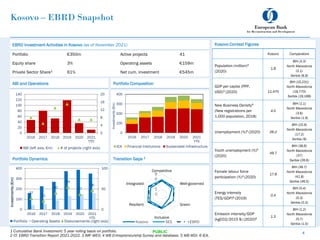
Kosovo – EBRD Snapshot
1 Cumulative Bank Investment: 5 year rolling basis on portfolio.
2 Cf. EBRD Transition Report 2021-2022. 3 IMF WEO. 4 WB Entrepreneurship Survey and database. 5 WB WDI. 6 IEA.
EBRD Investment Activities in Kosovo (as of November 2021)
Portfolio €350m Active projects 41
Equity share 3% Operating assets €159m
Private Sector Share1 61% Net cum. investment €545m
ABI and Operations Portfolio Composition
Portfolio Dynamics Transition Gaps 2
4
Kosovo Context Figures
PUBLIC
0
2
4
6
8
Competitive
Well-governed
Green
Inclusive
Resilient
Integrated
Kosovo SEE EBRD
27
21
40
54
37
46
0
50
100
0
100
200
300
400
2016 2017 2018 2019 2020 2021
YTD
Investments
(€m)
Portfolio Operating Assets Disbursements (right axis)
0
100
200
300
400
2016 2017 2018 2019 2020 2021
YTD
Investments
(€m)
ICA Financial Institutions Sustainable Infrastructure
0
4
8
12
16
20
0
20
40
60
80
100
120
140
2016 2017 2018 2019 2020 2021
YTD
ABI (left axis, €m) # of projects (right axis)
Kosovo Comparators
Population (million)3
(2020)
1.8
BIH (3.3)
North Macedonia
(2.1)
Serbia (6.9)
GDP per capita (PPP,
USD)3 (2020) 11,470
BIH (15,231)
North Macedonia
(16,770)
Serbia (19,168)
New Business Density4
(New registrations per
1,000 population, 2018)
4.0
BIH (1.1)
North Macedonia
(3.6)
Serbia (1.9)
Unemployment (%)5 (2020) 26.2
BIH (15.9)
North Macedonia
(17.2)
Serbia (9)
Youth unemployment (%)4
(2020)
49.7
BIH (36.6)
North Macedonia
(37)
Serbia (26.6)
Female labour force
participation (%)4 (2020)
17.8
BIH (36.7)
North Macedonia
(41.8)
Serbia (46.5)
Energy intensity
(TES/GDP)6 (2019)
0.4
BIH (0.4)
North Macedonia
(0.3)
Serbia (0.3)
Emission intensity/GDP
(kgCO2/2015 $) (2020)6
1.3
BIH (1.2)
North Macedonia
(0.7)
Serbia (1.0)
1. Implementation of Previous Strategy (2016-2021)
1.1. Key Transition Results Achieved during Previous Strategy
Annual Business Investment (ABI) Technical Assistance and Investment Grants
Strategic Alignment 2016-2021 Transition Impact Performance*
Priority 1: Support competitive development of the private sector through investments, enhancing internal capacity of companies and improving
business environment
Key Transition Results
• Facilitated access to finance for small businesses via credit lines exceeding €50m with 7 partner banks and
microfinance institutions, and signed first leasing line.
• Supported the enhancement of the competitiveness and efficiency of SMEs by providing 186 local consulting
and international advisory projects, together with coaching and skill transfer training.
• Supported the expansion of private sector through direct lending (€30m) to a wide range of companies enabling
Santefarm (pharmaceutical), REKS (recycling), and Kujtesa (ICT) to expand and upgrade their facilities.
• Launched Women in Business (WiB) programme in Kosovo to support women led SMEs by providing dedicated
credit lines and advisory services via TEB Bank.
• Supported the agribusiness industry via direct lending (e.g. Viva fresh and Meridian) and advisory services to
help over 40 businesses expand, upgrade their value chains, develop their standards, and analyse market
needs to accelerate exports.
• Successfully supported Central Bank of Kosovo in adopting the legal and regulatory framework for factoring and
reviewed the legal framework governing bank resolution in Kosovo, aligning with international best practice;
together with capacity building and training for stakeholders such as PFIs in each topic.
Results Indicators 2020 Since 2016
No. of ASB clients
reporting increased
productivity
30 144
Volume of MSMEs loans
disbursed
€29 m €299 m
Volume WiB loans
disbursed [€m]
€1.2 €12.9
5
Key Quantitative Results
Priority 2: 4% (11
projects) Priority 1: 10%
(19 projects)
Priority 3: 86%
(11 projects)
€70.2m
PUBLIC
* Transition impact performance reflects how likely projects are to achieve the transition impact expected of them at signing. Calculated based on active mature
(> 2 years) portfolio.
Priority 2: 33%
(19 projects)
Priority 1: 27%
(29 projects)
Priority 3: 40%
(15 projects)
€366.1m
GET share: 43%
On-track: 77.5%
(31 projects)
Off-track: 22.5%
(9 projects)
ETI: 69.1
PTI: 68.7
1. Implementation of Previous Strategy (2016-2021)
1.1. Key Transition Results Achieved during Previous Strategy
Priority 2: Enhance energy security and sustainability by financing investments in the sector, supporting sector reform, promoting energy efficiency
and renewable energy
Key Transition Results
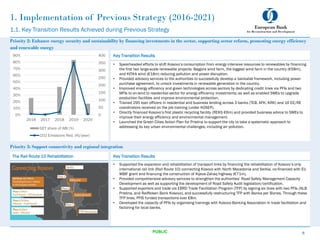
• Spearheaded efforts to shift Kosovo’s consumption from energy intensive resources to renewables by financing
the first two large-scale renewable projects: Bajgora wind farm, the biggest wind farm in the country (€58m),
and KITKA wind (€18m) reducing pollution and power disruption.
• Provided advisory services to the authorities to successfully develop a bankable framework, including power
purchase agreement, to unlock investments in renewable generation in the country.
• Improved energy efficiency and green technologies across sectors by dedicating credit lines via PFIs and two
MFIs to on-lend to residential sector for energy efficiency investments; as well as enabled SMEs to upgrade
production facilities and improve environmental protection.
• Trained 295 loan officers in residential and business lending across 3 banks (TEB, AFK, KRK) and 16 EE/RE
coordinators received on the job training (under KOSEP).
• Directly financed Kosovo’s first plastic recycling facility (REKS €6m) and provided business advice to SMEs to
improve their energy efficiency and environmental management.
• Launched the Green Cities Action Plan for Pristina to support the city to take a systematic approach to
addressing its key urban environmental challenges, including air pollution.
Priority 3: Support connectivity and regional integration
Key Transition Results
• Supported the expansion and rehabilitation of transport links by financing the rehabilitation of Kosovo’s only
international rail link (Rail Route 10) connecting Kosovo with North Macedonia and Serbia, co-financed with EU
WBIF grant and financing the construction of Kijeve-Zahaq highway (€71m).
• Provided comprehensive advisory services to strengthen the authorities’ Road Safety Management Capacity
Development as well as supporting the development of Road Safety Audit legislation/certification.
• Supported exporters and trade via EBRD Trade Facilitation Program (TFP) by signing six lines with two PFIs (NLB
Pristina, and Raiffeisen Bank Kosovo), and successfully restructuring TFP with Banka per Biznes. Through these
TFP lines, PFIS funded transactions over €8m.
• Developed the capacity of PFIs by organising trainings with Kosovo Banking Association in trade facilitation and
factoring for local banks.
The Rail Route 10 Rehabilitation
6
PUBLIC
0
50
100
150
200
250
300
350
400
0%
10%
20%
30%
40%
50%
60%
70%
80%
90%
2016 2017 2018 2019 2020
GET share of ABI (%)
CO2 Emissions Red. (Kt/year)
1. Implementation of Previous Strategy (2016-2021)
1.2. Challenges to Implementation and Key Lessons
Context for Implementation
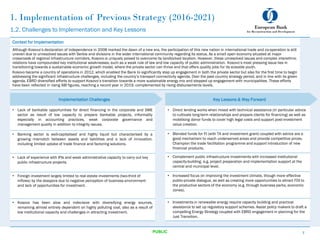
Although Kosovo’s declaration of independence in 2008 marked the dawn of a new era, the participation of this new nation in international trade and co-operation is still
uneven due to unresolved issues with Serbia and divisions in the wider international community regarding its status. As a small open economy situated at major
crossroads of regional infrastructure corridors, Kosovo is uniquely poised to overcome its landlocked location. However, these unresolved issues and complex interethnic
relations have compounded key institutional weaknesses, such as a weak rule of law and low capacity of public administration. Kosovo’s most pressing issue lies in
transitioning towards a sustainable economic growth model, where the private sector can thrive and that offers quality jobs for its sizeable youth.
Kosovo became a country of operations in 2012, which enabled the Bank to significantly step up engagement in both the private sector but also for the first time to begin
addressing the significant infrastructure challenges, including the country’s transport connectivity agenda. Over the past country strategy period, and in line with its green
agenda, EBRD diversified efforts to support Kosovo’s transition towards a more sustainable energy mix and stepped up engagement with municipalities. These efforts
have been reflected in rising ABI figures, reaching a record year in 2019, complemented by rising disbursements levels.
• Lack of bankable opportunities for direct financing in the corporate and SME
sector as result of low capacity to prepare bankable projects, informality
especially in accounting practices, weak corporate governance and
management quality in addition to integrity issues.
• Banking sector is well-capitalised and highly liquid but characterised by a
growing mismatch between assets and liabilities and a lack of innovation,
including limited uptake of trade finance and factoring solutions.
• Lack of experience with IFIs and weak administrative capacity to carry out key
public infrastructure projects.
• Foreign investment largely limited to real estate investments (two-third of
inflows) by the diaspora due to negative perception of business environment
and lack of opportunities for investment.
• Kosovo has been slow and indecisive with diversifying energy sources,
remaining almost entirely dependent on highly polluting coal, also as a result of
low institutional capacity and challenges in attracting investment.
• Direct lending works when mixed with technical assistance (in particular advice
to cultivate long-term relationships and prepare clients for financing) as well as
mobilising donor funds to cover high legal costs and support post-investment
value creation.
• Blended funds for FI (with TA and investment grant) coupled with advice are a
good mechanism to reach underserved areas and provide competitive prices.
Champion the trade facilitation programme and support introduction of new
financial products.
• Complement public infrastructure investments with increased institutional
capacity-building, e.g. project preparation and implementation support at the
central and municipal level.
• Increased focus on improving the investment climate, though more effective
public-private dialogue, as well as creating more opportunities to attract FDI to
the productive sectors of the economy (e.g. through business parks, economic
zones).
• Investments in renewable energy require capacity building and practical
assistance to set up regulatory support schemes. Assist policy makers to draft a
compelling Energy Strategy coupled with EBRD engagement in planning for the
Just Transition.
Implementation Challenges Key Lessons & Way Forward
7
PUBLIC
2. Economic Context
Economic growth was mostly consumption-driven over the past decade.
Between 2010 and 2019, growth averaged 3.6 per cent annually and was
primarily led by domestic demand, in particular private consumption, while
investment contribution was significantly smaller. Conversely, net exports
acted as a drag on growth, mostly through rising imports. On the
production side, growth was driven mostly by services, primarily trade and
tourism-related ones. Despite a fall since 2015, the unemployment rate
has remained high, especially for youth.
The economy is recovering strongly following a recession in 2020, helped
by the supportive external environment. Exports was among the main
growth drivers in the first three quarters of 2021 due to significant
increase in diaspora visits which boosted services revenues as well as
strong expansion of goods exports. Robust growth in household
consumption was supported by continuously growing remittances inflows.
From a sector perspective, recovery is driven by strong growth of domestic
trade and manufacturing. Following near stagnation in 2020, inflation was
on the rise in 2021 driven by the increased energy and food prices.
The fiscal stance was loosened. To ease the crisis, the government
adopted first an emergency package, followed by a recovery package. As a
result, public debt increased at end-2020. The expansionary fiscal policy
continued in 2021.
The economy is expected to surpass its 2019 level in 2021. Economic
growth should be mainly driven by the recovery in consumption,
investment and travel and tourism activities related to the country’s large
diaspora. Risks to the projections are balanced and mainly relate to the
potential weaknesses in the external sector and the future course of the
pandemic. Further risks lie in the area of the country’s public investment
management. A swifter recovery would be helped by the acceleration of
the hitherto-slow implementation of key infrastructure projects.
2.1. Macroeconomic Context and Outlook for Strategy Period
Source: National authorities, World Bank, IMF
8
PUBLIC
Kosovo - Main Macroeconomic Indicators
2017 2018 2019 2020
GDP growth
(% y-o-y)
4.8 3.4 4.8 -5.3
CPI inflation
(% avg.)
1.5 1.1 2.7 0.2
Government balance
(% of GDP)
-1.4 -2.8 -2.9 -7.8
Current account balance
(% of GDP)
-5.7 -7.8 -5.8 -6.7
Net FDI (% of GDP)
[minus indicates inflow]
-3.3 -3.4 -2.7 -4.2
External debt
(% of GDP)
32.9 30.5 31.2 37.2
Gross reserves
(% of GDP)
10.8 11.5 12.2 13.3
General government gross debt
(% of GDP)
16.2 17.0 17.6 24.1
Unemployment rate
(%)
30.3 29.4 26.0 26.2
Nominal GDP ($bn) 7.2 7.9 8.0 7.8
2. Economic Context
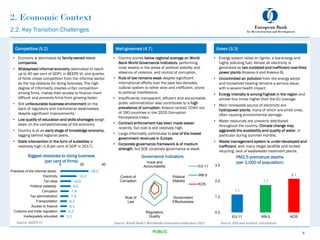
• Economy is dominated by family-owned micro
companies.
• Widespread informal economy (estimated to reach
up to 40 per cent of GDP): in BEEPS VI, one quarter
of firms chose competition from the informal sector
as the top obstacle for doing business. The high
degree of informality creates unfair competition
among firms, makes their access to finance more
difficult and prevents firms from growing faster.
• Still unfavourable business environment on the
back of regulatory and institutional weaknesses,
despite significant improvements.
• Low quality of education and skills shortages weigh
down on the competitiveness of the economy.
• Country is at an early stage of knowledge economy,
lagging behind regional peers.
• State intervention in the form of subsidies is
relatively high (1.8 per cent of GDP in 2017).
• Country scores below regional average on World
Bank World Governance Indicators, performing
most weakly in the areas of political stability and
absence of violence, and control of corruption.
• Rule of law remains weak despite significant
international efforts over the past two decades.
Judicial system is rather slow and inefficient, prone
to political interference.
• Insufficiently transparent, efficient and accountable
public administration also contributes to a high
prevalence of corruption. Kosovo ranked 104th out
of 180 countries in the 2020 Corruption
Perceptions Index.
• Contract enforcement has been made easier
recently, but cost is still relatively high.
• Large informality contributes to one of the lowest
government revenues in Europe.
• Corporate governance framework is of medium
strength, but SOE corporate governance is weak.
2.2. Key Transition Challenges
• Energy system relies on lignite, a low-energy and
highly polluting fuel. Almost all electricity is
generated by two outdated and inefficient coal-fired
power plants (Kosovo A and Kosovo B).
• Uncontrolled air pollution from the energy sector
and household heating remains a serious issue,
with a severe health impact.
• Energy intensity is among highest in the region and
almost four times higher than the EU average.
• Main renewable source of electricity are
hydropower plants, many of which are small ones,
often causing environmental damage.
• Water resources are unevenly distributed
throughout the country. Climate change may
aggravate the availability and quality of water, in
particular during summer months.
• Waste management system is under-developed and
inefficient, with many illegal landfills and limited
recycling; lack of wastewater treatment plants.
Competitive (5.2) Well-governed (4.7) Green (3.3)
9
PUBLIC
Governance indicators PM2.5 premature deaths
(per 1,000 of population)
Biggest obstacles to doing business
(per cent of firms)
26.0
15.0
10.0
9.5
7.9
7.6
6.2
6.1
5.2
3.3
0 20 40
Practices of the informal sector
Electricity
Tax rates
Political instability
Corruption
Tax administration
Transportation
Access to finance
Customs and trade regulation
Inadequately educated…
Source: BEEPS VI Source: World Bank's Worldwide Governance Indicators 2021
1.1
1.7
2.1
0.0
1.0
2.0
3.0
EU-11 WB-5 KOS
Source: EEA and authors' calculations
Voice and
Accountability
Political
Stability
Government
Effectiveness
Regulatory
Quality
Rule of
Law
Control of
Corruption
EU-11
WB-5
KOS
2. Economic Context
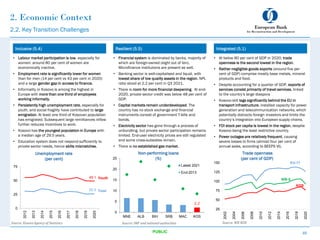
• Labour market participation is low, especially for
women: around 80 per cent of women are
economically inactive.
• Employment rate is significantly lower for women
than for men (14 per cent vs 43 per cent in 2020)
and a large gender gap in access to finance.
• Informality in Kosovo is among the highest in
Europe with more than one third of employees
working informally.
• Persistently high unemployment rate, especially for
youth, and social fragility have contributed to large
emigration. At least one third of Kosovan population
has emigrated. Subsequent large remittances inflow
further reduces incentives to work.
• Kosovo has the youngest population in Europe with
a median age of 29.5 years.
• Education system does not respond sufficiently to
private sector needs, hence skills mismatches.
• Financial system is dominated by banks, majority of
which are foreign-owned (eight out of ten).
Microfinance institutions are present as well.
• Banking sector is well-capitalised and liquid, with
lowest share of low quality assets in the region. NPL
ratio stood at 2.2 per cent in Q3 2021.
• There is room for more financial deepening. At end-
2020, private sector credit was below 48 per cent of
GDP.
• Capital markets remain underdeveloped. The
country has no stock exchange and financial
instruments consist of government T-bills and
bonds.
• Electricity sector has gone through a process of
unbundling, but private sector participation remains
limited. End-user electricity prices are still regulated
and some cross-subsidies remain.
• There is no established gas market.
2.2. Key Transition Challenges
• At below 80 per cent of GDP in 2020, trade
openness is the second lowest in the region.
• Rather negligible goods exports (around five per
cent of GDP) comprise mostly base metals, mineral
products and food.
• Despite accounting for a quarter of GDP, exports of
services consist primarily of travel services, linked
to the country’s large diaspora
• Kosovo still lags significantly behind the EU in
transport infrastructure, installed capacity for power
generation and telecommunication networks, which
potentially distracts foreign investors and limits the
country’s integration into European supply chains.
• FDI stock per capita is lowest in the region, despite
Kosovo being the least restrictive country.
• Power outages are relatively frequent, causing
severe losses to firms (almost four per cent of
annual sales, according to BEEPS VI).
Inclusive (5.4) Resilient (5.5) Integrated (5.1)
10
PUBLIC
Unemployment rate
(per cent)
Non-performing loans
(%)
Trade openness
(per cent of GDP)
Source: Kosovo Agency of Statistics Source: WB WDI
Source: IMF and national authorities
25
50
75
100
125
150
2002
2004
2006
2008
2010
2012
2014
2016
2018
2020
KOS
WB-5
EU-11
49.1
25.9
0
25
50
75
2012
2013
2014
2015
2016
2017
2018
2019
2020
Youth
Total
2.2
0
5
10
15
20
25
MNE ALB BIH SRB MAC KOS
Latest 2021
End-2013
3. Government Priorities and Stakeholder Engagement
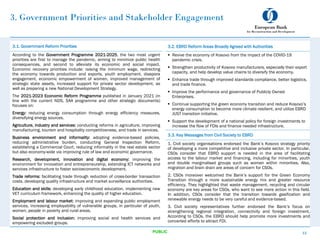
3.1. Government Reform Priorities
According to the Government Programme 2021-2025, the two most urgent
priorities are first to manage the pandemic, aiming to minimize public health
consequences, and second to alleviate its economic and social impact.
Economic recovery priorities include: raising the minimum wage, redirecting
the economy towards production and exports, youth employment, diaspora
engagement, economic empowerment of women, improved management of
strategic state assets, increased support for private sector development, as
well as preparing a new National Development Strategy.
The 2021-2023 Economic Reform Programme published in January 2021 (in
line with the current NDS, SAA programme and other strategic documents)
focuses on:
Energy: reducing energy consumption through energy efficiency measures,
diversifying energy sources.
Agriculture, industry and services: conducting reforms in agriculture, improving
manufacturing, tourism and hospitality competitiveness, and trade in services.
Business environment and informality: adopting evidence-based policies,
reducing administrative burden, conducting General Inspection Reform,
establishing a Commercial Court, reducing informality in the real estate sector
but also economy-wide via improving rule of law and economic governance.
Research, development, innovation and digital economy: improving the
environment for innovation and entrepreneurship, extending ICT networks and
services infrastructure to foster socioeconomic development.
Trade reforms: facilitating trade through reduction of cross-border transaction
costs, developing quality infrastructure and market surveillance authorities.
Education and skills: developing early childhood education, implementing new
VET curriculum framework, enhancing the quality of higher education.
Employment and labour market: improving and expanding public employment
services, increasing employability of vulnerable groups, in particular of youth,
women, people in poverty and rural areas.
Social protection and inclusion: improving social and health services and
empowering excluded groups.
3.2. EBRD Reform Areas Broadly Agreed with Authorities
 Revive the economy of Kosovo from the impact of the COVID-19
pandemic crisis.
 Strengthen productivity of Kosovo manufacturers, especially their export
capacity, and help develop value chains to diversify the economy.
 Enhance trade through improved standards compliance, better logistics,
and trade finance.
 Improve the performance and governance of Publicly Owned
Enterprises.
 Continue supporting the green economy transition and reduce Kosovo’s
energy consumption to become more climate resilient, and utilize EBRD
JUST transition initiative.
 Support the development of a national policy for foreign investments to
increase the flow of FDIs and finance needed infrastructure.
3.3. Key Messages from Civil Society to EBRD
1. Civil society organisations endorsed the Bank’s Kosovo strategy priority
of developing a more competitive and inclusive private sector. In particular,
CSOs consider that EBRD support is needed in the area of facilitating
access to the labour market and financing, including for minorities, youth
and double marginalised groups such as women within minorities. Also,
migration and brain drain are areas of concern for CSOs.
2. CSOs moreover welcomed the Bank’s support for the Green Economy
Transition through a more sustainable energy mix and greater resource
efficiency. They highlighted that waste management, recycling and circular
economy are key areas for CSOs, who want to see more action in this field.
In addition, CSOs consider that the transition towards gasification and
renewable energy needs to be very careful and evidence-based.
3. Civil society representatives further endorsed the Bank’s focus on
strengthening regional integration, connectivity and foreign investment.
According to CSOs, the EBRD should help promote more investments and
concerted efforts to attract FDI.
11
PUBLIC
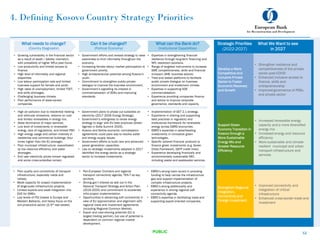
4. Defining Kosovo Country Strategy Priorities
What needs to change?
(Country Diagnostic)
Can it be changed?
(Political Economy)
What can the Bank do?
(Institutional Capabilities)
• Growing vulnerability in the financial sector
as a result of asset / liability mismatch,
with probability of higher NPLs post Covid.
• Low productivity and limited access to
finance.
• High level of informality and regional
disparities.
• Low labour participation rate and limited
business support for female and youth.
• High rates of unemployment, limited TVET,
and skills shortages.
• Challenging business climate.
• Poor performance of state-owned
companies.
• Government efforts and revised strategy to raise
awareness to limit informality throughout the
economy.
• Increasing female labour market participation is
government priority.
• High entrepreneurial potential among Kosovo’s
youth.
• Commitment to strengthen public-private
dialogue to improve the business environment.
• Government’s signalling its interest in
commercialization of SOEs and improving
standards.
• Expertise in strengthening financial
resilience through long-term financing and
NPL resolution solutions.
• Range of targeted instruments to increase
SME competitiveness, skills and financial
inclusion (WiB, business advice).
• Tried and tested platforms to facilitate
public private dialogue on business
environment and investment climate.
• Expertise in supporting SOE
commercialisation.
• Experience providing companies finance
and advice to improve corporate
governance, standards and capacity.
• High air pollution due to residential heating
and vehicular emissions, reliance on coal
and limited renewables in energy mix.
• State dominance of major services.
• Low level of investments in renewable
energy, lack of regulations, and limited PSP.
• High energy usage and carbon intensity in
residential and commercial buildings (four
times higher than the EU average).
• Poor municipal infrastructure exacerbated
by low resource efficiency and water
shortages.
• End user electricity prices remain regulated
and some cross-subsidies remain.
• Government plans to phase out subsidies on
electricity (2017-2026 Energy Strategy).
• Government’s willingness to revise energy
strategy to align with EU best practices (Green
Agenda in Sofia Summit 2020).
• Kosovo and Serbia economic normalisation
agreements could pave way to resolve water
and energy supply issues.
• Government efforts to build new and advanced
power generation capacities.
• Law on strategic investments adopted in 2017
identified the energy sector as a strategic
sector to increase investments.
• Implementation of GET 2.1 strategy.
• Experience in sharing and supporting
best practices in regulatory and
institutional framework for renewable
energy across EBRD economies.
• EBRD’s expertise in spearheading
investments in innovative green
technologies.
• Specific tailored financial products to
finance green investments (e.g. Green
Cities Framework, GEFF credit lines).
• Experience developing financially and
environmentally sustainable MEI,
including waste and wastewater services.
• Poor quality and connectivity of transport
infrastructure, especially roads and
railway.
• Weak capacity for project implementation
of large-scale infrastructure projects.
• Limited exports and weak integration into
GVC for SMEs.
• Low levels of FDI (lowest in Europe and
Western Balkans), and heavy focus on the
non-productive sector (2/3rd real estate).
• Pan-European Corridors and regional
transport connectivity agenda, TEN-T as key
anchors.
• Strong gov’t interest as laid out in the
National Transport Strategy and Action Plan
(2015-2025) and commitment to accelerate
infra project implementation.
• Opportunities in advancing soft connectivity in
view of EU approximation and alignment with
regional trade and investment agreements
(including Regional Common Market).
• Export and near-shoring potential (EU is
largest trading partner), but use of potential is
dependent on common regional market
development.
• EBRD’s strong track record in providing
funding to help narrow the infrastructure
gap and support implementation of
complex infrastructure projects.
• EBRD’s strong additionality and
experience in driving regional soft
connectivity agenda.
• EBRD’s expertise in facilitating trade and
supporting export-oriented companies.
Strategic Priorities
(2022-2027)
What We Want to see
in 2027
Develop a More
Competitive and
Inclusive Private
Sector to Foster
Economic Recovery
and Growth
• Strengthen resilience and
competitiveness of the private
sector post-COVID
• Enhanced inclusive access to
finance, skills and
entrepreneurship
• Improved governance of POEs
and private sector
Support Green
Economy Transition in
Kosovo through a
More Sustainable
Energy Mix and
Greater Resource
Efficiency
• Increased renewable energy
capacity and a more diversified
energy mix
• Increased energy and resource
efficiency
• More sustainable and climate-
resilient municipal and urban
transport infrastructure and
services
Strengthen Regional
Integration,
Connectivity and
Foreign Investment
• Improved connectivity and
integration of critical
infrastructure
• Enhanced cross-border trade and
investment
12
PUBLIC
5. Activities and Results Framework
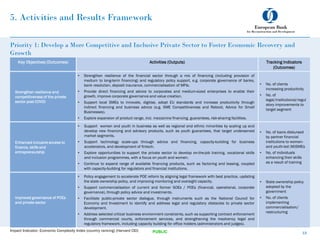
Priority 1: Develop a More Competitive and Inclusive Private Sector to Foster Economic Recovery and
Growth
Key Objectives (Outcomes) Activities (Outputs) Tracking Indicators
(Outcomes)
Strengthen resilience and
competitiveness of the private
sector post-COVID
• Strengthen resilience of the financial sector through a mix of financing (including provision of
medium to long-term financing) and regulatory policy support, e.g. corporate governance of banks,
bank resolution, deposit insurance, commercialisation of MFIs.
• Provide direct financing and advice to corporates and medium-sized enterprises to enable their
growth, improve corporate governance and value creation.
• Support local SMEs to innovate, digitise, adopt EU standards and increase productivity through
indirect financing and business advice (e.g. SME Competitiveness and Reboot, Advice for Small
Businesses).
• Explore expansion of product range, incl. mezzanine financing, guarantees, risk-sharing facilities.
• No. of clients
increasing productivity
• No. of
legal/institutional/regul
atory improvements to
target segment
Enhanced inclusive access to
finance, skills and
entrepreneurship
• Support women and youth in business as well as regional and ethnic minorities by scaling up and
develop new financing and advisory products, such as youth guarantees, that target underserved
market segments.
• Support technology scale-ups through advice and financing, capacity-building for business
accelerators, and development of fintech.
• Explore opportunities to support the private sector to develop on-the-job training, vocational skills
and inclusion programmes, with a focus on youth and women.
• Continue to expand range of available financing products, such as factoring and leasing, coupled
with capacity-building for regulators and financial institutions.
• No. of loans disbursed
by partner financial
institutions to women-
and youth-led (M)SMEs
• No. of individuals
enhancing their skills
as a result of training
Improved governance of POEs
and private sector
• Policy engagement to accelerate POE reform by aligning legal framework with best practice, updating
the state ownership policy, and improving monitoring and oversight capacity.
• Support commercialisation of current and former SOEs / POEs (financial, operational, corporate
governance), through policy advice and investments.
• Facilitate public-private sector dialogue, through instruments such as the National Council for
Economy and Investment to identify and address legal and regulatory obstacles to private sector
development.
• Address selected critical business environment constraints, such as supporting contract enforcement
through commercial courts, enforcement services, and strengthening the insolvency legal and
regulatory framework, including capacity building for office holders (administrators and judges).
• State ownership policy
adopted by the
government
• No. of clients
implementing
commercialisation/
restructuring
13
PUBLIC
Impact Indicator: Economic Complexity Index (country ranking) (Harvard CID)
5. Activities and Results Framework
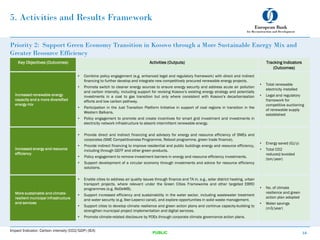
Priority 2: Support Green Economy Transition in Kosovo through a More Sustainable Energy Mix and
Greater Resource Efficiency
Key Objectives (Outcomes) Activities (Outputs) Tracking Indicators
(Outcomes)
Increased renewable energy
capacity and a more diversified
energy mix
• Combine policy engagement (e.g. enhanced legal and regulatory framework) with direct and indirect
financing to further develop and integrate new competitively procured renewable energy projects.
• Promote switch to cleaner energy sources to ensure energy security and address acute air pollution
and carbon intensity, including support for revising Kosovo’s existing energy strategy and potentially
investments in a coal to gas transition but only where consistent with Kosovo’s decarbonisation
efforts and low carbon pathway.
• Participation in the Just Transition Platform Initiative in support of coal regions in transition in the
Western Balkans.
• Policy engagement to promote and create incentives for smart grid investment and investments in
electricity network infrastructure to absorb intermittent renewable energy.
• Total renewable
electricity installed
• Legal and regulatory
framework for
competitive auctioning
of renewable supply
established
Increased energy and resource
efficiency
• Provide direct and indirect financing and advisory for energy and resource efficiency of SMEs and
corporates (SME Competitiveness Programme, Reboot programme, green trade finance).
• Provide indirect financing to improve residential and public buildings energy and resource efficiency,
including through GEFF and other green products.
• Policy engagement to remove investment barriers in energy and resource efficiency investments.
• Support development of a circular economy through investments and advice for resource efficiency
solutions.
• Energy saved (GJ/y)
• Total CO2
reduced/avoided
(ton/year)
More sustainable and climate-
resilient municipal infrastructure
and services
• Enable cities to address air quality issues through finance and TA in, e.g., solar district heating, urban
transport projects, where relevant under the Green Cities Frameworks and other targeted EBRD
programmes (e.g. ReDeWB).
• Support increased efficiency and sustainability in the water sector, including wastewater treatment
and water security (e.g. Iber-Lepenci canal), and explore opportunities in solid waste management.
• Support cities to develop climate resilience and green action plans and continue capacity-building to
strengthen municipal project implementation and digital services.
• Promote climate-related disclosure by POEs through corporate climate governance action plans.
• No. of climate
resilience and green
action plan adopted
• Water savings
(m3/year)
14
PUBLIC
Impact Indicator: Carbon intensity (CO2/GDP) (IEA)
5. Activities and Results Framework
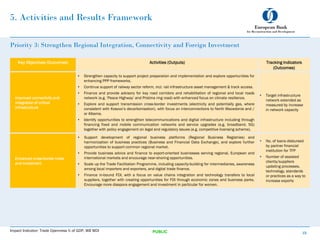
Priority 3: Strengthen Regional Integration, Connectivity and Foreign Investment
Key Objectives (Outcomes) Activities (Outputs) Tracking Indicators
(Outcomes)
Improved connectivity and
integration of critical
infrastructure
• Strengthen capacity to support project preparation and implementation and explore opportunities for
enhancing PPP frameworks.
• Continue support of railway sector reform, incl. rail infrastructure asset management & track access.
• Finance and provide advisory for key road corridors and rehabilitation of regional and local roads
network (e.g. ‘Peace Highway’ and Pristina ring road) with enhanced focus on climate resilience.
• Explore and support transmission cross-border investments (electricity and potentially gas, where
consistent with Kosovo’s decarbonisation), with focus on interconnections to North Macedonia and /
or Albania.
• Identify opportunities to strengthen telecommunications and digital infrastructure including through
financing fixed and mobile communication networks and service upgrades (e.g. broadband, 5G)
together with policy engagement on legal and regulatory issues (e.g. competitive licensing scheme).
• Target infrastructure
network extended as
measured by increase
in network capacity
Enhanced cross-border trade
and investment
• Support development of regional business platforms (Regional Business Registries) and
harmonization of business practices (Business and Financial Data Exchange), and explore further
opportunities to support common regional market.
• Provide business advice and finance to export-oriented businesses serving regional, European and
international markets and encourage near-shoring opportunities.
• Scale up the Trade Facilitation Programme, including capacity-building for intermediaries, awareness
among local importers and exporters, and digital trade finance.
• Finance in-bound FDI, with a focus on value chains integration and technology transfers to local
suppliers, together with creating opportunities for FDI through economic zones and business parks.
Encourage more diaspora engagement and investment in particular for women.
• No. of loans disbursed
by partner financial
institution for TFP
• Number of assisted
clients/suppliers
updating processes,
technology, standards
or practices as a way to
increase exports
15
PUBLIC
Impact Indicator: Trade Openness % of GDP, WB WDI
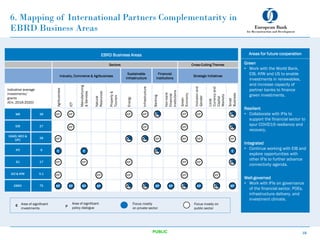
6. Mapping of International Partners Complementarity in
EBRD Business Areas
EBRD Business Areas
Sectors Cross-Cutting Themes
Industry, Commerce & Agribusiness
Sustainable
Infrastructure
Financial
Institutions
Strategic Initiatives
Indicative average
investments/
grants
(€m, 2016-2020)
Agribusiness
ICT
Manufacturing
&
Services
Natural
Resources
Property
&
Tourism
Energy
Infrastructure
Banking
Non-bank
Financial
Institutions
Green
Economy
Inclusion
and
Gender
Local
Currency
and
Capital
Markets
Small
Business
WB 39
EIB 27
USAID, MCC &
DFC
26
IFC 6
EU 17
GIZ & KfW 0.1
EBRD 75
Focus mostly
on private sector
€ P
Area of significant
policy dialogue
Area of significant
investments
Focus mostly on
public sector
16
PUBLIC
€P
€P €P
€P
€P €P
€P
€P
€
€P
€P
€P €P
€P
€P
€P €P
€P
€P €P
€P €P
€P €P €P
€ €
€P
€P
€P
€P €P
€P €P
€P
€P
€P €P
€P €P
€P €P
Areas for future cooperation
Green
• Work with the World Bank,
EIB, KfW and US to enable
investments in renewables,
and increase capacity of
partner banks to finance
green investments.
Resilient
• Collaborate with IFIs to
support the financial sector to
spur COVID19 resilience and
recovery.
Integrated
• Continue working with EIB and
explore opportunities with
other IFIs to further advance
connectivity agenda.
Well-governed
• Work with IFIs on governance
of the financial sector, POEs,
infrastructure delivery, and
investment climate.
€P €P
€P €P
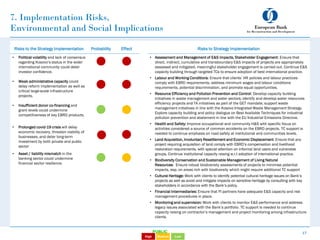
7. Implementation Risks,
Environmental and Social Implications
Risks to the Strategy Implementation Probability Effect
• Political volatility and lack of consensus
regarding Kosovo’s status in the wider
international community could deter
investor confidence.
• Weak administrative capacity could
delay reform implementation as well as
critical large-scale infrastructure
projects.
• Insufficient donor co-financing and
grant levels could undermine
competitiveness of key EBRD products.
• Prolonged covid-19 crisis will delay
economic recovery, threaten viability of
businesses, and deter long-term
investment by both private and public
sector
• Asset / liability mismatch in the
banking sector could undermine
financial sector resilience.
Risks to Strategy Implementation
• Assessment and Management of E&S Impacts, Stakeholder Engagement: Ensure that
direct, indirect, cumulative and transboundary E&S impacts of projects are appropriately
assessed and mitigated, meaningful stakeholder engagement is carried out. Continue E&S
capacity building through targeted TCs to ensure adoption of best international practice.
• Labour and Working Conditions: Ensure that clients’ HR policies and labour practices
comply with EBRD requirements, address minimum wages and labour conditions
requirements, potential discrimination, and promote equal opportunities.
• Resource Efficiency and Pollution Prevention and Control: Develop capacity building
initiatives in waste management and water sectors; identify and develop water resources
efficiency projects and TA initiatives as part of the GET mandate; support waste
management initiatives in line with the Kosovo Integrated Waste Management Strategy.
Explore capacity building and policy dialogue on Best Available Techniques for industrial
pollution prevention and abatement in line with the EU Industrial Emissions Directive.
• Health and Safety: Improve occupational and community H&S with specific focus on
activities considered a source of common accidents on the EBRD projects. TC support is
needed to continue emphasis on road safety at institutional and communities levels.
• Land Acquisition, Involuntary Resettlement and Economic Displacement: Ensure that any
project requiring acquisition of land comply with EBRD’s compensation and livelihood
restoration requirements, with special attention on informal land users and vulnerable
groups. Continue institutional capacity raising w.r.t adoption of international practice.
• Biodiversity Conservation and Sustainable Management of Living Natural
Resources: Ensure robust biodiversity assessments of projects to minimise potential
impacts, esp. on areas rich with biodiversity which might require additional TC support
• Cultural Heritage: Work with clients to identify potential cultural heritage issues on Bank’s
projects as well as avoid and mitigate impacts on sensitive heritage by consulting with key
stakeholders in accordance with the Bank’s policy.
• Financial Intermediaries: Ensure that FI partners have adequate E&S capacity and risk
management procedures in place.
• Monitoring and supervision: Work with clients to monitor E&S performance and address
legacy issues associated with the Bank’s portfolio. TC support is needed to continue
capacity raising on contractor’s management and project monitoring among infrastructure
clients.
17
PUBLIC
High Medium Low
18
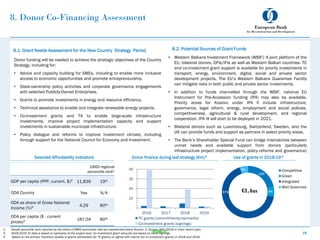
8.1. Grant Needs Assessment for the New Country Strategy Period 8.2. Potential Sources of Grant Funds
Donor funding will be needed to achieve the strategic objectives of the Country
Strategy, including for:
• Advice and capacity building for SMEs, including to enable more inclusive
access to economic opportunities and promote entrepreneurship.
• State-ownership policy activities and corporate governance engagements
with selected Publicly-Owned Enterprises.
• Grants to promote investments in energy and resource efficiency.
• Technical assistance to enable and integrate renewable energy projects.
• Co-investment grants and TA to enable large-scale infrastructure
investments, improve project implementation capacity and support
investments in sustainable municipal infrastructure.
• Policy dialogue and reforms to improve investment climate, including
through support for the National Council for Economy and Investment.
• Western Balkans Investment Framework (WBIF): A joint platform of the
EU, bilateral donors, DFIs/IFIs as well as Western Balkan countries. TC
and co-investment grant support is available for priority investments in
transport, energy, environment, digital, social and private sector
development projects. The EU’s Western Balkans Guarantee Facility
can mitigate risks in both public and private sector investments.
• In addition to funds channelled through the WBIF, national EU
Instrument for Pre-Accession funding (IPA) may also be available.
Priority areas for Kosovo under IPA II include infrastructure,
governance, legal reform, energy, employment and social policies,
competitiveness, agricultural & rural development, and regional
cooperation. IPA III will start to be deployed in 2021.
• Bilateral donors such as Luxembourg, Switzerland, Sweden, and the
UK can provide funds and support as partners in select priority areas.
• The Bank’s Shareholder Special Fund can bridge mismatches between
unmet needs and available support from donors (particularly
infrastructure project implementation, policy reforms and governance)
areas).
EBRD regional
percentile rank1
GDP per capita (PPP, current. $)2 11,839 19th
ODA Country Yes N/A
ODA as share of Gross National
Income (%)3 4.29 80th
ODA per capita ($ - current
prices)3 187.04 80th
Selected Affordability Indicators Donor finance during last strategy (€m)4 Use of grants in 2018-195
1. Simple percentile rank reported as the share of EBRD economies that are represented below Kosovo. 2. Source: WDI (2019 or most recent year)
3. 2016-2019 TC data is based on earmarks at the project level. Co-investment grant amounts are based on client signings.
4. Based on the primary Transition Quality of grants earmarked (for TC grants) or signed with clients (for co-investment grants) in 2018 and 2019.
8. Donor Co-Financing Assessment
-
10
20
30
40
2016 2017 2018 2019
TC grants (commitments/earmarks)
Co-investment grants (signings)
Competitive
Green
Integrated
Well Governed
67%
22%
6%
5%
€1.4m
PUBLIC
Annexes
PUBLIC
Annex 1 – Political Assessment in the Context of Article 1
Kosovo’s commitment to and application of the political principles stated in
Article 1 of the Agreement Establishing the Bank has continued since the
adoption of the previous country strategy, in line with its efforts towards
implementation of the comprehensive EU reform agenda. At the same time
many challenges remain. Kosovo shares many key institutional weaknesses
common to the Western Balkans countries. They are additionally aggravated
by complex inter-ethnic relations within the country and by continuing political
controversy in the wider international community regarding Kosovo’s status.
Kosovo proclaimed independence in 2008. The question of legality of this act
was considered by the International Court of Justice (ICJ), to which it had been
referred by the United Nations General Assembly (UNGA). The ICJ issued its
decision on 22 July 2010, ruling that the Declaration of Independence “did not
violate any applicable rule of international law”.1 Although this decision
constituted an Advisory Opinion, which, as such, is not binding for any country,
it was reinforced in September 2010 by the Resolution of the UNGA, which
“acknowledged the contents of the decision of the ICJ”. While many countries
do not recognise Kosovo, and this will remain a political matter for each
member of the international community to decide upon, the number of
bilateral recognitions as of 2021 exceeds 100. Continuing political
controversy, stemming from different positions in the wider international
community regarding Kosovo’s status, affects assessments of the situation in
Kosovo produced by different international actors.
The constitutional and legislative framework for a pluralistic parliamentary
democracy, the separation of powers and checks and balances in the political
system, the guarantees for fundamental rights and protection of minorities,
and for the meaningful role of civil society are in place in Kosovo and are
largely in line with international and European standards.
Kosovo’s key weaknesses, which are common to the Western Balkans
countries, include weak rule of law, the relatively low capacity of public
administration, especially at the local level, and uneven culture of political
dialogue and consensus building. The progress in
20
PUBLIC
1. Accordance with International Law of the Unilateral Declaration of Independence in Respect of Kosovo. Advisory Opinion, I.C.J. Reports 2010.
these areas has been slow.
Efforts towards EU approximation remain the main external anchor for
comprehensive reforms. The EU has repeatedly stressed that Kosovo
shares the European perspective of the rest of the Western Balkans.
Kosovo signed the Stabilisation and Association Agreement with the EU in
October 2015. It was approved by the European Parliament on 21 January
2016 and formally entered into force on 1 April 2016.
Kosovo and Serbia have engaged in an EU-facilitated Dialogue aimed at
normalising their relations, which remains important in order for both to
move forward on their respective European paths. Despite a number of
agreements concluded as part of this dialogue, there has so far been little
progress in the practical implementation. For most part of the previous
strategy period there was, for various reasons, a stalemate in the high-level
part of the Dialogue.
Free Elections and Representative Government
Free, fair and competitive elections
The existing legal framework, which is largely based on two pieces of
legislation (Constitution of 2008 and the Law on General Elections adopted
the same year), enables democratic elections, provided the authorities and
political parties exercise sufficient will to implement it. Since 2010, there
have been several unsuccessful attempts to change the electoral system,
which failed due to lack of consensus among the key stakeholders.
Elections in Kosovo generally allow for competition between different
political parties and free choice for voters. The candidates are able to
campaign freely. The Central Election Commission (CEC) is an independent
permanent body, appointed by the parliament for a four-year mandate, and
operates in an efficient and transparent manner. The Electoral Code
provides for domestic and international election observation at all levels of
election administration.
The last general elections, which took place in February 2021, were the
Annex 1 – Political Assessment in the Context of Article 1
fifth since the declaration of independence and the fourth held throughout the
country, including in the majority Serb-populated northern Kosovo. All of these
elections were held early. The pandemic did not make it possible to organise a
full-fledged election observation mission (EOM) by EU as in the past, but the
shared view of expert election teams deployed on the ground was that the
elections, particularly the election day, were orderly and peaceful, although
some long-standing issues remain. Previous reports by EOM assessed the
elections as generally well organised and administered, transparent, and with
no major incidents or violations, with vibrant and competitive campaign,
except for Kosovo Serb majority areas, where there is lack of competition.
While voting unfolds reasonably well, the credibility of the post-election
process is often negatively affected by a lack of timely decisions by CEC and by
the inefficient handling of complaints and delayed certification.
Among other long-standing problems of Kosovan elections is the credibility of
the voter list, which includes more voters than the country’s estimated
resident population. Another long-standing issue is procedures for out-of-
country voting. Previous reports by EOM noted also the tendency to call early
elections at extremely short notice and shorten the official electoral campaign.
The reports by the EOM recommended as priority improving the accuracy of
the voter list, providing a minimum of two months’ notice for elections, and
include clear provisions on challenging results at all levels. 2
Separation of powers and effective checks and balances
The constitutional and legislative framework for a parliamentary democracy,
underpinned by the separation of powers and checks and balances in the
political system, independent legislature and procedures of legislative
oversight in prescribed domains of decision-making, is in place in Kosovo and
largely in line with international and European standards. The Constitutional
Court is independent and is playing an increasingly important role. Over the
last years, it has issued a number of decisions with strong political impact.
The single-chamber parliament, which is the primary legislative institution
directly elected for a four-year mandate, is composed of 120 seats, including
21
PUBLIC
20 seats reserved for political entities representing ethnic minorities. The
scope of powers of the legislature to hold the government to account and to
exercise parliamentary oversight is largely in line with international
standards, although in practice the oversight of the executive branch of
power remains weak. There is space for improvement in strengthening
supervision of independent institutions, regulatory authorities and
agencies, with suitable reporting and accountability mechanism. The overall
efficiency of the work of the parliament needs improvement as it is
undermined by frequent lack of quorum and by lack of constructive political
dialogue.
The main remaining challenges include a relatively weak professional
expertise at the local level, budgetary constraints and overall absorption
capacity.
Effective power to govern of elected officials
Kosovo has established institutional, legal, and financial arrangements for
elected officials to exercise effective power to govern and they are not
constrained by any non-democratic veto powers or other undue influences.
Kosovo stands out in the region due to significant international presence,
although this presence nowadays plays a limited role. The UN Security
Council Resolution 1244 (UNSCR 1244), which in 1999 established the
United Nations Interim Administration Mission in Kosovo (UNMIK), is still
formally in force and serves as the basis for the status-neutral international
presence both of the UNMIK and the European Union Rule of Law Mission
(EULEX).
EULEX, established in 2008, was the largest civilian mission ever launched
under the European Security and Defence Policy. Its aim is to assist the
Kosovan authorities in the area of the rule of law, specifically in the police,
judiciary and customs. EULEX’ responsibilities have been gradually reduced,
as well as its staff (from more than 3,000 in 2008 to less than 500 in
2020). Its current mandate expires in June 2023. Kosovo has also NATO-
led foreign military presence - Kosovo Force (KFOR) - which, in accordance
with UNSCR 1244, has been leading a peace support operation in Kosovo
2. EU Election Observation Mission. Early legislative elections in Kosovo 6 October 2019. Final Report.
Annex 1 – Political Assessment in the Context of Article 1
since June 1999. Today, a significantly reduced KFOR (about 5,000 troops)
continues to contribute towards maintaining a safe and secure environment
and freedom of movement for all citizens.
Civil Society, Media and Participation
Scale and independence of civil society
There is a satisfactory legal framework for civil society organisations (CSOs). As
elsewhere in the Western Balkans, CSOs remain heavily dependent on foreign
funding and problems with funding are the greatest obstacle for their
functioning. Many CSOs are project-based, and relatively narrowly specialised.
However, in contrast to many other Western Balkan countries, CSOs in general
are spread evenly throughout the country, including the rural areas. In April
2019, the Assembly adopted a new Law on Freedom of Association in Non-
Governmental Organisations, which improved the legal protection of CSOs by
aligning it to the best international standards. The Government Strategy for
Cooperation with Civil Society for 2019-2023 was adopted through a broadly
participatory process, with a focus on improving participation in community-
based CSOs and securing the financial sustainability of the sector. The
assessment of the implementation of the previous country strategy
demonstrated some progress achieved in the area of public consultations and
transparency in public funding.
In 2018, an annual report on the government’s consultations was released for
the first time. Public consultations by the governments are improving, including
through an increased use of online consultations. While many public bodies
have for the first time conducted open calls and consultations in accordance
with legal requirements, capacity remains uneven.
Independence and pluralism of media operating without censorship
Pluralism in the media, which operates broadly freely and without censorship,
and access to public information have increased in recent years. The legal
framework is largely in place and in line with international standards.
Broadcast media are regulated through by-laws issued by the audio-visual
22
PUBLIC
regulatory body, the Independent Media Commission. The Press Council of
Kosovo, which is a self-regulatory body for the print media, helps to
promote freedom of speech, the right of citizens to be duly informed and
the respect for the Press Code of Kosovo. At the same time, more needs to
be done to ensure that freedom of expression and media, which are
guaranteed by the Constitution, are respected in practice, since there is a
widespread perception among Kosovan citizens that media is over-
politicised and are under pressure from political parties. Media ownership
structures remain unclear. Although media are obliged to submit ownership
reports on an annual basis, if they are not registered as companies and do
not pay taxes, they are not compelled to disclose their ownership to
anyone.
The main sources of information are television, online media, and social
networks, especially for Kosovo’s significant young population. The public
broadcaster (RTK) has four channels and two radio stations. There are five
private TV channels, which attract a considerable audience. Recent years
witnessed explosive growth in internet access, making the internet
penetration rate in Kosovo comparable to EU countries. Social media is
playing an increasingly important role with Facebook being the main
platform used by Kosovans (roughly half of the population).
Multiple channels of civic and political participation
Multiple channels of civic and political participation are in place. The
government reports annually on implementation of its key strategic
documents. The right to access public information is regulated by law. The
parliament has improved its outreach activities in the last few years,
including public hearings. The Government has put in place a mechanism
for consultations with civil society for the new draft bills.
Freedom to form political parties and existence of organised opposition
The freedom to form political parties is both guaranteed by the Constitution
and implemented in practical terms, as highlighted by the existence of a
Annex 1 – Political Assessment in the Context of Article 1
significant opposition able to campaign freely and oppose government
initiatives. 25 political entities participated in the last general elections, and
14 different political parties are represented in the national parliament.
Rule of Law and Access to Justice
Supremacy of the law
Necessary legislative and institutional safeguards for the supremacy of the law
are in place. Over the past few years, Kosovo has adopted legislation for major
judicial reform, and the core legal and institutional framework to ensure that
the rule of law is in place. Citizens have the right to a free and fair trial and are
free from arbitrary arrest or detention. Kosovan authorities have committed to
cooperate with EULEX, including its Special Investigative Task Force, which
investigated the war crimes allegations raised by Resolution 1782 of PACE
adopted in January 2011, and later on with the newly established Kosovo
Specialist Chambers and Specialist Prosecutor’s Office (KSC/SPO). In 2020,
the serving President of Kosovo, ex-Speaker of the parliament and the leader
of one of the largest political parties voluntarily surrendered to KSC/SPO
following the confirmed indictment against them. Both have resigned from
their state and political functions. Previously, in 2019, a serving Prime Minister
answered the call of KSC/SPO for questioning and resigned consequently.
Independence of the judiciary
The independence of the judiciary is guaranteed by the Constitution and key
safeguards are in place to ensure its impartiality, although enforcement is
uneven. Strengthening the independence and efficiency of the judiciary has
been, according to the EU, which provides significant assistance to Kosovo in
this area, one of the main objectives of the on-going comprehensive reforms.
The EU has assessed that some progress has been achieved to this end,
mainly in the area of legislative reforms in the rule of law area. However, the
judiciary remains vulnerable to undue political influence. 3
23
PUBLIC
Government and citizens equally subject to the law
The right to access public information is provided by law, with the number
of unanswered or refused requests being relatively low. The laws on the
declaration of assets and on preventing conflicts of interest were adopted
by the parliament. The initial reforms in public administration create
conditions for the gradual establishing of a stable and professional civil
service, which should be an important avenue to prevent abuse of authority
and ensure that government and citizens are equal to the law. The reforms
included the adoption of a law on civil service, establishment of the
Ombudsperson (Ombudsperson Institution of Kosovo), and adoption of the
new law on Ombudsperson.
Effective policies and institutions to prevent corruption
The legal framework for the fight against corruption is in place and is largely
in line with international standards. Although Kosovo, due to the status
issues explained in the Preamble to the Annex 1, is not a party to
international anti-corruption conventions, it has made efforts to align its
legislation with these conventions. The new Criminal Code, which entered
into force in 2019, harmonised its provisions with EU’s best practices.
As regards organisation, there are currently almost twenty different anti-
corruption institutions in Kosovo. Coordination between them is weak and
their responsibilities overlap. However, the decision of the government, in
October 2020, to abolish one of such institutions, the special anti-
corruption task force within the police, has been criticised by the EU as
undermining the authorities’ commitment to fighting high- level corruption.
According to the 2020 Transparency International Corruption Perception
Index (CPI), Kosovo’s ranking has been deteriorating in the last few years,
and it is currently placed as 104th out of 180 countries, on par with
Albania. The latest progress Report on Kosovo by the EC notes that limited
progress has been achieved in the fight against corruption, particularly high-
level corruption. Since it has been established, the Anti-Corruption Agency
sent more than 1,000 cases to the prosecution.
3. Kosovo 2020 Report, European Commission, 6 October 2020.
4. ibid
Annex 1 – Political Assessment in the Context of Article 1
Since the adoption of the previous country strategy, more than 60 cases
pertaining to high-level corruption and organised crime have been subject to
monitoring by the newly established track record mechanism, but only eight
ended with guilty verdicts. The situation in the north of Kosovo with respect to
organised crime continues to pose challenge to law enforcement agencies. 4
The Council of the EU stressed in its Conclusions of 18 June 2019 the need to
“resolutely address” corruption and organised crime. 5
Civil and Political Rights
Freedom of speech, information, religion, conscience, movement, association,
assembly and private property
Kosovo has a solid legal basis for the protection of fundamental rights and
freedoms, which are enshrined in the new Constitution adopted in 2008. The
Constitution lists the main international instruments, including the Universal
Declaration of Human Rights, the European Convention for the Protection of
Human Rights and Fundamental Freedoms and its Protocols, which are all
directly applicable in Kosovo and, in case of conflict, take precedence over
national laws. This is an important mechanism, especially given that Kosovo is
not a member of the UN or of the Council of Europe with their monitoring
instruments and is not a signatory party to any international instrument on
human rights.
The Constitution provides citizens with the right to refer violations of their
rights and freedoms guaranteed by the Constitution to the Constitutional
Court. This can also be done by the Ombudsperson. Over the last few years,
various additional structures were set up both at the central and local level to
assist with the protection and enforcement of fundamental rights. The
international community continues to be involved in the capacity building in
this area.
Since Kosovo is not a member of the UN, it is not subject to assessment in the
framework of the Universal Periodic Review (a process through which the
human rights record of the UN Member States is periodically reviewed). The
International Human Rights Working Group, established by UNMIK in
September 2015, assisted in the implementation of human rights
24
PUBLIC
mechanisms and frameworks by the relevant Kosovo institutions, including
in reviewing the draft of Kosovo Human Rights Strategy (2016-2020). 6
While fundamental rights are broadly enforced by the state institutions and
respected, the latest EU reports pointed to remaining deficiencies, including
a lack of coordinating mechanisms for the efficient implementation of
strategies for the promotion and enforcement of human rights. The
weaknesses in the consistent enforcement of the guaranteed rights include
also the unresolved fate of persons missing after the conflicts of the
1990s, and the integration of persons with disabilities.
Political inclusiveness for women, ethnic and other minorities
As a result of its history of inter-ethnic conflict, as well as continuing
differences of opinion in the wider international community regarding the
status of Kosovo, the issues related to the rights of ethnic minorities in
Kosovo are particularly sensitive. Six ethnic communities are specifically
mentioned in Kosovo’s Constitution. According to the last (2011) Census,
ethnic Albanians are 93 per cent of the population; ethnic Serbs 1.5 per
cent; ethnic Turks 1 per cent; Roma, Ashkali, and Egyptians (RAE) 2 per
cent; Gorans 0.6 per cent; Bosniaks 1.5 per cent. It should be noted,
however, that ethnic Serbs boycotted the 2011 Census in northern Kosovo
and their participation in the Census elsewhere was uneven. Unofficial
estimates derived from the data used for practical purposes by the
international presence in Kosovo put an estimated share of ethnic Serbs in
the total population of Kosovo at 5-7 per cent. During the general elections
in Serbia, Serbian electoral administration uses the number of about
100,000 of Kosovo residents registered to vote in these elections, but not
all of them are necessarily ethnic Serbs.
The legislative framework for the protection of ethnic minorities is in place
in Kosovo. Their rights are guaranteed by the Constitution and by the Law
on the Protection of the Rights of Minorities. The Council of Europe
Framework Convention for the Protection of National Minorities is directly
applicable in Kosovo and takes precedence over Kosovo legislation.
5. Council Conclusions, Enlargement and Stabilisation and Association Process, Council of the European Union, 18 June 2019.
6. Report of the Secretary-General on the United Nations Interim Administration Mission in Kosovo, 1 February 2016.
Annex 1 – Political Assessment in the Context of Article 1
The interests of minority ethnic communities are protected by a complex
mechanism in place at the central level.
By regional standards, minorities are well represented in the national
Parliament and in the government. In the parliament, there are 20 seats set
aside for minorities out of the 120 MPs, of which 10 seats are specifically set
aside for ethnic Serbs. The 20 “guaranteed” seats are enshrined in the
Constitution. The 2014 elections were the first when the system of
“guaranteed” seats replaced the provisional system of “reserved” seats, which
in practical terms allowed minorities in the past to have 25 MPs rather than 20
as in the current Parliament. Two of the five Deputy Speakers of the
Parliament represent non-majority communities.
The current governing coalition includes overwhelming majority of the political
parties representing ethnic minorities, including ethnic Serbs. Serbian is one of
the two official languages in Kosovo, alongside Albanian. Efforts have been
made to improve the situation at the local level, including through the
establishment of municipalities specifically to accommodate the interests of
ethnic minorities, including better access to basic services. Out of the total of
38 municipalities, ten have either a majority or considerable ethnic Serbian
population. One of the key elements of the 2013 EU-brokered agreement
between Pristina and Belgrade on the principles for normalisation of their
relations envisaged the establishment of the Association/Community of
Serbian majority municipalities, which remains subject of heated debates,
including as regards the Dialogue between Belgrade and Pristina. The EC
recommended, among specific measures related to human rights, establishing
a special body enabling direct consultation on the promotion and protection of
religious and cultural heritage with minority communities.
The lack of trust between the Kosovan Albanian and some of the Kosovan
minority communities persists. Various agencies report occasional incidents
motivated by ethnic and religious hatred and cases of discrimination, as well
as physical attacks against ethnic minorities. The authorities will have to do
more to ensure the genuine integration of ethnic minorities. More also remains
to be done to protect smaller ethnic minorities, particularly the most
vulnerable RAE community. Several measures have been taken, notably to
25
PUBLIC
address the issue of persons without documents and to integrate internally
displaced persons (IDPs) and Roma refugees from Kosovo. Education
projects have continued to lead to a certain increase in the enrolment rates
of Roma children in secondary education. However, high unemployment
rates persist, while access to unemployment benefits remains problematic.
Stereotyping against RAE persists, including in the media.
The key legislative elements for gender equality, including constitutional
provisions and a specific law on gender equality, are in place in Kosovo. By
regional standards, women have an impressive representation in the
national parliament, exceeding 30 per cent. Since the adoption of the
previous country strategy two Presidents of Kosovo (counting the current
President) have been women.
On the local level, however, women remain underrepresented at the
decision-making level. There is not a single woman among mayors in
Kosovo. There are also very few ethnic minority women that have senior
political positions. Discriminatory customs and stereotypes are still present
in the rural areas, undermining women’s basic rights. A remarkable 14 per
cent of rural women, according to UN data, are illiterate, compared to four
per cent of rural men.
Freedom from harassment, intimidation and torture
Constitutional guarantees against harassment, intimidation, and torture are
in place and are upheld in practice. Through amending the law on the
Ombudsperson, Kosovo has aligned with the requirements of the Optional
Protocol to the Convention Against Torture. A delegation of the Council of
Europe’s Committee for the Prevention of Torture and Inhuman or
Degrading Treatment or Punishment (CPT) last visited Kosovo in 2015.
Particular attention was paid to the treatment and conditions of detention
of persons in police custody and the situation in penitentiary
establishments (including the regime for juvenile offenders, remand
prisoners and inmates held in a new high-security prison and the provision
of health). According to EC’s latest progress report on Kosovo, the situation
remains “satisfactory”. 7
7.Kosovo 2020 Report, European Commission, 6 October 2020.

EBRD_kosovo-country-strategy.pdf

  • 1.
    Kosovo Country Strategy PUBLIC Approvedby the Board of Directors on 26 January 2022 2022-2027
  • 2.
    Table of Contentsand Glossary Executive Summary Kosovo– EBRD Snapshot I. Implementation of Previous Strategy (2016- 2020) Key Transition Results Achieved during Previous Strategy Challenges to Implementation and Key Lessons II. Economic Context Macroeconomic Context and Outlook for Strategy Period Key Transition Challenges III. Government Priorities and Stakeholder Engagement IV. Defining EBRD’s Kosovo Country Strategy Priorities V. Activities and Results Framework VI. Mapping of International Partners’ Complementarity in EBRD Business Areas VII.Implementation Risks and Environmental and Social Implications VIII.Donor Co-Financing Assessment Annex 1 – Political Assessment ABI Annual Bank Investment ASB Advice for Small Business CoOs Countries of Operations CSR Corporate Social Responsibility EE Energy Efficiency EIB European Investment Bank ETI Expected Transition Impact EU European Union E&S Environmental & Social FDI Foreign Direct Investment FI Financial Institution GEFF Green Economy Financing Facility GET Green Economy Transition GHG Greenhouse Gas GVC Global Value Chains H&S Health & Safety ICA Industry, Commerce & Agribusiness ICT Information and Communication Technology IFI International Financial Institution IPA Pre-Accession funding IPPF Infrastructure Project Preparation Facility LCY Local Currency MEI Municipal and Environmental Investment M&A Mergers and Acquisitions M&S Manufacturing & Services MSME Micro, Small and Medium Enterprise NDC Nationally Determined Contribution NPL Non-Performing Loans PFI Partner Financial Institution POE Publicly-Owned Enterprises PPP Private-Public Partnership PTI Portfolio Transition Impact RSF Risk Sharing Facility SOB State-Owned Bank SOE State-Owned Enterprise SSA Stabilisation and Association Agreement TC Technical Cooperation TFP Trade Facilitation Programme VCIP Venture Capital Investment Programme WB Western Balkan WBIF Western Balkans Investment Framework WiB Women in Business programme yoy Year-on-year Table of Contents Glossary of Key Terms 2 PUBLIC
  • 3.
    Executive Summary Kosovo’s commitmentto and application of the political principles stated in Article 1 of the Agreement Establishing the Bank has continued since the adoption of the previous country strategy, in line with its efforts towards EU approximation. At the same time many challenges remain. Kosovo shares many key institutional weaknesses common to the Western Balkans countries, including weak rule of law, relatively low capacity of public administration, and an uneven culture of political dialogue and consensus building. These are additionally aggravated by complex inter-ethnic relations within the country and by continuing political controversy in the wider international community regarding Kosovo’s status. As an open and youthful economy situated in the heart of the Western Balkans and at major crossroads of regional infrastructure corridors, Kosovo is well positioned to overcome its landlocked location and small size of the economy through deeper regional integration. Pressing reforms will however be needed to create an environment in which the private sector can thrive beyond the limited domestic market and create employment opportunities for all. Transition gaps are particularly acute in competitiveness (with an economy characterised by informality, high unemployment particularly among youth, and significant gender gaps), green (with extremely high coal dependency, high energy intensity, lack of municipal and environmental infrastructure, and other resource inefficiencies), and integration (with slow implementation of key transport and energy connectivity projects as well as inadequate levels of institutional arrangements for trade and investment at a regional level). EBRD is well positioned to help strengthen private sector performance in the country, accelerate reform efforts to create quality employment for Kosovo’s young and multiethnic population, encourage female participation, and to help ‘green’ Kosovo’s growth by enabling the transition away from coal and address air pollution, through tailored policy and financial instruments. The Bank will continue pursuing its traditional forte of helping to deliver on the country’s connectivity agenda with enhanced focus on project implementation, and step up its support for municipalities and enlisting them to carry out climate-resilient and greener infrastructure investments. The Bank will pay particular attention to accelerating the implementation of public sector investments and supporting the delivery under the EU’s Economic and Investment Plan. Complementing its five-year, longer-term agenda, the Bank will equally help the country navigate the repercussions of the COVID19 pandemic through stepped up response measures, including for publicly-owned enterprises and municipalities as well as the financial sector as the backbone for economic activity. Throughout, regional integration will remain the lodestar to guide the Bank’s investment and policy activities, and special emphasis will be placed on exploring synergies with the Bank’s activities in neighbouring economies. Continued strategic partnership with the EU and other IFIs, and donor support in the form of technical assistance, investment grants, and guarantees that can be blended with EBRD’s product range will be key for the Bank to deliver on the following strategic priorities in Kosovo in 2022-2027: • Develop a More Competitive and Inclusive Private Sector to Foster Economic Recovery and Growth; • Support Green Economy Transition in Kosovo through a More Sustainable Energy Mix and Greater Resource Efficiency; • Strengthen Regional Integration, Connectivity and Foreign Investment. 3 PUBLIC
  • 4.
    Kosovo – EBRDSnapshot 1 Cumulative Bank Investment: 5 year rolling basis on portfolio. 2 Cf. EBRD Transition Report 2021-2022. 3 IMF WEO. 4 WB Entrepreneurship Survey and database. 5 WB WDI. 6 IEA. EBRD Investment Activities in Kosovo (as of November 2021) Portfolio €350m Active projects 41 Equity share 3% Operating assets €159m Private Sector Share1 61% Net cum. investment €545m ABI and Operations Portfolio Composition Portfolio Dynamics Transition Gaps 2 4 Kosovo Context Figures PUBLIC 0 2 4 6 8 Competitive Well-governed Green Inclusive Resilient Integrated Kosovo SEE EBRD 27 21 40 54 37 46 0 50 100 0 100 200 300 400 2016 2017 2018 2019 2020 2021 YTD Investments (€m) Portfolio Operating Assets Disbursements (right axis) 0 100 200 300 400 2016 2017 2018 2019 2020 2021 YTD Investments (€m) ICA Financial Institutions Sustainable Infrastructure 0 4 8 12 16 20 0 20 40 60 80 100 120 140 2016 2017 2018 2019 2020 2021 YTD ABI (left axis, €m) # of projects (right axis) Kosovo Comparators Population (million)3 (2020) 1.8 BIH (3.3) North Macedonia (2.1) Serbia (6.9) GDP per capita (PPP, USD)3 (2020) 11,470 BIH (15,231) North Macedonia (16,770) Serbia (19,168) New Business Density4 (New registrations per 1,000 population, 2018) 4.0 BIH (1.1) North Macedonia (3.6) Serbia (1.9) Unemployment (%)5 (2020) 26.2 BIH (15.9) North Macedonia (17.2) Serbia (9) Youth unemployment (%)4 (2020) 49.7 BIH (36.6) North Macedonia (37) Serbia (26.6) Female labour force participation (%)4 (2020) 17.8 BIH (36.7) North Macedonia (41.8) Serbia (46.5) Energy intensity (TES/GDP)6 (2019) 0.4 BIH (0.4) North Macedonia (0.3) Serbia (0.3) Emission intensity/GDP (kgCO2/2015 $) (2020)6 1.3 BIH (1.2) North Macedonia (0.7) Serbia (1.0)
  • 5.
    1. Implementation ofPrevious Strategy (2016-2021) 1.1. Key Transition Results Achieved during Previous Strategy Annual Business Investment (ABI) Technical Assistance and Investment Grants Strategic Alignment 2016-2021 Transition Impact Performance* Priority 1: Support competitive development of the private sector through investments, enhancing internal capacity of companies and improving business environment Key Transition Results • Facilitated access to finance for small businesses via credit lines exceeding €50m with 7 partner banks and microfinance institutions, and signed first leasing line. • Supported the enhancement of the competitiveness and efficiency of SMEs by providing 186 local consulting and international advisory projects, together with coaching and skill transfer training. • Supported the expansion of private sector through direct lending (€30m) to a wide range of companies enabling Santefarm (pharmaceutical), REKS (recycling), and Kujtesa (ICT) to expand and upgrade their facilities. • Launched Women in Business (WiB) programme in Kosovo to support women led SMEs by providing dedicated credit lines and advisory services via TEB Bank. • Supported the agribusiness industry via direct lending (e.g. Viva fresh and Meridian) and advisory services to help over 40 businesses expand, upgrade their value chains, develop their standards, and analyse market needs to accelerate exports. • Successfully supported Central Bank of Kosovo in adopting the legal and regulatory framework for factoring and reviewed the legal framework governing bank resolution in Kosovo, aligning with international best practice; together with capacity building and training for stakeholders such as PFIs in each topic. Results Indicators 2020 Since 2016 No. of ASB clients reporting increased productivity 30 144 Volume of MSMEs loans disbursed €29 m €299 m Volume WiB loans disbursed [€m] €1.2 €12.9 5 Key Quantitative Results Priority 2: 4% (11 projects) Priority 1: 10% (19 projects) Priority 3: 86% (11 projects) €70.2m PUBLIC * Transition impact performance reflects how likely projects are to achieve the transition impact expected of them at signing. Calculated based on active mature (> 2 years) portfolio. Priority 2: 33% (19 projects) Priority 1: 27% (29 projects) Priority 3: 40% (15 projects) €366.1m GET share: 43% On-track: 77.5% (31 projects) Off-track: 22.5% (9 projects) ETI: 69.1 PTI: 68.7
  • 6.
    1. Implementation ofPrevious Strategy (2016-2021) 1.1. Key Transition Results Achieved during Previous Strategy Priority 2: Enhance energy security and sustainability by financing investments in the sector, supporting sector reform, promoting energy efficiency and renewable energy Key Transition Results • Spearheaded efforts to shift Kosovo’s consumption from energy intensive resources to renewables by financing the first two large-scale renewable projects: Bajgora wind farm, the biggest wind farm in the country (€58m), and KITKA wind (€18m) reducing pollution and power disruption. • Provided advisory services to the authorities to successfully develop a bankable framework, including power purchase agreement, to unlock investments in renewable generation in the country. • Improved energy efficiency and green technologies across sectors by dedicating credit lines via PFIs and two MFIs to on-lend to residential sector for energy efficiency investments; as well as enabled SMEs to upgrade production facilities and improve environmental protection. • Trained 295 loan officers in residential and business lending across 3 banks (TEB, AFK, KRK) and 16 EE/RE coordinators received on the job training (under KOSEP). • Directly financed Kosovo’s first plastic recycling facility (REKS €6m) and provided business advice to SMEs to improve their energy efficiency and environmental management. • Launched the Green Cities Action Plan for Pristina to support the city to take a systematic approach to addressing its key urban environmental challenges, including air pollution. Priority 3: Support connectivity and regional integration Key Transition Results • Supported the expansion and rehabilitation of transport links by financing the rehabilitation of Kosovo’s only international rail link (Rail Route 10) connecting Kosovo with North Macedonia and Serbia, co-financed with EU WBIF grant and financing the construction of Kijeve-Zahaq highway (€71m). • Provided comprehensive advisory services to strengthen the authorities’ Road Safety Management Capacity Development as well as supporting the development of Road Safety Audit legislation/certification. • Supported exporters and trade via EBRD Trade Facilitation Program (TFP) by signing six lines with two PFIs (NLB Pristina, and Raiffeisen Bank Kosovo), and successfully restructuring TFP with Banka per Biznes. Through these TFP lines, PFIS funded transactions over €8m. • Developed the capacity of PFIs by organising trainings with Kosovo Banking Association in trade facilitation and factoring for local banks. The Rail Route 10 Rehabilitation 6 PUBLIC 0 50 100 150 200 250 300 350 400 0% 10% 20% 30% 40% 50% 60% 70% 80% 90% 2016 2017 2018 2019 2020 GET share of ABI (%) CO2 Emissions Red. (Kt/year)
  • 7.
    1. Implementation ofPrevious Strategy (2016-2021) 1.2. Challenges to Implementation and Key Lessons Context for Implementation Although Kosovo’s declaration of independence in 2008 marked the dawn of a new era, the participation of this new nation in international trade and co-operation is still uneven due to unresolved issues with Serbia and divisions in the wider international community regarding its status. As a small open economy situated at major crossroads of regional infrastructure corridors, Kosovo is uniquely poised to overcome its landlocked location. However, these unresolved issues and complex interethnic relations have compounded key institutional weaknesses, such as a weak rule of law and low capacity of public administration. Kosovo’s most pressing issue lies in transitioning towards a sustainable economic growth model, where the private sector can thrive and that offers quality jobs for its sizeable youth. Kosovo became a country of operations in 2012, which enabled the Bank to significantly step up engagement in both the private sector but also for the first time to begin addressing the significant infrastructure challenges, including the country’s transport connectivity agenda. Over the past country strategy period, and in line with its green agenda, EBRD diversified efforts to support Kosovo’s transition towards a more sustainable energy mix and stepped up engagement with municipalities. These efforts have been reflected in rising ABI figures, reaching a record year in 2019, complemented by rising disbursements levels. • Lack of bankable opportunities for direct financing in the corporate and SME sector as result of low capacity to prepare bankable projects, informality especially in accounting practices, weak corporate governance and management quality in addition to integrity issues. • Banking sector is well-capitalised and highly liquid but characterised by a growing mismatch between assets and liabilities and a lack of innovation, including limited uptake of trade finance and factoring solutions. • Lack of experience with IFIs and weak administrative capacity to carry out key public infrastructure projects. • Foreign investment largely limited to real estate investments (two-third of inflows) by the diaspora due to negative perception of business environment and lack of opportunities for investment. • Kosovo has been slow and indecisive with diversifying energy sources, remaining almost entirely dependent on highly polluting coal, also as a result of low institutional capacity and challenges in attracting investment. • Direct lending works when mixed with technical assistance (in particular advice to cultivate long-term relationships and prepare clients for financing) as well as mobilising donor funds to cover high legal costs and support post-investment value creation. • Blended funds for FI (with TA and investment grant) coupled with advice are a good mechanism to reach underserved areas and provide competitive prices. Champion the trade facilitation programme and support introduction of new financial products. • Complement public infrastructure investments with increased institutional capacity-building, e.g. project preparation and implementation support at the central and municipal level. • Increased focus on improving the investment climate, though more effective public-private dialogue, as well as creating more opportunities to attract FDI to the productive sectors of the economy (e.g. through business parks, economic zones). • Investments in renewable energy require capacity building and practical assistance to set up regulatory support schemes. Assist policy makers to draft a compelling Energy Strategy coupled with EBRD engagement in planning for the Just Transition. Implementation Challenges Key Lessons & Way Forward 7 PUBLIC
  • 8.
    2. Economic Context Economicgrowth was mostly consumption-driven over the past decade. Between 2010 and 2019, growth averaged 3.6 per cent annually and was primarily led by domestic demand, in particular private consumption, while investment contribution was significantly smaller. Conversely, net exports acted as a drag on growth, mostly through rising imports. On the production side, growth was driven mostly by services, primarily trade and tourism-related ones. Despite a fall since 2015, the unemployment rate has remained high, especially for youth. The economy is recovering strongly following a recession in 2020, helped by the supportive external environment. Exports was among the main growth drivers in the first three quarters of 2021 due to significant increase in diaspora visits which boosted services revenues as well as strong expansion of goods exports. Robust growth in household consumption was supported by continuously growing remittances inflows. From a sector perspective, recovery is driven by strong growth of domestic trade and manufacturing. Following near stagnation in 2020, inflation was on the rise in 2021 driven by the increased energy and food prices. The fiscal stance was loosened. To ease the crisis, the government adopted first an emergency package, followed by a recovery package. As a result, public debt increased at end-2020. The expansionary fiscal policy continued in 2021. The economy is expected to surpass its 2019 level in 2021. Economic growth should be mainly driven by the recovery in consumption, investment and travel and tourism activities related to the country’s large diaspora. Risks to the projections are balanced and mainly relate to the potential weaknesses in the external sector and the future course of the pandemic. Further risks lie in the area of the country’s public investment management. A swifter recovery would be helped by the acceleration of the hitherto-slow implementation of key infrastructure projects. 2.1. Macroeconomic Context and Outlook for Strategy Period Source: National authorities, World Bank, IMF 8 PUBLIC Kosovo - Main Macroeconomic Indicators 2017 2018 2019 2020 GDP growth (% y-o-y) 4.8 3.4 4.8 -5.3 CPI inflation (% avg.) 1.5 1.1 2.7 0.2 Government balance (% of GDP) -1.4 -2.8 -2.9 -7.8 Current account balance (% of GDP) -5.7 -7.8 -5.8 -6.7 Net FDI (% of GDP) [minus indicates inflow] -3.3 -3.4 -2.7 -4.2 External debt (% of GDP) 32.9 30.5 31.2 37.2 Gross reserves (% of GDP) 10.8 11.5 12.2 13.3 General government gross debt (% of GDP) 16.2 17.0 17.6 24.1 Unemployment rate (%) 30.3 29.4 26.0 26.2 Nominal GDP ($bn) 7.2 7.9 8.0 7.8
  • 9.
    2. Economic Context •Economy is dominated by family-owned micro companies. • Widespread informal economy (estimated to reach up to 40 per cent of GDP): in BEEPS VI, one quarter of firms chose competition from the informal sector as the top obstacle for doing business. The high degree of informality creates unfair competition among firms, makes their access to finance more difficult and prevents firms from growing faster. • Still unfavourable business environment on the back of regulatory and institutional weaknesses, despite significant improvements. • Low quality of education and skills shortages weigh down on the competitiveness of the economy. • Country is at an early stage of knowledge economy, lagging behind regional peers. • State intervention in the form of subsidies is relatively high (1.8 per cent of GDP in 2017). • Country scores below regional average on World Bank World Governance Indicators, performing most weakly in the areas of political stability and absence of violence, and control of corruption. • Rule of law remains weak despite significant international efforts over the past two decades. Judicial system is rather slow and inefficient, prone to political interference. • Insufficiently transparent, efficient and accountable public administration also contributes to a high prevalence of corruption. Kosovo ranked 104th out of 180 countries in the 2020 Corruption Perceptions Index. • Contract enforcement has been made easier recently, but cost is still relatively high. • Large informality contributes to one of the lowest government revenues in Europe. • Corporate governance framework is of medium strength, but SOE corporate governance is weak. 2.2. Key Transition Challenges • Energy system relies on lignite, a low-energy and highly polluting fuel. Almost all electricity is generated by two outdated and inefficient coal-fired power plants (Kosovo A and Kosovo B). • Uncontrolled air pollution from the energy sector and household heating remains a serious issue, with a severe health impact. • Energy intensity is among highest in the region and almost four times higher than the EU average. • Main renewable source of electricity are hydropower plants, many of which are small ones, often causing environmental damage. • Water resources are unevenly distributed throughout the country. Climate change may aggravate the availability and quality of water, in particular during summer months. • Waste management system is under-developed and inefficient, with many illegal landfills and limited recycling; lack of wastewater treatment plants. Competitive (5.2) Well-governed (4.7) Green (3.3) 9 PUBLIC Governance indicators PM2.5 premature deaths (per 1,000 of population) Biggest obstacles to doing business (per cent of firms) 26.0 15.0 10.0 9.5 7.9 7.6 6.2 6.1 5.2 3.3 0 20 40 Practices of the informal sector Electricity Tax rates Political instability Corruption Tax administration Transportation Access to finance Customs and trade regulation Inadequately educated… Source: BEEPS VI Source: World Bank's Worldwide Governance Indicators 2021 1.1 1.7 2.1 0.0 1.0 2.0 3.0 EU-11 WB-5 KOS Source: EEA and authors' calculations Voice and Accountability Political Stability Government Effectiveness Regulatory Quality Rule of Law Control of Corruption EU-11 WB-5 KOS
  • 10.
    2. Economic Context •Labour market participation is low, especially for women: around 80 per cent of women are economically inactive. • Employment rate is significantly lower for women than for men (14 per cent vs 43 per cent in 2020) and a large gender gap in access to finance. • Informality in Kosovo is among the highest in Europe with more than one third of employees working informally. • Persistently high unemployment rate, especially for youth, and social fragility have contributed to large emigration. At least one third of Kosovan population has emigrated. Subsequent large remittances inflow further reduces incentives to work. • Kosovo has the youngest population in Europe with a median age of 29.5 years. • Education system does not respond sufficiently to private sector needs, hence skills mismatches. • Financial system is dominated by banks, majority of which are foreign-owned (eight out of ten). Microfinance institutions are present as well. • Banking sector is well-capitalised and liquid, with lowest share of low quality assets in the region. NPL ratio stood at 2.2 per cent in Q3 2021. • There is room for more financial deepening. At end- 2020, private sector credit was below 48 per cent of GDP. • Capital markets remain underdeveloped. The country has no stock exchange and financial instruments consist of government T-bills and bonds. • Electricity sector has gone through a process of unbundling, but private sector participation remains limited. End-user electricity prices are still regulated and some cross-subsidies remain. • There is no established gas market. 2.2. Key Transition Challenges • At below 80 per cent of GDP in 2020, trade openness is the second lowest in the region. • Rather negligible goods exports (around five per cent of GDP) comprise mostly base metals, mineral products and food. • Despite accounting for a quarter of GDP, exports of services consist primarily of travel services, linked to the country’s large diaspora • Kosovo still lags significantly behind the EU in transport infrastructure, installed capacity for power generation and telecommunication networks, which potentially distracts foreign investors and limits the country’s integration into European supply chains. • FDI stock per capita is lowest in the region, despite Kosovo being the least restrictive country. • Power outages are relatively frequent, causing severe losses to firms (almost four per cent of annual sales, according to BEEPS VI). Inclusive (5.4) Resilient (5.5) Integrated (5.1) 10 PUBLIC Unemployment rate (per cent) Non-performing loans (%) Trade openness (per cent of GDP) Source: Kosovo Agency of Statistics Source: WB WDI Source: IMF and national authorities 25 50 75 100 125 150 2002 2004 2006 2008 2010 2012 2014 2016 2018 2020 KOS WB-5 EU-11 49.1 25.9 0 25 50 75 2012 2013 2014 2015 2016 2017 2018 2019 2020 Youth Total 2.2 0 5 10 15 20 25 MNE ALB BIH SRB MAC KOS Latest 2021 End-2013
  • 11.
    3. Government Prioritiesand Stakeholder Engagement 3.1. Government Reform Priorities According to the Government Programme 2021-2025, the two most urgent priorities are first to manage the pandemic, aiming to minimize public health consequences, and second to alleviate its economic and social impact. Economic recovery priorities include: raising the minimum wage, redirecting the economy towards production and exports, youth employment, diaspora engagement, economic empowerment of women, improved management of strategic state assets, increased support for private sector development, as well as preparing a new National Development Strategy. The 2021-2023 Economic Reform Programme published in January 2021 (in line with the current NDS, SAA programme and other strategic documents) focuses on: Energy: reducing energy consumption through energy efficiency measures, diversifying energy sources. Agriculture, industry and services: conducting reforms in agriculture, improving manufacturing, tourism and hospitality competitiveness, and trade in services. Business environment and informality: adopting evidence-based policies, reducing administrative burden, conducting General Inspection Reform, establishing a Commercial Court, reducing informality in the real estate sector but also economy-wide via improving rule of law and economic governance. Research, development, innovation and digital economy: improving the environment for innovation and entrepreneurship, extending ICT networks and services infrastructure to foster socioeconomic development. Trade reforms: facilitating trade through reduction of cross-border transaction costs, developing quality infrastructure and market surveillance authorities. Education and skills: developing early childhood education, implementing new VET curriculum framework, enhancing the quality of higher education. Employment and labour market: improving and expanding public employment services, increasing employability of vulnerable groups, in particular of youth, women, people in poverty and rural areas. Social protection and inclusion: improving social and health services and empowering excluded groups. 3.2. EBRD Reform Areas Broadly Agreed with Authorities  Revive the economy of Kosovo from the impact of the COVID-19 pandemic crisis.  Strengthen productivity of Kosovo manufacturers, especially their export capacity, and help develop value chains to diversify the economy.  Enhance trade through improved standards compliance, better logistics, and trade finance.  Improve the performance and governance of Publicly Owned Enterprises.  Continue supporting the green economy transition and reduce Kosovo’s energy consumption to become more climate resilient, and utilize EBRD JUST transition initiative.  Support the development of a national policy for foreign investments to increase the flow of FDIs and finance needed infrastructure. 3.3. Key Messages from Civil Society to EBRD 1. Civil society organisations endorsed the Bank’s Kosovo strategy priority of developing a more competitive and inclusive private sector. In particular, CSOs consider that EBRD support is needed in the area of facilitating access to the labour market and financing, including for minorities, youth and double marginalised groups such as women within minorities. Also, migration and brain drain are areas of concern for CSOs. 2. CSOs moreover welcomed the Bank’s support for the Green Economy Transition through a more sustainable energy mix and greater resource efficiency. They highlighted that waste management, recycling and circular economy are key areas for CSOs, who want to see more action in this field. In addition, CSOs consider that the transition towards gasification and renewable energy needs to be very careful and evidence-based. 3. Civil society representatives further endorsed the Bank’s focus on strengthening regional integration, connectivity and foreign investment. According to CSOs, the EBRD should help promote more investments and concerted efforts to attract FDI. 11 PUBLIC
  • 12.
    4. Defining KosovoCountry Strategy Priorities What needs to change? (Country Diagnostic) Can it be changed? (Political Economy) What can the Bank do? (Institutional Capabilities) • Growing vulnerability in the financial sector as a result of asset / liability mismatch, with probability of higher NPLs post Covid. • Low productivity and limited access to finance. • High level of informality and regional disparities. • Low labour participation rate and limited business support for female and youth. • High rates of unemployment, limited TVET, and skills shortages. • Challenging business climate. • Poor performance of state-owned companies. • Government efforts and revised strategy to raise awareness to limit informality throughout the economy. • Increasing female labour market participation is government priority. • High entrepreneurial potential among Kosovo’s youth. • Commitment to strengthen public-private dialogue to improve the business environment. • Government’s signalling its interest in commercialization of SOEs and improving standards. • Expertise in strengthening financial resilience through long-term financing and NPL resolution solutions. • Range of targeted instruments to increase SME competitiveness, skills and financial inclusion (WiB, business advice). • Tried and tested platforms to facilitate public private dialogue on business environment and investment climate. • Expertise in supporting SOE commercialisation. • Experience providing companies finance and advice to improve corporate governance, standards and capacity. • High air pollution due to residential heating and vehicular emissions, reliance on coal and limited renewables in energy mix. • State dominance of major services. • Low level of investments in renewable energy, lack of regulations, and limited PSP. • High energy usage and carbon intensity in residential and commercial buildings (four times higher than the EU average). • Poor municipal infrastructure exacerbated by low resource efficiency and water shortages. • End user electricity prices remain regulated and some cross-subsidies remain. • Government plans to phase out subsidies on electricity (2017-2026 Energy Strategy). • Government’s willingness to revise energy strategy to align with EU best practices (Green Agenda in Sofia Summit 2020). • Kosovo and Serbia economic normalisation agreements could pave way to resolve water and energy supply issues. • Government efforts to build new and advanced power generation capacities. • Law on strategic investments adopted in 2017 identified the energy sector as a strategic sector to increase investments. • Implementation of GET 2.1 strategy. • Experience in sharing and supporting best practices in regulatory and institutional framework for renewable energy across EBRD economies. • EBRD’s expertise in spearheading investments in innovative green technologies. • Specific tailored financial products to finance green investments (e.g. Green Cities Framework, GEFF credit lines). • Experience developing financially and environmentally sustainable MEI, including waste and wastewater services. • Poor quality and connectivity of transport infrastructure, especially roads and railway. • Weak capacity for project implementation of large-scale infrastructure projects. • Limited exports and weak integration into GVC for SMEs. • Low levels of FDI (lowest in Europe and Western Balkans), and heavy focus on the non-productive sector (2/3rd real estate). • Pan-European Corridors and regional transport connectivity agenda, TEN-T as key anchors. • Strong gov’t interest as laid out in the National Transport Strategy and Action Plan (2015-2025) and commitment to accelerate infra project implementation. • Opportunities in advancing soft connectivity in view of EU approximation and alignment with regional trade and investment agreements (including Regional Common Market). • Export and near-shoring potential (EU is largest trading partner), but use of potential is dependent on common regional market development. • EBRD’s strong track record in providing funding to help narrow the infrastructure gap and support implementation of complex infrastructure projects. • EBRD’s strong additionality and experience in driving regional soft connectivity agenda. • EBRD’s expertise in facilitating trade and supporting export-oriented companies. Strategic Priorities (2022-2027) What We Want to see in 2027 Develop a More Competitive and Inclusive Private Sector to Foster Economic Recovery and Growth • Strengthen resilience and competitiveness of the private sector post-COVID • Enhanced inclusive access to finance, skills and entrepreneurship • Improved governance of POEs and private sector Support Green Economy Transition in Kosovo through a More Sustainable Energy Mix and Greater Resource Efficiency • Increased renewable energy capacity and a more diversified energy mix • Increased energy and resource efficiency • More sustainable and climate- resilient municipal and urban transport infrastructure and services Strengthen Regional Integration, Connectivity and Foreign Investment • Improved connectivity and integration of critical infrastructure • Enhanced cross-border trade and investment 12 PUBLIC
  • 13.
    5. Activities andResults Framework Priority 1: Develop a More Competitive and Inclusive Private Sector to Foster Economic Recovery and Growth Key Objectives (Outcomes) Activities (Outputs) Tracking Indicators (Outcomes) Strengthen resilience and competitiveness of the private sector post-COVID • Strengthen resilience of the financial sector through a mix of financing (including provision of medium to long-term financing) and regulatory policy support, e.g. corporate governance of banks, bank resolution, deposit insurance, commercialisation of MFIs. • Provide direct financing and advice to corporates and medium-sized enterprises to enable their growth, improve corporate governance and value creation. • Support local SMEs to innovate, digitise, adopt EU standards and increase productivity through indirect financing and business advice (e.g. SME Competitiveness and Reboot, Advice for Small Businesses). • Explore expansion of product range, incl. mezzanine financing, guarantees, risk-sharing facilities. • No. of clients increasing productivity • No. of legal/institutional/regul atory improvements to target segment Enhanced inclusive access to finance, skills and entrepreneurship • Support women and youth in business as well as regional and ethnic minorities by scaling up and develop new financing and advisory products, such as youth guarantees, that target underserved market segments. • Support technology scale-ups through advice and financing, capacity-building for business accelerators, and development of fintech. • Explore opportunities to support the private sector to develop on-the-job training, vocational skills and inclusion programmes, with a focus on youth and women. • Continue to expand range of available financing products, such as factoring and leasing, coupled with capacity-building for regulators and financial institutions. • No. of loans disbursed by partner financial institutions to women- and youth-led (M)SMEs • No. of individuals enhancing their skills as a result of training Improved governance of POEs and private sector • Policy engagement to accelerate POE reform by aligning legal framework with best practice, updating the state ownership policy, and improving monitoring and oversight capacity. • Support commercialisation of current and former SOEs / POEs (financial, operational, corporate governance), through policy advice and investments. • Facilitate public-private sector dialogue, through instruments such as the National Council for Economy and Investment to identify and address legal and regulatory obstacles to private sector development. • Address selected critical business environment constraints, such as supporting contract enforcement through commercial courts, enforcement services, and strengthening the insolvency legal and regulatory framework, including capacity building for office holders (administrators and judges). • State ownership policy adopted by the government • No. of clients implementing commercialisation/ restructuring 13 PUBLIC Impact Indicator: Economic Complexity Index (country ranking) (Harvard CID)
  • 14.
    5. Activities andResults Framework Priority 2: Support Green Economy Transition in Kosovo through a More Sustainable Energy Mix and Greater Resource Efficiency Key Objectives (Outcomes) Activities (Outputs) Tracking Indicators (Outcomes) Increased renewable energy capacity and a more diversified energy mix • Combine policy engagement (e.g. enhanced legal and regulatory framework) with direct and indirect financing to further develop and integrate new competitively procured renewable energy projects. • Promote switch to cleaner energy sources to ensure energy security and address acute air pollution and carbon intensity, including support for revising Kosovo’s existing energy strategy and potentially investments in a coal to gas transition but only where consistent with Kosovo’s decarbonisation efforts and low carbon pathway. • Participation in the Just Transition Platform Initiative in support of coal regions in transition in the Western Balkans. • Policy engagement to promote and create incentives for smart grid investment and investments in electricity network infrastructure to absorb intermittent renewable energy. • Total renewable electricity installed • Legal and regulatory framework for competitive auctioning of renewable supply established Increased energy and resource efficiency • Provide direct and indirect financing and advisory for energy and resource efficiency of SMEs and corporates (SME Competitiveness Programme, Reboot programme, green trade finance). • Provide indirect financing to improve residential and public buildings energy and resource efficiency, including through GEFF and other green products. • Policy engagement to remove investment barriers in energy and resource efficiency investments. • Support development of a circular economy through investments and advice for resource efficiency solutions. • Energy saved (GJ/y) • Total CO2 reduced/avoided (ton/year) More sustainable and climate- resilient municipal infrastructure and services • Enable cities to address air quality issues through finance and TA in, e.g., solar district heating, urban transport projects, where relevant under the Green Cities Frameworks and other targeted EBRD programmes (e.g. ReDeWB). • Support increased efficiency and sustainability in the water sector, including wastewater treatment and water security (e.g. Iber-Lepenci canal), and explore opportunities in solid waste management. • Support cities to develop climate resilience and green action plans and continue capacity-building to strengthen municipal project implementation and digital services. • Promote climate-related disclosure by POEs through corporate climate governance action plans. • No. of climate resilience and green action plan adopted • Water savings (m3/year) 14 PUBLIC Impact Indicator: Carbon intensity (CO2/GDP) (IEA)
  • 15.
    5. Activities andResults Framework Priority 3: Strengthen Regional Integration, Connectivity and Foreign Investment Key Objectives (Outcomes) Activities (Outputs) Tracking Indicators (Outcomes) Improved connectivity and integration of critical infrastructure • Strengthen capacity to support project preparation and implementation and explore opportunities for enhancing PPP frameworks. • Continue support of railway sector reform, incl. rail infrastructure asset management & track access. • Finance and provide advisory for key road corridors and rehabilitation of regional and local roads network (e.g. ‘Peace Highway’ and Pristina ring road) with enhanced focus on climate resilience. • Explore and support transmission cross-border investments (electricity and potentially gas, where consistent with Kosovo’s decarbonisation), with focus on interconnections to North Macedonia and / or Albania. • Identify opportunities to strengthen telecommunications and digital infrastructure including through financing fixed and mobile communication networks and service upgrades (e.g. broadband, 5G) together with policy engagement on legal and regulatory issues (e.g. competitive licensing scheme). • Target infrastructure network extended as measured by increase in network capacity Enhanced cross-border trade and investment • Support development of regional business platforms (Regional Business Registries) and harmonization of business practices (Business and Financial Data Exchange), and explore further opportunities to support common regional market. • Provide business advice and finance to export-oriented businesses serving regional, European and international markets and encourage near-shoring opportunities. • Scale up the Trade Facilitation Programme, including capacity-building for intermediaries, awareness among local importers and exporters, and digital trade finance. • Finance in-bound FDI, with a focus on value chains integration and technology transfers to local suppliers, together with creating opportunities for FDI through economic zones and business parks. Encourage more diaspora engagement and investment in particular for women. • No. of loans disbursed by partner financial institution for TFP • Number of assisted clients/suppliers updating processes, technology, standards or practices as a way to increase exports 15 PUBLIC Impact Indicator: Trade Openness % of GDP, WB WDI
  • 16.
    6. Mapping ofInternational Partners Complementarity in EBRD Business Areas EBRD Business Areas Sectors Cross-Cutting Themes Industry, Commerce & Agribusiness Sustainable Infrastructure Financial Institutions Strategic Initiatives Indicative average investments/ grants (€m, 2016-2020) Agribusiness ICT Manufacturing & Services Natural Resources Property & Tourism Energy Infrastructure Banking Non-bank Financial Institutions Green Economy Inclusion and Gender Local Currency and Capital Markets Small Business WB 39 EIB 27 USAID, MCC & DFC 26 IFC 6 EU 17 GIZ & KfW 0.1 EBRD 75 Focus mostly on private sector € P Area of significant policy dialogue Area of significant investments Focus mostly on public sector 16 PUBLIC €P €P €P €P €P €P €P €P € €P €P €P €P €P €P €P €P €P €P €P €P €P €P €P €P € € €P €P €P €P €P €P €P €P €P €P €P €P €P €P €P Areas for future cooperation Green • Work with the World Bank, EIB, KfW and US to enable investments in renewables, and increase capacity of partner banks to finance green investments. Resilient • Collaborate with IFIs to support the financial sector to spur COVID19 resilience and recovery. Integrated • Continue working with EIB and explore opportunities with other IFIs to further advance connectivity agenda. Well-governed • Work with IFIs on governance of the financial sector, POEs, infrastructure delivery, and investment climate. €P €P €P €P
  • 17.
    7. Implementation Risks, Environmentaland Social Implications Risks to the Strategy Implementation Probability Effect • Political volatility and lack of consensus regarding Kosovo’s status in the wider international community could deter investor confidence. • Weak administrative capacity could delay reform implementation as well as critical large-scale infrastructure projects. • Insufficient donor co-financing and grant levels could undermine competitiveness of key EBRD products. • Prolonged covid-19 crisis will delay economic recovery, threaten viability of businesses, and deter long-term investment by both private and public sector • Asset / liability mismatch in the banking sector could undermine financial sector resilience. Risks to Strategy Implementation • Assessment and Management of E&S Impacts, Stakeholder Engagement: Ensure that direct, indirect, cumulative and transboundary E&S impacts of projects are appropriately assessed and mitigated, meaningful stakeholder engagement is carried out. Continue E&S capacity building through targeted TCs to ensure adoption of best international practice. • Labour and Working Conditions: Ensure that clients’ HR policies and labour practices comply with EBRD requirements, address minimum wages and labour conditions requirements, potential discrimination, and promote equal opportunities. • Resource Efficiency and Pollution Prevention and Control: Develop capacity building initiatives in waste management and water sectors; identify and develop water resources efficiency projects and TA initiatives as part of the GET mandate; support waste management initiatives in line with the Kosovo Integrated Waste Management Strategy. Explore capacity building and policy dialogue on Best Available Techniques for industrial pollution prevention and abatement in line with the EU Industrial Emissions Directive. • Health and Safety: Improve occupational and community H&S with specific focus on activities considered a source of common accidents on the EBRD projects. TC support is needed to continue emphasis on road safety at institutional and communities levels. • Land Acquisition, Involuntary Resettlement and Economic Displacement: Ensure that any project requiring acquisition of land comply with EBRD’s compensation and livelihood restoration requirements, with special attention on informal land users and vulnerable groups. Continue institutional capacity raising w.r.t adoption of international practice. • Biodiversity Conservation and Sustainable Management of Living Natural Resources: Ensure robust biodiversity assessments of projects to minimise potential impacts, esp. on areas rich with biodiversity which might require additional TC support • Cultural Heritage: Work with clients to identify potential cultural heritage issues on Bank’s projects as well as avoid and mitigate impacts on sensitive heritage by consulting with key stakeholders in accordance with the Bank’s policy. • Financial Intermediaries: Ensure that FI partners have adequate E&S capacity and risk management procedures in place. • Monitoring and supervision: Work with clients to monitor E&S performance and address legacy issues associated with the Bank’s portfolio. TC support is needed to continue capacity raising on contractor’s management and project monitoring among infrastructure clients. 17 PUBLIC High Medium Low
  • 18.
    18 8.1. Grant NeedsAssessment for the New Country Strategy Period 8.2. Potential Sources of Grant Funds Donor funding will be needed to achieve the strategic objectives of the Country Strategy, including for: • Advice and capacity building for SMEs, including to enable more inclusive access to economic opportunities and promote entrepreneurship. • State-ownership policy activities and corporate governance engagements with selected Publicly-Owned Enterprises. • Grants to promote investments in energy and resource efficiency. • Technical assistance to enable and integrate renewable energy projects. • Co-investment grants and TA to enable large-scale infrastructure investments, improve project implementation capacity and support investments in sustainable municipal infrastructure. • Policy dialogue and reforms to improve investment climate, including through support for the National Council for Economy and Investment. • Western Balkans Investment Framework (WBIF): A joint platform of the EU, bilateral donors, DFIs/IFIs as well as Western Balkan countries. TC and co-investment grant support is available for priority investments in transport, energy, environment, digital, social and private sector development projects. The EU’s Western Balkans Guarantee Facility can mitigate risks in both public and private sector investments. • In addition to funds channelled through the WBIF, national EU Instrument for Pre-Accession funding (IPA) may also be available. Priority areas for Kosovo under IPA II include infrastructure, governance, legal reform, energy, employment and social policies, competitiveness, agricultural & rural development, and regional cooperation. IPA III will start to be deployed in 2021. • Bilateral donors such as Luxembourg, Switzerland, Sweden, and the UK can provide funds and support as partners in select priority areas. • The Bank’s Shareholder Special Fund can bridge mismatches between unmet needs and available support from donors (particularly infrastructure project implementation, policy reforms and governance) areas). EBRD regional percentile rank1 GDP per capita (PPP, current. $)2 11,839 19th ODA Country Yes N/A ODA as share of Gross National Income (%)3 4.29 80th ODA per capita ($ - current prices)3 187.04 80th Selected Affordability Indicators Donor finance during last strategy (€m)4 Use of grants in 2018-195 1. Simple percentile rank reported as the share of EBRD economies that are represented below Kosovo. 2. Source: WDI (2019 or most recent year) 3. 2016-2019 TC data is based on earmarks at the project level. Co-investment grant amounts are based on client signings. 4. Based on the primary Transition Quality of grants earmarked (for TC grants) or signed with clients (for co-investment grants) in 2018 and 2019. 8. Donor Co-Financing Assessment - 10 20 30 40 2016 2017 2018 2019 TC grants (commitments/earmarks) Co-investment grants (signings) Competitive Green Integrated Well Governed 67% 22% 6% 5% €1.4m PUBLIC
  • 19.
  • 20.
    Annex 1 –Political Assessment in the Context of Article 1 Kosovo’s commitment to and application of the political principles stated in Article 1 of the Agreement Establishing the Bank has continued since the adoption of the previous country strategy, in line with its efforts towards implementation of the comprehensive EU reform agenda. At the same time many challenges remain. Kosovo shares many key institutional weaknesses common to the Western Balkans countries. They are additionally aggravated by complex inter-ethnic relations within the country and by continuing political controversy in the wider international community regarding Kosovo’s status. Kosovo proclaimed independence in 2008. The question of legality of this act was considered by the International Court of Justice (ICJ), to which it had been referred by the United Nations General Assembly (UNGA). The ICJ issued its decision on 22 July 2010, ruling that the Declaration of Independence “did not violate any applicable rule of international law”.1 Although this decision constituted an Advisory Opinion, which, as such, is not binding for any country, it was reinforced in September 2010 by the Resolution of the UNGA, which “acknowledged the contents of the decision of the ICJ”. While many countries do not recognise Kosovo, and this will remain a political matter for each member of the international community to decide upon, the number of bilateral recognitions as of 2021 exceeds 100. Continuing political controversy, stemming from different positions in the wider international community regarding Kosovo’s status, affects assessments of the situation in Kosovo produced by different international actors. The constitutional and legislative framework for a pluralistic parliamentary democracy, the separation of powers and checks and balances in the political system, the guarantees for fundamental rights and protection of minorities, and for the meaningful role of civil society are in place in Kosovo and are largely in line with international and European standards. Kosovo’s key weaknesses, which are common to the Western Balkans countries, include weak rule of law, the relatively low capacity of public administration, especially at the local level, and uneven culture of political dialogue and consensus building. The progress in 20 PUBLIC 1. Accordance with International Law of the Unilateral Declaration of Independence in Respect of Kosovo. Advisory Opinion, I.C.J. Reports 2010. these areas has been slow. Efforts towards EU approximation remain the main external anchor for comprehensive reforms. The EU has repeatedly stressed that Kosovo shares the European perspective of the rest of the Western Balkans. Kosovo signed the Stabilisation and Association Agreement with the EU in October 2015. It was approved by the European Parliament on 21 January 2016 and formally entered into force on 1 April 2016. Kosovo and Serbia have engaged in an EU-facilitated Dialogue aimed at normalising their relations, which remains important in order for both to move forward on their respective European paths. Despite a number of agreements concluded as part of this dialogue, there has so far been little progress in the practical implementation. For most part of the previous strategy period there was, for various reasons, a stalemate in the high-level part of the Dialogue. Free Elections and Representative Government Free, fair and competitive elections The existing legal framework, which is largely based on two pieces of legislation (Constitution of 2008 and the Law on General Elections adopted the same year), enables democratic elections, provided the authorities and political parties exercise sufficient will to implement it. Since 2010, there have been several unsuccessful attempts to change the electoral system, which failed due to lack of consensus among the key stakeholders. Elections in Kosovo generally allow for competition between different political parties and free choice for voters. The candidates are able to campaign freely. The Central Election Commission (CEC) is an independent permanent body, appointed by the parliament for a four-year mandate, and operates in an efficient and transparent manner. The Electoral Code provides for domestic and international election observation at all levels of election administration. The last general elections, which took place in February 2021, were the
  • 21.
    Annex 1 –Political Assessment in the Context of Article 1 fifth since the declaration of independence and the fourth held throughout the country, including in the majority Serb-populated northern Kosovo. All of these elections were held early. The pandemic did not make it possible to organise a full-fledged election observation mission (EOM) by EU as in the past, but the shared view of expert election teams deployed on the ground was that the elections, particularly the election day, were orderly and peaceful, although some long-standing issues remain. Previous reports by EOM assessed the elections as generally well organised and administered, transparent, and with no major incidents or violations, with vibrant and competitive campaign, except for Kosovo Serb majority areas, where there is lack of competition. While voting unfolds reasonably well, the credibility of the post-election process is often negatively affected by a lack of timely decisions by CEC and by the inefficient handling of complaints and delayed certification. Among other long-standing problems of Kosovan elections is the credibility of the voter list, which includes more voters than the country’s estimated resident population. Another long-standing issue is procedures for out-of- country voting. Previous reports by EOM noted also the tendency to call early elections at extremely short notice and shorten the official electoral campaign. The reports by the EOM recommended as priority improving the accuracy of the voter list, providing a minimum of two months’ notice for elections, and include clear provisions on challenging results at all levels. 2 Separation of powers and effective checks and balances The constitutional and legislative framework for a parliamentary democracy, underpinned by the separation of powers and checks and balances in the political system, independent legislature and procedures of legislative oversight in prescribed domains of decision-making, is in place in Kosovo and largely in line with international and European standards. The Constitutional Court is independent and is playing an increasingly important role. Over the last years, it has issued a number of decisions with strong political impact. The single-chamber parliament, which is the primary legislative institution directly elected for a four-year mandate, is composed of 120 seats, including 21 PUBLIC 20 seats reserved for political entities representing ethnic minorities. The scope of powers of the legislature to hold the government to account and to exercise parliamentary oversight is largely in line with international standards, although in practice the oversight of the executive branch of power remains weak. There is space for improvement in strengthening supervision of independent institutions, regulatory authorities and agencies, with suitable reporting and accountability mechanism. The overall efficiency of the work of the parliament needs improvement as it is undermined by frequent lack of quorum and by lack of constructive political dialogue. The main remaining challenges include a relatively weak professional expertise at the local level, budgetary constraints and overall absorption capacity. Effective power to govern of elected officials Kosovo has established institutional, legal, and financial arrangements for elected officials to exercise effective power to govern and they are not constrained by any non-democratic veto powers or other undue influences. Kosovo stands out in the region due to significant international presence, although this presence nowadays plays a limited role. The UN Security Council Resolution 1244 (UNSCR 1244), which in 1999 established the United Nations Interim Administration Mission in Kosovo (UNMIK), is still formally in force and serves as the basis for the status-neutral international presence both of the UNMIK and the European Union Rule of Law Mission (EULEX). EULEX, established in 2008, was the largest civilian mission ever launched under the European Security and Defence Policy. Its aim is to assist the Kosovan authorities in the area of the rule of law, specifically in the police, judiciary and customs. EULEX’ responsibilities have been gradually reduced, as well as its staff (from more than 3,000 in 2008 to less than 500 in 2020). Its current mandate expires in June 2023. Kosovo has also NATO- led foreign military presence - Kosovo Force (KFOR) - which, in accordance with UNSCR 1244, has been leading a peace support operation in Kosovo 2. EU Election Observation Mission. Early legislative elections in Kosovo 6 October 2019. Final Report.
  • 22.
    Annex 1 –Political Assessment in the Context of Article 1 since June 1999. Today, a significantly reduced KFOR (about 5,000 troops) continues to contribute towards maintaining a safe and secure environment and freedom of movement for all citizens. Civil Society, Media and Participation Scale and independence of civil society There is a satisfactory legal framework for civil society organisations (CSOs). As elsewhere in the Western Balkans, CSOs remain heavily dependent on foreign funding and problems with funding are the greatest obstacle for their functioning. Many CSOs are project-based, and relatively narrowly specialised. However, in contrast to many other Western Balkan countries, CSOs in general are spread evenly throughout the country, including the rural areas. In April 2019, the Assembly adopted a new Law on Freedom of Association in Non- Governmental Organisations, which improved the legal protection of CSOs by aligning it to the best international standards. The Government Strategy for Cooperation with Civil Society for 2019-2023 was adopted through a broadly participatory process, with a focus on improving participation in community- based CSOs and securing the financial sustainability of the sector. The assessment of the implementation of the previous country strategy demonstrated some progress achieved in the area of public consultations and transparency in public funding. In 2018, an annual report on the government’s consultations was released for the first time. Public consultations by the governments are improving, including through an increased use of online consultations. While many public bodies have for the first time conducted open calls and consultations in accordance with legal requirements, capacity remains uneven. Independence and pluralism of media operating without censorship Pluralism in the media, which operates broadly freely and without censorship, and access to public information have increased in recent years. The legal framework is largely in place and in line with international standards. Broadcast media are regulated through by-laws issued by the audio-visual 22 PUBLIC regulatory body, the Independent Media Commission. The Press Council of Kosovo, which is a self-regulatory body for the print media, helps to promote freedom of speech, the right of citizens to be duly informed and the respect for the Press Code of Kosovo. At the same time, more needs to be done to ensure that freedom of expression and media, which are guaranteed by the Constitution, are respected in practice, since there is a widespread perception among Kosovan citizens that media is over- politicised and are under pressure from political parties. Media ownership structures remain unclear. Although media are obliged to submit ownership reports on an annual basis, if they are not registered as companies and do not pay taxes, they are not compelled to disclose their ownership to anyone. The main sources of information are television, online media, and social networks, especially for Kosovo’s significant young population. The public broadcaster (RTK) has four channels and two radio stations. There are five private TV channels, which attract a considerable audience. Recent years witnessed explosive growth in internet access, making the internet penetration rate in Kosovo comparable to EU countries. Social media is playing an increasingly important role with Facebook being the main platform used by Kosovans (roughly half of the population). Multiple channels of civic and political participation Multiple channels of civic and political participation are in place. The government reports annually on implementation of its key strategic documents. The right to access public information is regulated by law. The parliament has improved its outreach activities in the last few years, including public hearings. The Government has put in place a mechanism for consultations with civil society for the new draft bills. Freedom to form political parties and existence of organised opposition The freedom to form political parties is both guaranteed by the Constitution and implemented in practical terms, as highlighted by the existence of a
  • 23.
    Annex 1 –Political Assessment in the Context of Article 1 significant opposition able to campaign freely and oppose government initiatives. 25 political entities participated in the last general elections, and 14 different political parties are represented in the national parliament. Rule of Law and Access to Justice Supremacy of the law Necessary legislative and institutional safeguards for the supremacy of the law are in place. Over the past few years, Kosovo has adopted legislation for major judicial reform, and the core legal and institutional framework to ensure that the rule of law is in place. Citizens have the right to a free and fair trial and are free from arbitrary arrest or detention. Kosovan authorities have committed to cooperate with EULEX, including its Special Investigative Task Force, which investigated the war crimes allegations raised by Resolution 1782 of PACE adopted in January 2011, and later on with the newly established Kosovo Specialist Chambers and Specialist Prosecutor’s Office (KSC/SPO). In 2020, the serving President of Kosovo, ex-Speaker of the parliament and the leader of one of the largest political parties voluntarily surrendered to KSC/SPO following the confirmed indictment against them. Both have resigned from their state and political functions. Previously, in 2019, a serving Prime Minister answered the call of KSC/SPO for questioning and resigned consequently. Independence of the judiciary The independence of the judiciary is guaranteed by the Constitution and key safeguards are in place to ensure its impartiality, although enforcement is uneven. Strengthening the independence and efficiency of the judiciary has been, according to the EU, which provides significant assistance to Kosovo in this area, one of the main objectives of the on-going comprehensive reforms. The EU has assessed that some progress has been achieved to this end, mainly in the area of legislative reforms in the rule of law area. However, the judiciary remains vulnerable to undue political influence. 3 23 PUBLIC Government and citizens equally subject to the law The right to access public information is provided by law, with the number of unanswered or refused requests being relatively low. The laws on the declaration of assets and on preventing conflicts of interest were adopted by the parliament. The initial reforms in public administration create conditions for the gradual establishing of a stable and professional civil service, which should be an important avenue to prevent abuse of authority and ensure that government and citizens are equal to the law. The reforms included the adoption of a law on civil service, establishment of the Ombudsperson (Ombudsperson Institution of Kosovo), and adoption of the new law on Ombudsperson. Effective policies and institutions to prevent corruption The legal framework for the fight against corruption is in place and is largely in line with international standards. Although Kosovo, due to the status issues explained in the Preamble to the Annex 1, is not a party to international anti-corruption conventions, it has made efforts to align its legislation with these conventions. The new Criminal Code, which entered into force in 2019, harmonised its provisions with EU’s best practices. As regards organisation, there are currently almost twenty different anti- corruption institutions in Kosovo. Coordination between them is weak and their responsibilities overlap. However, the decision of the government, in October 2020, to abolish one of such institutions, the special anti- corruption task force within the police, has been criticised by the EU as undermining the authorities’ commitment to fighting high- level corruption. According to the 2020 Transparency International Corruption Perception Index (CPI), Kosovo’s ranking has been deteriorating in the last few years, and it is currently placed as 104th out of 180 countries, on par with Albania. The latest progress Report on Kosovo by the EC notes that limited progress has been achieved in the fight against corruption, particularly high- level corruption. Since it has been established, the Anti-Corruption Agency sent more than 1,000 cases to the prosecution. 3. Kosovo 2020 Report, European Commission, 6 October 2020. 4. ibid
  • 24.
    Annex 1 –Political Assessment in the Context of Article 1 Since the adoption of the previous country strategy, more than 60 cases pertaining to high-level corruption and organised crime have been subject to monitoring by the newly established track record mechanism, but only eight ended with guilty verdicts. The situation in the north of Kosovo with respect to organised crime continues to pose challenge to law enforcement agencies. 4 The Council of the EU stressed in its Conclusions of 18 June 2019 the need to “resolutely address” corruption and organised crime. 5 Civil and Political Rights Freedom of speech, information, religion, conscience, movement, association, assembly and private property Kosovo has a solid legal basis for the protection of fundamental rights and freedoms, which are enshrined in the new Constitution adopted in 2008. The Constitution lists the main international instruments, including the Universal Declaration of Human Rights, the European Convention for the Protection of Human Rights and Fundamental Freedoms and its Protocols, which are all directly applicable in Kosovo and, in case of conflict, take precedence over national laws. This is an important mechanism, especially given that Kosovo is not a member of the UN or of the Council of Europe with their monitoring instruments and is not a signatory party to any international instrument on human rights. The Constitution provides citizens with the right to refer violations of their rights and freedoms guaranteed by the Constitution to the Constitutional Court. This can also be done by the Ombudsperson. Over the last few years, various additional structures were set up both at the central and local level to assist with the protection and enforcement of fundamental rights. The international community continues to be involved in the capacity building in this area. Since Kosovo is not a member of the UN, it is not subject to assessment in the framework of the Universal Periodic Review (a process through which the human rights record of the UN Member States is periodically reviewed). The International Human Rights Working Group, established by UNMIK in September 2015, assisted in the implementation of human rights 24 PUBLIC mechanisms and frameworks by the relevant Kosovo institutions, including in reviewing the draft of Kosovo Human Rights Strategy (2016-2020). 6 While fundamental rights are broadly enforced by the state institutions and respected, the latest EU reports pointed to remaining deficiencies, including a lack of coordinating mechanisms for the efficient implementation of strategies for the promotion and enforcement of human rights. The weaknesses in the consistent enforcement of the guaranteed rights include also the unresolved fate of persons missing after the conflicts of the 1990s, and the integration of persons with disabilities. Political inclusiveness for women, ethnic and other minorities As a result of its history of inter-ethnic conflict, as well as continuing differences of opinion in the wider international community regarding the status of Kosovo, the issues related to the rights of ethnic minorities in Kosovo are particularly sensitive. Six ethnic communities are specifically mentioned in Kosovo’s Constitution. According to the last (2011) Census, ethnic Albanians are 93 per cent of the population; ethnic Serbs 1.5 per cent; ethnic Turks 1 per cent; Roma, Ashkali, and Egyptians (RAE) 2 per cent; Gorans 0.6 per cent; Bosniaks 1.5 per cent. It should be noted, however, that ethnic Serbs boycotted the 2011 Census in northern Kosovo and their participation in the Census elsewhere was uneven. Unofficial estimates derived from the data used for practical purposes by the international presence in Kosovo put an estimated share of ethnic Serbs in the total population of Kosovo at 5-7 per cent. During the general elections in Serbia, Serbian electoral administration uses the number of about 100,000 of Kosovo residents registered to vote in these elections, but not all of them are necessarily ethnic Serbs. The legislative framework for the protection of ethnic minorities is in place in Kosovo. Their rights are guaranteed by the Constitution and by the Law on the Protection of the Rights of Minorities. The Council of Europe Framework Convention for the Protection of National Minorities is directly applicable in Kosovo and takes precedence over Kosovo legislation. 5. Council Conclusions, Enlargement and Stabilisation and Association Process, Council of the European Union, 18 June 2019. 6. Report of the Secretary-General on the United Nations Interim Administration Mission in Kosovo, 1 February 2016.
  • 25.
    Annex 1 –Political Assessment in the Context of Article 1 The interests of minority ethnic communities are protected by a complex mechanism in place at the central level. By regional standards, minorities are well represented in the national Parliament and in the government. In the parliament, there are 20 seats set aside for minorities out of the 120 MPs, of which 10 seats are specifically set aside for ethnic Serbs. The 20 “guaranteed” seats are enshrined in the Constitution. The 2014 elections were the first when the system of “guaranteed” seats replaced the provisional system of “reserved” seats, which in practical terms allowed minorities in the past to have 25 MPs rather than 20 as in the current Parliament. Two of the five Deputy Speakers of the Parliament represent non-majority communities. The current governing coalition includes overwhelming majority of the political parties representing ethnic minorities, including ethnic Serbs. Serbian is one of the two official languages in Kosovo, alongside Albanian. Efforts have been made to improve the situation at the local level, including through the establishment of municipalities specifically to accommodate the interests of ethnic minorities, including better access to basic services. Out of the total of 38 municipalities, ten have either a majority or considerable ethnic Serbian population. One of the key elements of the 2013 EU-brokered agreement between Pristina and Belgrade on the principles for normalisation of their relations envisaged the establishment of the Association/Community of Serbian majority municipalities, which remains subject of heated debates, including as regards the Dialogue between Belgrade and Pristina. The EC recommended, among specific measures related to human rights, establishing a special body enabling direct consultation on the promotion and protection of religious and cultural heritage with minority communities. The lack of trust between the Kosovan Albanian and some of the Kosovan minority communities persists. Various agencies report occasional incidents motivated by ethnic and religious hatred and cases of discrimination, as well as physical attacks against ethnic minorities. The authorities will have to do more to ensure the genuine integration of ethnic minorities. More also remains to be done to protect smaller ethnic minorities, particularly the most vulnerable RAE community. Several measures have been taken, notably to 25 PUBLIC address the issue of persons without documents and to integrate internally displaced persons (IDPs) and Roma refugees from Kosovo. Education projects have continued to lead to a certain increase in the enrolment rates of Roma children in secondary education. However, high unemployment rates persist, while access to unemployment benefits remains problematic. Stereotyping against RAE persists, including in the media. The key legislative elements for gender equality, including constitutional provisions and a specific law on gender equality, are in place in Kosovo. By regional standards, women have an impressive representation in the national parliament, exceeding 30 per cent. Since the adoption of the previous country strategy two Presidents of Kosovo (counting the current President) have been women. On the local level, however, women remain underrepresented at the decision-making level. There is not a single woman among mayors in Kosovo. There are also very few ethnic minority women that have senior political positions. Discriminatory customs and stereotypes are still present in the rural areas, undermining women’s basic rights. A remarkable 14 per cent of rural women, according to UN data, are illiterate, compared to four per cent of rural men. Freedom from harassment, intimidation and torture Constitutional guarantees against harassment, intimidation, and torture are in place and are upheld in practice. Through amending the law on the Ombudsperson, Kosovo has aligned with the requirements of the Optional Protocol to the Convention Against Torture. A delegation of the Council of Europe’s Committee for the Prevention of Torture and Inhuman or Degrading Treatment or Punishment (CPT) last visited Kosovo in 2015. Particular attention was paid to the treatment and conditions of detention of persons in police custody and the situation in penitentiary establishments (including the regime for juvenile offenders, remand prisoners and inmates held in a new high-security prison and the provision of health). According to EC’s latest progress report on Kosovo, the situation remains “satisfactory”. 7 7.Kosovo 2020 Report, European Commission, 6 October 2020.