EASY DECOUPLED
SITEBUILDING WITH
GRAPHQL AND NEXT.JS
Jani Tarvainen, September 2017 (Helsinki.js Meetup & DrupalCon Vienna)
About me, Jani Tarvainen
Personal branding
@velmu
Web development for 20y+
Interested in all things
tech and around it
Currently working mostly
with content thingamajigs
Working knowledge of
TS/JS and Symfony/PHP
Day job at ,
night job at
eZ Systems
Malloc
Agenda
What is Decoupled Sitebuilding?
Intro to and
Walkthrough of React Rauma 2017 site
My experiences: the good, the bad & the ugly
GraphQL Next.js
What is Decoupled Sitebuilding?
Also known as Headless, API driven, who knows...
A Content API of some sorts provides a feed
Traditionally REST based (or a JSON kludge)
Strong buzz for some years, but not the norm
Content management is cost driven, you need efficiency
Boutique solutions out of question for mainstream
GraphQL and Next.js
Two separate technologies that work well together
Opinionated to reduce &
1st load from SSR HTML, subsequent from a GraphQL API
built in a similar way, but not on Next.js
Not the only options, some alternatives:
Vue.js clone of Next:
An alternative to GraphQL:
Something around Web Components, ish rendering?
Yak Shaving Bikeshedding
Economist.com
Nuxt.js
Falcor
lit-html
GraphQL, 1st release in 2015
GraphQL is "a query language for your API"
Not "SQL" for Graph Databases (but it )
A REST alternative, not verb based (only POSTs)
Implementations for many CMSes & Content APIs
Can minimise HTTP-round trips by embedding resources
Intro video:
can be
Zero to GraphQL in 30 Minutes
Next.js, 1st release in 2016
A JavaScript framework with routing, etc.
Uses React.js as a universal view layer
Run the same code on server and client
Simple to get started with, but customizable
Intro video: Next.js: Universal React Made Easy & Simple
Walkthrough of React Rauma 2017
https://react.nu/
A site for a tech conference
in October 2017 in Rauma
Resources:
eZ Platform GraphiQL backend
React Rauma 2017 site (react.nu)
Site source on GitHub
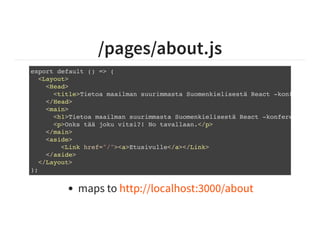
/pages/about.js
export default () => (
<Layout>
<Head>
<title>Tietoa maailman suurimmasta Suomenkielisestä React -konferenssis
</Head>
<main>
<h1>Tietoa maailman suurimmasta Suomenkielisestä React -konferenssista
<p>Onks tää joku vitsi?! No tavallaan.</p>
</main>
<aside>
<Link href="/"><a>Etusivulle</a></Link>
</aside>
</Layout>
);
maps to http://localhost:3000/about
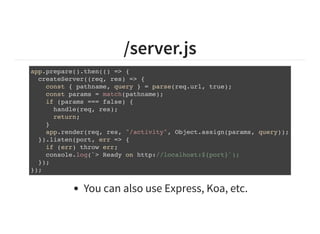
/server.js
app.prepare().then(() => {
createServer((req, res) => {
const { pathname, query } = parse(req.url, true);
const params = match(pathname);
if (params === false) {
handle(req, res);
return;
}
app.render(req, res, "/activity", Object.assign(params, query));
}).listen(port, err => {
if (err) throw err;
console.log(`> Ready on http://localhost:${port}`);
});
});
You can also use Express, Koa, etc.
/pages/index.js
static async getInitialProps() {
let query = `
{
frontpage: location(id: ${id}) {
content {
fields(identifier: ["title", "body"]) {
fieldDefIdentifier,
value {
... on TextLineFieldValue {
text
}
... on RichTextFieldValue {
html5
}
... on ImageFieldValue {
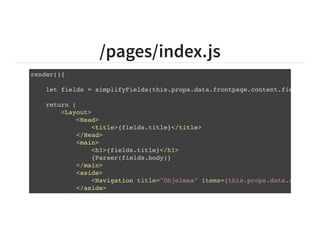
/pages/index.js
render(){
let fields = simplifyFields(this.props.data.frontpage.content.fields);
return (
<Layout>
<Head>
<title>{fields.title}</title>
</Head>
<main>
<h1>{fields.title}</h1>
{Parser(fields.body)}
</main>
<aside>
<Navigation title="Ohjelmaa" items={this.props.data.activitie
</aside>
</Layout>
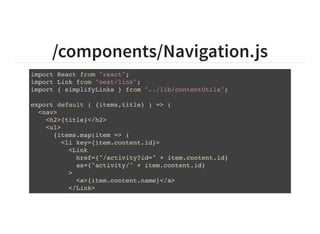
/components/Navigation.js
import React from "react";
import Link from "next/link";
import { simplifyLinks } from "../lib/contentUtils";
export default ( {items,title} ) => (
<nav>
<h2>{title}</h2>
<ul>
{items.map(item => (
<li key={item.content.id}>
<Link
href={"/activity?id=" + item.content.id}
as={"activity/" + item.content.id}
>
<a>{item.content.name}</a>
</Link>
</li>
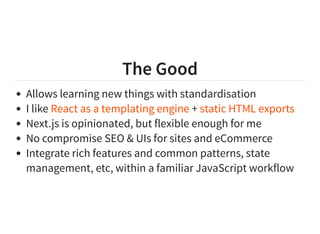
The Good
Allows learning new things with standardisation
I like +
Next.js is opinionated, but flexible enough for me
No compromise SEO & UIs for sites and eCommerce
Integrate rich features and common patterns, state
management, etc, within a familiar JavaScript workflow
React as a templating engine static HTML exports
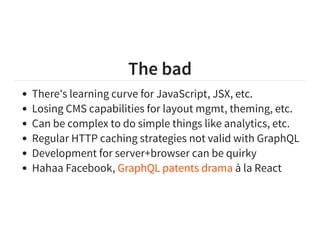
The bad
There's learning curve for JavaScript, JSX, etc.
Losing CMS capabilities for layout mgmt, theming, etc.
Can be complex to do simple things like analytics, etc.
Regular HTTP caching strategies not valid with GraphQL
Development for server+browser can be quirky
Hahaa Facebook, à la ReactGraphQL patents drama
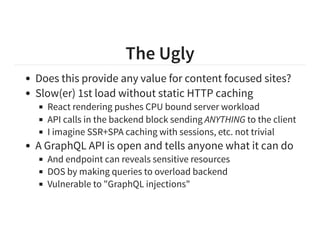
The Ugly
Does this provide any value for content focused sites?
Slow(er) 1st load without static HTTP caching
React rendering pushes CPU bound server workload
API calls in the backend block sending ANYTHING to the client
I imagine SSR+SPA caching with sessions, etc. not trivial
A GraphQL API is open and tells anyone what it can do
And endpoint can reveals sensitive resources
DOS by making queries to overload backend
Vulnerable to "GraphQL injections"
THE END
Questions?
Slides:
React Rauma 2017:
Thank you
https://janit.iki.fi/cms-graphql-nextjs
https://react.nu

Easy Decoupled Sitebuilding with GraphQL and Next.js

  • 1.
    EASY DECOUPLED SITEBUILDING WITH GRAPHQLAND NEXT.JS Jani Tarvainen, September 2017 (Helsinki.js Meetup & DrupalCon Vienna)
  • 2.
    About me, JaniTarvainen Personal branding @velmu Web development for 20y+ Interested in all things tech and around it Currently working mostly with content thingamajigs Working knowledge of TS/JS and Symfony/PHP Day job at , night job at eZ Systems Malloc
  • 3.
    Agenda What is DecoupledSitebuilding? Intro to and Walkthrough of React Rauma 2017 site My experiences: the good, the bad & the ugly GraphQL Next.js
  • 4.
    What is DecoupledSitebuilding? Also known as Headless, API driven, who knows... A Content API of some sorts provides a feed Traditionally REST based (or a JSON kludge) Strong buzz for some years, but not the norm Content management is cost driven, you need efficiency Boutique solutions out of question for mainstream
  • 5.
    GraphQL and Next.js Twoseparate technologies that work well together Opinionated to reduce & 1st load from SSR HTML, subsequent from a GraphQL API built in a similar way, but not on Next.js Not the only options, some alternatives: Vue.js clone of Next: An alternative to GraphQL: Something around Web Components, ish rendering? Yak Shaving Bikeshedding Economist.com Nuxt.js Falcor lit-html
  • 6.
    GraphQL, 1st releasein 2015 GraphQL is "a query language for your API" Not "SQL" for Graph Databases (but it ) A REST alternative, not verb based (only POSTs) Implementations for many CMSes & Content APIs Can minimise HTTP-round trips by embedding resources Intro video: can be Zero to GraphQL in 30 Minutes
  • 7.
    Next.js, 1st releasein 2016 A JavaScript framework with routing, etc. Uses React.js as a universal view layer Run the same code on server and client Simple to get started with, but customizable Intro video: Next.js: Universal React Made Easy & Simple
  • 8.
    Walkthrough of ReactRauma 2017 https://react.nu/ A site for a tech conference in October 2017 in Rauma Resources: eZ Platform GraphiQL backend React Rauma 2017 site (react.nu) Site source on GitHub
  • 9.
    /pages/about.js export default ()=> ( <Layout> <Head> <title>Tietoa maailman suurimmasta Suomenkielisestä React -konferenssis </Head> <main> <h1>Tietoa maailman suurimmasta Suomenkielisestä React -konferenssista <p>Onks tää joku vitsi?! No tavallaan.</p> </main> <aside> <Link href="/"><a>Etusivulle</a></Link> </aside> </Layout> ); maps to http://localhost:3000/about
  • 10.
    /server.js app.prepare().then(() => { createServer((req,res) => { const { pathname, query } = parse(req.url, true); const params = match(pathname); if (params === false) { handle(req, res); return; } app.render(req, res, "/activity", Object.assign(params, query)); }).listen(port, err => { if (err) throw err; console.log(`> Ready on http://localhost:${port}`); }); }); You can also use Express, Koa, etc.
  • 11.
    /pages/index.js static async getInitialProps(){ let query = ` { frontpage: location(id: ${id}) { content { fields(identifier: ["title", "body"]) { fieldDefIdentifier, value { ... on TextLineFieldValue { text } ... on RichTextFieldValue { html5 } ... on ImageFieldValue {
  • 12.
    /pages/index.js render(){ let fields =simplifyFields(this.props.data.frontpage.content.fields); return ( <Layout> <Head> <title>{fields.title}</title> </Head> <main> <h1>{fields.title}</h1> {Parser(fields.body)} </main> <aside> <Navigation title="Ohjelmaa" items={this.props.data.activitie </aside> </Layout>
  • 13.
    /components/Navigation.js import React from"react"; import Link from "next/link"; import { simplifyLinks } from "../lib/contentUtils"; export default ( {items,title} ) => ( <nav> <h2>{title}</h2> <ul> {items.map(item => ( <li key={item.content.id}> <Link href={"/activity?id=" + item.content.id} as={"activity/" + item.content.id} > <a>{item.content.name}</a> </Link> </li>
  • 14.
    The Good Allows learningnew things with standardisation I like + Next.js is opinionated, but flexible enough for me No compromise SEO & UIs for sites and eCommerce Integrate rich features and common patterns, state management, etc, within a familiar JavaScript workflow React as a templating engine static HTML exports
  • 15.
    The bad There's learningcurve for JavaScript, JSX, etc. Losing CMS capabilities for layout mgmt, theming, etc. Can be complex to do simple things like analytics, etc. Regular HTTP caching strategies not valid with GraphQL Development for server+browser can be quirky Hahaa Facebook, à la ReactGraphQL patents drama
  • 16.
    The Ugly Does thisprovide any value for content focused sites? Slow(er) 1st load without static HTTP caching React rendering pushes CPU bound server workload API calls in the backend block sending ANYTHING to the client I imagine SSR+SPA caching with sessions, etc. not trivial A GraphQL API is open and tells anyone what it can do And endpoint can reveals sensitive resources DOS by making queries to overload backend Vulnerable to "GraphQL injections"
  • 17.
    THE END Questions? Slides: React Rauma2017: Thank you https://janit.iki.fi/cms-graphql-nextjs https://react.nu