Quarter 2: Module 2
WRITING A
POSITION PAPER
English for Academic and Professional Purposes
Presented By: Group 2
Writing a position paper involves stating your stand on
a particular issue and backing it up with solid
evidence, logical reasoning, and persuasive
language.
LESSON 1: WRITING A POSITION PAPER
In this lesson, you will
learn the key components
and techniques to write a
compelling position paper.
PURPOSES IN WRITING A POSITION PAPER
The main goal of a position paper is to convince your
audience that your stance on an issue is valid and worth
considering. Other specific purposes include:
1. To explain sensitive or controversial subjects
2. To criticize actions, decisions, or situations
3. To commend people or organizations for doing things
right
4. To persuade people to follow a course of action
5. To propose a better solution to a problem or issue
PARTS OF A POSITION PAPER
A well-structured position paper is divided into three major
parts:
1. Introduction (1 paragraph around 20% of the paper)
a. Contains the issue or situation to be discussed.
b. Present facts and may include statistics of the issue.
c. Establish your position on the issue.
2. Body (1 to 3 paragraphs around 60% of the paper)
a. Provide main arguments containing 4 E's (Evidence,
Explanation, Example, and Extra details).
• i. evidence provides facts and statistics to support your
stand
• ii. explanation provides reasons to support your
evidences
• iii. example provides a few statement for clearer
information.
• iv. extra details provide quotes or statement of some
experts
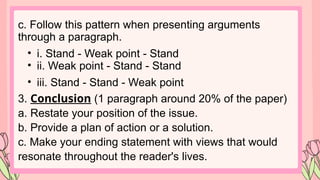
c. Follow this pattern when presenting arguments
through a paragraph.
• i. Stand - Weak point - Stand
• ii. Weak point - Stand - Stand
• iii. Stand - Stand - Weak point
3. Conclusion (1 paragraph around 20% of the paper)
a. Restate your position of the issue.
b. Provide a plan of action or a solution.
c. Make your ending statement with views that would
resonate throughout the reader's lives.
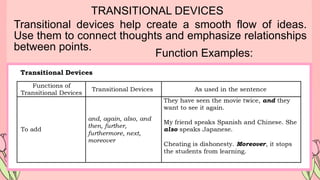
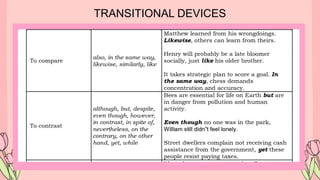
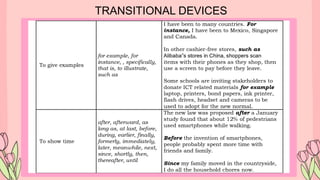
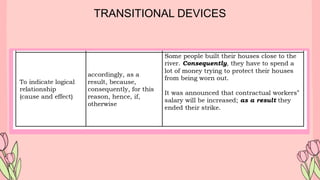
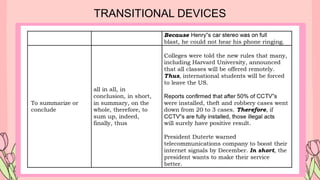
TRANSITIONAL DEVICES
Transitional devices help create a smooth flow of ideas.
Use them to connect thoughts and emphasize relationships
between points.
Function Examples:
TRANSITIONAL DEVICES
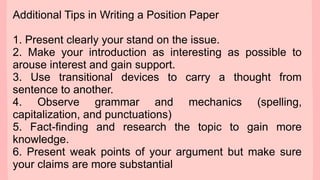
Additional Tips in Writing a Position Paper
1. Present clearly your stand on the issue.
2. Make your introduction as interesting as possible to
arouse interest and gain support.
3. Use transitional devices to carry a thought from
sentence to another.
4. Observe grammar and mechanics (spelling,
capitalization, and punctuations)
5. Fact-finding and research the topic to gain more
knowledge.
6. Present weak points of your argument but make sure
your claims are more substantial
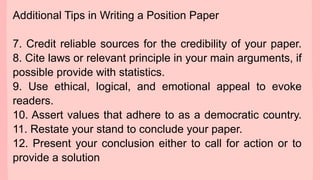
Additional Tips in Writing a Position Paper
7. Credit reliable sources for the credibility of your paper.
8. Cite laws or relevant principle in your main arguments, if
possible provide with statistics.
9. Use ethical, logical, and emotional appeal to evoke
readers.
10. Assert values that adhere to as a democratic country.
11. Restate your stand to conclude your paper.
12. Present your conclusion either to call for action or to
provide a solution
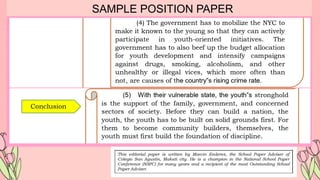
SAMPLE POSITION PAPER
MEMBERS:
Llagas, Princess Angel
Manlunas, Jerneh
Baguio, Geraldine
Domingo, Thea Pauline
Arigo, James Syriel
Jamboy, Give Heart
Pangandoyon,
Reynaldo
THANK
YOU!

EAPP- POSITION PAPER, about writing a position paper

  • 1.
    Quarter 2: Module2 WRITING A POSITION PAPER English for Academic and Professional Purposes Presented By: Group 2
  • 2.
    Writing a positionpaper involves stating your stand on a particular issue and backing it up with solid evidence, logical reasoning, and persuasive language. LESSON 1: WRITING A POSITION PAPER In this lesson, you will learn the key components and techniques to write a compelling position paper.
  • 3.
    PURPOSES IN WRITINGA POSITION PAPER The main goal of a position paper is to convince your audience that your stance on an issue is valid and worth considering. Other specific purposes include: 1. To explain sensitive or controversial subjects 2. To criticize actions, decisions, or situations 3. To commend people or organizations for doing things right 4. To persuade people to follow a course of action 5. To propose a better solution to a problem or issue
  • 4.
    PARTS OF APOSITION PAPER A well-structured position paper is divided into three major parts: 1. Introduction (1 paragraph around 20% of the paper) a. Contains the issue or situation to be discussed. b. Present facts and may include statistics of the issue. c. Establish your position on the issue.
  • 5.
    2. Body (1to 3 paragraphs around 60% of the paper) a. Provide main arguments containing 4 E's (Evidence, Explanation, Example, and Extra details). • i. evidence provides facts and statistics to support your stand • ii. explanation provides reasons to support your evidences • iii. example provides a few statement for clearer information. • iv. extra details provide quotes or statement of some experts
  • 6.
    c. Follow thispattern when presenting arguments through a paragraph. • i. Stand - Weak point - Stand • ii. Weak point - Stand - Stand • iii. Stand - Stand - Weak point 3. Conclusion (1 paragraph around 20% of the paper) a. Restate your position of the issue. b. Provide a plan of action or a solution. c. Make your ending statement with views that would resonate throughout the reader's lives.
  • 7.
    TRANSITIONAL DEVICES Transitional deviceshelp create a smooth flow of ideas. Use them to connect thoughts and emphasize relationships between points. Function Examples:
  • 8.
  • 9.
  • 10.
  • 11.
  • 12.
    Additional Tips inWriting a Position Paper 1. Present clearly your stand on the issue. 2. Make your introduction as interesting as possible to arouse interest and gain support. 3. Use transitional devices to carry a thought from sentence to another. 4. Observe grammar and mechanics (spelling, capitalization, and punctuations) 5. Fact-finding and research the topic to gain more knowledge. 6. Present weak points of your argument but make sure your claims are more substantial
  • 13.
    Additional Tips inWriting a Position Paper 7. Credit reliable sources for the credibility of your paper. 8. Cite laws or relevant principle in your main arguments, if possible provide with statistics. 9. Use ethical, logical, and emotional appeal to evoke readers. 10. Assert values that adhere to as a democratic country. 11. Restate your stand to conclude your paper. 12. Present your conclusion either to call for action or to provide a solution
  • 17.
  • 18.
  • 19.
  • 20.
    MEMBERS: Llagas, Princess Angel Manlunas,Jerneh Baguio, Geraldine Domingo, Thea Pauline Arigo, James Syriel Jamboy, Give Heart Pangandoyon, Reynaldo
  • 21.