
E-Agriculture: From Cutlass to Cutting Edge Practical Solutions for the Knowledge Age  Telojo V. Onu Caribbean Farmers Network (CAFAN)  Only Connect? Emerging ICT Options and Opportunities for Farmers 26 August 2008  ASTUGI - JAPAN
THE GREAT AMERICAN DESERT
CHALLENGES Early immigrants to the Western Hemisphere faced challenges in settlement and agriculture.  Soil – Clay Loamy Soil and Thick Grass Water – No water sources Transportation – No linkages
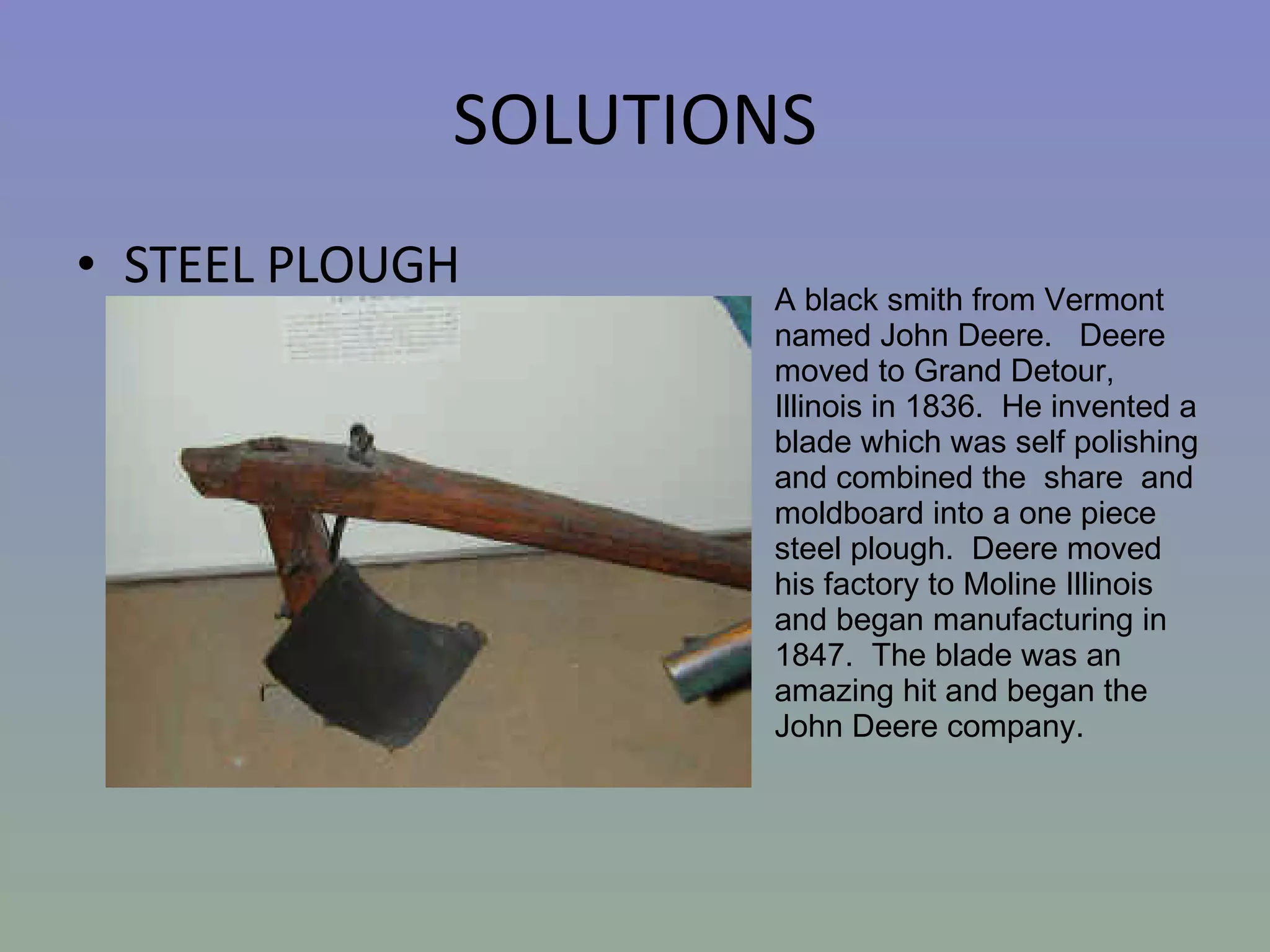
SOLUTIONS STEEL PLOUGH A black smith from Vermont named John Deere.   Deere moved to Grand Detour, Illinois in 1836.  He invented a blade which was self polishing and combined the  share  and moldboard into a one piece steel plough.  Deere moved his factory to Moline Illinois and began manufacturing in 1847.  The blade was an amazing hit and began the John Deere company. 
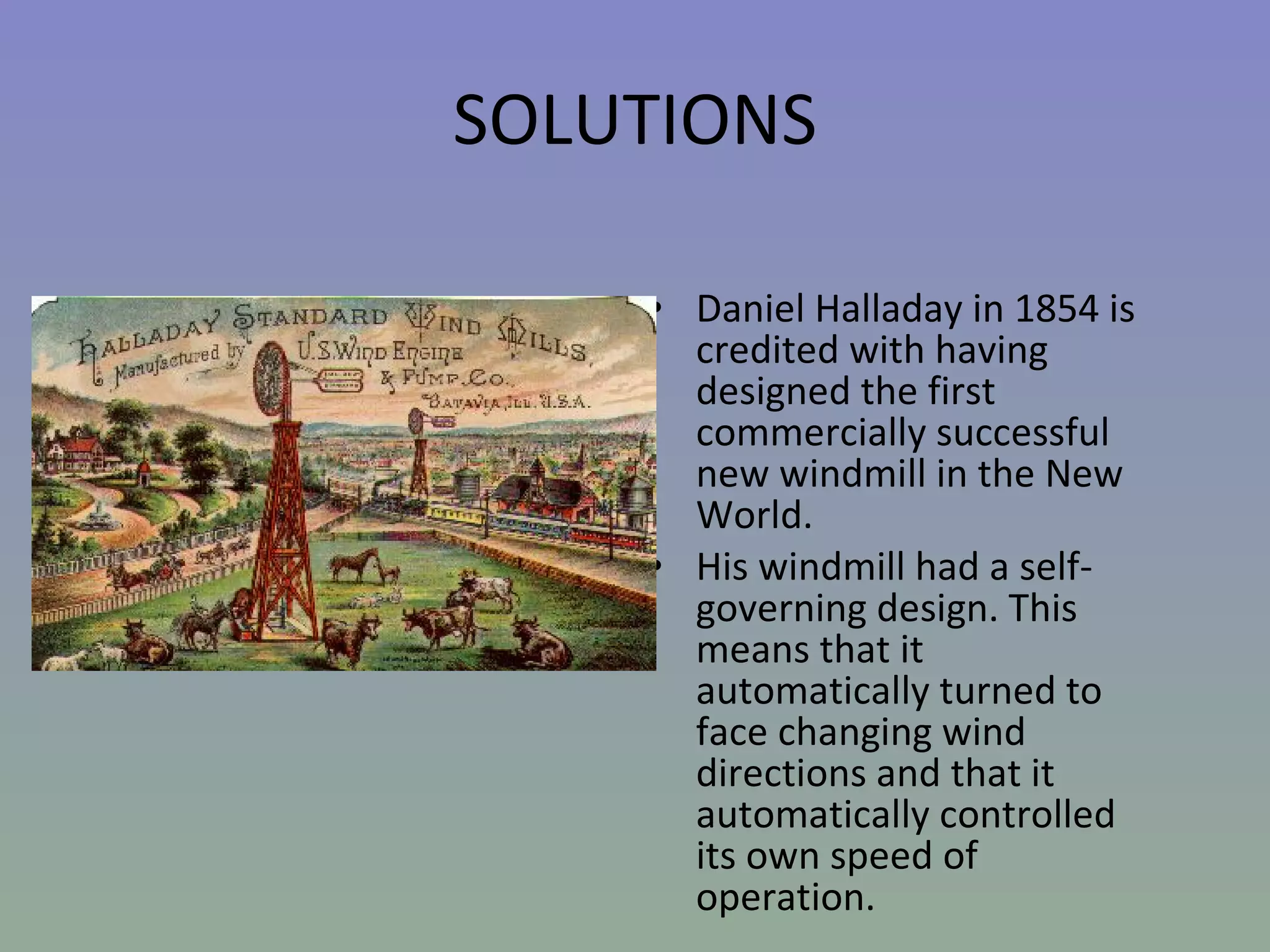
SOLUTIONS Daniel Halladay in 1854 is credited with having designed the first commercially successful new windmill in the New World.  His windmill had a self-governing design. This means that it automatically turned to face changing wind directions and that it automatically controlled its own speed of operation.
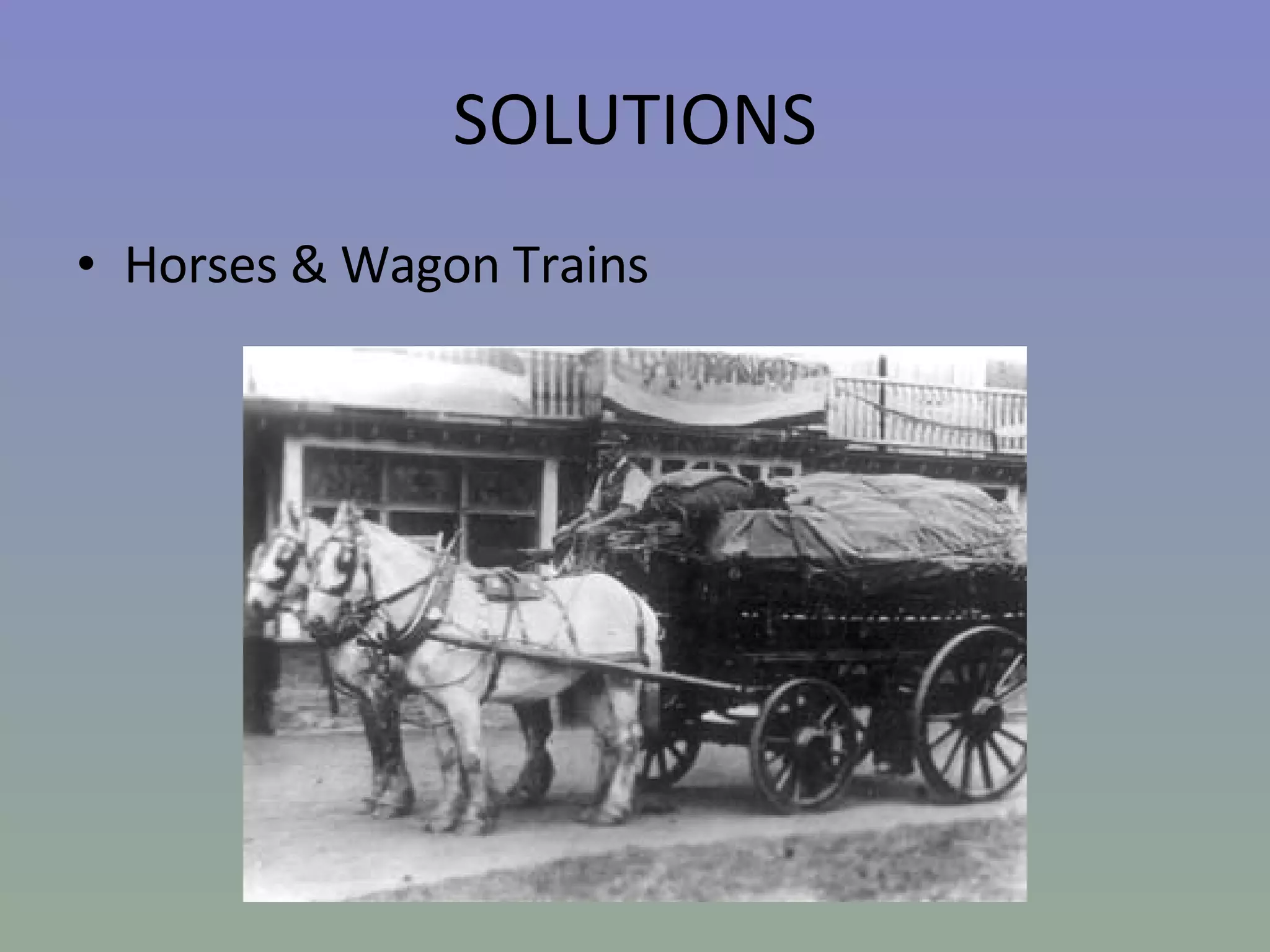
SOLUTIONS Horses & Wagon Trains
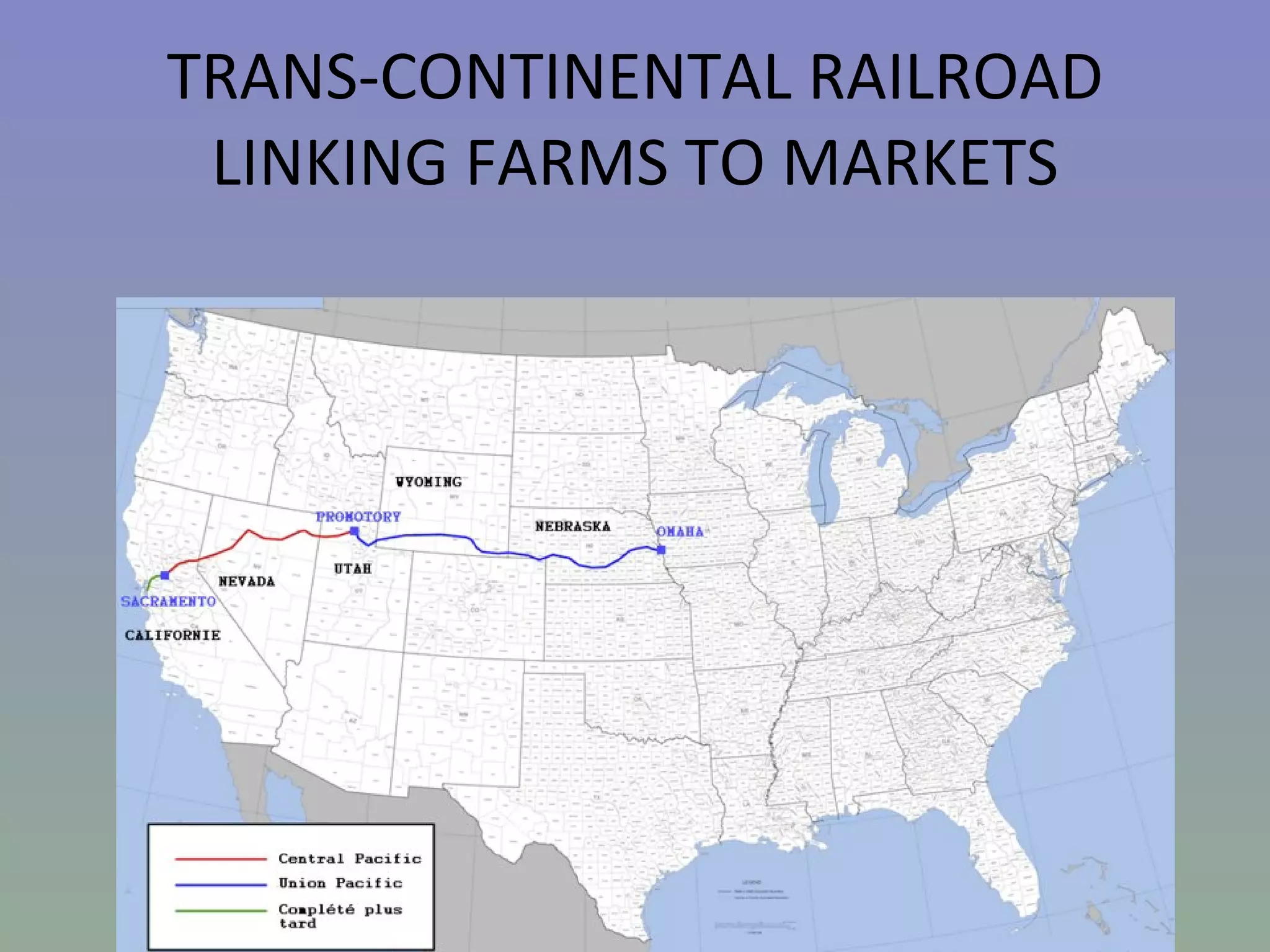
SOLUTIONS Then the  First Transcontinental Railroad  in the  United States  was built across  North America  in the 1860s, linking the  railway  network of the  Eastern United States  with  California  on the  Pacific  coast. Ceremonially completed on  May 10 ,  1869 , at the famous " golden spike " event at  Promontory Summit, Utah , it created a nation-wide mechanized transportation network that revolutionized the population and economy of the  American West .  This network caused the  wagon trains  of previous decades to become obsolete, exchanging it for a modern transportation system.
TRANS-CONTINENTAL RAILROAD LINKING FARMS TO MARKETS
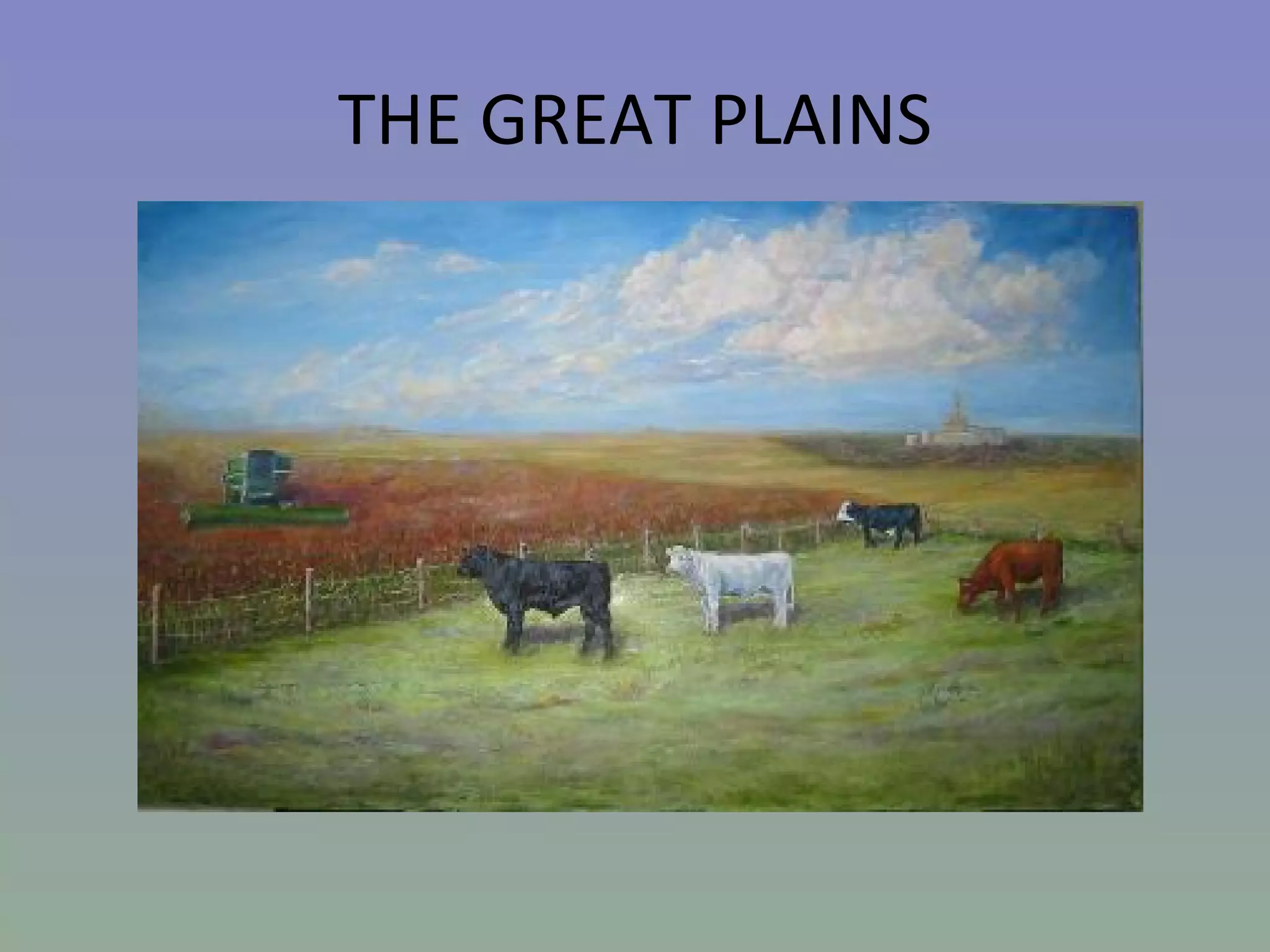
THE GREAT PLAINS
Settlement in the west only happened because of a series of  enabling technologies Plough – was able to till dry soil Windmill – deliver water Rail Road – Transportation to facilitate linkage to the markets
OLD ICTS Vs NEW ICTS Radio TV Telephone  Computers Mobile Phones Internet
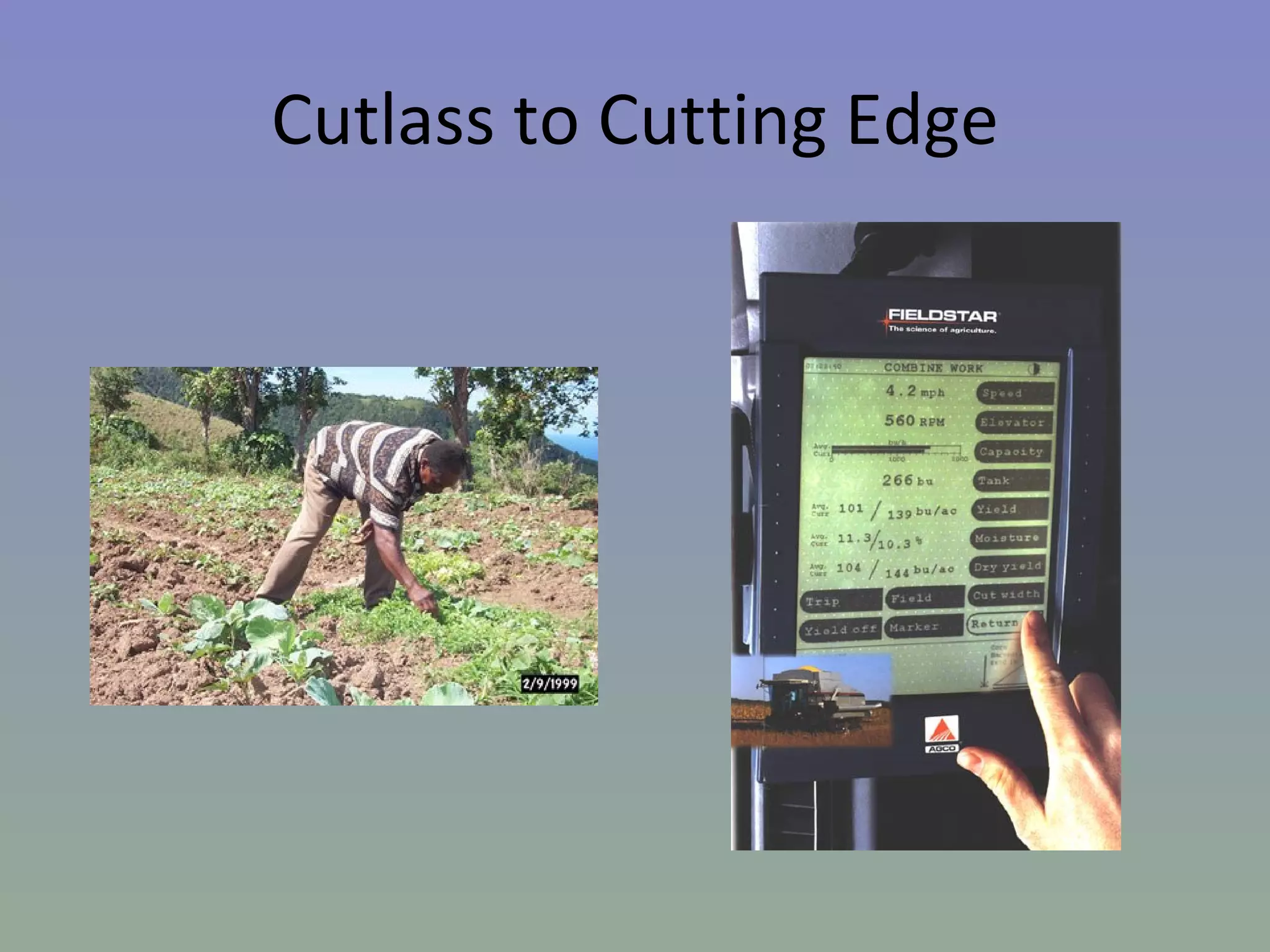
Cutlass to Cutting Edge
Role of the “e” in E-agriculture E- nable – ICTs are tools that act as enablers for farmers E-mpower – Through the sharing of knowledge, ICTs can build capacities E-lectronic  - ICTs have facilitated communication in Virtual Spaces E- veryone  - Solving Problems in Institutional Redesign involves people, groups and communities.
NEW ECONOMY Matter is neither created nor destroyed but  transforms from one form to another.  - Newton Rapidly Changing Global Scenario
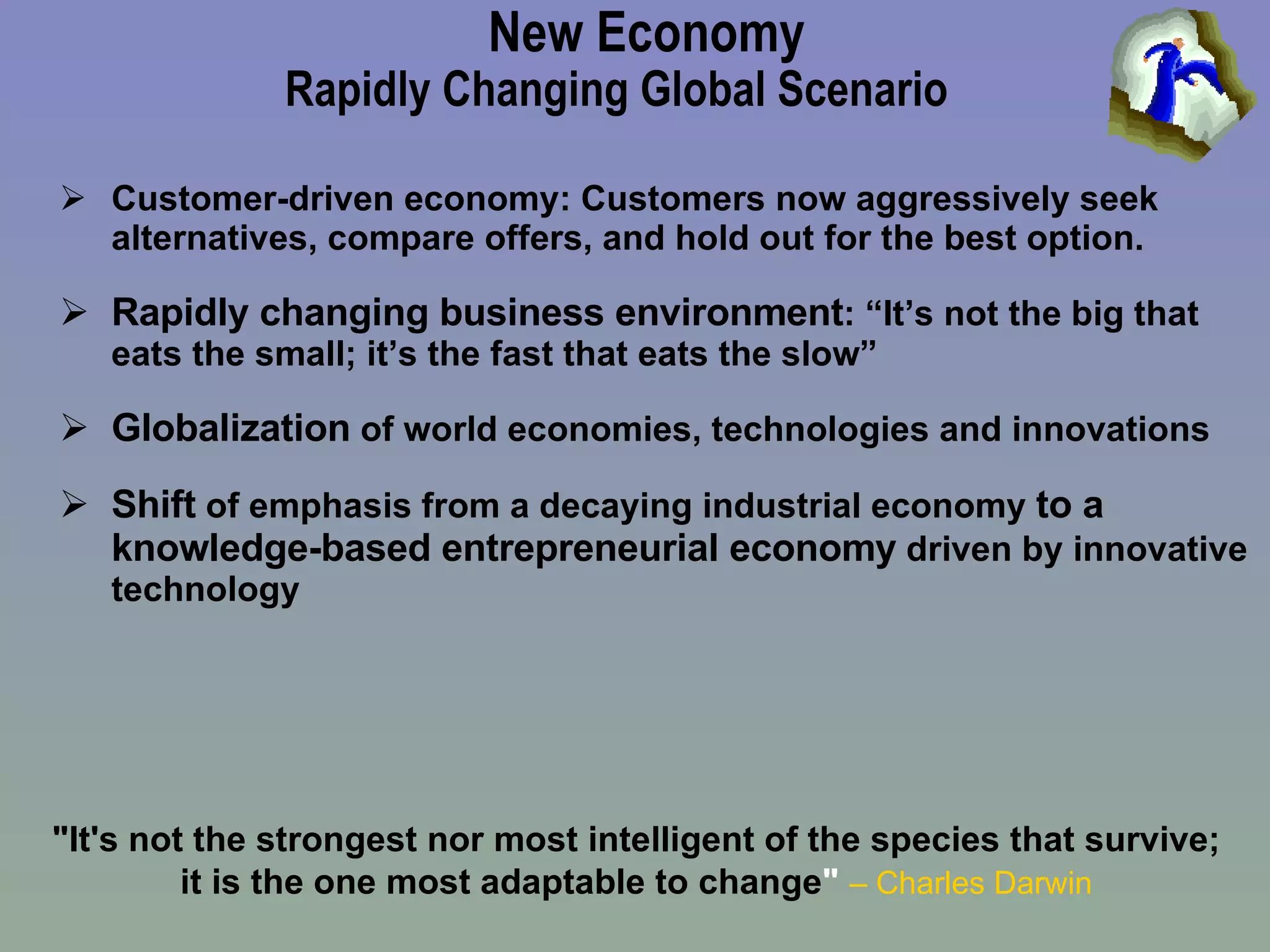
New Economy Rapidly Changing Global Scenario Customer-driven economy:  Customers now aggressively seek alternatives, compare offers, and hold out for the best option. Rapidly changing business environment : “It’s not the big that eats the small; it’s the fast that eats the slow” Globalization  of world economies, technologies and innovations Shift  of emphasis from a decaying industrial economy  to a knowledge-based entrepreneurial economy  driven by innovative technology "It's not the strongest nor most intelligent of the species that survive; it is the one most adaptable to change "   – Charles Darwin
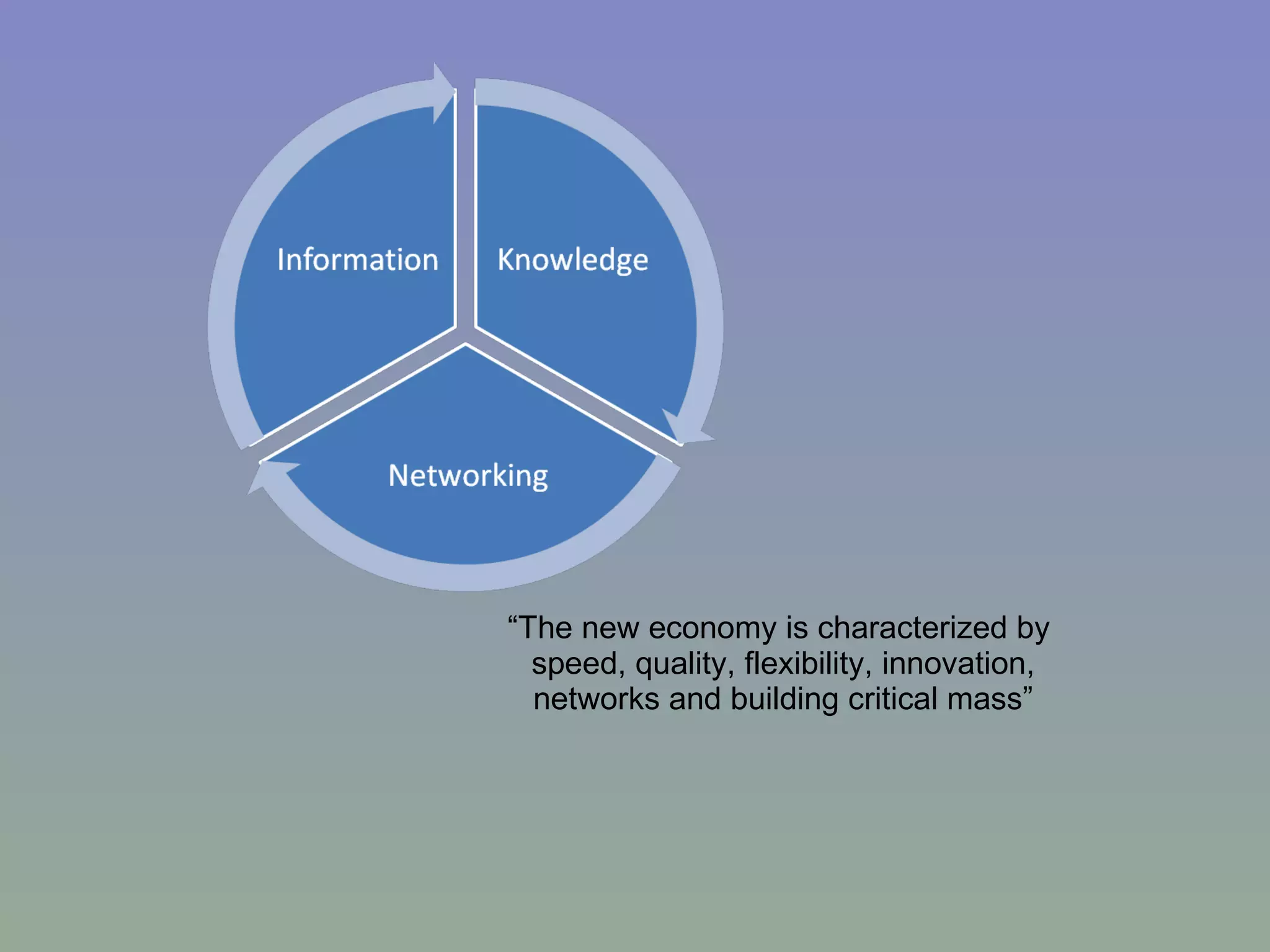
“ The new economy is characterized by  speed, quality, flexibility, innovation, networks and building critical mass”
Practical Considerations for ICTs in Agriculture & Rural Development Agriculture information transfer is a very complex process.   Information Infrastructure  Access and Costs Need for Content Knowledge Sharing Policy Regulation  Legislation  Risk Management  Strategies need to deliver outcomes which address needs in a sustainable manner
Practical Solutions to ensure Sustainability Needs Driven(Customer Centric) -  Bottom up Approach Stakeholder Consultation  & Participation and Buy In  - Information and Knowledge  (Assets) , Property – Ownership Power and Control is in the hands of the society and shared with the institution Community and Society Oriented (Multi-stakeholders) Strategies should be Socially Driven not Technologically Determined
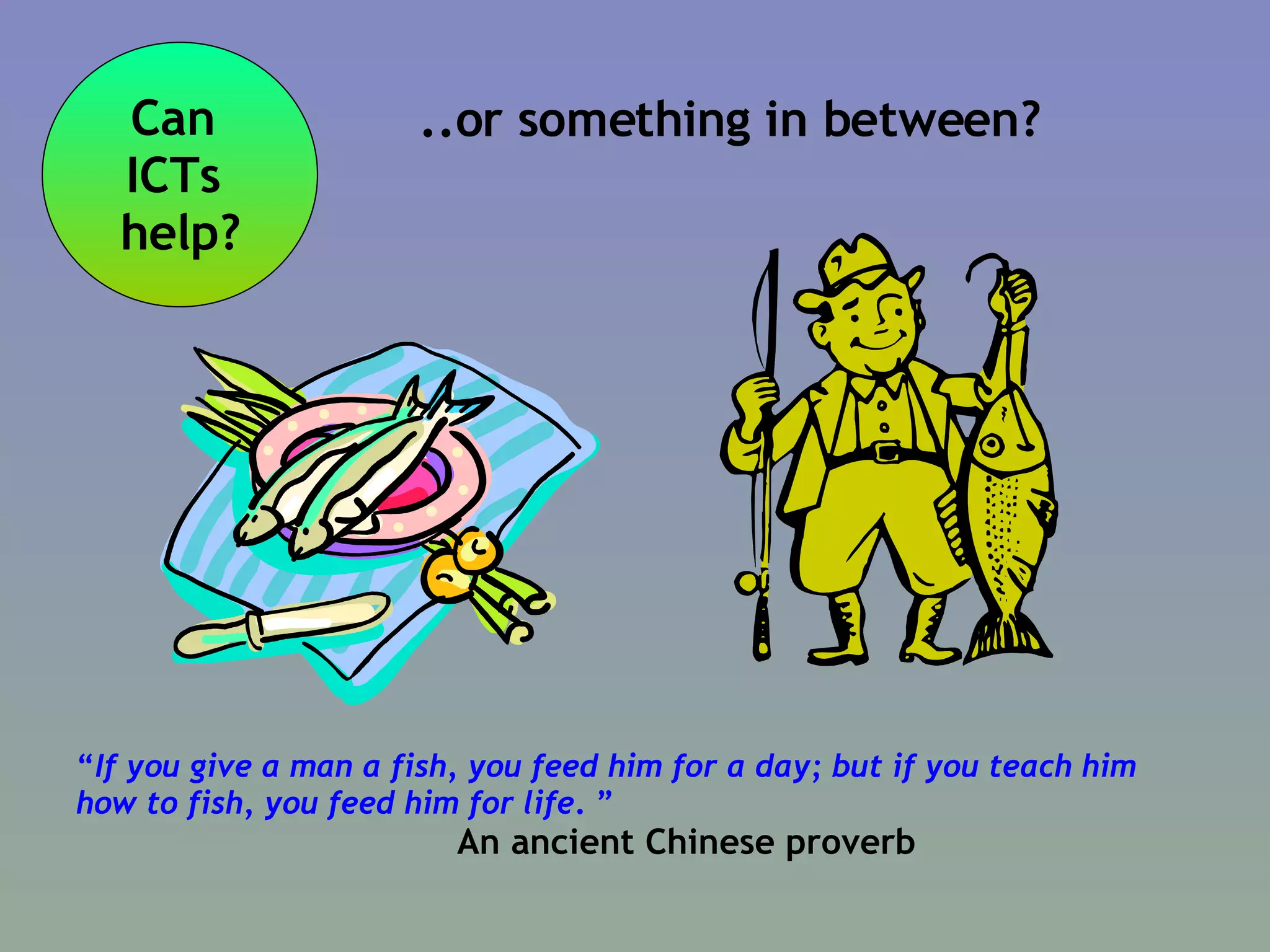
“ If you give a man a fish, you feed him for a day; but if you teach him how to fish, you feed him for life .  ” An ancient Chinese proverb Can  ICTs  help? ..or something in between?
Objective:  To facilitate a community knowledge network of practice for Small Farm Holders and Farmer associations and stakeholders across 16 Caribbean Islands by providing cheap network communications using innovative digital technologies (VOIP) to facilitate timely agriculture related information (market prices, information about fertilizers, crop varieties etc.)  Approach:  Partner with Mobile Telecom & VOIP Providers to create a closed user group service at a low cost to members of the network. Regional  - CaFAN  -  VOIP  ( ATA Adapters) – Peer Network & Gateway -  Pilot Internet Access  - Low cost Edge Service –( Data Cards) Modem and Router - $20US mth Local Level -  CUG with Local Mobile Network  - (Digicel or C&W) - $5US a month  ( Free SMS) VOIP Gateway -  At each Network Contact Point (using SMS or code) Agritalk   CaFAN Initiative  1
Beneficiaries:  Nearly 1 million farmers  Benefits to community:  Better prices, reliable information, Ease in selling their products  etc… Driving Agency:  CaFAN, Farmer Associations
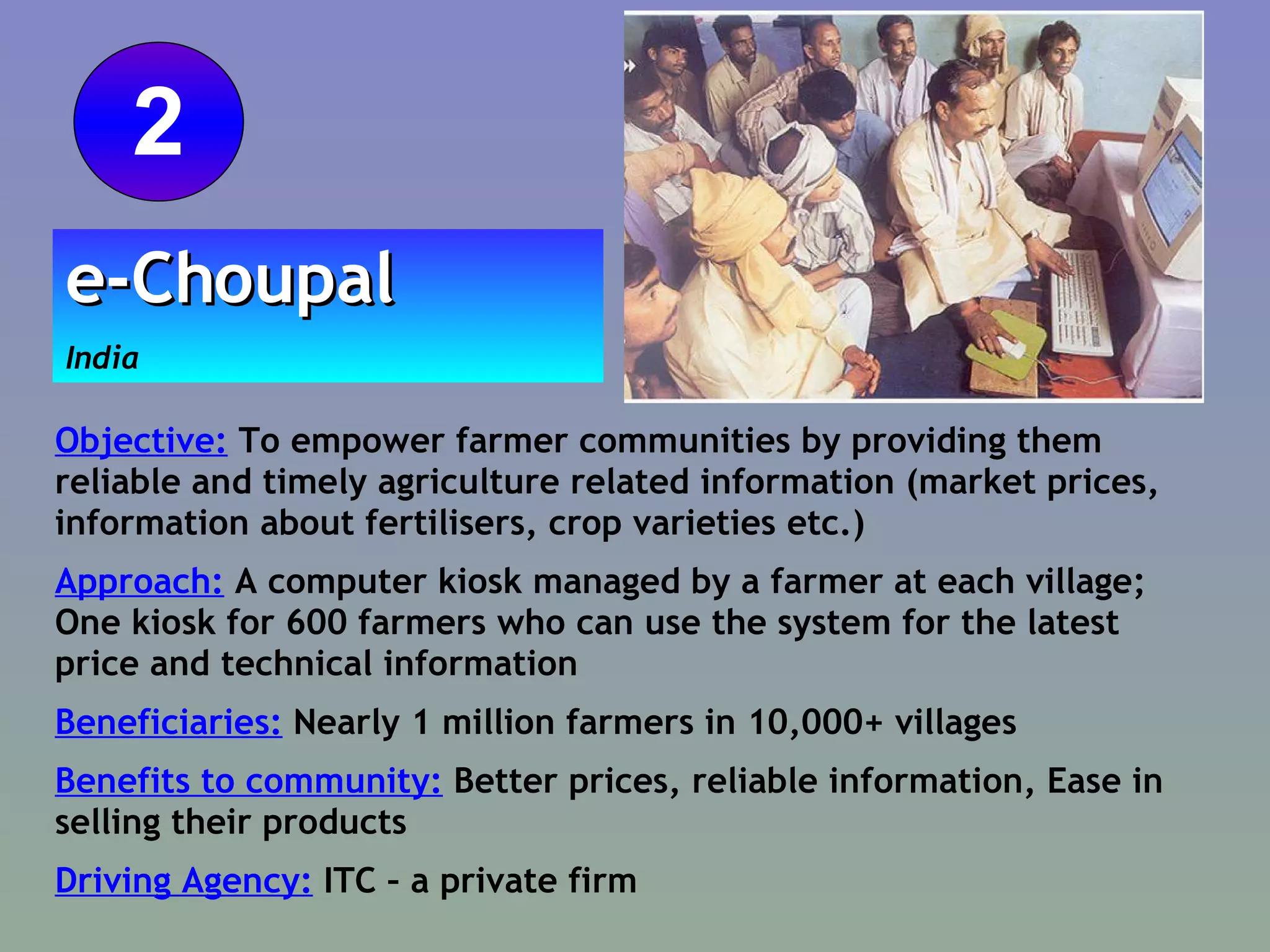
Objective:  To empower farmer communities by providing them reliable and timely agriculture related information (market prices, information about fertilisers, crop varieties etc.)  Approach:  A computer kiosk managed by a farmer at each village; One kiosk for 600 farmers who can use the system for the latest price and technical information  Beneficiaries:  Nearly 1 million farmers in 10,000+ villages Benefits to community:  Better prices, reliable information, Ease in selling their products  Driving Agency:  ITC – a private firm e-Choupal   India 2
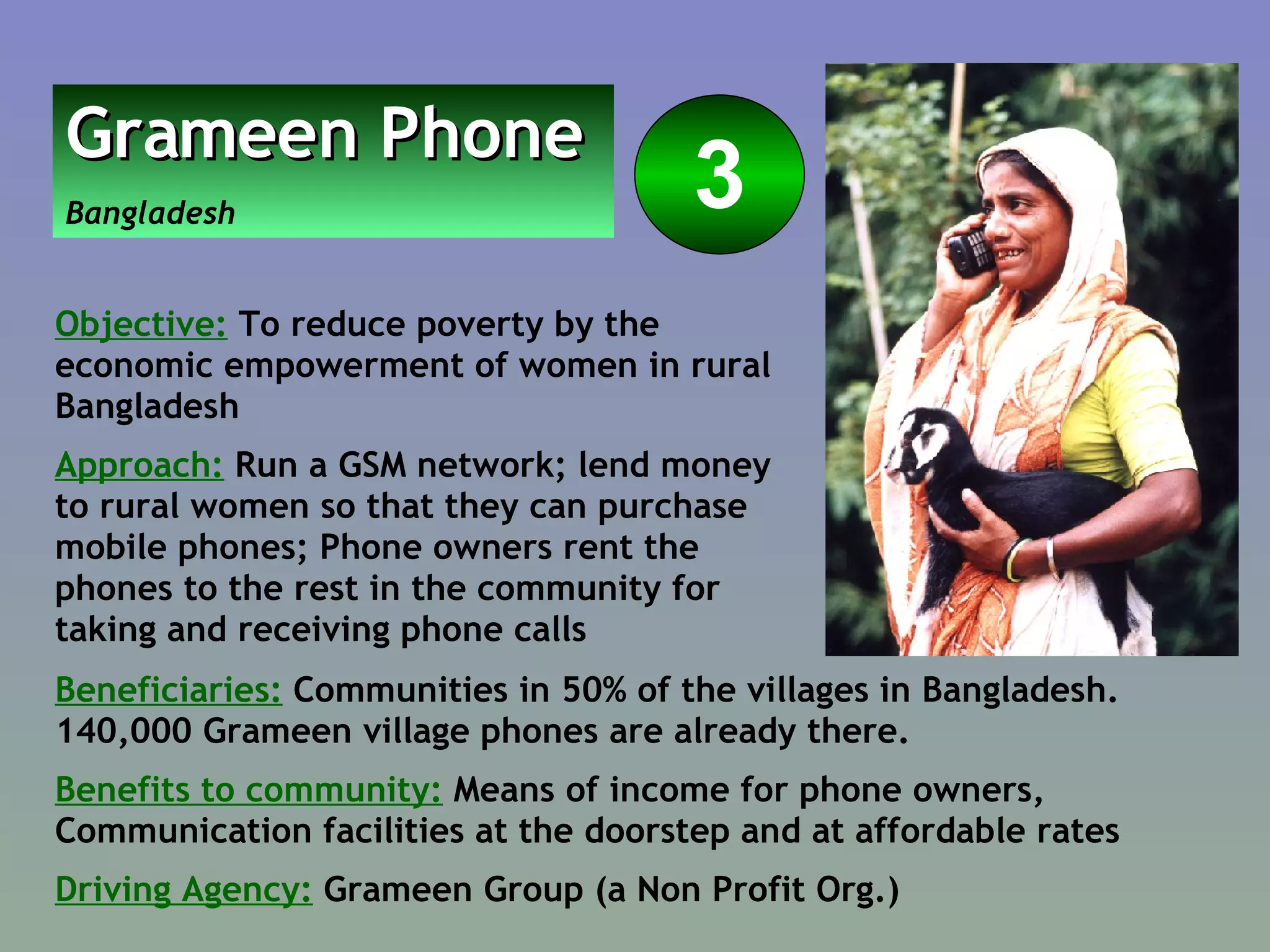
Beneficiaries:  Communities in 50% of the villages in Bangladesh. 140,000 Grameen village phones are already there.  Benefits to community:  Means of income for phone owners, Communication facilities at the doorstep and at affordable rates  Driving Agency:  Grameen Group (a Non Profit Org.) Grameen Phone   Bangladesh 3 Objective:  To reduce poverty by the economic empowerment of women in rural Bangladesh Approach:  Run a GSM network; lend money to rural women so that they can purchase mobile phones; Phone owners rent the phones to the rest in the community for taking and receiving phone calls
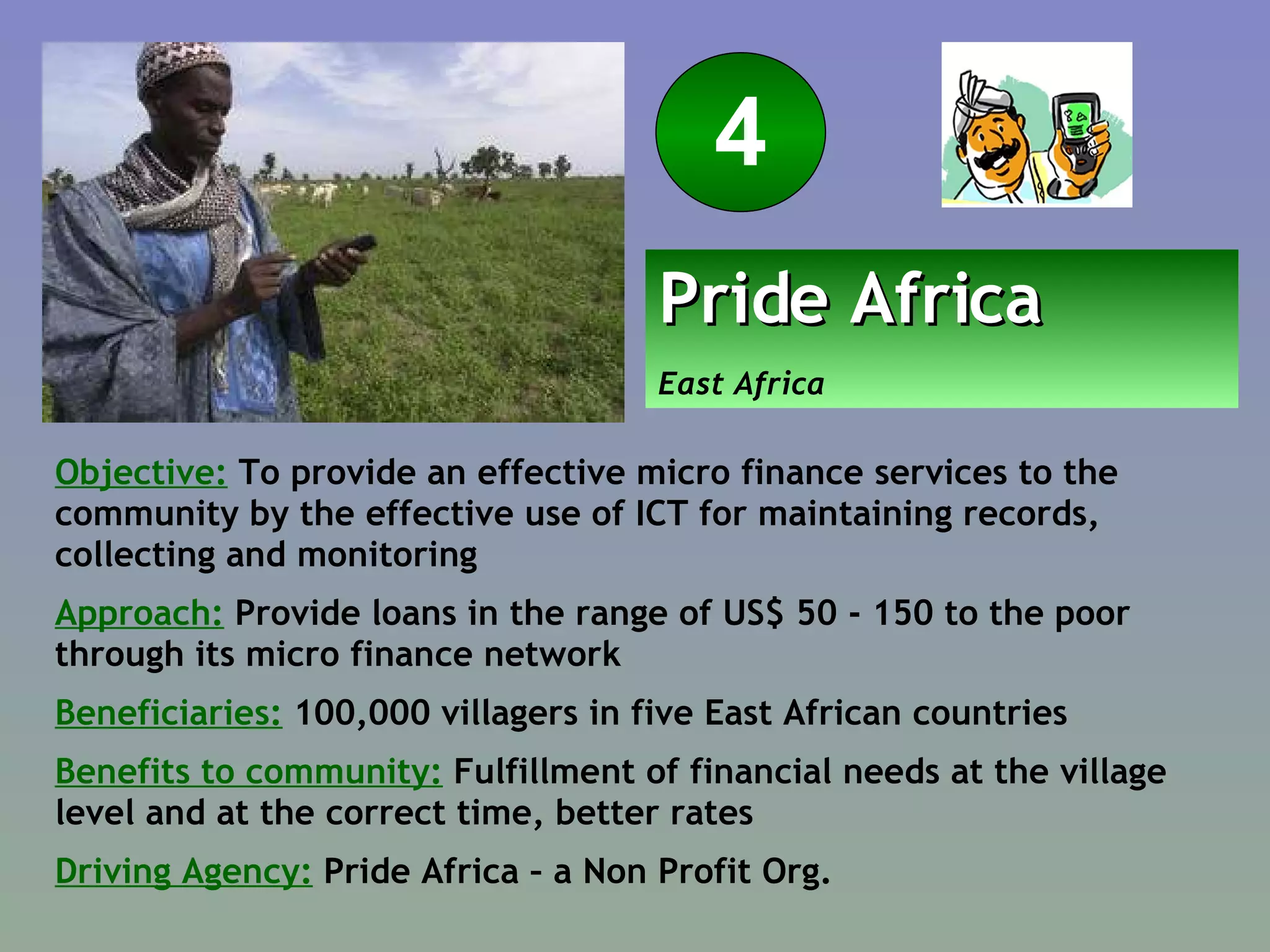
Objective:  To provide an effective micro finance services to the community by the effective use of ICT for maintaining records, collecting and monitoring Approach:  Provide loans in the range of US$ 50 - 150 to the poor through its micro finance network Beneficiaries:   100,000 villagers in five East African countries Benefits to community:  Fulfillment of financial needs at the village level and at the correct time, better rates Driving Agency:  Pride Africa – a Non Profit Org. Pride Africa   East Africa 4
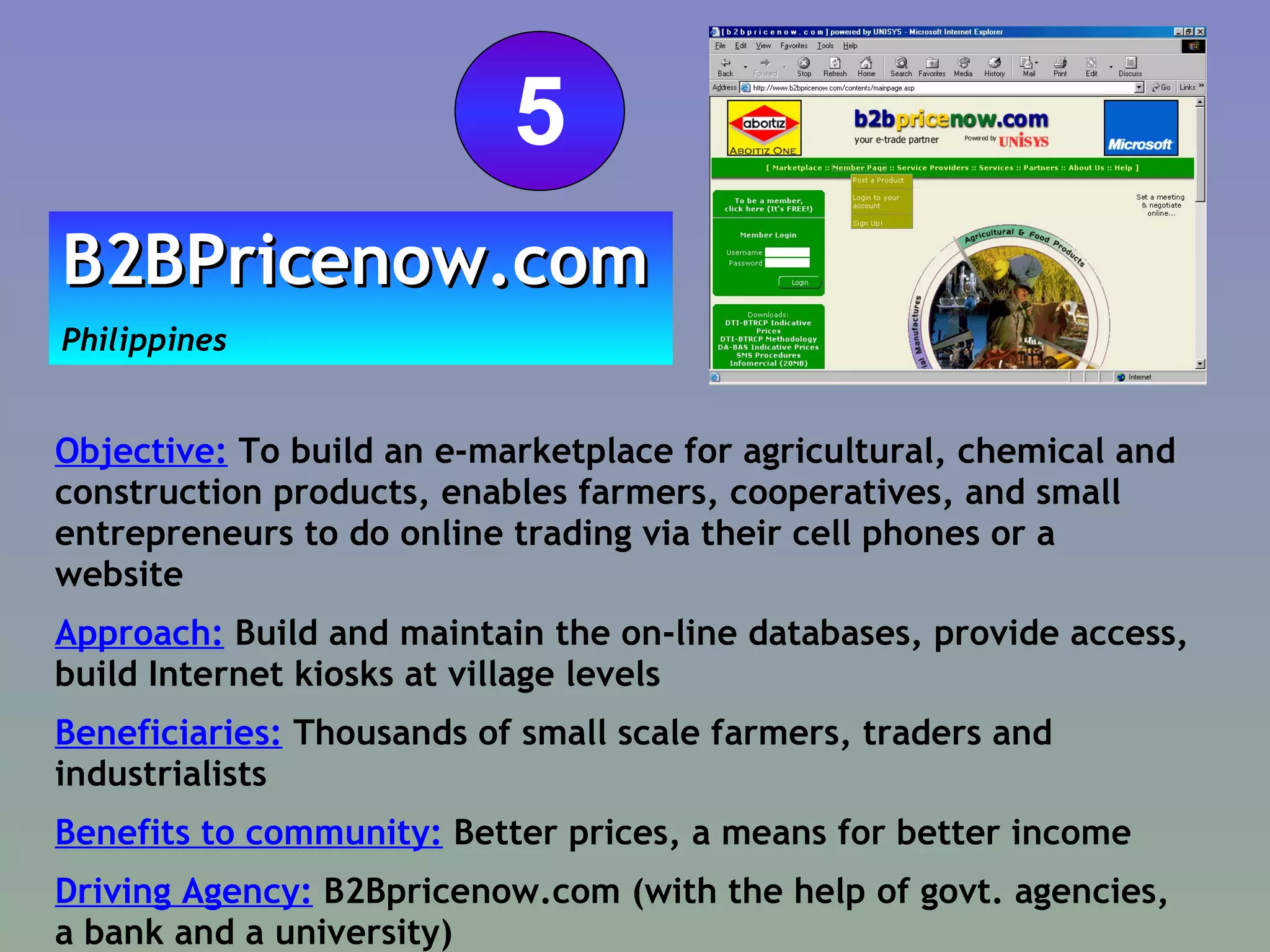
Objective:  To build  an e-marketplace for agricultural, chemical and construction products, enables farmers, cooperatives, and small entrepreneurs to do online trading via their cell phones  or a website Approach:  Build and maintain the on-line databases, provide access, build Internet kiosks at village levels  Beneficiaries:  Thousands of small scale farmers, traders and industrialists Benefits to community:  Better prices, a means for better income Driving Agency:  B2Bpricenow.com (with the help of govt. agencies, a bank and a university) B2BPricenow.com   Philippines 5
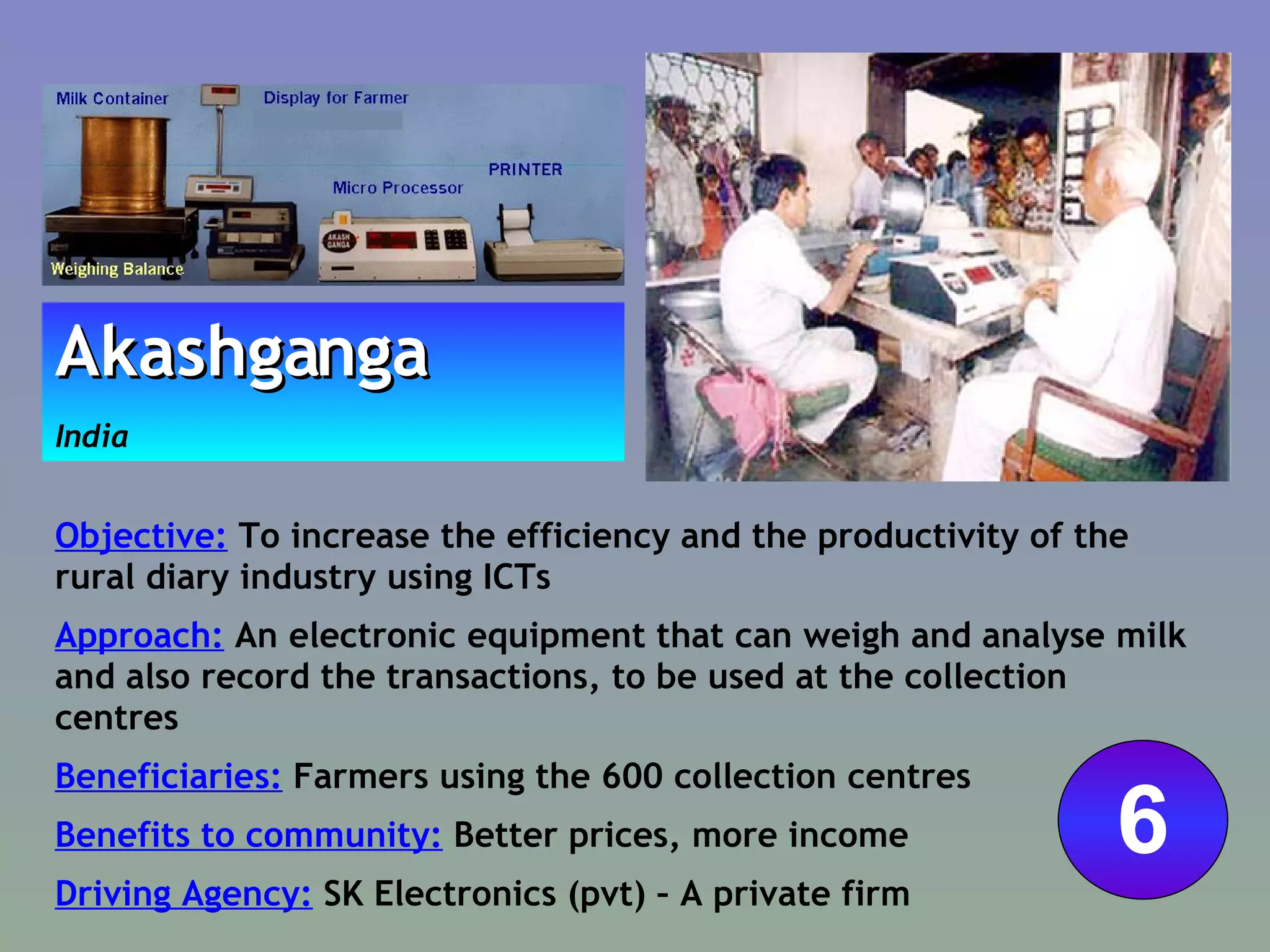
Objective:  To increase the efficiency and the productivity of the rural diary industry using ICTs Approach:  An electronic equipment that can weigh and analyse milk and also record the transactions, to be used at the collection centres  Beneficiaries:  Farmers using the 600 collection centres  Benefits to community:  Better prices, more income Driving Agency:  SK Electronics (pvt) – A private firm Akashganga   India 6
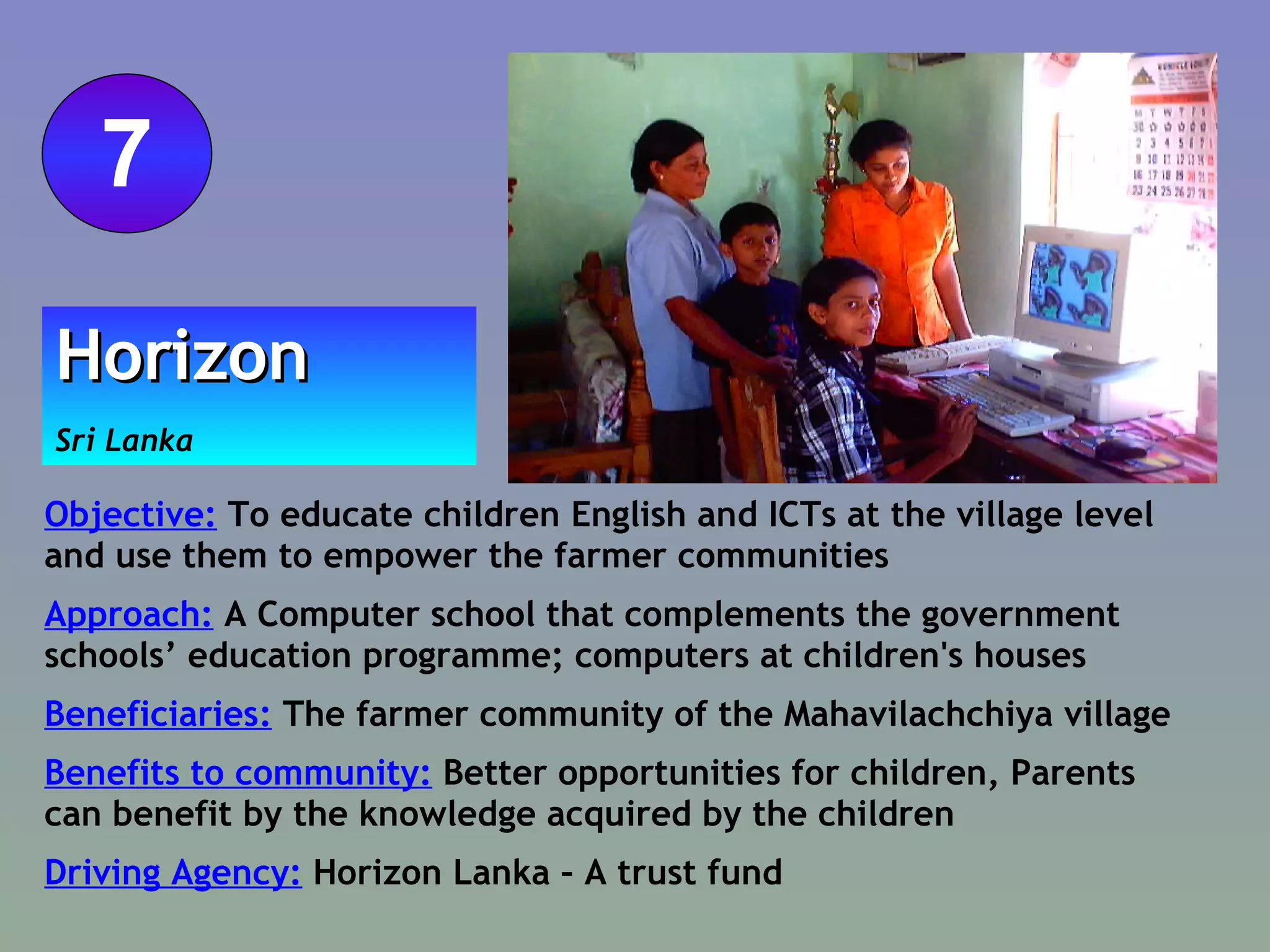
Objective:  To educate children English and ICTs at the village level and use them to empower the farmer communities Approach:  A Computer school that complements the government schools’ education programme; computers at children's houses  Beneficiaries:  The farmer community of the Mahavilachchiya village Benefits to community:  Better opportunities for children, Parents can benefit by the knowledge acquired by the children  Driving Agency:  Horizon Lanka – A trust fund Horizon Sri Lanka 7
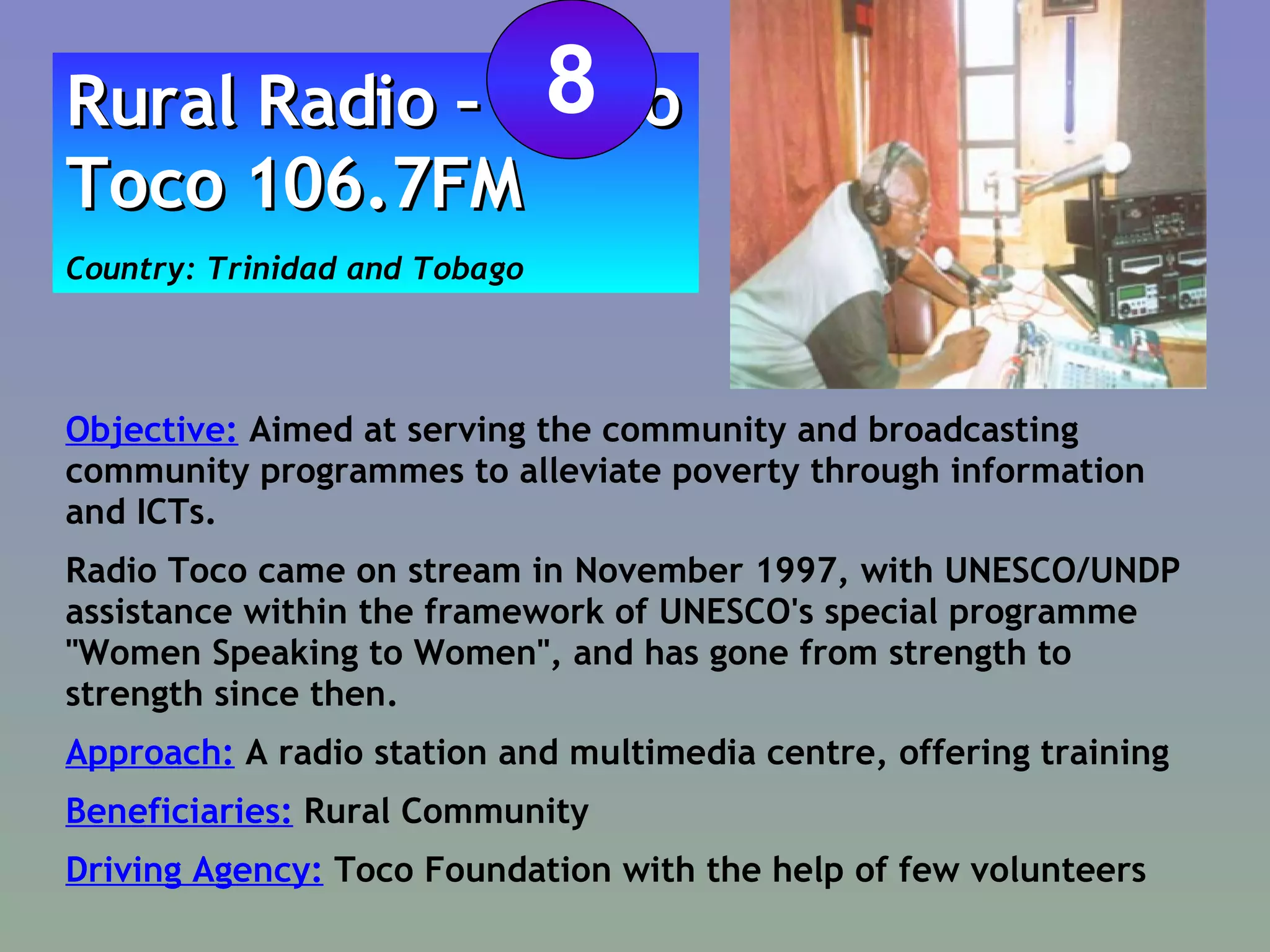
Objective:  Aimed at serving the community and broadcasting community programmes to alleviate poverty through information and ICTs. Radio Toco came on stream in November 1997, with UNESCO/UNDP assistance within the framework of UNESCO's special programme "Women Speaking to Women", and has gone from strength to strength since then.  Approach:  A radio station and multimedia centre, offering training Beneficiaries:  Rural Community  Driving Agency:  Toco Foundation with the help of few volunteers Rural Radio – Radio Toco 106.7FM Country: Trinidad and Tobago 8
Other Opportunities Mobile Phone – Resale of Credit – etop up E-learning ( Teachers being able to conduct lessons online)  - Tools – Skype, DimDim, Rural Community Services – Voice over Internet Protocol – resale of minutes Intermediary Services – Question and Answer Services for Farmers Record Management
Lessons Learnt ICTs are not Aladdin's Lamp  It is a myth that ICTs are only for the ‘rich’, and not for the ‘people in the rural community (e.g. All ) ICTs are for Communities  The technologies themselves can do nothing. What needs most is the effective participation of the communities  Need for Public Private Partnerships to solve Problems  We have to get the People and Processes first before the Technology
A strong leadership from the village is essential for the success of any ICT4D project (e.g Agri-Talk ) ICTs will not necessarily change the lifestyles of the rural communities. Rather they will introduce new methods of doing the same old activities (e.g. Pride Africa)  Need for Collective Management Lobbying  & Advocacy New Skills Lessons Learnt Contd…

E-Agriculture:From Cutlass to Cutting Edge - Practical Solutions for the Knowledge Age

  • 1.
    E-Agriculture: From Cutlassto Cutting Edge Practical Solutions for the Knowledge Age Telojo V. Onu Caribbean Farmers Network (CAFAN) Only Connect? Emerging ICT Options and Opportunities for Farmers 26 August 2008 ASTUGI - JAPAN
  • 2.
  • 3.
    CHALLENGES Early immigrantsto the Western Hemisphere faced challenges in settlement and agriculture. Soil – Clay Loamy Soil and Thick Grass Water – No water sources Transportation – No linkages
  • 4.
    SOLUTIONS STEEL PLOUGHA black smith from Vermont named John Deere.   Deere moved to Grand Detour, Illinois in 1836.  He invented a blade which was self polishing and combined the  share  and moldboard into a one piece steel plough.  Deere moved his factory to Moline Illinois and began manufacturing in 1847.  The blade was an amazing hit and began the John Deere company. 
  • 5.
    SOLUTIONS Daniel Halladayin 1854 is credited with having designed the first commercially successful new windmill in the New World. His windmill had a self-governing design. This means that it automatically turned to face changing wind directions and that it automatically controlled its own speed of operation.
  • 6.
    SOLUTIONS Horses &Wagon Trains
  • 7.
    SOLUTIONS Then the First Transcontinental Railroad in the United States was built across North America in the 1860s, linking the railway network of the Eastern United States with California on the Pacific coast. Ceremonially completed on May 10 , 1869 , at the famous " golden spike " event at Promontory Summit, Utah , it created a nation-wide mechanized transportation network that revolutionized the population and economy of the American West . This network caused the wagon trains of previous decades to become obsolete, exchanging it for a modern transportation system.
  • 8.
  • 9.
  • 10.
    Settlement in thewest only happened because of a series of enabling technologies Plough – was able to till dry soil Windmill – deliver water Rail Road – Transportation to facilitate linkage to the markets
  • 11.
    OLD ICTS VsNEW ICTS Radio TV Telephone Computers Mobile Phones Internet
  • 12.
  • 13.
    Role of the“e” in E-agriculture E- nable – ICTs are tools that act as enablers for farmers E-mpower – Through the sharing of knowledge, ICTs can build capacities E-lectronic - ICTs have facilitated communication in Virtual Spaces E- veryone - Solving Problems in Institutional Redesign involves people, groups and communities.
  • 14.
    NEW ECONOMY Matteris neither created nor destroyed but transforms from one form to another. - Newton Rapidly Changing Global Scenario
  • 15.
    New Economy RapidlyChanging Global Scenario Customer-driven economy: Customers now aggressively seek alternatives, compare offers, and hold out for the best option. Rapidly changing business environment : “It’s not the big that eats the small; it’s the fast that eats the slow” Globalization of world economies, technologies and innovations Shift of emphasis from a decaying industrial economy to a knowledge-based entrepreneurial economy driven by innovative technology "It's not the strongest nor most intelligent of the species that survive; it is the one most adaptable to change " – Charles Darwin
  • 16.
    “ The neweconomy is characterized by speed, quality, flexibility, innovation, networks and building critical mass”
  • 17.
    Practical Considerations forICTs in Agriculture & Rural Development Agriculture information transfer is a very complex process.  Information Infrastructure Access and Costs Need for Content Knowledge Sharing Policy Regulation Legislation Risk Management Strategies need to deliver outcomes which address needs in a sustainable manner
  • 18.
    Practical Solutions toensure Sustainability Needs Driven(Customer Centric) - Bottom up Approach Stakeholder Consultation & Participation and Buy In - Information and Knowledge (Assets) , Property – Ownership Power and Control is in the hands of the society and shared with the institution Community and Society Oriented (Multi-stakeholders) Strategies should be Socially Driven not Technologically Determined
  • 19.
    “ If yougive a man a fish, you feed him for a day; but if you teach him how to fish, you feed him for life . ” An ancient Chinese proverb Can ICTs help? ..or something in between?
  • 20.
    Objective: Tofacilitate a community knowledge network of practice for Small Farm Holders and Farmer associations and stakeholders across 16 Caribbean Islands by providing cheap network communications using innovative digital technologies (VOIP) to facilitate timely agriculture related information (market prices, information about fertilizers, crop varieties etc.) Approach: Partner with Mobile Telecom & VOIP Providers to create a closed user group service at a low cost to members of the network. Regional - CaFAN - VOIP ( ATA Adapters) – Peer Network & Gateway - Pilot Internet Access - Low cost Edge Service –( Data Cards) Modem and Router - $20US mth Local Level - CUG with Local Mobile Network - (Digicel or C&W) - $5US a month ( Free SMS) VOIP Gateway - At each Network Contact Point (using SMS or code) Agritalk CaFAN Initiative 1
  • 21.
    Beneficiaries: Nearly1 million farmers Benefits to community: Better prices, reliable information, Ease in selling their products etc… Driving Agency: CaFAN, Farmer Associations
  • 22.
    Objective: Toempower farmer communities by providing them reliable and timely agriculture related information (market prices, information about fertilisers, crop varieties etc.) Approach: A computer kiosk managed by a farmer at each village; One kiosk for 600 farmers who can use the system for the latest price and technical information Beneficiaries: Nearly 1 million farmers in 10,000+ villages Benefits to community: Better prices, reliable information, Ease in selling their products Driving Agency: ITC – a private firm e-Choupal India 2
  • 23.
    Beneficiaries: Communitiesin 50% of the villages in Bangladesh. 140,000 Grameen village phones are already there. Benefits to community: Means of income for phone owners, Communication facilities at the doorstep and at affordable rates Driving Agency: Grameen Group (a Non Profit Org.) Grameen Phone Bangladesh 3 Objective: To reduce poverty by the economic empowerment of women in rural Bangladesh Approach: Run a GSM network; lend money to rural women so that they can purchase mobile phones; Phone owners rent the phones to the rest in the community for taking and receiving phone calls
  • 24.
    Objective: Toprovide an effective micro finance services to the community by the effective use of ICT for maintaining records, collecting and monitoring Approach: Provide loans in the range of US$ 50 - 150 to the poor through its micro finance network Beneficiaries: 100,000 villagers in five East African countries Benefits to community: Fulfillment of financial needs at the village level and at the correct time, better rates Driving Agency: Pride Africa – a Non Profit Org. Pride Africa East Africa 4
  • 25.
    Objective: Tobuild an e-marketplace for agricultural, chemical and construction products, enables farmers, cooperatives, and small entrepreneurs to do online trading via their cell phones or a website Approach: Build and maintain the on-line databases, provide access, build Internet kiosks at village levels Beneficiaries: Thousands of small scale farmers, traders and industrialists Benefits to community: Better prices, a means for better income Driving Agency: B2Bpricenow.com (with the help of govt. agencies, a bank and a university) B2BPricenow.com Philippines 5
  • 26.
    Objective: Toincrease the efficiency and the productivity of the rural diary industry using ICTs Approach: An electronic equipment that can weigh and analyse milk and also record the transactions, to be used at the collection centres Beneficiaries: Farmers using the 600 collection centres Benefits to community: Better prices, more income Driving Agency: SK Electronics (pvt) – A private firm Akashganga India 6
  • 27.
    Objective: Toeducate children English and ICTs at the village level and use them to empower the farmer communities Approach: A Computer school that complements the government schools’ education programme; computers at children's houses Beneficiaries: The farmer community of the Mahavilachchiya village Benefits to community: Better opportunities for children, Parents can benefit by the knowledge acquired by the children Driving Agency: Horizon Lanka – A trust fund Horizon Sri Lanka 7
  • 28.
    Objective: Aimedat serving the community and broadcasting community programmes to alleviate poverty through information and ICTs. Radio Toco came on stream in November 1997, with UNESCO/UNDP assistance within the framework of UNESCO's special programme "Women Speaking to Women", and has gone from strength to strength since then. Approach: A radio station and multimedia centre, offering training Beneficiaries: Rural Community Driving Agency: Toco Foundation with the help of few volunteers Rural Radio – Radio Toco 106.7FM Country: Trinidad and Tobago 8
  • 29.
    Other Opportunities MobilePhone – Resale of Credit – etop up E-learning ( Teachers being able to conduct lessons online) - Tools – Skype, DimDim, Rural Community Services – Voice over Internet Protocol – resale of minutes Intermediary Services – Question and Answer Services for Farmers Record Management
  • 30.
    Lessons Learnt ICTsare not Aladdin's Lamp It is a myth that ICTs are only for the ‘rich’, and not for the ‘people in the rural community (e.g. All ) ICTs are for Communities The technologies themselves can do nothing. What needs most is the effective participation of the communities Need for Public Private Partnerships to solve Problems We have to get the People and Processes first before the Technology
  • 31.
    A strong leadershipfrom the village is essential for the success of any ICT4D project (e.g Agri-Talk ) ICTs will not necessarily change the lifestyles of the rural communities. Rather they will introduce new methods of doing the same old activities (e.g. Pride Africa) Need for Collective Management Lobbying & Advocacy New Skills Lessons Learnt Contd…