PATRICIA ÁLVAREZ SÁNCHEZ
University of Málaga
Urban Landscapes in India:
From Political Uncertainty in Rushdie’s Midnight’s Children
to Globalization in Adiga’s The White Tiger
Salman Rushdie’s Midnight’s Children (1981)
Srinagar (Kashmir)
In those days there was no army camp at the lakeside, no endless snakes […] no
soldiers hid behind the crests of the mountains... In those days travellers were no
t
shot as spies if they took photographs of bridges, and apart from the Englishme
n's
houseboats on the lake, the valley had hardly changed since the Mughal Empire
…
(Midnight’s Children 5)
Agra
The Jallianwala Bagh Massacre (1919) in Amritsar
Bombay/Mumbai
Karachi
Aravind Adiga’s The White Tiger (2008)
Laxmangarth
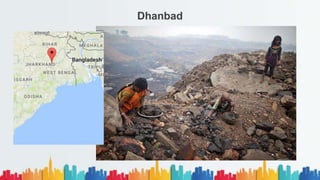
Dhanbad
Delhi
We were like two separate cities—inside and outside the dark egg” (White Tiger 116)
Delhi
The rich live in “big housing colonies” (White Tiger 98) and the poor “live on the sides of the road in Delhi” (White Ti
ger 99).
Gurgaon (Delhi)
To escape the “Darkness”, the rural hinterland where he comes from, he
undermines the values that he has been forced to follow all his life.
- First of all, he goes to the Dehli Zoo. In the observation of the tiger, he realizes he has been trapped in a
cage all his life.
-In the second place, Balram starts to be illuminated by poetry:
“You were looking for the keys for years, but the door was always open” (216)
and "The moment you recognise what is beautiful in this world, you stop being a slave" (236).
- The final change comes when the city starts to speak to him in the language of the war:
My heart was bitter that night. The city knew this—and under the dim orange glow cast everywhere by th
e weal streetlamps, she was bitter.
Speak to me of civil war, I told Delhi.
I will, she said (White Tiger 188)
Balram undergoes three changes
Bangalore (Silicon Valley)
Conclusion
Saleem’s family’s migration in Midnight’s Childre
n
mirrors the political and social uncertainty of the
history of modern India:
- The Jallianwala Bagh massacre
- The Quit India movement launched by Gandhi
- The partition of India
- The post-independence riots
- The rise and success of Bollywood
- The war with Pakistan
- Indira Gandhi’s State of Emergency
Midnight’s Children
Conclusion
The White Tiger depicts the city of New Delhi
as a centre where complex economic changes
have given way to the rise of new industries such
as technology, trade and outsourcing for the USA.
The protagonist becomes an ambitious choreograph
er
of the urban inventorie in New Delhi and Bangalore,
cities with extraordinary energetic creativity and
opportunities, of worldliness and ambition, the
enactment of globalization.
The White Tiger
PATRICIA ÁLVAREZ SÁNCHEZ
Patriciaalvarezsanchez@gmail.com
THANK YOU

Eaclals Conference

  • 1.
    PATRICIA ÁLVAREZ SÁNCHEZ Universityof Málaga Urban Landscapes in India: From Political Uncertainty in Rushdie’s Midnight’s Children to Globalization in Adiga’s The White Tiger
  • 2.
  • 3.
    Srinagar (Kashmir) In thosedays there was no army camp at the lakeside, no endless snakes […] no soldiers hid behind the crests of the mountains... In those days travellers were no t shot as spies if they took photographs of bridges, and apart from the Englishme n's houseboats on the lake, the valley had hardly changed since the Mughal Empire … (Midnight’s Children 5)
  • 4.
  • 5.
    The Jallianwala BaghMassacre (1919) in Amritsar
  • 6.
  • 7.
  • 8.
    Aravind Adiga’s TheWhite Tiger (2008)
  • 9.
  • 10.
  • 11.
    Delhi We were liketwo separate cities—inside and outside the dark egg” (White Tiger 116)
  • 12.
    Delhi The rich livein “big housing colonies” (White Tiger 98) and the poor “live on the sides of the road in Delhi” (White Ti ger 99).
  • 13.
  • 14.
    To escape the“Darkness”, the rural hinterland where he comes from, he undermines the values that he has been forced to follow all his life. - First of all, he goes to the Dehli Zoo. In the observation of the tiger, he realizes he has been trapped in a cage all his life. -In the second place, Balram starts to be illuminated by poetry: “You were looking for the keys for years, but the door was always open” (216) and "The moment you recognise what is beautiful in this world, you stop being a slave" (236). - The final change comes when the city starts to speak to him in the language of the war: My heart was bitter that night. The city knew this—and under the dim orange glow cast everywhere by th e weal streetlamps, she was bitter. Speak to me of civil war, I told Delhi. I will, she said (White Tiger 188) Balram undergoes three changes
  • 15.
  • 16.
    Conclusion Saleem’s family’s migrationin Midnight’s Childre n mirrors the political and social uncertainty of the history of modern India: - The Jallianwala Bagh massacre - The Quit India movement launched by Gandhi - The partition of India - The post-independence riots - The rise and success of Bollywood - The war with Pakistan - Indira Gandhi’s State of Emergency Midnight’s Children
  • 17.
    Conclusion The White Tigerdepicts the city of New Delhi as a centre where complex economic changes have given way to the rise of new industries such as technology, trade and outsourcing for the USA. The protagonist becomes an ambitious choreograph er of the urban inventorie in New Delhi and Bangalore, cities with extraordinary energetic creativity and opportunities, of worldliness and ambition, the enactment of globalization. The White Tiger
  • 18.