E2P
(Enterprise-to-Person)
vs P2P
(Person-to-Person)
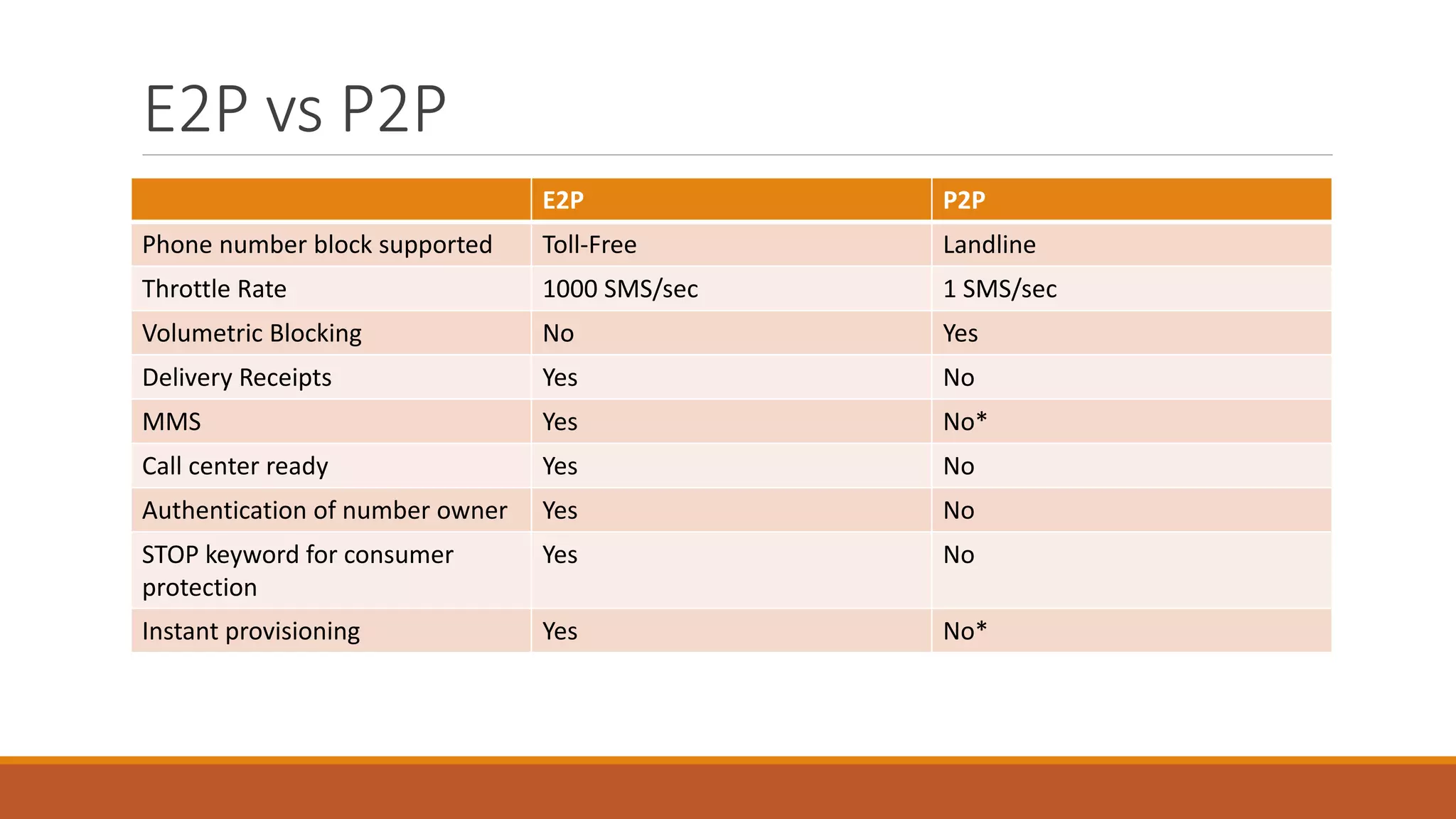
E2P vs P2P
E2P P2P
Phone number block supported Toll-Free Landline
Throttle Rate 1000 SMS/sec 1 SMS/sec
Volumetric Blocking No Yes
Delivery Receipts Yes No
MMS Yes No*
Call center ready Yes No
Authentication of number owner Yes No
STOP keyword for consumer
protection
Yes No
Instant provisioning Yes No*
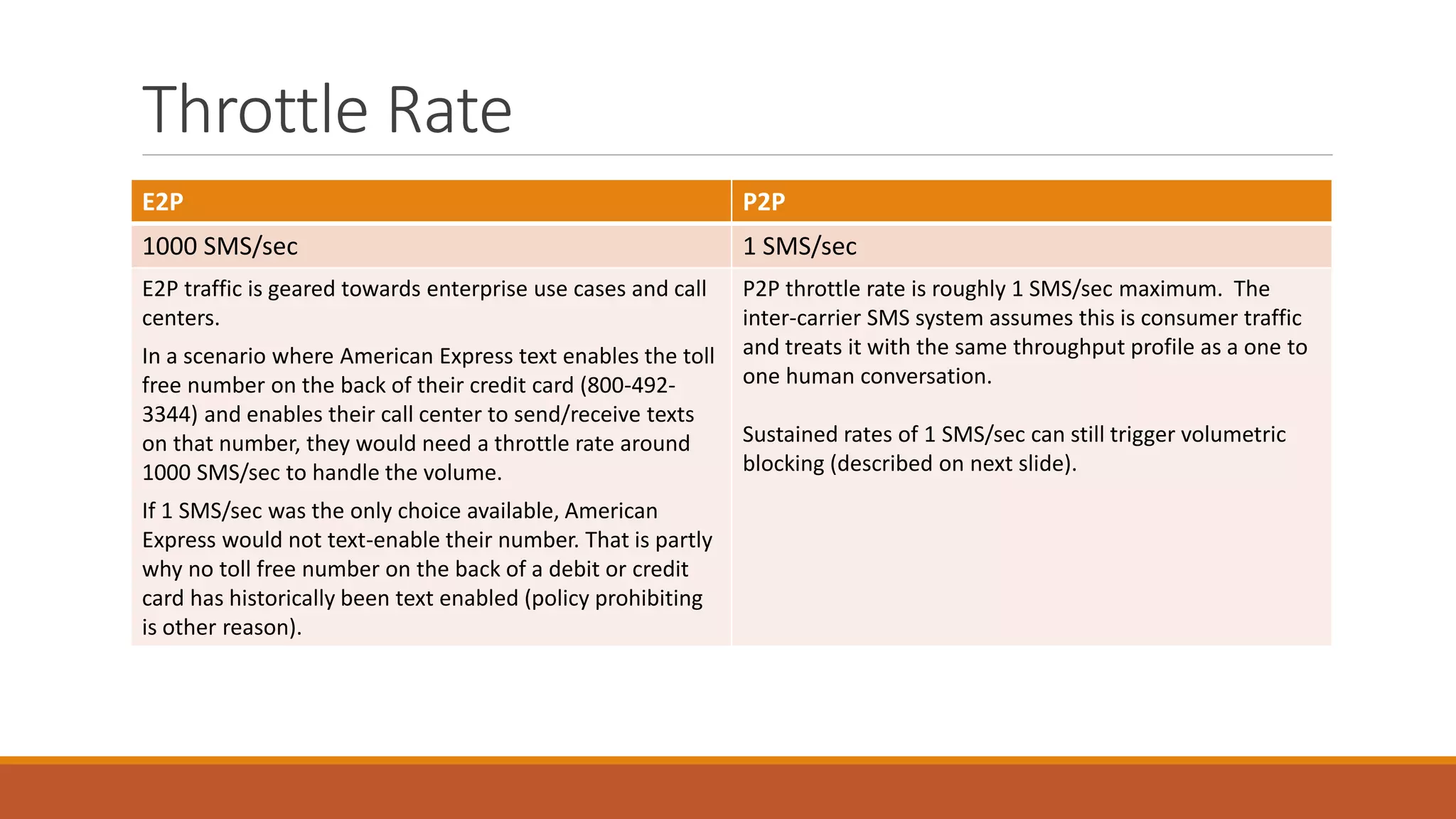
Throttle Rate
E2P P2P
1000 SMS/sec 1 SMS/sec
E2P traffic is geared towards enterprise use cases and call
centers.
In a scenario where American Express text enables the toll
free number on the back of their credit card (800-492-
3344) and enables their call center to send/receive texts
on that number, they would need a throttle rate around
1000 SMS/sec to handle the volume.
If 1 SMS/sec was the only choice available, American
Express would not text-enable their number. That is partly
why no toll free number on the back of a debit or credit
card has historically been text enabled (policy prohibiting
is other reason).
P2P throttle rate is roughly 1 SMS/sec maximum. The
inter-carrier SMS system assumes this is consumer traffic
and treats it with the same throughput profile as a one to
one human conversation.
Sustained rates of 1 SMS/sec can still trigger volumetric
blocking (described on next slide).
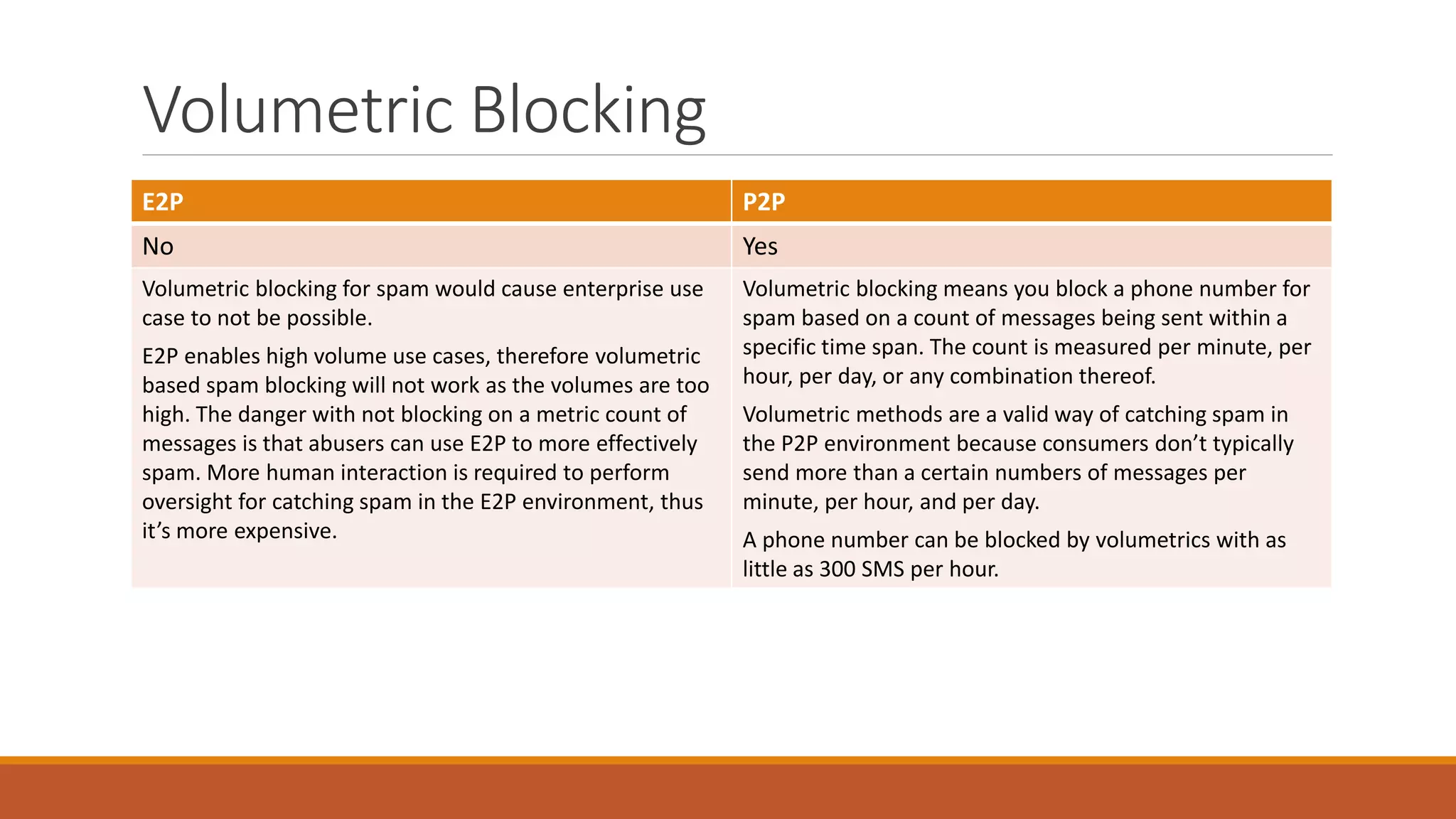
Volumetric Blocking
E2P P2P
No Yes
Volumetric blocking for spam would cause enterprise use
case to not be possible.
E2P enables high volume use cases, therefore volumetric
based spam blocking will not work as the volumes are too
high. The danger with not blocking on a metric count of
messages is that abusers can use E2P to more effectively
spam. More human interaction is required to perform
oversight for catching spam in the E2P environment, thus
it’s more expensive.
Volumetric blocking means you block a phone number for
spam based on a count of messages being sent within a
specific time span. The count is measured per minute, per
hour, per day, or any combination thereof.
Volumetric methods are a valid way of catching spam in
the P2P environment because consumers don’t typically
send more than a certain numbers of messages per
minute, per hour, and per day.
A phone number can be blocked by volumetrics with as
little as 300 SMS per hour.
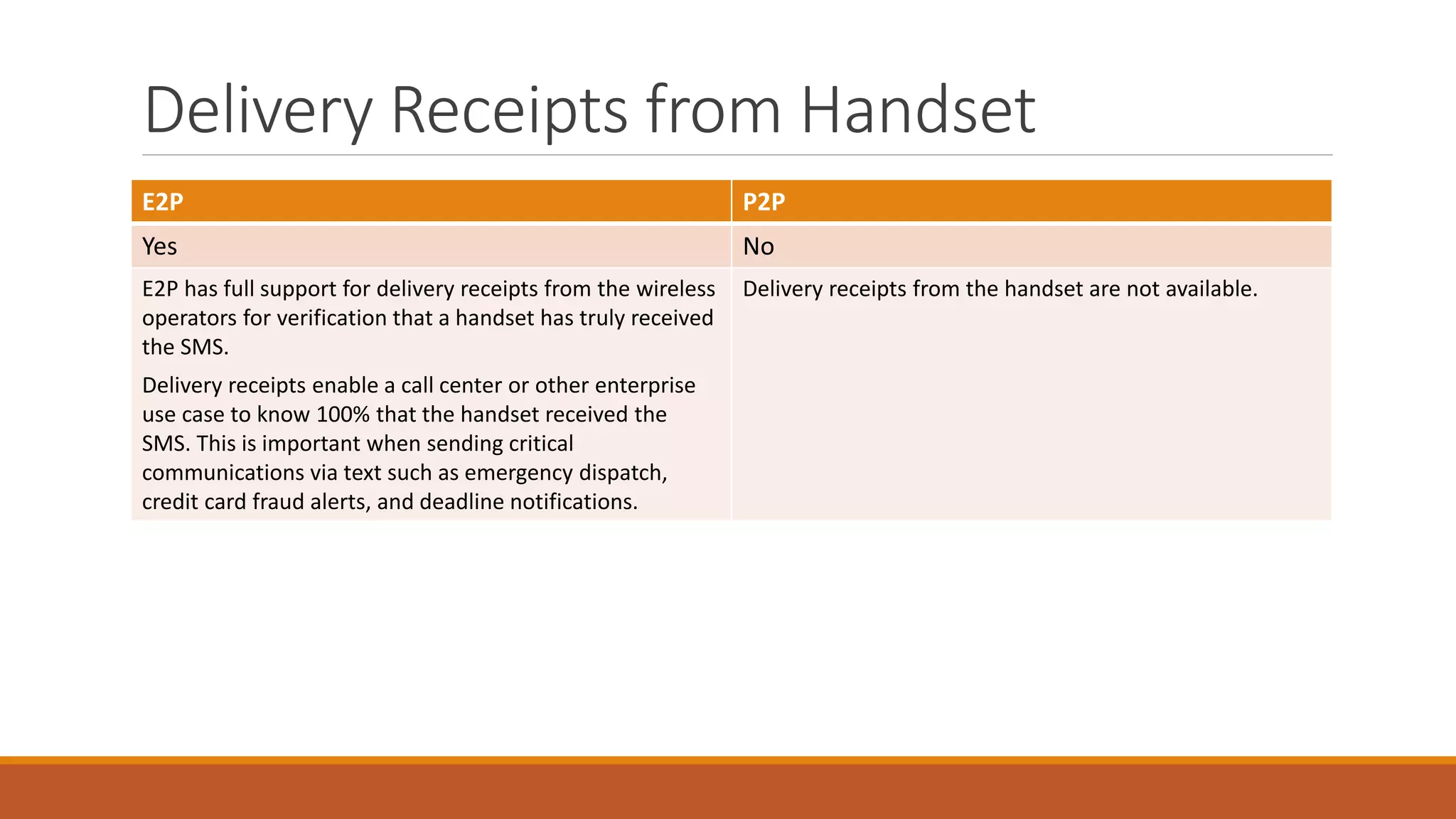
Delivery Receipts from Handset
E2P P2P
Yes No
E2P has full support for delivery receipts from the wireless
operators for verification that a handset has truly received
the SMS.
Delivery receipts enable a call center or other enterprise
use case to know 100% that the handset received the
SMS. This is important when sending critical
communications via text such as emergency dispatch,
credit card fraud alerts, and deadline notifications.
Delivery receipts from the handset are not available.
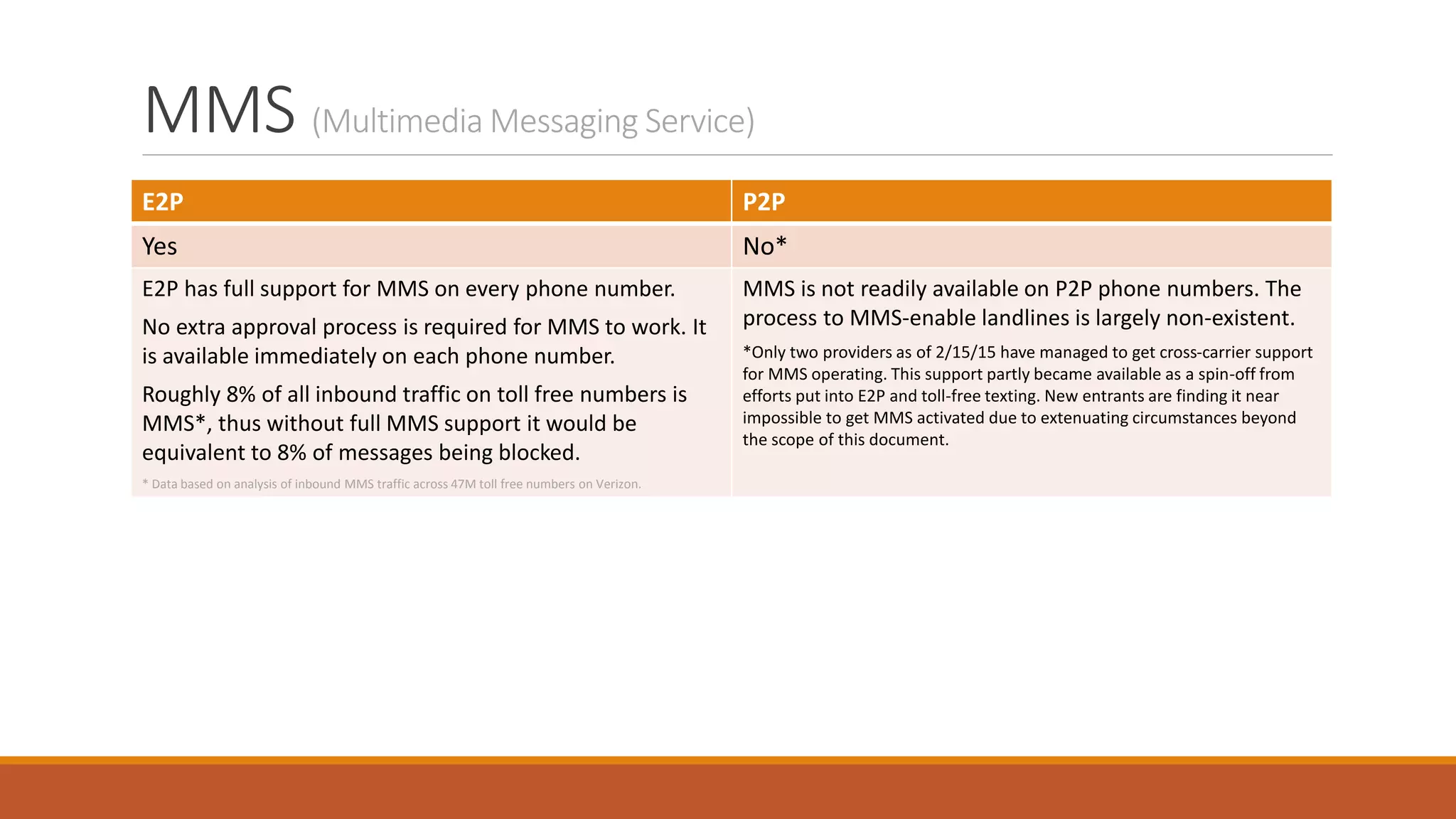
MMS (Multimedia Messaging Service)
E2P P2P
Yes No*
E2P has full support for MMS on every phone number.
No extra approval process is required for MMS to work. It
is available immediately on each phone number.
Roughly 8% of all inbound traffic on toll free numbers is
MMS*, thus without full MMS support it would be
equivalent to 8% of messages being blocked.
* Data based on analysis of inbound MMS traffic across 47M toll free numbers on Verizon.
MMS is not readily available on P2P phone numbers. The
process to MMS-enable landlines is largely non-existent.
*Only two providers as of 2/15/15 have managed to get cross-carrier support
for MMS operating. This support partly became available as a spin-off from
efforts put into E2P and toll-free texting. New entrants are finding it near
impossible to get MMS activated due to extenuating circumstances beyond
the scope of this document.
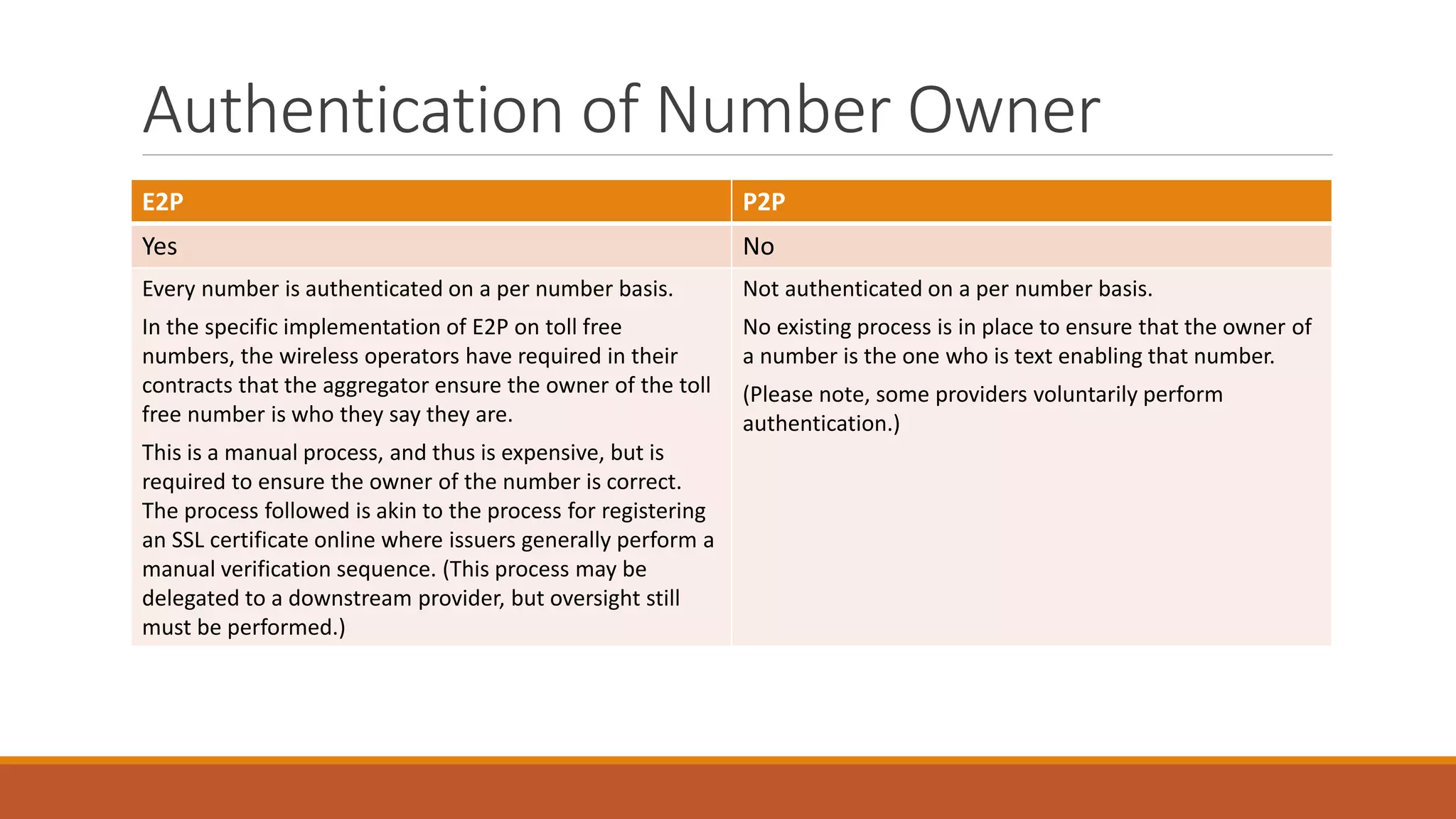
Authentication of Number Owner
E2P P2P
Yes No
Every number is authenticated on a per number basis.
In the specific implementation of E2P on toll free
numbers, the wireless operators have required in their
contracts that the aggregator ensure the owner of the toll
free number is who they say they are.
This is a manual process, and thus is expensive, but is
required to ensure the owner of the number is correct.
The process followed is akin to the process for registering
an SSL certificate online where issuers generally perform a
manual verification sequence. (This process may be
delegated to a downstream provider, but oversight still
must be performed.)
Not authenticated on a per number basis.
No existing process is in place to ensure that the owner of
a number is the one who is text enabling that number.
(Please note, some providers voluntarily perform
authentication.)
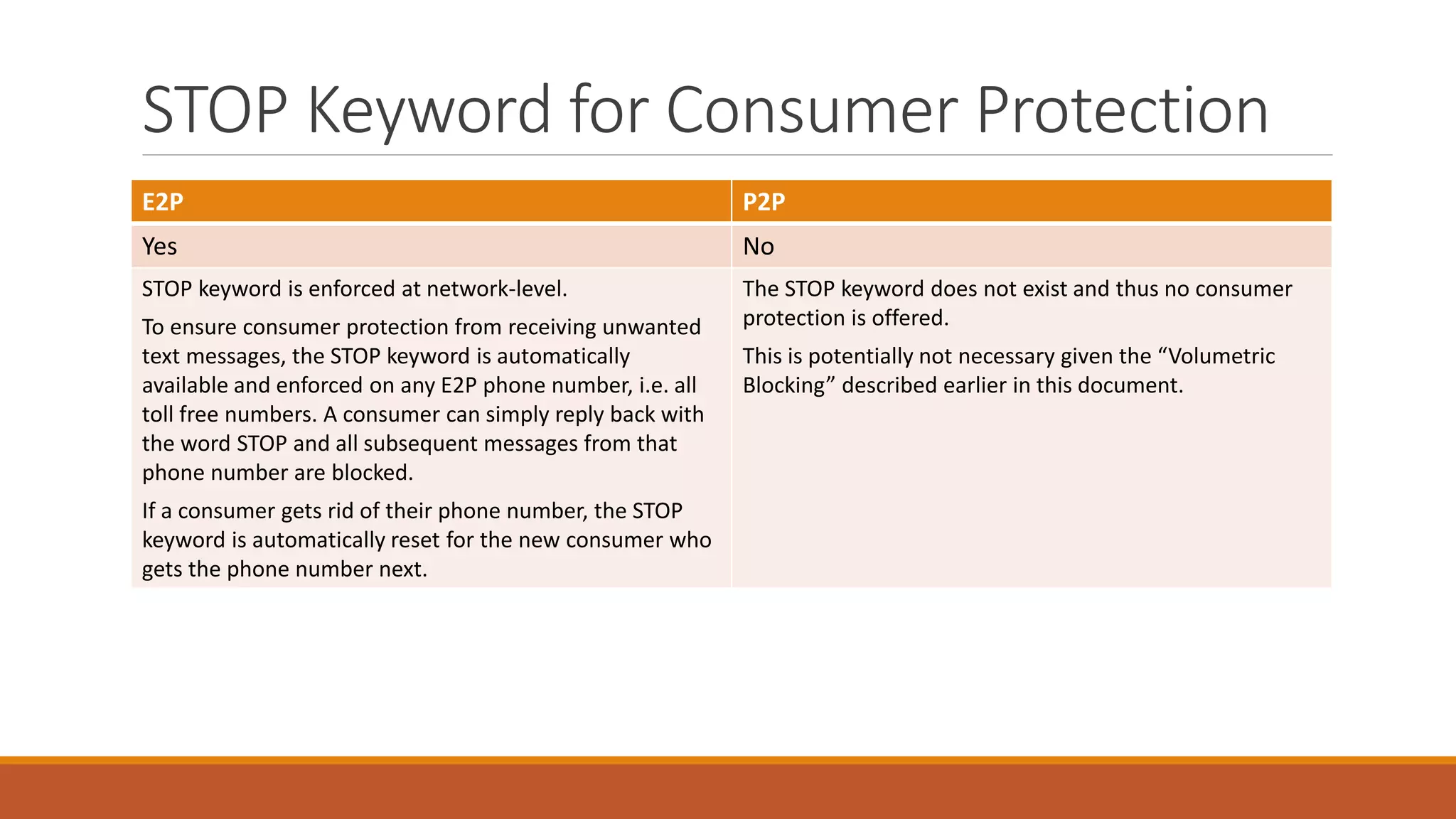
STOP Keyword for Consumer Protection
E2P P2P
Yes No
STOP keyword is enforced at network-level.
To ensure consumer protection from receiving unwanted
text messages, the STOP keyword is automatically
available and enforced on any E2P phone number, i.e. all
toll free numbers. A consumer can simply reply back with
the word STOP and all subsequent messages from that
phone number are blocked.
If a consumer gets rid of their phone number, the STOP
keyword is automatically reset for the new consumer who
gets the phone number next.
The STOP keyword does not exist and thus no consumer
protection is offered.
This is potentially not necessary given the “Volumetric
Blocking” described earlier in this document.
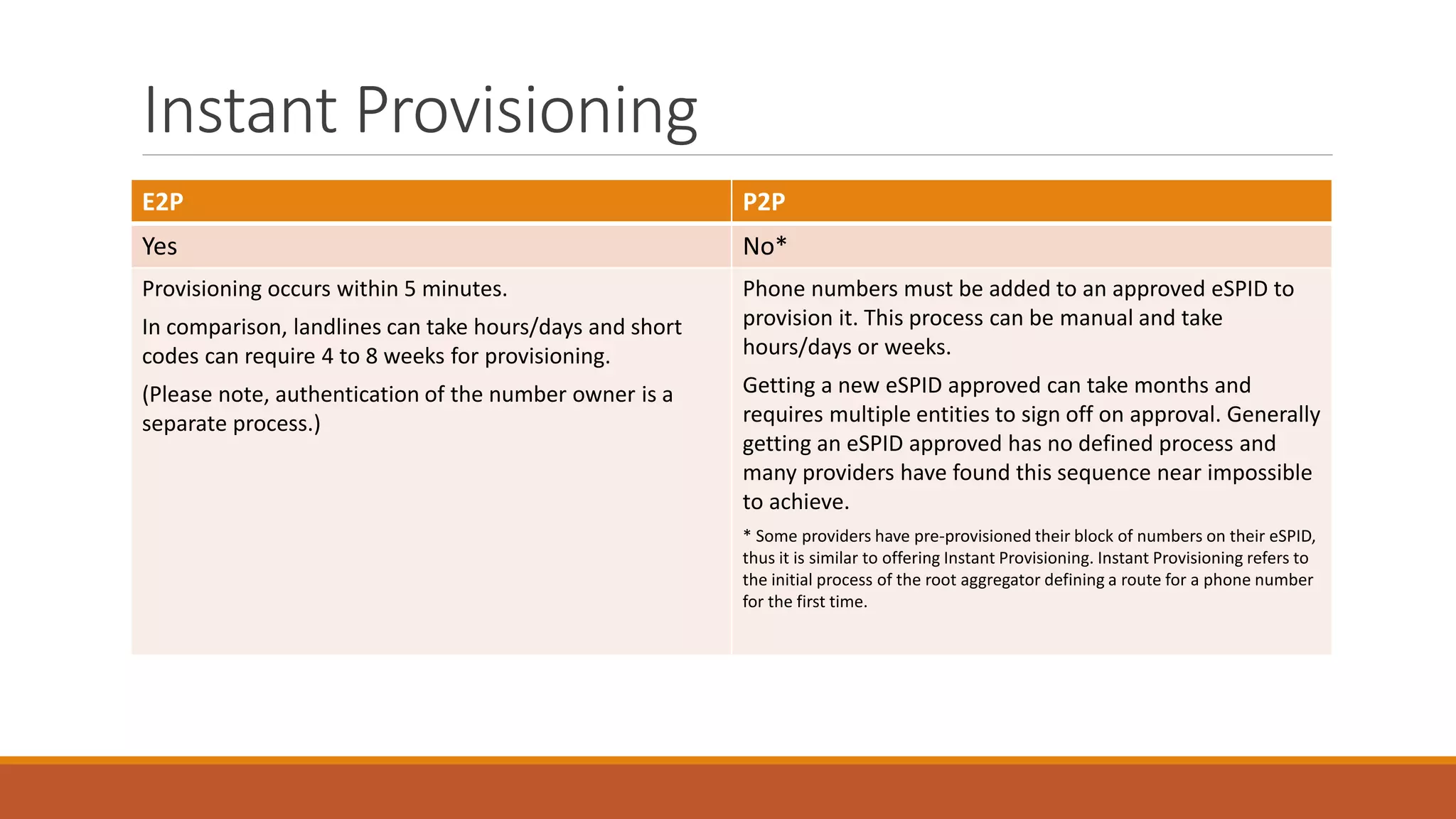
Instant Provisioning
E2P P2P
Yes No*
Provisioning occurs within 5 minutes.
In comparison, landlines can take hours/days and short
codes can require 4 to 8 weeks for provisioning.
(Please note, authentication of the number owner is a
separate process.)
Phone numbers must be added to an approved eSPID to
provision it. This process can be manual and take
hours/days or weeks.
Getting a new eSPID approved can take months and
requires multiple entities to sign off on approval. Generally
getting an eSPID approved has no defined process and
many providers have found this sequence near impossible
to achieve.
* Some providers have pre-provisioned their block of numbers on their eSPID,
thus it is similar to offering Instant Provisioning. Instant Provisioning refers to
the initial process of the root aggregator defining a route for a phone number
for the first time.

E2p vs p2p summary

  • 1.
  • 2.
    E2P vs P2P E2PP2P Phone number block supported Toll-Free Landline Throttle Rate 1000 SMS/sec 1 SMS/sec Volumetric Blocking No Yes Delivery Receipts Yes No MMS Yes No* Call center ready Yes No Authentication of number owner Yes No STOP keyword for consumer protection Yes No Instant provisioning Yes No*
  • 3.
    Throttle Rate E2P P2P 1000SMS/sec 1 SMS/sec E2P traffic is geared towards enterprise use cases and call centers. In a scenario where American Express text enables the toll free number on the back of their credit card (800-492- 3344) and enables their call center to send/receive texts on that number, they would need a throttle rate around 1000 SMS/sec to handle the volume. If 1 SMS/sec was the only choice available, American Express would not text-enable their number. That is partly why no toll free number on the back of a debit or credit card has historically been text enabled (policy prohibiting is other reason). P2P throttle rate is roughly 1 SMS/sec maximum. The inter-carrier SMS system assumes this is consumer traffic and treats it with the same throughput profile as a one to one human conversation. Sustained rates of 1 SMS/sec can still trigger volumetric blocking (described on next slide).
  • 4.
    Volumetric Blocking E2P P2P NoYes Volumetric blocking for spam would cause enterprise use case to not be possible. E2P enables high volume use cases, therefore volumetric based spam blocking will not work as the volumes are too high. The danger with not blocking on a metric count of messages is that abusers can use E2P to more effectively spam. More human interaction is required to perform oversight for catching spam in the E2P environment, thus it’s more expensive. Volumetric blocking means you block a phone number for spam based on a count of messages being sent within a specific time span. The count is measured per minute, per hour, per day, or any combination thereof. Volumetric methods are a valid way of catching spam in the P2P environment because consumers don’t typically send more than a certain numbers of messages per minute, per hour, and per day. A phone number can be blocked by volumetrics with as little as 300 SMS per hour.
  • 5.
    Delivery Receipts fromHandset E2P P2P Yes No E2P has full support for delivery receipts from the wireless operators for verification that a handset has truly received the SMS. Delivery receipts enable a call center or other enterprise use case to know 100% that the handset received the SMS. This is important when sending critical communications via text such as emergency dispatch, credit card fraud alerts, and deadline notifications. Delivery receipts from the handset are not available.
  • 6.
    MMS (Multimedia MessagingService) E2P P2P Yes No* E2P has full support for MMS on every phone number. No extra approval process is required for MMS to work. It is available immediately on each phone number. Roughly 8% of all inbound traffic on toll free numbers is MMS*, thus without full MMS support it would be equivalent to 8% of messages being blocked. * Data based on analysis of inbound MMS traffic across 47M toll free numbers on Verizon. MMS is not readily available on P2P phone numbers. The process to MMS-enable landlines is largely non-existent. *Only two providers as of 2/15/15 have managed to get cross-carrier support for MMS operating. This support partly became available as a spin-off from efforts put into E2P and toll-free texting. New entrants are finding it near impossible to get MMS activated due to extenuating circumstances beyond the scope of this document.
  • 7.
    Authentication of NumberOwner E2P P2P Yes No Every number is authenticated on a per number basis. In the specific implementation of E2P on toll free numbers, the wireless operators have required in their contracts that the aggregator ensure the owner of the toll free number is who they say they are. This is a manual process, and thus is expensive, but is required to ensure the owner of the number is correct. The process followed is akin to the process for registering an SSL certificate online where issuers generally perform a manual verification sequence. (This process may be delegated to a downstream provider, but oversight still must be performed.) Not authenticated on a per number basis. No existing process is in place to ensure that the owner of a number is the one who is text enabling that number. (Please note, some providers voluntarily perform authentication.)
  • 8.
    STOP Keyword forConsumer Protection E2P P2P Yes No STOP keyword is enforced at network-level. To ensure consumer protection from receiving unwanted text messages, the STOP keyword is automatically available and enforced on any E2P phone number, i.e. all toll free numbers. A consumer can simply reply back with the word STOP and all subsequent messages from that phone number are blocked. If a consumer gets rid of their phone number, the STOP keyword is automatically reset for the new consumer who gets the phone number next. The STOP keyword does not exist and thus no consumer protection is offered. This is potentially not necessary given the “Volumetric Blocking” described earlier in this document.
  • 9.
    Instant Provisioning E2P P2P YesNo* Provisioning occurs within 5 minutes. In comparison, landlines can take hours/days and short codes can require 4 to 8 weeks for provisioning. (Please note, authentication of the number owner is a separate process.) Phone numbers must be added to an approved eSPID to provision it. This process can be manual and take hours/days or weeks. Getting a new eSPID approved can take months and requires multiple entities to sign off on approval. Generally getting an eSPID approved has no defined process and many providers have found this sequence near impossible to achieve. * Some providers have pre-provisioned their block of numbers on their eSPID, thus it is similar to offering Instant Provisioning. Instant Provisioning refers to the initial process of the root aggregator defining a route for a phone number for the first time.