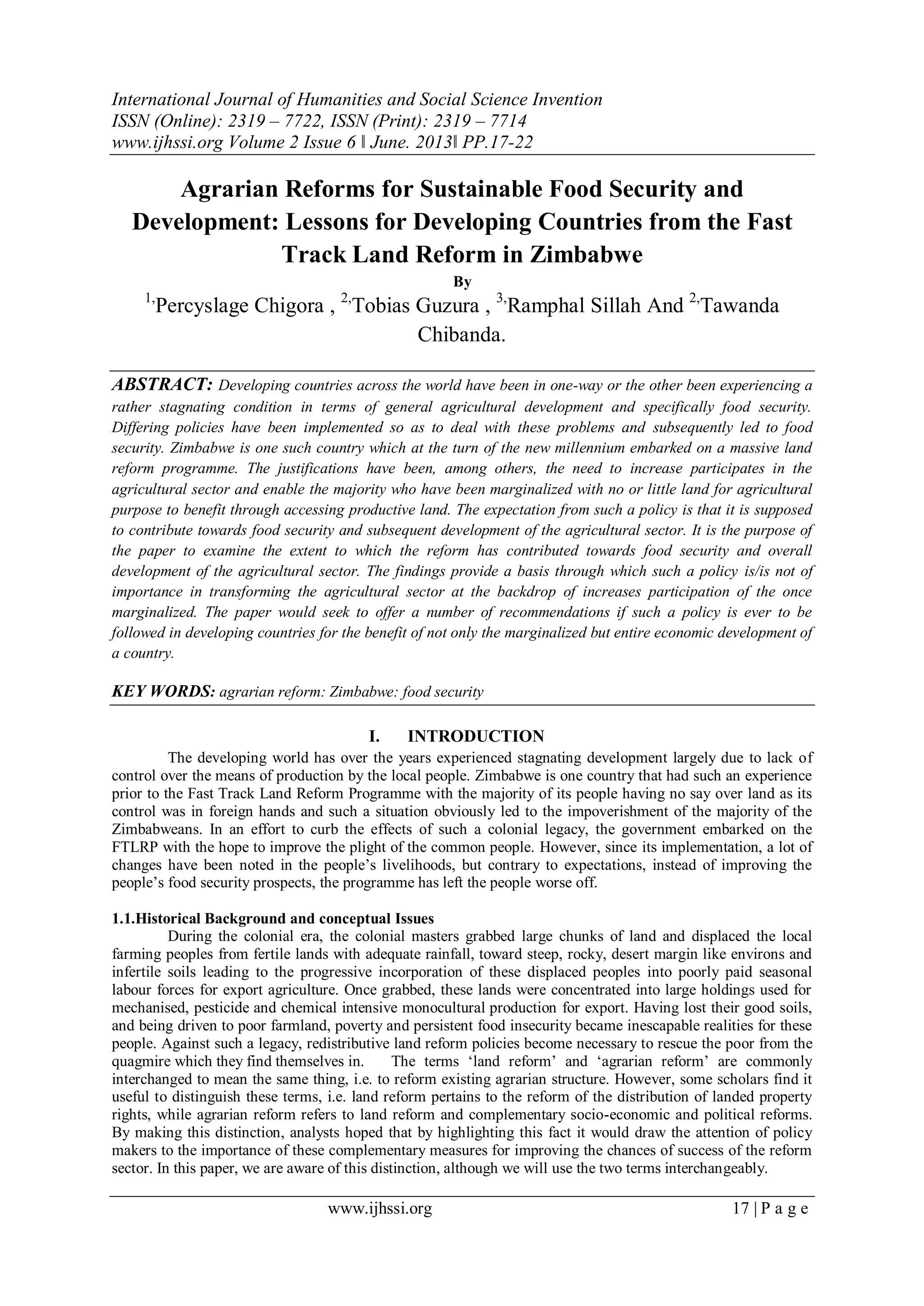
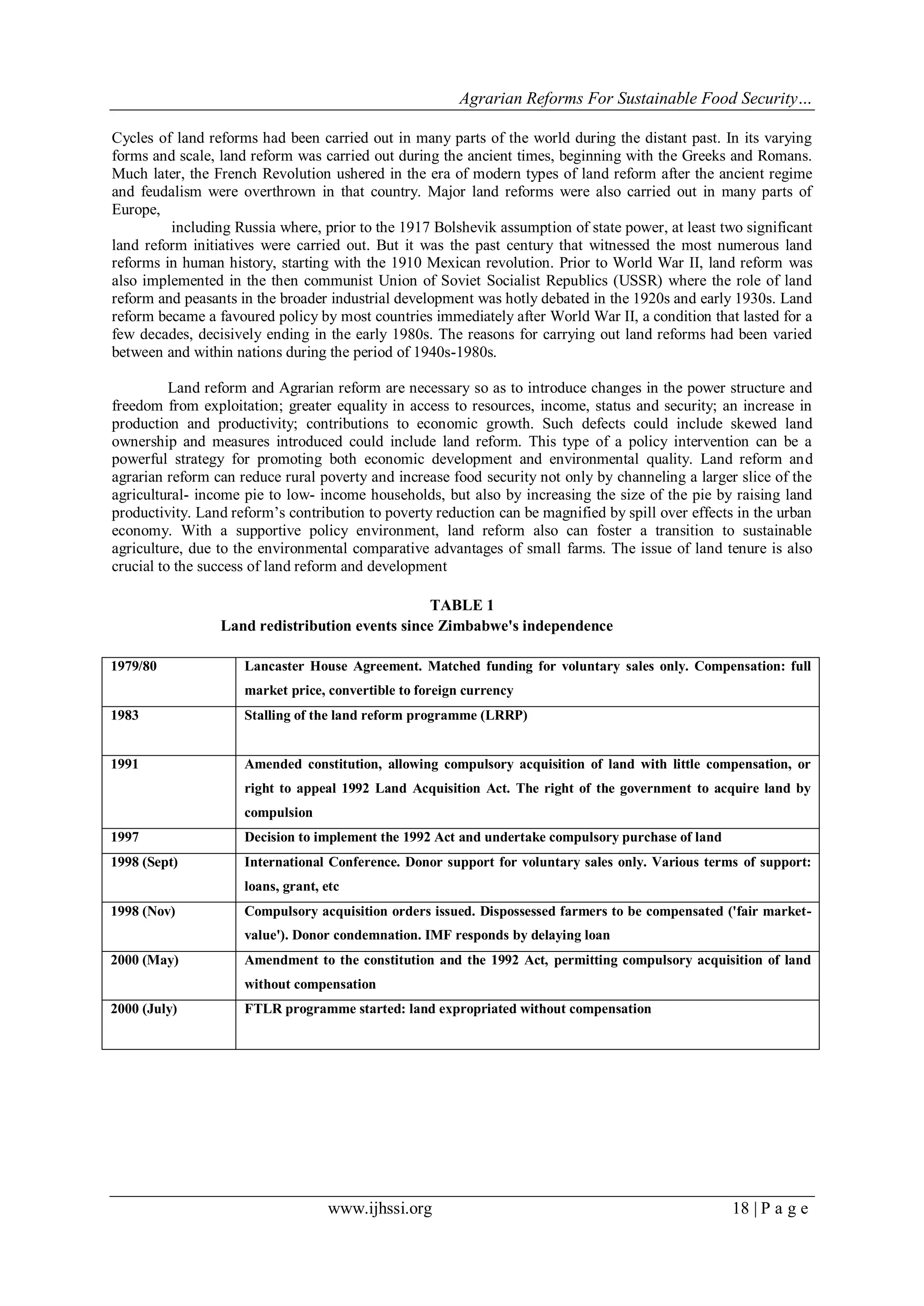
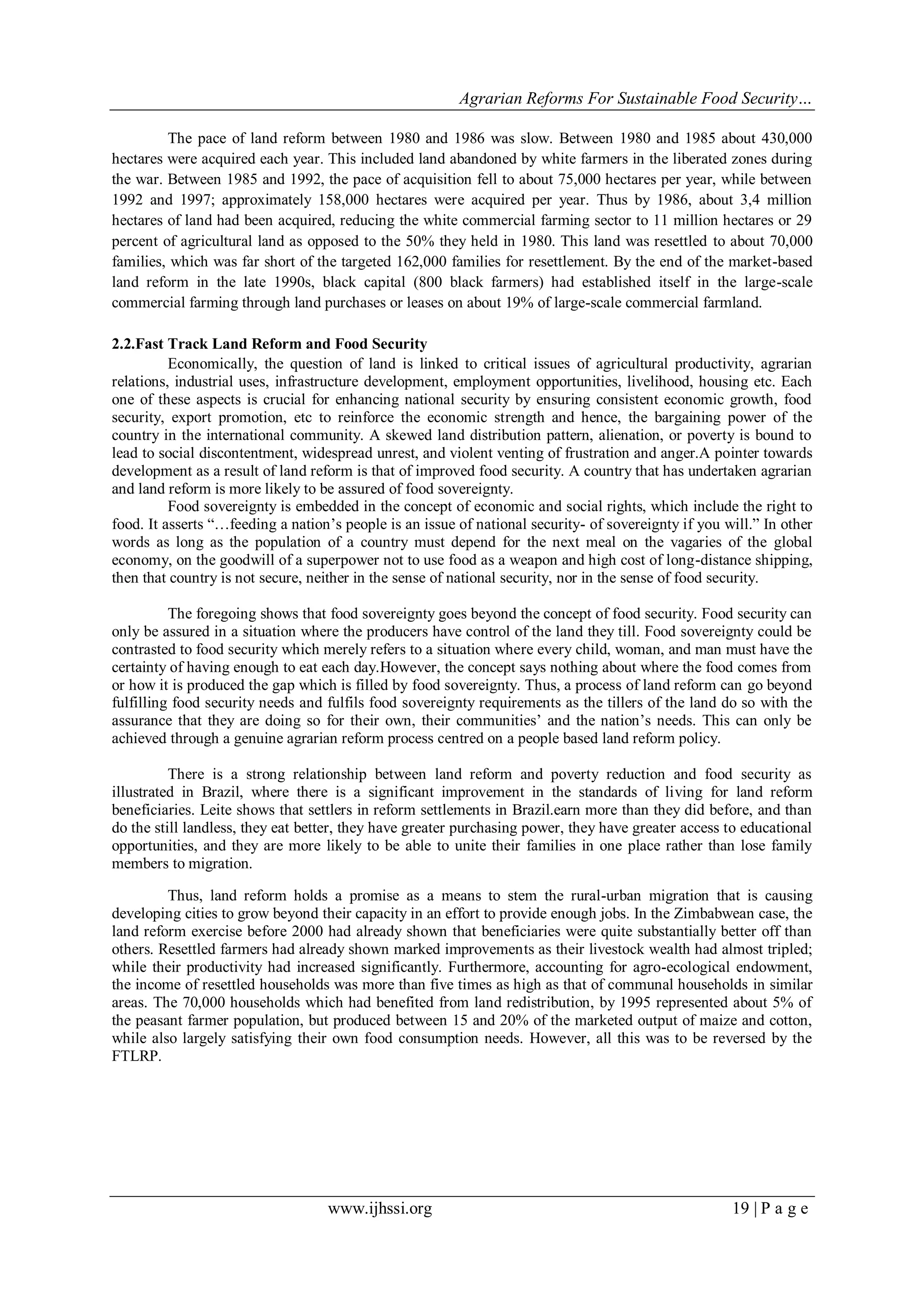
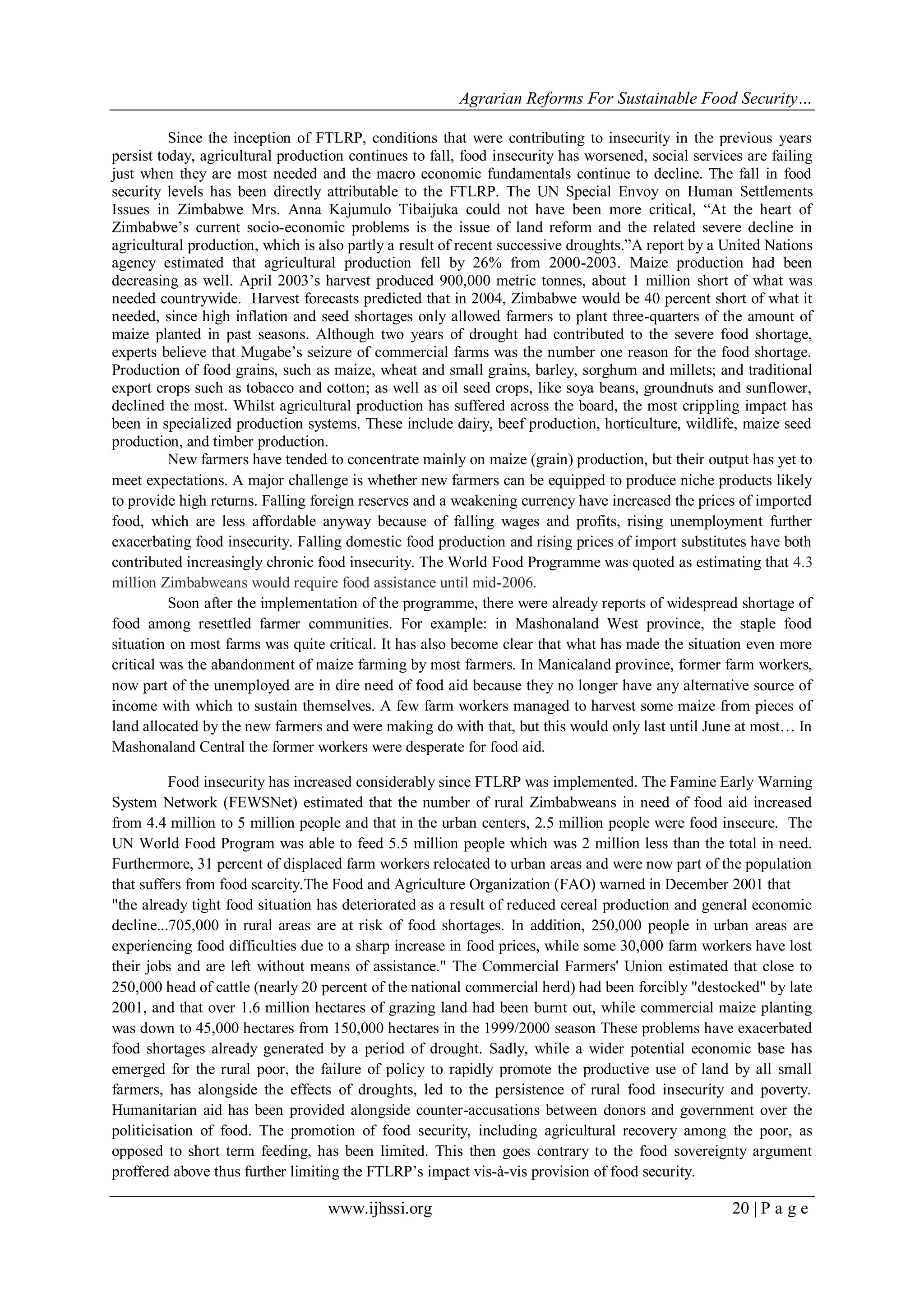
The paper analyzes the fast track land reform program in Zimbabwe and its impact on food security and agricultural development, revealing that rather than enhancing food security, the program worsened conditions for many farmers. It discusses the historical context of land ownership in Zimbabwe and contrasts the expectations of the reform with the actual outcomes, which included a decline in agricultural production and increased food insecurity. The authors propose that successful land reform requires integrated socio-economic reforms and recommendations for policymakers in developing countries to learn from Zimbabwe's experience.
![Agrarian Reforms For Sustainable Food Security…
www.ijhssi.org 22 | P a g e
REFERENCES
[1] Deininger K, et al How Land reform can contribute to economic growth and poverty: Empirical evidence from international and
Zimbabwe experience (Harare, SARIPS, 2000)
[2] EIU Zimbabwe Country Report, March 2004.
[3] FAO, "Food Supply Situation Tightening in Southern Africa," Africa Report No. 3, December 2001, @ www.fao.org. 23/09/08
[4] FCTZ (2002b) Assessment of the Impact of the Land Reform Programme on Commercial Farm Worker Livelihoods, Harare
[5] Kinsey, B.H., „Land Reform, Growth and Equity: Emerging Evidence from Zimbabwe‟s Resettlement Program‟, Journal of
Southern African Studies, 25, 2 (1999) 178
[6] UNDP, 2 November 2005
[7] Leite, S, et al Impactos dos Assentamentos: Um Estudo sobre o Meio Rural Brasileiro. (Brasilia, Nucleo de Estudos Agrarios e
Desenvolvimento Rural (NEAD), 2004)
[8] Moyo, S. 1995. The Land Question in Zimbabwe, Harare: SAPES Books.
[9] Prosterman, Roy, Mary Temple, and Timothy Hanstad (eds) Agrarian Reform and Grassroots Development: Ten Cases.
Boulder: Lynne Rienner Publishers. 1990
[10] Sobhan, R Agrarian Reform and Social Transformation: Preconditions for Development (London, Zed Books, 1993) 23
[11] Thiesenhusen, W (ed.) Searching for Agrarian Reform in Latin America. Boston: Unwin Hyman. 1989 7-9
[12] Wines, Michael."In Zimbabwe, Even the Farmers Are Going Hungry," The New York Times, 29 February 2004.
[13] Ziegler, J “Economic, Social and Cultural Rights: The Right to Food - A Report submitted by the Special Rapporteur on the right
to food in accordance with Commission on Human Rights Resolution 2003/25” (Geneva, UN Commission on Human Rights,
E/CN. 4/2004/10, 9 February 2004)](https://image.slidesharecdn.com/e0263017022-130711021600-phpapp01/75/International-Journal-of-Humanities-and-Social-Science-Invention-IJHSSI-6-2048.jpg)


![Coded Agents – with UiPath SDK + LangGraph [Virtual Hands-on Workshop]](https://cdn.slidesharecdn.com/ss_thumbnails/codedagentsdeck-251215155422-5497c599-thumbnail.jpg?width=640&height=640&fit=bounds)
