E-learning
Definition:
1. A learning system based on formalised teaching but with the help of
electronic resources is known as E-learning.
2. E-learning refers to a learning system that we can obtain through the internet
using an electronic device. We also call it online learning or online education.
The ‘E’ in E-learning stands for ‘Electronic.’ Hence, the original term
‘electronic learning.’
These are the 10 different types of e-learning:
1) Computer Managed Learning (CML)
2) Computer Assisted Instruction (CAI)
3) Synchronous Online Learning
4) Asynchronous Online Learning
5) Fixed E-Learning
6) Adaptive E-Learning
7) Linear E-Learning
8) Interactive Online Learning
9) Individual Online Learning
10)Collaborative Online Learning
Purpose
To increase spare energy from
student on material that learned
Increase active
participation
from them
Increase independent
learn skills
Increase learning
material quality
Implementation of e-learning:
• Website or webpage
• Links
• Chat client
• Quizzes
• Database management
• Record system and logs
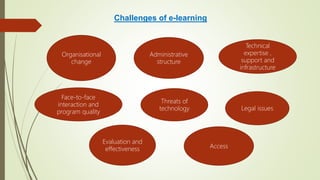
Organisational
change
Access
Administrative
structure
Technical
expertise ,
support and
infrastructure
Face-to-face
interaction and
program quality
Threats of
technology Legal issues
Evaluation and
effectiveness
Challenges of e-learning
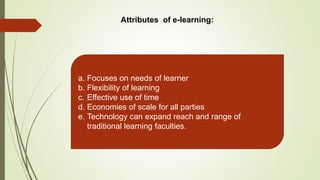
Attributes of e-learning:
a. Focuses on needs of learner
b. Flexibility of learning
c. Effective use of time
d. Economies of scale for all parties
e. Technology can expand reach and range of
traditional learning faculties.
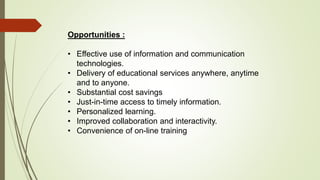
Opportunities :
• Effective use of information and communication
technologies.
• Delivery of educational services anywhere, anytime
and to anyone.
• Substantial cost savings
• Just-in-time access to timely information.
• Personalized learning.
• Improved collaboration and interactivity.
• Convenience of on-line training
Advantages Of eLearning :
1. You are able to link the various resources in several varying formats.
2. It is a very efficient way of delivering courses online.
3. Due to its convenience and flexibility, the resources are available from anywhere and
at any time.
4. Everyone, who are part time students or are working full time, can take advantage of
web-based learning.
5. Web-based learning promotes active and independent learning.
6. As you have access to the net 24x7, you can train yourself anytime and from
anywhere also.
7. It is a very convenient and flexible option; above all, you don't have to depend on
anyone for anything.
8. Not only can you train yourself on a day to day basis, but also on weekends or
whenever you have the free time to. There is no hard and fast rule.
9. Through discussion boards and chats, you are able to interact with everyone online
and also clear your doubts if any.
10.The video instructions that are provided for audio and video learning can be rewound
and seen and heard again and again if you do not happen to understand the topic
first time around.
Disadvantages Of eLearning :
1. The face-to-face learning experience is missing.
2. Most of the online assessments are limited to questions that are only objective in
nature.
3. There is also the problem of the extent of security of online learning programs.
4. The authenticity of a particular student's work is also a problem as online just about
anyone can do a project rather than the actual student itself.
5. The assessments that are computer marked generally have a tendency of being
only knowledge-based and not necessarily practicality-based.

E learning

  • 1.
  • 2.
    Definition: 1. A learningsystem based on formalised teaching but with the help of electronic resources is known as E-learning. 2. E-learning refers to a learning system that we can obtain through the internet using an electronic device. We also call it online learning or online education. The ‘E’ in E-learning stands for ‘Electronic.’ Hence, the original term ‘electronic learning.’
  • 3.
    These are the10 different types of e-learning: 1) Computer Managed Learning (CML) 2) Computer Assisted Instruction (CAI) 3) Synchronous Online Learning 4) Asynchronous Online Learning 5) Fixed E-Learning 6) Adaptive E-Learning 7) Linear E-Learning 8) Interactive Online Learning 9) Individual Online Learning 10)Collaborative Online Learning
  • 4.
    Purpose To increase spareenergy from student on material that learned Increase active participation from them Increase independent learn skills Increase learning material quality
  • 5.
    Implementation of e-learning: •Website or webpage • Links • Chat client • Quizzes • Database management • Record system and logs
  • 7.
    Organisational change Access Administrative structure Technical expertise , support and infrastructure Face-to-face interactionand program quality Threats of technology Legal issues Evaluation and effectiveness Challenges of e-learning
  • 8.
    Attributes of e-learning: a.Focuses on needs of learner b. Flexibility of learning c. Effective use of time d. Economies of scale for all parties e. Technology can expand reach and range of traditional learning faculties.
  • 9.
    Opportunities : • Effectiveuse of information and communication technologies. • Delivery of educational services anywhere, anytime and to anyone. • Substantial cost savings • Just-in-time access to timely information. • Personalized learning. • Improved collaboration and interactivity. • Convenience of on-line training
  • 10.
    Advantages Of eLearning: 1. You are able to link the various resources in several varying formats. 2. It is a very efficient way of delivering courses online. 3. Due to its convenience and flexibility, the resources are available from anywhere and at any time. 4. Everyone, who are part time students or are working full time, can take advantage of web-based learning. 5. Web-based learning promotes active and independent learning. 6. As you have access to the net 24x7, you can train yourself anytime and from anywhere also. 7. It is a very convenient and flexible option; above all, you don't have to depend on anyone for anything. 8. Not only can you train yourself on a day to day basis, but also on weekends or whenever you have the free time to. There is no hard and fast rule. 9. Through discussion boards and chats, you are able to interact with everyone online and also clear your doubts if any. 10.The video instructions that are provided for audio and video learning can be rewound and seen and heard again and again if you do not happen to understand the topic first time around.
  • 11.
    Disadvantages Of eLearning: 1. The face-to-face learning experience is missing. 2. Most of the online assessments are limited to questions that are only objective in nature. 3. There is also the problem of the extent of security of online learning programs. 4. The authenticity of a particular student's work is also a problem as online just about anyone can do a project rather than the actual student itself. 5. The assessments that are computer marked generally have a tendency of being only knowledge-based and not necessarily practicality-based.