E-Commerce Payment
Systems
.
2
Online Credit Card Use
• Processed in much the same way that in-
store purchases are
• Major difference is that online merchants
do not see or take impression of card, and
no signature is available (Cardholder Not
Present transactions)
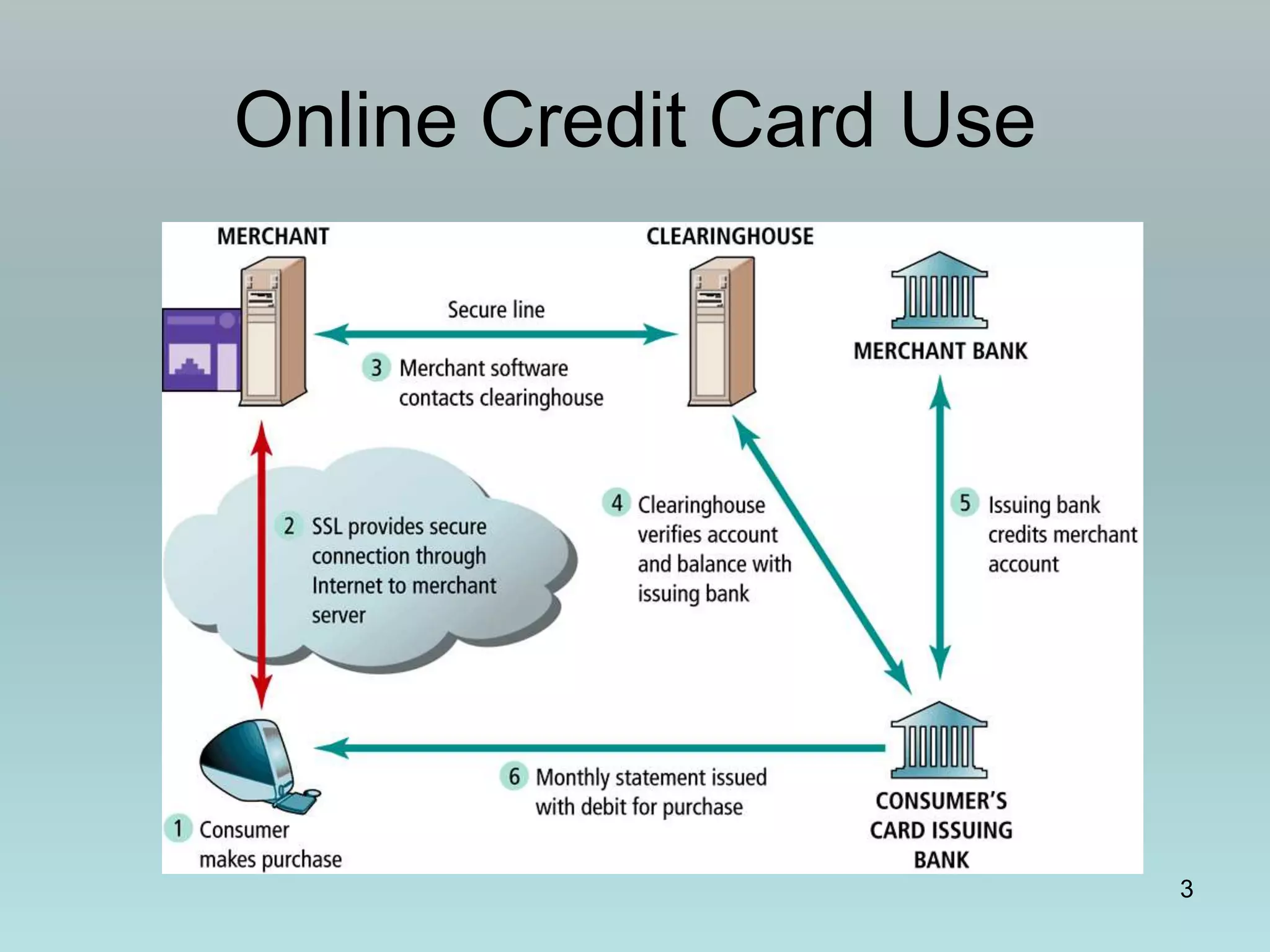
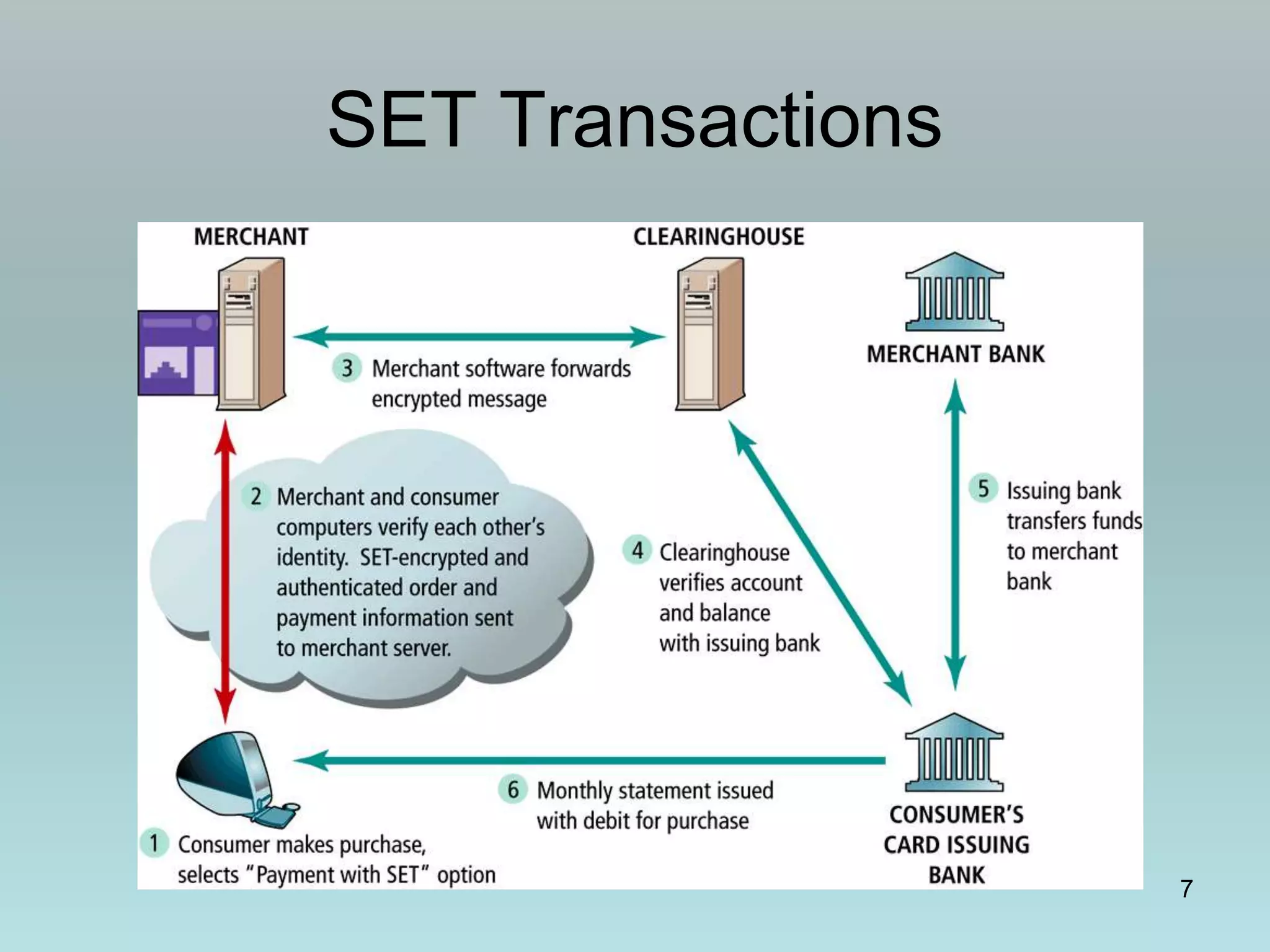
• Participants include consumer, merchant,
clearinghouse, merchant bank (acquiring
bank) and consumer’s card issuing bank
3
Online Credit Card Use
4
Problems with Online CC Use
• Security – Neither merchant nor consumer are
authenticated. Merchant gets consumers credit
card number for possible later misuse.
• Cost – for merchants, around 2.5% of purchase
price plus transaction fee of 2-3 rupees per
transaction
• Social equity – many people do not have access
to credit cards (young adults, plus almost 1000
million other adult Indian who cannot afford
cards or are considered poor risk)
5
SET (Secure Electronic
Transaction) Protocol
• Developed to address deficiencies in online
credit card use. Open standard developed by
MasterCard and Visa.
• Authenticates cardholder and merchant identity
through use of digital certificates.
• Transaction process similar to standard online
credit card transaction, with identity verification.
• Thus far, has not caught on much, due to costs
involved in integrating SET into existing
systems, and lack of interest among consumers
6
SET at Work
• SET uses SSL and PKI. Customer must
have a SET enabled browser and
merchant needs SET enabled server.
• Consumer’s credit card issuing bank
issues a digital certificate (electronic
wallet) with consumer’s public key and
bank’s public key (signed with bank’s
private key).
• Merchants get a similar digital certificate
from bank.
7
SET Transactions
8
Other Online Payment Systems
Digital Wallets
9
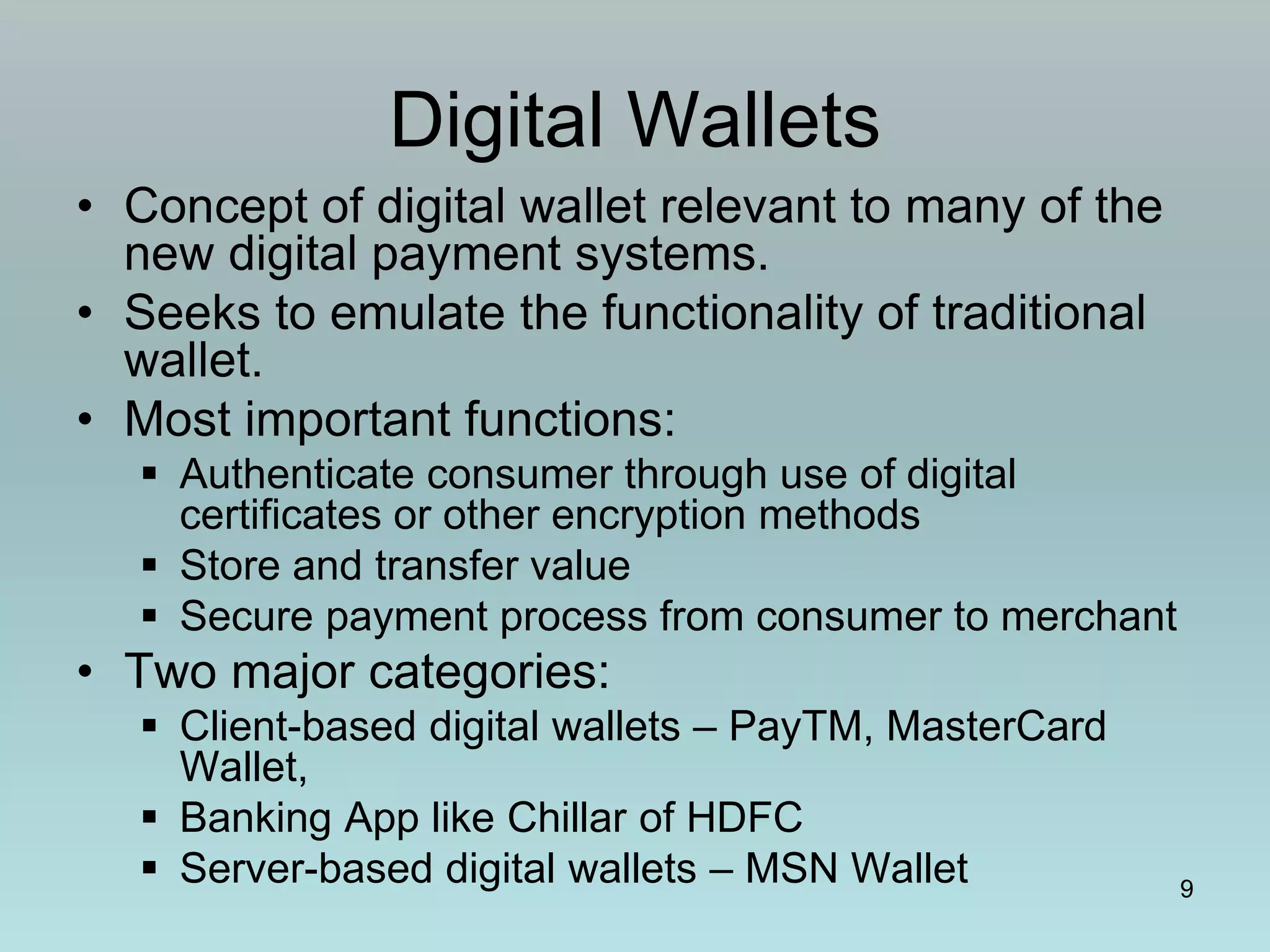
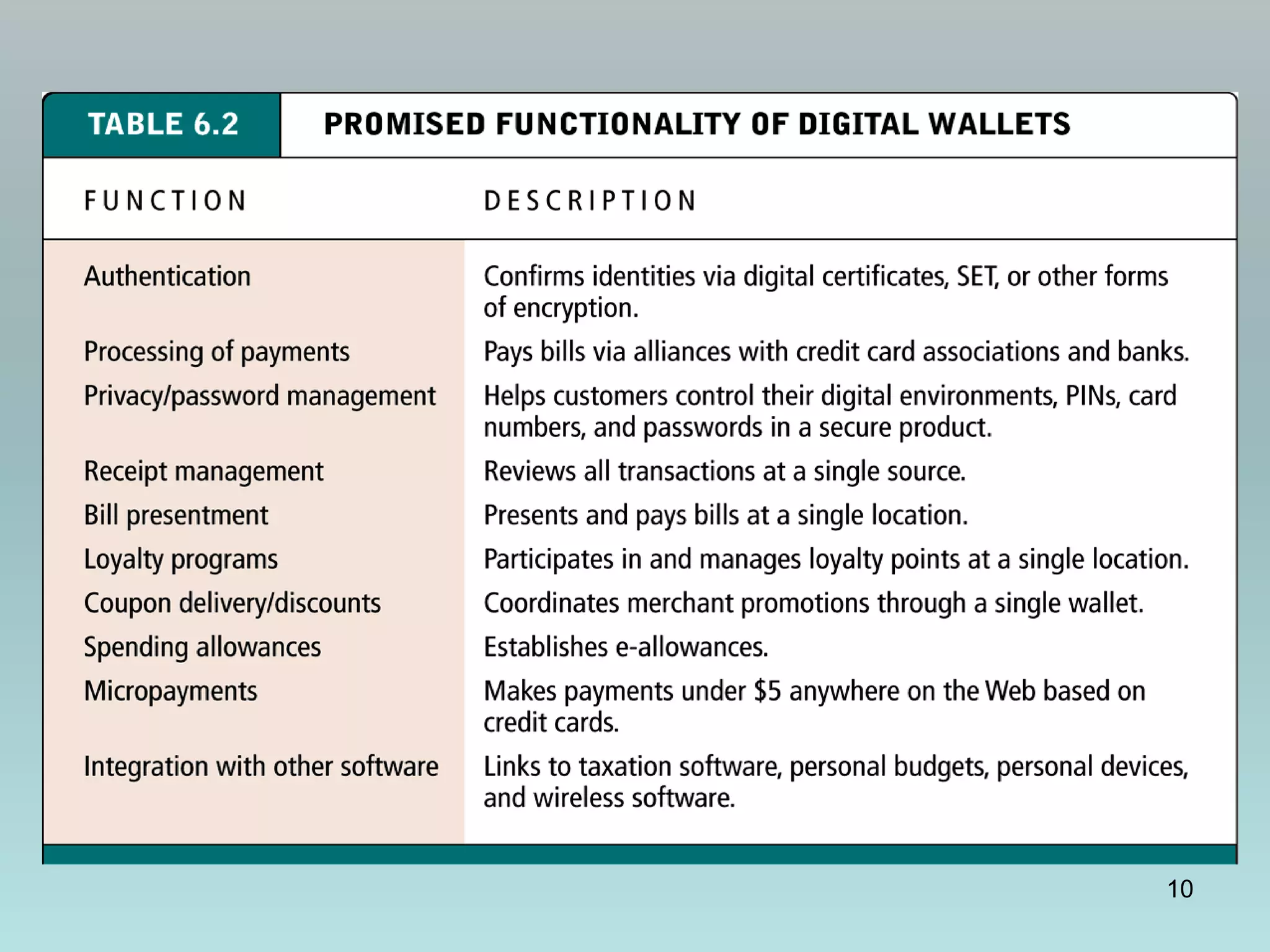
Digital Wallets
• Concept of digital wallet relevant to many of the
new digital payment systems.
• Seeks to emulate the functionality of traditional
wallet.
• Most important functions:
 Authenticate consumer through use of digital
certificates or other encryption methods
 Store and transfer value
 Secure payment process from consumer to merchant
• Two major categories:
 Client-based digital wallets – PayTM, MasterCard
Wallet,
 Banking App like Chillar of HDFC
 Server-based digital wallets – MSN Wallet
10
11
Digital Cash
• One of the first forms of alternative payment
systems
• Not really “cash” – rather, form of value
storage and value exchange that have limited
convertibility into other forms of value, and
require intermediaries to convert.
• Many of early examples have disappeared;
concepts survive as part of P2P payment
systems.
12
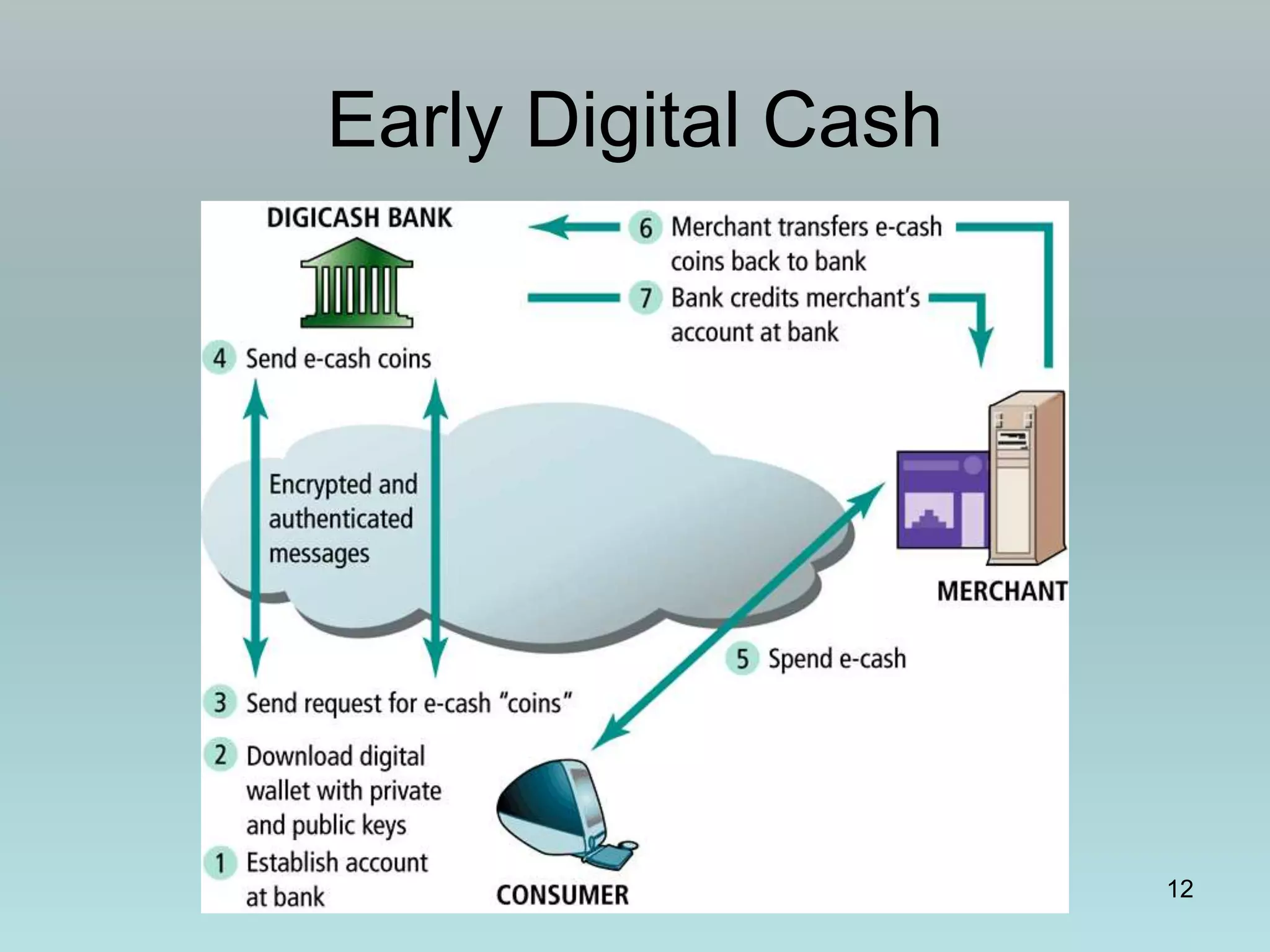
Early Digital Cash
13
PayPal
• One of e-commerce’s major success stories:
– Went public in 2002; acquired by eBay October 2002 for $1.5
billion
• A “peer-to-peer” payment system using email.
• Fills a niche that credit card companies avoided –
individuals and small merchants
• Piggybacks on existing credit card and checking payment
systems
• Weakness: suffers from relatively high levels of fraud
• PayPal has more than 35 million account members and
is available to users in 38 countries around the world
14
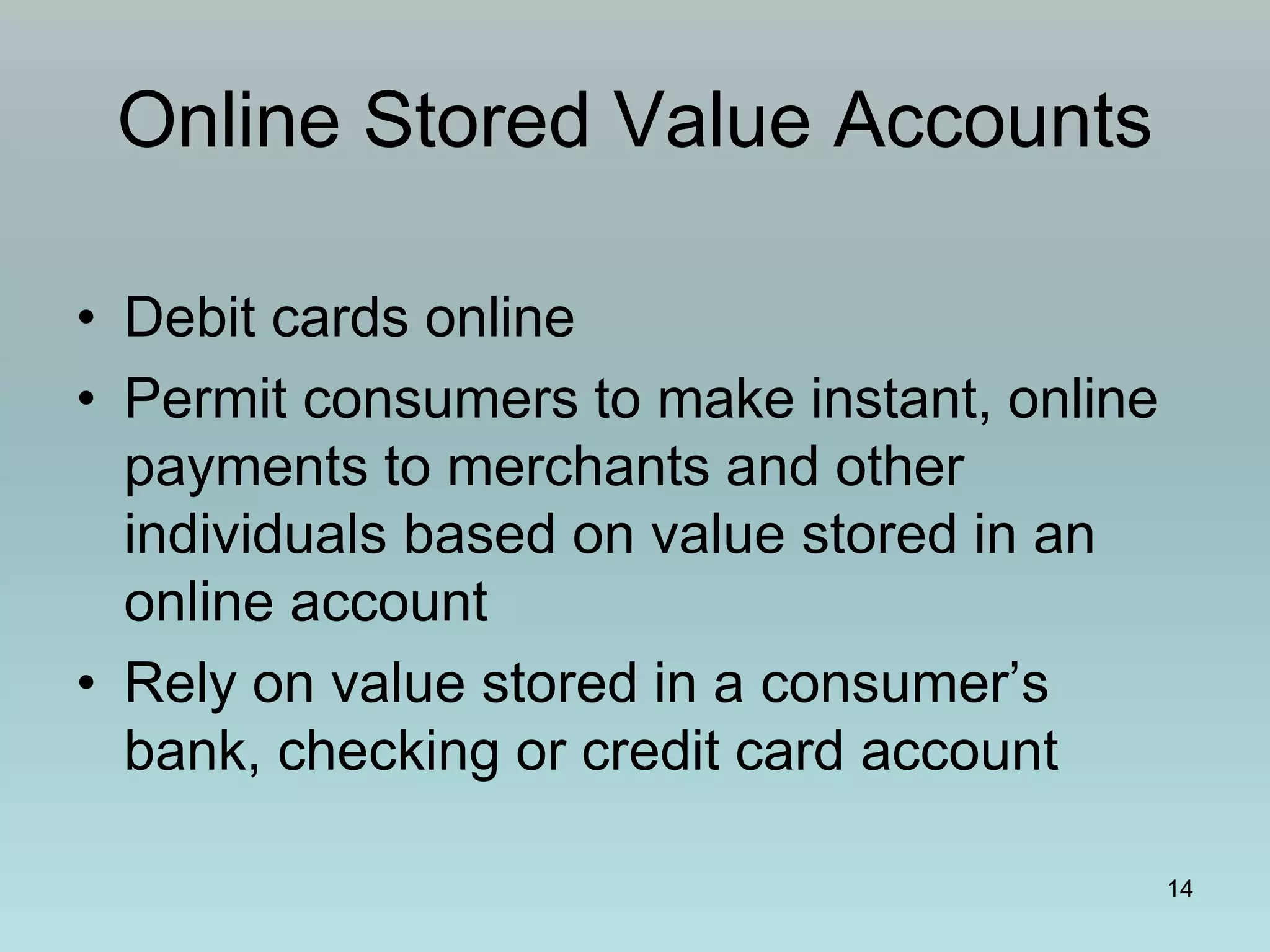
Online Stored Value Accounts
• Debit cards online
• Permit consumers to make instant, online
payments to merchants and other
individuals based on value stored in an
online account
• Rely on value stored in a consumer’s
bank, checking or credit card account
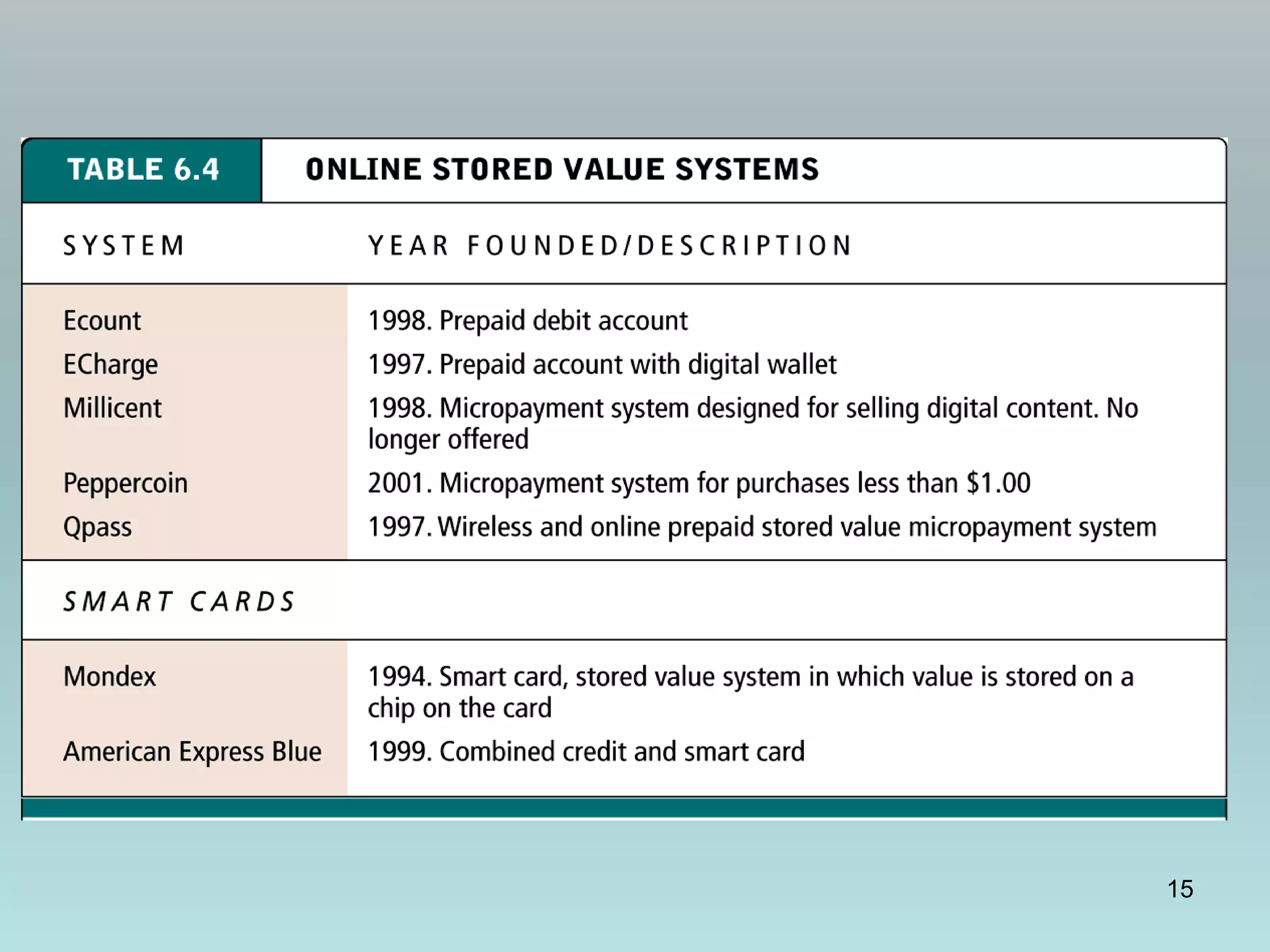
15
16
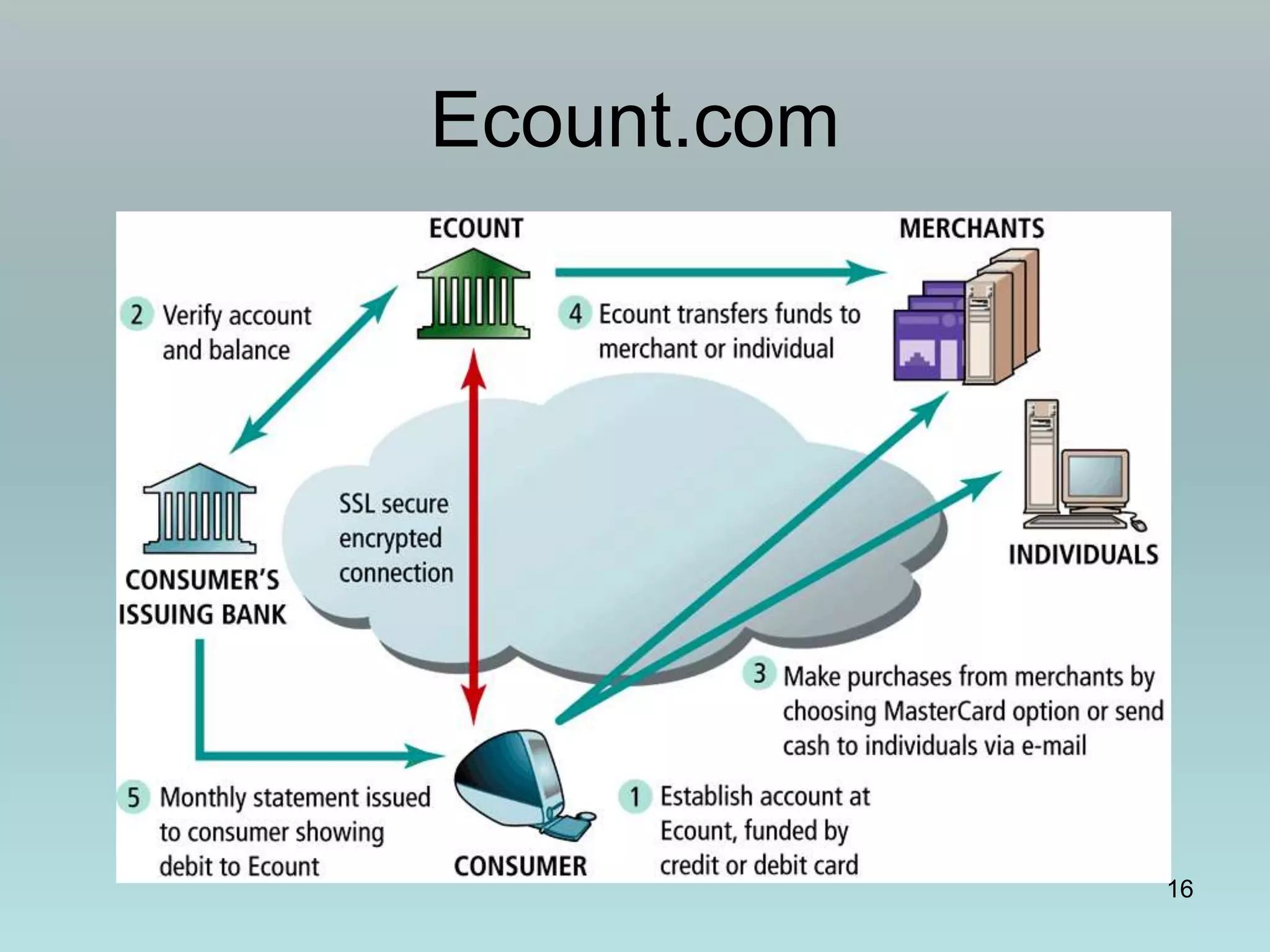
Ecount.com
17
Digital Credit Card
• Credit account for online shopping.
• Focus specifically on making use of credit
cards safer and more convenient for online
merchants and consumers.
• Example: eCharge and CyberCash
(Verisign 2002)
• Customer has credit account but no
physical card.
• May use one-time account number.
18
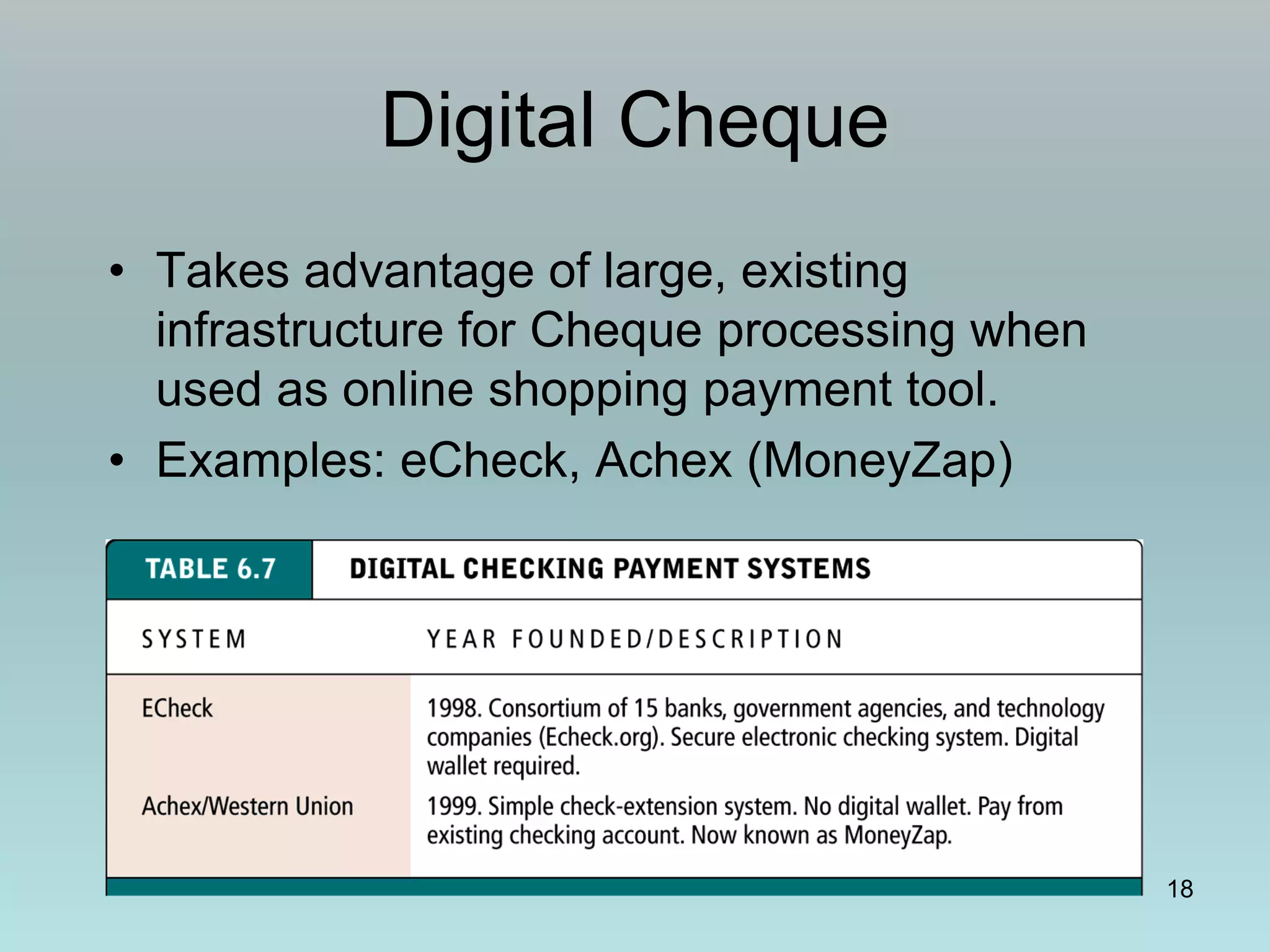
Digital Cheque
• Takes advantage of large, existing
infrastructure for Cheque processing when
used as online shopping payment tool.
• Examples: eCheck, Achex (MoneyZap)
19
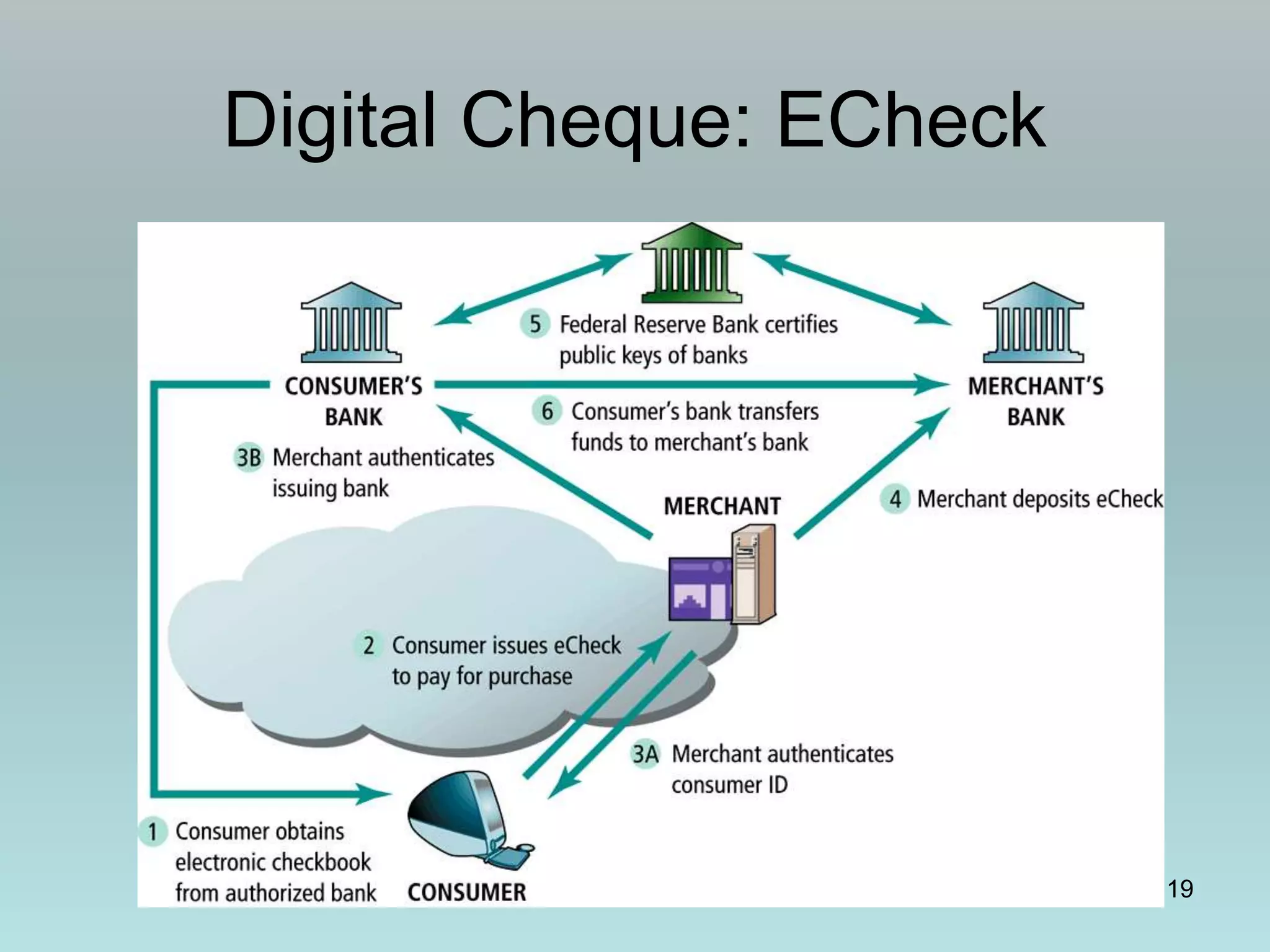
Digital Cheque: ECheck
20
B2B Payment Systems
• More complex than B2C.
– Authentication and integrity very important as
transaction may be dealing with large sums of
money.
– Should be tied to legally binding contracts.
– Interface with accounting systems
– Should provide standard business credit as in
two 10 net 30
Query Session
You may have many …
21

E commerce payment systems

  • 1.
  • 2.
    2 Online Credit CardUse • Processed in much the same way that in- store purchases are • Major difference is that online merchants do not see or take impression of card, and no signature is available (Cardholder Not Present transactions) • Participants include consumer, merchant, clearinghouse, merchant bank (acquiring bank) and consumer’s card issuing bank
  • 3.
  • 4.
    4 Problems with OnlineCC Use • Security – Neither merchant nor consumer are authenticated. Merchant gets consumers credit card number for possible later misuse. • Cost – for merchants, around 2.5% of purchase price plus transaction fee of 2-3 rupees per transaction • Social equity – many people do not have access to credit cards (young adults, plus almost 1000 million other adult Indian who cannot afford cards or are considered poor risk)
  • 5.
    5 SET (Secure Electronic Transaction)Protocol • Developed to address deficiencies in online credit card use. Open standard developed by MasterCard and Visa. • Authenticates cardholder and merchant identity through use of digital certificates. • Transaction process similar to standard online credit card transaction, with identity verification. • Thus far, has not caught on much, due to costs involved in integrating SET into existing systems, and lack of interest among consumers
  • 6.
    6 SET at Work •SET uses SSL and PKI. Customer must have a SET enabled browser and merchant needs SET enabled server. • Consumer’s credit card issuing bank issues a digital certificate (electronic wallet) with consumer’s public key and bank’s public key (signed with bank’s private key). • Merchants get a similar digital certificate from bank.
  • 7.
  • 8.
    8 Other Online PaymentSystems Digital Wallets
  • 9.
    9 Digital Wallets • Conceptof digital wallet relevant to many of the new digital payment systems. • Seeks to emulate the functionality of traditional wallet. • Most important functions:  Authenticate consumer through use of digital certificates or other encryption methods  Store and transfer value  Secure payment process from consumer to merchant • Two major categories:  Client-based digital wallets – PayTM, MasterCard Wallet,  Banking App like Chillar of HDFC  Server-based digital wallets – MSN Wallet
  • 10.
  • 11.
    11 Digital Cash • Oneof the first forms of alternative payment systems • Not really “cash” – rather, form of value storage and value exchange that have limited convertibility into other forms of value, and require intermediaries to convert. • Many of early examples have disappeared; concepts survive as part of P2P payment systems.
  • 12.
  • 13.
    13 PayPal • One ofe-commerce’s major success stories: – Went public in 2002; acquired by eBay October 2002 for $1.5 billion • A “peer-to-peer” payment system using email. • Fills a niche that credit card companies avoided – individuals and small merchants • Piggybacks on existing credit card and checking payment systems • Weakness: suffers from relatively high levels of fraud • PayPal has more than 35 million account members and is available to users in 38 countries around the world
  • 14.
    14 Online Stored ValueAccounts • Debit cards online • Permit consumers to make instant, online payments to merchants and other individuals based on value stored in an online account • Rely on value stored in a consumer’s bank, checking or credit card account
  • 15.
  • 16.
  • 17.
    17 Digital Credit Card •Credit account for online shopping. • Focus specifically on making use of credit cards safer and more convenient for online merchants and consumers. • Example: eCharge and CyberCash (Verisign 2002) • Customer has credit account but no physical card. • May use one-time account number.
  • 18.
    18 Digital Cheque • Takesadvantage of large, existing infrastructure for Cheque processing when used as online shopping payment tool. • Examples: eCheck, Achex (MoneyZap)
  • 19.
  • 20.
    20 B2B Payment Systems •More complex than B2C. – Authentication and integrity very important as transaction may be dealing with large sums of money. – Should be tied to legally binding contracts. – Interface with accounting systems – Should provide standard business credit as in two 10 net 30
  • 21.
    Query Session You mayhave many … 21