Taxonomical Heirarchy
• Scientific Name - Grimpoteuthis spp.
• Phylum - Mollusca
• Class - Cephalopoda
• Order - Octopoda
• Family - Opisthoteuthidae
Distribution
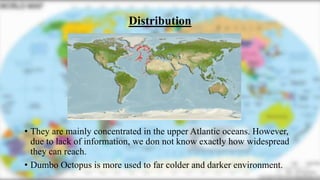
• They are mainly concentrated in the upper Atlantic oceans. However,
due to lack of information, we don not know exactly how widespread
they can reach.
• Dumbo Octopus is more used to far colder and darker environment.
Anatomy and Behaviour
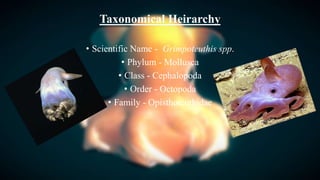
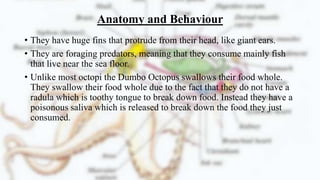
• They have huge fins that protrude from their head, like giant ears.
• They are foraging predators, meaning that they consume mainly fish
that live near the sea floor.
• Unlike most octopi the Dumbo Octopus swallows their food whole.
They swallow their food whole due to the fact that they do not have a
radula which is toothy tongue to break down food. Instead they have a
poisonous saliva which is released to break down the food they just
consumed.
More about Dumbo Octopus
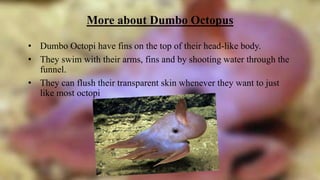
• Dumbo Octopi have fins on the top of their head-like body.
• They swim with their arms, fins and by shooting water through the
funnel.
• They can flush their transparent skin whenever they want to just
like most octopi
Habitat
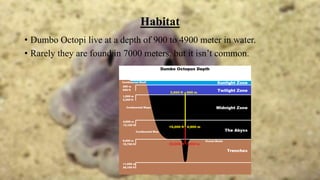
• Dumbo Octopi live at a depth of 900 to 4900 meter in water.
• Rarely they are found in 7000 meters, but it isn’t common.
Feeding
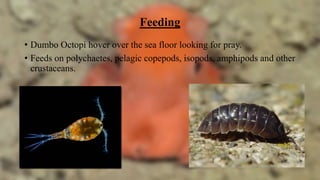
• Dumbo Octopi hover over the sea floor looking for pray.
• Feeds on polychaetes, pelagic copepods, isopods, amphipods and other
crustaceans.
Size and Weight
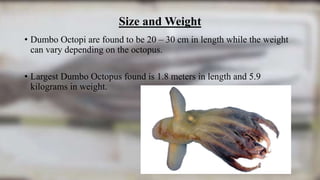
• Dumbo Octopi are found to be 20 – 30 cm in length while the weight
can vary depending on the octopus.
• Largest Dumbo Octopus found is 1.8 meters in length and 5.9
kilograms in weight.
How Dumbo Octopus got its name
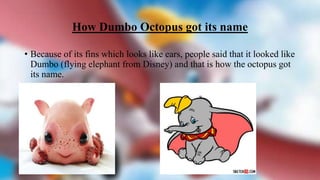
• Because of its fins which looks like ears, people said that it looked like
Dumbo (flying elephant from Disney) and that is how the octopus got
its name.
Dumbo octopus.pptx
Dumbo octopus.pptx

Dumbo octopus.pptx

  • 2.
    Taxonomical Heirarchy • ScientificName - Grimpoteuthis spp. • Phylum - Mollusca • Class - Cephalopoda • Order - Octopoda • Family - Opisthoteuthidae
  • 3.
    Distribution • They aremainly concentrated in the upper Atlantic oceans. However, due to lack of information, we don not know exactly how widespread they can reach. • Dumbo Octopus is more used to far colder and darker environment.
  • 4.
    Anatomy and Behaviour •They have huge fins that protrude from their head, like giant ears. • They are foraging predators, meaning that they consume mainly fish that live near the sea floor. • Unlike most octopi the Dumbo Octopus swallows their food whole. They swallow their food whole due to the fact that they do not have a radula which is toothy tongue to break down food. Instead they have a poisonous saliva which is released to break down the food they just consumed.
  • 5.
    More about DumboOctopus • Dumbo Octopi have fins on the top of their head-like body. • They swim with their arms, fins and by shooting water through the funnel. • They can flush their transparent skin whenever they want to just like most octopi
  • 6.
    Habitat • Dumbo Octopilive at a depth of 900 to 4900 meter in water. • Rarely they are found in 7000 meters, but it isn’t common.
  • 7.
    Feeding • Dumbo Octopihover over the sea floor looking for pray. • Feeds on polychaetes, pelagic copepods, isopods, amphipods and other crustaceans.
  • 8.
    Size and Weight •Dumbo Octopi are found to be 20 – 30 cm in length while the weight can vary depending on the octopus. • Largest Dumbo Octopus found is 1.8 meters in length and 5.9 kilograms in weight.
  • 9.
    How Dumbo Octopusgot its name • Because of its fins which looks like ears, people said that it looked like Dumbo (flying elephant from Disney) and that is how the octopus got its name.