DSW Prospectus Form
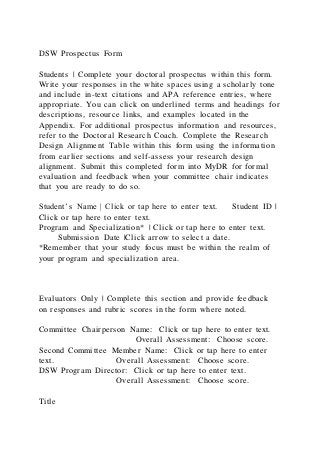
Students | Complete your doctoral prospectus within this form.
Write your responses in the white spaces using a scholarly tone
and include in-text citations and APA reference entries, where
appropriate. You can click on underlined terms and headings for
descriptions, resource links, and examples located in the
Appendix. For additional prospectus information and resources,
refer to the Doctoral Research Coach. Complete the Research
Design Alignment Table within this form using the information
from earlier sections and self-assess your research design
alignment. Submit this completed form into MyDR for formal
evaluation and feedback when your committee chair indicates
that you are ready to do so.
Student’s Name | Click or tap here to enter text. Student ID |
Click or tap here to enter text.
Program and Specialization* | Click or tap here to enter text.
Submission Date |Click arrow to select a date.
*Remember that your study focus must be within the realm of
your program and specialization area.
Evaluators Only | Complete this section and provide feedback
on responses and rubric scores in the form where noted.
Committee Chairperson Name: Click or tap here to enter text.
Overall Assessment: Choose score.
Second Committee Member Name: Click or tap here to enter
text. Overall Assessment: Choose score.
DSW Program Director: Click or tap here to enter text.
Overall Assessment: Choose score.
Title
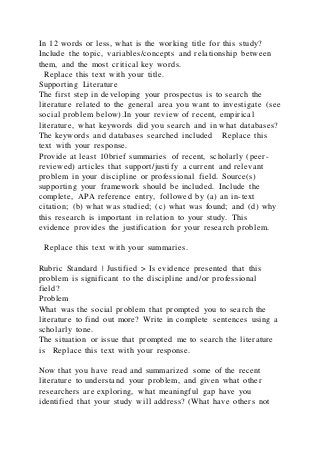
In 12 words or less, what is the working title for this study?
Include the topic, variables/concepts and relationship between
them, and the most critical key words.
Replace this text with your title.
Supporting Literature
The first step in developing your prospectus is to search the
literature related to the general area you want to investigate (see
social problem below).In your review of recent, empirical
literature, what keywords did you search and in what databases?
The keywords and databases searched included Replace this
text with your response.
Provide at least 10brief summaries of recent, scholarly (peer-
reviewed) articles that support/justify a current and relevant
problem in your discipline or professional field. Source(s)
supporting your framework should be included. Include the
complete, APA reference entry, followed by (a) an in-text
citation; (b) what was studied; (c) what was found; and (d) why
this research is important in relation to your study. This
evidence provides the justification for your research problem.
Replace this text with your summaries .
Rubric Standard | Justified > Is evidence presented that this
problem is significant to the discipline and/or professional
field?
Problem
What was the social problem that prompted you to search the
literature to find out more? Write in complete sentences using a
scholarly tone.
The situation or issue that prompted me to search the literature
is Replace this text with your response.
Now that you have read and summarized some of the recent
literature to understand your problem, and given what other
researchers are exploring, what meaningful gap have you
identified that your study will address? (What have others not
yet explored about this problem that you will contribute with
your study?)
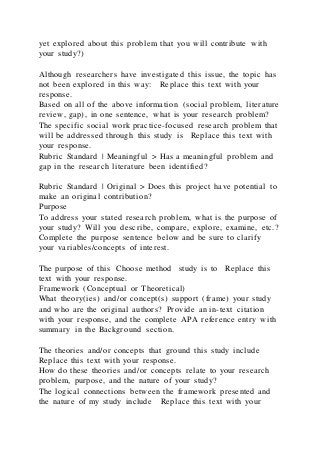
Although researchers have investigated this issue, the topi c has
not been explored in this way: Replace this text with your
response.
Based on all of the above information (social problem, literature
review, gap), in one sentence, what is your research problem?
The specific social work practice-focused research problem that
will be addressed through this study is Replace this text with
your response.
Rubric Standard | Meaningful > Has a meaningful problem and
gap in the research literature been identified?
Rubric Standard | Original > Does this project have potential to
make an original contribution?
Purpose
To address your stated research problem, what is the purpose of
your study? Will you describe, compare, explore, examine, etc.?
Complete the purpose sentence below and be sure to clarify
your variables/concepts of interest.
The purpose of this Choose method study is to Replace this
text with your response.
Framework (Conceptual or Theoretical)
What theory(ies) and/or concept(s) support (frame) your study
and who are the original authors? Provide an in-text citation
with your response, and the complete APA reference entry with
summary in the Background section.
The theories and/or concepts that ground this study include
Replace this text with your response.
How do these theories and/or concepts relate to your research
problem, purpose, and the nature of your study?
The logical connections between the framework presented and
the nature of my study include Replace this text with your
response.
Rubric Standard | Grounded > Is the problem framed to enable
the researcher to either build upon or counter the previously
published findings on the topic?
Research Question(s) and Hypotheses (if applicable)
List the question(s) that you plan to use to address the social
work practice-focused research problem. Your question(s) must
align with your study purpose and include the variables and/or
concepts and how they will be examined.
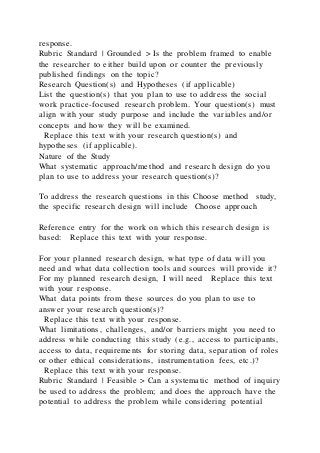
Replace this text with your research question(s) and
hypotheses (if applicable).
Nature of the Study
What systematic approach/method and research design do you
plan to use to address your research question(s)?
To address the research questions in this Choose method study,
the specific research design will include Choose approach
Reference entry for the work on which this research design is
based: Replace this text with your response.
For your planned research design, what type of data will you
need and what data collection tools and sources will provide it?
For my planned research design, I will need Replace this text
with your response.
What data points from these sources do you plan to use to
answer your research question(s)?
Replace this text with your response.
What limitations, challenges, and/or barriers might you need to
address while conducting this study (e.g., access to participants,
access to data, requirements for storing data, separation of roles
or other ethical considerations, instrumentation fees, etc.)?
Replace this text with your response.
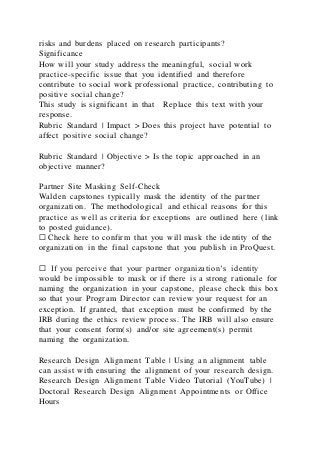
Rubric Standard | Feasible > Can a systematic method of inquiry
be used to address the problem; and does the approach have the
potential to address the problem while considering potential
risks and burdens placed on research participants?
Significance
How will your study address the meaningful, social work
practice-specific issue that you identified and therefore
contribute to social work professional practice, contributing to
positive social change?
This study is significant in that Replace this text with your
response.
Rubric Standard | Impact > Does this project have potential to
affect positive social change?
Rubric Standard | Objective > Is the topic approached in an
objective manner?
Partner Site Masking Self-Check
Walden capstones typically mask the identity of the partner
organization. The methodological and ethical reasons for this
practice as well as criteria for exceptions are outlined here (link
to posted guidance).
☐ Check here to confirm that you will mask the identity of the
organization in the final capstone that you publish in ProQuest.
☐ If you perceive that your partner organization’s identity
would be impossible to mask or if there is a strong rationale for
naming the organization in your capstone, please check this box
so that your Program Director can review your request for an
exception. If granted, that exception must be confirmed by the
IRB during the ethics review process. The IRB will also ensure
that your consent form(s) and/or site agreement(s) permit
naming the organization.
Research Design Alignment Table | Using an alignment table
can assist with ensuring the alignment of your research design.
Research Design Alignment Table Video Tutorial (YouTube) |
Doctoral Research Design Alignment Appointments or Office
Hours
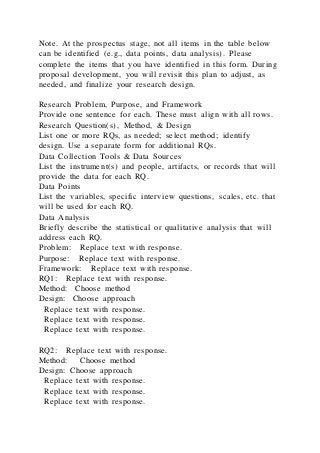
Note. At the prospectus stage, not all items in the table below
can be identified (e.g., data points, data analysis). Please
complete the items that you have identified in this form. During
proposal development, you will revisit this plan to adjust, as
needed, and finalize your research design.
Research Problem, Purpose, and Framework
Provide one sentence for each. These must align with all rows.
Research Question(s), Method, & Design
List one or more RQs, as needed; select method; identify
design. Use a separate form for additional RQs.
Data Collection Tools & Data Sources
List the instrument(s) and people, artifacts, or records that will
provide the data for each RQ.
Data Points
List the variables, specific interview questions, scales, etc. that
will be used for each RQ.
Data Analysis
Briefly describe the statistical or qualitative analysis that will
address each RQ.
Problem: Replace text with response.
Purpose: Replace text with response.
Framework: Replace text with response.
RQ1: Replace text with response.
Method: Choose method
Design: Choose approach
Replace text with response.
RQ2: Replace text with response.
Method: Choose method
Design: Choose approach
Replace text with response.
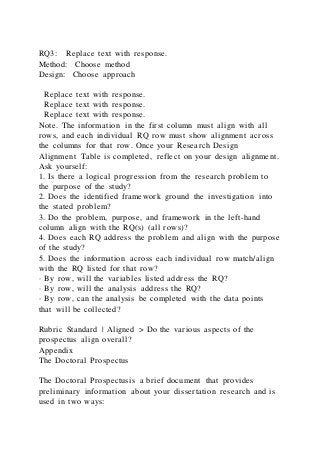
RQ3: Replace text with response.
Method: Choose method
Design: Choose approach
Replace text with response.
Note. The information in the first column must align with all
rows, and each individual RQ row must show alignment across
the columns for that row. Once your Research Design
Alignment Table is completed, reflect on your design alignment.
Ask yourself:
1. Is there a logical progression from the research problem to
the purpose of the study?
2. Does the identified framework ground the investigation into
the stated problem?
3. Do the problem, purpose, and framework in the left-hand
column align with the RQ(s) (all rows)?
4. Does each RQ address the problem and align with the purpose
of the study?
5. Does the information across each individual row match/align
with the RQ listed for that row?
· By row, will the variables listed address the RQ?
· By row, will the analysis address the RQ?
· By row, can the analysis be completed with the data points
that will be collected?
Rubric Standard | Aligned > Do the various aspects of the
prospectus align overall?
Appendix
The Doctoral Prospectus
The Doctoral Prospectusis a brief document that provides
preliminary information about your dissertation research and is
used in two ways:
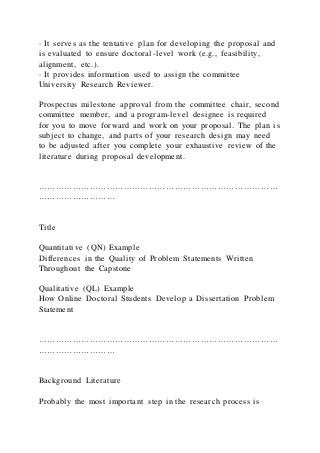
· It serves as the tentative plan for developing the proposal and
is evaluated to ensure doctoral-level work (e.g., feasibility,
alignment, etc.).
· It provides information used to assign the committee
University Research Reviewer.
Prospectus milestone approval from the committee chair, second
committee member, and a program-level designee is required
for you to move forward and work on your proposal. The plan i s
subject to change, and parts of your research design may need
to be adjusted after you complete your exhaustive review of the
literature during proposal development.
…………………………………………………………………………
………………………
Title
Quantitative (QN) Example
Differences in the Quality of Problem Statements Written
Throughout the Capstone
Qualitative (QL) Example
How Online Doctoral Students Develop a Dissertation Problem
Statement
…………………………………………………………………………
………………………
Background Literature
Probably the most important step in the research process is
searching recent, peer-reviewed literatureand reading
articlesrelated to the general area you want to investigate. The
area is based on an identified social problem. As you read and
learn, you will narrow your focus. This is how you will identify
a discipline-specific research problem.
[Note: Scholarly, empirical articles and how to find them.]
First, you’ll need to determine your search terms or
keywordsand the databases you should search.As you conduct
your search of the literature, stay organized by keeping a search
log.
Search Log Example
Database
Search Terms
Results
Notes
Thoreau
online doctoral program completion; limited to peer reviewed,
2016-present
1175
Search too broad; Narrow by using multiple terms
Thoreau
online doctoral program completion AND ABD; limited to peer
reviewed, 2016-present
13
Much better; Several relevant articles found
Education Source
Etc.
Example for this Form
The keywords and databases searched included ABD, online
doctoral program completion, doctoral capstone completion,
online research training, and online learning in the databases
Education Source, ERIC, and SAGE Journals, as well as in a
Thoreau multidatabase search.
As you read and evaluate literature, you also need to organize
your research. A literature review matrix is one way to help you
visualize what has and hasn't been done in your field. It will
help you understand the scholarly works related to your area of
interest. The importance of organizing and recording your
review of literature cannot be overstated. You will refer to your
notes as you write, so start on the right track from the
beginning!
[Suggestion: If you keep your search log in an Excel workbook,
use the second tab in the same workbook for your literature
review matrix.]
For this form, includethe complete, APA reference entry and(a)
an in-text citation; (b) what they studied; (c) what they found;
and (d) why this is important in relation to your study. This
evidence provides the justification for your research problem.
These sources provide justification that this problem is
meaningful to the discipline or professional field. These
references should ideally be from the past 5 years. Reference
entries related to the framework should be included here, too.
[Note: During proposal development, you will conduct an
exhaustive review and synthesize your sources, rather than
summarize.]
Example (for one article; at least 10 are required)
Ismail, H. M., Majid, F. A., & Ismail, I. S. (2013). “It’s
complicated” relationship: Research students’ perspective on
doctoral supervision. Procedia - Social and Behavioral Sciences,
90, 165–170. http://doi.org/10.1016/j.sbspro.2013.07.078
(a) Ismail, Majid, and Ismail (2013); (b) focused on the student
experience with supervision while learning to conduct research;
(c) found three issues of lack of positive communication, lack
of expertise, and power conflicts; and (d) this is important in
relation to my study because it may help explain progress on the
development of a problem statement in the capstone process.
Rubric Standard | Justified >Is evidence presented that this
problem is significant to the discipline and/or professional
field?
…………………………………………………………………………
………………………
Problem
Social Problem
The situation or issue being experienced by a population or
within your discipline that prompted you to search the literature
to find out more is sometimes called a social problem. It is the
issue that students see “on the ground” so to speak. The social
problem is often what prompts students to think about a topic of
interest. Usually such a topic is one that students identify with,
sometimes having personally experienced some aspect of the
problem as it exists in the world.
Example
The issue that prompted me to search the literature is the low
completion rate of students in doctoral programs. It is common
knowledge in the education discipline that only about half of
the students who enter doctoral programs will complete, and the
lack of progress is often due to the dissertation process. A
search in The Chronicle of Higher Education will result in
numerous articles about supporting doctoral students with their
capstone research to improve the completion rates of doctoral
programs.
Gap
The need to address an identified gap in the research
literaturemust be clear and there must be current relevance to
the discipline and area of practice. Keep in mind that a gap in
the research is not, in and of itself, a reason to conduct
research. The gap relates to the rubric standard: Meaningful.
Example
Although researchers have investigated this issue, there is very
little or no literature on the development of problem statements
by students in online doctoral programs.
Research Problem
A research problem is a focused topic of concern, a condition to
be improved upon, or troubling question that is supported in
scholarly literature or theory that you study to understand in
more detail, and that can lead to recommendations for
resolutions. It is the research problem that drives the rest of the
dissertation: the purpose, the research questions, and the
methodology.
QN Example
In one sentence, the specific research problem isthat it is not
known whether the quality of problem statements written by
online doctoral students varies over time in the program.
QL Example
In one sentence, the specific research problem isthat there is a
lack of information on how online doctoral students go about
developing their research problem statement for their
dissertations.
Rubric Standard | Meaningful >Has a meaningful problem and
gap in the research literature been identified?
Rubric Standard | Original >Does this project have potential to
make an original contribution?
…………………………………………………………………………
………………………
Purpose
To address your stated research problem, what is the purpose of
your study? Will you describe, compare, explore, examine, etc.?
Be sure to clarify your variables/concepts of interest. For
example:
· In quantitative studies, state what needs be studied by
describing two or more factors (variables) and a conjectured
relationship among them related to the identified gap or
problem.
· In qualitative studies, describe the need for increased
understanding about the issue to be studied, based on the
identified gap or problem.
· In mixed-methods studies, with both quantitative and
qualitative aspects, clarify how the two approaches will be used
together to inform the study.
QN Example
The purpose of this quantitative study is to examine differences
in the quality of problem statements written by doctoral
students in online programs during the various stages of their
doctoral studies.
QL Example
The purpose of this qualitative study is to improve the
understanding of the process by which doctoral students in
online programs arrive at a viable problem statement for their
dissertations.
…………………………………………………………………………
………………………
Framework
The framework includes the theories and/or concepts relevant to
your topic. Align the framework with the problem, purpose,
research questions, and background of your study. This
theoretical or conceptual framework is the basis for
understanding, designing, and analyzing ways to investigate
your research problem (data collection and analysis). Provide
the original scholarly literature (citing original authors) on the
theory and/or concepts, even if it is more than 5 years old.
Please do not cite secondary sources.
Example Theoretical Framework
The theories and/or concepts that ground this study include
Perry’s (1970) theory of epistemological development.
Example Conceptual Framework
The theories and/or concepts that ground this study include
Perry’s (1970) theory of epistemological development, focusing
specifically on the concepts of online learning and the
pedagogical challenges associated with online learning and
dissertation writing.
Next, explain how these theories and/or concepts relate to your
research problem, purpose, and the nature of your study. Your
topic/approach should align with the identified framework so
that you will either build upon or counter the previously
published findings on the topic.
Example Connection for the Theoretical Framework
The logical connections between the framework presented and
my study approach include Perry’s theoretical work, which has
been used extensively in all aspects of higher education, albeit
more frequently with undergraduates than with doctoral
students. The approach provides details on cognitive-structural
changes that emerge as a result of development and learning.
Example Connection for the Conceptual Framework
The logical connections between the framework presented and
my study approach include Perry’s theoretical work, which has
been used extensively in all aspects of higher education, albeit
more frequently with undergraduates than with doctoral
students. Further, subsequent research and application of
Perry’s theory offer guidance on ways to facilitate academic
development, thus allowing for insight into the pedagogical
challenge of the dissertation.
Rubric Standard | Grounded >Is the problem framed to enable
the researcher to either build upon or counter the previously
published findings on the topic?
…………………………………………………………………………
………………………
Research Question(s) and Hypotheses (if applicable)
List the overarching question and/or a series of related
questions that are informed by the study purpose, that will be
used to address the research problem. A research question
informs the research design by providing a foundation for:
· generation of null and alternative hypotheses in quantitative
studies,
· questions necessary to build the design structure for
qualitative studies, and
· a process by which different methods will work together in
mixed-methods studies.
QN Example
RQ1: Based on objective ratings by doctoral faculty, what are
the differences in the overall quality of problem statements as
students progress through the doctoral study process?
H01—Based on objective ratings by doctoral faculty, there are
no statistically significant differences in the overall quality of
problem statements as students progress through the doctoral
study process.
H1—Based on objective ratings by doctoral faculty, there are
statistically significant differences in the overall quality of
problem statements as students progress through the doctoral
study process.
QL Example
For students with a high-quality problem statement at the
dissertation stage, what themes emerge in their reports of the
process that they used to develop it?
…………………………………………………………………………
………………………
Nature of the Study
Explain the systematic approach/method and research design
you plan to use to address your research question(s). Examples
of study design are as follows:
· Quantitative—for descriptive, correlational, or inferential
survey research designs, using validated existing survey
instruments
· Qualitative—for action research, case study, program
evaluation, or basic (generic) qualitative
QN Example
To address the research questions in this quantitative study, the
specific research design will include a repeated-measure design
(Frankfort-Nachmias & Nachmias, 2008) with objective ratings
of student work products examined across time. This
quantitative analysis should help pinpoint the amount of growth
from the beginning to the end of the project.
Reference entry for the work on which this research design is
based:
Frankfort-Nachmias, C., & Nachmias, D. (2008). Research
methods in the social sciences cd-rom spss cd-rom vol 15. (7th
ed.). Worth Pub.
QL Example
To address the research questions in this qualitative study, the
specific research design will include a single descriptive case
study (Yin, 2014) with interviews with students and faculty.
This qualitative analysis using pattern matching and cross case
analysis will improve the understanding of the process by which
doctoral students in online programs arrive at a viable problem
statement for their dissertations.
Reference entry for the work on which this research design is
based:
Yin, R. K. (2014). Case study research: Design and methods
(Fifth edition). SAGE.
Then, for your planned research design, present the type of data
you will need, and a list of possibledata collection tools and
sources that could be used to address the proposed research
question(s), such as test scores from college students, employee
surveys, observations of a phenomenon, interviews with
practitioners, historical documents from state records, de-
identified medical records, or information from a federal
database. At this point, you should have an idea of the type of
data needed to address your research question(s). Explain
whether you will be collecting primary data (collected by the
you, the researcher) or accessing secondary data (preexisting or
public data collected by others). If you are collecting data, you
should present the tentative plan for instrument(s) and potential
participants. If using secondary data, identify the data source,
how the data will be accessed. Possible secondary data sources,
by program, are available on the Center for Research Quality
website. [Note. This is your tentative plan, so keep in mind that
things might need to be modified during the proposal stage—
particularly after you have completed your exhaustive review of
the literature.]
QN Example
For my planned research design, I will need to request access to
preexisting/secondary data from the W University’s online
doctoral program related to problem statement development of
at least 300 students.
QL Example
For my planned research design, I will need to recruit both
student and faculty participants for individual interviews.
Interview protocols will be developed to address the problem
and purpose of the study.
Next, provide the data points from these sources you plan to use
to answer your research question(s). Data points are the specific
variables or type of information that you will use in your
analysis. For example, they may include items on a survey or
types of interview questions (not the actual survey or interview
questions). If using secondary data, you must ensure the data
include the variables or data points that you need to address
your research question.
QN Example
The program collects and rates doctoral problem statements
written at four key points in a doctoral student’s career: the
premise, the prospectus, the proposal, and the doctoral study
writing stage. The data will be deidentified and contain the
scores by stage of program for 300 online doctoral students.
Other data may be collected from surveys of instructors.
QL Example
The data will include responses to the faculty and student
interview questions regarding how online doctoral students go
about developing their research problem statement for their
dissertations.
Finally, provide information on limitations, challenges, and/or
barriers that may need to be addressed when conducting this
study. These may include access to participants, access to data,
separation of roles (researcher versus employee),
instrumentation fees, etc. If you are thinking about collecting
data on a sensitive topic or from a vulnerable population, an
early consultation with the Institutional Review Board (IRB;
[email protected]) during your prospectus process is
recommended to gain ethics guidance that you can incorporate
into your subsequent proposal drafts and research planning.
[Note. Find more information on research ethics and potential
“red flag” issues on the IRB Guides and FAQs.]
QN Example
A potential barrier when using secondary data is that data
access will probably include a partner-site agreement and
potentially an external research ethics review (IRB), which may
take some additional time. A possible barrier for collecting
survey data is difficulty in recruitment of participants. I will
attend IRB Office Hours to ask questions about these issues.
QL Example
A potential barrier when collecting primary data include partner
site agreement and possible difficulty recruiting participants for
interviews. Ensuring clear separation of my role at the
institution from my role as researcher may also be a challenge.
Rubric Standard | Feasible >Can a systematic method of inquiry
be used to address the problem; and does the approach have the
potential to address the problem while considering potential
risks and burdens placed on research participants?
…………………………………………………………………………
………………………
Significance
How will your study address the meaningful, social work
practice-specific issue that you identified and therefore
contribute to social work professional practice, contributing to
positive social change? Detail how your findings might support
professional practice or allow practical application (answer the
So what? question).
Example
This study is significant in that it will fill a gap in
understanding by focusing specifically on development of
problem statements by students in online doctoral programs.
The results of this study should aid doctoral committees and
academic programs in helping students to succeed in their final
projects, thus supporting eventual degree attainment. Education
has long been a force for social change by addressing inequities
in society. Because a broad range of students attends online
institutions, supporting their successful attainment of a terminal
degree allows for increased diversity among individuals in key
academic and scholarly leadership positions.
Rubric Standard | Impact >Does this project have potential to
affect positive social change?
Rubric Standard | Objective >Is the topic approached in an
objective manner?
…………………………………………………………………………
………………………
My Doctoral Research (MyDR)
If you have not done so already, you should familiarize yourself
with the MyDRsystem. The MyDR system was designed to
assist you and your committee in navigating your doctoral
research journey, from the very beginning through the final
approval. The various landing pages in MyDR will track your
progress and will serve as a central location for resources to
support that progress. There is a process flow tool in which you
exchange and store faculty evaluations of and feedback on your
work as you progress along that journey.
You will be entered into the MyDR system when both your
committee chair and second member nominees are approved by
the academic program. At that point, you will be able to access
MyDR from the homepage of your dissertation completion
course in Blackboard. The first document that you will submit
for approval in MyDR will be your prospectus.

DSW Prospectus FormStudents Complete your doctoral prospectus

  • 1.
    DSW Prospectus Form Students| Complete your doctoral prospectus within this form. Write your responses in the white spaces using a scholarly tone and include in-text citations and APA reference entries, where appropriate. You can click on underlined terms and headings for descriptions, resource links, and examples located in the Appendix. For additional prospectus information and resources, refer to the Doctoral Research Coach. Complete the Research Design Alignment Table within this form using the information from earlier sections and self-assess your research design alignment. Submit this completed form into MyDR for formal evaluation and feedback when your committee chair indicates that you are ready to do so. Student’s Name | Click or tap here to enter text. Student ID | Click or tap here to enter text. Program and Specialization* | Click or tap here to enter text. Submission Date |Click arrow to select a date. *Remember that your study focus must be within the realm of your program and specialization area. Evaluators Only | Complete this section and provide feedback on responses and rubric scores in the form where noted. Committee Chairperson Name: Click or tap here to enter text. Overall Assessment: Choose score. Second Committee Member Name: Click or tap here to enter text. Overall Assessment: Choose score. DSW Program Director: Click or tap here to enter text. Overall Assessment: Choose score. Title
  • 2.
    In 12 wordsor less, what is the working title for this study? Include the topic, variables/concepts and relationship between them, and the most critical key words. Replace this text with your title. Supporting Literature The first step in developing your prospectus is to search the literature related to the general area you want to investigate (see social problem below).In your review of recent, empirical literature, what keywords did you search and in what databases? The keywords and databases searched included Replace this text with your response. Provide at least 10brief summaries of recent, scholarly (peer- reviewed) articles that support/justify a current and relevant problem in your discipline or professional field. Source(s) supporting your framework should be included. Include the complete, APA reference entry, followed by (a) an in-text citation; (b) what was studied; (c) what was found; and (d) why this research is important in relation to your study. This evidence provides the justification for your research problem. Replace this text with your summaries . Rubric Standard | Justified > Is evidence presented that this problem is significant to the discipline and/or professional field? Problem What was the social problem that prompted you to search the literature to find out more? Write in complete sentences using a scholarly tone. The situation or issue that prompted me to search the literature is Replace this text with your response. Now that you have read and summarized some of the recent literature to understand your problem, and given what other researchers are exploring, what meaningful gap have you identified that your study will address? (What have others not
  • 3.
    yet explored aboutthis problem that you will contribute with your study?) Although researchers have investigated this issue, the topi c has not been explored in this way: Replace this text with your response. Based on all of the above information (social problem, literature review, gap), in one sentence, what is your research problem? The specific social work practice-focused research problem that will be addressed through this study is Replace this text with your response. Rubric Standard | Meaningful > Has a meaningful problem and gap in the research literature been identified? Rubric Standard | Original > Does this project have potential to make an original contribution? Purpose To address your stated research problem, what is the purpose of your study? Will you describe, compare, explore, examine, etc.? Complete the purpose sentence below and be sure to clarify your variables/concepts of interest. The purpose of this Choose method study is to Replace this text with your response. Framework (Conceptual or Theoretical) What theory(ies) and/or concept(s) support (frame) your study and who are the original authors? Provide an in-text citation with your response, and the complete APA reference entry with summary in the Background section. The theories and/or concepts that ground this study include Replace this text with your response. How do these theories and/or concepts relate to your research problem, purpose, and the nature of your study? The logical connections between the framework presented and the nature of my study include Replace this text with your
  • 4.
    response. Rubric Standard |Grounded > Is the problem framed to enable the researcher to either build upon or counter the previously published findings on the topic? Research Question(s) and Hypotheses (if applicable) List the question(s) that you plan to use to address the social work practice-focused research problem. Your question(s) must align with your study purpose and include the variables and/or concepts and how they will be examined. Replace this text with your research question(s) and hypotheses (if applicable). Nature of the Study What systematic approach/method and research design do you plan to use to address your research question(s)? To address the research questions in this Choose method study, the specific research design will include Choose approach Reference entry for the work on which this research design is based: Replace this text with your response. For your planned research design, what type of data will you need and what data collection tools and sources will provide it? For my planned research design, I will need Replace this text with your response. What data points from these sources do you plan to use to answer your research question(s)? Replace this text with your response. What limitations, challenges, and/or barriers might you need to address while conducting this study (e.g., access to participants, access to data, requirements for storing data, separation of roles or other ethical considerations, instrumentation fees, etc.)? Replace this text with your response. Rubric Standard | Feasible > Can a systematic method of inquiry be used to address the problem; and does the approach have the potential to address the problem while considering potential
  • 5.
    risks and burdensplaced on research participants? Significance How will your study address the meaningful, social work practice-specific issue that you identified and therefore contribute to social work professional practice, contributing to positive social change? This study is significant in that Replace this text with your response. Rubric Standard | Impact > Does this project have potential to affect positive social change? Rubric Standard | Objective > Is the topic approached in an objective manner? Partner Site Masking Self-Check Walden capstones typically mask the identity of the partner organization. The methodological and ethical reasons for this practice as well as criteria for exceptions are outlined here (link to posted guidance). ☐ Check here to confirm that you will mask the identity of the organization in the final capstone that you publish in ProQuest. ☐ If you perceive that your partner organization’s identity would be impossible to mask or if there is a strong rationale for naming the organization in your capstone, please check this box so that your Program Director can review your request for an exception. If granted, that exception must be confirmed by the IRB during the ethics review process. The IRB will also ensure that your consent form(s) and/or site agreement(s) permit naming the organization. Research Design Alignment Table | Using an alignment table can assist with ensuring the alignment of your research design. Research Design Alignment Table Video Tutorial (YouTube) | Doctoral Research Design Alignment Appointments or Office Hours
  • 6.
    Note. At theprospectus stage, not all items in the table below can be identified (e.g., data points, data analysis). Please complete the items that you have identified in this form. During proposal development, you will revisit this plan to adjust, as needed, and finalize your research design. Research Problem, Purpose, and Framework Provide one sentence for each. These must align with all rows. Research Question(s), Method, & Design List one or more RQs, as needed; select method; identify design. Use a separate form for additional RQs. Data Collection Tools & Data Sources List the instrument(s) and people, artifacts, or records that will provide the data for each RQ. Data Points List the variables, specific interview questions, scales, etc. that will be used for each RQ. Data Analysis Briefly describe the statistical or qualitative analysis that will address each RQ. Problem: Replace text with response. Purpose: Replace text with response. Framework: Replace text with response. RQ1: Replace text with response. Method: Choose method Design: Choose approach Replace text with response. Replace text with response. Replace text with response. RQ2: Replace text with response. Method: Choose method Design: Choose approach Replace text with response. Replace text with response. Replace text with response.
  • 7.
    RQ3: Replace textwith response. Method: Choose method Design: Choose approach Replace text with response. Replace text with response. Replace text with response. Note. The information in the first column must align with all rows, and each individual RQ row must show alignment across the columns for that row. Once your Research Design Alignment Table is completed, reflect on your design alignment. Ask yourself: 1. Is there a logical progression from the research problem to the purpose of the study? 2. Does the identified framework ground the investigation into the stated problem? 3. Do the problem, purpose, and framework in the left-hand column align with the RQ(s) (all rows)? 4. Does each RQ address the problem and align with the purpose of the study? 5. Does the information across each individual row match/align with the RQ listed for that row? · By row, will the variables listed address the RQ? · By row, will the analysis address the RQ? · By row, can the analysis be completed with the data points that will be collected? Rubric Standard | Aligned > Do the various aspects of the prospectus align overall? Appendix The Doctoral Prospectus The Doctoral Prospectusis a brief document that provides preliminary information about your dissertation research and is used in two ways:
  • 8.
    · It servesas the tentative plan for developing the proposal and is evaluated to ensure doctoral-level work (e.g., feasibility, alignment, etc.). · It provides information used to assign the committee University Research Reviewer. Prospectus milestone approval from the committee chair, second committee member, and a program-level designee is required for you to move forward and work on your proposal. The plan i s subject to change, and parts of your research design may need to be adjusted after you complete your exhaustive review of the literature during proposal development. ………………………………………………………………………… ……………………… Title Quantitative (QN) Example Differences in the Quality of Problem Statements Written Throughout the Capstone Qualitative (QL) Example How Online Doctoral Students Develop a Dissertation Problem Statement ………………………………………………………………………… ……………………… Background Literature Probably the most important step in the research process is
  • 9.
    searching recent, peer-reviewedliteratureand reading articlesrelated to the general area you want to investigate. The area is based on an identified social problem. As you read and learn, you will narrow your focus. This is how you will identify a discipline-specific research problem. [Note: Scholarly, empirical articles and how to find them.] First, you’ll need to determine your search terms or keywordsand the databases you should search.As you conduct your search of the literature, stay organized by keeping a search log. Search Log Example Database Search Terms Results Notes Thoreau online doctoral program completion; limited to peer reviewed, 2016-present 1175 Search too broad; Narrow by using multiple terms Thoreau online doctoral program completion AND ABD; limited to peer reviewed, 2016-present 13 Much better; Several relevant articles found Education Source Etc. Example for this Form The keywords and databases searched included ABD, online doctoral program completion, doctoral capstone completion,
  • 10.
    online research training,and online learning in the databases Education Source, ERIC, and SAGE Journals, as well as in a Thoreau multidatabase search. As you read and evaluate literature, you also need to organize your research. A literature review matrix is one way to help you visualize what has and hasn't been done in your field. It will help you understand the scholarly works related to your area of interest. The importance of organizing and recording your review of literature cannot be overstated. You will refer to your notes as you write, so start on the right track from the beginning! [Suggestion: If you keep your search log in an Excel workbook, use the second tab in the same workbook for your literature review matrix.] For this form, includethe complete, APA reference entry and(a) an in-text citation; (b) what they studied; (c) what they found; and (d) why this is important in relation to your study. This evidence provides the justification for your research problem. These sources provide justification that this problem is meaningful to the discipline or professional field. These references should ideally be from the past 5 years. Reference entries related to the framework should be included here, too. [Note: During proposal development, you will conduct an exhaustive review and synthesize your sources, rather than summarize.] Example (for one article; at least 10 are required) Ismail, H. M., Majid, F. A., & Ismail, I. S. (2013). “It’s complicated” relationship: Research students’ perspective on doctoral supervision. Procedia - Social and Behavioral Sciences, 90, 165–170. http://doi.org/10.1016/j.sbspro.2013.07.078 (a) Ismail, Majid, and Ismail (2013); (b) focused on the student
  • 11.
    experience with supervisionwhile learning to conduct research; (c) found three issues of lack of positive communication, lack of expertise, and power conflicts; and (d) this is important in relation to my study because it may help explain progress on the development of a problem statement in the capstone process. Rubric Standard | Justified >Is evidence presented that this problem is significant to the discipline and/or professional field? ………………………………………………………………………… ……………………… Problem Social Problem The situation or issue being experienced by a population or within your discipline that prompted you to search the literature to find out more is sometimes called a social problem. It is the issue that students see “on the ground” so to speak. The social problem is often what prompts students to think about a topic of interest. Usually such a topic is one that students identify with, sometimes having personally experienced some aspect of the problem as it exists in the world. Example The issue that prompted me to search the literature is the low completion rate of students in doctoral programs. It is common knowledge in the education discipline that only about half of the students who enter doctoral programs will complete, and the
  • 12.
    lack of progressis often due to the dissertation process. A search in The Chronicle of Higher Education will result in numerous articles about supporting doctoral students with their capstone research to improve the completion rates of doctoral programs. Gap The need to address an identified gap in the research literaturemust be clear and there must be current relevance to the discipline and area of practice. Keep in mind that a gap in the research is not, in and of itself, a reason to conduct research. The gap relates to the rubric standard: Meaningful. Example Although researchers have investigated this issue, there is very little or no literature on the development of problem statements by students in online doctoral programs. Research Problem A research problem is a focused topic of concern, a condition to be improved upon, or troubling question that is supported in scholarly literature or theory that you study to understand in more detail, and that can lead to recommendations for resolutions. It is the research problem that drives the rest of the dissertation: the purpose, the research questions, and the methodology. QN Example In one sentence, the specific research problem isthat it is not known whether the quality of problem statements written by
  • 13.
    online doctoral studentsvaries over time in the program. QL Example In one sentence, the specific research problem isthat there is a lack of information on how online doctoral students go about developing their research problem statement for their dissertations. Rubric Standard | Meaningful >Has a meaningful problem and gap in the research literature been identified? Rubric Standard | Original >Does this project have potential to make an original contribution? ………………………………………………………………………… ……………………… Purpose To address your stated research problem, what is the purpose of your study? Will you describe, compare, explore, examine, etc.? Be sure to clarify your variables/concepts of interest. For example: · In quantitative studies, state what needs be studied by describing two or more factors (variables) and a conjectured relationship among them related to the identified gap or problem. · In qualitative studies, describe the need for increased understanding about the issue to be studied, based on the identified gap or problem. · In mixed-methods studies, with both quantitative and qualitative aspects, clarify how the two approaches will be used together to inform the study.
  • 14.
    QN Example The purposeof this quantitative study is to examine differences in the quality of problem statements written by doctoral students in online programs during the various stages of their doctoral studies. QL Example The purpose of this qualitative study is to improve the understanding of the process by which doctoral students in online programs arrive at a viable problem statement for their dissertations. ………………………………………………………………………… ……………………… Framework The framework includes the theories and/or concepts relevant to your topic. Align the framework with the problem, purpose, research questions, and background of your study. This theoretical or conceptual framework is the basis for understanding, designing, and analyzing ways to investigate your research problem (data collection and analysis). Provide the original scholarly literature (citing original authors) on the theory and/or concepts, even if it is more than 5 years old. Please do not cite secondary sources. Example Theoretical Framework The theories and/or concepts that ground this study include Perry’s (1970) theory of epistemological development. Example Conceptual Framework
  • 15.
    The theories and/orconcepts that ground this study include Perry’s (1970) theory of epistemological development, focusing specifically on the concepts of online learning and the pedagogical challenges associated with online learning and dissertation writing. Next, explain how these theories and/or concepts relate to your research problem, purpose, and the nature of your study. Your topic/approach should align with the identified framework so that you will either build upon or counter the previously published findings on the topic. Example Connection for the Theoretical Framework The logical connections between the framework presented and my study approach include Perry’s theoretical work, which has been used extensively in all aspects of higher education, albeit more frequently with undergraduates than with doctoral students. The approach provides details on cognitive-structural changes that emerge as a result of development and learning. Example Connection for the Conceptual Framework The logical connections between the framework presented and my study approach include Perry’s theoretical work, which has been used extensively in all aspects of higher education, albeit more frequently with undergraduates than with doctoral students. Further, subsequent research and application of Perry’s theory offer guidance on ways to facilitate academic development, thus allowing for insight into the pedagogical challenge of the dissertation. Rubric Standard | Grounded >Is the problem framed to enable the researcher to either build upon or counter the previously published findings on the topic?
  • 16.
    ………………………………………………………………………… ……………………… Research Question(s) andHypotheses (if applicable) List the overarching question and/or a series of related questions that are informed by the study purpose, that will be used to address the research problem. A research question informs the research design by providing a foundation for: · generation of null and alternative hypotheses in quantitative studies, · questions necessary to build the design structure for qualitative studies, and · a process by which different methods will work together in mixed-methods studies. QN Example RQ1: Based on objective ratings by doctoral faculty, what are the differences in the overall quality of problem statements as students progress through the doctoral study process? H01—Based on objective ratings by doctoral faculty, there are no statistically significant differences in the overall quality of problem statements as students progress through the doctoral study process. H1—Based on objective ratings by doctoral faculty, there are statistically significant differences in the overall quality of problem statements as students progress through the doctoral study process. QL Example For students with a high-quality problem statement at the dissertation stage, what themes emerge in their reports of the process that they used to develop it?
  • 17.
    ………………………………………………………………………… ……………………… Nature of theStudy Explain the systematic approach/method and research design you plan to use to address your research question(s). Examples of study design are as follows: · Quantitative—for descriptive, correlational, or inferential survey research designs, using validated existing survey instruments · Qualitative—for action research, case study, program evaluation, or basic (generic) qualitative QN Example To address the research questions in this quantitative study, the specific research design will include a repeated-measure design (Frankfort-Nachmias & Nachmias, 2008) with objective ratings of student work products examined across time. This quantitative analysis should help pinpoint the amount of growth from the beginning to the end of the project. Reference entry for the work on which this research design is based: Frankfort-Nachmias, C., & Nachmias, D. (2008). Research methods in the social sciences cd-rom spss cd-rom vol 15. (7th ed.). Worth Pub. QL Example To address the research questions in this qualitative study, the specific research design will include a single descriptive case study (Yin, 2014) with interviews with students and faculty. This qualitative analysis using pattern matching and cross case analysis will improve the understanding of the process by which doctoral students in online programs arrive at a viable problem
  • 18.
    statement for theirdissertations. Reference entry for the work on which this research design is based: Yin, R. K. (2014). Case study research: Design and methods (Fifth edition). SAGE. Then, for your planned research design, present the type of data you will need, and a list of possibledata collection tools and sources that could be used to address the proposed research question(s), such as test scores from college students, employee surveys, observations of a phenomenon, interviews with practitioners, historical documents from state records, de- identified medical records, or information from a federal database. At this point, you should have an idea of the type of data needed to address your research question(s). Explain whether you will be collecting primary data (collected by the you, the researcher) or accessing secondary data (preexisting or public data collected by others). If you are collecting data, you should present the tentative plan for instrument(s) and potential participants. If using secondary data, identify the data source, how the data will be accessed. Possible secondary data sources, by program, are available on the Center for Research Quality website. [Note. This is your tentative plan, so keep in mind that things might need to be modified during the proposal stage— particularly after you have completed your exhaustive review of the literature.] QN Example For my planned research design, I will need to request access to preexisting/secondary data from the W University’s online doctoral program related to problem statement development of at least 300 students. QL Example
  • 19.
    For my plannedresearch design, I will need to recruit both student and faculty participants for individual interviews. Interview protocols will be developed to address the problem and purpose of the study. Next, provide the data points from these sources you plan to use to answer your research question(s). Data points are the specific variables or type of information that you will use in your analysis. For example, they may include items on a survey or types of interview questions (not the actual survey or interview questions). If using secondary data, you must ensure the data include the variables or data points that you need to address your research question. QN Example The program collects and rates doctoral problem statements written at four key points in a doctoral student’s career: the premise, the prospectus, the proposal, and the doctoral study writing stage. The data will be deidentified and contain the scores by stage of program for 300 online doctoral students. Other data may be collected from surveys of instructors. QL Example The data will include responses to the faculty and student interview questions regarding how online doctoral students go about developing their research problem statement for their dissertations. Finally, provide information on limitations, challenges, and/or barriers that may need to be addressed when conducting this study. These may include access to participants, access to data, separation of roles (researcher versus employee), instrumentation fees, etc. If you are thinking about collecting data on a sensitive topic or from a vulnerable population, an
  • 20.
    early consultation withthe Institutional Review Board (IRB; [email protected]) during your prospectus process is recommended to gain ethics guidance that you can incorporate into your subsequent proposal drafts and research planning. [Note. Find more information on research ethics and potential “red flag” issues on the IRB Guides and FAQs.] QN Example A potential barrier when using secondary data is that data access will probably include a partner-site agreement and potentially an external research ethics review (IRB), which may take some additional time. A possible barrier for collecting survey data is difficulty in recruitment of participants. I will attend IRB Office Hours to ask questions about these issues. QL Example A potential barrier when collecting primary data include partner site agreement and possible difficulty recruiting participants for interviews. Ensuring clear separation of my role at the institution from my role as researcher may also be a challenge. Rubric Standard | Feasible >Can a systematic method of inquiry be used to address the problem; and does the approach have the potential to address the problem while considering potential risks and burdens placed on research participants? ………………………………………………………………………… ……………………… Significance
  • 21.
    How will yourstudy address the meaningful, social work practice-specific issue that you identified and therefore contribute to social work professional practice, contributing to positive social change? Detail how your findings might support professional practice or allow practical application (answer the So what? question). Example This study is significant in that it will fill a gap in understanding by focusing specifically on development of problem statements by students in online doctoral programs. The results of this study should aid doctoral committees and academic programs in helping students to succeed in their final projects, thus supporting eventual degree attainment. Education has long been a force for social change by addressing inequities in society. Because a broad range of students attends online institutions, supporting their successful attainment of a terminal degree allows for increased diversity among individuals in key academic and scholarly leadership positions. Rubric Standard | Impact >Does this project have potential to affect positive social change? Rubric Standard | Objective >Is the topic approached in an objective manner? ………………………………………………………………………… ……………………… My Doctoral Research (MyDR) If you have not done so already, you should familiarize yourself with the MyDRsystem. The MyDR system was designed to assist you and your committee in navigating your doctoral research journey, from the very beginning through the final
  • 22.
    approval. The variouslanding pages in MyDR will track your progress and will serve as a central location for resources to support that progress. There is a process flow tool in which you exchange and store faculty evaluations of and feedback on your work as you progress along that journey. You will be entered into the MyDR system when both your committee chair and second member nominees are approved by the academic program. At that point, you will be able to access MyDR from the homepage of your dissertation completion course in Blackboard. The first document that you will submit for approval in MyDR will be your prospectus.