Regulatory
framework for
digital platforms
M. Cox – E. L. Camilli – DG CONNECT,
European Commission
The views expressed are personal
and cannot be attributed to the
institution
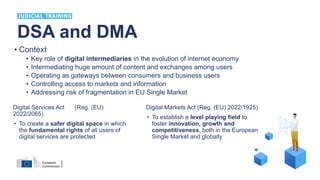
DSA and DMA
Digital Services Act (Reg. (EU)
2022/2065)
• To create a safer digital space in which
the fundamental rights of all users of
digital services are protected
Digital Markets Act (Reg. (EU) 2022/1925)
• To establish a level playing field to
foster innovation, growth and
competitiveness, both in the European
Single Market and globally
• Context
• Key role of digital intermediaries in the evolution of internet economy
• Intermediating huge amount of content and exchanges among users
• Operating as gateways between consumers and business users
• Controlling access to markets and information
• Addressing risk of fragmentation in EU Single Market
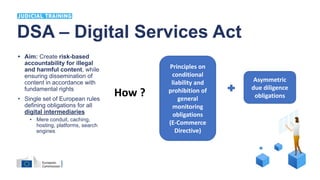
• Aim: Create risk-based
accountability for illegal
and harmful content, while
ensuring dissemination of
content in accordance with
fundamental rights
• Single set of European rules
defining obligations for all
digital intermediaries
• Mere conduit, caching,
hosting, platforms, search
engines
DSA – Digital Services Act
How ?
Principles on
conditional
liability and
prohibition of
general
monitoring
obligations
(E-Commerce
Directive)
Asymmetric
due diligence
obligations
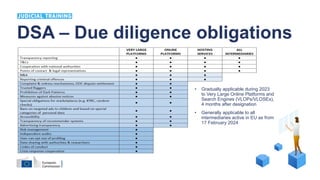
DSA – Due diligence obligations
• Gradually applicable during 2023
to Very Large Online Platforms and
Search Engines (VLOPs/VLOSEs),
4 months after designation
• Generally applicable to all
intermediaries active in EU as from
17 February 2024
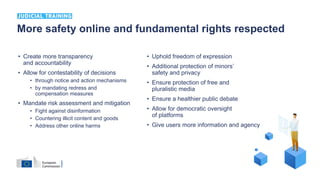
• Create more transparency
and accountability
• Allow for contestability of decisions
• through notice and action mechanisms
• by mandating redress and
compensation measures
• Mandate risk assessment and mitigation
• Fight against disinformation
• Countering illicit content and goods
• Address other online harms
• Uphold freedom of expression
• Additional protection of minors’
safety and privacy
• Ensure protection of free and
pluralistic media
• Ensure a healthier public debate
• Allow for democratic oversight
of platforms
• Give users more information and agency
More safety online and fundamental rights respected
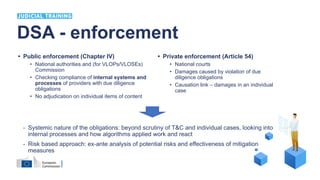
• Public enforcement (Chapter IV)
• National authorities and (for VLOPs/VLOSEs)
Commission
• Checking compliance of internal systems and
processes of providers with due diligence
obligations
• No adjudication on individual items of content
• Private enforcement (Article 54)
• National courts
• Damages caused by violation of due
diligence obligations
• Causation link – damages in an individual
case
DSA - enforcement
- Systemic nature of the obligations: beyond scrutiny of T&C and individual cases, looking into
internal processes and how algorithms applied work and react
- Risk based approach: ex-ante analysis of potential risks and effectiveness of mitigation
measures
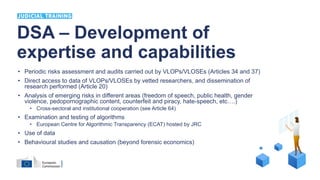
• Periodic risks assessment and audits carried out by VLOPs/VLOSEs (Articles 34 and 37)
• Direct access to data of VLOPs/VLOSEs by vetted researchers, and dissemination of
research performed (Article 20)
• Analysis of emerging risks in different areas (freedom of speech, public health, gender
violence, pedopornographic content, counterfeit and piracy, hate-speech, etc….)
• Cross-sectoral and institutional cooperation (see Article 64)
• Examination and testing of algorithms
• European Centre for Algorithmic Transparency (ECAT) hosted by JRC
• Use of data
• Behavioural studies and causation (beyond forensic economics)
DSA – Development of
expertise and capabilities
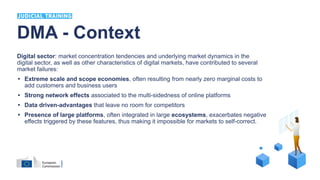
Digital sector: market concentration tendencies and underlying market dynamics in the
digital sector, as well as other characteristics of digital markets, have contributed to several
market failures:
• Extreme scale and scope economies, often resulting from nearly zero marginal costs to
add customers and business users
• Strong network effects associated to the multi-sidedness of online platforms
• Data driven-advantages that leave no room for competitors
• Presence of large platforms, often integrated in large ecosystems, exacerbates negative
effects triggered by these features, thus making it impossible for markets to self-correct.
DMA - Context
• Focus on gatekeepers of a ‘core’ platform service as most powerful actors in the
ecosystem of digital services
• Designation of gatekeepers in ten Core Platform Services (online intermediation services, online
search engines, online social networking services, video-sharing platform services,
number-independent interpersonal communication services, operating systems, web browsers,
virtual assistants, cloud computing services, advertising services) on the basis of quantitative and
qualitative criteria
• Horizontal application that covers all sectors
• Ex-ante regulations, clear list of do’s and don’ts to drive innovation and foster
contestability of the markets
• Complementarity by providing new tools alongside competition law and sectoral
regulations that continue to apply
DMA – central ideas
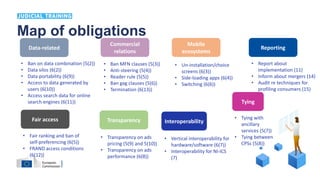
Map of obligations
Data-related
• Ban on data combination (5(2))
• Data silos (6(2))
• Data portability (6(9))
• Access to data generated by
users (6(10))
• Access search data for online
search engines (6(11))
Commercial
relations
• Ban MFN clauses (5(3))
• Anti-steering (5(4))
• Reader rule (5(5))
• Ban gag clauses (5(6))
• Termination (6(13))
Mobile
ecosystems
• Un-installation/choice
screens (6(3))
• Side-loading apps (6(4))
• Switching (6(6))
Reporting
• Report about
implementation (11)
• Inform about mergers (14)
• Audit re techniques for
profiling consumers (15)
Fair access
• Fair ranking and ban of
self-preferencing (6(5))
• FRAND access conditions
(6(12))
Transparency
• Transparency on ads
pricing (5(9) and 5(10))
• Transparency on ads
performance (6(8))
Interoperability
• Vertical interoperability for
hardware/software (6(7))
• Interoperability for NI-ICS
(7)
Tying
• Tying with
ancillary
services (5(7))
• Tying between
CPSs (5(8))
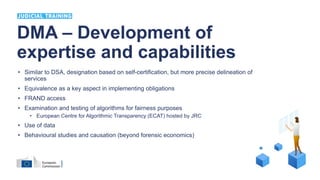
• Similar to DSA, designation based on self-certification, but more precise delineation of
services
• Equivalence as a key aspect in implementing obligations
• FRAND access
• Examination and testing of algorithms for fairness purposes
• European Centre for Algorithmic Transparency (ECAT) hosted by JRC
• Use of data
• Behavioural studies and causation (beyond forensic economics)
DMA – Development of
expertise and capabilities
THANK
YOU
for your participation!
DSA DMA_regulatory-framework-for-digital-platforms.pdf

DSA DMA_regulatory-framework-for-digital-platforms.pdf

  • 2.
    Regulatory framework for digital platforms M.Cox – E. L. Camilli – DG CONNECT, European Commission The views expressed are personal and cannot be attributed to the institution
  • 3.
    DSA and DMA DigitalServices Act (Reg. (EU) 2022/2065) • To create a safer digital space in which the fundamental rights of all users of digital services are protected Digital Markets Act (Reg. (EU) 2022/1925) • To establish a level playing field to foster innovation, growth and competitiveness, both in the European Single Market and globally • Context • Key role of digital intermediaries in the evolution of internet economy • Intermediating huge amount of content and exchanges among users • Operating as gateways between consumers and business users • Controlling access to markets and information • Addressing risk of fragmentation in EU Single Market
  • 4.
    • Aim: Createrisk-based accountability for illegal and harmful content, while ensuring dissemination of content in accordance with fundamental rights • Single set of European rules defining obligations for all digital intermediaries • Mere conduit, caching, hosting, platforms, search engines DSA – Digital Services Act How ? Principles on conditional liability and prohibition of general monitoring obligations (E-Commerce Directive) Asymmetric due diligence obligations
  • 5.
    DSA – Duediligence obligations • Gradually applicable during 2023 to Very Large Online Platforms and Search Engines (VLOPs/VLOSEs), 4 months after designation • Generally applicable to all intermediaries active in EU as from 17 February 2024
  • 6.
    • Create moretransparency and accountability • Allow for contestability of decisions • through notice and action mechanisms • by mandating redress and compensation measures • Mandate risk assessment and mitigation • Fight against disinformation • Countering illicit content and goods • Address other online harms • Uphold freedom of expression • Additional protection of minors’ safety and privacy • Ensure protection of free and pluralistic media • Ensure a healthier public debate • Allow for democratic oversight of platforms • Give users more information and agency More safety online and fundamental rights respected
  • 7.
    • Public enforcement(Chapter IV) • National authorities and (for VLOPs/VLOSEs) Commission • Checking compliance of internal systems and processes of providers with due diligence obligations • No adjudication on individual items of content • Private enforcement (Article 54) • National courts • Damages caused by violation of due diligence obligations • Causation link – damages in an individual case DSA - enforcement - Systemic nature of the obligations: beyond scrutiny of T&C and individual cases, looking into internal processes and how algorithms applied work and react - Risk based approach: ex-ante analysis of potential risks and effectiveness of mitigation measures
  • 8.
    • Periodic risksassessment and audits carried out by VLOPs/VLOSEs (Articles 34 and 37) • Direct access to data of VLOPs/VLOSEs by vetted researchers, and dissemination of research performed (Article 20) • Analysis of emerging risks in different areas (freedom of speech, public health, gender violence, pedopornographic content, counterfeit and piracy, hate-speech, etc….) • Cross-sectoral and institutional cooperation (see Article 64) • Examination and testing of algorithms • European Centre for Algorithmic Transparency (ECAT) hosted by JRC • Use of data • Behavioural studies and causation (beyond forensic economics) DSA – Development of expertise and capabilities
  • 9.
    Digital sector: marketconcentration tendencies and underlying market dynamics in the digital sector, as well as other characteristics of digital markets, have contributed to several market failures: • Extreme scale and scope economies, often resulting from nearly zero marginal costs to add customers and business users • Strong network effects associated to the multi-sidedness of online platforms • Data driven-advantages that leave no room for competitors • Presence of large platforms, often integrated in large ecosystems, exacerbates negative effects triggered by these features, thus making it impossible for markets to self-correct. DMA - Context
  • 10.
    • Focus ongatekeepers of a ‘core’ platform service as most powerful actors in the ecosystem of digital services • Designation of gatekeepers in ten Core Platform Services (online intermediation services, online search engines, online social networking services, video-sharing platform services, number-independent interpersonal communication services, operating systems, web browsers, virtual assistants, cloud computing services, advertising services) on the basis of quantitative and qualitative criteria • Horizontal application that covers all sectors • Ex-ante regulations, clear list of do’s and don’ts to drive innovation and foster contestability of the markets • Complementarity by providing new tools alongside competition law and sectoral regulations that continue to apply DMA – central ideas
  • 11.
    Map of obligations Data-related •Ban on data combination (5(2)) • Data silos (6(2)) • Data portability (6(9)) • Access to data generated by users (6(10)) • Access search data for online search engines (6(11)) Commercial relations • Ban MFN clauses (5(3)) • Anti-steering (5(4)) • Reader rule (5(5)) • Ban gag clauses (5(6)) • Termination (6(13)) Mobile ecosystems • Un-installation/choice screens (6(3)) • Side-loading apps (6(4)) • Switching (6(6)) Reporting • Report about implementation (11) • Inform about mergers (14) • Audit re techniques for profiling consumers (15) Fair access • Fair ranking and ban of self-preferencing (6(5)) • FRAND access conditions (6(12)) Transparency • Transparency on ads pricing (5(9) and 5(10)) • Transparency on ads performance (6(8)) Interoperability • Vertical interoperability for hardware/software (6(7)) • Interoperability for NI-ICS (7) Tying • Tying with ancillary services (5(7)) • Tying between CPSs (5(8))
  • 12.
    • Similar toDSA, designation based on self-certification, but more precise delineation of services • Equivalence as a key aspect in implementing obligations • FRAND access • Examination and testing of algorithms for fairness purposes • European Centre for Algorithmic Transparency (ECAT) hosted by JRC • Use of data • Behavioural studies and causation (beyond forensic economics) DMA – Development of expertise and capabilities
  • 13.