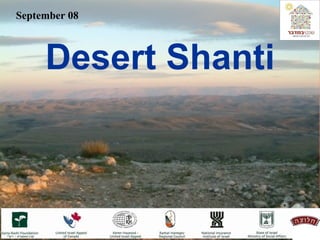
September 08 Desert Shanti
“  In 100 years, the bank account I had, the house I lived in and the car I drove, will be meaningless… but the world will be different  because I was significant in someone’s life – Today…”
Table of Content About The Shanti House Desert Shanti Appendix
The Shanti House
The house is home to youngsters suffering from physical, sexual and verbal abuse, orphaned or abandoned by their parents, and drop-outs from formal therapeutic institutions (native Israelis, new immigrants and lone soldiers). Shanti House was created for them as an informal, warm, open and loving environment. For most of the home’s teenagers, this is their first  experience of such unconditional love, homeliness and a sense of family. About Shanti House 1984-2008
About Shanti House Upon arrival they are greeted by a professional team and given support and an opportunity to unburden their frustrations, that together with the provision of basic needs and therapeutic activities, help their return to a normative way of life and an opportunity to return to school or to a work environment as well as military service. 35-50 teenagers between the ages 14-21 stay at Shanti House at any given time. Shanti House treats on average between 700 to 1,000 teenagers annually. For the past 24 years Shanti House has assisted over 18,000 teenagers
Target population – teenagers from all over the country. Teenagers arriving on their own, who are willing to get help. Teenagers who are referred by social services, police, the media and more. Initial acceptance is unconditional!!! Providing all their needs: bed and board, understanding and love. Preparing a personal program with the educational-treatment team. About Shanti House The Method
Desert Shanti
Desert Shanti Out of five existing centers for youth at risk In Israel none are in the south A National Problem In the south, 28,000 teenagers are at high risk. Continue…
120,000 teenagers live in Israel’s southern region. Constant Increase in violence, drugs and alcohol abuse. Increasing problems with family interaction. The desert’s majestic calmness and its healing power. Over 20 years of experience. The advantage of combining an urban house with a desert location. Key factors in our decision to open another house in the south Desert Shanti
We are “going up” to Ramat Negev Desert Shanti
Ramat Negev local council south of Ben-Gurion College, Zaparim junction on route 40. The village is spread over 540 dunams: 150 dunams for buildings 400 dunams for open space Location and territory Desert Shanti
Program Goals To create an educational, therapeutic and rehabilitating home to save teenagers at risk. To combine family atmosphere with a quality of life associated with the characteristics of the desert. A will to help as many teenagers as possible through diversified means. A centre for preventive counseling on drug, alcohol and violence. Linking the  desert , nature and the theraputic model of Shanti House Desert Shanti
Emphasis on very special natural design…providing a homely and soothing environment with a unique appearance…a welcoming atmosphere for the youth at risk An environmentally friendly construction that will utilize accessible and recycled materials. Water and garbage recycling and an option for solar or wind power Unique Program Desert Shanti The goal of Desert Shanti is financial independence
Continue… Program Outline Home to assist youth at risk   Occupational therapies Educational and preventive activities Desert Shanti
House to assist youths At any given time 35-100 teenagers will reside in the village (1,000 annually). Reception open 24 hours a day. Stay, according to necessity. No to: drugs, alcohol and violence. המשך ... Continue… Desert Shanti
Participating in therapy with animals (therapeutic horse ranch) Participating in household management. Working in the agricultural fields. Occupational Therapy Continue… Desert Shanti
Annually, ~10,000 high-school teenagers, parents, therapists and youngsters from Israel and abroad will visit the guesthouse. Music centre, desert tours, enhancing the link to the heritage of Israel, and artistic activities. Activities and workshops to prevent drug abuse will be an integral and intensive part of the program Educational and Preventive Activities  Desert Shanti
 
Desert Shanti Project Budget
Donated Funds Desert Shanti
Fund Raising By Stages Part 1 To commence building a home to help youth at risk. In 04/2007 Part 2 – Funds Have Been Secured $  half  million to construct the horse ranch and to prepare land for agriculture “  First Step”- Save teenagers in the south Part 3 We will start raising 2.5 million $ funds, to complete the guest house Desert Shanti
Timetable 2003  2004  2005  2006  2007  2008  2009 Concept Permits & Committees $5.3 million raised Infrastructure Saving teenagers Desert Shanti Stage 1  Stage 2 Stage 3
Appendix
Project leaders Project initiator -  Maryuma Klein founder of Shanti House Project managers  -  Sacta-Rashi Fund Founding partners   Sacta-Rashi Fund Ramat Negev Local Council Keren Kayemet le Israel (KKL) Leaders Uzi Havashush - Development Manager Ramat Negev Maryuma Klein - Chairwoman of Shanti House Association Michael Ben-Yossef - Managing Director Shanti House Association
Program specification Stage 3 Guesthouses Lecture halls Service areas Stage 2   Horse ranch Animal farm Amphitheatre Recording studio Agriculture Stage 1 Housing area – for youths, counsellors, house and family mother Public space: studio, club, dining-room, classrooms Service area: kitchens, workroom, laundry, garbage, generator rooms, toilets and office
 
Stages in project advancement Operational costs for the first three years are secured through:  Labour & Welfare Ministry – Youth Authority   Social Security – “Special Projects” Conclusion of all land development, buildings and construction plans The project passed the committees and regulators and received all the necessary permits Land breaking was carried out by the Keren Kayemet le Israel in May 2005. The I.D.F. Officer’s School adopted the project .
Project managers  – Sacta-Rashi Fund Architect  – Yuval Amir Landscape architects  – Dafna Tamir & Ilan Akrish Management & engineering supervision  – Ramon Engineers. Permits and administrative team Bezeq I.D.F Ma’atz Water commission Mekorot Committees  – local, regional & national Health Ministry Ministry of the Environment Ministry of Agriculture Electric Power Company Antiquities Authority
Ramat Negev Local Council Jurisdiction - 4.5 million dunams - the largest in Israel 12 municipalities.   Population 3,700 and growing Economy and occupation: Agriculture, tourism, industry, R&D.   Its location at the junction between the centre of Israel, Egypt and Jordan creates optimal conditions for increase in tourism, agriculture and industry.   The boarder crossing with Egypt and the planned highway connecting the centre of Israel with Egypt, Jordan and Syria create a potential for commerce and transportation between Israel and its neighbours.
Sacta-Rashi Fund Founded in 1984 One of the largest private family-held funds in Israel The fund’s goal is to help the needy in Israel while focusing on children, teenagers and special needs populations in the geographical and social periphery of Israeli society.   Areas of activity: education, welfare and health. Scope of impact: touching the lives of 10% of the population.
Contact us Sacta-Rashi Fund Arie Halfon, Managing Director projects construction and development  Ben-Shemen Youth Village 73112 Israel  Tel:  +972 8 914 6600 Fax:  +972 8 921 9404 Email:  [email_address] Website:  www.sacta-rashi.org.il
Contact us Tel Aviv Shanti House  - Association  #580199594 Michael Ben-Yossef, Project Manager 17 Simtat Shlush Neve Zedek, Tel Aviv 68103 Israel P.O.B 50041 Tel:  +972 3 510 3339  Fax:  +972 3 516 8603  Email:  [email_address]   Website:  www.shanti.org.il
Thank you!

Ds inetrent e

  • 1.
  • 2.
    “ In100 years, the bank account I had, the house I lived in and the car I drove, will be meaningless… but the world will be different because I was significant in someone’s life – Today…”
  • 3.
    Table of ContentAbout The Shanti House Desert Shanti Appendix
  • 4.
  • 5.
    The house ishome to youngsters suffering from physical, sexual and verbal abuse, orphaned or abandoned by their parents, and drop-outs from formal therapeutic institutions (native Israelis, new immigrants and lone soldiers). Shanti House was created for them as an informal, warm, open and loving environment. For most of the home’s teenagers, this is their first experience of such unconditional love, homeliness and a sense of family. About Shanti House 1984-2008
  • 6.
    About Shanti HouseUpon arrival they are greeted by a professional team and given support and an opportunity to unburden their frustrations, that together with the provision of basic needs and therapeutic activities, help their return to a normative way of life and an opportunity to return to school or to a work environment as well as military service. 35-50 teenagers between the ages 14-21 stay at Shanti House at any given time. Shanti House treats on average between 700 to 1,000 teenagers annually. For the past 24 years Shanti House has assisted over 18,000 teenagers
  • 7.
    Target population –teenagers from all over the country. Teenagers arriving on their own, who are willing to get help. Teenagers who are referred by social services, police, the media and more. Initial acceptance is unconditional!!! Providing all their needs: bed and board, understanding and love. Preparing a personal program with the educational-treatment team. About Shanti House The Method
  • 8.
  • 9.
    Desert Shanti Outof five existing centers for youth at risk In Israel none are in the south A National Problem In the south, 28,000 teenagers are at high risk. Continue…
  • 10.
    120,000 teenagers livein Israel’s southern region. Constant Increase in violence, drugs and alcohol abuse. Increasing problems with family interaction. The desert’s majestic calmness and its healing power. Over 20 years of experience. The advantage of combining an urban house with a desert location. Key factors in our decision to open another house in the south Desert Shanti
  • 11.
    We are “goingup” to Ramat Negev Desert Shanti
  • 12.
    Ramat Negev localcouncil south of Ben-Gurion College, Zaparim junction on route 40. The village is spread over 540 dunams: 150 dunams for buildings 400 dunams for open space Location and territory Desert Shanti
  • 13.
    Program Goals Tocreate an educational, therapeutic and rehabilitating home to save teenagers at risk. To combine family atmosphere with a quality of life associated with the characteristics of the desert. A will to help as many teenagers as possible through diversified means. A centre for preventive counseling on drug, alcohol and violence. Linking the desert , nature and the theraputic model of Shanti House Desert Shanti
  • 14.
    Emphasis on veryspecial natural design…providing a homely and soothing environment with a unique appearance…a welcoming atmosphere for the youth at risk An environmentally friendly construction that will utilize accessible and recycled materials. Water and garbage recycling and an option for solar or wind power Unique Program Desert Shanti The goal of Desert Shanti is financial independence
  • 15.
    Continue… Program OutlineHome to assist youth at risk Occupational therapies Educational and preventive activities Desert Shanti
  • 16.
    House to assistyouths At any given time 35-100 teenagers will reside in the village (1,000 annually). Reception open 24 hours a day. Stay, according to necessity. No to: drugs, alcohol and violence. המשך ... Continue… Desert Shanti
  • 17.
    Participating in therapywith animals (therapeutic horse ranch) Participating in household management. Working in the agricultural fields. Occupational Therapy Continue… Desert Shanti
  • 18.
    Annually, ~10,000 high-schoolteenagers, parents, therapists and youngsters from Israel and abroad will visit the guesthouse. Music centre, desert tours, enhancing the link to the heritage of Israel, and artistic activities. Activities and workshops to prevent drug abuse will be an integral and intensive part of the program Educational and Preventive Activities Desert Shanti
  • 19.
  • 20.
  • 21.
  • 22.
    Fund Raising ByStages Part 1 To commence building a home to help youth at risk. In 04/2007 Part 2 – Funds Have Been Secured $ half million to construct the horse ranch and to prepare land for agriculture “ First Step”- Save teenagers in the south Part 3 We will start raising 2.5 million $ funds, to complete the guest house Desert Shanti
  • 23.
    Timetable 2003 2004 2005 2006 2007 2008 2009 Concept Permits & Committees $5.3 million raised Infrastructure Saving teenagers Desert Shanti Stage 1 Stage 2 Stage 3
  • 24.
  • 25.
    Project leaders Projectinitiator - Maryuma Klein founder of Shanti House Project managers - Sacta-Rashi Fund Founding partners Sacta-Rashi Fund Ramat Negev Local Council Keren Kayemet le Israel (KKL) Leaders Uzi Havashush - Development Manager Ramat Negev Maryuma Klein - Chairwoman of Shanti House Association Michael Ben-Yossef - Managing Director Shanti House Association
  • 26.
    Program specification Stage3 Guesthouses Lecture halls Service areas Stage 2 Horse ranch Animal farm Amphitheatre Recording studio Agriculture Stage 1 Housing area – for youths, counsellors, house and family mother Public space: studio, club, dining-room, classrooms Service area: kitchens, workroom, laundry, garbage, generator rooms, toilets and office
  • 27.
  • 28.
    Stages in projectadvancement Operational costs for the first three years are secured through: Labour & Welfare Ministry – Youth Authority Social Security – “Special Projects” Conclusion of all land development, buildings and construction plans The project passed the committees and regulators and received all the necessary permits Land breaking was carried out by the Keren Kayemet le Israel in May 2005. The I.D.F. Officer’s School adopted the project .
  • 29.
    Project managers – Sacta-Rashi Fund Architect – Yuval Amir Landscape architects – Dafna Tamir & Ilan Akrish Management & engineering supervision – Ramon Engineers. Permits and administrative team Bezeq I.D.F Ma’atz Water commission Mekorot Committees – local, regional & national Health Ministry Ministry of the Environment Ministry of Agriculture Electric Power Company Antiquities Authority
  • 30.
    Ramat Negev LocalCouncil Jurisdiction - 4.5 million dunams - the largest in Israel 12 municipalities. Population 3,700 and growing Economy and occupation: Agriculture, tourism, industry, R&D. Its location at the junction between the centre of Israel, Egypt and Jordan creates optimal conditions for increase in tourism, agriculture and industry. The boarder crossing with Egypt and the planned highway connecting the centre of Israel with Egypt, Jordan and Syria create a potential for commerce and transportation between Israel and its neighbours.
  • 31.
    Sacta-Rashi Fund Foundedin 1984 One of the largest private family-held funds in Israel The fund’s goal is to help the needy in Israel while focusing on children, teenagers and special needs populations in the geographical and social periphery of Israeli society. Areas of activity: education, welfare and health. Scope of impact: touching the lives of 10% of the population.
  • 32.
    Contact us Sacta-RashiFund Arie Halfon, Managing Director projects construction and development Ben-Shemen Youth Village 73112 Israel Tel: +972 8 914 6600 Fax: +972 8 921 9404 Email: [email_address] Website: www.sacta-rashi.org.il
  • 33.
    Contact us TelAviv Shanti House - Association #580199594 Michael Ben-Yossef, Project Manager 17 Simtat Shlush Neve Zedek, Tel Aviv 68103 Israel P.O.B 50041 Tel: +972 3 510 3339 Fax: +972 3 516 8603 Email: [email_address] Website: www.shanti.org.il
  • 34.