DRYING
DRYING
• Drying is defined as the removal of small
amounts of water or other liquid from a
material by the application of heat
• Drying is possible when the environment is
unsaturated with water vapor
APPLICATIONS
• Prepartion of bulk drugs
Drying is the final stage of processing
e.g. Dried aluminum hydroxide
Spray dried lactose
Powdered extracts
Drying step is essential after filtration and
centrifugation operations
APPLICATIONS
• Preservation of drug products
Drying is necessary to avoid deterioration of
drugs
Crude drugs of animal and vegetable
origin – chemical decomposition
Blood products, skin, tissue – microbial
growth
APPLICATIONS
• Improved characteristics
Drying produces materials of spherical shape ,
uniform size, free flowing end enhanced
solubility
e.g. granules are dried to improve fluidity
and compression characteristics
Viscous and sticky materials are not free
flowing. Drying modify these characteristics
THEORY OF DRYING
• In a wet mass water may be present as bound
water and unbound water
• Bound water :
It is the minimum water held by the material that
exerts an equilibrium vapor pressure less than
pure water at the same temperature
The substances containing bound water –
hygroscopic substances
THEORY OF DRYING
• Unbound water
It is the amount of water held by the material
that exerts an equilibrium vapor pressure
equal to that of pure water at the same
temperature
EQUILIBRIUM RELATIONSHIPS
• Air of constant temperature and humidity is
passed over the wet solid
• After a long exposure equilibrium is attained
• On attaining equilibrium further exposure will
not alter the moisture content in the solid
• At this stage VP of the wet solid = surrounding
atmosphere .
EQUILIBRIUM MOISTURE CONTENT
• it is the amount of water present in the solid
which exerts a vapor pressure equal to the
vapor pressure of the atmosphere
surrounding it.
DESORPTION :-
When air of constant temperature and humidity
is continuously passed over the solid
Solid containing moisture > EMC
Then solid loses water continuously till EMC is
reached
This phenomenon is known as desorption
SORPTION
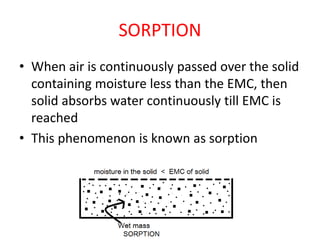
• When air is continuously passed over the solid
containing moisture less than the EMC, then
solid absorbs water continuously till EMC is
reached
• This phenomenon is known as sorption
Measurement of EMC of materials
• The solid samples are placed in a series of
desiccators
• This samples exposed to several humidity
conditions
• This exposure is continued until the material
attains a constant weight
• The difference in the final and initial weights
gives the moisture content
Applications of EMC
• Over drying can be avoided
Drying should be stopped when the moisture
content reaches the level of EMC under
experimental condition
FREE MOISTURE CONTENT
It is the amount of water that is free to
evaporate from the solid surface
FMC = Total water content – EMC
Rate relationships
• Rate relationship can be studied with a simple
model which mimic the conditions of a dryer.
• a wet slab of material to be dried is placed in the
trays whose bottom and sides are insulated.
• The air having constant temperature, humidity,
pressure and air velocity is blown over the solid.
• The superficial water diffuses through the
surrounding stationary air film
Rate relationships
• The air carries this water
• Periodically the slab is weighed
• The difference in the weights of two
successive periods gives the loss of moisture
content.
• The moisture present in the solid can be
expressed on a wet weight or dry weight basis
Rate relationships
• % loss on drying(LOD)
= * 100
• %moisture content (MC)
= *100
• Drying rate =
DRYING RATE CURVE.
• From the above experiment we get data for
FMC .
• FMC plotted on x axis and drying rate on y axis
• The curve so obtained is called drying rate
curve.
DRYING RATE CURVE
INITIAL ADJUSTMENT RATE PERIOD
• Time corresponding to A-B
B- wet bulb temperature of drying air
CONSTANT RATE PERIOD
• Time corresponding to BC
• Temperature and rate of drying remains
constant
• Moisture evaporating from the surface is
replaced by the water diffusing from the
interior of the solid
• Critical moisture content
FIRST FALLING RATE PERIOD
• Time corresponding to CD – unsaturated
surface drying
• Once the surface water evaporated then there
will not be enough water to maintain
continuous film on the surface
FIRST FALLING RATE PERIOD
• Dry spots begins to appear
• Rate of drying fall off
• The point D – second critical point
at this point the film of surface water is
completely evaporated
SECOND FALLING RATE PERIOD
• Time corresponding to DE
• Rate of drying falling rapidly than the first
falling rate period
• Rate of drying dependent on the rate of
diffusion of water vapor
• E- Equilibrium moisture content
SECOND FALLING RATE PERIOD
• Beyond E, the drying rate is equal to zero.
• i.e. temperature and moisture content remain
constant
• Don’t worry about what I am doing. Worry
about why you are worried about what I am
doing
DRYING.pptx

  • 1.
  • 2.
    DRYING • Drying isdefined as the removal of small amounts of water or other liquid from a material by the application of heat • Drying is possible when the environment is unsaturated with water vapor
  • 3.
    APPLICATIONS • Prepartion ofbulk drugs Drying is the final stage of processing e.g. Dried aluminum hydroxide Spray dried lactose Powdered extracts Drying step is essential after filtration and centrifugation operations
  • 4.
    APPLICATIONS • Preservation ofdrug products Drying is necessary to avoid deterioration of drugs Crude drugs of animal and vegetable origin – chemical decomposition Blood products, skin, tissue – microbial growth
  • 5.
    APPLICATIONS • Improved characteristics Dryingproduces materials of spherical shape , uniform size, free flowing end enhanced solubility e.g. granules are dried to improve fluidity and compression characteristics Viscous and sticky materials are not free flowing. Drying modify these characteristics
  • 6.
    THEORY OF DRYING •In a wet mass water may be present as bound water and unbound water • Bound water : It is the minimum water held by the material that exerts an equilibrium vapor pressure less than pure water at the same temperature The substances containing bound water – hygroscopic substances
  • 7.
    THEORY OF DRYING •Unbound water It is the amount of water held by the material that exerts an equilibrium vapor pressure equal to that of pure water at the same temperature
  • 8.
    EQUILIBRIUM RELATIONSHIPS • Airof constant temperature and humidity is passed over the wet solid • After a long exposure equilibrium is attained • On attaining equilibrium further exposure will not alter the moisture content in the solid • At this stage VP of the wet solid = surrounding atmosphere .
  • 9.
    EQUILIBRIUM MOISTURE CONTENT •it is the amount of water present in the solid which exerts a vapor pressure equal to the vapor pressure of the atmosphere surrounding it.
  • 10.
    DESORPTION :- When airof constant temperature and humidity is continuously passed over the solid Solid containing moisture > EMC Then solid loses water continuously till EMC is reached This phenomenon is known as desorption
  • 11.
    SORPTION • When airis continuously passed over the solid containing moisture less than the EMC, then solid absorbs water continuously till EMC is reached • This phenomenon is known as sorption
  • 12.
    Measurement of EMCof materials • The solid samples are placed in a series of desiccators • This samples exposed to several humidity conditions • This exposure is continued until the material attains a constant weight • The difference in the final and initial weights gives the moisture content
  • 13.
    Applications of EMC •Over drying can be avoided Drying should be stopped when the moisture content reaches the level of EMC under experimental condition
  • 14.
    FREE MOISTURE CONTENT Itis the amount of water that is free to evaporate from the solid surface FMC = Total water content – EMC
  • 15.
    Rate relationships • Raterelationship can be studied with a simple model which mimic the conditions of a dryer. • a wet slab of material to be dried is placed in the trays whose bottom and sides are insulated. • The air having constant temperature, humidity, pressure and air velocity is blown over the solid. • The superficial water diffuses through the surrounding stationary air film
  • 16.
    Rate relationships • Theair carries this water • Periodically the slab is weighed • The difference in the weights of two successive periods gives the loss of moisture content. • The moisture present in the solid can be expressed on a wet weight or dry weight basis
  • 17.
    Rate relationships • %loss on drying(LOD) = * 100 • %moisture content (MC) = *100 • Drying rate =
  • 18.
    DRYING RATE CURVE. •From the above experiment we get data for FMC . • FMC plotted on x axis and drying rate on y axis • The curve so obtained is called drying rate curve.
  • 19.
  • 20.
    INITIAL ADJUSTMENT RATEPERIOD • Time corresponding to A-B B- wet bulb temperature of drying air
  • 21.
    CONSTANT RATE PERIOD •Time corresponding to BC • Temperature and rate of drying remains constant • Moisture evaporating from the surface is replaced by the water diffusing from the interior of the solid • Critical moisture content
  • 22.
    FIRST FALLING RATEPERIOD • Time corresponding to CD – unsaturated surface drying • Once the surface water evaporated then there will not be enough water to maintain continuous film on the surface
  • 23.
    FIRST FALLING RATEPERIOD • Dry spots begins to appear • Rate of drying fall off • The point D – second critical point at this point the film of surface water is completely evaporated
  • 24.
    SECOND FALLING RATEPERIOD • Time corresponding to DE • Rate of drying falling rapidly than the first falling rate period • Rate of drying dependent on the rate of diffusion of water vapor • E- Equilibrium moisture content
  • 25.
    SECOND FALLING RATEPERIOD • Beyond E, the drying rate is equal to zero. • i.e. temperature and moisture content remain constant
  • 26.
    • Don’t worryabout what I am doing. Worry about why you are worried about what I am doing