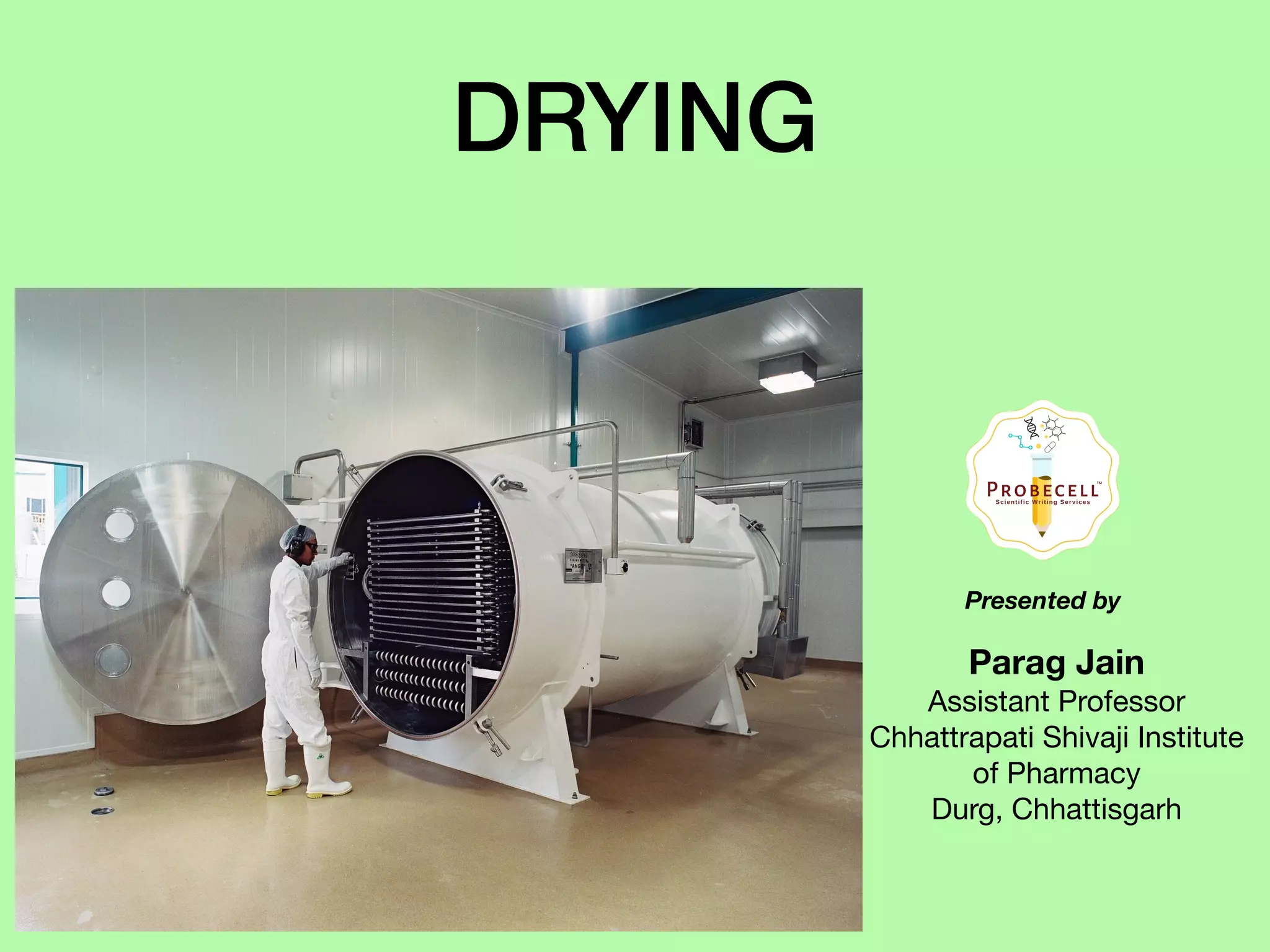
DRYING
Parag Jain
Assistant Professor 

Chhattrapati Shivaji Institute
of Pharmacy

Durg, Chhattisgarh
Presented by
Drying
• Drying	is	 commonly	 the last	 stage in	 a manufacture
process.

• Drying	is	 the	 final	 removal	 of	 water	from	 material
(usually by heat)

• Non-thermal drying
• As Squeezing wetted sponge

• Adsorption by desiccant (desiccation)

• Extraction
Importance
• To	 avoid	 or	 eliminate 		 moisture	which	may	 lead	 to
corrosion and decrease the product or drug stability.

• To improve or keep the good properties of a material, e.g.
Flowability, compressibility.

• To	 reduce	 the	cost	 of 		 transportation	 of	 large	
volume materials ( liquids).

• To make the material easy or more suitable for handling.

• Preservation.

• The final step in Evaporation, Filtration, Crystallization.
Rate of drying in a bed of powder:
• The rate at which drying occurs has been found to
show certain phases in which the change in moisture
content is plotted against time. From A to the
relationship is linear, which is known as the constant-
rate period, whereas from B to C the rate of loss of
moisture decreases and is known as the falling-rate
period. The end of the constant rate period, B, is
referred to as the critical moisture content.
- The first falling- rate period
has a linear relationship, that
is , the decrease in drying
rate is uniform, whereas in
the second falling-rate
period there is a continuous
decrease in the rate of
drying until the EMC is
reached.
• Constant-rate period: It is found that the evaporation
rate from the drying bed is similar to that of the solvent
alone from a free liquid surface under the same
conditions, indicating that the evaporation takes place
from the wet surface of the solid, and that the surface
remains wet in this period as a result of the liquid
being replaced from below as fast as it is vaporized
Controlling factors in this period are the rate at which
heat can be transferred and the rate of removal of the
vapour.
• First falling-rate period: As moisture is removed from the
surface, a point will be reached when the rate of
vaporization is insufficient to saturate the air in contact with
the surface. Under these conditions, the rate of drying will
be limited by the rate of capillary transfer of the liquid to the
surface of the wet bed, and this becomes increasingly
difficult as the bed dries, the solvent level decreases and
thus has further to travel to the point of evaporation.
Consequently, the rate of drying decreases continuously.
• Second falling-rate period: Any moisture that remains
within the drying bed at the end of the first falling –rate
period is unable to move, so that drying cannot take place
on the surface. i.e. the drying rate depends on the
movement of the vapour through the pores of the bed to
the surface, in general by molecular diffusion
Dryers for Solid Materials
Moisture content of wet solids
• The moisture content of a wet solid is expressed as
kilograms of moisture associated with 1 kg of the
moisture – free solid. Thus a moisture content of
0.4 means that 0.4 kg of removable water is
present per kg of the solid. It is sometimes
calculated as percentage moisture content.
• Total moisture content: This is the total amount of
liquid associated with a wet solid. The easily
removable water is known as the free moisture
content, and the moisture which is more difficult
to remove is the equilibrium moisture content.
The easily removable water is known as
unbound water.
• Unbound water: This water exists as a liquid and
exerts its fully vapour pressure, it can be removed
readily by evaporation. During a drying process
this water is easily lost but the resulting solid is
not completely free from water molecules.
Equilibrium moisture content:
• The moisture content present in a solid under steady-
state ambient conditions is termed the eq. moisture
content. Its value changes with temperature, humidity
and the nature of the solid.

Bound water:
• Part of the moisture present in a wet solid may be
adsorbed on surfaces of the solid or be adsorbed
within its structure to such an extent to prevent it from
developing its full vapour pressure and from being
easily removed by evaporation. Such moisture is
described as “bound” and is more difficult to remove
than unbound water.
• Equilibrium moisture content:
• The moisture content present in a solid under steady-state ambient
conditions is termed the eq. moisture content. Its value changes with
temperature, humidity and the nature of the solid.
• Bound water :
• Part of the moisture present in a wet solid may be adsorbed on
surfaces of the solid or be adsorbed within its structure to such an
extent to prevent it from developing its full vapour pressure and from
being easily removed by evaporation. Such moisture is described as
“bound” and is more difficult to remove than unbound water.
Equipments
1. Drum dryer (Film drying)
2. Spray dryer
3. Freeze Dryer
4. Tray drier
5. Fluidized Bed Dryer
6. Vacuum Dryer
Drum dryer
(Rollerdryer/Filmdrum dryer)
Principal:
• Material on drum & dried.
Construction:
• Hollow steel Drum
• Feed pan
• Spreader
• Doctor’s knife
• Storage bin (A conveyor)
Drum Dryer (Film Drying)
• It consists of a drum of about 0.75-1.5 m in diameter
and 2-4 m in length, heated internally, usually by steam
and rotated on its longitudinal axis.
• Operation: The liquid is applied to the surface and
spread to a film, this may be done in various ways, but
the simplest method is that shown in the diagram, where
the drum dips into a feed pan.
• Drying rate is controlled by using a suitable speed of
rotation and the drum temperature. The product is
scraped from the surface of the drum by means of a
doctor knife.
Working:
• Steam in drum- drum is rotated – through
feed pan.
• Material adhere to pan- thin layer form.
• Material dry during rotation.
• Doctor’s knife- Dry material is scrap –fall in
storage bin.
Application:
• For drying- solutions, slurries, Suspensions,
milk products, starch products, antibiotics,
various substances etc,.
Advantages 

• 1- The method gives rapid drying, the thin film spread over a
large area resulting in rapid heat and mass transfer. 

• 2- The equipment is compact, occupying much less space
than other dryers. 

• 3- Heating time is short, being only a few seconds. 

• 4- The drum can be enclosed in a vacuum jacket, enabling
the temperature of drying to be reduced. 

• 5- The product is obtained in flake form, which is convenient
for many purposes. 

• The only disadvantage : is that operating conditions are
critical and it is necessary to introduce careful control on
feed rate, film thickness, speed of drum rotation and drum
temperature.
Spray dryer
Principal:
• Material to fine droplets- moving stream of
hot gas.
Construction:
• Large cylindrical drying chamber.
• Inlet of hot air & atomizer- In Roof.
• Connected to a cyclone separator.
Spray Dryer
• The spray dryer provides a large surface area for heat
and mass transfer by atomizing the liquid to small
droplets.
• These are sprayed into a stream of hot air, so that each
droplet dries to a solid particle.
• The drying chamber resembles the cyclone ensuring
good circulation of air, to facilitate heat and mass
transfer, and that dried particles are separated by the
centrifugal action.
• Spray dryer can be operated efficiently at various feed
rates.
Spray Dryer
Working:
1. Atomization of the liquid: Liquid feed- into
chamber through atomizer.
2. Drying of liquid droplets: Due to hot air
drying.
3. Recovery of dried product: Recovery in last
step.
Application:
• For drying of large quantity material.
• Drying of thermo-labile, hygroscopic material.
• Drying of medicine like chloramphenicol.
Advantages
• The droplets are small, giving a large surface area for
heat transfer, so that evaporation is very rapid. The
actual drying time of a droplet is only a fraction of a
second, and the overall time in the dryer is only a few
seconds. 

• Because evaporation is very rapid, the droplets do not
attain a high temperature, most of the heat being used
as latent heat of vaporization. 

• The characteristic particle form gives the product a
high bulk density and, in turn, ready solubility. 

• The powder will have a uniform and controllable
particle size.
Disadvantages
• The equipment is very bulky, connected to accessories, fans, heaters,) 

• That is make it expensive. 

• Uses: 

• 1- Drying of any substance in solution or in suspension form 

• 2- It is most useful for drying of thermo labile materials e.g. antibiotics. 

• 3- Suitable for large quantities solution. 

• 4- Suitable for both soluble and insoluble substances e.g. citric acid,
gelatin, starch. 

• 5- It can produce spherical particles in the respiratory range e.g. dry
powder inhalers. 

• 6- Drying of milk, soap and detergents which is pharmaceutically
related compounds.
Freeze Dryer
• Freeze drying is a process used to dry extremely heat-
sensitive materials. It allows the drying , without excessive
damage, of proteins, blood products and even
microorganisms, which retain a small but significant
viability.
• In this process the initial liquid solution or
suspension is frozen, the pressure above the frozen state
is reduced and the water removed by sublimation.
• Thus a liquid-to-vapour transition takes place, but here
three states of matter involved: liquid to solid, then
solid to vapour.
Freeze dryer
(Lyophilization)
Principal:
• Drying by sublimation-triple point- temp. &
pressure below triple point.
Construction:
• Drying chamber in trays.
• Heating coils.
• Vapor condensing or adsorption system with
refrigerator.
• Vacuum pump.
Door
Condenser
Vacuum
pump
Shelves
Heating
System
Refrigerator
Fig.Industrialfreezedryer
Drying
chamber
Working:
1. Preparation & pretreatment: vacuum ay vacuum
tray dryers
2. Pre-freezing for solidifying water: cold (-50oC)
3. Primary drying (Sublimation of ice under
vacuum): at 0.0098oC & 0.533 kilopasals.
temperature is increased to 300C within 2 hours.
Then temperature kept constant. around 98 to 99%
water is removed.
4. Secondary drying (Removal of moisture at high
vacuum): temp as 50 to 60oC & low vacuum.
5. Packing: air replace with gas and seal.
Application:
• For production of dosage forms as injections,
solutions, suspensions.
• For drying of Blood plasma and its
fractionated products, Bacterial & viral
cultures, Human tissue, Antibiotics, Steroids,
Food items (Prawns etc)
Advantages :
• Suitable for thermo-labile material.
• Loss of volatile is less.
• No migration occurs.
• Suitable for moisture sensitive material.
• Sterility maintain
Disadvantages:
• High costs.
• Time consuming.
• Oxidation may occurs.
TRAY DRYER
(TRAY DRYER / TRUCK DRYER / SHELF DRYER / CABINET DRYER /
COMPARTMENT DRYER )
Principal:
• Hot air- Circulation.
Construction:
• Small or a large cabinet insulated (to reduce
heat loss) compartment in which trays.
• Heater- Heating of air
• Fan: Circulate the air
• Inlet & Outlet.
Tray drier
• Air flows in direction of the arrows over each
shelf in turn.
• The wet material is spread on shallow trays
resting on the shelves.
• Electrical elements or steam-heated pipes are
positioned as shown, so that the air is
periodically reheated after it has cooled by
passage over the wet material on one shelf
before it passes on the next.
Tray drier
Working:
• Material loaded in trays- Fresh air is introduced.
• The material is heated by hot air circulated.
• The trays containing the load remain in the
dryer until drying is complete,
• After which they are withdrawn, emptied and
recharged for drying the next batch.
Application:
• For drying of sticky material & granular mass.
• Drying of crude drugs, chemicals, powders,
tablet granules etc.
Advantages :
• Easy to operate.
• Batch process for different product.
• Can useful for drying of verity of material.
Disadvantages:
• Require labor.
• Cost increasing
• Time consuming
Disadvantages of tray drying :
• The drying time is long 

• Dissolved material can migrate to the upper surface of
the bed of granules 

• Granules may aggregate owing to bridge formation at
the points of contact of the granules.
Fluidized Bed Dryer
• ‘Fluidized’ means something that behaves like liquid. In
the fluidized bed dryer, the mixture of solids and gas
behave like a liquid and solid are called fluidized.
• It provides good contact between hot air and particles to
obtain efficient drying.
• The hot air is passed through a mesh, which supports
the conical vessel with a porous base.
• This vessel is filled with powder to be dried.
• It has wheels and can be clipped to the central plate by
means of a rapid acting ring closure.
Fluidized bed dryer
Principal:
• Hot air-trough bed of granules.
• Granules lifted from bottom & suspend in air
(Fluidized state).
Construction:
• Fluidized bed dryer- steel or plastic.
• Detachable bowl- perforated bottom with wire
mesh-support material.
• Fan- upper part- circulate air.
• Fresh air inlet/pre-filter/heat exchanger- to heat
air.
• Bag filters- collect fine
Working:
• Material load – detachable bowl.
• Fresh enter – inlet- heater- hot air- through
bed-with optimum velocity.
• Particle suspend- fluidized state- drying takes
place.
Application:
• Drying of tablet granules.
• Suitable for other process to mixing etc.
• Modified form – use for coating of granules.
Advantages :
• Fast process.
• Available in different capacity.
• Easy handling, reduce labor cost.
• High thermal efficiency.
• Suitable for applying high temp.
• Suitable for thermo-labile substances.
Disadvantages:
• Develops electric charges.
• Attrition may occur.
Vacuum Dryer
• This equipment is a good example of conduction drier.
The vacuum oven consists of a jacketed vessel to
withstand vacuum within the oven.
• There are supports for the shelves giving a larger area
for conduction heat transfer. The oven can be closed by
a door.
• The oven is connected through a condenser and liquid
receiver to a vacuum pump.
• Operating pressure can be as low as 0.03-0.03 bar, at
which pressures water boils at 25-35 0C.
Vacuum Dryer
Principal:
• Drying – by application of vacuum.
Construction:
• Iron heavy jacketed vessel.
• Hallow shelves.
• Metal trays.
• Oven to vacuum pump.
Working:
• Material of trays- placed on shelves.
• Pressure decreased by vacuum pump.
• Steam/hot hair- into jacket of shelves.
• Drying will takes place.
Application:
• Drying of heat sensitive material, dusty
hygroscopic material,
• Drugs containing toxic solvents.
Advantages :
• Easy operating
• Easy for batch process of different compounds.
• Various modes can be used for heating.
• Drying takes place at a low temperature.
• There is little air present, so, there is minimum
risk of oxidation.
Disadvantages:
• Low heat transfer efficiency.
• Limited capacity.
• More expensive.
Advantages of vacuum oven: 

• Drying takes place at a low temperature.

• There is little air present, so, there is minimum risk of
oxidation.
Website: www.probecell.com Email: probecellinfo@gmail.com
Ph: 7415211131
Office: Smriti Nagar, Bhilai, Chhattisgarh - 490020
https://youtube.com/c/ParagJainthunderpassionate https://www.facebook.com/thesisresearchwriting
Research article Review article Thesis Synopsis PhD Title Research guidance

Pharmaceutical Engineering: Drying

  • 1.
    DRYING Parag Jain Assistant Professor Chhattrapati Shivaji Institute of Pharmacy Durg, Chhattisgarh Presented by
  • 2.
    Drying • Drying is commonly the last stage in a manufacture process. • Drying is the final removal of water from material (usually by heat) • Non-thermal drying • As Squeezing wetted sponge • Adsorption by desiccant (desiccation) • Extraction
  • 3.
    Importance • To avoid or eliminate moisture which may lead to corrosion and decrease the product or drug stability. • To improve or keep the good properties of a material, e.g. Flowability, compressibility. • To reduce the cost of transportation of large volume materials ( liquids). • To make the material easy or more suitable for handling. • Preservation. • The final step in Evaporation, Filtration, Crystallization.
  • 4.
    Rate of dryingin a bed of powder: • The rate at which drying occurs has been found to show certain phases in which the change in moisture content is plotted against time. From A to the relationship is linear, which is known as the constant- rate period, whereas from B to C the rate of loss of moisture decreases and is known as the falling-rate period. The end of the constant rate period, B, is referred to as the critical moisture content.
  • 5.
    - The firstfalling- rate period has a linear relationship, that is , the decrease in drying rate is uniform, whereas in the second falling-rate period there is a continuous decrease in the rate of drying until the EMC is reached.
  • 6.
    • Constant-rate period:It is found that the evaporation rate from the drying bed is similar to that of the solvent alone from a free liquid surface under the same conditions, indicating that the evaporation takes place from the wet surface of the solid, and that the surface remains wet in this period as a result of the liquid being replaced from below as fast as it is vaporized Controlling factors in this period are the rate at which heat can be transferred and the rate of removal of the vapour.
  • 7.
    • First falling-rateperiod: As moisture is removed from the surface, a point will be reached when the rate of vaporization is insufficient to saturate the air in contact with the surface. Under these conditions, the rate of drying will be limited by the rate of capillary transfer of the liquid to the surface of the wet bed, and this becomes increasingly difficult as the bed dries, the solvent level decreases and thus has further to travel to the point of evaporation. Consequently, the rate of drying decreases continuously.
  • 8.
    • Second falling-rateperiod: Any moisture that remains within the drying bed at the end of the first falling –rate period is unable to move, so that drying cannot take place on the surface. i.e. the drying rate depends on the movement of the vapour through the pores of the bed to the surface, in general by molecular diffusion
  • 9.
    Dryers for SolidMaterials Moisture content of wet solids • The moisture content of a wet solid is expressed as kilograms of moisture associated with 1 kg of the moisture – free solid. Thus a moisture content of 0.4 means that 0.4 kg of removable water is present per kg of the solid. It is sometimes calculated as percentage moisture content.
  • 10.
    • Total moisturecontent: This is the total amount of liquid associated with a wet solid. The easily removable water is known as the free moisture content, and the moisture which is more difficult to remove is the equilibrium moisture content. The easily removable water is known as unbound water. • Unbound water: This water exists as a liquid and exerts its fully vapour pressure, it can be removed readily by evaporation. During a drying process this water is easily lost but the resulting solid is not completely free from water molecules.
  • 11.
    Equilibrium moisture content: •The moisture content present in a solid under steady- state ambient conditions is termed the eq. moisture content. Its value changes with temperature, humidity and the nature of the solid. Bound water: • Part of the moisture present in a wet solid may be adsorbed on surfaces of the solid or be adsorbed within its structure to such an extent to prevent it from developing its full vapour pressure and from being easily removed by evaporation. Such moisture is described as “bound” and is more difficult to remove than unbound water.
  • 12.
    • Equilibrium moisturecontent: • The moisture content present in a solid under steady-state ambient conditions is termed the eq. moisture content. Its value changes with temperature, humidity and the nature of the solid. • Bound water : • Part of the moisture present in a wet solid may be adsorbed on surfaces of the solid or be adsorbed within its structure to such an extent to prevent it from developing its full vapour pressure and from being easily removed by evaporation. Such moisture is described as “bound” and is more difficult to remove than unbound water.
  • 13.
    Equipments 1. Drum dryer(Film drying) 2. Spray dryer 3. Freeze Dryer 4. Tray drier 5. Fluidized Bed Dryer 6. Vacuum Dryer
  • 14.
    Drum dryer (Rollerdryer/Filmdrum dryer) Principal: •Material on drum & dried. Construction: • Hollow steel Drum • Feed pan • Spreader • Doctor’s knife • Storage bin (A conveyor)
  • 15.
    Drum Dryer (FilmDrying) • It consists of a drum of about 0.75-1.5 m in diameter and 2-4 m in length, heated internally, usually by steam and rotated on its longitudinal axis. • Operation: The liquid is applied to the surface and spread to a film, this may be done in various ways, but the simplest method is that shown in the diagram, where the drum dips into a feed pan. • Drying rate is controlled by using a suitable speed of rotation and the drum temperature. The product is scraped from the surface of the drum by means of a doctor knife.
  • 17.
    Working: • Steam indrum- drum is rotated – through feed pan. • Material adhere to pan- thin layer form. • Material dry during rotation. • Doctor’s knife- Dry material is scrap –fall in storage bin. Application: • For drying- solutions, slurries, Suspensions, milk products, starch products, antibiotics, various substances etc,.
  • 18.
    Advantages • 1-The method gives rapid drying, the thin film spread over a large area resulting in rapid heat and mass transfer. • 2- The equipment is compact, occupying much less space than other dryers. • 3- Heating time is short, being only a few seconds. • 4- The drum can be enclosed in a vacuum jacket, enabling the temperature of drying to be reduced. • 5- The product is obtained in flake form, which is convenient for many purposes. • The only disadvantage : is that operating conditions are critical and it is necessary to introduce careful control on feed rate, film thickness, speed of drum rotation and drum temperature.
  • 19.
    Spray dryer Principal: • Materialto fine droplets- moving stream of hot gas. Construction: • Large cylindrical drying chamber. • Inlet of hot air & atomizer- In Roof. • Connected to a cyclone separator.
  • 20.
    Spray Dryer • Thespray dryer provides a large surface area for heat and mass transfer by atomizing the liquid to small droplets. • These are sprayed into a stream of hot air, so that each droplet dries to a solid particle. • The drying chamber resembles the cyclone ensuring good circulation of air, to facilitate heat and mass transfer, and that dried particles are separated by the centrifugal action. • Spray dryer can be operated efficiently at various feed rates.
  • 21.
  • 22.
    Working: 1. Atomization ofthe liquid: Liquid feed- into chamber through atomizer. 2. Drying of liquid droplets: Due to hot air drying. 3. Recovery of dried product: Recovery in last step. Application: • For drying of large quantity material. • Drying of thermo-labile, hygroscopic material. • Drying of medicine like chloramphenicol.
  • 23.
    Advantages • The dropletsare small, giving a large surface area for heat transfer, so that evaporation is very rapid. The actual drying time of a droplet is only a fraction of a second, and the overall time in the dryer is only a few seconds. • Because evaporation is very rapid, the droplets do not attain a high temperature, most of the heat being used as latent heat of vaporization. • The characteristic particle form gives the product a high bulk density and, in turn, ready solubility. • The powder will have a uniform and controllable particle size.
  • 24.
    Disadvantages • The equipmentis very bulky, connected to accessories, fans, heaters,) • That is make it expensive. • Uses: • 1- Drying of any substance in solution or in suspension form • 2- It is most useful for drying of thermo labile materials e.g. antibiotics. • 3- Suitable for large quantities solution. • 4- Suitable for both soluble and insoluble substances e.g. citric acid, gelatin, starch. • 5- It can produce spherical particles in the respiratory range e.g. dry powder inhalers. • 6- Drying of milk, soap and detergents which is pharmaceutically related compounds.
  • 25.
    Freeze Dryer • Freezedrying is a process used to dry extremely heat- sensitive materials. It allows the drying , without excessive damage, of proteins, blood products and even microorganisms, which retain a small but significant viability. • In this process the initial liquid solution or suspension is frozen, the pressure above the frozen state is reduced and the water removed by sublimation. • Thus a liquid-to-vapour transition takes place, but here three states of matter involved: liquid to solid, then solid to vapour.
  • 26.
    Freeze dryer (Lyophilization) Principal: • Dryingby sublimation-triple point- temp. & pressure below triple point. Construction: • Drying chamber in trays. • Heating coils. • Vapor condensing or adsorption system with refrigerator. • Vacuum pump.
  • 27.
  • 28.
    Working: 1. Preparation &pretreatment: vacuum ay vacuum tray dryers 2. Pre-freezing for solidifying water: cold (-50oC) 3. Primary drying (Sublimation of ice under vacuum): at 0.0098oC & 0.533 kilopasals. temperature is increased to 300C within 2 hours. Then temperature kept constant. around 98 to 99% water is removed. 4. Secondary drying (Removal of moisture at high vacuum): temp as 50 to 60oC & low vacuum. 5. Packing: air replace with gas and seal.
  • 29.
    Application: • For productionof dosage forms as injections, solutions, suspensions. • For drying of Blood plasma and its fractionated products, Bacterial & viral cultures, Human tissue, Antibiotics, Steroids, Food items (Prawns etc)
  • 30.
    Advantages : • Suitablefor thermo-labile material. • Loss of volatile is less. • No migration occurs. • Suitable for moisture sensitive material. • Sterility maintain Disadvantages: • High costs. • Time consuming. • Oxidation may occurs.
  • 31.
    TRAY DRYER (TRAY DRYER/ TRUCK DRYER / SHELF DRYER / CABINET DRYER / COMPARTMENT DRYER ) Principal: • Hot air- Circulation. Construction: • Small or a large cabinet insulated (to reduce heat loss) compartment in which trays. • Heater- Heating of air • Fan: Circulate the air • Inlet & Outlet.
  • 32.
    Tray drier • Airflows in direction of the arrows over each shelf in turn. • The wet material is spread on shallow trays resting on the shelves. • Electrical elements or steam-heated pipes are positioned as shown, so that the air is periodically reheated after it has cooled by passage over the wet material on one shelf before it passes on the next.
  • 33.
  • 34.
    Working: • Material loadedin trays- Fresh air is introduced. • The material is heated by hot air circulated. • The trays containing the load remain in the dryer until drying is complete, • After which they are withdrawn, emptied and recharged for drying the next batch. Application: • For drying of sticky material & granular mass. • Drying of crude drugs, chemicals, powders, tablet granules etc.
  • 35.
    Advantages : • Easyto operate. • Batch process for different product. • Can useful for drying of verity of material. Disadvantages: • Require labor. • Cost increasing • Time consuming
  • 36.
    Disadvantages of traydrying : • The drying time is long • Dissolved material can migrate to the upper surface of the bed of granules • Granules may aggregate owing to bridge formation at the points of contact of the granules.
  • 37.
    Fluidized Bed Dryer •‘Fluidized’ means something that behaves like liquid. In the fluidized bed dryer, the mixture of solids and gas behave like a liquid and solid are called fluidized. • It provides good contact between hot air and particles to obtain efficient drying. • The hot air is passed through a mesh, which supports the conical vessel with a porous base. • This vessel is filled with powder to be dried. • It has wheels and can be clipped to the central plate by means of a rapid acting ring closure.
  • 38.
    Fluidized bed dryer Principal: •Hot air-trough bed of granules. • Granules lifted from bottom & suspend in air (Fluidized state). Construction: • Fluidized bed dryer- steel or plastic. • Detachable bowl- perforated bottom with wire mesh-support material. • Fan- upper part- circulate air. • Fresh air inlet/pre-filter/heat exchanger- to heat air. • Bag filters- collect fine
  • 40.
    Working: • Material load– detachable bowl. • Fresh enter – inlet- heater- hot air- through bed-with optimum velocity. • Particle suspend- fluidized state- drying takes place. Application: • Drying of tablet granules. • Suitable for other process to mixing etc. • Modified form – use for coating of granules.
  • 41.
    Advantages : • Fastprocess. • Available in different capacity. • Easy handling, reduce labor cost. • High thermal efficiency. • Suitable for applying high temp. • Suitable for thermo-labile substances. Disadvantages: • Develops electric charges. • Attrition may occur.
  • 42.
    Vacuum Dryer • Thisequipment is a good example of conduction drier. The vacuum oven consists of a jacketed vessel to withstand vacuum within the oven. • There are supports for the shelves giving a larger area for conduction heat transfer. The oven can be closed by a door. • The oven is connected through a condenser and liquid receiver to a vacuum pump. • Operating pressure can be as low as 0.03-0.03 bar, at which pressures water boils at 25-35 0C.
  • 43.
    Vacuum Dryer Principal: • Drying– by application of vacuum. Construction: • Iron heavy jacketed vessel. • Hallow shelves. • Metal trays. • Oven to vacuum pump.
  • 45.
    Working: • Material oftrays- placed on shelves. • Pressure decreased by vacuum pump. • Steam/hot hair- into jacket of shelves. • Drying will takes place. Application: • Drying of heat sensitive material, dusty hygroscopic material, • Drugs containing toxic solvents.
  • 46.
    Advantages : • Easyoperating • Easy for batch process of different compounds. • Various modes can be used for heating. • Drying takes place at a low temperature. • There is little air present, so, there is minimum risk of oxidation. Disadvantages: • Low heat transfer efficiency. • Limited capacity. • More expensive.
  • 47.
    Advantages of vacuumoven: • Drying takes place at a low temperature. • There is little air present, so, there is minimum risk of oxidation.
  • 48.
    Website: www.probecell.com Email:probecellinfo@gmail.com Ph: 7415211131 Office: Smriti Nagar, Bhilai, Chhattisgarh - 490020 https://youtube.com/c/ParagJainthunderpassionate https://www.facebook.com/thesisresearchwriting Research article Review article Thesis Synopsis PhD Title Research guidance