Pharmaceutical Industry
Drug Substance & Drug Product
Dr. Useni Reddy Mallu
Mobile: 7901020060
E-mail: info@manasalifesciences.com
Website: www.manasalifesciences.com
DS & DP Manufacturing
Drug Substance: Canagliflozin
 Canagliflozin, sold under the brand name Invokana, Sulisent, Prominad
 Used to treat type 2 diabetes.
 Canagliflozin was approved for medical use in the United States in 2013.
 Canagliflozin is an anti-diabeticmedication used to improve blood sugar control in
people with type 2 diabetes.
 It was developed by Mitsubishi Tanabe Pharma and is marketed under license
by Janssen.
 It is used together with exercise and diet.
 It is not recommended in type 1 diabetes. It is taken by mouth.
 Molar mass 444.52 g/mol
 Chemical formula: C24H25FO5S
Drug Substance Synthesis
Starting material-
1
Stage-3
Stage-2
Stage-1
Stage-4 Stage-5
Stage-6
Intermediate-2
Starting material-2
Starting material-3
Stage-7 (Final product)
Canagliflozin
Bi-product
Degradation
products
Intermediate-1
Impurity Profile
Intermediates
Bi Product
Degradation
Products
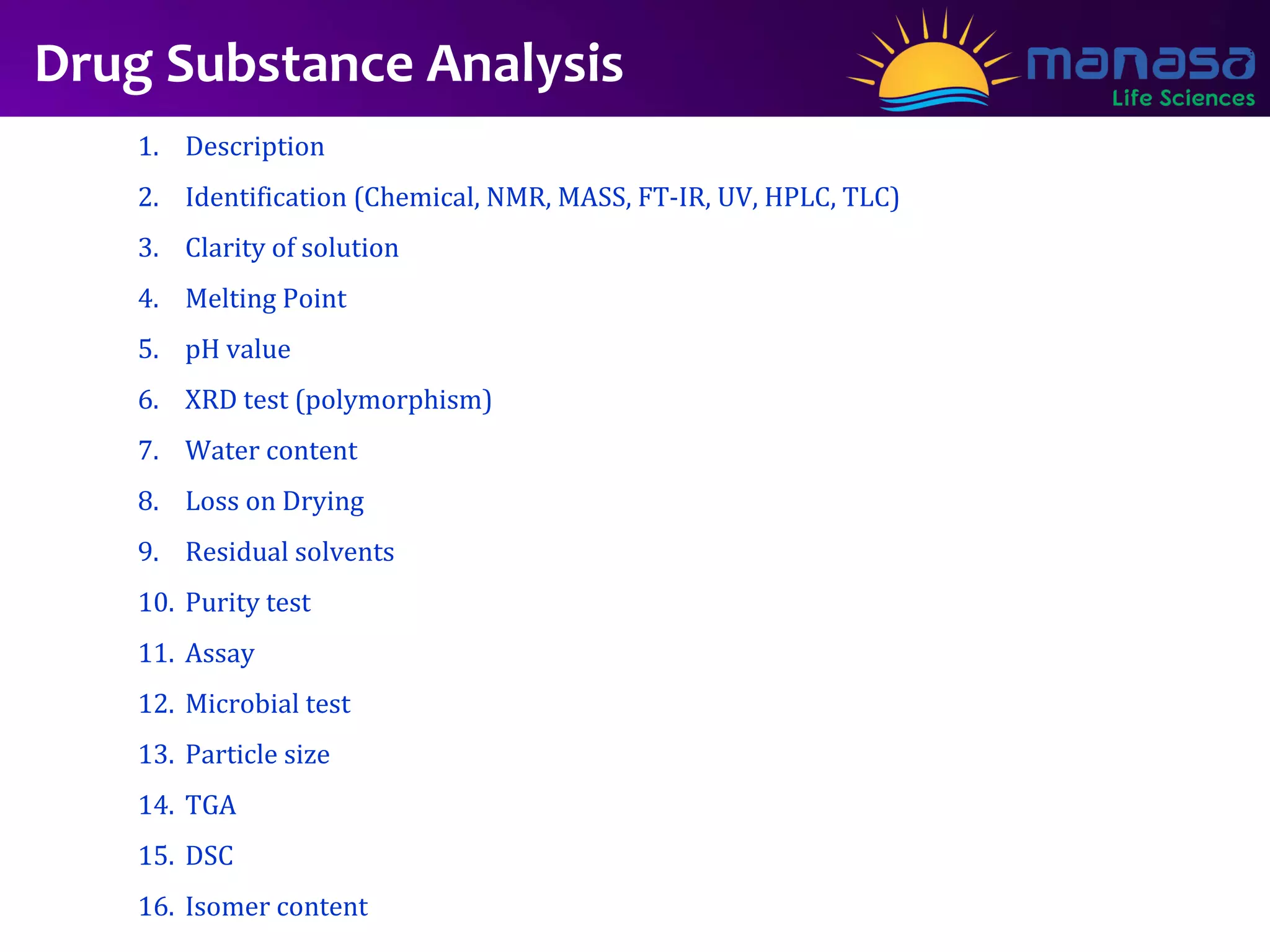
Drug Substance Analysis
1. Description
2. Identification (Chemical, NMR, MASS, FT-IR, UV, HPLC, TLC)
3. Clarity of solution
4. Melting Point
5. pH value
6. XRD test (polymorphism)
7. Water content
8. Loss on Drying
9. Residual solvents
10. Purity test
11. Assay
12. Microbial test
13. Particle size
14. TGA
15. DSC
16. Isomer content
Drug Product Case Study
Dry mixing
In-active (Excipients) 1, 2, 3)
Drying
Excipients-4 & 5
addition
Wet Granulation
Blending
Compression (un-coated tablets
Coating (coated tablets)
Packing
Excipient-6 addition
Canagliflozin
Active (API)
Ex. Lactose, HPMC, Mg stearate,
Povidone, Cellulose, Starch
Ex. Preservatives (parabens, benzoyl
alcohol)
Coating excipients (film coating,
colourants)
Possible degradation
products
Drug Product Analysis
1. Description
2. Identification (Chemical, NMR, MASS, FT-IR, UV, HPLC, TLC)
3. Physical parameters (thickness, Hardness)
4. Friability
5. Average weight
6. XRD test (polymorphism)
7. Loss on Drying
8. Residual solvents
9. Purity test
10. Assay
11. Microbial test
12. Isomer content
13. TGA
14. DSC
15. Preservatives content
Hold Time Study (Tablets)
Hold time Study (Capsules)
Questions
&
Answers

Drug substance and drug product manasa life sciences

  • 1.
    Pharmaceutical Industry Drug Substance& Drug Product Dr. Useni Reddy Mallu Mobile: 7901020060 E-mail: info@manasalifesciences.com Website: www.manasalifesciences.com
  • 2.
    DS & DPManufacturing
  • 3.
    Drug Substance: Canagliflozin Canagliflozin, sold under the brand name Invokana, Sulisent, Prominad  Used to treat type 2 diabetes.  Canagliflozin was approved for medical use in the United States in 2013.  Canagliflozin is an anti-diabeticmedication used to improve blood sugar control in people with type 2 diabetes.  It was developed by Mitsubishi Tanabe Pharma and is marketed under license by Janssen.  It is used together with exercise and diet.  It is not recommended in type 1 diabetes. It is taken by mouth.  Molar mass 444.52 g/mol  Chemical formula: C24H25FO5S
  • 4.
    Drug Substance Synthesis Startingmaterial- 1 Stage-3 Stage-2 Stage-1 Stage-4 Stage-5 Stage-6 Intermediate-2 Starting material-2 Starting material-3 Stage-7 (Final product) Canagliflozin Bi-product Degradation products Intermediate-1
  • 5.
  • 6.
    Drug Substance Analysis 1.Description 2. Identification (Chemical, NMR, MASS, FT-IR, UV, HPLC, TLC) 3. Clarity of solution 4. Melting Point 5. pH value 6. XRD test (polymorphism) 7. Water content 8. Loss on Drying 9. Residual solvents 10. Purity test 11. Assay 12. Microbial test 13. Particle size 14. TGA 15. DSC 16. Isomer content
  • 7.
    Drug Product CaseStudy Dry mixing In-active (Excipients) 1, 2, 3) Drying Excipients-4 & 5 addition Wet Granulation Blending Compression (un-coated tablets Coating (coated tablets) Packing Excipient-6 addition Canagliflozin Active (API) Ex. Lactose, HPMC, Mg stearate, Povidone, Cellulose, Starch Ex. Preservatives (parabens, benzoyl alcohol) Coating excipients (film coating, colourants) Possible degradation products
  • 8.
    Drug Product Analysis 1.Description 2. Identification (Chemical, NMR, MASS, FT-IR, UV, HPLC, TLC) 3. Physical parameters (thickness, Hardness) 4. Friability 5. Average weight 6. XRD test (polymorphism) 7. Loss on Drying 8. Residual solvents 9. Purity test 10. Assay 11. Microbial test 12. Isomer content 13. TGA 14. DSC 15. Preservatives content
  • 9.
    Hold Time Study(Tablets)
  • 10.
    Hold time Study(Capsules)
  • 11.