Dressing for Success
What’s So Important about DRESS?First impressions are CRITICAL! You are marketing a product – YOURSELF!Dress is the first thing an employer sees when greeting you!Will dressing properly get you the job?  NO, but it will:Give you a competitive edge Provide a positive first impression!
Should you be judged by what you wear?PERHAPS NOTTHE REALITY:You ARE judgedWith the job interview, it’s HOW YOU ARE DRESSED that sets the tone of the interview.The Reality
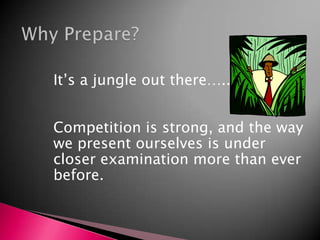
Why Prepare?	It’s a jungle out there…..	Competition is strong, and the way we present ourselves is under closer examination more than ever before.
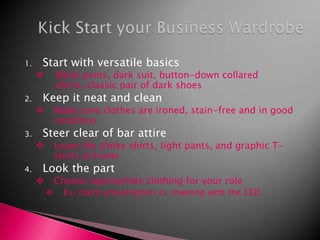
For the InterviewPresent yourself as a professional
Dress for the interview, not a party
Don’t distract the interviewer’s attention; it should be on what you have to say, not your appearance
Arrive early and check out your appearance
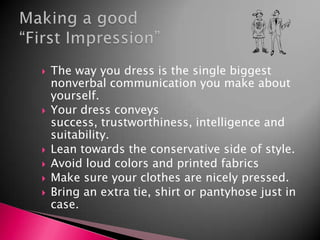
A smile, a firm handshake, and a positive attitude make a good first impressionConservative is ALWAYS the safest routeBUT – do some investigation of the employerWhat you wear should make you look as though you FIT IN with the organizationIf you overdress or under dress, the employer may feel that you don’t care enough about the job!Ways to find out the proper dress:Call the Human Resources offices and askVisit the company’s office and observe the attire current employees are wearingMake sure you are not there on a “casual day”!How Should I Dress?
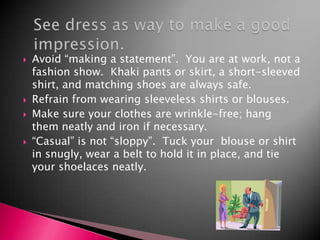
Avoid “making a statement”.  You are at work, not a fashion show.  Khaki pants or skirt, a short-sleeved shirt, and matching shoes are always safe.Refrain from wearing sleeveless shirts or blouses.Make sure your clothes are wrinkle-free; hang them neatly and iron if necessary.“Casual” is not “sloppy”.  Tuck your  blouse or shirt in snugly, wear a belt to hold it in place, and tie your shoelaces neatly.See dress as way to make a good impression.
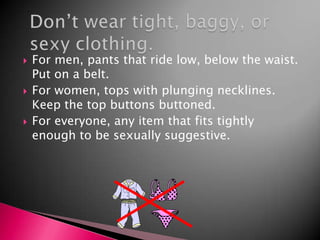
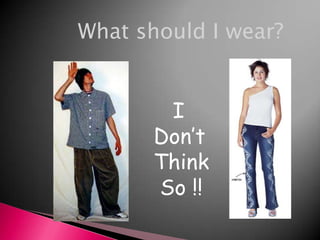
For men, pants that ride low, below the waist.  Put on a belt.For women, tops with plunging necklines. Keep the top buttons buttoned.For everyone, any item that fits tightly enough to be sexually suggestive.Don’t wear tight, baggy, or sexy clothing.
What should I wear?    I  Don’t  Think  So !!
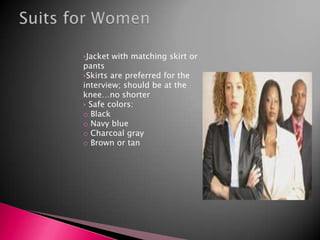
Jacket with matching skirt orpantsSkirts are preferred for theinterview; should be at theknee…no shorterSafe colors:
Black
 Navy blue
Charcoal gray
Brown or tanSuits for Women
Business dress with matching jacket is okay…no party, cocktail, or sun dressesSuits for Women (cont.)
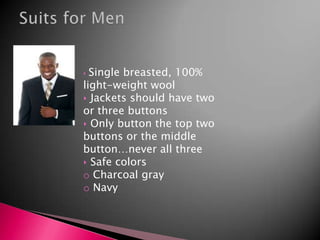
Single breasted, 100%light-weight woolJackets should have twoor three buttonsOnly button the top twobuttons or the middlebutton…never all threeSafe colors
Charcoal gray
NavySuits for Men
 Tank-style tops in cotton,knit, or silkTailored shirt
Safest color: white
It’s conservative
It doesn’t offend anyoneBlouses/Tops for Women
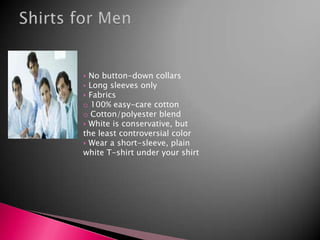
No button-down collars
Long sleeves only
Fabrics

Dressing for success

  • 1.
  • 2.
    What’s So Importantabout DRESS?First impressions are CRITICAL! You are marketing a product – YOURSELF!Dress is the first thing an employer sees when greeting you!Will dressing properly get you the job? NO, but it will:Give you a competitive edge Provide a positive first impression!
  • 3.
    Should you bejudged by what you wear?PERHAPS NOTTHE REALITY:You ARE judgedWith the job interview, it’s HOW YOU ARE DRESSED that sets the tone of the interview.The Reality
  • 4.
    Why Prepare? It’s ajungle out there….. Competition is strong, and the way we present ourselves is under closer examination more than ever before.
  • 5.
    For the InterviewPresentyourself as a professional
  • 6.
    Dress for theinterview, not a party
  • 7.
    Don’t distract theinterviewer’s attention; it should be on what you have to say, not your appearance
  • 8.
    Arrive early andcheck out your appearance
  • 9.
    A smile, afirm handshake, and a positive attitude make a good first impressionConservative is ALWAYS the safest routeBUT – do some investigation of the employerWhat you wear should make you look as though you FIT IN with the organizationIf you overdress or under dress, the employer may feel that you don’t care enough about the job!Ways to find out the proper dress:Call the Human Resources offices and askVisit the company’s office and observe the attire current employees are wearingMake sure you are not there on a “casual day”!How Should I Dress?
  • 10.
    Avoid “making astatement”. You are at work, not a fashion show. Khaki pants or skirt, a short-sleeved shirt, and matching shoes are always safe.Refrain from wearing sleeveless shirts or blouses.Make sure your clothes are wrinkle-free; hang them neatly and iron if necessary.“Casual” is not “sloppy”. Tuck your blouse or shirt in snugly, wear a belt to hold it in place, and tie your shoelaces neatly.See dress as way to make a good impression.
  • 11.
    For men, pantsthat ride low, below the waist. Put on a belt.For women, tops with plunging necklines. Keep the top buttons buttoned.For everyone, any item that fits tightly enough to be sexually suggestive.Don’t wear tight, baggy, or sexy clothing.
  • 12.
    What should Iwear? I Don’t Think So !!
  • 13.
    Jacket with matchingskirt orpantsSkirts are preferred for theinterview; should be at theknee…no shorterSafe colors:
  • 14.
  • 15.
  • 16.
  • 17.
  • 18.
    Business dress withmatching jacket is okay…no party, cocktail, or sun dressesSuits for Women (cont.)
  • 19.
    Single breasted, 100%light-weightwoolJackets should have twoor three buttonsOnly button the top twobuttons or the middlebutton…never all threeSafe colors
  • 20.
  • 21.
  • 22.
    Tank-style topsin cotton,knit, or silkTailored shirt
  • 23.
  • 24.
  • 25.
    It doesn’t offendanyoneBlouses/Tops for Women
  • 26.
  • 27.
  • 28.

Editor's Notes

  • #28 Remember“You only getone chanceto make a firstimpression.”
  • #29 Utah Education NetworkBusinessEducationlinks.orgDelranschools.orgCollegegrad.comwww.charlestonsouthern.edu/careers