Visit https://ebookfinal.com to download the full version and
explore more ebooks
JavaScript for NET Developers 1st Edition Ovais
Mehboob Ahmed Khan
_____ Click the link below to download _____
https://ebookfinal.com/download/javascript-for-net-
developers-1st-edition-ovais-mehboob-ahmed-khan/
Explore and download more ebooks at ebookfinal.com
Here are some suggested products you might be interested in.

Click the link to download
HTML5 for NET Developers Jim Jackson
https://ebookfinal.com/download/html5-for-net-developers-jim-jackson/
Rails for NET Developers 1st Edition Jeff Cohen
https://ebookfinal.com/download/rails-for-net-developers-1st-edition-
jeff-cohen/
NET 4 for Enterprise Architects and Developers Sudhanshu
Hate
https://ebookfinal.com/download/net-4-for-enterprise-architects-and-
developers-sudhanshu-hate/
Net mobile Web developers guide 1st Edition Ben Combee
https://ebookfinal.com/download/net-mobile-web-developers-guide-1st-
edition-ben-combee/
Beginning jQuery 2 for ASP NET Developers Using jQuery 2
with ASP NET Web Forms and ASP NET MVC 1st Edition Bipin
Joshi (Auth.)
https://ebookfinal.com/download/beginning-jquery-2-for-asp-net-
developers-using-jquery-2-with-asp-net-web-forms-and-asp-net-mvc-1st-
edition-bipin-joshi-auth/
Mathematics for Game Developers 1st Edition Christopher
Tremblay
https://ebookfinal.com/download/mathematics-for-game-developers-1st-
edition-christopher-tremblay/
JavaScript Essentials for Dummies 1st Edition Paul
Mcfedries
https://ebookfinal.com/download/javascript-essentials-for-dummies-1st-
edition-paul-mcfedries/
Jasperreports Reporting for Java Developers 1st Edition
David Heffelfinger
https://ebookfinal.com/download/jasperreports-reporting-for-java-
developers-1st-edition-david-heffelfinger/
Beginning Math Concepts for Game Developers 1st Edition
Ph.D.
https://ebookfinal.com/download/beginning-math-concepts-for-game-
developers-1st-edition-ph-d/
JavaScript for NET Developers 1st Edition Ovais
Mehboob Ahmed Khan Digital Instant Download
Author(s): Ovais Mehboob Ahmed Khan
ISBN(s): 9781785886461, 1785886460
Edition: 1
File Details: PDF, 5.98 MB
Year: 2016
Language: english
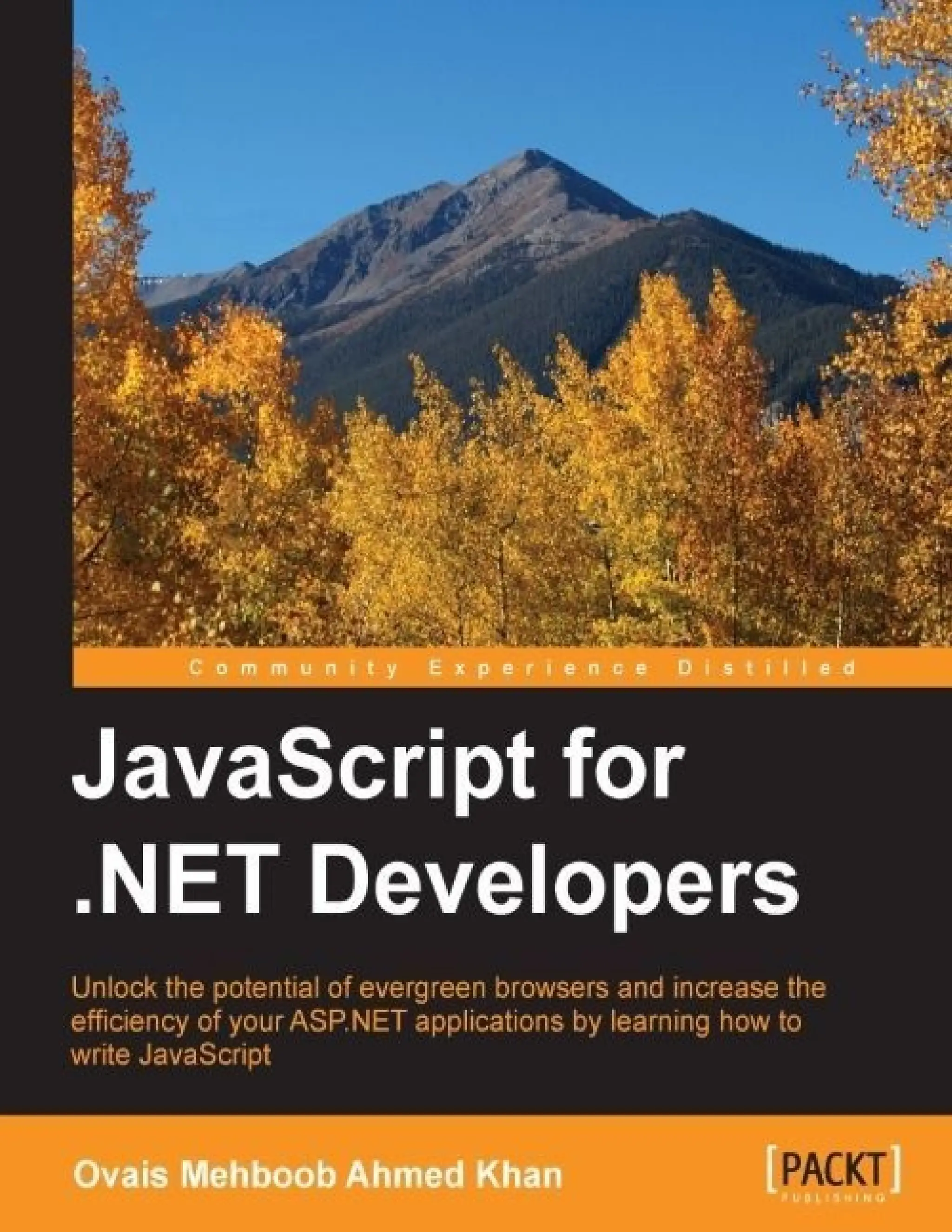
JavaScript for .NET Developers
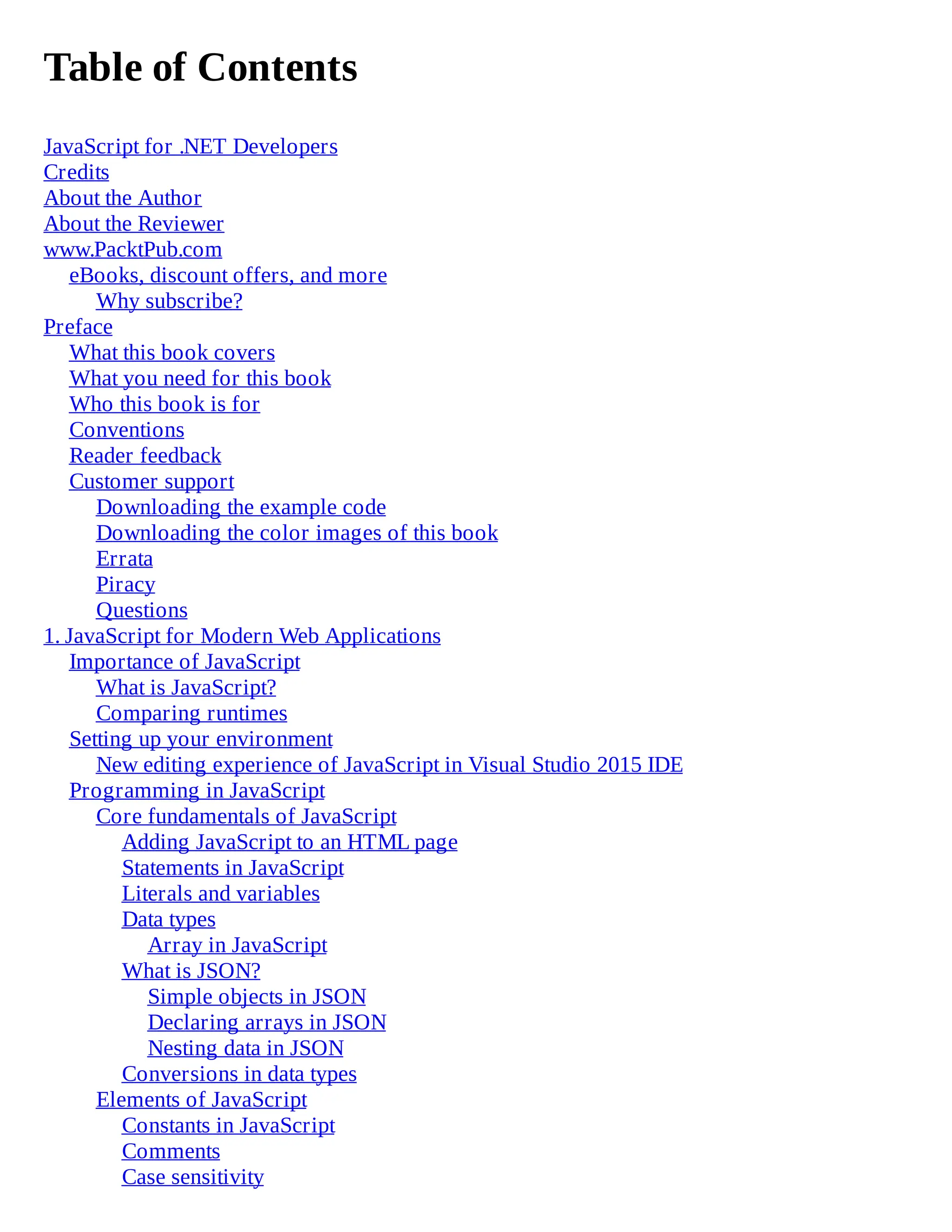
Table of Contents
JavaScript for .NET Developers
Credits
About the Author
About the Reviewer
www.PacktPub.com
eBooks, discount offers, and more
Why subscribe?
Preface
What this book covers
What you need for this book
Who this book is for
Conventions
Reader feedback
Customer support
Downloading the example code
Downloading the color images of this book
Errata
Piracy
Questions
1. JavaScript for Modern Web Applications
Importance of JavaScript
What is JavaScript?
Comparing runtimes
Setting up your environment
New editing experience of JavaScript in Visual Studio 2015 IDE
Programming in JavaScript
Core fundamentals of JavaScript
Adding JavaScript to an HTML page
Statements in JavaScript
Literals and variables
Data types
Array in JavaScript
What is JSON?
Simple objects in JSON
Declaring arrays in JSON
Nesting data in JSON
Conversions in data types
Elements of JavaScript
Constants in JavaScript
Comments
Case sensitivity
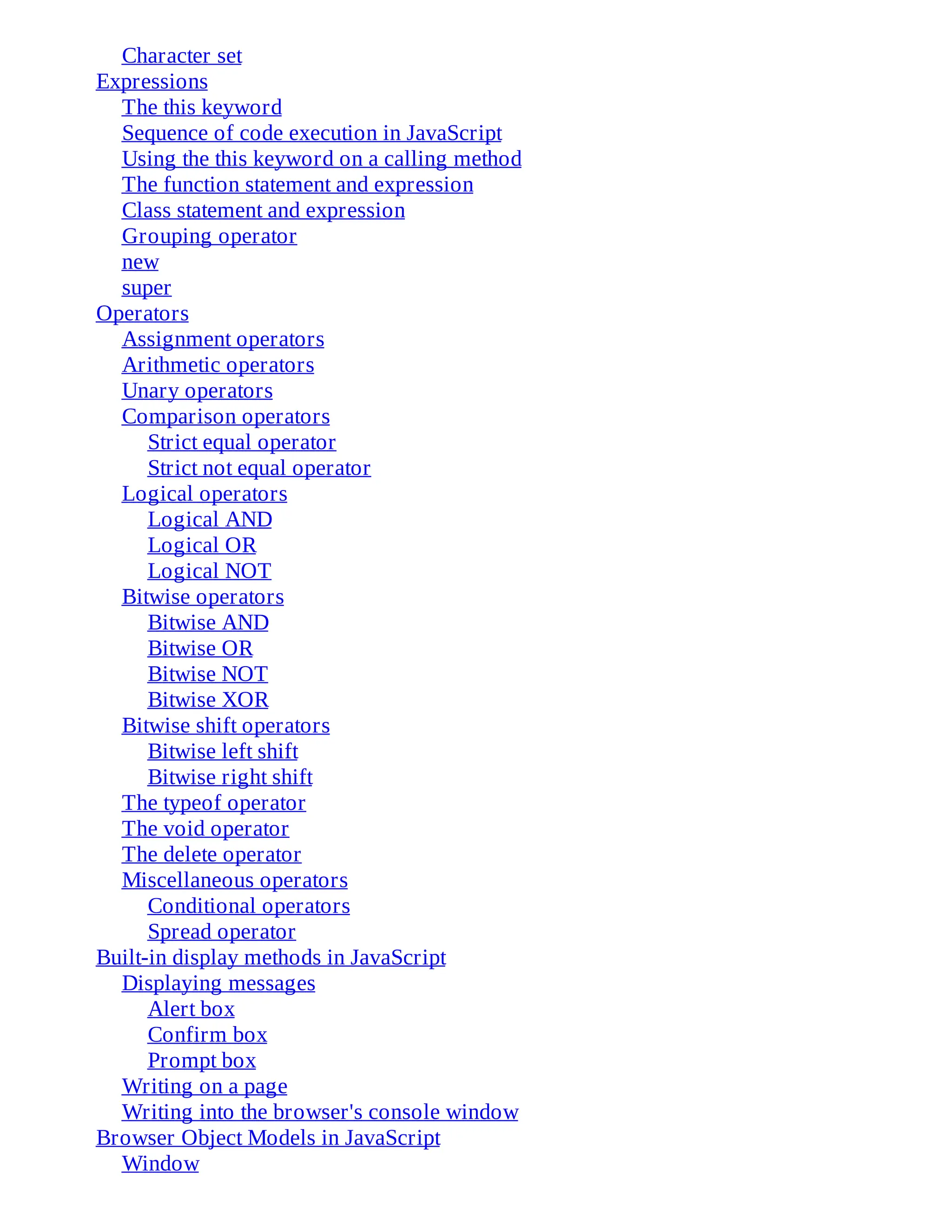
Character set
Expressions
The this keyword
Sequence of code execution in JavaScript
Using the this keyword on a calling method
The function statement and expression
Class statement and expression
Grouping operator
new
super
Operators
Assignment operators
Arithmetic operators
Unary operators
Comparison operators
Strict equal operator
Strict not equal operator
Logical operators
Logical AND
Logical OR
Logical NOT
Bitwise operators
Bitwise AND
Bitwise OR
Bitwise NOT
Bitwise XOR
Bitwise shift operators
Bitwise left shift
Bitwise right shift
The typeof operator
The void operator
The delete operator
Miscellaneous operators
Conditional operators
Spread operator
Built-in display methods in JavaScript
Displaying messages
Alert box
Confirm box
Prompt box
Writing on a page
Writing into the browser's console window
Browser Object Models in JavaScript
Window
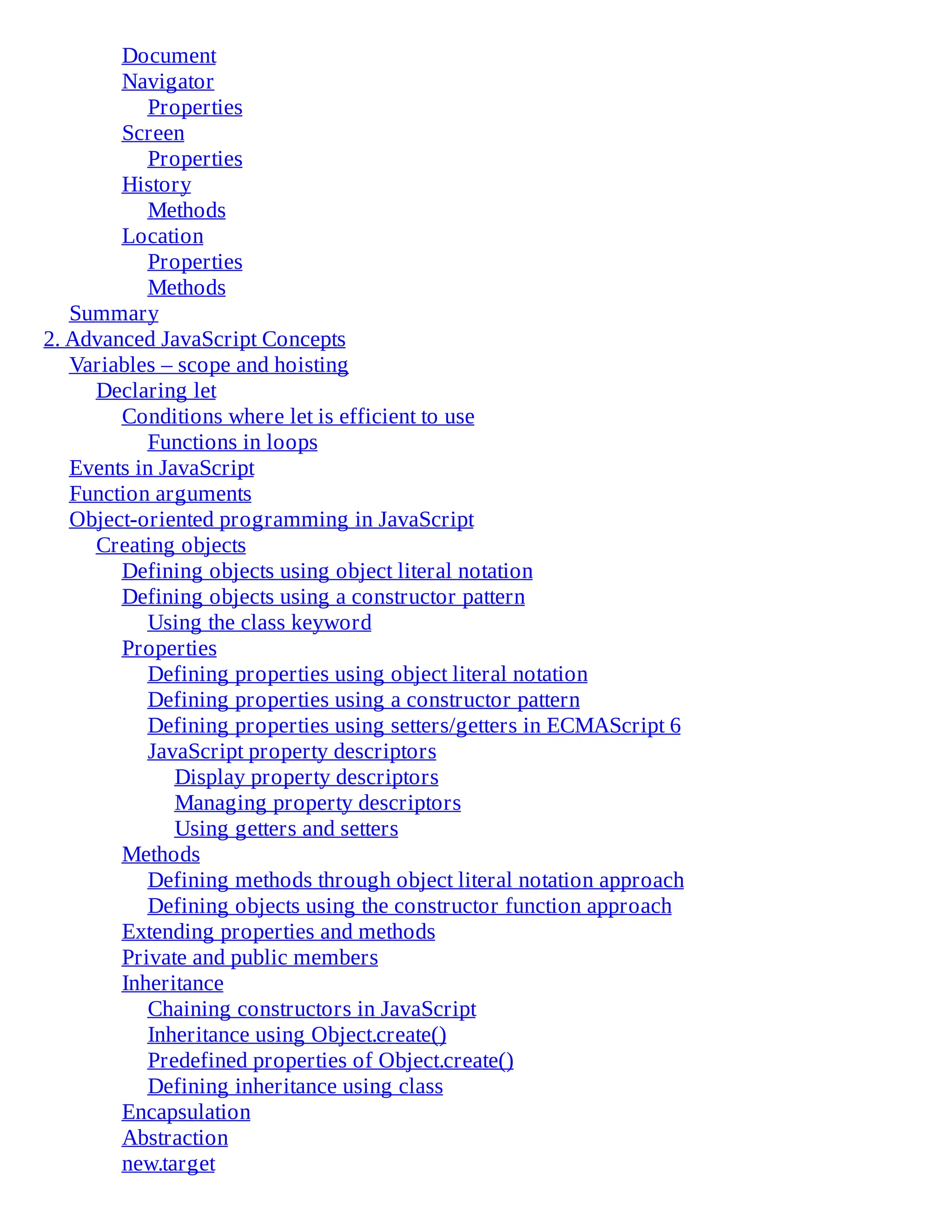
Document
Navigator
Properties
Screen
Properties
History
Methods
Location
Properties
Methods
Summary
2. Advanced JavaScript Concepts
Variables – scope and hoisting
Declaring let
Conditions where let is efficient to use
Functions in loops
Events in JavaScript
Function arguments
Object-oriented programming in JavaScript
Creating objects
Defining objects using object literal notation
Defining objects using a constructor pattern
Using the class keyword
Properties
Defining properties using object literal notation
Defining properties using a constructor pattern
Defining properties using setters/getters in ECMAScript 6
JavaScript property descriptors
Display property descriptors
Managing property descriptors
Using getters and setters
Methods
Defining methods through object literal notation approach
Defining objects using the constructor function approach
Extending properties and methods
Private and public members
Inheritance
Chaining constructors in JavaScript
Inheritance using Object.create()
Predefined properties of Object.create()
Defining inheritance using class
Encapsulation
Abstraction
new.target
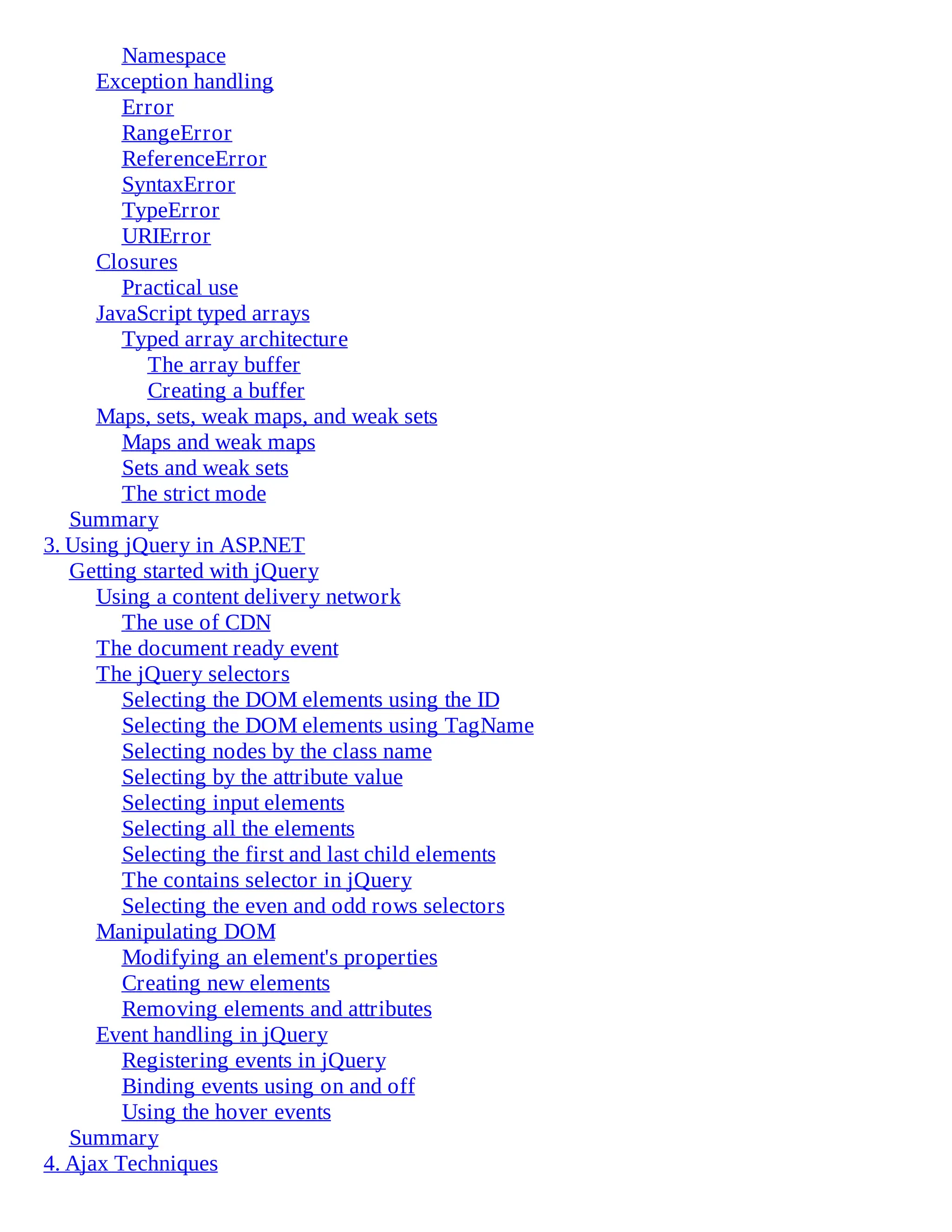
Namespace
Exception handling
Error
RangeError
ReferenceError
SyntaxError
TypeError
URIError
Closures
Practical use
JavaScript typed arrays
Typed array architecture
The array buffer
Creating a buffer
Maps, sets, weak maps, and weak sets
Maps and weak maps
Sets and weak sets
The strict mode
Summary
3. Using jQuery in ASP.NET
Getting started with jQuery
Using a content delivery network
The use of CDN
The document ready event
The jQuery selectors
Selecting the DOM elements using the ID
Selecting the DOM elements using TagName
Selecting nodes by the class name
Selecting by the attribute value
Selecting input elements
Selecting all the elements
Selecting the first and last child elements
The contains selector in jQuery
Selecting the even and odd rows selectors
Manipulating DOM
Modifying an element's properties
Creating new elements
Removing elements and attributes
Event handling in jQuery
Registering events in jQuery
Binding events using on and off
Using the hover events
Summary
4. Ajax Techniques
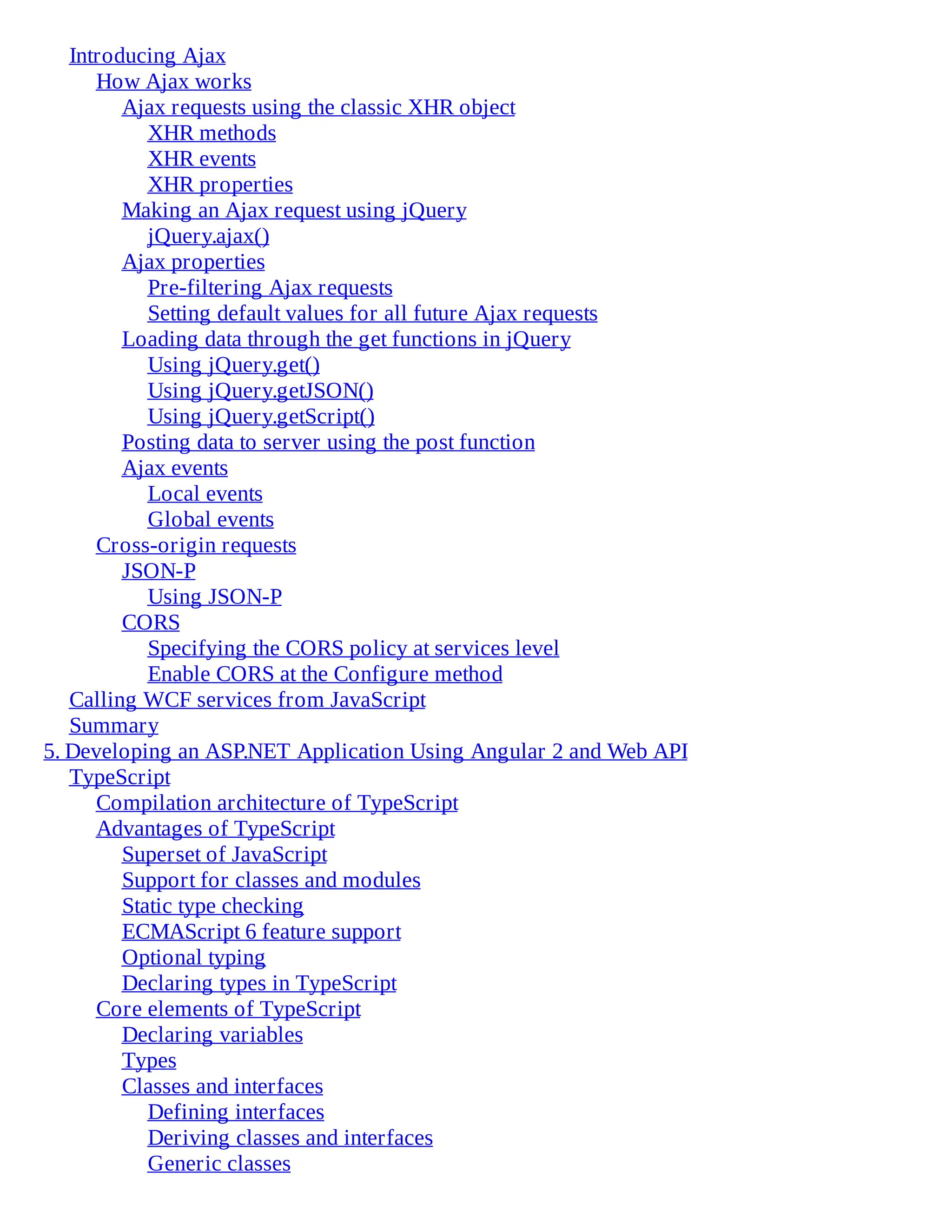
Introducing Ajax
How Ajax works
Ajax requests using the classic XHR object
XHR methods
XHR events
XHR properties
Making an Ajax request using jQuery
jQuery.ajax()
Ajax properties
Pre-filtering Ajax requests
Setting default values for all future Ajax requests
Loading data through the get functions in jQuery
Using jQuery.get()
Using jQuery.getJSON()
Using jQuery.getScript()
Posting data to server using the post function
Ajax events
Local events
Global events
Cross-origin requests
JSON-P
Using JSON-P
CORS
Specifying the CORS policy at services level
Enable CORS at the Configure method
Calling WCF services from JavaScript
Summary
5. Developing an ASP.NET Application Using Angular 2 and Web API
TypeScript
Compilation architecture of TypeScript
Advantages of TypeScript
Superset of JavaScript
Support for classes and modules
Static type checking
ECMAScript 6 feature support
Optional typing
Declaring types in TypeScript
Core elements of TypeScript
Declaring variables
Types
Classes and interfaces
Defining interfaces
Deriving classes and interfaces
Generic classes
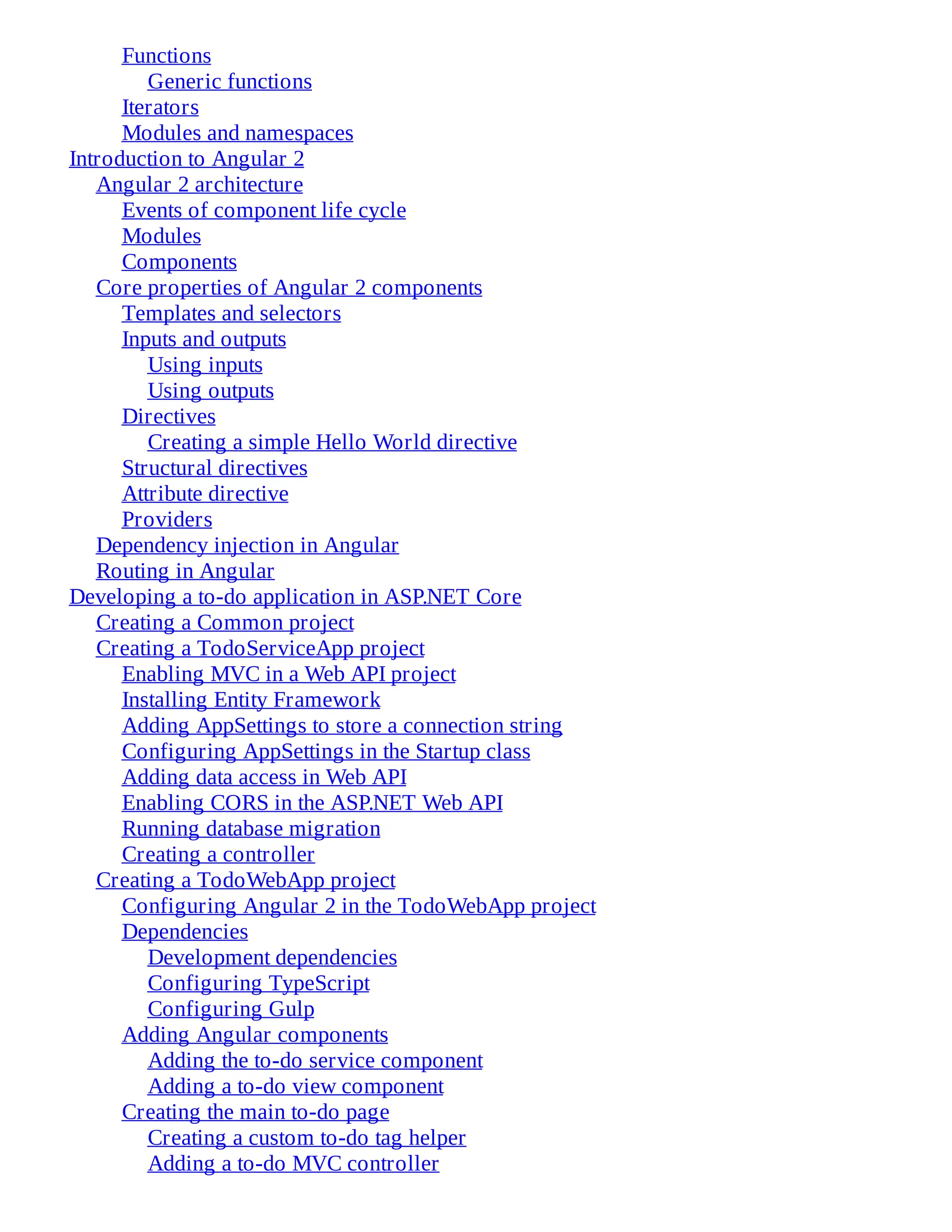
Functions
Generic functions
Iterators
Modules and namespaces
Introduction to Angular 2
Angular 2 architecture
Events of component life cycle
Modules
Components
Core properties of Angular 2 components
Templates and selectors
Inputs and outputs
Using inputs
Using outputs
Directives
Creating a simple Hello World directive
Structural directives
Attribute directive
Providers
Dependency injection in Angular
Routing in Angular
Developing a to-do application in ASP.NET Core
Creating a Common project
Creating a TodoServiceApp project
Enabling MVC in a Web API project
Installing Entity Framework
Adding AppSettings to store a connection string
Configuring AppSettings in the Startup class
Adding data access in Web API
Enabling CORS in the ASP.NET Web API
Running database migration
Creating a controller
Creating a TodoWebApp project
Configuring Angular 2 in the TodoWebApp project
Dependencies
Development dependencies
Configuring TypeScript
Configuring Gulp
Adding Angular components
Adding the to-do service component
Adding a to-do view component
Creating the main to-do page
Creating a custom to-do tag helper
Adding a to-do MVC controller
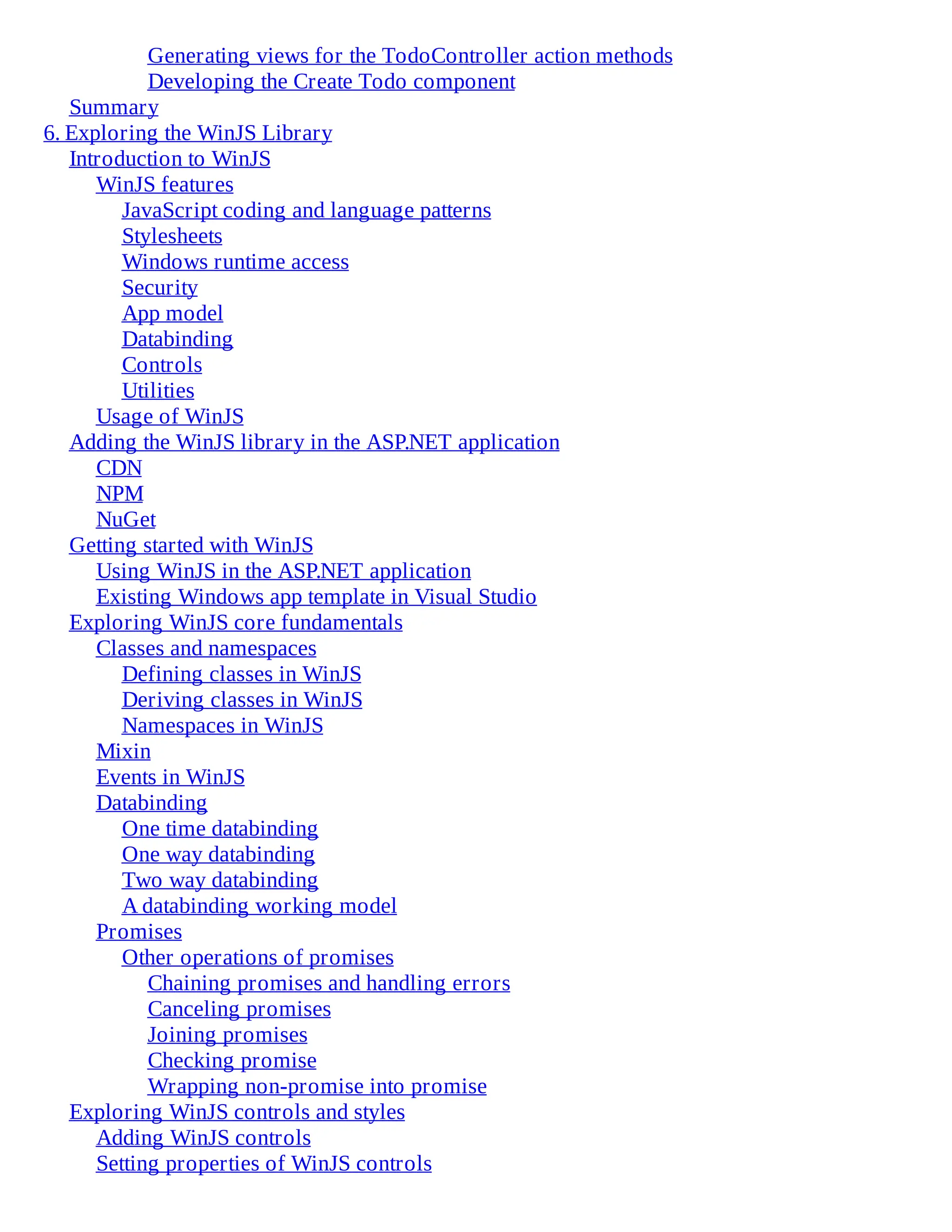
Generating views for the TodoController action methods
Developing the Create Todo component
Summary
6. Exploring the WinJS Library
Introduction to WinJS
WinJS features
JavaScript coding and language patterns
Stylesheets
Windows runtime access
Security
App model
Databinding
Controls
Utilities
Usage of WinJS
Adding the WinJS library in the ASP.NET application
CDN
NPM
NuGet
Getting started with WinJS
Using WinJS in the ASP.NET application
Existing Windows app template in Visual Studio
Exploring WinJS core fundamentals
Classes and namespaces
Defining classes in WinJS
Deriving classes in WinJS
Namespaces in WinJS
Mixin
Events in WinJS
Databinding
One time databinding
One way databinding
Two way databinding
A databinding working model
Promises
Other operations of promises
Chaining promises and handling errors
Canceling promises
Joining promises
Checking promise
Wrapping non-promise into promise
Exploring WinJS controls and styles
Adding WinJS controls
Setting properties of WinJS controls
Using Windows runtime features
Hosted apps and accessing the camera
Creating the ASP.NET core application
Converting an ASP.NET application into Windows application using the Hosted app
concept
Summary
7. JavaScript Design Patterns
Creational patterns
Singleton design pattern
Factory pattern
Abstract factory pattern
Prototype pattern
Structural patterns
Adapter pattern
Decorator pattern
Facade pattern
Bridge pattern
Behavioral pattern
Chain of responsibility pattern
Observer pattern
Pub/sub pattern
Promises
Summary
8. Node.js for ASP.NET Developers
Introduction to Node.js
Request processing by the Node.js web server
Comparison of Node.js with .NET
NPM
Installing Node.js
Using Node.js with Visual Studio 2015
Simple console application using Node.js
Web applications with Node.js
Creating blank Node.js applications
Using the Express framework for web applications in Node.js
Extend simple Node.js to use Express
Express view engines
EJS view engine
Jade view engine
Routing in the Express application
Middleware
MVC with the Express framework
MVC pattern
Creating a controller
Creating data services
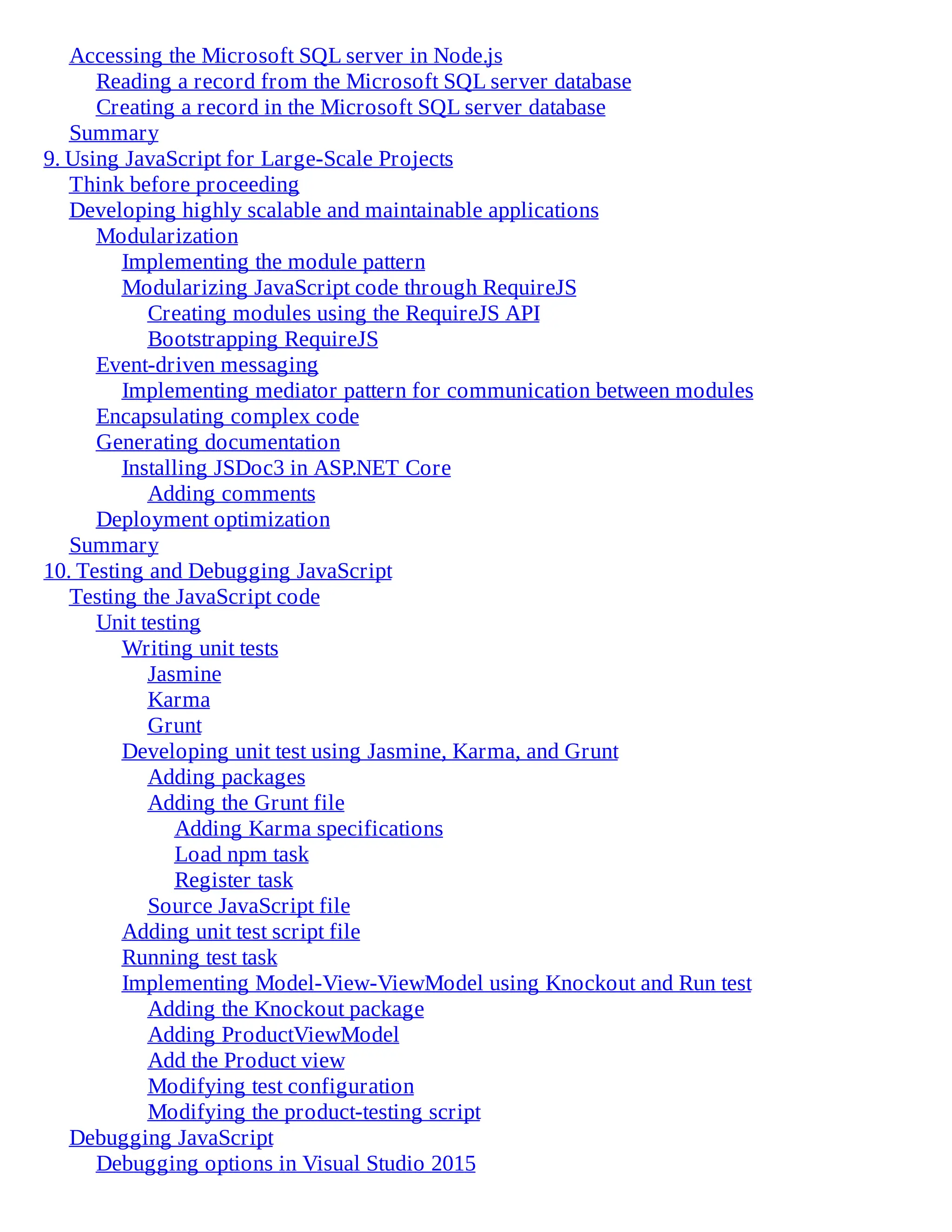
Accessing the Microsoft SQL server in Node.js
Reading a record from the Microsoft SQL server database
Creating a record in the Microsoft SQL server database
Summary
9. Using JavaScript for Large-Scale Projects
Think before proceeding
Developing highly scalable and maintainable applications
Modularization
Implementing the module pattern
Modularizing JavaScript code through RequireJS
Creating modules using the RequireJS API
Bootstrapping RequireJS
Event-driven messaging
Implementing mediator pattern for communication between modules
Encapsulating complex code
Generating documentation
Installing JSDoc3 in ASP.NET Core
Adding comments
Deployment optimization
Summary
10. Testing and Debugging JavaScript
Testing the JavaScript code
Unit testing
Writing unit tests
Jasmine
Karma
Grunt
Developing unit test using Jasmine, Karma, and Grunt
Adding packages
Adding the Grunt file
Adding Karma specifications
Load npm task
Register task
Source JavaScript file
Adding unit test script file
Running test task
Implementing Model-View-ViewModel using Knockout and Run test
Adding the Knockout package
Adding ProductViewModel
Add the Product view
Modifying test configuration
Modifying the product-testing script
Debugging JavaScript
Debugging options in Visual Studio 2015
Debugging from Visual Studio with Internet Explorer
Debugging from Visual Studio with Google Chrome
Developer Tools
Debugging options in Microsoft Edge
Standard breakpoints
Conditional breakpoints
Tracepoints
Event
Add event tracepoint
Add event breakpoints
XHR
Debugging TypeScript
Debugger keyword supported by all browsers
Summary
Index
JavaScript for .NET Developers
Copyright © 2016 Packt Publishing
All rights reserved. No part of this book may be reproduced, stored in a retrieval system, or
transmitted in any form or by any means, without the prior written permission of the
publisher, except in the case of brief quotations embedded in critical articles or reviews.
Every effort has been made in the preparation of this book to ensure the accuracy of the
information presented. However, the information contained in this book is sold without
warranty, either express or implied. Neither the author, nor Packt Publishing, and its dealers
and distributors will be held liable for any damages caused or alleged to be caused directly or
indirectly by this book.
Packt Publishing has endeavored to provide trademark information about all of the
companies and products mentioned in this book by the appropriate use of capitals. However,
Packt Publishing cannot guarantee the accuracy of this information.
First published: July 2016
Production reference: 1260716
Published by Packt Publishing Ltd.
Livery Place
35 Livery Street
Birmingham B3 2PB, UK.
ISBN 978-1-78588-646-1
www.packtpub.com
Credits
Author
Ovais Mehboob Ahmed Khan
Reviewer
Nicholas Suter
Commissioning Editor
Edward Gordon
Acquisition Editor
Nitin Dasan
Content Development Editor
Deepti Thore
Technical Editors
Pranil Pathare
Deepti Tuscano
Copy Editor
Vibha Shukla
Project Coordinator
Shweta H Birwatkar
Proofreader
Safis Editing
Indexer
Mariammal Chettiyar
Graphics
Disha Haria
Production Coordinator
Nilesh Mohite
Cover Work
Nilesh Mohite
About the Author
Ovais Mehboob Ahmed Khan is a seasoned programmer and solution architect with more
than 13 years of software development experience. He has worked in different organizations
across Pakistan, the USA, and the Middle East. Currently, he is working for a government
entity based in Dubai, and also provides consultancy services to a Microsoft gold partner firm
based in New Jersey.
He is a Microsoft MVP in Visual Studio and Development Technologies and specializes
mainly in Microsoft .NET and web development. He has authored numerous technical articles
on different websites such as MSDN, TechNet, DZone, and personal blog at
http://ovaismehboob.wordpress.com.
He is an active speaker and group leader of Microsoft Developers UAE Meetup, Microsoft
Technology Practices, and Developers and Enterprise Practices user groups, and has
presented various technical sessions in different events and conferences.
In short, Ovais is a passionate developer who is always interested in learning new
technologies. He can be reached at <ovaismehboob@hotmail.com> and on Twitter,
@ovaismehboob.
I would like to thank my family for supporting. Especially my mother, wife, and brother, who
have always encouraged me in every goal of my life. My father, may he rest in peace, would
have been proud of my achievements.
About the Reviewer
Nicholas Suter is a .NET software craftsman, focused on patterns, practices, and quality
development in a Microsoft environment. He has been nominated for Microsoft .NET MVP
since 2014.
He works for Cellenza, a French agile consulting company based in Paris, where he leads,
trains, and audits teams more on technical matters than team practices.
He wrote a book in 2013 on web development called Visual Studio 2013, Concevoir et
développer des projets Web, les gérer avec TFS 2013, (French) for ENI Editions, and reviewed
Entity Framework Tutorial, Second Edition, for Packt Publishing in 2015.
www.PacktPub.com
eBooks, discount offers, and more
Did you know that Packt offers eBook versions of every book published, with PDF and ePub
files available? You can upgrade to the eBook version at www.PacktPub.com and as a print
book customer, you are entitled to a discount on the eBook copy. Get in touch with us at
<customercare@packtpub.com> for more details.
At www.PacktPub.com, you can also read a collection of free technical articles, sign up for a
range of free newsletters and receive exclusive discounts and offers on Packt books and
eBooks.
https://www2.packtpub.com/books/subscription/packtlib
Do you need instant solutions to your IT questions? PacktLib is Packt's online digital book
library. Here, you can search, access, and read Packt's entire library of books.
Why subscribe?
Fully searchable across every book published by Packt
Copy and paste, print, and bookmark content
On demand and accessible via a web browser
Preface
This is a book about the JavaScript programming language, and is targeted at .NET
developers who want to develop responsive web applications using popular client-side
JavaScript-based frameworks and create a rich user experience. It is also intended for
programmers who have a basic knowledge of the JavaScript programming language and
wanted to learn some core and advanced concepts followed by some industry-wide best
practices and patterns to structure and design web applications.
This book starts with the basics of JavaScript and helps the reader to gain knowledge about
the core concepts and then proceeds towards some advanced topics. There is a chapter that
primarily focuses on the jQuery library, which is widely used throughout web application
development, followed by a chapter on Ajax techniques that help developers to understand
how asynchronous requests can be made. This is followed by the options to make requests
either through the plain vanilla JavaScript XHR object or through the jQuery library. There is
also a chapter that develops a complete application using Angular 2 and ASP.NET Core, and
introduces TypeScript, a superset of JavaScript that supports the latest and evolving features
of ECMAScript 2015. We will also explore the Windows JavaScript (WinJS) library to
develop Windows applications using JavaScript and HTML and use this library to bring
Windows behavior, look, and feel to ASP.NET web applications. There is a complete chapter
on Node.js that helps developers to learn how powerful the JavaScript language is on the
server side, followed by a chapter on using JavaScript in a large-scale project. Finally, this
book will end with a chapter about testing and debugging and discuss what testing suites and
debugging techniques are there to troubleshoot and make an application robust.
This book has some very dense topics that require full concentration, hence is ideal for
someone having some prior knowledge. All the chapters are related to JavaScript and work
around JavaScript frameworks and libraries to build rich web applications. With this book,
the reader will get the end-to-end knowledge about the JavaScript language and its
frameworks and libraries built on top of it, followed by the techniques to test and troubleshoot
the JavaScript code.
What this book covers
Chapter 1, JavaScript for Modern Web Applications, focuses on the basic concepts of
JavaScript that involve declaration of variables, datatypes, implementing arrays, expressions,
operators, and functions. We will write simple programs in JavaScript using Visual Studio
2015, and see what this IDE offers for writing JavaScript programs. We will also study how
JavaScript code can be written and compare the .NET runtime with the JavaScript runtime to
clarify the execution cycle of code-compilation process.
Chapter 2, Advanced JavaScript Concepts, covers the advanced concepts of JavaScript and
gives developers an insight into the JavaScript language. It will show the extent to which the
JavaScript language can be used as far as features are concerned. We will discuss variables
hoisting and their scope, property descriptors, object-oriented programming, closures, typed
arrays, and exception handling.
Chapter 3, Using jQuery in ASP.NET, discusses jQuery and how to use it in web applications
developed in ASP.NET Core. We will discuss the options jQuery provides and the advantages
it has when comparing it with the plain vanilla JavaScript for manipulating DOM elements,
attaching events, and performing complex operations.
Chapter 4, Ajax Techniques, discusses the techniques of making asynchronous requests known
as Ajax requests. We will explore the core concepts of using the XMLHttpRequest (XHR)
object and study the basic architecture of how Ajax request is processed and the events and
methods it provides. On the other hand, we will also explore what the jQuery library provides
in comparison with the plain XHR object.
Chapter 5, Developing an ASP.NET Application Using Angular 2 and Web API, teaches the
basic concepts of TypeScript and uses it with Angular 2. We will develop a simple application
in ASP.NET Core using Angular 2 as a frontend client-side framework, Web API for backend
services, and Entity Framework Core for database persistence. At the time of writing, Angular
2 was in a beta version, and we have used the beta version in this chapter. With the future
releases of Angular 2, there are chances of having some changes in the framework, but the
basic concepts will almost be the same. For future updates, you can refer to http://angular.io/.
Chapter 6, Exploring the WinJS Library, explores the Microsoft developed WinJS library,
which is a JavaScript library to not only develop Windows applications using JavaScript and
HTML, but also use it with ASP.NET and other web frameworks. We will discuss the core
concepts of defining classes, namespaces, deriving classes, mixins, and promises. We will
also look into the data-binding techniques and how to use Windows controls or specific
attributes in HTML elements to change the behaviour, look, and feel of the control. Moreover,
we will end up using the WinRT API to access a device's camera in our web application and
discuss the concepts of a Hosted app through which any web application can be transformed
into a Windows application using a Universal Window template in Visual Studio 2015.
Chapter 7, JavaScript Design Patterns, shows that design patterns provide efficient solutions
to software design. We will discuss some of the industry-wide best design patterns spread into
creational, structural, and behavioral categories. Each category will be covering four types of
design patterns that can be used and implemented using JavaScript to solve a particular design
problem.
Chapter 8, Node.js for ASP.NET Developers, focuses on the basics of Node.js and how to use it
to develop server-side applications using JavaScript. In this chapter, we will discuss view
engines such as EJS and Jade and the use of controllers and services to implement the MVC
pattern. Moreover, we will end this chapter by performing some examples of accessing a
Microsoft SQL Server database to perform, create, and retrieve operations on a database.
Chapter 9, Using JavaScript for Large-Scale Projects, provides best practices of using
JavaScript for large-scale applications. We will discuss how to structure our JavaScript-based
projects by splitting them into modules to increase the scalability and maintainability. We will
see how effectively we can use the Mediator pattern to provide communication between
modules and the documentation frameworks that increase the maintainability of your
JavaScript code. Finally, we will discuss how the application can be optimized by
compressing and merging JavaScript files into a minified version and increase performance.
Chapter 10, Testing and Debugging JavaScript, focuses on the testing and debugging
JavaScript applications. We will discuss one of the most popular testing suites of JavaScript
code known as Jasmine, and use it with Karma to run the test cases. For debugging, we will
discuss some tips and techniques to debug JavaScript with Visual Studio and what Microsoft
Edge offers to make debugging easy. In the end, we will study the basic concepts of how
Microsoft Edge enables debugging for TypeScript files and the configuration needed to
achieve it.
What you need for this book
Throughout the book, we will be using Visual Studio 2015 to practice examples. For the
server-side technology, we have used ASP.NET Core for web application development, and
used JavaScript on top of it. In Chapter 8, Node.js for ASP.NET Developers, we used Node.js to
show how JavaScript can be used on the server side. For Node.js, we will require some
extensions for Visual Studio 2015 to be installed, and the details are specified in the chapter.
Who this book is for
This book is targeted at .NET developers who have solid programming experience in
ASP.NET Core. Throughout this book, we have used ASP.NET Core for web development and
assumed that developers have thorough knowledge or working experience in .NET Core and
ASP.NET Core.
Conventions
In this book, you will find a number of text styles that distinguish between different kinds of
information. Here are some examples of these styles and an explanation of their meaning.
Code words in text, database table names, folder names, filenames, file extensions, pathnames,
dummy URLs, user input, and Twitter handles are shown as follows: "JavaScript can be placed
in the <head> or <body> sections of your HTML page."
A block of code is set as follows:
<html>
<head>
<script>
alert("This is a simple text");
</script>
</head>
</html>
Any command-line input or output is written as follows:
dotnet ef database update –verbose
New terms and important words are shown in bold. Words that you see on the screen, for
example, in menus or dialog boxes, appear in the text like this: "When the page loads, it will
show the pop-up message and a text as This is a simple text."
Note
Warnings or important notes appear in a box like this.
Tip
Tips and tricks appear like this.
Reader feedback
Feedback from our readers is always welcome. Let us know what you think about this book—
what you liked or disliked. Reader feedback is important for us as it helps us develop titles
that you will really get the most out of.
To send us general feedback, simply e-mail <feedback@packtpub.com>, and mention the
book's title in the subject of your message.
If there is a topic that you have expertise in and you are interested in either writing or
contributing to a book, see our author guide at www.packtpub.com/authors.
Customer support
Now that you are the proud owner of a Packt book, we have a number of things to help you to
get the most from your purchase.
Downloading the example code
You can download the example code files for this book from your account at
http://www.packtpub.com. If you purchased this book elsewhere, you can visit
http://www.packtpub.com/support and register to have the files e-mailed directly to you.
You can download the code files by following these steps:
1. Log in or register to our website using your e-mail address and password.
2. Hover the mouse pointer on the SUPPORT tab at the top.
3. Click on Code Downloads & Errata.
4. Enter the name of the book in the Search box.
5. Select the book for which you're looking to download the code files.
6. Choose from the drop-down menu where you purchased this book from.
7. Click on Code Download.
You can also download the code files by clicking on the Code Files button on the book's
webpage at the Packt Publishing website. This page can be accessed by entering the book's
name in the Search box. Please note that you need to be logged in to your Packt account.
Once the file is downloaded, please make sure that you unzip or extract the folder using the
latest version of:
WinRAR / 7-Zip for Windows
Zipeg / iZip / UnRarX for Mac
7-Zip / PeaZip for Linux
The code bundle for the book is also hosted on GitHub at
https://github.com/PacktPublishing/JavaScript-For-.NET-Developers. We also have other code
bundles from our rich catalog of books and videos available at
https://github.com/PacktPublishing/. Check them out!
Downloading the color images of this book
We also provide you with a PDF file that has color images of the screenshots/diagrams used
in this book. The color images will help you better understand the changes in the output. You
can download this file from
https://www.packtpub.com/sites/default/files/downloads/JavaScriptForNETDevelopers_ColorImage
Errata
Although we have taken every care to ensure the accuracy of our content, mistakes do happen.
If you find a mistake in one of our books—maybe a mistake in the text or the code—we
would be grateful if you could report this to us. By doing so, you can save other readers from
frustration and help us improve subsequent versions of this book. If you find any errata,
please report them by visiting http://www.packtpub.com/submit-errata, selecting your book,
clicking on the Errata Submission Form link, and entering the details of your errata. Once
your errata are verified, your submission will be accepted and the errata will be uploaded to
our website or added to any list of existing errata under the Errata section of that title.
To view the previously submitted errata, go to
https://www.packtpub.com/books/content/support and enter the name of the book in the search
field. The required information will appear under the Errata section.
Piracy
Piracy of copyrighted material on the Internet is an ongoing problem across all media. At
Packt, we take the protection of our copyright and licenses very seriously. If you come across
any illegal copies of our works in any form on the Internet, please provide us with the
location address or website name immediately so that we can pursue a remedy.
Please contact us at <copyright@packtpub.com> with a link to the suspected pirated material.
We appreciate your help in protecting our authors and our ability to bring you valuable
content.
Questions
If you have a problem with any aspect of this book, you can contact us at
<questions@packtpub.com>, and we will do our best to address the problem.
Chapter 1. JavaScript for Modern Web
Applications
The growth in web development evolved with a rapid pace in recent years. Most of the
business applications that developed on a desktop platform are now shifted to the web
platform, and the reason is the ease of access and continuous addition of rich capabilities on
the web platform. Typically, any web application that provides the characteristics of the
desktop applications is considered as rich web application. Thus, it involves extensive use of
JavaScript and its frameworks and libraries.
JavaScript plays an important role in developing rich applications and allows developers to
do less server-side post-backs and call server-side functions through ajaxified requests. Not
only this, but now many companies and communities are developing good frameworks such
as Angular, Knockout, ReactJS, and so on to bring state-of-the-art and groundbreaking
capabilities. Microsoft has also released the WinJS library to access mobile native device
features such as camera, storage, and so on from a web application running on mobile
browsers. myNFC is also a great JavaScript library that allows developers to create
applications for smartphones.
Importance of JavaScript
All the client-side frameworks are based on JavaScript. Being an ASP.NET developer, we
should have solid concepts of JavaScript before using or integrating them in our applications.
JavaScript is the client-side scripting language and one of the most popular programming
languages of all times that run on top of a browser. When working on a web development
project, this language serves you in many better ways to make user interface (UI) responsive.
With JavaScript, you can manipulate HTML page Document Object Model (DOM) elements,
call server-side code through ajaxified requests and bring new rich experience to your
customers. There are many innovations being done at the core JavaScript library, and
different frameworks and various libraries have been developed.
What is JavaScript?
JavaScript is a programming language created in 1995 by Brenden Eich. Initially, it was only
supported by Netscape Browser, but later they decided to release a standard known as ECMA
specification to let other browsers implement and provide engines to execute JavaScript on
their browsers. The reason for providing the standard is to have the complete specification
details for the party to follow and provide consistent behavior.
Earlier it was only targeted to execute on browsers and perform client-side operations that
work with HTML pages and provide features such as manipulating DOM elements and
defining event handlers and other functionalities. Later, and in recent years, it has become a
powerful language and not only bounded to the client-side operations. With Node.js, we can
use JavaScript on server side and there are various modules and plugins provided by Node to
perform I/O operations, server-side events, and more.
Comparing runtimes
As this book is targeted for .NET developers, let's compare the JavaScript runtime with .NET
runtime. There are a few things in common, but the basic runtime is different.
In .NET, Common Language Runtime (CLR) does the just-in-time (JIT) compilation on the
code that is running and provides memory management. JIT compilation is done on the
Intermediate Language (IL) code that is generated once you build your project.
In the JavaScript world, browser engine is the runtime for the JavaScript language. Every
browser interprets JavaScript in its own way, but follows the ECMA scripting standards.
Different browsers have different implementations, for example, Microsoft Edge uses Chakra
engine, Chrome uses V8, and Firefox has Monkey engines. Initially, JavaScript was
implemented as an interpreted language, but few modern browsers now perform JIT
compilation. Every engine provides a set of services such as memory management,
compilation, and processing.
The following diagram shows the comparison between both the architectures:
The JavaScript parser parses and tokenizes the JavaScript code into a syntax tree. All the
browsers, except Google V8, parse the syntax tree and generate a bytecode that finally
converts into a machine code through JIT compilation. On the other hand, Google V8 engine
parses the syntax tree and instead of generating a bytecode first, it directly generates the
machine code.
The .NET source code is compiled by its own language compiler, such as C# or VB.NET
compiler and passes through the several stages of the compiler pipeline to generate an IL
code. This IL code is then read by the JIT compiler that generates the native machine code.
Exploring the Variety of Random
Documents with Different Content
“They went away and never told me whether they’d be back to
breakfast. Now, blast the luck! if I cook up a lot of grub for the whole
party, and they ain’t here to eat it, the things’ll all spile, and then I’ll
catch thunder for being extravagant and wasteful. And if I don’t cook
for the lot, they’ll be sure to come back, and then there’ll be a fuss
’cause breakfast ain’t ready.”
“Oh, never mind the breakfast; there are other things more important
than that, just now.”
The cook stared at him aghast.
“Other things more im-port-ant to look after! Oh, every hair of my
head! Oh, my boot-heels! Oh, if I didn’t get breakfast to-morrow,
what a swearing, red hot mess there’d be—every man a-cussing me.
You never was a camp cook—you don’t know what it is.”
“It’s the softest job in the train.”
“Say that again and I’ll knock you down! Great Cæsar! if I wanted to
have the sweetest revenge on an enemy, I’d condemn him to cook
all his life for a camp. He’d go crazy—every hair in his head would
turn gray in a few months. Heavens! what torments! Talk about your
referees—talk about your President of the United States—your
umpires—your settlers of disputes—there’s not so thankless a job in
the world as that of a camp cook. It is always, cook, do this—cook,
do that; cook, when’s dinner going to be ready? There ain’t enough
biscuits, cook—why didn’t ye make more? You never make the
coffee strong enough, cook—why don’t ye make it stronger? Cook,
go fetch some drinking water! just as if I war a slave. No wonder I’m
cross; who ever saw a camp cook that wasn’t? Nobody.
“And then if a meal ain’t ready to a second, how I’m sworn at and
cursed. Cook, what makes you always behind? you are never on
time. Then when it is ready, then comes the music—a regular dirge
to me. One grumbling rascal says the meat ain’t cooked; another
swears ’cause thar’s gnats in the coffee—just as if I could go round
catching bugs like a boy with a butterfly net. And if a feller is in a
civilized country and has butter, then it melts until you have to soak
your bread in it to get any one. They cuss me for that too, and say
I’m lazy and stingy because I won’t tote an ice-chest round. These
fellers are the worst I ever did see. Bimeby they’ll be wanting ice
cream, jelly, chocolate, oranges, mattresses to sleep on, and a
waiter for every one. They’ll be wanting linen shirts, kid gloves, and a
boot black bimeby—I wouldn’t be at all surprised if they should beg
for ottomans, easy-chairs and musketo-bars—not a bit. Oh, curse
the day I was fool enough to join as camp cook! Oh, every hair of my
head!”
The Canadian, seeing he was in a fever, no further aggravated him
by continuing the conversation, but glancing over the plain, said:
“There are three horses yet—no, two, that are loose. Can you throw
a lariat, cook?”
“No, I can’t—and what’s more, I ain’t a-going to. I’m up every
morning before daylight, cooking while you lazy fellows are snoring;
then I drive team and wash dishes at the same time—I ain’t cross-
eyed, and the result is I go slap into some hole, then get cussed.
Then at noon you fellers roll on your lazy backs and see me cook,
cook; and each one is always wanting me to cook a dish just the way
some one else don’t want it done. Then it’s wash dishes and drive
team again all the afternoon; a cross-eyed man could do it well
enough, but I can’t. Then I’m washing dishes long after every one’s
asleep at night, and am expected to turn out every morning a little
after midnight and go to work, work again. No, sir; if you want the
horses brought up, you can do it yourself, for I can’t and won’t.”
“All right, Duncan. You do have a hard time, that is a fact. Go in now,
and get some sleep and I’ll try my hand at catching the horses.”
Duncan went inside and found Pedro and Mr. Wheeler both in a
semi-stupor, from different causes, while Robidoux took a lariat and
started away toward the black horse and the mustang, Dimple.
They were some two hundred yards distant, and both grazing,
though differently. The moon shone brightly, and by its light he could
see the black horse was quietly feeding, while the mustang was
restless and kept moving away from him as if afraid of his superior
size.
Silence reigned over the level plain as the Canadian walked rapidly
toward them with his lariat in his hand. He looked carefully over the
plain—nothing was in sight; he was alone on the plain in the Land of
Silence.
He halted, as a thought struck him, hesitated a moment, then went
on.
“What if I should see the ghost the guide was talking about?” he
mused. “I begin to believe he did see one after the strange things
that have happened to-night. That Pedro fellow they say is a brave
man, but he’s scared to-night. I wonder if he saw it? I’d hate to have
him ride up to me now.”
Once more he looked around on the moonlit silent plain—once more
he moved on.
The black horse ceased his browsing as he drew near, and looked at
him fixedly; something at that moment occurred to Robidoux.
“Pedro’s horse is in the cave,” he whispered to himself; “and all the
others are gone except Dimple. It is strange—whose horse can it
be?”
He went on and drew near. The mustang had moved away quite a
distance, and stood snorting and tossing her mane; she was
evidently affrighted—what was the matter?
She was gazing at something behind him—he turned. As he did so
he uttered a sharp cry.
A form was coming toward him from the hillock—a colossal form
walking rapidly. A tall hat surmounted his head, and in the band was
a waving plume; a serape was over his shoulders, almost concealing
his body; he was quite near, being in fact only a rod or so distant.
The Canadian knew it was not Pedro, and no man as enormous was
of the party besides him except Cimarron Jack, and he was away.
He trembled; could it be the guide’s ghost?
The man was almost upon him, and was advancing rapidly. Seized
with sudden terror, nameless but vivid, he clasped his hands and
awaited his approach. His old superstitions were fully aroused, and
he felt it was a thing to be dreaded.
In five seconds he stood face to face with the whitest, ghastliest
face, the blackest, keenest eye, and the most terrifying form he had
ever seen. He knew now who it was, from the guide’s description.
Horror! he was facing, on this moonlight night, on this bare, lonely
plain, the ghost of the Trailer!
“You are late on the plain to-night.”
They were almost the very words he had spoken to the guide. With a
wild cry, and moved by his great terror, he saw the figure stalk
toward the black horse, which walked to meet him.
He stopped in the entrance and stared back, then again shrieking,
he sprung in and tightly closed the trap; he had seen the mustang,
seized with fear, scour away over the plain, and coming toward the
hillock on the stalking black horse was the terrible, strange form—the
Trailer’s spirit!
Still shined the moon quietly down. There is dire trouble in the Land
of Silence to-night.
CHAPTER XI.
A REFUGE IN TIME.
Away rode the Apaches galloping south-east, leading the captured
horses behind them. In the sudden surprise and retreat they had
forgotten to retain those articles which they had fixed their eyes on,
only a few diminutive and easily-carried articles being clung to. Their
most precious prize had been abandoned—the caddy of “black
Navy”—far more precious in their estimation than gold or ornaments.
It had been pounded, hammered, dashed against wagon hubs, but in
vain; and so, though reluctantly, they rode away minus two braves,
with two more fatally wounded, with a paltry prize of twelve aged,
heavy horses, whose best run was a mere rapid canter, and who
were incumbered with heavy, impeding harness.
Not knowing the nature or number of their foes, they were riding
away toward a part of the plain some twenty miles distant, which was
traversed by numerous and deep arroyos (small chasms or deep
ravines) which in their great number and devious windings afforded
excellent shelter.
Looking back, though they could not see more than several miles in
the hazy moonlight, they were certain that they were pursued, but by
whom or how many they could not determine.
They had been plundering the abandoned wagons of their recent
victorious foes—that they were aware of; but where they had been
so effectually concealed, or how many they numbered were enigmas
the shrewdest could not unravel.
Moonlight still hung over the Land of Silence, and the round full orb
in the eastern zenith still shone clearly. Still rode the savages on.
Behind, but gaining, came five white men, or about one-fifth of the
savages, riding faster and quite as directly toward the plain of the
arroyos. The savages, as they rode over the ground, chattered
noisily—these men, too, conversed, but gloomily.
“We can not distinguish the Apaches—perhaps we are straying from
the trail,” remarked Louis Robidoux.
“Ain’t nuther!” This from the guide, surlily.
“How do you know?” asked Sam, spurring to the guide’s side.
“Bekase we air goin’ ter the eye-dentical place whar they’re goin’.”
“Where is that—to the ravines?”
“Gulches. Dead Man’s Gulches.”
“Why are they named so strangely?”
“Because a man that gits in thar stands a mighty poor show to git out
again. You’ve seen them Chinese puzzles, haven’t you?—we boys
used to have them at school. The only difference between the two is,
that whar yer kin easy git ter the center of the Gulches, you kain’t in
the puzzle; but both air mighty hard ter git out of. I’ve seen a man
that said he traveled four days trying ter git out, and didn’t move a
mile in the whole time. The creeks are parallel, criss-cross, angling—
every which way; and they are deep and wide. God pity the
greenhorn that gits inter them.”
“I heard a Mexican tell some whopping yarns about some Dead
Man’s Gulches, but I didn’t believe him; but sence ye say so and
back him, why I’ll hev ter give in, I reckon,” remarked Burt Scranton.
“Wait till yer git thar an’ then see fur yourself,” suggested the guide.
“Durn me ef I want any truck with ’em, you hear me, gran’mother?”
“Then you are sure the red-skinned knaves will go to the Gulches?”
interrogatively spoke Sam.
“Sartain. They’re skeered and don’t know who shot at ’em. Thar’s
mighty peert shelter in the Gulches, an’ that’s whar every Apache fur
miles ’round skedaddles ter when he’s hard pressed. I’ll bet my
bottom dollar we’ll be sure ter find ’em thar.”
“You, too, Jack?” Cimarron Jack nodded.
“Very well; how far distant are they?”
“A matter of fifteen or twenty miles, p’r’aps. About two hours’ sharp
spurring.”
“All right then. Spur up, boys, spur up! Here goes for the Gulches—
hurrah!”
“Hurrah for Dead Man’s Gulches!” was the answer, as on they sped.
“Three and a tiger for the catamount-chewers; for the rattlesnake-
charmers; for the scorpion-eaters; and for the cocks of the walk!”
yelled Cimarron Jack, suiting the action (the former one) to the word.
They were given lustily, and the trampled herbage under the ringing
hoofs slowly raised to find that the ruthless destroyers were passed
on and were rapidly receding from sight.
Two hours later. Now the moon was in the zenith, round, white and
gleaming, and the actors in the varying tragedy were passing over a
different landscape. The plain, though still level, taken as a whole,
was cut into many islands, capes, peninsulas—into all manner of
curious shapes by the deceitful ravines and small creeks, called
Dead Man’s Gulches.
Winding in and out, slipping, crawling, and at short times and long
intervals, trotting, was a serpentine train of dusky forms, twisting and
climbing deeper and deeper into the wild and sandy maze.
Ever and anon they looked back, and some grinned sardonically,
while others frowned and fingered their tomahawks nervously. They
were looking at a small party behind who were just entering the
Gulches, a mile away, and who were coming boldly and rapidly on in
pursuit.
Unlike the savages they were unincumbered with leading horses,
and were able to move much more rapidly. They were also in Indian
file and were headed by Simpson, the guide—now a guide in a
useful and important sense, for he was acquainted with many (not
all, by any means) of the mazes into which they were involving
themselves.
“Durn my hide!” he growled, as he mounted an eminence.
“Gee-whiz! what a pile of ’em thar is. Gee-whittaker! ef they’d turn
and surround us in these durned gulches what a battue thar’d be. A
serround—it’d be the last of every mother’s son of us.”
The guide was losing his taciturnity—a sure sign he was in earnest,
and so he was.
“We’d better look sharp,” resumed Jack.
“Keep your eyes open all of you and see that no red rascal leaves
the main pack. The moon shines clear and we can easily tell if any
one drops into a hole.”
They obeyed his instructions, and leaving the guide to find the way,
steadily watched the retreating band. Now they would be sharply
outlined against the sky, winding out of view like a tread mill; now
they would appear coursing over a level “reach;” and again they
would disappear altogether.
“Cuss the place!” sharply exclaimed Burt, as his horse slipped down
a low bank. “It’s jest like the old Adirondacks, on a small scale. I’ll bet
them devils make two rods ter our one.”
“No, they don’t,” said Jack. “They are held back by our horses—durn
’em. We’ll soon catch ’em.”
“Then what will we do—they are five to our one, and all armed with
good rifles the Government gave them?” queried Sam.
“Fight—we can do nothing else. The Government didn’t give ’em
rifles—it’s the Ingun agents. They make a handsome profit on the
rifles, trading ’em for furs and the like. The Inguns get guns and then
turn round and kill whites with them.”
“But the Apaches have no agent.”
“What difference does that make? The northern tribes do—good
breech-loading rifles are given them by the stand. There’s such a
thing as trade, and swop, and steal—as much among Inguns as
whites. The reservation Inguns don’t have much use for rifles, so
they trade ’em off to hostile tribes. You bet sometime I’m going to try
for an Ingun agency, then—hurrah!”
“K’rect!” came from the guide.
“Hullo!” cried Burt, sharply. “The pack ain’t quite so big as it was.”
They ceased and looked ahead. Surely enough, the band had
diminished one-half at least. The remainder still kept on, though with
slackened speed. The guide stopped short.
“It’s not any use ter go much further—fust thing we know we’ll be
inter a big ambuscade. Any thing but that, say I.”
“We can keep on for three or four hundred yards yet, Tim. They’ve
stopped in some big gulch while the rest have gone on. They will lie
there to pepper us when we come on and they won’t stir. We might
get in a volley on them, too, by riding along.”
The guide cogitated for a moment. The plan seemed feasible, and
accordingly he again bent his eyes to the ground, and the party
glided in and out among the gulches.
“Now, fellows, and you ’specially, Robidoux, mind your eye. We ain’t
on a bare plain, now, but in a devilish mean place. Keep close to
Simpson and have your guns cocked and ready. Ride slow,
Simpson!”
“Ay, ay!” and as the guide slackened his pace they clustered about
him. Now the gulches grew narrower, deeper, and thicker. It became
difficult to climb some of the sandy, yielding, and precipitous banks;
the descents, too, became attended with danger. Sometimes they
were forced to follow a ravine some little distance in order to find an
emerging place; then again they were obliged to ride along a bank to
find a safe descending spot. This irksome and dangerous task was
rendered doubly dangerous by the fact that at some advanced point,
they knew not where, nearly a score of bloodthirsty and cunning
Apaches lay waiting for their scalps.
The foremost band still retreated, but slowly in order to stimulate
them to greater haste, which would, of course, be attended with a
large degree of recklessness. They were within half a mile, having
lost ground, and were apparently beating the led horses to urge their
lagging steps. But the sharp eyes of Scranton had given them timely
warning, without which they would surely have run into a fatal trap.
They were now on a “reach” and had space for a fast trot of a
hundred yards or more, when they would reach the brink of a
yawning chasm, black and gloomy in its dark and serpentine
shadow. Here the guide stopped, followed by the others.
“It’s no use ter go further,” he said. “Do yer see that big gulch ahead?
Wal, yer may bet yer lives that in that black shadder more ’n a dozen
dirty ’Patchies air watchin’ us. We’ll stop fur a change, right hyar.”
“Here’s a splendid place for a stand,” said Jack, pointing to a deep
fissure adjacent.
“Le’s climb for that, and if there’s any ’Patchies in the gully, yender,
ye’ll see how quick they’ll come skinning out, when they find out
we’ve found ’em out.”
“And we’ll rout them out, right out,” said the Canadian, mimicking
Jack’s speech. The latter turned upon him and grasped him by the
throat.
“This ain’t the first time you’ve insulted me,” he cried; “but, by Judas,
it’ll be the last.”
Huff! a stream of flame shot out from the shadow, a loud report
sounded, and a bullet whistled past Jack’s head. His timely and
sudden change of position had saved his life.
Letting loose the malicious Canadian, he spurred his horse toward
the fissure.
“Come on!” he cried, “we are attacked! Yonder’s the other pack
coming back to help; right down in this gully; now, lively!”
Pell-mell, helter-skelter, they dashed recklessly into the friendly
fissure, while simultaneously a hideous, blood-curdling yell rung out
from the black, shadowy gulch, and a harmless volley sped over
their heads. They were discovered and perhaps entrapped—the fight
had arrived, and they were opposed to and harassed by, five times
their number of wily, cruel, unrelenting foes.
In five minutes the “reach” was swarming with yelling, screeching
and bloodthirsty Apaches, forming to pounce upon the devoted band
below.
CHAPTER XII.
A MYSTERIOUS SHOT.
After the Canadian had trembled, shuddered and brooded awhile
without being alarmed by a second visitation, he began to look into
the why and the wherefore of it. To follow his vague and erratic mind-
wanderings would be a dull task, as he was too terrified and
confused to shape his thoughts into any discernible matter.
An hour perhaps passed and it was now the early morning. In the
cave the torch cast its flickering light over a dull, gloomy scene.
Pedro and Mr. Wheeler lay motionless in a semi-stupor; Duncan
muttered disjointedly in his sleep, bewailing and cursing his hard lot;
the horse of the Mexican stood in his giant proportions quietly in a
corner; and only the Canadian was at all conscious of passing
sounds and events. These had not come—were yet to arrive; and
arrive they did in no very merry manner.
All had been quiet, Duncan in his heavy sleep forgetting to snore,
when the mustang, Dimple, nickered loudly; at the same moment
Pedro turned uneasily and muttered:
“The Trailer—my precious, yellow gold.”
The Canadian started, and springing to his feet glanced round in the
darkness as though momentarily expecting a second visitation of the
man in the towering hat; but all was quiet, the torch flickered weirdly,
and he again sat near the entrance.
“What does he mean?” he soliloquized.
“The Trailer—that means that horrible ghost. And yellow gold—what
does that mean? He has seen the specter—that I am satisfied of; it
accounts for his strange alarm and apathy; but the gold, the gold—
what gold does he mean?”
Another shrill nicker from Dimple outside; in his abstraction he noted
it not but went on with his soliloquy.
“I have hunted the moose on Moosehead Lake, and on the head-
waters of the Penobscot; I’ve lumbered on the Kennebec and
Androscoggin; I’ve fished in the Thousand Isles; I’ve hunted the bear
in the Missouri Ozarks; but of all the ghastly moons that ever shone,
this one to-night is the ghastliest. The very moon in the Land of
Silence is different from other moons—or the same moon at other
places. There it is white; here it is yellow, red, and sometimes even
blood-red, like a ruby. What a quiet, ghastly place—this vast yellow
wilderness; how still the air always is; how sultry and hazy the days
and dreamy the nights; how— Halloa!”
Again the mustang nickered, shriller and wilder than before. He was
about to resume, when a wild, unearthly yell broke upon the quiet
night air—a yell as if Pandemonium had broken loose. Starting back
with fear, he clasped his hands, then ran to the entrance and flung it
open.
He closed it as quickly, if not sooner, as a rumbling sound came from
behind the hillock, a sound of thundering hoofs, and the hideous yell
pealed again; then, as he peeped through a chink, he saw the
cause.
Riding like wild-fire, screaming and whooping, came a dozen
Indians, charging on the wagons from behind the hill. Clustering
together with tossing arms, they rode swoop down upon them. He
started down, then ran quickly to Pedro.
“Pedro—Pedro Felipe—wake up—arise; we are charged by
Apaches.”
At the word Apaches Pedro rose suddenly, from sheer habit, as his
eye was vacant, and his air that of a somnambulist; his energy was
short-lived, and he sunk down again.
“Pedro—for heaven’s sake get your gun; we are attacked.”
“Have you seen it?”
“Seen them? Yes; they are yelling outside—don’t you hear them?
Come, hurry!”
“Have they got my gold?”
Robidoux was sharp enough to take advantage of this question, and
he replied:
“Yes, yes; all of it. Come, hurry!”
Pedro needed no other incentive, but sprung from his couch and
grasped his rifle. Springing toward the door, he hoarsely said:
“Senor, here we go—altogether; Caramba!”
Before Robidoux could stop him he had flung back the trap-door and
was standing outside, aiming at a slender Apache just entering a
wagon. The broad, dusky back of the savage, in contrast to the
moonlit, white wagon-cover, offered a good mark; and quickly
sighting, the Mexican drew the trigger. The Apache, with a wild yell,
sunk back on the wagon-tongue and hung suspended across it,
killed immediately. This was a decidedly favorable event; for,
awakened by the sight of his habitual foe, aroused by his successful
shot, Pedro was himself again.
The Canadian smiled as Pedro darted back into the cave, at seeing
a once more natural expression on his features. Should he retain his
equanimity they had but little to fear beyond the plundering of the
train, and that might be prevented for the present, as the whole line
of wagons was commanded by the entrance.
The utmost confusion prevailed among the dusky plunderers as the
fatal bullet ended their companion’s career forever. Some darted
behind wagons; some flew to their adjacent mustangs; two
clambered into a wagon; while the rest scattered like rabbits, not
knowing by whom the shot was fired, or where the precise
marksman was stationed.
They were thoroughly alarmed, inasmuch as, not belonging to Red-
Knife’s band, they had accidentally fallen upon the train. They had
been surprised at not finding a human being near the wagons; they
were thunder-struck at the mysterious shot and its fatal effect.
Their alarm and surprise was somewhat dissipated very soon by
Pedro’s firing from a chink in the trap-door. He had aimed at the
prostrate form of a savage, lying on the ground behind a wagon; the
bullet struck him fairly in the side, and, with a groan of mortal agony,
he stretched himself prone, to speedily die.
Though by this shot Pedro had reduced his enemies’ number in
some degree, still, upon the whole, the shot was disadvantageous, in
this wise: when he fired, the chink being small, the force of the
explosion had carried away a portion of the rotten planking, making
the aperture distinctly visible from the wagons. The lynx-eyed
savages instantly discovered this, and were instantly aware the hill
was hollow—a mere shell.
A grunt of relief and gratification went around the line of skulking
figures, speedily changed to one of alarm. A hole, black and wide,
suddenly appeared in the hillside; a stream of flame shot out, a
report sounded, and two savages yelled loudly, and, with their
comrades, clambered upon the wheels in order to effectually conceal
themselves, and protect their bodies from the murderous fire.
“Well done!” remarked Pedro to his companions, all of whom had
taken part in the volley. “We killed none, but made them howl,
nevertheless.”
Cool, deliberate, noble Pedro was himself again—the far-famed
scout and feared Indian-fighter. Now was his brain clear; now were
his nerves steady; and the famous master of Indian strategy was
rapidly running down his No. 1 buckshot, with eyes sparkling like a
ferret’s.
“Senors—sirs, fire not hastily. It is a fault with you Americans—you
are not sufficiently aware of the importance of keeping cool. See!
they have quite concealed themselves; never mind, we are entirely
safe, well ammunitioned, and able to prevent them from plundering
the wagons. Keep cool, watch every point, and when you fire be sure
and aim.”
“I hope they won’t hurt any of my tin cups,” anxiously muttered
Duncan. “We haven’t got but five, and one of them leaks. It’ll be just
like ’em to go and eat all my brown sugar up—oh, my boot-heels! if
they do how I’ll get cussed. If the President of the United States was
struck by lightning you fellers ’d cuss me, and say I was to blame.”
“Less talking, senor, if you please,” gently admonished Pedro. “‘All
tongue no sand,’ as Simpson says.”
A few minutes passed, and suddenly Duncan broke out again:
“Every hair of my head! Save it—oh, save it, for heaven’s sake!”
“Save what?” asked Robidoux.
“Don’t you see that small stream running down through the wagon-
bottom?”
“I see something dark, I think. What is it?”
“Flour! flour! Oh, save it! My boot-heels! won’t I get a cussing when I
tell ’em they can’t have any more biscuit? Everybody ’ll swear at me:
Cook, I never saw such a clumsy bunch of darned carelessness;
cook, the next time you want buffler-chips or fire-wood you can get
’em yourself; never ask me to pack water for you again, cook, for I
won’t do it, you careless, wasteful old cook; then Cimarron Jack, or
whatever you call him, ’ll sure desert, ’cause I couldn’t help myself
when the Injuns wasted the flour—he, a feller that don’t get bread of
any kind once a year. Oh, every hair of my head! I’m the cussing-
post for the world to swear at—me, the camp-cook, a low, thankless
dog.”
“I will see they are informed of the true state of affairs, now,” said
Pedro, consolingly.
Duncan burst out, in high dudgeon:
“Think that ’ll do any good? think ’ee, think ’ee? Sir, I solemnly swear
it!—if you put your hand on the Bible afore an alcalde, or whatever
you call him, and swear—yes, sir, swear upon your oath, they’d still
cuss me and say I’m the one to blame. Oh, curse the unlucky,
miserable day I learned to cook!
“If any young man should come to me and ask me for advice,” he
resumed, after a brief pause, “perhaps I couldn’t tell him what to do,
but I could just naturally tell him what not to do. I’d say, young man,
don’t let any fellow inveigle you into learning the pastry-cook’s trade
—it ’ll be the ruin of you. Oh, look at my flour—going all the time.”
During the time in which he had been speaking, the moon had been
steadily moving on its downward, westward course, making the
wagon-shadows larger, perceptibly. Though but little longer, they
were of sufficient length to form a black isthmus between the wagons
and the most distant end of the hill. Duncan, on stopping, observed a
change come o’er the face of the grand old strategist. From a cool,
impassible calm it had changed to an expression of positive terror,
which as quickly vanished, giving, in turn, place to a look of
moderate anxiety.
Stepping to the torch, he extinguished it, gazing anxiously to the roof
before so doing. Then in the darkness he whispered:
“Senor Wheeler, you will be of more use in guarding the door. Allow
me to advise you to look well to it. Men, you two place yourselves by
my side, in readiness to fire.”
They did so, and he continued:
“I saw, just now, the entire body of the Apaches scamper along that
longest shadow to the right. They have discovered the hill is only a
shell, and will endeavor to force their way into it before daybreak.
There are now nine of them and they will at once go to work. There
is nothing to be feared—the moon shines so brightly that we can see
the slightest crevice they may make.”
No longer they watched the wagons in the bright moonlight; but with
every confidence in their famous leader, with hands touching his
garments, they waited, looking at the small chinks in the roof through
which the white sky shone plainly.
Pedro was an infallible prophet when he prophesied, for this reason
—he never prognosticated without mature deliberation, always ruled
by existing circumstances. Men wondered and marveled, but,
superficial themselves, considered it a marvelous power, when, like
many other strange powers (?), it was only the legitimate offspring of
two healthy parents—shrewdness and thought.
In this case he was right. Before five minutes had passed, a slight
noise was heard on one side of the slanting roof, rather low down, a
grating rasping noise.
“They are boring. God grant they haven’t got my butcher-knife!”
excitedly whispered Duncan, in a fever. “Where do you think they are
boring with their cussed knives and hatchets?”
Pedro chuckled.
“They are working too low to reach us. There is one part—a quarter
—of the hill that is solid. They are boring at that place, ha! ha!”
The rasping continued, growing louder and harsher. The savages
were strangely bold and reckless. No other noise was heard, only
the same quick, grating sounds—grate, grate—as the metal
weapons glanced from the flinty, pebbly soil.
“If they were boring on this side, now, they would be nearly through, I
judge by their vigorous, rapid work,” observed Pedro. “But, as they
are at work on a solid part of the hill, they will get through to us in
about a week. Ha! ha! Apache!” and he laughed, tauntingly.
“I wonder where the others are,” interrogatively spoke the Canadian.
“They might be in trouble for all we know.”
“Near the Dead-Man’s Gulch,” replied Pedro. “I believe they took that
route in pursuit.”
“They stand a slim chance of recovering the horses.”
“I was not well at the time the attack was made,” and if it had been
light a blush would have been seen on Pedro’s cheek. “How many
did they number?
“About thirty, I believe,” Simpson said.
“Six to one—hum! Well, the odds are certainly against them. If we
were only out of this hole now, we might ride to their assistance.”
“And leave the girl—the sweet, pretty lass?”
“Ah, that is a painful mystery—painful indeed. It quite astounds me.”
“Mr. Wheeler and Carpenter are well nigh crazy over it. It is lucky in
one way that these cussed Apaches have been pestering us—they
have kept their thoughts somewhat away from her. Poor Miss Kissie!
Where has she gone?”
“Hark!”
A loud report came to their ears, and at the same time, though
unseen by them, the working Indians, with a loud whoop, fled from
the hill. A shriek of agony at the same time resounded from the roof,
and a body dropped heavily with a hollow sound.
“By every hair of my head!” cried Duncan, “hear them rascals
skedaddle!”
“Who shot?” cried Pedro. “Senor, I say, who shot?”
“It came from inside the hill, I’ll take my oath to it!” declared
Robidoux.
“I know it did, senor—I know it did;” and Pedro’s voice showed he
was excited. “No one shot here, and some one shot from inside the
hill and killed a savage. Who shot?”
They could not tell.
CHAPTER XIII.
A MIRACULOUS ESCAPE.
On the “reach” above the fissure in which Cimarron Jack’s band was
concealed, danced and whooped the entire band of Apaches, eager
for white blood, and, as prospects appeared, in good chances of
getting it. Conspicuous among the painted pack stalked Red-Knife,
the renegade, to and fro, cogitating and framing a feasible plan for
extermination.
It needed not a very subtle brain or a very bold man to ferret out the
whites from their present position, and well he knew it. While many
plans, ideas and means gratuitously presented themselves to his
scheming head, but one was accepted—at once the most feasible,
the easiest executed, and the one attended with the least danger—a
surround.
Conjectured, planned, advocated—done; so he thought, in his
inordinate self-esteem. He did not for a moment consider that the
noted “squaw from the bitter river” was thoroughly versed in savage
warfare—that he had a vast store of experience to draw from—that
he was crafty and brave as a lion. In his vast conceit, he entirely
ignored the fact, and went directly on with putting his plan into
execution.
The whites were in an isolated fissure about fifteen feet in depth by
twenty wide and one hundred long, in the shape of a horse-shoe, the
party being ensconced under the bank at the “caulk” in the concavity.
Here they were safe for the present, but a small ravine opening from
the fissure, rendered their situation precarious. This ravine played an
important part in the tragedy, for whose acts the actors were now
preparing earnestly.
Where it entered the “horse-shoe” fissure, it was narrow, being only
about three feet in width, but in a hundred yards it ran under sandy
Welcome to our website – the ideal destination for book lovers and
knowledge seekers. With a mission to inspire endlessly, we offer a
vast collection of books, ranging from classic literary works to
specialized publications, self-development books, and children's
literature. Each book is a new journey of discovery, expanding
knowledge and enriching the soul of the reade
Our website is not just a platform for buying books, but a bridge
connecting readers to the timeless values of culture and wisdom. With
an elegant, user-friendly interface and an intelligent search system,
we are committed to providing a quick and convenient shopping
experience. Additionally, our special promotions and home delivery
services ensure that you save time and fully enjoy the joy of reading.
Let us accompany you on the journey of exploring knowledge and
personal growth!
ebookfinal.com

Download Complete JavaScript for NET Developers 1st Edition Ovais Mehboob Ahmed Khan PDF for All Chapters

  • 1.
    Visit https://ebookfinal.com todownload the full version and explore more ebooks JavaScript for NET Developers 1st Edition Ovais Mehboob Ahmed Khan _____ Click the link below to download _____ https://ebookfinal.com/download/javascript-for-net- developers-1st-edition-ovais-mehboob-ahmed-khan/ Explore and download more ebooks at ebookfinal.com
  • 2.
    Here are somesuggested products you might be interested in. Click the link to download HTML5 for NET Developers Jim Jackson https://ebookfinal.com/download/html5-for-net-developers-jim-jackson/ Rails for NET Developers 1st Edition Jeff Cohen https://ebookfinal.com/download/rails-for-net-developers-1st-edition- jeff-cohen/ NET 4 for Enterprise Architects and Developers Sudhanshu Hate https://ebookfinal.com/download/net-4-for-enterprise-architects-and- developers-sudhanshu-hate/ Net mobile Web developers guide 1st Edition Ben Combee https://ebookfinal.com/download/net-mobile-web-developers-guide-1st- edition-ben-combee/
  • 3.
    Beginning jQuery 2for ASP NET Developers Using jQuery 2 with ASP NET Web Forms and ASP NET MVC 1st Edition Bipin Joshi (Auth.) https://ebookfinal.com/download/beginning-jquery-2-for-asp-net- developers-using-jquery-2-with-asp-net-web-forms-and-asp-net-mvc-1st- edition-bipin-joshi-auth/ Mathematics for Game Developers 1st Edition Christopher Tremblay https://ebookfinal.com/download/mathematics-for-game-developers-1st- edition-christopher-tremblay/ JavaScript Essentials for Dummies 1st Edition Paul Mcfedries https://ebookfinal.com/download/javascript-essentials-for-dummies-1st- edition-paul-mcfedries/ Jasperreports Reporting for Java Developers 1st Edition David Heffelfinger https://ebookfinal.com/download/jasperreports-reporting-for-java- developers-1st-edition-david-heffelfinger/ Beginning Math Concepts for Game Developers 1st Edition Ph.D. https://ebookfinal.com/download/beginning-math-concepts-for-game- developers-1st-edition-ph-d/
  • 5.
    JavaScript for NETDevelopers 1st Edition Ovais Mehboob Ahmed Khan Digital Instant Download Author(s): Ovais Mehboob Ahmed Khan ISBN(s): 9781785886461, 1785886460 Edition: 1 File Details: PDF, 5.98 MB Year: 2016 Language: english
  • 7.
  • 8.
    Table of Contents JavaScriptfor .NET Developers Credits About the Author About the Reviewer www.PacktPub.com eBooks, discount offers, and more Why subscribe? Preface What this book covers What you need for this book Who this book is for Conventions Reader feedback Customer support Downloading the example code Downloading the color images of this book Errata Piracy Questions 1. JavaScript for Modern Web Applications Importance of JavaScript What is JavaScript? Comparing runtimes Setting up your environment New editing experience of JavaScript in Visual Studio 2015 IDE Programming in JavaScript Core fundamentals of JavaScript Adding JavaScript to an HTML page Statements in JavaScript Literals and variables Data types Array in JavaScript What is JSON? Simple objects in JSON Declaring arrays in JSON Nesting data in JSON Conversions in data types Elements of JavaScript Constants in JavaScript Comments Case sensitivity
  • 9.
    Character set Expressions The thiskeyword Sequence of code execution in JavaScript Using the this keyword on a calling method The function statement and expression Class statement and expression Grouping operator new super Operators Assignment operators Arithmetic operators Unary operators Comparison operators Strict equal operator Strict not equal operator Logical operators Logical AND Logical OR Logical NOT Bitwise operators Bitwise AND Bitwise OR Bitwise NOT Bitwise XOR Bitwise shift operators Bitwise left shift Bitwise right shift The typeof operator The void operator The delete operator Miscellaneous operators Conditional operators Spread operator Built-in display methods in JavaScript Displaying messages Alert box Confirm box Prompt box Writing on a page Writing into the browser's console window Browser Object Models in JavaScript Window
  • 10.
    Document Navigator Properties Screen Properties History Methods Location Properties Methods Summary 2. Advanced JavaScriptConcepts Variables – scope and hoisting Declaring let Conditions where let is efficient to use Functions in loops Events in JavaScript Function arguments Object-oriented programming in JavaScript Creating objects Defining objects using object literal notation Defining objects using a constructor pattern Using the class keyword Properties Defining properties using object literal notation Defining properties using a constructor pattern Defining properties using setters/getters in ECMAScript 6 JavaScript property descriptors Display property descriptors Managing property descriptors Using getters and setters Methods Defining methods through object literal notation approach Defining objects using the constructor function approach Extending properties and methods Private and public members Inheritance Chaining constructors in JavaScript Inheritance using Object.create() Predefined properties of Object.create() Defining inheritance using class Encapsulation Abstraction new.target
  • 11.
    Namespace Exception handling Error RangeError ReferenceError SyntaxError TypeError URIError Closures Practical use JavaScripttyped arrays Typed array architecture The array buffer Creating a buffer Maps, sets, weak maps, and weak sets Maps and weak maps Sets and weak sets The strict mode Summary 3. Using jQuery in ASP.NET Getting started with jQuery Using a content delivery network The use of CDN The document ready event The jQuery selectors Selecting the DOM elements using the ID Selecting the DOM elements using TagName Selecting nodes by the class name Selecting by the attribute value Selecting input elements Selecting all the elements Selecting the first and last child elements The contains selector in jQuery Selecting the even and odd rows selectors Manipulating DOM Modifying an element's properties Creating new elements Removing elements and attributes Event handling in jQuery Registering events in jQuery Binding events using on and off Using the hover events Summary 4. Ajax Techniques
  • 12.
    Introducing Ajax How Ajaxworks Ajax requests using the classic XHR object XHR methods XHR events XHR properties Making an Ajax request using jQuery jQuery.ajax() Ajax properties Pre-filtering Ajax requests Setting default values for all future Ajax requests Loading data through the get functions in jQuery Using jQuery.get() Using jQuery.getJSON() Using jQuery.getScript() Posting data to server using the post function Ajax events Local events Global events Cross-origin requests JSON-P Using JSON-P CORS Specifying the CORS policy at services level Enable CORS at the Configure method Calling WCF services from JavaScript Summary 5. Developing an ASP.NET Application Using Angular 2 and Web API TypeScript Compilation architecture of TypeScript Advantages of TypeScript Superset of JavaScript Support for classes and modules Static type checking ECMAScript 6 feature support Optional typing Declaring types in TypeScript Core elements of TypeScript Declaring variables Types Classes and interfaces Defining interfaces Deriving classes and interfaces Generic classes
  • 13.
    Functions Generic functions Iterators Modules andnamespaces Introduction to Angular 2 Angular 2 architecture Events of component life cycle Modules Components Core properties of Angular 2 components Templates and selectors Inputs and outputs Using inputs Using outputs Directives Creating a simple Hello World directive Structural directives Attribute directive Providers Dependency injection in Angular Routing in Angular Developing a to-do application in ASP.NET Core Creating a Common project Creating a TodoServiceApp project Enabling MVC in a Web API project Installing Entity Framework Adding AppSettings to store a connection string Configuring AppSettings in the Startup class Adding data access in Web API Enabling CORS in the ASP.NET Web API Running database migration Creating a controller Creating a TodoWebApp project Configuring Angular 2 in the TodoWebApp project Dependencies Development dependencies Configuring TypeScript Configuring Gulp Adding Angular components Adding the to-do service component Adding a to-do view component Creating the main to-do page Creating a custom to-do tag helper Adding a to-do MVC controller
  • 14.
    Generating views forthe TodoController action methods Developing the Create Todo component Summary 6. Exploring the WinJS Library Introduction to WinJS WinJS features JavaScript coding and language patterns Stylesheets Windows runtime access Security App model Databinding Controls Utilities Usage of WinJS Adding the WinJS library in the ASP.NET application CDN NPM NuGet Getting started with WinJS Using WinJS in the ASP.NET application Existing Windows app template in Visual Studio Exploring WinJS core fundamentals Classes and namespaces Defining classes in WinJS Deriving classes in WinJS Namespaces in WinJS Mixin Events in WinJS Databinding One time databinding One way databinding Two way databinding A databinding working model Promises Other operations of promises Chaining promises and handling errors Canceling promises Joining promises Checking promise Wrapping non-promise into promise Exploring WinJS controls and styles Adding WinJS controls Setting properties of WinJS controls
  • 15.
    Using Windows runtimefeatures Hosted apps and accessing the camera Creating the ASP.NET core application Converting an ASP.NET application into Windows application using the Hosted app concept Summary 7. JavaScript Design Patterns Creational patterns Singleton design pattern Factory pattern Abstract factory pattern Prototype pattern Structural patterns Adapter pattern Decorator pattern Facade pattern Bridge pattern Behavioral pattern Chain of responsibility pattern Observer pattern Pub/sub pattern Promises Summary 8. Node.js for ASP.NET Developers Introduction to Node.js Request processing by the Node.js web server Comparison of Node.js with .NET NPM Installing Node.js Using Node.js with Visual Studio 2015 Simple console application using Node.js Web applications with Node.js Creating blank Node.js applications Using the Express framework for web applications in Node.js Extend simple Node.js to use Express Express view engines EJS view engine Jade view engine Routing in the Express application Middleware MVC with the Express framework MVC pattern Creating a controller Creating data services
  • 16.
    Accessing the MicrosoftSQL server in Node.js Reading a record from the Microsoft SQL server database Creating a record in the Microsoft SQL server database Summary 9. Using JavaScript for Large-Scale Projects Think before proceeding Developing highly scalable and maintainable applications Modularization Implementing the module pattern Modularizing JavaScript code through RequireJS Creating modules using the RequireJS API Bootstrapping RequireJS Event-driven messaging Implementing mediator pattern for communication between modules Encapsulating complex code Generating documentation Installing JSDoc3 in ASP.NET Core Adding comments Deployment optimization Summary 10. Testing and Debugging JavaScript Testing the JavaScript code Unit testing Writing unit tests Jasmine Karma Grunt Developing unit test using Jasmine, Karma, and Grunt Adding packages Adding the Grunt file Adding Karma specifications Load npm task Register task Source JavaScript file Adding unit test script file Running test task Implementing Model-View-ViewModel using Knockout and Run test Adding the Knockout package Adding ProductViewModel Add the Product view Modifying test configuration Modifying the product-testing script Debugging JavaScript Debugging options in Visual Studio 2015
  • 17.
    Debugging from VisualStudio with Internet Explorer Debugging from Visual Studio with Google Chrome Developer Tools Debugging options in Microsoft Edge Standard breakpoints Conditional breakpoints Tracepoints Event Add event tracepoint Add event breakpoints XHR Debugging TypeScript Debugger keyword supported by all browsers Summary Index
  • 18.
  • 19.
    JavaScript for .NETDevelopers Copyright © 2016 Packt Publishing All rights reserved. No part of this book may be reproduced, stored in a retrieval system, or transmitted in any form or by any means, without the prior written permission of the publisher, except in the case of brief quotations embedded in critical articles or reviews. Every effort has been made in the preparation of this book to ensure the accuracy of the information presented. However, the information contained in this book is sold without warranty, either express or implied. Neither the author, nor Packt Publishing, and its dealers and distributors will be held liable for any damages caused or alleged to be caused directly or indirectly by this book. Packt Publishing has endeavored to provide trademark information about all of the companies and products mentioned in this book by the appropriate use of capitals. However, Packt Publishing cannot guarantee the accuracy of this information. First published: July 2016 Production reference: 1260716 Published by Packt Publishing Ltd. Livery Place 35 Livery Street Birmingham B3 2PB, UK. ISBN 978-1-78588-646-1 www.packtpub.com
  • 20.
    Credits Author Ovais Mehboob AhmedKhan Reviewer Nicholas Suter Commissioning Editor Edward Gordon Acquisition Editor Nitin Dasan Content Development Editor Deepti Thore Technical Editors Pranil Pathare Deepti Tuscano Copy Editor Vibha Shukla Project Coordinator Shweta H Birwatkar Proofreader Safis Editing Indexer Mariammal Chettiyar Graphics
  • 21.
    Disha Haria Production Coordinator NileshMohite Cover Work Nilesh Mohite
  • 22.
    About the Author OvaisMehboob Ahmed Khan is a seasoned programmer and solution architect with more than 13 years of software development experience. He has worked in different organizations across Pakistan, the USA, and the Middle East. Currently, he is working for a government entity based in Dubai, and also provides consultancy services to a Microsoft gold partner firm based in New Jersey. He is a Microsoft MVP in Visual Studio and Development Technologies and specializes mainly in Microsoft .NET and web development. He has authored numerous technical articles on different websites such as MSDN, TechNet, DZone, and personal blog at http://ovaismehboob.wordpress.com. He is an active speaker and group leader of Microsoft Developers UAE Meetup, Microsoft Technology Practices, and Developers and Enterprise Practices user groups, and has presented various technical sessions in different events and conferences. In short, Ovais is a passionate developer who is always interested in learning new technologies. He can be reached at <ovaismehboob@hotmail.com> and on Twitter, @ovaismehboob. I would like to thank my family for supporting. Especially my mother, wife, and brother, who have always encouraged me in every goal of my life. My father, may he rest in peace, would have been proud of my achievements.
  • 23.
    About the Reviewer NicholasSuter is a .NET software craftsman, focused on patterns, practices, and quality development in a Microsoft environment. He has been nominated for Microsoft .NET MVP since 2014. He works for Cellenza, a French agile consulting company based in Paris, where he leads, trains, and audits teams more on technical matters than team practices. He wrote a book in 2013 on web development called Visual Studio 2013, Concevoir et développer des projets Web, les gérer avec TFS 2013, (French) for ENI Editions, and reviewed Entity Framework Tutorial, Second Edition, for Packt Publishing in 2015.
  • 24.
  • 25.
    eBooks, discount offers,and more Did you know that Packt offers eBook versions of every book published, with PDF and ePub files available? You can upgrade to the eBook version at www.PacktPub.com and as a print book customer, you are entitled to a discount on the eBook copy. Get in touch with us at <customercare@packtpub.com> for more details. At www.PacktPub.com, you can also read a collection of free technical articles, sign up for a range of free newsletters and receive exclusive discounts and offers on Packt books and eBooks. https://www2.packtpub.com/books/subscription/packtlib Do you need instant solutions to your IT questions? PacktLib is Packt's online digital book library. Here, you can search, access, and read Packt's entire library of books.
  • 26.
    Why subscribe? Fully searchableacross every book published by Packt Copy and paste, print, and bookmark content On demand and accessible via a web browser
  • 27.
    Preface This is abook about the JavaScript programming language, and is targeted at .NET developers who want to develop responsive web applications using popular client-side JavaScript-based frameworks and create a rich user experience. It is also intended for programmers who have a basic knowledge of the JavaScript programming language and wanted to learn some core and advanced concepts followed by some industry-wide best practices and patterns to structure and design web applications. This book starts with the basics of JavaScript and helps the reader to gain knowledge about the core concepts and then proceeds towards some advanced topics. There is a chapter that primarily focuses on the jQuery library, which is widely used throughout web application development, followed by a chapter on Ajax techniques that help developers to understand how asynchronous requests can be made. This is followed by the options to make requests either through the plain vanilla JavaScript XHR object or through the jQuery library. There is also a chapter that develops a complete application using Angular 2 and ASP.NET Core, and introduces TypeScript, a superset of JavaScript that supports the latest and evolving features of ECMAScript 2015. We will also explore the Windows JavaScript (WinJS) library to develop Windows applications using JavaScript and HTML and use this library to bring Windows behavior, look, and feel to ASP.NET web applications. There is a complete chapter on Node.js that helps developers to learn how powerful the JavaScript language is on the server side, followed by a chapter on using JavaScript in a large-scale project. Finally, this book will end with a chapter about testing and debugging and discuss what testing suites and debugging techniques are there to troubleshoot and make an application robust. This book has some very dense topics that require full concentration, hence is ideal for someone having some prior knowledge. All the chapters are related to JavaScript and work around JavaScript frameworks and libraries to build rich web applications. With this book, the reader will get the end-to-end knowledge about the JavaScript language and its frameworks and libraries built on top of it, followed by the techniques to test and troubleshoot the JavaScript code.
  • 28.
    What this bookcovers Chapter 1, JavaScript for Modern Web Applications, focuses on the basic concepts of JavaScript that involve declaration of variables, datatypes, implementing arrays, expressions, operators, and functions. We will write simple programs in JavaScript using Visual Studio 2015, and see what this IDE offers for writing JavaScript programs. We will also study how JavaScript code can be written and compare the .NET runtime with the JavaScript runtime to clarify the execution cycle of code-compilation process. Chapter 2, Advanced JavaScript Concepts, covers the advanced concepts of JavaScript and gives developers an insight into the JavaScript language. It will show the extent to which the JavaScript language can be used as far as features are concerned. We will discuss variables hoisting and their scope, property descriptors, object-oriented programming, closures, typed arrays, and exception handling. Chapter 3, Using jQuery in ASP.NET, discusses jQuery and how to use it in web applications developed in ASP.NET Core. We will discuss the options jQuery provides and the advantages it has when comparing it with the plain vanilla JavaScript for manipulating DOM elements, attaching events, and performing complex operations. Chapter 4, Ajax Techniques, discusses the techniques of making asynchronous requests known as Ajax requests. We will explore the core concepts of using the XMLHttpRequest (XHR) object and study the basic architecture of how Ajax request is processed and the events and methods it provides. On the other hand, we will also explore what the jQuery library provides in comparison with the plain XHR object. Chapter 5, Developing an ASP.NET Application Using Angular 2 and Web API, teaches the basic concepts of TypeScript and uses it with Angular 2. We will develop a simple application in ASP.NET Core using Angular 2 as a frontend client-side framework, Web API for backend services, and Entity Framework Core for database persistence. At the time of writing, Angular 2 was in a beta version, and we have used the beta version in this chapter. With the future releases of Angular 2, there are chances of having some changes in the framework, but the basic concepts will almost be the same. For future updates, you can refer to http://angular.io/. Chapter 6, Exploring the WinJS Library, explores the Microsoft developed WinJS library, which is a JavaScript library to not only develop Windows applications using JavaScript and HTML, but also use it with ASP.NET and other web frameworks. We will discuss the core concepts of defining classes, namespaces, deriving classes, mixins, and promises. We will also look into the data-binding techniques and how to use Windows controls or specific attributes in HTML elements to change the behaviour, look, and feel of the control. Moreover, we will end up using the WinRT API to access a device's camera in our web application and discuss the concepts of a Hosted app through which any web application can be transformed into a Windows application using a Universal Window template in Visual Studio 2015.
  • 29.
    Chapter 7, JavaScriptDesign Patterns, shows that design patterns provide efficient solutions to software design. We will discuss some of the industry-wide best design patterns spread into creational, structural, and behavioral categories. Each category will be covering four types of design patterns that can be used and implemented using JavaScript to solve a particular design problem. Chapter 8, Node.js for ASP.NET Developers, focuses on the basics of Node.js and how to use it to develop server-side applications using JavaScript. In this chapter, we will discuss view engines such as EJS and Jade and the use of controllers and services to implement the MVC pattern. Moreover, we will end this chapter by performing some examples of accessing a Microsoft SQL Server database to perform, create, and retrieve operations on a database. Chapter 9, Using JavaScript for Large-Scale Projects, provides best practices of using JavaScript for large-scale applications. We will discuss how to structure our JavaScript-based projects by splitting them into modules to increase the scalability and maintainability. We will see how effectively we can use the Mediator pattern to provide communication between modules and the documentation frameworks that increase the maintainability of your JavaScript code. Finally, we will discuss how the application can be optimized by compressing and merging JavaScript files into a minified version and increase performance. Chapter 10, Testing and Debugging JavaScript, focuses on the testing and debugging JavaScript applications. We will discuss one of the most popular testing suites of JavaScript code known as Jasmine, and use it with Karma to run the test cases. For debugging, we will discuss some tips and techniques to debug JavaScript with Visual Studio and what Microsoft Edge offers to make debugging easy. In the end, we will study the basic concepts of how Microsoft Edge enables debugging for TypeScript files and the configuration needed to achieve it.
  • 30.
    What you needfor this book Throughout the book, we will be using Visual Studio 2015 to practice examples. For the server-side technology, we have used ASP.NET Core for web application development, and used JavaScript on top of it. In Chapter 8, Node.js for ASP.NET Developers, we used Node.js to show how JavaScript can be used on the server side. For Node.js, we will require some extensions for Visual Studio 2015 to be installed, and the details are specified in the chapter.
  • 31.
    Who this bookis for This book is targeted at .NET developers who have solid programming experience in ASP.NET Core. Throughout this book, we have used ASP.NET Core for web development and assumed that developers have thorough knowledge or working experience in .NET Core and ASP.NET Core.
  • 32.
    Conventions In this book,you will find a number of text styles that distinguish between different kinds of information. Here are some examples of these styles and an explanation of their meaning. Code words in text, database table names, folder names, filenames, file extensions, pathnames, dummy URLs, user input, and Twitter handles are shown as follows: "JavaScript can be placed in the <head> or <body> sections of your HTML page." A block of code is set as follows: <html> <head> <script> alert("This is a simple text"); </script> </head> </html> Any command-line input or output is written as follows: dotnet ef database update –verbose New terms and important words are shown in bold. Words that you see on the screen, for example, in menus or dialog boxes, appear in the text like this: "When the page loads, it will show the pop-up message and a text as This is a simple text." Note Warnings or important notes appear in a box like this. Tip Tips and tricks appear like this.
  • 33.
    Reader feedback Feedback fromour readers is always welcome. Let us know what you think about this book— what you liked or disliked. Reader feedback is important for us as it helps us develop titles that you will really get the most out of. To send us general feedback, simply e-mail <feedback@packtpub.com>, and mention the book's title in the subject of your message. If there is a topic that you have expertise in and you are interested in either writing or contributing to a book, see our author guide at www.packtpub.com/authors.
  • 34.
    Customer support Now thatyou are the proud owner of a Packt book, we have a number of things to help you to get the most from your purchase.
  • 35.
    Downloading the examplecode You can download the example code files for this book from your account at http://www.packtpub.com. If you purchased this book elsewhere, you can visit http://www.packtpub.com/support and register to have the files e-mailed directly to you. You can download the code files by following these steps: 1. Log in or register to our website using your e-mail address and password. 2. Hover the mouse pointer on the SUPPORT tab at the top. 3. Click on Code Downloads & Errata. 4. Enter the name of the book in the Search box. 5. Select the book for which you're looking to download the code files. 6. Choose from the drop-down menu where you purchased this book from. 7. Click on Code Download. You can also download the code files by clicking on the Code Files button on the book's webpage at the Packt Publishing website. This page can be accessed by entering the book's name in the Search box. Please note that you need to be logged in to your Packt account. Once the file is downloaded, please make sure that you unzip or extract the folder using the latest version of: WinRAR / 7-Zip for Windows Zipeg / iZip / UnRarX for Mac 7-Zip / PeaZip for Linux The code bundle for the book is also hosted on GitHub at https://github.com/PacktPublishing/JavaScript-For-.NET-Developers. We also have other code bundles from our rich catalog of books and videos available at https://github.com/PacktPublishing/. Check them out!
  • 36.
    Downloading the colorimages of this book We also provide you with a PDF file that has color images of the screenshots/diagrams used in this book. The color images will help you better understand the changes in the output. You can download this file from https://www.packtpub.com/sites/default/files/downloads/JavaScriptForNETDevelopers_ColorImage
  • 37.
    Errata Although we havetaken every care to ensure the accuracy of our content, mistakes do happen. If you find a mistake in one of our books—maybe a mistake in the text or the code—we would be grateful if you could report this to us. By doing so, you can save other readers from frustration and help us improve subsequent versions of this book. If you find any errata, please report them by visiting http://www.packtpub.com/submit-errata, selecting your book, clicking on the Errata Submission Form link, and entering the details of your errata. Once your errata are verified, your submission will be accepted and the errata will be uploaded to our website or added to any list of existing errata under the Errata section of that title. To view the previously submitted errata, go to https://www.packtpub.com/books/content/support and enter the name of the book in the search field. The required information will appear under the Errata section.
  • 38.
    Piracy Piracy of copyrightedmaterial on the Internet is an ongoing problem across all media. At Packt, we take the protection of our copyright and licenses very seriously. If you come across any illegal copies of our works in any form on the Internet, please provide us with the location address or website name immediately so that we can pursue a remedy. Please contact us at <copyright@packtpub.com> with a link to the suspected pirated material. We appreciate your help in protecting our authors and our ability to bring you valuable content.
  • 39.
    Questions If you havea problem with any aspect of this book, you can contact us at <questions@packtpub.com>, and we will do our best to address the problem.
  • 40.
    Chapter 1. JavaScriptfor Modern Web Applications The growth in web development evolved with a rapid pace in recent years. Most of the business applications that developed on a desktop platform are now shifted to the web platform, and the reason is the ease of access and continuous addition of rich capabilities on the web platform. Typically, any web application that provides the characteristics of the desktop applications is considered as rich web application. Thus, it involves extensive use of JavaScript and its frameworks and libraries. JavaScript plays an important role in developing rich applications and allows developers to do less server-side post-backs and call server-side functions through ajaxified requests. Not only this, but now many companies and communities are developing good frameworks such as Angular, Knockout, ReactJS, and so on to bring state-of-the-art and groundbreaking capabilities. Microsoft has also released the WinJS library to access mobile native device features such as camera, storage, and so on from a web application running on mobile browsers. myNFC is also a great JavaScript library that allows developers to create applications for smartphones.
  • 41.
    Importance of JavaScript Allthe client-side frameworks are based on JavaScript. Being an ASP.NET developer, we should have solid concepts of JavaScript before using or integrating them in our applications. JavaScript is the client-side scripting language and one of the most popular programming languages of all times that run on top of a browser. When working on a web development project, this language serves you in many better ways to make user interface (UI) responsive. With JavaScript, you can manipulate HTML page Document Object Model (DOM) elements, call server-side code through ajaxified requests and bring new rich experience to your customers. There are many innovations being done at the core JavaScript library, and different frameworks and various libraries have been developed.
  • 42.
    What is JavaScript? JavaScriptis a programming language created in 1995 by Brenden Eich. Initially, it was only supported by Netscape Browser, but later they decided to release a standard known as ECMA specification to let other browsers implement and provide engines to execute JavaScript on their browsers. The reason for providing the standard is to have the complete specification details for the party to follow and provide consistent behavior. Earlier it was only targeted to execute on browsers and perform client-side operations that work with HTML pages and provide features such as manipulating DOM elements and defining event handlers and other functionalities. Later, and in recent years, it has become a powerful language and not only bounded to the client-side operations. With Node.js, we can use JavaScript on server side and there are various modules and plugins provided by Node to perform I/O operations, server-side events, and more.
  • 43.
    Comparing runtimes As thisbook is targeted for .NET developers, let's compare the JavaScript runtime with .NET runtime. There are a few things in common, but the basic runtime is different. In .NET, Common Language Runtime (CLR) does the just-in-time (JIT) compilation on the code that is running and provides memory management. JIT compilation is done on the Intermediate Language (IL) code that is generated once you build your project. In the JavaScript world, browser engine is the runtime for the JavaScript language. Every browser interprets JavaScript in its own way, but follows the ECMA scripting standards. Different browsers have different implementations, for example, Microsoft Edge uses Chakra engine, Chrome uses V8, and Firefox has Monkey engines. Initially, JavaScript was implemented as an interpreted language, but few modern browsers now perform JIT compilation. Every engine provides a set of services such as memory management, compilation, and processing. The following diagram shows the comparison between both the architectures:
  • 44.
    The JavaScript parserparses and tokenizes the JavaScript code into a syntax tree. All the browsers, except Google V8, parse the syntax tree and generate a bytecode that finally converts into a machine code through JIT compilation. On the other hand, Google V8 engine parses the syntax tree and instead of generating a bytecode first, it directly generates the machine code. The .NET source code is compiled by its own language compiler, such as C# or VB.NET
  • 45.
    compiler and passesthrough the several stages of the compiler pipeline to generate an IL code. This IL code is then read by the JIT compiler that generates the native machine code.
  • 46.
    Exploring the Varietyof Random Documents with Different Content
  • 47.
    “They went awayand never told me whether they’d be back to breakfast. Now, blast the luck! if I cook up a lot of grub for the whole party, and they ain’t here to eat it, the things’ll all spile, and then I’ll catch thunder for being extravagant and wasteful. And if I don’t cook for the lot, they’ll be sure to come back, and then there’ll be a fuss ’cause breakfast ain’t ready.” “Oh, never mind the breakfast; there are other things more important than that, just now.” The cook stared at him aghast. “Other things more im-port-ant to look after! Oh, every hair of my head! Oh, my boot-heels! Oh, if I didn’t get breakfast to-morrow, what a swearing, red hot mess there’d be—every man a-cussing me. You never was a camp cook—you don’t know what it is.” “It’s the softest job in the train.” “Say that again and I’ll knock you down! Great Cæsar! if I wanted to have the sweetest revenge on an enemy, I’d condemn him to cook all his life for a camp. He’d go crazy—every hair in his head would turn gray in a few months. Heavens! what torments! Talk about your referees—talk about your President of the United States—your umpires—your settlers of disputes—there’s not so thankless a job in the world as that of a camp cook. It is always, cook, do this—cook, do that; cook, when’s dinner going to be ready? There ain’t enough biscuits, cook—why didn’t ye make more? You never make the coffee strong enough, cook—why don’t ye make it stronger? Cook, go fetch some drinking water! just as if I war a slave. No wonder I’m cross; who ever saw a camp cook that wasn’t? Nobody. “And then if a meal ain’t ready to a second, how I’m sworn at and cursed. Cook, what makes you always behind? you are never on time. Then when it is ready, then comes the music—a regular dirge to me. One grumbling rascal says the meat ain’t cooked; another swears ’cause thar’s gnats in the coffee—just as if I could go round catching bugs like a boy with a butterfly net. And if a feller is in a civilized country and has butter, then it melts until you have to soak your bread in it to get any one. They cuss me for that too, and say
  • 48.
    I’m lazy andstingy because I won’t tote an ice-chest round. These fellers are the worst I ever did see. Bimeby they’ll be wanting ice cream, jelly, chocolate, oranges, mattresses to sleep on, and a waiter for every one. They’ll be wanting linen shirts, kid gloves, and a boot black bimeby—I wouldn’t be at all surprised if they should beg for ottomans, easy-chairs and musketo-bars—not a bit. Oh, curse the day I was fool enough to join as camp cook! Oh, every hair of my head!” The Canadian, seeing he was in a fever, no further aggravated him by continuing the conversation, but glancing over the plain, said: “There are three horses yet—no, two, that are loose. Can you throw a lariat, cook?” “No, I can’t—and what’s more, I ain’t a-going to. I’m up every morning before daylight, cooking while you lazy fellows are snoring; then I drive team and wash dishes at the same time—I ain’t cross- eyed, and the result is I go slap into some hole, then get cussed. Then at noon you fellers roll on your lazy backs and see me cook, cook; and each one is always wanting me to cook a dish just the way some one else don’t want it done. Then it’s wash dishes and drive team again all the afternoon; a cross-eyed man could do it well enough, but I can’t. Then I’m washing dishes long after every one’s asleep at night, and am expected to turn out every morning a little after midnight and go to work, work again. No, sir; if you want the horses brought up, you can do it yourself, for I can’t and won’t.” “All right, Duncan. You do have a hard time, that is a fact. Go in now, and get some sleep and I’ll try my hand at catching the horses.” Duncan went inside and found Pedro and Mr. Wheeler both in a semi-stupor, from different causes, while Robidoux took a lariat and started away toward the black horse and the mustang, Dimple. They were some two hundred yards distant, and both grazing, though differently. The moon shone brightly, and by its light he could see the black horse was quietly feeding, while the mustang was restless and kept moving away from him as if afraid of his superior size.
  • 49.
    Silence reigned overthe level plain as the Canadian walked rapidly toward them with his lariat in his hand. He looked carefully over the plain—nothing was in sight; he was alone on the plain in the Land of Silence. He halted, as a thought struck him, hesitated a moment, then went on. “What if I should see the ghost the guide was talking about?” he mused. “I begin to believe he did see one after the strange things that have happened to-night. That Pedro fellow they say is a brave man, but he’s scared to-night. I wonder if he saw it? I’d hate to have him ride up to me now.” Once more he looked around on the moonlit silent plain—once more he moved on. The black horse ceased his browsing as he drew near, and looked at him fixedly; something at that moment occurred to Robidoux. “Pedro’s horse is in the cave,” he whispered to himself; “and all the others are gone except Dimple. It is strange—whose horse can it be?” He went on and drew near. The mustang had moved away quite a distance, and stood snorting and tossing her mane; she was evidently affrighted—what was the matter? She was gazing at something behind him—he turned. As he did so he uttered a sharp cry. A form was coming toward him from the hillock—a colossal form walking rapidly. A tall hat surmounted his head, and in the band was a waving plume; a serape was over his shoulders, almost concealing his body; he was quite near, being in fact only a rod or so distant. The Canadian knew it was not Pedro, and no man as enormous was of the party besides him except Cimarron Jack, and he was away. He trembled; could it be the guide’s ghost? The man was almost upon him, and was advancing rapidly. Seized with sudden terror, nameless but vivid, he clasped his hands and
  • 50.
    awaited his approach.His old superstitions were fully aroused, and he felt it was a thing to be dreaded. In five seconds he stood face to face with the whitest, ghastliest face, the blackest, keenest eye, and the most terrifying form he had ever seen. He knew now who it was, from the guide’s description. Horror! he was facing, on this moonlight night, on this bare, lonely plain, the ghost of the Trailer! “You are late on the plain to-night.” They were almost the very words he had spoken to the guide. With a wild cry, and moved by his great terror, he saw the figure stalk toward the black horse, which walked to meet him. He stopped in the entrance and stared back, then again shrieking, he sprung in and tightly closed the trap; he had seen the mustang, seized with fear, scour away over the plain, and coming toward the hillock on the stalking black horse was the terrible, strange form—the Trailer’s spirit! Still shined the moon quietly down. There is dire trouble in the Land of Silence to-night.
  • 51.
    CHAPTER XI. A REFUGEIN TIME. Away rode the Apaches galloping south-east, leading the captured horses behind them. In the sudden surprise and retreat they had forgotten to retain those articles which they had fixed their eyes on, only a few diminutive and easily-carried articles being clung to. Their most precious prize had been abandoned—the caddy of “black Navy”—far more precious in their estimation than gold or ornaments. It had been pounded, hammered, dashed against wagon hubs, but in vain; and so, though reluctantly, they rode away minus two braves, with two more fatally wounded, with a paltry prize of twelve aged, heavy horses, whose best run was a mere rapid canter, and who were incumbered with heavy, impeding harness. Not knowing the nature or number of their foes, they were riding away toward a part of the plain some twenty miles distant, which was traversed by numerous and deep arroyos (small chasms or deep ravines) which in their great number and devious windings afforded excellent shelter. Looking back, though they could not see more than several miles in the hazy moonlight, they were certain that they were pursued, but by whom or how many they could not determine. They had been plundering the abandoned wagons of their recent victorious foes—that they were aware of; but where they had been so effectually concealed, or how many they numbered were enigmas the shrewdest could not unravel. Moonlight still hung over the Land of Silence, and the round full orb in the eastern zenith still shone clearly. Still rode the savages on. Behind, but gaining, came five white men, or about one-fifth of the savages, riding faster and quite as directly toward the plain of the
  • 52.
    arroyos. The savages,as they rode over the ground, chattered noisily—these men, too, conversed, but gloomily. “We can not distinguish the Apaches—perhaps we are straying from the trail,” remarked Louis Robidoux. “Ain’t nuther!” This from the guide, surlily. “How do you know?” asked Sam, spurring to the guide’s side. “Bekase we air goin’ ter the eye-dentical place whar they’re goin’.” “Where is that—to the ravines?” “Gulches. Dead Man’s Gulches.” “Why are they named so strangely?” “Because a man that gits in thar stands a mighty poor show to git out again. You’ve seen them Chinese puzzles, haven’t you?—we boys used to have them at school. The only difference between the two is, that whar yer kin easy git ter the center of the Gulches, you kain’t in the puzzle; but both air mighty hard ter git out of. I’ve seen a man that said he traveled four days trying ter git out, and didn’t move a mile in the whole time. The creeks are parallel, criss-cross, angling— every which way; and they are deep and wide. God pity the greenhorn that gits inter them.” “I heard a Mexican tell some whopping yarns about some Dead Man’s Gulches, but I didn’t believe him; but sence ye say so and back him, why I’ll hev ter give in, I reckon,” remarked Burt Scranton. “Wait till yer git thar an’ then see fur yourself,” suggested the guide. “Durn me ef I want any truck with ’em, you hear me, gran’mother?” “Then you are sure the red-skinned knaves will go to the Gulches?” interrogatively spoke Sam. “Sartain. They’re skeered and don’t know who shot at ’em. Thar’s mighty peert shelter in the Gulches, an’ that’s whar every Apache fur miles ’round skedaddles ter when he’s hard pressed. I’ll bet my bottom dollar we’ll be sure ter find ’em thar.” “You, too, Jack?” Cimarron Jack nodded.
  • 53.
    “Very well; howfar distant are they?” “A matter of fifteen or twenty miles, p’r’aps. About two hours’ sharp spurring.” “All right then. Spur up, boys, spur up! Here goes for the Gulches— hurrah!” “Hurrah for Dead Man’s Gulches!” was the answer, as on they sped. “Three and a tiger for the catamount-chewers; for the rattlesnake- charmers; for the scorpion-eaters; and for the cocks of the walk!” yelled Cimarron Jack, suiting the action (the former one) to the word. They were given lustily, and the trampled herbage under the ringing hoofs slowly raised to find that the ruthless destroyers were passed on and were rapidly receding from sight. Two hours later. Now the moon was in the zenith, round, white and gleaming, and the actors in the varying tragedy were passing over a different landscape. The plain, though still level, taken as a whole, was cut into many islands, capes, peninsulas—into all manner of curious shapes by the deceitful ravines and small creeks, called Dead Man’s Gulches. Winding in and out, slipping, crawling, and at short times and long intervals, trotting, was a serpentine train of dusky forms, twisting and climbing deeper and deeper into the wild and sandy maze. Ever and anon they looked back, and some grinned sardonically, while others frowned and fingered their tomahawks nervously. They were looking at a small party behind who were just entering the Gulches, a mile away, and who were coming boldly and rapidly on in pursuit. Unlike the savages they were unincumbered with leading horses, and were able to move much more rapidly. They were also in Indian file and were headed by Simpson, the guide—now a guide in a useful and important sense, for he was acquainted with many (not
  • 54.
    all, by anymeans) of the mazes into which they were involving themselves. “Durn my hide!” he growled, as he mounted an eminence. “Gee-whiz! what a pile of ’em thar is. Gee-whittaker! ef they’d turn and surround us in these durned gulches what a battue thar’d be. A serround—it’d be the last of every mother’s son of us.” The guide was losing his taciturnity—a sure sign he was in earnest, and so he was. “We’d better look sharp,” resumed Jack. “Keep your eyes open all of you and see that no red rascal leaves the main pack. The moon shines clear and we can easily tell if any one drops into a hole.” They obeyed his instructions, and leaving the guide to find the way, steadily watched the retreating band. Now they would be sharply outlined against the sky, winding out of view like a tread mill; now they would appear coursing over a level “reach;” and again they would disappear altogether. “Cuss the place!” sharply exclaimed Burt, as his horse slipped down a low bank. “It’s jest like the old Adirondacks, on a small scale. I’ll bet them devils make two rods ter our one.” “No, they don’t,” said Jack. “They are held back by our horses—durn ’em. We’ll soon catch ’em.” “Then what will we do—they are five to our one, and all armed with good rifles the Government gave them?” queried Sam. “Fight—we can do nothing else. The Government didn’t give ’em rifles—it’s the Ingun agents. They make a handsome profit on the rifles, trading ’em for furs and the like. The Inguns get guns and then turn round and kill whites with them.” “But the Apaches have no agent.” “What difference does that make? The northern tribes do—good breech-loading rifles are given them by the stand. There’s such a thing as trade, and swop, and steal—as much among Inguns as
  • 55.
    whites. The reservationInguns don’t have much use for rifles, so they trade ’em off to hostile tribes. You bet sometime I’m going to try for an Ingun agency, then—hurrah!” “K’rect!” came from the guide. “Hullo!” cried Burt, sharply. “The pack ain’t quite so big as it was.” They ceased and looked ahead. Surely enough, the band had diminished one-half at least. The remainder still kept on, though with slackened speed. The guide stopped short. “It’s not any use ter go much further—fust thing we know we’ll be inter a big ambuscade. Any thing but that, say I.” “We can keep on for three or four hundred yards yet, Tim. They’ve stopped in some big gulch while the rest have gone on. They will lie there to pepper us when we come on and they won’t stir. We might get in a volley on them, too, by riding along.” The guide cogitated for a moment. The plan seemed feasible, and accordingly he again bent his eyes to the ground, and the party glided in and out among the gulches. “Now, fellows, and you ’specially, Robidoux, mind your eye. We ain’t on a bare plain, now, but in a devilish mean place. Keep close to Simpson and have your guns cocked and ready. Ride slow, Simpson!” “Ay, ay!” and as the guide slackened his pace they clustered about him. Now the gulches grew narrower, deeper, and thicker. It became difficult to climb some of the sandy, yielding, and precipitous banks; the descents, too, became attended with danger. Sometimes they were forced to follow a ravine some little distance in order to find an emerging place; then again they were obliged to ride along a bank to find a safe descending spot. This irksome and dangerous task was rendered doubly dangerous by the fact that at some advanced point, they knew not where, nearly a score of bloodthirsty and cunning Apaches lay waiting for their scalps. The foremost band still retreated, but slowly in order to stimulate them to greater haste, which would, of course, be attended with a
  • 56.
    large degree ofrecklessness. They were within half a mile, having lost ground, and were apparently beating the led horses to urge their lagging steps. But the sharp eyes of Scranton had given them timely warning, without which they would surely have run into a fatal trap. They were now on a “reach” and had space for a fast trot of a hundred yards or more, when they would reach the brink of a yawning chasm, black and gloomy in its dark and serpentine shadow. Here the guide stopped, followed by the others. “It’s no use ter go further,” he said. “Do yer see that big gulch ahead? Wal, yer may bet yer lives that in that black shadder more ’n a dozen dirty ’Patchies air watchin’ us. We’ll stop fur a change, right hyar.” “Here’s a splendid place for a stand,” said Jack, pointing to a deep fissure adjacent. “Le’s climb for that, and if there’s any ’Patchies in the gully, yender, ye’ll see how quick they’ll come skinning out, when they find out we’ve found ’em out.” “And we’ll rout them out, right out,” said the Canadian, mimicking Jack’s speech. The latter turned upon him and grasped him by the throat. “This ain’t the first time you’ve insulted me,” he cried; “but, by Judas, it’ll be the last.” Huff! a stream of flame shot out from the shadow, a loud report sounded, and a bullet whistled past Jack’s head. His timely and sudden change of position had saved his life. Letting loose the malicious Canadian, he spurred his horse toward the fissure. “Come on!” he cried, “we are attacked! Yonder’s the other pack coming back to help; right down in this gully; now, lively!” Pell-mell, helter-skelter, they dashed recklessly into the friendly fissure, while simultaneously a hideous, blood-curdling yell rung out from the black, shadowy gulch, and a harmless volley sped over their heads. They were discovered and perhaps entrapped—the fight
  • 57.
    had arrived, andthey were opposed to and harassed by, five times their number of wily, cruel, unrelenting foes. In five minutes the “reach” was swarming with yelling, screeching and bloodthirsty Apaches, forming to pounce upon the devoted band below.
  • 58.
    CHAPTER XII. A MYSTERIOUSSHOT. After the Canadian had trembled, shuddered and brooded awhile without being alarmed by a second visitation, he began to look into the why and the wherefore of it. To follow his vague and erratic mind- wanderings would be a dull task, as he was too terrified and confused to shape his thoughts into any discernible matter. An hour perhaps passed and it was now the early morning. In the cave the torch cast its flickering light over a dull, gloomy scene. Pedro and Mr. Wheeler lay motionless in a semi-stupor; Duncan muttered disjointedly in his sleep, bewailing and cursing his hard lot; the horse of the Mexican stood in his giant proportions quietly in a corner; and only the Canadian was at all conscious of passing sounds and events. These had not come—were yet to arrive; and arrive they did in no very merry manner. All had been quiet, Duncan in his heavy sleep forgetting to snore, when the mustang, Dimple, nickered loudly; at the same moment Pedro turned uneasily and muttered: “The Trailer—my precious, yellow gold.” The Canadian started, and springing to his feet glanced round in the darkness as though momentarily expecting a second visitation of the man in the towering hat; but all was quiet, the torch flickered weirdly, and he again sat near the entrance. “What does he mean?” he soliloquized. “The Trailer—that means that horrible ghost. And yellow gold—what does that mean? He has seen the specter—that I am satisfied of; it accounts for his strange alarm and apathy; but the gold, the gold— what gold does he mean?”
  • 59.
    Another shrill nickerfrom Dimple outside; in his abstraction he noted it not but went on with his soliloquy. “I have hunted the moose on Moosehead Lake, and on the head- waters of the Penobscot; I’ve lumbered on the Kennebec and Androscoggin; I’ve fished in the Thousand Isles; I’ve hunted the bear in the Missouri Ozarks; but of all the ghastly moons that ever shone, this one to-night is the ghastliest. The very moon in the Land of Silence is different from other moons—or the same moon at other places. There it is white; here it is yellow, red, and sometimes even blood-red, like a ruby. What a quiet, ghastly place—this vast yellow wilderness; how still the air always is; how sultry and hazy the days and dreamy the nights; how— Halloa!” Again the mustang nickered, shriller and wilder than before. He was about to resume, when a wild, unearthly yell broke upon the quiet night air—a yell as if Pandemonium had broken loose. Starting back with fear, he clasped his hands, then ran to the entrance and flung it open. He closed it as quickly, if not sooner, as a rumbling sound came from behind the hillock, a sound of thundering hoofs, and the hideous yell pealed again; then, as he peeped through a chink, he saw the cause. Riding like wild-fire, screaming and whooping, came a dozen Indians, charging on the wagons from behind the hill. Clustering together with tossing arms, they rode swoop down upon them. He started down, then ran quickly to Pedro. “Pedro—Pedro Felipe—wake up—arise; we are charged by Apaches.” At the word Apaches Pedro rose suddenly, from sheer habit, as his eye was vacant, and his air that of a somnambulist; his energy was short-lived, and he sunk down again. “Pedro—for heaven’s sake get your gun; we are attacked.” “Have you seen it?”
  • 60.
    “Seen them? Yes;they are yelling outside—don’t you hear them? Come, hurry!” “Have they got my gold?” Robidoux was sharp enough to take advantage of this question, and he replied: “Yes, yes; all of it. Come, hurry!” Pedro needed no other incentive, but sprung from his couch and grasped his rifle. Springing toward the door, he hoarsely said: “Senor, here we go—altogether; Caramba!” Before Robidoux could stop him he had flung back the trap-door and was standing outside, aiming at a slender Apache just entering a wagon. The broad, dusky back of the savage, in contrast to the moonlit, white wagon-cover, offered a good mark; and quickly sighting, the Mexican drew the trigger. The Apache, with a wild yell, sunk back on the wagon-tongue and hung suspended across it, killed immediately. This was a decidedly favorable event; for, awakened by the sight of his habitual foe, aroused by his successful shot, Pedro was himself again. The Canadian smiled as Pedro darted back into the cave, at seeing a once more natural expression on his features. Should he retain his equanimity they had but little to fear beyond the plundering of the train, and that might be prevented for the present, as the whole line of wagons was commanded by the entrance. The utmost confusion prevailed among the dusky plunderers as the fatal bullet ended their companion’s career forever. Some darted behind wagons; some flew to their adjacent mustangs; two clambered into a wagon; while the rest scattered like rabbits, not knowing by whom the shot was fired, or where the precise marksman was stationed. They were thoroughly alarmed, inasmuch as, not belonging to Red- Knife’s band, they had accidentally fallen upon the train. They had been surprised at not finding a human being near the wagons; they were thunder-struck at the mysterious shot and its fatal effect.
  • 61.
    Their alarm andsurprise was somewhat dissipated very soon by Pedro’s firing from a chink in the trap-door. He had aimed at the prostrate form of a savage, lying on the ground behind a wagon; the bullet struck him fairly in the side, and, with a groan of mortal agony, he stretched himself prone, to speedily die. Though by this shot Pedro had reduced his enemies’ number in some degree, still, upon the whole, the shot was disadvantageous, in this wise: when he fired, the chink being small, the force of the explosion had carried away a portion of the rotten planking, making the aperture distinctly visible from the wagons. The lynx-eyed savages instantly discovered this, and were instantly aware the hill was hollow—a mere shell. A grunt of relief and gratification went around the line of skulking figures, speedily changed to one of alarm. A hole, black and wide, suddenly appeared in the hillside; a stream of flame shot out, a report sounded, and two savages yelled loudly, and, with their comrades, clambered upon the wheels in order to effectually conceal themselves, and protect their bodies from the murderous fire. “Well done!” remarked Pedro to his companions, all of whom had taken part in the volley. “We killed none, but made them howl, nevertheless.” Cool, deliberate, noble Pedro was himself again—the far-famed scout and feared Indian-fighter. Now was his brain clear; now were his nerves steady; and the famous master of Indian strategy was rapidly running down his No. 1 buckshot, with eyes sparkling like a ferret’s. “Senors—sirs, fire not hastily. It is a fault with you Americans—you are not sufficiently aware of the importance of keeping cool. See! they have quite concealed themselves; never mind, we are entirely safe, well ammunitioned, and able to prevent them from plundering the wagons. Keep cool, watch every point, and when you fire be sure and aim.” “I hope they won’t hurt any of my tin cups,” anxiously muttered Duncan. “We haven’t got but five, and one of them leaks. It’ll be just
  • 62.
    like ’em togo and eat all my brown sugar up—oh, my boot-heels! if they do how I’ll get cussed. If the President of the United States was struck by lightning you fellers ’d cuss me, and say I was to blame.” “Less talking, senor, if you please,” gently admonished Pedro. “‘All tongue no sand,’ as Simpson says.” A few minutes passed, and suddenly Duncan broke out again: “Every hair of my head! Save it—oh, save it, for heaven’s sake!” “Save what?” asked Robidoux. “Don’t you see that small stream running down through the wagon- bottom?” “I see something dark, I think. What is it?” “Flour! flour! Oh, save it! My boot-heels! won’t I get a cussing when I tell ’em they can’t have any more biscuit? Everybody ’ll swear at me: Cook, I never saw such a clumsy bunch of darned carelessness; cook, the next time you want buffler-chips or fire-wood you can get ’em yourself; never ask me to pack water for you again, cook, for I won’t do it, you careless, wasteful old cook; then Cimarron Jack, or whatever you call him, ’ll sure desert, ’cause I couldn’t help myself when the Injuns wasted the flour—he, a feller that don’t get bread of any kind once a year. Oh, every hair of my head! I’m the cussing- post for the world to swear at—me, the camp-cook, a low, thankless dog.” “I will see they are informed of the true state of affairs, now,” said Pedro, consolingly. Duncan burst out, in high dudgeon: “Think that ’ll do any good? think ’ee, think ’ee? Sir, I solemnly swear it!—if you put your hand on the Bible afore an alcalde, or whatever you call him, and swear—yes, sir, swear upon your oath, they’d still cuss me and say I’m the one to blame. Oh, curse the unlucky, miserable day I learned to cook! “If any young man should come to me and ask me for advice,” he resumed, after a brief pause, “perhaps I couldn’t tell him what to do,
  • 63.
    but I couldjust naturally tell him what not to do. I’d say, young man, don’t let any fellow inveigle you into learning the pastry-cook’s trade —it ’ll be the ruin of you. Oh, look at my flour—going all the time.” During the time in which he had been speaking, the moon had been steadily moving on its downward, westward course, making the wagon-shadows larger, perceptibly. Though but little longer, they were of sufficient length to form a black isthmus between the wagons and the most distant end of the hill. Duncan, on stopping, observed a change come o’er the face of the grand old strategist. From a cool, impassible calm it had changed to an expression of positive terror, which as quickly vanished, giving, in turn, place to a look of moderate anxiety. Stepping to the torch, he extinguished it, gazing anxiously to the roof before so doing. Then in the darkness he whispered: “Senor Wheeler, you will be of more use in guarding the door. Allow me to advise you to look well to it. Men, you two place yourselves by my side, in readiness to fire.” They did so, and he continued: “I saw, just now, the entire body of the Apaches scamper along that longest shadow to the right. They have discovered the hill is only a shell, and will endeavor to force their way into it before daybreak. There are now nine of them and they will at once go to work. There is nothing to be feared—the moon shines so brightly that we can see the slightest crevice they may make.” No longer they watched the wagons in the bright moonlight; but with every confidence in their famous leader, with hands touching his garments, they waited, looking at the small chinks in the roof through which the white sky shone plainly. Pedro was an infallible prophet when he prophesied, for this reason —he never prognosticated without mature deliberation, always ruled by existing circumstances. Men wondered and marveled, but, superficial themselves, considered it a marvelous power, when, like many other strange powers (?), it was only the legitimate offspring of two healthy parents—shrewdness and thought.
  • 64.
    In this casehe was right. Before five minutes had passed, a slight noise was heard on one side of the slanting roof, rather low down, a grating rasping noise. “They are boring. God grant they haven’t got my butcher-knife!” excitedly whispered Duncan, in a fever. “Where do you think they are boring with their cussed knives and hatchets?” Pedro chuckled. “They are working too low to reach us. There is one part—a quarter —of the hill that is solid. They are boring at that place, ha! ha!” The rasping continued, growing louder and harsher. The savages were strangely bold and reckless. No other noise was heard, only the same quick, grating sounds—grate, grate—as the metal weapons glanced from the flinty, pebbly soil. “If they were boring on this side, now, they would be nearly through, I judge by their vigorous, rapid work,” observed Pedro. “But, as they are at work on a solid part of the hill, they will get through to us in about a week. Ha! ha! Apache!” and he laughed, tauntingly. “I wonder where the others are,” interrogatively spoke the Canadian. “They might be in trouble for all we know.” “Near the Dead-Man’s Gulch,” replied Pedro. “I believe they took that route in pursuit.” “They stand a slim chance of recovering the horses.” “I was not well at the time the attack was made,” and if it had been light a blush would have been seen on Pedro’s cheek. “How many did they number? “About thirty, I believe,” Simpson said. “Six to one—hum! Well, the odds are certainly against them. If we were only out of this hole now, we might ride to their assistance.” “And leave the girl—the sweet, pretty lass?” “Ah, that is a painful mystery—painful indeed. It quite astounds me.”
  • 65.
    “Mr. Wheeler andCarpenter are well nigh crazy over it. It is lucky in one way that these cussed Apaches have been pestering us—they have kept their thoughts somewhat away from her. Poor Miss Kissie! Where has she gone?” “Hark!” A loud report came to their ears, and at the same time, though unseen by them, the working Indians, with a loud whoop, fled from the hill. A shriek of agony at the same time resounded from the roof, and a body dropped heavily with a hollow sound. “By every hair of my head!” cried Duncan, “hear them rascals skedaddle!” “Who shot?” cried Pedro. “Senor, I say, who shot?” “It came from inside the hill, I’ll take my oath to it!” declared Robidoux. “I know it did, senor—I know it did;” and Pedro’s voice showed he was excited. “No one shot here, and some one shot from inside the hill and killed a savage. Who shot?” They could not tell.
  • 66.
    CHAPTER XIII. A MIRACULOUSESCAPE. On the “reach” above the fissure in which Cimarron Jack’s band was concealed, danced and whooped the entire band of Apaches, eager for white blood, and, as prospects appeared, in good chances of getting it. Conspicuous among the painted pack stalked Red-Knife, the renegade, to and fro, cogitating and framing a feasible plan for extermination. It needed not a very subtle brain or a very bold man to ferret out the whites from their present position, and well he knew it. While many plans, ideas and means gratuitously presented themselves to his scheming head, but one was accepted—at once the most feasible, the easiest executed, and the one attended with the least danger—a surround. Conjectured, planned, advocated—done; so he thought, in his inordinate self-esteem. He did not for a moment consider that the noted “squaw from the bitter river” was thoroughly versed in savage warfare—that he had a vast store of experience to draw from—that he was crafty and brave as a lion. In his vast conceit, he entirely ignored the fact, and went directly on with putting his plan into execution. The whites were in an isolated fissure about fifteen feet in depth by twenty wide and one hundred long, in the shape of a horse-shoe, the party being ensconced under the bank at the “caulk” in the concavity. Here they were safe for the present, but a small ravine opening from the fissure, rendered their situation precarious. This ravine played an important part in the tragedy, for whose acts the actors were now preparing earnestly. Where it entered the “horse-shoe” fissure, it was narrow, being only about three feet in width, but in a hundred yards it ran under sandy
  • 67.
    Welcome to ourwebsite – the ideal destination for book lovers and knowledge seekers. With a mission to inspire endlessly, we offer a vast collection of books, ranging from classic literary works to specialized publications, self-development books, and children's literature. Each book is a new journey of discovery, expanding knowledge and enriching the soul of the reade Our website is not just a platform for buying books, but a bridge connecting readers to the timeless values of culture and wisdom. With an elegant, user-friendly interface and an intelligent search system, we are committed to providing a quick and convenient shopping experience. Additionally, our special promotions and home delivery services ensure that you save time and fully enjoy the joy of reading. Let us accompany you on the journey of exploring knowledge and personal growth! ebookfinal.com