Dose-Response
Relationship
Dr. Sanooz Raheem
Objectives
1. Describe dose response relationship
2. Explain therapeutic window phenomenon
3. Define a. drug potency b. drug efficiency
4. Define therapeutic index and its clinical importance
Dose-Response Relationship
• When a Drug administered systemically
• Dose-plasma concentration relationship (determined by pharmacokinetic
properties)
• Plasma concentration (dose)-response relationship
• Intensity of response increases with increase in dose / concentration at the
receptor
• Drug-receptor interaction obeys law of mass action
Emax * [D]
E=
KD +[D]
E- observed effect
D- dose
Emax- maximal response
Kd- dissociation constant of the drug-receptor complex
Dose-Response Curve
E =
Emax X [D]
Kd + [D]
Dose-response and log dose-response
curves
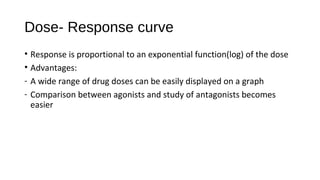
Dose- Response curve
• Response is proportional to an exponential function(log) of the dose
• Advantages:
- A wide range of drug doses can be easily displayed on a graph
- Comparison between agonists and study of antagonists becomes
easier
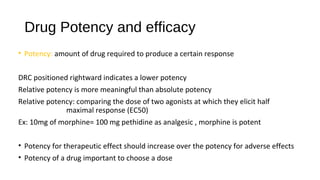
Drug Potency and efficacy
• Potency: amount of drug required to produce a certain response
DRC positioned rightward indicates a lower potency
Relative potency is more meaningful than absolute potency
Relative potency: comparing the dose of two agonists at which they elicit half
maximal response (EC50)
Ex: 10mg of morphine= 100 mg pethidine as analgesic , morphine is potent
• Potency for therapeutic effect should increase over the potency for adverse effects
• Potency of a drug important to choose a dose
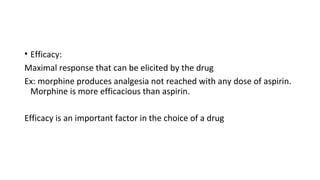
• Efficacy:
Maximal response that can be elicited by the drug
Ex: morphine produces analgesia not reached with any dose of aspirin.
Morphine is more efficacious than aspirin.
Efficacy is an important factor in the choice of a drug
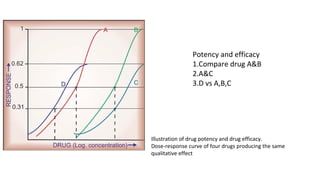
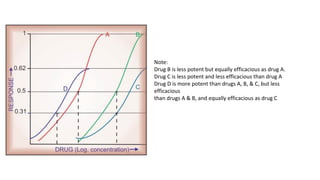
Illustration of drug potency and drug efficacy.
Dose-response curve of four drugs producing the same
qualitative effect
Potency and efficacy
1.Compare drug A&B
2.A&C
3.D vs A,B,C
Note:
Drug B is less potent but equally efficacious as drug A.
Drug C is less potent and less efficacious than drug A
Drug D is more potent than drugs A, B, & C, but less
efficacious
than drugs A & B, and equally efficacious as drug C
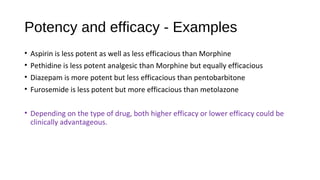
Potency and efficacy - Examples
• Aspirin is less potent as well as less efficacious than Morphine
• Pethidine is less potent analgesic than Morphine but equally efficacious
• Diazepam is more potent but less efficacious than pentobarbitone
• Furosemide is less potent but more efficacious than metolazone
• Depending on the type of drug, both higher efficacy or lower efficacy could be
clinically advantageous.
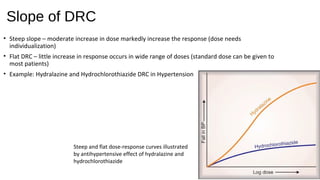
Slope of DRC
• Steep slope – moderate increase in dose markedly increase the response (dose needs
individualization)
• Flat DRC – little increase in response occurs in wide range of doses (standard dose can be given to
most patients)
• Example: Hydralazine and Hydrochlorothiazide DRC in Hypertension
Steep and flat dose-response curves illustrated
by antihypertensive effect of hydralazine and
hydrochlorothiazide
Therapeutic efficacy
• Depends on
- Relative potency and efficacy
- Pharmacokinetic variables
- Pathophysiological variables
• Expressed in terms of
a.Degree of benefit/ relief afforded by the drug or
b.Success rate in achieving a defined therapeutic end point
Ex: a drug which makes a higher percentage of epileptic patients totally
seizure free than another drug is the more therapeutically effective
antiepileptic.
Drug Selectivity
• Some drugs may produce different actions
• DRCs for different effects of drug may be different
• Extent of separation of DRCs of a drug for different effects is a
measure of its selectivity
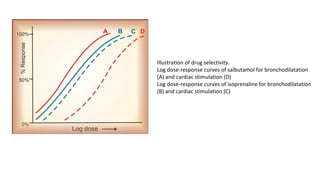
Ex: Isoprenaline vs salbutamol
Illustration of drug selectivity.
Log dose-response curves of salbutamol for bronchodilatation
(A) and cardiac stimulation (D)
Log dose-response curves of isoprenaline for bronchodilatation
(B) and cardiac stimulation (C)
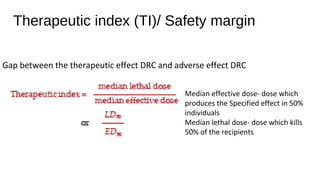
Therapeutic index (TI)/ Safety margin
Gap between the therapeutic effect DRC and adverse effect DRC
Median effective dose- dose which
produces the Specified effect in 50%
individuals
Median lethal dose- dose which kills
50% of the recipients
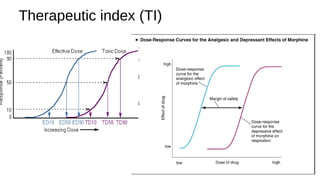
Therapeutic index (TI)
Therapeutic window/ therapeutic range
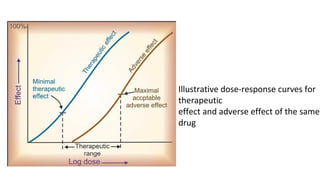
• Bounded by the dose which produces minimal therapeutic effect and
the dose which produces maximal acceptable adverse effect
• Individual variability: effective dose may be toxic for others
• Defining the therapeutic range is difficult
• Few drugs higher therapeutic response and adverse effects in higher
doses
Ex: Prednisolone in Asthma
Illustrative dose-response curves for
therapeutic
effect and adverse effect of the same
drug
Risk-benefit ratio
• Judgment between estimated harm and the expected advantages
• Estimated harms:
- Adverse effects
- Cost
- Inconvenience
• Expected advantages:
- Relief of symptoms
- Cure
- Reduction in complications/mortality
- Improvement in quality of life
• Prescribe when benefit outweighs the risks
• Difficult to measure accurately
• Should rely on pharmacoepidemiology and experience
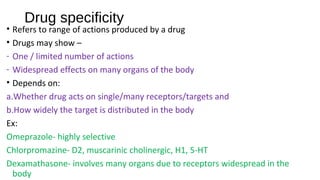
Drug specificity
• Refers to range of actions produced by a drug
• Drugs may show –
- One / limited number of actions
- Widespread effects on many organs of the body
• Depends on:
a.Whether drug acts on single/many receptors/targets and
b.How widely the target is distributed in the body
Ex:
Omeprazole- highly selective
Chlorpromazine- D2, muscarinic cholinergic, H1, 5-HT
Dexamathasone- involves many organs due to receptors widespread in the
body
Combined effects of drugs
objectives
• Describe the combined effects of drug action
• Explain synergism with few examples
• Explain antagonism with few examples
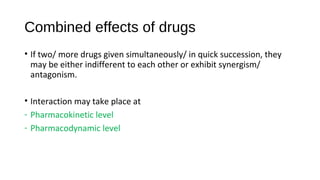
Combined effects of drugs
• If two/ more drugs given simultaneously/ in quick succession, they
may be either indifferent to each other or exhibit synergism/
antagonism.
• Interaction may take place at
- Pharmacokinetic level
- Pharmacodynamic level
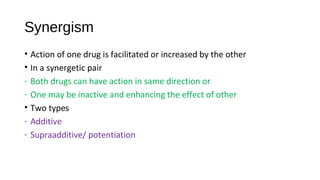
Synergism
• Action of one drug is facilitated or increased by the other
• In a synergetic pair
- Both drugs can have action in same direction or
- One may be inactive and enhancing the effect of other
• Two types
- Additive
- Supraadditive/ potentiation
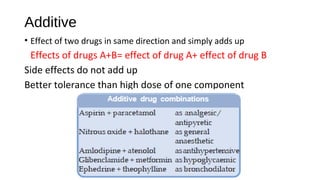
Additive
• Effect of two drugs in same direction and simply adds up
Effects of drugs A+B= effect of drug A+ effect of drug B
Side effects do not add up
Better tolerance than high dose of one component
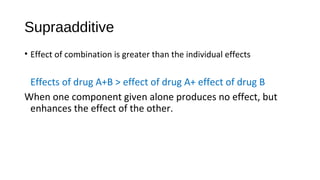
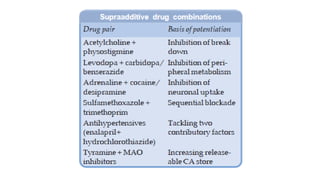
Supraadditive
• Effect of combination is greater than the individual effects
Effects of drug A+B > effect of drug A+ effect of drug B
When one component given alone produces no effect, but
enhances the effect of the other.
Antagonism
• One drug decreases or abolishes the action of the other
Effects of A+B < effect of drug A+ effect of drug B
• One drug is inactive and decreases the effect of the other
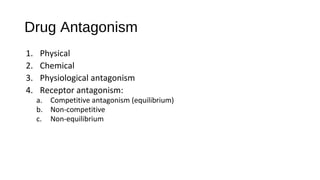
Drug Antagonism
1. Physical
2. Chemical
3. Physiological antagonism
4. Receptor antagonism:
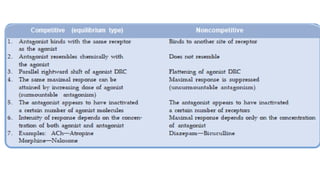
a. Competitive antagonism (equilibrium)
b. Non-competitive
c. Non-equilibrium
Physical antagonism
• Based on the physical property of the drug
- charcoal : adsorbs alkaloids (used in alkaloidal poisonings)
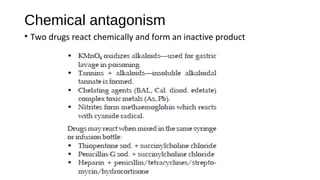
Chemical antagonism
• Two drugs react chemically and form an inactive product
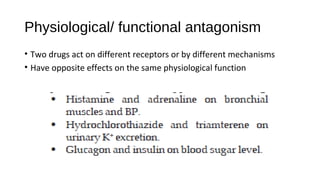
Physiological/ functional antagonism
• Two drugs act on different receptors or by different mechanisms
• Have opposite effects on the same physiological function
Receptor antagonism
• One drug/ antagonist blocks the receptor action of the other
drug/agonist
• Receptor antagonists are relatively selective
Receptor antagonism - curves
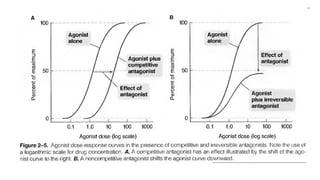
Competitive:
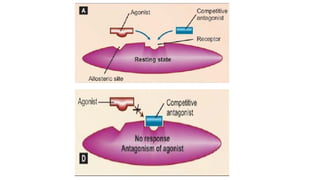
o Antagonist is chemically similar to agonist and binds to same receptor
molecules
o Affinity (1) but IA (0), Result – no response
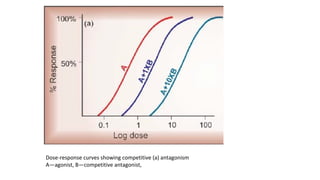
o Log DRC shifts to the right
o antagonism is reversible – increase in concentration of agonist overcomes
the block
o Parallel shift of curve to the right side when the concentration of antagonist
increases
o Extent of shift depends on affinity and concentration of antagonist
Plot on a DRC for competitive antagonists
A&B. Antagonism A>B, Agonist notify as
C
Dose-response curves showing competitive (a) antagonism
A—agonist, B—competitive antagonist,
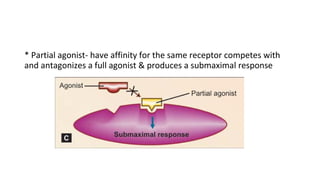
* Partial agonist- have affinity for the same receptor competes with
and antagonizes a full agonist & produces a submaximal response
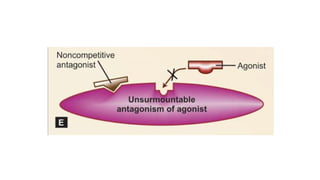
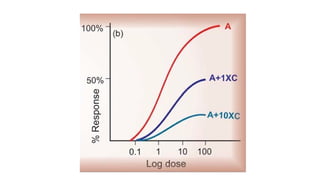
Non-competitive/ allosteric antagonism:
o Allosteric site binding- altering receptor not to bind with
agonist/ unable to transduce the response
o Chemically unrelated to antagonist
o No competition between them – no change of effect even
agonist concentration is increased
o Increasing concentration of antagonist progressively flatten DRC
o Not in clinical use
Plot on a graph for non-competitive
antagonists A&B, Antagonism A>B, Agonist
notify as C
• Non – equilibrium:
• Antagonists Binds receptor with strong bond
• Dissociation is slow and agonists cannot displace antagonists
• Irreversible antagonism develops
• DRC shifts to the right and Maximal response lowered
• Phenoxybenzamine is a non-equilibrium antagonist of adrenaline
at the alpha adrenergic receptors
Plot on a DRC for agonist A and non-
equilibrium antagonist B
Compare between competitive and non-
competitive antagonists?
THANKYOU

Dose response relationship

  • 1.
  • 2.
    Objectives 1. Describe doseresponse relationship 2. Explain therapeutic window phenomenon 3. Define a. drug potency b. drug efficiency 4. Define therapeutic index and its clinical importance
  • 3.
    Dose-Response Relationship • Whena Drug administered systemically • Dose-plasma concentration relationship (determined by pharmacokinetic properties) • Plasma concentration (dose)-response relationship • Intensity of response increases with increase in dose / concentration at the receptor • Drug-receptor interaction obeys law of mass action
  • 4.
    Emax * [D] E= KD+[D] E- observed effect D- dose Emax- maximal response Kd- dissociation constant of the drug-receptor complex
  • 5.
    Dose-Response Curve E = EmaxX [D] Kd + [D] Dose-response and log dose-response curves
  • 6.
    Dose- Response curve •Response is proportional to an exponential function(log) of the dose • Advantages: - A wide range of drug doses can be easily displayed on a graph - Comparison between agonists and study of antagonists becomes easier
  • 7.
    Drug Potency andefficacy • Potency: amount of drug required to produce a certain response DRC positioned rightward indicates a lower potency Relative potency is more meaningful than absolute potency Relative potency: comparing the dose of two agonists at which they elicit half maximal response (EC50) Ex: 10mg of morphine= 100 mg pethidine as analgesic , morphine is potent • Potency for therapeutic effect should increase over the potency for adverse effects • Potency of a drug important to choose a dose
  • 8.
    • Efficacy: Maximal responsethat can be elicited by the drug Ex: morphine produces analgesia not reached with any dose of aspirin. Morphine is more efficacious than aspirin. Efficacy is an important factor in the choice of a drug
  • 9.
    Illustration of drugpotency and drug efficacy. Dose-response curve of four drugs producing the same qualitative effect Potency and efficacy 1.Compare drug A&B 2.A&C 3.D vs A,B,C
  • 10.
    Note: Drug B isless potent but equally efficacious as drug A. Drug C is less potent and less efficacious than drug A Drug D is more potent than drugs A, B, & C, but less efficacious than drugs A & B, and equally efficacious as drug C
  • 11.
    Potency and efficacy- Examples • Aspirin is less potent as well as less efficacious than Morphine • Pethidine is less potent analgesic than Morphine but equally efficacious • Diazepam is more potent but less efficacious than pentobarbitone • Furosemide is less potent but more efficacious than metolazone • Depending on the type of drug, both higher efficacy or lower efficacy could be clinically advantageous.
  • 12.
    Slope of DRC •Steep slope – moderate increase in dose markedly increase the response (dose needs individualization) • Flat DRC – little increase in response occurs in wide range of doses (standard dose can be given to most patients) • Example: Hydralazine and Hydrochlorothiazide DRC in Hypertension Steep and flat dose-response curves illustrated by antihypertensive effect of hydralazine and hydrochlorothiazide
  • 13.
    Therapeutic efficacy • Dependson - Relative potency and efficacy - Pharmacokinetic variables - Pathophysiological variables • Expressed in terms of a.Degree of benefit/ relief afforded by the drug or b.Success rate in achieving a defined therapeutic end point Ex: a drug which makes a higher percentage of epileptic patients totally seizure free than another drug is the more therapeutically effective antiepileptic.
  • 14.
    Drug Selectivity • Somedrugs may produce different actions • DRCs for different effects of drug may be different • Extent of separation of DRCs of a drug for different effects is a measure of its selectivity Ex: Isoprenaline vs salbutamol
  • 15.
    Illustration of drugselectivity. Log dose-response curves of salbutamol for bronchodilatation (A) and cardiac stimulation (D) Log dose-response curves of isoprenaline for bronchodilatation (B) and cardiac stimulation (C)
  • 16.
    Therapeutic index (TI)/Safety margin Gap between the therapeutic effect DRC and adverse effect DRC Median effective dose- dose which produces the Specified effect in 50% individuals Median lethal dose- dose which kills 50% of the recipients
  • 17.
  • 18.
    Therapeutic window/ therapeuticrange • Bounded by the dose which produces minimal therapeutic effect and the dose which produces maximal acceptable adverse effect • Individual variability: effective dose may be toxic for others • Defining the therapeutic range is difficult • Few drugs higher therapeutic response and adverse effects in higher doses Ex: Prednisolone in Asthma
  • 19.
    Illustrative dose-response curvesfor therapeutic effect and adverse effect of the same drug
  • 20.
    Risk-benefit ratio • Judgmentbetween estimated harm and the expected advantages • Estimated harms: - Adverse effects - Cost - Inconvenience • Expected advantages: - Relief of symptoms - Cure - Reduction in complications/mortality - Improvement in quality of life
  • 21.
    • Prescribe whenbenefit outweighs the risks • Difficult to measure accurately • Should rely on pharmacoepidemiology and experience
  • 22.
    Drug specificity • Refersto range of actions produced by a drug • Drugs may show – - One / limited number of actions - Widespread effects on many organs of the body • Depends on: a.Whether drug acts on single/many receptors/targets and b.How widely the target is distributed in the body Ex: Omeprazole- highly selective Chlorpromazine- D2, muscarinic cholinergic, H1, 5-HT Dexamathasone- involves many organs due to receptors widespread in the body
  • 23.
  • 24.
    objectives • Describe thecombined effects of drug action • Explain synergism with few examples • Explain antagonism with few examples
  • 25.
    Combined effects ofdrugs • If two/ more drugs given simultaneously/ in quick succession, they may be either indifferent to each other or exhibit synergism/ antagonism. • Interaction may take place at - Pharmacokinetic level - Pharmacodynamic level
  • 26.
    Synergism • Action ofone drug is facilitated or increased by the other • In a synergetic pair - Both drugs can have action in same direction or - One may be inactive and enhancing the effect of other • Two types - Additive - Supraadditive/ potentiation
  • 27.
    Additive • Effect oftwo drugs in same direction and simply adds up Effects of drugs A+B= effect of drug A+ effect of drug B Side effects do not add up Better tolerance than high dose of one component
  • 28.
    Supraadditive • Effect ofcombination is greater than the individual effects Effects of drug A+B > effect of drug A+ effect of drug B When one component given alone produces no effect, but enhances the effect of the other.
  • 30.
    Antagonism • One drugdecreases or abolishes the action of the other Effects of A+B < effect of drug A+ effect of drug B • One drug is inactive and decreases the effect of the other
  • 31.
    Drug Antagonism 1. Physical 2.Chemical 3. Physiological antagonism 4. Receptor antagonism: a. Competitive antagonism (equilibrium) b. Non-competitive c. Non-equilibrium
  • 32.
    Physical antagonism • Basedon the physical property of the drug - charcoal : adsorbs alkaloids (used in alkaloidal poisonings)
  • 33.
    Chemical antagonism • Twodrugs react chemically and form an inactive product
  • 34.
    Physiological/ functional antagonism •Two drugs act on different receptors or by different mechanisms • Have opposite effects on the same physiological function
  • 35.
    Receptor antagonism • Onedrug/ antagonist blocks the receptor action of the other drug/agonist • Receptor antagonists are relatively selective
  • 36.
    Receptor antagonism -curves Competitive: o Antagonist is chemically similar to agonist and binds to same receptor molecules o Affinity (1) but IA (0), Result – no response o Log DRC shifts to the right o antagonism is reversible – increase in concentration of agonist overcomes the block o Parallel shift of curve to the right side when the concentration of antagonist increases o Extent of shift depends on affinity and concentration of antagonist
  • 38.
    Plot on aDRC for competitive antagonists A&B. Antagonism A>B, Agonist notify as C
  • 39.
    Dose-response curves showingcompetitive (a) antagonism A—agonist, B—competitive antagonist,
  • 40.
    * Partial agonist-have affinity for the same receptor competes with and antagonizes a full agonist & produces a submaximal response
  • 41.
    Non-competitive/ allosteric antagonism: oAllosteric site binding- altering receptor not to bind with agonist/ unable to transduce the response o Chemically unrelated to antagonist o No competition between them – no change of effect even agonist concentration is increased o Increasing concentration of antagonist progressively flatten DRC o Not in clinical use
  • 43.
    Plot on agraph for non-competitive antagonists A&B, Antagonism A>B, Agonist notify as C
  • 45.
    • Non –equilibrium: • Antagonists Binds receptor with strong bond • Dissociation is slow and agonists cannot displace antagonists • Irreversible antagonism develops • DRC shifts to the right and Maximal response lowered • Phenoxybenzamine is a non-equilibrium antagonist of adrenaline at the alpha adrenergic receptors
  • 46.
    Plot on aDRC for agonist A and non- equilibrium antagonist B
  • 47.
    Compare between competitiveand non- competitive antagonists?
  • 50.