Don’t Copy Wrong:
Copyright!
Elise C. Cole
Local Collections Librarian
elise.cole@Oakville.ca
Don’t Copy Wrong: Copyright!
•Copyright is the right to copy or reproduce a work. It applies automatically as
soon as a work is created, so long as it meets certain criteria
•Copyright does not apply to facts or ideas, but does apply to the expression of
those ideas as a work
•A “work” is defined as a book, poem, photograph, sculpture, painting, drawing,
song, lyrics, sound recording, broadcast, performance and many other items.
•Automatic copyright applies so long as the work is fixed, original and
depending on the nationality of the creator and where it’s published
© Elise C. Cole, Oakville Public Library 2019 2
Don’t Copy Wrong: Copyright!
•Copyright is one form of Intellectual Property recognized in Canada. The other
five are:
•Patents
•Trademarks
•Industrial design
•Confidential information and trade secrets
•Protection of integrated circuit topography
© Elise C. Cole, Oakville Public Library 2019 3
Don’t Copy Wrong: Copyright!
• Let’s take a look at the criteria:
• Fixed: Works are in some material form, can be identified, and are considered to
have some permanence: i.e., a book, a photograph, etc. If it’s saved to a
computer’s hard drive or to a USB key, it’s also considered fixed. If it’s just
displayed on a computer monitor without being saved, it’s not fixed.
• Original: It’s not that the work is unique, but just that it’s not a reproduction of a
work that already exists
• Nationality/Place of Publication: Canadian Copyright is automatically extended to
citizens/residents of Canada, or those creators who live in Copyright Treaty
countries
© Elise C. Cole, Oakville Public Library 2019 4
Don’t Copy Wrong: Copyright!
•Copyright law in Canada was officially enshrined into law in 1924. Only Copyright
owners and creators can enforce copyright on their own works
•The current Copyright Act in effect is the Copyright Modernization Act of 2012, and
is under review by the federal government. Dr. Michael Geist provides wonderful
information about the review via his blog: http://www.michaelgeist.ca/blog/
•Copyright in Canada covers a work for the life of the creator plus 50 years, except
for sound recordings which are from the time the sound recording was released plus
70 years. If the USMCA or NAFTA 2.0 is ratified by the Canadian government, that
would see the term extended to match that of the United States and Mexico which
both adhere to life of the creator plus 70 years
© Elise C. Cole, Oakville Public Library 2019 5
Don’t Copy Wrong: Copyright!
•Works created by an employee:
•When a work is created in the course of employment, like my presentation,
copyright is held by the employer unless the employment contract specifies
otherwise.
•The copyright on this presentation will expire and the work will enter public
domain on Jan 1 of the year 50 years after my death based on current
copyright law
© Elise C. Cole, Oakville Public Library 2019 6
Don’t Copy Wrong: Copyright!
•Works created by an volunteer:
• For works created by volunteers (think of the volunteers of your local
Ontario Ancestors branch, etc.,) copyright of the works created by those
volunteers belong solely to the volunteer, unless there is an agreement
otherwise between the volunteer and organization
© Elise C. Cole, Oakville Public Library 2019 7
Don’t Copy Wrong: Copyright!
•Newspapers aka Collective Works
•General rule of Life plus 50 applies to the individual articles and to the
collective work as a whole. The idea that newspapers published prior to 1929
are in the public domain is not based on the Copyright Act and should be
considered very carefully.
•Freelancers who contribute their work to a magazine or other periodical are
considered the creator and thereby copyright owners of their work, unless they
have agreed otherwise. The agreement must also specify if they allow their
work to be included in both print and electronic versions, including as part of a
database.
© Elise C. Cole, Oakville Public Library 2019 8
Don’t Copy Wrong: Copyright!
•Crown Copyright (published works by the federal, provincial or territorial
governments belong to Her Majesty and are under copyright for 50 years after
the first publication
•There are lots of government bodies that now provide Open Government
Initiatives to allow for works to reproduced more easily. If you’re unsure, contact
the government body responsible for the publication to request permission to
use
© Elise C. Cole, Oakville Public Library 2019 9
Don’t Copy Wrong: Copyright!
•Economic rights, moral rights, and neighbouring rights are the three types of
rights set out in the Copyright Act:
•Economic rights include the right to reproduce, publish the work, adapt it,
translate it and telecommunicate it to the public (all ways the creator might
earn money)
•Neighbouring rights protect those authorized to perform the work, I.e. these
rights protect the performer of a song, while copyright protects the composer
•Moral rights protect the reputation of the creator. Moral rights ALWAYS
remain with the creator of the work, though they may choose not to exercise
them. There are three Moral rights: Paternity, Integrity, and Association
© Elise C. Cole, Oakville Public Library 2019 10
Don’t Copy Wrong: Copyright!
•Fair Dealing: While this isn’t described in the Copyright Act, it allows the
everyday person to make copies if it’s for specific purposes which are
considered fair. Final determination can only be made by a judge in a court of
law.
•Purposes covered by Fair Dealing: If you make a copy of the work or a part of
it for the purpose of research, private study, education, parody or satire, then
you meet the criteria of fair dealing. These have been determined via court
cases, the most significant one being the case of the Supreme Court hearing of
CCH Canadian Ltd. v. Law Society of Upper Canada
•If Fair Dealing can be applied, then you need to look at an additional six
factors: Purpose of the Dealing, Character of the Dealing, Nature of the Work,
Amount of the Dealing, Effect of the Dealing on the Work, and Available
Alternatives
© Elise C. Cole, Oakville Public Library 2019 11
Don’t Copy Wrong: Copyright!
•Other copies that are allowed under Copyright Law:
•Time Shifting, Backup Copies including Computer Programs, Private Copies
of sound recordings, Works in Public Places (i.e., sketch of a painting
permanently on display in a public venue or building), Incidental Use (i.e.,
news crew records music in the background while filming a news segment
while a band is playing at the bar)
•Exceptions apply that allow schools to make copies for student use (i.e.,
classroom study, performances if the audience is made up of other students
and teachers.
© Elise C. Cole, Oakville Public Library 2019 12
Don’t Copy Wrong: Copyright!
•Exceptions also exist for LAMs (Libraries, Archives and Museums) if the copy
is necessary for the maintenance of items in the permanent collection, like the
preservation of documents and for internal records. LAMs may provide copies
for a customer if it falls under Fair Dealing for the customer (i.e, research) but it
cannot be reproduced further
•Many Libraries have an agreement with Access Copyright which they post
near their photocopiers which prevents them from infringing copyright
•Organizations are also allowed to reproduce works into an alternative format
for customers with perceptual disabilities, with the exception of cinematographic
works
© Elise C. Cole, Oakville Public Library 2019 13
Don’t Copy Wrong: Copyright!
•To keep in mind:
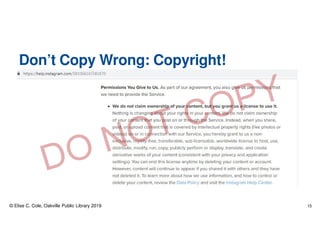
•Website Terms & Conditions spell out what happens when you post material
to their site. You could potentially commit copyright infringement and/or have
your work used in a way you don’t want it to be used. For example take a
look at the Instagram Terms of Use:
© Elise C. Cole, Oakville Public Library 2019 14
Don’t Copy Wrong: Copyright!
© Elise C. Cole, Oakville Public Library 2019 15
Don’t Copy Wrong: Copyright!
•How do you protect your work?
•When posting to sites where you are granting them licence to use your work,
you can’t.
•When posting to sites where you have complete control, you can add a
watermark to your images, and be sure to include your copyright statement
on materials using the Copyright symbol, your name and the year
i.e., © Elise C. Cole 2019
•If you find that someone has infringed your copyright, you can contact them
to remove the material, ask their ISP to step in, or consider suing them for
copyright infringement (border, civil or criminal charges)
© Elise C. Cole, Oakville Public Library 2019 16
Don’t Copy Wrong: Copyright!
•Violations of Copyright include:
•Plagiarism
•Piracy
•Bootlegging
•Counterfeiting
•Violation of Moral Rights
•Digital Infringements like circumventing digital locks unless an exception
applies, or removing or tampering with a watermark or other indication a
creator has placed on their work to indicate they hold copyright
•WHEN IN DOUBT, ASK FOR PERMISSION!
© Elise C. Cole, Oakville Public Library 2019 17
Don’t Copy Wrong: Copyright!
•Unlocatable Copyright Owners:
•If you have done everything possible and can prove that the copyright owner
is unknown or cannot be located, you can apply to The Copyright Board of
Canada for a licence to use a published copyright work.
•These types of works are sometimes called “orphan works”
•An application is required, and proof of a thorough search for the owner of
the copyright. As It may take months to receive a decision, you may wish to
explore other alternatives.
© Elise C. Cole, Oakville Public Library 2019 18
Don’t Copy Wrong: Copyright!
•Rule of Thumb: Assume the image you want to use is under copyright until you
investigate and determine its status
•If the image you wish to use is your own or you know the copyright owner and
they are willing to allow to you to use it for a specific purpose, great!
•Some sites will grant you licences to use images and will charge you to buy a
licence. It may limit your use, and it can expire after a certain period, so be
certain to read and understand the terms before signing and/or making
payment.
•You may not use an image found via an internet search without permission
unless you determine that it can be used that way (“Images may be subject to
copyright” on every Google Images result)
•DO YOUR HOMEWORK!
© Elise C. Cole, Oakville Public Library 2019 19
Don’t Copy Wrong: Copyright!
•Fair Dealing does apply to Images, so if you are using the image for personal
research, etc., and won’t be using it further, you should be okay.
•Posting an image covered by copyright, for which you have not received
permission to use, to social media and to online sites including family trees is
copyright infringement
•Public Domain, Creative Commons, Open Source Resources are one way to
access images that do not require permission to use
© Elise C. Cole, Oakville Public Library 2019 20
Don’t Copy Wrong: Copyright!
•Public domain: The term of copyright has expired, so life of the creator plus 50
years have passed. The image, with exceptions, moves into public domain as of
1 January
•Creative Commons: Not all works covered by this licensing system are
available for free. Visit https://creativecommons.org/ to learn more about the
different licences and to search via their new image search, offering 300
million+ images
© Elise C. Cole, Oakville Public Library 2019 21
Don’t Copy Wrong: Copyright!
•Repositories
•New York Public Library’s Digital Library: https://digitalcollections.nypl.org/
where public domain images are available as high resolution downloads
•Pixabay: https://pixabay.com/ Free for commercial use, no attribution
required
•Search for royalty free images (or music, etc) to find more! Just be sure to
read the terms of use to be sure!
© Elise C. Cole, Oakville Public Library 2019 22
Thank you!
How to contact me:
• elise.cole@oakville.ca
• https://www.linkedin.com/in/eliseccole/
© Elise C. Cole, Oakville Public Library 2019 23

Don't Copy Wrong Copyright

  • 1.
    Don’t Copy Wrong: Copyright! EliseC. Cole Local Collections Librarian elise.cole@Oakville.ca
  • 2.
    Don’t Copy Wrong:Copyright! •Copyright is the right to copy or reproduce a work. It applies automatically as soon as a work is created, so long as it meets certain criteria •Copyright does not apply to facts or ideas, but does apply to the expression of those ideas as a work •A “work” is defined as a book, poem, photograph, sculpture, painting, drawing, song, lyrics, sound recording, broadcast, performance and many other items. •Automatic copyright applies so long as the work is fixed, original and depending on the nationality of the creator and where it’s published © Elise C. Cole, Oakville Public Library 2019 2
  • 3.
    Don’t Copy Wrong:Copyright! •Copyright is one form of Intellectual Property recognized in Canada. The other five are: •Patents •Trademarks •Industrial design •Confidential information and trade secrets •Protection of integrated circuit topography © Elise C. Cole, Oakville Public Library 2019 3
  • 4.
    Don’t Copy Wrong:Copyright! • Let’s take a look at the criteria: • Fixed: Works are in some material form, can be identified, and are considered to have some permanence: i.e., a book, a photograph, etc. If it’s saved to a computer’s hard drive or to a USB key, it’s also considered fixed. If it’s just displayed on a computer monitor without being saved, it’s not fixed. • Original: It’s not that the work is unique, but just that it’s not a reproduction of a work that already exists • Nationality/Place of Publication: Canadian Copyright is automatically extended to citizens/residents of Canada, or those creators who live in Copyright Treaty countries © Elise C. Cole, Oakville Public Library 2019 4
  • 5.
    Don’t Copy Wrong:Copyright! •Copyright law in Canada was officially enshrined into law in 1924. Only Copyright owners and creators can enforce copyright on their own works •The current Copyright Act in effect is the Copyright Modernization Act of 2012, and is under review by the federal government. Dr. Michael Geist provides wonderful information about the review via his blog: http://www.michaelgeist.ca/blog/ •Copyright in Canada covers a work for the life of the creator plus 50 years, except for sound recordings which are from the time the sound recording was released plus 70 years. If the USMCA or NAFTA 2.0 is ratified by the Canadian government, that would see the term extended to match that of the United States and Mexico which both adhere to life of the creator plus 70 years © Elise C. Cole, Oakville Public Library 2019 5
  • 6.
    Don’t Copy Wrong:Copyright! •Works created by an employee: •When a work is created in the course of employment, like my presentation, copyright is held by the employer unless the employment contract specifies otherwise. •The copyright on this presentation will expire and the work will enter public domain on Jan 1 of the year 50 years after my death based on current copyright law © Elise C. Cole, Oakville Public Library 2019 6
  • 7.
    Don’t Copy Wrong:Copyright! •Works created by an volunteer: • For works created by volunteers (think of the volunteers of your local Ontario Ancestors branch, etc.,) copyright of the works created by those volunteers belong solely to the volunteer, unless there is an agreement otherwise between the volunteer and organization © Elise C. Cole, Oakville Public Library 2019 7
  • 8.
    Don’t Copy Wrong:Copyright! •Newspapers aka Collective Works •General rule of Life plus 50 applies to the individual articles and to the collective work as a whole. The idea that newspapers published prior to 1929 are in the public domain is not based on the Copyright Act and should be considered very carefully. •Freelancers who contribute their work to a magazine or other periodical are considered the creator and thereby copyright owners of their work, unless they have agreed otherwise. The agreement must also specify if they allow their work to be included in both print and electronic versions, including as part of a database. © Elise C. Cole, Oakville Public Library 2019 8
  • 9.
    Don’t Copy Wrong:Copyright! •Crown Copyright (published works by the federal, provincial or territorial governments belong to Her Majesty and are under copyright for 50 years after the first publication •There are lots of government bodies that now provide Open Government Initiatives to allow for works to reproduced more easily. If you’re unsure, contact the government body responsible for the publication to request permission to use © Elise C. Cole, Oakville Public Library 2019 9
  • 10.
    Don’t Copy Wrong:Copyright! •Economic rights, moral rights, and neighbouring rights are the three types of rights set out in the Copyright Act: •Economic rights include the right to reproduce, publish the work, adapt it, translate it and telecommunicate it to the public (all ways the creator might earn money) •Neighbouring rights protect those authorized to perform the work, I.e. these rights protect the performer of a song, while copyright protects the composer •Moral rights protect the reputation of the creator. Moral rights ALWAYS remain with the creator of the work, though they may choose not to exercise them. There are three Moral rights: Paternity, Integrity, and Association © Elise C. Cole, Oakville Public Library 2019 10
  • 11.
    Don’t Copy Wrong:Copyright! •Fair Dealing: While this isn’t described in the Copyright Act, it allows the everyday person to make copies if it’s for specific purposes which are considered fair. Final determination can only be made by a judge in a court of law. •Purposes covered by Fair Dealing: If you make a copy of the work or a part of it for the purpose of research, private study, education, parody or satire, then you meet the criteria of fair dealing. These have been determined via court cases, the most significant one being the case of the Supreme Court hearing of CCH Canadian Ltd. v. Law Society of Upper Canada •If Fair Dealing can be applied, then you need to look at an additional six factors: Purpose of the Dealing, Character of the Dealing, Nature of the Work, Amount of the Dealing, Effect of the Dealing on the Work, and Available Alternatives © Elise C. Cole, Oakville Public Library 2019 11
  • 12.
    Don’t Copy Wrong:Copyright! •Other copies that are allowed under Copyright Law: •Time Shifting, Backup Copies including Computer Programs, Private Copies of sound recordings, Works in Public Places (i.e., sketch of a painting permanently on display in a public venue or building), Incidental Use (i.e., news crew records music in the background while filming a news segment while a band is playing at the bar) •Exceptions apply that allow schools to make copies for student use (i.e., classroom study, performances if the audience is made up of other students and teachers. © Elise C. Cole, Oakville Public Library 2019 12
  • 13.
    Don’t Copy Wrong:Copyright! •Exceptions also exist for LAMs (Libraries, Archives and Museums) if the copy is necessary for the maintenance of items in the permanent collection, like the preservation of documents and for internal records. LAMs may provide copies for a customer if it falls under Fair Dealing for the customer (i.e, research) but it cannot be reproduced further •Many Libraries have an agreement with Access Copyright which they post near their photocopiers which prevents them from infringing copyright •Organizations are also allowed to reproduce works into an alternative format for customers with perceptual disabilities, with the exception of cinematographic works © Elise C. Cole, Oakville Public Library 2019 13
  • 14.
    Don’t Copy Wrong:Copyright! •To keep in mind: •Website Terms & Conditions spell out what happens when you post material to their site. You could potentially commit copyright infringement and/or have your work used in a way you don’t want it to be used. For example take a look at the Instagram Terms of Use: © Elise C. Cole, Oakville Public Library 2019 14
  • 15.
    Don’t Copy Wrong:Copyright! © Elise C. Cole, Oakville Public Library 2019 15
  • 16.
    Don’t Copy Wrong:Copyright! •How do you protect your work? •When posting to sites where you are granting them licence to use your work, you can’t. •When posting to sites where you have complete control, you can add a watermark to your images, and be sure to include your copyright statement on materials using the Copyright symbol, your name and the year i.e., © Elise C. Cole 2019 •If you find that someone has infringed your copyright, you can contact them to remove the material, ask their ISP to step in, or consider suing them for copyright infringement (border, civil or criminal charges) © Elise C. Cole, Oakville Public Library 2019 16
  • 17.
    Don’t Copy Wrong:Copyright! •Violations of Copyright include: •Plagiarism •Piracy •Bootlegging •Counterfeiting •Violation of Moral Rights •Digital Infringements like circumventing digital locks unless an exception applies, or removing or tampering with a watermark or other indication a creator has placed on their work to indicate they hold copyright •WHEN IN DOUBT, ASK FOR PERMISSION! © Elise C. Cole, Oakville Public Library 2019 17
  • 18.
    Don’t Copy Wrong:Copyright! •Unlocatable Copyright Owners: •If you have done everything possible and can prove that the copyright owner is unknown or cannot be located, you can apply to The Copyright Board of Canada for a licence to use a published copyright work. •These types of works are sometimes called “orphan works” •An application is required, and proof of a thorough search for the owner of the copyright. As It may take months to receive a decision, you may wish to explore other alternatives. © Elise C. Cole, Oakville Public Library 2019 18
  • 19.
    Don’t Copy Wrong:Copyright! •Rule of Thumb: Assume the image you want to use is under copyright until you investigate and determine its status •If the image you wish to use is your own or you know the copyright owner and they are willing to allow to you to use it for a specific purpose, great! •Some sites will grant you licences to use images and will charge you to buy a licence. It may limit your use, and it can expire after a certain period, so be certain to read and understand the terms before signing and/or making payment. •You may not use an image found via an internet search without permission unless you determine that it can be used that way (“Images may be subject to copyright” on every Google Images result) •DO YOUR HOMEWORK! © Elise C. Cole, Oakville Public Library 2019 19
  • 20.
    Don’t Copy Wrong:Copyright! •Fair Dealing does apply to Images, so if you are using the image for personal research, etc., and won’t be using it further, you should be okay. •Posting an image covered by copyright, for which you have not received permission to use, to social media and to online sites including family trees is copyright infringement •Public Domain, Creative Commons, Open Source Resources are one way to access images that do not require permission to use © Elise C. Cole, Oakville Public Library 2019 20
  • 21.
    Don’t Copy Wrong:Copyright! •Public domain: The term of copyright has expired, so life of the creator plus 50 years have passed. The image, with exceptions, moves into public domain as of 1 January •Creative Commons: Not all works covered by this licensing system are available for free. Visit https://creativecommons.org/ to learn more about the different licences and to search via their new image search, offering 300 million+ images © Elise C. Cole, Oakville Public Library 2019 21
  • 22.
    Don’t Copy Wrong:Copyright! •Repositories •New York Public Library’s Digital Library: https://digitalcollections.nypl.org/ where public domain images are available as high resolution downloads •Pixabay: https://pixabay.com/ Free for commercial use, no attribution required •Search for royalty free images (or music, etc) to find more! Just be sure to read the terms of use to be sure! © Elise C. Cole, Oakville Public Library 2019 22
  • 23.
    Thank you! How tocontact me: • elise.cole@oakville.ca • https://www.linkedin.com/in/eliseccole/ © Elise C. Cole, Oakville Public Library 2019 23